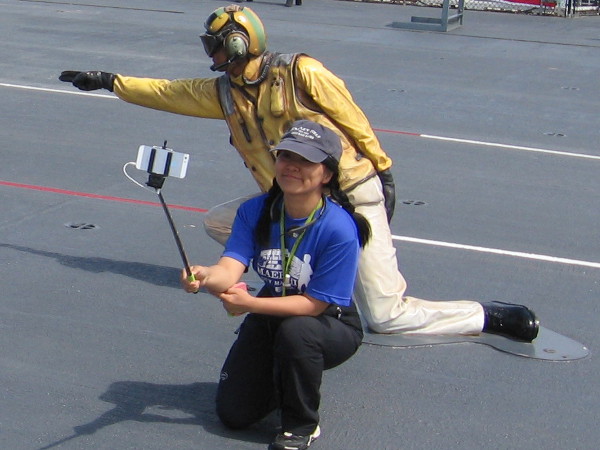
USS Midway visitor takes photograph with selfie stick next to aircraft-launching Shooter mannequin.
I hope you enjoy a few photos I took recently of planes and people (and helicopters) on the flight deck of San Diego’s USS Midway Museum. The historic aircraft carrier served longer than any other American carrier in the 20th century, spanning five decades from 1945 to 1992. Countless amazing stories have been lived by thousands serving aboard the USS Midway, and many of those stories continue today as docents and volunteers relate their personal shipboard experiences to visitors from around the world. San Diego’s unique aircraft carrier museum, now over ten years old, hosts over a million visitors a year.
Midway’s large flight deck, enlarged from 2.8 to 4 acres in 1966, today features a couple dozen restored aircraft that represent different eras of modern military history. The internet is jammed with pages showing and describing these aircraft in detail, so I thought I’d just provide a quick flavor of what it’s like to walk out on the flight deck on a typical San Diego day. If you’d like to take the cool self-guided tour of the ship, which I highly recommend, plan to spend at least an hour!
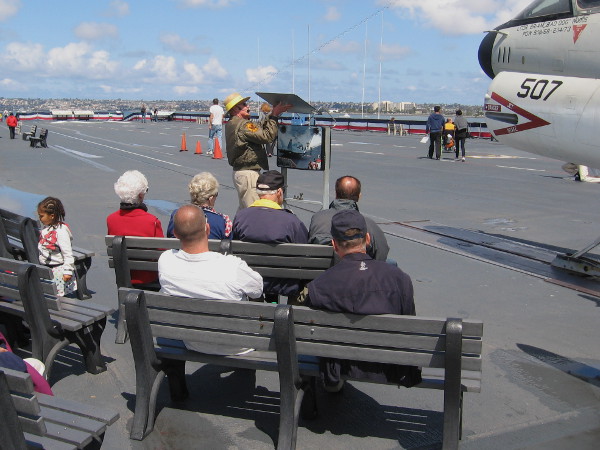
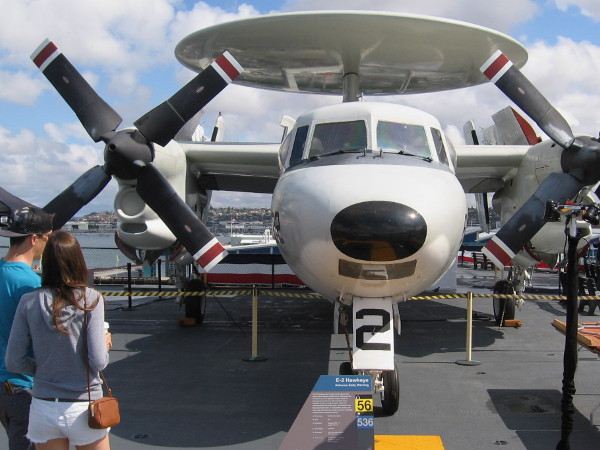
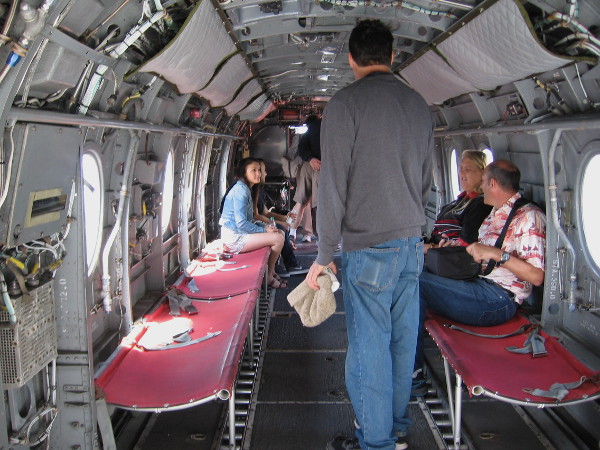
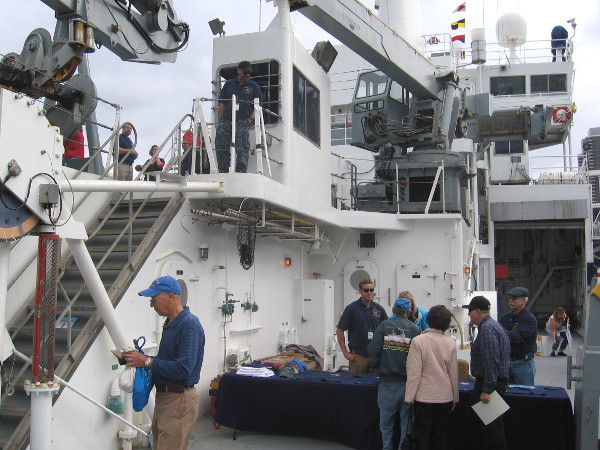
Lady walks past F-14 Tomcat fighter jet on USS Midway aircraft carrier’s flight deck.Tourists at USS Midway Museum walk out onto one of the two horns that project over San Diego Bay.Sign describes how to read Navy flag signals.Man lingers near F-8 Crusader, the US Navy’s first supersonic fighter.People sit on benches listening to a docent talk about launching airplanes from Midway’s two steam-powered catapults.Guy checks out A-7 Corsair positioned to be launched from powerful catapult, which accelerated aircraft to 170 mph in about 3 seconds!Young couple takes a look at E-2 Hawkeye, an Airborne Early Warning aircraft.Looking south from atop the flight deck. Seen are the Unconditional Surrender statue, Tuna Harbor, and the Coronado Bay Bridge.USS Midway visitors enjoy a sunny San Diego day near EKA-3 Skywarrior.Visitors find out what it’s like inside a CH-46 Sea Knight helicopter.Peering through cockpit of HO3S utility helicopter at the nearby HUP Retriever.This HO3S Dragonfly, first helicopter aboard the USS Midway in 1948, is undergoing restoration.Docent veteran talks about how aircraft landed on the flight deck using a tailhook and multiple arresting cables.Exhibit on Midway’s LSO Platform shows how Navy pilots landed in difficult conditions, relying on optical guidance.Navy pilot mannequin in flight suit stands near FA-18 Hornet, painted as a TOPGUN enemy aircraft.A-6 Intruder bomber on display near USS Midway’s superstructure.Volunteers work to restore SH-2 Seasprite, beyond orange nose of H-34 Seabat.The huge flight deck of the USS Midway Museum hosts visitors from around the world, special military-related events, decades of history, and never-ending activity on San Diego Bay.
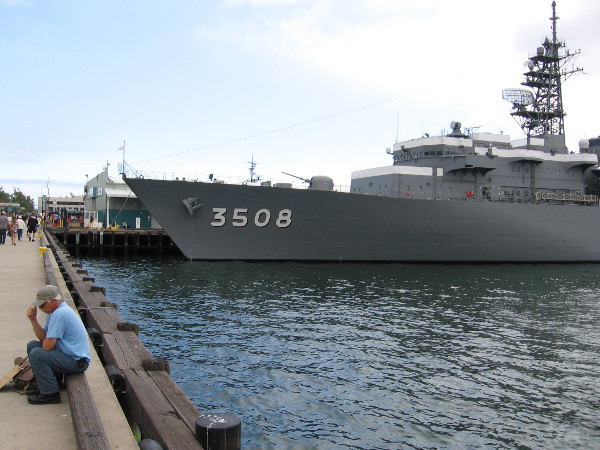
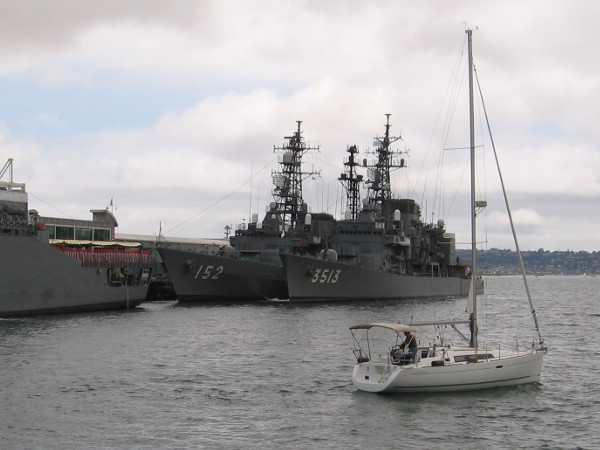
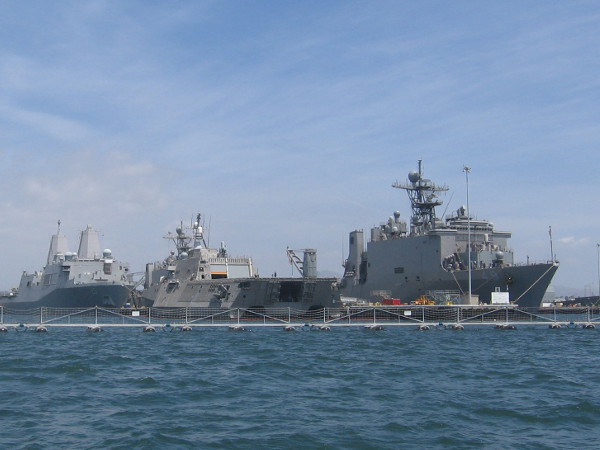
Three Japanese warships are visiting downtown San Diego’s waterfront.
This afternoon I spotted three ships of the Japanese Self-Defense Force in San Diego. They were docked at the downtown Cruise Ship Terminal on the busy Embarcadero. The Japan Maritime Self-Defense Force must be training with the US Navy off our coast, although I find nothing about any joint naval exercises when I do a quick search of Google News.
A year ago I spotted three warships belonging to Japan docked in the same spot. I see the big training ship Kashima, of the Japan Maritime Self-Defense Force, has returned. (Last year an article I researched referred to it as a landing ship.) I suspect the other two are destroyers, like last time.
It’s an interesting sight you don’t often see up close, so I took a few pics!
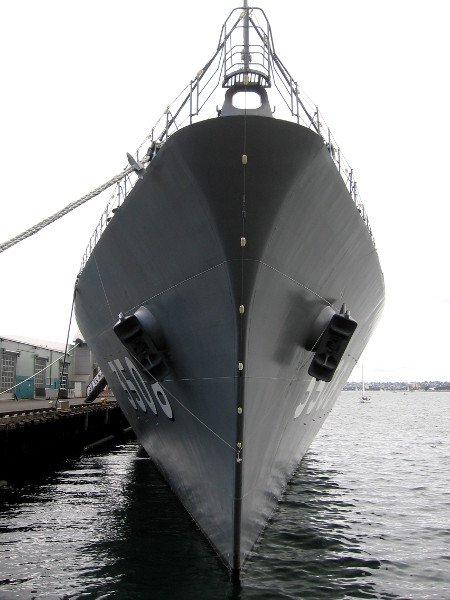
A sailboat on San Diego Bay checks out an unusual sight on a cloudy day.Bow of big training ship Kashima, of the Japan Maritime Self-Defense Force.
…
To enjoy future posts, you can “like” Cool San Diego Sights on Facebook, or follow me on Twitter.
Corroded plaque shows tallship, ironclad, early warship, aircraft carrier and jets.
I have received more information about the origin of the Navy Bicentennial plaque situated on San Diego’s Embarcadero near the USS Midway Museum.
Last September, I published the blog Help solve a Navy mystery in San Diego. This fascinating plaque is passed by thousands walking along our waterfront every day. It’s located on the Greatest Generation Walk among other military memorials and monuments, but even today there is no public information about what the plaque is or where it came from.
After emailing the Port of San Diego, last October I published the blog Unknown Navy plaque: Mystery partially solved! I’d been sent information that included a detailed description of the plaque. I also learned that the plaque had been moved from the Broadway Pier. But the exact origin remained unknown.
Then, out of the blue, two amazing things have happened. Cool San Diego Sights has received comments shedding light on the actual people who created this very important, historical plaque.
My name is William Abell and I was an ML3 aboard the USS Ajax AR6 and I helped create this plaque in the ship’s foundry in 1975. I have a certificate from Admiral J L Holloway III commemorating the plaque’s creation and my part in its creation. The date on the certificate is Oct 13, 1975. The plaque was to be a gift to the City of San Diego. I am now a retired police commander living in Monroe WA.
The second comment I received yesterday morning. It directed my attention to this blog post:
I am Molder Chief Petty Officer Jesse G. Lopez USN Ret. The foundry crew from Navy Repair Ship USS Ajax AR-6, created the pattern which was made by Patternmaker Chief Carlos De Santiago USN RET and molded by myself when I was a MLFN. Petty Officer Abell was our Third Class in charge of the molders.
AMAZING UPDATE!
I’ve received detailed information about the plaque, including photographs of its creation and creators! Click here!
…
To enjoy future posts, you can “like” Cool San Diego Sights on Facebook, or follow me on Twitter.
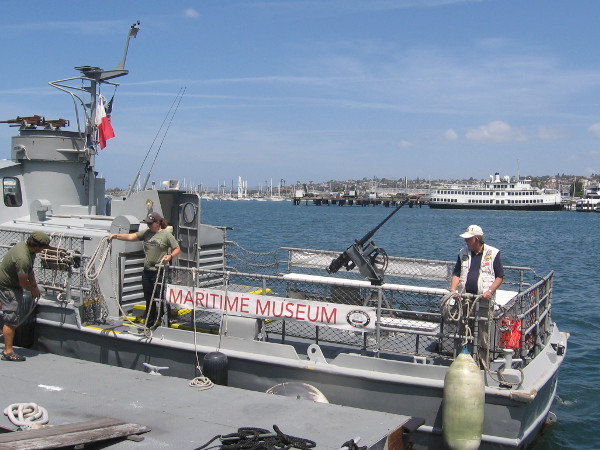
The restored Swift Boat, PCF-816 approaches the Maritime Museum of San Diego on downtown’s waterfront.
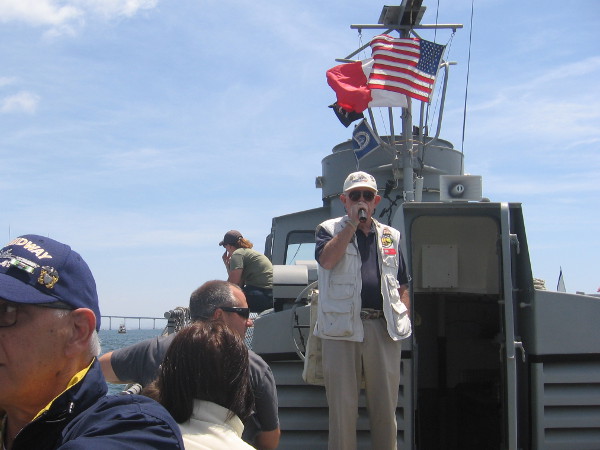
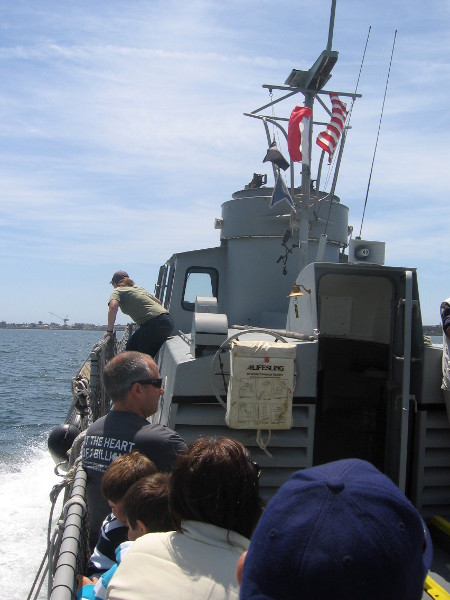
Last weekend I embarked on a very unique boat adventure on San Diego Bay. Enjoying sunshine and a cool ocean breeze, I sat outside on the Maritime Museum of San Diego’s restored Swift Boat, and took in various interesting sights during an approximately one hour tour.
PCF-816 is a small Mark ll Patrol Craft Fast “Swift Boat” that was originally used in San Diego (1968-1969) to train sailors before they were deployed to fight in the Vietnam War. In 1971 the vessel was donated to the Republic of Malta, where it was used to patrol their coast. In 2012 the beat up boat returned to San Diego. After many hours of work by volunteers, it was carefully restored to it’s present fine condition. You might note in the photos that she still flies the Maltese flag.
If you’re fascinated by tacking sailboats, arching bridges and sprawling shipyards, interested in military history or modern Navy ships, or just want to enjoy a cruise on San Diego Bay, you might enjoy this tour!
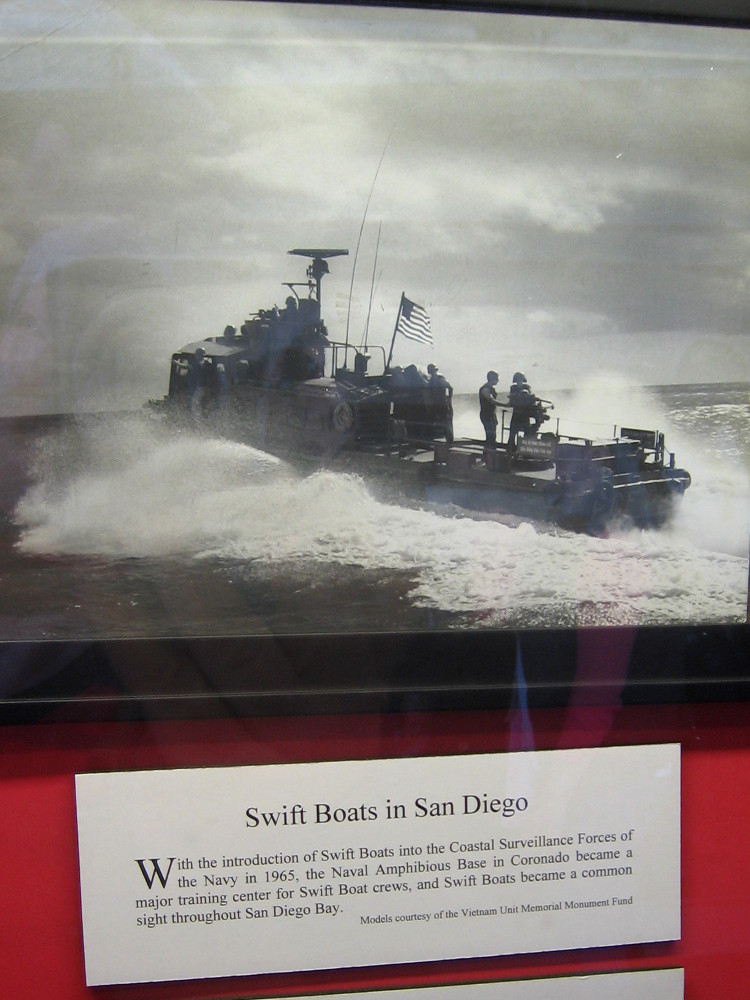
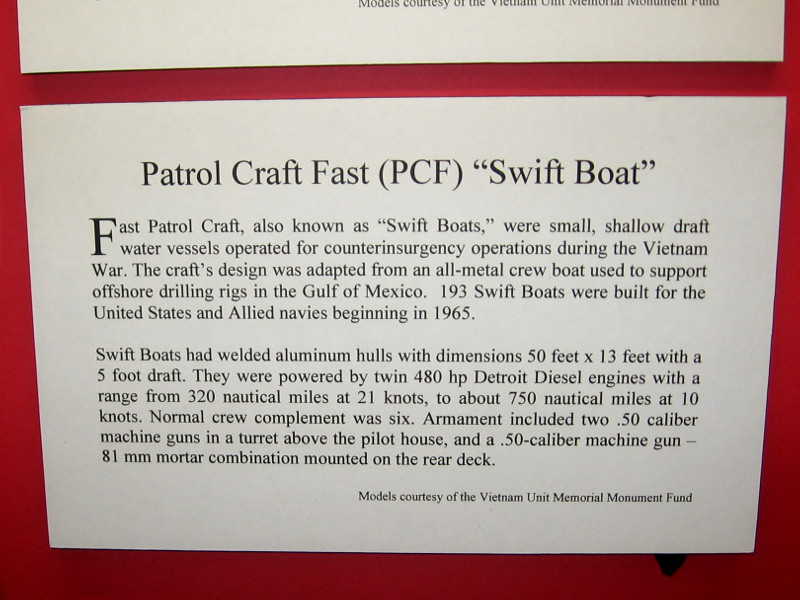
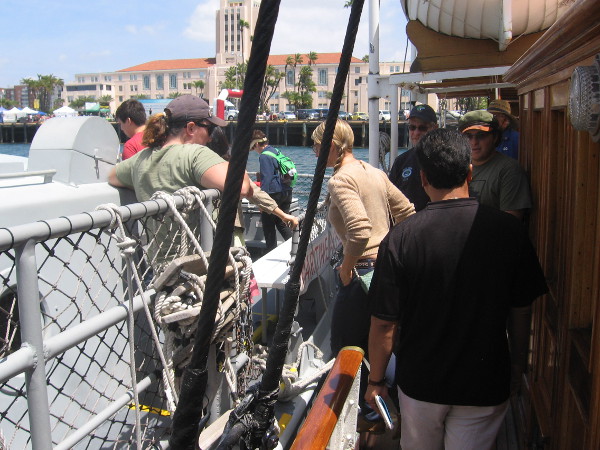
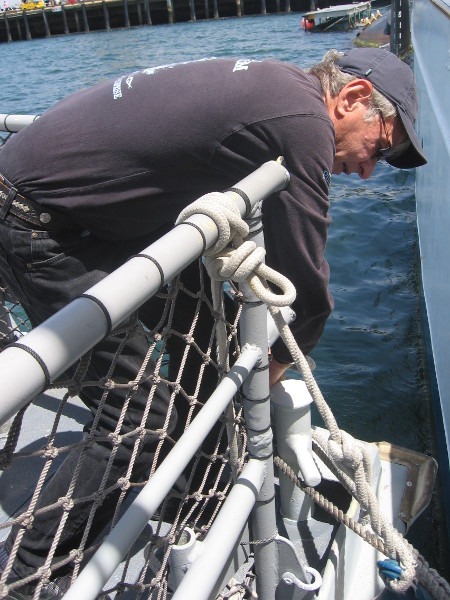
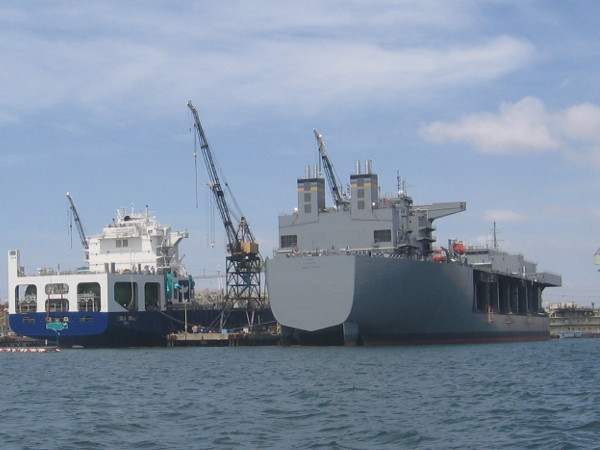
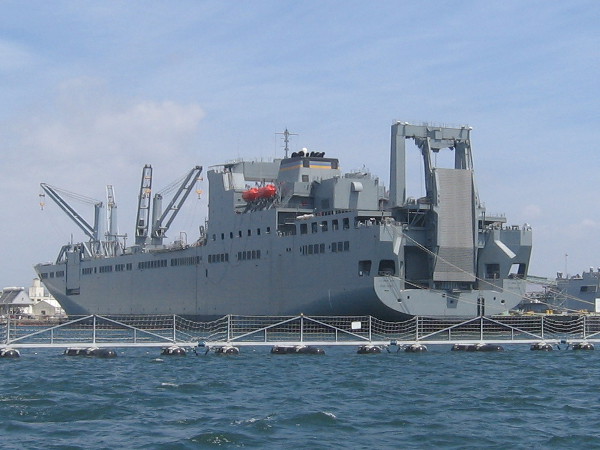
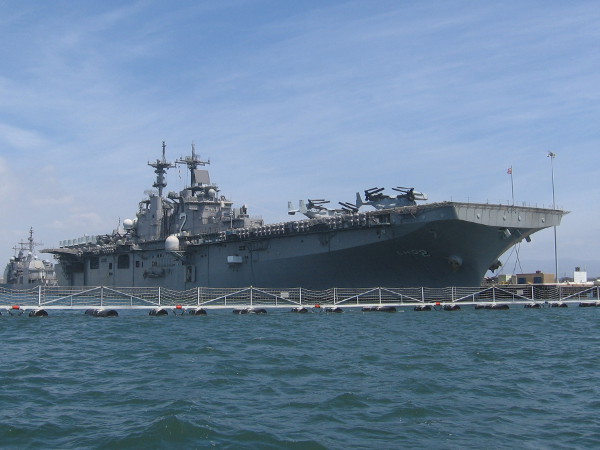
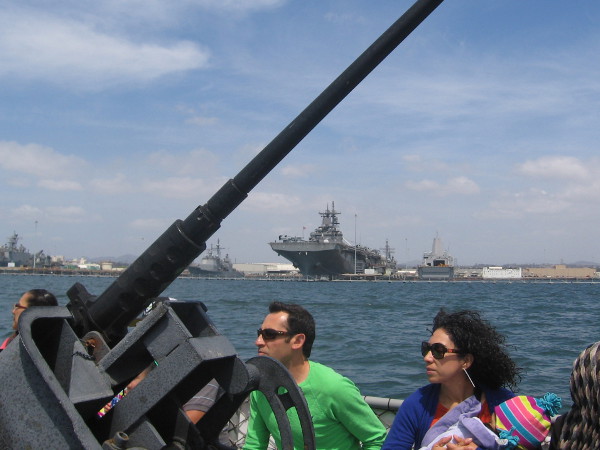
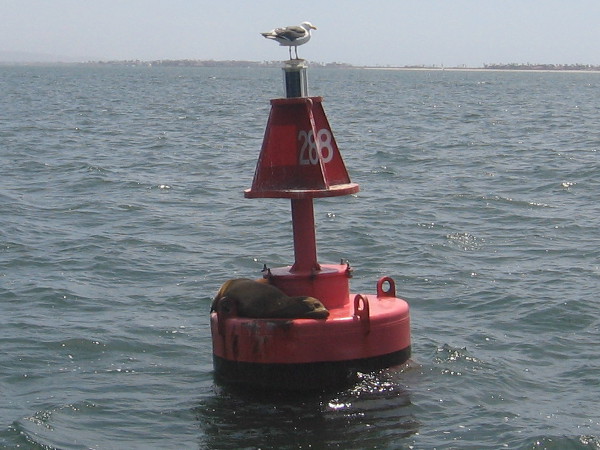
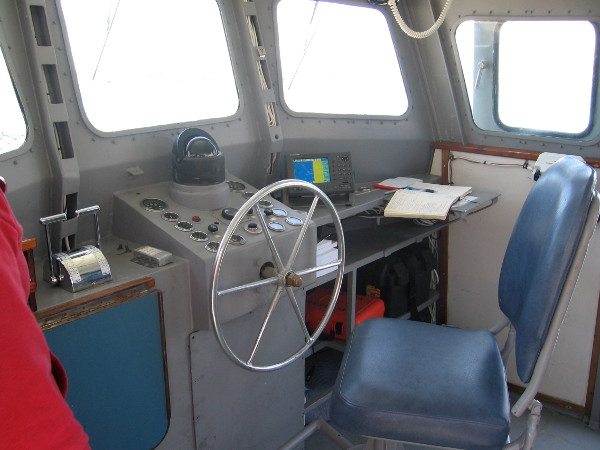
Inside the Maritime Museum’s steam ferry Berkeley, visitors check out informative exhibits as they wait to board the old Swift Boat.With the introduction of Swift Boats into the Coastal Surveillance Forces of the Navy in 1965, the Naval Amphibious Base in Coronado became a major training center for Swift Boat crews.Patrol Craft Fast (PCF) was the U.S. Navy’s official name for a Swift Boat. They were small, shallow draft water vessels operated for counterinsurgency operations during the Vietnam War.People board the old Vietnam War-era boat from the Maritime Museum’s docked steam yacht Medea.We cast off and begin a partial tour of the bay, including enormous shipyards and many San Diego Navy ships.A museum volunteer narrates our tour and points out some of the unique sights on San Diego Bay.No matter what boat or ship you choose, a cruise of the big bay is both relaxing and invigorating.We pass under the immense bow of the USS Midway aircraft carrier, which is also a super popular museum.We pass a sailboat and begin under the Coronado Bay Bridge. We are approaching San Diego’s very large, busy shipyards.A huge Navy ship in dry dock at BAE Systems’ San Diego shipyard. NASSCO and Continental Maritime also have enormous yards on the bay.The gigantic gray ship is the USNS Lewis B. Puller. The first of its kind, it’s a forward staging base that will act as a floating base or transfer station.USNS Bob Hope is also huge! She’s a vehicle cargo ship used for Army vehicle prepositioning, She’s the only Navy vessel to be named after legendary entertainer Bob Hope.That unique ship in the middle is a new Independence-class littoral combat ship. USS Coronado is a trimaran, which allows it to operate in shallow coastal water.USS Essex is an enormous United States Navy Wasp-class amphibious assault ship based in San Diego.Naval Base San Diego (also called 32nd Street Naval Station) occupies a long stretch of South Bay. It’s the largest United States Navy base on the west coast.Guy enjoying the tour dons helmet and mans the Swift Boat’s 50 caliber machine gun, which is mounted over a 81mm mortar on the boat’s rear deck.A pith military helmet once worn by Viet Cong soldiers is passed around for the passengers to examine.A watchful seagull and lazy sea lion share a harbor buoy on calm, sunny San Diego Bay.Heading back toward downtown San Diego, we learn more about the history of Swift Boat training in our fascinating city.After docking, I get a quick pic of the Mark ll Swift Boat’s small pilot house.Swift Boat, PCF-816 is one of many interesting, diverse vessels in the Maritime Museum of San Diego’s collection.
…
To enjoy future posts, you can “like” Cool San Diego Sights on Facebook or follow me on Twitter.
The black sail of submarine USS Dolphin (AGSS-555). The retired research sub is docked next to steam ferry Berkeley of the Maritime Museum of San Diego.
Here come some photographs taken inside the USS Dolphin, the world record deepest diving submarine!
Anyone can tour the Dolphin when visiting the Maritime Museum of San Diego. The museum, located downtown on the waterfront, is home to a world-class collection of unique and historic ships.
I personally know very little about submarines. My descriptions come from various signs and a little searching performed on the internet. If you spot an error or would like to provide some info, please leave a comment at the bottom of this post!
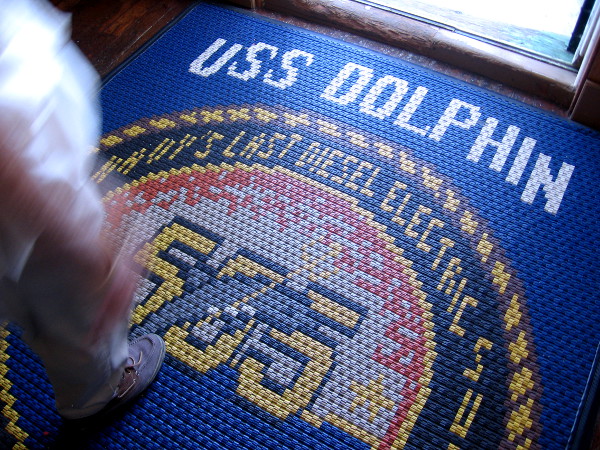
The Maritime Museum of San Diego boasts two submarines in its world-class collection of ships. The USS Dolphin holds the world record for deep diving.Display inside the Berkeley, next to doorway which leads museum visitors outside to the Dolphin.
The above Maritime Museum display includes the following information:
On November 24, 1968, barely two months after commissioning, the USS Dolphin dove to a depth in excess of three thousand feet to become the world’s deepest diving submarine…this record still stands today. The following year, in August 1969, the Dolphin achieved another world record by launching a torpedo from a depth never equaled by another submarine.
Built exclusively for research, Dolphin is responsible for many achievements. Most significant among these is her unique deep diving capability… Employed by both Navy and civilian researchers, she is equipped with an impressive array of instruments that can support multiple missions…. She is currently configured to conduct extensive deep water acoustic research, oceanic survey work, sensor trials, and engineering evaluations.
…With her decommissioning on January 15, 2007, the United States retired its last active diesel-electric submarine.
Second display contains info about the sub’s design and it’s numerous historic achievements.
External mounting pads: 6 port, 6 starboard, forward and aft of sail
Crew compliment: 3 officers, 18 enlisted, 4 scientists (46 crew, all are not deployed)
Operational endurance: Over 15 days (for long deployments, Dolphin can be towed at 9-10 knots)
ACHIEVEMENTS AND CONTRIBUTIONS
First successful submarine-to-aircraft optical communication
Development of a Laser Imaging system of photographic clarity
Development of an Extreme Low Frequency (ELF) antenna
Evaluation of various non-acoustic Anti-Submarine Warfare techniques
Evaluation of various “low probability of interception” active sonars
First submarine launch of a mobile submarine simulator (MOSS) system
First successful submarine test of BQS-15 sonar system
Development of a highly accurate towed body position monitoring system
Development of a highly accurate target management system
Evaluation of a possible “fifth force of nature”
First successful submarine-to-aircraft two-way laser communication
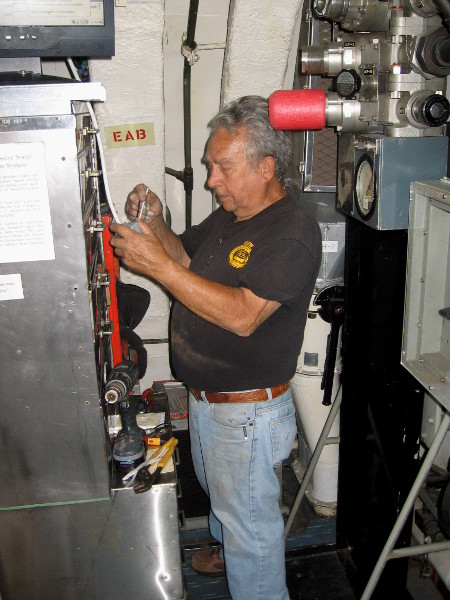
A museum visitor gets ready to walk outside to a very cool submarine.Walking along the deck to forward end of the submarine. The tower-like sail contains the bridge, periscope and communications masts.This forward hatch (and the rear one) were cut into the hull so museum visitors could easily walk through the sub’s length. Originally there was one hatch, at the sail.An electrician volunteer, Ed, at work just inside the USS Dolphin. He told me several stories from his days serving on submarines.A sign inside the underwater research vessel provides answers to a few common questions.
This sign inside the submarine answers some common questions and includes the following fascinating facts:
Dolphin’s hull material is HY-80 steel…her hull is a ring-stiffened cylinder without pressure bulkheads (if she has a leak the whole boat will flood)…
When she had her torpedo tube installed, Dolphin could carry four torpedoes… After initial tests and the launch of a torpedo in 1969 from the deepest depth ever recorded, Dolphin was refitted for other research purposes, and never carried torpedoes again.
There are no visual viewing ports in this submarine…. Dolphin did carry imaging electronics for observing the bottom.
Dolphin did not have any claws for picking items off the seafloor as she was restricted to a minimum altitude of fifty feet above the bottom. One experiment launched an ROV (remote operated vehicle) with power and communication cable attached to Dolphin while submerged…
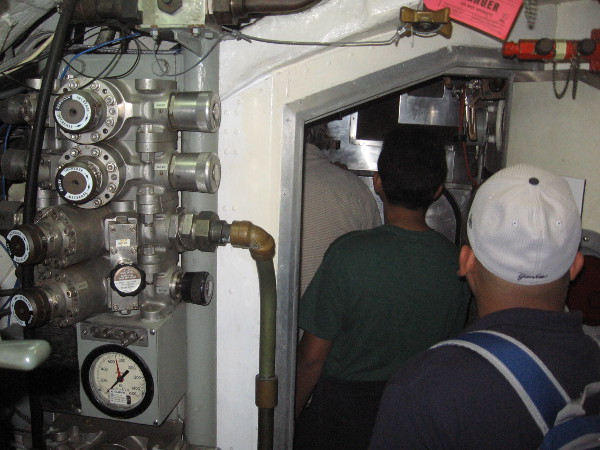
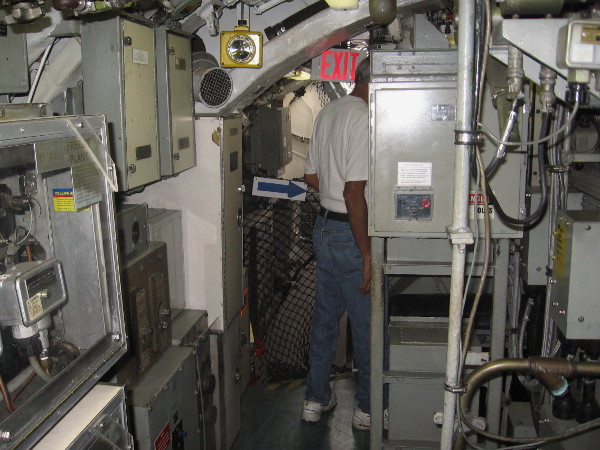
Starting along the very narrow main hallway. This unusual sub contains no compartments. To the left one can see a reverse osmosis water filtration system.Red pyro locker used to safely house signal flares.Those crew bunks on the left don’t look terribly spacious or comfortable.There are more pipes, wires, gauges, valves and gizmos than you can shake a stick at.A group of curious visitors is entering the amazing Control Room, near the center of the USS Dolphin.The periscope works and tourists can view San Diego Bay and downtown buildings with perfect clarity.Folks peer down through floor at Pump Room below the Control Room, where a hero defied death to save his crewmates.
On May 21, 2002, the room below was the center of heroic action to save the submarine and crew. On that day, Dolphin was conducting training exercises about 100 miles off the San Diego coastline when a torpedo shield door gasket failed, and water began to flood the submarine…
Chief Machinist’s Mate (SW) John D. Wise Jr., realizing what needed to be done, dove into the 57 degree water of the flooded pump room…with less than a foot of breathable space…he aligned the seawater valves and then remained in the pump room for more than 90 minutes…
For his courageous efforts, Chief Wise was awarded the Navy and Marine Corps Medal.
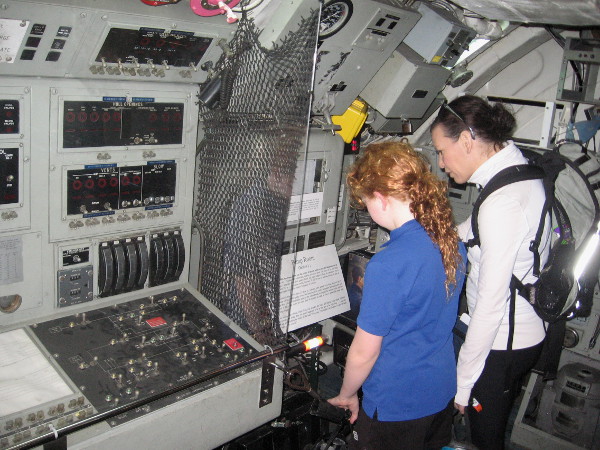
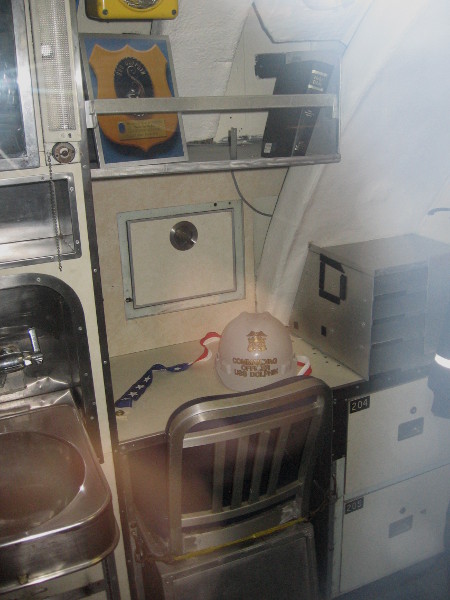
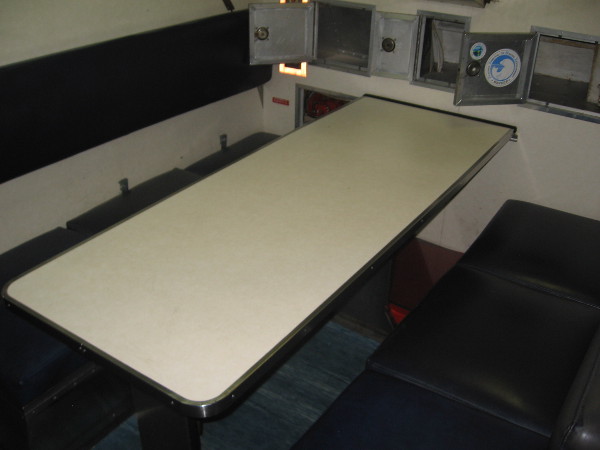
A panel with many complicated switches. In the Control Room, one can monitor the main storage batteries, generators and propulsion system.The wheel used to pilot the Dolphin. One drove using only instruments, including gauges that display rise/dive, ordered depth, system depth, cavitation, turns, dummy log, depth to keel.Photo of tiny Officers’ Quarters was through glass, which produced some glare.This is the first toilet I’ve photographed for my blog. Hopefully the last!Photos on wall of tiny mess area show what life was like aboard Dolphin.This is where food was prepared.This dining table was constantly in use. Not much to see in the way of decor.Continuing down the main hallway toward the rear of the submarine. Don’t ask me what all this stuff is.Apparently this is some sort of freezer.You get an idea of what it’s like to carefully walk through the narrow submarine.High-Pressure Air Compressor Controllers among a jumble of pipes and valves.Up a ladder and back outside into the bright San Diego sunshine!
…
To enjoy future posts, you can “like” Cool San Diego Sights on Facebook, or follow me on Twitter.
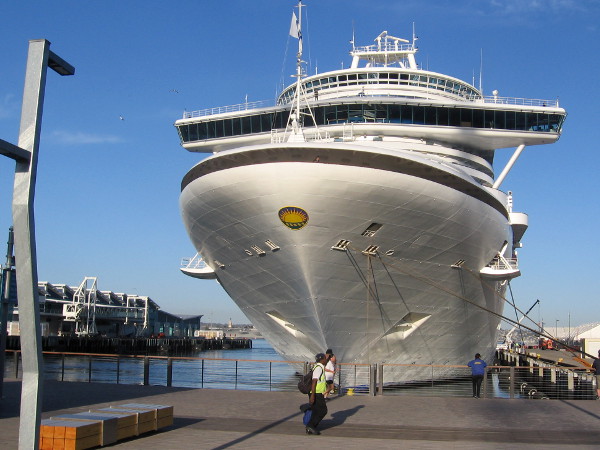
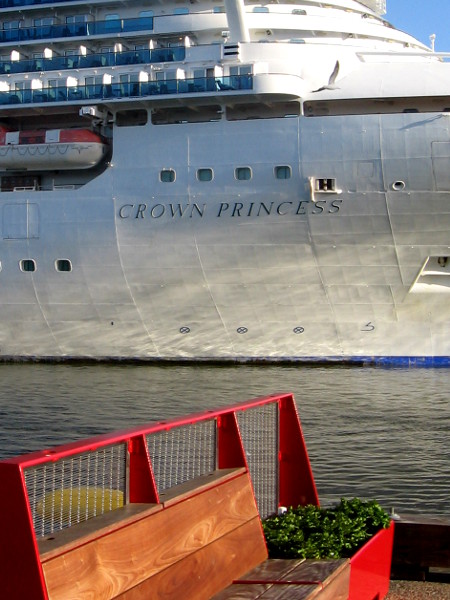
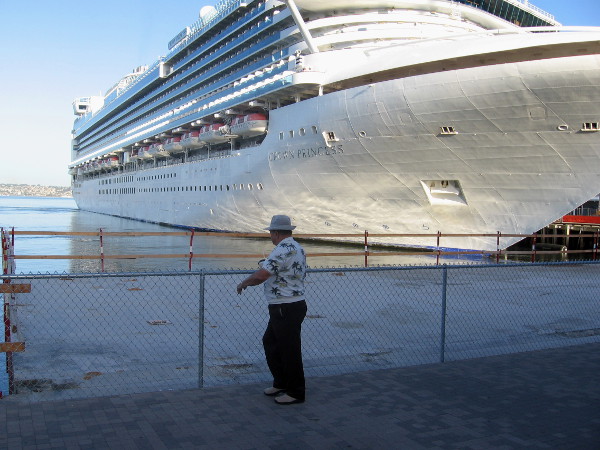
The huge Crown Princess cruise ship is docked on San Diego’s Embarcadero.
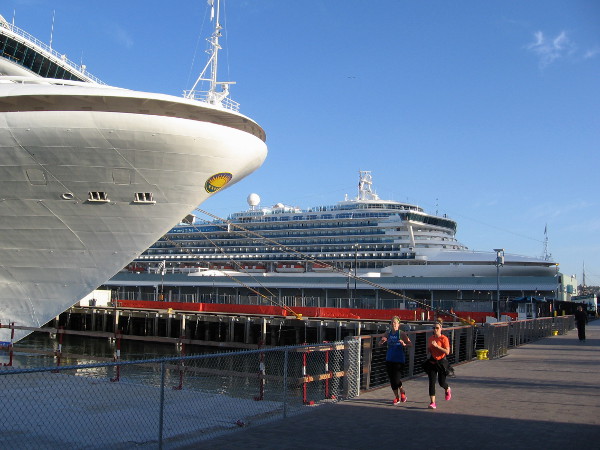
Everyone has seen photos of cruise ships, but two beauties were docked on San Diego’s waterfront this morning and gleaming in the sunshine, so I had to whip out my camera!
Once in a while, two or three cruise ships visit downtown at the same time. Some of these vessels are so huge that stood on end they’d dwarf many nearby skyscrapers. The two ships I saw in port today are operated by Princess Cruise Line. Both are classified as Grand-class cruise ships and have nearly identical lengths. Even after seeing them in person, it’s hard for me to grasp that these ships are 950 feet long! The Crown Princess can carry 3,080 passengers with a crew of 1,201. The Star Princess accommodates 2,590 passengers and a crew of 1,150. Incredible!
Two luxurious Grand-class cruise ships gleam on either side of the Cruise Ship Terminal.Gull checks out an amazing morning sight. Photo taken from the Broadway Pier.Man gazes at the sunlit bay. The fenced area is where the Bay Cafe used to stand. It soon will be an observation platform.
…
To enjoy future posts, you can “like” Cool San Diego Sights on Facebook. or follow me on Twitter.
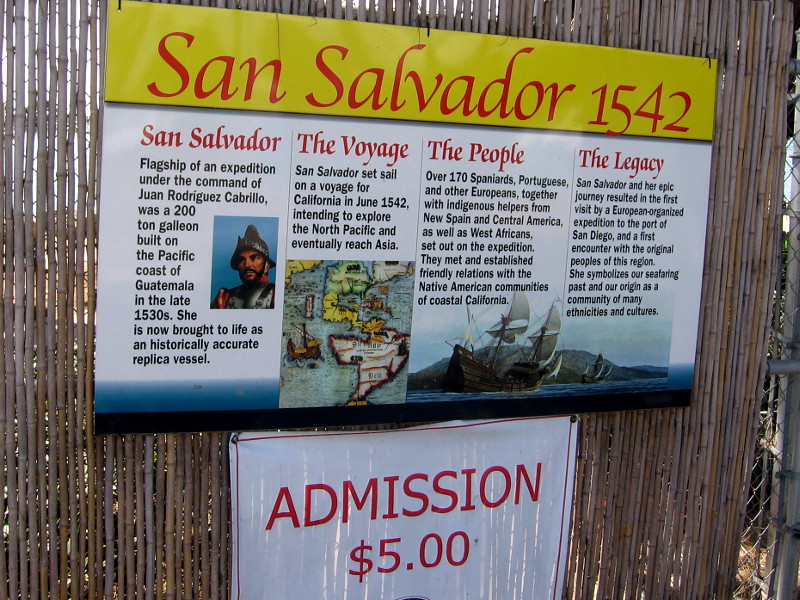
Sign at entrance to San Salvador build site. You have a couple more weeks to visit before the replica galleon’s historic launch into San Diego Bay.
Yesterday I enjoyed a tour of something so unbelievably cool it almost defies description. Along with my photographs I took some notes, but what I’m about to write might not be perfectly accurate. I’m relying to an extent on memory, which with my advancing age isn’t quite what it used to be. So if anyone reading my captions spots an error, PLEASE write a comment at the bottom of this blog post!
Later this month, the Maritime Museum of San Diego will be launching its absolutely fantastic, historically accurate, seaworthy replica of the galleon San Salvador. The original San Salvador was the ship that Portuguese explorer Juan Rodriguez Cabrillo sailed in during his voyage of discovery up the California coast on behalf of Spain. The famous galleon entered San Diego Bay in 1542, making Cabrillo the first European to visit the large, natural harbor. What we call San Diego today he named San Miguel.
Today, the full-size working replica of Cabrillo’s ship is being built at the west end of Spanish Landing, in an area called San Salvador Village, between Harbor Island and San Diego International Airport. The finished ship will be 92 feet long with a beam of 24 feet. As I understand it, construction has been underway for about four years, and for a variety of reasons has taken a couple years longer than originally projected. But once the decks are re-caulked, the shrouds tarred, and a few other things finished, the ship’s exterior will finally be ready for its imminent introduction into San Diego Bay!
The galleon, which without ballast weighs about 130 tons, will be slowly towed to the Broadway Pier downtown, then lifted by a huge crane into the bay. While docked beside the other ships of the Maritime Museum, the interior will be finished, about 60 more tons of lead ballast added, and the vessel’s ability to remain upright thoroughly tested by the Coast Guard.
(Don’t quote me on the 130 tons and 60 tons. Those figures came entirely from my leaky memory.)
There’s simply too much awesome stuff to describe in a few paragraphs, so let me now show you my photographs and I’ll include in the captions some of the cool stuff I learned or observed…
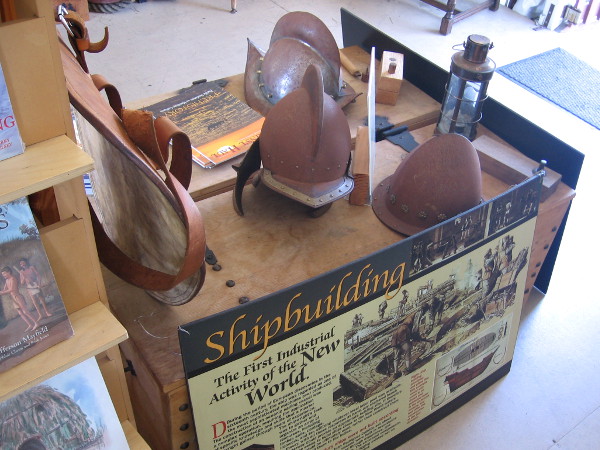
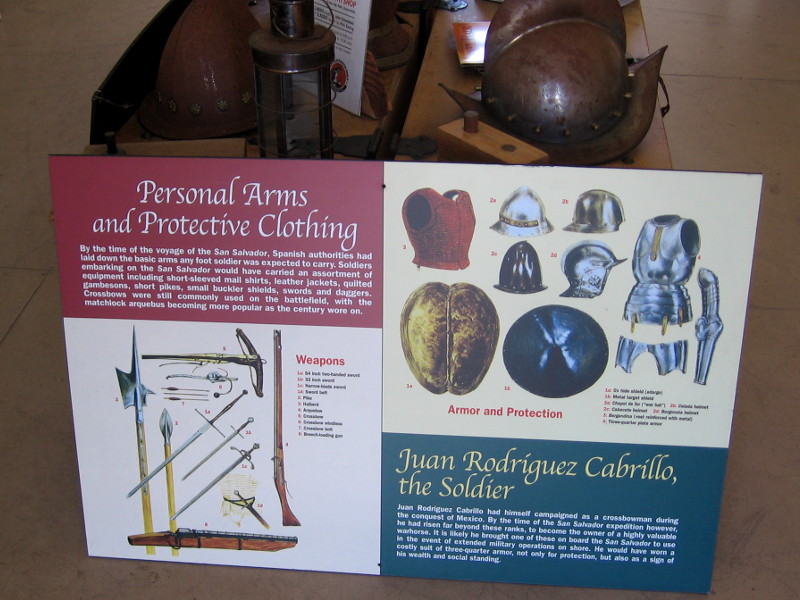
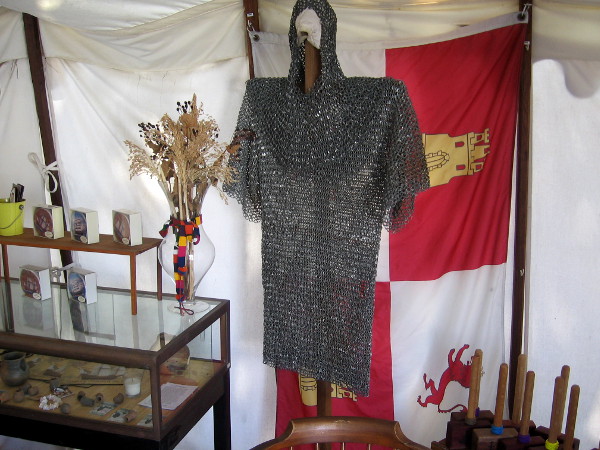
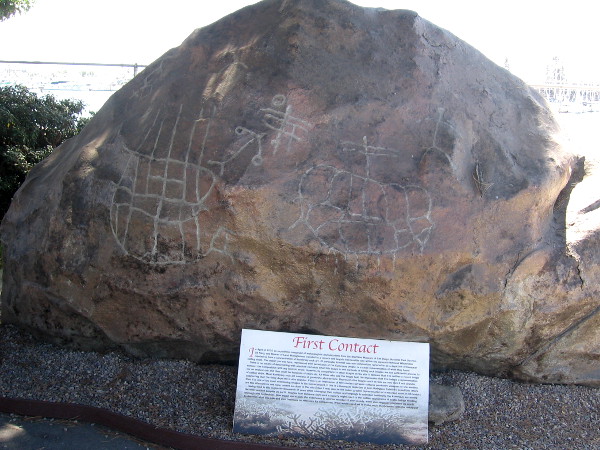
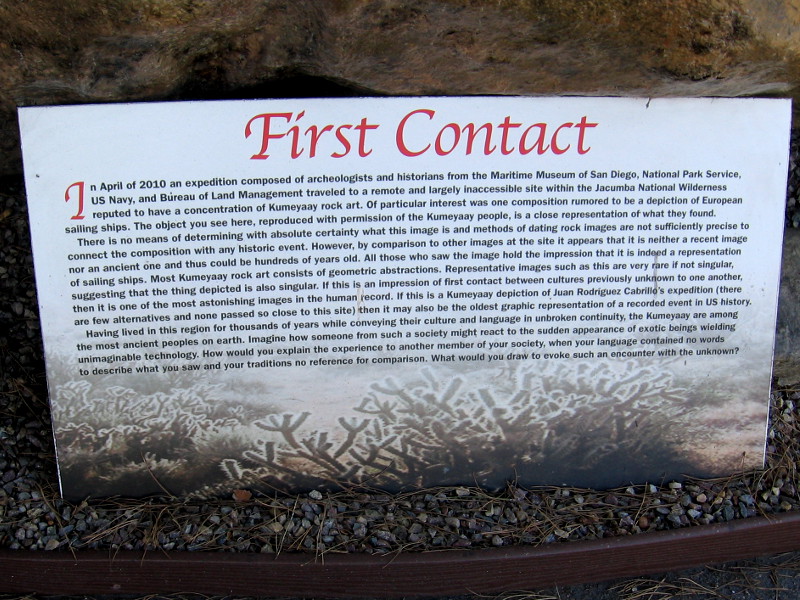
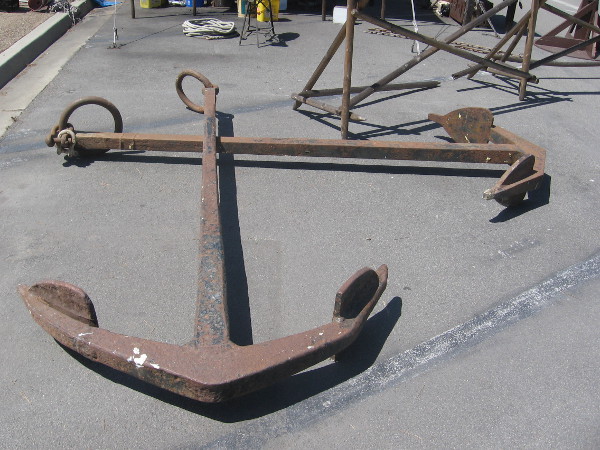
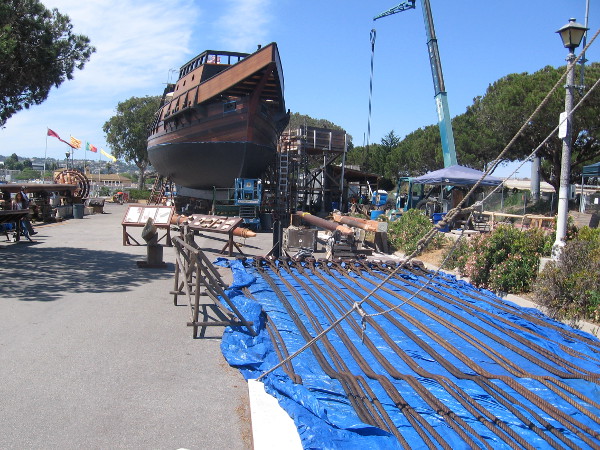
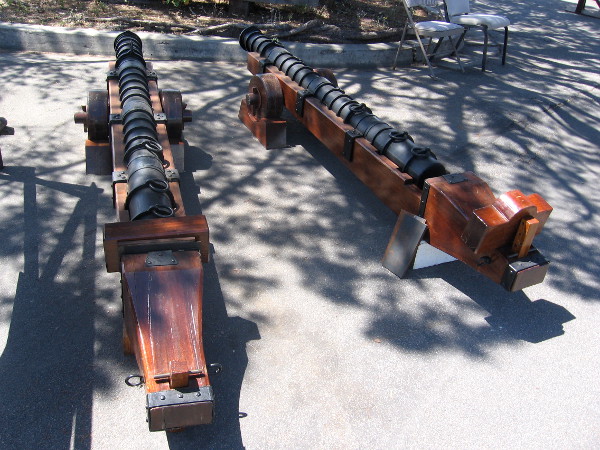
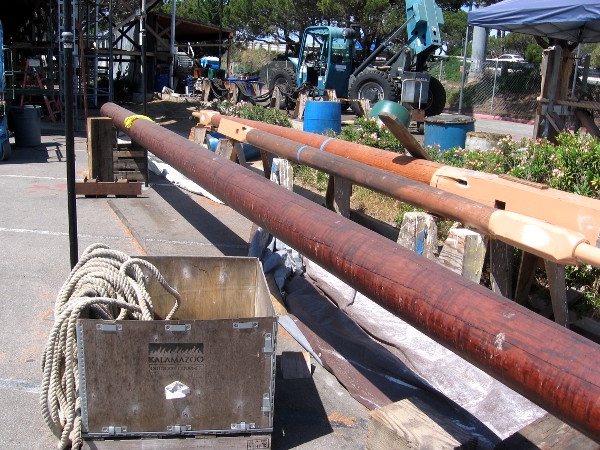
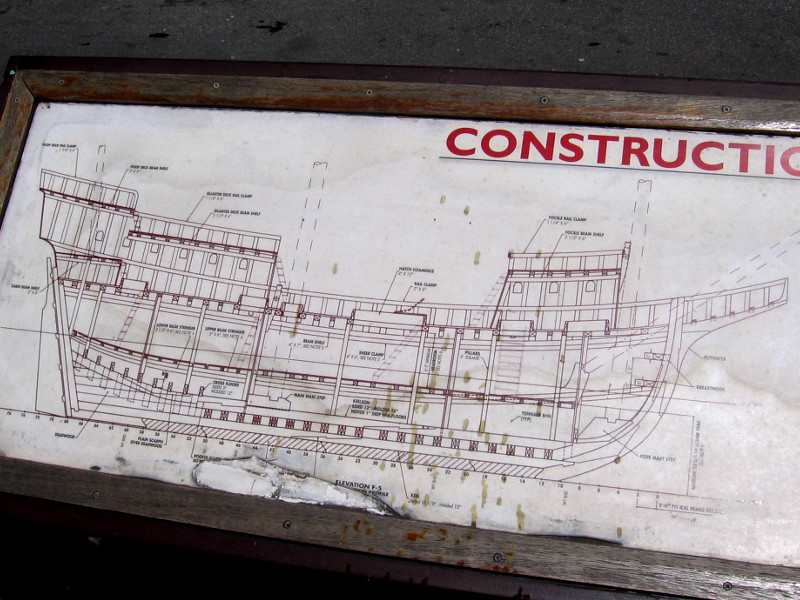
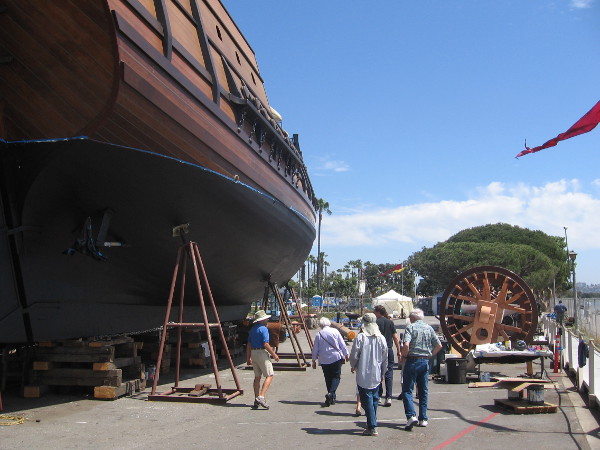
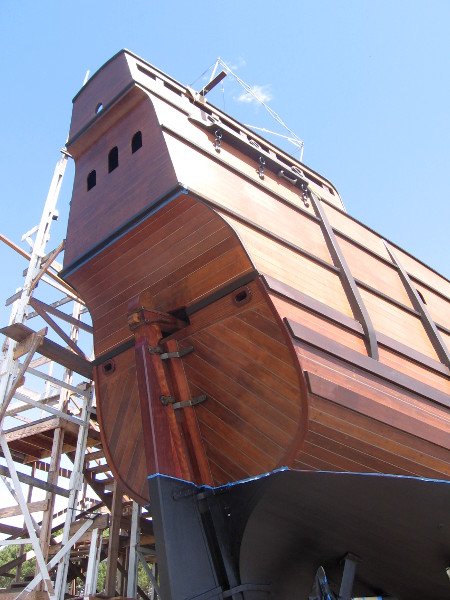
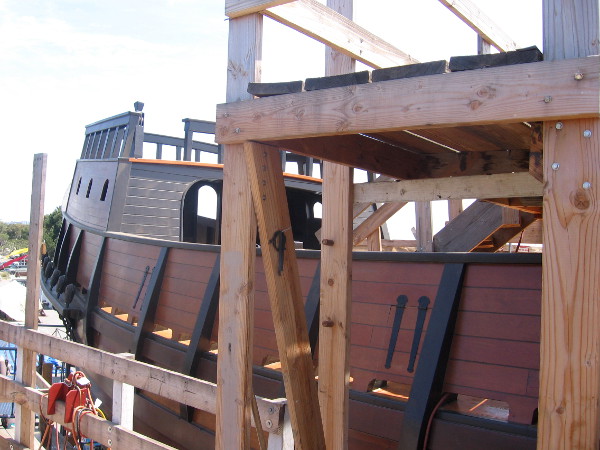
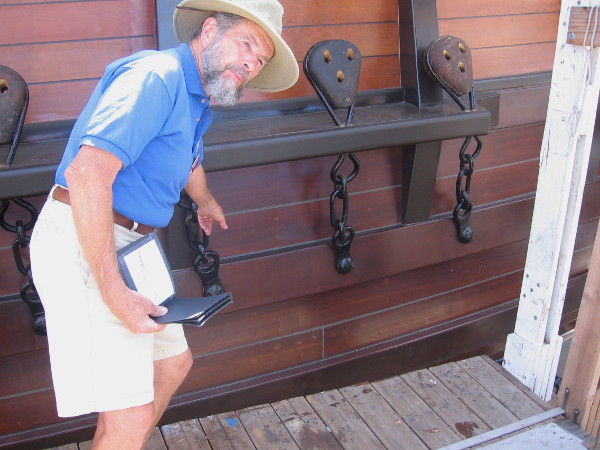
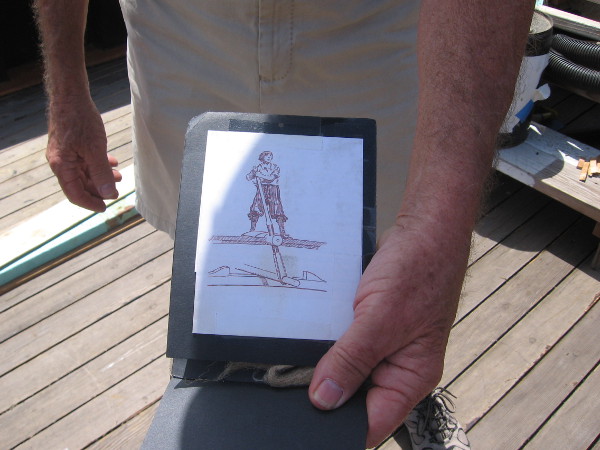
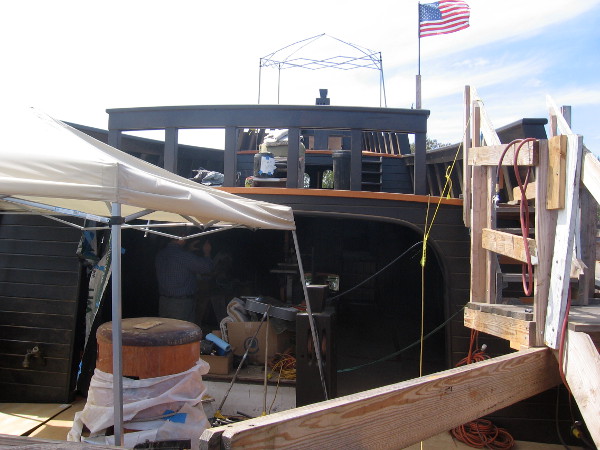
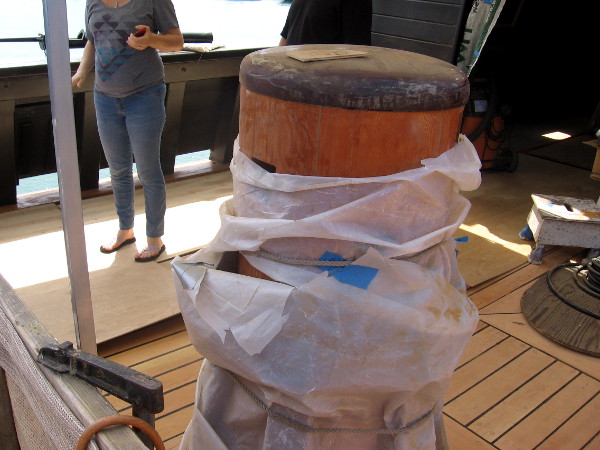
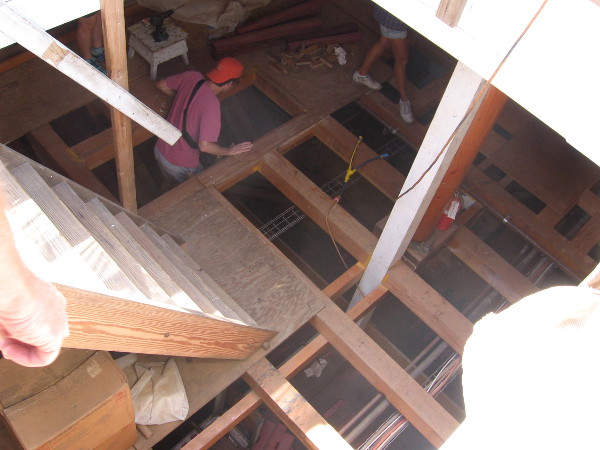
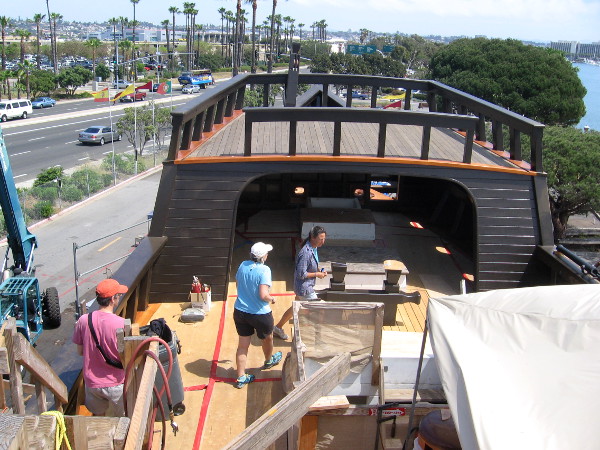
Shipbuilding was the first industrial activity of the New World. Gift shop at site entrance includes Spanish conquistador helmets and breastplate.Poster shows personal arms and protective clothing used by the men who sailed with Juan Rodriguez Cabrillo five centuries ago.A small museum and gift shop includes many interesting sights, including a shirt of chain mail and flag of the Spanish Empire.Diagram shows the sail plan for historic galleon San Salvador.Various items on display include lantern, candle, bottle, ship’s food and native Kumeyaay artifacts.Outside, at the build site, there are many more exhibits. This reproduction of found rock art seems to show sailing ships. The native Kumeyaay people often visited San Diego Bay.First Contact. If this rock art is a Kumeyaay depiction of Cabrillo’s expedition, it might be the oldest graphic representation of a recorded event in American history.Here’s a huge anchor! I didn’t ask, but I assume it will be used by the San Salvador.San Salvador carries six sails totaling a little less than 5000 square feet. The sails are not only used to propel the ship, but exert a larger influence on steering than the rudder.View of a small sail suspended from a yard, with Harbor Drive in the background north of the build site.Suspended from a crane is a shroud (rigging that helps hold a mast) that’s being tarred. The bow of the galleon comes to a sharp point at its beak.Iron in an undeveloped region of the New World was a precious commodity. Imported ingots were often used to forge various fittings and hardware.Hooks, chain links and other iron instruments were crucial to sail and maintain a large ship.The San Salvador carried armament to defend the expedition from potential threats. The cannon-like bombard and swivel gun could be fired from the deck.Two bombards on display at the San Salvador build site. They could fire shot about five pounds in weight and were mounted on wheels.Detailed map of Cabrillo’s route up the California coast. He found neither treasure, nor a passage to the Atlantic.There are no blueprints for the galleon San Salvador. To reconstruct the 16th century ship, the Maritime Museum of San Diego used scarce historical clues.It was difficult to find the right kinds of wood for different parts of the vessel. Both old and modern shipbuilding techniques were used.Wood mast segments and yards are coasted with linseed oil, I believe. They’ll be installed once the ship is afloat in San Diego Bay.Approaching the impressive reproduction of the historic galleon. Just imagine going for an ocean sail in this!Detailed schematic shows framework and beams that support decking and hull.The master builder sets up keel, stem, sternpost and deadwood, locked together with long iron drifts. The master frame is then built.I believe these are the lower halves of two masts (main and fore), each ending in a crow’s nest.A look at the super hard wood hull of the galleon San Salvador at Spanish Landing.Volunteer tour guide shows how six segments of heavy lead are attached to the keel.Each piece of lead weighs over 6000 pounds. The lead was originally used for the drop hammers of Rohr Industries in Chula Vista to form aircraft parts.A small tour group investigates the amazing galleon on a sunny San Diego day!The high stern of San Salvador. The rudder is attached to a tiller. That propeller below (and an eventual engine) is a modern convenience unknown by Cabrillo!Our group climbed the steps of scaffolding to check out the hull, upper deck and aftcastle.We’re shown where a shroud connects to the ship’s side. The darker looking lower portion of the hull is made of hard wood, which is heavier than water.We’re almost on top!View of the San Salvador galleon while standing atop the aftcastle. Work to finish the vessel’s deck and interior is underway.This deck will be re-caulked soon using cotton, hemp rope and synthetic tar. Earlier caulking with less modern materials was unsuccessful, if I recall correctly.Sketch of helmsman steering the galleon with a vertical lever attached to the rudder’s tiller. He had a window to look through in the aftcastle.Looking back at the aftcastle and rearmost poop deck from the center of the upper deck. You can see the window through which the helmsman peered.Capstan is a revolving vertical timber that projects through the deck. Bars will be inserted and used by sailors to turn the capstan, hauling ropes or chains.This is one of five separate water-tight compartments being worked on below. Bunks will be contained here, for journeys out to the Channel Islands eventually.Under the forecastle, looking toward the bow’s beak. The two holes beside the rectangular chain locker are hawseholes, through which the anchor chain is lifted or lowered.Looking straight down here you can see where the foremast and bowsprit are seated.Wow! Is this cool! How often does one get to walk around an actual honest-to-goodness working galleon!
…
To enjoy future posts, you can “like” Cool San Diego Sights on Facebook or follow me on Twitter.
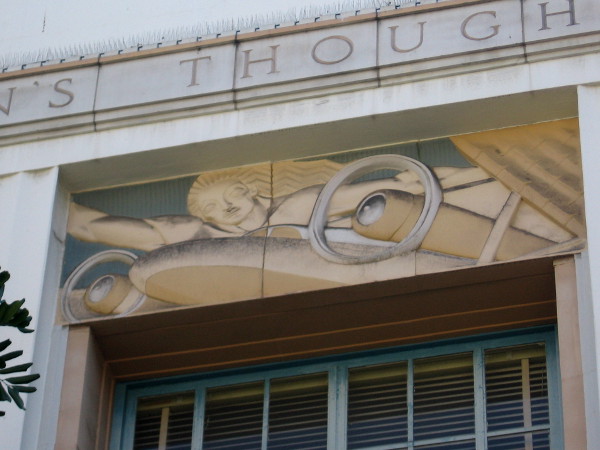
Art Deco relief work shows female flying above propellers of airplane.
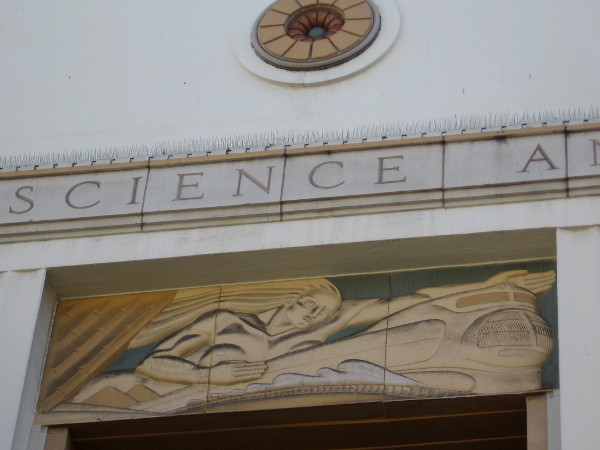
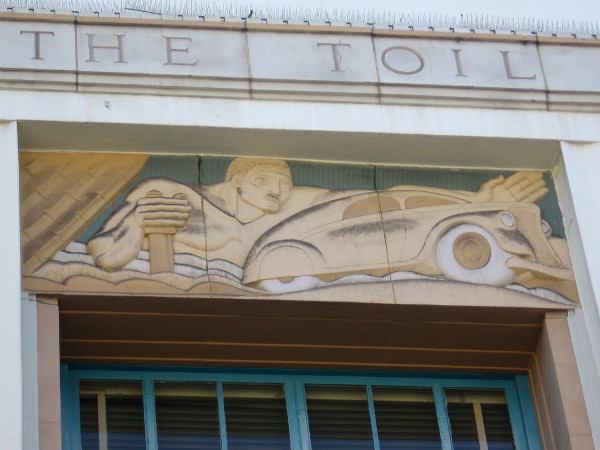
“Through science and the toil of patient men, the nation’s thought traverses land and air and sea.” Those are the words inscribed along the top of downtown San Diego’s Post Office, on E Street between 8th and 9th Avenue. Beneath the words are nine terra-cotta panels created by Archibald Garner in 1937. The Art Deco images include a car, train, ship and airplane, the means by which mail has been delivered over many decades, transmitting the written word across the nation and around the world.
Titled “Transportation of the Mail,” Garner’s handsome panels were the result of a Department of Treasury competition. Like most Post Office public art created during the New Deal, the work was funded through the Treasury Department’s Section of Painting and Sculpture, also known as The Section of Fine Arts. The post office itself was built by the Works Progress Administration (WPA) and stands across the street from the now closed old Central Library. You can see a few interesting photos of the library here.
View of San Diego’s downtown Post Office from Ninth Avenue.Steamship cuts through ocean waves on its way to deliver the mail.Distinctive Art Deco train can be seen near roof of San Diego’s old Post Office.Historically interesting panels, which appear at the top of high windows.Classic automobile in Art Deco public artwork in downtown San Diego.
…
To enjoy future posts, you can “like” Cool San Diego Sights on Facebook. or follow me on Twitter.
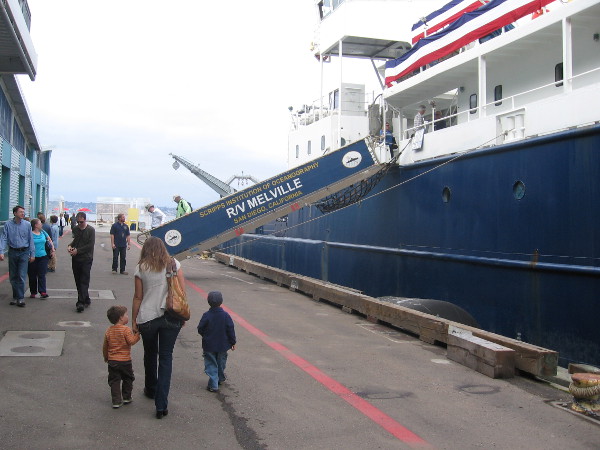
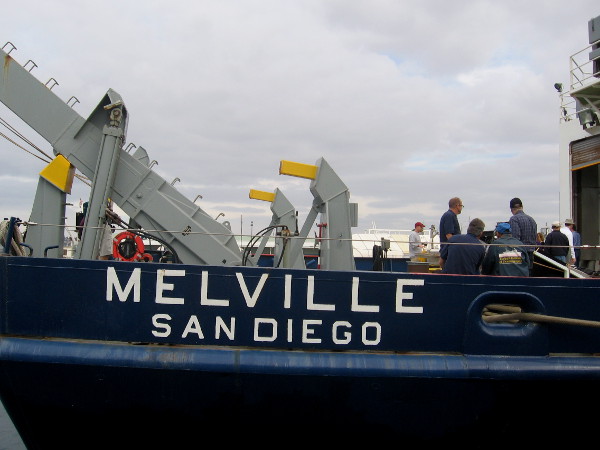
Ready to board R/V Melville from San Diego’s Broadway Pier before the research ship is retired.
The research ship Melville retired today. For five decades scientists aboard the ship helped to expand our understanding of the oceans, marine biology and planet Earth. I headed down to the Broadway Pier on San Diego’s Embarcadero this morning, because for one rare and final time the general public was invited to tour this legendary ship!
The R/V Melville, the oldest active ship in the University-National Oceanographic Laboratory System fleet of marine research ships, was launched by the Navy in 1969. Operated by the world-famous Scripps Institution of Oceanography in La Jolla, the vessel has undertaken 391 research cruises and steamed a total of 1,547,080 nautical miles. A fact sheet distributed to today’s visitors also notes that the Melville logged over 90 equator crossings and has hosted around 7,116 scientists from 237 institutions. That amounts to a lot of knowledge gained!
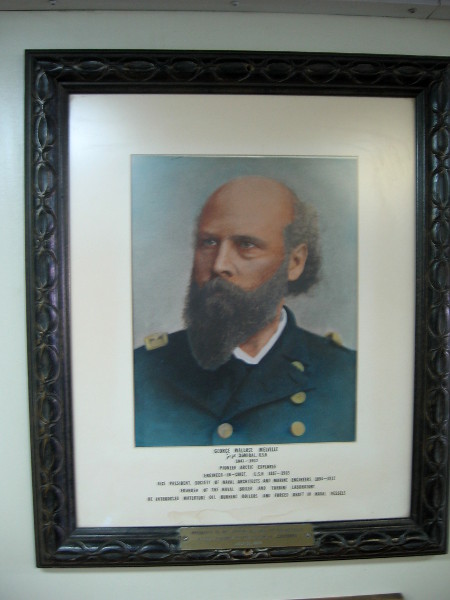
The amazing oceanographic research ship was named after George Melville, an arctic explorer and Rear Admiral in the United States Navy. One interesting fact: the ship was used in the filming of the 1976 movie King Kong!
I took these photos as I enjoyed this fascinating final tour of the ship. I hope my captions accurately describe what I saw. (If they don’t, please leave a comment!) Some of the interior shots are a bit blurry. I apologize.
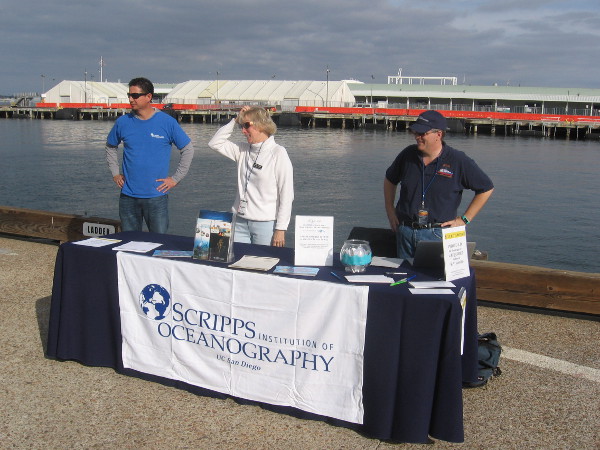
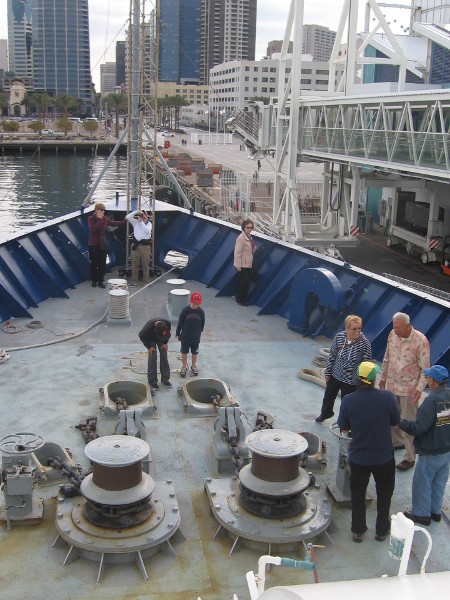
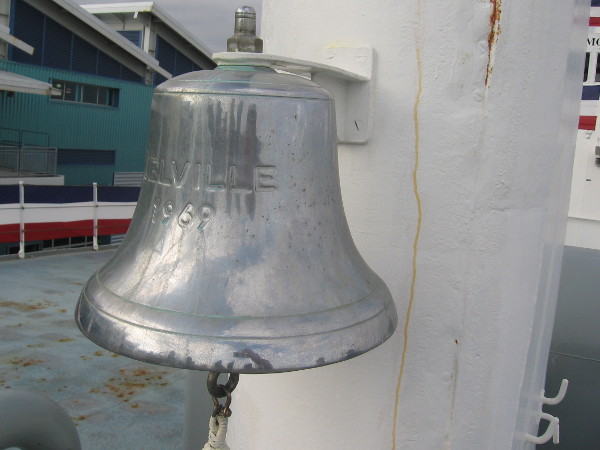
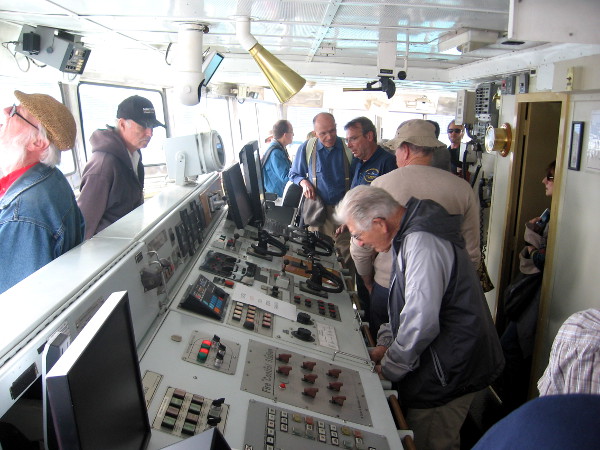
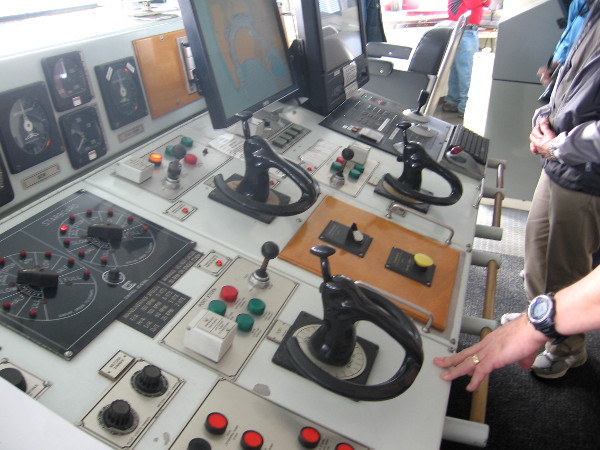
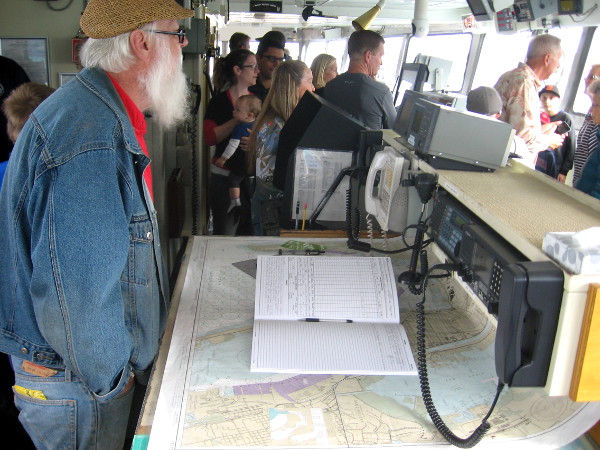
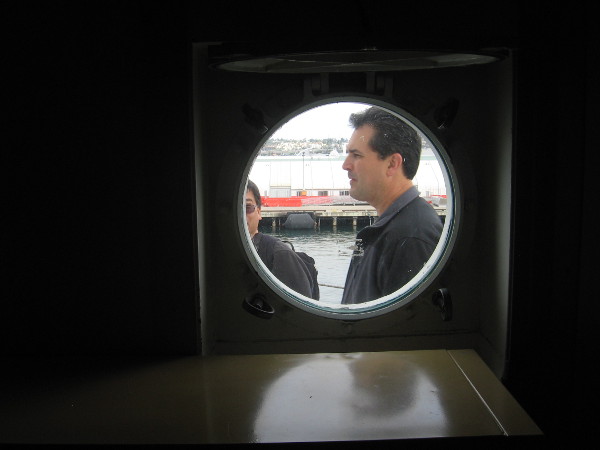
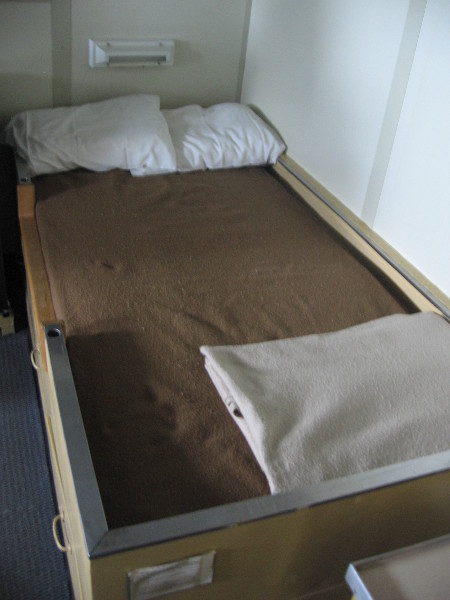
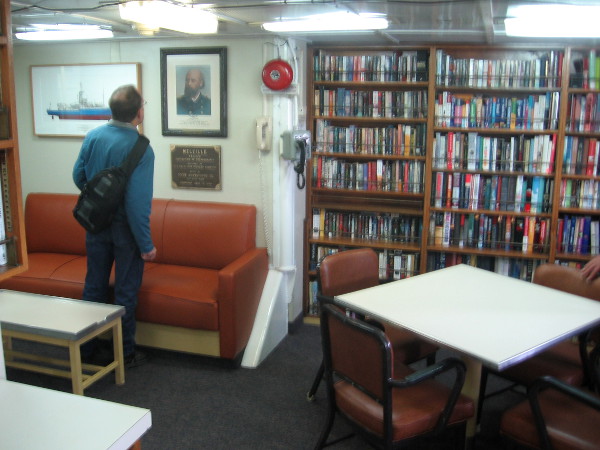
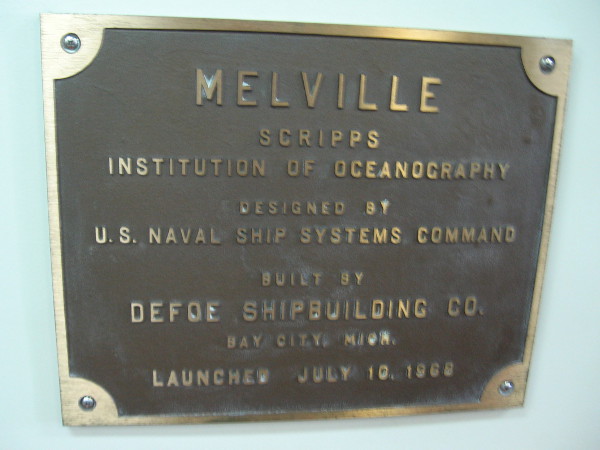
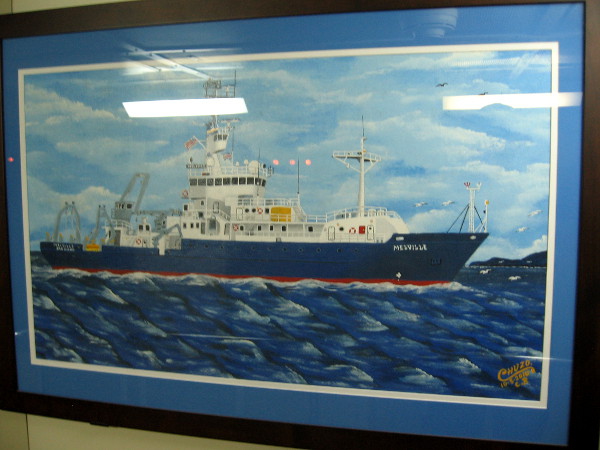
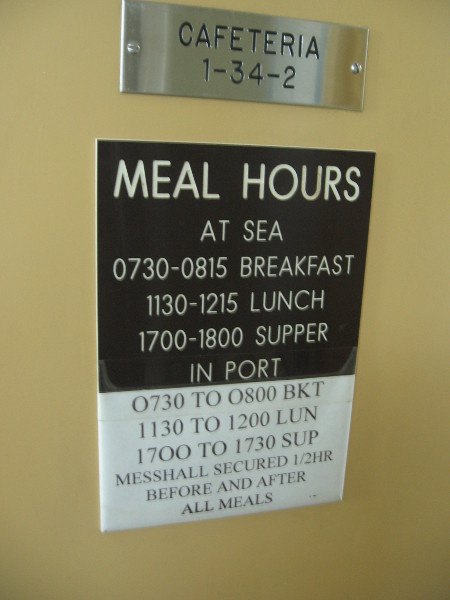
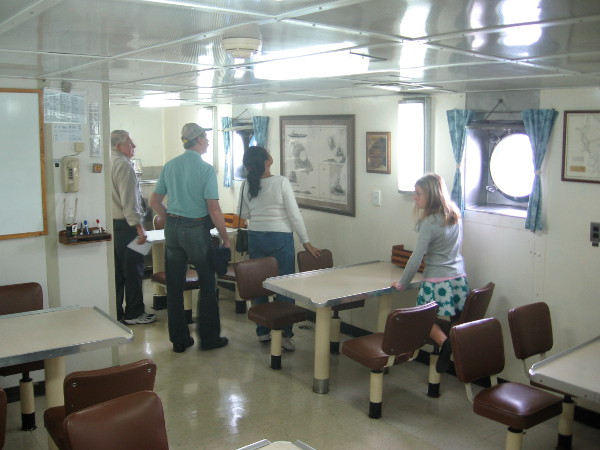
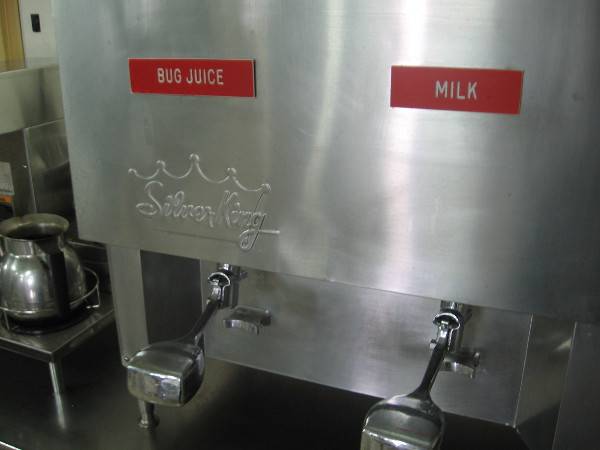
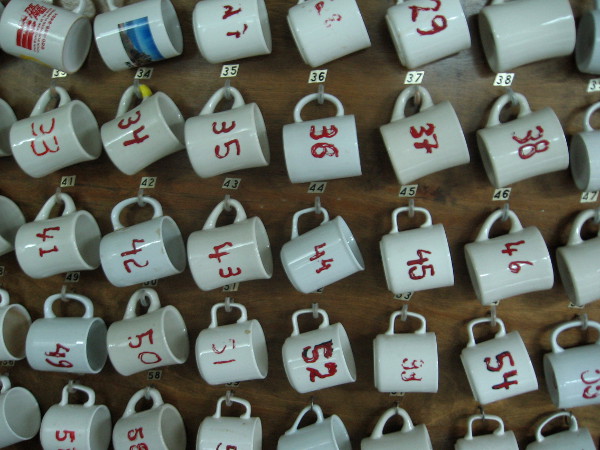
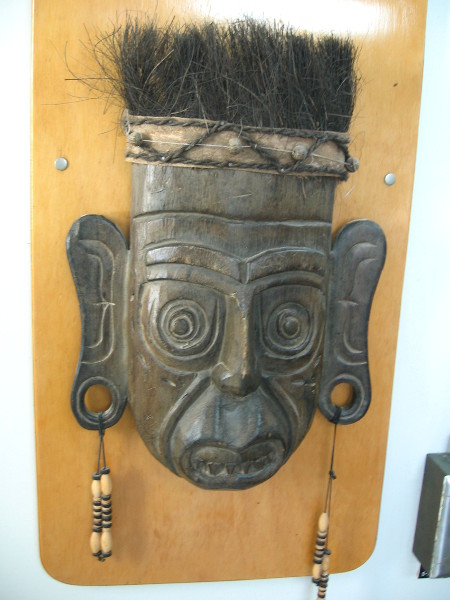
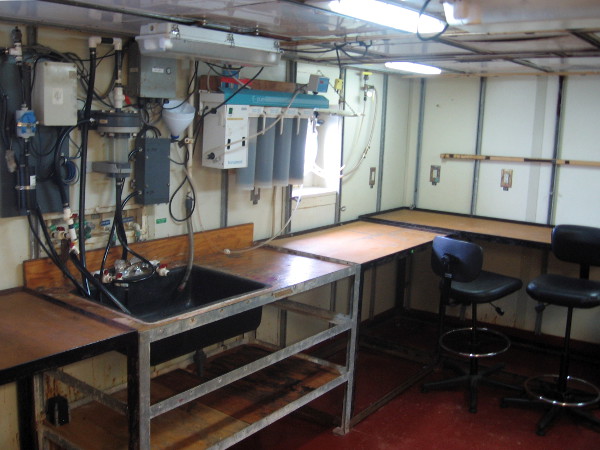
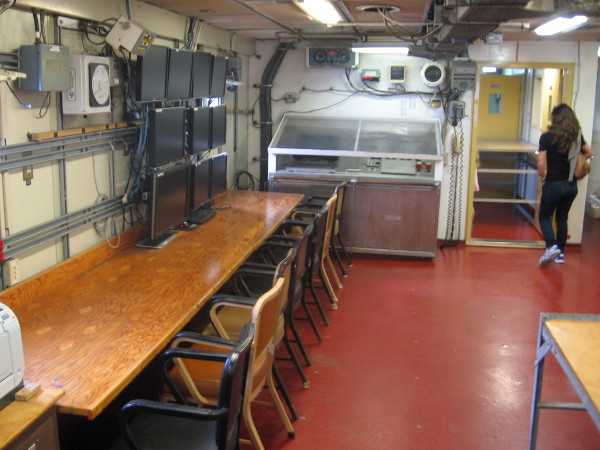
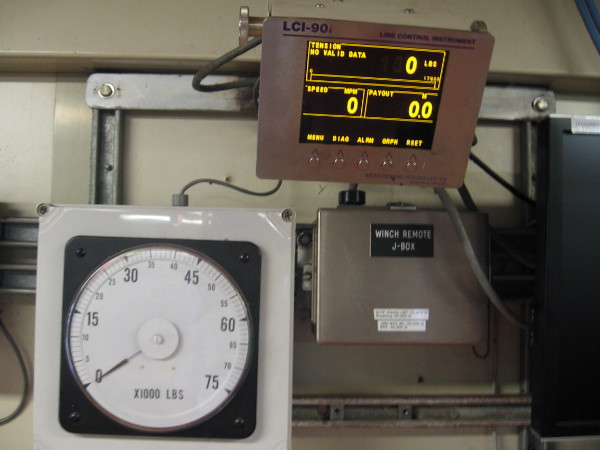
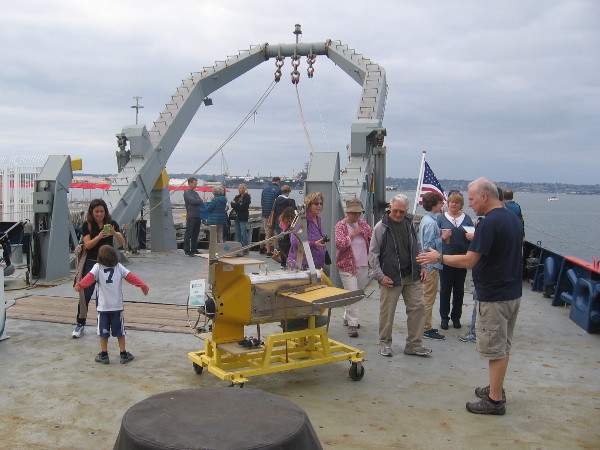
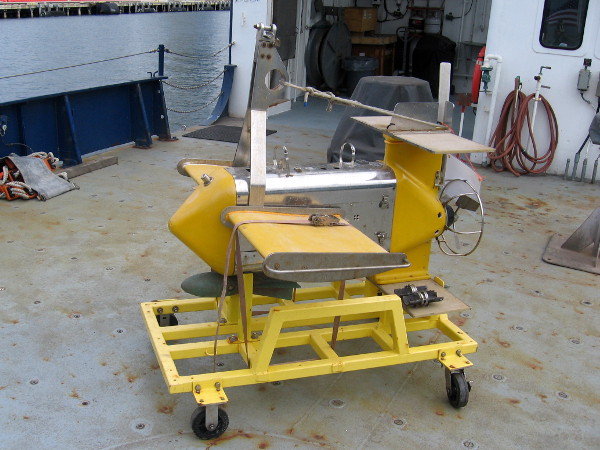
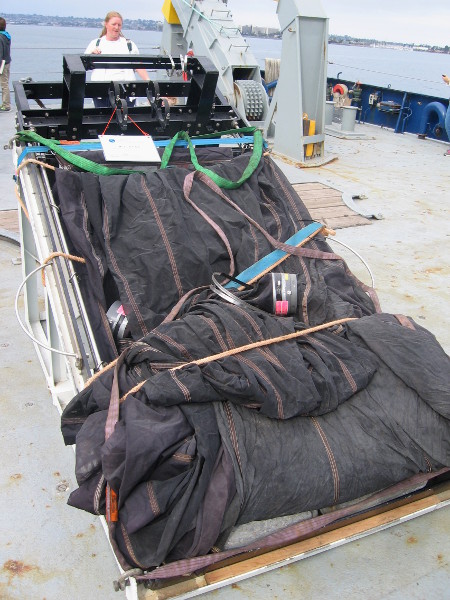
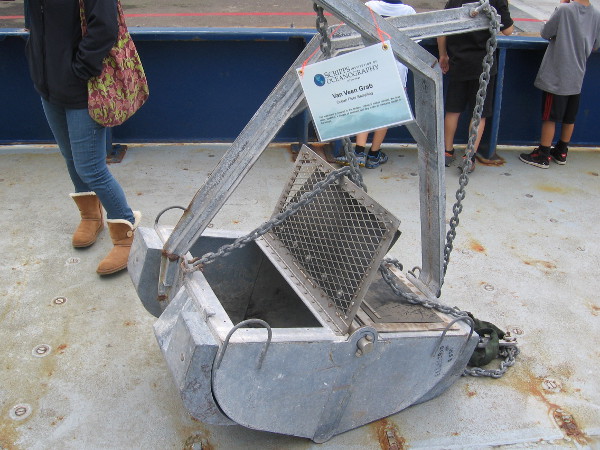
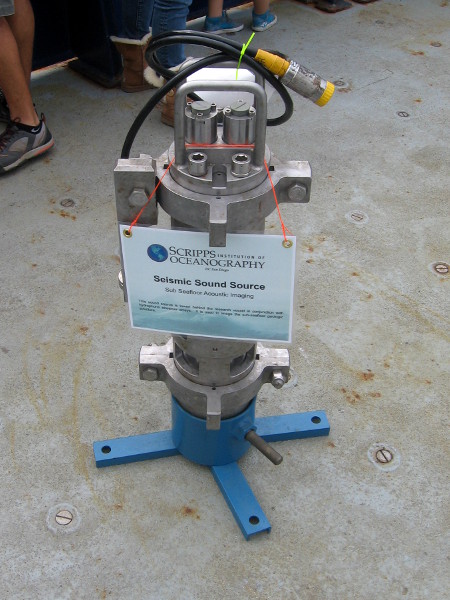
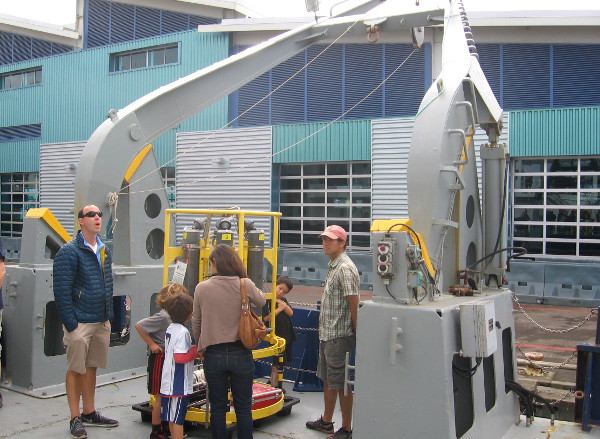
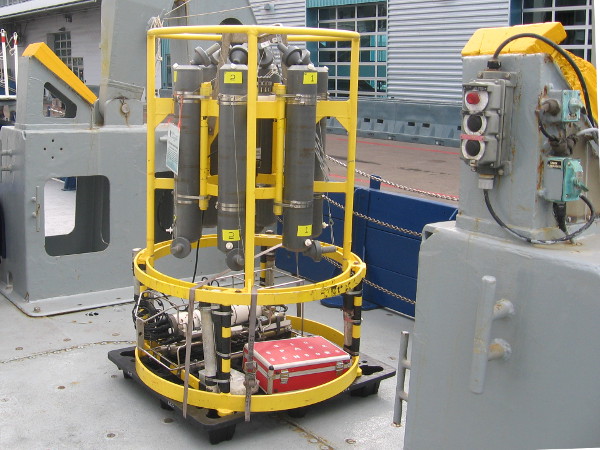
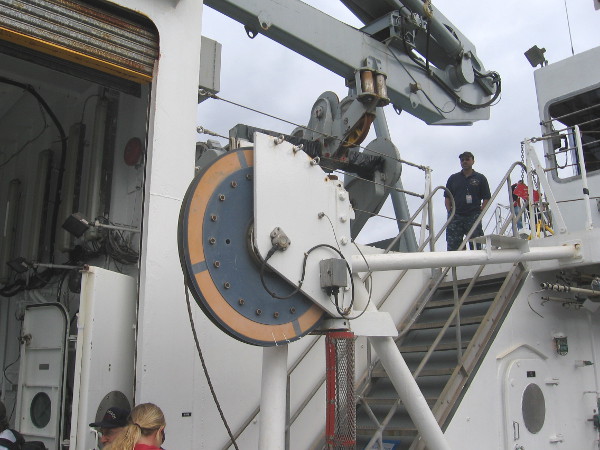
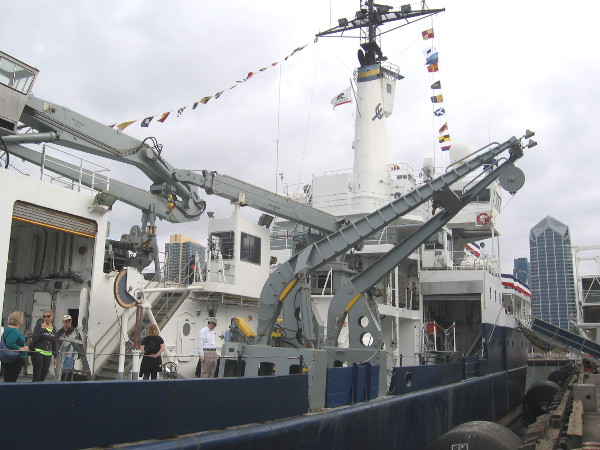
The Melville is operated by the Scripps Institution of Oceanography, part of UCSD in La Jolla.One of many friendly, helpful people who’ve served on the history-making ship.The tour started at the bow. Downtown San Diego skyline rises in the background.Excited people climb up toward the pilot house of Melville.The shiny ship’s bell!Huge number of buttons, knobs, switches and dials in the pilot house of Melville.A second photo of the complicated ship control console.The ship’s log is open on some navigational charts.Looking out porthole from the chief scientist’s quarters below deck.The chief scientist during research cruises slept here.The library, lounge and study contains many shelves of books and several interesting displays.Graphic in library depicts the R/V Melville.Portrait of George Wallace Melville, the ship’s namesake.Bronze plaque commemorates the Melville’s launch date in 1968.Painting by artist Chuzo of the Melville hangs in a corridor near some stairs below deck.Meal hours are posted on door leading to the cafeteria.Visitors check out the mess hall where crew and research scientists enjoyed a break, to eat, talk and share knowledge.Hungry folks can choose bug juice or milk. I’ll take milk, please!Numbered mugs on the mess hall wall. Number 1 belongs to the captain.Several masks, ethnic artifacts and marine objects decorate the walls of the cafeteria.A look at a shipboard laboratory where various materials could be analyzed.At the photo’s center is a winch control. Video monitors help scientists visualize their work underwater.Gauge registers up to 75,000 pounds of tension!Massive A-frame at stern of Melville. The working deck contains exhibits for people to check out.Sea Soar is an undulating towed vehicle used to collect real-time information, from the sea surface to a depth of 400 meters.This outdoor area can be closed off during rough weather so that work can be performed when conditions are poor.M.O.C.N.E.S.S. Multiple Opening/Closing Net and Environmental Sensing System allows oceanographers to catch zooplankton and measure environmental properties like salinity and temperature.Kids examine a rock dredge, used for the recovery of heavy material on the ocean floor.Van Veen Grab for ocean floor sampling. When it hits bottom, the jaws close and grab a sample of sediment, rocks and creatures.Seismic Sound Source for sub seafloor acoustic imaging. Towed behind research vessel in conjunction with hydrophone streamer arrays to image the sub-seafloor geologic structure.Heavy machinery available on the complex ship includes multiple winches, cables, cranes.Ocean probe with multiple sensors near an A-frame at ship’s side, where it might be lowered by cable into the water.CTD and Water Sampling Rosette measures conductivity, temperature and depth with a variety of sensors. Other chemical and biological parameters can also be measured.The super strong cable runs from here to one of two A-frames, where equipment can be towed or lowered.One of many powerful winches on the research vessel Melville.View from Broadway Pier of A-frame jutting from the Melville’s side.Farewell R/V Melville. The human race learned much during your many decades of service!
…
To enjoy future posts, you can “like” Cool San Diego Sights on Facebook or follow me on Twitter.
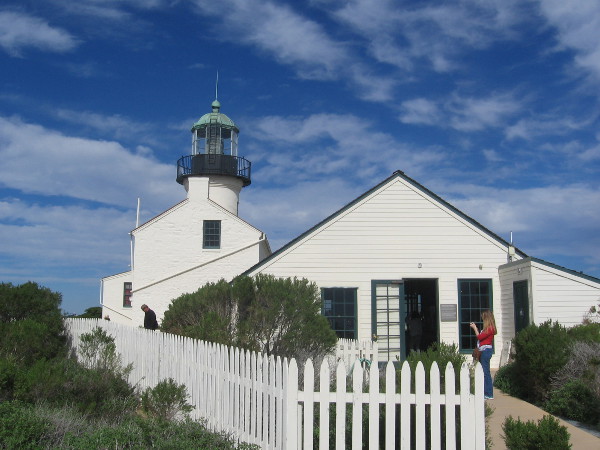
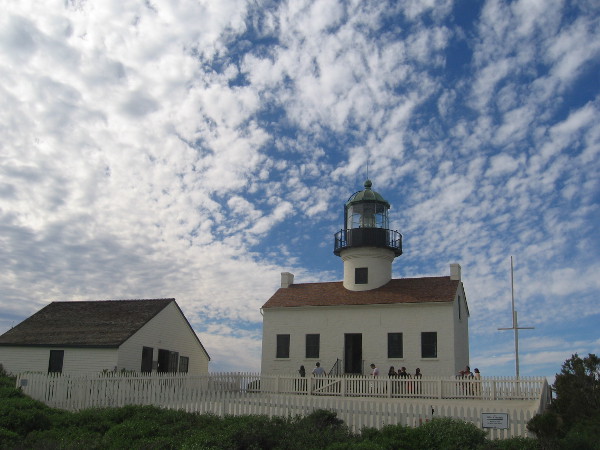
Looking up at the Old Point Loma Lighthouse in Cabrillo National Monument.
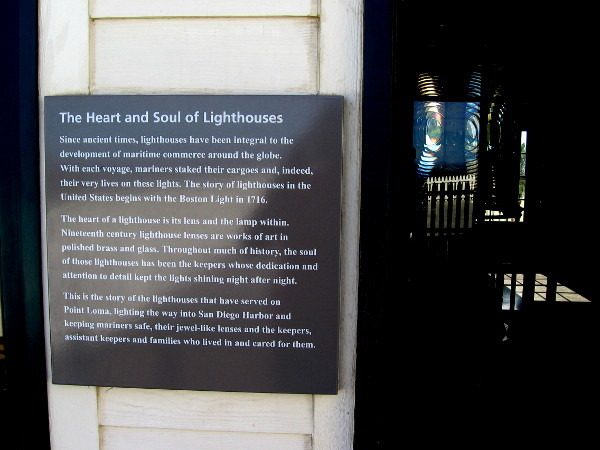
Everyone likes to explore the Old Point Loma Lighthouse. You can climb up the winding staircase and peer into several interesting rooms where the lighthouse keeper and his family lived. But the small museum in the nearby assistant keeper’s quarters contains the true marvels of science and art. Come inside and let us have a quick look!
The assistant keeper’s quarters next to the lighthouse today contains a small museum.Sign outside lighthouse shows huge Fresnel lens which guided ships with focused light 400 feet above sea level.Sign at entrance to museum. The heart of a lighthouse is the lens and lamp. 19th century lenses are works of art made of polished brass and glass.
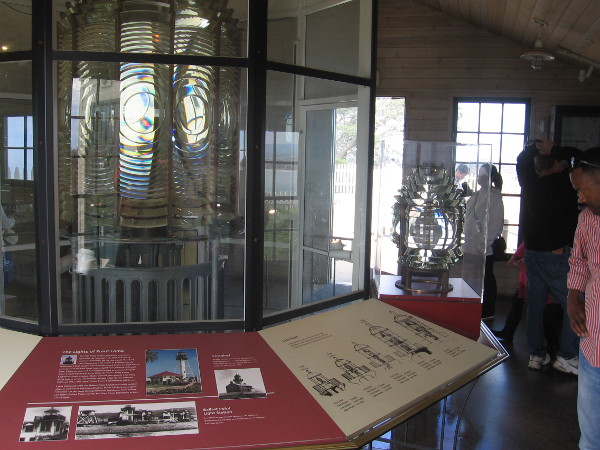
The highly polished Fresnel lenses utilized by lighthouses are beautiful objects. They refract and reflect light, creating prismatic colors when viewed from certain angles. It’s almost a miracle that a small flame in a lamp can be magnified to the extent that ships far out at sea can easily see it and be guided to safety. Light intensified by lenses in this museum could be seen 18 to 24 miles away!
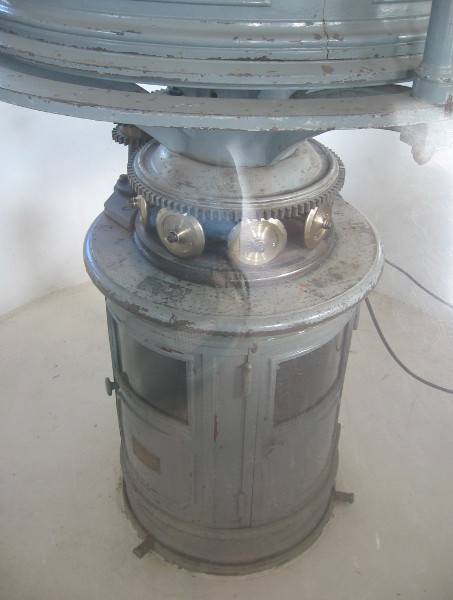
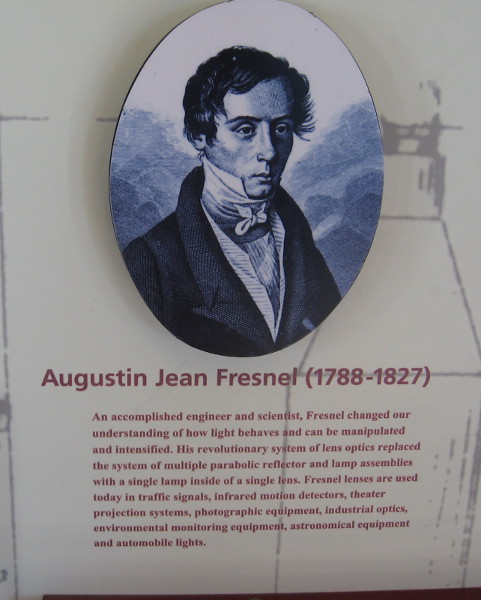
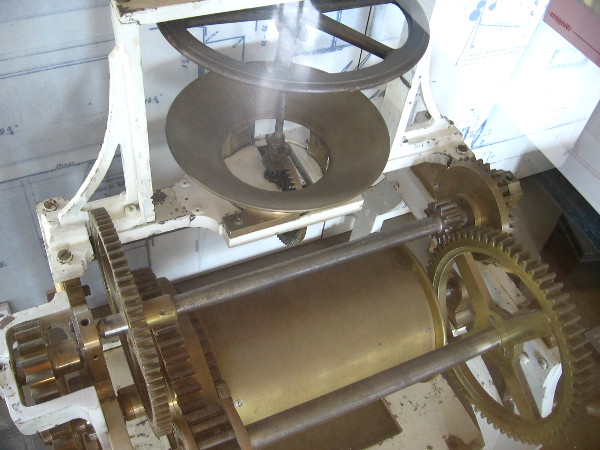
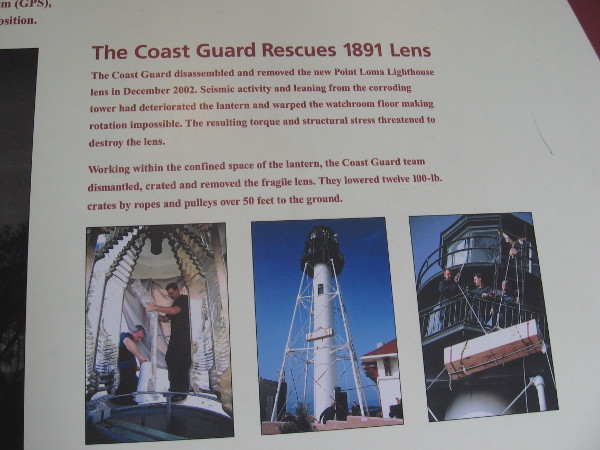
This 3rd Order Fresnel lens was used by the New Point Loma Lighthouse, built in 1891 down by the water.An optical wonder, this huge lens is an amazing, highly polished light bender.Diagram shows how a complex Fresnel lens functions.The base of the heavy Fresnel lens with chariot wheels visible.There are different orders of size, as illustrated in this display.Augustin Jean Fresnel (1788-1827) was an accomplished engineer and scientist. Fresnel lenses are used in many modern applications today.Small museum by Old Point Loma Lighthouse contains various very cool exhibits.This small 5th Order lens lighted the Ballast Point Lighthouse from 1890 to 1960.Log book of daily expenditures for oil, wicks and chimneys.This clockwork of gears slowly turned the light above.The keeper’s service box contained cleaning supplies and delicate tools for maintaining the lamp.The Coast Guard removed this large Fresnel lens from the New Point Loma Lighthouse in 2002.Looking at the iconic Old Point Loma Lighthouse and small museum beside it.
…
To enjoy future posts, you can “like” Cool San Diego Sights on Facebook or follow me on Twitter.




























































 Cool San Diego Sights!