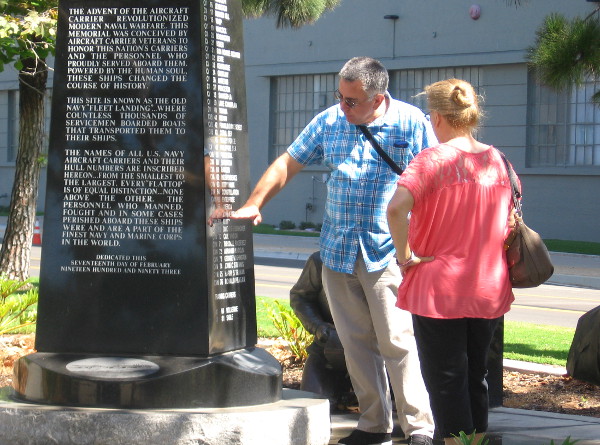
Man points out a recent fleet carrier name on the Aircraft Carrier Memorial.
Take a stroll down the Greatest Generation Walk on San Diego’s Embarcadero and you’re likely to see people standing beside the Aircraft Carrier Memorial, just gazing at the long list of historic Navy ships. Many will run their hand along the black marble obelisk as they search for the ship on which they or a loved one served.
The listed names include every fleet carrier, training carrier, light carrier, escort carrier, and amphibious assault ship from American history. Well, almost. I’ve noticed the fleet carrier section has run out of space, and the last ship named is the Ronald Reagan (CVN-76). No room remains to engrave the more recent USS George H.W. Bush (CVN-77).
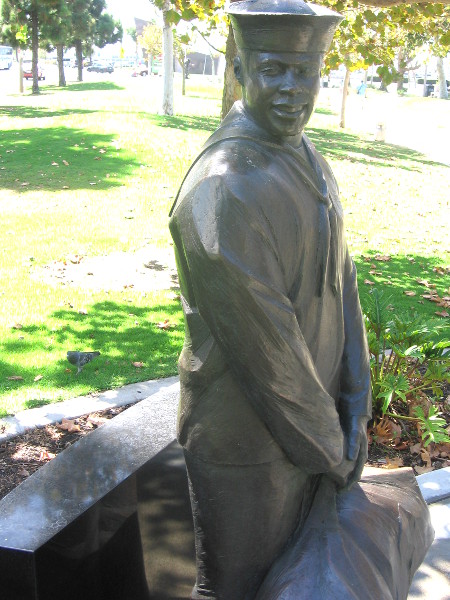
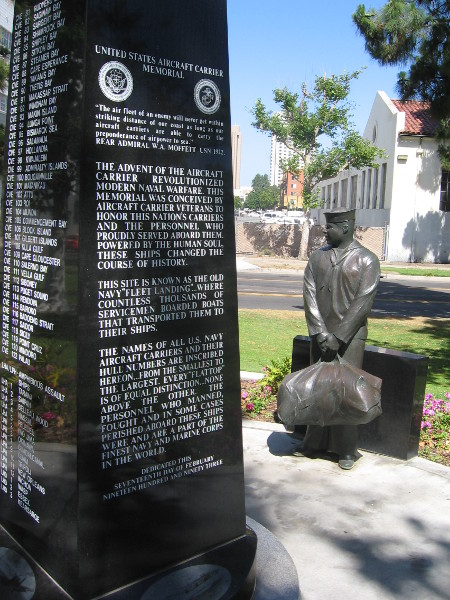
Sculpture of a sailor who served aboard a flattop.Obelisk of Aircraft Carrier Memorial remembers past ships from naval history.
The memorial, whose bronze figures were sculpted by artists T.J. Dixon and James Nelson, contains the following words:
The advent of the aircraft carrier revolutionized modern naval warfare. This memorial was conceived by aircraft carrier veterans to honor this nation’s carriers and the personnel who proudly served aboard them. Powered by the human soul, these ships changed the course of history.
This site is known as the old navy “fleet landing”…where countless thousands of servicemen boarded boats that transported them to their ships.
The names of all U.S. Navy aircraft carriers and their hull numbers are inscribed hereon…from the smallest to the largest. Every “flattop” is of equal distinction…none above the other. The personnel who manned, fought and in some cases perished aboard these ships were and are a part of the finest Navy and Marine Corps in the world.
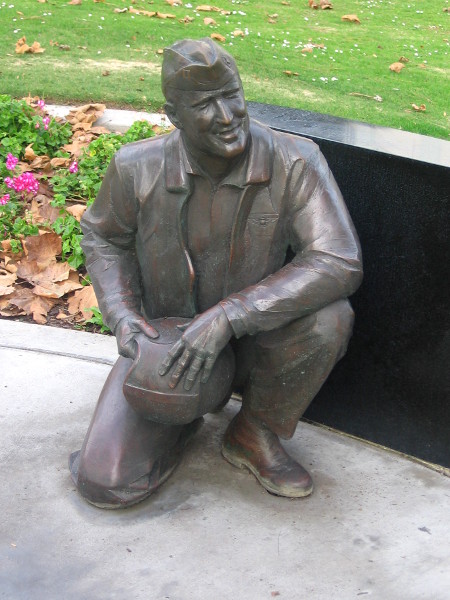
Sculpture of a naval aviator who flew from a carrier.The Aircraft Carrier Memorial can be found on San Diego’s Greatest Generation Walk.
The Greatest Generation Walk is located on San Diego Bay, just south of the USS Midway Museum.
…
To enjoy future posts, you can “like” Cool San Diego Sights on Facebook or follow me on Twitter.
I just received an email from the Port of San Diego. It concerns a blog post I wrote last month about a mysterious Navy plaque on the Embarcadero. The plaque stands near the USS Midway Museum, among other military monuments and works of art on the Greatest Generation Walk.
Here’s the body of the reply, which provides a little more of the history of two interesting plaques:
“The plaque in question, which is on the Harbor Drive side of the stone, is a 30” x 22” cast bronze bas relief that commemorates the 200th anniversary of the founding of the Navy – 1773 to 1973. We don’t have information on the exact date it was created and installed but it was most likely cast and mounted around the time of the anniversary in 1973. The sponsor of this plaque was the U.S. Navy. The images in the plaque include representative ships and planes used by the Navy during its first 200 years. From left to right they include: (1) a sailing warship, probably a frigate; (2) a Civil War era ironclad monitor; (3) a pre-World War I battleship or armored cruiser; (4) a modern (circa 1973) aircraft carrier; (5) a nuclear powered submarine; and (6) two F-4 Phantom jet fighter planes. The plaque also includes a circular rendering of the U.S. Navy emblem showing an anchor and eagle and the words “United States Navy”. There is also an oval shaped emblem that includes an anchor superimposed by the dates 1773 and 1973 and the words “United States Navy – Building on a Proud Tradition.” (See image below, which is also attached.) This plaque was originally located on Broadway Pier at a bench and planter area. After the extensive renovation of Broadway Pier some years ago, the plaque was remounted in its current location near the USS Midway by the Port of San Diego’s General Services department.”
Photo of Navy 200 year commemoration plaque courtesy the Port of San Diego.
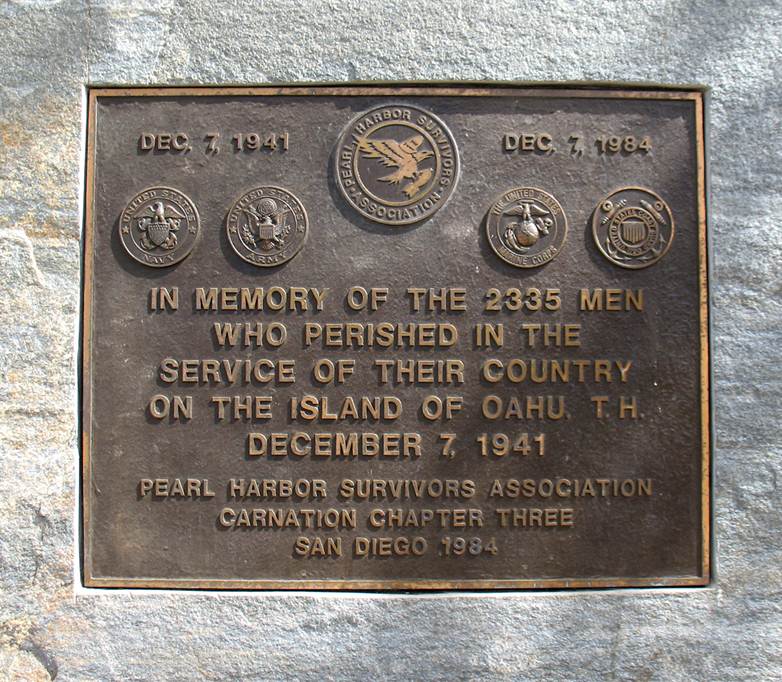
“The Pearl Harbor Survivors plaque, which you mentioned, was also originally displayed on Broadway Pier prior to the above-mentioned renovations. This plaque was sponsored by the Pearl Harbor Survivors Association, Carnation Chapter, San Diego, and dedicated during the Chapter’s annual remembrance ceremony on December 7, 1984. From the image attached and shown below, you can read the inscription on the plaque. The five circular emblems are those of the U.S. Navy, U.S. Army, U.S. Marine Corps, U.S. Coast Guard, and the Pearl Harbor Survivors Association.”
Photo of Pearl Harbor Survivors plaque courtesy the Port of San Diego.
The exact origin of the first plaque still seems a bit mysterious to me. Was it unique to the Broadway Pier? Were more of these plaques created?
Thanks go to the Port of San Diego, who provided the above descriptions and the photographs!
Thanks also go to gpcox, who spent a good bit of time searching for answers to this fascinating mystery!
My name is William Abell and I was an ML3 aboard the USS Ajax AR6 and I helped create this plaque in the ship’s foundry in 1975. I have a certificate from Admiral J L Holloway III commemorating the plaque’s creation and my part in its creation. The date on the certificate is Oct 13, 1975. The plaque was to be a gift to the City of San Diego. I am now a retired police commander living in Monroe WA.
UPDATE!
A subsequent comment has directed my attention to the following information:
I am Molder Chief Petty Officer Jesse G. Lopez USN Ret. The foundry crew from Navy Repair Ship USS Ajax AR-6, created the pattern which was made by Patternmaker Chief Carlos De Santiago USN RET and molded by myself when I was a MLFN. Petty Officer Abell was our Third Class in charge of the molders.
AMAZING UPDATE!
I’ve received detailed information about the plaque, including photographs of its creation and creators! Click here!
…
To enjoy future posts, you can “like” Cool San Diego Sights on Facebook or follow me on Twitter.
Seaworthy replica of galleon San Salvador built by San Diego Maritime Museum.
On my way to the Cabrillo Festival yesterday, I swung by Spanish Landing across from the airport to check out the San Salvador. As you might recall from my blog post from early last December, the San Salvador is a replica of the galleon sailed by explorer Juan Rodriguez Cabrillo in 1542. The San Diego Maritime Museum is building it.
I was surprised to see the cool ship is nearly completed! Check out some pics I took over the surrounding fence! I spoke to a young volunteer who was working near the ship, and she told me the San Salvador is expected to launch in early 2015. The galleon will be sailing up the coast of California, recreating the historic trip by the famous explorer. And a documentary will be filmed during the voyage!
The peculiar-looking vessel will be able to navigate the open ocean, she assured me, and is ready to go today, but the folks building her are doing as much additional detail work as they can while the ship remains on dry land.
Bow modeled after historic galleon sailed by explorer Cabrillo in 1542.Stern of the wooden galleon that will sail on the Pacific Ocean in early 2015.View of the San Salvador and a huge mast from Harbor Drive sidewalk.People on the upper deck of the almost finished galleon.
…
To enjoy future posts, you can “like” Cool San Diego Sights on Facebook, or follow me on Twitter.
Juan Rodriguez Cabrillo discovered San Diego Bay for Spain in 1542.
San Diego’s 51st Annual Cabrillo Festival was held today. Taking place at Ballast Point near the south end of Naval Base Point Loma, the event allowed the public to view a reenactment of Juan Rodriguez Cabrillo’s entrance into San Diego Bay in 1542. Cabrillo, born in Portugal, commanded his voyage of discovery on behalf of Spain, sailing the galleon San Salvador up the west coast of America.
In addition to the colorful reenactment, the festival included a short ceremony, speeches, costumes, National Park exhibits, food and dance provided by various cultural groups, and just a lot of interesting local history. I took some photographs. Here they are!
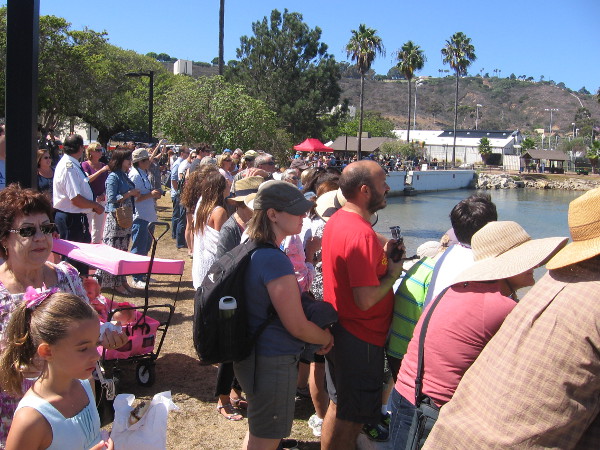
Visitors to the 51st Annual Cabrillo Festival await reenactment of historic event.People gather above the small beach at Ballast Point on Naval Base Point Loma.As people await a rowboat full of reenactors, event commentary is provided.
A short walk out to a point beside the bay provided a view of the San Diego Maritime Museum’s tall ship Californian, which portrayed Cabrillo’s galleon San Salvador.
Tall ship Californian, in the distance, serves during event as Cabrillo’s galleon San Salvador.
I took pictures of two signs by the above fenced archeological site…
Sign at Ballast Point tells about archeological site of old Spanish whaling station.Stones and tiles are remains of an old tryworks oven where whale oil was boiled.
I headed back to the gathered crowd to await the main event…
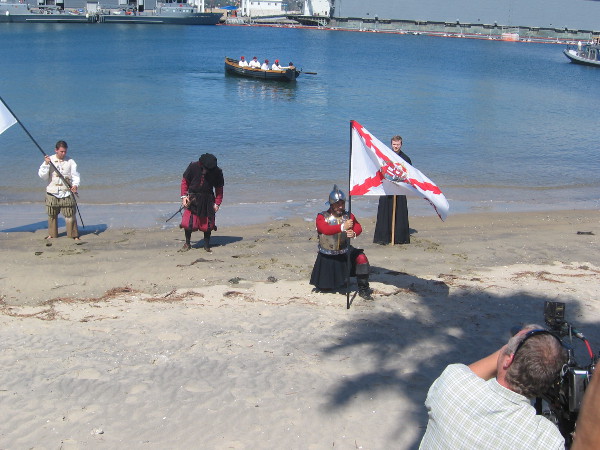
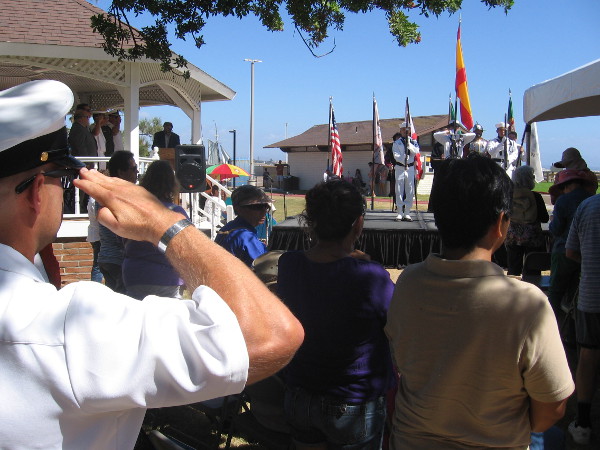
Here comes the rowboat containing explorer Cabrillo, a priest and crew members.People watching this recreation of history are snapping photos like crazy.Cabrillo leaps from the galleon’s small boat onto the shore!Cabrillo in armor raises his sword, while priest with cross stands behind him.Cabrillo now plants a Spanish Cross of Burgundy flag on soil of New World.A proclamation is read on behalf of Spain by Portuguese explorer Cabrillo.Actors depart the narrow beach and head up to join the onlookers.Kids pose with a modern day version of Juan Rodriguez Cabrillo.Many folks in costume were in the big crowd!Navy honor guard prepares for anthems of four nations and a moment of silence.Making an adjustment to costume from the Old World centuries ago.Anthems were played for Spain, Portugal, Mexico and the United States.
In addition to the four national anthems, a moment of silence honored the Native American Kumeyaay, who lived in this area long before Europeans arrived. Cabrillo spent a few days anchored in today’s San Diego Bay, a place he originally named San Miguel. He took on fresh water and traded with the native Kumeyaay people that he met.
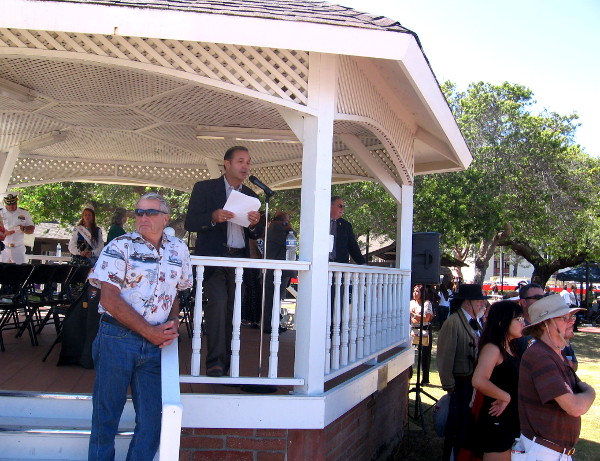
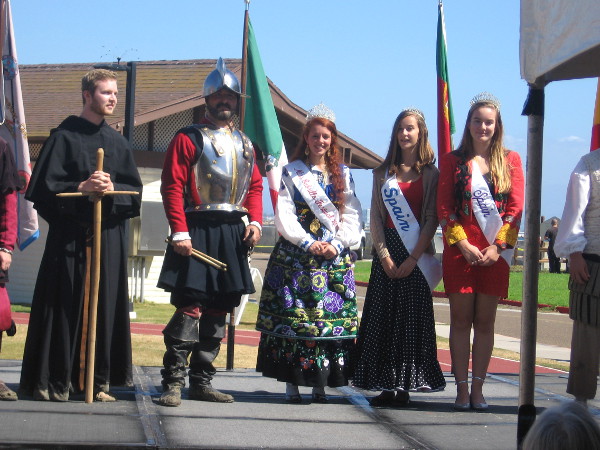
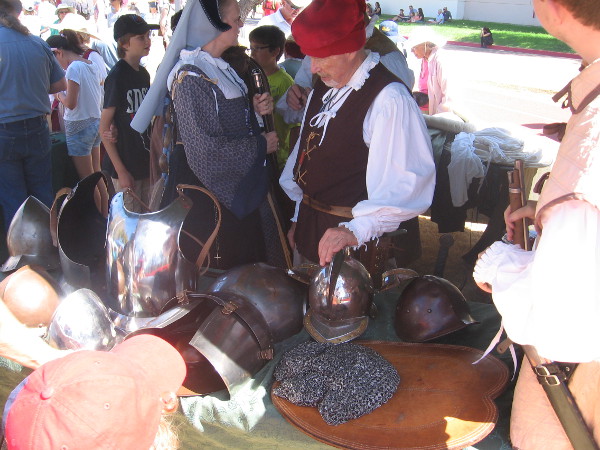
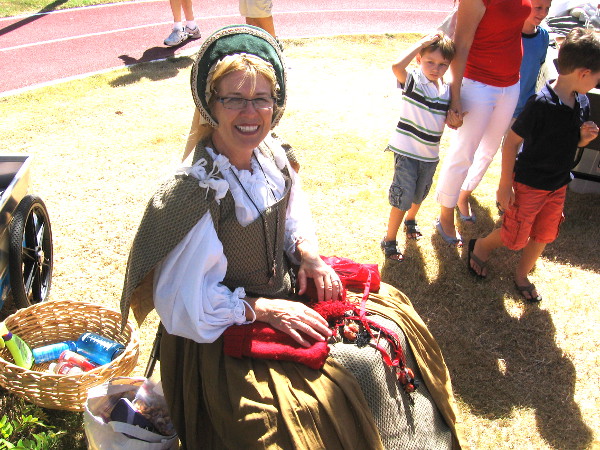
People watch with interest during the short ceremony that included several speeches.Several beauty queens appear on stage and smile for everyone.Exhibits included various parts of Spanish conquistador armor.Small boy tries on a surprisingly heavy steel helmet.Chainmail was being twisted with an apparatus at the end of this table.Biscuits, nuts and an astrolabe are typical items carried on a Spanish galleon.Scouts demonstrate rope making with an interesting machine.Friendly lady was making woolen caps to be worn under those heavy steel helmets!
…
To enjoy future posts, you can “like” Cool San Diego Sights on Facebook, or follow me on Twitter.
Here comes the San Diego Trolley’s cool Silver Line, approaching America Plaza!
Do you love riding on trains? I do! Please take a ride with me on a cool restored streetcar that runs in a circle through downtown San Diego!
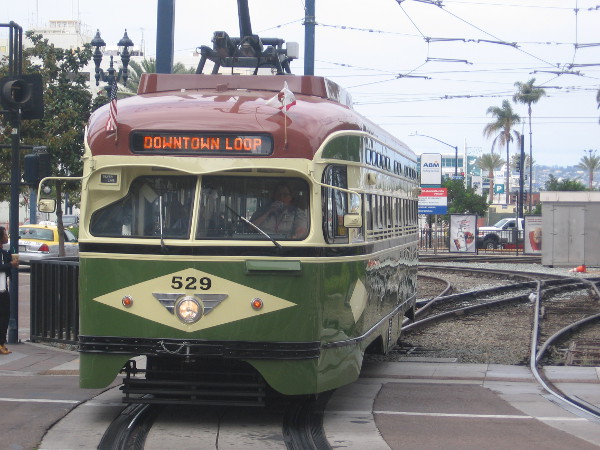
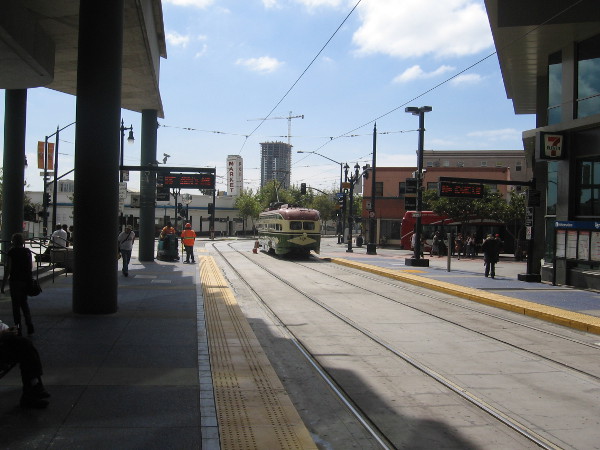
Here comes PCC 529 now, coming down the track toward the America Plaza trolley station! This beautiful President’s Conference Committee car was built in 1945 and is an example of the sort of transportation common throughout San Diego during that era. Streetcars have run through San Diego’s history since the 1890’s. Today they’re making a bit of a comeback with this Vintage Trolley, which runs on a downtown loop called the Silver Line.
PCC 529, before it was lovingly restored by volunteers, sat rusting under some pine trees in South Lake Tahoe. How it got there, I don’t know. But here it comes now, getting closer to the station, so lets tap our Compass cards on the ticket reader and hurry up to hop aboard!
PCC 529 is a meticulously restored President’s Conference Committee streetcar.As we ride down C Street, a modern red trolley is seen on the opposite track.
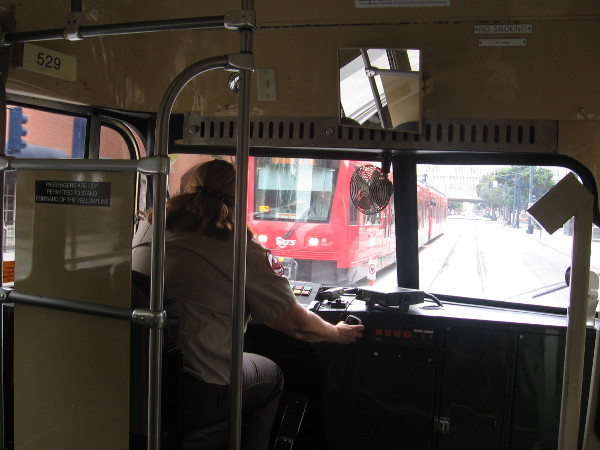
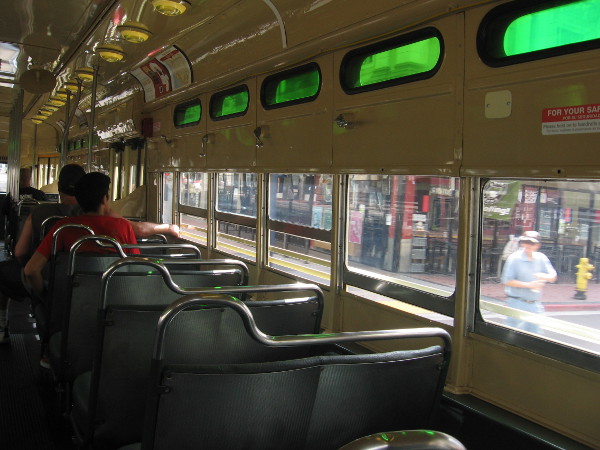
We immediately head up to the front seat to watch the friendly MTS driver pilot this old streetcar down the track. Unlike modern trolleys or light rail, this vehicle really clatters and jerks along and makes you feel like your laboring forward! Whenever the door opens, a bell rings!
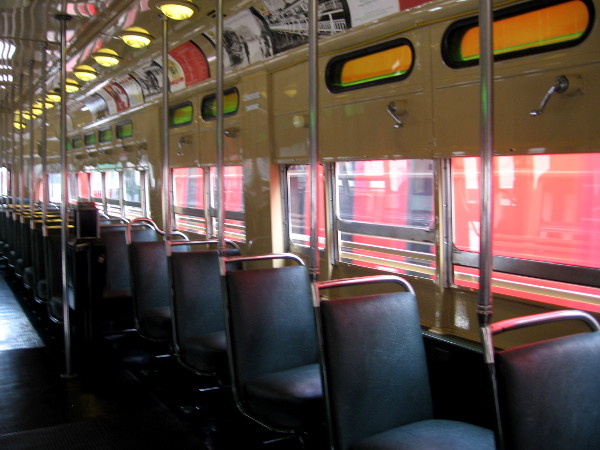
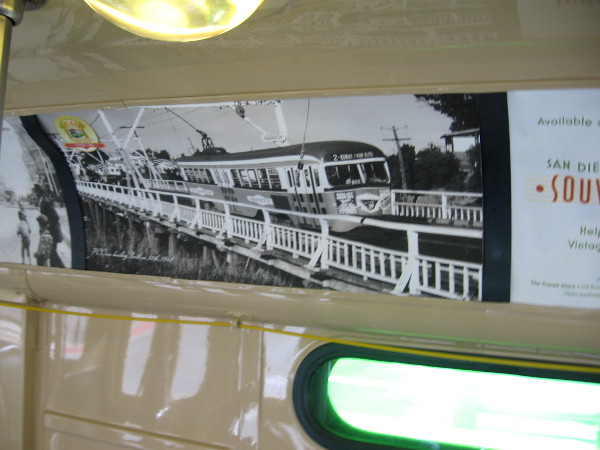
Turning around, we notice the beautiful streetcar appears almost empty at the moment.No, there’s one more passenger looking out the window at downtown San Diego.Images inside the Silver Line show streetcars on San Diego roads and bridges long ago.
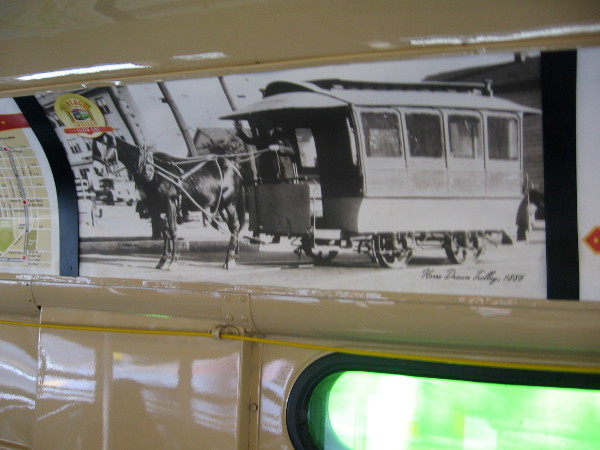
Walking down toward the rear of the refurbished car, we check out some old black-and-white photos. It’s cool to envision the streets of San Diego filled with streetcars over half a century ago!
Here’s an old photo of a streetcar that was pulled by a horse–or is that a mule.Another passenger steps onto the restored trolley at the Fifth Avenue station.
The bells rings, the door opens, and another passenger steps aboard!
These windows open, so riders can enjoy the fresh air outside.
You can dangle your arm out a window if you like, I suppose. It’s fun to just sit and watch the buildings and people flash by. This is what I call riding in style!
As we get off at City College, other folks step aboard the historic streetcar.
Our short ride is over!
I turn around to enjoy another glance at this classic example of public transit.There goes PCC 529. That was one super fun ride!
Thanks for joining me. That was fun!
…
To enjoy future posts, you can “like” Cool San Diego Sights on Facebook, or follow me on Twitter.
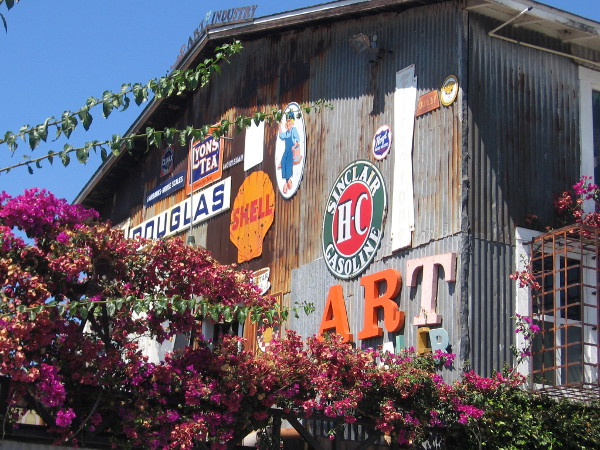
Nostalgic advertising signs recall the past in what is now trendy, modern East Village.
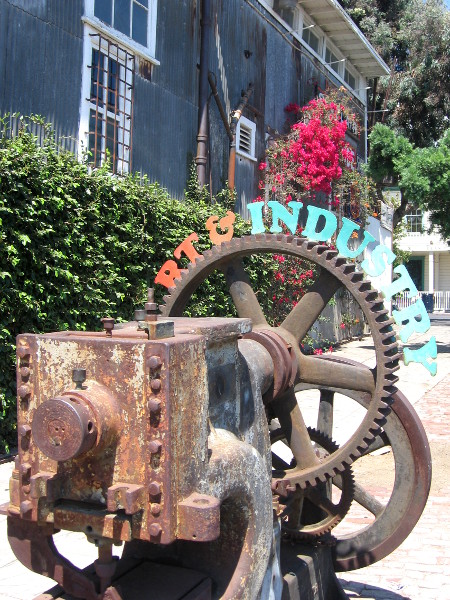
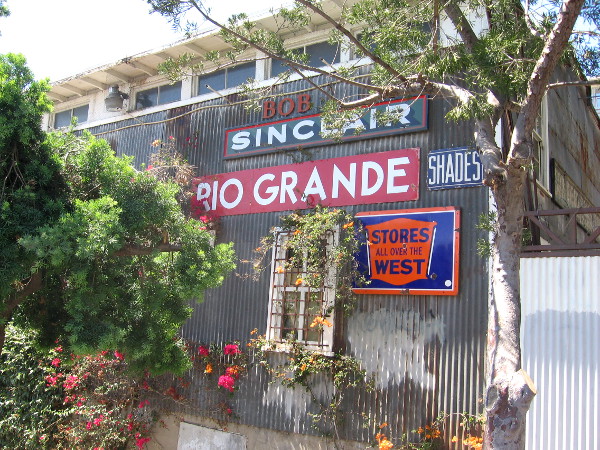
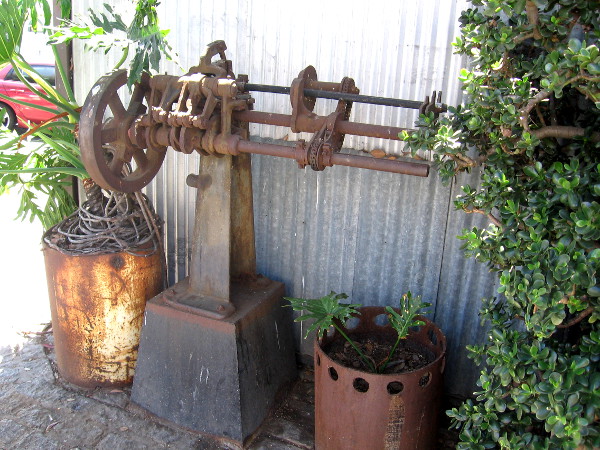
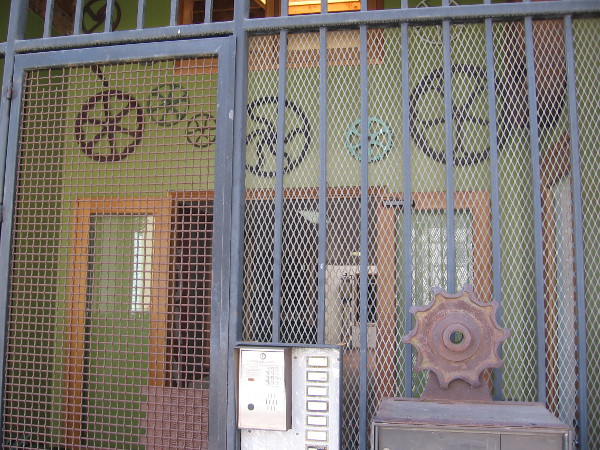
I always enjoy walking along J Street, between Park Boulevard and 13th Street, in downtown San Diego’s East Village. This where you’ll find the old Wheel Works Building, which is now a hip multi-media incubator and special events venue. What makes the place most interesting to me is all the cool and creative stuff that surrounds it! Take a look at these pics!
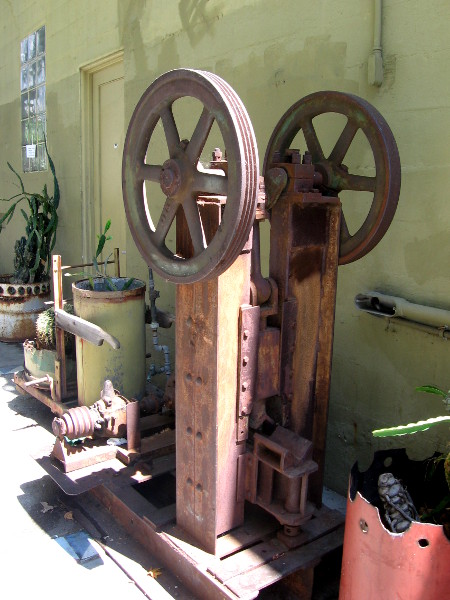
Turning a bit left, gazing over bright red bougainvillea at the new Central Library.Large gears on nearby sidewalk with words Art and Industry.I believe this old structure adjacent to Wheel Works is called the Broom Works Building.Rusted parts of machinery on sidewalk are brimming with potted plants.Front door of Wheel Works Building has lots of cogs and gears around it.I believe 21st Century Bob used to be an antique store here.Various industrial contraptions decorate the outside wall of the old Wheel Works Building. UPDATE! I’ve learned these machines belong to the Bob Sinclair Collection. Bob Sinclair was an entrepreneur and visionary who purchased historic properties in East Village for his business enterprises. He collected many fascinating artifacts. He owned both the Wheel Works and Broom Works buildings.South side of nostalgic old building seen from the San Diego Library.
…
To enjoy future posts, you can “like” Cool San Diego Sights on Facebook or follow me on Twitter.
Corroded plaque shows tallship, ironclad, early warship, aircraft carrier and jets.
I’ve wondered for a long time about this mysterious plaque on San Diego’s Embarcadero. It’s located on the Greatest Generation Walk, right next to the USS Midway Museum, and stands back-to-back with a Pearl Harbor Survivors Plaque which I blogged about here.
Thousands of people walk by this old, corroded plaque every day, but I can find absolutely nothing on the internet about its origin. An image framed by rope includes several vessels, including a tall ship (perhaps the USS Constitution), an ironclad (perhaps the USS Monitor), an old warship with a side-mounted gun, an aircraft carrier, and some jets flying overhead. Words indicate the plaque commemorates the United States Navy’s 200 years of Building on a Proud Tradition. The United States Navy began in 1775 and celebrated its bicentennial in 1975.
Obviously, whoever placed the plaque at this location must know something about its history. But even the Port of San Diego website, where the other monuments on the Greatest Generation Walk are listed and described, says nothing about it!
The slab that it’s embedded in appears very similar to the slab right next to it, containing the Pearl Harbor Survivors Plaque. But I’ve found nothing specific about that plaque, either!
Perhaps someone out there can identify this mystery plaque! What the heck is it? Where did it come from? Help solve this mystery!
Mysterious plaque by Midway Museum commemorates Navy’s 200 year anniversary.
UPDATE!
I received more information about this plaque from the Port of San Diego. Please visit this blog post!
UPDATE!
William Abell wrote the following in the comment section:
My name is William Abell and I was an ML3 aboard the USS Ajax AR6 and I helped create this plaque in the ship’s foundry in 1975. I have a certificate from Admiral J L Holloway III commemorating the plaque’s creation and my part in its creation. The date on the certificate is Oct 13, 1975. The plaque was to be a gift to the City of San Diego. I am now a retired police commander living in Monroe WA.
UPDATE!
A subsequent comment directed me to the following information:
I am Molder Chief Petty Officer Jesse G. Lopez USN Ret. The foundry crew from Navy Repair Ship USS Ajax AR-6, created the pattern which was made by Patternmaker Chief Carlos De Santiago USN RET and molded by myself when I was a MLFN. Petty Officer Abell was our Third Class in charge of the molders.
AMAZING UPDATE!
I’ve received detailed information about the plaque, including photographs of its creation and creators! Click here!
…
To enjoy future posts, you can “like” Cool San Diego Sights on Facebook, or follow me on Twitter.
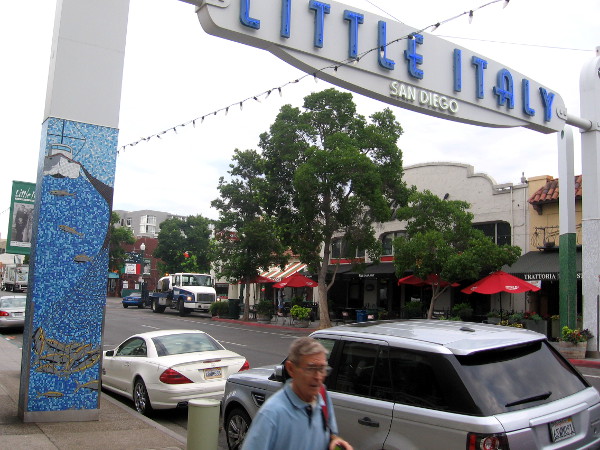
Pedestrian passes Little Italy sign on India Street in San Diego.
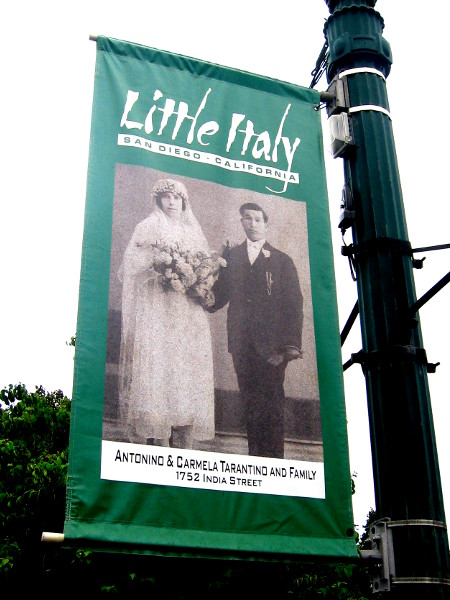
Today, if you were to walk through downtown San Diego’s historic Little Italy neighborhood, you’d probably see a number of very interesting street banners and plaques. These commemorate the Legends of Little Italy.
Early one morning while I walked to a nearby trolley station, I took a few quick photographs along India Street. You might enjoy looking at them. I transcribed much of what appears on the plaques.
Plaque explains the history of the Little Italy Landmark Sign.
The Little Italy Landmark Sign was dedicated and lit at the 7th Annual Little Italy Festa on the evening of October 8, 2000. The landmark sign was constructed as a tribute to this immigrant neighborhood which, until the late 1960s, was the hub of the world’s tuna fishing and canning industry. The nautical theme can be seen in the portholes at the top of the pillars, the blue neon of the lettering and the cable span which holds up the sign. The mosaic tile work on each side of the street tells how this immigrant community is historically tied to the bay, the church and the Italian homeland. This sign is a testament to the preservation of Little Italy’s cultural heritage and to the ongoing revitalization of this dynamic urban ethnic neighborhood in Downtown San Diego.
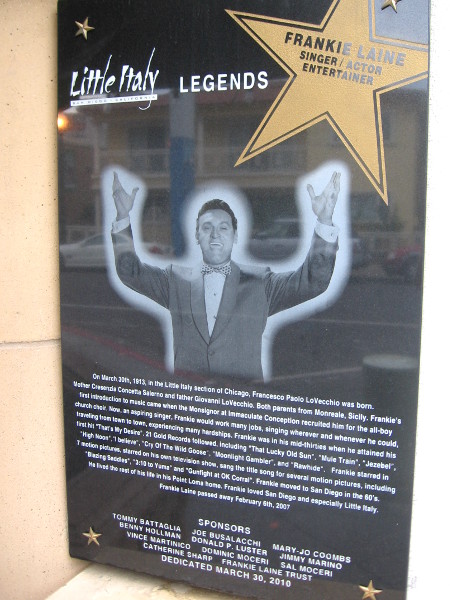
Mosaic tiles show the community’s ties to Italy and traditions.Singing and acting legend Frankie Laine lived in San Diego.
On March 30th, 1913, in the Little Italy section of Chicago, Francesco Paolo LoVecchio was born. Mother Cresenzia Concetta Salerno and father Giovanni LoVecchio. Both parents from Monreale, Sicily. Frankie’s first introduction to music came when the Monsignor at Immaculate Conception recruited him for the all-boy church choir. Now, an aspiring singer, Frankie would work many jobs, singing wherever and whenever he could, traveling from town to town, experiencing many hardships. Frankie was in his mid-thirties when he attained his first hit “That’s My Desire”. 21 Gold Records followed, including “The Lucky Old Sun”, “Mule Train”, “Jezebel”, “High Noon”, “I believe”, “Cry of the Wild Goose”, “Moonlight Gambler”, and “Rawhide”. Frankie starred in 7 motion pictures, starred in his own television show, sang the title song for several motion pictures, including “Blazing Saddles”, “3:10 to Yuma” and “Gunfight at OK Corral”. Frankie moved to San Diego in the 60’s. He lived the rest of his life in his Point Loma home. Frankie loved San Diego and especially Little Italy. Frankie Laine passed away February 6th, 2007.
Tony and Rose Bernadino used to live on Date Street.Tony Bernardini was an Italian immigrant who settled in San Diego.
Tony Bernardini left his native Bari, Italy to sail to America in 1907. He came with little money, but his heart was full of hope and enthusiasm for the opportunities that awaited him in his New World. Passing through Ellis Island, he quickly made his way to San Diego, where he found a climate and a neighborhood that reminded him of the place he had left. Tony took a job with the San Diego Electric Railway Company, maintaining the tracks for San Diego’s extensive streetcar lines. He worked hard, saved his money, and sent for his future wife, Rosa Monteleone, in 1911.
Tony and Rosa married shortly after her arrival in San Diego. They went on to have seven children; Clara, Fred, Lily, Vito, Matha, Nick, and Angelina. With hard work, Tony was able to bring several other members of their families to America to join them. In the early 1930’s, he got an opportunity to buy the building located on this corner from an acquaintance, who offered to finance the transaction for him. He opened the Civic Center Liquor House. Rosa and all of the children helped him run the business. During the first seven years he ran the business, he was only able to pay the interest on the Property’s note. But with the Declaration of World War II in 1941, San Diego’s economy heated up dramatically. Despite the fact that all three of their sons joined the Army to fight in the War, Tony, Rosa, and their daughters continued to work in the business, and by the end of the War, Tony had managed to pay off the note completely. he had achieved the American dream!
The story of love, hard work, and strong family life.
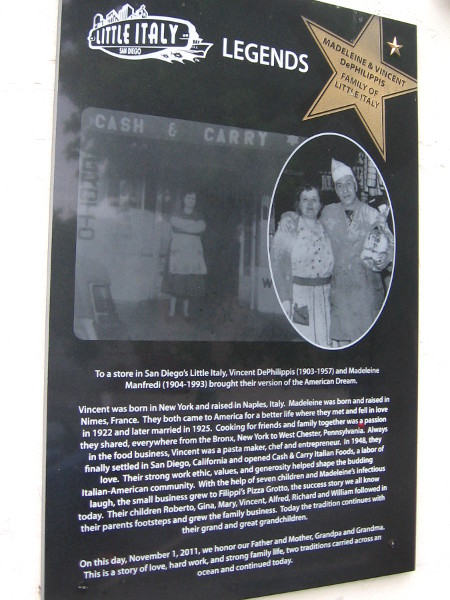
To a store in San Diego’s Little Italy, Vincent DePhilippis (1903-1957) and Madeleine Manfredi (1904-1993) brought their version of the American Dream.
Vincent was born in New York and raised in Naples, Italy. Madeleine was born and raised in Nimes, France. They both came to America for a better life where they met and fell in love in 1922 and later married in 1925. Cooking for friends and family together was a passion they shared, everywhere from the Bronx, New York to West Chester, Pennsylvania. Always in the food business, Vincent was a pasta maker, chef and entrepreneur. In 1948, they finally settled in San Diego, California and opened Cash & Carry Italian Foods, a labor of love. Their strong work ethic, values, and generosity helped shape the budding Italian-American community. With the help of seven children and Madeleine’s infectious laugh, the small business grew to Filippi’s Pizza Grotto, the success story we all know today. Their children Roberto, Gina, Mary, Vincent, Alfred, Richard and William followed in their parents footsteps and grew the family business. Today the tradition continues with their grand and great grandchildren.
Banner on street lamp shows Tarantino family.Past lives become legends in the annals of Little Italy’s history.Morning coffee and companionship on a Little Italy sidewalk.
UPDATE!
During another walk through Little Italy I discovered another fascinating plaque:
Plaque shows Rose and Salvatore Cresci, Family of Little Italy.The story of Rose and Salvatore “Sal” Cresci, Little Italy Legends. (Click photo to enlarge for easy reading.)
UPDATE!
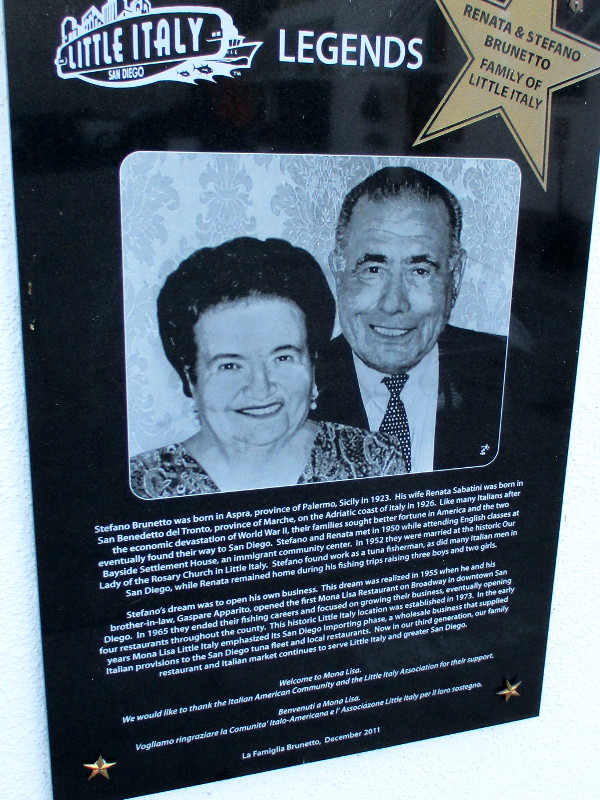
Here come two more signs that I found! The first concerns Pietro and Cristina Busalacchi, Italian immigrants who established restaurants in San Diego. The second concerns Renata and Stefano Brunetto. Stefano, a tuna fisherman, opened Mona Lisa Restaurant with his brother-in-law Gaspare Apparito.
…
To enjoy future posts, you can “like” Cool San Diego Sights on Facebook, or follow me on Twitter.
Public art at Lillian Place shows many facets of African-American history in San Diego.
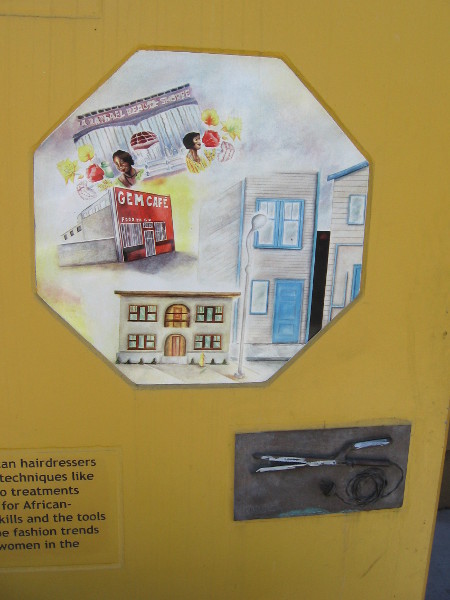
Should you walk through downtown San Diego’s East Village in the vicinity of 14th and J Streets, you might be attracted to several large yellow panels along the sidewalk. This proud display of public art at Lillian Place was raised to commemorate how African-Americans have played an important role in building our diverse and beautiful city.
The artwork, created by Jihmye Collins and Nina Karavasiles, is titled “A San Diego African-American Legacy” and represents African-American contributions to San Diego’s development and rich history.
Cast metal parachute recalls 1943’s Top Black Owned Business in the United States.
Here’s a large portion of the text contained on the panels:
People of African decent were present in San Diego as early as the establishment of Presidio de San Diego in 1769, and played a role in settling the area now known as Old Town.
In the later decades of the 1800s, African-Americans began emigrating to Horton New Town, San Diego’s present-day downtown, relocating primarily from the southern US.
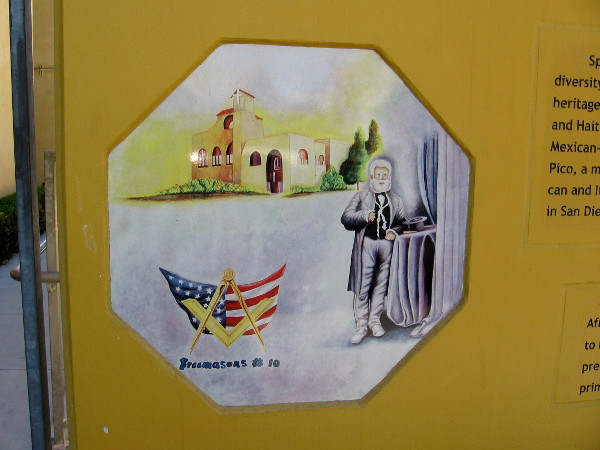
Religious institutions were, and continue to be a cornerstone of the African-American community. In 1887, the African Methodist Episcopal Church became the first organized African-American congregation in downtown San Diego, followed soon after by Calvary Baptist and Bethel AME. At the same time, African-American social and civic groups like the Violet Club, Acme Social Club and Fidelity Lodge #10 of the Prince Hall Masons became important organizations in the community.
San Diego was once the center of a thriving jazz, blues, and gospel music scene. The Creole Palace at the Douglas Hotel and the Crossroads Jazz Club were just two of the spots that hosted local and national talent playing to mixed audiences.
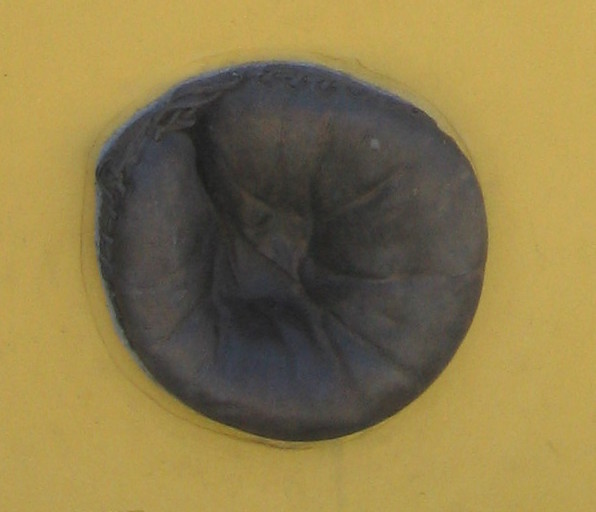
African-Americans have always played a major role in amateur and professional sports in San Diego. Local favorite Archie Moore fought at the city Coliseum as did other champions. San Diegan John Ritchey became the first black player in the Pacific Coast League when he was signed as a catcher to the then minor league padres in 1948.
The entrepreneurial spirit of the African-American community flourished through the 20th century with doctor’s offices, hotels and clubs, barbers and beauty parlors, cafes and restaurants, ice cream parlors, laundries, jewelers and pool halls that served the African American community as well as other San Diegans.
During World War II, African-American stunt pilot and businessman Howard Skippy Smith owned the Pacific parachute Company factory on 8th Avenue. Named the Top Black Owned Business in the United States in 1943, Mr. Smith operated an integrated work place that reflected the ethnic and racial diversity of wartime San Diego.
On this block of J Street, African-American Lillian Grant owned multiple buildings, offering rooms to an ethnically mixed clientele during the time of segregation. Next door at the corner of 14th and J Streets sat the Vine/Carter Hotels. Known as the colored hotels, it was owned and operated by African-Americans Alonzo and Katie Carter from the 1930s to the 1950s.
African-Americans helped to build religious institutions and community organizations.Exact duplicate of baseball catcher’s mitt from the 1940’s made of cast metal.Artwork shows San Diego as an important center of jazz, blues, and gospel music. Count Basie and Billie Holiday both played at the Creole Palace.Hair curling iron is a symbol of many thriving African-American entrepreneurs.
…
To enjoy future posts, you can “like” Cool San Diego Sights on Facebook, or follow me on Twitter.
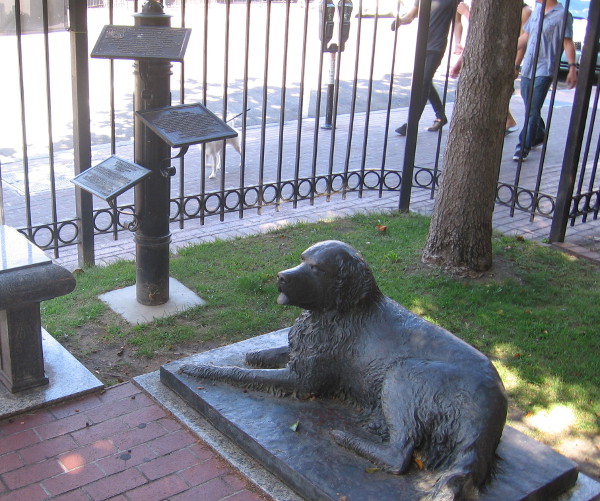
Sculpture of Bum, San Diego’s town dog, in a grassy Gaslamp pocket park.
One of San Diego’s most famous celebrities had four legs and a tail. His name was Bum.
Bum the dog made San Diego his home in the late 19th century. He arrived in town in 1886 by stowing away on the Santa Rosa, a steamship from San Francisco. Soon thereafter, he became the well known town mascot.
Everyone was proud to be Bum’s pal. San Diegans young and old gladly provided food, friendship and their front porches for his sleeping place. Bum helped firemen hurry to fires, led parades, and protected the town’s children. We know this today because James Edward Friend, a journalist, wrote about Bum’s life and famous exploits.
Bum was so popular that one local restaurant put up a sign that read Bum Eats Here. When the city of San Diego passed a law requiring dog licenses, Bum’s picture was featured on the license.
Bum was a free spirit. Nobody owned him. But he had a claim on everybody’s heart. He was given free fare on trains, whenever he decided to come or go. He was given special medical attention when one foreleg became badly mangled in a train accident. He was even given a home at the County Hospital by the Board of Supervisors when his arthritis made it hard to get around. Bum was buried on the hospital grounds after his death in 1898.
Bum’s life has come to represent a small chapter of San Diego’s history, back when today’s downtown competed with Old Town and was called New Town. A bronze sculpture of the famous town dog now occupies a shady pocket park in downtown’s Gaslamp District. You can find the exact likeness of the St. Bernard-Spaniel mix lying on the grass not far from the William Heath Davis House, which is a small museum and the oldest wooden structure in the Gaslamp.
Plaque remembers history of Bum in early San Diego and his legendary exploits.
The nearby plaque reads:
Bum
San Diego’s Official Town Dog
Died November 10, 1898 – Aged 12 Years
Loved by everyone – owned by no one. His name suited him because he arrived as a town stowaway, befriended everyone and “bummed” quality food from the local eateries. As a young dog he survived a scuffle with another dog on the Santa Fe train tracks. Though he lost a foreleg and part of his tail, his spirit was unbroken. He guarded the children, led the parades and fire trucks, and had many adventures. So admired was Bum that the City Council awarded him a lifetime dog license. When he died, children collected pennies for a proper burial.
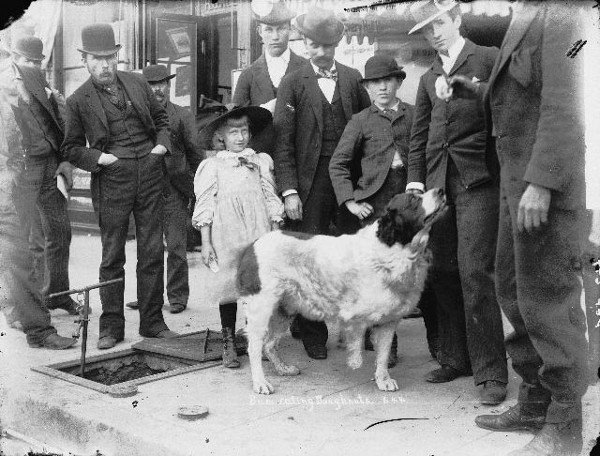
Bum waits faithfully downtown next to the William Heath Davis House museum.Historical photograph shows Bum among his many San Diegan human friends.Greyfriars Bobby, town dog of Edinburgh, Scotland.
Another dog sculpture perched on a nearby bench is of Greyfriars Bobby, the official town dog of Edinburgh, Scotland. The love and loyalty of both legendary dogs is the reason San Diego and Edinburgh are sister cities.
Bum sculpture recalls another rich chapter of San Diego’s history.
…
To enjoy future posts, you can “like” Cool San Diego Sights on Facebook, or follow me on Twitter.



































 Cool San Diego Sights!