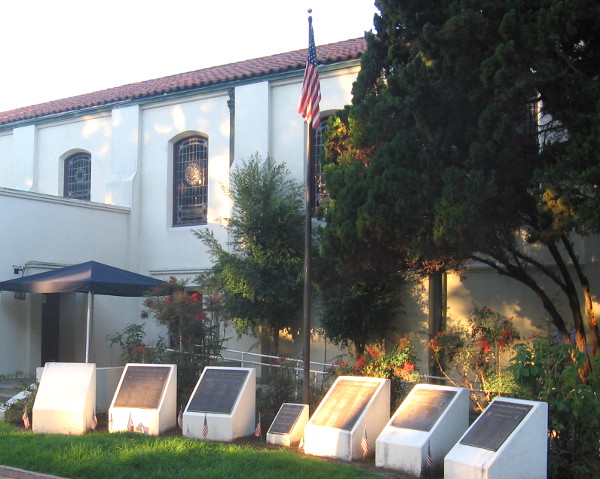
Morning light shines on monument originally called the San Diego Peace Memorial.
A fervent wish for this New Year: May There Be Peace on Earth.
Perhaps it’s futile to expect peaceful human coexistence on this crazy, mixed up planet. It often seems that way. That’s unfortunate. But it would be even more tragic to completely lose hope.
The creators of one poignant local memorial certainly yearned for the end of war. Because they understood war is brutal.
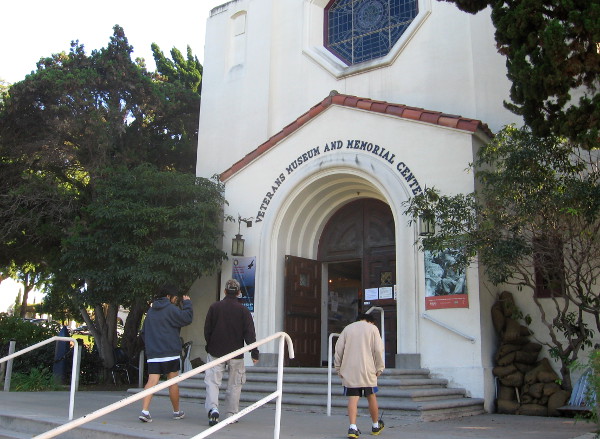
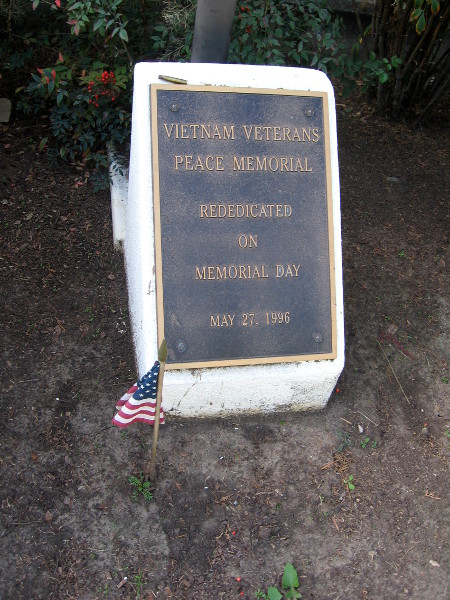
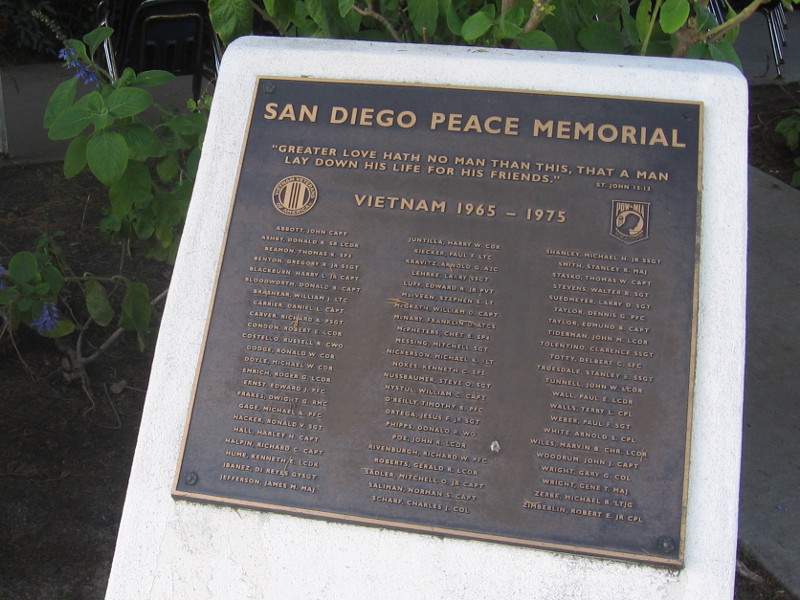
A row of plaques stand on the east side of the Veterans Museum and Memorial Center in Balboa Park. Originally called the San Diego Peace Memorial and installed in Old Town in 1969, the silent monument was renamed the Vietnam Veterans Peace Memorial in 1996 and moved to this location. It lists all San Diegans who were killed or designated missing in action during the Vietnam War.
Today’s Veterans Museum and Memorial Center is housed in the former chapel of the old San Diego Naval Hospital, which was built during World War II. Throughout the history of mankind, wars have invariably reminded us of the sanctity of peace.
In 2015, May There Be Peace on Earth.
People head into the Veterans Museum and Memorial Center in Balboa Park.Vietnam Veterans Peace Memorial was originally located in Old Town.Small American flags remember those who sacrificed in a difficult, controversial war.Names of San Diegans who lost their lives fighting in the Vietnam War, 1965-1975.Flag flies above Veterans Museum, formerly the San Diego Naval Hospital Chapel.
…
To enjoy future posts, you can “like” Cool San Diego Sights on Facebook or follow me on Twitter.
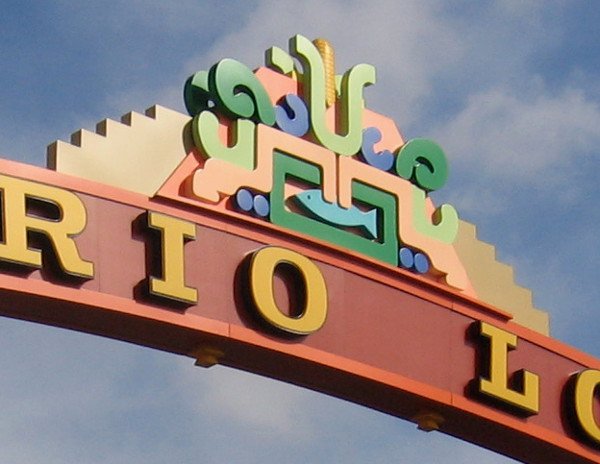
The colorful new Barrio Logan gateway sign arches over Cesar Chavez Parkway.
A little over a week ago, the new Barrio Logan gateway sign had a dedication ceremony. The welcoming sign, arching over Cesar Chavez Parkway between Harbor Drive and Interstate 5, is similar to others that can be spotted in various communities around San Diego. Its design, however, is notably different. The cornice contains a variety of symbolic elements inspired by this neighborhood’s complex history.
The cornice contains a variety of combined symbols that represent the community.One of two displays on either column that explains the design.
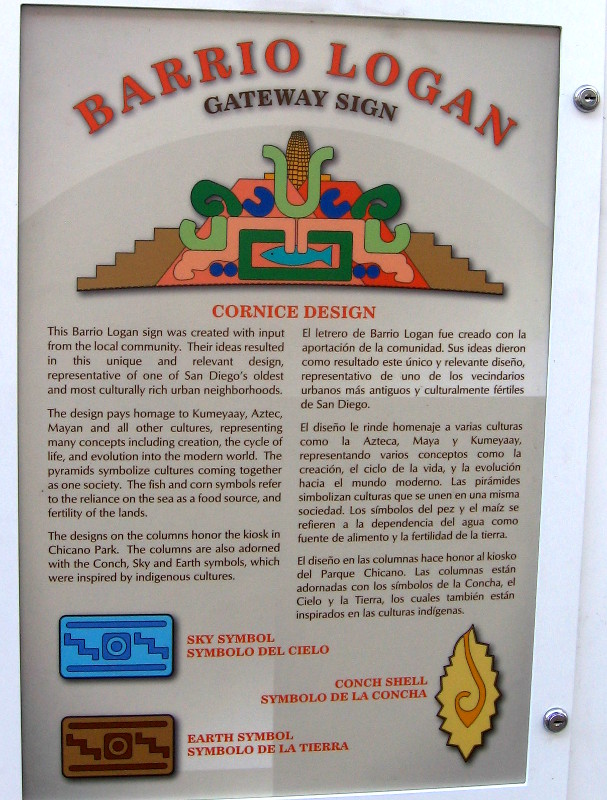
Small displays near the base of each column can be read from either sidewalk. They explain the significance of the cornice design:
“This Barrio Logan sign was created with input from the local community. Their ideas resulted in this unique and relevant design, representative of one of San Diego’s oldest and most culturally rich urban neighborhoods.
The design pays homage to Kumeyaay, Aztec, Mayan and all other cultures, representing many concepts including creation, the cycle of life, and evolution into the modern world. The pyramids symbolize cultures coming together as one society. The fish and corn symbols refer to the reliance on the sea as a food source, and fertility of the lands.
The designs on the columns honor the kiosk in Chicano Park. The columns are also adorned with the Conch, Sky and Earth symbols, which were inspired by indigenous cultures.”
View of the gateway sign as one approaches from the Barrio Logan trolley station.
…
To enjoy future posts, you can “like” Cool San Diego Sights on Facebook, or follow me on Twitter.
Abraham Lincoln, slavery, the Constitution, dissent, the Civil War, and lingering questions.
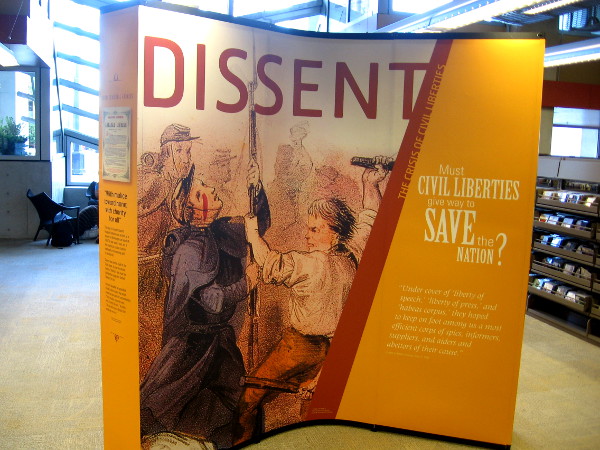
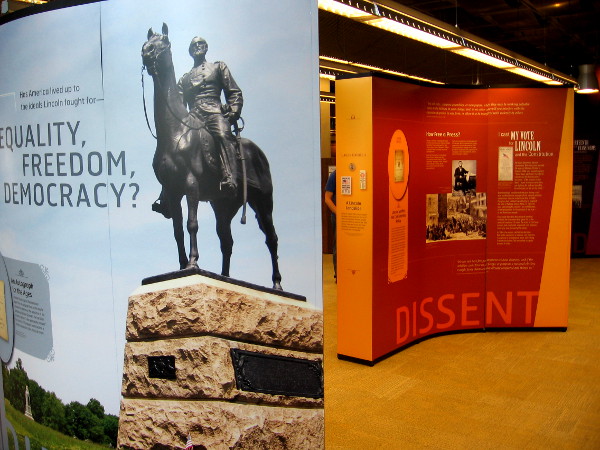
A thought-provoking historical exhibit is currently on display in downtown San Diego’s Central Library. Titled “Lincoln: The Constitution and the Civil War,” the large multi-paneled exhibit outlines and discusses a number of controversial issues that arose during the time of America’s Civil War. The exhibit, which has visited a number of different libraries, was created by the American Library Association and the National Constitution Center.
Old photos and texts help visitors to understand the election of Abraham Lincoln, the secession of the southern states, and the Civil War itself; complex topics that are explored include slavery and the plight of African Americans, the Constitution and state sovereignty, and civil liberties.
If you happen to find yourself in East Village, pop into the library. The large display is on the ground floor and very difficult to miss. The traveling exhibit will remain at this location through January 9, 2015.
Lincoln: the Constitution and the Civil War is on display in San Diego’s Central Library.Meet Mr. Lincoln. The new American president was viewed by some with uncertainty or distrust.People at San Diego’s new downtown public library check out a provocative historical exhibit.The Confederacy attacked Fort Sumter after Lincoln decided to resupply the fortification.Old envelope depicts a boxing match between Lincoln and Jefferson Davis.The Civil War, fought for complex reasons, effectively ended slavery in America.The original Constitution didn’t abolish slavery. It left the matter to the states.Exhibit examines dissent, and Lincoln’s choice to suspend the writ of habeas corpus.Traveling library exhibit asks about the state of equality, freedom and democracy today.It is for us the living…to be dedicated here to the unfinished work.
…
To enjoy future posts, you can “like” Cool San Diego Sights on Facebook. or follow me on Twitter.
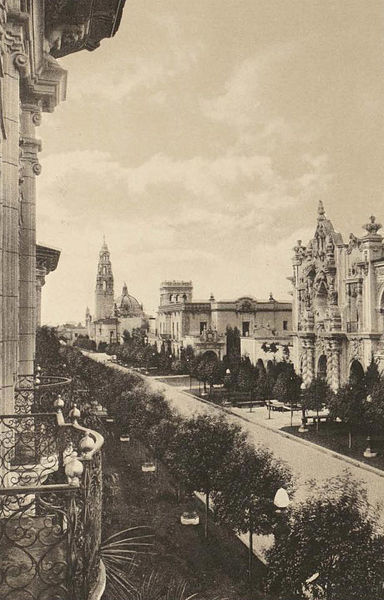
Photograph of the Panama-California Exposition’s La Puerta del Oeste (west entrance) taken from Cabrillo Bridge. The dome and bell tower of the California State Building rise into the San Diego sky.
Balboa Park’s big Centennial celebration is approaching fast! The year-long event kicks off with the opening of December Nights on Friday, December 5th. Later this month, the celebration will continue with a grand New Year’s Eve procession and concert at the Spreckels Organ Pavilion!
The Balboa Park Centennial marks the hundred years that have passed since the opening of the Panama-California Exposition in 1915. While a large open space park near downtown San Diego (originally named City Park) was established in 1872, Balboa Park didn’t really take shape until many years later. Many of the buildings along El Prado which visitors enjoy today owe their existence to the development of the Panama-California Exposition, which covered 640 acres and promoted San Diego as the first United States port of call after a passage through the newly opened Panama Canal. Other parts of Balboa Park were created twenty years later for the California Pacific International Exposition–but that’s a different story.
In honor of the Centennial–now just two days away–I figured I’d post a bunch of historical photographs of Balboa Park as it appeared a century ago. The following black-and-white photos are from Wikimedia Commons, and provide different views of the amazing Panama-California Exposition. I had to do a little detective work with some of the images. Since I’m by no means an expert, please leave a comment if I’ve written captions that require correction.
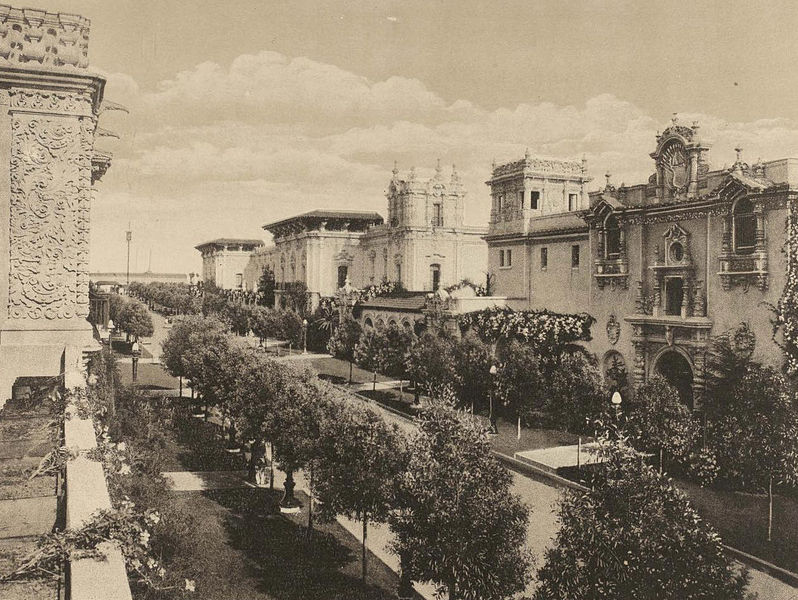
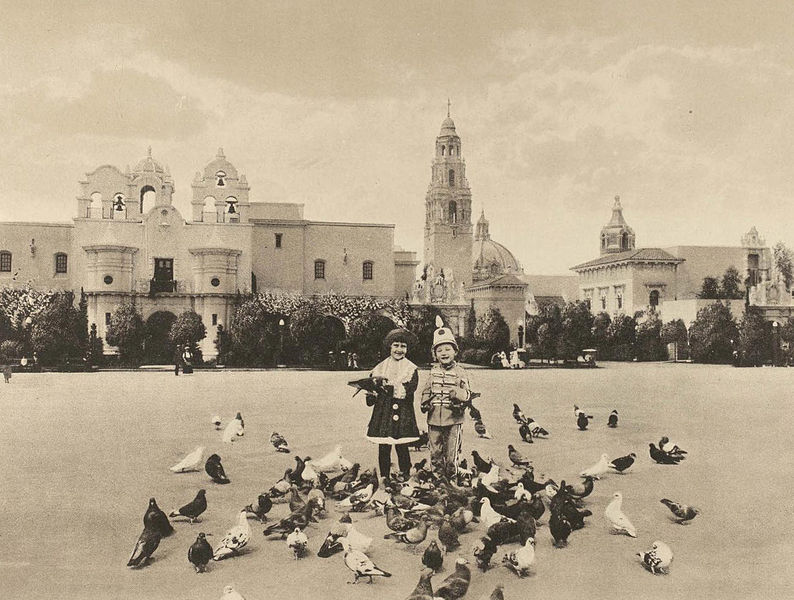
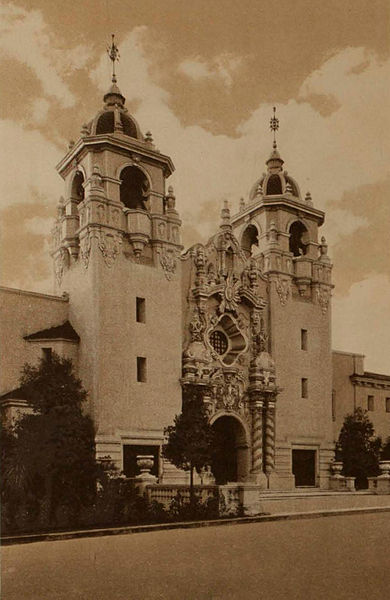
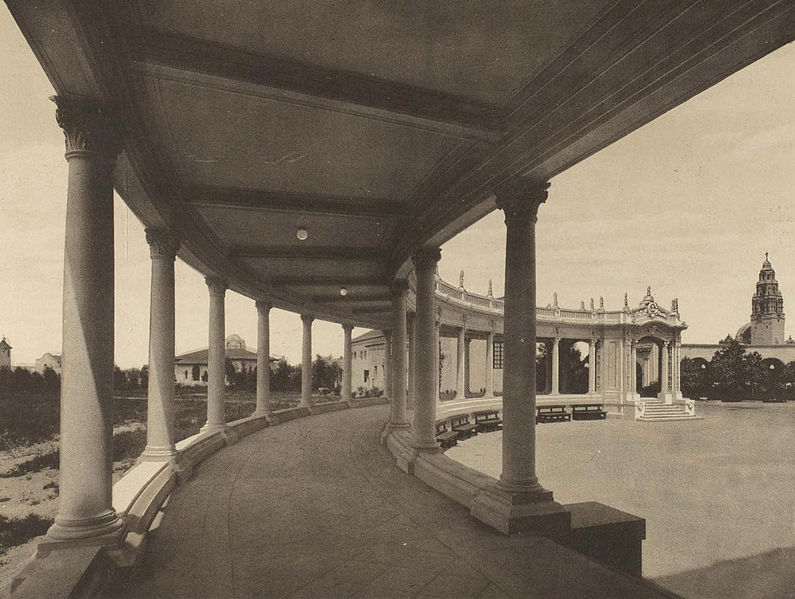
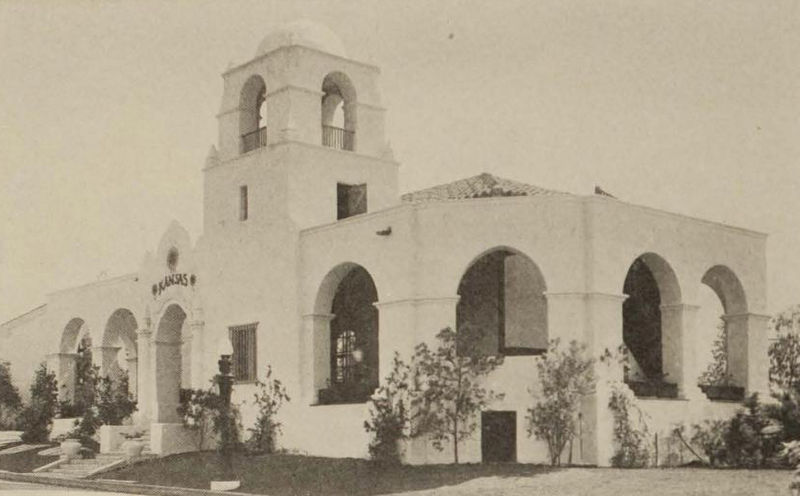
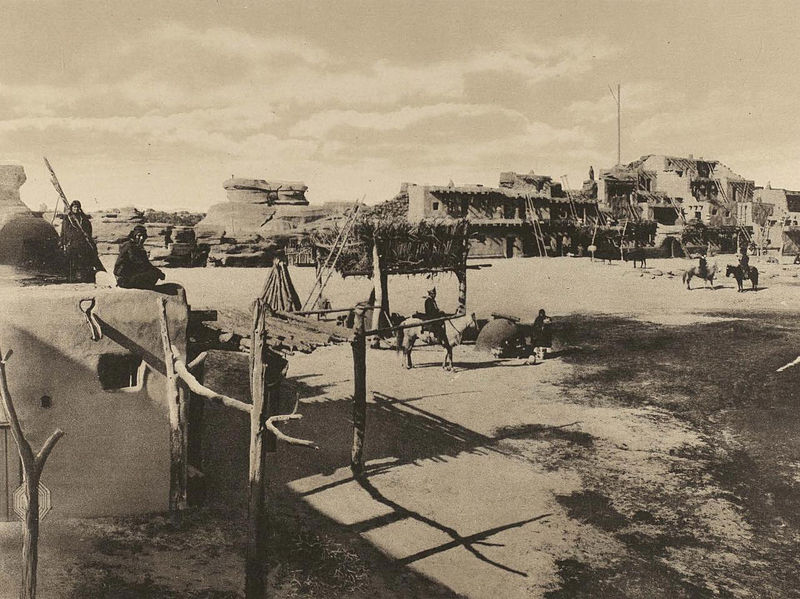
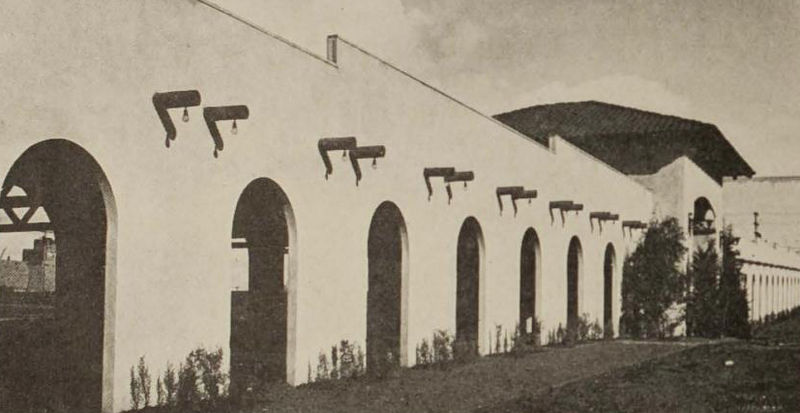
Cover of the 1915 Official Guide Book to San Diego’s Panama-California Exposition. The event celebrated the opening of the Panama Canal, and lasted through 1916.Aerial view from downtown San Diego of Balboa Park’s 1915 Panama-California Exposition. In 1910 San Diego had a small population of only 39,578.La Laguna Cabrillo lake and Camino Cabrillo road beneath Cabrillo Bridge. California State Route 163, a designated scenic highway, runs beneath the historic bridge today.Detailed 1915 map shows Panama-California Exposition ground plan in Balboa Park (originally named City Park).Photo taken of Balboa Park in 1915 from the California Tower provides panoramic view of many exposition buildings designed in the Spanish Colonial Revival architectural style.Looking west along El Prado through the heart of Balboa Park in 1915. At the exposition’s opening ceremony, President Woodrow Wilson activated the electric street lamps with a telegraphic signal.Commerce and Industries Building and Foreign Arts Building stand side-by-side on the south side of tree-lined El Prado. Today, the rebuilt structures are called the Casa de Balboa and House of Hospitality.Commerce and Industries Building. Rebuilt as Casa de Balboa, it’s now home of Museum of Photographic Arts, San Diego History Center, and San Diego Model Railroad Museum.View of shady pergola and the iconic 208 feet tall California Tower from Los Jardines de Montezuma (Montezuma Gardens) in 1915.Los Jardines de Montezuma (today named Alcazar Garden) at Balboa Park’s Panama-California Exposition.Spacious gardens near California State Building’s landmark dome and bell tower during the Panama-California Exposition.U.S. Navy ambulance parked near entrance of the California State Building, today the Museum of Man.Kids feed pigeons on the central Plaza de Panama. The Indian Arts Building with mission bells on left was renamed House of Charm and reconstructed in 1996. It now contains the Mingei Museum.Expansive gardens near the Food Products Building. Today’s enormous Moreton Fig Tree was planted in 1914 near this location.Elegant facade of Food Products Building, which was eventually reconstructed in 1971 as part of the Casa del Prado. It’s now the entrance to the San Diego Junior Theatre.View of La Laguna de las Flores, the reflecting pool (or lagoon) at the Panama-California Exposition. This area was called the Botanical Court.The Botanical Building, then and now one of the largest lath structures in the world. In 1915 its popular name was Lath Palace.Fountain by Botanical Building at the Panama-California Expositon in Balboa Park. The Botanical Court a hundred years later remains largely unchanged.Gazing over reflecting pool at Commerce and Industries Building and Foreign Arts Building. A favorite photographic spot for a century in San Diego.Food Products Building is reflected in tranquil lily pond directly in front of the large lath Botanical Building.View of tree-lined El Prado from second floor of Varied Industries Building, which is now part of the Casa del Prado.Varied Industries Building seen from the west a short distance. Rebuilt as a part of Casa del Prado, today it houses various art and botanical organizations.Home Economy Building (left of Foreign Arts Building), site of today’s Timken Museum of Art. A wicker Electriquette motor cart is visible among people in the Plaza de Panama.Fine photo across Esplanade of the Indian Arts Building, rebuilt in later years and renamed the House of Charm.One of many popular recitals in the Organ Pavilion at the Panama-California Exposition. (This venue is now called the Spreckels Organ Pavilion.)Organ Pavilion colonnade with California Bell Tower in distance. Trees and a large parking lot exist today on the left, behind the classic structure.View of Spreckels Organ in 1915, from a shady spot in the colonnade. Those wooden benches were replaced many years ago with benches made of steel.The distant Organ Pavilion appears in this photo between the San Joaquin Valley Building and the Kern and Tulare Counties Building.Kansas State Building at Panama-California Exposition. Most of these old state buildings no longer exist today, a hundred years later.Montana State Building, near the site of today’s International Cottages.People take a stroll past a handful of state buildings at the Panama-California Exposition in Balboa Park.Utah State Building at the Panama-California Exposition.Washington State Building at the Panama-California Exposition.Artillery practice at the exposition’s U.S. Marine Camp, which was located near the site of today’s Air and Space Museum.Southern California Counties Building, which stood a century ago in Balboa Park at the site of today’s Natural History Museum.Visitors back in 1915 enjoy the Southern California Counties Building’s elegant patio.Large area called the Painted Desert at the Panama-California Exposition. This unique attraction was near the site of today’s Veteran’s Memorial.The elaborate Taos pueblo in the Painted Desert was a fantastic sight at San Diego’s Panama-California Exposition.Realistic exhibit shows Zuni native life at the Panama-California Exposition in San Diego’s Balboa Park.The Pala gem mine was one of the amusements along the Isthmus north of El Prado, near today’s San Diego Zoo parking lot. It featured a 300 foot long tunnel filled with simulated gems.The Cawston Ostrich Farm was an Egyptian pyramid-shaped amusement on the Isthmus, a section of the expo popularly called the fun street.The Japanese Tea Pavilion, northeast of the Botanical Building in 1915. Today, the Tea Pavilion at the Japanese Friendship Garden is located elsewhere and appears entirely different.Citrus and other gardens in a wide north section of the Panama-California Exposition. This is near the entrance of today’s San Diego Zoo.The long Tractor Building was located near a tractor demonstration field, just west of the Painted Desert.California bungalow, surrounded by model farm at the 1915 exposition. Agricultural exhibits and demonstrations were an important part of the event.The Lipton Tea Gardens at the Panama-California Exposition, one more interesting image from San Diego’s rich history.
…
To enjoy future posts, you can “like” Cool San Diego Sights on Facebook, or follow me on Twitter.
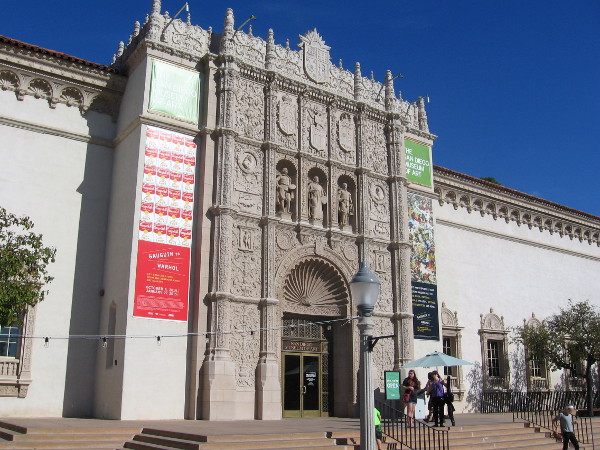
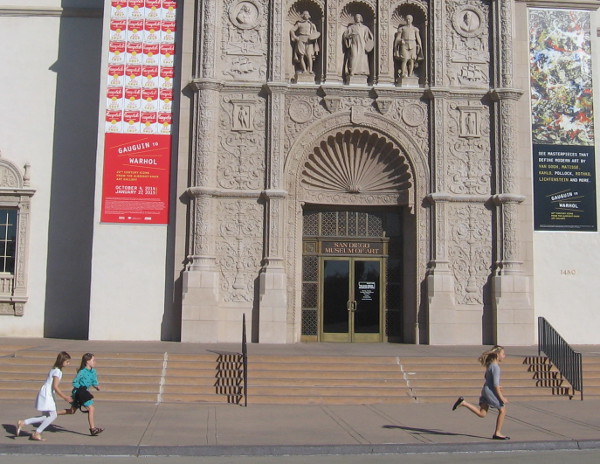
Visitors near entrance to the San Diego Museum of Art in Balboa Park.
Yesterday morning was super special. I was able to experience dozens of amazing fine art masterpieces firsthand!
My friend Catherine Jones, a docent at the San Diego Museum of Art in Balboa Park, very graciously provided me and a friend with a special tour. We were given an in-depth look at the landmark Gauguin to Warhol exhibit, being shown for a limited time in San Diego.
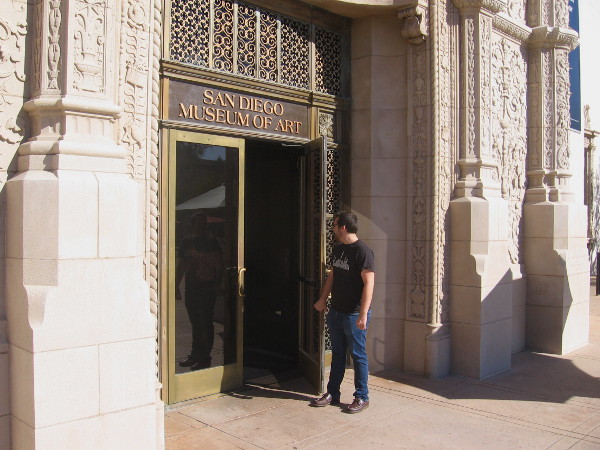
Follow me into the world-class San Diego Museum of Art, and we’ll check out a few of these stunning paintings together!
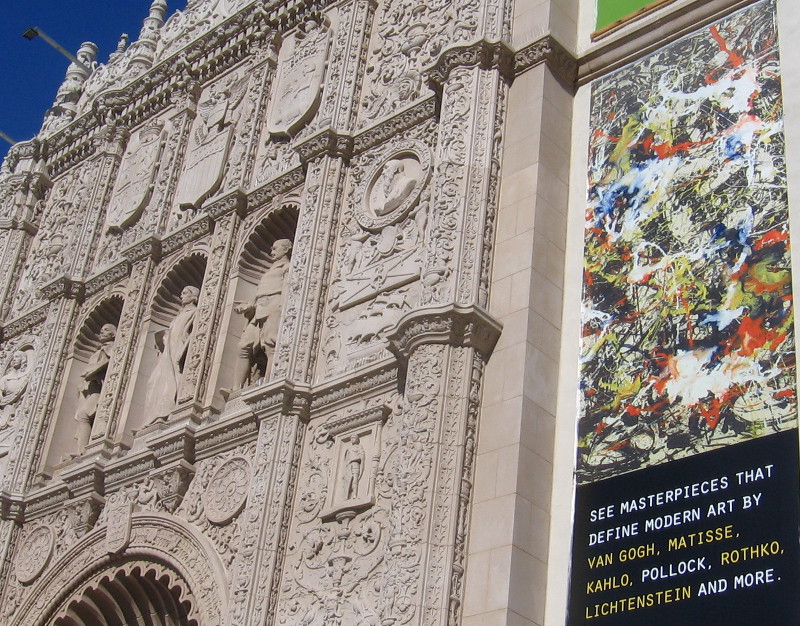
Masterpieces that define modern art by Van Gogh, Matisse, Kahlo, Pollock, and more…Step through this door to see an amazing exhibit of mind-blowing art!
Gauguin to Warhol: 20th Century Icons from the Albright-Knox Art Gallery is an exhibit containing dozens of true masterpieces from many of the world’s most famous modern painters. Artists with important pieces on display include Vincent Van Gogh, Pablo Picasso, Henri Matisse, Marc Chagall, Georgia O’Keeffe, Salvador Dalí, Frida Kahlo, Jackson Pollock and Roy Lichtenstein .
The exhibit is a whirlwind journey through time, progressing from Impressionism in the late 18th Century to Post-impressionism, Surrealism, Abstract Expressionism, Minimalism and finally Pop Art in the 1960s. One can follow the emergence and evolution of major art movements over eight decades–and observe how visual abstraction, experimentation and provocative simplicity took a greater and greater hold on the imaginations of many great artists.
These fantastic paintings all come from the Albright-Knox Art Gallery in Buffalo, New York. San Diego is the exclusive West Coast stop for this traveling exhibition.
(The following descriptions and reactions were formed in my own muddled human brain, and notes were taken only sporadically. I’m not even close to being an art expert, so take everything I say with a very large grain of salt!)
Paul Gauguin. Spirit of the Dead Watching,1892, courtesy the Albright-Knox Art Gallery.
A few steps after we admire a fine example of classic Impressionism, the 1890 Peasants in the Fields by Camille Pissarro, we are stopped in our tracks by a stunning masterpiece by Paul Gauguin. It’s the instantly recognizable Spirit of the Dead Watching, painted in 1892.
Spirit of the Dead Watching was created during Gauguin’s residence in Tahiti. It depicts his young wife Tehura, awakened by a frightening dream. A nightmarish figure with a mask-like face sits at the foot of her bed, seemingly a dark omen.
The bright, gauzy, fine daubs of paint of the earlier Impressionist movement seem to have given way to broad, unabashed swaths of rich color. The elements in this Post-Impressionist image appear two-dimensional; objects depicted seem to have become bold, emotionally colored symbols, rather than more-realistic objects given depth using traditional perspective.
The Spirit of the Dead Watching is both uniquely beautiful and disturbing, not unlike a few of the canvases to come on our tour.
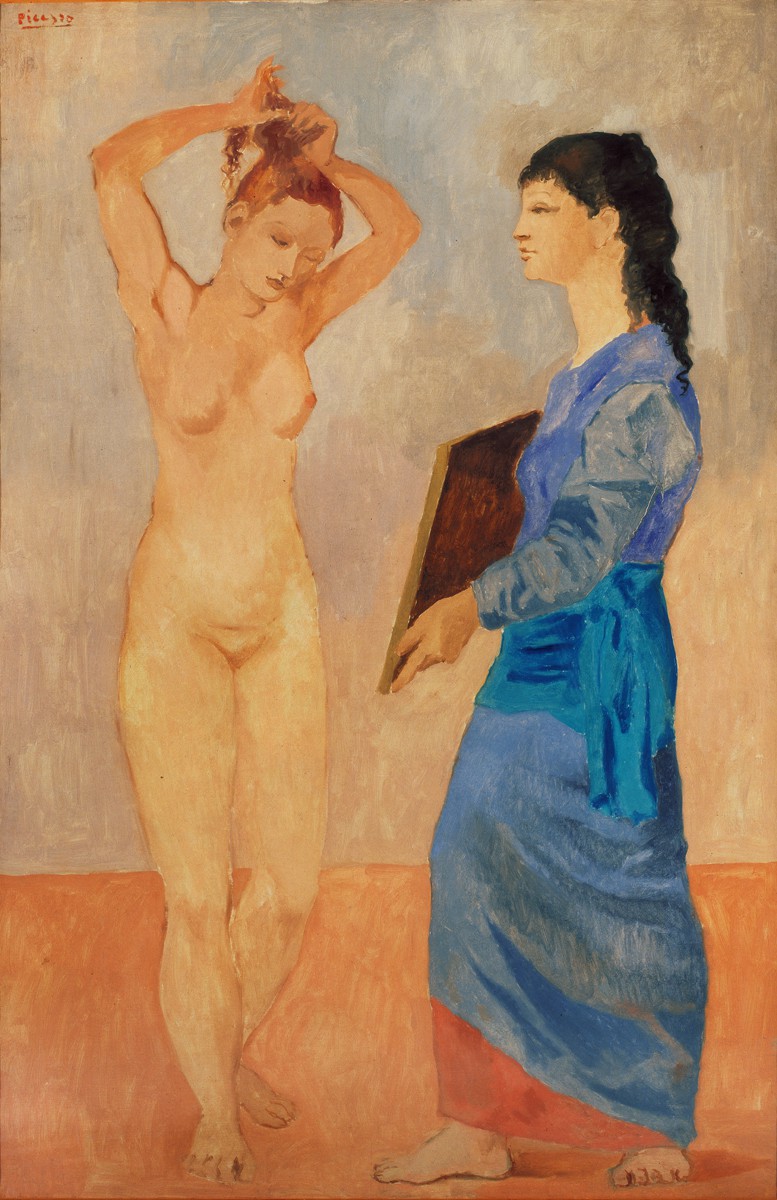
Pablo Picasso, La Toileete, 1906, courtesy the Albright-Knox Art Gallery.
Another few steps and we are looking at Pablo Picasso’s La Toilette, painted in 1906 just before his well-known innovations with Cubism.
The two women depicted are different views by Picasso of the same model. The painting seems to be mostly about lustrous, subtle color and soft, slightly angular shapes. It struck me that fusing the two figures, with their simple faces and forms, would result in a sort of Cubist composite creation. Perhaps we see the gears slowly turning in Picasso’s creative mind.
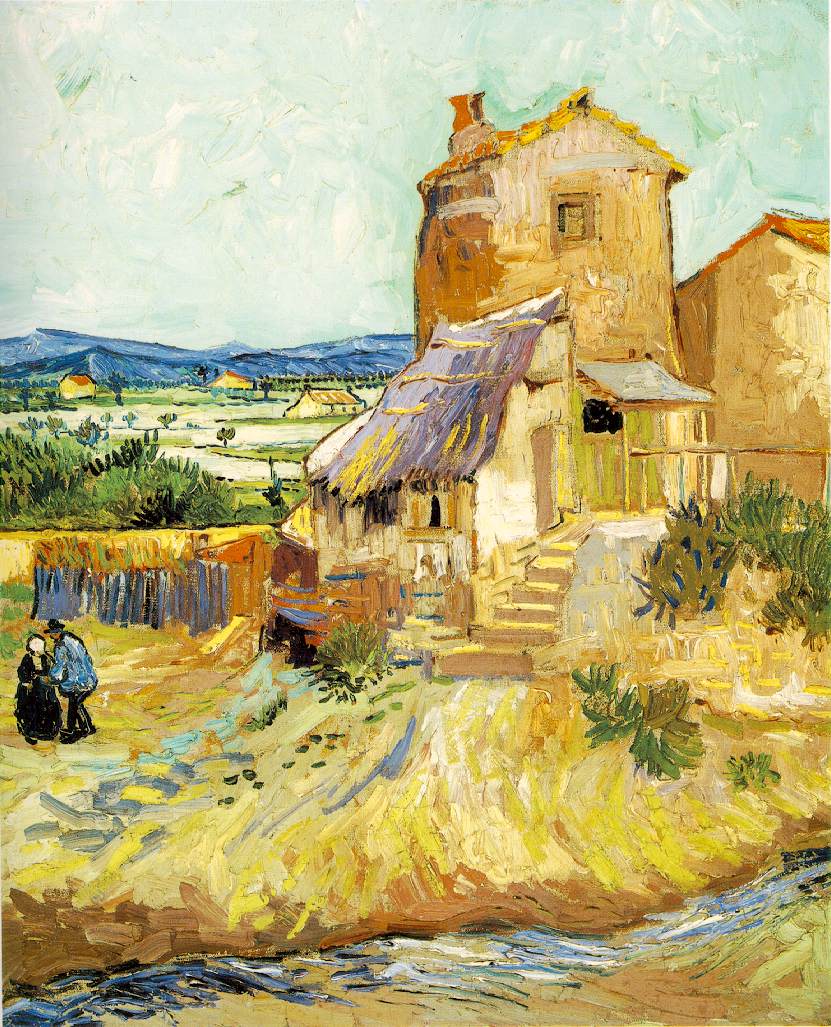
Vincent Van Gogh, The Old Mill, 1888, courtesy the Albright-Knox Art Gallery.
The masterpiece that I enjoyed most–because it’s just so indescribably magical–is Van Gogh’s The Old Mill, from 1888, another fine example of Post-Impressionism. Thick smears of paint and bold brush strokes of light give the painting strange depth and glowing solidity, in spite of its greatly simplified, almost crude representation of a country scene. I felt like I had entered a magical landscape, located somewhere between a gleaming dream and a warm, everyday experience. To me, it’s a piece of art that would never grow old.
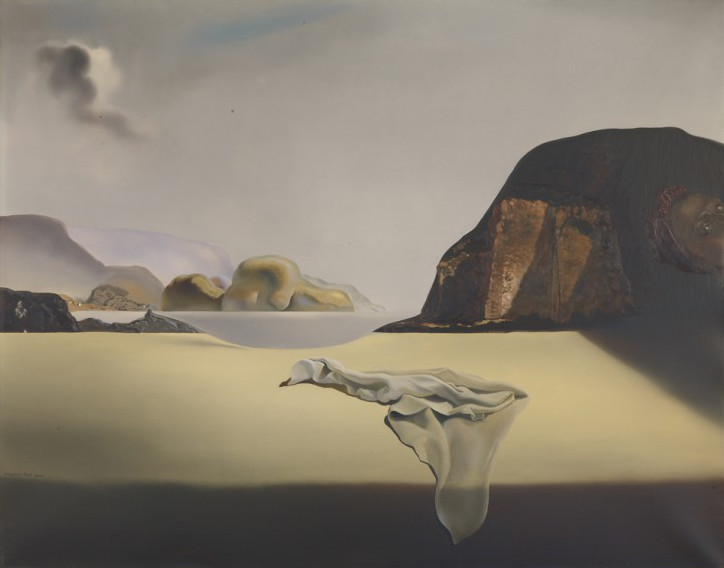
Salvador Dalí, The Transparent Simulacrum of the Feigned Image, 1938, courtesy the Albright-Knox Art Gallery.
Here we see the emergence of Surrealism. And this masterpiece is by the ever popular Salvador Dalí!
The Transparent Simulacrum of the Feigned Image, 1938, is one of Dalí’s most iconic works. It’s mysterious, strange and stimulates thought. What do the various elements in the design represent? Is that a bowl of mashed potatoes with gravy on a table with a napkin, or is that a lake nestled between mountains? The onlooker isn’t quite sure if the painting is primarily fun or symbolic, or a depiction of the unconscious, or sublime reality. Abstraction has surely taken hold of the artist’s vision, as the scene is a complete departure from ordinary experience.
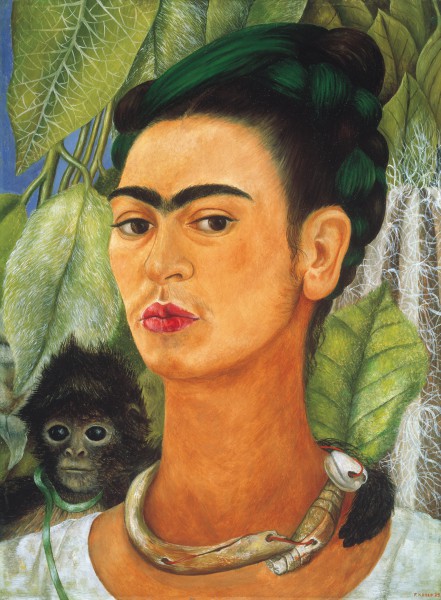
Frida Kahlo, Self-Portrait With Monkey, 1938, courtesy the Albright-Knox Art Gallery.
Mexican artist Frida Kahlo’s impressive Self-Portrait With Monkey, painted in 1938, is said to be Surrealist. To me it appears more like a beautifully colorful Post-Impressionist Gauguin. According to Wikipedia: “Frida rejected the “surrealist” label; she believed that her work reflected more of her reality than her dream.”
Gazing at this one portrait, I understand her assertion. Apart from one canvas in the exhibit, a depiction of fleshy, bloody butchered meat, this painting seems more solidly lifelike and ripe with organic truth than any other work that I recall seeing.
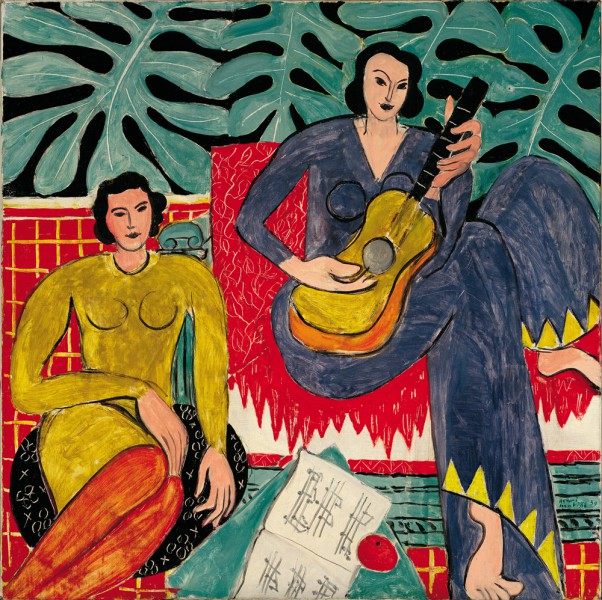
Henri Matisse, La Musique, 1939, courtesy the Albright-Knox Art Gallery.
I also love this one! La Musique, by Henri Matisse in 1939, is the sort of joyful, broadening, invigorating style of art that I personally like. Catherine pointed out that the lady on the left is very prim and composed, but the wild lady on the right is the type you’d want to date! Exactly right! The hands and feet are wonderfully twisted and elongated as if they’re swimming within splashes of swirling color and music!
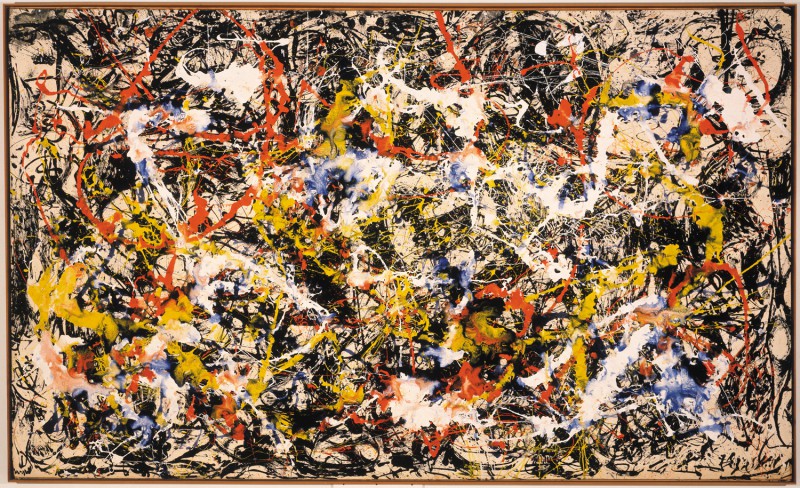
Jackson Pollock, Convergence, 1952, courtesy the Albright-Knox Art Gallery.
Jackson Pollock today is recognized as a master of Abstract Expressionism. His unique drip paintings are unmistakeable. And his Convergence from 1952 nearly covers an entire museum wall!
Okay, perhaps I’m an ignoramus and a dullard. To me this style of painting seems a bit random, cynical, and a thumb in the eye of earlier, more skillful artistic styles. Several of the canvases in this portion of gallery struck me in a similar way. The absurdly huge creations of these famous Abstract Expressionists seem more than experimental–they seem despondent, angry, nihilistic and disillusioned–perhaps a reaction to the massive chaos and inhumanity of two world wars in the early 20th Century. But I do appreciate Pollock’s artful balance, his dynamic strands of color, and the peculiar, imposing beauty that has resulted!
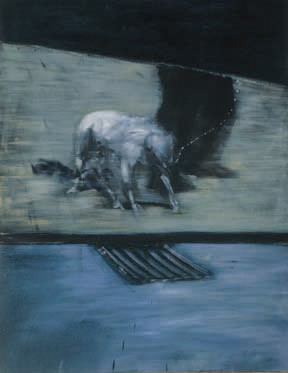
Francis Bacon, Man With Dog, 1954, courtesy the Albright-Knox Art Gallery.
Here’s one painting that is absolutely disturbing. It’s the sort of thing you’d expect to see in a short horror story by Poe, or above the mantle in a cobwebby haunted house! As if penetrating the dark recesses of the human subconscious, Francis Bacon’s unsettling Man With Dog, 1954, seems to portray the bottom of a shadowy figure being resisted by a featureless, spectral hound attracted to a sewer grate. This painting definitely succeeds in bringing out a strong feeling of unfocused loathing. If the aim of art is to stir the emotions, this piece is triumphant!
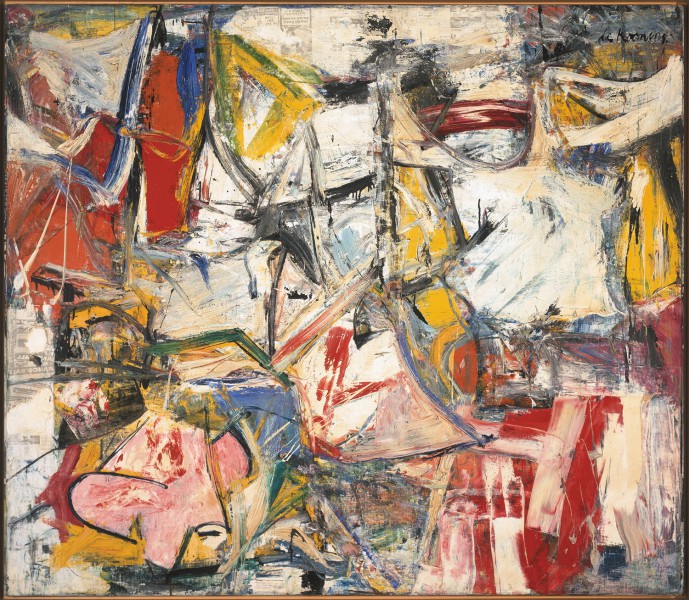
Willem de Kooning, Gotham News, 1955, courtesy the Albright-Knox Art Gallery.
A manic jumble of impulsive, uncertain emotions in two dimensions seems to compose Willem de Kooning’s Abstract Expressionist Gotham News, completed in 1955. Flesh tones and slightly organic shapes are intermixed with the angled, heavy lines of a large city’s architecture, looking to my eye like stained glass put into a blender. Energy and spasmodic randomness seem to convey no clear artistic notion, nor rouse any one particular emotion. It’s just a big mixture of complex energy! Perhaps that was the artist’s intent!
Andy Warhol, 100 Cans, 1962, courtesy the Albright-Knox Art Gallery.
An Andy Warhol response to modernism, his iconic 100 Cans was painted in 1962. Since then, the Pop Art image of multiple Campbell’s Soup cans has spread and mutated throughout the popular culture.
Is this painting a celebration of unrepentant commercialism, or a resigned condemnation? Is he asking the fundamental question: What is art? Or is it just his affirmation that an increasingly technological and global culture has changed life forever, and that art has become something of a commodity? I’ve heard arguments on every side.
The original painting is hanging on a wall at the San Diego Museum of Art! See it for yourself and decide!
The amazing Gauguin to Warhol exhibit runs in San Diego through January 27, 2015.
This truly special, eye-opening exhibit, Gauguin to Warhol, can be enjoyed at the San Diego Museum of Art through January 27, 2015.
It might be a once-in-a-lifetime opportunity to really appreciate these many great masterpieces. If you can, go see it!
…
To enjoy future posts, you can “like” Cool San Diego Sights on Facebook, or follow me on Twitter.
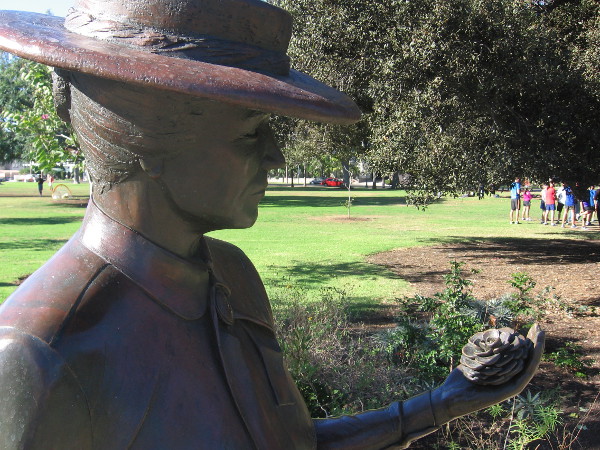
Kate Sessions, the Mother of Balboa Park, holds a pine cone by the grass.
Balboa Park is bursting with cool sights wherever you go. If you’ve ever driven or walked along El Prado a short distance west of the Cabrillo Bridge, you’ve probably seen some slightly larger than life sculptures of people standing on either side of the street. Sefton Plaza, located at the intersection of El Prado and Balboa Drive, is the location of these four bronze sculptures.
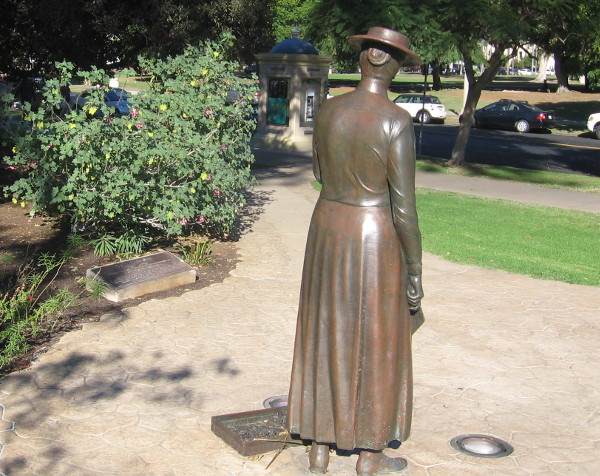
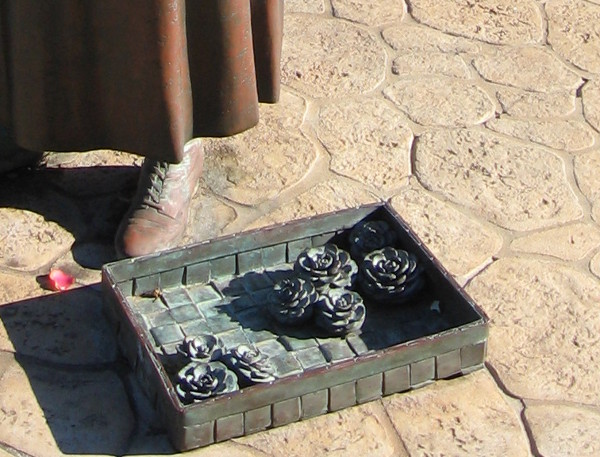
On the south side stands a representation of horticulturist Kate Sessions holding a trowel and pine cone. Often called the Mother of Balboa Park, she was instrumental in creating the park’s many lush gardens and groves of trees. The sculpture stands among a variety of beautiful plants including species she introduced in the early years of the park.
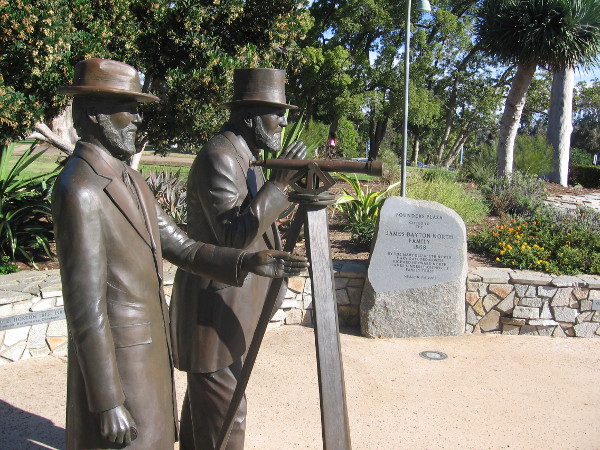
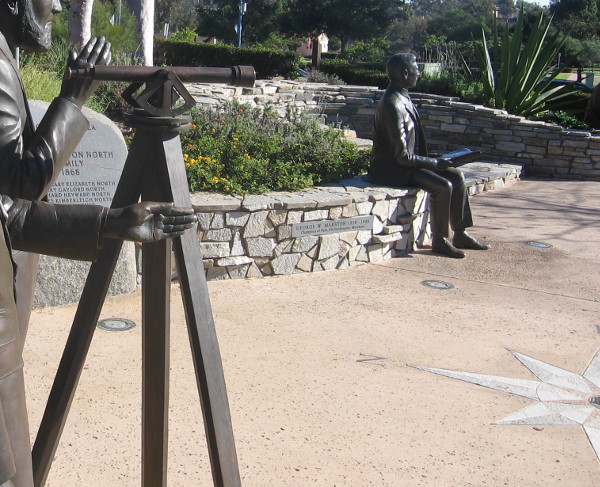
The three lifelike sculptures on the north side of Sefton Plaza, an area called Founder’s Plaza, represent Ephraim Morse, Alonzo Horton and George Marston. These three were the visionaries who orginally conceived Balboa Park, then worked tirelessly to create it.
Ephraim Morse, an early settler and promoter of San Diego, and Alonzo Horton, a land speculator responsible for downtown San Diego’s current location, proposed in 1868 that the new city park occupy 1,400 acres. The sheer size of the park was simply amazing, considering San Diego at the time had a mere 2,300 residents! George Marston, often called the Father of Balboa Park, was a prominent department store owner who personally funded the park’s design. To turn the grand vision into reality, he hired the former superintendent of New York City’s Central Park, Samuel B. Parsons Jr. The park’s construction began in 1903 at the corner of Sixth Avenue and Date Street. (Just a three minute walk from where I live! I love it!)
The four wonderfully realistic bronze sculptures were created by local artist Ruth Hayward. She intentionally made them about 10% larger than life, so they’d appear slightly imposing.
Balboa Park, which began as a grand idea in the minds of just a few people, today is the nation’s largest urban cultural park!
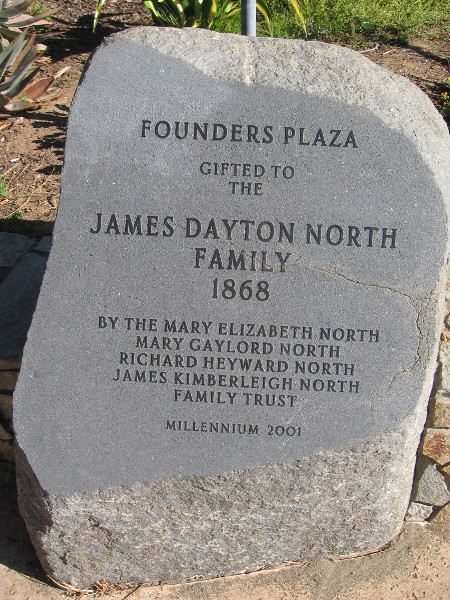
During her life, Kate Sessions created gardens and landscapes for all to enjoy.Kate Sessions lingers on footpath between Cabrillo Bridge and Sixth Avenue.More pine cones fill a shallow box at Kate Sessions’ booted feet.Lifelike sculptures of Ephraim Morse and Alonzo Horton in Founder’s Plaza.Two of Balboa Park’s early advocates survey their awesome creation.Founders Plaza gifted to the James Dayton North Family 1868.Near Morse and Horton, George Marston sits on a wall, enjoying the surrounding beauty.George Marston is remembered today as the Father of Balboa Park.Bronze sculpture sits comfortably next to its hat by a small pool of water.
…
To enjoy future posts, you can “like” Cool San Diego Sights on Facebook, or follow me on Twitter.
New Cisterra building rises behind Tony Gwynn statue at Petco Park in East Village.
As the local economy has improved, I’ve noticed a spate of new construction underway in downtown San Diego. Several skyscrapers are on the rise!
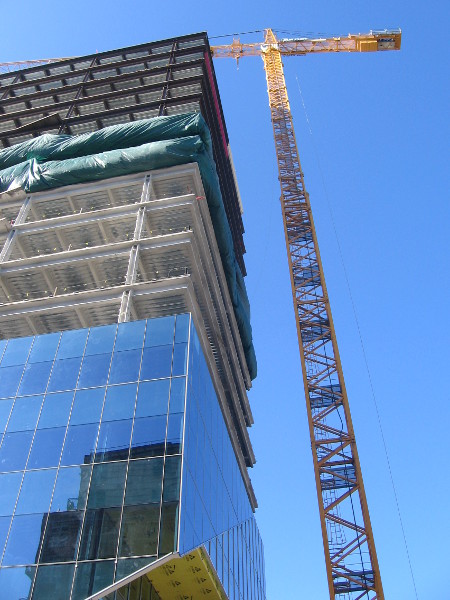
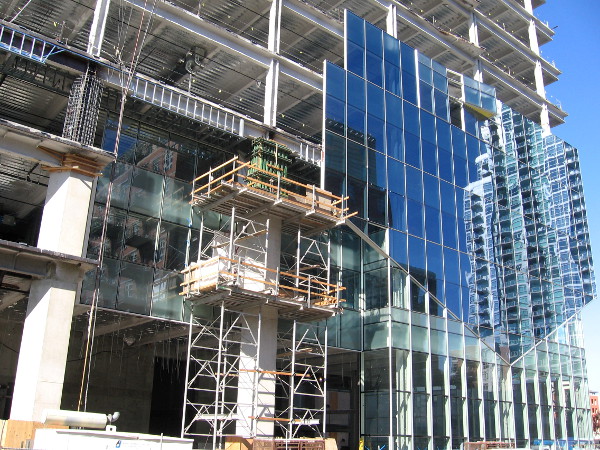
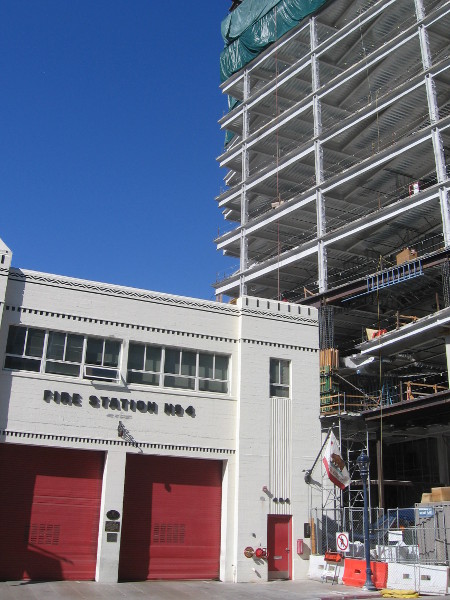
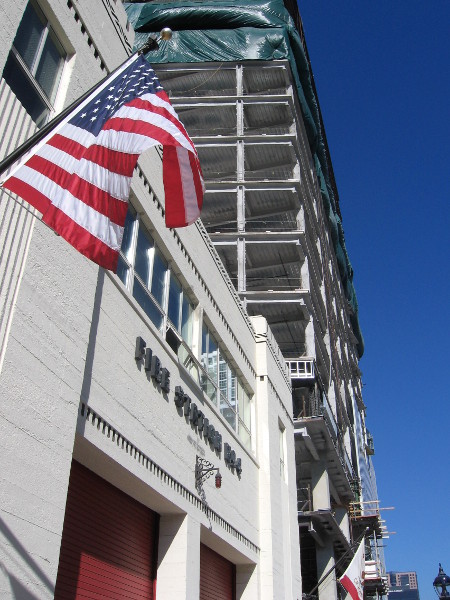
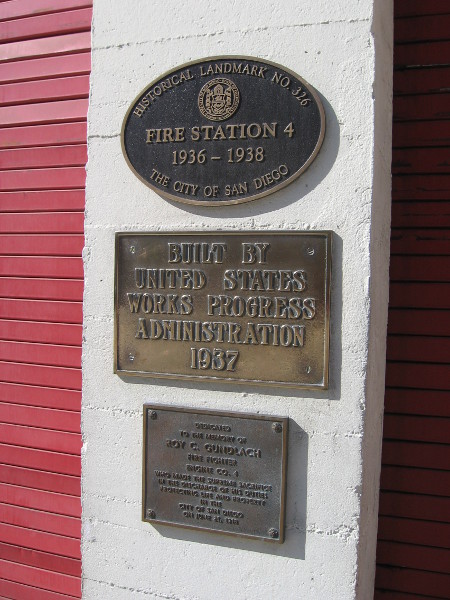
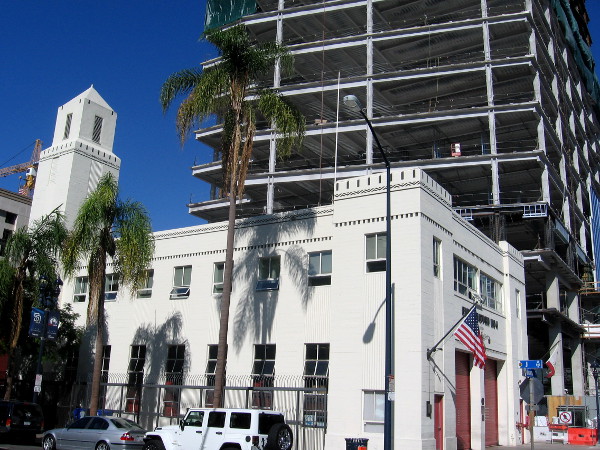
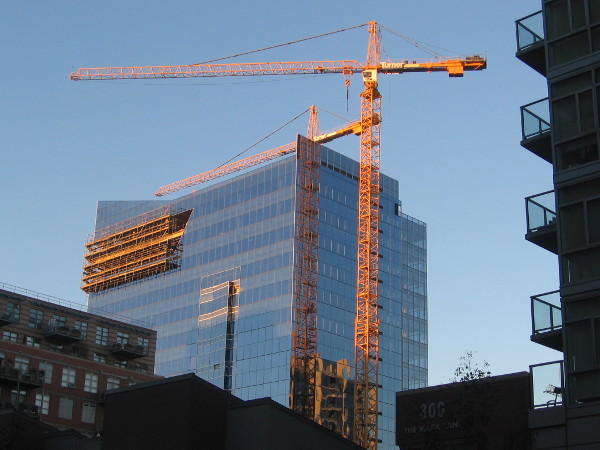
Last weekend I walked past the rapidly progressing Cisterra building which will overlook East Village. It stands just a block north of Petco’s Park at the Park. The future home of gigantic Sempra Energy, the high-rise is being built directly next to one of San Diego’s most interesting old buildings: Fire Station 4. The beautiful little firehouse is San Diego’s oldest, dating from the 1930’s. Once the shiny new skyscraper is completed, the two buildings side-by-side will create quite a contrast!
New skyscraper in San Diego to be headquarters of Sempra Energy.Steel lattice, glass grid and odd reflections make for an interesting photo.Construction of this gleaming high-rise can be observed in downtown San Diego.Stately little Fire Station No. 4 beside new modern skyscraper.This is the oldest firehouse in San Diego, in service since 1938.Fire Station 4, built as a New Deal WPA project, is a designated historical landmark.Beautiful old San Diego firehouse at the foot of what will be a shiny new skyscraper.
Here’s a bonus pic which I took on a morning in early February…
A rising skyscraper shines brightly in the early morning.
…and another I took in March…
Fire Station Number 4 at base of silvery, shiny new skyscraper.
…
To enjoy future posts, you can “like” Cool San Diego Sights on Facebook or follow me on Twitter.
Blacksmith at Fall Back Festival in San Diego’s Gaslamp works the bellows.
Today I checked out a great event in downtown San Diego’s Gaslamp Quarter. Called the Fall Back Festival: the Children’s Historical and Cultural Street Faire, this historical reenactment places visitors in a magical time machine, transporting them back to the 1880’s.
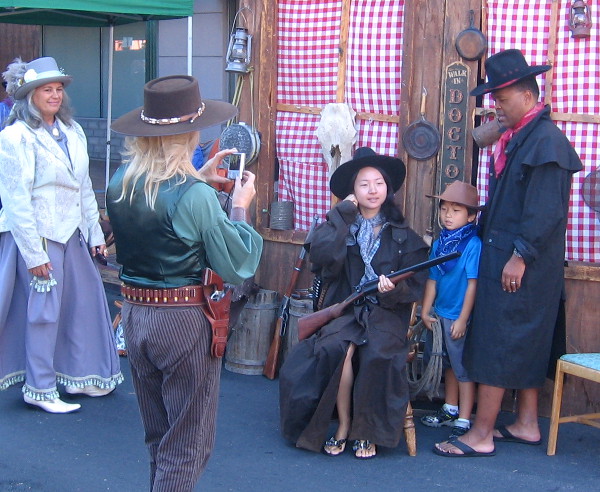
Three blocks of fun included a blacksmith, old western storefronts, pony rides, candle dipping and other educational activities. Many participants wore costumes and clothing from this early period in San Diego’s history. There was also an exciting High Noon shootout–which I unfortunately missed. But I did capture a few pics…
Lady in old-fashioned dress walks with her umbrella past Horton Grand Hotel.
I snapped the above photo as I headed toward the festival. The lady was just walking along through modern, shiny downtown San Diego like an image from the past.
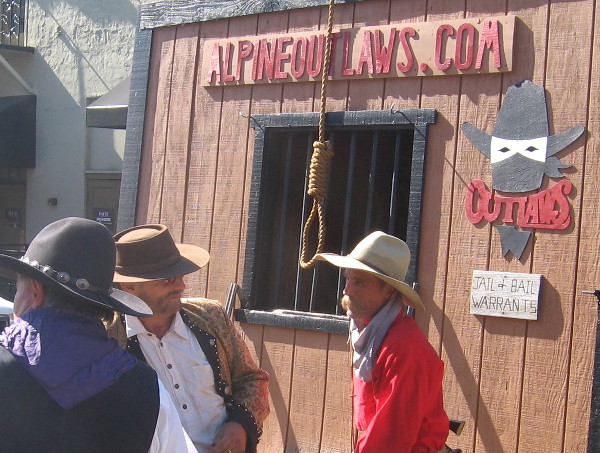
These cowboys, the Alpine Outlaws, have a jailhouse downtown and a hanging noose!
Yikes! The first thing I saw was a bunch of crafty outlaws!
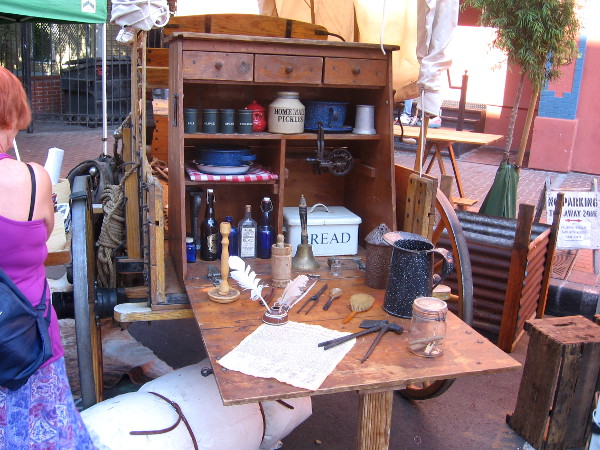
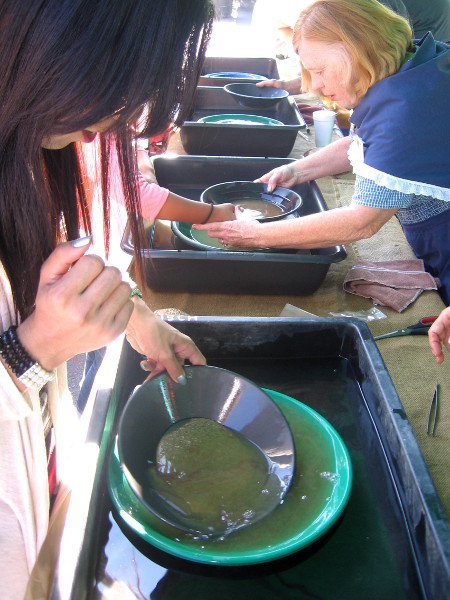
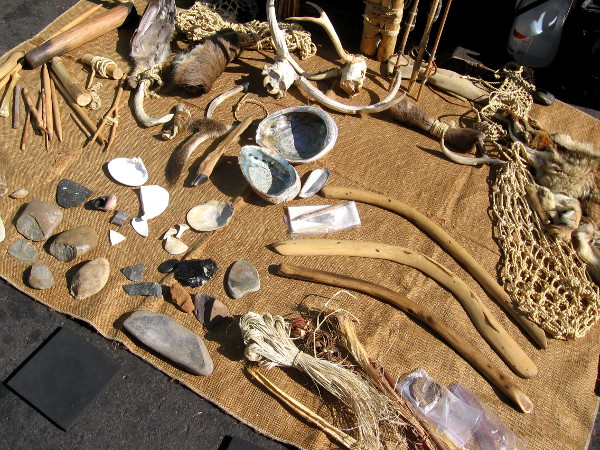
Festival celebrates the diverse and fascinating early history of San Diego.Wood cabinet at rear of wagon is packed with wares typical in 1880’s.A table full of rusty irons from the Old West!Temecula Valley Prospectors had kids panning for real gold.Realistic replicas of Native American tools and weapons were on display.
An interesting guy named Dave, of San Diego Survival History and Fitness, showed me a very cool display. He made all of the above implements and weapons by hand, using materials and techniques that were used by the Kumeyaay and earlier native peoples in the San Diego area. The Spaniards who built their first California Mission in San Diego feared the throwing sticks which you can see in the above photo. Shaped like a boomerang, they had the power to easily bring down a deer!
Historical exhibit has photos of Japanese settlers and community in San Diego.San Diego Model A Club had a row of old automobiles at the Fall Back Festival.Of course, there was live country western music for the crowd to enjoy!
…
To enjoy future posts, you can “like” Cool San Diego Sights on Facebook or follow me on Twitter.
The facade pipes of the Spreckels Organ have been removed to be refurbished.
Those who attended last Sunday’s free concert at Balboa Park’s Spreckels Organ Pavilion enjoyed a once-in-a-lifetime experience.
According to Dale Sorenson, Co-Curator of the Spreckels Organ, this is the first time he’s seen San Diego’s historic outdoor organ without the facade pipes. These big pipes, which interfere with the sound from the organ’s many other interior pipes and instruments, have been removed temporarily. They are in the process of being gilded–not with gold leaf, which is very expensive and a long tedious process, but with mica. The renovation is in preparation for the Balboa Park Centennial celebration. A very special concert will be presented this New Year’s Eve, on the organ’s one hundredth birthday!
Without the facade pipes, last weekend’s concert was heard at full power! Among the majestic pieces played by San Diego Civic Organist Dr. Carol Williams were Toccata, Symphonie V by Charles-Marie Widor, Prelude in B minor, BWV 544 by J. S. Bach, and Te Deum by Charles Tournemire.
Here are some behind the scenes photos of the organ, from outside and from within!
The facade’s temporary removal allows a very rare look at the interior pipes.Mechanical instruments now visible include cymbals, gong and snare drum.Civic Organist Dr. Carol Williams before once-in-a-lifetime concert with booming sound!People line up near gift shop to see and hear organ up close during the concert!Entering the organ pavilion building where offices, displays and the instrument reside.A hallway contains dozens of historical photos of concerts, organists and Balboa Park.Visitors can often go inside after the free 2 o’clock Sunday concerts.Heading up west stairs to see and hear the pipes and complex organ workings.Looking behind where the facade pipes are usually located.Looking up we see swell shutters and a big bass drum!Turning to the right we find even more ranks of pipes.Cluster of long and short pipes seen from east side of organ.Banners and informative exhibits in stairwell on east side of building.Visitor checks out display inside organ pavilion building.Opera star sings at crowded pavilion during memorial service for President Harding in 1923.Mice near pipes comment that all hell breaks loose on Sunday!Albert Einstein in front of Spreckels Organ in 1930.1915 photo of John D. Spreckels on Electriquette wicker cart among pigeons in Balboa Park.Demonstration of how air pressure affects the pipe organ’s action.2005 bust of John D. Spreckels by sculptor Claudio D’Agostino.1915 San Diego Union newspaper announces America’s First Out-Of-Door Organ.Looking out onto the stage from inside.
…
To enjoy future posts, you can “like” Cool San Diego Sights on Facebook or follow me on Twitter.
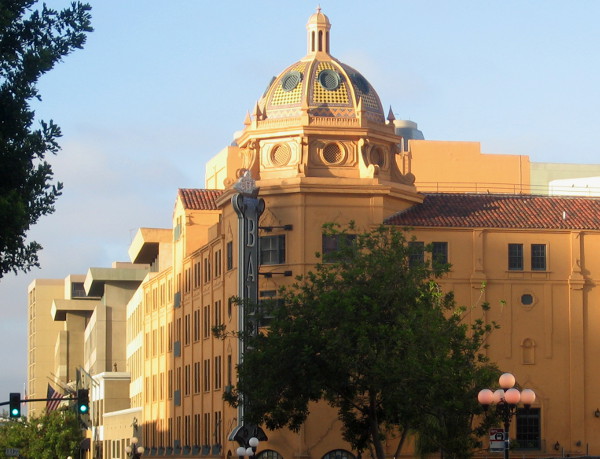
Distinctive dome of the restored Balboa Theatre seen from Broadway.
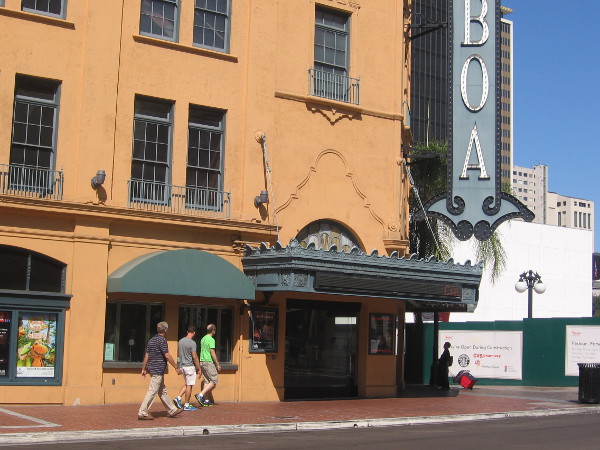
It’s going to be chilly and drizzly today, so I might not be going out for my customary walk. Instead, I thought I’d share a few photos of downtown’s beautiful Balboa Theatre that I took at various times last summer.
The Balboa Theatre has a long and interesting history. Built in 1924 as a vaudeville and movie palace, the large multi-story building containing offices overlooking Fourth Avenue has undergone a complex series of transformations. During World War II, it was used to house sailors waiting to ship out from San Diego. At one point the aging building was saved from demolition; finally it was nominated to the National Register of Historic Places. In 2008, the Balboa Theatre reopened after a thorough remodel, and it is now considered one of the foremost performance venues in the world. It was recently named by CNN Travel as one of the world’s 15 most spectacular theatres! Not bad!
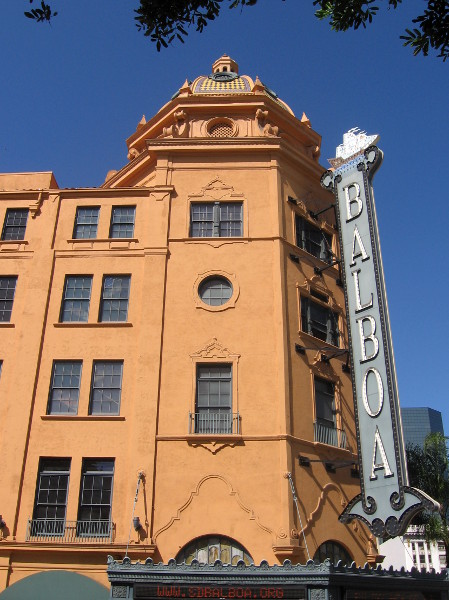
Here are a few more pics of the exterior. I often steer my feet so that I walk past this beautiful building!
Balboa Theatre sign is a landmark in San Diego’s Gaslamp.People walk past box office of the historic Balboa Theatre.Close look at artwork on Balboa Theatre’s cool marquee.The Balboa Theatre is on the National Register of Historic Places.The Balboa Theatre stands next to downtown’s equally cool Horton Plaza.
One more pic I added on a later date:
Window display of old photograph and letter B from Balboa Theatre sign. These can be seen a short distance down the sidewalk.
…
To enjoy future posts, you can “like” Cool San Diego Sights on Facebook. or follow me on Twitter.




































 Cool San Diego Sights!