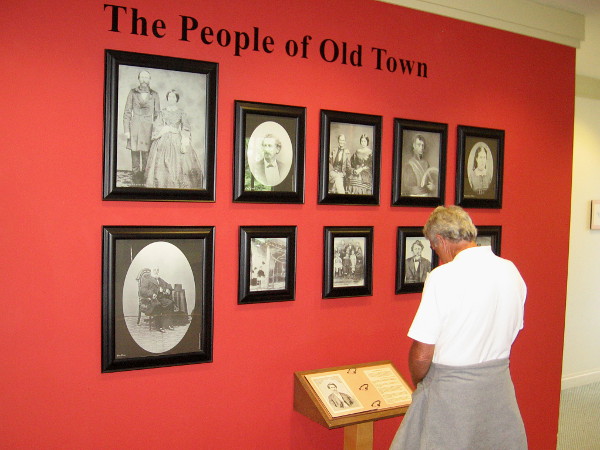
Visitor to the second floor of the McCoy House Museum learns about some notable early residents of Old Town San Diego.
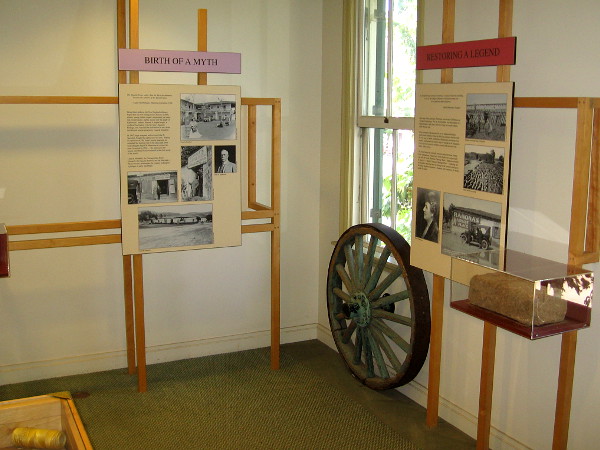
Should you visit the McCoy House Museum in Old Town San Diego State Historic Park, be sure to venture up the stairs to the second floor. There you’ll discover several fascinating exhibits. In addition to old photographs of notable early residents of San Diego, you’ll find an explanation of Old Town’s gradual decline as competing New Town (the site of modern downtown San Diego) grew and became the center of government and commerce. You will also learn about Old Town’s continuing legacy, including the events that led to the creation of Old Town San Diego State Historic Park in 1968.
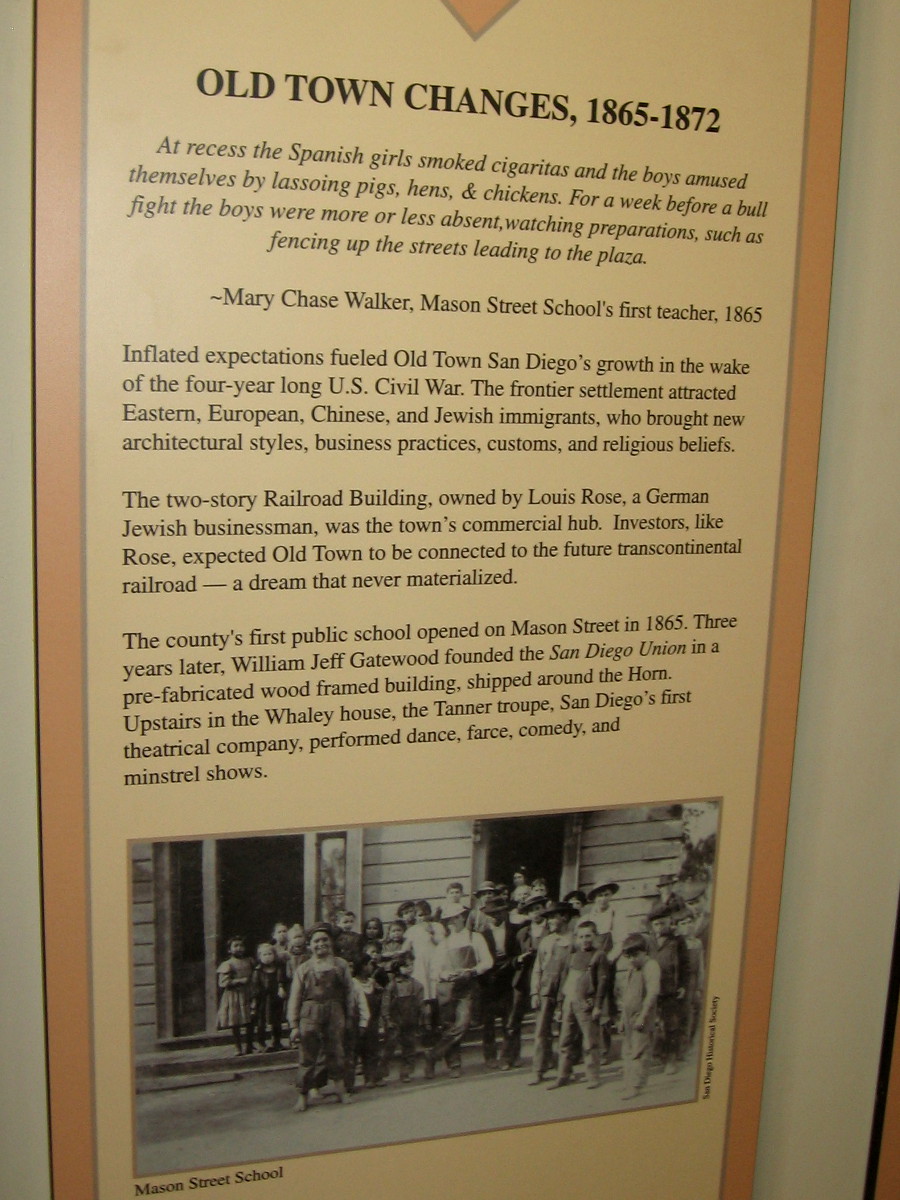
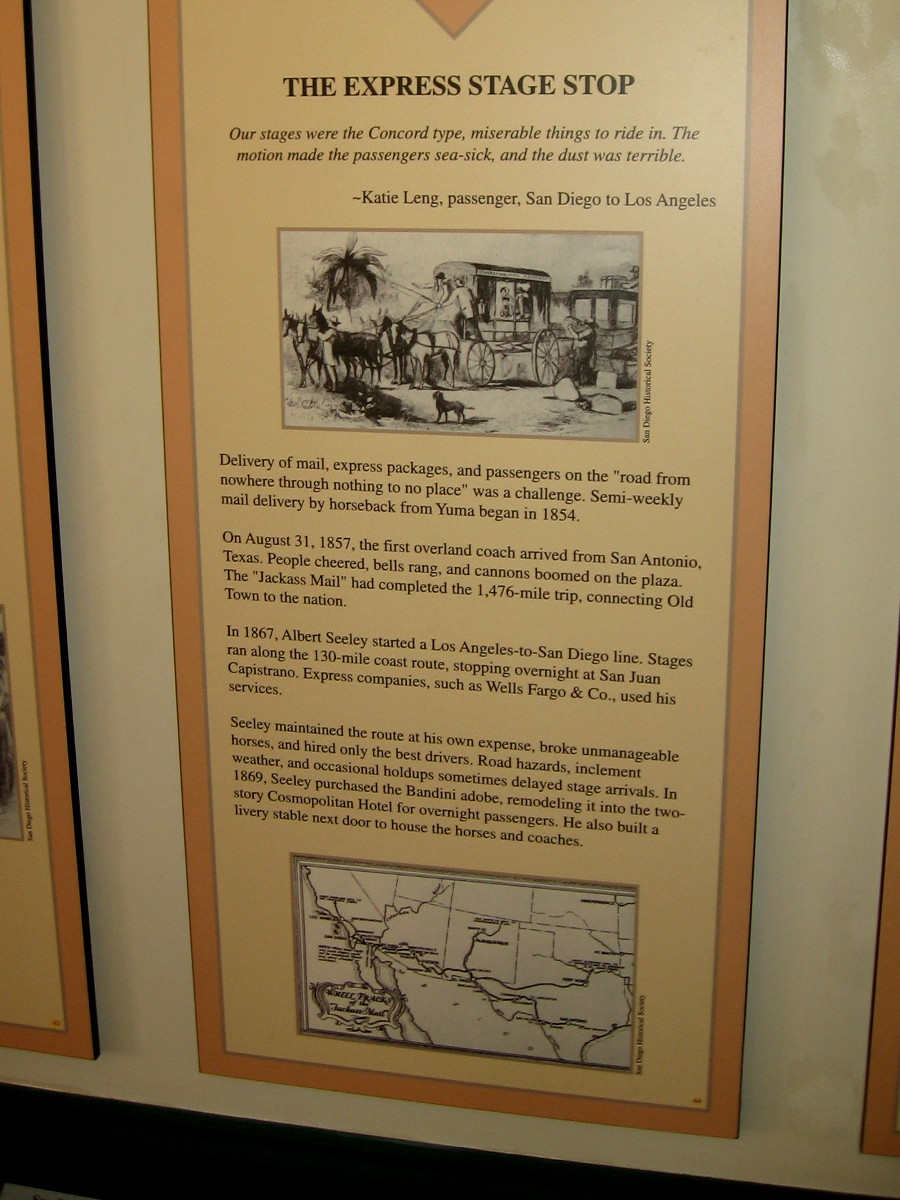
If you’d like to read the displays, click the images to enlarge them.
From a window on the museum’s second floor one can also look down upon the scraggly native plant garden just northwest of the McCoy House. A map near the window shows the location of Sycamore, Toyon, Oak, Cottonwood, Elderberry and Willow trees. Other native plants include Yerba Mansa, Datura, Aster, Poppy, Deerweed, Sumac, Lemonadeberry, Manzanita, Monkeyflower, different Sages, Deergrass, Prickly Pear and Yucca. Many of these plants were used by the Native American Kumeyaay in their daily lives long before explorer Juan Rodriguez Cabrillo discovered San Diego Bay in 1542.
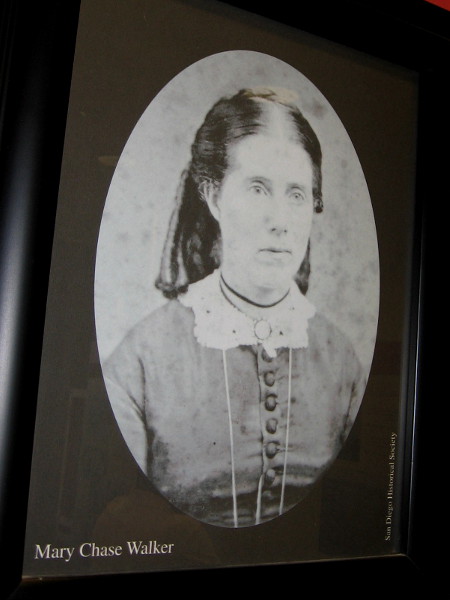
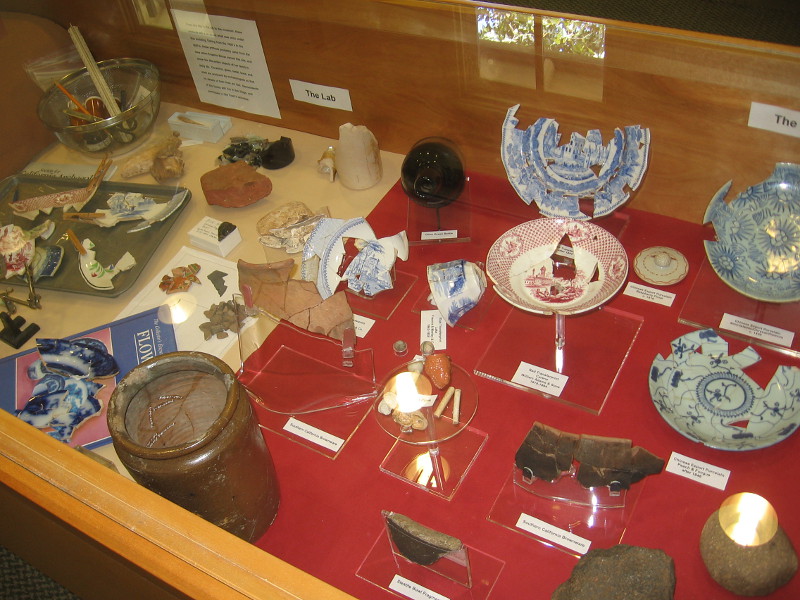
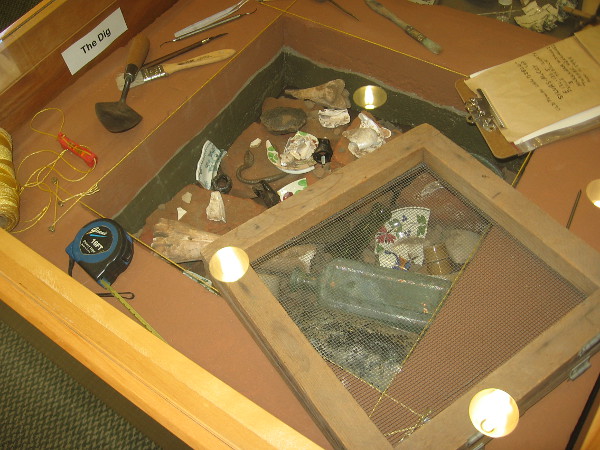
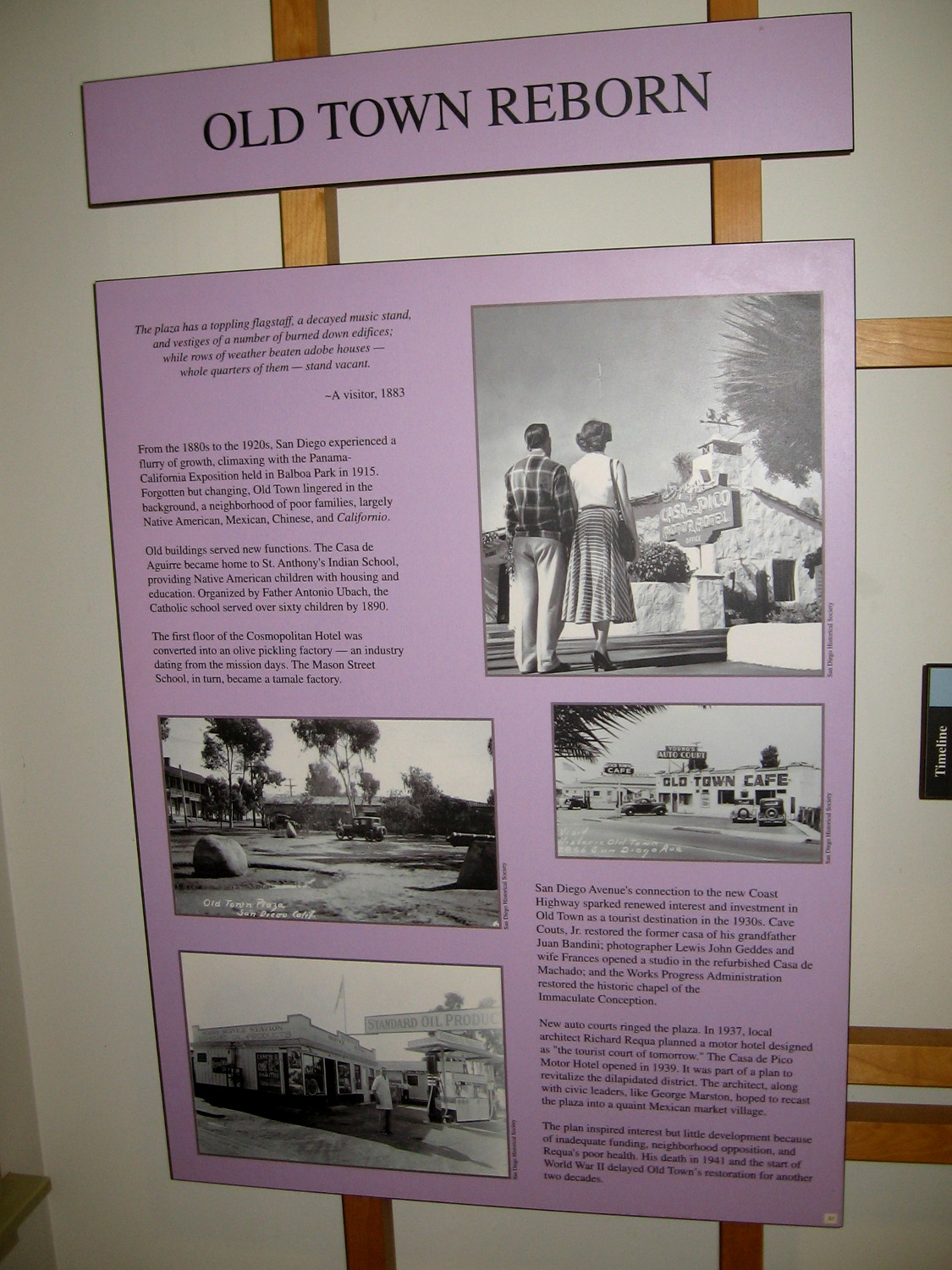
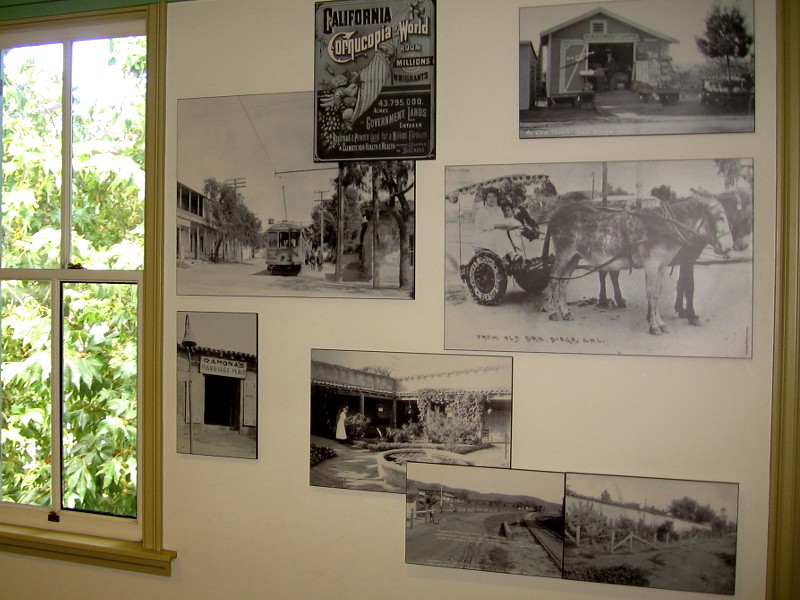
Pio Pico settled in San Diego in 1819 after the death of his father, a soldier assigned to the Presidio. Merchant and rancher, he later lived in Los Angeles and became the last governor of Mexican Alta California.In 1865, Mary Chase Walker became Old Town’s first school teacher. She taught at the one room Mason Street schoolhouse and described early San Diego as a desolate place. She went on to join the suffragette movement.Agoston Haraszthy, born in Hungary, led a fascinating life. As an American pioneer, businessman and wine expert, he became San Diego’s first town marshal and the first county sheriff.Fire devastated Old Town in 1872. At the time only one water pump existed, and it was broken. Firefighters watched helplessly. The fire and many other factors helped to bring about the rise of competing New Town.Various fascinating historical exhibits can be explored on the second floor of the McCoy House Museum in Old Town San Diego State Historic Park.In the early 20th century, neglected, ruined buildings in Old Town were fixed up and converted into tourist attractions. Entrepreneur John D. Spreckels extended his streetcar line to Old Town.Artifacts found under the rebuilt McCoy House date from the 1830’s to 1850’s. They include fragments of daily life from that eraArchaeologists analyze each find, record every detail. These objects probably came from the time when Eugenia Silvas owned this site. Family descendants still live in San Diego and are involved in Old Town’s activities.Archaeologist’s tools on display in the McCoy House Museum.Once again, Old Town became a tourist destination in the 1930’s when San Diego Avenue became connected to the new Coast Highway.Old Town languished during World War II. After the war, some suggested setting aside Old Town as a historic community. In 1968, Old Town San Diego became a state historic park.Photographs in the McCoy House Museum recall Old Town San Diego’s colorful past.
…
I live in downtown San Diego and love to walk! You can follow Cool San Diego Sights via Facebook or Twitter!
You can easily explore Cool San Diego Sights by using the search box on my blog’s sidebar. Or click a tag! There are thousands upon thousands of unique photos for you to enjoy!
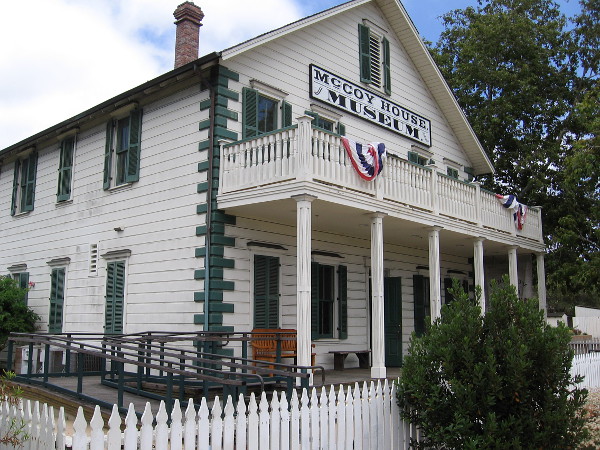
The McCoy House Museum, in Old Town San Diego State Historic Park, is a reconstruction of a home built in 1869 for Sheriff James McCoy.
While there are many small museums and historical attractions that visitors can enjoy in Old Town San Diego State Historic Park, the McCoy House Museum is the best place to see an extensive series of interpretive displays that describe the complete history of early San Diego.
The McCoy House, standing on the north end of Old Town, is a reconstruction of a home built in 1869 for Sheriff James McCoy and his family. James McCoy, who lived from 1821 to 1895, like many early San Diego residents was an ambitious man, working diverse jobs, filling many roles. At the age of 21 he sailed from Ireland to America seeking opportunity. He became a soldier, then a stagehand, then San Diego county assessor, then county sheriff in 1861. He acquired substantial real estate holdings and finally won election to the state senate in 1871.
The interpretive displays in the McCoy House Museum provide a good look back at San Diego’s formative years. They detail the life of the Native American Kumeyaay who’ve lived in the region for thousands of years, the first Spanish explorers, the establishment of the Spanish mission, the Mexican period and the subsequent American period.
If you’d like to read the displays, click my photographs to enlarge them.
This blog post covers the first floor of the museum. I’ll cover the second floor exhibits in a later post. After heading up some stairs, one can find information about the more prominent residents of Old Town, plus the town’s later history as it competed with New Town, which eventually rose to become downtown San Diego as we know it today.
Anyone who is a history buff must visit the McCoy House Museum. You’ll be transported back in time and see how life was exciting, difficult, and altogether different many, many years ago in San Diego.
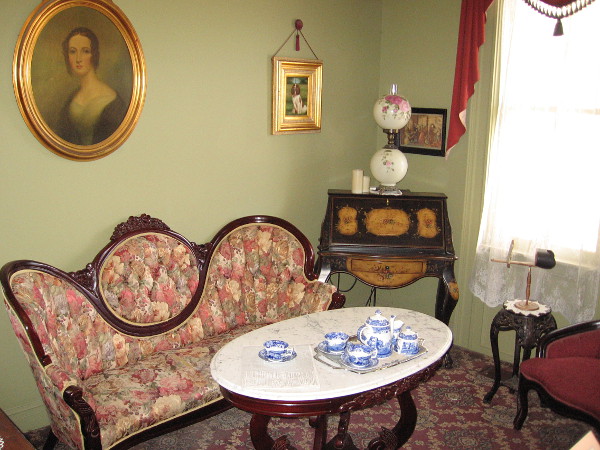
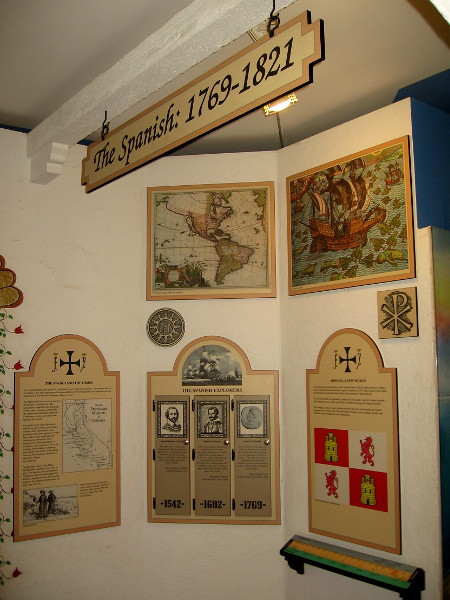
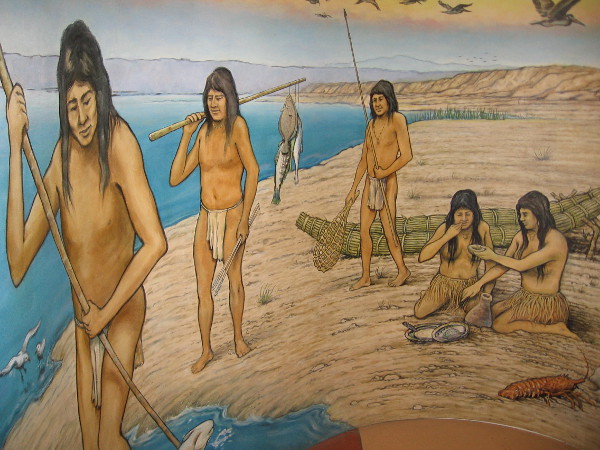
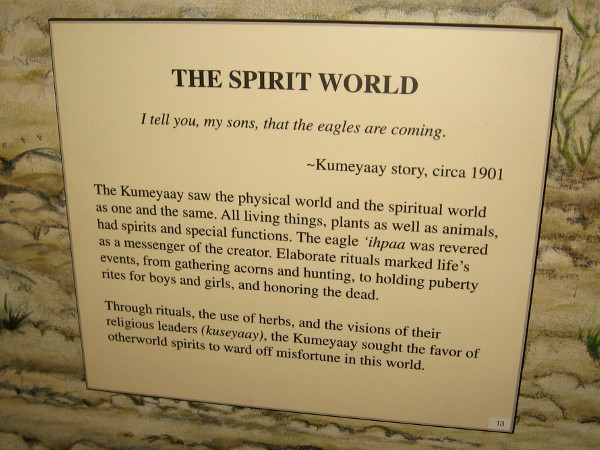
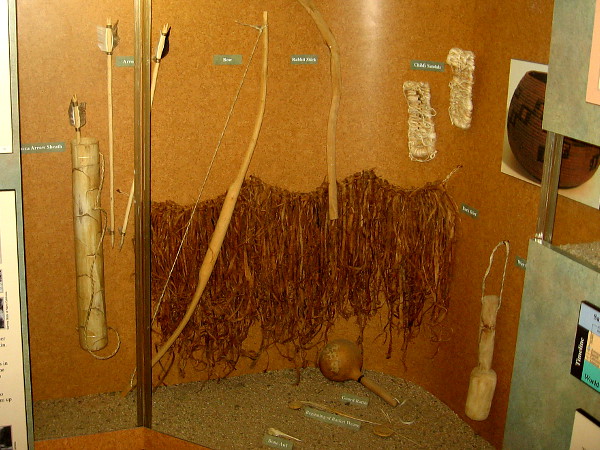
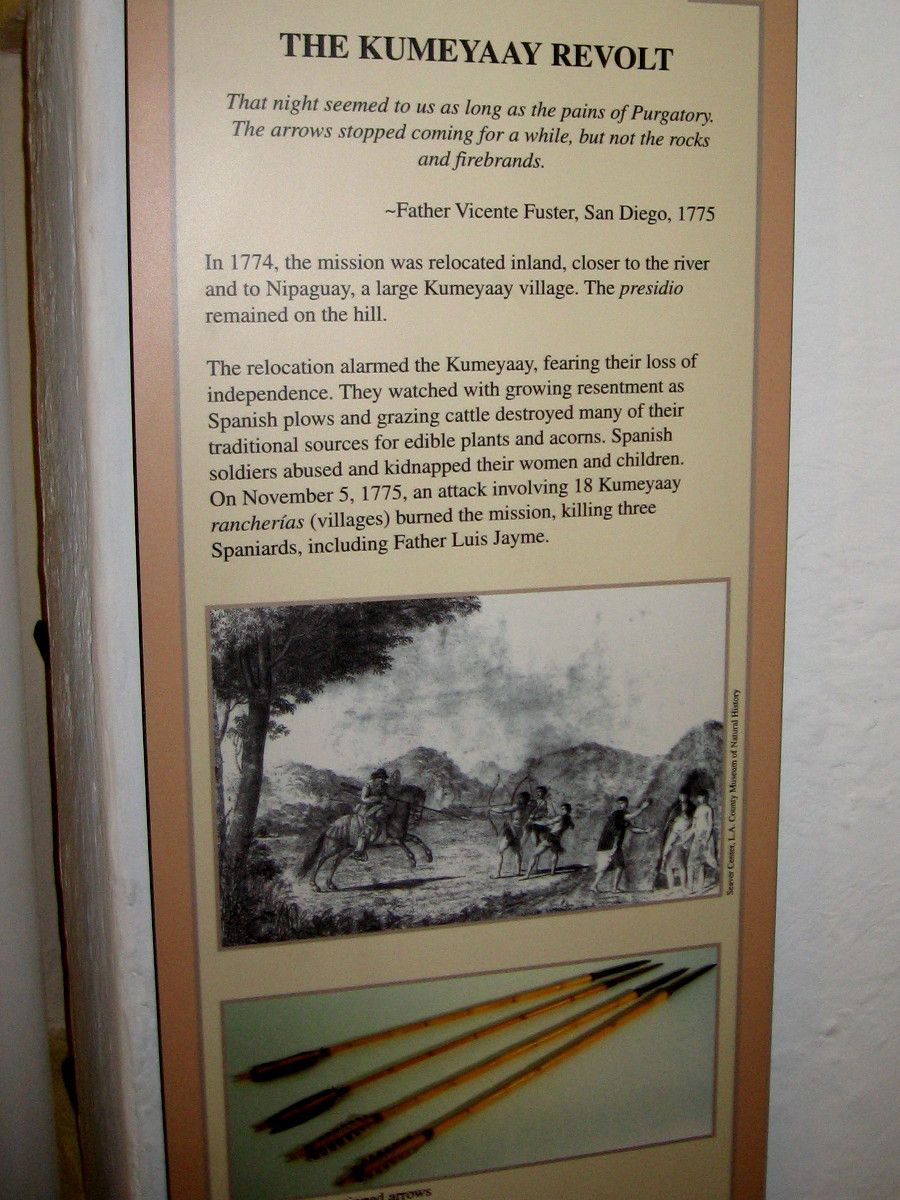
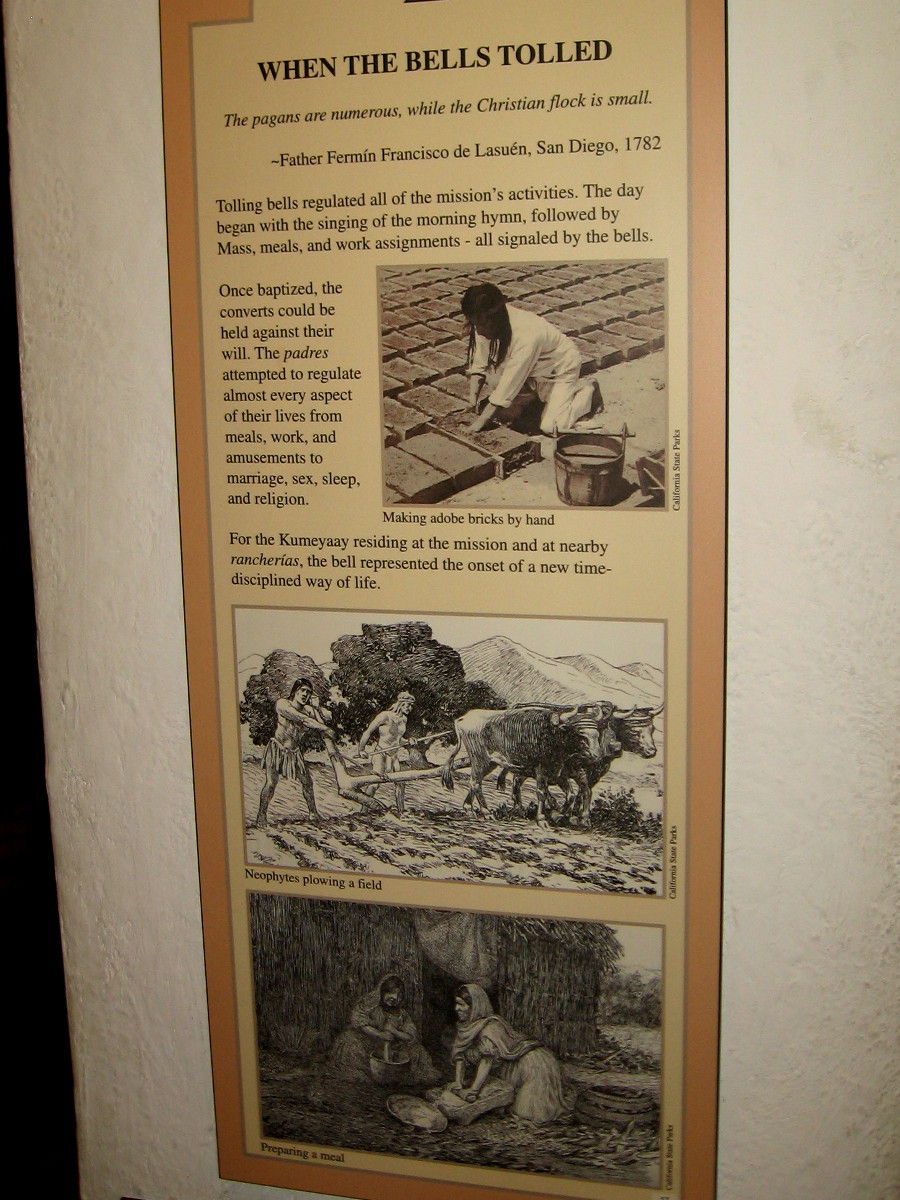
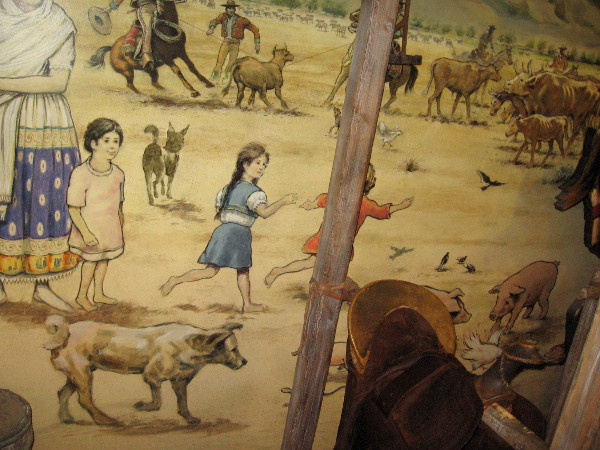
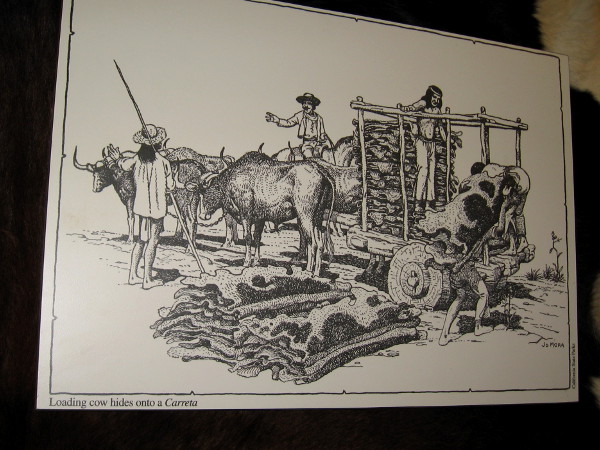
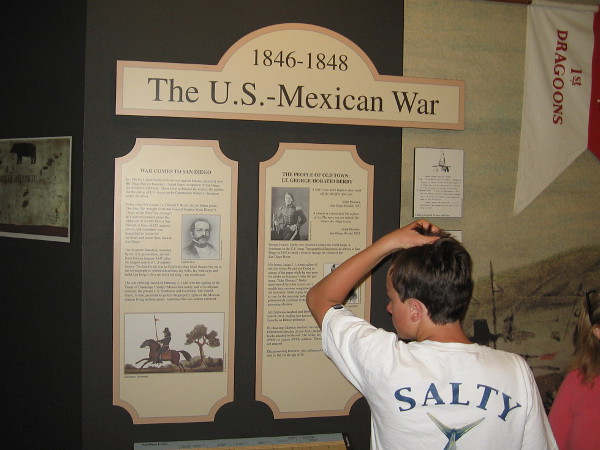
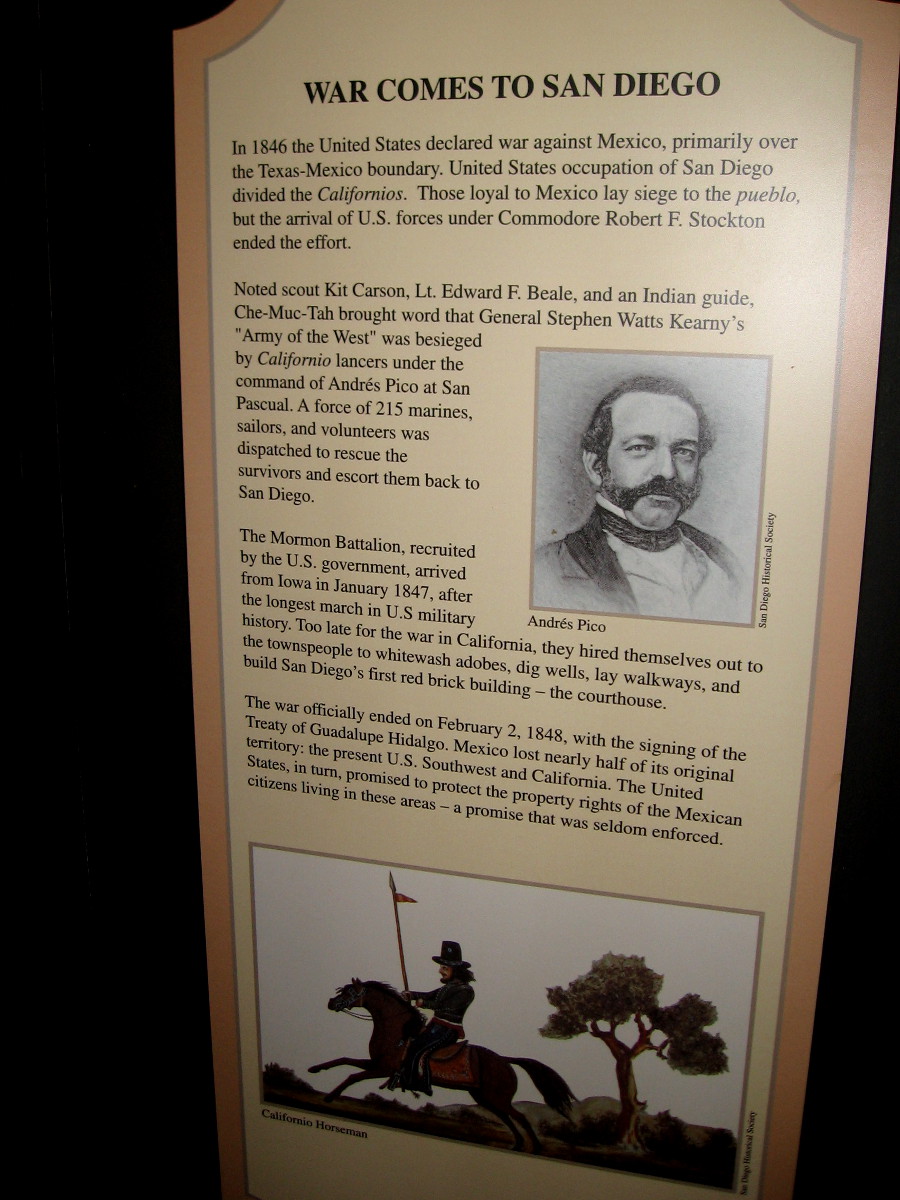
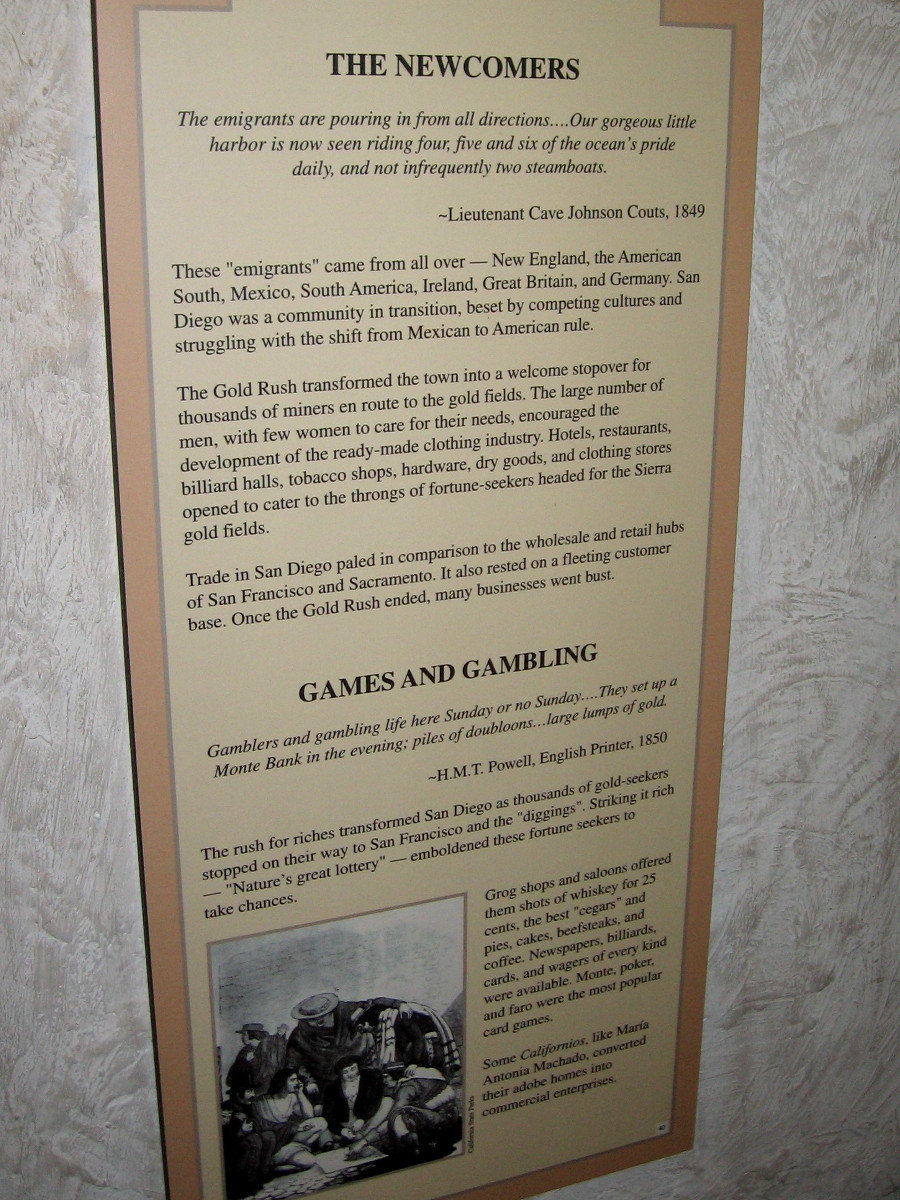
Sign lists important dates concerning the McCoy House. Today it’s a museum containing exhibits that explain the fascinating history of Old Town San Diego.Just inside the front door, this might have resembled the parlor of the original McCoy House, occupied by an upper middle class family in San Diego’s Old Town.Framed photo on one wall from the San Diego Historical Society shows the original McCoy House.Interpretive exhibits inside the McCoy House Museum begin with the Spanish period of San Diego, from 1769 to 1821.Quotes from the journeys of Juan Rodriguez Cabrillo, Sebastian Vizcaino and Gaspar de Portola.A string of missions was created by Spain in California to secure its claim to new territory. The first mission, in San Diego, was originally established on Presidio Hill near the native Kumeyaay village of Cosoy.An artistic representation of life among the Kumeyaay people. They often visited the nearby coast to hunt and gather food.For thousands of years, the Kumeyaay lived along the coast and interior valleys of what is now San Diego County. They moved with the seasons to take advantage of available resources.The Kumeyaay built dome-shaped houses from oak, willow or sycamore branches. The simple structures were called ee-wahs.The Kumeyaay saw the physical and spiritual world as one and the same.Exhibit in the McCoy House Museum shows artifacts associated with the Kumeyaay, including a bark skirt, arrows, rabbit stick, child’s sandals, gourd rattle and war club.The Kumeyaay revolted against the Spanish missionaries in 1775, a year after the San Diego mission was relocated inland very close to a large Kumeyaay village.Once baptized, converted Kumeyaay followed a strict life. Mission bells signaled the day’s activities, including the singing of hymns, Mass, meals and work assignments.Mexico gained its independence from Spain in 1821 after a decade of bloodshed. Changes included a decline in support for the presidio and freedom from Spain’s trade regulations.After the breakup of the Spanish missions, the era of the great ranchos began. Californios were often racially mixed descendants of soldier-settler families.Vaqueros were the original cowboys. They worked on the extensive ranches and handled the large herds of stock.A fanciful picture of life on a rancho, with vaqueros at work and children at play.The Californios loved to celebrate feast days, weddings and religious festivals.Cattle by the thousands roamed San Diego’s hills. Their dried hides were used in trade and were sometimes referred to as California banknotes.Illustration of loading cow hides onto a carreta. Hides were gathered by ships along the coast to be transported around Cape Horn to the eastern United States.Exhibit inside the McCoy House Museum recreates the small shop of a Boston trader. The brig Pilgrim of Two Years Before the Mast brought people aboard to buy wares and finished goods that weren’t available in San Diego.Illustrations of cow hides being cured. This activity took place at La Playa, a point on San Diego Bay near Ballast Point in Point Loma.Diagram of the brig Pilgrim, made famous in Richard Henry Dana Jr.’s classic Two Years Before the Mast. As an ordinary seaman, Dana collected cattle hides up and down the California coast.Exhibit in the McCoy House Museum details local history during the Mexican–American War from 1846 to 1848.During the war, U.S. occupation of San Diego divided the loyalty of the Californios. The two sides fought briefly at the Battle of San Pasqual.Around the time of the Gold Rush, San Diego saw an influx of emigrants from all over, including New England, the American South, Mexico, South America, Ireland, Great Britain and Germany.Old Town tales include the construction of the first jail in 1850. The walls were so poorly made, the first prisoner, Roy Bean, easily dug himself out, then celebrated at a nearby saloon!Grog shops became popular gathering places. They were a social hub of San Diego life, providing customers with news and provisions.A recreated Old Town grog shop can be found inside the McCoy House Museum.After the California Gold Rush of 1849, San Diego became more developed. A courthouse and newspaper were established. Transportation included clipper ships, stage lines and steamships.Poster advertises a new clipper ship route. A very quick trip may be relied upon!Between 1865 and 1872, Old Town San Diego continued to grow. The first public school opened, and the town welcomed its first theatrical company in the Whaley house.The first overland coach to San Diego began service in 1854. Additional stage lines came into existence, allowing for the delivery of mail, express packages and passengers.Visitors to the McCoy House Museum can step into a replica stage stop and see what life was like in Old Town during San Diego’s rugged early history.
…
I live in downtown San Diego and love to walk! You can follow Cool San Diego Sights via Facebook or Twitter!
You can easily explore Cool San Diego Sights by using the search box on my blog’s sidebar. Or click a tag! There are thousands upon thousands of interesting photos for you to enjoy!
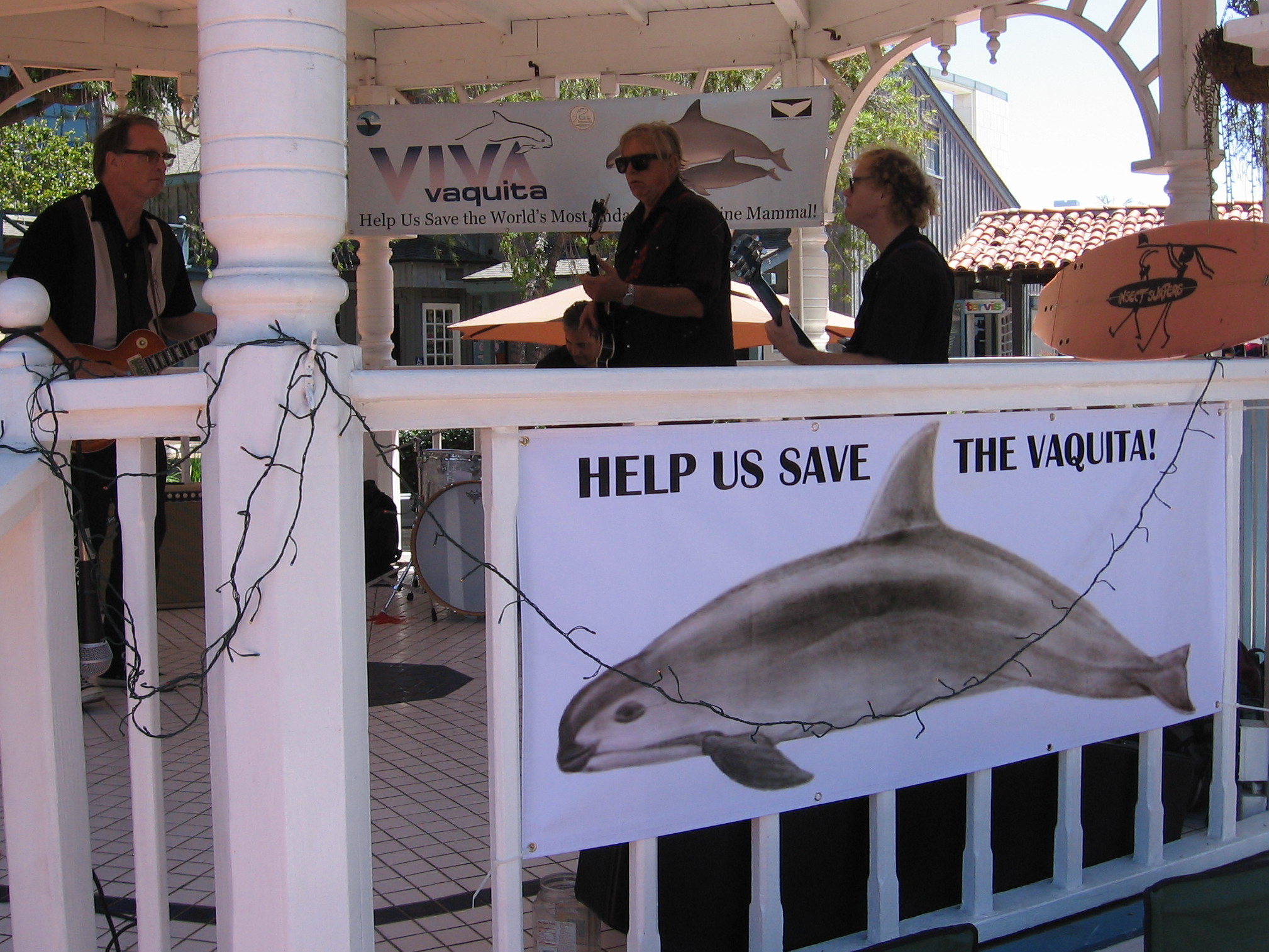
Help us Save the Vaquita display at the east gazebo of Seaport Village in San Diego. The band Insect Surfers was providing some music!
The Vaquita is the world’s most endangered marine mammal. It is thought that about 60 of the animals exist in the ocean today. This small species of porpoise (Phocoena sinus) lives in the warm waters of the eastern Pacific Ocean–specifically in the northern Gulf of California, in a small region east of Baja California not too distant from San Diego. According to the International Union for the Conservation of Nature, the Vaquita is classified as Critically Endangered.
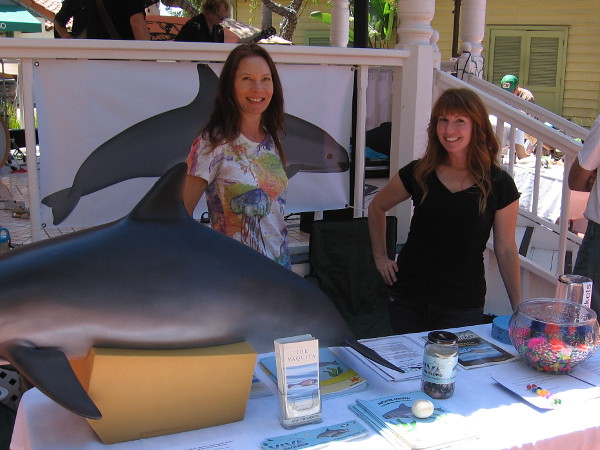
International Save the Vaquita Day was observed today in San Diego and many other cities around the world. I swung by Seaport Village to see what efforts are underway to save Mexico’s “Panda of the Sea” and to learn a little about the Vaquita.
I learned that the Vaquita, thankfully, enjoys clean waters. Their big threat is being entangled in the gillnets of fishermen. A major effort is underway to eliminate these nets from the Vaquita’s natural habitat. But some fishermen, seeking to provide a living for themselves, use them anyway.
I learned there’s also an effort to inform consumers that some shrimp and fish that one finds in the grocery store is caught with gillnets. It is hoped enlightened shoppers will seek out and purchase seafood that isn’t caught with this type of net.
I learned that Vaquitas have never been held in aquariums, and has only been known to science since 1958.
If this species goes extinct, it will be gone forever.
These nice ladies are working hard to save the Vaquita. It is hoped many others will join the effort, in any way possible. Time is very limited–perhaps a year or two–before the species might go extinct.Kids make art and learn about the critically endangered Vaquita, a marine mammal that clings to a tenuous existence not far from San Diego.
…
I live in downtown San Diego and love to walk! You can follow Cool San Diego Sights via Facebook or Twitter!
Special education kids in San Diego are fortunate to have a non-profit school that turns young lives around, helping emotionally disturbed and learning disabled students make their way toward a positive future. This school is called Aseltine.
The awesome people at Aseltine School believe that all children deserve access to the full opportunities of life. They also believe that when troubled kids are encouraged to take purposeful action, they develop self-esteem and overcome self-doubt.
I am privileged to know some of the friendly people who work at Aseltine. I recently learned that the small school exists due to the generosity of others. Here is their Mission Statement.
When I visit Aseltine from time to time, I see polite students laughing, smiling and learning to live life the way it should be lived–with optimism and gladness.
Please consider offering the good people of Aseltine a little bit of help. There are many different ways to get involved. Click this link to learn more!
Work of art by a student at the non-profit Aseltine School in San Diego. Aseltine helps special education kids make their way toward a bright, positive future.
In case you’re in San Diego and you read this in time, Aseltine School’s Festival of the Arts event is coming up on July 13, 2016, and will take place from 5 pm to 7pm at Cafe on Park, which is located at 3831 Park Boulevard. Student poetry and artwork will be featured, and those attending can help the school out with donations, purchases of art, or even by grabbing a bite to eat.
I urge those who enjoy following my blog to check out Aseltine’s website. Can you help?
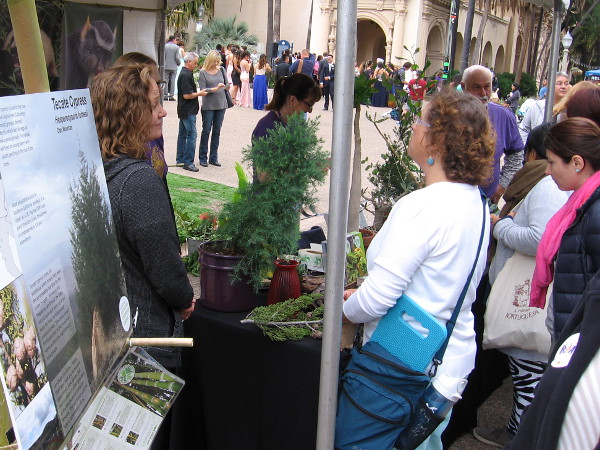
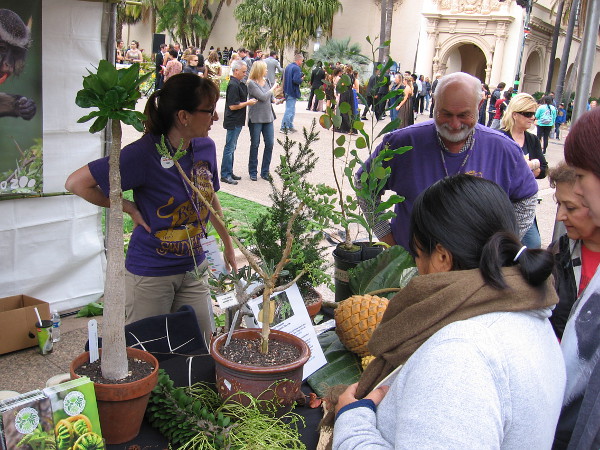
Visitors at the San Diego Zoo Centennial Festival in Balboa Park learn how rare, threatened and endangered native plants are being saved by the zoo.
Many know how the San Diego Zoo is a world leader in working to protect animal species from extinction. One important task is to store critical genetic material. Their world-renowned Frozen Zoo has been storing cryogenically preserved biological samples since 1976.
When I walked through the San Diego Zoo Centennial Festival in Balboa Park last Saturday, I learned something that really impressed me. Not only is the zoo striving to save the world’s most endangered wild animals, but San Diego Zoo Global has developed an important native plant seed bank, in an effort to conserve rare and threatened local plant species.
The zoo is member of the California Plant Rescue Partnership, whose goal is the long term conservation of wild plant species through seed banks and field work. One of the people with whom I briefly spoke has the job of hiking about San Diego County, searching for and monitoring populations of these rare plant species. What a fantastic job that must be!
The zoo has developed an extensive seed collection. Some native plants being protected are the San Diego golden star Bloomeria clevelandii, Dudleya brevifolia, Monardella stoneana, Comarostaphylis diversifolia ssp. diversifolia, and Corethrogyne filaginifolia var. linifolia, which is commonly called the Del Mar sand aster.
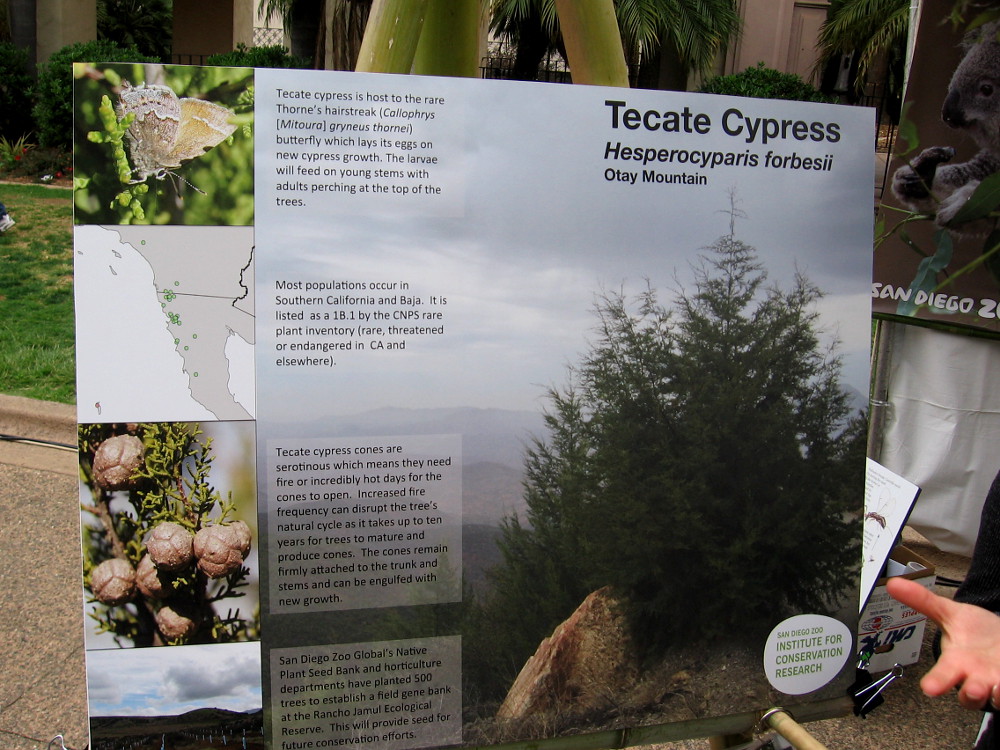
The San Diego Zoo Institute for Conservation Research is also working hard to save the Tecate Cypress in Southern California and Baja California, a tree that the rare Thorne’s hairstreak butterfly depends upon. A poster at the zoo’s centennial event helped to explain why this effort is so urgent.
San Diego Zoo Global’s Native Plant Seed Bank and horticulture departments have planted 500 Tecate Cypress trees to establish a field gene bank. (Click to enlarge.)The San Diego Zoo’s conservation efforts extend beyond protecting animal species threatened by extinction. Plants are important, too!
…
I live in downtown San Diego and love to walk! You can follow Cool San Diego Sights via Facebook or Twitter!
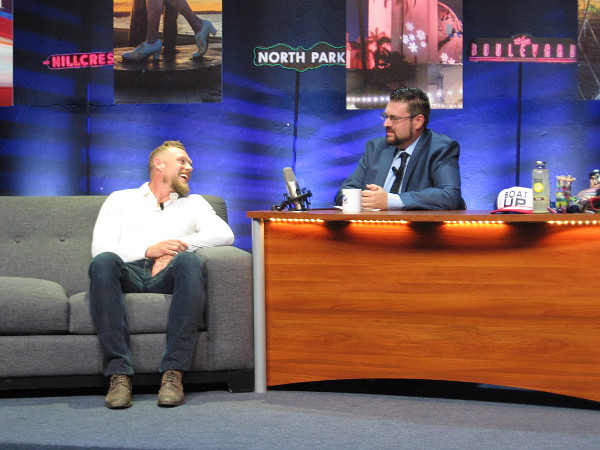
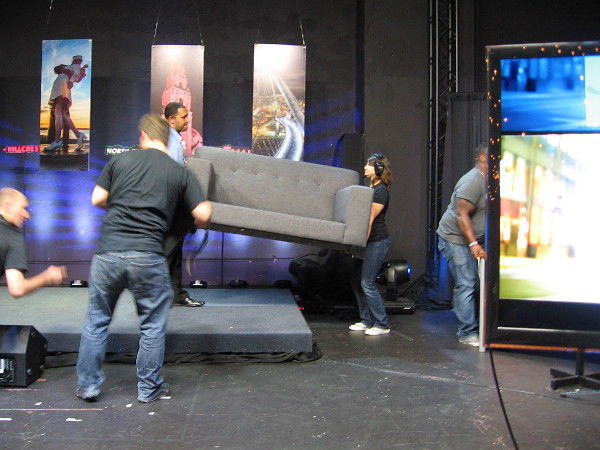
On the set of Tonight in San Diego, taped with a live studio audience in The Raw Space at the Spreckels Theatre. Host Jesse Egan talks to comedian Erik Knowles.
Are you looking for some cool entertainment? There’s a live television talk show debuting in San Diego modeled after those popular late night variety shows which millions of people love. It’s called Tonight in San Diego.
Anyone can attend a live taping of new shows in The Raw Space, a small venue that is part of the downtown Spreckels Theatre. Like those well-known national shows filmed in Los Angeles, San Diego audience members participate in the live taping: clapping and cheering on cue, while enjoying comedy acts, live music and interviews of local celebrities. Of course there’s a house band and opportunities for the most enthusiastic audience members to win prizes. There’s also a bar serving wine and beer that people can visit during breaks.
I was invited to the most recent taping–which was last night! It was the last episode of the show to be featured exclusively on YouTube. From this point forward, Tonight in San Diego will air on KSDY Channel 50!
So what did I think?
The show is fairly witty, fun and quite well-produced. The host Jesse Egan, who hails from Ocean Beach, is a naturally funny guy. The monologue was a bit silly. The music was great. The opportunity to watch a live television show being produced is what intrigued me most–I was surprised at the number of people involved and impressed by how smoothly the entire process went.
The night I attended, the guests were standup comedian Erik Knowles, San Diego Rugby’s Phil MacKenzie (aka The Dragon) and a fantastic musician Mike Pinto, who I considered to be the highlight of the evening. The atmosphere was casual and many jokes were off-color. Laughter was provoked with quips about open pants, alcohol and smoking weed. This will obviously narrow the show’s appeal. I got the impression the show was directed more toward party people and hipsters than a more general audience.
Tonight in San Diego has incredible potential. At this point, seemingly few know about it. If this is your cup of tea, head to their website and get a ticket. As a member of the live studio audience, you’ll certainly be entertained for an hour and a half, and you’ll have the opportunity to be a part of history. Because I think this might be the beginning of something big!
The Raw Space is a small venue on First Avenue just south of Broadway in downtown San Diego.A comedy act by Erik Knowles, who explains with a wink that being a stoned Dad can be surprisingly beneficial.Tonight in San Diego host Jesse Egan discusses our city’s new pro rugby team with guest Phil MacKenzie.Photograph of the house band’s drummer. Three other great musicians were concealed by cameras. Yours truly, a mere blogger, was considered media and given a front row seat! I still can’t believe it!A quick change on the set. Getting ready for a musical act by talented guest Mike Pinto, who brought the house down.A video screen off to one side shows what actually appears on television. Here Jesse Egan is having a laugh with musician Mike Pinto.
…
I live in downtown San Diego and love to walk. Occasionally my blog contains surprises! You can follow Cool San Diego Sights via Facebook or Twitter!
To easily explore Cool San Diego Sights, use the search box on my blog’s sidebar. Or click a tag! There are thousands upon thousands of fun photos for you to enjoy!
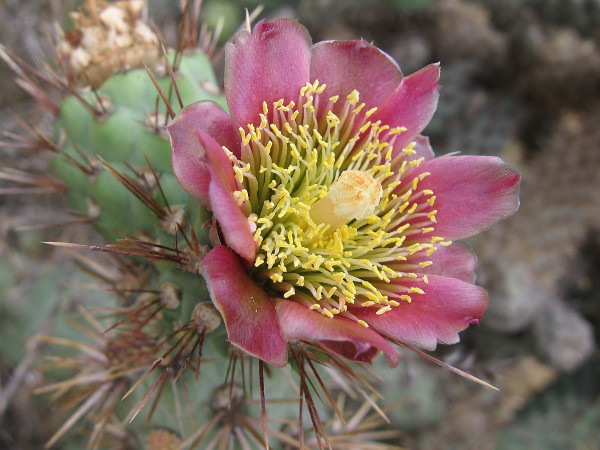
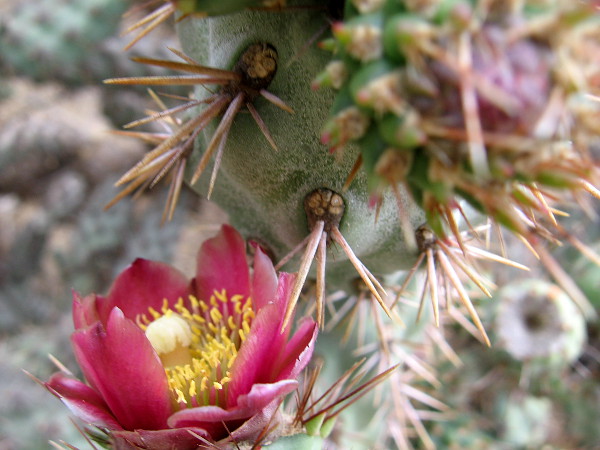
Spectacular flower of a Coastal cholla cactus in San Diego. Seen along a trail near Morley Field Drive that leads into Balboa Park’s Florida Canyon.
I took these colorful photos while walking Sunday through Balboa Park, along one of the rugged dirt trails that leads up out of Florida Canyon. A short hike can be enjoyed through native coastal chaparral and spring wildflowers, between Morley Field and Park Boulevard, just south of Morley Field Drive.
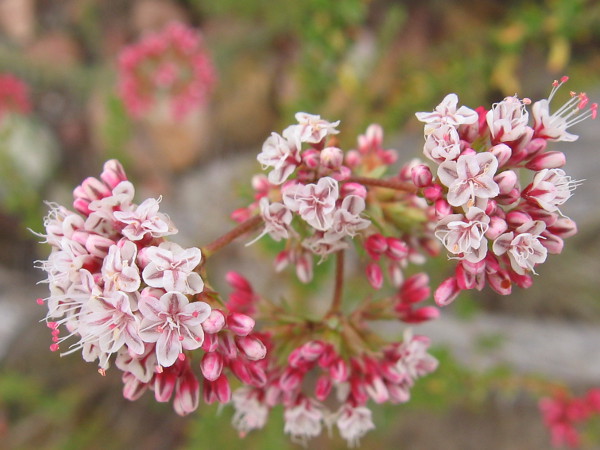
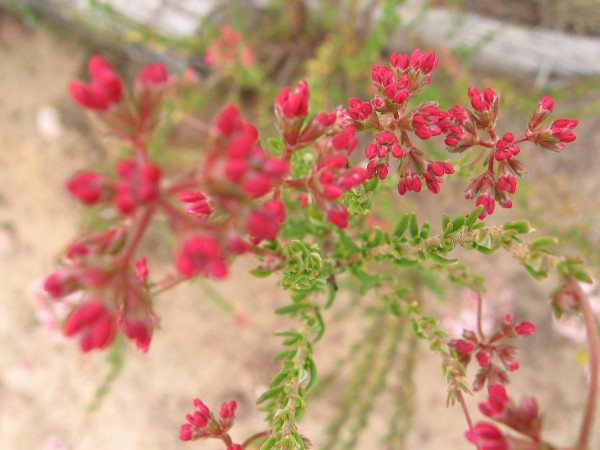
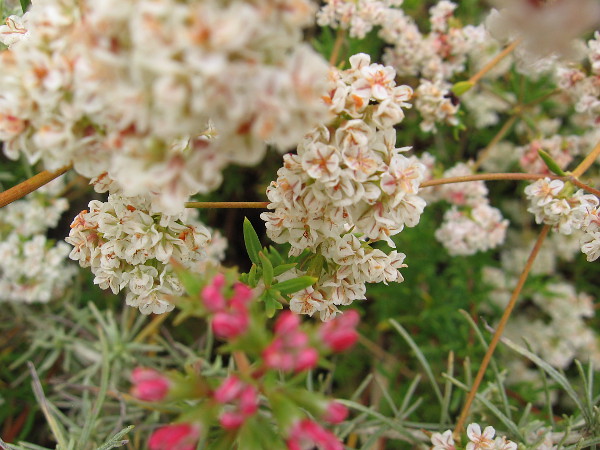
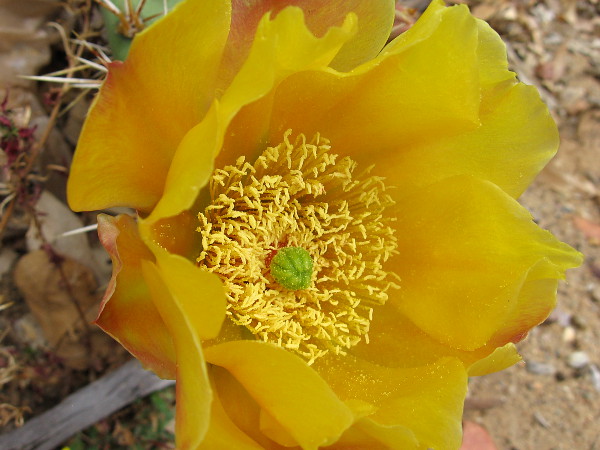
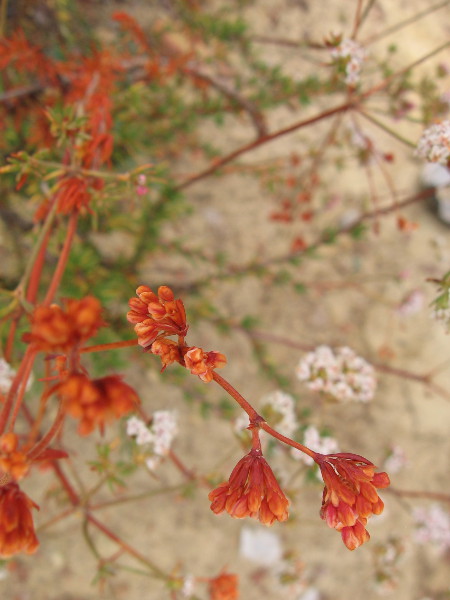
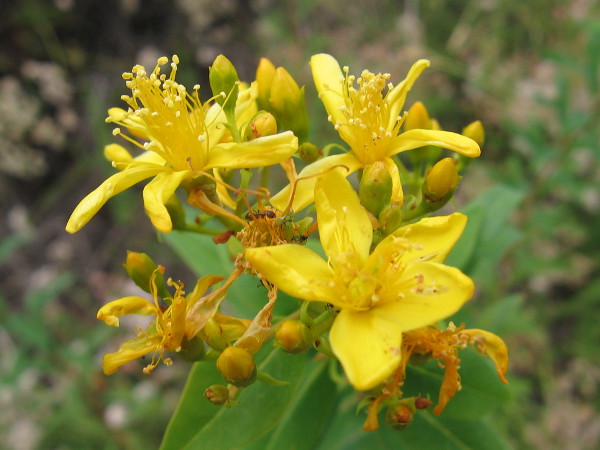
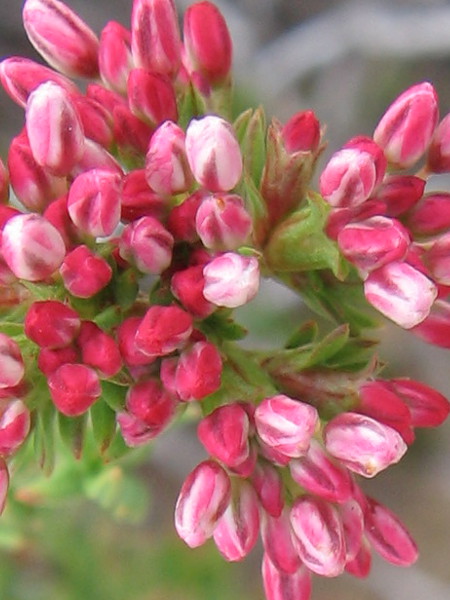
Flat-top buckwheat, or California buckwheat, flower clusters are opening in spring. These native plants grow profusely in arid San Diego.Small red flower clusters of flat-top buckwheat (Eriogonum deflexum) that have yet to open.More buckwheat in Balboa Park’s Florida Canyon. Native Americans used the plant to make tea with medicinal properties.Another flower on a very spiny Coastal cholla (Cylindropuntia prolifera) makes for an interesting photograph.A wild yellow prickly pear cactus flower near the rim of Balboa Park’s Florida Canyon, just across Park Boulevard from the San Diego Zoo.These buckwheat flower clusters have turned brown. Perhaps that’s why the plant is sometimes called skeletonweed.These flowers that I randomly photographed along the trail have me stumped. I tried to identify them, but without success. If you know what they are, please leave a comment!A profusion of red and white buckwheat beauty.
…
I live in downtown San Diego and love to walk! You can follow Cool San Diego Sights via Facebook or Twitter!
The Coronado Bay Bridge has seen far too many tragic suicides.
Would you please consider signing a very important online petition? The Coronado San Diego Bridge Collaborative For Suicide Prevention has begun a petition to help prevent Coronado Bay Bridge suicides.
Tragically, in the past 47 years, about 370 souls have jumped from the bridge. Most of these people felt driven to end their own lives because of deep depression. All could have been helped. The petition, addressed to the California Department of Transportation, asks that a suicide barrier be installed on the San Diego–Coronado Bridge. It would be similar to a intelligently-designed device now being installed on the Golden Gate Bridge in San Francisco, which is a unique type of a net that is configured to safely catch jumpers and arrest them until help arrives.
Kids play by fountain in San Diego’s crown jewel, Balboa Park, one of the world’s great cultural treasures.
Hey you guys! Please, please, please–can you all do a super easy favor? You know how awesome Balboa Park is? One of our local casinos (Harrah’s) is giving away $100,000 to non-profit organizations that make our community a better place. The Friends of Balboa Park–the organization that oversees the park’s improvements, coordinates volunteers, supports educational programs and historical preservation and other vital projects–needs our online votes!
All you have to do is visit this webpage, then scroll down to Friends of Balboa Park and cast a vote using your email! I just did it a couple minutes ago! I don’t know if Harrah’s will email you stuff, but under the law there should be a one click unsubscribe option should that happen. That’s all you gotta do! It would be really, really awesome to help out Balboa Park, which provides joy to millions of people!
Many of you know that Balboa Park needs additional funds very badly. So please share this info with other people who have a soft spot for Balboa Park! Let’s get his ball rolling. Let’s try to get thousands of votes!
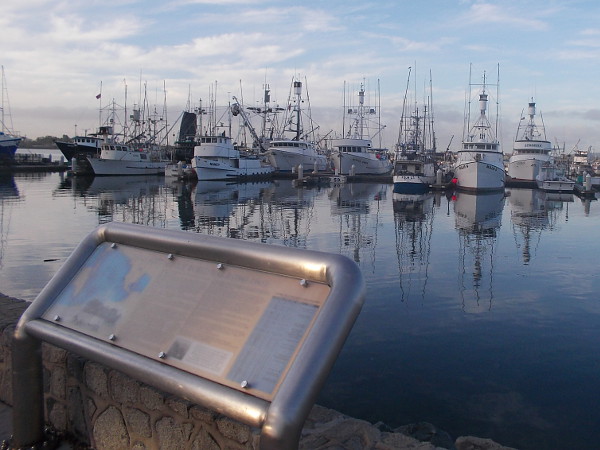
Information sign beside Tuna Harbor, in downtown San Diego, describes how local tuna boats were utilized in the Pacific Ocean theater of World War II.
Some fascinating historical information can be found on San Diego’s Embarcadero, right next to Tuna Harbor where many commercial fishing boats dock downtown. The sign, erected by the San Diego Port Commission in 2008, is titled Tuna Fleet Service World War II (1941-1945). It provides a glimpse of how dozens of San Diego-based Tuna Clippers joined the American war effort during the Second World War.
Here is the text on the sign:
During World War II, 600 fishing vessels were taken by the Navy, Army, and Coast Guard, including 52 “Tuna Clippers”.
On Pearl Harbor Day, the U.S. canned tuna industry was located almost exclusively in Southern California, and canners received most of their tunas from “baitboats”. Fishermen on these boats chum live bait (sardines, anchovies) to attract the tunas into a feeding frenzy and then use rigged bamboo poles to pull the hooked tunas aboard. Dating from 1924, a fleet of large “baitboats” was developed and became know as “Tuna Clippers”. These large ships, equipped with powerful diesel engines and newly developed brine refrigeration, fished for tunas found migrating thousands of miles from San Diego on trips of 90 days or more. During the 1930s, this San Diego high seas fleet was studies by the U.S. Navy, resulting in wartime plans that included the conversion of Tuna Clippers to minesweepers.
At the time Pearl Harbor was attacked, there were 90 vessels in the California baitboat fleet, including 76 Tuna Clippers plus 3 under construction. The 49 Tuna Clippers taken by the Navy and 3 by the Army represented about 55% of the fish carrying capacity of the entire baitboat fleet.
After war was declared, the Government ordered the Tuna Fleet to make port in California or Panama. Ten of the Tuna Clippers entering the Canal Zone in December 1941, were immediately taken for temporary patrol duty. The U.S. Army took three Clippers for use in the Panama Sea region, the SHASTA and CAPE HORN as tugs and the INVADER as a supply ship.
On February 16, 1942, tuna fishermen attended a meeting conducted by Commander W. J. Morcott, USN (Ret.) at the Naval Reserve Armory. 600 tuna fishermen signed up, with Skippers and Engineers receiving warrant ratings, and others given petty officer ratings according to age and experience. Within 10 days, a fleet of 16 Tuna Clippers, painted gray and marked with YP number designations as Yard Patrol vessels, left San Diego harbor on February 25, 1942. Their destination was the “Panama Sea Frontier” for picket duty to protect the Canal.
In May 1942, a convoy of six YP Clippers left San Diego for the “Hawaiian Sea Frontier”. These YPs transported supplies to French Frigate Shoals, the islands of Midway, Johnston, Fanning, Christmas, Palmyra, and Canton. In June 1942, seven YP Clippers left San Diego, for service at Efate Island or Samoa, or Auckland, New Zealand. In November 1942, another group of five headed for the U.S. Naval base at Tutuilla, Samoa. As the conflict moved towards Japan, YP Tuna Clippers were sent on missions to other Islands and Atolls of the Western Pacific.
The Navy discovered that “Yippies” were able to transport troops, gasoline, ammunition, and refrigerated cargoes and capable of navigation within shallow atolls and over minefields, of towing damaged warships, and rescuing downed pilots. This is why “Yippies” were also called the “Pork Chop Express” or “Errand Boys of the Pacific” or the “Solomon Island Ferry”. During the Solomon Island Campaign in 1942, the PARAMOUNT (YP 289) and the PICOROTO (YP 290) delivered frozen turkeys and all the fixings for a traditional holiday feast at Guadalcanal Island. In 1943, frozen turkeys were also delivered to the Marines fighting on Bougainville in time for Thanksgiving by the AMERICAN BEAUTY (YP-514).
“Yippies” were equipped with CW radios, fathometers, Navy radar and Navy sonar. Armament included machineguns, and other gun gear to fire Depth charges. The YP crew of tuna fishermen and regular Navy ran from 4 to 20 men.
Two YPs were destroyed in the Solomon Islands campaign by enemy surface ships: On 9 September 1942, off Tulagi Island, the PROSPECT (YP-346), and on 25 October 1942, off Guadalcanal Island, the ENDEAVOR (YP-284). The number of casualties sustained is unknown.
Two YPs were lost in the Midway region: On 23 May 1942, the TRIUNFO (YP 277) was destroyed by fire and explosions enroute to French Frigate Shoals (North of Hawaii), and then scuttled to avoid enemy capture. Only two crewmembers survived. During October 1942, the YANKEE (YP-345), with 17 crewmembers, on a voyage from Pearl Harbor to Midway Island via French Frigate Shoals, was “lost without a trace from causes unknown”.
Four YPs were lost at sea: CALIFORNIA (YP-235) on 1 April 1943, after fire and beaching in the Gulf of Mexico from an explosion of undetermined origin; NAVIGATOR (YP-279), 5 September 1943, foundered in heavy weather enroute to Townsville, Australia; CAPE SAN VINCENT (YP-280), on 24 April 1946, sank near Saipan Island; SAN SALVADOR (YP-281) on 9 January 1944, was destroyed after the foundering in Force 9 storm, with crew of 19 and one dog rescued, near Wallis Island, South Pacific. After transfer to the U.S. Army in July, 1943 the SEA TERN (ex YP-269) was lost at sea off Baja California.
Three YPs were destroyed during October 1945, because of a typhoon off Okinawa: PARAMOUNT (YP-289); CONTE GRANDE (YP-520) and CHALLENGER (YP-239).
The Navy destroyed 7 YPs after the War during 1946 and 1947: AMERICAN VOYAGER (YP-287), CIPANGO (YP-504), EUROPA (YP-236), FALCOM (YP-515), QUEEN AMELIA (YP-516), QUEEN ELIZABETH (YP-519), and YVONNE LOUISE (YP-282).
The successful wartime experience of the “Yippies” caused the Navy to build 30 wood-hull vessels patterned on the Tuna Clipper design. Each of 30 newly constructed wood hull Navy YPs was of 128 in length, of 14 feet draft, and powered with a 500 H.P. diesel main engine. They were built during 1945, two each by 15 different shipyards located in California, Oregon, and Washington.
Commencing in 1947, 24 of these YPs were added to the U.S. Tuna Fleet.
After the war, the Navy and Army transferred 33 surviving former Tuna Clippers to the War Shipping Administration (WSA) for buy-back by the previous owners. Three of these surviving vessels never returned to the U.S. tuna fishery: CABRILLO, FISHERMAN II, AND THEODORE FOSS.
Additional information on the sign:
Tuna clippers joined the navy too and were painted a dull slate grey, while the stalwart Portuguese descendants learned to fire the guns that were mounted upon the deck. Equipped with the finest refrigeration systems, these trim craft became “errand boys” of the Pacific, delivering food and fuel to the fronts. One day these tunaboats will be convoying a fleet of small ships to Panama. Next month, perhaps, they’ll be off to Midway Island with gasoline for navy PBYs. Two months later, they’ll be down in the Solomons running the “milk route” between Guadalcanal and Tulagi with supplies – part of the saga of men and boats.
excerpt from San Diego Union
July 23, 1943
Scores of converted tuna clippers slipped out of San Diego bay on their way to do valiant work in Pacific battle areas. First boats sailed from here Feb. 25, 1942. These small, sturdy diesel-powered boats are ideal for convoying and patrolling as well as for transporting needed war supplies to defeat the Japanese.
excerpt from San Diego Union
July 23, 1943
Today’s commercial fishing fleet in San Diego includes picturesque boats that provide fresh seafood for restaurants and a Saturday dockside market. (The USS Midway aircraft carrier, now a popular museum) is visible in the background of this photograph.)Someone walking down the Embarcadero near Tuna Harbor pauses to read a bit of fascinating information concerning the Second World War.Left part of the sign depicts map of the Pacific theater of World War II in relation to San Diego. Pictured are some vessels that participated.A detailed description of how the local Tuna Fleet served in various capacities during World War II.California Tuna Clippers: Military Service World War II. (Click the image to enlarge.)Commercial fishing vessel Dalena in San Diego’s present-day Tuna Harbor.
…
I live in downtown San Diego and love to walk! You can follow Cool San Diego Sights via Facebook or Twitter!
You can easily explore Cool San Diego Sights by using the search box on my blog’s sidebar. Or click a tag! There are thousands upon thousands of unique photos for you to enjoy!































 Cool San Diego Sights!