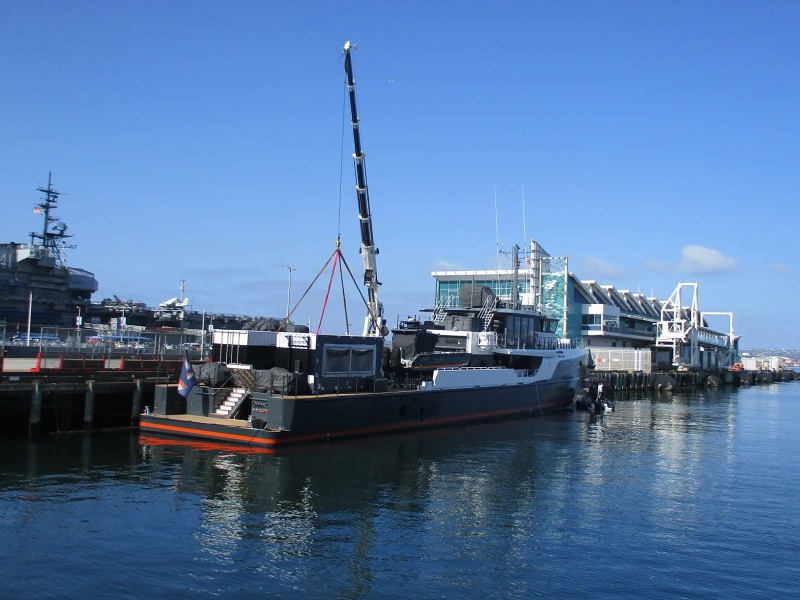
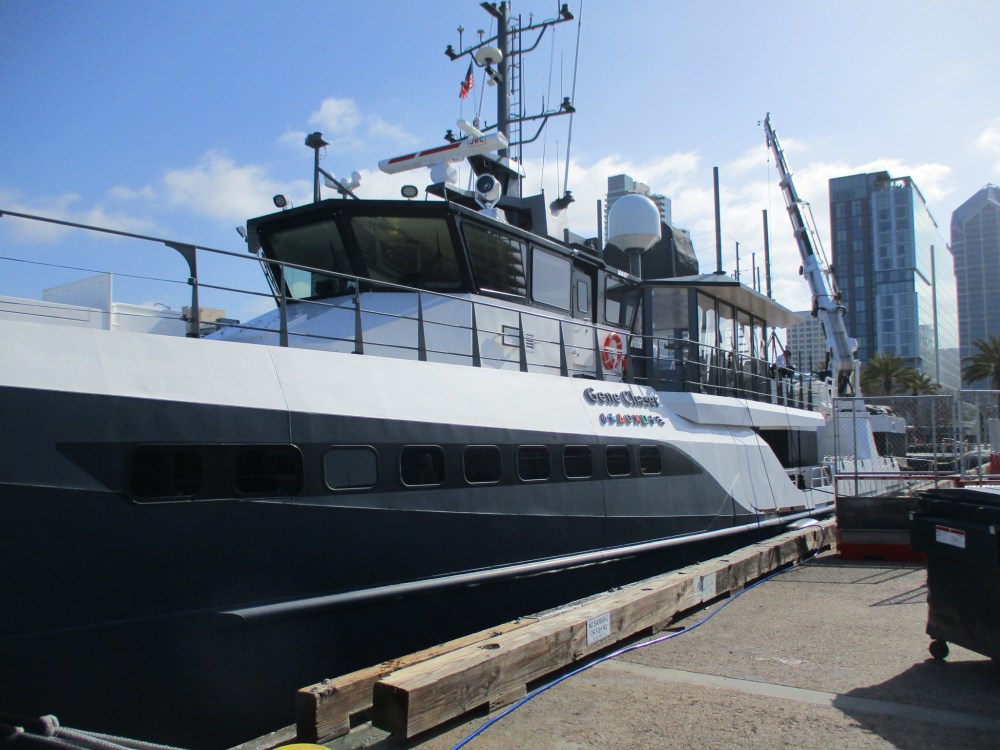
A very unusual yacht with a very unusual name is visiting San Diego. I saw the research yacht Gene Chaser this morning docked at Broadway Pier.
Gene Chaser is essentially a super high tech floating laboratory. I had to search the internet to learn about it. This article explains the ship’s capabilities and the aim of its owner: scientist, inventor and entrepreneur Dr. Jonathan Rothberg.
The yacht is fitted in such a way that technological breakthroughs can be made while traveling the world’s oceans seeking new solutions and knowledge from nature.
The article explains: To support the fast pace of creating and using new technology, GENE CHASER has extensive rapid prototyping capabilities — best in class 3D printing, CNC, laser cutting, and electronics fabrication are all on board. All of which complement the cutting edge molecular biology laboratory and high power computational infrastructure at the heart of the ship.
Comparing my photos with that in the article, it’s apparent major changes have recently been made to the vessel. It’s like nothing I’ve ever seen before!
…
Thanks for visiting Cool San Diego Sights!
I post new blogs pretty often. If you like discovering new things, bookmark coolsandiegosights.com and swing on by occasionally!
I live in downtown San Diego and love to walk around with my camera! You can follow Cool San Diego Sights via Facebook or Twitter!
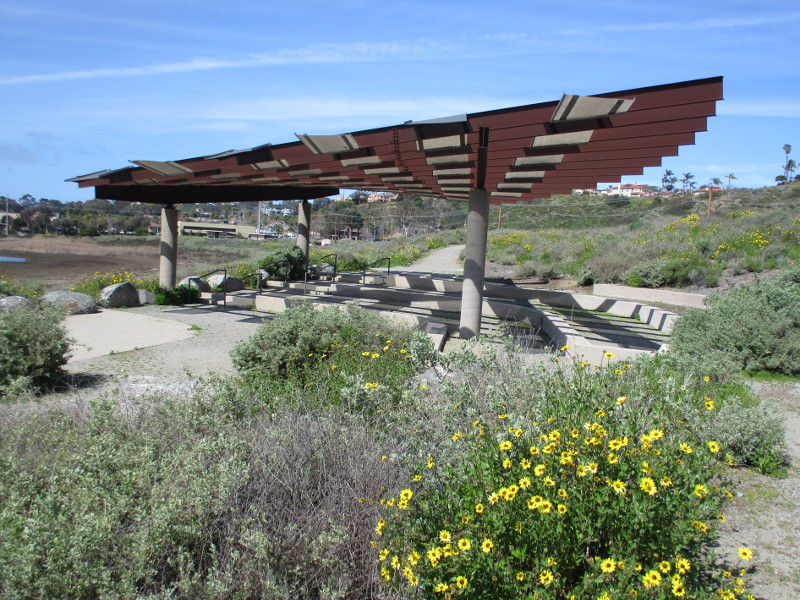
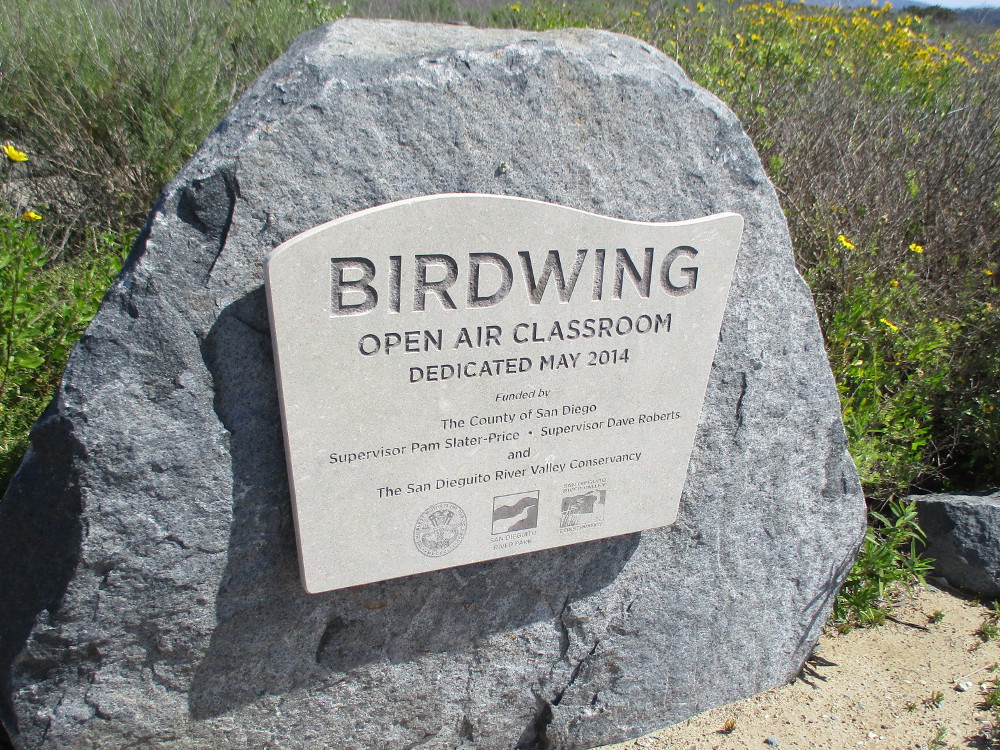
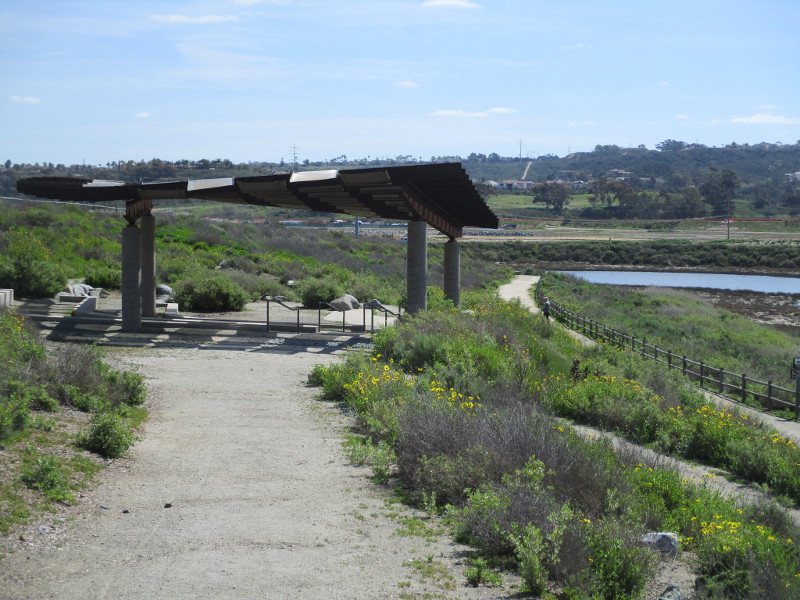
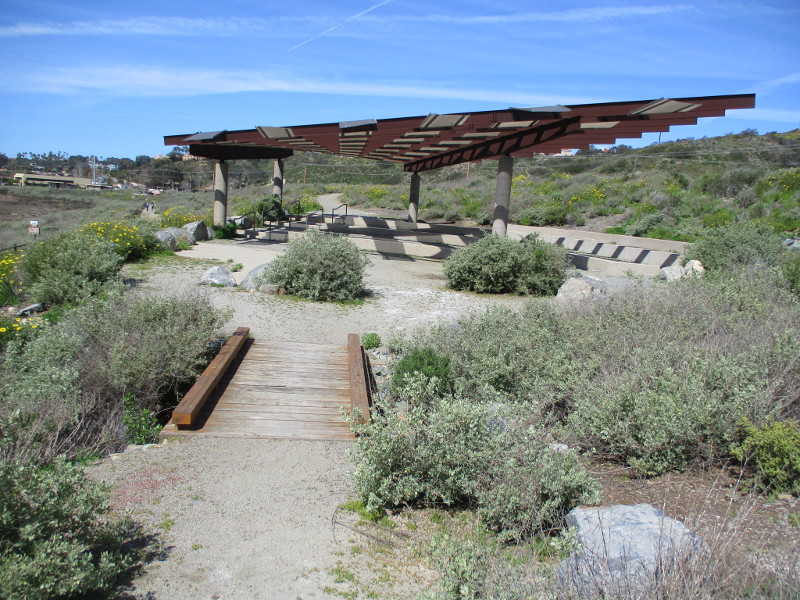
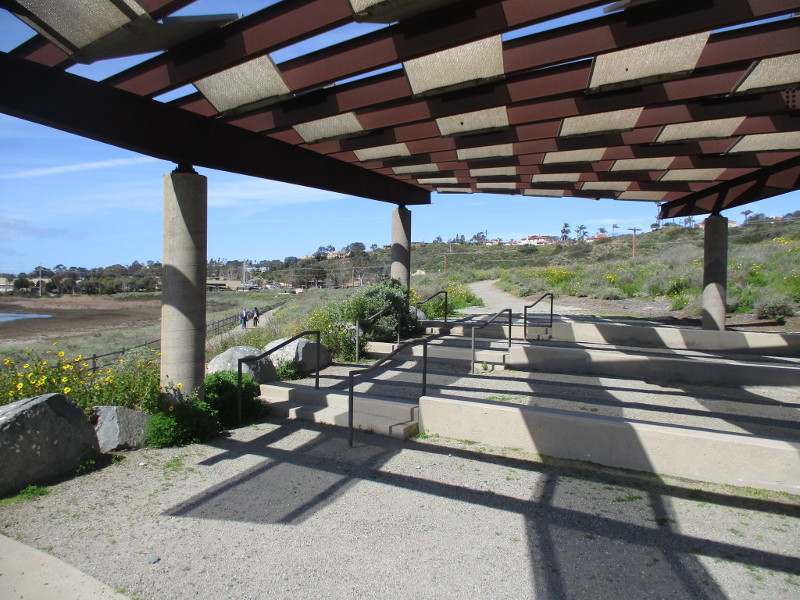
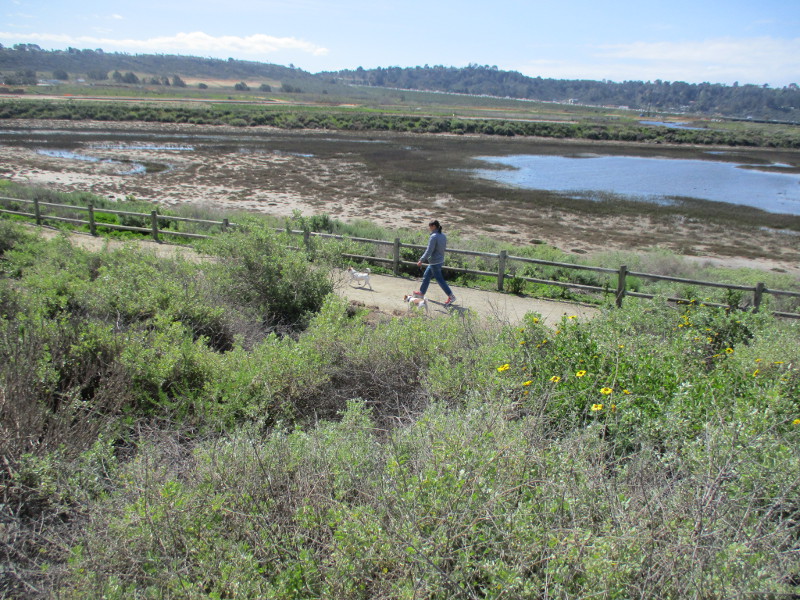
Beside the San Dieguito Lagoon wetland, near the west end of the San Dieguito River Park, you’ll find a beautiful outdoor space where one can learn about nature and soak in its goodness.
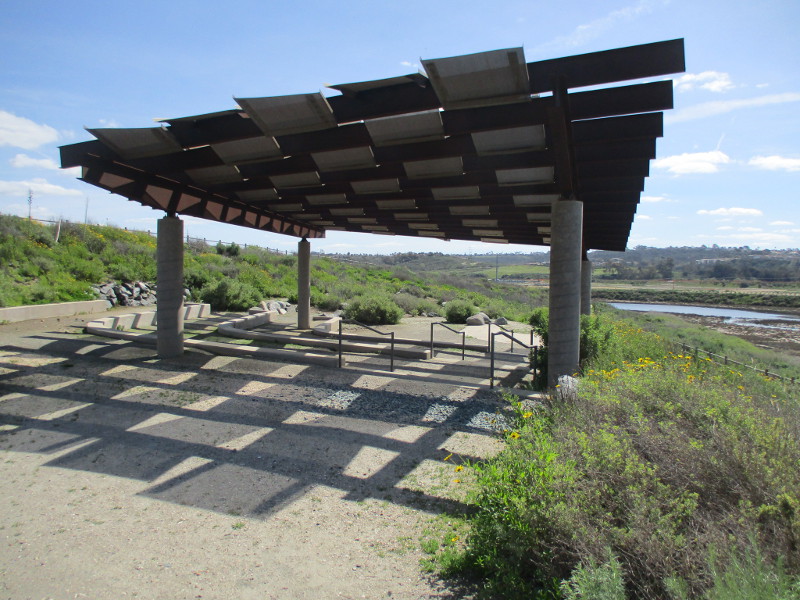
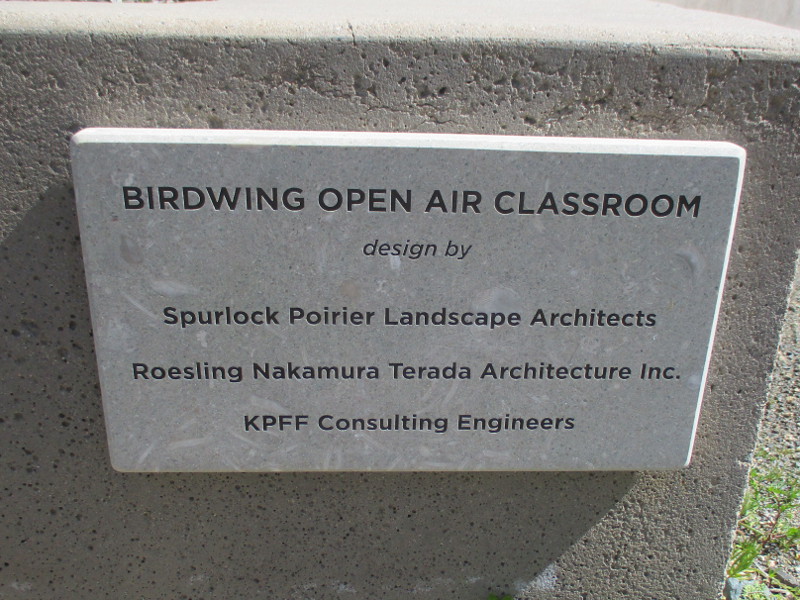
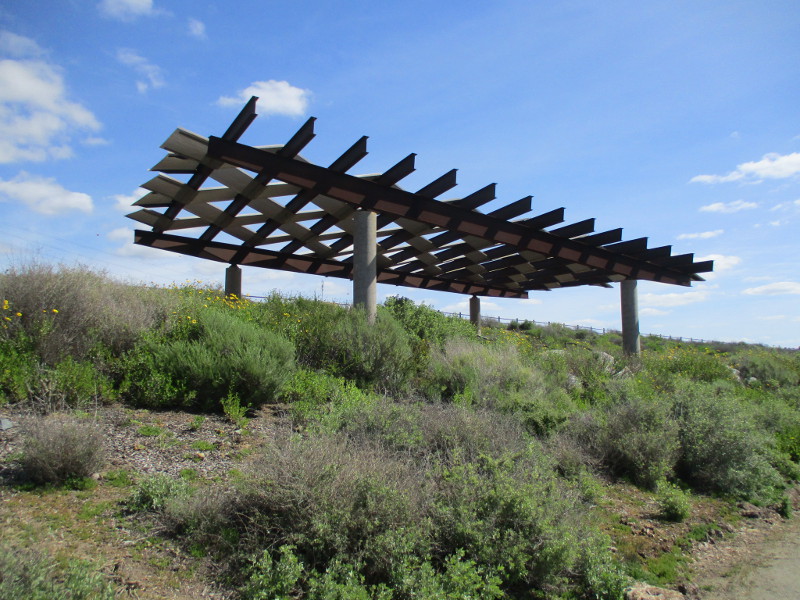
The shady, airy Birdwing Open Air Classroom was dedicated in 2014. It does indeed look a bit like a bird’s wing in flight!
Birdwing may be used as a trailside classroom by teachers, scientists and park rangers. It is also a place for walkers and hikers to relax and gaze out the nearby lagoon.
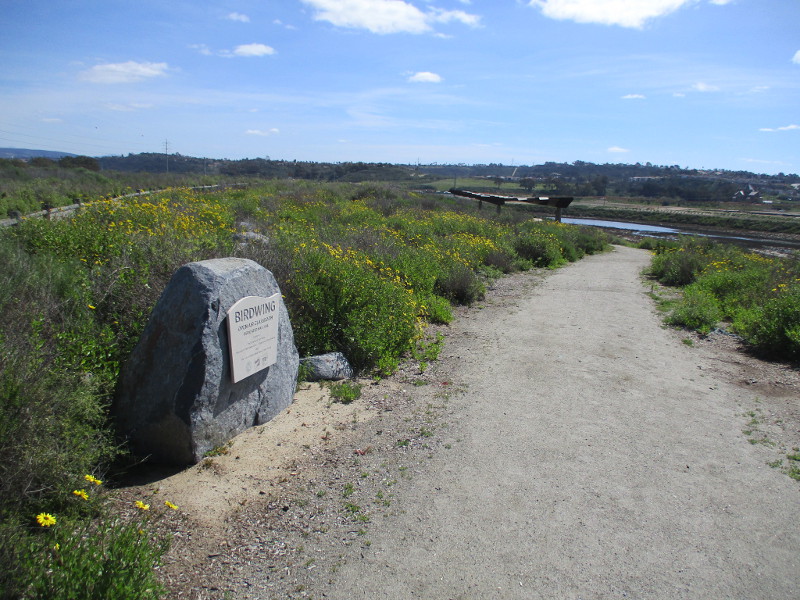
A short looping path and bridge near the structure passes through yellow bush sunflowers and other native plants. From that path I observed an osprey flying high in the sky–too small for a sharp photograph with my little camera.
The Birdwing Open Air Classroom can be accessed from the Coast to Crest Trail perhaps a quarter mile east of San Andres Drive and the ranger station.
You can learn more about the Birdwing Open Air Classroom here.
…
Thanks for visiting Cool San Diego Sights!
I post new blogs pretty often. If you like discovering new things, bookmark coolsandiegosights.com and swing on by occasionally!
I live in downtown San Diego and love to walk around with my camera! You can follow Cool San Diego Sights via Facebook or Twitter!
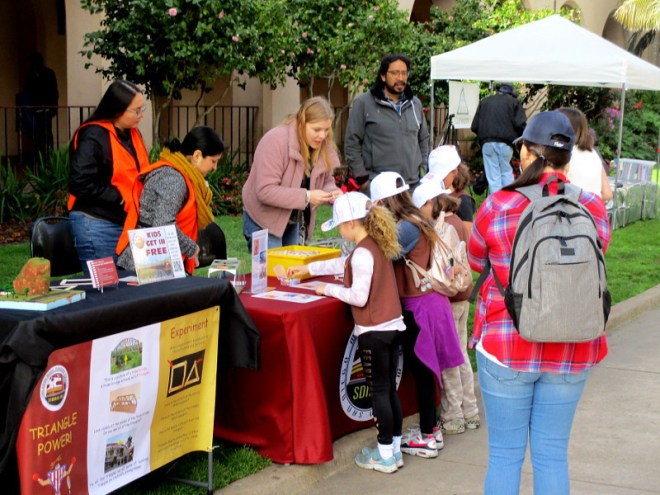
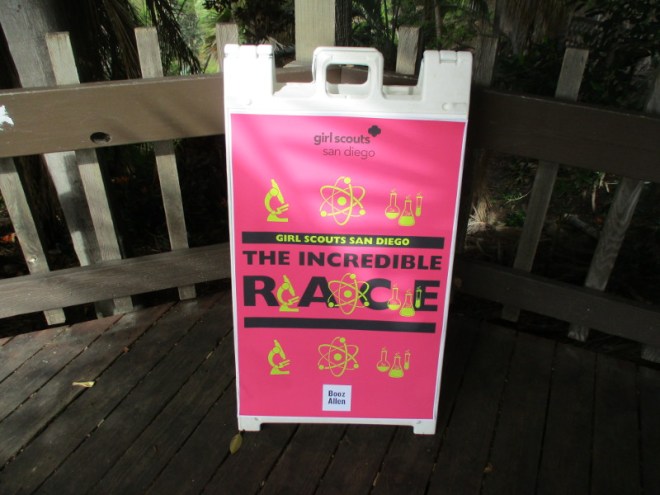
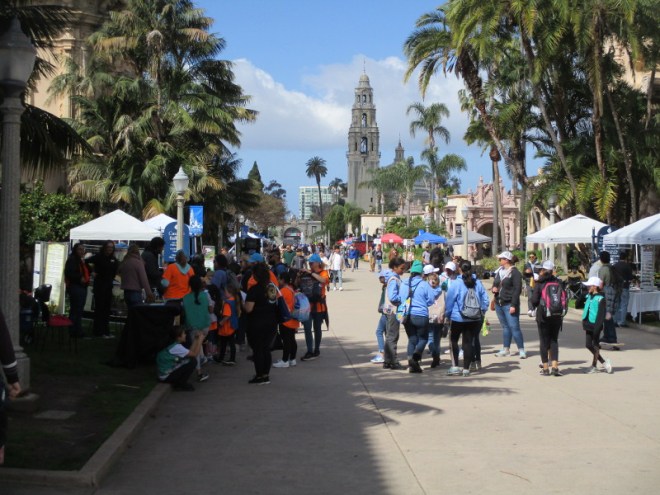
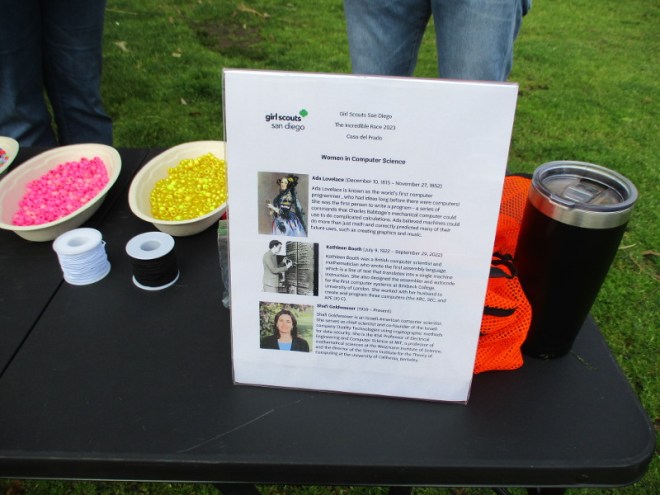
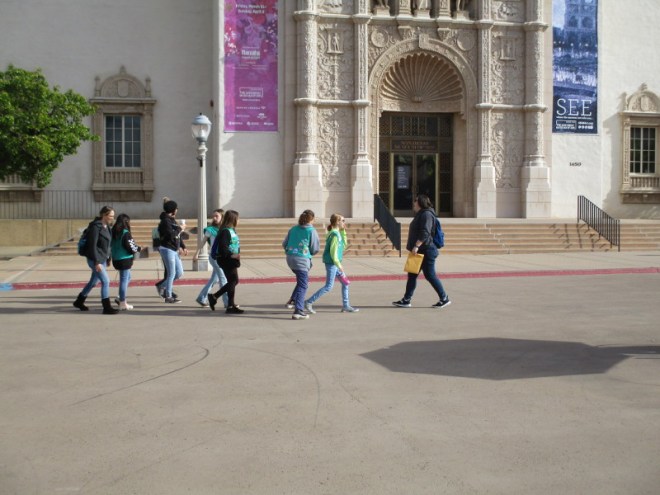
Hundreds of Girl Scouts from around San Diego gathered in Balboa Park this morning to take part in the Incredible Race!
Many stations were set up around the park: along El Prado, in front of museums, even in the parking area behind the San Diego Automotive Museum. Girls were being challenged to explore STEM, which stands for Science, Technology, Engineering and Mathematics.
During the Incredible Race, teams would solve riddles and proceed station to station where fun, educational hands-on activities awaited.
As I walked through the park, I saw a lot of excited young people running energetically about, enjoying San Diego’s beautiful crown jewel and learning lots of cool stuff, too!
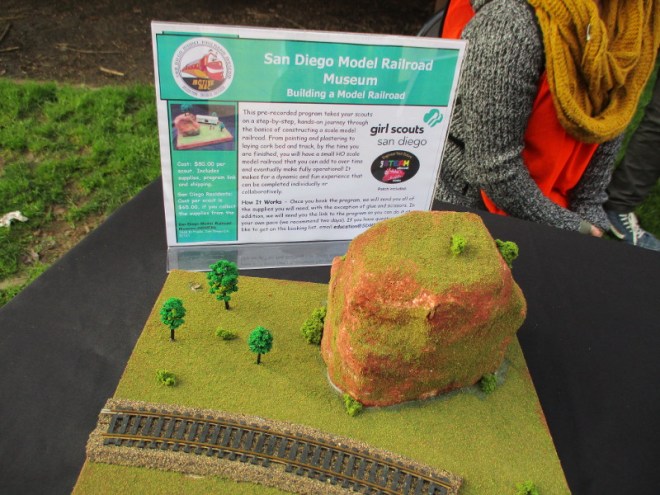
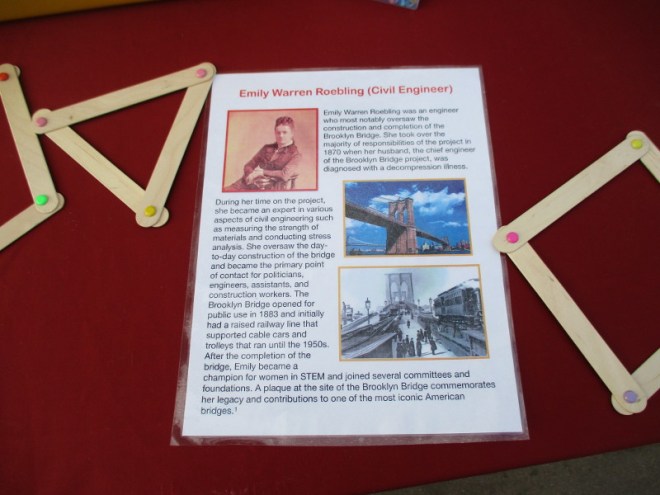
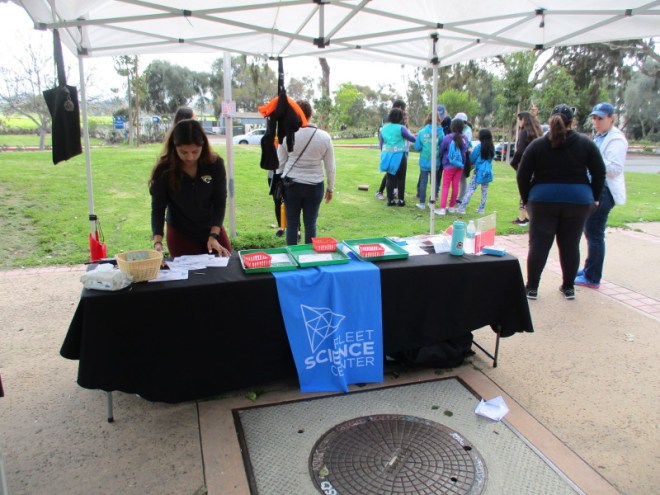
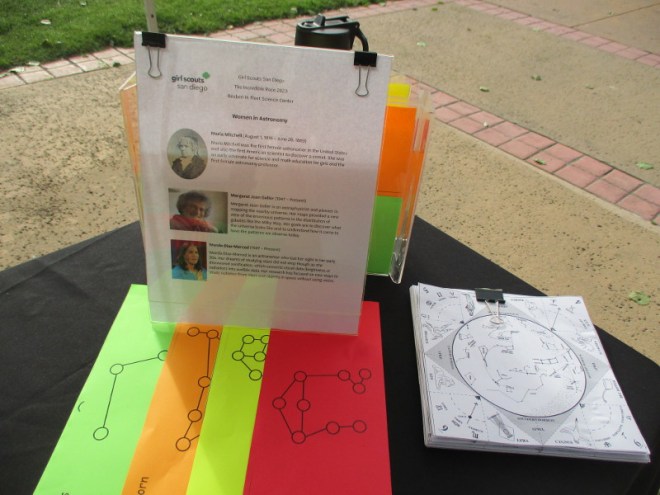
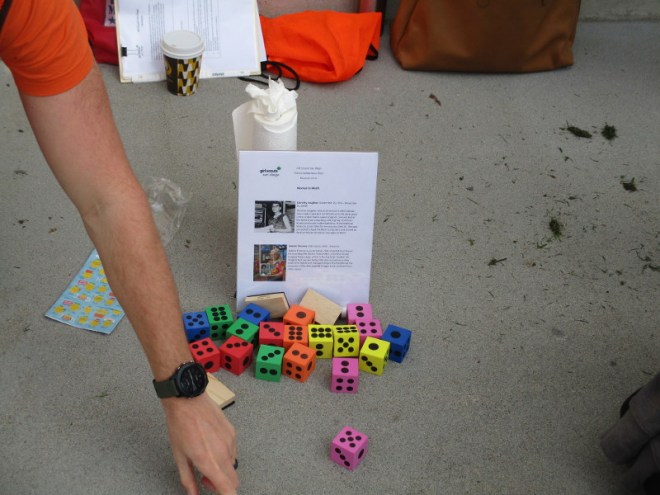
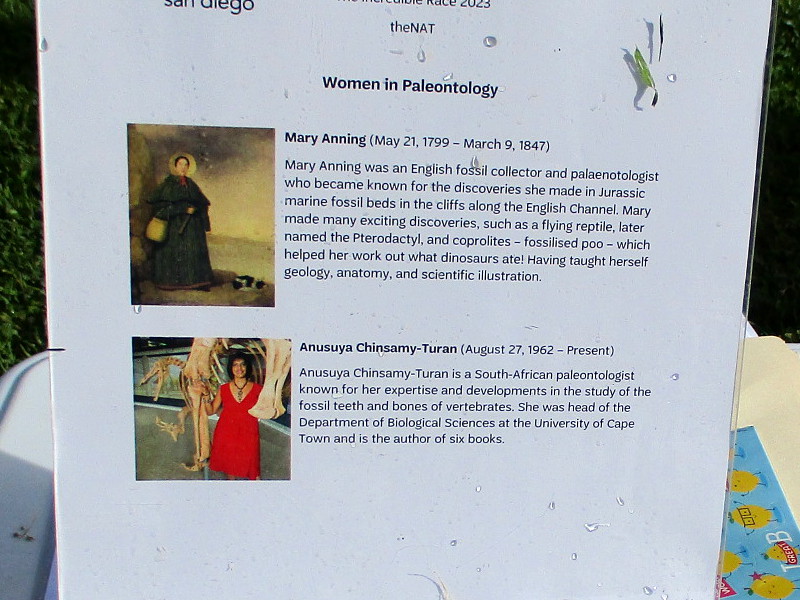
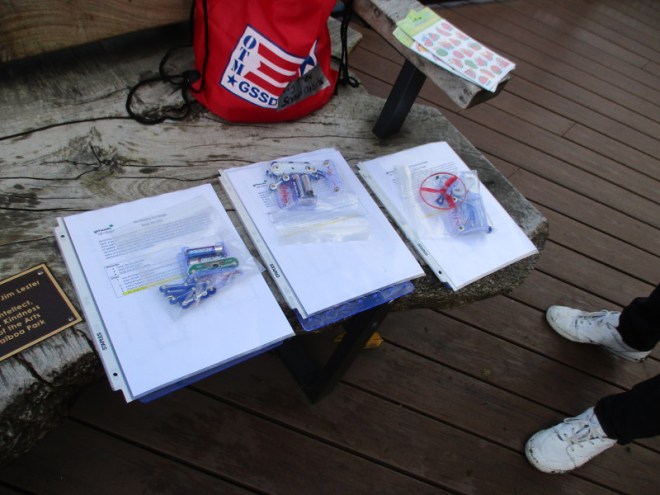
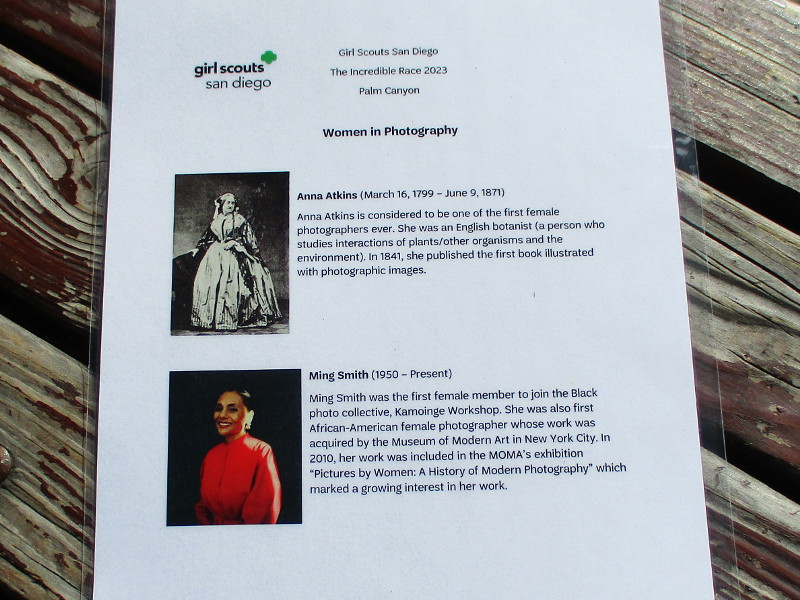
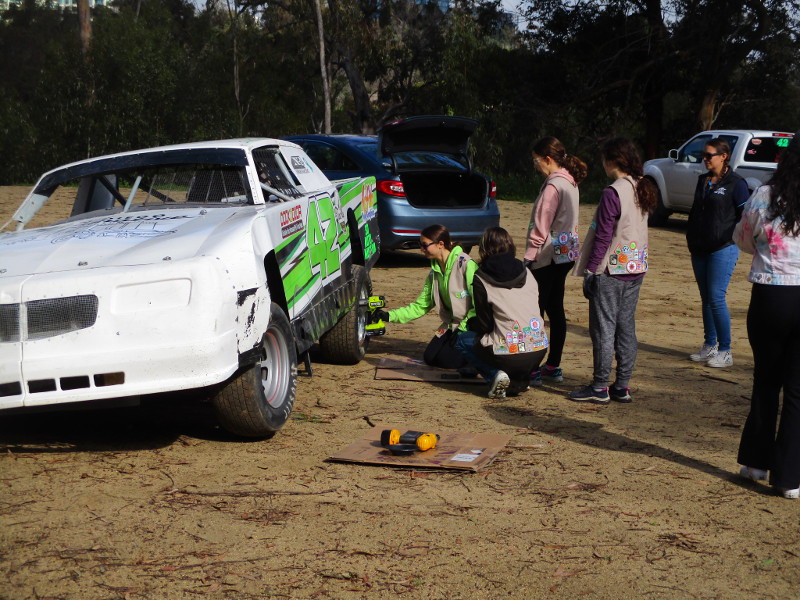
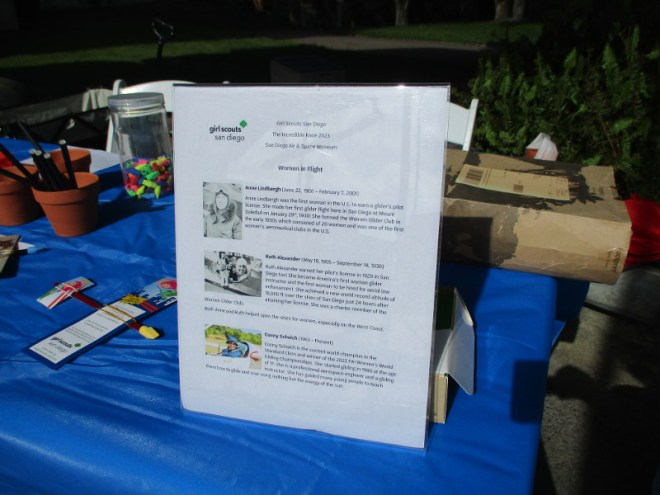
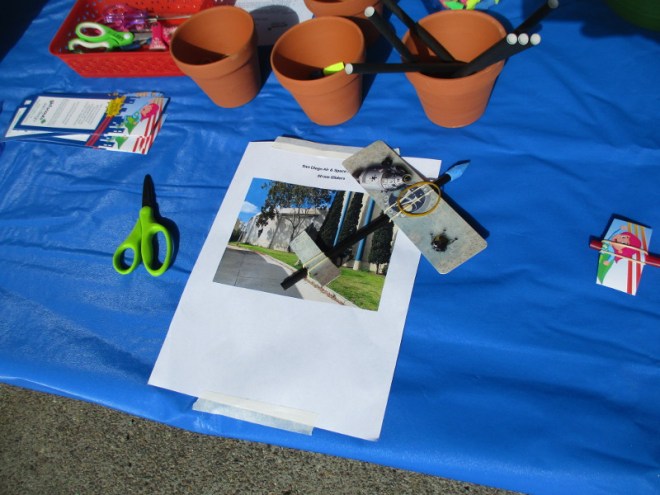
The San Diego Model Railroad Museum demonstrates how to plan and build a model railroad.Emily Warren Roebling was an engineer who oversaw the construction and completion of the Brooklyn Bridge.A table with activities near the Fleet Science Center.Learning about constellations and Women in Astronomy.In front of the Museum of Us, Girl Scouts could learn about Women in Math.At the Casa del Prado, one could make binary bracelets and learn about Women in Computer Science.By the San Diego Natural History Museum, there was a fun dinosaur fossil digging activity and information about Women in Paleontology.On the platform under the Moreton Bay Fig, curious Girl Scouts learned about electrical circuits and Women in Engineering.Above beautiful Palm Canyon, a station recognized historically important Women in Photography.Behind the San Diego Automotive Museum, participants could change a tire on a cool race car!At the San Diego Air and Space Museum, Women in Flight were recognized, including Anne Lindbergh, the first woman in the United States to earn a glider’s pilot license. She made her first flight in San Diego, at Mount Soledad in 1930.Girl Scouts could make their own gliders!
…
Thanks for visiting Cool San Diego Sights!
I post new blogs pretty often. If you like discovering new things, bookmark coolsandiegosights.com and swing on by occasionally!
I live in downtown San Diego and love to walk around with my camera! You can follow Cool San Diego Sights via Facebook or Twitter!
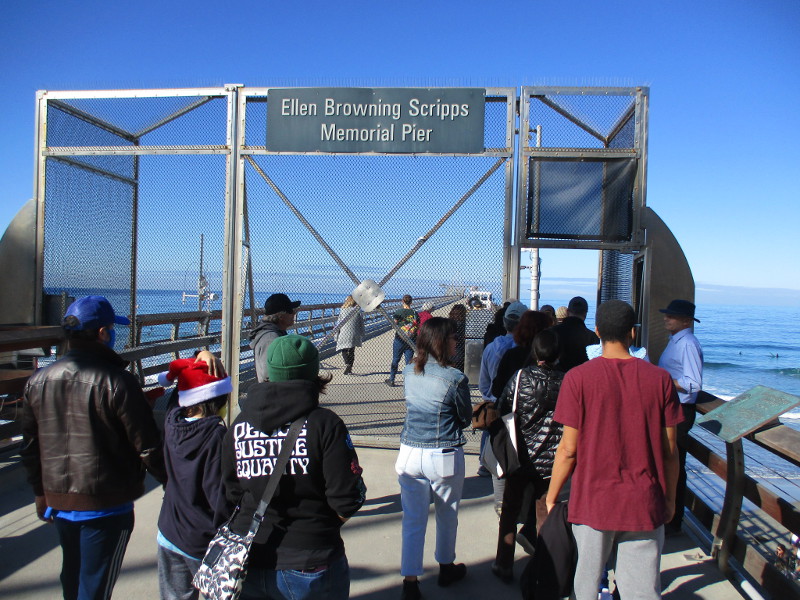
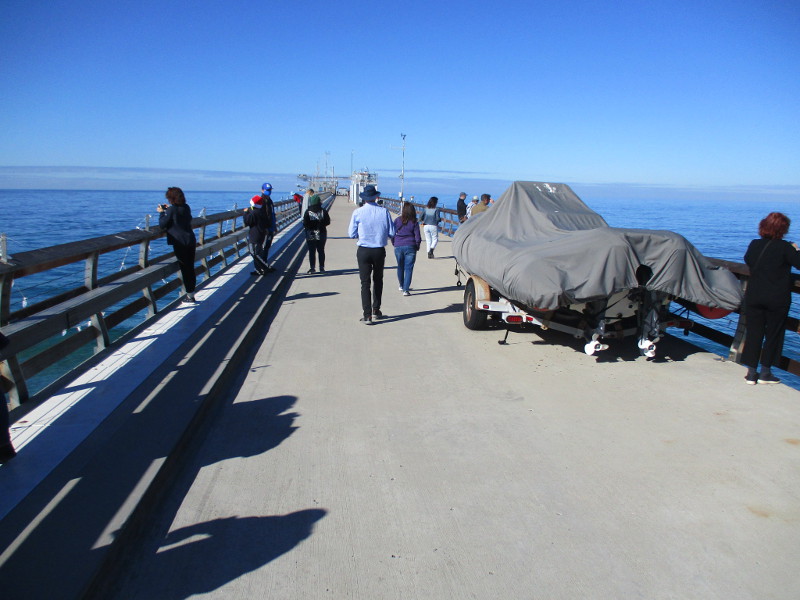
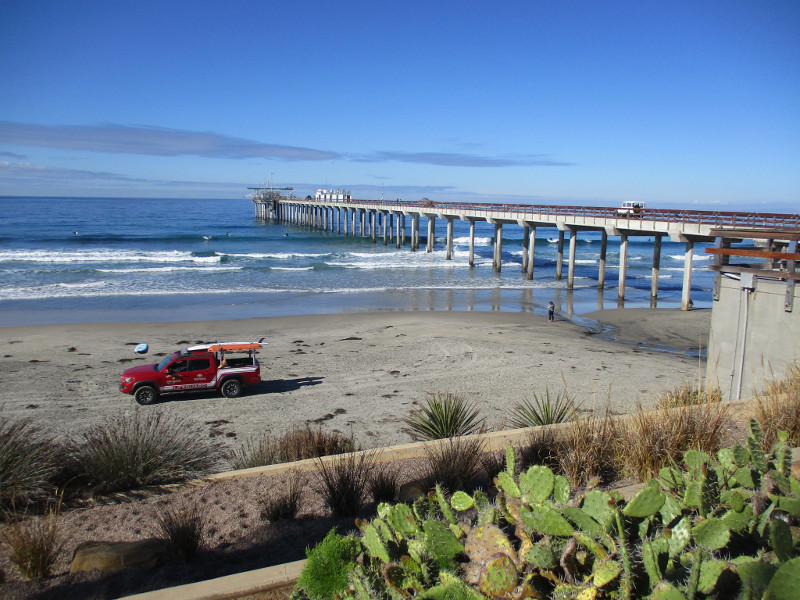
The long Ellen Browning Scripps Memorial Pier, jutting into the Pacific Ocean north of La Jolla Shores, is operated by the Scripps Institution of Oceanography. The research pier is utilized by scientists and students who strive to learn more about our environment and the diverse life within it.
The public is usually restricted from going onto Scripps Pier, but those who register for a once-a-month tour get the opportunity to walk out to its very end. And that’s what I did today!
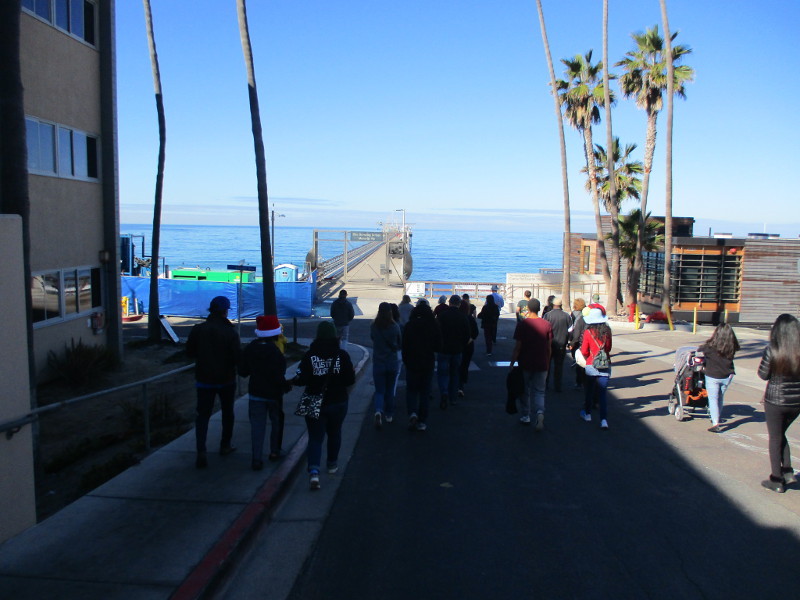
The tour–every second Saturday of the month (register here)–begins in front of the historic Scripps Building, then circles around several additional campus buildings until it reaches the foot of the pier. As our group walked along, the knowledgeable tour guide told us about the origin and history of the world-renowned Scripps Institution of Oceanography, and how its environmental and biological research benefits us all.
Then we came to the amazing pier and our sense of wonder grew…
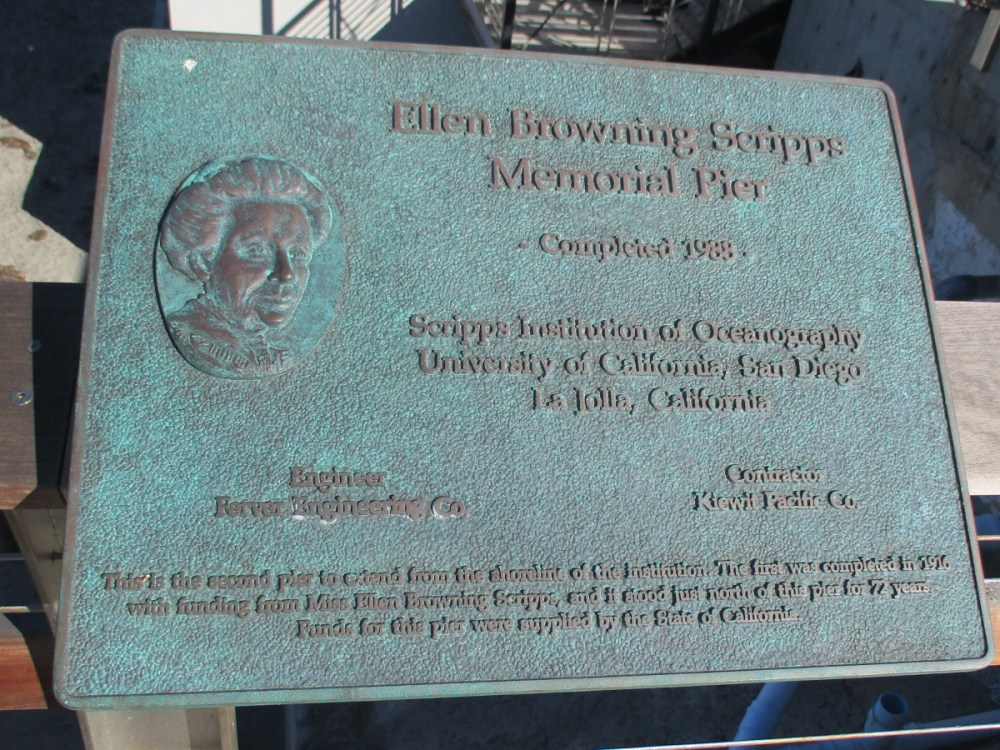
The original wooden pier, built in 1916 with funding from Ellen Browning Scripps, was destroyed in 1983 by an El Niño powered storm. The current modern pier was built in 1988. Today it’s considered one of the world’s largest research piers.
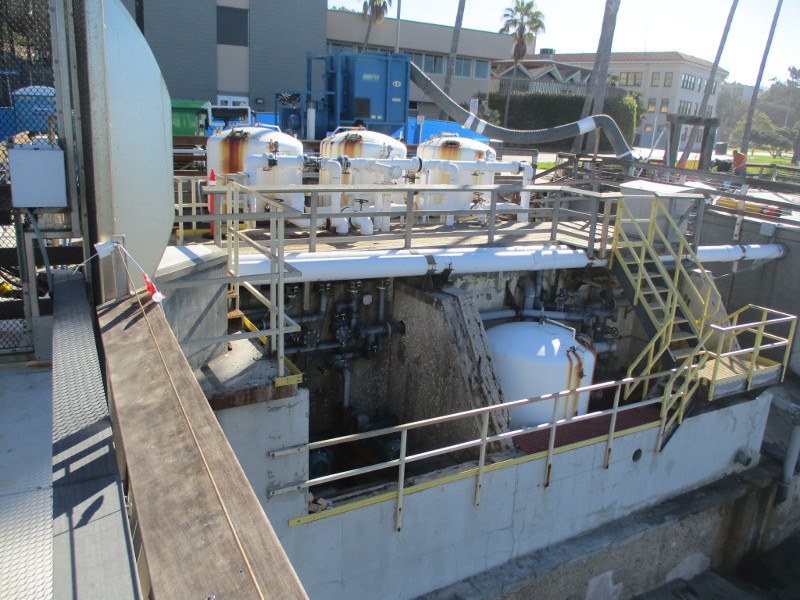
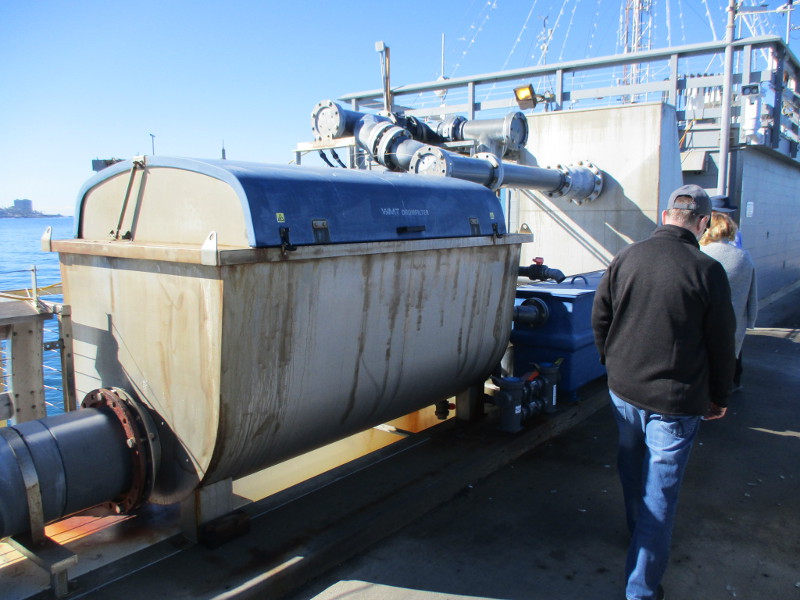
Looking back at the foot of the pier we could see these tank-like water filters.
At the end of Scripps Pier is a pump station. The pier slopes slightly upward as you walk to its end. The reason? So that the freshly pumped seawater, propelled by gravity, will run down a covered trough that stretches along one side of the long pier.
The water, carefully filtered, is then used in the Scripps research labs on shore.
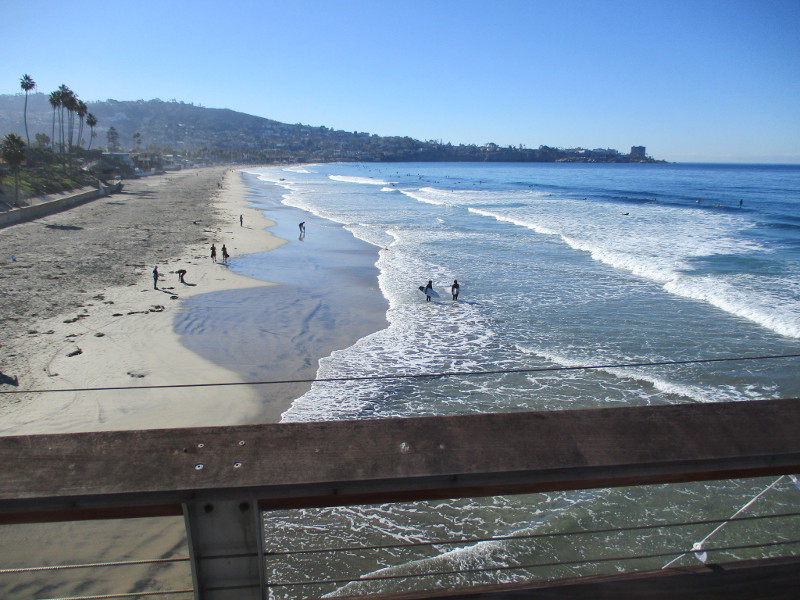
Walking out on the pier high over the beach, looking south toward La Jolla Shores. That’s the Village of La Jolla and La Jolla Cove jutting in the distance.
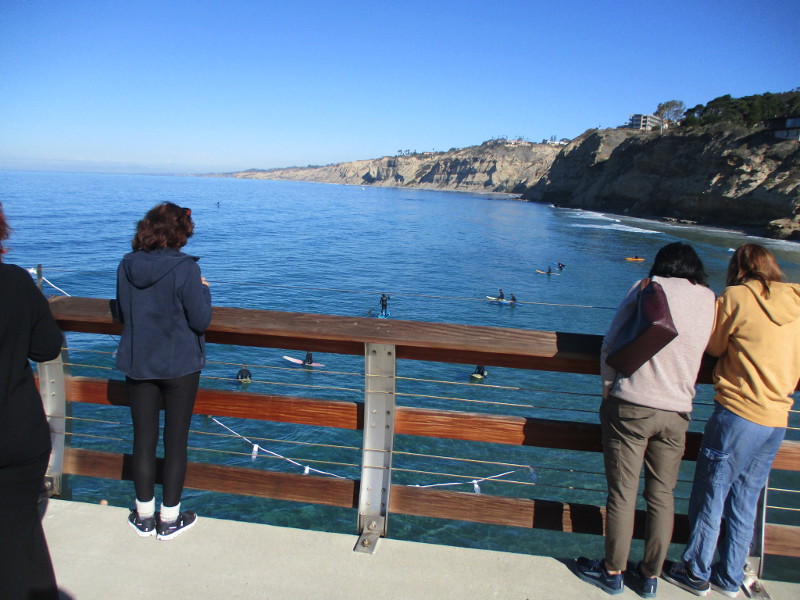
Now we’re gazing north toward the distant sandstone cliffs of Torrey Pines State Beach.
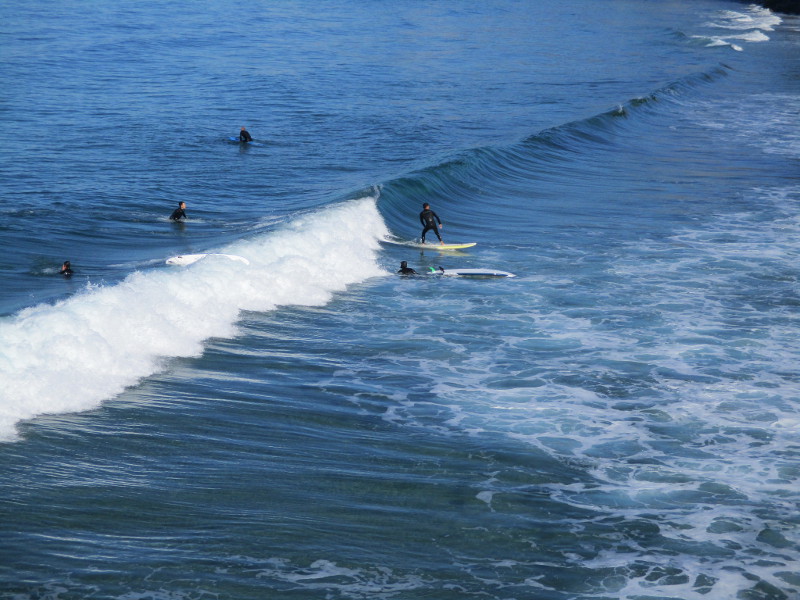
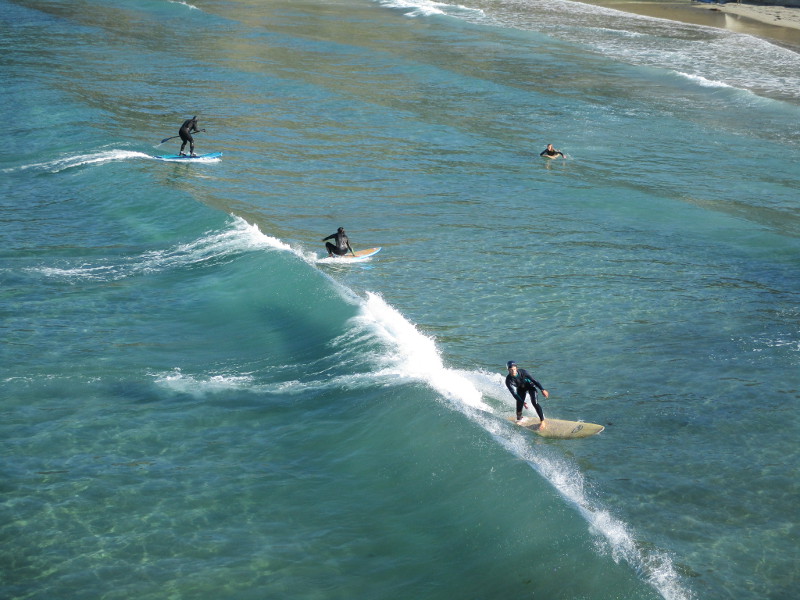
Many surfers were out today! A sunny San Diego day in December.
Looking back toward a portion of the Scripps Institution of Oceanography campus. (Scripps is a part of UC San Diego.)
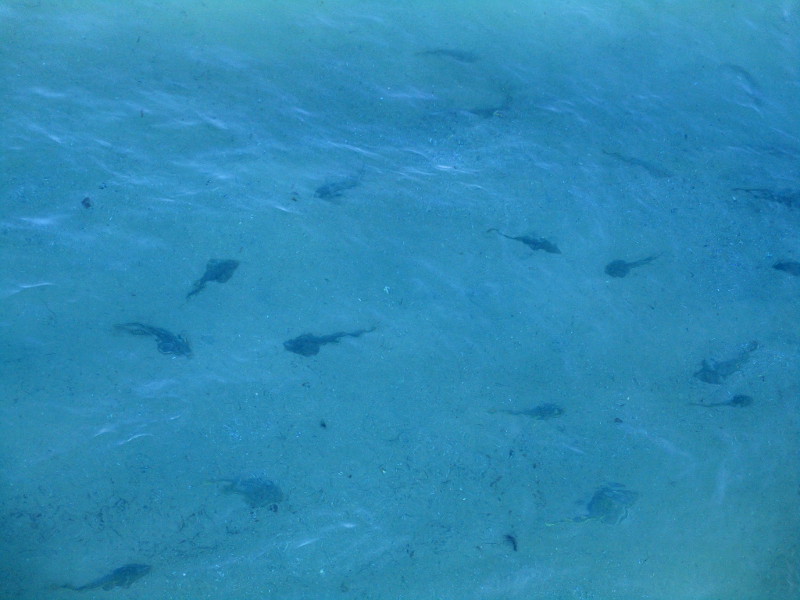
We observed lots of guitarfish in the water below. When you’re swimming or surfing, you don’t necessarily see all that marine life beneath you!
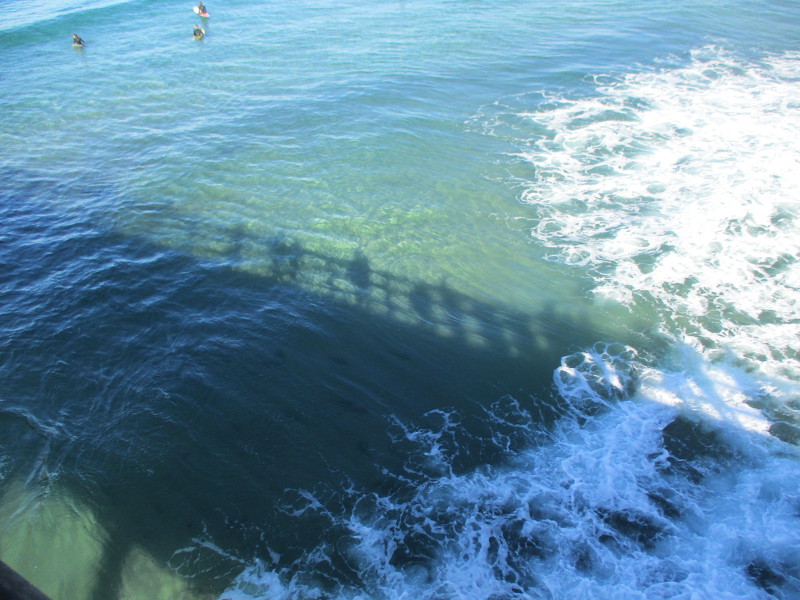
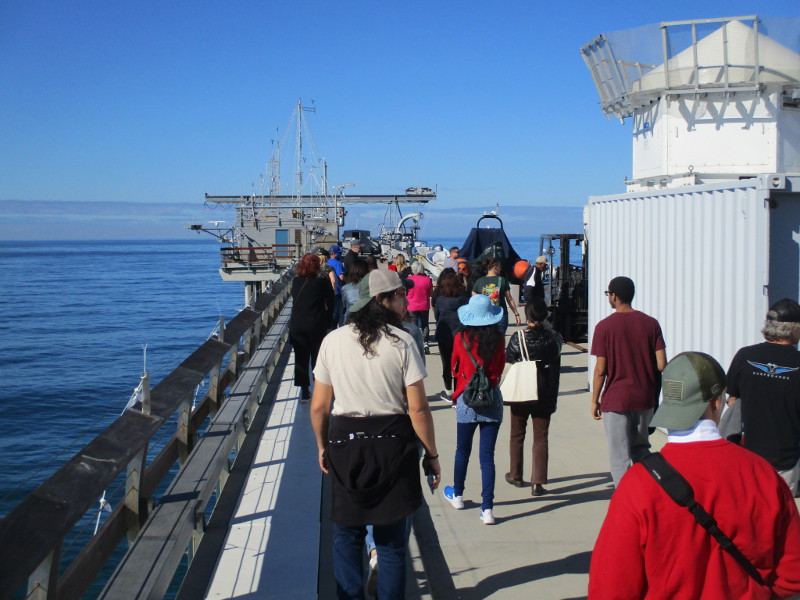
Amazing views can be enjoyed from Scripps Pier. Looking down, we saw numerous surfers waiting for that perfect wave on either side of the pier.
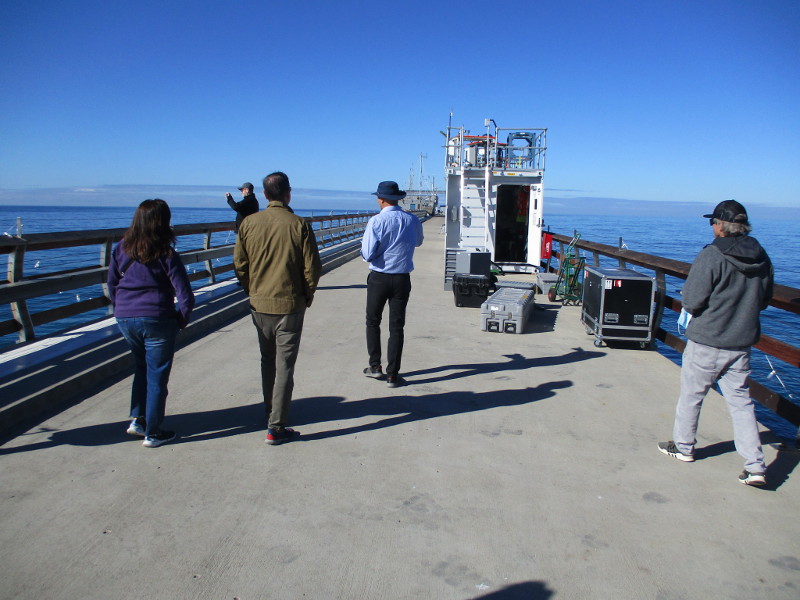
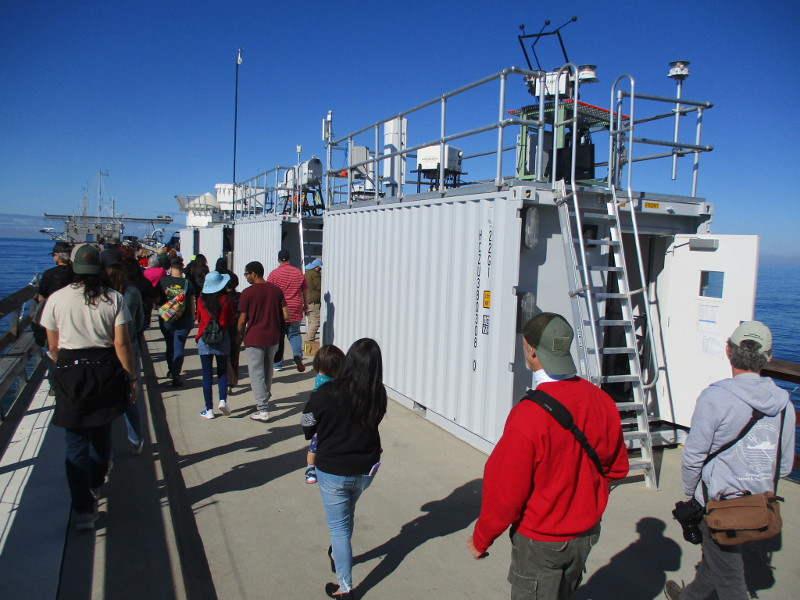
We followed our tour guide to a group of container-like structures that were recently placed on Scripps Pier. Together they constitute a mobile facility that will be used for a one year atmospheric study by the U.S. Department of Energy.
A wide variety of scientific instruments, including radar, lidar, sky imagers and radiometers will measure cloud formation, reflectivity and other atmospheric phenomena.
We are approaching the end of Scripps Pier, where that prominent gray structure houses a seawater pump.
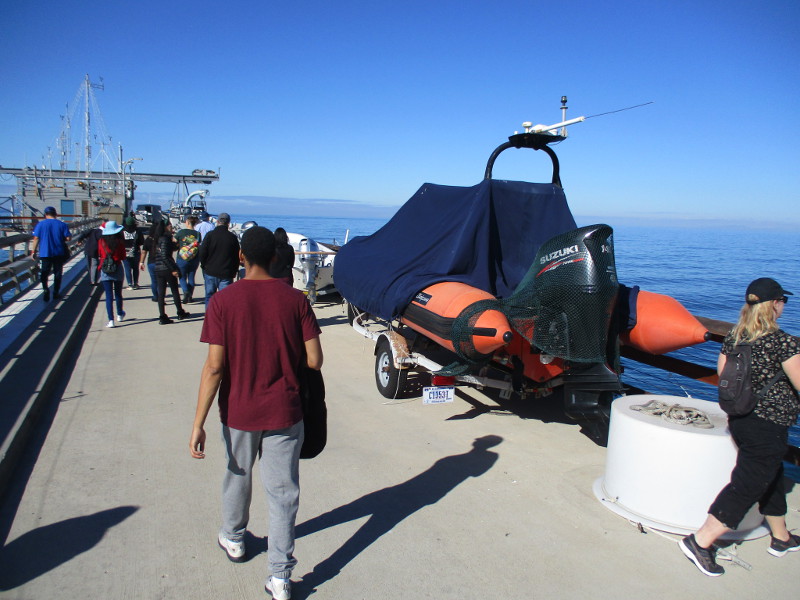
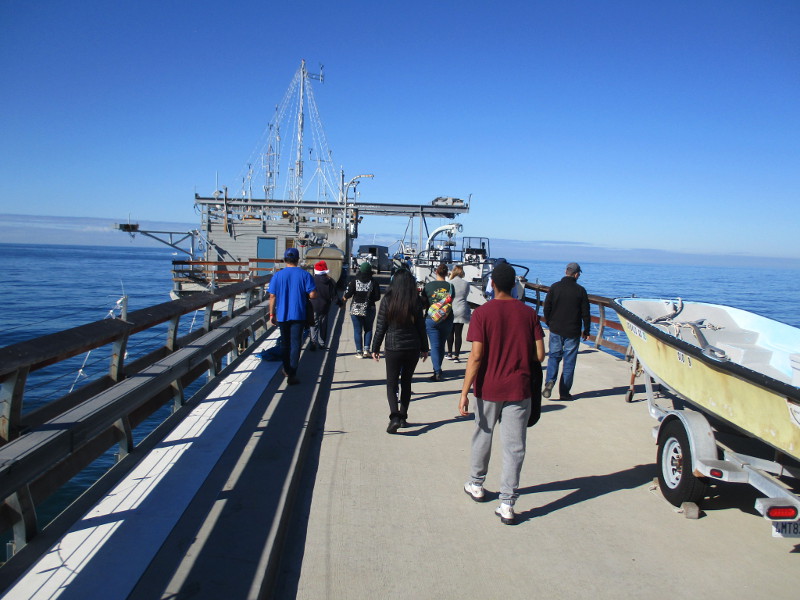
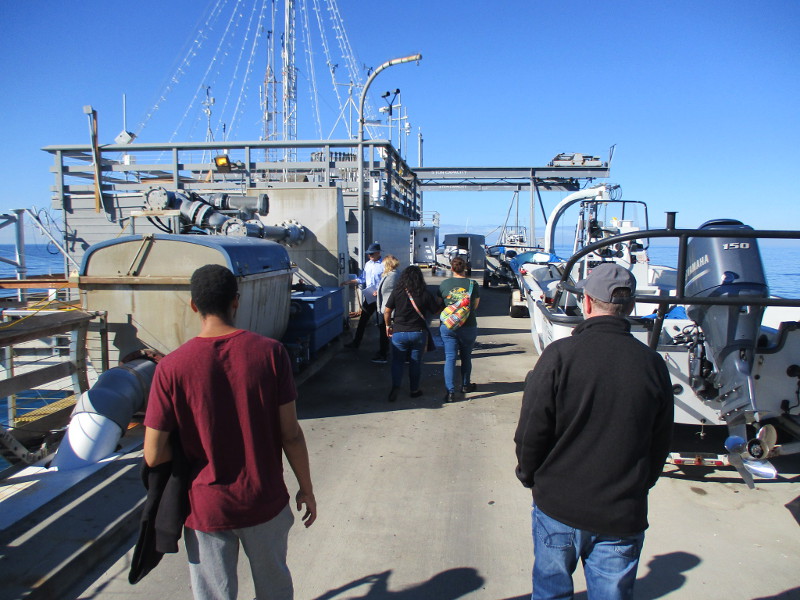
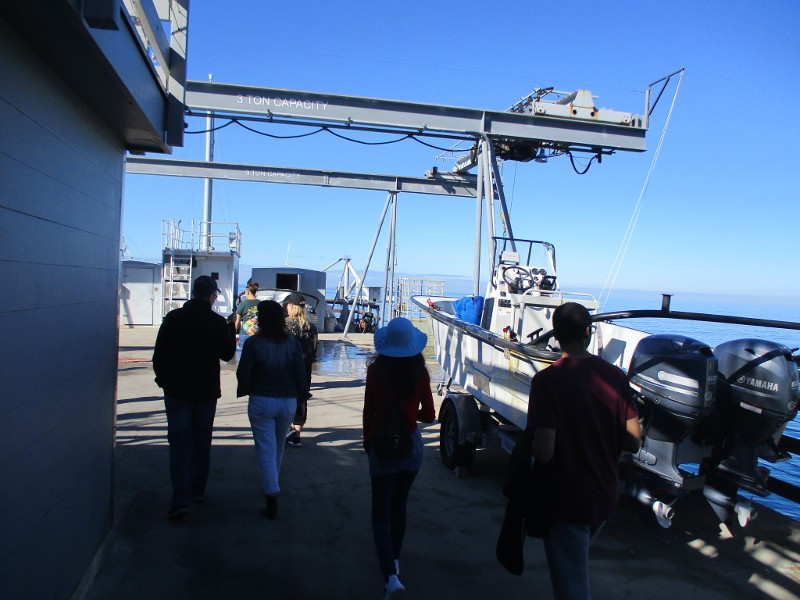
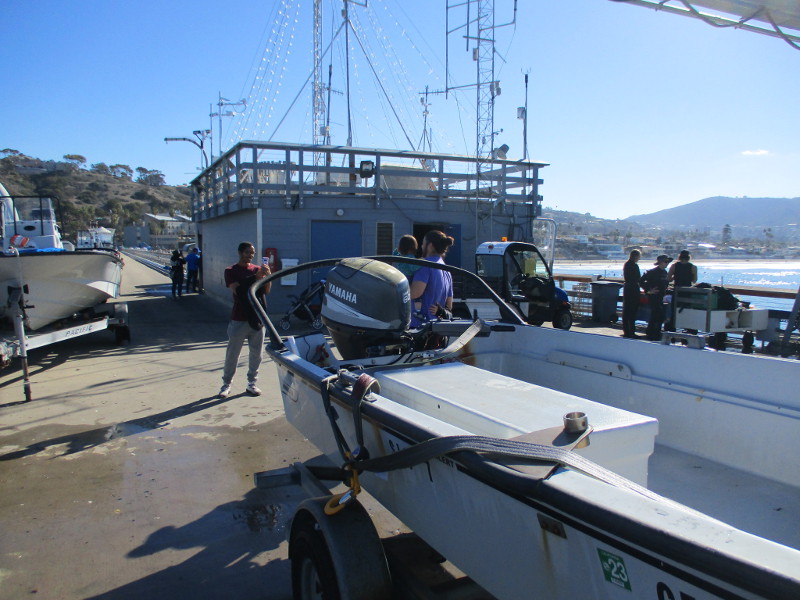
All sorts of small boats are kept near the end of the pier, where they can be lowered into the ocean to carry out research.
Notice something shaped like a Christmas tree atop the pump structure ahead? It lights up during the Holiday Season! (As do swags of lights along the length of the pier.)
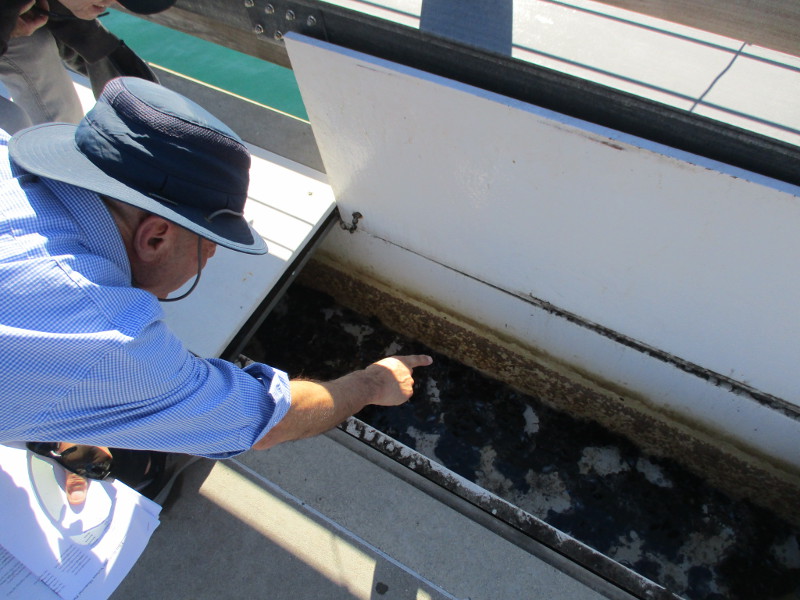
Lifting a lid from that long trough that channels the pumped seawater gravitationally down the pier’s length. We saw barnacles, mussels and a live crab skittering around! (You can understand why those filters are necessary at the foot of the pier.)
There’s additional filtration near the pump!
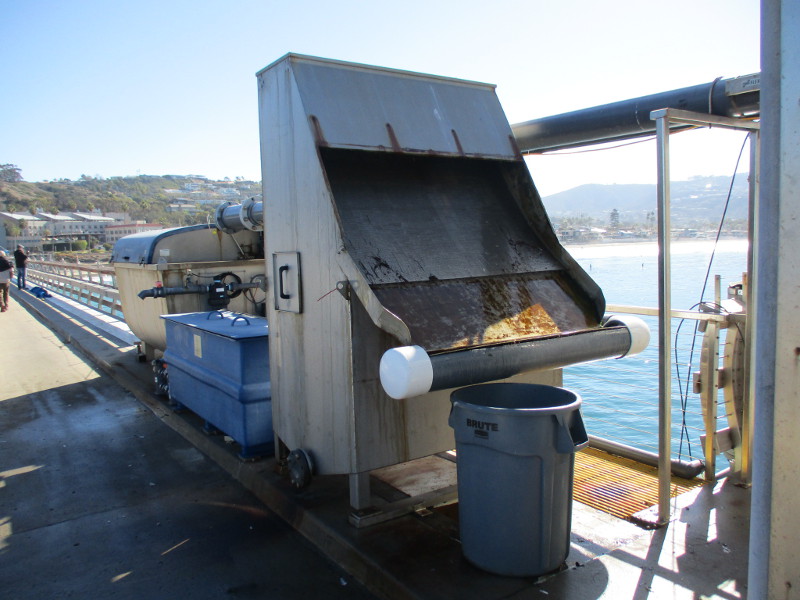
I believe this device filters out the larger objects from the pumped seawater, before the water heads down the long trough. You can see some slimy seaweed stuck in it.
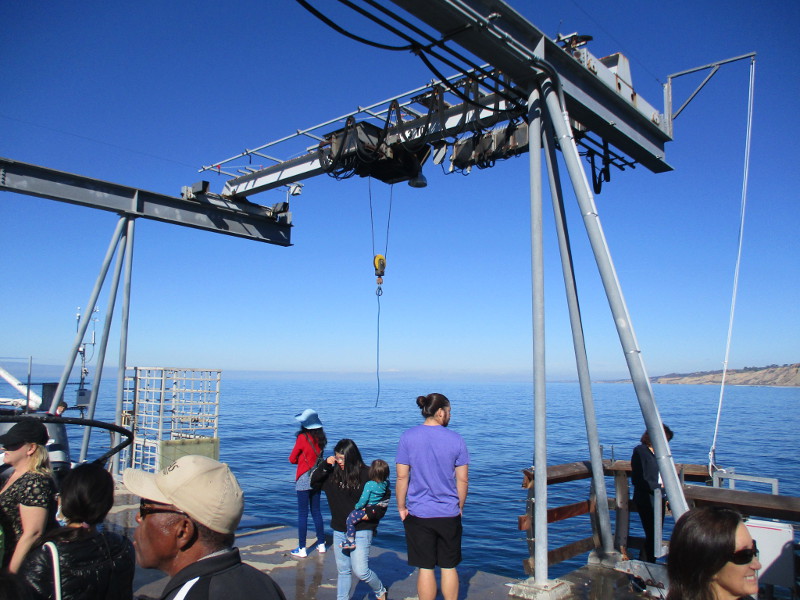
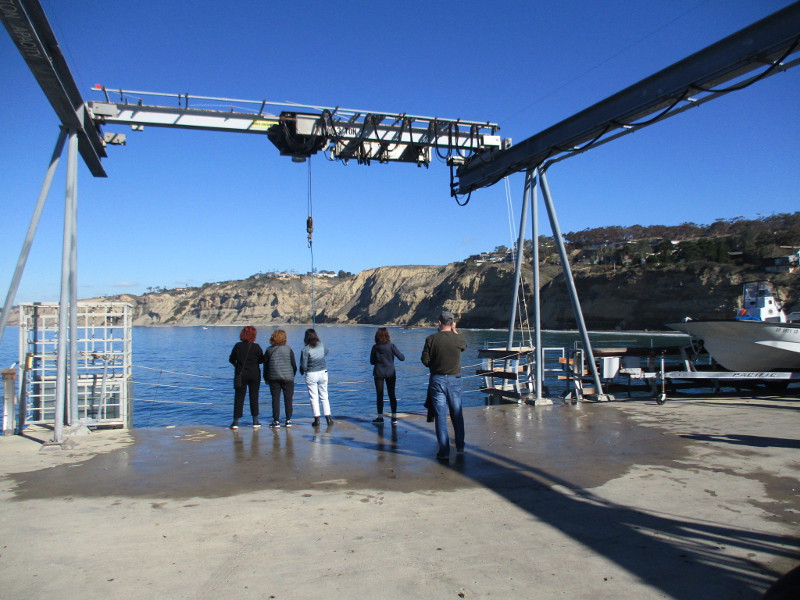
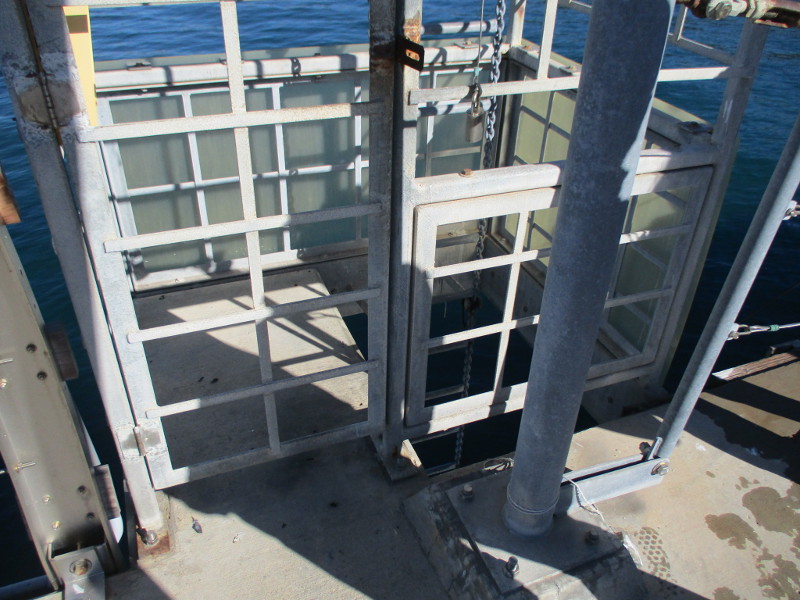
From this crane boats can be lowered to the ocean surface. On the left you can see the cage-like entrance to a descending ladder.
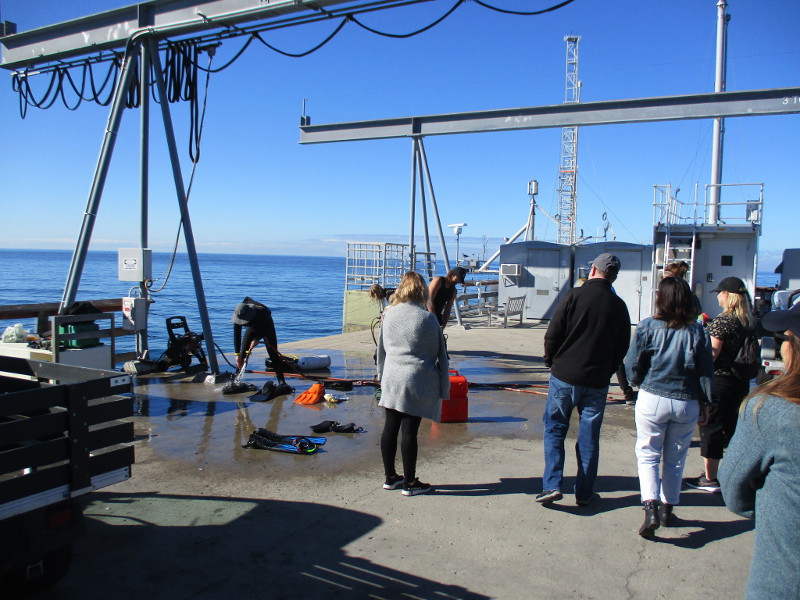
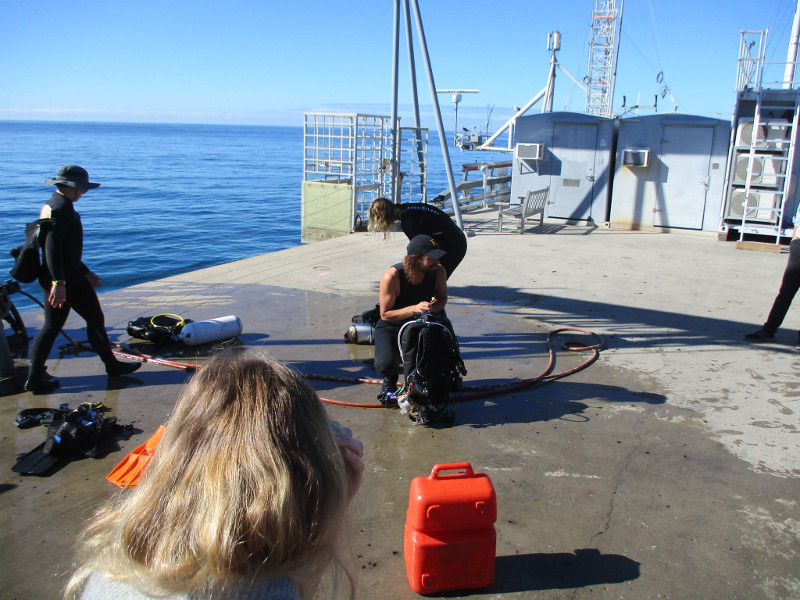
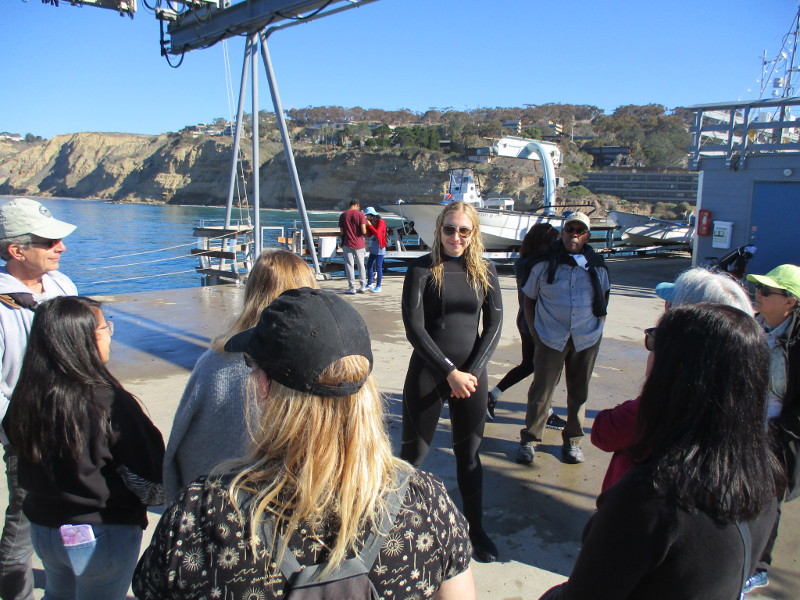
Our tour group came upon several people in wetsuits, just back from a dive!
A super friendly graduate student explained how they had dived at an artificial reef off Black’s Beach, to the north, near the Torrey Pines Gliderport. They photographed abundant sea life.
The wet spot is from their boat that was recently lifted!
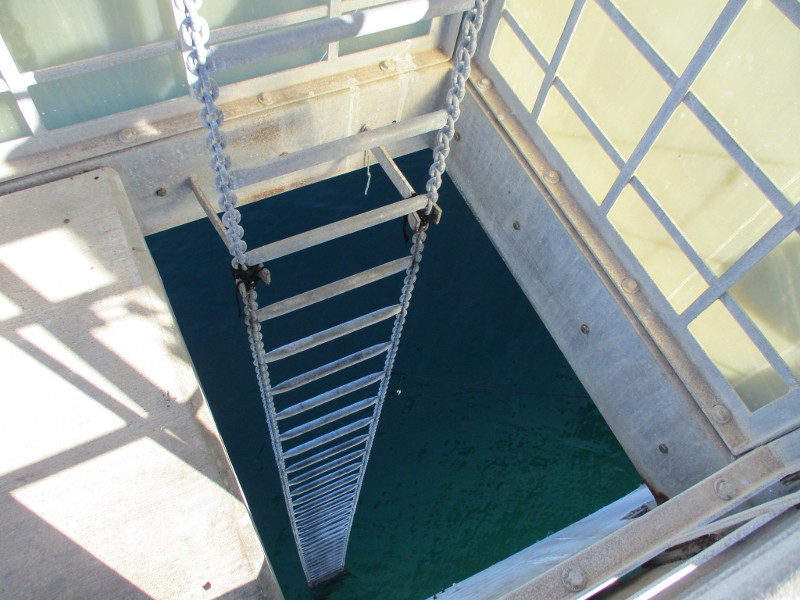
That’s one long ladder down to the water!
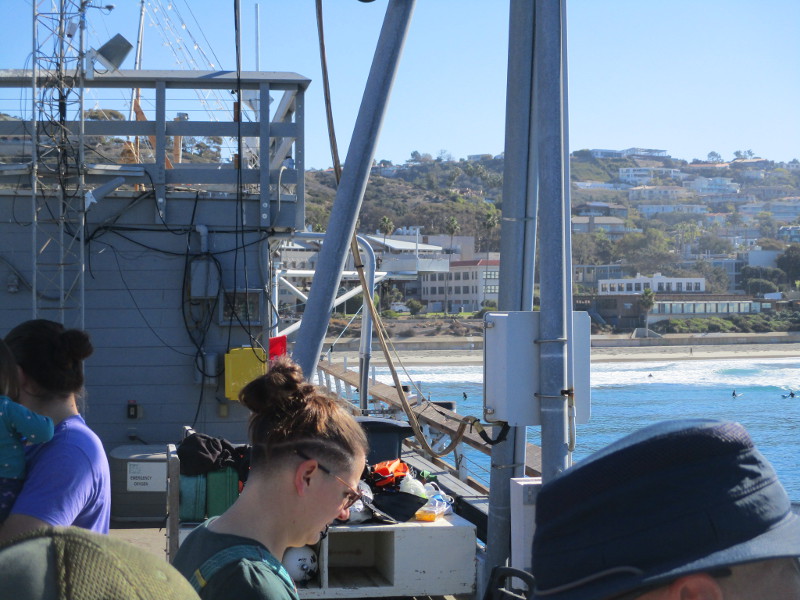
I noticed many instruments on the roof of the pump structure, including antennas and wind gages.
And to one side is the Scripps Osprey Platform! (You can see it near the center of this photograph.)
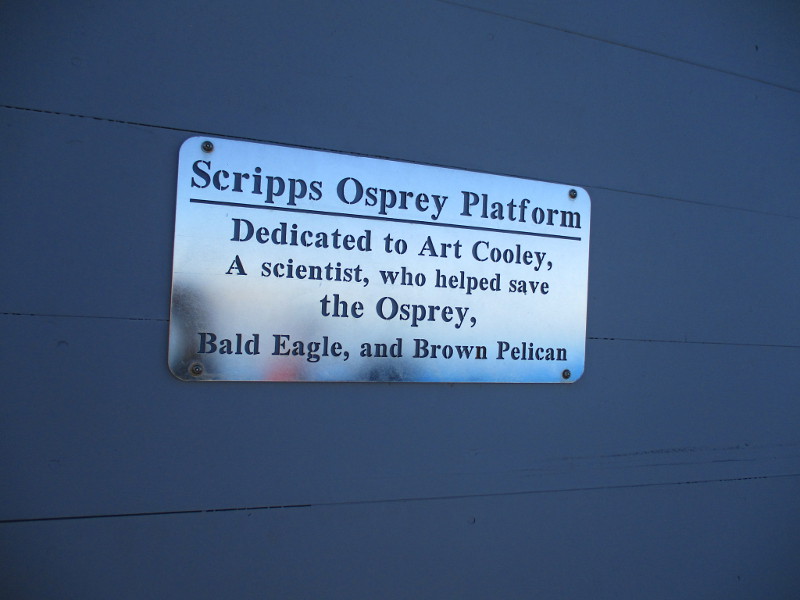
A plaque on the pump structure. The Scripps Osprey Platform is dedicated to Art Cooley, a scientist who helped save the Osprey, Bald Eagle and Brown Pelican.
…
Thanks for visiting Cool San Diego Sights!
I post new blogs pretty often. If you like discovering new things, bookmark coolsandiegosights.com and swing on by occasionally!
I live in downtown San Diego and love to walk around with my camera! You can follow Cool San Diego Sights via Facebook or Twitter!
The planet Mars vanished from San Diego’s night sky early this evening!
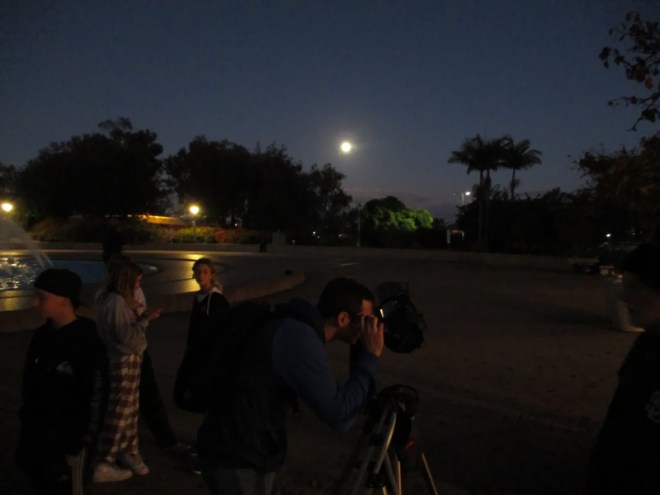
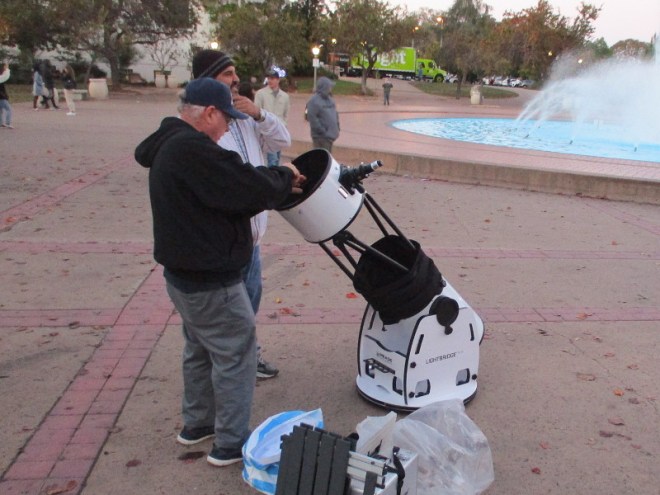
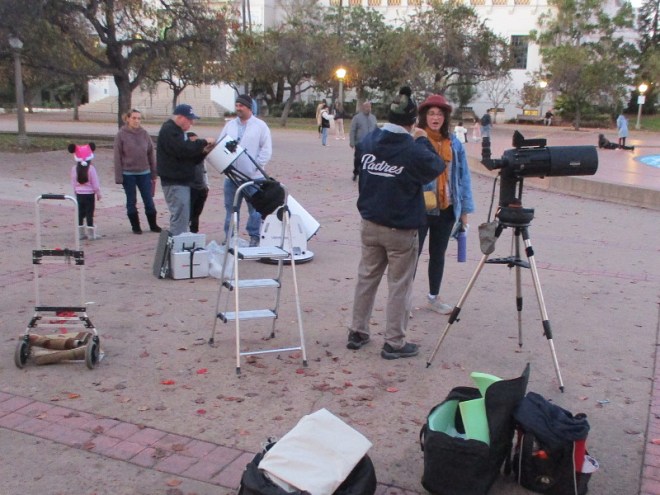
Members of the San Diego Astronomy Association had telescopes trained on the Red Planet near the Fleet Science Center in Balboa Park when it disappeared!
But nobody seemed in the least distressed.
That’s because those gazing skyward understood the moon in its orbit around the Earth had begun to pass “over” much more distant Mars, in what is called a lunar occultation of Mars.
Random people walking through Balboa Park came up and were invited to peer through the telescopes. At times the instruments were aimed at the planet Jupiter and its four largest moons that were made plainly visible: Io, Europa, Ganymede and Callisto.
Families and kids looked into space with a sense of wonder. Many then entered the Fleet Science Center to view the monthly planetarium show The Sky Tonight, where we saw the latest jaw-dropping images from the James Webb Space Telescope.
When the presentation ended an hour later, and we all went outside, Mars had returned!
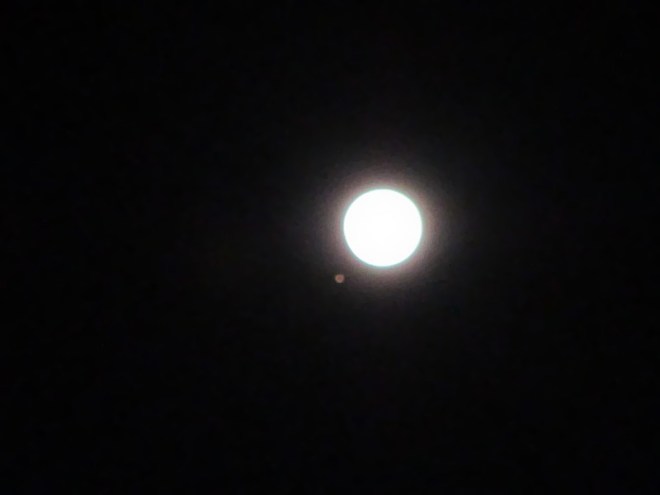
The next image was captured by my small camera a few minutes before the lunar occultation of Mars. I set it on maximum zoom.
You can’t see the moon’s craters, but you can see fuzzy little red Mars!
…
Thanks for visiting Cool San Diego Sights!
I post new blogs pretty often. If you like discovering new things, bookmark coolsandiegosights.com and swing on by occasionally!
It’s easy to explore Cool San Diego Sights by using the search box on this website’s sidebar. Or click a tag. There’s a lot of stuff to share and enjoy!
I live in downtown San Diego and love to walk around with my camera! You can follow Cool San Diego Sights via Facebook or Twitter!
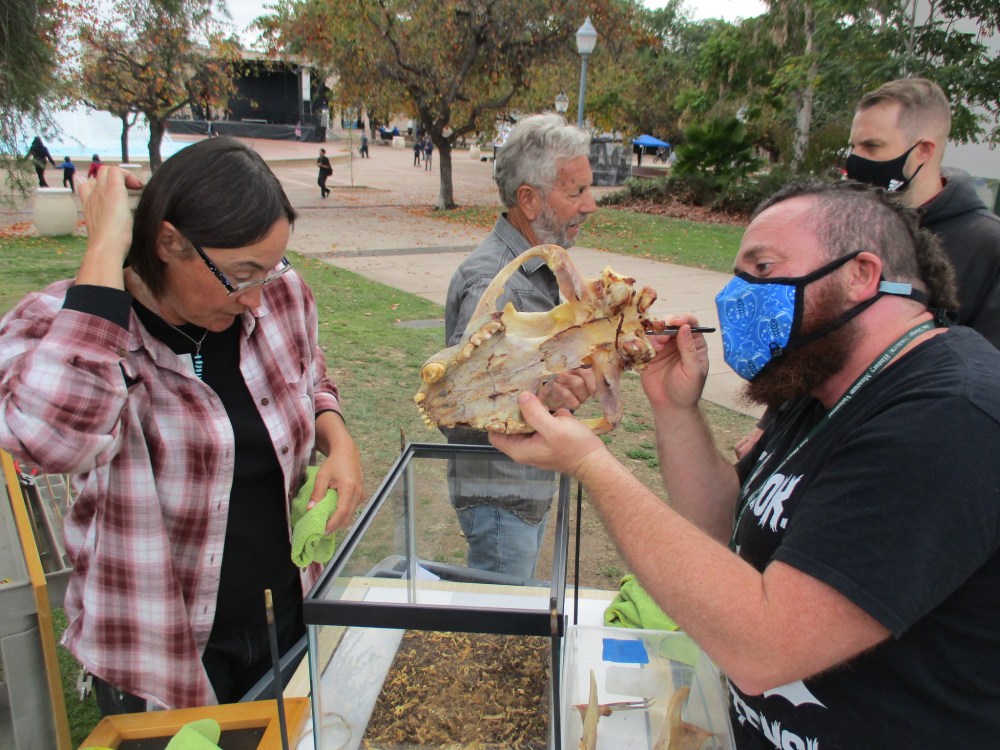
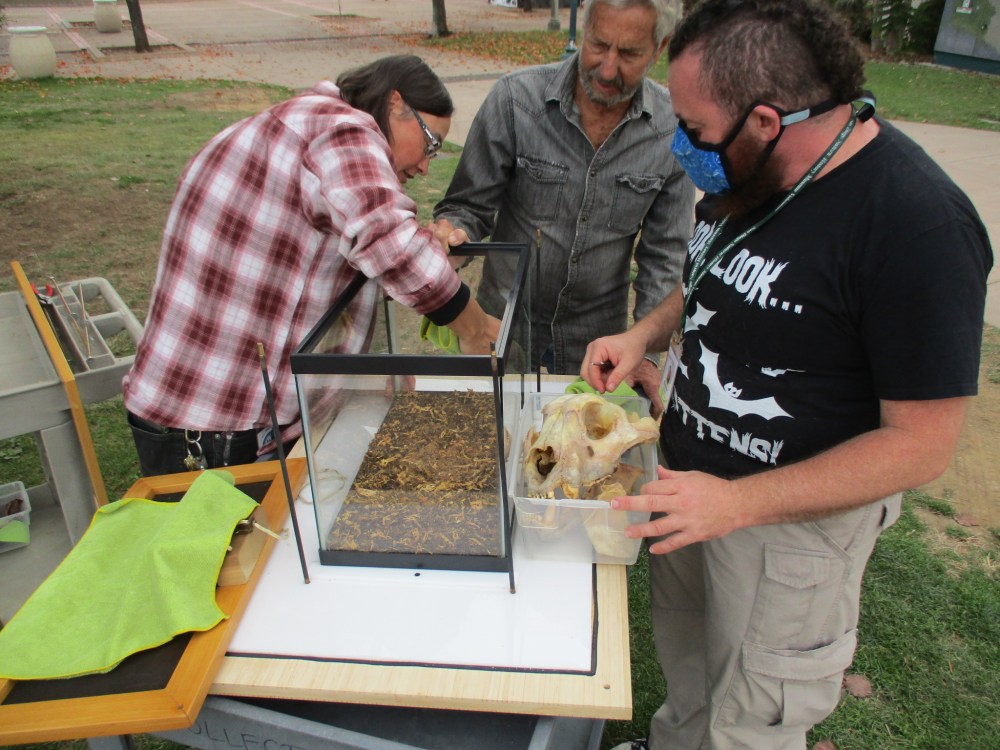
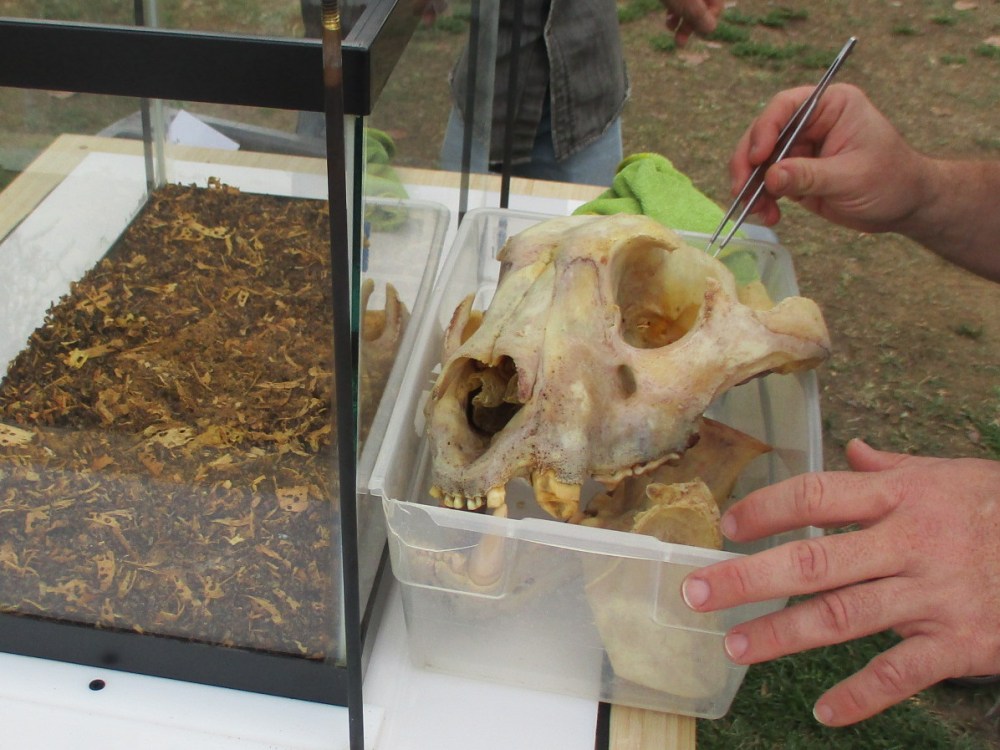
Why was there a Sumatran tiger skull outside in Balboa Park today?
Because the skull’s flesh had been devoured by a mass of skin beetles. And those beetles (and their very hungry larvae) would be a nuisance if they escaped indoors!
Scientists from the nearby San Diego Natural History Museum were carefully preparing the Sumatran tiger skull for their collection!
The museum’s Birds and Mammals Department already contains tens of thousands of specimens. I was told preserved specimens, including this tiger skull, are very useful when it comes to comparative anatomy.
I’ve learned that Birds and Mammals Department curator Philip Unitt is the author of The Birds of San Diego County, which happens to be on my bookshelf! (It should be on yours, too.)
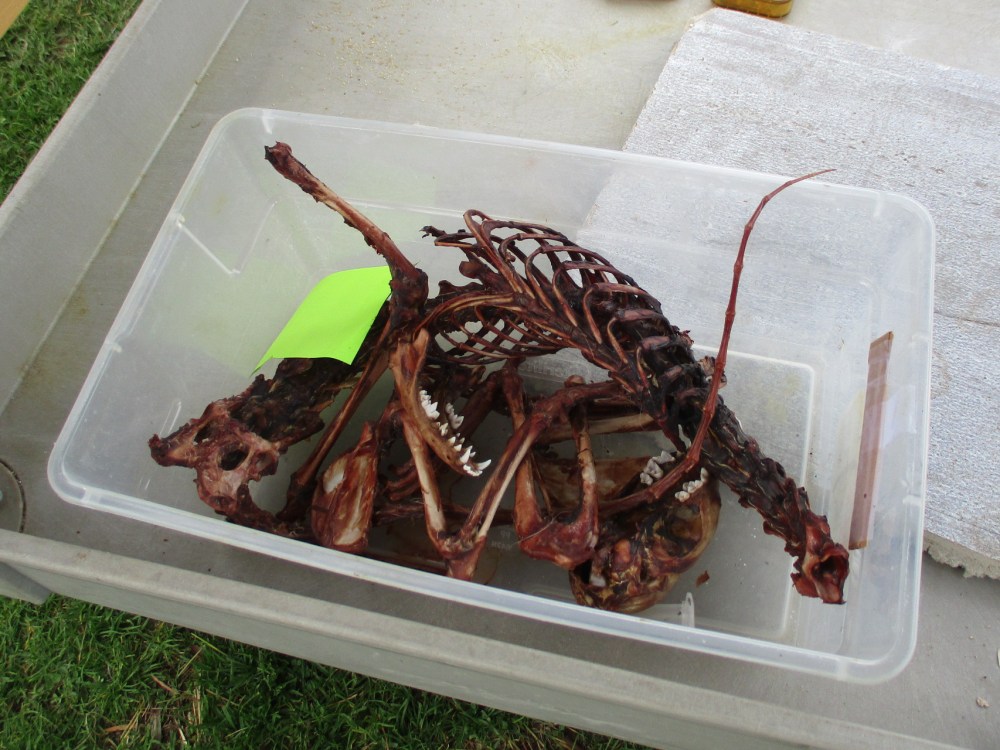
I noticed another critter in a nearby container waiting for the skin beetle (Dermestidae) treatment. A gray fox that was road kill in La Jolla would provide dinner for the beetles next!
Funny. I was visiting Balboa Park to check out the ongoing preparations for December Nights. Which just goes to show–you never know what you’ll discover when walking through this amazing park!
The San Diego Natural History Museum, like many other Balboa Park museums, will be open free to the public during December Nights!
Here’s the beetles’ next meal: a gray fox…
…
Thanks for visiting Cool San Diego Sights!
I post new blogs pretty often. If you like discovering new things, bookmark coolsandiegosights.com and swing on by occasionally!
It’s easy to explore Cool San Diego Sights by using the search box on this website’s sidebar. Or click a tag. There’s a lot of stuff to share and enjoy!
I live in downtown San Diego and love to walk around with my camera! You can follow Cool San Diego Sights via Facebook or Twitter!
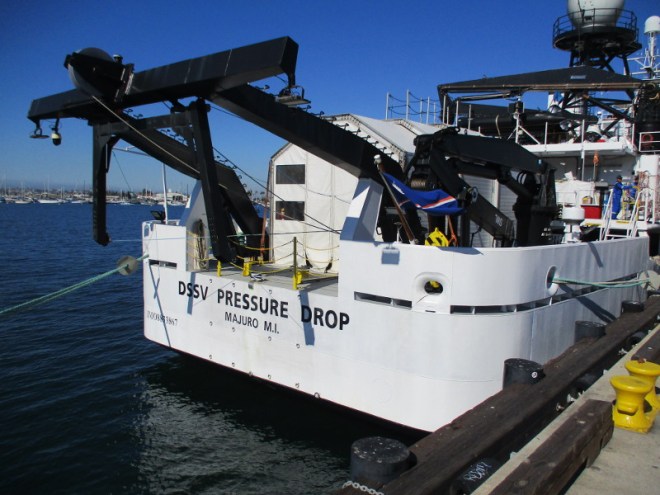
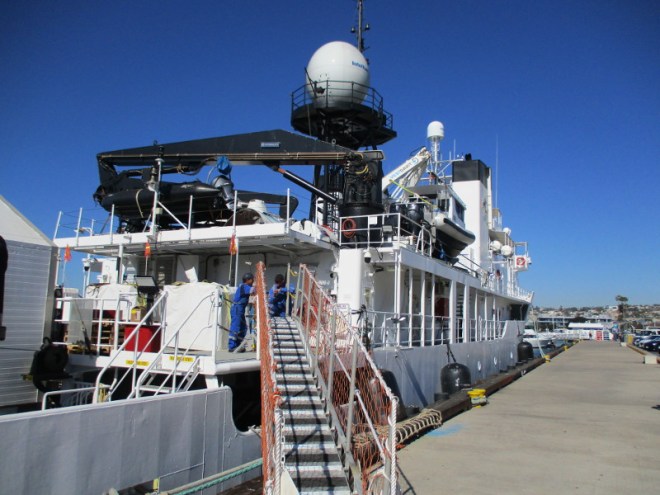
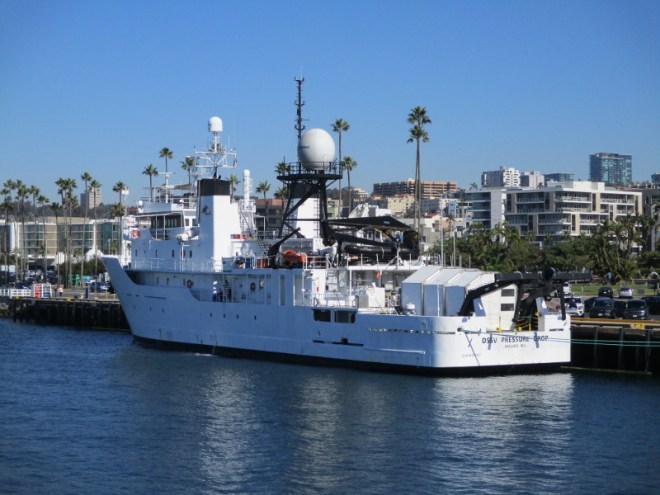
Every so often, a very unusual, one-of-a-kind ship will dock on San Diego’s Embarcadero. Today I saw a unique ship with the peculiar name DSSV Pressure Drop, so I had to check it out!
It turns out DSSV (Deep Submersible Support Vessel) Pressure Drop, a privately owned ex-US Navy ship, is absolutely extraordinary! Last year its submersible, called Limiting Factor, made the deepest manned dive ever in Earth’s oceans–it descended 10,928 meters into the Challenger Deep in the Mariana Trench!
This historic dive and others have produced important scientific research, such as mapping of the ocean floor and retrieval of deep sea specimens–including completely new species of living organisms!
The numerous exploits of DSSV Pressure Drop and its adventurous owner Victor Vescovo make for great reading. Here’s a recent article that provides a lot of background and detail.
I was told DSSV Pressure Drop will be hanging around San Diego for a couple of months, so if you happen to walk along the Embarcadero just north of the Maritime Museum of San Diego, keep your eyes peeled!
…
Thank you for visiting Cool San Diego Sights!
I post new blogs pretty often, so you might want to bookmark coolsandiegosights.com and check back from time to time.
You can explore Cool San Diego Sights by using the search box on this website’s sidebar. Or click a tag! There’s a lot of stuff to share and enjoy!
I live in downtown San Diego and love to walk around with my camera! You can follow Cool San Diego Sights via Facebook or Twitter!
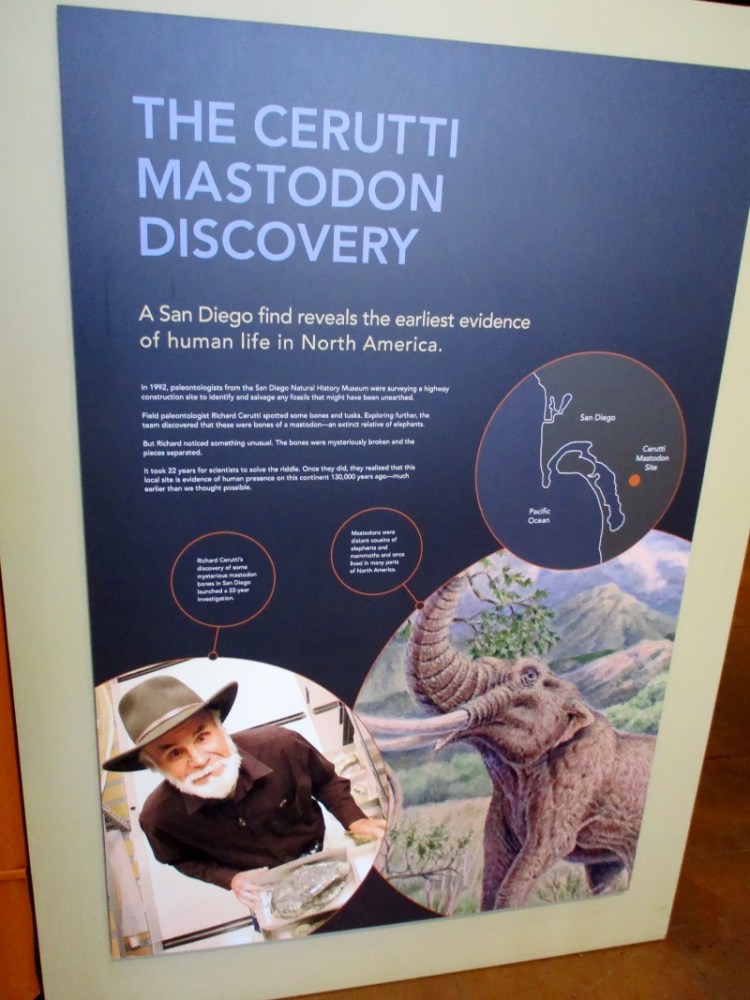
Did you know humans might have been living in your neighborhood 130,000 years ago?
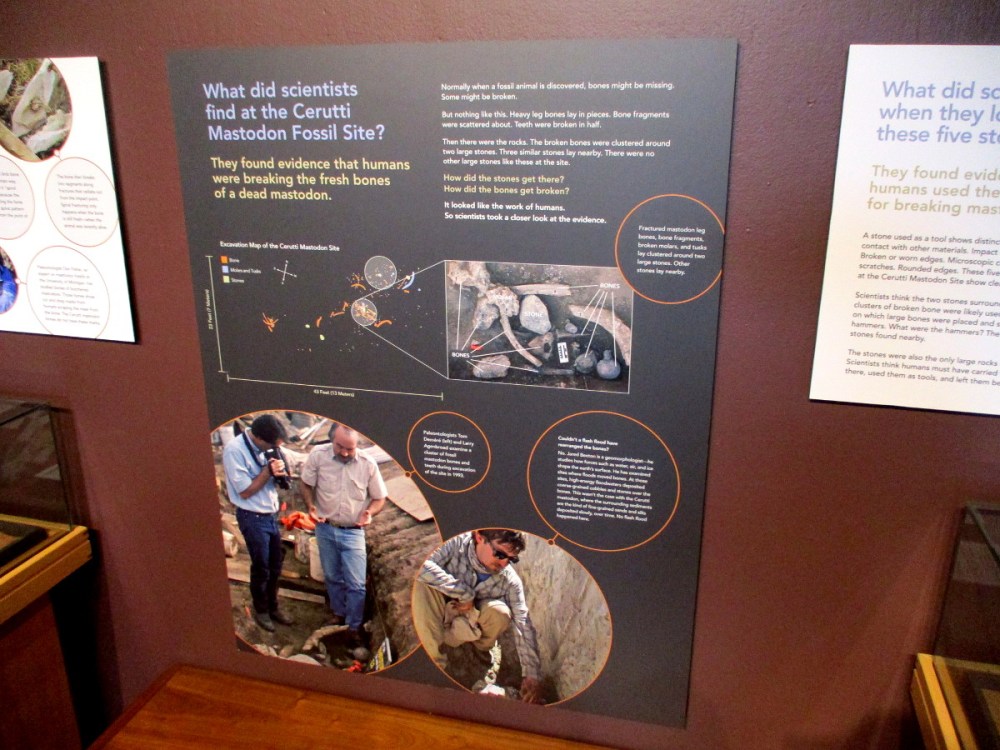
I was visiting the San Diego Natural History Museum when my eyes fell upon an interesting display concerning the Cerutti Mastodon site.
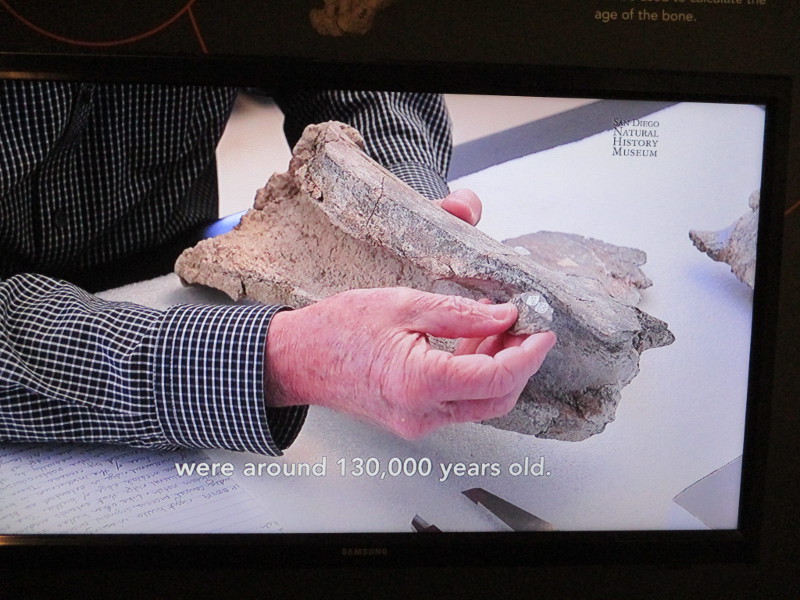
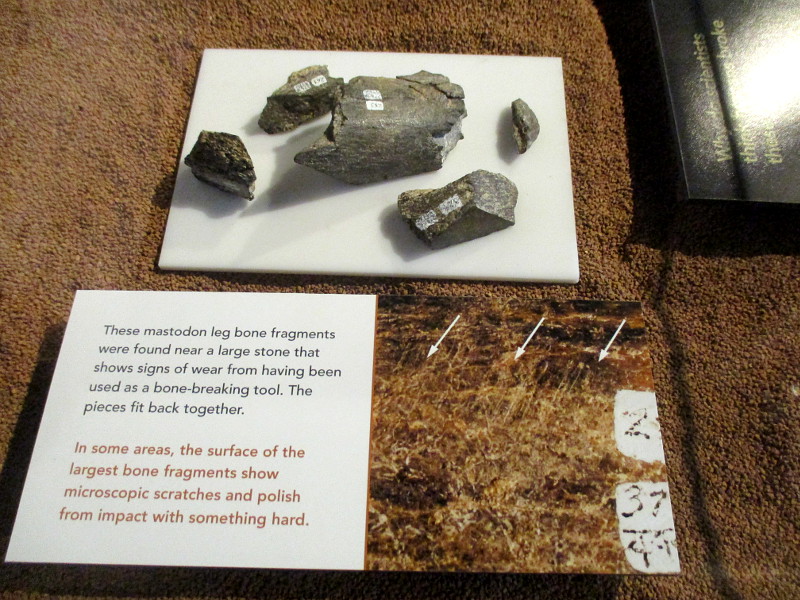
Thirty years ago, during the expansion of State Route 54 in the South Bay, a team of researchers from the San Diego Natural History Museum discovered mastodon bones among cobbles. The bones appeared to have been intentionally broken. It was believed the stones, which had impact marks, had been used by humans to fracture the mastodon bones to extract marrow.
Using radiometric dating, the bones were found to be about 130,000 years old. If, indeed, early humans had worked these bones, that would mean humans were in North America about 100,000 years earlier than previously thought!
Many experts asserted the bones were broken due to the heavy machinery used for freeway construction. Two years ago, however, more evidence was obtained. Bone micro-residues were observed on the cobbles, which seems to confirm that ancient inhabitants of San Diego did indeed hammer at fresh, tasty mastodon bones!
If all of this excites your curiosity, the Wikipedia article concerning San Diego’s scientifically important Cerutti Mastodon site can be found here.
And here’s a detailed article about the discovery written in 2017.
…
I live in downtown San Diego and love to walk around with my camera! You can follow Cool San Diego Sights via Facebook or Twitter!
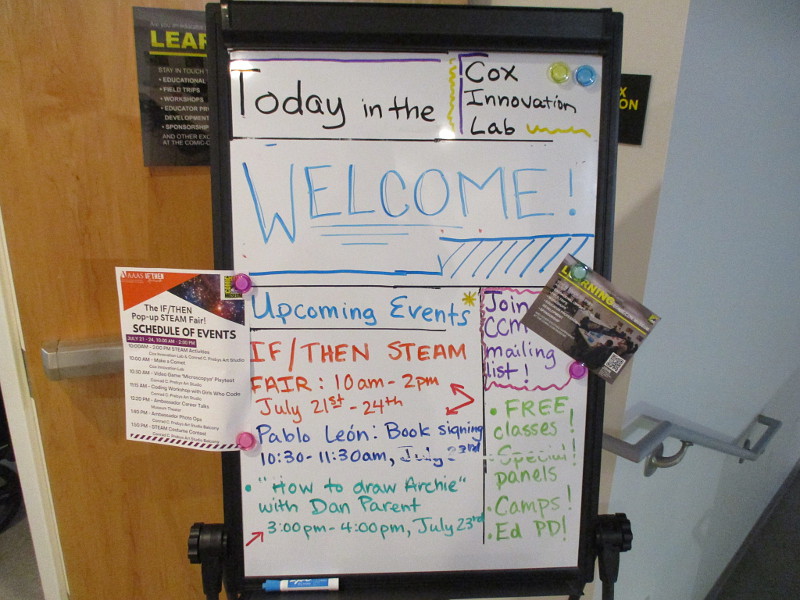
This week a very cool educational event is being held at the Comic-Con Museum that should interest Comic-Con attendees and residents of San Diego alike.
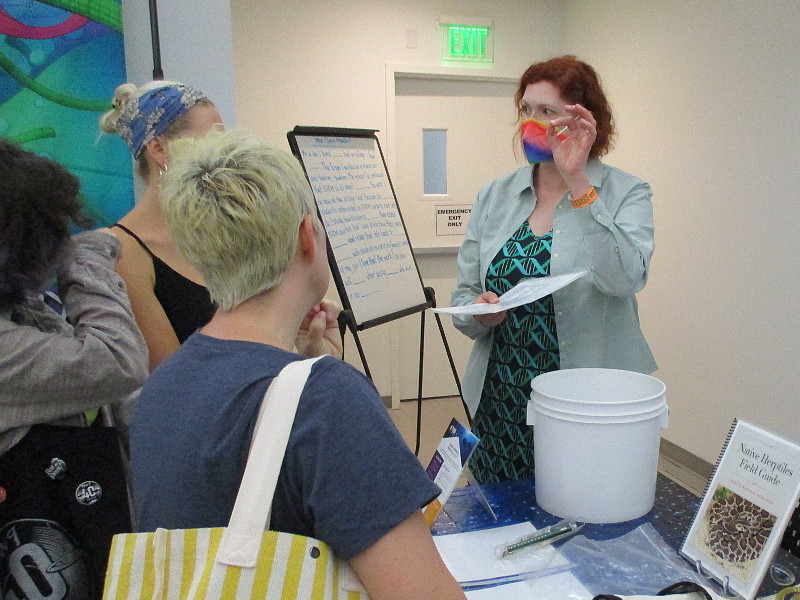
Today through Sunday–throughout Comic-Con week–a group of Advancement of Science (AAAS) IF/THEN Ambassadors are at the museum encouraging STEAM learning! Particularly for young women!
The event features computer scientists and environmentalists and paleontologists and astrophysicists . . . even an astronaut! Visitors both young and old (like me) can create, experiment, play games, and talk to professional woman who are leaders in their fields.
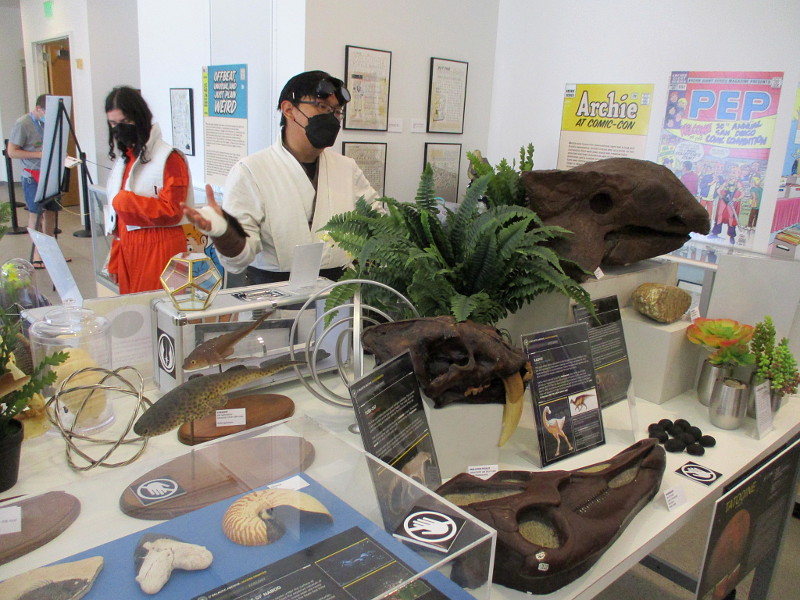
I walked around the museum’s COX Innovation Lab looking at table displays, impressed by all that I saw. I even got to watch how to make a quasi-comet!
One cool display was about how life might have evolved on the fictional planets of Star Wars. Comparisons are made between often bizarre creatures and the organisms in our own Earth’s fossil record.
Inspirational talks are held down in the museum’s auditorium, but I arrived a little too early, so I missed that. But they will be held all week.
To learn more about this awesome event, click here!
If you’d like to view my coverage of Comic-Con so far, which includes hundreds of cool photographs, click here!
…
I live in downtown San Diego and love to walk around with my camera! You can follow Cool San Diego Sights via Facebook or Twitter!
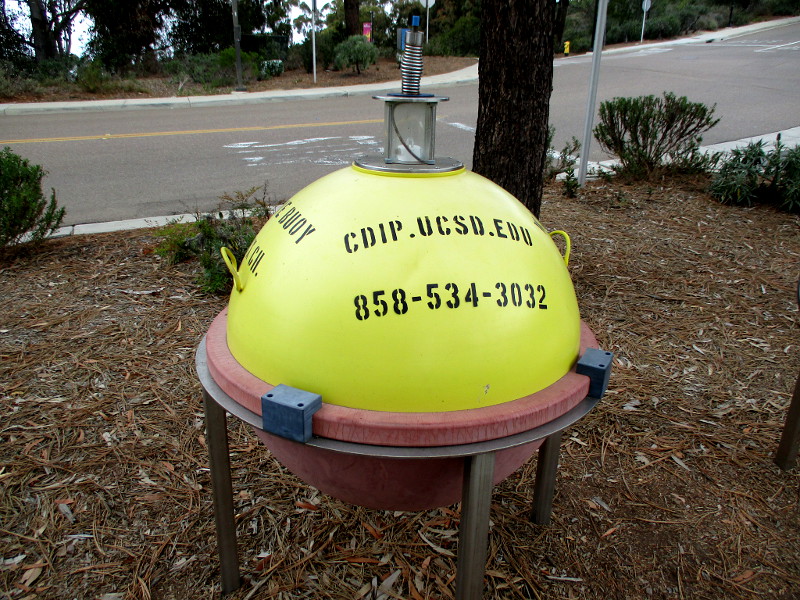
Perhaps you’ve seen those spherical yellow buoys bobbing on the ocean off San Diego’s coast. Have you ever wondered what’s inside them?
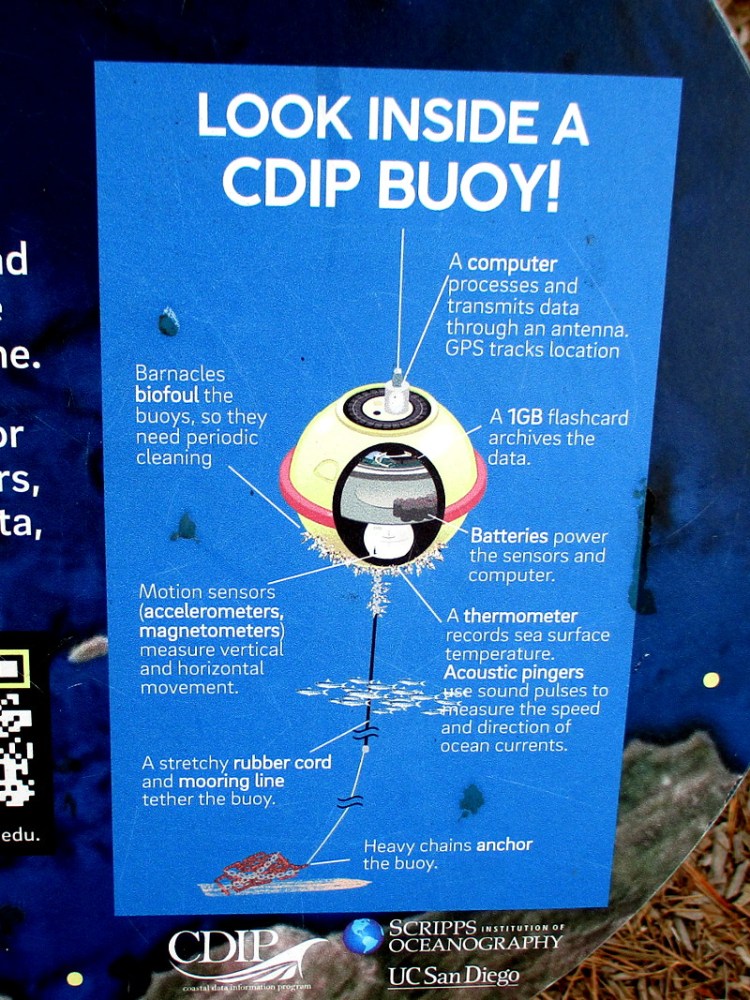
Well, there’s a CDIP (Coastal Data Information Program) buoy on display near the Birch Aquarium at Scripps Institution of Oceanography. And a nearby sign describes the technology that makes a buoy such a valuable resource of information!
Buoys like this one measure wave height, period, direction and sea surface temperature information.
The data is used by coastal engineers, planners, scientists, harbor masters, lifeguards, mariners, boaters, surfers, divers, fishers and beach-goers! That’s a lot of people who benefit from buoys!
Inside a plain-looking buoy there are various high tech instruments, including accelerometers, magnetometers, a thermometer, acoustic pingers, a computer, GPS and antenna to transmit all the collected, archived information!
(Did you know biofoul was a word? I didn’t!)
Next time I see one of these yellow CDIP buoys, I’ll have a much greater appreciation of what they are!
…
I live in downtown San Diego and love to walk around with my camera! You can follow Cool San Diego Sights via Facebook or Twitter!















 Cool San Diego Sights!