A closer look: Koester Memorial Sundial at SDSU.

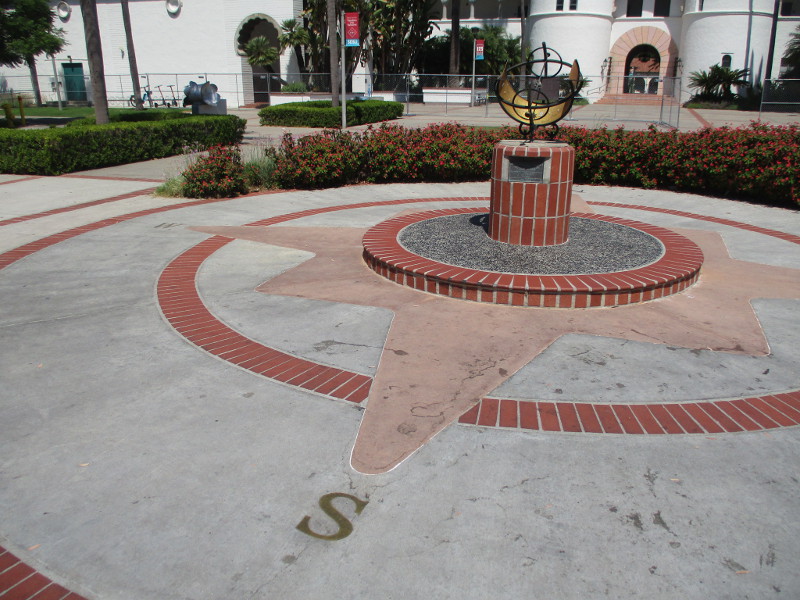
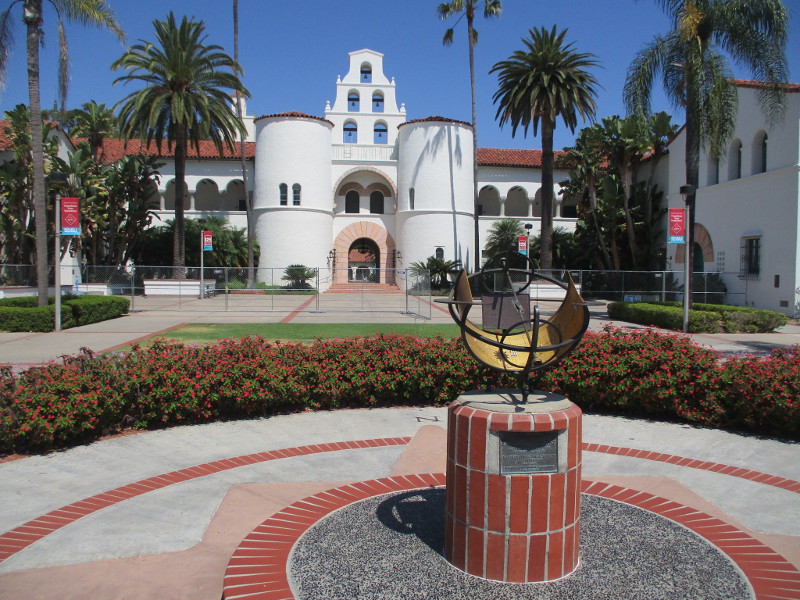
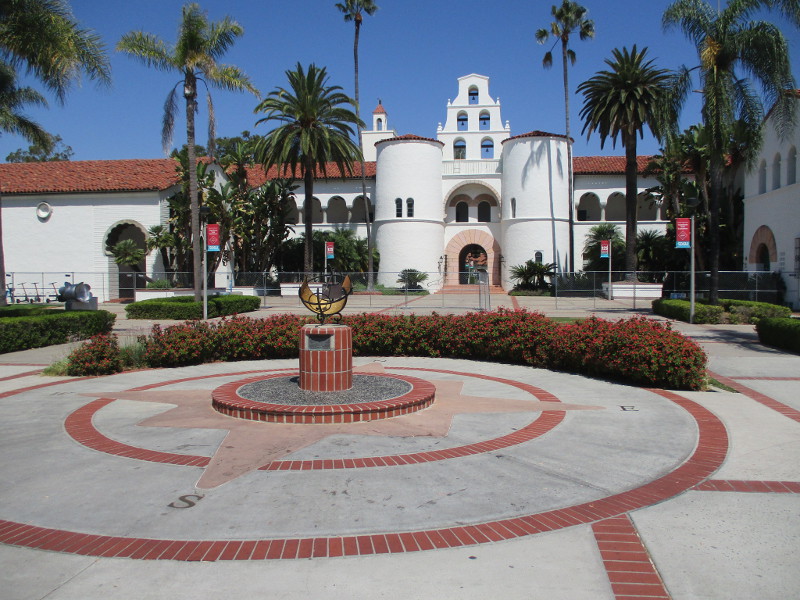
The Koester Memorial Sundial stands prominently in San Diego State University’s Campanile Mall, directly in front of the iconic Hepner Hall. I took photographs of the sundial when I walked through the SDSU campus a few days ago. A couple of corroded plaques invite a closer look.

According to this article, dedicated on November 4, 1978, the Gübelin Equatorial Sundial [is] in memory of the late George A. Koester

Koester began his career at San Diego State in 1950 and went on to complete 14 years as a professor of education and 10 years as executive dean. During his time on Montezuma Mesa, Koester played a prominent role in building the campus, working on the creation of Love Library, the music and drama buildings, Aztec Center, Zura Hall, student health services, and multiple parking structures…
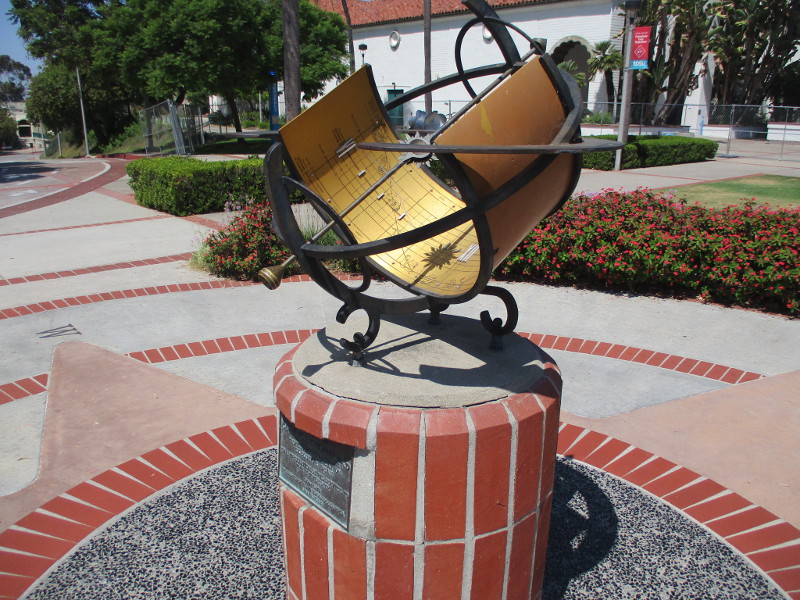
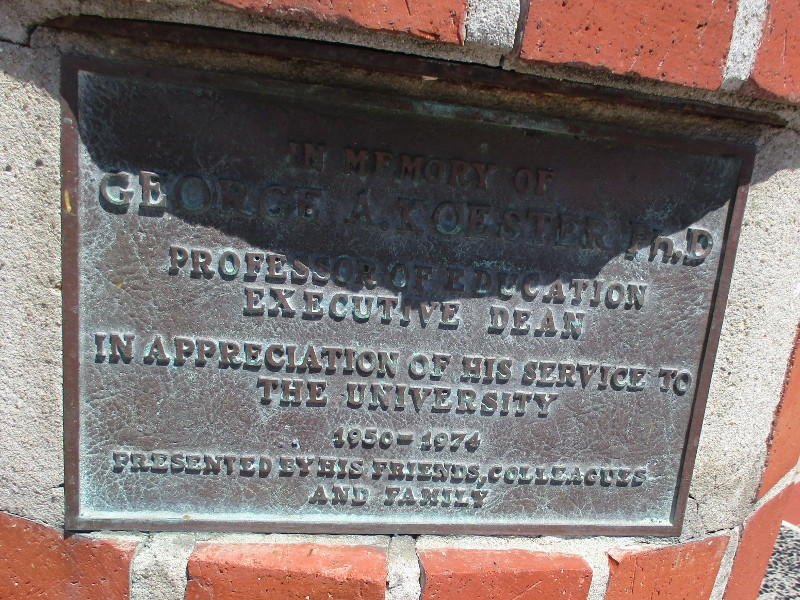
A plaque embedded in the brick pedestal states:

IN MEMORY OF GEORGE A. KOESTER Ph.D – PROFESSOR OF EDUCATION – EXECUTIVE DEAN – IN APPRECIATION OF HIS SERVICE TO THE UNIVERSITY 1950 – 1974 – PRESENTED BY HIS FRIENDS, COLLEAGUES AND FAMILY
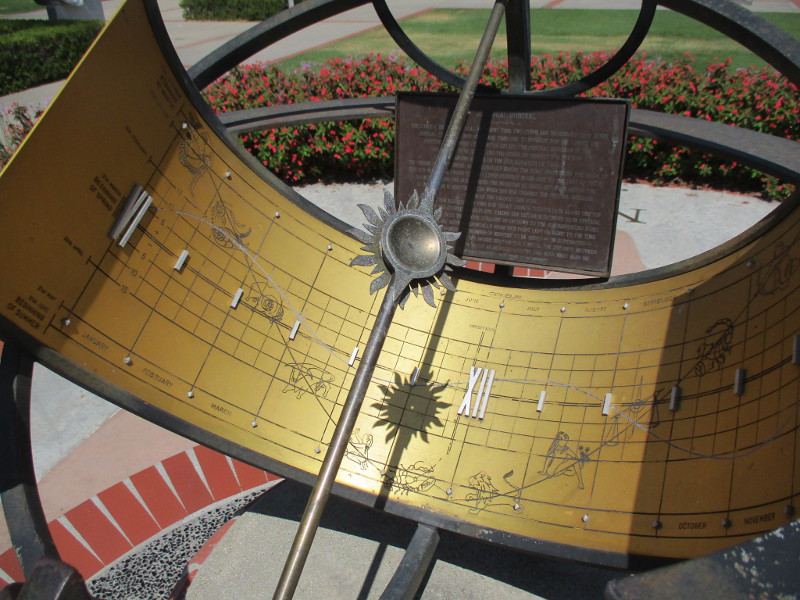
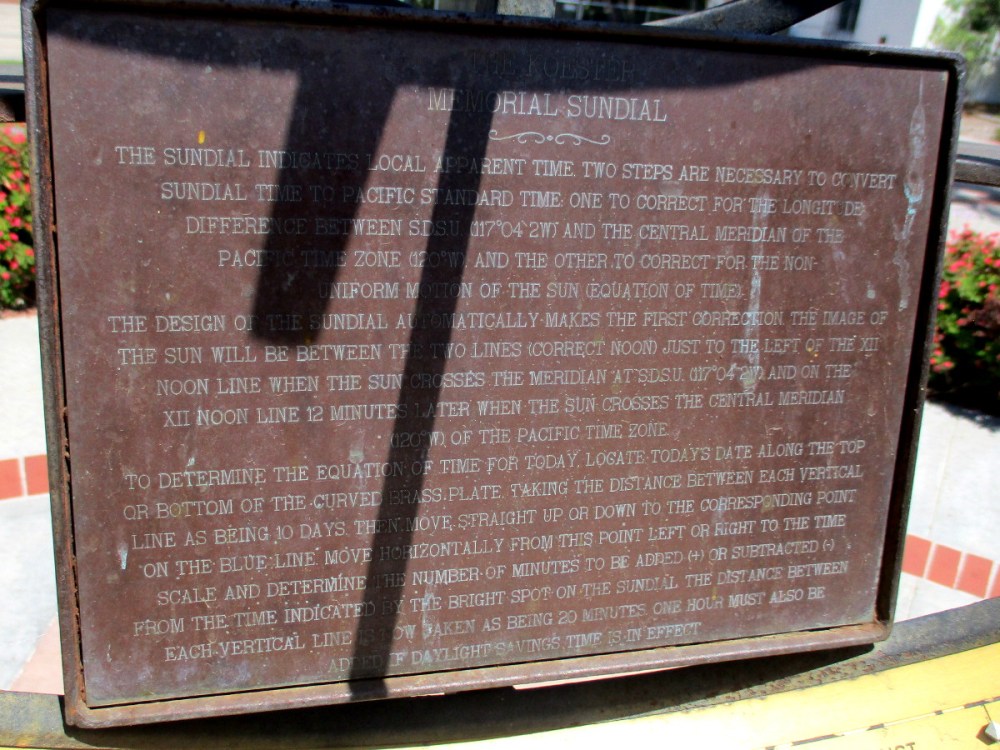
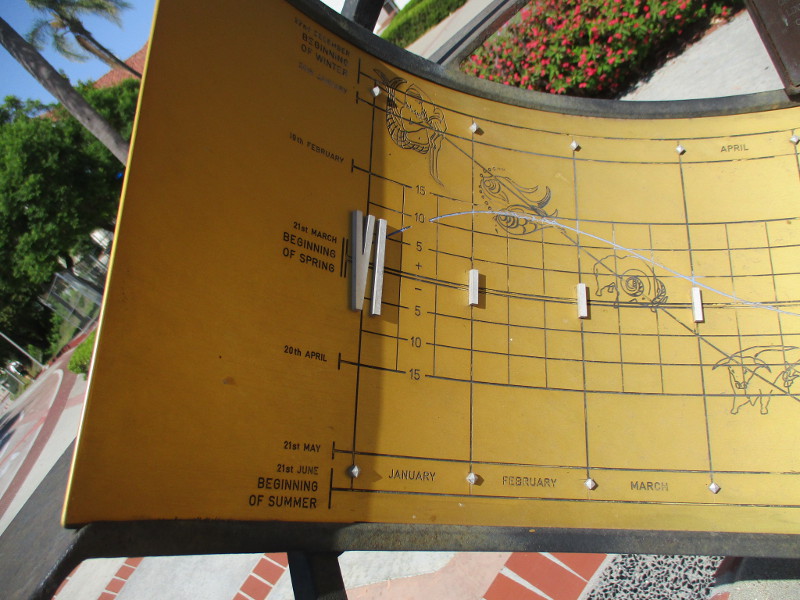
Within the sundial, a faded plaque (I increased the image contrast) describes how the beautiful and fascinating device works. I transcribed as best I could, without every word in caps:

THE KOESTER MEMORIAL SUNDIAL

The sundial indicates local apparent time. Two steps are necessary to convert sundial time to Pacific Standard Time: one to correct for the longitude difference between SDSU (117°04`2W) and the central meridian of the Pacific Time Zone (120°W), and the other to correct for the non-uniform motion of the sun (equation of time).

The design of the sundial automatically makes the first correction. The image of the sun will be between the two lines (correct noon) just to the left of the XII noon line when the sun crosses the meridian at SDSU (117°04`2W) and on the XII noon line 12 minutes later when the sun crosses the central meridian (120°W) of the Pacific Time Zone.

To determine the equation of time for today, locate today’s date along the top or bottom the curved brass plate. Taking the distance between each vertical line as being 10 days, then move straight up or down to the corresponding point on the blue line. Move horizontally from this point left or right to the time scale and determine the number of minutes to be added (+) or subtracted (-) from the time indicated by the bright spot on the sundial. The distance between each vertical line is now taken as being 20 minutes. One hour must also be added if Daylight Savings Time is in effect.

Whew! Got that?

I think I’ll stick to my wristwatch or phone!
Thanks for visiting Cool San Diego Sights!

I post new blogs pretty often. If you like discovering new things, bookmark coolsandiegosights.com and swing on by occasionally!

I live in downtown San Diego and love to walk around with my camera! You can follow Cool San Diego Sights via Facebook or X.
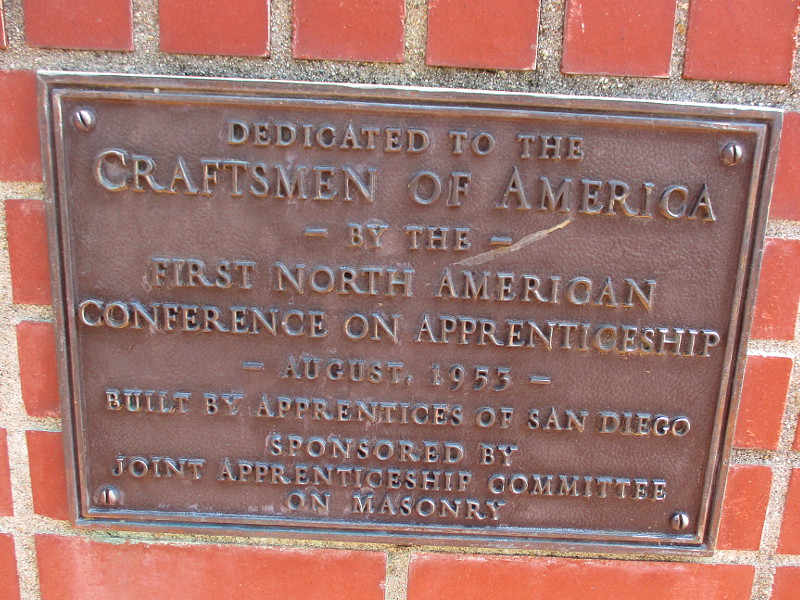
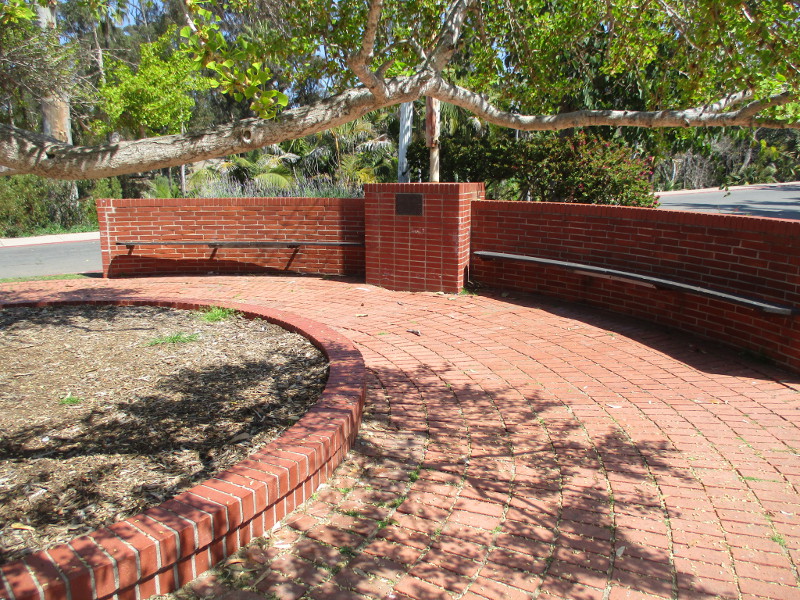
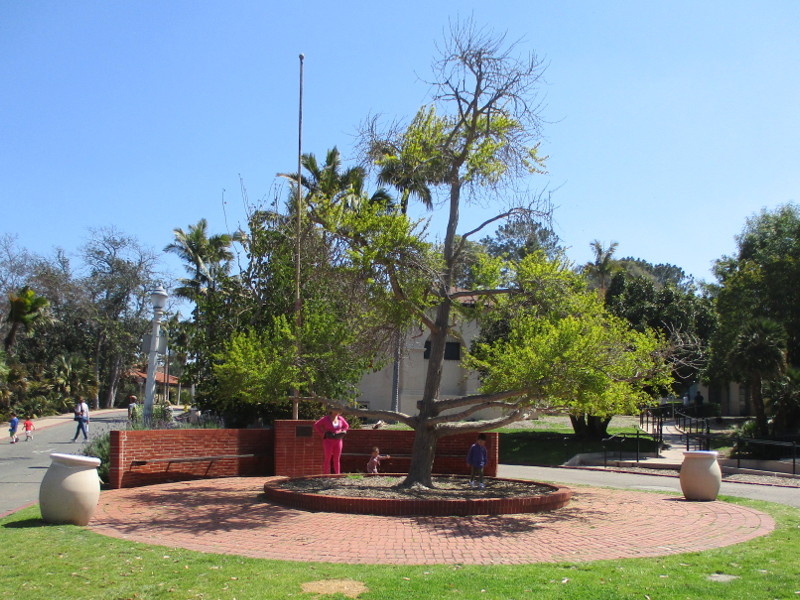
Balboa Park plaque dedicated to Craftsmen of America.

Balboa Park in San Diego is full of surprising history.

Perhaps you’ve seen this plaque. It can be found in a modest brick plaza at the House of Pacific Relations International Cottages, beneath a rusty, flagless flagpole, a few steps from the entrance to the United Nations Building and Gift Shop.

The plaque proudly states:

DEDICATED TO THE CRAFTSMEN OF AMERICA BY THE FIRST NORTH AMERICAN CONFERENCE ON APPRENTICESHIP — AUGUST, 1953 — BUILT BY APPRENTICES OF SAN DIEGO SPONSORED BY JOINT APPRENTICESHIP COMMITTEE ON MASONRY

Internet searches provide very little about this history. Perhaps a knowledgeable reader out there can contribute a comment. The brick wall and circular patio must have been built by local masonry apprentices.

I did find an interesting old article in the August 26, 1953 edition of CONVAIRIETY, a newspaper for employees of the Convair Division of General Dynamics. It begins by explaining how Two Convair San Diego men who formerly were apprentices at SD were singled out for honors during the first North American Conference on Apprenticeship held in San Diego Aug. 2-9.

You can see the full CONVARIETY article by clicking here, or read the text more easily by clicking here and scrolling down.

Thanks for visiting Cool San Diego Sights!

I post new blogs pretty often. If you like discovering new things, bookmark coolsandiegosights.com and swing on by occasionally!

I live in downtown San Diego and love to walk around with my camera! You can follow Cool San Diego Sights via Facebook or X.
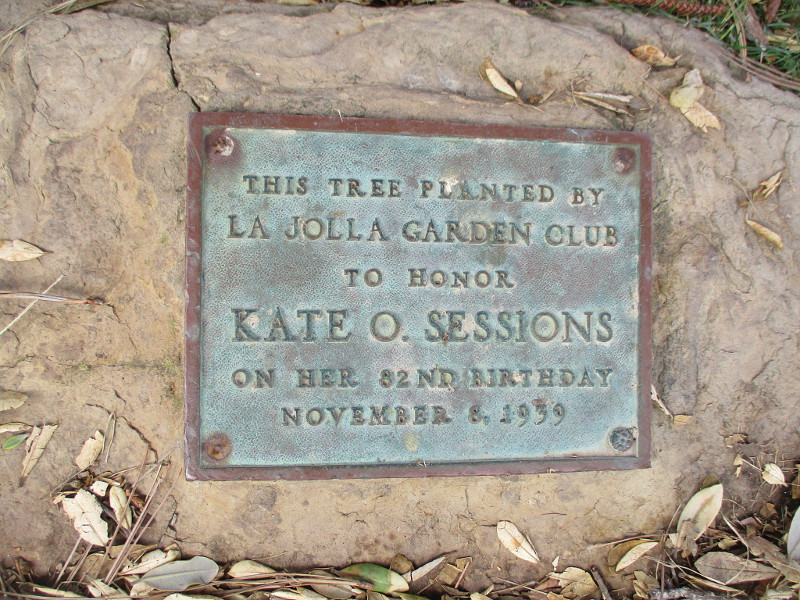
Plaque in La Jolla honors Kate Sessions.

Ellen Browning Scripps Memorial Park, originally named La Jolla Park, was established in 1887. The scenic coastal park has seen almost a century and a half of history, so it’s not surprising a variety of historical plaques can be found by visitors wandering around its 5.6 acres. I once photographed a couple of these plaques and shared them here.

An old plaque that honors San Diego’s beloved horticulturist Kate Sessions can also be discovered at Ellen Browning Scripps Memorial Park. The plaque is located near a New Zealand Christmas tree (metrosideros tomentosa) that was planted by the La Jolla Garden Club in 1939 on Kate Sessions’ 82nd birthday. She would pass away in 1940.

Katherine Olivia Sessions is widely known as the Mother of Balboa Park, but she planted hundreds of trees all over San Diego. She even has a park named after her in La Jolla. Her legacy will continue far into the future. Many majestic trees throughout our beautiful city were planted by her own hand.

Thanks for visiting Cool San Diego Sights!

I post new blogs pretty often. If you like discovering new things, bookmark coolsandiegosights.com and swing on by occasionally!

I live in downtown San Diego and love to walk around with my camera! You can follow Cool San Diego Sights via Facebook or X.
Ghirardelli’s marquee and Gaslamp history.

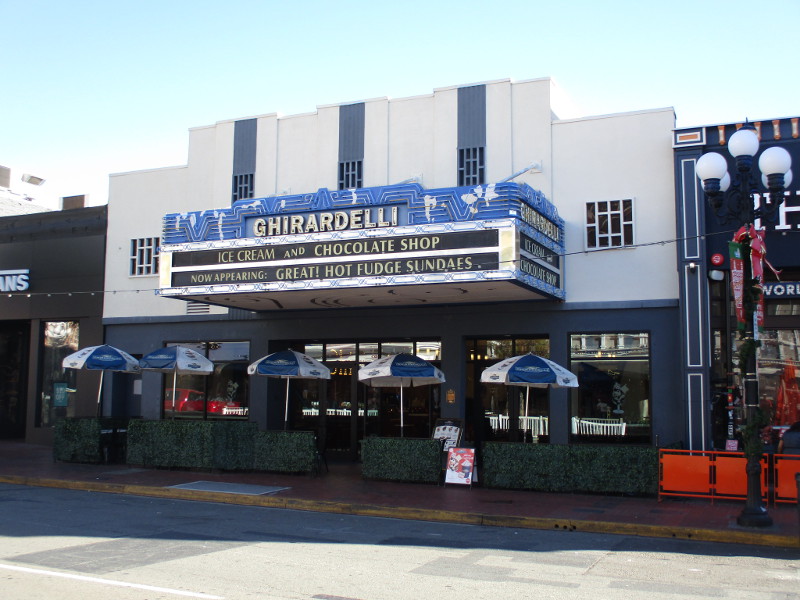
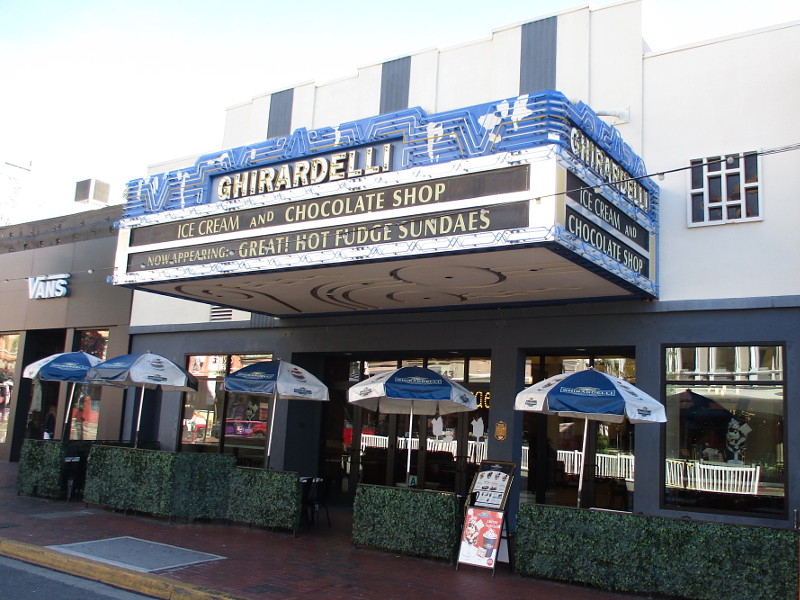
Have you ever wondered why the Ghirardelli Ice Cream & Chocolate Shop in San Diego’s historic Gaslamp Quarter has an old-fashioned theater marquee? That’s because the building, erected in 1912, was originally a movie theater!

The Casino Theatre at 643 Fifth Avenue opened in 1913 and was one of several movie theaters in the Gaslamp that provided entertainment for ever-changing audiences over the decades. In the 1930s it was remodeled into the Art Deco style. Here’s an image from the 40s, with the Casino Café “Lunch” restaurant located next door, offering breakfast, waffles and steaks.

In the 1950s and 60s, The Casino and its movie theater neighbors at Fifth and G Street–The Aztec and The Savoy–would be open all night and show 3 big features, according to a comment here. Slowly these old theaters would fall as television’s popularity rose.

In the 1970s, while the Gaslamp neighborhood experienced urban decay, The Casino Theatre began to show X-rated movies, along with the other nearby theaters. I’ve been told sailors made up much of the clientele.

Here’s a gallery of photos of the The Casino Theatre over many years. Some of the titles you’ll read in the marquee are a bit salacious!

I hadn’t realized the marquee was seen in Marty Feldman’s 1980 movie In God We Tru$t. That image can be viewed here.

Today you’ll find a plaque near the historic building’s front entrance:

The Casino Theatre, 1912

The first theatre to be built with the new building ordinance for fire safety. It had two doors near the stage for fire escape and a five-foot-wide exterior passage on both sides and the rear for the protection of other buildings in case of fire. However, two years after construction, the northern passage was occupied by a food stand, and the southern passage contained a shoe shining establishment.

Temptation of a different sort! In a historic Gaslamp Quarter that now attracts loads of tourists, the colorfully lit old marquee teases you with ice cream, chocolate and hot fudge sundaes!

Thanks for visiting Cool San Diego Sights!

I post new blogs pretty often. If you like discovering new things, bookmark coolsandiegosights.com and swing on by occasionally!

I live in downtown San Diego and love to walk around with my camera! You can follow Cool San Diego Sights via Facebook or X.
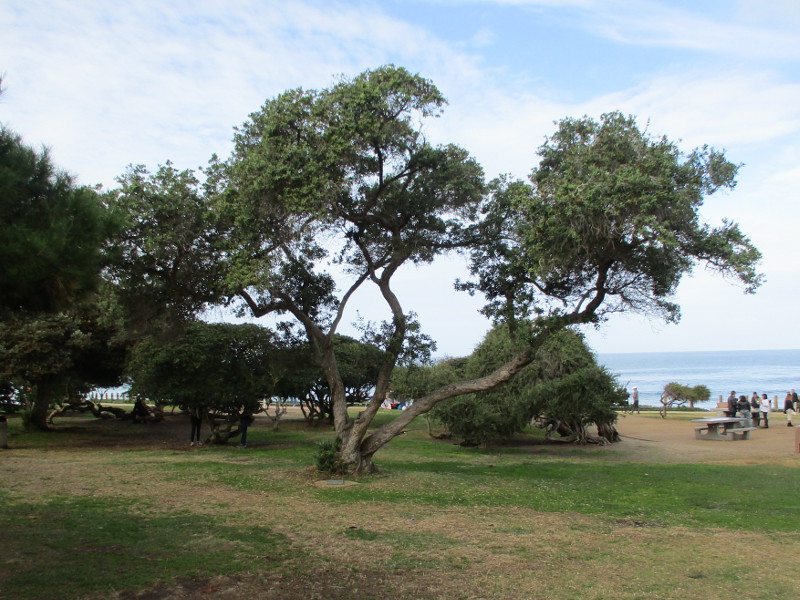
Del Mar plaque tells of community service.

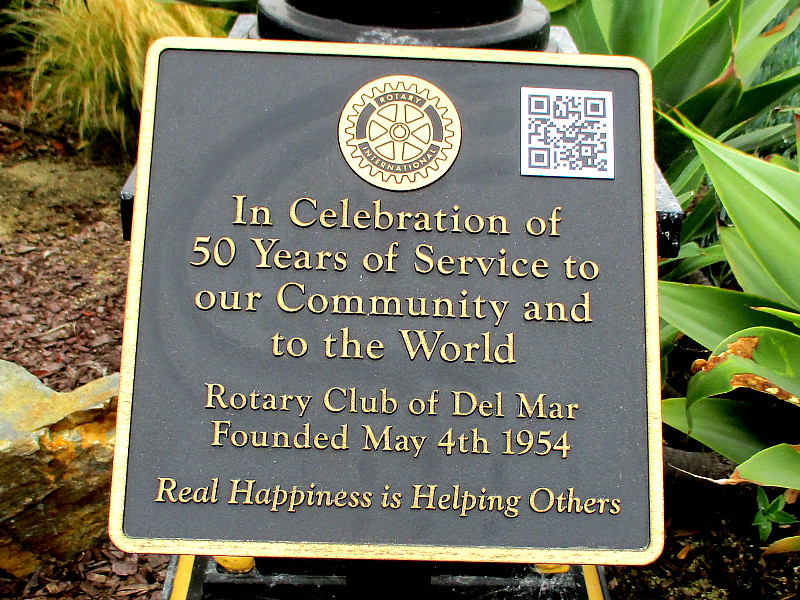
Real Happiness is Helping Others. I saw these wise words on the above plaque during my long North County walk a week ago. I had paused in Del Mar at the corner of 15th Street and Camino del Mar to gaze up at the Rotary Club street clock.

You see these Rotary Club clocks in many cities and towns. After a while, one’s eyes might skip right over them. But I’m glad I took a closer look, because I found the plaque and did some research concerning this particular clock.

This clock was originally dedicated in 2006 to celebrate Rotary Club’s 52-year history. It was renovated ten years ago, in 2014. Here’s an article from back then.

I was curious to see what community service the Rotary Club of Del Mar offers. I learned they do a lot! From beach clean-ups, to food and blood drives, to literacy projects and supporting the arts, to supporting a Canine Companion program . . .

Here is the Rotary Club of Del Mar’s community service webpage.

Thanks for visiting Cool San Diego Sights!

I post new blogs pretty often. If you like discovering new things, bookmark coolsandiegosights.com and swing on by occasionally!

I live in downtown San Diego and love to walk around with my camera! You can follow Cool San Diego Sights via Facebook or X.
San Diego assisted the American Revolution?

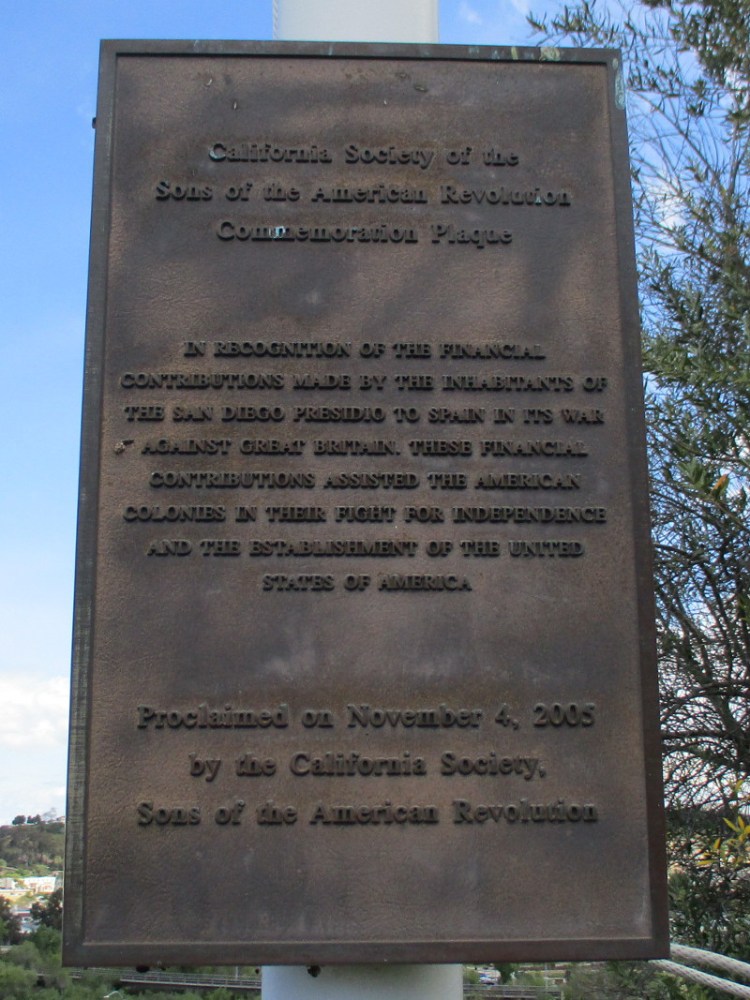
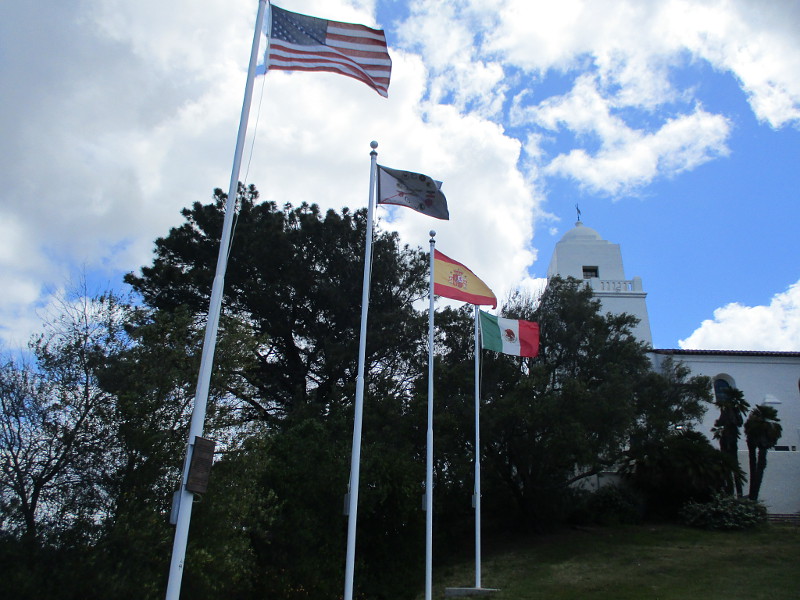
I’m not a historian. If you are, perhaps you might leave a comment concerning a plaque that is mounted to a flagpole on San Diego’s Presidio Hill, near the ruins of the old Spanish Presidio.

The plaque states:

California Society of the Sons of the American Revolution Commemoration Plaque

IN RECOGNITION OF THE FINANCIAL CONTRIBUTIONS MADE BY THE INHABITANTS OF THE SAN DIEGO PRESIDIO TO SPAIN IN ITS WAR AGAINST GREAT BRITAIN. THESE FINANCIAL CONTRIBUTIONS ASSISTED THE AMERICAN COLONIES IN THE FIGHT FOR INDEPENDENCE AND THE ESTABLISHMENT OF THE UNITED STATES OF AMERICA

Proclaimed on November 4, 2005 by the California Society, Sons of the American Revolution

The Presidio of San Diego was established in 1769, seven years before the adoption of the United States Declaration of Independence in 1776. The American Revolution saw its ultimate success in 1783 when the British signed the Treaty of Paris.

Today four flagpoles stand on Presidio Hill. The four flags represent the United States, the Kumeyaay Nation, Spain and Mexico. They demonstrate that San Diego’s history is both diverse and complex.

How significant were these financial contributions made by inhabitants of the Presidio to Spain? In what form were the contributions? Were they obtained through the labor of indigenous Kumeyaay on the land taken by Spanish missions? San Diego in its very early years was sparsely populated and relatively poor. How, specifically, did these financial contributions help Spain in its war against Great Britain?

Clearly, I’m no historian! If you know more about this, please leave a comment!

UPDATE!

On July 6, 2024 I came across more information concerning this.

During the Independence Day celebration at the International Cottages in Balboa Park, the House of Spain had an elaborate display in front of their cottage, explaining how Spain helped the United States win the Revolutionary War against Great Britain.

An emphasis was placed on the Spanish General Bernardo de Galvez, who provided patriots with money, medicines, arms, and key wartime information. He was a hero at the Battles of Mobile and Pensacola.

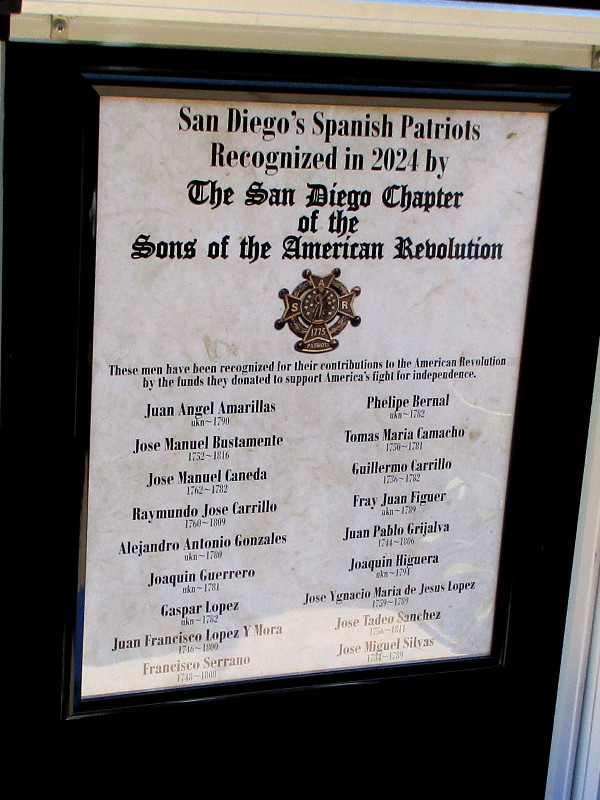
One display explained how the Spanish living in distant San Diego contributed, too. “San Diego’s Spanish Patriots” were soldiers at the old Presidio, who provided funds from their own pockets to support America’s fight for independence.

I was told by a gentleman who sounded knowledgeable that in addition to soldiers and others associated with the newly established Spanish Missions, Native Americans up and down California within the Spanish sphere of influence were also “persuaded” to make monetary contributions, albeit in lesser amounts.

Apparently all of these contributions were provided at the request of Junípero Serra. Collected funds then made their way to the opposite coast of America, where they bolstered the efforts of Galvez.

If my understanding of this history isn’t correct, or you know more about the subject, please leave a comment!

Thanks for visiting Cool San Diego Sights!

I post new blogs pretty often. If you like discovering new things, bookmark coolsandiegosights.com and swing on by occasionally!

I live in downtown San Diego and love to walk around with my camera! You can follow Cool San Diego Sights via Facebook or X.

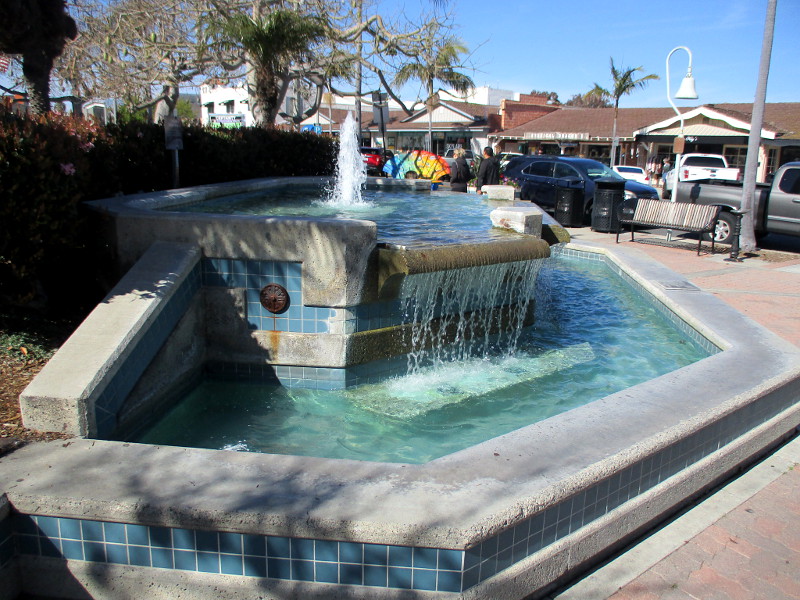
Fountain and bell in downtown Carlsbad.
At the intersection of Grand Avenue and State Street in downtown Carlsbad you’ll find benches next to a gently bubbling fountain and a historical bell.

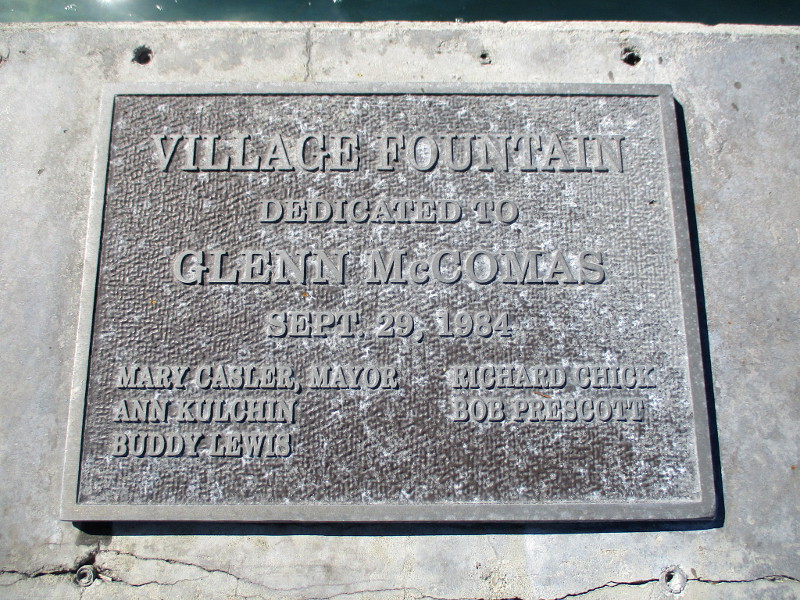
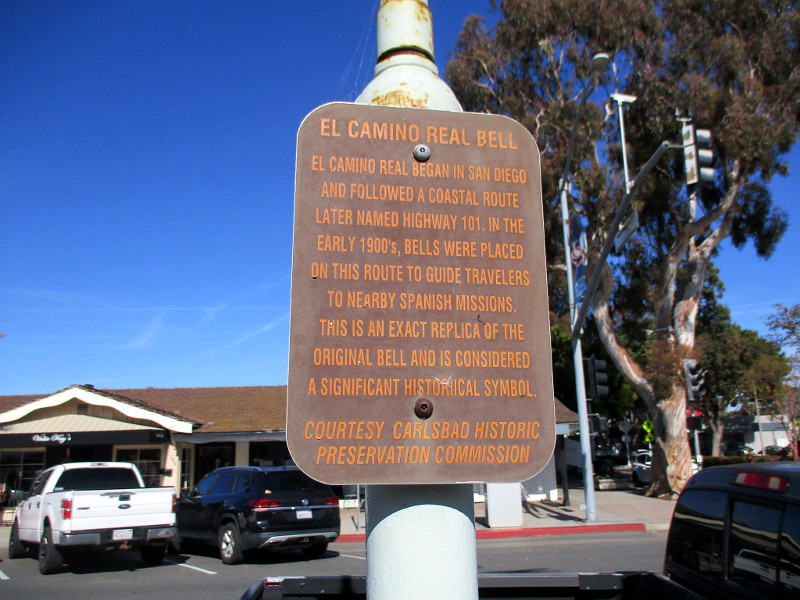
I took photographs of the 1984 Village Fountain and El Camino Real Bell and their respective plaques during my last visit to Carlsbad. You might enjoy these.

Should you explore downtown Carlsbad by foot, this pleasant corner is a good place to sit, relax and watch people passing by while soaking in the Southern California sunshine.

VILLAGE FOUNTAIN DEDICATED TO GLENN McCOMAS SEPT. 29, 1984

EL CAMINO REAL BELL

EL CAMINO REAL BEGAN IN SAN DIEGO AND FOLLOWED A COASTAL ROUTE LATER NAMED HIGHWAY 101. IN THE EARLY 1900’s, BELLS WERE PLACED ON THIS ROUTE TO GUIDE TRAVELERS TO NEARBY SPANISH MISSIONS. THIS IS AN EXACT REPLICA OF THE ORIGINAL BELL AND IS CONSIDERED A SIGNIFICANT HISTORICAL SYMBOL.

COURTESY CARLSBAD HISTORIC PRESERVATION COMMISSION

Thanks for visiting Cool San Diego Sights!

I post new blogs pretty often. If you like discovering new things, bookmark coolsandiegosights.com and swing on by occasionally!

I live in downtown San Diego and love to walk around with my camera! You can follow Cool San Diego Sights via Facebook or X (formerly known as Twitter)!

Two wise plaques overlook La Jolla beauty.

Two plaques can be found at an ocean overlook in La Jolla, midway between La Jolla Cove and the Children’s Pool.

After viewing the beautiful surf and rocks below, eyes might read the wise quotes on these plaques, which are embedded in the low stone and abalone shell wall.

Treat Earth well. It was not given to you by your parents. It was lent to you by your children. –Anonymous

We make a living by what we get but we make a life by what we give. –Winston Churchill

Thanks for visiting Cool San Diego Sights!

I post new blogs pretty often. If you like discovering new things, bookmark coolsandiegosights.com and swing on by occasionally!

I live in downtown San Diego and love to walk around with my camera! You can follow Cool San Diego Sights via Facebook or X (formerly known as Twitter)!

Plaques honor heroes in La Jolla park.

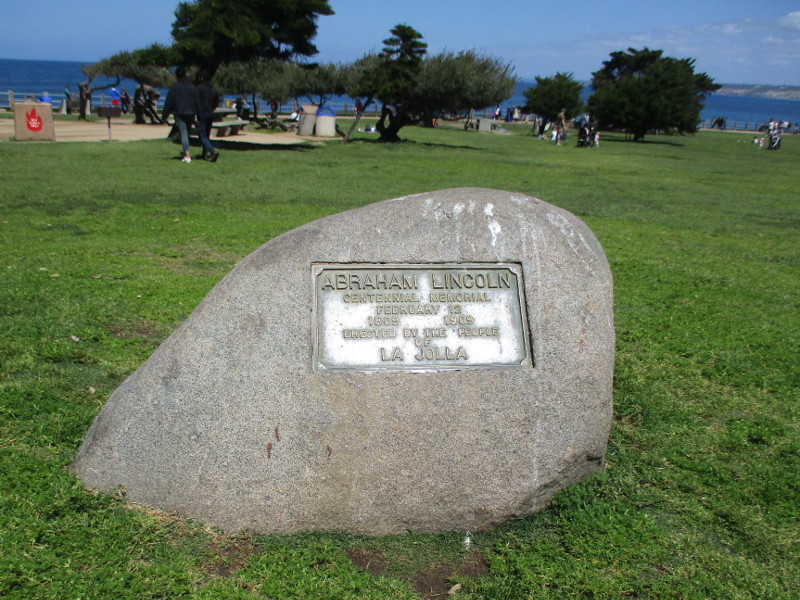
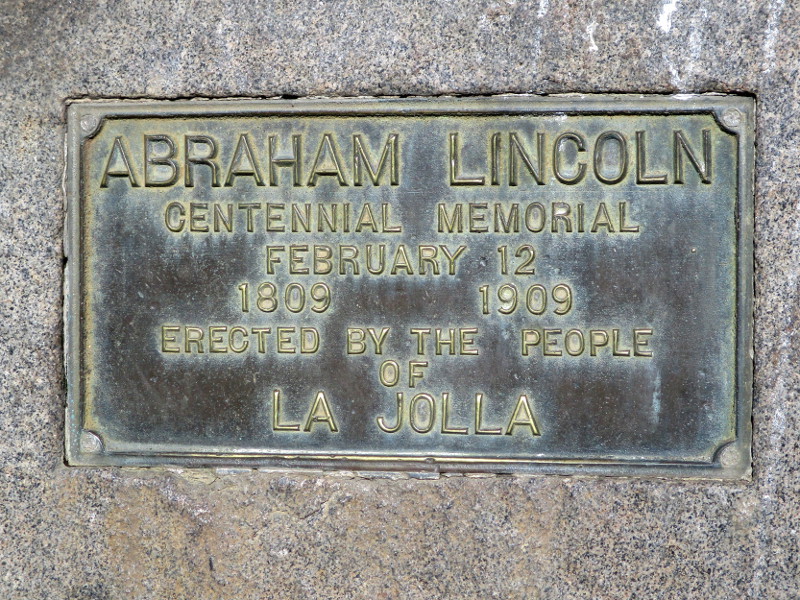
During my walk last weekend through Ellen Browning Scripps Park in La Jolla, I paused to take photographs of two plaques. One is over a century old. The other was created much more recently.

Both plaques honor people who, in their own way, made the world better. Both are heroes.

The Abraham Lincoln Centennial Memorial, set inside a boulder, is dated February 12, 1909. It was placed by the people of La Jolla beside a flagpole that no longer exists. I found an article that concerns the placement of this plaque. Read it here.

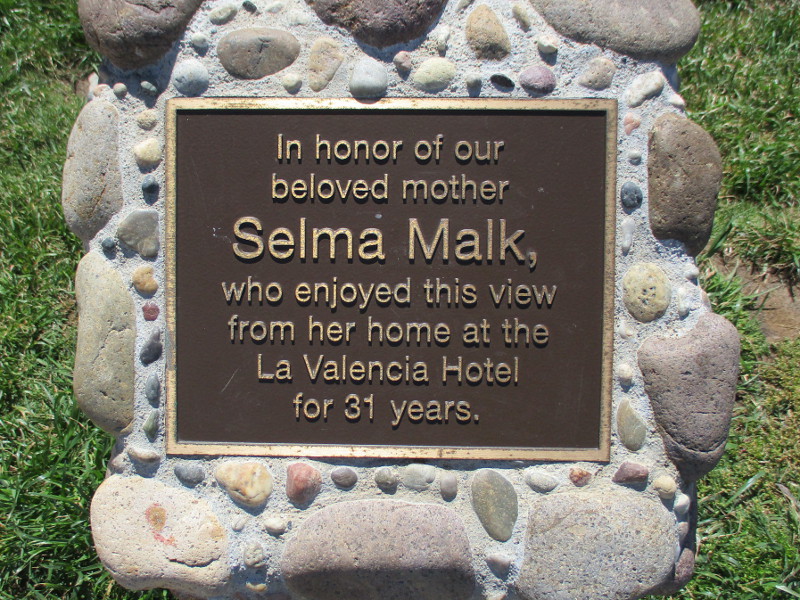
The second plaque reads:

In honor of our beloved mother Selma Malk, who enjoyed this view from her home at the La Valencia Hotel for 31 years.

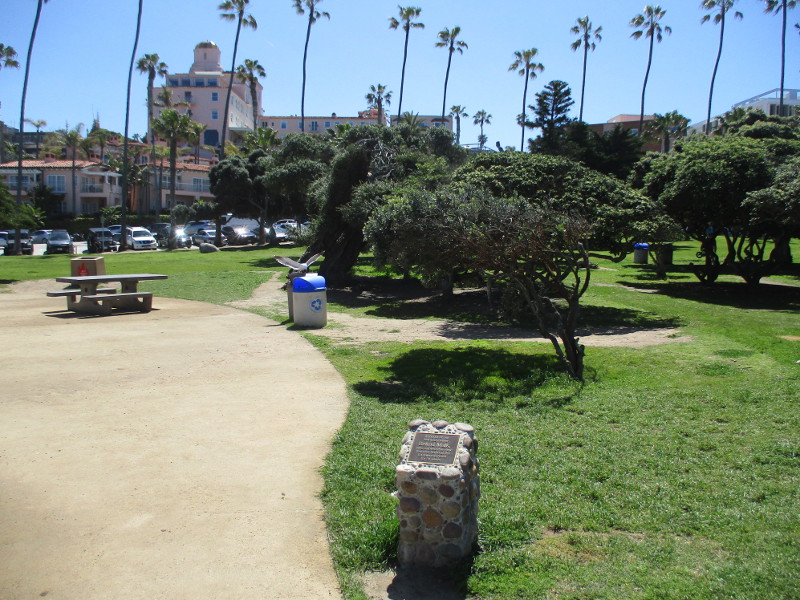
The plaque was recently placed between a newly renovated picnic area and the scenic boardwalk south of La Jolla Cove.

According to this article: Selma Malk lived for 32 years at La Jolla’s La Valencia Hotel and volunteered at the Birch Aquarium and Athenaeum Music & Arts Library in La Jolla and the Mingei International Museum in San Diego’s Balboa Park. She died in La Jolla in 2017 at age 103.

In the next photo, you can see the historic La Valencia Hotel.

Thanks for visiting Cool San Diego Sights!

I post new blogs pretty often. If you like discovering new things, bookmark coolsandiegosights.com and swing on by occasionally!

I live in downtown San Diego and love to walk around with my camera! You can follow Cool San Diego Sights via Facebook or X (formerly known as Twitter)!

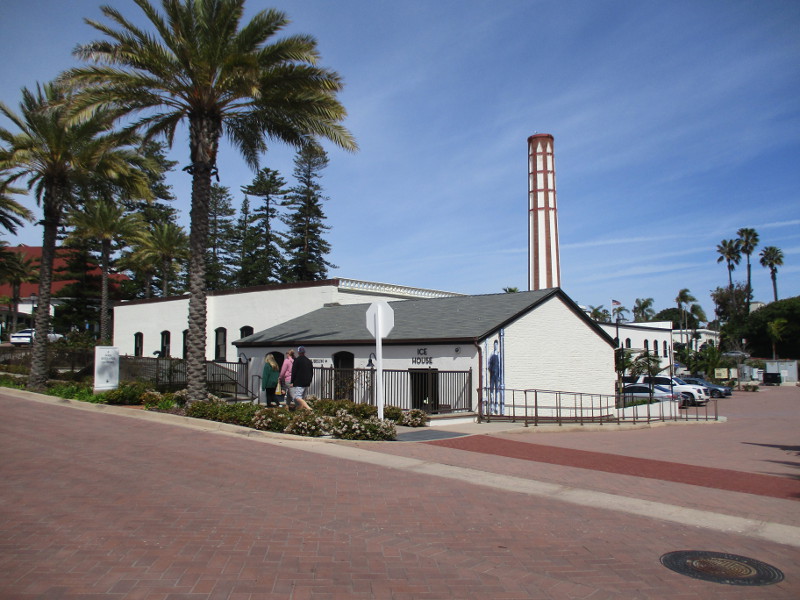
Hotel del Coronado’s industrial complex.

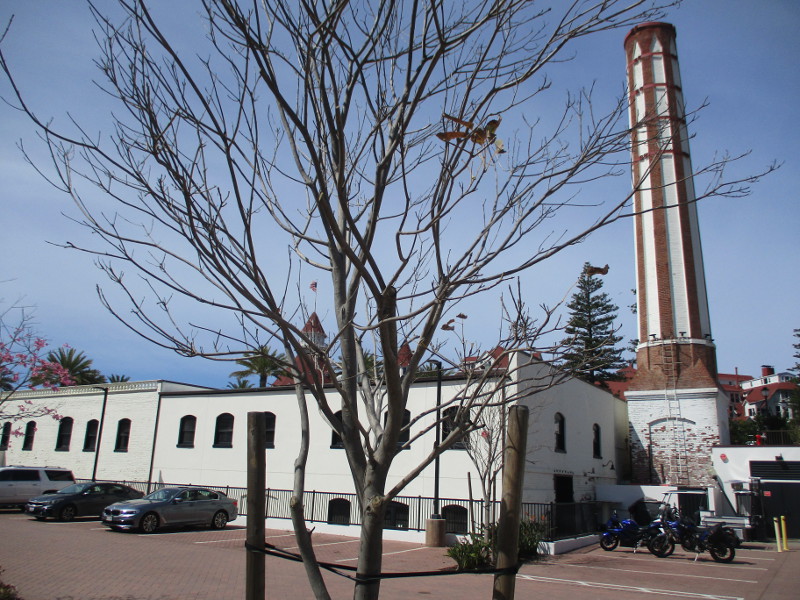
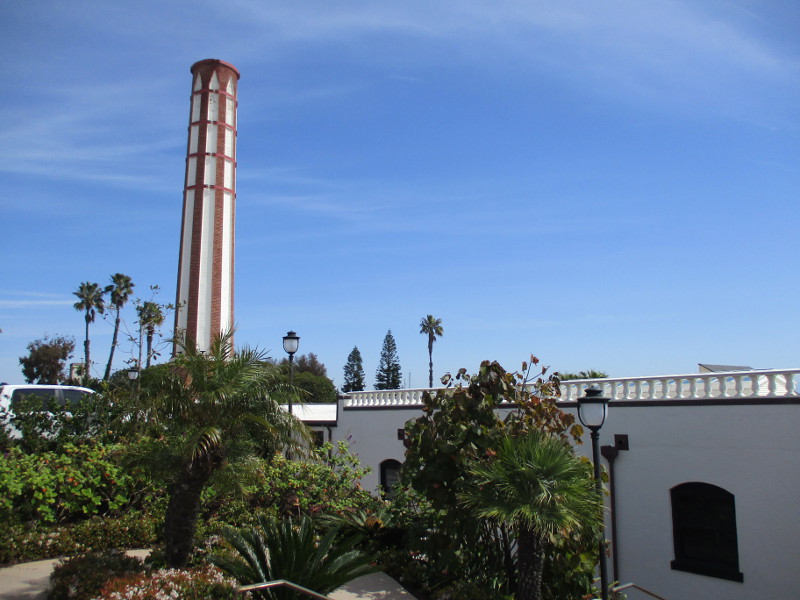
What’s that tall brick smokestack near the world-famous Hotel del Coronado?

It’s the most noticeable part of a historic industrial complex!

I walked around the Hotel Del’s old laundry building, ice house and power plant last month during the San Diego Architectural Foundation Open House event. I discovered several plaques that provide information about these three buildings, which, clustered south of the hotel lobby entrance, are called the industrial complex.

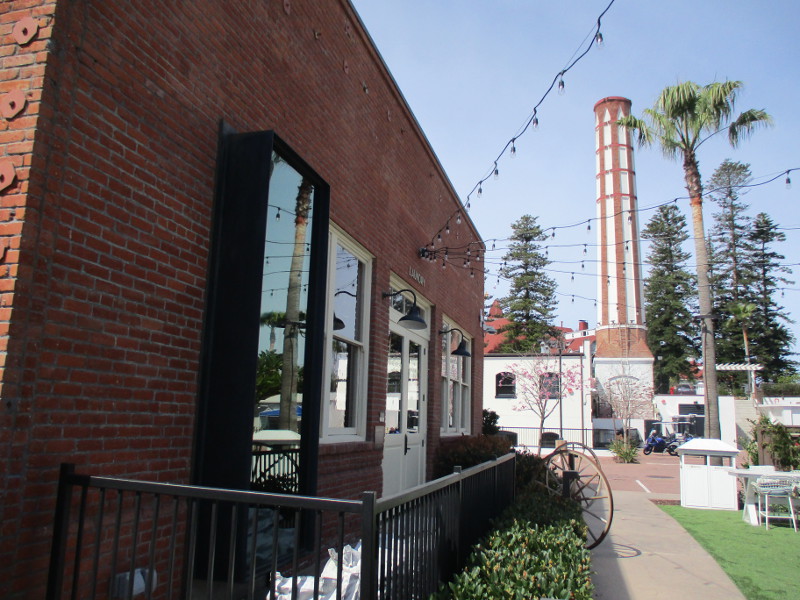
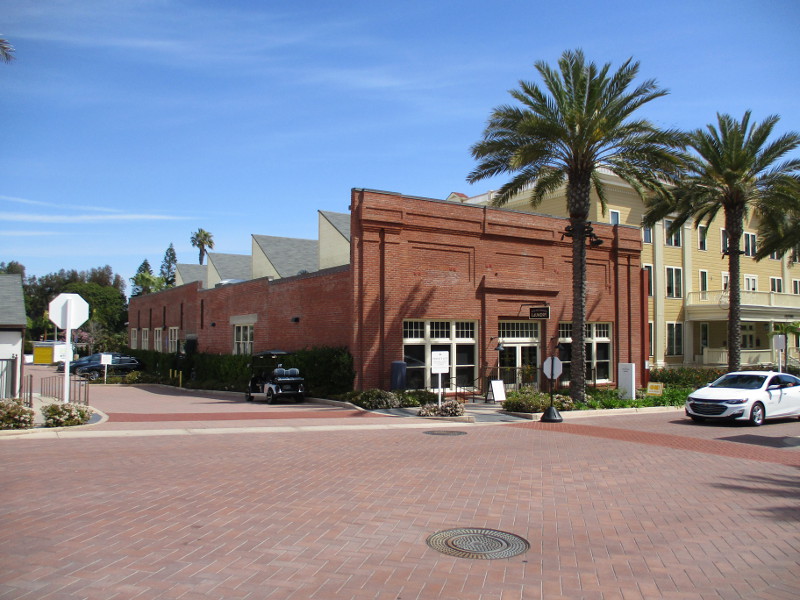
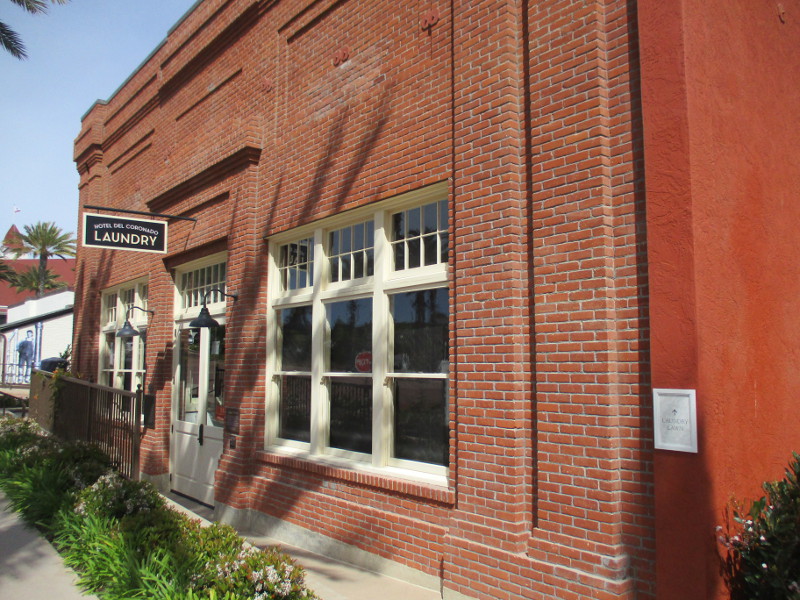
The brick building shown below once provided the Hotel del Coronado’s laundry service. It’s now home to The Laundry Pub!

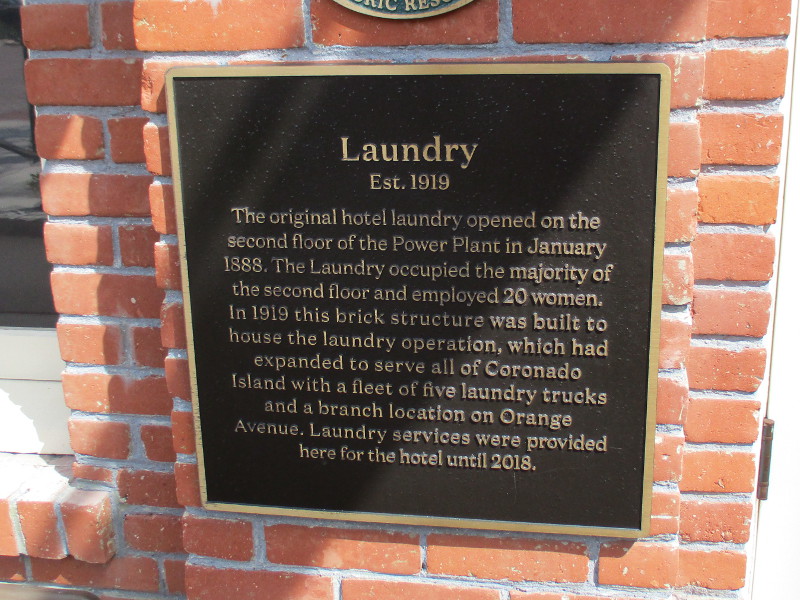
Laundry, established 1919.

The original hotel laundry opened on the second floor of the Power Plant in January 1888. The Laundry occupied the majority of the second floor and employed 20 women. In 1919 this brick structure was built to house the laundry operation, which had expanded to serve all of Coronado Island with a fleet of five laundry trucks and a branch location on Orange Avenue. Laundry services were provided here for the hotel until 2018.

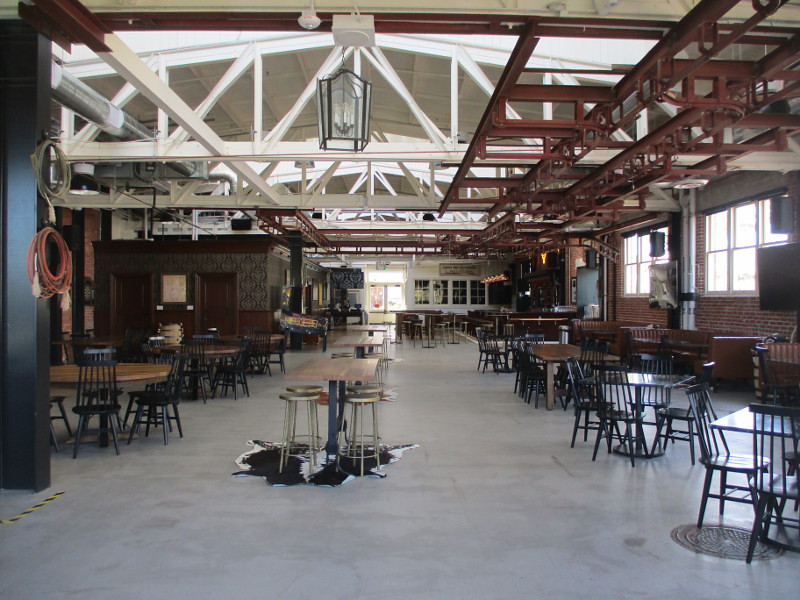
The next photo is through the window of The Laundry Pub, which features an 1880s-era bar and the laundry’s early conveyor system above restored wood floors.

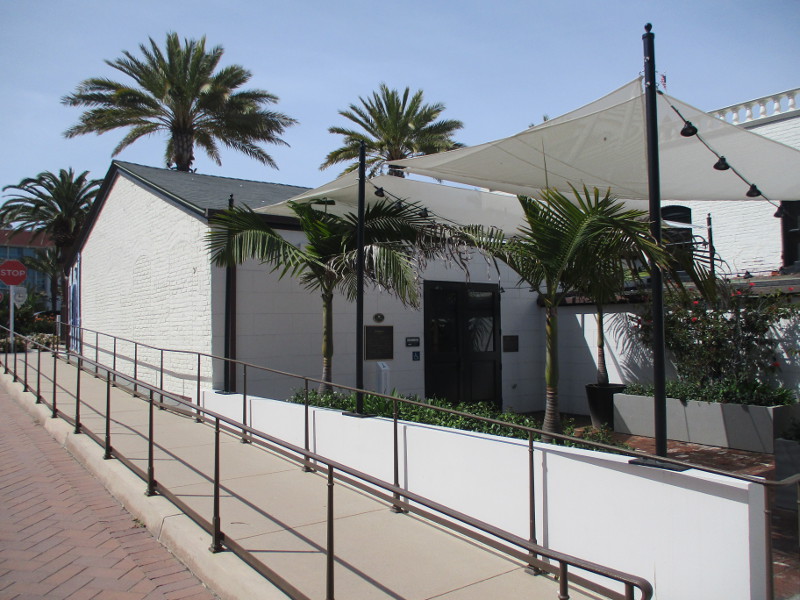
North of the brick laundry building is the hotel’s old ice house.

The ice house is now home to the fascinating Ice House Museum of the Hotel del Coronado, where you can view historical displays and artifacts, plus photographs of the many celebrities, movie stars and United States Presidents who’ve visited the Victorian resort over the years. I blogged about the museum two years ago here.

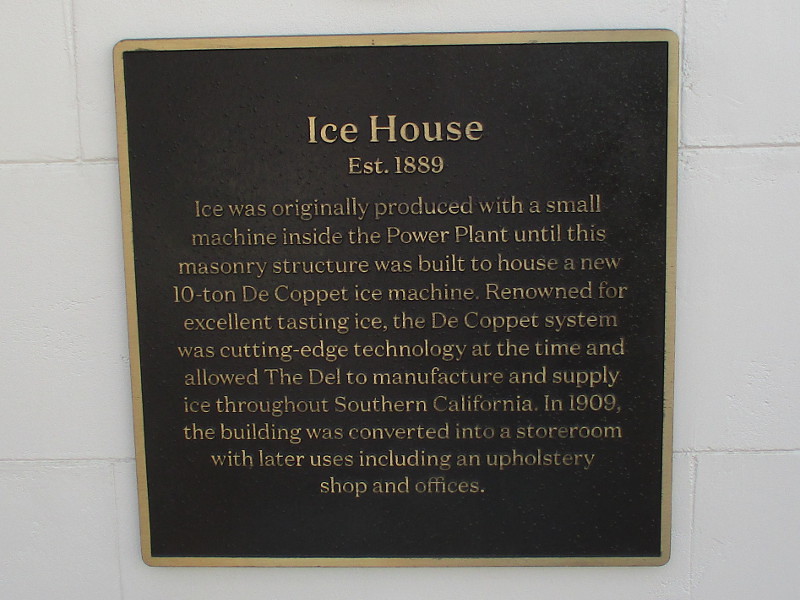
In the rear of the ice house is this plaque…

Ice House, established 1889.

Ice was originally produced with a small machine inside the Power Plant until this masonry structure was built to house a new 10-ton De Coppet ice machine. Renowned for excellent tasting ice, the De Coppet system was cutting edge technology at the time and allowed The Del to manufacture and supply ice throughout Southern California. In 1909, the building was converted into a storeroom with later uses including an upholstery shop and offices.

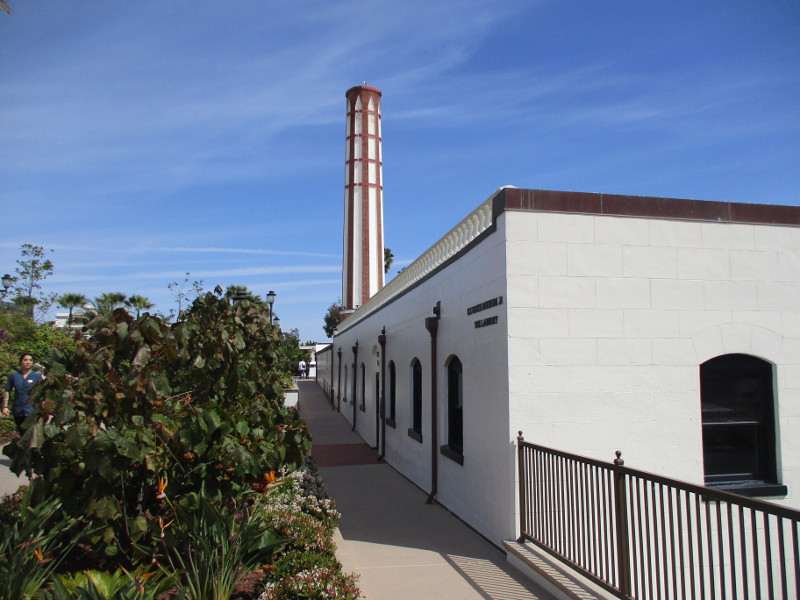
Lastly, north of the ice house is the old power plant with its tall, striped smokestack.

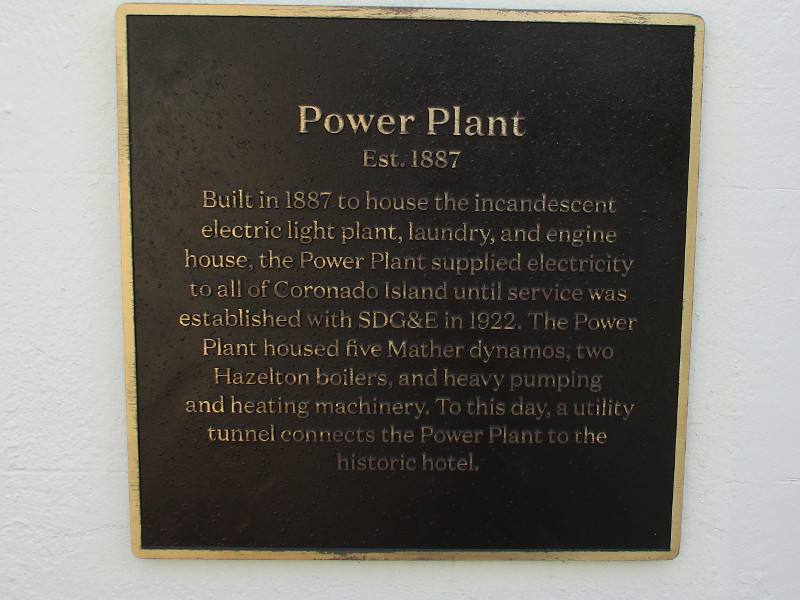
Power Plant, established 1887.

Built in 1887 to house the incandescent electric light plant, laundry, and engine house, the Power Plant supplied electricity to all of Coronado Island until service was established with SDG&E in 1922. The Power Plant housed five Mather dynamos, two Hazelton boilers, and heavy pumping and heating machinery. To this day, a utility tunnel connects the Power Plant to the historic hotel.

Thanks for visiting Cool San Diego Sights!

I post new blogs pretty often. If you like discovering new things, bookmark coolsandiegosights.com and swing on by occasionally!

I live in downtown San Diego and love to walk around with my camera! You can follow Cool San Diego Sights via Facebook or X (formerly known as Twitter)!