Unknown Navy plaque: Mystery partially solved!

I just received an email from the Port of San Diego.  It concerns a blog post I wrote last month about a mysterious Navy plaque on the Embarcadero.  The plaque stands near the USS Midway Museum, among other military monuments and works of art on the Greatest Generation Walk.

Here’s the body of the reply, which provides a little more of the history of two interesting plaques:

“The plaque in question, which is on the Harbor Drive side of the stone, is a 30” x 22” cast bronze bas relief that commemorates the 200th anniversary of the founding of the Navy – 1773 to 1973. We don’t have information on the exact date it was created and installed but it was most likely cast and mounted around the time of the anniversary in 1973. The sponsor of this plaque was the U.S. Navy. The images in the plaque include representative ships and planes used by the Navy during its first 200 years. From left to right they include: (1) a sailing warship, probably a frigate; (2) a Civil War era ironclad monitor; (3) a pre-World War I battleship or armored cruiser; (4) a modern (circa 1973) aircraft carrier; (5) a nuclear powered submarine; and (6) two F-4 Phantom jet fighter planes. The plaque also includes a circular rendering of the U.S. Navy emblem showing an anchor and eagle and the words “United States Navy”. There is also an oval shaped emblem that includes an anchor superimposed by the dates 1773 and 1973 and the words “United States Navy – Building on a Proud Tradition.” (See image below, which is also attached.) This plaque was originally located on Broadway Pier at a bench and planter area. After the extensive renovation of Broadway Pier some years ago, the plaque was remounted in its current location near the USS Midway by the Port of San Diego’s General Services department.”

Photo of Navy 200 year commemoration plaque courtesy the Port of San Diego.

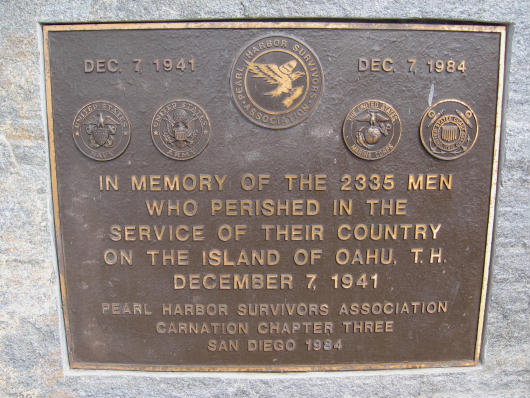
“The Pearl Harbor Survivors plaque, which you mentioned, was also originally displayed on Broadway Pier prior to the above-mentioned renovations. This plaque was sponsored by the Pearl Harbor Survivors Association, Carnation Chapter, San Diego, and dedicated during the Chapter’s annual remembrance ceremony on December 7, 1984. From the image attached and shown below, you can read the inscription on the plaque. The five circular emblems are those of the U.S. Navy, U.S. Army, U.S. Marine Corps, U.S. Coast Guard, and the Pearl Harbor Survivors Association.”

Photo of Pearl Harbor Survivors plaque courtesy the Port of San Diego.

The exact origin of the first plaque still seems a bit mysterious to me.  Was it unique to the Broadway Pier?  Were more of these plaques created?

Thanks go to the Port of San Diego, who provided the above descriptions and the photographs!

Thanks also go to gpcox, who spent a good bit of time searching for answers to this fascinating mystery!

UPDATE!

William Abell wrote the following comment on the original blog post:

My name is William Abell and I was an ML3 aboard the USS Ajax AR6 and I helped create this plaque in the ship’s foundry in 1975. I have a certificate from Admiral J L Holloway III commemorating the plaque’s creation and my part in its creation. The date on the certificate is Oct 13, 1975. The plaque was to be a gift to the City of San Diego. I am now a retired police commander living in Monroe WA.

UPDATE!

A subsequent comment has directed my attention to the following information:

I am Molder Chief Petty Officer Jesse G. Lopez USN Ret. The foundry crew from Navy Repair Ship USS Ajax AR-6, created the pattern which was made by Patternmaker Chief Carlos De Santiago USN RET and molded by myself when I was a MLFN. Petty Officer Abell was our Third Class in charge of the molders.

AMAZING UPDATE!

I’ve received detailed information about the plaque, including photographs of its creation and creators! Click here!

To enjoy future posts, you can “like” Cool San Diego Sights on Facebook or follow me on Twitter.

Help solve a Navy mystery in San Diego!

Corroded plaque shows tallship, ironclad, early warship, aircraft carrier and jets.

I’ve wondered for a long time about this mysterious plaque on San Diego’s Embarcadero. It’s located on the Greatest Generation Walk, right next to the USS Midway Museum, and stands back-to-back with a Pearl Harbor Survivors Plaque which I blogged about here.

Thousands of people walk by this old, corroded plaque every day, but I can find absolutely nothing on the internet about its origin. An image framed by rope includes several vessels, including a tall ship (perhaps the USS Constitution), an ironclad (perhaps the USS Monitor), an old warship with a side-mounted gun, an aircraft carrier, and some jets flying overhead. Words indicate the plaque commemorates the United States Navy’s 200 years of Building on a Proud Tradition. The United States Navy began in 1775 and celebrated its bicentennial in 1975.

Obviously, whoever placed the plaque at this location must know something about its history.  But even the Port of San Diego website, where the other monuments on the Greatest Generation Walk are listed and described, says nothing about it!

The slab that it’s embedded in appears very similar to the slab right next to it, containing the Pearl Harbor Survivors Plaque. But I’ve found nothing specific about that plaque, either!

Perhaps someone out there can identify this mystery plaque! What the heck is it? Where did it come from? Help solve this mystery!

Mysterious plaque by Midway Museum commemorates Navy's 200 year anniversary.
Mysterious plaque by Midway Museum commemorates Navy’s 200 year anniversary.

UPDATE!

I received more information about this plaque from the Port of San Diego. Please visit this blog post!

UPDATE!

William Abell wrote the following in the comment section:

My name is William Abell and I was an ML3 aboard the USS Ajax AR6 and I helped create this plaque in the ship’s foundry in 1975. I have a certificate from Admiral J L Holloway III commemorating the plaque’s creation and my part in its creation. The date on the certificate is Oct 13, 1975. The plaque was to be a gift to the City of San Diego. I am now a retired police commander living in Monroe WA.

UPDATE!

A subsequent comment directed me to the following information:

I am Molder Chief Petty Officer Jesse G. Lopez USN Ret. The foundry crew from Navy Repair Ship USS Ajax AR-6, created the pattern which was made by Patternmaker Chief Carlos De Santiago USN RET and molded by myself when I was a MLFN. Petty Officer Abell was our Third Class in charge of the molders.

AMAZING UPDATE!

I’ve received detailed information about the plaque, including photographs of its creation and creators! Click here!

To enjoy future posts, you can “like” Cool San Diego Sights on Facebook, or follow me on Twitter.

Legends on the streets of San Diego’s Little Italy.

Pedestrian passes Little Italy sign on India Street in San Diego.

Today, if you were to walk through downtown San Diego’s historic Little Italy neighborhood, you’d probably see a number of very interesting street banners and plaques. These commemorate the Legends of Little Italy.

Early one morning while I walked to a nearby trolley station, I took a few quick photographs along India Street. You might enjoy looking at them. I transcribed much of what appears on the plaques.

Plaque explains the history of the Little Italy Landmark Sign.

The Little Italy Landmark Sign was dedicated and lit at the 7th Annual Little Italy Festa on the evening of October 8, 2000. The landmark sign was constructed as a tribute to this immigrant neighborhood which, until the late 1960s, was the hub of the world’s tuna fishing and canning industry. The nautical theme can be seen in the portholes at the top of the pillars, the blue neon of the lettering and the cable span which holds up the sign. The mosaic tile work on each side of the street tells how this immigrant community is historically tied to the bay, the church and the Italian homeland. This sign is a testament to the preservation of Little Italy’s cultural heritage and to the ongoing revitalization of this dynamic urban ethnic neighborhood in Downtown San Diego.

Mosaic tiles show the community's ties to Italy and traditions.
Mosaic tiles show the community’s ties to Italy and traditions.
Singing and acting legend Frankie Laine lived in San Diego.

On March 30th, 1913, in the Little Italy section of Chicago, Francesco Paolo LoVecchio was born. Mother Cresenzia Concetta Salerno and father Giovanni LoVecchio. Both parents from Monreale, Sicily. Frankie’s first introduction to music came when the Monsignor at Immaculate Conception recruited him for the all-boy church choir. Now, an aspiring singer, Frankie would work many jobs, singing wherever and whenever he could, traveling from town to town, experiencing many hardships. Frankie was in his mid-thirties when he attained his first hit “That’s My Desire”. 21 Gold Records followed, including “The Lucky Old Sun”, “Mule Train”, “Jezebel”, “High Noon”, “I believe”, “Cry of the Wild Goose”, “Moonlight Gambler”, and “Rawhide”. Frankie starred in 7 motion pictures, starred in his own television show, sang the title song for several motion pictures, including “Blazing Saddles”, “3:10 to Yuma” and “Gunfight at OK Corral”. Frankie moved to San Diego in the 60’s. He lived the rest of his life in his Point Loma home. Frankie loved San Diego and especially Little Italy. Frankie Laine passed away February 6th, 2007.

Tony and Rose Bernadino used to live on Date Street.
Tony Bernardini was an Italian immigrant who settled in San Diego.

Tony Bernardini left his native Bari, Italy to sail to America in 1907. He came with little money, but his heart was full of hope and enthusiasm for the opportunities that awaited him in his New World. Passing through Ellis Island, he quickly made his way to San Diego, where he found a climate and a neighborhood that reminded him of the place he had left. Tony took a job with the San Diego Electric Railway Company, maintaining the tracks for San Diego’s extensive streetcar lines. He worked hard, saved his money, and sent for his future wife, Rosa Monteleone, in 1911.

Tony and Rosa married shortly after her arrival in San Diego. They went on to have seven children; Clara, Fred, Lily, Vito, Matha, Nick, and Angelina. With hard work, Tony was able to bring several other members of their families to America to join them. In the early 1930’s, he got an opportunity to buy the building located on this corner from an acquaintance, who offered to finance the transaction for him. He opened the Civic Center Liquor House. Rosa and all of the children helped him run the business. During the first seven years he ran the business, he was only able to pay the interest on the Property’s note. But with the Declaration of World War II in 1941, San Diego’s economy heated up dramatically. Despite the fact that all three of their sons joined the Army to fight in the War, Tony, Rosa, and their daughters continued to work in the business, and by the end of the War, Tony had managed to pay off the note completely. he had achieved the American dream!

The story of love, hard work, and strong family life.

To a store in San Diego’s Little Italy, Vincent DePhilippis (1903-1957) and Madeleine Manfredi (1904-1993) brought their version of the American Dream.

Vincent was born in New York and raised in Naples, Italy. Madeleine was born and raised in Nimes, France. They both came to America for a better life where they met and fell in love in 1922 and later married in 1925. Cooking for friends and family together was a passion they shared, everywhere from the Bronx, New York to West Chester, Pennsylvania. Always in the food business, Vincent was a pasta maker, chef and entrepreneur. In 1948, they finally settled in San Diego, California and opened Cash & Carry Italian Foods, a labor of love. Their strong work ethic, values, and generosity helped shape the budding Italian-American community. With the help of seven children and Madeleine’s infectious laugh, the small business grew to Filippi’s Pizza Grotto, the success story we all know today. Their children Roberto, Gina, Mary, Vincent, Alfred, Richard and William followed in their parents footsteps and grew the family business. Today the tradition continues with their grand and great grandchildren.

Banner on street lamp shows Tarantino family.
Past lives become legends in the annals of Little Italy's history.
Past lives become legends in the annals of Little Italy’s history.
Morning coffee and companionship on a Little Italy sidewalk.

UPDATE!

During another walk through Little Italy I discovered another fascinating plaque:

Plaque shows Rose and Salvatore Cresci, Family of Little Italy.
The story of Rose and Salvatore
The story of Rose and Salvatore “Sal” Cresci, Little Italy Legends. (Click photo to enlarge for easy reading.)

UPDATE!

Here come two more signs that I found! The first concerns Pietro and Cristina Busalacchi, Italian immigrants who established restaurants in San Diego. The second concerns Renata and Stefano Brunetto. Stefano, a tuna fisherman, opened Mona Lisa Restaurant with his brother-in-law Gaspare Apparito.

IMG_8680z

IMG_8680z

IMG_8689z

IMG_8689z

To enjoy future posts, you can “like” Cool San Diego Sights on Facebook, or follow me on Twitter.

Sculpture of Bum, San Diego’s famous town dog.

Sculpture of Bum, San Diego's town dog, in a grassy Gaslamp pocket park.
Sculpture of Bum, San Diego’s town dog, in a grassy Gaslamp pocket park.

One of San Diego’s most famous celebrities had four legs and a tail. His name was Bum.

Bum the dog made San Diego his home in the late 19th century. He arrived in town in 1886 by stowing away on the Santa Rosa, a steamship from San Francisco. Soon thereafter, he became the well known town mascot.

Everyone was proud to be Bum’s pal. San Diegans young and old gladly provided food, friendship and their front porches for his sleeping place. Bum helped firemen hurry to fires, led parades, and protected the town’s children. We know this today because James Edward Friend, a journalist, wrote about Bum’s life and famous exploits.

Bum was so popular that one local restaurant put up a sign that read Bum Eats Here. When the city of San Diego passed a law requiring dog licenses, Bum’s picture was featured on the license.

Bum was a free spirit. Nobody owned him. But he had a claim on everybody’s heart. He was given free fare on trains, whenever he decided to come or go. He was given special medical attention when one foreleg became badly mangled in a train accident. He was even given a home at the County Hospital by the Board of Supervisors when his arthritis made it hard to get around. Bum was buried on the hospital grounds after his death in 1898.

Bum’s life has come to represent a small chapter of San Diego’s history, back when today’s downtown competed with Old Town and was called New Town. A bronze sculpture of the famous town dog now occupies a shady pocket park in downtown’s Gaslamp District. You can find the exact likeness of the St. Bernard-Spaniel mix lying on the grass not far from the William Heath Davis House, which is a small museum and the oldest wooden structure in the Gaslamp.

Plaque remembers history of Bum in early San Diego and his legendary exploits.

The nearby plaque reads:

Bum

San Diego’s Official Town Dog

Died November 10, 1898 – Aged 12 Years

Loved by everyone – owned by no one. His name suited him because he arrived as a town stowaway, befriended everyone and “bummed” quality food from the local eateries. As a young dog he survived a scuffle with another dog on the Santa Fe train tracks. Though he lost a foreleg and part of his tail, his spirit was unbroken. He guarded the children, led the parades and fire trucks, and had many adventures. So admired was Bum that the City Council awarded him a lifetime dog license. When he died, children collected pennies for a proper burial.

Bum waits faithfully downtown next to the William Heath Davis House museum.
Historical photograph shows Bum among his many San Diegan human friends.
Greyfriars Bobby, town dog of Edinburgh, Scotland.

Another dog sculpture perched on a nearby bench is of Greyfriars Bobby, the official town dog of Edinburgh, Scotland. The love and loyalty of both legendary dogs is the reason San Diego and Edinburgh are sister cities.

Bum sculpture recalls a wonderful chapter of San Diego's rich history.
Bum sculpture recalls another rich chapter of San Diego’s history.

To enjoy future posts, you can “like” Cool San Diego Sights on Facebook, or follow me on Twitter.

War Memorial Building forgets Memorial Day.

Veterans War Memorial in Balboa Park.

I thought of heading up to Mt. Soledad for the Memorial Day ceremony this afternoon, but the thought of crowds and a parking hassle was just too much. Instead, I went for a long walk!

My brilliant plan was to head up Park Boulevard to check out the Veterans War Memorial Building in Balboa Park, just north of the San Diego Zoo. The War Memorial Building was built in 1950 to honor Americans who’d served in the military overseas. Certainly something had to be going on there for Memorial Day!

Boy was I wrong.

The place was dead. Closed. No people. Nothing. Not even a flag on the flagpole. They couldn’t even raise a flag for Memorial Day?

No flag flies for Memorial Day.
San Diego Veterans War Memorial Building plaque.

The plaque reads:

SAN DIEGO VETERANS WAR MEMORIAL BUILDING

DEDICATED BY THE CITIZENS OF SAN DIEGO AS A LIVING MEMORIAL TO OUR HONORED DEAD OF ALL WARS AND TO THOSE AMERICANS WHO HAVE FOUGHT FOR THE FOUR FREEDOMS

I

FREEDOM OF SPEECH AND EXPRESSION

II

FREEDOM OF EVERY PERSON TO WORSHIP GOD IN HIS OWN WAY

III

FREEDOM FROM WANT

IV

FREEDOM FROM FEAR

Veterans War Memorial is closed on Memorial Day.

To enjoy future posts, you can “like” Cool San Diego Sights on Facebook, or follow me on Twitter.

Bronze plaque marks birthplace of naval aviation.

Bronze plaque in Coronado marks birthplace of naval aviation.

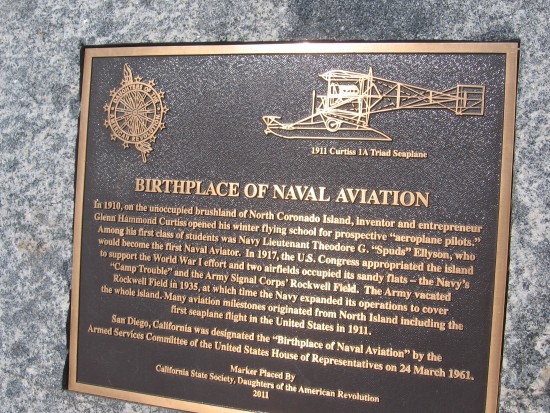
In Coronado’s beautiful Centennial Park, just north of the Coronado Ferry Landing, you can find this relatively new bronze plaque. It marks the birthplace of naval aviation, Rockwell Field, which no longer exists.

The historical marker reads:

BIRTHPLACE OF NAVAL AVIATION

In 1910, on the unoccupied brushland of North Coronado Island, inventor and entrepreneur Glenn Hammond Curtiss opened his winter flying school for prospective “aeroplane pilots.” Among his first class of students was Navy Lieutenant Theodore G. “Spuds” Ellyson, who would become the first Naval Aviator. In 1917, the U.S. Congress appropriated the island to support the World War I effort and two airfields occupied its sandy flats–the Navy’s “Camp Trouble” and the Army Signal Corps’ Rockwell Field. The Army vacated Rockwell Field in 1935, at which time the Navy expanded its operations to cover the whole island. Many aviation milestones originated from North Island including the first seaplane flight in the United States in 1911.

San Diego, California was designated the “Birthplace of Naval Aviation” by the Armed Services Committee of the United States House of Representatives on 24 March 1961.

Marker Placed By

California State Society, Daughters of the American Revolution

2011
Historical marker is located near east end of Centennial Park.
Rockwell Field in 1924.

To enjoy future posts, you can “like” Cool San Diego Sights on Facebook, or follow me on Twitter.

Bust of war hero in Little Italy’s Piazza Basilone.

Bust of World War II hero John Basilone in Little Italy.

This handsome bust is the central feature of Piazza Basilone, a small urban space with tables, umbrellas and a fountain at the corner of India and Fir Street in Little Italy.

A plaque beneath the bust begins with the following words:

GUNNERY SERGEANT JOHN BASILONE

NOVEMBER 4, 1916 – FEBRUARY 19, 1945

SERGEANT JOHN BASILONE WAS ONE OF THE FIRST ENLISTED MARINES TO BE AWARDED THE CONGRESSIONAL MEDAL OF HONOR OF WORLD WAR II. HE WAS ALSO POSTHUMOUSLY AWARDED THE NATIONAL CROSS.

HE WAS BORN TO ITALIAN IMMIGRANTS, SALVATORE AND DORA BASILONE, IN BUFFALO, NEW YORK. HE AND HIS TEN BROTHERS AND SISTERS GREW UP IN RARITAN, NEW JERSEY. RESTLESS AND ADVENTUROUS BY NATURE, JOHN ENLISTED IN THE ARMY AT THE AGE EIGHTEEN AND WAS ASSIGNED TO GARRISON SERVICE IN THE PHILIPPINES.

AFTER HIS HONORABLE DISCHARGE FROM THE ARMY, BASILONE RETURNED TO RARITAN. AS THE STORM CLOUDS OF WAR GATHERED, JOHN BELIEVED HIS PLACE WAS WITH THE FIGHTING FORCES. IN JULY 1940 HE ENLISTED IN THE MARINE CORPS.

IT WAS ON GUADACANAL THAT SERGEANT BASILONE ACHIEVED HIS PLACE IN MARINE CORPS HISTORY, BECOMING ONE OF THE FIRST ENLISTED MARINES TO BE AWARDED THE MEDAL OF HONOR OF WORLD WAR II; THE NATION’S HIGHEST AWARD FOR EXTRAORDINARY HEROISM AND CONSPICUOUS GALLANTRY IN ACTION.

During the Battle of Guadalcanal, Basilone held off 3,000 Japanese troops after his unit was almost entirely destroyed. He was later killed in action on the first day of the Battle of Iwo Jima.

Planet Earth globe fountain in Little Italy's Piazza Basilone.
Planet Earth globe fountain in Little Italy’s Piazza Basilone.

This unique fountain is just a few feet away.

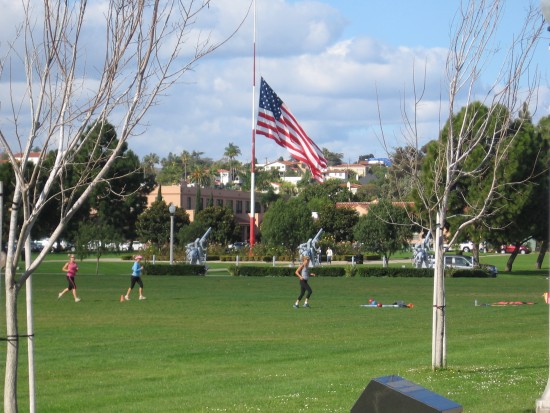
Huge Liberty Station flag at half-mast.

Huge Liberty Station flag at half mast.
Huge Liberty Station flag at half-mast.

I took a nice long walk this chilly morning from Spanish Landing to the edge of the Marine Corps Recruit Depot.  I followed dirt and paved walkways, staying mostly near the edge of the boat channel that runs between Point Loma’s Liberty Station and Lindbergh Field.

Here are pics of one sight that was very hard not to miss.  The gigantic flag at NTC Liberty Station was flying in the breeze at half-mast, most likely due to Nelson Mandela’s death today.

In the first photo you can see ladies getting a workout in a big grassy area, and some large guns that are monuments to the old Naval Training Center.

Today’s Liberty Station is a complex of stores, offices, museums, residential and park space.  It used to be Naval Training Center San Diego, which was closed in 1997 and eventually redeveloped using the historic old buildings.  The grassy expanse near the boat channel is Preble Field. It was the marching ground where Navy recruits assembled, marched and graduated from boot camp.

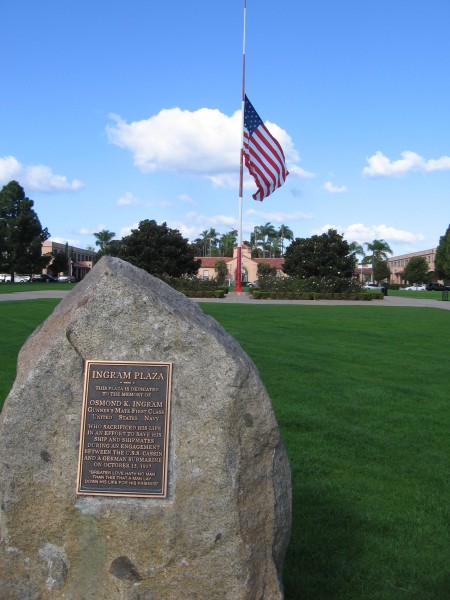
Flag at half mast at Ingram Plaza.
Flag at half mast in Ingram Plaza.

Beyond this plaque is where Ingram Plaza used to be.  Ingram Plaza was the site of tent camps in the 1920s where incoming recruits were temporarily isolated to prevent outbreaks of contagious diseases.  Here they also got haircuts, new uniforms and physical training before joining the regular routines of the base.

The plaque reads:

THIS PLAZA IS DEDICATED TO THE MEMORY OF OSMOND K. INGRAM GUNNERS MATE FIRST CLASS UNITED STATES NAVY WHO SACRIFICED HIS LIFE IN AN EFFORT TO SAVE HIS SHIP AND SHIPMATES DURING AN ENGAGEMENT BETWEEN THE U.S.S. CASSIN AND A GERMAN SUBMARINE ON OCTOBER 15, 1917

“GREATER LOVE HATH NO MAN THAN THIS THAT A MAN LAY DOWN HIS LIFE FOR HIS FRIENDS'”

UPDATE!

Here are a few more photos I took on a later day:

Plaques at NTC Liberty Station remember the history of Naval Training Center San Diego.
Preble Field was a grinder or marching ground. However, it is most fondly remembered as the location of every boot camp graduation ceremony, where boys became men.
Ingram Plaza was the site of the original tent camps in the 1920s. New recruits were isolated here for three weeks, and given haircuts, uniforms and physical training.

To enjoy future posts, you can “like” Cool San Diego Sights on Facebook, or follow me on Twitter.
Peek into the San Diego Firehouse Museum.

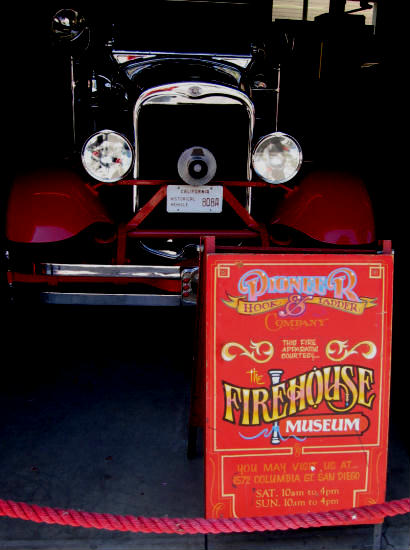
sign at the firehouse museum in little italy

If you’re ever in the Little Italy neighborhood in downtown San Diego, you might want to check out the small but jam-packed Firehouse Museum.

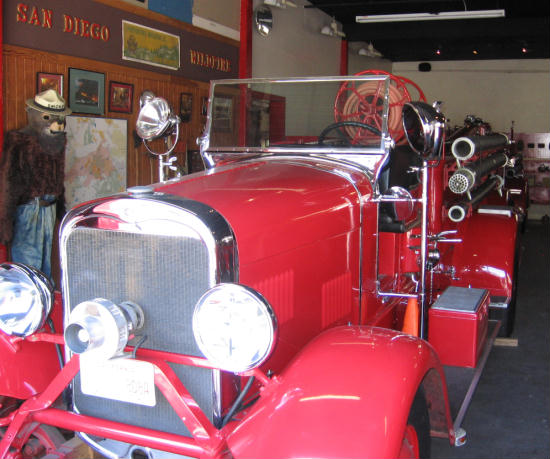
Shiny red fire trucks, interesting historical photos, old fire fighting apparatus, memorabilia and even Smokey Bear are on display. And excited kids can climb into one of the cool fire engines!

This sign by the sidewalk invites tourists and passersby to take a peek into the firehouse.

a peek at a cool firetruck and smokey bear

I took a photo from outside, aiming left.

old firetrucks in san diego firehouse museum

And then the above photo aiming right.

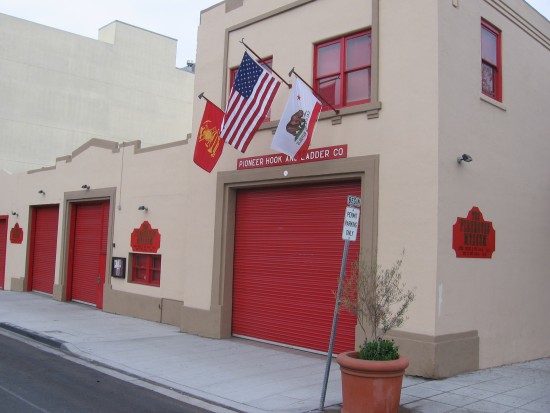
The next pic was taken on a later day, in the early morning when the museum was still closed…

The San Diego Firehouse Museum in the early morning.

A plaque appeared on the museum’s exterior in mid to late 2015!

Old Fire Station Number Six. From 1915 to 1970, San Diego Fire Department's original Fire Station 6 proudly served the community of Little Italy.
Old Fire Station Number Six. From 1915 to 1970, San Diego Fire Department’s original Fire Station 6 proudly served the community of Little Italy.

The plaque includes this fascinating information:

In the workshop on this site some of America’s most significant fire service innovations were created by the specialty trade-skilled firefighters who worked here, including the world’s first gas engine powered fireboat, the Bill Kettner. In 1963 the National Fire Protection Association declared the national standard thread the official fire hose thread of the United States of America. The machine which enabled this federal legislation was invented here six years earlier by inventor and battalion chief Robert Ely. The common thread allowed thousands of American firefighters to connect their fire hoses together, allowing them to work as one. As a result, countless lives and priceless amounts of property and the environment have been saved.

Follow this blog for more photos of cool stuff! Join me on Facebook or Twitter.

Plaque remembers Pearl Harbor victims.

plaque memorializes victims of pearl harbor

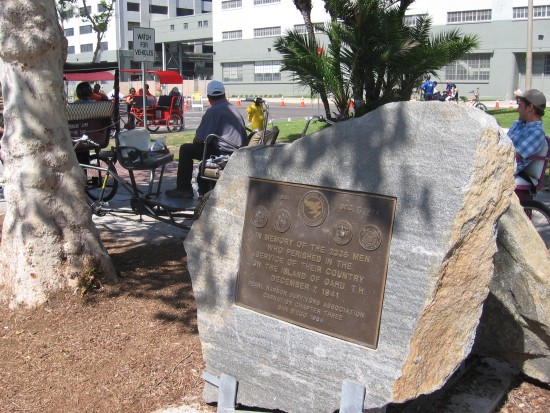
This plaque, embedded in a large old slab, is located on the Embarcadero. You’ll find it right next to the USS Midway Museum, at the north end of the Greatest Generation Walk. It remembers the victims of the surprise attack on Pearl Harbor on December 7, 1941.

It reads:

IN MEMORY OF THE 2335 MEN WHO PERISHED IN THE SERVICE OF THEIR COUNTRY ON THE ISLAND OF OAHU.

It looks like the memorial was unveiled by a local chapter of the Pearl Harbor Survivors Association in 1984. I’m not sure where the plaque was located originally. I searched the internet briefly, but found nothing.

UPDATE!

I’ve learned that this plaque was originally located on the Broadway Pier, prior to its renovation a few years ago.  This post contains more info I received from the Port of San Diego.

Pedicab drivers wait near Pearl Harbor plaque.