Reviewing photographs that I took in San Diego five years ago, I see all sorts of unique events could be enjoyed back then. Here are a few of the photos from April 2016 that I took during my walks and adventures throughout the city.
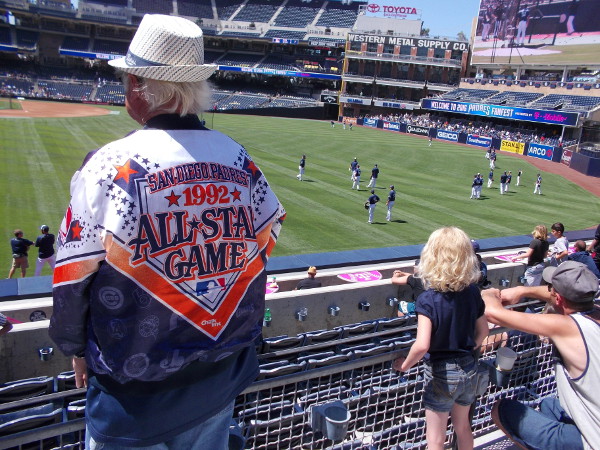
Later in the year San Diego would host Major League Baseball’s All-Star Game and Petco Park was getting ready. The new Horton Plaza Park would also soon open, and I was following the progress of its construction.
As you can see by clicking the following links, cool experiences are sometimes found in unexpected places!
Click the following links to see a bunch of fun photographs!
This blog now features thousands of photos around San Diego! Are you curious? There’s lots of cool stuff to check out!
Here’s the Cool San Diego Sights main page, where you can read the most current blog posts. If you’re using a phone or small mobile device, click those three parallel lines up at the top–that opens up my website’s sidebar, where you’ll see the most popular posts, a search box, and more!
To enjoy future posts, you can also “like” Cool San Diego Sights on Facebook or follow me on Twitter.
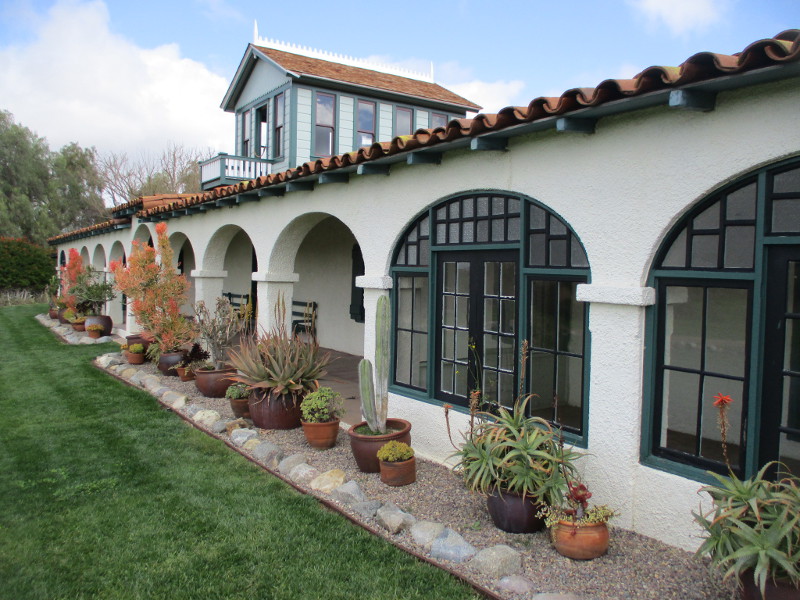
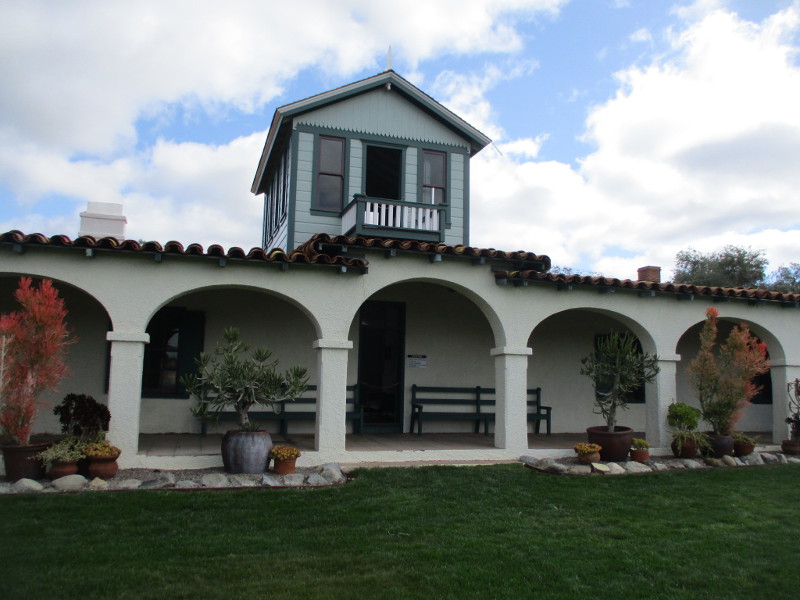
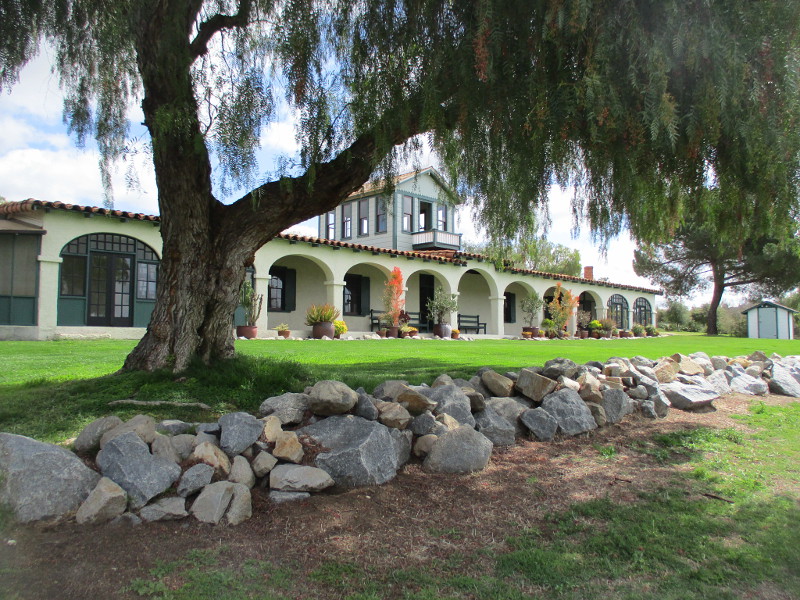
The Rancho Guajome Adobe is an architecturally and historically important 19th century ranch house located in Vista, California. I visited it a little over a week ago and walked around the grounds, learning about the fascinating history of the place while taking a few photographs.
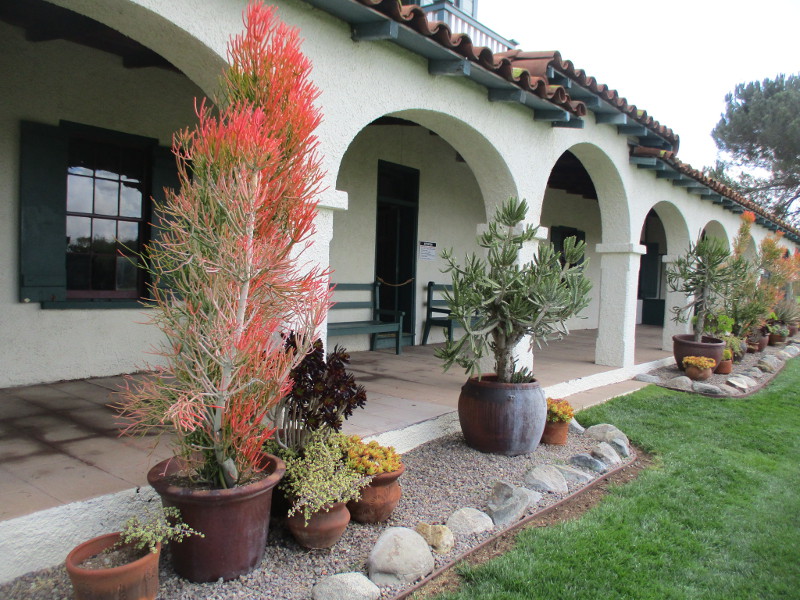
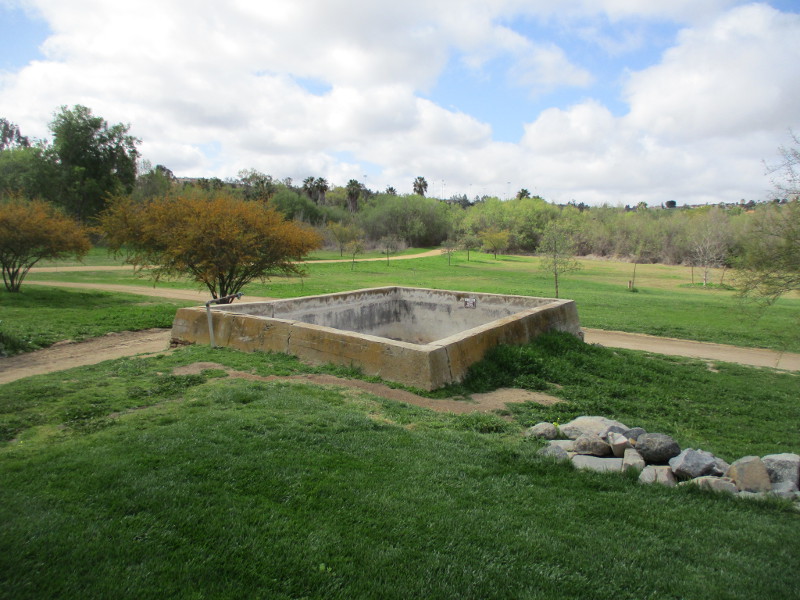
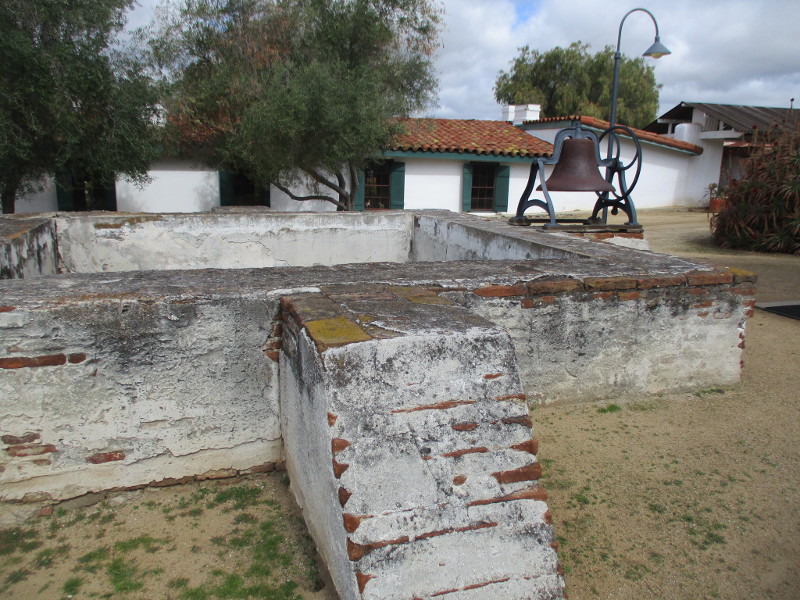
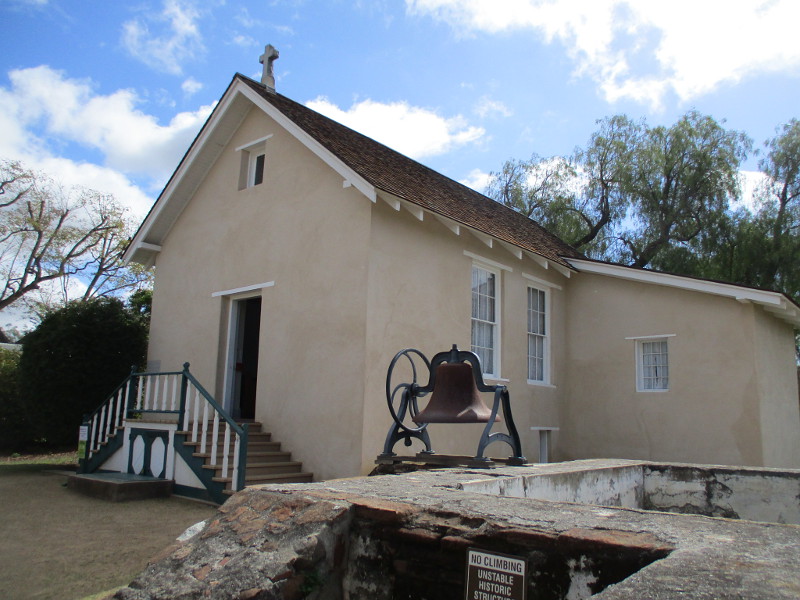
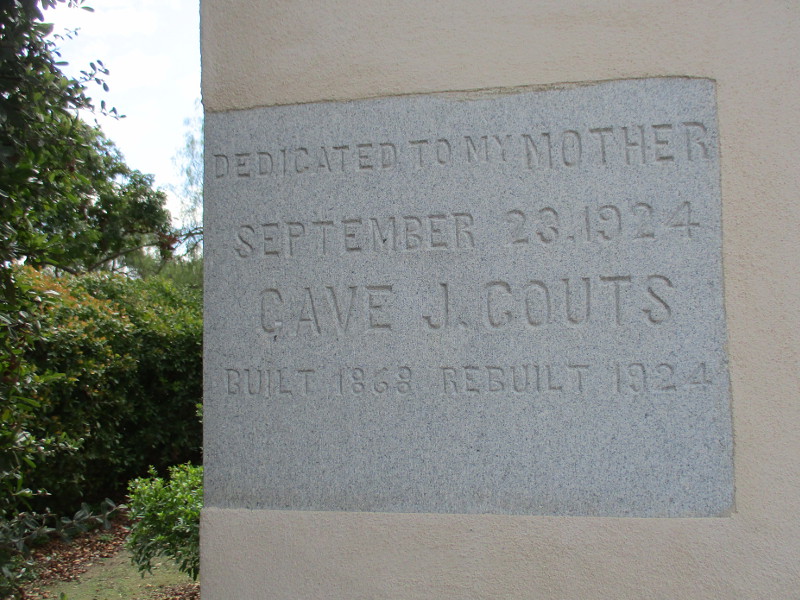
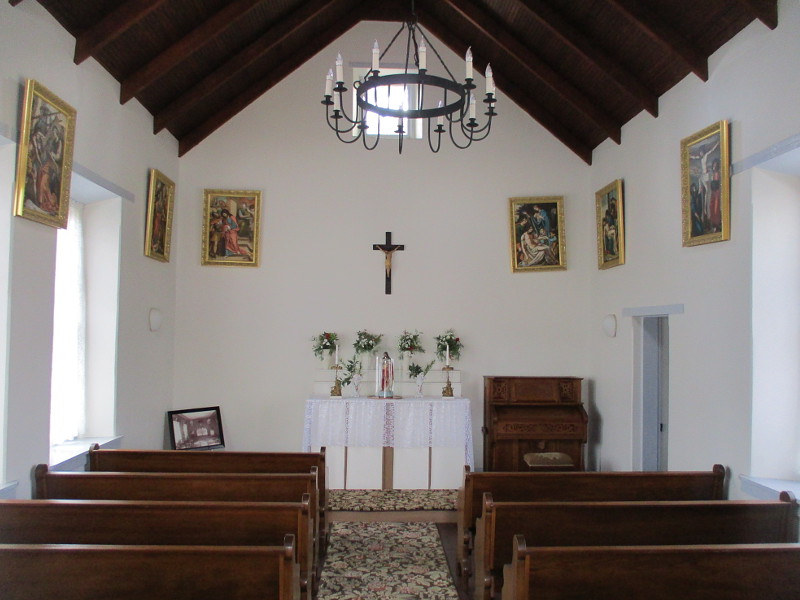
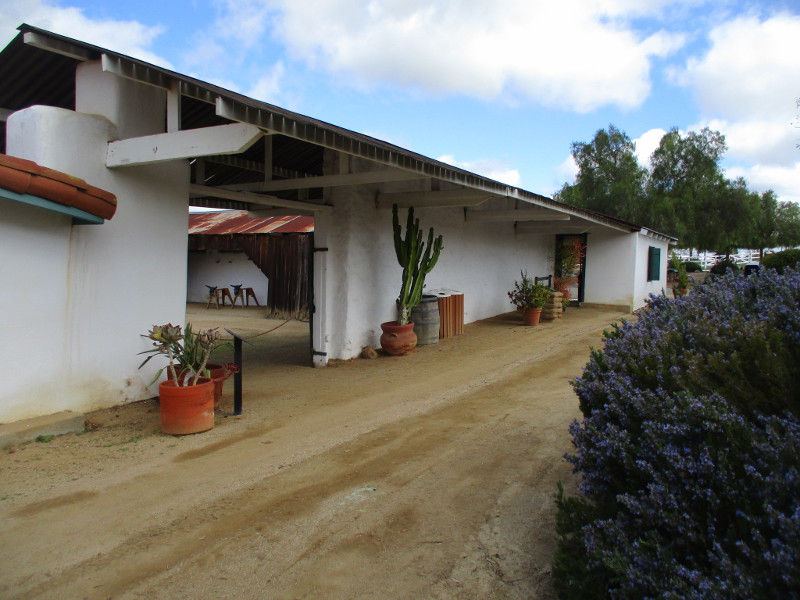
I approached the Guajome Ranch House from the Santa Fe Trail to its south, then circled counterclockwise around the complex, viewing the beautiful arcaded veranda, several cisterns fed by wells, the chapel, and other outbuildings. I spotted various signs and plaques relating the history of the ranch, which was once the home of prominent early San Diego resident Cave Johnson Couts and his wife Maria Ysidora Barbara Bandini.
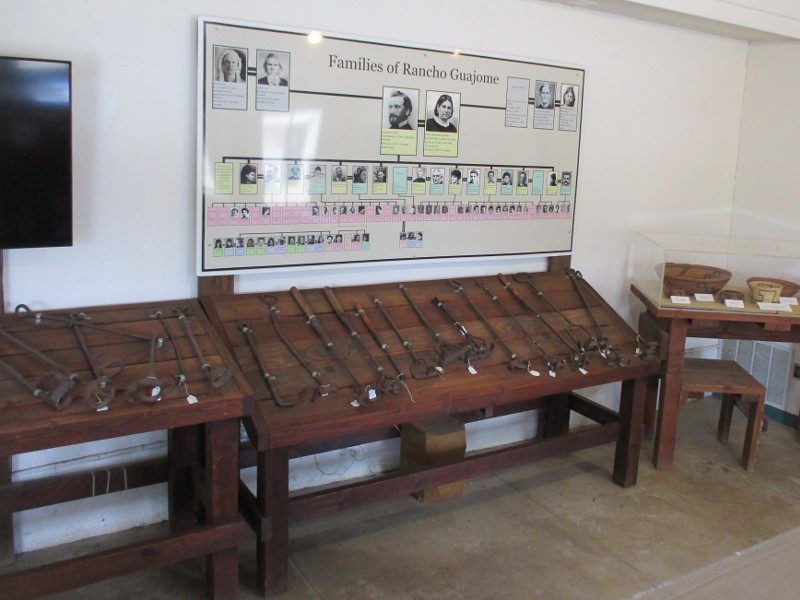
As you can see, I also stepped into a small museum. That’s where you can purchase tickets to guided and self-guided house tours.
According to Wikipedia: “The adobe was built in 1852 and served as the headquarters of Rancho Guajome, a Mexican land grant. Abel Stearns had given the rancho to Ysidora Bandini (sister of his wife Arcadia Bandini), as a wedding gift when she married Lieutenant Cave Johnson Couts in 1851. It was built with the profits from the cattle boom of the 1850s, when many California ranchos supplied the Gold Rush miners and associated new American immigrants with meat and leather. Couts was appointed sub-agent for the native Luiseño people (San Luis Rey Mission Indians) in 1853. He used their labor to improve his properties in the area, including this one and nearby Rancho Buena Vista and Rancho Vallecitos de San Marcos…”
I didn’t venture inside the 22-room hacienda, but I most likely will at some future time. The old ranch house is located in Rancho Guajome Adobe County Park. Check out the parks website here to learn more.
The following photos provide a taste of what you’ll see should you visit this historic place.
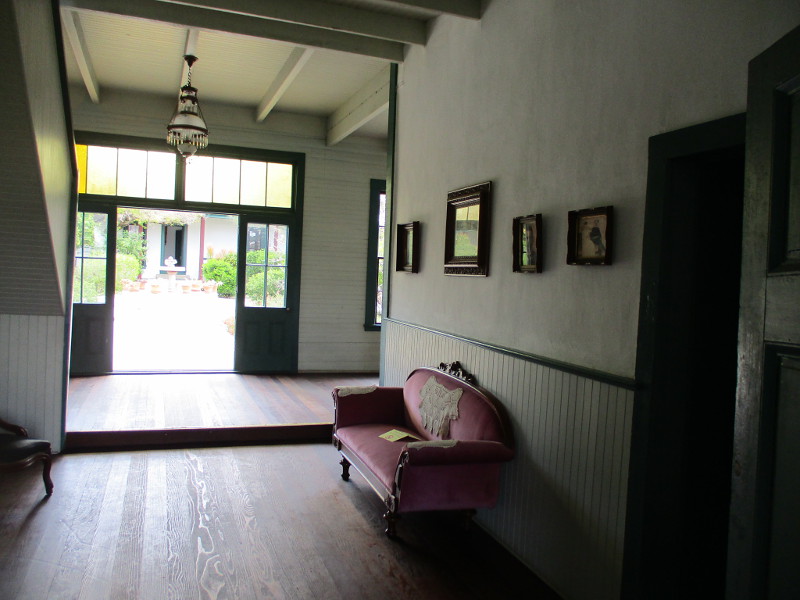
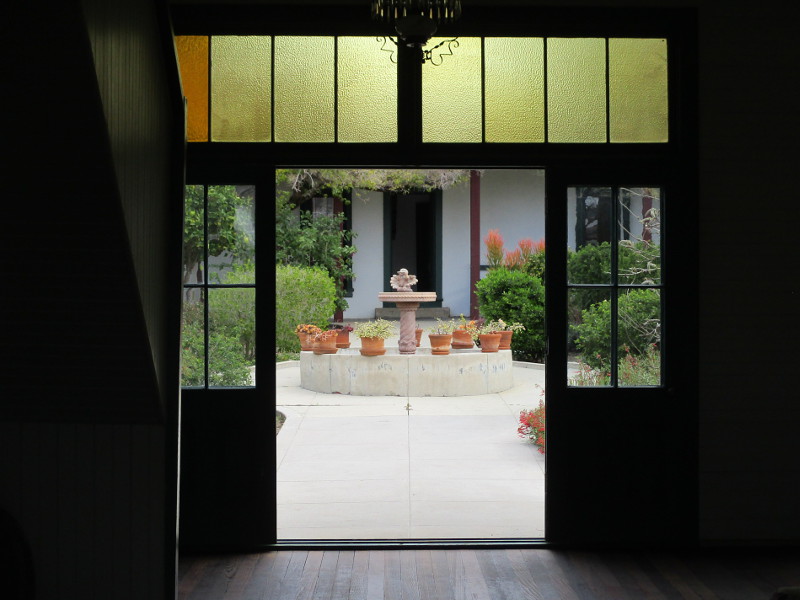
Peering from the veranda through an open door…
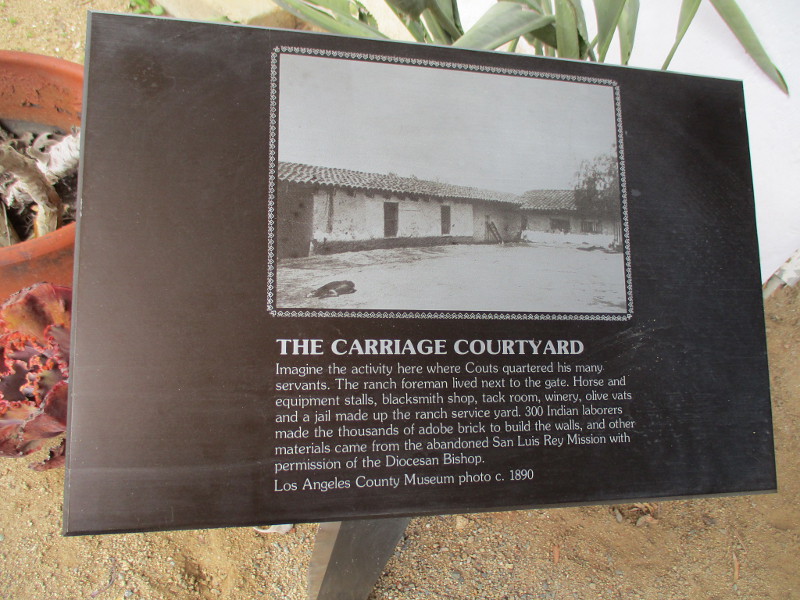
The sign reads:
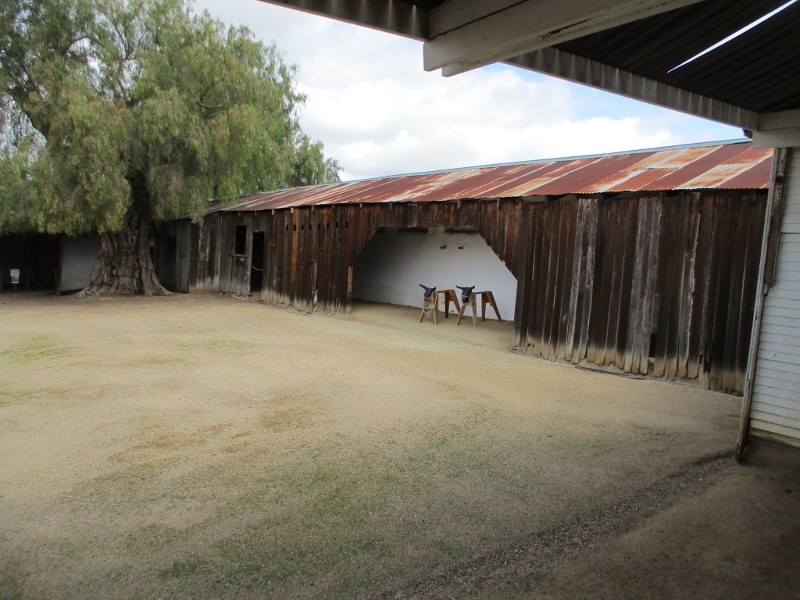
The Carriage Courtyard.
Imagine the activity here where Couts quartered his many servants. The ranch foreman lived next to the gate. Horse and equipment stalls, blacksmith shop, tack room, winery, olive vats and a jail made up the ranch service yard. 300 Indian laborers made the thousands of adobe brick to build the walls, and other materials came from the abandoned San Luis Rey Mission with permission of the Diocesan Bishop.
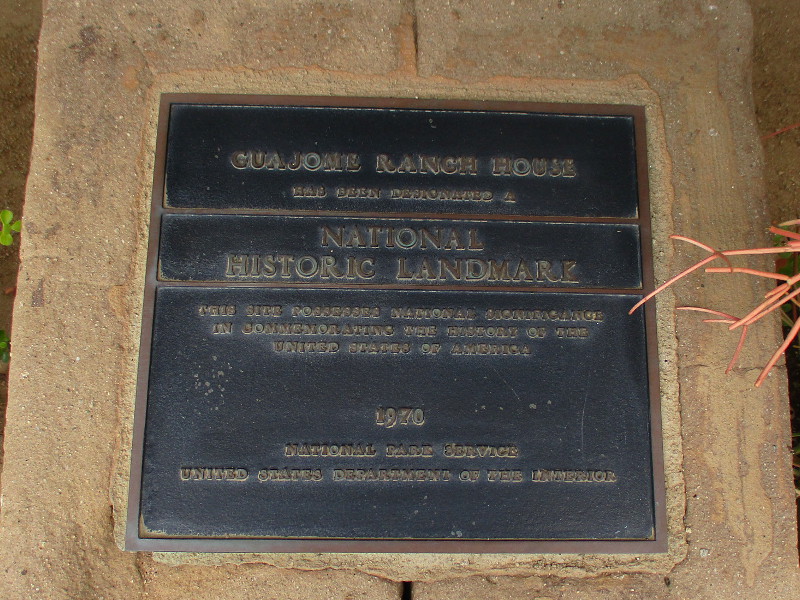
Guajome Ranch House has been designated a National Historic Landmark
This site possesses national significance commemorating the history of the United States of America
1970
National Park Service
United States Department of the Interior
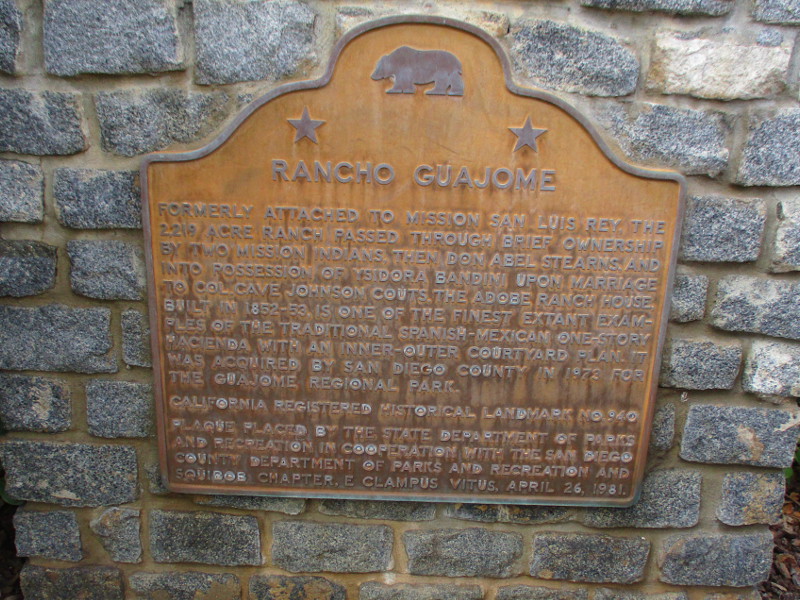
Rancho Guajome
Formerly attached to Mission San Luis Rey, the 2,219 acre ranch passed through brief ownership by two mission Indians, then Don Abel Stearns, and into possession of Ysidora Bandini upon marriage to Col. Cave Johnson Couts. The adobe ranch house built in 1852-53, is one of the finest extant examples of the traditional Spanish-Mexican one-story hacienda with an inner-outer courtyard plan. It was acquired by San Diego County in 1973 for the Guajome Regional Park.
California registered Historical Landmark No. 940
Plaque placed by the State Department of Parks and Recreation in cooperation with the San Diego County Department of Parks and Recreation and Squibob Chapter, E Clampus Vitus, April 26, 1981.
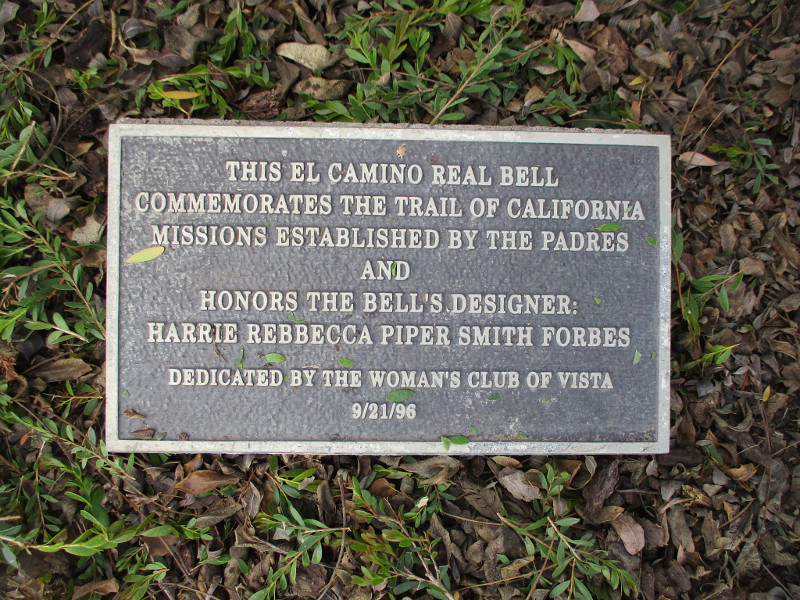
This El Camino Real Bell commemorates the trail of California missions established by the padres and honors the bell’s designer: Harrie Rebbecca Piper Smith Forbes
Dedicated by the Woman’s Club of Vista
9/21/96
At its beginning, Rancho Guajome was a working cattle ranch. Because the West was dry, cattle owners like Cave Couts would turn their cattle out on unfenced pastures. However, during this “open range” period, sometimes cattle from different ranchos intermixed, making it difficult to determine which cattleman owned which cattle. The branding iron was invented as a solution…
Cave Johnson Couts was born in 1821 in Springfield, Tennessee, and died in 1874 in San Diego at the Horton House. His wife Maria Ysidora Barbara Bandini was born in 1828 in San Diego, was married in 1851 at the Casa de Bandini in Old Town (now the Cosmopolitan Hotel), and died in 1897 in Los Angeles.
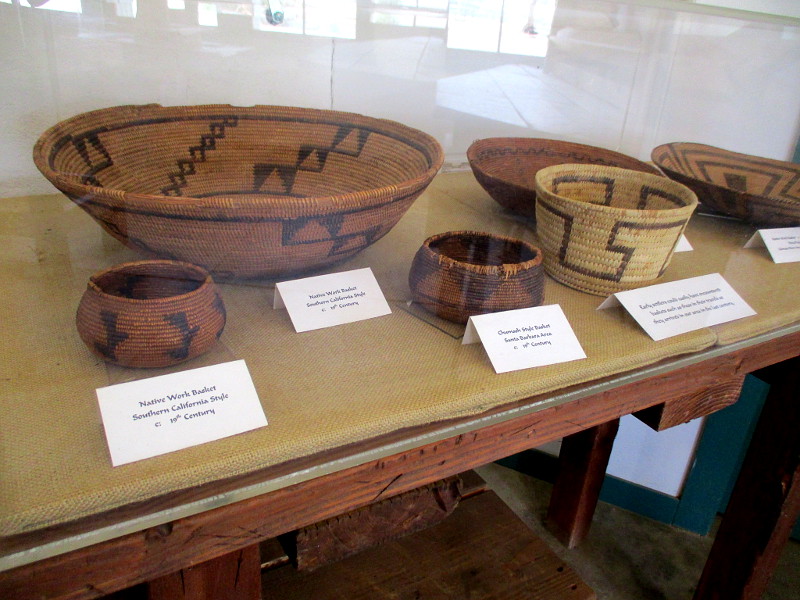
Included in the museum display are Native work baskets, Southern California style, circa 19th century.
Rancho Guajome Adobe farm equipment included a farm wagon, breaking carts for training horses, a broadcast seeder, a sulky used for racing horses, and a four-bottom Stockton plow used to turn soil to prepare fields for planting.
In the past I blogged about the Colorado House, a two-story hotel that was built in Old Town San Diego in 1851 by the very same Cave Couts. Today it serves as the Wells Fargo History Museum. Read that here.
I’ve also blogged about the El Campo Santo cemetery grave of Juan Mendoza, who was shot in the back by Cave Couts. See that here. (During one walk I spotted another mysterious wooden tombstone with the name Juan Mendoza by a parking lot, across the San Diego River from Old Town. Read that here!)
…
I live in downtown San Diego and love to walk around with my camera! You can follow Cool San Diego Sights via Facebook or Twitter!
You can easily explore Cool San Diego Sights by using the search box on my blog’s sidebar. Or click a tag! There are thousands upon thousands of photos for you to enjoy!
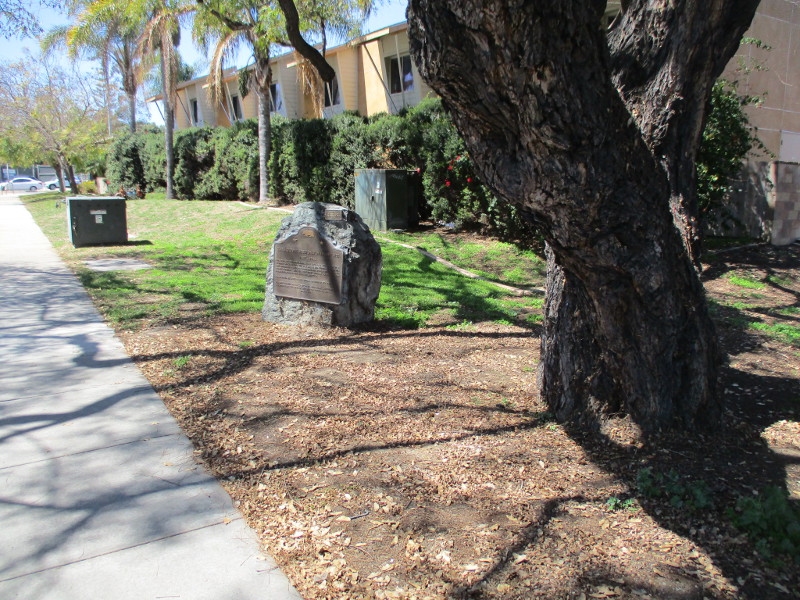
If you’ve driven down Garnet Avenue in Pacific Beach, you might have noticed a couple of enormous old trees at the corner of Pico Street, just east of Soledad Mountain Road.
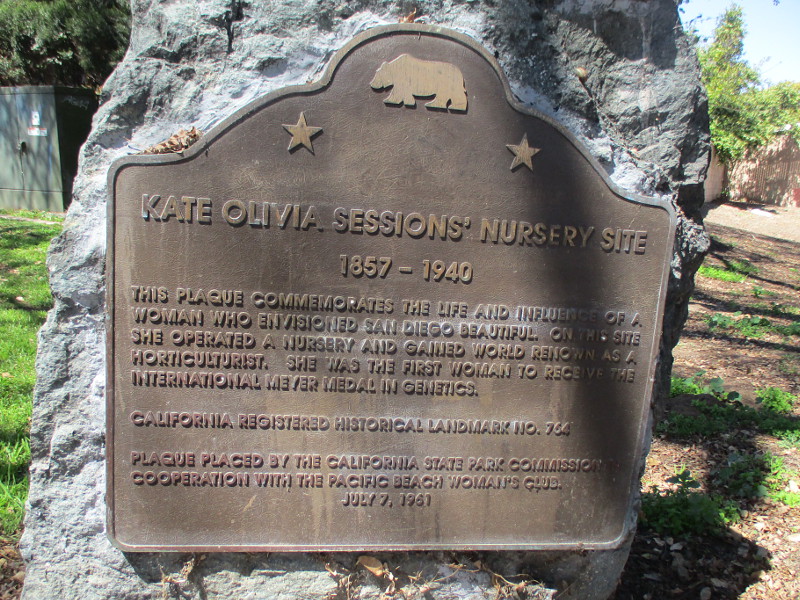
By the sidewalk stands an easily overlooked historical marker. It reads:
KATE OLIVIA SESSIONS’ NURSERY SITE
1857-1940
THIS PLAQUE COMMEMORATES THE LIFE AND INFLUENCE OF A WOMAN WHO ENVISIONED SAN DIEGO BEAUTIFUL. ON THIS SITE SHE OPERATED A NURSERY AND GAINED WORLD RENOWN AS A HORTICULTURIST. SHE WAS THE FIRST WOMAN TO RECEIVE THE INTERNATIONAL MEYER MEDAL IN GENETICS.
CALIFORNIA REGISTERED HISTORICAL LANDMARK NO. 764
PLAQUE PLACED BY THE CALIFORNIA STATE PARK COMMISSION IN COOPERATION WITH THE PACIFIC BEACH WOMAN’S CLUB.
JULY 7, 1961
Kate Sessions is probably best known as the Mother of Balboa Park. In addition to owning other nurseries and growing fields in San Diego, she maintained a small nursery in a corner of Balboa Park (originally called City Park) under an 1892 agreement with the City of San Diego. She was required under the lease to plant 100 trees in the park each year. Most of the older trees in Balboa Park that you see today were planted by her hand.
The colorful jacaranda trees seen around San Diego were also introduced to the city by Kate Sessions.
I recently blogged about the very first camphor tree planted in North America. She’s the one who planted it. The historic camphor tree stands just west of Balboa Park in Bankers Hill near a beautiful historic house. To revisit that old blog post, click here.
Here are a couple more photos that I took this weekend by the historical marker…
…
I live in downtown San Diego and love to walk around with my camera! You can follow Cool San Diego Sights via Facebook or Twitter!
You can easily explore Cool San Diego Sights by using the search box on my blog’s sidebar. Or click a tag! There are thousands upon thousands of photos for you to enjoy!
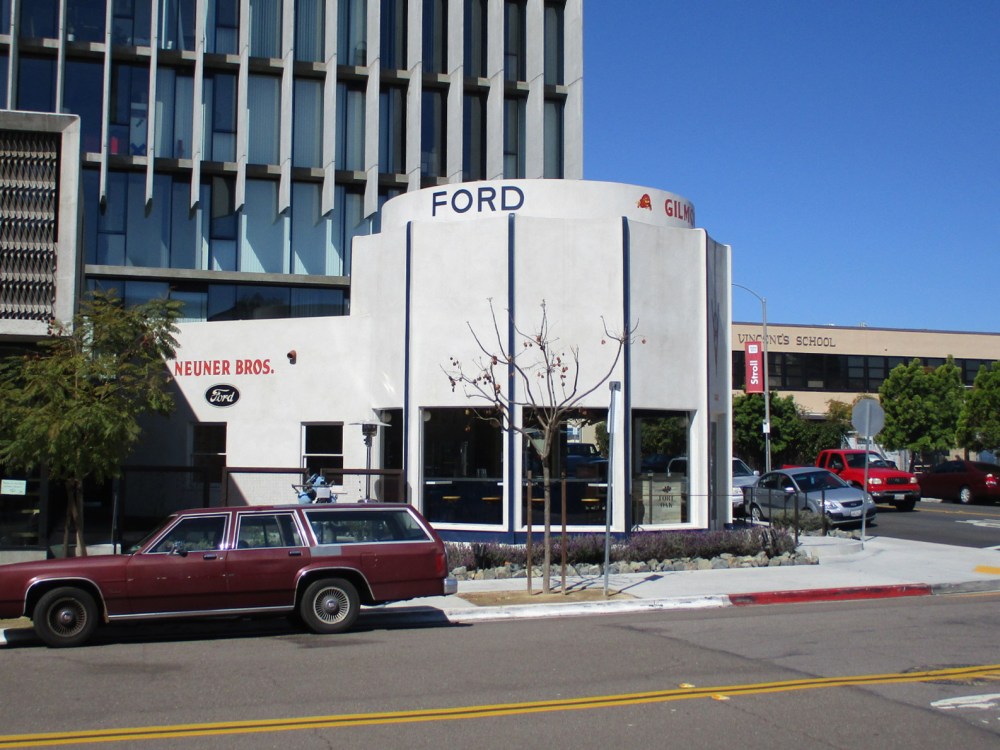
I was walking through Mission Hills yesterday when I suddenly thought I’d taken a wrong turn and ended up in Balboa Park!
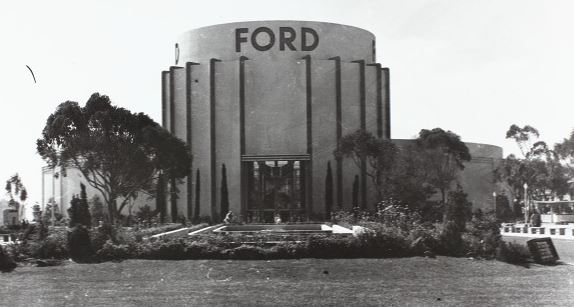
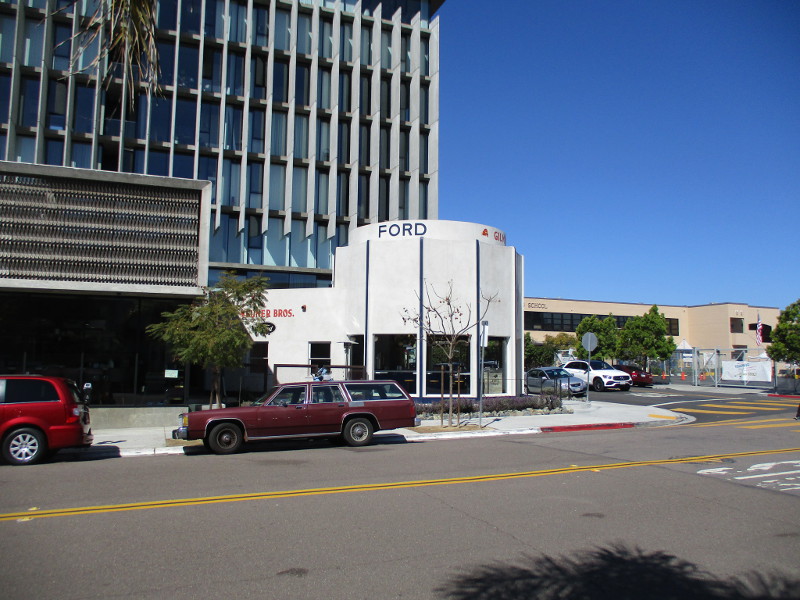
There, rising in front of me, was a miniature version of the old Ford Building, home of the San Diego Air and Space Museum!
The unique, cylindrical, Streamline Moderne-style Ford Building in Balboa Park, which resembles a V8 engine, was erected by the Ford Motor Company for the 1935 California Pacific International Exposition.
This smaller version in Mission Hills can be found at the corner of Ft. Stockton Drive and Hawk Street. It’s the home of the Fort Oak restaurant.
Ford Building from 1935 California Pacific International Exposition in Balboa Park. No known copyright image from Flickr.
My walk yesterday went from Hillcrest through Mission Hills. I also visited Pacific Beach. Many photos and fascinating blog posts are coming! I also will be blogging about an amazing historic site in Vista, which I visited last weekend.
Now I’m about to head out walking again! Happy Sunday!
…
This blog now features thousands of photos around San Diego! Are you curious? There’s lots of cool stuff to check out!
Here’s the Cool San Diego Sights main page, where you can read the most current blog posts. If you’re using a phone or small mobile device, click those three parallel lines up at the top–that opens up my website’s sidebar, where you’ll see the most popular posts, a search box, and more!
To enjoy future posts, you can also “like” Cool San Diego Sights on Facebook or follow me on Twitter.
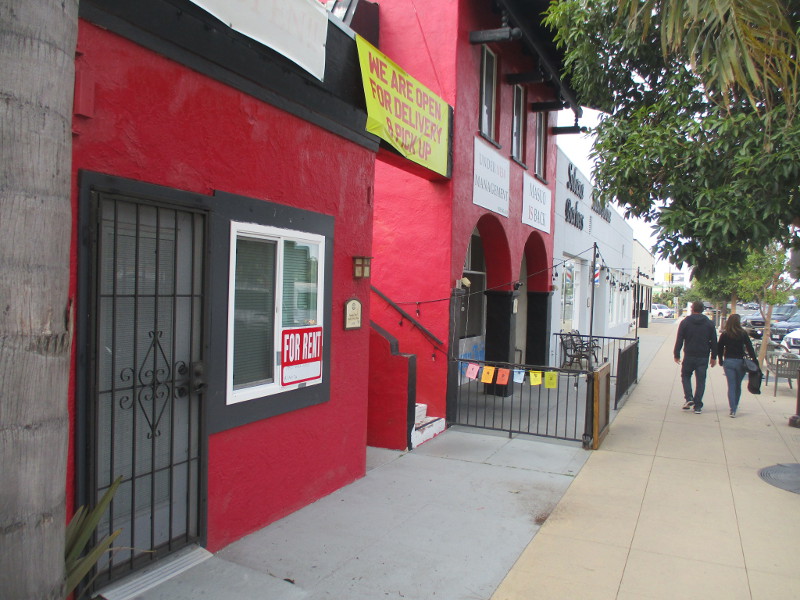
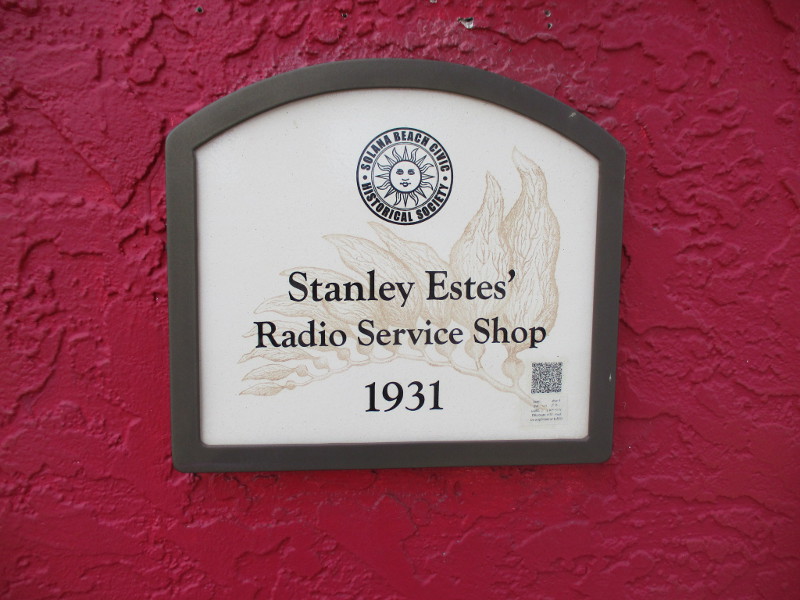
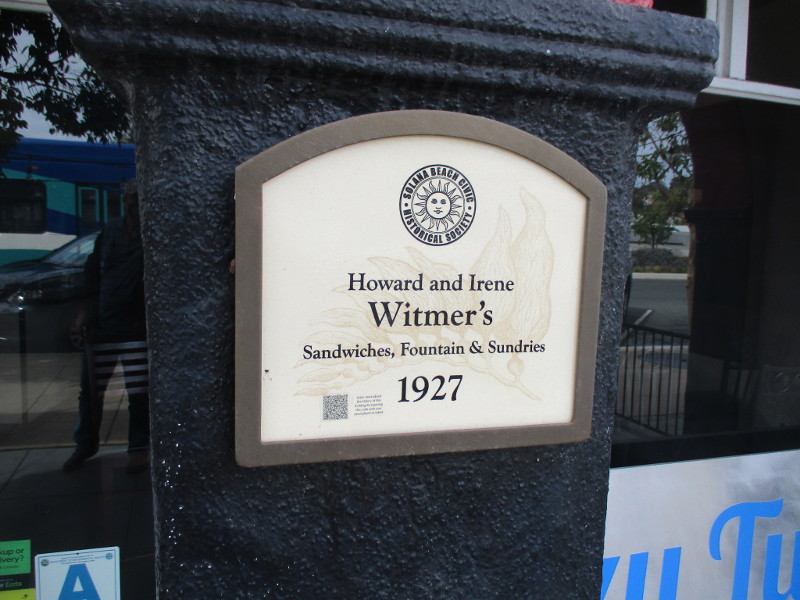
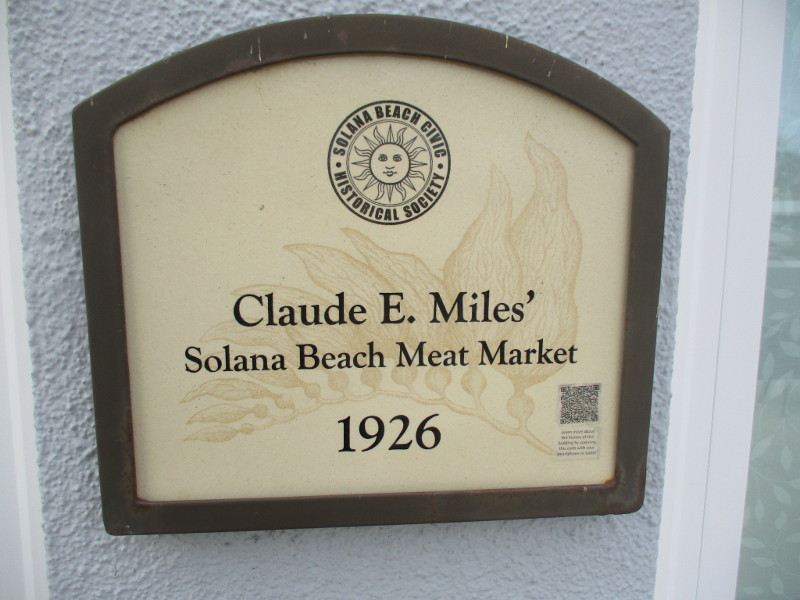
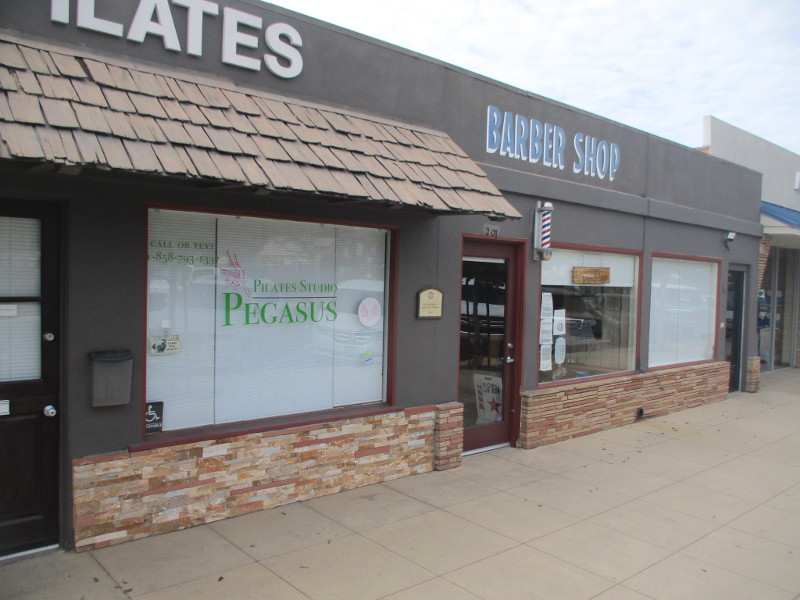
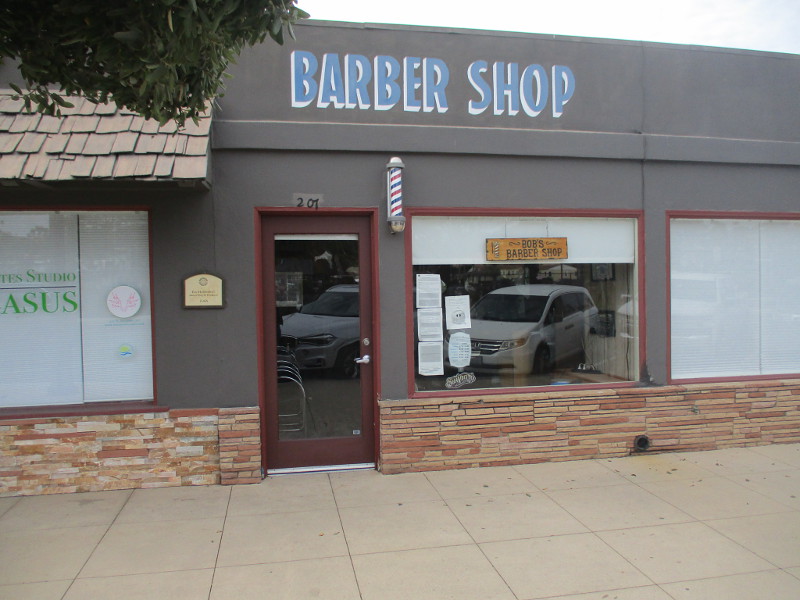
Walk along Highway 101 in Solana Beach and you might notice a series of plaques describing historical buildings.
During my most recent adventure in Solana Beach, I took photos of several buildings and plaques immediately south and north of Plaza Street/Lomas Santa Fe Drive. This stretch of highway was the coastal town’s main street a century ago.
To learn more about these and other historical buildings, and to view a variety of interesting old photographs, visit this page of the Solana Beach Civic And Historical Society. They’re the ones who created the plaques.
This first batch of photos is from the 100 south block of Highway 101. All of these small, modest buildings are now home to local businesses, including an eatery and salon.
Stanley Estes’ Radio Service Shop, 1931.Howard and Irene Witmer’s Sandwiches, Fountain and Sundries, 1927.Ira E. Conner’s Meats, Groceries, Hardware and Dry Goods, 1925.Claude E. Miles’ Solana Beach Meat Market, 1926.William and Angie Kurtz’s Solana Beach Drug Store, 1928.
The next three photographs were taken on the 200 north block of Highway 101…
Ray Hobberlin’s Barber Shop and Residence, 1948.
…
I live in downtown San Diego and love to walk around with my camera! You can follow Cool San Diego Sights via Facebook or Twitter!
You can easily explore Cool San Diego Sights by using the search box on my blog’s sidebar. Or click a tag! There are thousands upon thousands of photos for you to enjoy!
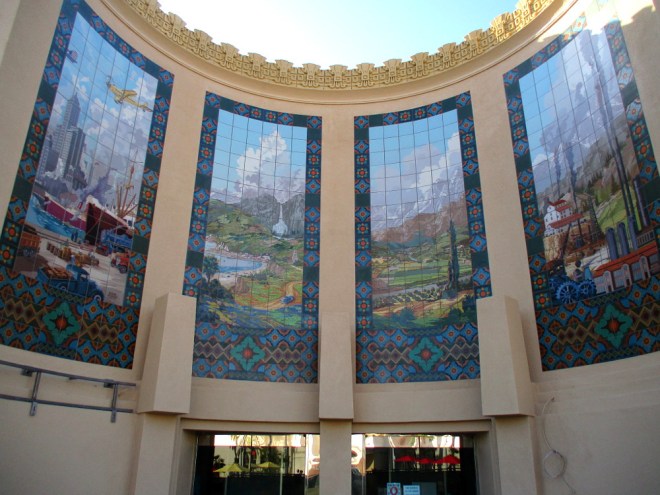
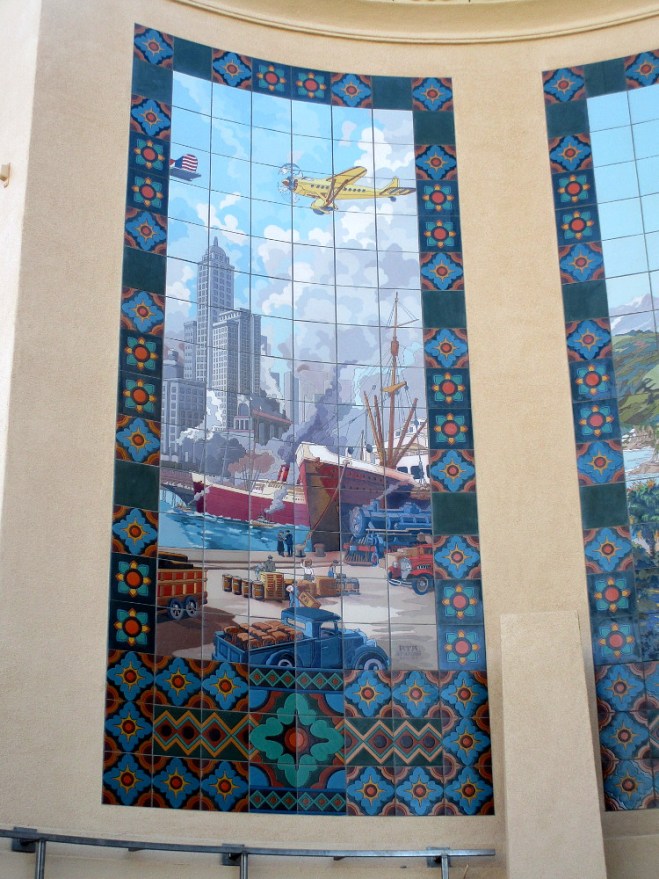
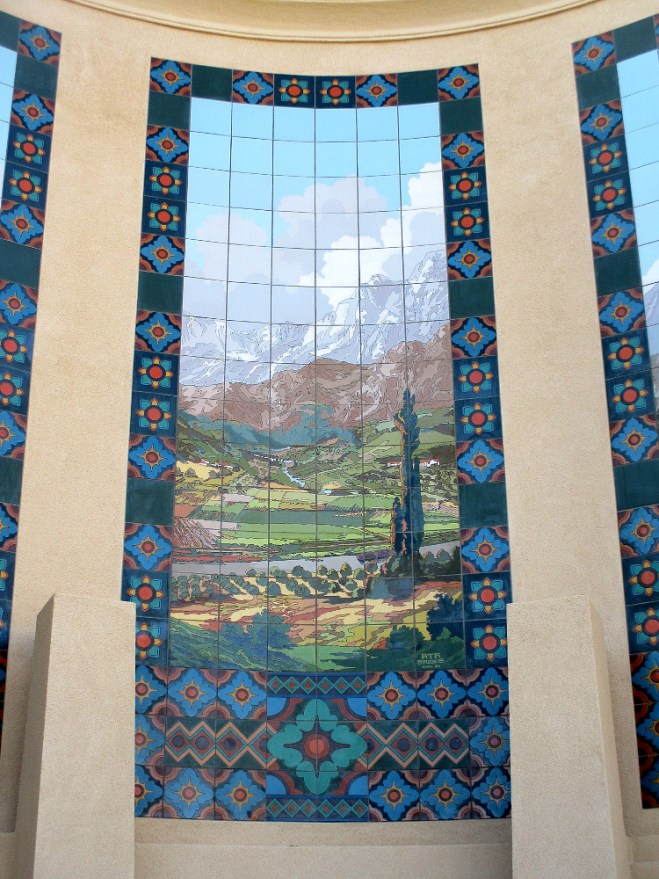
Today was an historic day! Four long-anticipated murals have debuted above the entrance of the San Diego Automotive Museum!
Yesterday’s scaffolding has been removed, revealing beautiful tile artwork that will be enjoyed by visitors to Balboa Park for many decades–perhaps even centuries–into the future!
I first blogged about the project back in late 2017. You can read what I wrote here.
As I explained, these permanent tile murals “…are based on murals that decorated the (California State Building) during the 1935 California Pacific International Exposition….Much of the California State Building’s original ornamentation no longer exists, including the four original murals. They were created for the exposition by Hollywood set designer Juan Larrinaga. Painted on fiberboard to appear like tilework, they depicted California’s commerce, scenic beauty, agriculture and industry.”
The exquisite tiles were created by RTK Studios in Ojai, California.
Those who enjoy at visit to the San Diego Automotive Museum, or the newly opened Pan American Plaza in front of the museum, will now be able feast their eyes on these four truly remarkable works of public art!
…
I live in downtown San Diego and love to walk around with my camera! You can follow Cool San Diego Sights via Facebook or Twitter!
You can easily explore Cool San Diego Sights by using the search box on my blog’s sidebar. Or click a tag! There are thousands upon thousands of photos for you to enjoy!
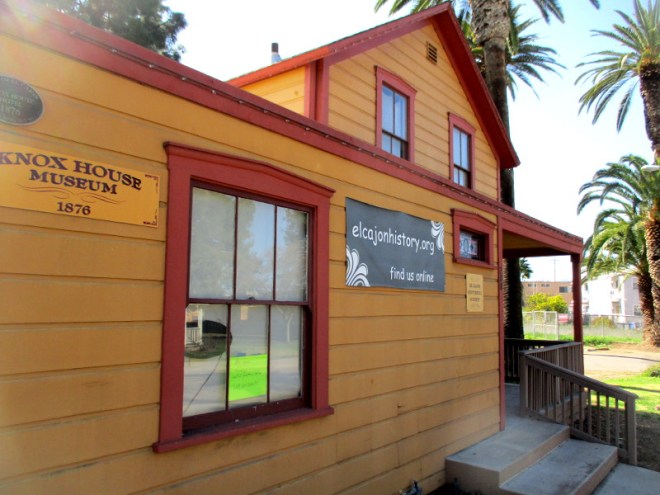
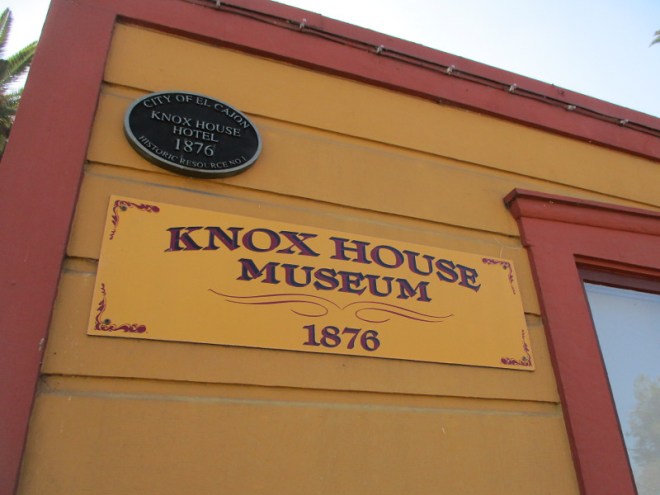
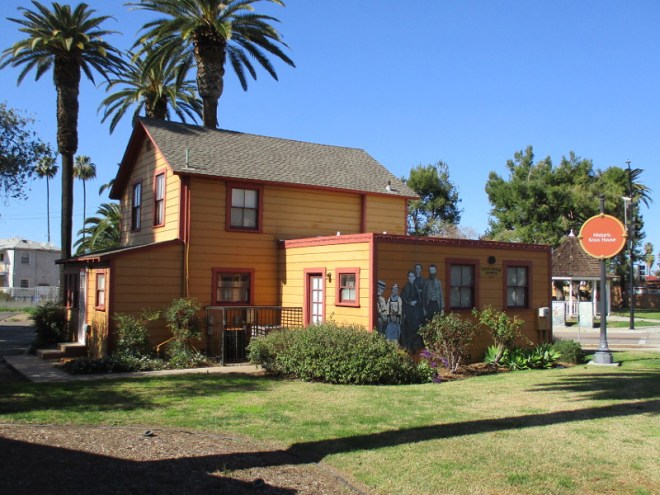
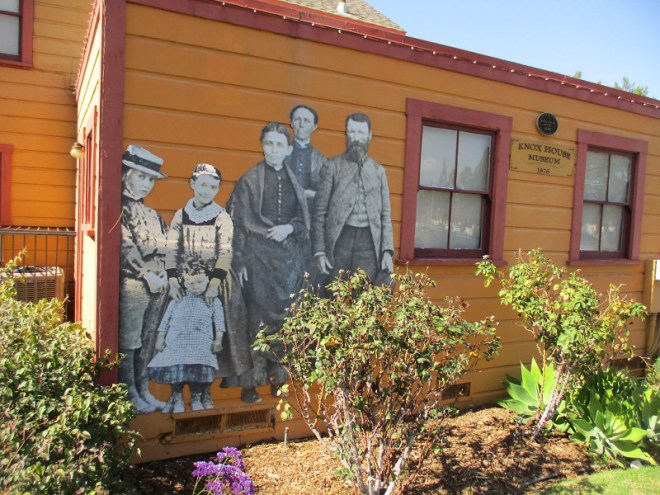
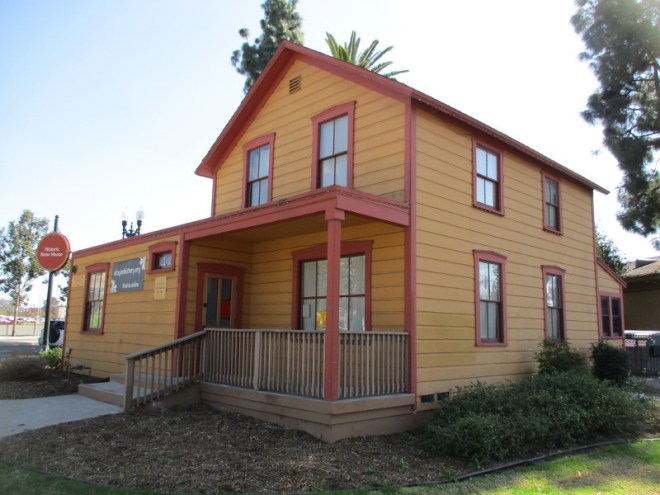
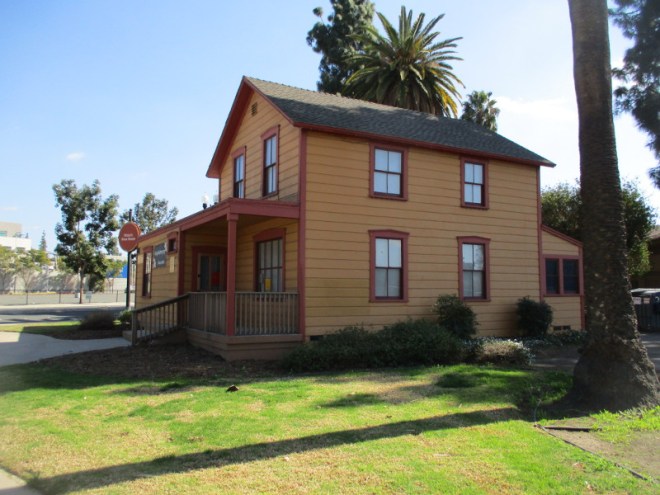
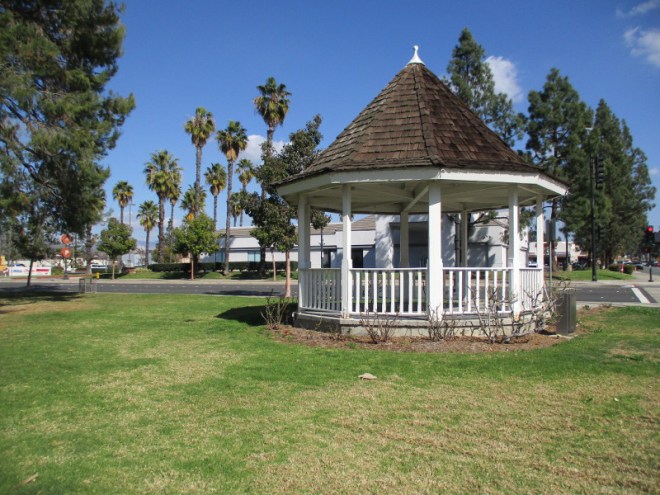
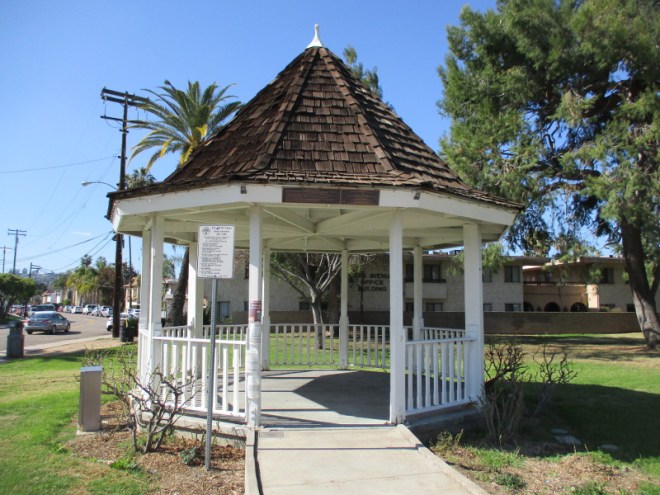
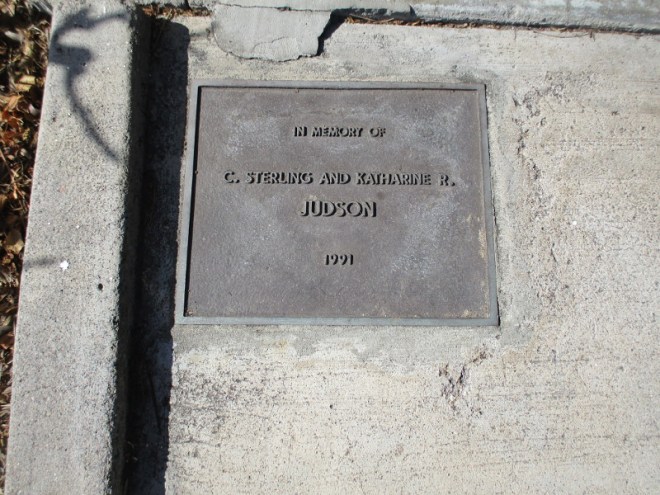
A few weeks ago, during my adventure in El Cajon, I walked around the Knox House Museum, which was closed at the time. I took a number of photographs of the historic structure, and the gazebo in small, grassy Judson Park to the north.
The Knox House Museum is operated by the El Cajon Historical Society. The building is a restoration of Amaziah Lord Knox’s original two-story, seven room El Cajon Hotel, which was built in 1876 near the present day corner of Main Street and Magnolia Avenue. The building also served as the Knox residence. In later years the hotel was altered in various ways and greatly enlarged. In 1972 the City of El Cajon purchased the original building and moved it to its present location, at the corner of Magnolia and Park Avenue.
To learn much, much more about the old hotel, the present day museum, and the history of El Cajon, which began in earnest with the discovery of gold in Julian in 1870, visit the El Cajon Historical Society’s website here! Among other things, you’ll learn why the Knox House Museum is painted in such unusual colors!
I spotted this old gazebo in Judson Park, across Park Avenue…
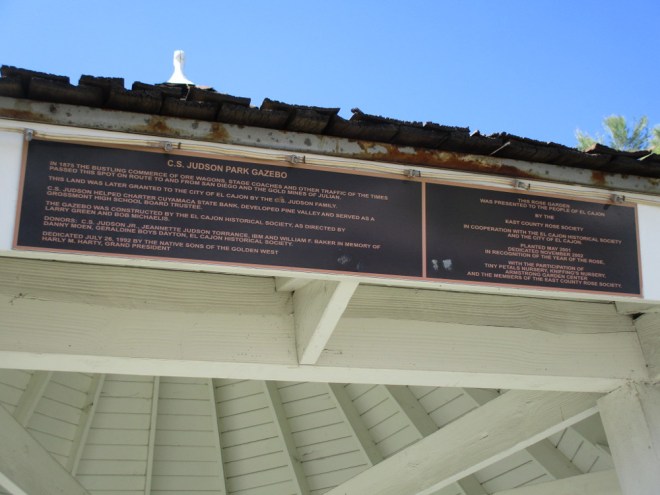
The plaque on the gazebo includes: In 1875 the bustling commerce of ore wagons, stage coaches and other traffic of the times passed this spot on route to and from San Diego and the gold mines of Julian. This land was later granted to the City of El Cajon by the C.S. Judson family…The gazebo was constructed by the El Cajon Historical Society…Dedicated July 26, 1992…This rose garden was presented to the people of El Cajon by the East County Rose Society…Dedicated November 2002…
…
This blog now features thousands of photos around San Diego! Are you curious? There’s lots of cool stuff to check out!
Here’s the Cool San Diego Sights main page, where you can read the most current blog posts. If you’re using a phone or small mobile device, click those three parallel lines up at the top–that opens up my website’s sidebar, where you’ll see the most popular posts, a search box, and more!
To enjoy future posts, you can also “like” Cool San Diego Sights on Facebook or follow me on Twitter.
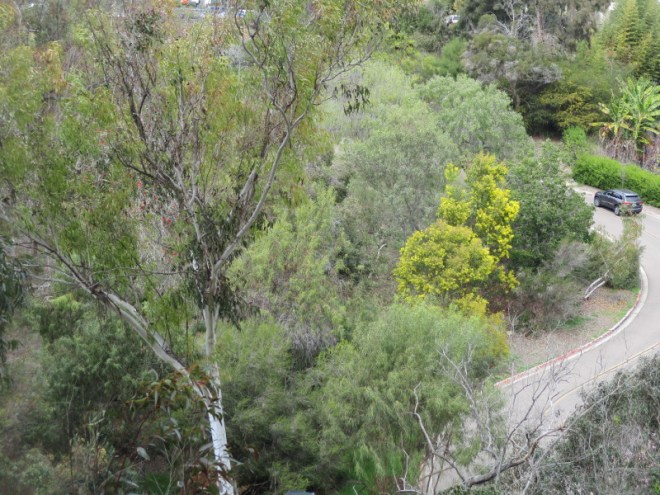
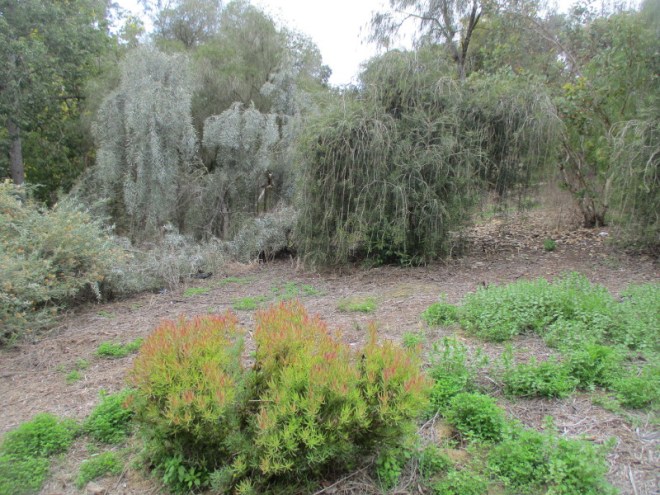
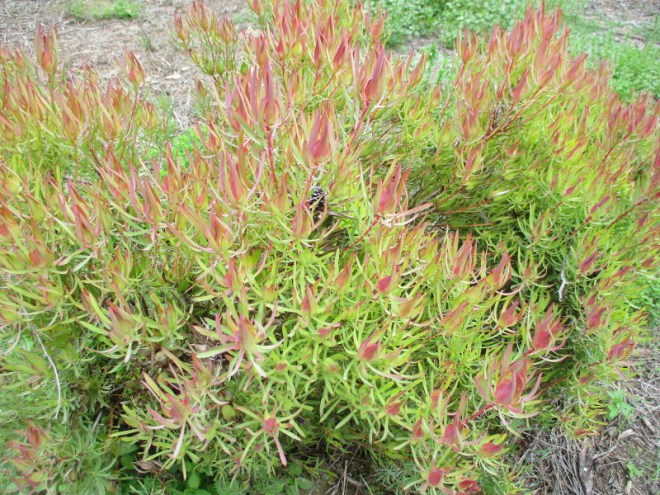
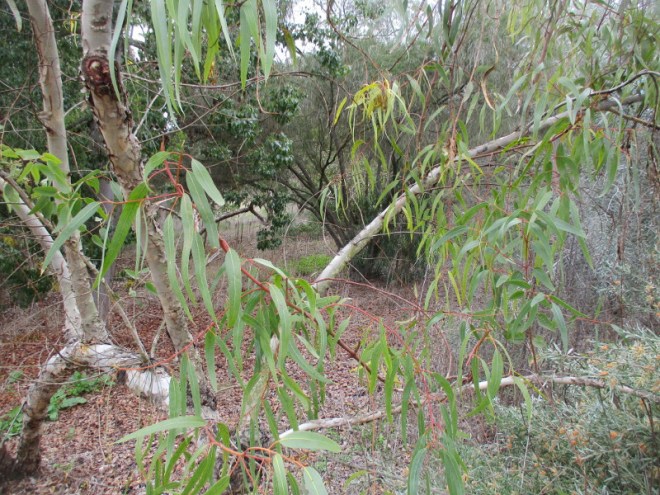
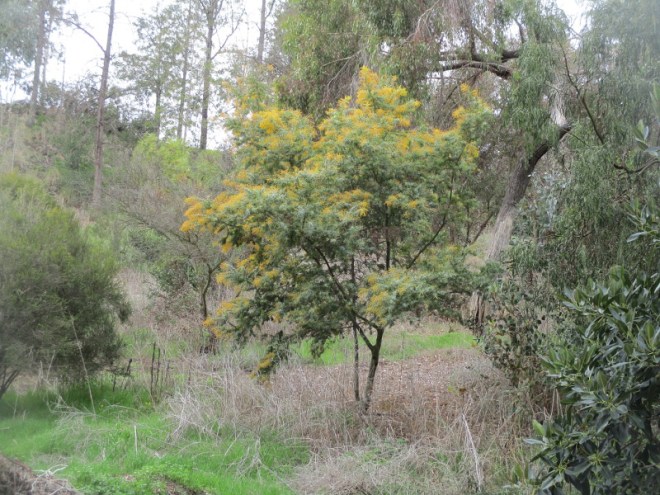
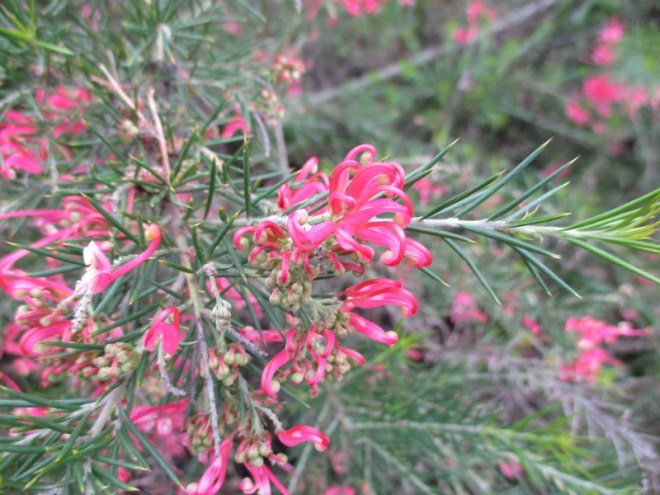
The nation of Australia presented the City of San Diego with many beautiful plants in 1976 for the United States Bicentennial. These plants can be found in Balboa Park’s seldom visited, little known Australian Garden.
Should you drive into the heart of Balboa Park by turning from Park Boulevard onto Presidents Way, you’ll glimpse the top of the Australian Garden to your right. To see most of the native Australian trees and shrubs, however, you must drive or carefully walk down winding, slightly steep Paseo de Oro, which motorists pass just before they reach the large parking lot behind the Spreckels Organ Pavilion. Look for the Gold Gulch Remote Parking Lot sign. There’s no sidewalk!
You can also reach the Australian Garden by walking south down Gold Gulch Trail, which begins near El Prado at the Zoro Garden. The trail passes under the Space Theater Way bridge near the Fleet Science Center and continues along the east side of the Japanese Friendship Garden. Once you see a fenced area where the green Balboa Park shuttles are stored, you’re there!
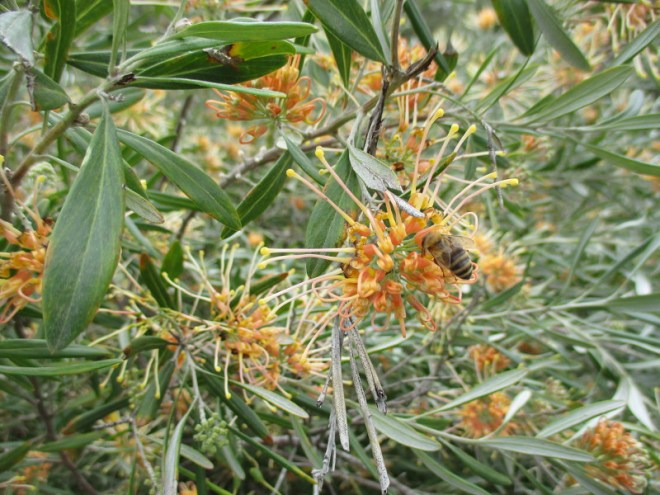
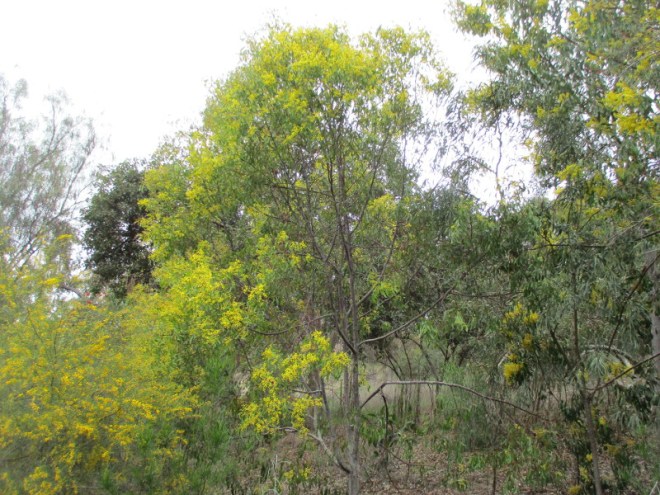
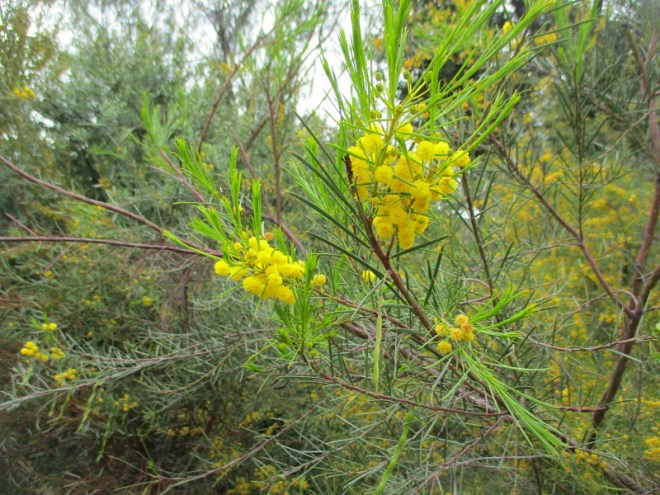
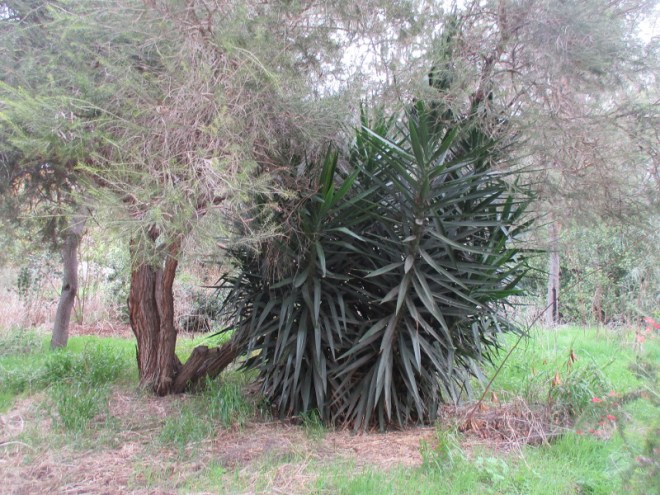
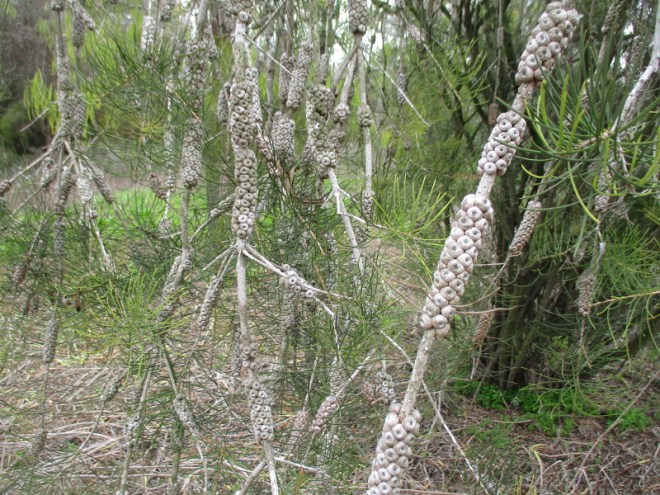
Plants in the Australian Garden, according to this page, include: “Grevellia, Acacia, Callistemon, Banksia, Hakea, Stenocarpus, Leptospermum, Melaleuca, and Eucalyptus.” There are no signs in Gold Gulch Canyon at the garden, but apparently there are plans to create trails in this area of Balboa Park and erect an informational kiosk.
In 1935, this small canyon was the home of Gold Gulch, a popular attraction at Balboa Park’s California Pacific International Exposition. According to Wikipedia, Gold Gulch was an “Old West mining town-ghost town re-creation for fairgoers to experience the atmosphere of a mining boomtown… Gold Gulch inspired and influenced subsequent Western theme parks…Examples include the Calico Ghost Town…and the “Ghost Town” section of Knott’s Berry Farm… and Frontierland by Walt Disney.…”
The above photo of the “hidden” Australian Garden was taken from a point above the canyon, behind the WorldBeat Cultural Center and Centro Cultural de la Raza.
…
This blog now features thousands of photos around San Diego! Are you curious? There’s lots of cool stuff to check out!
Here’s the Cool San Diego Sights main page, where you can read the most current blog posts. If you’re using a phone or small mobile device, click those three parallel lines up at the top–that opens up my website’s sidebar, where you’ll see the most popular posts, a search box, and more!
To enjoy future posts, you can also “like” Cool San Diego Sights on Facebook or follow me on Twitter.
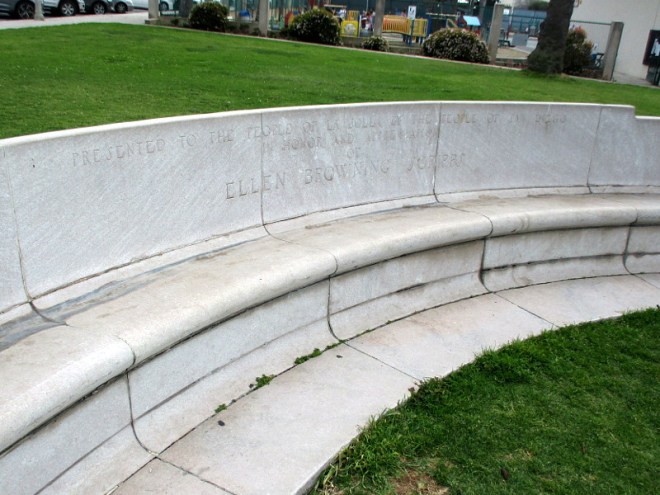
Perhaps you remember a blog post from years ago, when I shared photographs of the Ellen Browning Scripps Memorial in La Jolla, with its beautiful sculpture of a young girl dipping her finger into a pool of water. For photos of the sculpture, and to learn more, click here.
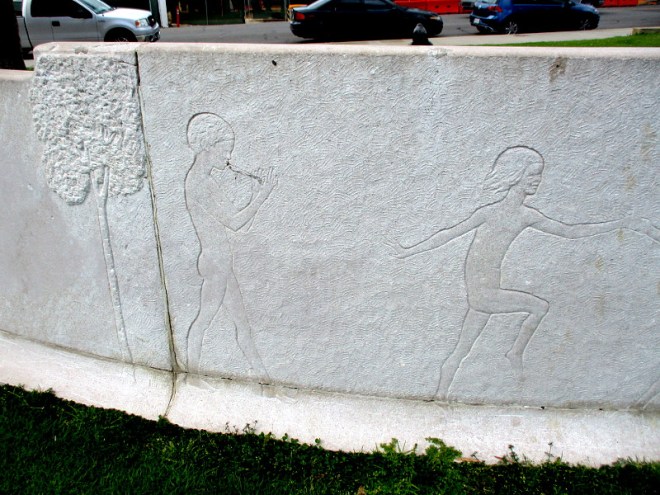
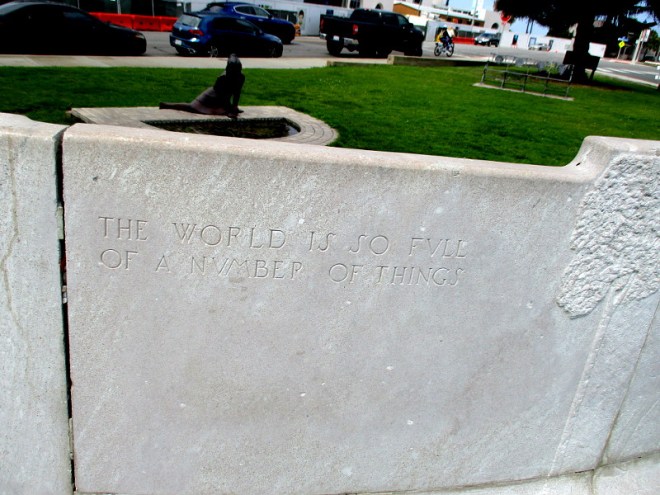
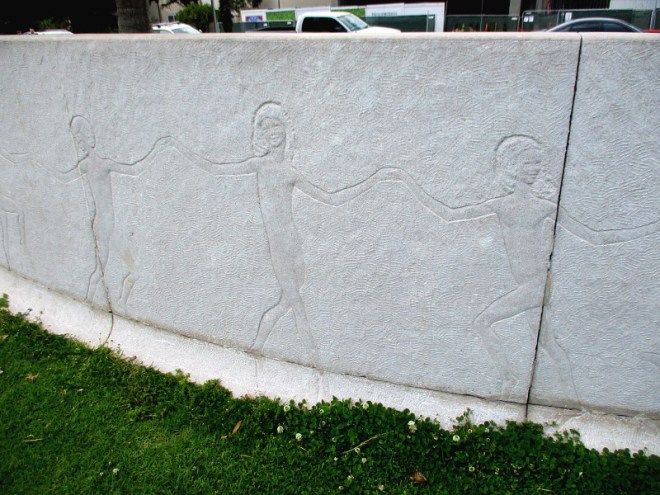
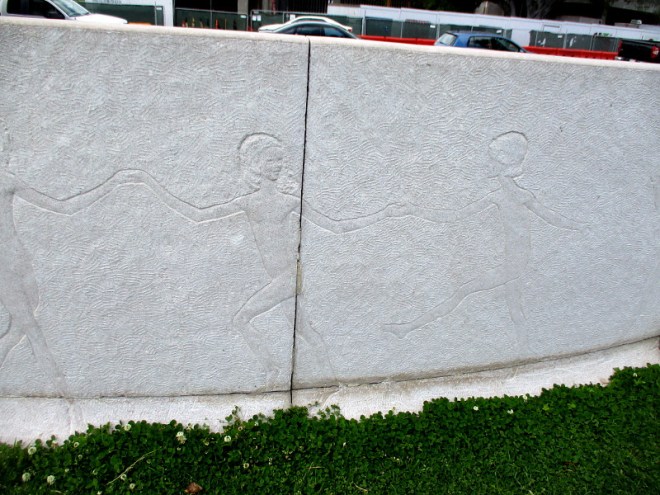
On Saturday I headed to La Jolla again to photograph playful images carved on the back of the nearby marble bench. I added contrast to my photos, so you can see the fine, fluid carvings of children making music and dancing, and the lines from Robert Louis Stevenson’s beloved A Child’s Garden of Verses.
Like the original sculpture, which was commissioned by the City of San Diego (and which went missing in 1996, to be replaced by a different sculpture) this curved marble bench was created by James Tank Porter in 1926. Inscribed in the front of the bench are the words: “Presented to the people of La Jolla by the people of San Diego, in honor and appreciation of Ellen Browning Scripps.”
The happy, carefree carvings make me wish I were a child again.
The world is so full of a number of things……I’m sure we should all be as happy as kings.
…
I live in downtown San Diego and love to walk around with my camera! You can follow Cool San Diego Sights via Facebook or Twitter!
You can easily explore Cool San Diego Sights by using the search box on my blog’s sidebar. Or click a tag! There are thousands upon thousands of photos for you to enjoy!
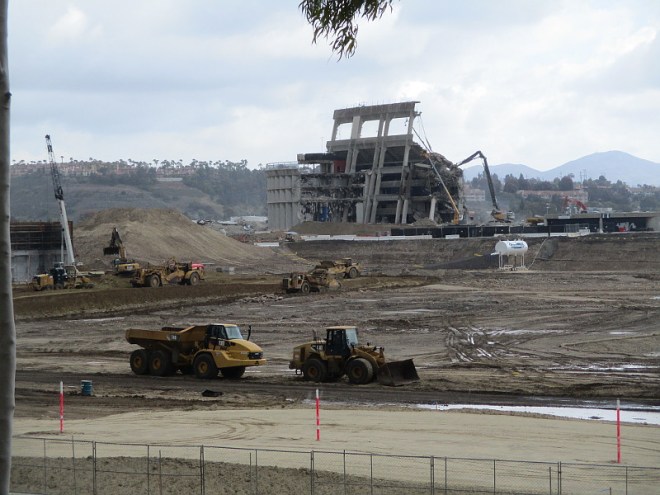
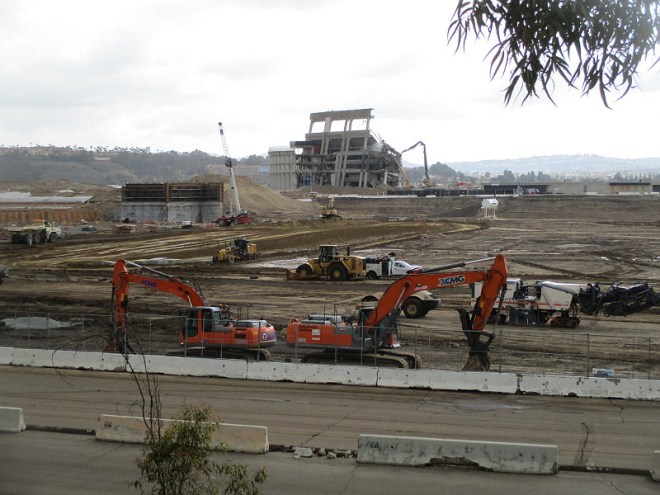
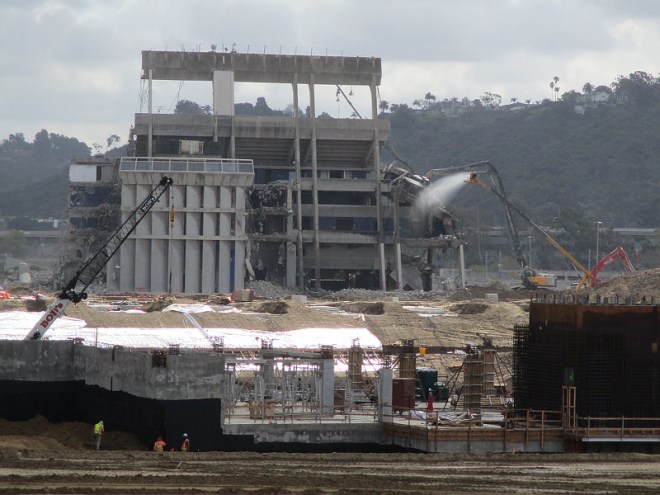
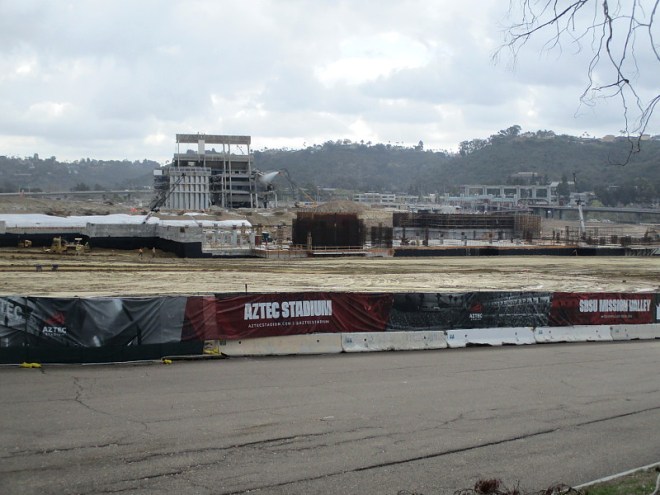
The last standing part of old San Diego Stadium, once home of the football Chargers and baseball Padres, is about to fall. Meanwhile, San Diego State University’s new Mission Valley campus has begun to rise!
I took photos this morning from the west side of the now vanished stadium parking lot that show the final section of stands being demolished. In the foreground, you can see the grading and initial construction work that will ultimately result in SDSU Mission Valley!
I posted photographs of earlier stages of the stadium’s demolition that were taken from its east side here.
To learn more about the future SDSU Mission Valley, its new Aztec Stadium, River Park and more, check out this web page!
…
I live in downtown San Diego and love to walk around with my camera! You can follow Cool San Diego Sights via Facebook or Twitter!
You can easily explore Cool San Diego Sights by using the search box on my blog’s sidebar. Or click a tag! There are thousands upon thousands of photos for you to enjoy!

































 Cool San Diego Sights!