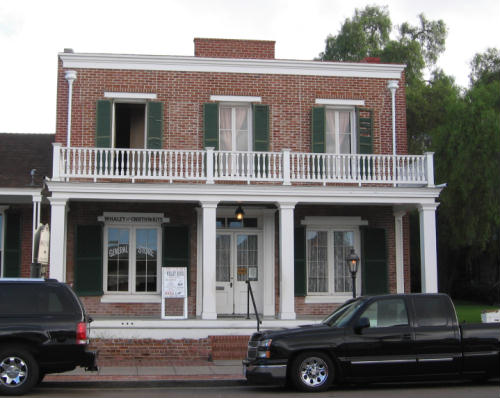
Is this the most haunted house in America?

perhaps the most haunted house in america

Whether or not you believe in the paranormal, the world famous Whaley House is undeniably an interesting place!

This rather plain-looking house, located near the center of Old Town at 2476 San Diego Avenue, fairly oozes with history. And it is said by some to be the most haunted house in America!

Now a museum, the Whaley House was built in 1857 by Thomas Whaley, a New York businessman who originally came to California for the gold rush of 1849. It was the very first two-story brick building in San Diego, built in the Greek Revival architectural style. In addition to being the Whaley family residence, at different times it served as the location of a general store, a county courthouse, a commercial theater, a ballroom, a school and polling place.

Various murders, hangings, suicides and untimely deaths have occurred in and around the Whaley residence. Up to half a dozen different dead Whaleys are said to linger as ghosts. The place has developed such a reputation as a haunted house that the museum offers late night ghost hunting tours. Over 100,000 people visit the museum annually.

Several months ago I happened to find myself near the Whaley House with a little free time. Seeing a docent dressed in a period costume standing on the front porch, I made my way over to speak with her.

She was very friendly. She seemed sincere when she claimed to have had several ghostly experiences in the Whaley House. She claimed that she’s heard footsteps pacing in the upstairs theater when nobody was present. She’s also seen a strange shadow moving back and forth on an upstairs wall, with no perceptible source.

The cashier at the gift shop next door claimed to have seen the mysterious shadow, as well. I asked her if she believed in ghosts, and she carefully remained neutral. I was interested to see that many books and souvenir in the gift shop concern the museum’s spooky reputation, including shirts that read “Got Ghosts?”

Life Magazine and Travel Channel’s America’s Most Haunted have both called the Whaley House the most haunted house in America. The Whaley House has appeared on numerous popular television shows and firmly established itself in the popular culture.

Old Town's historic Whaley House.
Old Town’s historic Whaley House.
Gazing toward Whaley House past gas lamp on San Diego Avenue.
The luxurious Whaley House served as granary, store, courthouse, school and theater.
Whaley House, built 1856-57, is the oldest brick structure in southern California.
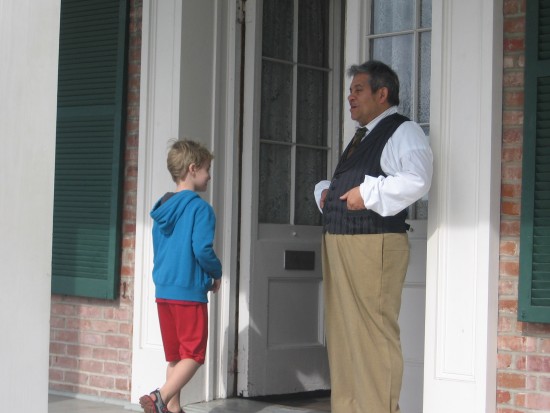
Boy ventures into supposedly haunted Whaley House.

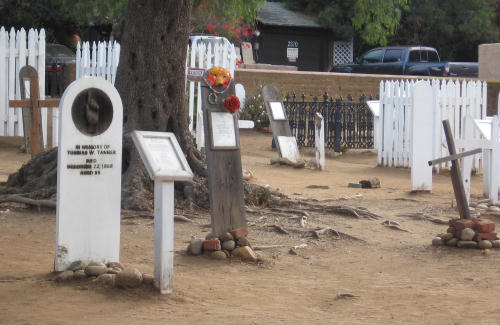
Graveyard contains early San Diego residents.

graveyard contains early san diego residents

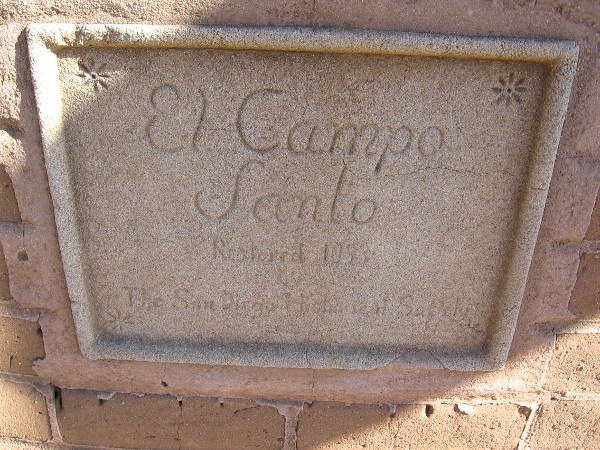
El Campo Santo (which means “The Holy Field” in Spanish) is a small Roman Catholic graveyard in Old Town, nestled between buildings several blocks south of the State Park. It contains a variety of weathered tombstones and crosses marking the final resting places of many early San Diego residents. It is designated California Historical Landmark #68.

Established in 1849, the cemetery reached full capacity in 1880. Today it is a popular attraction for passing tourists.

Walk about carefully and read the old inscriptions, and you’ll discover pioneer families, soldiers, politicians, small children, Mexicans, Native Americans, unknown people, rich and poor, educated and illiterate . . . buried side by side.

Nearly five hundred people were buried at El Campo Santo. One of the graves belongs to notorious Santiago “Yankee Jim” Robinson. He stole San Diego’s only row boat, and was hung at the site of the nearby Whaley House.

Supposedly all sorts of ghosts, vapors, hovering torsos, spectral figures and weird apparitions have been seen at this cemetery. And supposedly they set off car alarms along San Diego Avenue.

One ghost is said to be a prostitute who was denied burial. Another is said to be Antonio Garra, a notable Native American. As chief of the Cupenos tribe, Garra led an uprising in 1851 against the people of San Diego due to unfair taxation. When finally captured, he was made to stand beside an open grave and executed by firing squad.

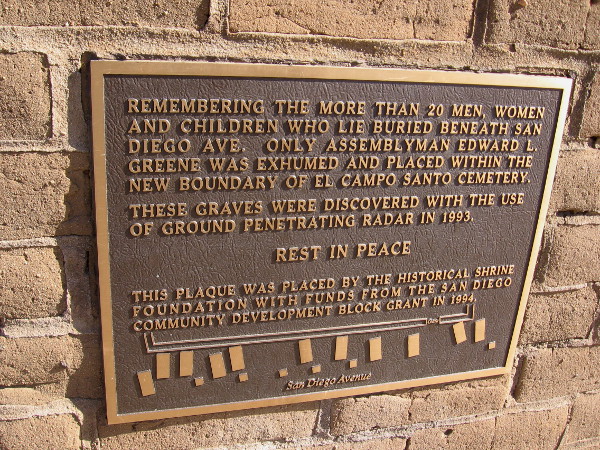
If such ghosts do exist, it seems they have one definite reason to be upset! In 1889 a horse-drawn streetcar line was built right through the hallowed cemetery. In 1942 the tracks were paved over with asphalt, creating the busy roadway. Today, according to a sign by the sidewalk, there are numerous graves directly under the street!

People read plaques and headstones in Old Town cemetery.
Do not disturb the peace and tranquility of those who have reposed from earthly cares.
More than 20 men, women and children lie buried beneath San Diego Avenue.
Grave site marker embedded in San Diego Avenue asphalt.
The Holy Field contains many of San Diego's original residents.
The Holy Field contains many of San Diego’s original residents.
Sign in wall that encloses El Campo Santo.

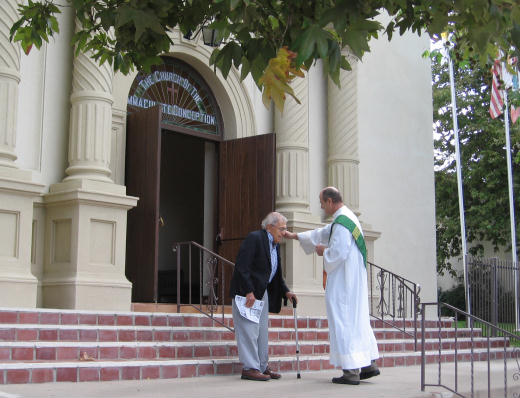
Priest on steps of historic Old Town church.

priest on steps of historic old town church

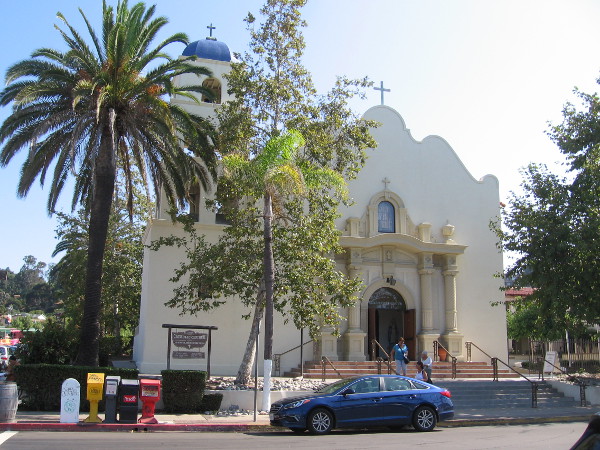
I was fortunate to get this great photograph while walking past the Immaculate Conception Church last Sunday morning. (Yes, I did a lot of walking last weekend!) It’s located directly across the street from the colorful shop in the previous blog post.

This historic church in Old Town was built in 1917, and its bell tower contains one of two original bells from the centuries old San Diego Mission. The other bell can be found at Mission San Diego de Alcala in Mission Valley.

I believe that’s a Catholic priest by the front steps with his hand on an elderly gentleman. It’s a warm gesture and a beautiful photo!

Here are more pics taken on later dates…

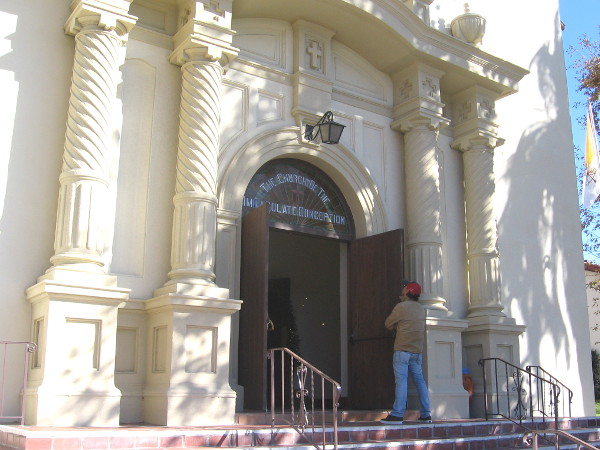
Man looks up at entrance to church.
Man looks up at entrance to Old Town church.
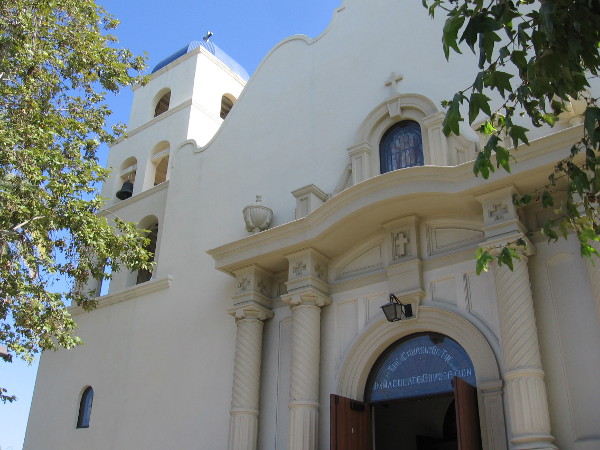
One of the original mission bells.
One of the original San Diego Mission bells can be seen in tower above.

IMG_7548z

IMG_7560z

I live in downtown San Diego and love to walk around with my camera! You can follow Cool San Diego Sights via Facebook or Twitter!

You can easily explore Cool San Diego Sights by using the search box on my blog’s sidebar. Or click a tag! There are thousands upon thousands of photos for you to enjoy!

Ghosts from history and a walk through Old Town.

ghost from history walks through old town

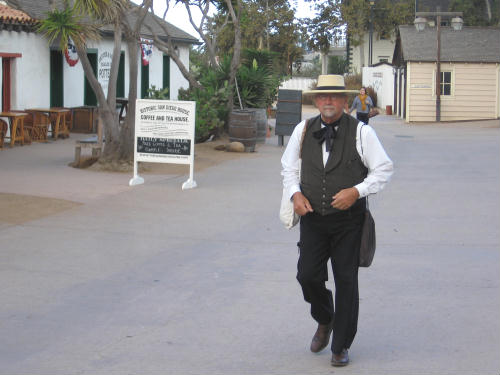
No, that isn’t really a ghost. At least, I don’t think so!

This cool photo shows a fellow dressed like an early resident of San Diego. I spotted him walking through Old Town first thing in the morning, before the daily throng of tourists began to filter in.

You can walk with a costumed tour guide and learn all about the early history of San Diego, back when the tiny, seldom-visited town belonged to Spain, then Mexico, then finally the United States. The hour-long walking tour is free and begins at the Robinson-Rose House at the northwest end of the large central plaza. Several historic buildings and interesting museums are visited during the leisurely tour. Whether or not you see a ghost might depend on your imagination!  The walking tours begin at 11 am and 2 pm.

Tour guide shows native Lemonade Berry near Casa de Estudillo in Old Town.
Friendly volunteer tour guide sums up San Diego's early history at end of a fascinating one hour tour.
Friendly volunteer tour guide sums up San Diego’s early history at end of a fascinating one hour tour.

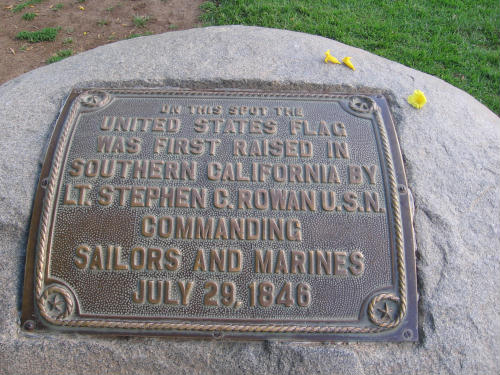
United States flag raised in Southern California.

united states flag raised in southern california

This historical plaque, located in Old Town San Diego State Historic Park’s grassy central Plaza de Las Armas, reads:

On this spot the United States Flag was first raised in Southern California by Lt. Stephen C. Rowan U.S.N. commanding Sailors and Marines July 29, 1846

Looking past the bronze plaque at a few Old Town buildings.

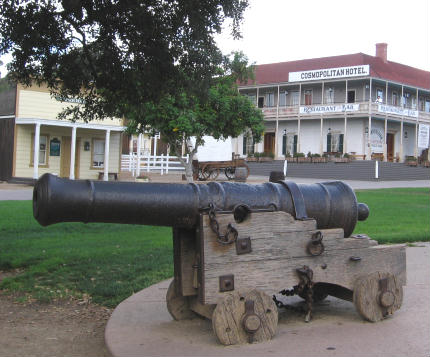
Cannon in San Diego’s Old Town plaza.

cannon in san diego's old town plaza

One of my favorite areas in San Diego is Old Town. There’s so much to see and enjoy wherever you turn. For lovers of history, it’s a treasure trove of discoveries.

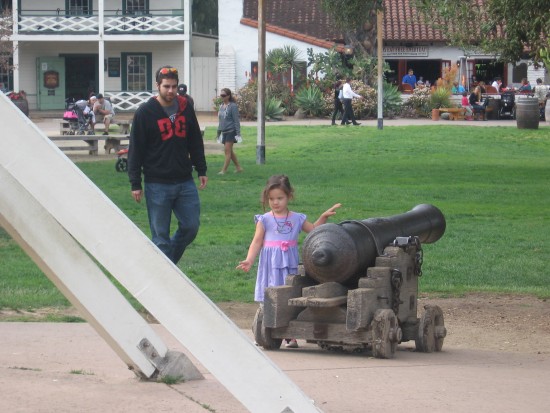
Here’s a photo taken inside the central Plaza de las Armas, the heart of Old Town San Diego State Historic Park. This old Spanish cannon is called El Capitan. It was one of ten cannons that long ago protected Fort Guijarros near the entrance to San Diego Bay. The Spanish fort was built in 1797 on Ballast Point out of adobe.

El Capitan was likely fired during the Battle of San Diego in 1803, when the Spanish attacked the American brig Lelia Byrd which was smuggling otter skins. This cannon was likely fired again at the American smuggler ship Franklin in 1828, when the fort was under Mexican control. The only other surviving cannon from Fort Guijarros is called El Jupiter, and can be seen in the Serra Museum atop nearby Presidio Hill.

Old Town is all about history. The grassy plaza, containing the cannon, historical plaques, a high flagpole and picnic benches, is surrounded by old adobe buildings preserved and recreated from the early 1800’s. San Diego originated right here, at the base of a bluff where a Spanish military outpost stood. The outpost, called the Presidio, was built by Gaspar de Portola in 1769. That same year, Mission San Diego de Alcala was founded on Presidio Hill by the ambitious Spanish Franciscan friar, Father Junipero Serra. This made Old Town the site of the very first European settlement in California.

Around the Plaza de las Armas visitors can check out numerous interesting small museums, including the original one-room schoolhouse, an old blacksmith shop, San Diego’s very first newspaper office, an early courthouse, and a stable with a large collection of antique wagons and stagecoaches. Tourists can find gifts and souvenirs in a smattering of craft-filled shops. Families can dine at several colorful restaurants. Plus, there are many additional historical and commercial attractions along San Diego Avenue to the south of the plaza.

Can you guess another thing I like? Admission to Old Town San Diego State Historic Park and all of its museums is free!

Girl walks past cannon in Old Town San Diego State Historic Park.
Girl walks past a cannon named El Capitan in Old Town San Diego State Historic Park.

Gaslamp Quarter, Historic Heart of San Diego.

gaslamp quarter, historic heart of san diego

The Gaslamp Quarter is not only the Historic Heart of San Diego, as the iconic sign proclaims, but it has become the center of entertainment and dining for downtown’s burgeoning nightlife. The popular Hard Rock Hotel, seen in this photograph, is but one of scores of cool attractions lining bustling Fourth, Fifth and Sixth Avenues between Broadway and Harbor Drive. Pouring even more life into the Gaslamp is nearby Petco Park, the San Diego Convention Center and Horton Plaza.

This area of town, a few decades ago, had become the home to vacant old buildings, half-deserted warehouses and seedy bars attracting lonely sailors homeported in San Diego. Many say the catalyst for its modern transformation was the establishment of Croce’s restaurant and jazz bar on Fifth Avenue in 1985. The popular Croce’s was created as a tribute to legendary singer Jim Croce by his surviving wife Ingrid.  As of 2014, Croce’s has moved to a different location on Bankers Hill.

Just a typical view of the always lively Gaslamp.
Just a typical view of city life in the always lively Gaslamp Quarter.
Fun, elaborate architecture can be seen all over the historic Gaslamp.
Fun, elaborate architecture can be seen all over the historic neighborhood.
People dine at restaurant in old Gaslamp building.
People dine at a restaurant in the heart of the Gaslamp district.
Bar patrons watch a soccer game.
Bar patrons watch a soccer game in style.
People stop to enjoy a treat at Ghirardelli's.
People stop to enjoy a treat at Ghirardelli’s.
Colorful stuff for sale in a Gaslamp store window.
Colorful stuff for sale in a touristy store window.
Plaque tells a bit about the Louis Bank of Commerce.
Plaque tells a bit about the Louis Bank of Commerce Building.
The legendary Louis Bank of Commerce Building attracts much attention!
Wyatt Earp operated a brothel in this fancy building.
San Diego’s first granite building shows Baroque style architecture.
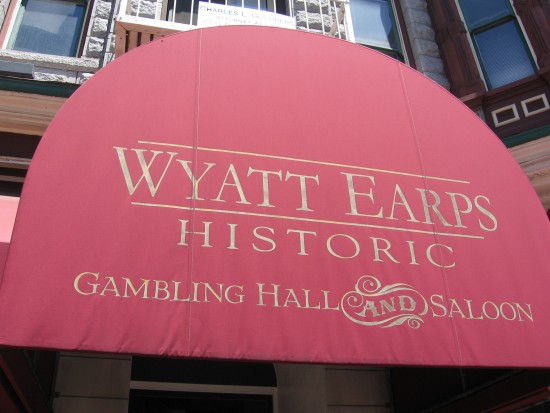
The two photos above show the Louis Bank of Commerce Building. In the late 1800’s it became home to the Oyster Bar,  one of four saloons and gambling halls operated by Wyatt Earp when he lived in San Diego.

Wyatt Earp's Historic Gambling Hall and Saloon.
Canopy reads: Wyatt Earp’s Historic Gambling Hall and Saloon.
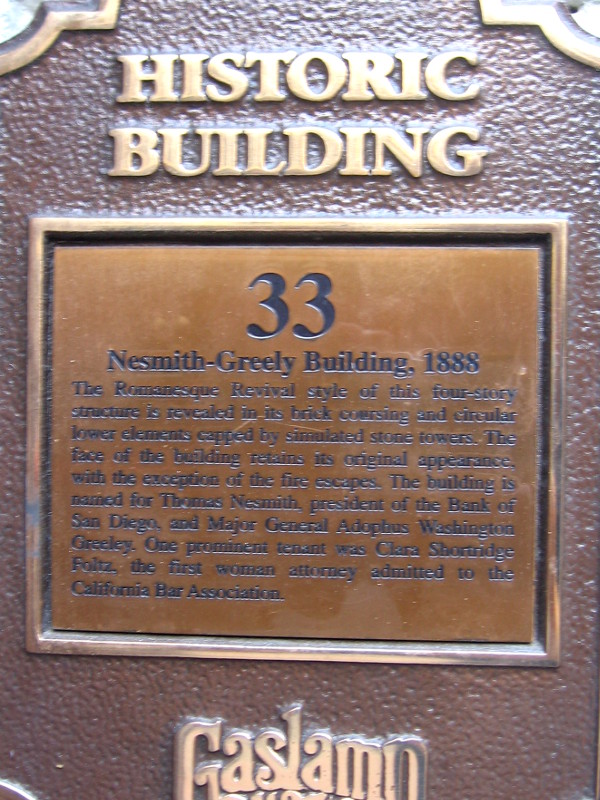
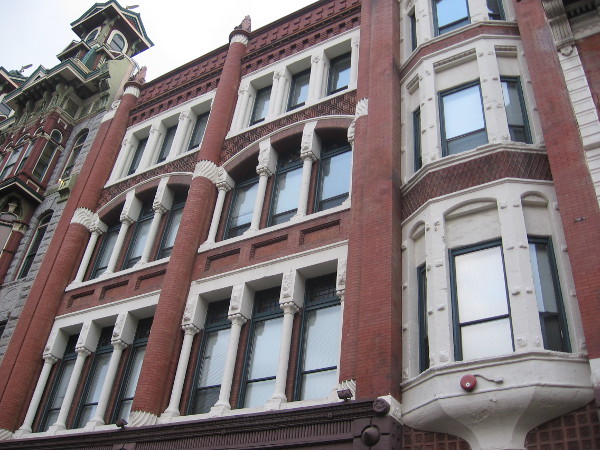
Nesmith-Greeley Building was built in the Romanesque Revival style.
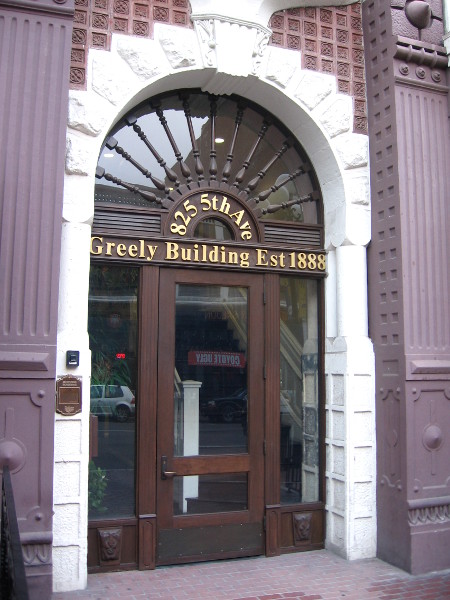
Nesmith-Greely Building was built in the Romanesque Revival style.
Nesmith-Greeley Building had office of first woman attorney in California Bar Association.
Greely Building contained office of the first woman attorney in California Bar Association.
Elegant doorway of the 1888 building.
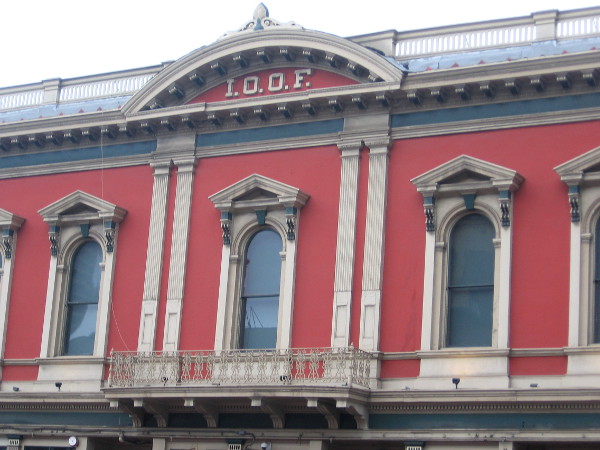
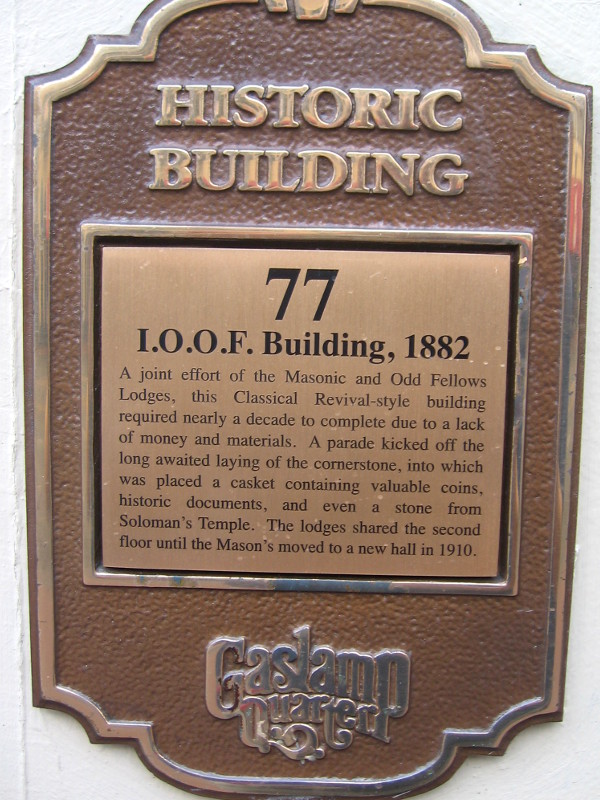
I.O.O.F. Building's cornerstone contains a stone from Soloman's Temple!
I.O.O.F. Building’s cornerstone contains a stone from Solomon’s Temple!
1882 Independent Order of Odd Fellows building.
The 1882 Independent Order of Odd Fellows building.
Closer view of the Classical Revival style I.O.O.F. building in the Gaslamp Quarter.
Closer view of the Classical Revival style I.O.O.F. building in San Diego’s Gaslamp Quarter.
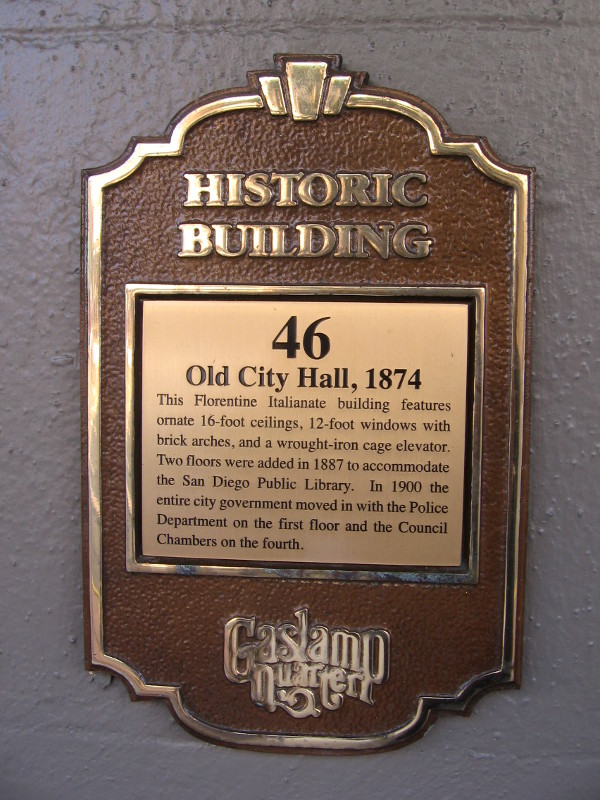
San Diego's historic Old City Hall is an 1874 Florentine Italianate building.
San Diego’s historic Old City Hall is an 1874 Florentine Italianate building.
Two floors were added to Old City Hall to accommodate San Diego Public Library in 1887.
The delightful entrance to Old City Hall.
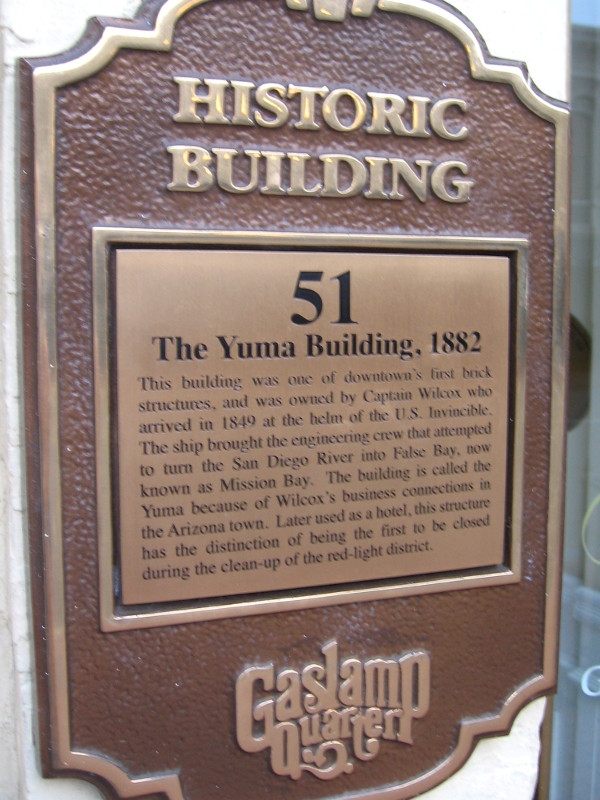
The Yuma Building was one of downtown's first brick structures.
The Yuma Building was one of downtown’s first brick structures.
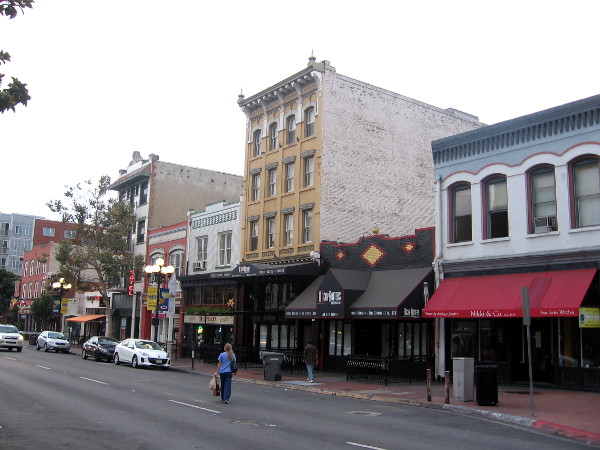
The Gaslamp's historic Yuma Building dates from 1882.
The distinctive Yuma Building also dates from 1882.
Looking down Fifth Avenue one early weekday morning.
Grand Pacific Hotel was built in 1887 at this location.
The distinctive old Victorian Grand Pacific Hotel in San Diego's Gaslamp.
The distinctive old Victorian Grand Pacific Hotel in San Diego’s fantastic Gaslamp.
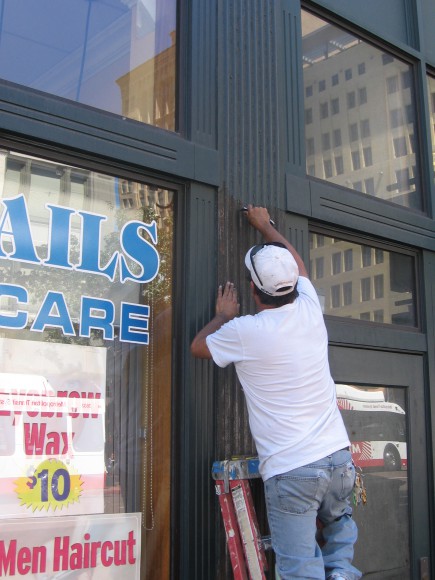
Worker scrapes paint from an old building.
Worker scrapes old paint as the years roll on.
Old Town Trolley Tours bus exits the Gaslamp.
Old Town Trolley Tours bus exits the popular Gaslamp Quarter.

Click to follow the Cool San Diego Sights blog on Twitter or Facebook!

Unrestored vintage Silver Line trolley car.

unrestored vintage silver line trolley

Here’s a photo of an unrestored vintage trolley car. It belongs to the San Diego trolley and one day will run on downtown’s Silver Line loop!

One vintage car has already been beautifully restored and is running during special hours. I’ll try to get a good pic of it one of these days.

Five cars are scheduled for restoration. They are relatively elegant post-war Presidents Conference Committee (PCC) cars, which ran in the city until 1949. Some would like to see these revitalized cars run up a new trolley line from downtown along Park Boulevard to the San Diego Zoo and beyond. It makes sense to me. Balboa Park and the zoo would be more easily reached by out-of-town visitors.

Streetcars have been a part of San Diego history since the 1890’s. The first were open-air coaches pulled by mules and horses. Eventually, electric streetcars ran from downtown to Hillcrest and east through many local communities, including North Park, Kensington and East San Diego. With the rise of the motorcar, they vanished. That is, until the modern red trolleys began service in 1981.

This photograph was taken at the 12th and Imperial trolley station, right next to the train and MTS trolley yard. You can see the tall bayside Hilton hotel in the background.

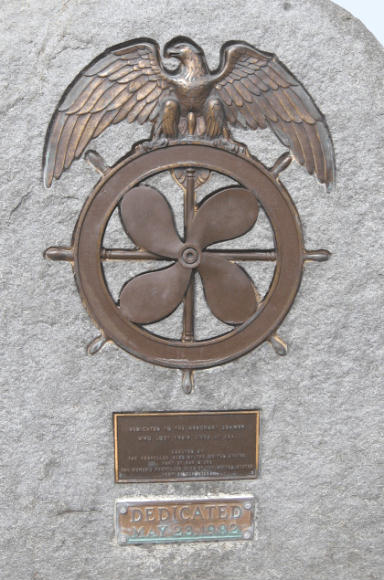
Merchant seamen memorial plaque in San Diego.

merchant seamen plaque in san diego

This plaque, a memorial to our nation’s merchant seamen, is located in San Diego’s Embarcadero Marina Park North between a popular walking path and the edge of the big bay. You’ll find it just steps from Seaport Village.

It reads:

Dedicated To the Merchant Seamen
Who Lost Their Lives At Sea
Donated by the Propeller Club of the United States
Port of San Diego
The Women’s Propeller Club of San Diego
Port of San Diego

A separate plaque reads:

Dedicated May 23, 1982

Seaport Village behind merchant seamen memorial.

Watch commercial fishermen unload their catch.

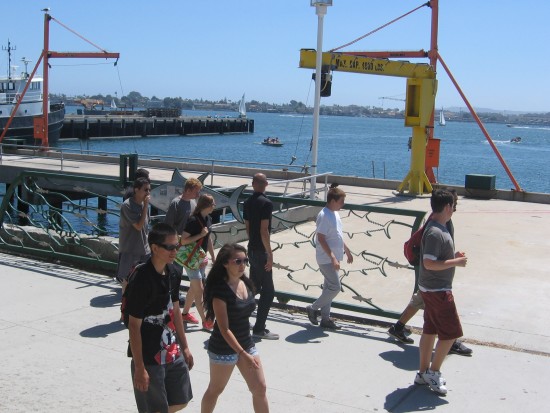
People walk down San Diego's Embarcadero.
People walk down San Diego’s Embarcadero.

watch commercial fishermen unload their catch

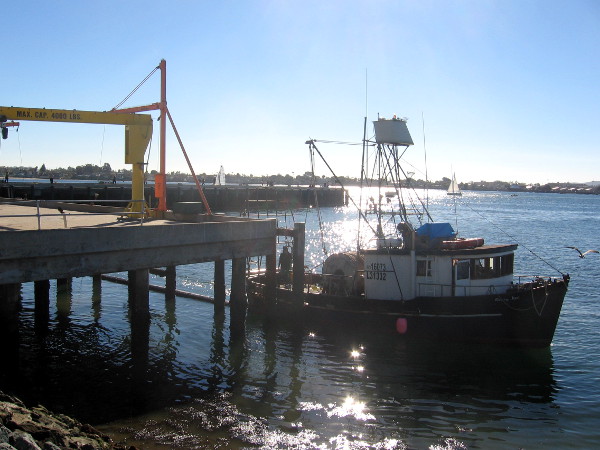
A great place to watch small commercial fishermen unload their catch or load up with ice is the dock just north of Seaport Village, opposite the Chesapeake Fish Company. Folks walking past can also peer through a glass window nearby and see workers in a refrigerated room cleaning and processing the fresh fish that ends up at restaurants throughout the region. I once heard the Chesapeake Fish Company is the largest fish broker west of the Mississippi.

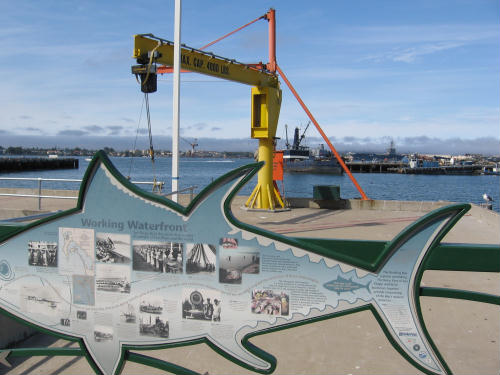
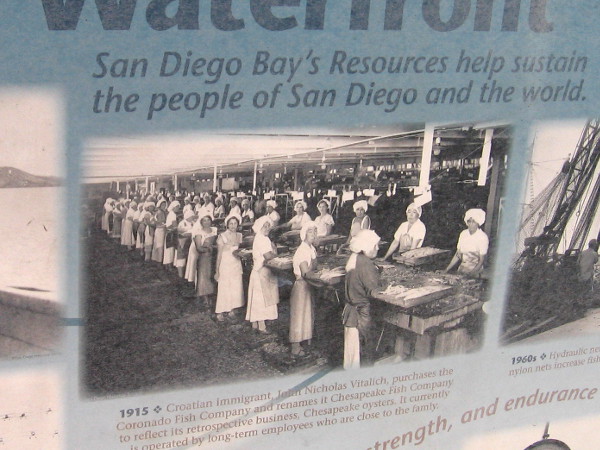
The sign in this photograph details the history of San Diego’s fishing industry–tuna fishing and canning in particular. At one time San Diego had the largest tuna fishing fleet in the world. Many of the fishermen were Italian migrants, which gave rise to the Little Italy neighborhood, about a mile to the north on downtown’s waterfront.

Tuna Harbor, adjacent to this dock, now is home to a ragtag group of local fishing boats. It’s also a great place to spot sea lions!

Working Waterfront sign shows photographs from San Diego's rich fishing history.
Working Waterfront sign shows photographs from San Diego’s rich fishing history.
1915 photo shows immigrants cleaning and canning locally caught fish.
Sign contrasts abundant catch of 1980 with the decline of tuna fishing in mid 80's.
Sign contrasts abundant catch of 1980 with the decline of tuna fishing in mid 80’s.
Fishing boat passes by the dock and crane.