Hotel del Coronado’s industrial complex.

What’s that tall brick smokestack near the world-famous Hotel del Coronado?

It’s the most noticeable part of a historic industrial complex!

I walked around the Hotel Del’s old laundry building, ice house and power plant last month during the San Diego Architectural Foundation Open House event. I discovered several plaques that provide information about these three buildings, which, clustered south of the hotel lobby entrance, are called the industrial complex.
The brick building shown below once provided the Hotel del Coronado’s laundry service. It’s now home to The Laundry Pub!

Laundry, established 1919.

The original hotel laundry opened on the second floor of the Power Plant in January 1888. The Laundry occupied the majority of the second floor and employed 20 women. In 1919 this brick structure was built to house the laundry operation, which had expanded to serve all of Coronado Island with a fleet of five laundry trucks and a branch location on Orange Avenue. Laundry services were provided here for the hotel until 2018.

The next photo is through the window of The Laundry Pub, which features an 1880s-era bar and the laundry’s early conveyor system above restored wood floors.

North of the brick laundry building is the hotel’s old ice house.

The ice house is now home to the fascinating Ice House Museum of the Hotel del Coronado, where you can view historical displays and artifacts, plus photographs of the many celebrities, movie stars and United States Presidents who’ve visited the Victorian resort over the years. I blogged about the museum two years ago here.

In the rear of the ice house is this plaque…

Ice House, established 1889.

Ice was originally produced with a small machine inside the Power Plant until this masonry structure was built to house a new 10-ton De Coppet ice machine. Renowned for excellent tasting ice, the De Coppet system was cutting edge technology at the time and allowed The Del to manufacture and supply ice throughout Southern California. In 1909, the building was converted into a storeroom with later uses including an upholstery shop and offices.

Lastly, north of the ice house is the old power plant with its tall, striped smokestack.

Power Plant, established 1887.

Built in 1887 to house the incandescent electric light plant, laundry, and engine house, the Power Plant supplied electricity to all of Coronado Island until service was established with SDG&E in 1922. The Power Plant housed five Mather dynamos, two Hazelton boilers, and heavy pumping and heating machinery. To this day, a utility tunnel connects the Power Plant to the historic hotel.

Thanks for visiting Cool San Diego Sights!

I post new blogs pretty often. If you like discovering new things, bookmark coolsandiegosights.com and swing on by occasionally!

I live in downtown San Diego and love to walk around with my camera! You can follow Cool San Diego Sights via Facebook or X (formerly known as Twitter)!

USS Midway, strangely wrapped!

Why is the towering island of the USS Midway aircraft carrier wrapped up?

To protect San Diego Bay and the environment as the historic aircraft carrier (now a popular tourist destination) receives a new coat of paint! That’s what I was told a couple days ago by a USS Midway Museum employee.

But how strange it appears!

Thanks for visiting Cool San Diego Sights!

I post new blogs pretty often. If you like discovering new things, bookmark coolsandiegosights.com and swing on by occasionally!

I live in downtown San Diego and love to walk around with my camera! You can follow Cool San Diego Sights via Facebook or X (formerly known as Twitter)!

Historic ferry in San Diego, like a cathedral.

It reminds one of stained glass in a cathedral. Exquisite art glass windows, fabricated over a century ago, fill a historic ship in San Diego with golden sunlight.

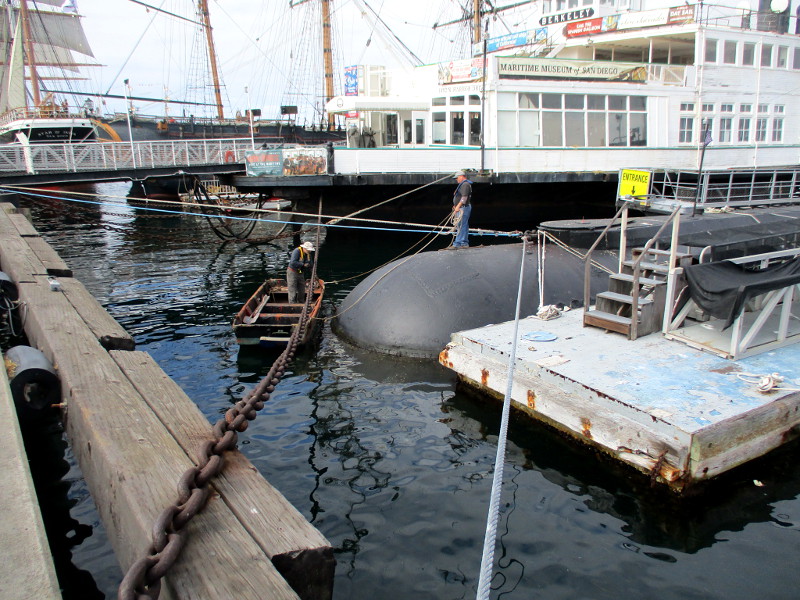
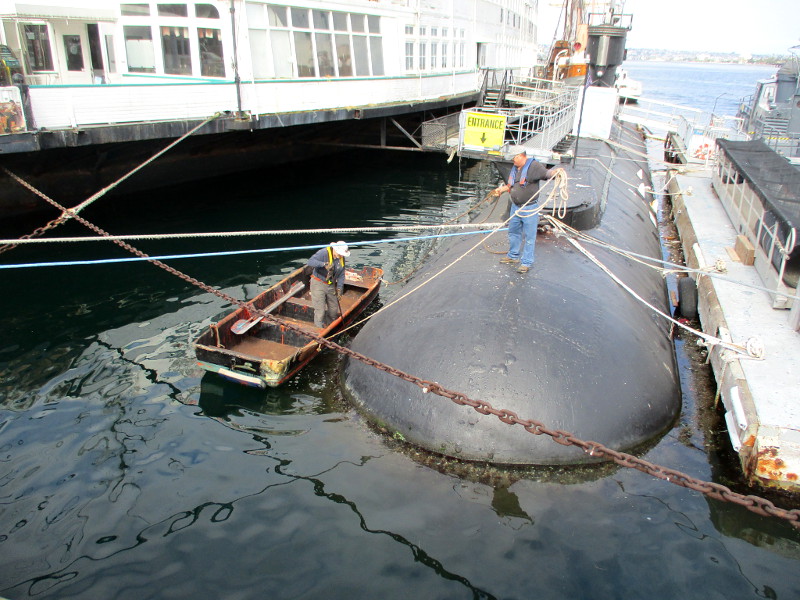
If you’ve ever stepped onto the Dan McKinney Deck of the steam ferry Berkeley (part of the Maritime Museum of San Diego) you’ve experienced the beauty. The long polished wooden benches, the soft light and tranquil quiet–the atmosphere is indeed similar to that of a cathedral.

I noticed during a recent visit that the Berkeley’s art glass was created by California Art Glass Works in San Francisco. The 1898 steam ferryboat Berkeley was built to carry Southern Pacific Railroad passengers between Oakland and San Francisco.

Out of curiosity, I’ve tried to find information concerning California Art Glass Works. The factory was located on Mission Street in San Francisco. It was famous for the manufacturing of lodge and church memorial windows.

Here’s a link to a page on the Oakland Museum of California website that contains information about California Art Glass Works and the man behind it. Among other things, you’ll learn the glass company was founded in 1879 by William Schroeder, who had learned the craft in Germany. California Art Glass won a silver medal at the Paris Exposition of 1900 for the windows it exhibited there.

If you happen to know more about California Art Glass Works, please leave a comment!

Thanks for visiting Cool San Diego Sights!

I post new blogs pretty often. If you like discovering new things, bookmark coolsandiegosights.com and swing on by occasionally!

I live in downtown San Diego and love to walk around with my camera! You can follow Cool San Diego Sights via Facebook or X (formerly known as Twitter)!

Two unusual rooms in a San Diego hotel!

A luxurious hotel in downtown San Diego contains two huge rooms that are quite unusual. One used to be a basketball court, and another was an indoor swimming pool!

The Guild Hotel occupies the historic 1924 building that was originally home of the Army-Navy YMCA. For decades, tens of thousands of sailors and military men would head to this location on Broadway, not far from the waterfront, to recreate. They’d play basketball, run around an elevated indoor track, and swim in a basement pool.

The Guild Hotel, when it moved into the iconic building, creatively repurposed two large indoor spaces. The huge basketball court was converted into the grand Grace Ballroom! The swimming pool was turned into the Society Ballroom!

I was shown these spaces several weeks ago during the San Diego Architectural Foundation Open House event.

Just inside the front entrance of the luxurious The Guild Hotel in downtown San Diego.

The Guild Bar in the hotel lobby.

To the left of the bar, a door opens to the unusual Grace Ballroom.

The Grace Ballroom at The Guild Hotel was originally an indoor basketball court. Military men shot hoops here for decades when the building was an Armed Services YMCA.

An elevated platform intended for jogging or running continues to surround the hotel ballroom!

Beautiful tiles along a stairway that descends from The Guild Hotel lobby to a lower level.

An old photograph of the large swimming pool that once occupied the Army-Navy YMCA’s basement.

The swimming pool is gone, replaced by the Society Ballroom! The historic space was set up as a meeting room when I toured the hotel.

Thanks for visiting Cool San Diego Sights!

I post new blogs pretty often. If you like discovering new things, bookmark coolsandiegosights.com and swing on by occasionally!

I live in downtown San Diego and love to walk around with my camera! You can follow Cool San Diego Sights via Facebook or X (formerly known as Twitter)!

Tintypes of Old Town folks in period attire!

Employees and volunteers at Old Town San Diego State Historic Park have posed for old-fashioned tintype photographs, while dressed in period attire!

I spotted this display recently in front of the Robinson-Rose House Visitors Center. The “nineteenth century reproduction clothing” in these photographs reflects Old Town’s interpretive period, which is between 1821 and 1872.

If you want to see more photos of California State Park folks in period attire, click here. Or head over to Old Town San Diego State Historic Park and simply walk around. You’ll likely meet staff and volunteers who appear to have emerged from our city’s early history!

Thanks for visiting Cool San Diego Sights!

I post new blogs pretty often. If you like discovering new things, bookmark coolsandiegosights.com and swing on by occasionally!

I live in downtown San Diego and love to walk around with my camera! You can follow Cool San Diego Sights via Facebook or X (formerly known as Twitter)!

A giant Balboa Park tree’s tiny beginning!

The giant Moreton Bay Fig tree just north of the San Diego Natural History Museum was not always so huge!

Years before any of us were born, this historic tree was planted in Balboa Park for the 1915 Panama-California Exposition. Visitors to the exposition might have viewed the tiny tree in one of the flower beds in a large formal garden. The garden stretched north of the Southern California Counties Building, which was later replaced by the Natural History Museum–the building visible in the above photograph.

I’ve found two images which show the young tree in the formal garden. Arrows have been added to mark the position of the small tree.

The first image is from a sign located under today’s Moreton Bay Fig, next to the observation platform. The second image is an old photograph–one of many century-old Balboa Park photographs that I posted here.

Did you know Balboa Park’s immense Moreton Bay Fig has a sister tree in National City? See my blog post concerning that here!

Thanks for visiting Cool San Diego Sights!

I post new blogs pretty often. If you like discovering new things, bookmark coolsandiegosights.com and swing on by occasionally!

I live in downtown San Diego and love to walk around with my camera! You can follow Cool San Diego Sights via Facebook or X (formerly known as Twitter)!

Exhibition of African American history in Coronado.

An exhibition now showing at The Coronado Historical Association‘s museum concerns the history of African Americans in Coronado. An Island Looks Back: Uncovering Coronado’s Hidden African American History is open free to the public and extremely enlightening.

Numerous old photographs and historical documents tell the story of how a few African Americans pioneers first came to Coronado in the late 19th century, and how their numbers would greatly increase beginning in 1944, because of the Federal Housing Project. The island had more than twice the African American population in 1960 than Chula Vista, El Cajon, Escondido, Imperial Beach, Lemon Grove, La Mesa and Vista combined!

The exhibition features stories of families through many generations, telling of their struggles and triumphs.

Some of Coronado’s earliest African American pioneers migrated west looking for opportunity, following Elisha Babcock, who would develop the once-barren island and build the Hotel del Coronado. In its early years, Coronado was considered more accepting of African American residents and visitors than most San Diego neighborhoods.

Members of the segregated United States military would also settle in Coronado–Civil War veterans, Buffalo Soldiers, and veterans of the two World Wars.

The exhibition explains that many African Americans in those early years worked as maids, cooks, nurses, butlers, housekeepers, gardeners, laborers, coachmen and chauffeurs. The pay was low and life could be difficult–many residents of Coronado would persist in supporting segregation for decades. Surprisingly, Coronado’s local schools were integrated from the beginning.

Visitors to the museum will learn how African American graduates from Coronado High School during the Civil Rights Era went on to successful careers and achievements in the arts, military, private business, and government. That success in the community continues to this day.

If you ever find yourself in beautiful Coronado, head to the The Coronado Historical Association‘s free museum and experience An Island Looks Back: Uncovering Coronado’s Hidden African American History.

You will be inspired by the life stories and accomplishments of African Americans who’ve called Coronado home.

Thanks for visiting Cool San Diego Sights!

I post new blogs pretty often. If you like discovering new things, bookmark coolsandiegosights.com and swing on by occasionally!

I live in downtown San Diego and love to walk around with my camera! You can follow Cool San Diego Sights via Facebook or X (formerly known as Twitter)!

Celebrities, ghosts and history in Bankers Hill!

The Hawthorne Historic Inn in Bankers Hill is a picturesque old Victorian. Built circa 1900 in the Dutch Colonial style, the building attracts the eyes of those passing down 1st Avenue.

A public tour of the Hawthorne Historic Inn was offered last weekend, as part of the San Diego Architectural Foundation Open House event, and I took full advantage of the opportunity!

Not only could visitors explore the interior, with its long, bright skylight and beautifully furnished rooms for rent, but we learned that the building has a very rich and surprising history!

A handout provided by the property owner explained how Mr. Jones, a movie starring Richard Gere, was filmed here in 1993. You might recall scenes of Richard Gere’s troubled character on the rooftop.

It also recounted how Mohammed Ali and Sammy Davis, Jr. stayed at the inn in the 1960s and 70s. Back then, unfortunately, African Americans had difficulty obtaining rooms in other establishments.

Another tidbit that interested me is that in the 1980s, the Hawthorne Inn was one of three officially haunted places in San Diego! (I saw no ghosts during my tour.)

The inn was originally called “The Plainsman” in an old classified ad. It was a boarding house. It is one of the few Working Man’s hotels remaining from the turn of the 19th century.

The second owner, last name Warren, was a women who was a Theosophist. She was likely involved in the founding of Lomaland, the Theosophical community located in Point Loma.

I learned the property has had its ups and downs, but is currently on the upswing. Today it’s a fine apartment building with great views of downtown and San Diego Bay from its upper floor and an outside balcony.

The Hawthorne Historic Inn is on the National Register of Historic Places. It is also a California State Historic Landmark.

Thanks for visiting Cool San Diego Sights!

I post new blogs pretty often. If you like discovering new things, bookmark coolsandiegosights.com and swing on by occasionally!

I live in downtown San Diego and love to walk around with my camera! You can follow Cool San Diego Sights via Facebook or X (formerly known as Twitter)!

A look inside San Diego’s Brain Observatory!

Refrigerator at the Brain Observatory holds brains preserved in formaldehyde.

About a year ago the Brain Observatory moved into downtown San Diego.

What, exactly, is the Brain Observatory?

It’s a museum-like place that the public can tour, whose mission is: Advancing knowledge of the brain and mental health through research, education, and the arts.

I enjoyed a look inside the Brain Observatory recently and much of what I saw was astounding. I was shown about briefly and learned about the unique facility’s history and mission.

The Brain Observatory houses a fully-functional research laboratory. Students and visitors can learn about the brain by utilizing authentic, state-of-the-art scientific equipment and by exploring real data, including samples from a large collection of donated human brains.

Founded in 2005 by Dr. Jacopo Annese, the Brain Observatory began as a brain research lab at UC San Diego. Ph.D. scientists from around the world, including a Nobel Prize winner from the Salk Institute, are on the Advisory Board.

The Brain Observatory uses MRI and microscopy to understand the biological basis of normal brain function and neurological disease. Advanced scientific equipment is also used to educate youth who take part in school programs.

Curious? The public can tour the Brain Observatory by reservation. In addition there are lunchtime lectures. Learn about these great opportunities by clicking here.

Dr. Jacopo Annese enthusiastically talked about his endeavors during my short visit. He has big plans. My own brain tried to assimilate so much information.

Brain Observatory tours and lectures, and the programs for students, are certain to be very stimulating!

A look inside the Brain Observatory in downtown San Diego. This space was last occupied by the SDSU Downtown Gallery.

The fascinating Brain Observatory uses scientific equipment to slice brains and conduct microscopic investigation.

Education is a focus of the Brain Observatory. Student artwork hangs on one wall.

Photos of people who donated their brains to science.

Thanks for visiting Cool San Diego Sights!

I post new blogs pretty often. If you like discovering new things, bookmark coolsandiegosights.com and swing on by occasionally!

I live in downtown San Diego and love to walk around with my camera! You can follow Cool San Diego Sights via Facebook or X (formerly known as Twitter)!

Elegant beauty returns as Botanical Building rebuilt!

The shapely, elegant beauty of Balboa Park’s Botanical Building is returning!

San Diego’s iconic wood and steel structure, which was badly in need of repair, is in the process of being rebuilt.

I took these photographs today. Compare them to photos I took months ago. You can view those here.

New wood lath now forms the airy roof of one wing. When it was built for the 1915 Panama-California Exposition, Balboa Park’s amazing Botanical Building was one of the largest lath structures in the world!

I can’t wait to see it finished!

Thanks for visiting Cool San Diego Sights!

I post new blogs pretty often. If you like discovering new things, bookmark coolsandiegosights.com and swing on by occasionally!

I live in downtown San Diego and love to walk around with my camera! You can follow Cool San Diego Sights via Facebook or X (formerly known as Twitter)!