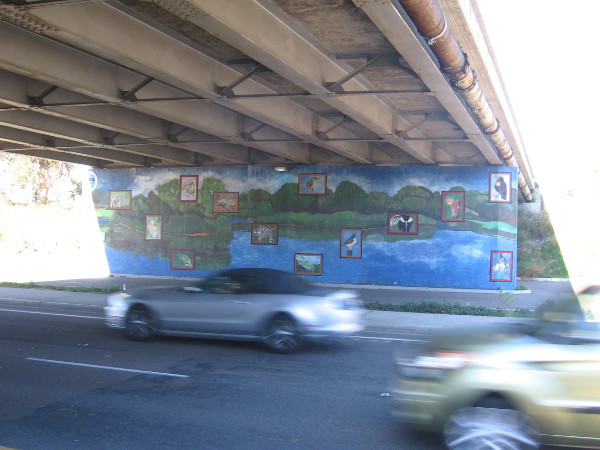
Cars zoom west down Friars Road, beneath the Morena Boulevard bridge.
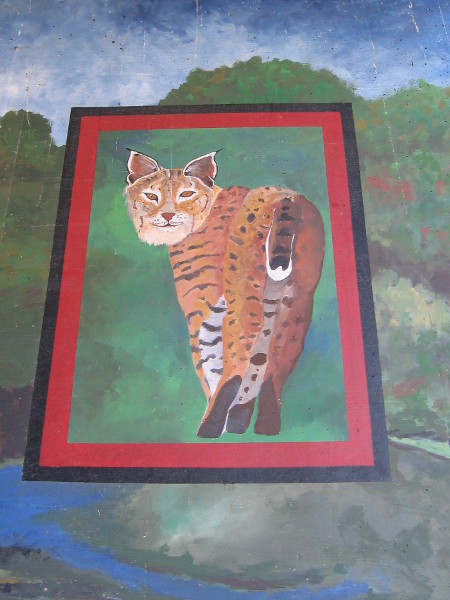
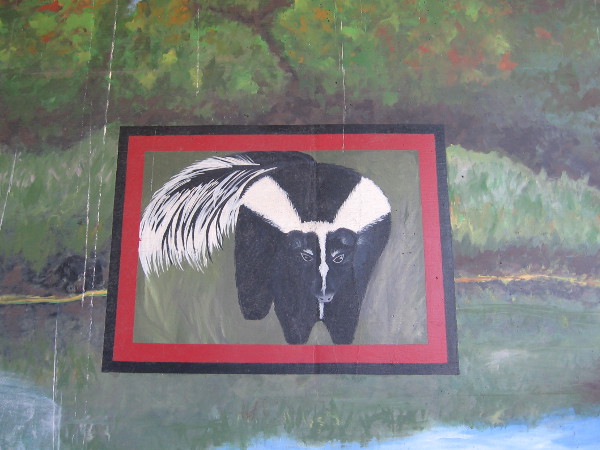
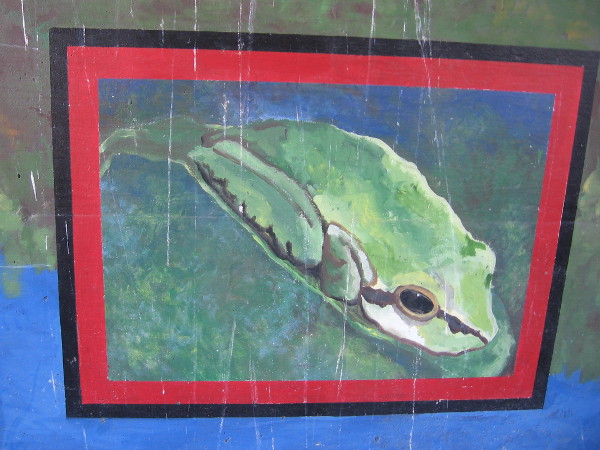
Should you ever drive west down Friars Road approaching Mission Bay, you might see a collection of native animals gathered under the Morena Boulevard bridge. They seem to like the place, because they never leave!
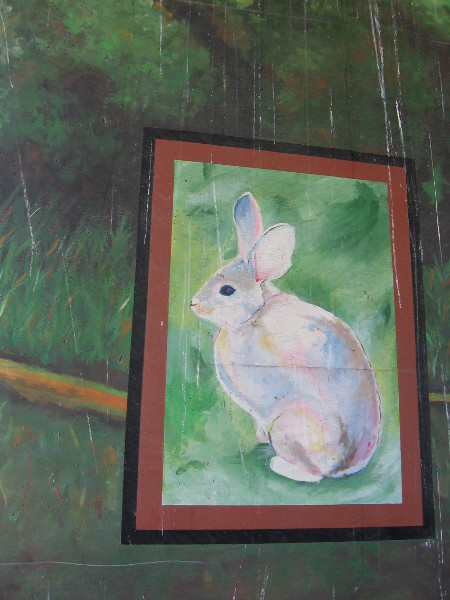
The west end of Mission Valley contains an open space preserve, where some wild animals live in the midst of a big city. The wildlife mural, designed in 2007 by lead artist Julia C. R. Gray, was a public art project of the San Diego River Park Foundation.
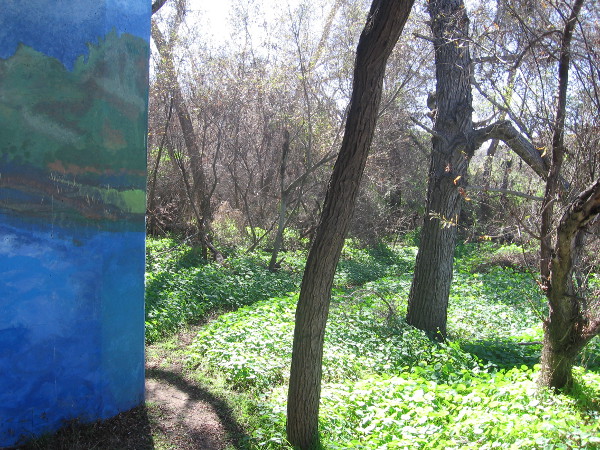
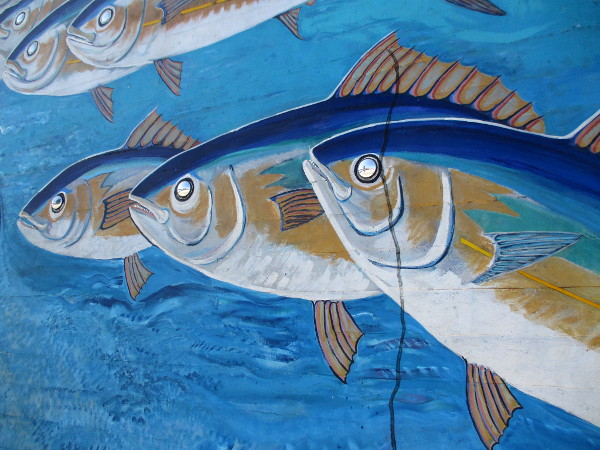
This mural is a project of the San Diego River Park Foundation.A bobcat lurks under the busy city bridge!So does a skunk! I didn’t smell this critter, however.Fish in dry water, painted on a public art mural near the San Diego River.Horned toad and raccoon, samples of wildlife that live in Mission Valley preserve.Frog in a painted mural, created by artist Julia C. R. Gray in 2007.A rabbit that’s still enough to be captured by my camera!It’s very rare to see a fox in the developed parts of San Diego.Second mural painted on south side of Friars Road also shows a river scene.Beyond lies open space. Lush vegetation provides shelter for wildlife near river.
…
To enjoy future posts, you can “like” Cool San Diego Sights on Facebook or follow me on Twitter.
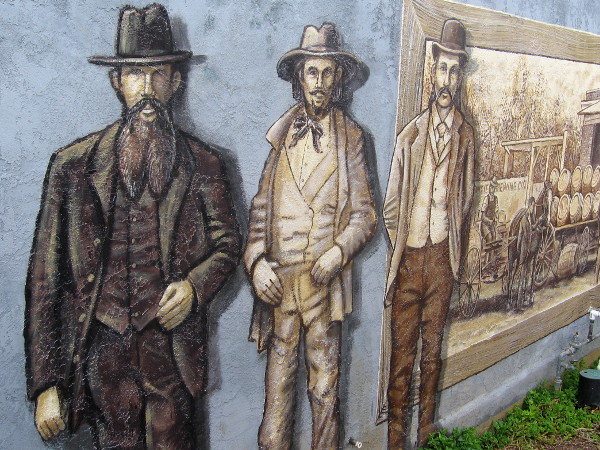
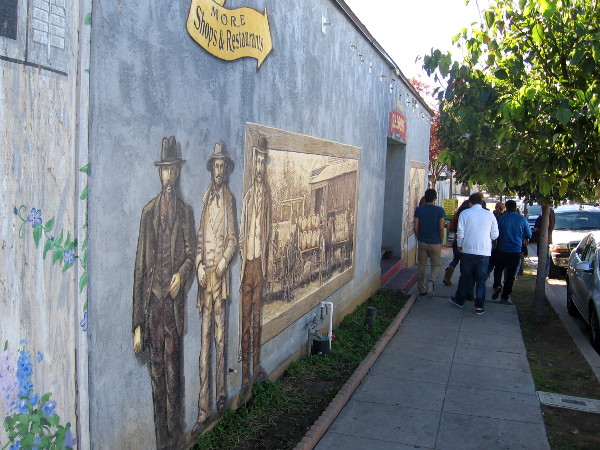
Several whiskered Western characters pose in a mural on Harney Street in Old Town.
There’s a fairly new street mural in Old Town that I really like. Every time I see it, my imagination travels back in time. Back to the first half of the 19th century.
San Diego for many decades was a tiny town seemingly in the middle of nowhere. Whether it belonged to Spain, or Mexico, or the United States, Old Town San Diego was a place of dusty roads and modest, sun-baked adobe houses, horses and wagons, rugged settlers and ranchers. Characters from that era seem to live again in this mural.
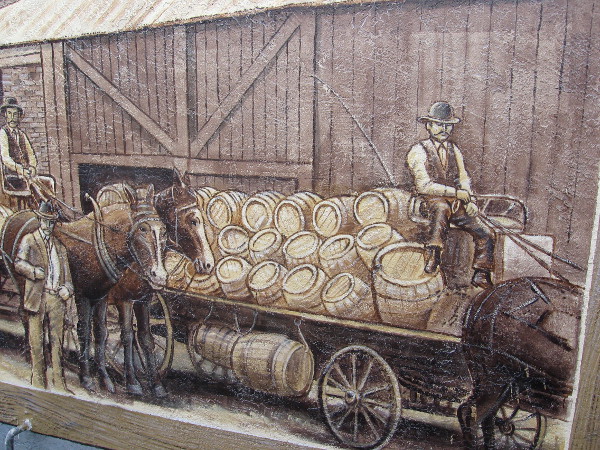
Artist Frank Mando painted this artwork in 2013. I couldn’t capture the entire piece in one shot. Enlivening a building at the corner of San Diego Avenue and Harney Street, the mural is divided in two by a door of the Old Town Saloon. Standing inside that door, as you’ll see, there seems to be a well-known movie star!
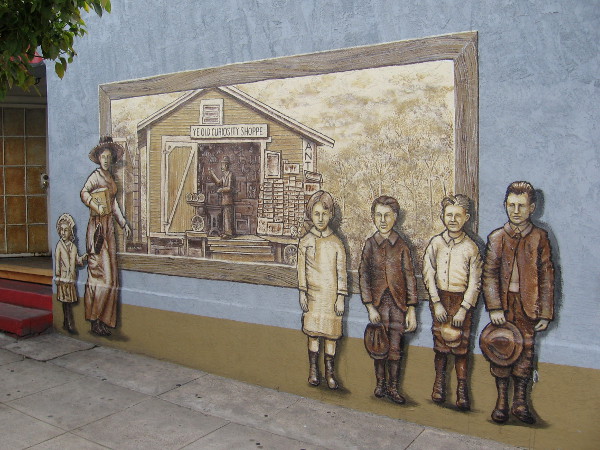
Freight wagon hauls a load of barrels in fun art that recalls early San Diego history.John Wayne seems to be coming through a door of the Old Town Saloon.Elegant lady and girl from long ago stroll past Ye Old Curiosity Shoppe.Old Town mural on building wall was painted in 2013 by artist Frank Mando.Kids standing along sidewalk seem to have materialized from San Diego’s past.People walk past nostalgic street mural near side entrance to Old Town Saloon.
…
To enjoy future posts, you can “like” Cool San Diego Sights on Facebook or follow me on Twitter.
Cool utility box in Hillcrest shows tall buildings on planet Earth.
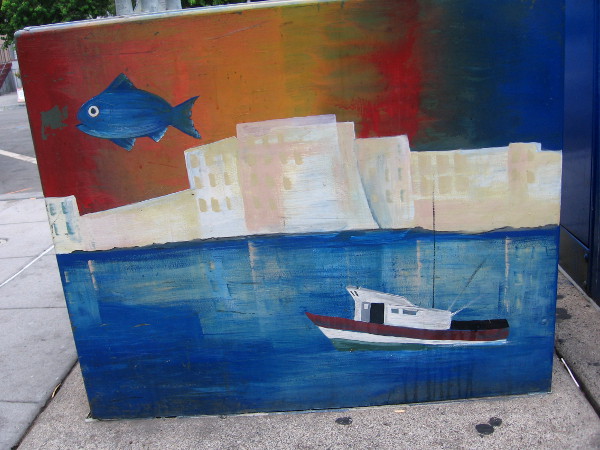
During my walks about San Diego, I spy all sorts of cool art on utility boxes and electrical transformers. Most of the painted artwork is super creative and colorful. You never know what you’ll find!
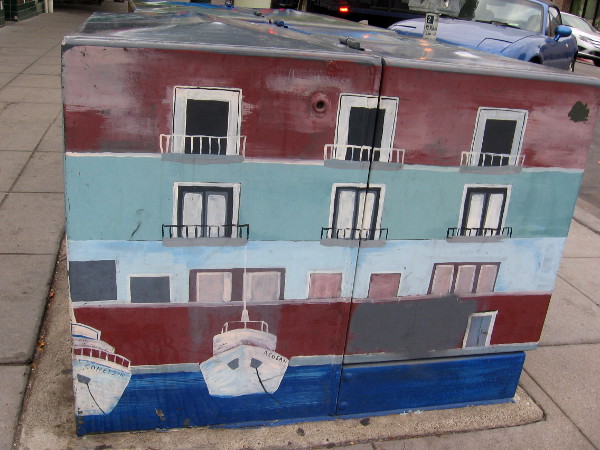
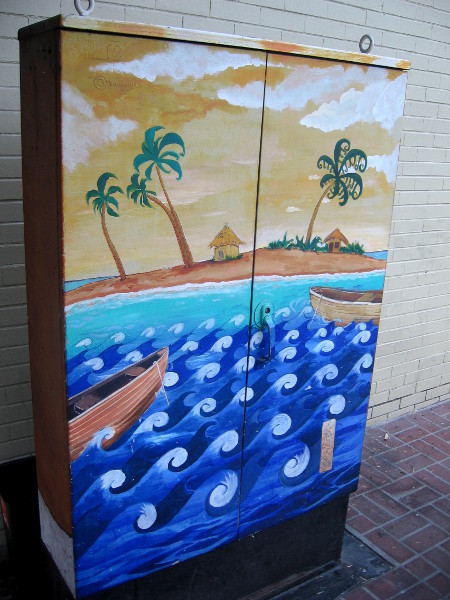
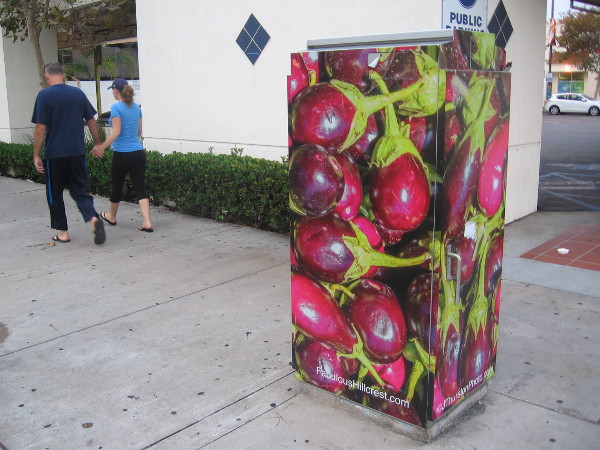
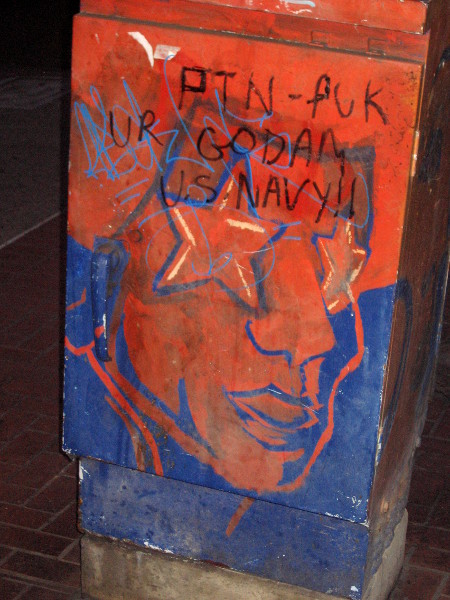
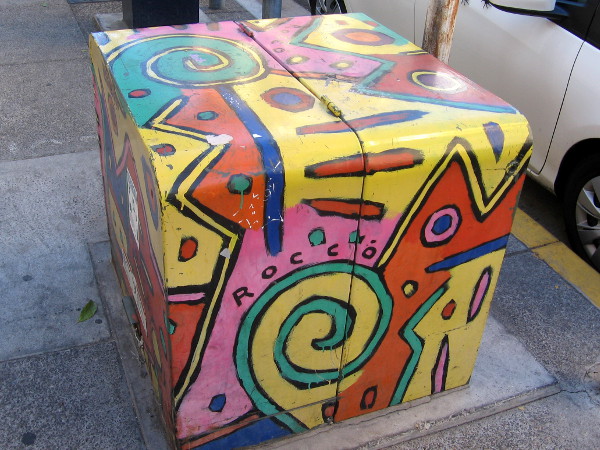
Little Italy art on utility box shows boats in water beneath row of windows.Fish and fishermen are big themes on Little Italy utility boxes.Tropical beach island scene on a fun, eye-catching Gaslamp utility box.Soft and peaceful beach image on this Imperial Beach utility box.Cool abstract face on an imaginative Hillcrest utility box.Some large utility boxes in Hillcrest feature photos of fruits and vegetables.This Hillcrest electrical transformer has a bold blue eye.East Village utility box art has been vandalized with angry words.Very colorful artwork on an East Village transformer.
…
To enjoy future posts, you can “like” Cool San Diego Sights on Facebook or follow me on Twitter.
Mind-blowing street art uses a whole spectrum of finely painted colors.
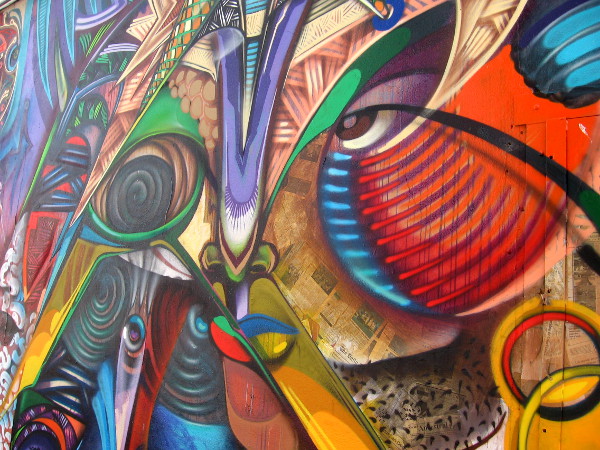
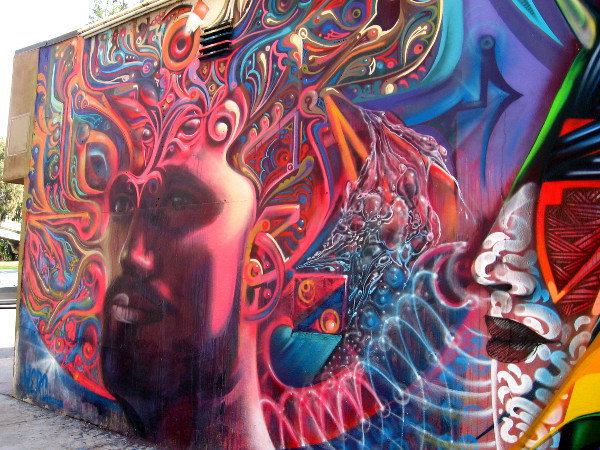
Wow! Check out this mind-blowing street mural, which caught my eye just across Dewey Street from Chicano Park. Titled Ancestors, it was spray-painted on a Barrio Logan building in 2013 by artists Maxx Moses and Isaias Crow.
A little online research reveals that Ancestors replaced another damaged mural on the same wall, which was titled Synergy. Maxx Moses likes to use spontaneity in his creative productions, and calls his unique art movement Concrete Alchemy. Isaias Crow’s artwork, which I believe is on the right side of the mural, is similarly awesome!
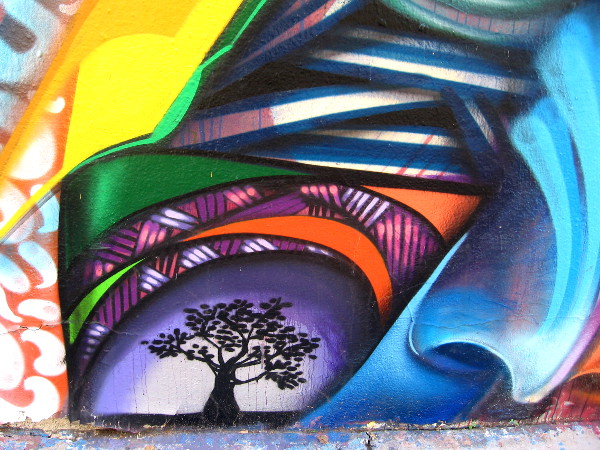
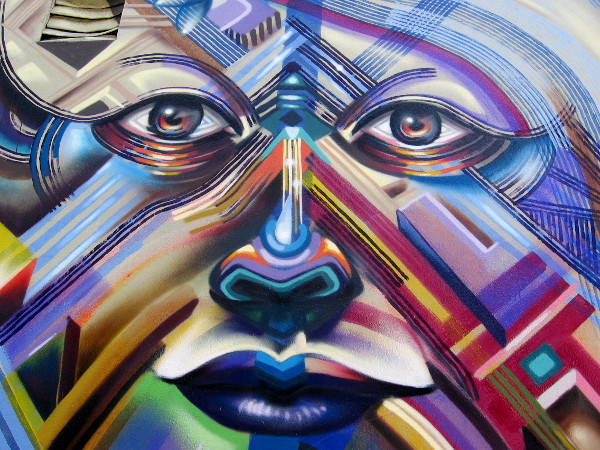
This dazzling urban art is directly across the street from world-famous Chicano Park.Such amazing detail. You could just stand and lose yourself in this cool artwork.Closer look at one portion of the Ancestors mural in Barrio Logan.Ancestors street mural celebrates the lives of those who built community.Small tree on the wall is enfolded by softly curved rich colors.The intricate image is alive with astounding vibrancy.This astonishing face is composed of many slivers of beaming light.
…
To enjoy future posts, you can “like” Cool San Diego Sights on Facebook, or follow me on Twitter.
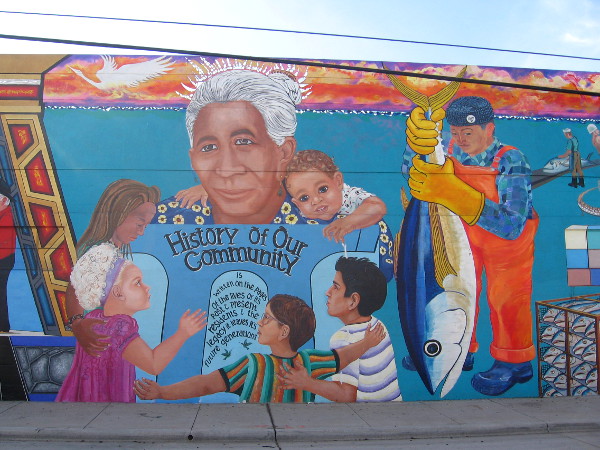
Super cool artwork depicts local community, history and sea life themes.
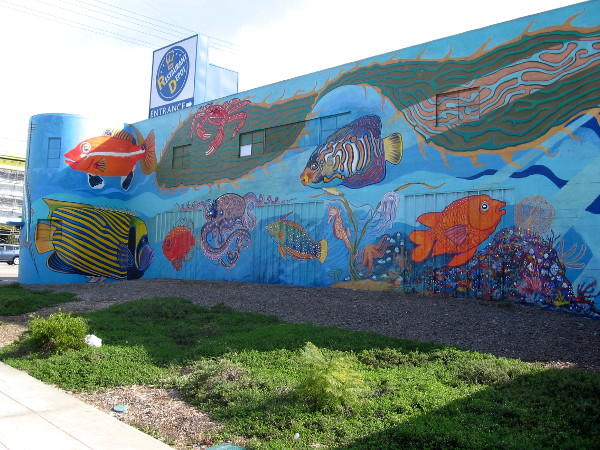
I don’t know much about this mural, apart from the fact that it’s huge, colorful and super cool. For years, it seems, scaffolding has stood against the long portion along Harbor Drive. Just recently the scaffolding vanished, and the brilliant, dynamic street art is fully visible in all its glory!
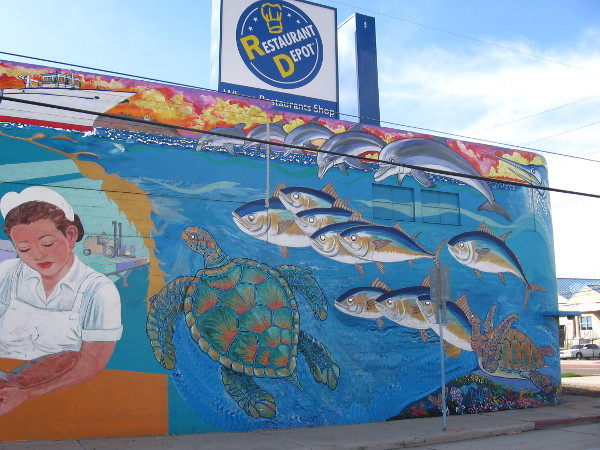
You can find this urban art at the intersection of Cesar Chavez Parkway and Harbor Drive, just south of downtown in Barrio Logan. It decorates the high wall that encloses the parking lot at Restaurant Depot.
I took these photos as I walked south to north along Harbor Drive, then turned west at the intersection for a little more fun artwork.
Enjoy!
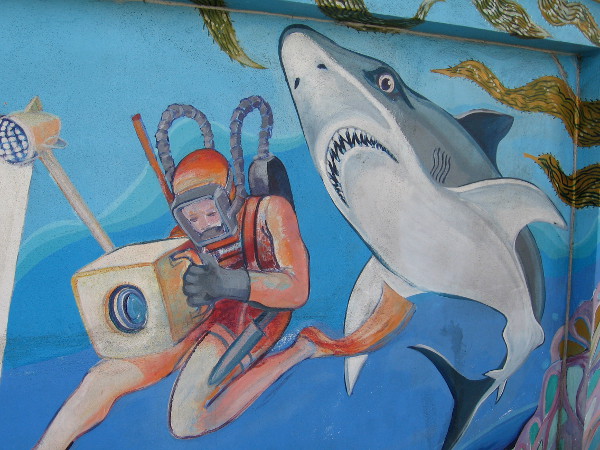
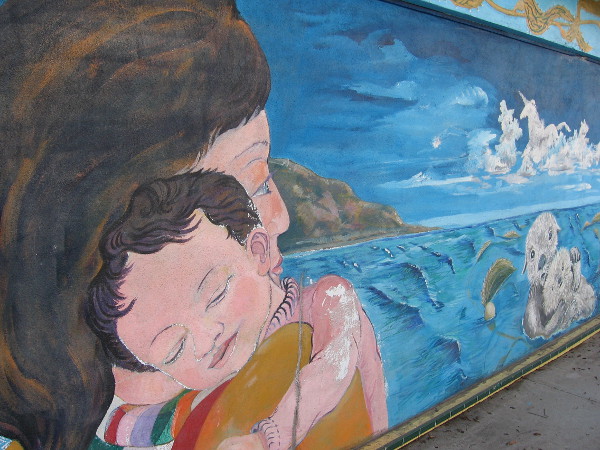
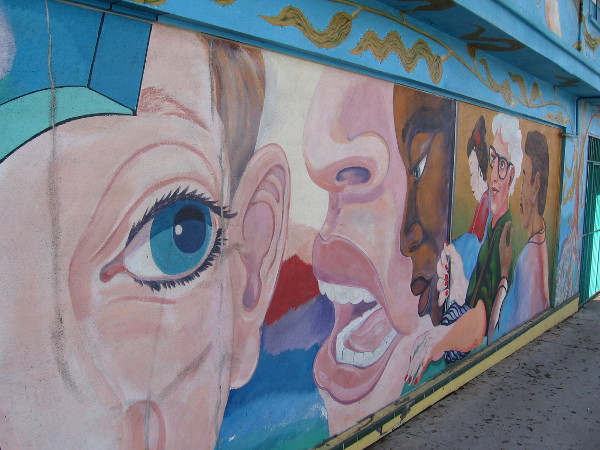
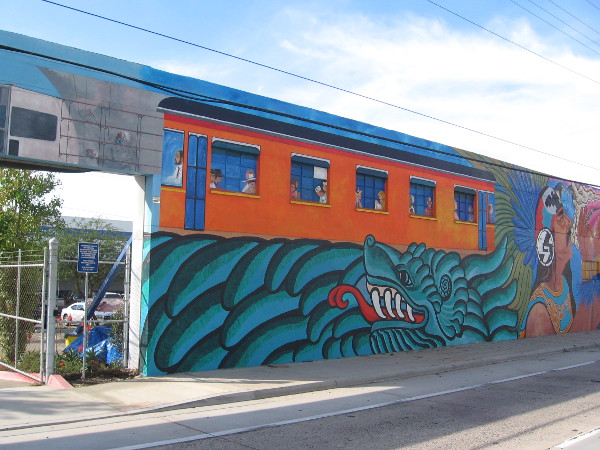
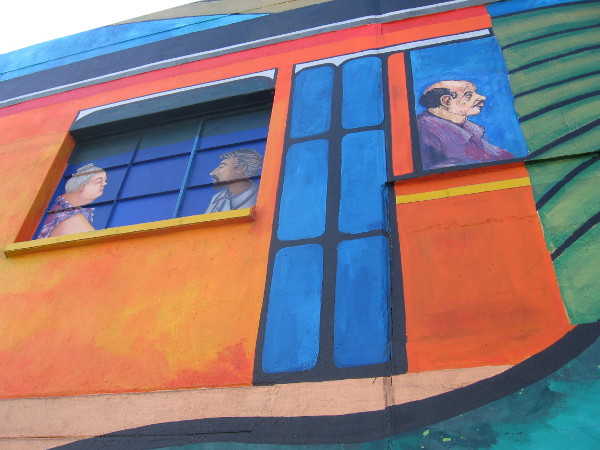
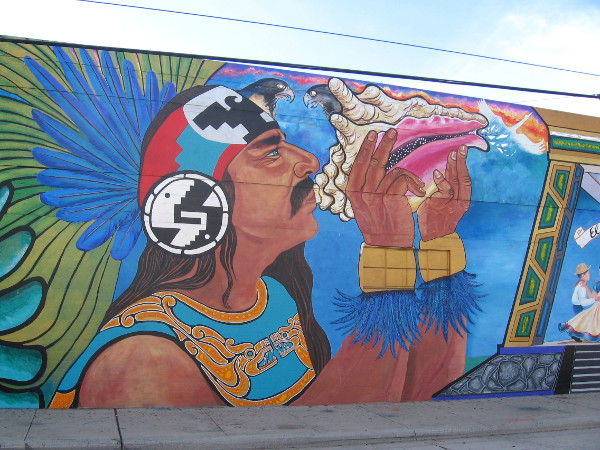
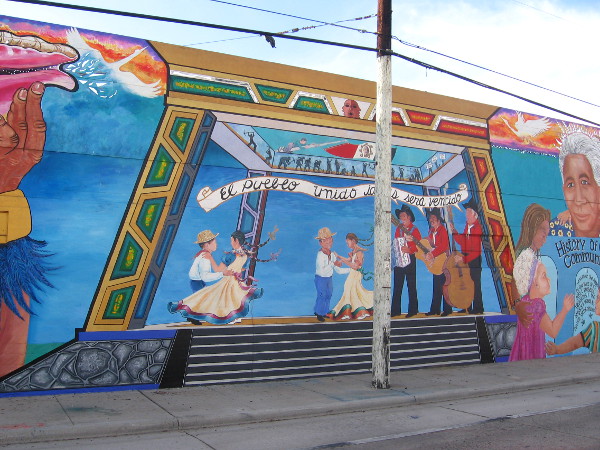
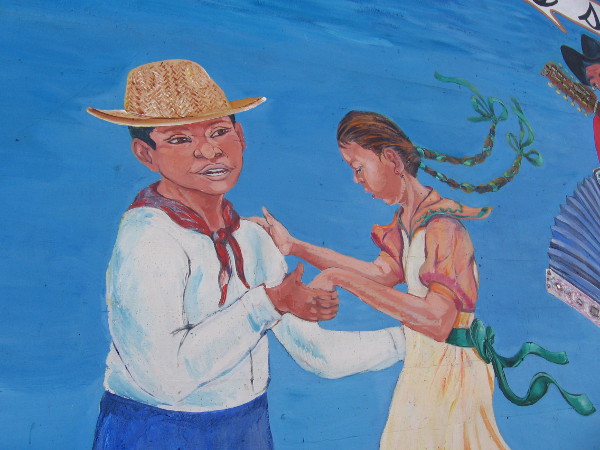
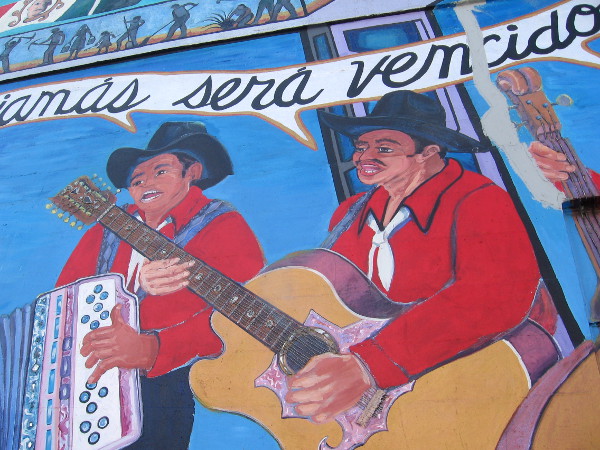
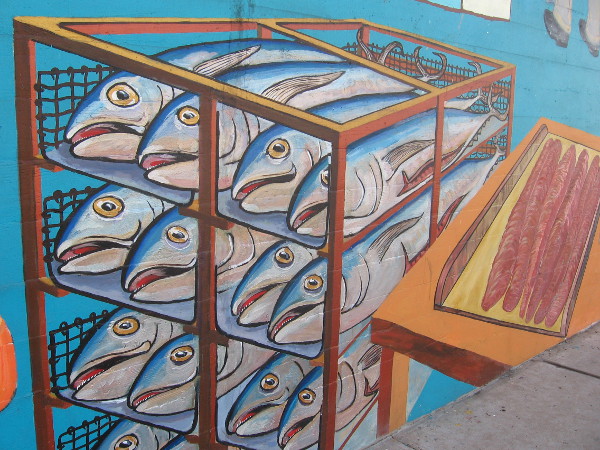
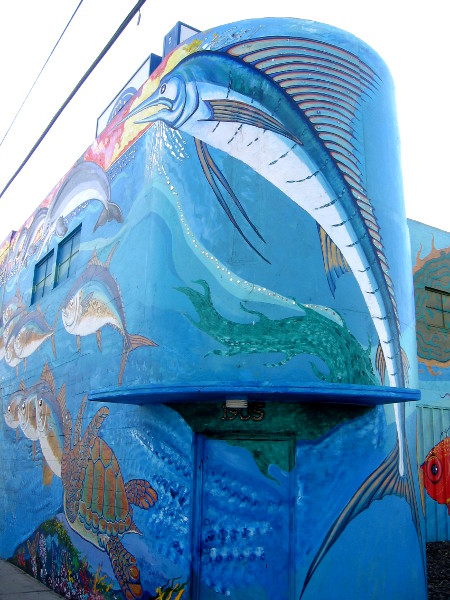
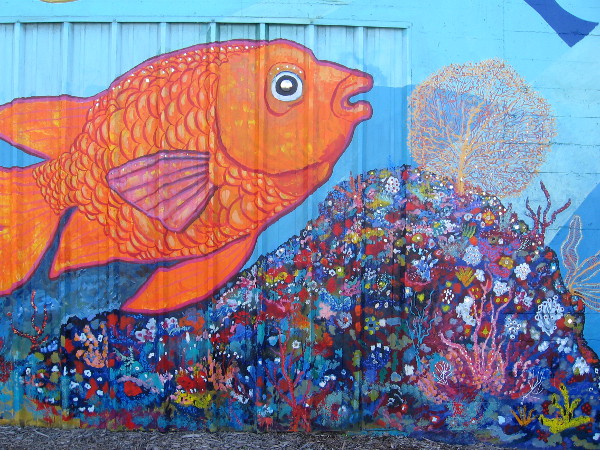
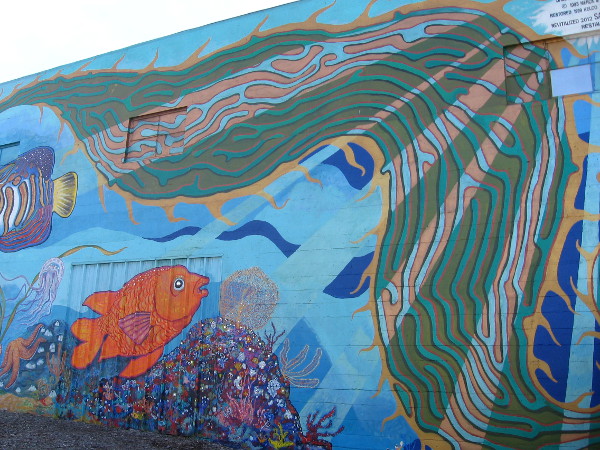
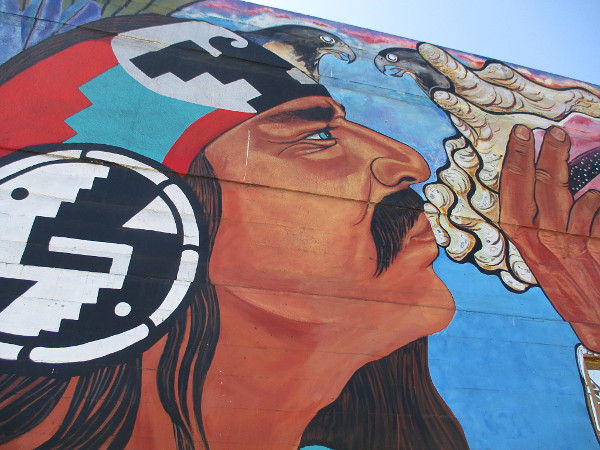
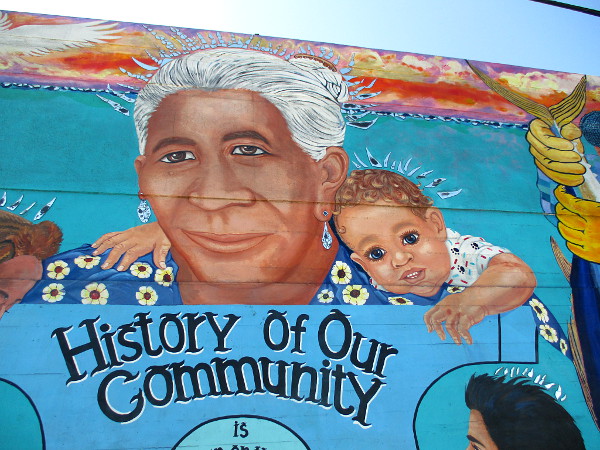
Long wall along Harbor Drive is the canvas for this very large street mural.Proximity to San Diego Bay inspires painted marine animals.This big fish seems to be watching for pedestrians on the Barrio Logan sidewalk.A scuba diver seems unaware a large hungry shark looms just behind!Mother with young child gazes out at the blue Pacific Ocean.People from all walks of life populate this very human work of art.San Diego Trolley travels through a scene similar to those found in nearby Chicano Park.Painted passengers on a trolley seem visible through a window.Aztec warrior in elaborate costume blows on a ceremonial conch.Nearby Chicano Park’s pavilion is shown with lots of folks dancing.Young man and lady dance on the festive outdoor mural.Musicians play instruments adding flavor to the celebration.History of Our Community includes the once vital tuna fishing industry.The lives of past and present residents provide generations of stories.Fish caught in local waters just off San Diego.The end of Harbor Drive section, and now we’ll turn west for a bit more…Walking around the mural on the high wall at Restaurant Depot.This north-facing wall contains lots of bright aquatic life!Beautifully painted fish, a seahorse, jellyfish and starfish.An orange Garibaldi just above the sparkling ocean bottom.Kelp frames the end of this long, amazing mural in Barrio Logan.This super fun street art is a landmark that is very hard to miss!
UPDATE!
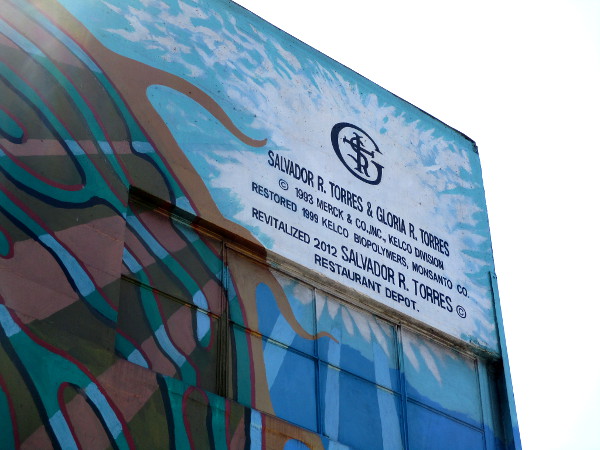
I learned years later (shame on me) that this 1993 mural is titled The Kelco Historical Community Mural, by artist Salvador Roberto Torres and his wife Gloria Rebolledo Torres. It was restored by Salvador Torres in 2012, which explains the scaffolding I had previously seen.
Salvador Roberto Torres is one of the founders of nearby Chicano Park, the largest collection of outdoor murals in the United States. He saw the great freeway pillars supporting the ramps to the San Diego–Coronado Bridge as potential concrete canvases, and so created the Chicano Park Monumental Public Mural Program in 1969. He was also one of the founders of the Centro Cultural de la Raza in Balboa Park.
During that later walk I took additional photos of the mural!
…
To enjoy future posts, you can “like” Cool San Diego Sights on Facebook, or follow me on Twitter.
Young man with skateboard paints for donations on a San Diego sidewalk.
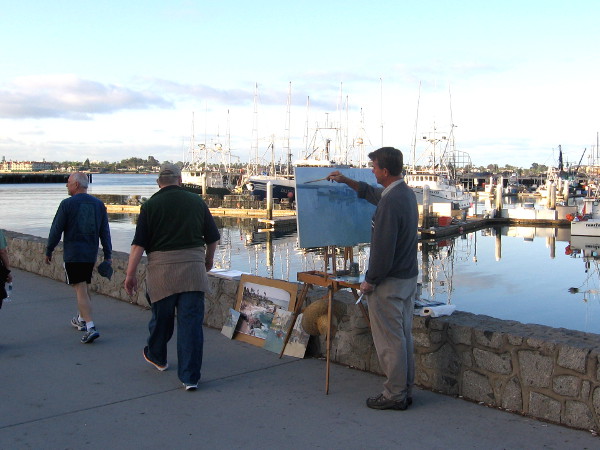
Once in a while my walks around San Diego take me past artists painting scenes from the big city. The artists might be working outside alone in a scenic or interesting place; or I might stumble upon a small crowd of art students working on many easels in a row. I love to pause and look over a shoulder for a few moments. I’m awed by human creativity.
Here are just a few pics that you might enjoy…
Artist in Balboa Park’s Spanish Village works on a canvas in the colorful courtyard.A painted guitarist seems to emerge from the sunny San Diego dappled brightness.An artist works next to Tuna Harbor as many people stroll past.Painter on the Embarcadero inspired by picturesque boats and reflections.Small painted boat seems to float in the nearby rippled water.
…
To enjoy future posts, you can “like” Cool San Diego Sights on Facebook. or follow me on Twitter.
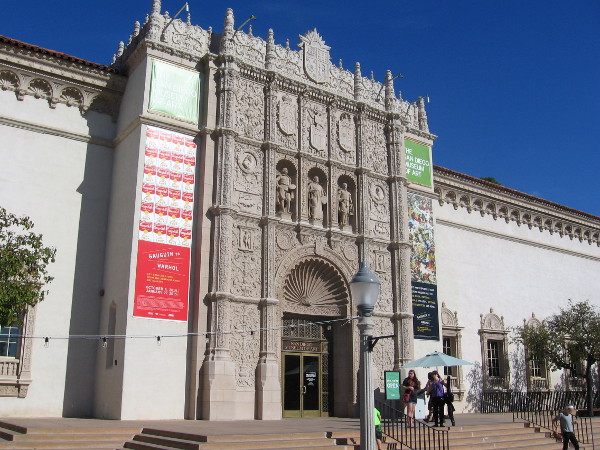
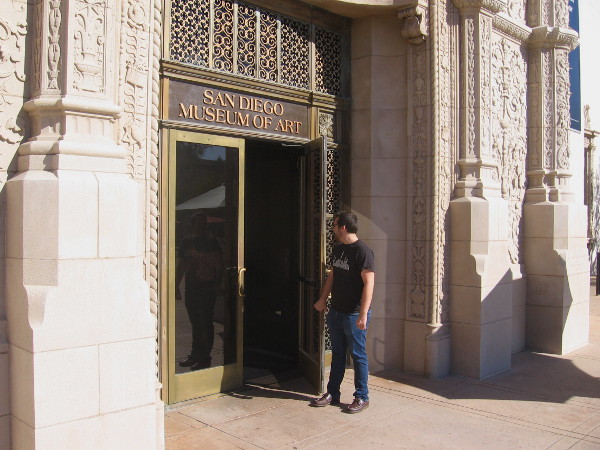
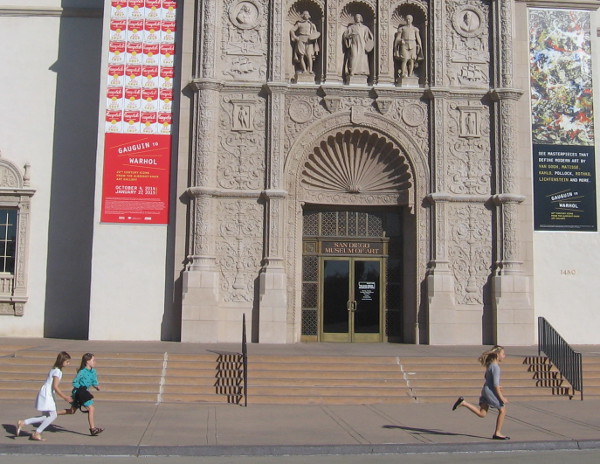
Visitors near entrance to the San Diego Museum of Art in Balboa Park.
Yesterday morning was super special. I was able to experience dozens of amazing fine art masterpieces firsthand!
My friend Catherine Jones, a docent at the San Diego Museum of Art in Balboa Park, very graciously provided me and a friend with a special tour. We were given an in-depth look at the landmark Gauguin to Warhol exhibit, being shown for a limited time in San Diego.
Follow me into the world-class San Diego Museum of Art, and we’ll check out a few of these stunning paintings together!
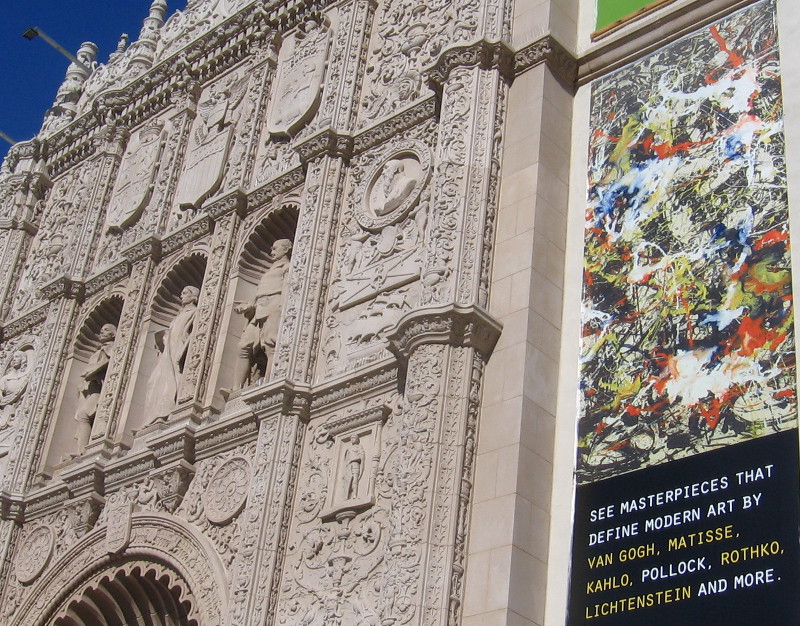
Masterpieces that define modern art by Van Gogh, Matisse, Kahlo, Pollock, and more…Step through this door to see an amazing exhibit of mind-blowing art!
Gauguin to Warhol: 20th Century Icons from the Albright-Knox Art Gallery is an exhibit containing dozens of true masterpieces from many of the world’s most famous modern painters. Artists with important pieces on display include Vincent Van Gogh, Pablo Picasso, Henri Matisse, Marc Chagall, Georgia O’Keeffe, Salvador Dalí, Frida Kahlo, Jackson Pollock and Roy Lichtenstein .
The exhibit is a whirlwind journey through time, progressing from Impressionism in the late 18th Century to Post-impressionism, Surrealism, Abstract Expressionism, Minimalism and finally Pop Art in the 1960s. One can follow the emergence and evolution of major art movements over eight decades–and observe how visual abstraction, experimentation and provocative simplicity took a greater and greater hold on the imaginations of many great artists.
These fantastic paintings all come from the Albright-Knox Art Gallery in Buffalo, New York. San Diego is the exclusive West Coast stop for this traveling exhibition.
(The following descriptions and reactions were formed in my own muddled human brain, and notes were taken only sporadically. I’m not even close to being an art expert, so take everything I say with a very large grain of salt!)
Paul Gauguin. Spirit of the Dead Watching,1892, courtesy the Albright-Knox Art Gallery.
A few steps after we admire a fine example of classic Impressionism, the 1890 Peasants in the Fields by Camille Pissarro, we are stopped in our tracks by a stunning masterpiece by Paul Gauguin. It’s the instantly recognizable Spirit of the Dead Watching, painted in 1892.
Spirit of the Dead Watching was created during Gauguin’s residence in Tahiti. It depicts his young wife Tehura, awakened by a frightening dream. A nightmarish figure with a mask-like face sits at the foot of her bed, seemingly a dark omen.
The bright, gauzy, fine daubs of paint of the earlier Impressionist movement seem to have given way to broad, unabashed swaths of rich color. The elements in this Post-Impressionist image appear two-dimensional; objects depicted seem to have become bold, emotionally colored symbols, rather than more-realistic objects given depth using traditional perspective.
The Spirit of the Dead Watching is both uniquely beautiful and disturbing, not unlike a few of the canvases to come on our tour.
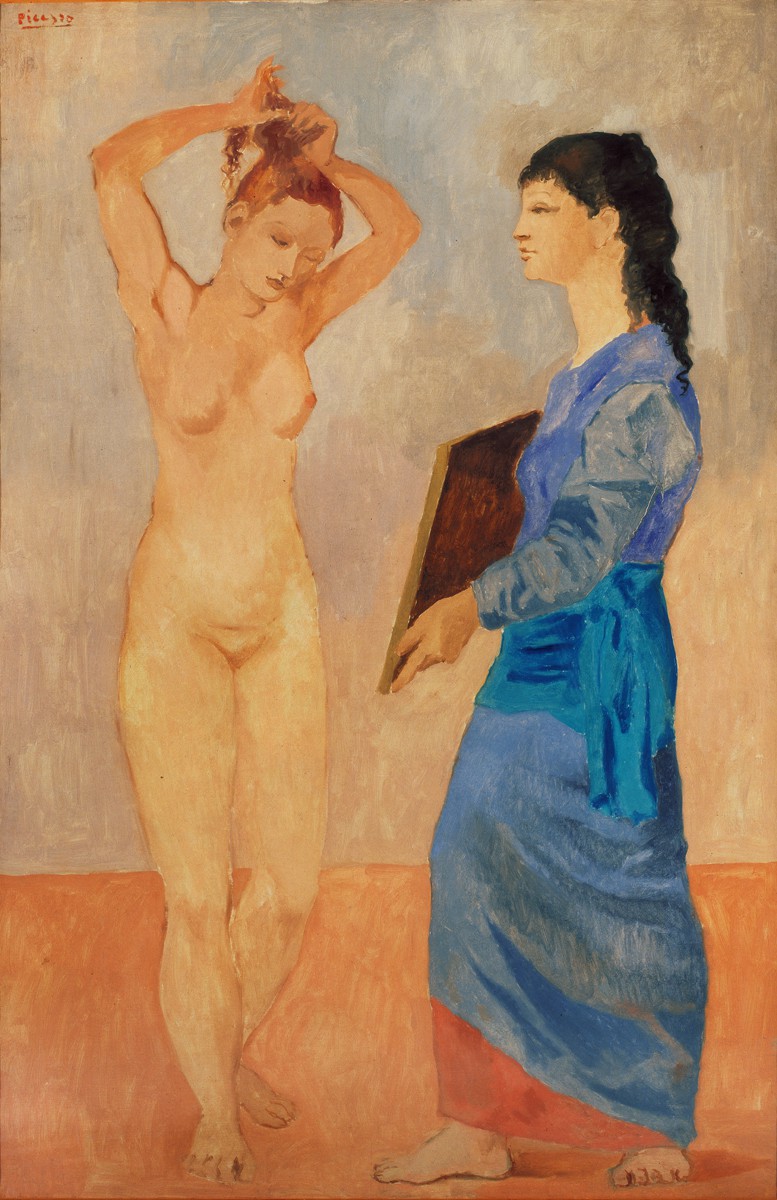
Pablo Picasso, La Toileete, 1906, courtesy the Albright-Knox Art Gallery.
Another few steps and we are looking at Pablo Picasso’s La Toilette, painted in 1906 just before his well-known innovations with Cubism.
The two women depicted are different views by Picasso of the same model. The painting seems to be mostly about lustrous, subtle color and soft, slightly angular shapes. It struck me that fusing the two figures, with their simple faces and forms, would result in a sort of Cubist composite creation. Perhaps we see the gears slowly turning in Picasso’s creative mind.
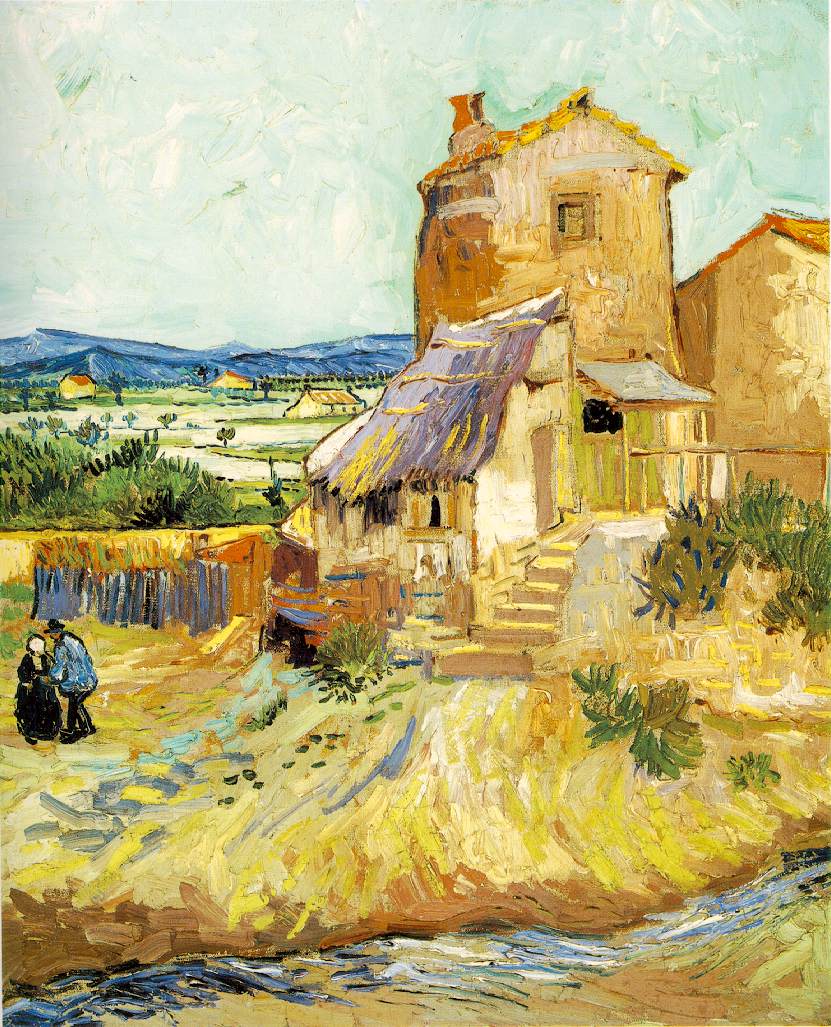
Vincent Van Gogh, The Old Mill, 1888, courtesy the Albright-Knox Art Gallery.
The masterpiece that I enjoyed most–because it’s just so indescribably magical–is Van Gogh’s The Old Mill, from 1888, another fine example of Post-Impressionism. Thick smears of paint and bold brush strokes of light give the painting strange depth and glowing solidity, in spite of its greatly simplified, almost crude representation of a country scene. I felt like I had entered a magical landscape, located somewhere between a gleaming dream and a warm, everyday experience. To me, it’s a piece of art that would never grow old.
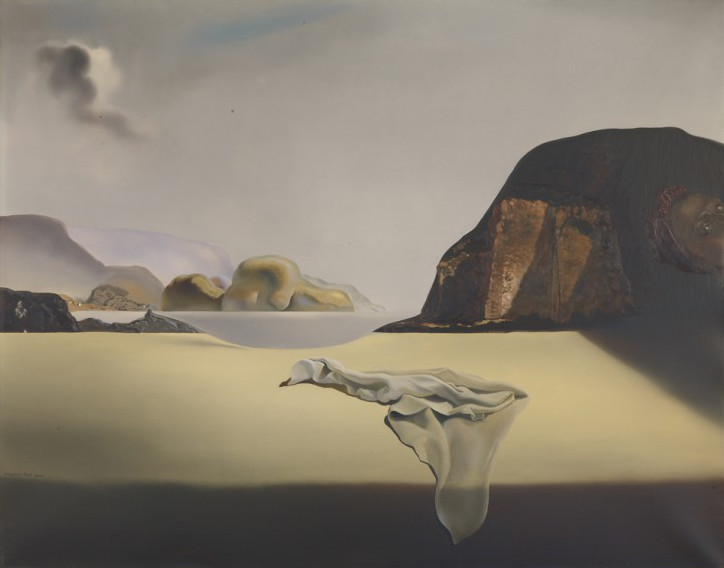
Salvador Dalí, The Transparent Simulacrum of the Feigned Image, 1938, courtesy the Albright-Knox Art Gallery.
Here we see the emergence of Surrealism. And this masterpiece is by the ever popular Salvador Dalí!
The Transparent Simulacrum of the Feigned Image, 1938, is one of Dalí’s most iconic works. It’s mysterious, strange and stimulates thought. What do the various elements in the design represent? Is that a bowl of mashed potatoes with gravy on a table with a napkin, or is that a lake nestled between mountains? The onlooker isn’t quite sure if the painting is primarily fun or symbolic, or a depiction of the unconscious, or sublime reality. Abstraction has surely taken hold of the artist’s vision, as the scene is a complete departure from ordinary experience.
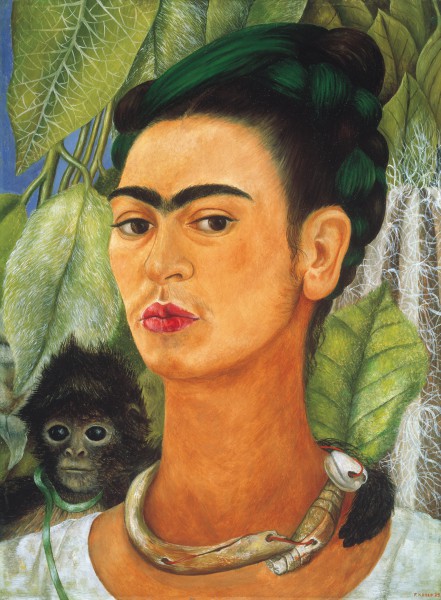
Frida Kahlo, Self-Portrait With Monkey, 1938, courtesy the Albright-Knox Art Gallery.
Mexican artist Frida Kahlo’s impressive Self-Portrait With Monkey, painted in 1938, is said to be Surrealist. To me it appears more like a beautifully colorful Post-Impressionist Gauguin. According to Wikipedia: “Frida rejected the “surrealist” label; she believed that her work reflected more of her reality than her dream.”
Gazing at this one portrait, I understand her assertion. Apart from one canvas in the exhibit, a depiction of fleshy, bloody butchered meat, this painting seems more solidly lifelike and ripe with organic truth than any other work that I recall seeing.
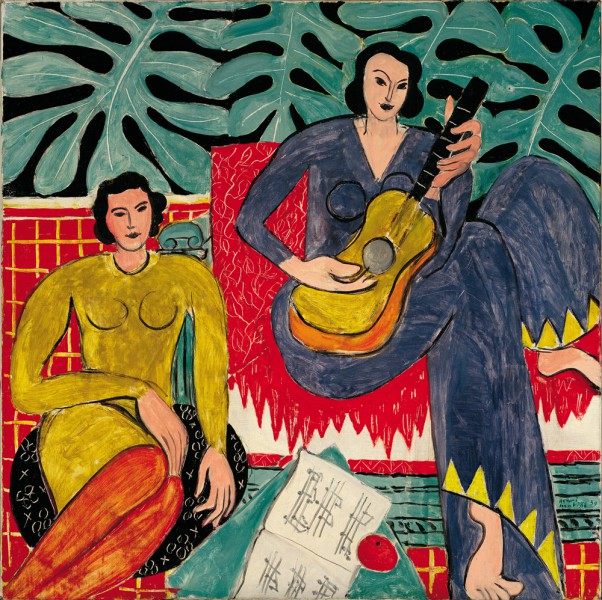
Henri Matisse, La Musique, 1939, courtesy the Albright-Knox Art Gallery.
I also love this one! La Musique, by Henri Matisse in 1939, is the sort of joyful, broadening, invigorating style of art that I personally like. Catherine pointed out that the lady on the left is very prim and composed, but the wild lady on the right is the type you’d want to date! Exactly right! The hands and feet are wonderfully twisted and elongated as if they’re swimming within splashes of swirling color and music!
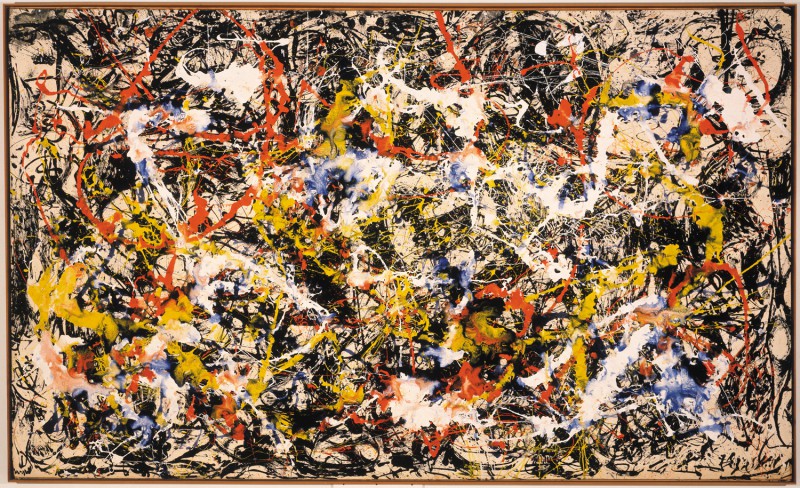
Jackson Pollock, Convergence, 1952, courtesy the Albright-Knox Art Gallery.
Jackson Pollock today is recognized as a master of Abstract Expressionism. His unique drip paintings are unmistakeable. And his Convergence from 1952 nearly covers an entire museum wall!
Okay, perhaps I’m an ignoramus and a dullard. To me this style of painting seems a bit random, cynical, and a thumb in the eye of earlier, more skillful artistic styles. Several of the canvases in this portion of gallery struck me in a similar way. The absurdly huge creations of these famous Abstract Expressionists seem more than experimental–they seem despondent, angry, nihilistic and disillusioned–perhaps a reaction to the massive chaos and inhumanity of two world wars in the early 20th Century. But I do appreciate Pollock’s artful balance, his dynamic strands of color, and the peculiar, imposing beauty that has resulted!
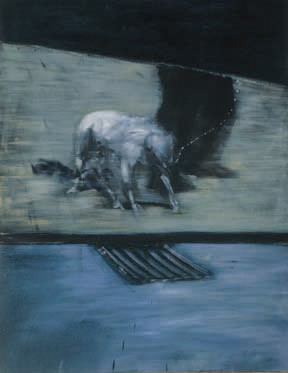
Francis Bacon, Man With Dog, 1954, courtesy the Albright-Knox Art Gallery.
Here’s one painting that is absolutely disturbing. It’s the sort of thing you’d expect to see in a short horror story by Poe, or above the mantle in a cobwebby haunted house! As if penetrating the dark recesses of the human subconscious, Francis Bacon’s unsettling Man With Dog, 1954, seems to portray the bottom of a shadowy figure being resisted by a featureless, spectral hound attracted to a sewer grate. This painting definitely succeeds in bringing out a strong feeling of unfocused loathing. If the aim of art is to stir the emotions, this piece is triumphant!
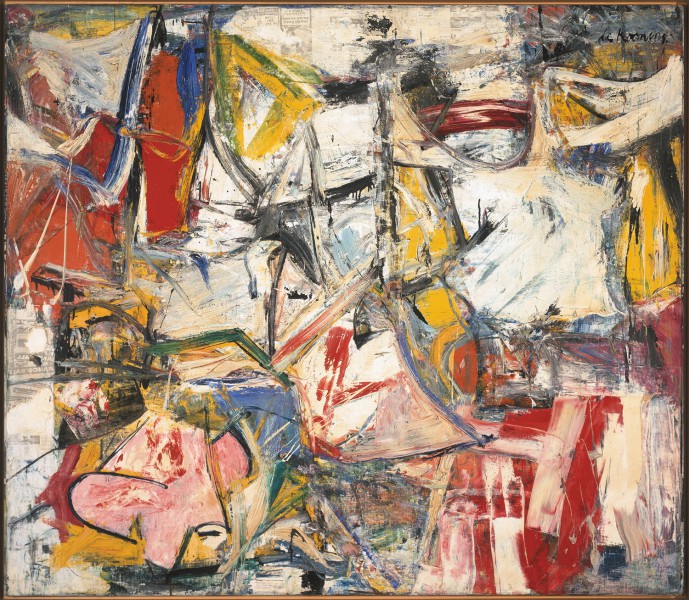
Willem de Kooning, Gotham News, 1955, courtesy the Albright-Knox Art Gallery.
A manic jumble of impulsive, uncertain emotions in two dimensions seems to compose Willem de Kooning’s Abstract Expressionist Gotham News, completed in 1955. Flesh tones and slightly organic shapes are intermixed with the angled, heavy lines of a large city’s architecture, looking to my eye like stained glass put into a blender. Energy and spasmodic randomness seem to convey no clear artistic notion, nor rouse any one particular emotion. It’s just a big mixture of complex energy! Perhaps that was the artist’s intent!
Andy Warhol, 100 Cans, 1962, courtesy the Albright-Knox Art Gallery.
An Andy Warhol response to modernism, his iconic 100 Cans was painted in 1962. Since then, the Pop Art image of multiple Campbell’s Soup cans has spread and mutated throughout the popular culture.
Is this painting a celebration of unrepentant commercialism, or a resigned condemnation? Is he asking the fundamental question: What is art? Or is it just his affirmation that an increasingly technological and global culture has changed life forever, and that art has become something of a commodity? I’ve heard arguments on every side.
The original painting is hanging on a wall at the San Diego Museum of Art! See it for yourself and decide!
The amazing Gauguin to Warhol exhibit runs in San Diego through January 27, 2015.
This truly special, eye-opening exhibit, Gauguin to Warhol, can be enjoyed at the San Diego Museum of Art through January 27, 2015.
It might be a once-in-a-lifetime opportunity to really appreciate these many great masterpieces. If you can, go see it!
…
To enjoy future posts, you can “like” Cool San Diego Sights on Facebook, or follow me on Twitter.
Adventure is out there! Just attach a bunch of balloons!
Okay, here’s a quick pic of some rather simple street art. I saw this colorfully painted utility box while walking up Bankers Hill a few days ago.
I love the symbolism in the image. A riot of small uplifting balloons whisking one’s home and carefully controlled life away on a carefree, restoring breeze was a theme that I really enjoyed in the Pixar movie Up!
Tomorrow I’m planning on a long walk. No telling where my legs will take me!
…
To enjoy future posts, you can “like” Cool San Diego Sights on Facebook, or follow me on Twitter.
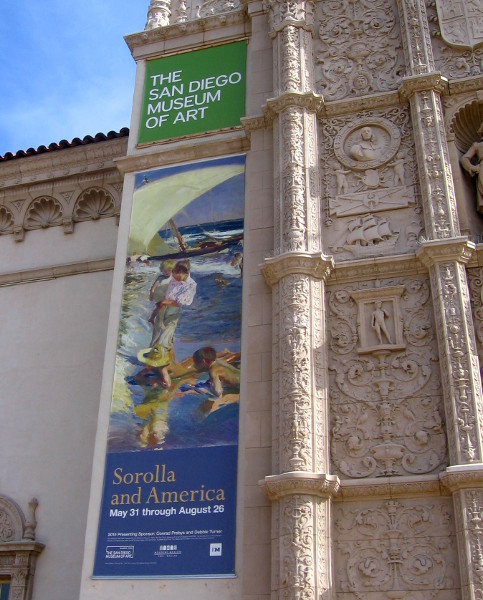
Sorolla and America special exhibit at San Diego Museum of Art.
Light is the physical means by which my eyes see. But I often don’t see true light.
Light is a mixture of myriad colors. But I often don’t see those many colors.
Yesterday I was struck by a few small touches of rare light. My eyes widened with astonishment during a few joyful, delicious moments of revelation.
I was very fortunate and privileged to be a given a special tour of the amazing Sorolla exhibition at the San Diego Museum of Art in Balboa Park. Catherine Jones, a docent at the museum, provided an excellent introduction to the light-dabbed paintings of a very important artist that the world has often overlooked.
Joaquín Sorolla y Bastida was a Spanish post-Impressionist painter who won several major art awards and popular fame while he lived, but who soon became forgotten with the advent of the modern abstract movement in the early twentieth century. His stylistically varied and often unusually angled images contain applications of light like I’ve never before seen. Bits of reflection and exquisite luster, and sheens of revealed color, pulled me into a world where the true essence of a subject seems to shine out like magic, but in a very natural way.
I could have gazed at his emotionally stirring, always fascinating paintings for the entire day!
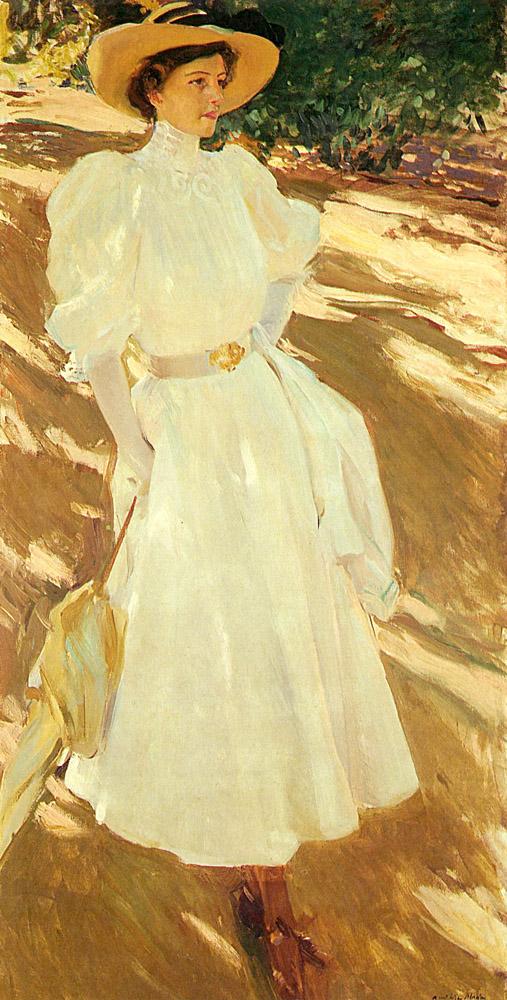
María at La Granja, courtesy San Diego Museum of Art.
The above painting, María at La Granja, was painted by Sorolla in 1907. In it you can see Sorolla’s famous application of light. The piece was donated to the San Diego Museum of Art in 1925 by Archer Huntington, philanthropist and founder of The Hispanic Society of America. The very first work of art to enter the collection, today María at La Granja is probably the most recognized image in the entire museum.
Joaquin Sorolla’s Portrait of President Taft, courtesy of Wikipedia.
Joaquin Sorolla’s Portrait of President Taft was commissioned by the president in 1909. It is one of many canvases in a special exhibit at the San Diego Museum of Art assembled from museums throughout the world. Most of Sorolla’s important works are present, including Another Marguerite (1892), which was awarded a gold medal at the National Exhibition in Madrid and first prize at the Chicago International Exhibition, and Sad Inheritance (1899), which was awarded the Grand Prix and a medal of honor at the Universal Exhibition in Paris in 1900, and the medal of honor at the National Exhibition in Madrid in 1901.
The two paintings that I’ve posted here hardly do justice to the full range of Sorolla’s splendor. His sun-splashed scenes of beach life in Valencia, his diverse and stunning portraits, his detailed scenes of life in Spain, all the essence and astonishing light that he captured, must be experienced firsthand to be most fully appreciated.
These works by Sorolla are on display for a limited time at the San Diego Museum of Art. If you can, you really should go see them! The special exhibition ends August 26, 2014.
…
To enjoy future posts, you can “like” Cool San Diego Sights on Facebook, or follow me on Twitter.
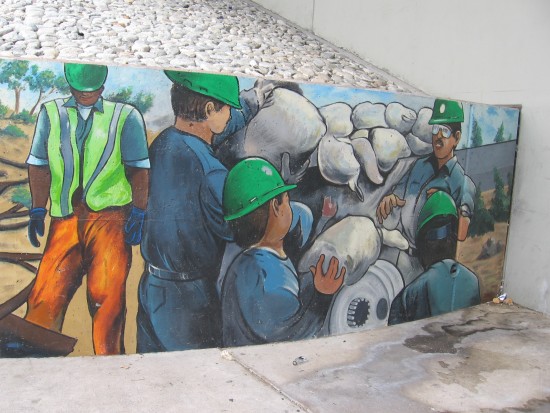
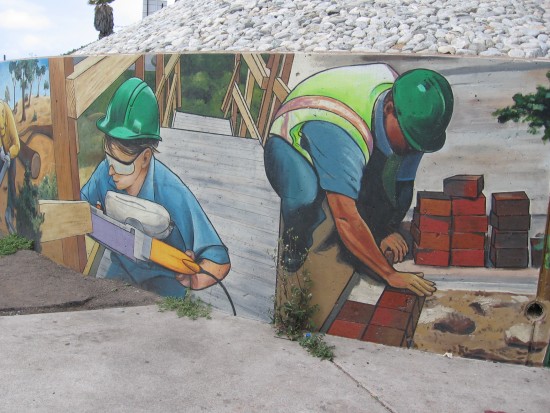
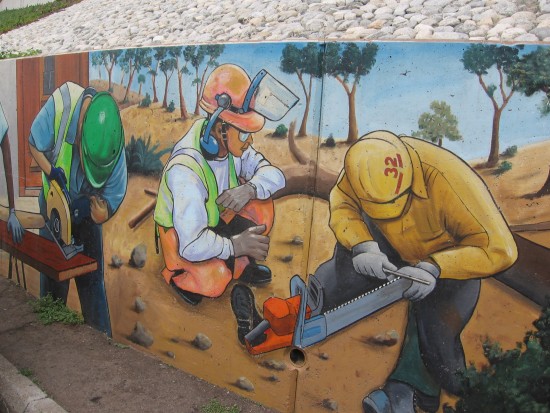
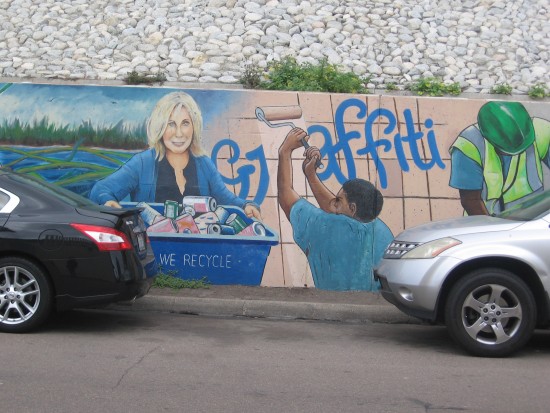
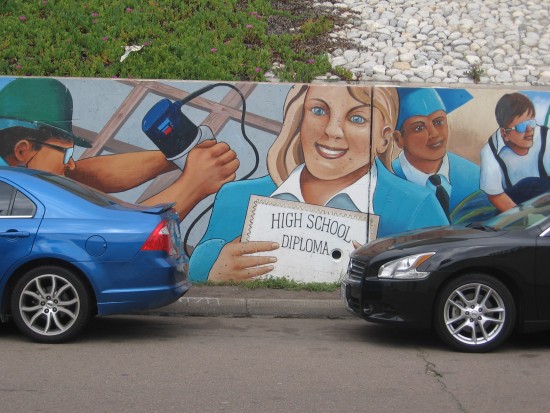
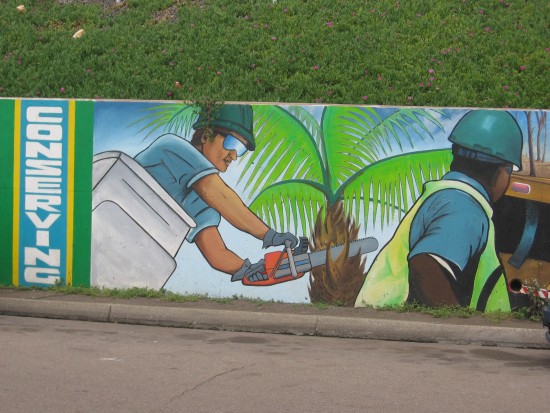
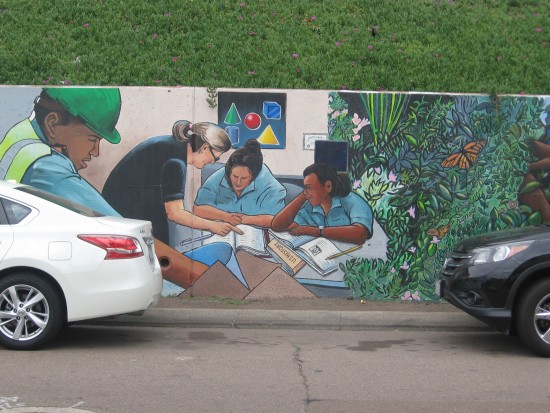
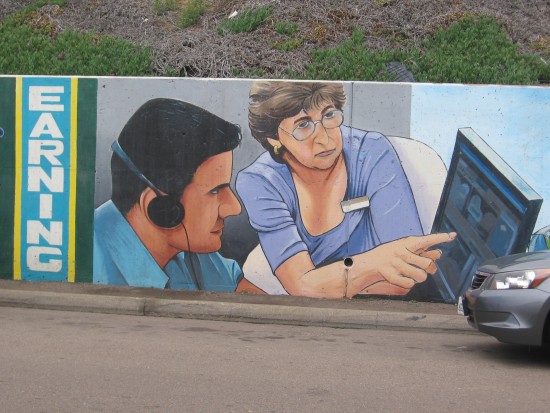
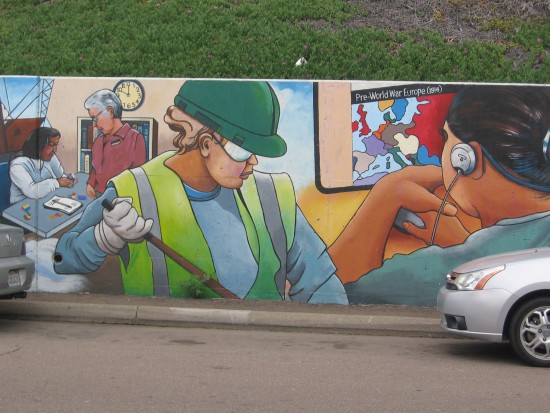
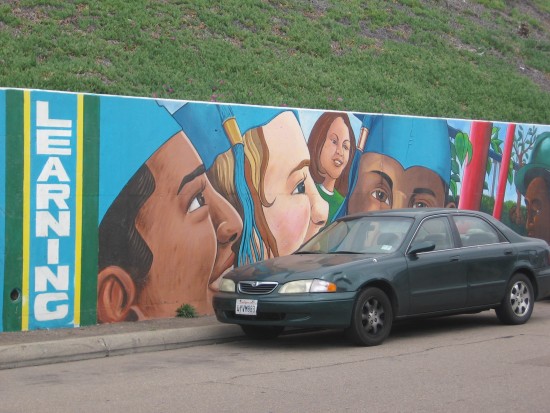
South end of long Urban Corps mural on Jefferson Street.
San Diego’s Urban Corp is a nonprofit dedicated to providing a high school education and green job training to young adults. Whenever I ride the trolley to work, I usually see a number of youth in green uniforms disembarking at the Old Town station. They’re heading off to begin another day developing new skills, while working to improve San Diego’s environment.
A long, colorful mural was recently painted along Jefferson Street, right across from the Urban Corps. You can find this public art near Rosecrans at Interstate 5.
Here are some pics I took as I walked north!
Mural depicts youth bettering San Diego’s environment.Urban Corps provides valuable employment training.Eliminating graffiti is one important activity.Youth have a second chance to earn a high school diploma.Urban Corps mural shows conservation efforts.Education is the key to moving forward to success.Young people have an opportunity to earn a paycheck.Segment of Urban Corps mural near Rosecrans and Jefferson.Optimism and opportunity on a long, colorful mural.

































 Cool San Diego Sights!