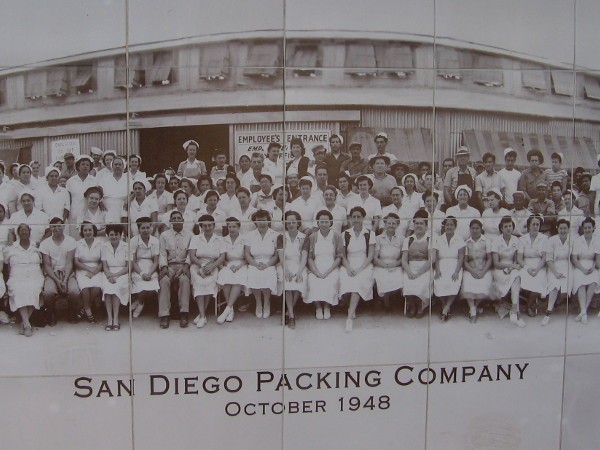
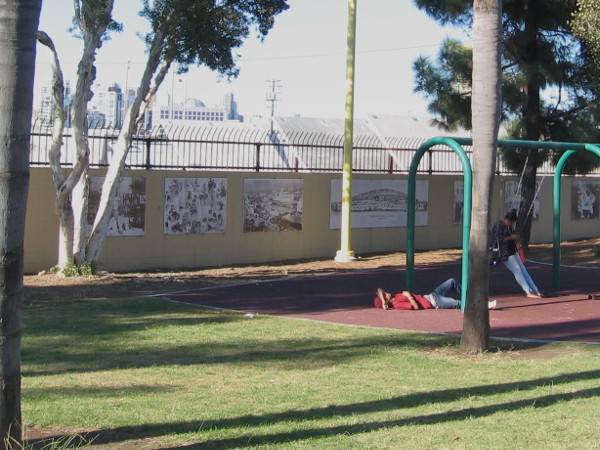
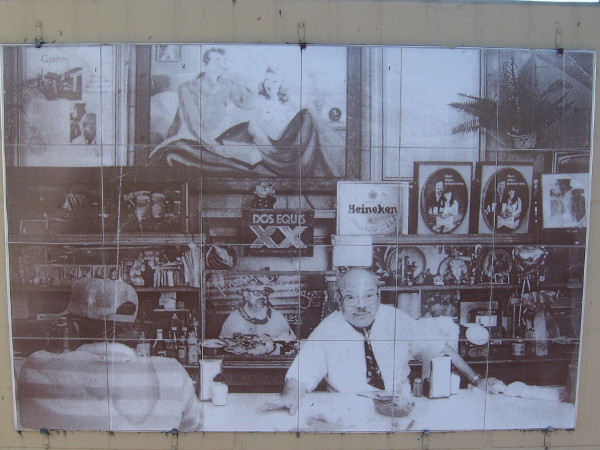
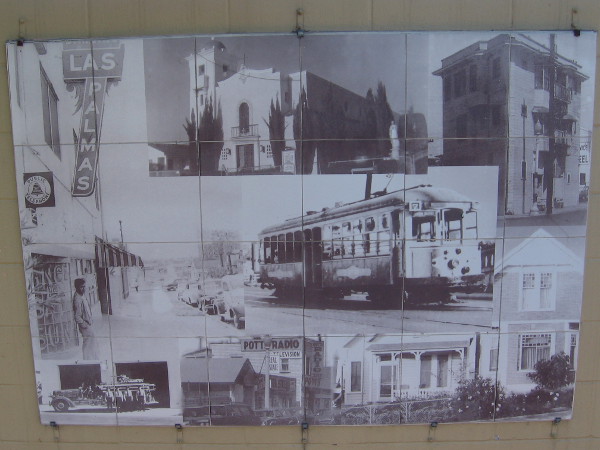
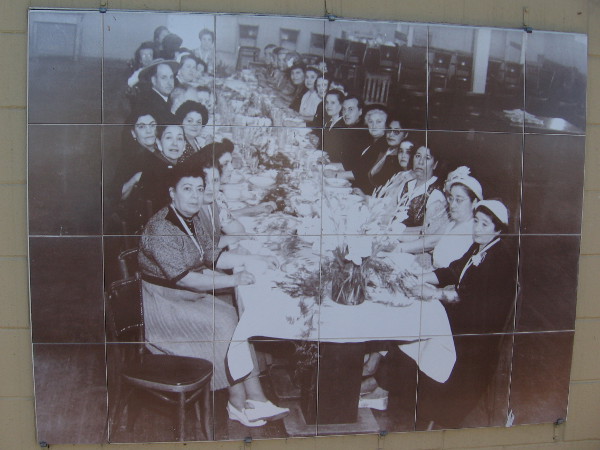
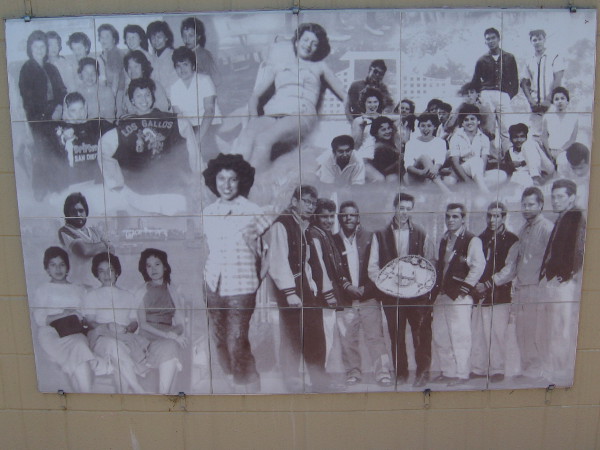
Close-up photo of one tile panel in a long mural, which is located on a wall near the Cesar Chavez Park playground in Barrio Logan.
Relatively few people know about a fascinating mural in Barrio Logan. Dedicated art and history lovers can find it at the very edge of San Diego’s beautiful bay, between the Tenth Avenue Marine Terminal and the base of the Coronado Bridge.
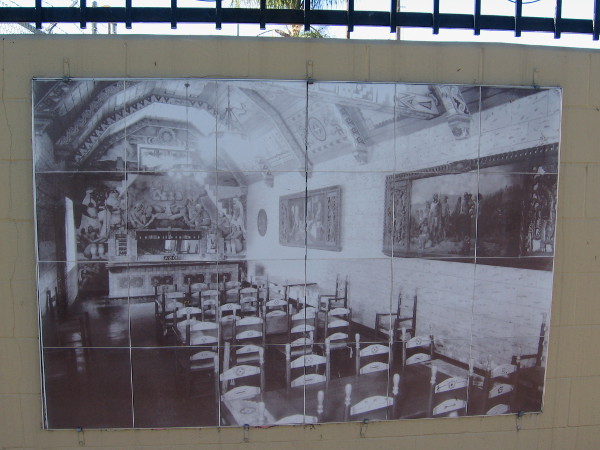
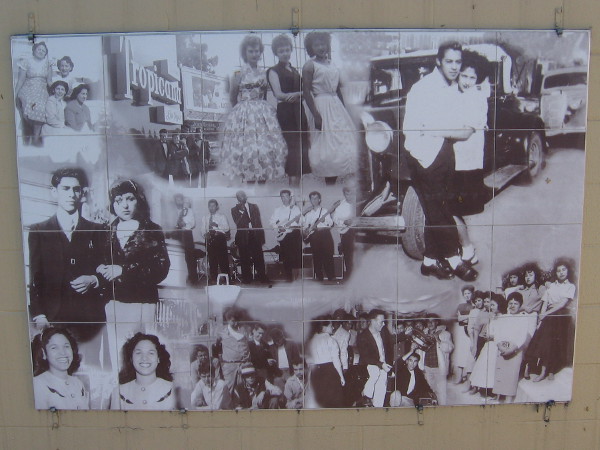
The mural is located in Cesar Chavez Park, on a long wall just north of the playground. Created by Dale Marsh/Tile Artisans, it consists of eleven ceramic tile panels depicting half a century of local history–from the 1900s to the 1950s–through the use of vintage photographs. Images fondly remember the day-to-day life many San Diegans in this predominantly Mexican American neighborhood experienced while growing up and working on our busy waterfront.
A brief description of each panel is contained in a nearby plaque also composed of tiles. I’ve transcribed most of the words and have used them in my photo captions.
Looking north past the Cesar Chavez Park playground at an interesting public mural that depicts local history.Descriptions of the eleven panels in the mural, which depicts Logan Heights in its Golden Years, 1900 through 1959.Aztec Brewery Art Ensemble adorned the ceiling and walls of the Rathskeller and Beer Tasting Room of the brewery in the early to mid 1900s on Main Street.Hoop skirts, 1932 Model T car with rumble seat and white 1936 Ford, Metro Theater usherette twins, model parents of the era, neighborhood Rhythm and Blues bands and their followers.Papa Chuey founding proprietor of Chuey’s Restaurant cashed checks and provided credit accounts for fishermen and cannery workers in hard times.Nifty Fifties teen scene in “The Heights” spotlights Physical Education class, jitterbug dancing and positive socialization. Friendship was a true binding factor among teenagers.Tuna boats filled with tired fishermen arrived at the tuna canneries bringing work for hopeful dockworkers and cannery workers. Their arrival meant livelihood for countless families.This 1948 Cannery Workers group photo depicts the numbers and spirit of the work force of the various canneries of San Diego’s Cannery Row.The “Leona C – San Diego” fishing crew portray the faces of the hard working men who in turn provided for numerous jobs for entire communities.Logan Heights landmarks include the street car at 5 cents per ride . . . the beautiful earlier architecture of Our Lady of Guadalupe Church and Las Palmas nightclub . . .Community social groups fostered a healthy and happy neighborhood where age gaps did not exist. Neighbors watched out for each other and provided a safety net for the youth.Teen social clubs such as Los Gallos, Los Chicanos and the Drifters comprised the Southeast Youth Council, which was sponsored by the Old Neighborhood House.Neighborhood House provided many community programs including Rondalla musical groups for women. Lupita, far right first row, is a legend in Logan Heights.
…
Follow this blog for more photos of interesting San Diego stuff! Join me on Facebook or Twitter.
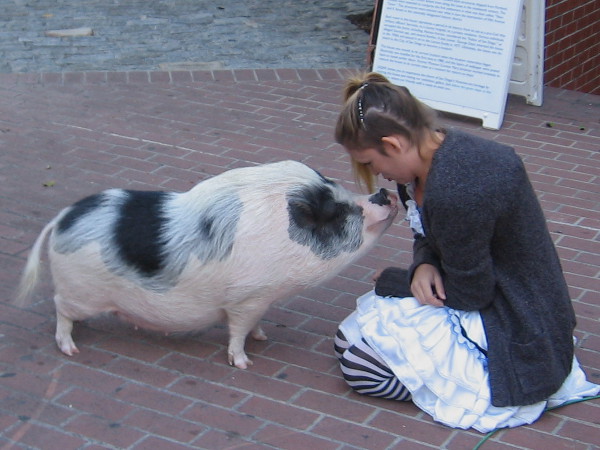
Lady promoting San Diego’s upcoming Fall Back Festival goes nose to nose with a friendly hog.
In two days a large number of characters from the Old West will be roaming the streets of modern San Diego. During the Fall Back Festival, which takes place this Sunday, November 8, between 11 and 4, several blocks of the Gaslamp Quarter will be transformed into a 1880s frontier town!
Visitors to the free event will be able to enjoy all sorts of historical exhibits, not to mention a saloon, a penny candy store, a town jail, hay and pony rides, panning for gold, butter churning, candle dipping, and a Wild West Show! Wow! I went last year and it was a lot of fun!
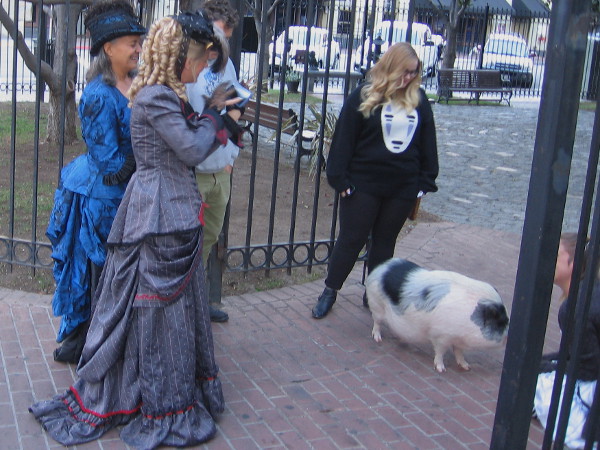
During my walk this morning I happened upon some folks promoting the event for the local NBC television news station. They were hanging out near the entrance to the William Heath Davis House Museum. Sneaky me… I took some pics!
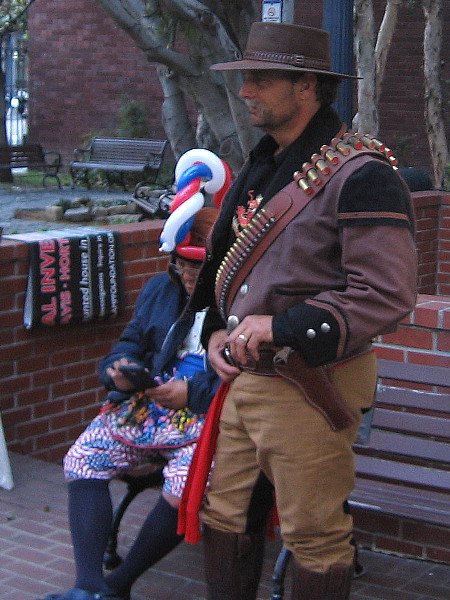
Ladies in frilly dresses linger between television shoots promoting San Diego’s Fall Back Festival. The annual event, which takes place near the William Heath Davis House Museum, will recreate a 1880s frontier town.A tough Western character hangs out with a silly balloon twister. This bench is beside the historic William Heath Davis House in downtown San Diego.Two gentleman from the Old West converse on Fourth Avenue sidewalk in San Diego’s modern Gaslamp Quarter.
…
Follow this blog for more photos of cool stuff! Join me on Facebook or Twitter.
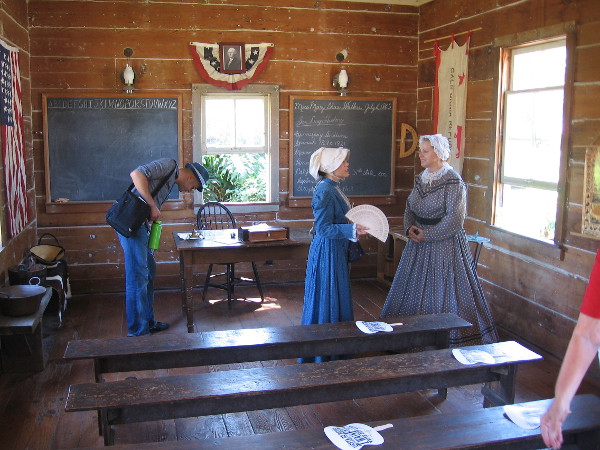
Gentleman in period attire tells visitors at Old Town San Diego State Historic Park about the history of the Mason Street School.
The Mason Street School was San Diego’s very first schoolhouse. It was built in 1865. In 2015, 150 years later, it’s one of the most interesting sights in Old Town San Diego Historic State Park.
The one room schoolhouse museum isn’t always open to the public. So whenever I walk through Old Town, I eagerly wander past to see if the front door is swung wide. If it is, I amble inside and look about, trying to absorb what life was like in the early days of San Diego.
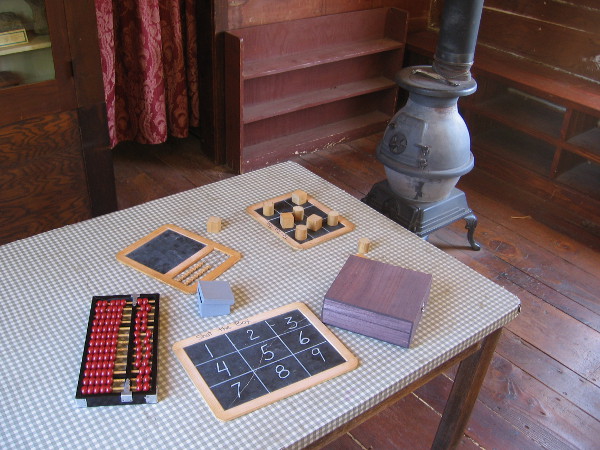
I remember how the Mason Street School used to contain numerous desks. But they’ve been replaced by plain benches, to more accurately portray where a small number of students from Spanish, American and other diverse backgrounds, grade one to eight, sat together and learned how to read, write and do arithmetic.
Back in the early years of San Diego, school was held twelve months a year. Hours were 9 to 4, but many students would skip school to watch bull fights, fiestas and other exciting town doings. Many children were held out of school by their parents to help on a ranch or farm, or to work in a family store.
San Diego in 1865 was a small, isolated, somewhat ramshackle town. Mary Chase Walker, Mason Street School’s first teacher, wrote when she arrived in San Diego by steamship: “I arrived in the bay of San Diego on the morning of July 5, 1865. It was a most desolate looking landscape. The hills were brown and barren; not a tree or green thing was to be seen. Of all the dilapidated, miserable looking places I had ever seen, this was the worst. The buildings were nearly all of adobe, one story in height, with no chimneys. Some of the roofs were covered with tile and some with earth…”
Mary Chase Walker originally traveled from Massachusetts to California, in search of greater opportunity. While in San Francisco, she learned of a teaching opening in San Diego. After less than a year at the Mason Street School, however, she became embroiled in a local controversy. One day she made a kind gesture to a lady who was part African-American, but many early San Diegans had arrived from the Confederate South and voiced their disapproval. A number of students were removed from the small school in anger. To allow the scandal to pass over, Mary quit teaching and married the president of the school board, early San Diego settler and prominent merchant Ephraim Morse.
It’s hard in modern times to imagine the life and culture of San Diego long ago. But one can get a flavor of that fascinating history by stepping inside the old Mason Street School.
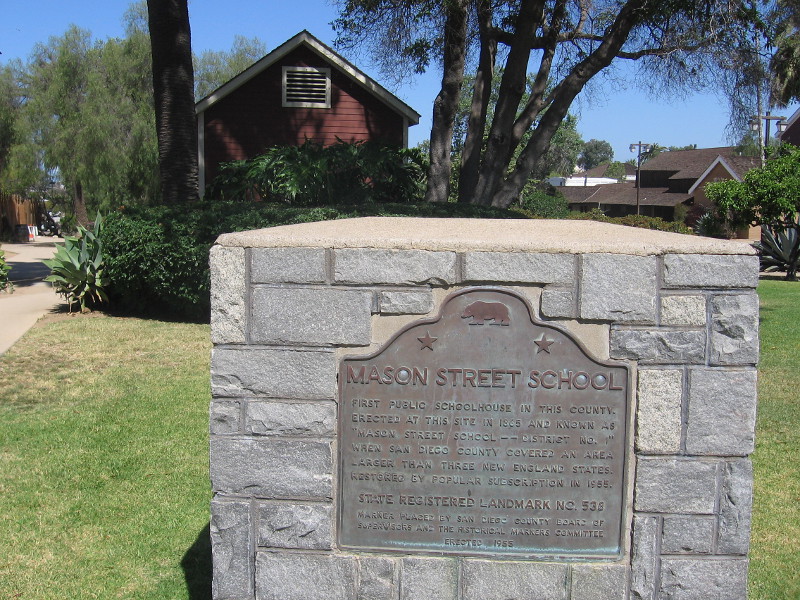
The Mason Street School was built in 1865, to provide education for the children of a sparsely populated San Diego.The first schoolhouse in San Diego County, the Mason Street School stands in historic Old Town.
The nearby plaque reads:
MASON STREET SCHOOL
FIRST PUBLIC SCHOOLHOUSE IN THIS COUNTY.
ERECTED AT THIS SITE IN 1865 AND KNOWN AS
“MASON STREET SCHOOL – – DISTRICT NO. 1”
WHEN SAN DIEGO COUNTY COVERED AN AREA
LARGER THAN THREE NEW ENGLAND STATES.
RESTORED BY POPULAR SUBSCRIPTION IN 1955.
STATE REGISTERED LANDMARK NO. 538
MARKER PLACED BY SAN DIEGO COUNTY BOARD OF
SUPERVISORS AND THE HISTORICAL MARKERS COMMITTEE
ERECTED 1955
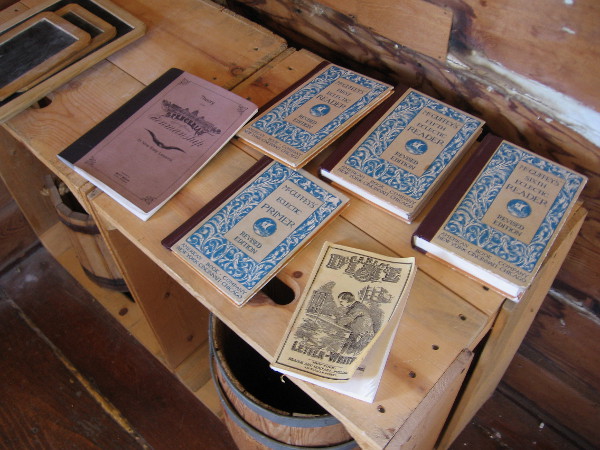
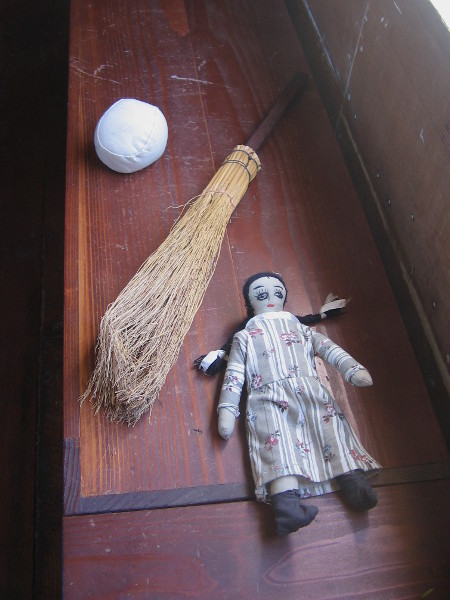
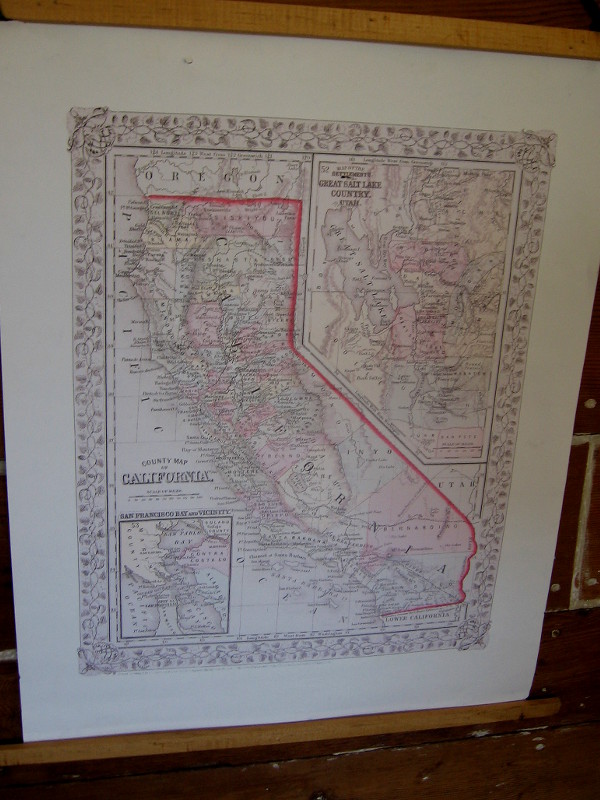
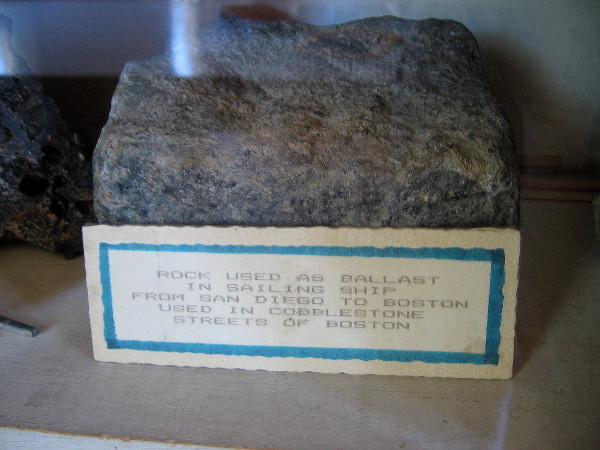
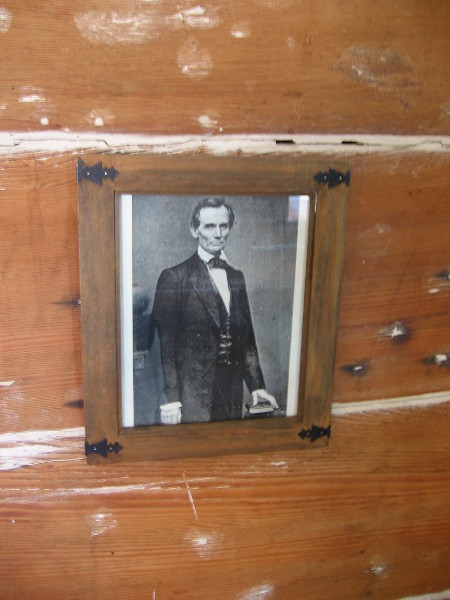
The Mason Street School museum is occasionally open to the public. If you’re lucky and it is, make sure to step inside!Years ago, the museum contained individual student desks. But these benches are a more faithful representation of actual history. Fancy desks were rare in this remote outpost of civilization!Children attending the Mason Street School used slates and chalk, as paper was also scarce and expensive. A wood stove provided heat.Some old Primers and Readers on a wooden table. A water bucket and dipper were used for drink.A ball, broom and doll.Public School Teacher’s State Certificate from the mid 19th century. San Diego’s first teacher was Mary Chase Walker.Old map of California from an era when many immigrants arrived by ship.Rock used as ballast in a ship that sailed from San Diego to Boston. Stones gathered on Ballast Point in Point Loma paved many of Boston’s cobblestone streets, 3000 miles away!Photographic portrait of President Abraham Lincoln on a primitive wall. Mason Street School was San Diego’s first schoolhouse, built in 1865 at the end of the Civil War.Water for washing and drinking was brought in from a well near the schoolhouse.The old well in the schoolhouse yard, beside a clump of prickly pear.The Mason Street School provides visitors to Old Town San Diego State Historic Park a fascinating look at our city’s very unique past.
…
Follow this blog for more San Diego history and photos of cool stuff! Join me on Facebook or Twitter.
Molten bronze is poured in the foundry of the USS Ajax. Historical photograph of the Navy Bicentennial Commemorative Plaque being created. Photo credit: United States Navy.
A few days ago I received new information about an important bronze plaque, which was created in 1975 to commemorate the United States Navy’s 200 year anniversary. The historic Navy Bicentennial Commemorative Plaque stands today on San Diego’s Embarcadero, on the Greatest Generation Walk next to the USS Midway Museum. Thousands of people breeze past it every day.
People pass the Navy Bicentennial Commemorative Plaque, displayed on the Greatest Generation Walk near the USS Midway Museum. Photo taken October 17, 2015.Photo of Navy 200 year commemoration plaque courtesy the Port of San Diego.
When I first saw the old plaque, I could find absolutely nothing about it on the internet. So I originally posted this blog. As new information trickled in–sometimes out of the blue–I posted this and this.
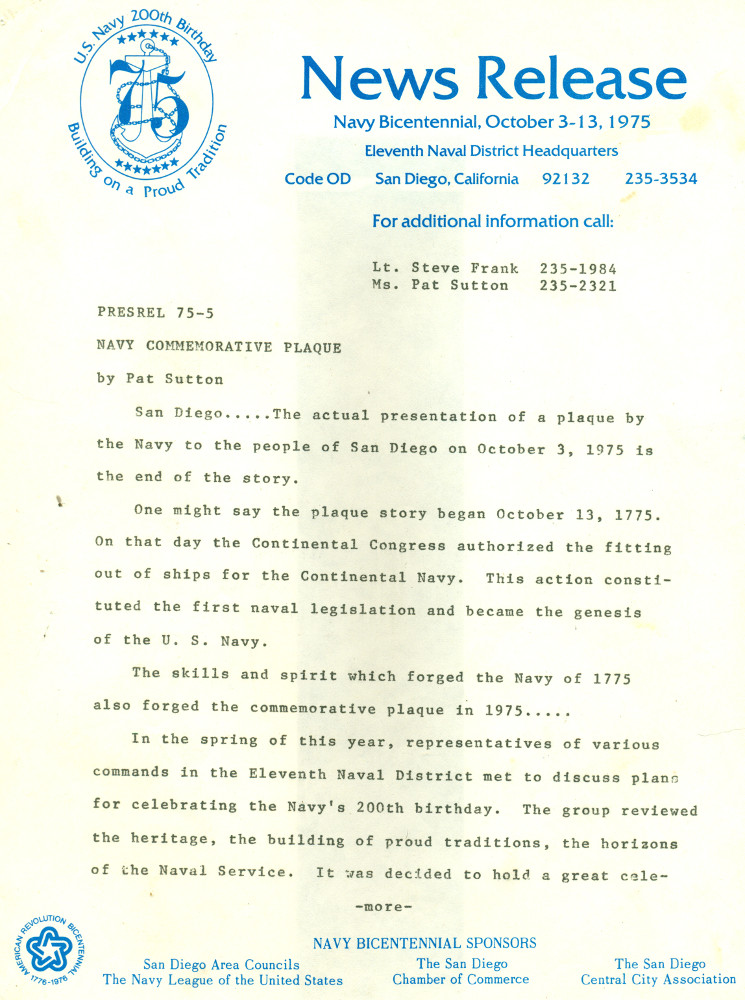
I was recently contacted by one of the plaque’s creators. He has provided detailed information about its history, including three amazing photographs and nine scans of a typed News Release from 40 years ago. The text of the News Release does not appear online, so I carefully transcribed the words. That way a very important bit of San Diego and Navy history won’t be lost.
(I tried to transcribe exactly, including possible misspellings. I’m not certain about the spelling of some names in the photo captions.)
If you know more about this plaque and would like to add some information, please leave a comment below. If you’d like to contact me, but don’t want to have your comment published, then please tell me that and I’ll email you.
Navy Commemorative Plaque News Release. Navy Bicentennial, October 3-13, 1975. Page 1.
NAVY COMMEMORATIVE PLAQUE
by Pat Sutton
San Diego . . . . . The actual presentation of a plaque by the Navy to the people of San Diego on October 3, 1975 is the end of the story.
One might say the plaque story began October 13, 1775. On that day the Continental Congress authorized the fitting out of ships for the Continental Navy. This action constituted the first naval legislation and became the genesis of the U. S. Navy.
The skills and spirit which forged the Navy of 1775 also forged the commemorative plaque in 1975 . . . . .
In the spring of this year, representatives of various commands in the Eleventh Naval District met to discuss plans for celebrating the Navy’s 200th birthday. The group reviewed the heritage, the building of proud traditions, the horizons of the Naval Service. It was decided to hold a great celebration
Navy Commemorative Plaque News Release. Navy Bicentennial, October 3-13, 1975. Page 2.
to honor the Navy, its members past and present, the nation and San Diego – so long a part of the life, the heritage and tradition of the Navy.
The plaque story developed in an uniquely traditional Navy way. The Navy’s microcosmic capabilities began to surface and swing into action.
Civilian Mrs. Jo Palm is the Visual Information Specialist for the Commander Naval Surface Force, Pacific. She also chaired the Navy Bicentennial exhibits committee. Jo conceived the idea that there should be some lasting remembrance of the occasion for the people of San Diego – perhaps a commemorative plaque would be appropriate.
Civilian Francisco (Cisco) Lopez is a designer with the General Atomic Company of San Diego. He is also a First Class Draftsman in the Navy Reserve. Tall, 28-years-old, Cisco is a 12-year Navyman, combining four years active duty with eight years in the Reserve. Last June he served his annual two weeks active duty in the Naval Surface Force Public Affairs graphics shop, reporting from his Reserve Unit with the Fleet Intelligence Center, Pacific.
“Jo told me her idea and we decided I should design something depicting 200 years of Navy history – along the lines of a plaque, but not like the usual plaque.”
Navy Commemorative Plaque News Release. Navy Bicentennial, October 3-13, 1975. Page 3.
Cisco was raised in San Francisco and has lived in San Diego the past five years. He graduated from San Francisco State and hopes eventually to be a research historian or teacher.
“I have almost a passion for history. I’m taking a month off work in June ’76, I’ll be in Philadelphia on the Fourth of July. As an armchair military historian I really relished the opportunity to be a part of today’s history by designing a representation of our Navy over a span of 200 years”.
At the suggestion of her student husband, Mel, Jo Palm went aboard Mel’s former ship, USS Ajax (AR-6), with Cisco’s drawing and the question, “Can you make it a reality?”
For a fleet repair ship like Ajax, “can” is a reality because she is designed for heavy duty hull repair; to provide a full range of repair services to Navy units in remote areas.
On her way to see the Repair Officer, Lieutenant Commander Harley M. Oien, Jo Palm passed through the Patternmaker/Carpenter Shop, remarkably clean despite the several huge saws rasping, whining and spewing sawdust. She was escorted through the Heavy Machine and Shipfitter’s shops where expert Navy operators can literally rebuild a whole ship.
Navy Commemorative Plaque News Release. Navy Bicentennial, October 3-13, 1975. Page 4.
Twelve-year Navy veteran, Chief Molder Marvin E. (Tex) Feasell of Baytown, TX, is in charge of the Ajax foundry. He recounts the meeting below decks in Mr. Oien’s office where he and a few key men, including Patternmaker First Class Ronald Gray, held a conference with Jo.
“We hashed, squabbled, explained our methods, discussed time frames, costs to the Bicentennial Birthday Fund, and most of all, the making of the pattern. That’s the critical area. That’s the make or break of the job”.
Tex Feazell learned his profession when he was sent to the Moulder “A” school right out of Boot Camp in 1963. He reported aboard Ajax in May 1974. He has a keen appreciation of the expertise of the Ajax crew, and a keen pride in its performance.
“We have one of the most hard charging crews in the fleet. The people are hard charging – hit it! Hit it! We wanted to show our skills. We wanted to make that plaque for the Navy and for San Diego. We didn’t know for over a week if we would get the job. It made us feel proud when we heard we were going to do it”.
And so the “make or break” responsibility of the Navy’s bicentennial birthday memento to San Diego was enthusiastically assumed by Patternmaker Ronald Gray, who applied his
Navy Commemorative Plaque News Release. Navy Bicentennial, October 3-13, 1975. Page 5.
Navy-learned skills to transform from drawing to working pattern the impression of 200 years of the United States Navy.
Ron has not always served in the time honored rate of Patternmaker. He joined the Navy shortly after he graduated from high school in Olympia, WA, and served his first hitch as a Commissaryman. A friend, appreciative of his carving hobby, suggested Ron reenlist under the Navy’s SCORE (Selective Conversion) program and be schooled as a Patternmaker.
Now, after 7 1/2 years in the Navy, 2 1/2 aboard Ajax, this craftsman laid the historical design out, carved his first figures in bas relief, glued them on board, then build up the other details. The pattern for the 30″ x 24″, 150 pound metal plaque would end up basically wood and plaster, however, the rope detail was real rope!
The Spirit of ’75, the hallmark of the Navy, nowhere better manifested itself than aboard the USS Ajax as the work progressed.
Patternmaker Third Class Roger Richie of Denver, CO, was a millman in civilian life and when he joined the Navy he wanted to be a carpenter. But at the time, there was no billet open at the carpenter school.
Navy Commemorative Plaque News Release. Navy Bicentennial, October 3-13, 1975. Page 6.
“Now I think I got lucky, because I was sent to Patternmaker’s School. There’s not too many of us in the Navy, or in the country, for that matter. So by what you might call a ‘freak accident’ I was here to help Ron on the plaque. There’s pride in this job”.
The Ajax Dental Department loaned Ron Gray tools for working on the intricate wax carvings, and a dental drill for final sanding. The ship’s Dental Officer, Commander Roger E. Bisson of Helena, MT, enjoys woodworking and asked to carve the plaque’s Navy aircraft with his precision instruments.
“We all want to contribute. Gray is so willing to share the glory with the team, even though he has done most of the work”, Bisson said.
Below the gleaming metal decks, at the very keel of Ajax on the concrete deck of the foundry, Molder First Class William McCoy of Coshocton, OH, and his men were ready. McCoy spent his first four years in the Navy as a destroyer torpedoman. Then for ten years he was a civilian molder. Unable to wash the salt from his veins, he returned to the Navy a year and a half ago.
McCoy described his work, “The molding art is fairly unchanged since the middle ages. We use primitive tools, primitive casting methods. A person with an understanding of the primitive makes an excellent molder”.
Navy Commemorative Plaque News Release. Navy Bicentennial, October 3-13, 1975. Page 7.
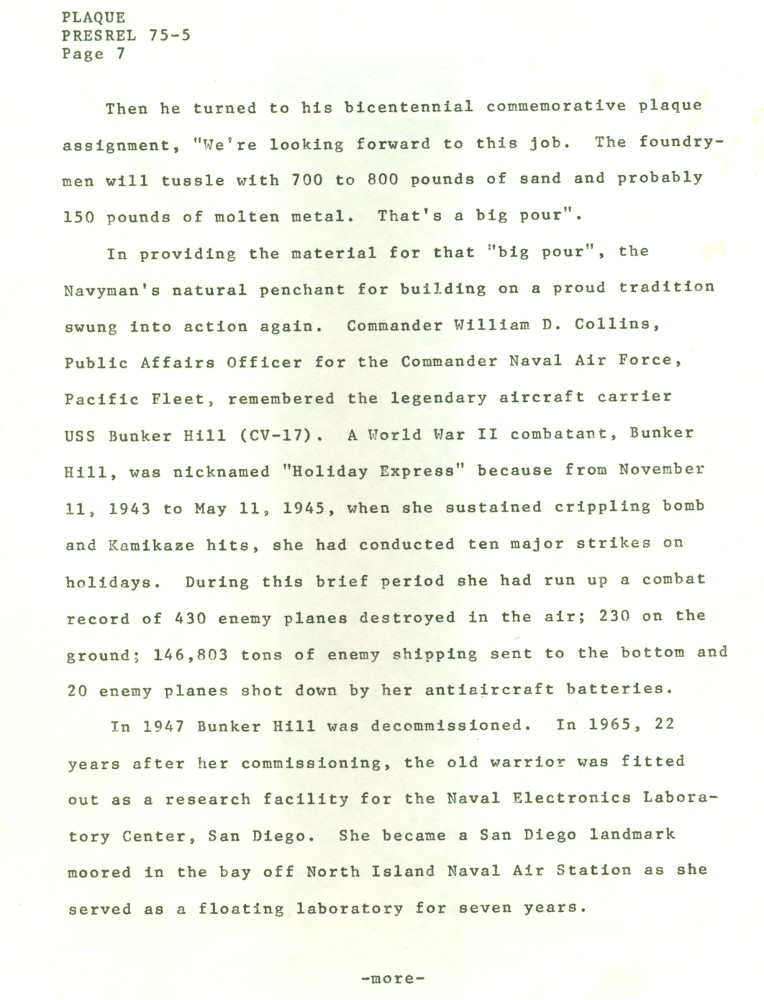
Then he turned to his bicentennial commemorative plaque assignment, “We’re looking forward to this job. The foundrymen will tussle with 700 to 800 pounds of sand and probably 150 pounds of molten metal. That’s a big pour”.
In providing the material for that “big pour”, the Navyman’s natural penchant for building on a proud tradition swung into action again. Commander William D. Collins, Public Affairs Officer for the Commander Naval Air Force, Pacific Fleet, remembered the legendary aircraft carrier USS Bunker Hill (CV-17). A World War II combatant, Bunker Hill, was nicknamed “Holiday Express” because from November 11, 1943 to May 11, 1945, when she sustained crippling bomb and Kamikaze hits, she had conducted ten major strikes on holidays. During this brief period she had run up a combat record of 430 enemy planes destroyed in the air; 230 on the ground; 146,803 tons of enemy shipping sent to the bottom and 20 enemy planes shot down by her antiaircraft batteries.
In 1947 Bunker Hill was decommissioned. In 1965, 22 years after her commissioning, the old warrior was fitted out as a research facility for the Naval Electronics Laboratory Center, San Diego. She became a San Diego landmark moored in the bay off North Island Naval Air Station as she served as a floating laboratory for seven years.
Navy Commemorative Plaque News Release. Navy Bicentennial, October 3-13, 1975. Page 8.
“The Bunker Hill was stripped of her brass and bronze fittings prior to her scraping in late 1972”, Commander Collins reported at a Bicentennial Committee meeting, “this was molded into ingots. Some of the ingots still remain and are stored at the Naval Station in Honolulu. We would be honored to have Bunker Hill permanently a part of San Diego. The Pacific Naval Air Force will provide her brass and bronze for the plaque”.
And so it was done.
In August Jo Palm called Cisco Lopez with the news that the plaque was to become a reality. Cisco told Jo of an uniquely Navy coincidence. “For my 1975 active duty tour I was stationed on Ajax! I designed ducting for ventilation of a spray booth. Great crew! I never expected to work with them again”.
On September tenth, after the sand had been rammed around the pattern and the pattern removed, leaving its historic impression (the negative), the excitement of expectancy on the Ajax foundry deck rose even as the metal of old Bunker Hill rose toward the proper temperature to pour.
Participants, both active and anticipating, ranged from Jo Palm and Cisco Lopez; Navy combat cameramen and photographers; to the molders, firemen, and as from the beginning,
Navy Commemorative Plaque News Release. Navy Bicentennial, October 3-13, 1975. Page 9.
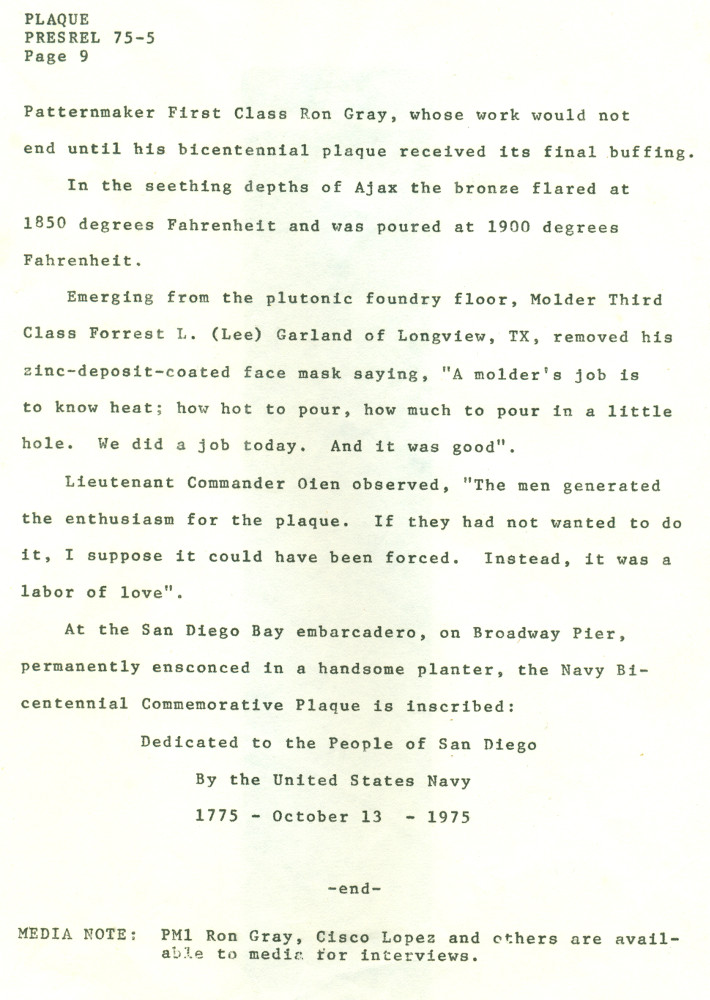
Patternmaker First Class Ron Gray, whose work would not end until his bicentennial plaque received its final buffing.
In the seething depths of Ajax the bronze flared at 1850 degrees Fahrenheit and was poured at 1900 degrees Fahrenheit.
Emerging from the plutonic foundry floor, Molder Third Class Forrest L. (Lee) Garland of Longview, TX, removed his zinc-deposit-coated face mask saying, “A molder’s job is to know hear; how hot to pour, how much to pour in a little hole. We did a job today. And it was good.”
Lieutenant Commander Oien observed, “The men generated the enthusiasm for the plaque. If they had not wanted to do it, I suppose it could have been forced. Instead, it was a labor of love”.
At the San Diego Bay embarcadero, on Broadway Pier, permanently ensconced in a handsome planter, the Navy Bicentennial Commemorative Plaque is inscribed:
Dedicated to the People of San Diego
By the United States Navy
1775 – October 13 – 1975
Tex Feazell and Ron Gray with the first wood carving and the original drawing. Photo credit: United States Navy.Patternmaker Kevin O’Connor, Molder Jessie Lopez, Molder Lee Garland, Patternmaker Roger Richie, two unidentified Molders, Bill McCoy and Ron Gray. Photo credit: United States Navy.
…
Follow this blog for more amazing, unexpected discoveries! Join me on Facebook or Twitter.
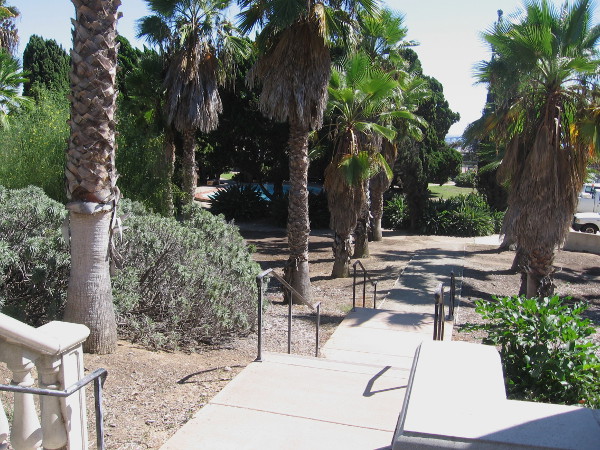
Looking north at steps that lead down from the quiet, stately Balboa Park Administrative Courtyard.
A few weeks ago I meandered about Inspiration Point in Balboa Park. Walking slowly, pausing often, going nowhere in particular. Just seeing what I might see.
At the south edge of the Balboa Park Administrative Courtyard, I stood and gazed down the hill toward a corner of downtown San Diego. You might remember my blog about the courtyard. It’s a place that very few people know about. It’s peaceful, green, a bit of heaven. A place of solitude.
As I stood, I glanced down some steps leading toward a seemingly unremarkable patch of trees. A dusty lot next to the trees contained dozens of parked city Park and Recreation trucks. I wondered to myself if the public was permitted to walk down those steps, into what appeared to be a city work area.
This mysterious path seems to lead to a jumble of trees and a dusty parking lot full of city Park and Recreation trucks.
Then I saw the blue among the trees. Was that water?
No sign indicated I couldn’t investigate. So I did.
And what I found took my breath away.
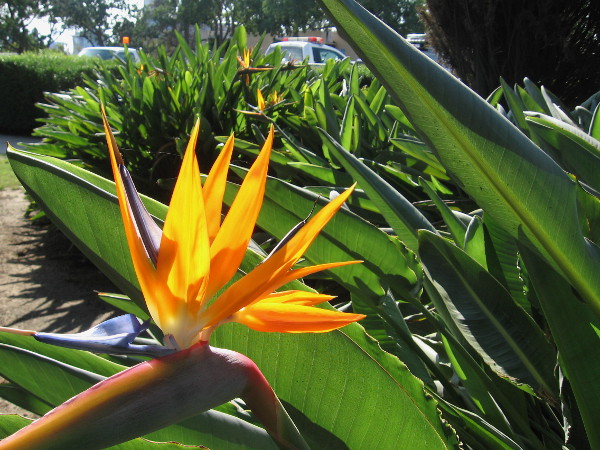
Beautiful Bird of Paradise in a section of Balboa Park where the public almost never goes.Entering a magical hollow in the trees, where a shining blue pool and small fountain await.
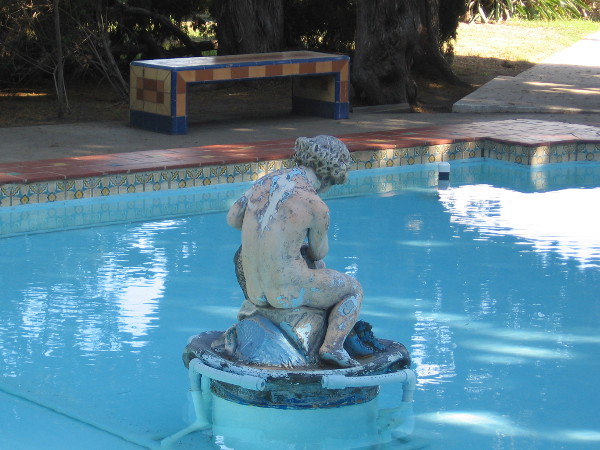
The trees seemed a forgotten oasis. At their center shined a lonely pool and a small fountain in the form of a child. The cherub seemed to be holding open the mouth of a carp, or perhaps reading a book–I don’t know.
The strange fountain appeared to occupy a magical place, entirely removed from the surrounding world.
What was it?
An email to the Friends of Balboa Park, an organization whose office is in the nearby Balboa Park Administration Building, provided a bit of information.
The person who replied parks her car in the lot not far from the pool and fountain, and she was completely amazed. She’d didn’t know of its existence.
Ranger Kim, who also works in the building, and who knows volumes about the history of Balboa Park, indicated that the fountain was left over from the 1920’s when the U.S. Navy built a large hospital campus in the immediate area.
In the 1980’s, the land was given to the city in exchange for acreage in Florida Canyon, where the new Naval Medical Center San Diego was built. The buildings from the 1920’s were eventually demolished, except for a Navy chapel, the administration building and its stately courtyard, and a nearby medical library and auditorium building. Today the chapel contains the Veterans Museum and Memorial Center; the administration building contains Balboa Park’s headquarters.
And, of course, magic remains where very few people go: a small fountain that healed spirits at the old Navy complex. A beautiful, hidden fountain forgotten by time.
The lonely fountain is in the form of a child. A few empty benches surround the tiled pool.This fountain is left over from the Navy hospital campus built in this area in the 1920’s.The figure seems to be holding open the jaws of a fish, or perhaps reading a book.A beautiful, hidden fountain forgotten by time.
…
Follow this blog for more amazing discoveries! Join me on Facebook or Twitter.
A beautiful live oak grove in Balboa Park honors men who died tragically on the USS Bennington in 1905.
Balboa Park is without a doubt one of America’s national treasures. Located just north of downtown San Diego, its 1,200 acres is the home of magnificent museums, gardens, architectural marvels, many recreational facilities and perhaps the world’s most famous zoo. The amazing urban park is so gigantic most visitors see only a small fraction of it. Some out-of-the-way corners of Balboa Park are enjoyed by locals who live nearby; other overlooked areas seem almost forgotten.
The USS Bennington Memorial Oak Grove is one such area. While many drive by it on any given day, as they travel along 26th Street just before it turns into Florida Drive, and a few joggers pass through the shady grove, I’d wager only a handful of San Diegans know of the oak grove’s existence or historical significance.
There are 66 live oak trees in this grove. They were planted to memorialize 66 men killed on the USS Bennington on the morning of July 21, 1905, when the gunboat’s boiler suddenly exploded and the ship nearly sank in San Diego’s harbor. No markers in the grove indicate the significance of the large gnarled oaks. (A 60 foot high granite obelisk stands at Fort Rosecrans National Cemetery in Point Loma, a memorial to those sailors who died on the USS Bennington. Most of the dead are buried there.)
The USS Bennington was a warship with a long and proud history. Commissioned in 1891, she was the ship that claimed Wake Island for the United States. After the boiler explosion in San Diego Bay, eleven men were awarded the Medal of Honor for extraordinary heroism.
Earlier this year, when I visited an exhibit in Balboa Park created by The Daughters of the American Revolution San Diego Chapter, I learned the local DAR would like to place plaques in the grove to memorialize the USS Bennington and the men who tragically died. If you, your business or organization would like information about the project, or to help, you might contact them from their page. Should this project come to fruition, I’ll be very pleased to blog about it!
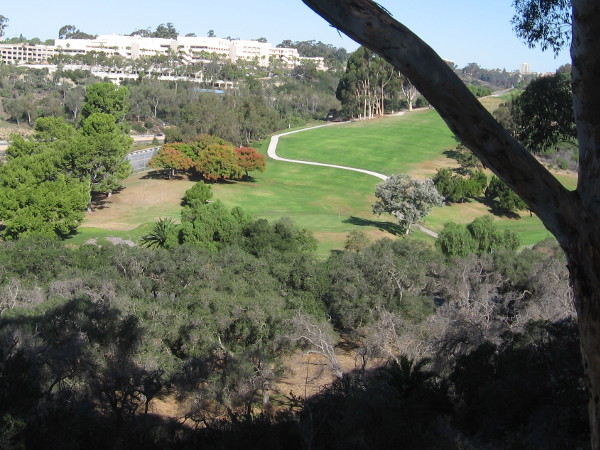
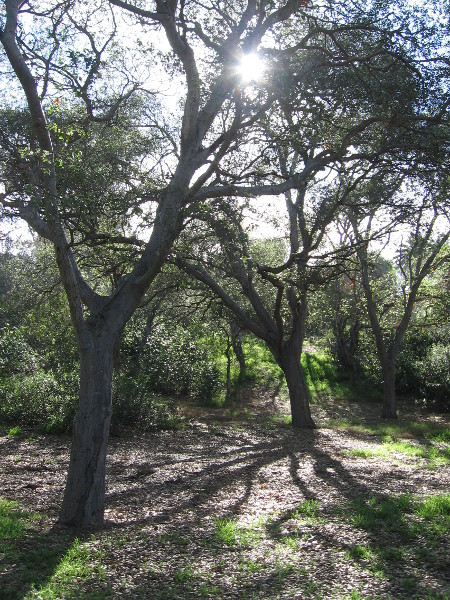
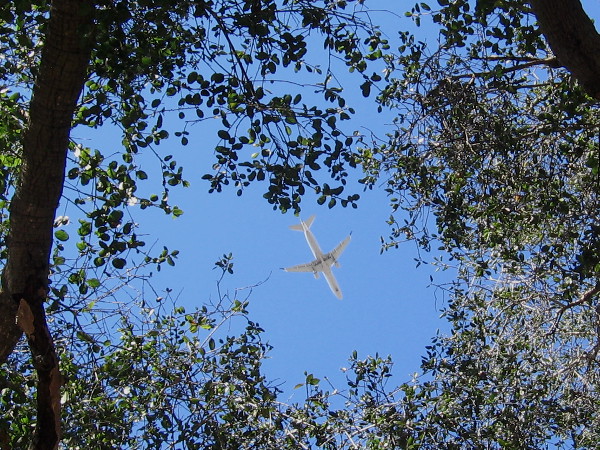
View of the Bennington Memorial Oak Grove from Golden Hill Park, located near Balboa Park’s southeast corner. Balboa Park’s public golf course and Naval Medical Center San Diego are also visible.Wooden footbridge along 26th Street leads to a little-used trail through USS Bennington Memorial Oak Grove in Balboa Park.Beautiful old oak trees memorialize 66 sailors killed in 1905 when the USS Bennington’s boiler exploded in San Diego’s nearby harbor.Looking up through the leaves of the live oak trees at blue sky and clouds.These trees, honoring fallen men, remind us of a sudden tragic moment in San Diego’s military history.A commercial airplane flies overhead as it crosses Balboa Park heading in toward Lindbergh Field.A jogger enjoys the shady old trees on a warm day in early October.
…
Follow this blog for more unique discoveries in San Diego! Join me on Facebook or Twitter.
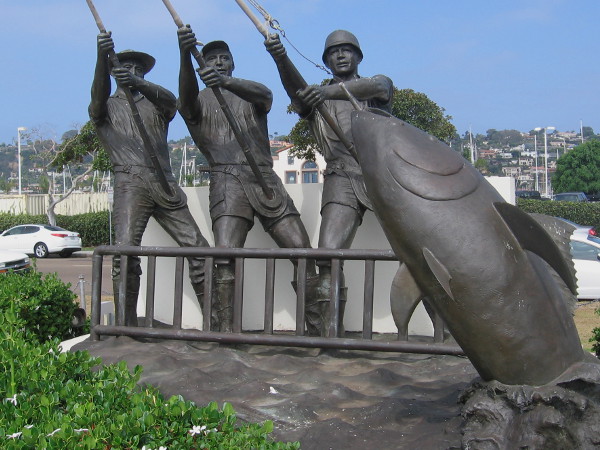
Three bronze fishermen on Shelter Island together reel in a large tuna.
A monumental bronze sculpture in Shoreline Park on Shelter Island has become an iconic image. The Tunaman’s Memorial, by artist Franco Vianello, dedicated in 1988, honors the courage and hard work of generations of tuna fishermen in San Diego. The 9,000 pound sculpture depicts three individuals pole fishing from a boat of the once-large tuna fleet out on the Pacific Ocean. The history of San Diego’s tuna fishing industry contains generations of life stories. These unwritten stories involve fishermen who immigrated from many different nations, including Italy, Portugal and Japan.
One polished side of the sculpture contains names of fishermen who were pioneers in our region, and those who were lost at sea. An inscription reads: Tunaman’s Memorial honoring those that built an industry and remembering those that departed this harbor in the sun and did not return. Anthony Mascarenhas.
The Tunaman’s Memorial on Shelter Island is a 9,000 pound bronze sculpture honoring generations of diverse fishermen.Tuna fishing in local waters was once a major industry in San Diego.Polished side of Tunaman’s Memorial contains names of San Diego fishing pioneers, and those who were lost at sea.This iconic sight on Shelter Island provides a glimpse back in history, at those in our community who worked the sea.
…
Follow this blog for more photos of cool stuff! Join me on Facebook or Twitter.
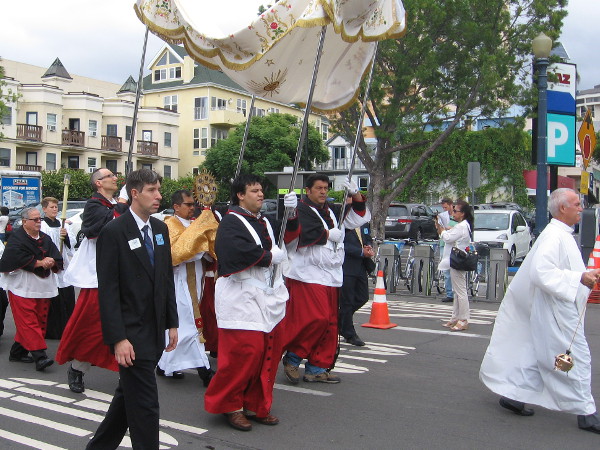
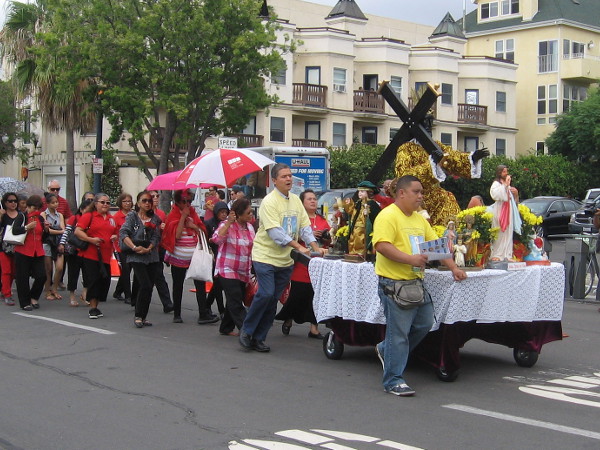
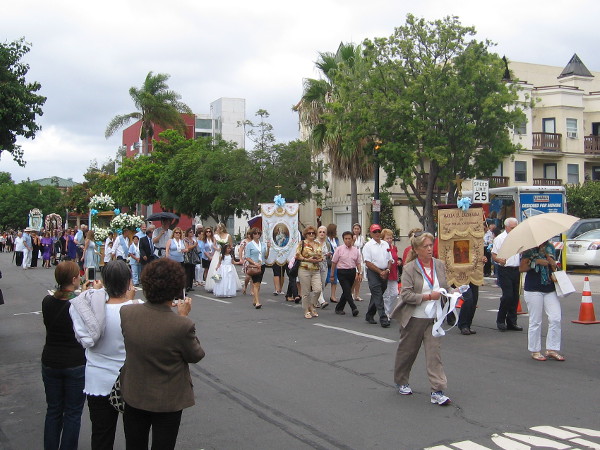
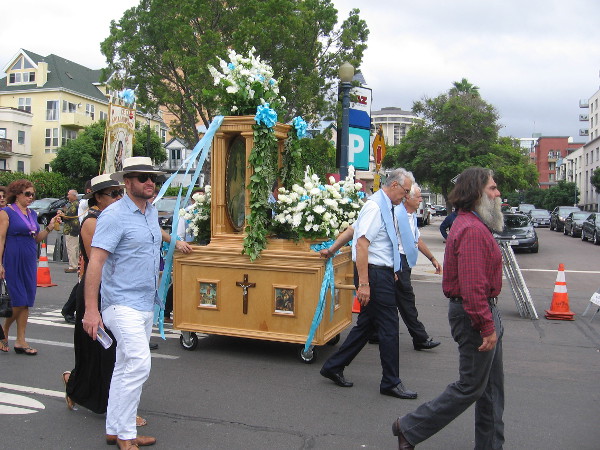
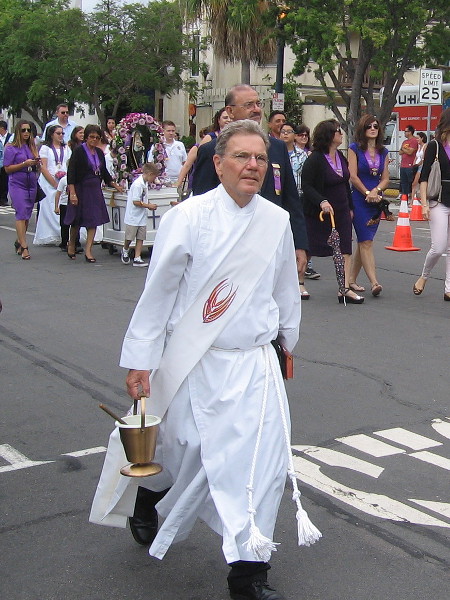
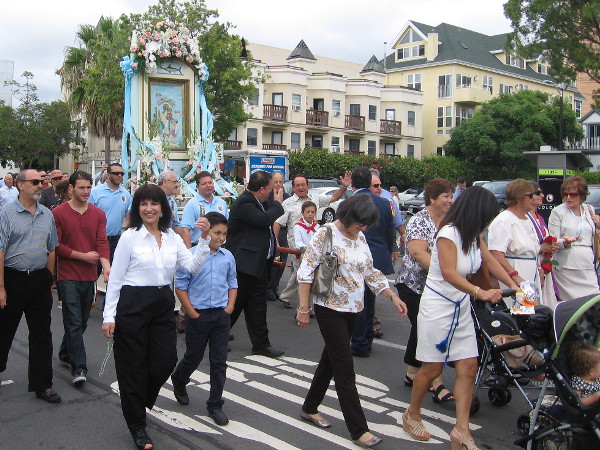
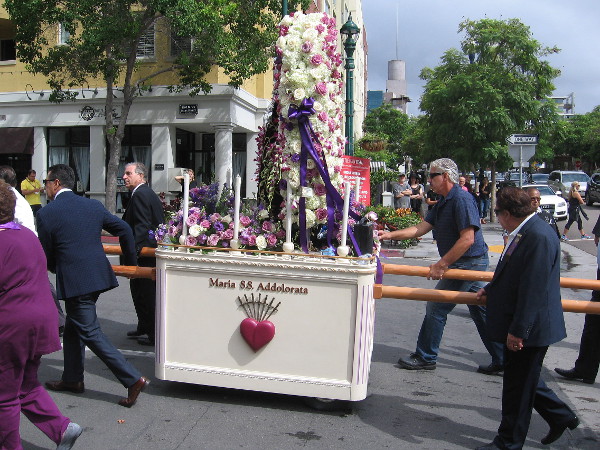
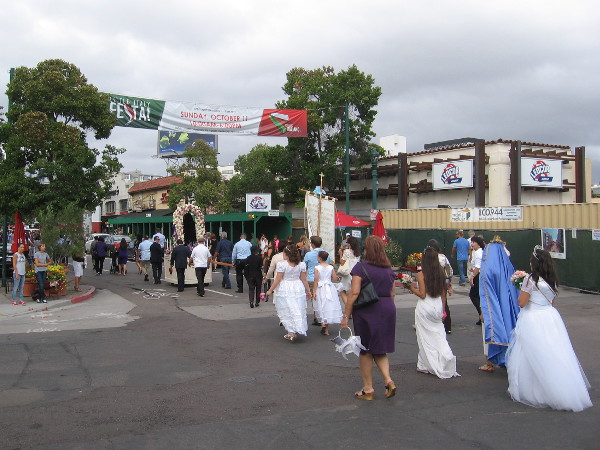
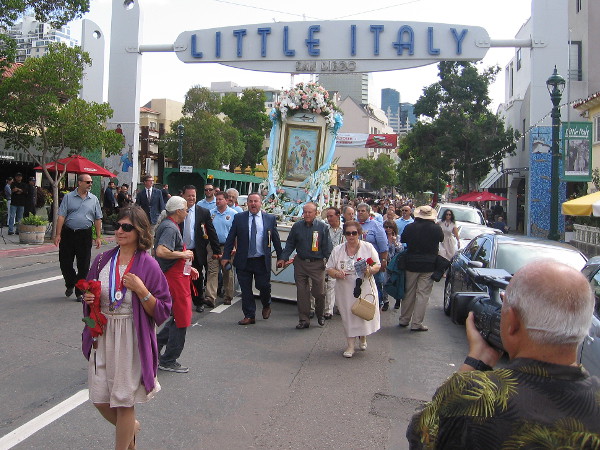
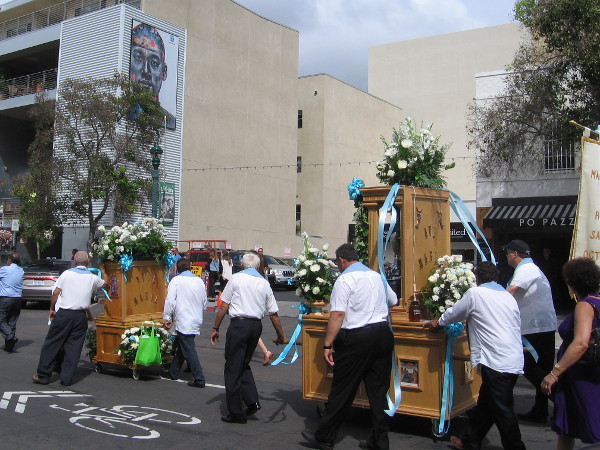
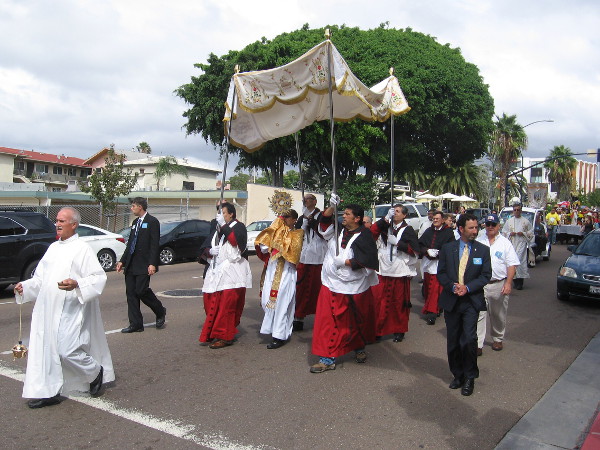
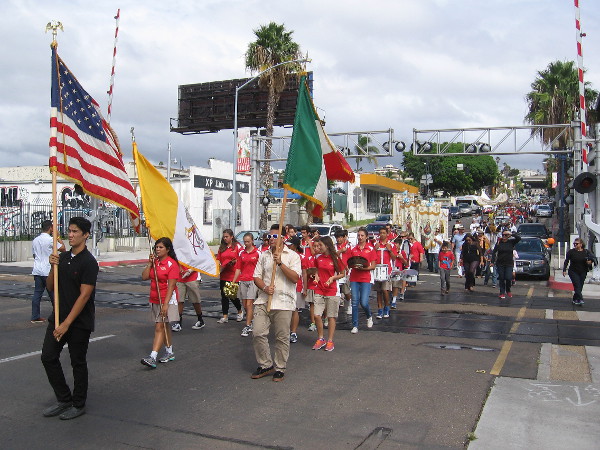
A colorful religious procession makes its way through San Diego’s culturally rich Little Italy neighborhood.
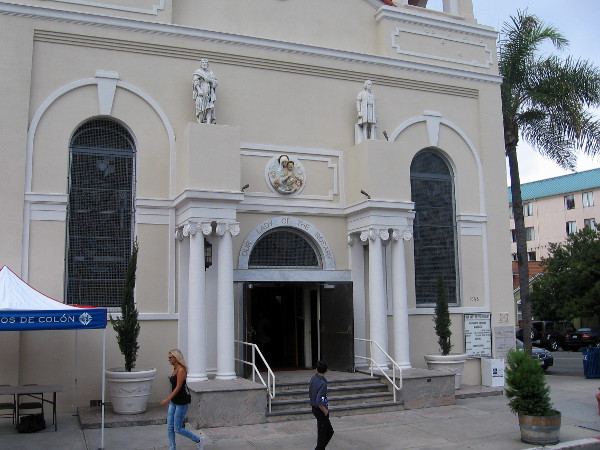
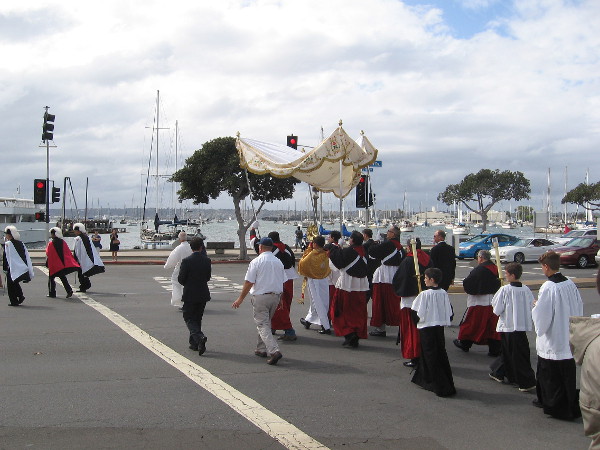
Early this afternoon, the historic Our Lady of the Rosary Parish in Little Italy celebrated Catholic Mass then held a grand procession. Parishioners marched from State Street in front of their church down to San Diego’s Embarcadero, where a fishing boat representing the local tuna fleet was blessed. I witnessed the procession a few years ago, but took no photos. So today I decided to walk along the sidewalk with my camera.
Forgive me for not knowing the details of the religious procession. I do know a large host of the faithful, in all manner of dress, many of Italian descent, and many carrying images of Jesus and Virgin Mary, marched joyfully north up India Street, then turned west down Hawthorn Street until they reached Harbor Drive. At the Hornblower dock, the fishing boat Patty Jo, which is a common sight out on San Diego Bay, was blessed by the priests of Our Lady of the Rosary. It’s a unique San Diego tradition that dates from the early 50s. At the completion of the religious ceremony, which was not open to the public, fireworks resounded in the overcast October sky!
In the early afternoon few were near the front entrance of the Our Lady of the Rosary Church in Little Italy. That would soon change.Plaque on Our Lady of the Rosary Church. Historical monument dedicated December 20, 1925.Banner declares Sunday, October 4 is Our Lady of the Rosary Catholic Church’s much anticipated Festa 2015.Mass was celebrated at noon in a large outside tent in nearby Amici Park.
The procession slowly assembles after Mass in front of the church.An elegant canopy emerges from the Catholic Church.The colorful religious procession, led by a youthful band, is ready to begin.
The procession is now heading north up India Street.
Approaching a banner announcing that next Sunday is Little Italy’s popular neighborhood Festa.Passing under the landmark Little Italy sign on India Street.
I caught an airplane coming over Bankers Hill preparing to land at Lindbergh Field.Now proceeding down Hawthorn. The threatened rain held off for the event!You can see that hundreds participated in this truly grand spectacle.
Finally arriving at San Diego Bay.A Harbor Patrol boat gives a water cannon salute for the occasion.Priests and those instrumental in blessing the tuna boats head onto the Hornblower dock at Grape Street.My camera could just catch a glimpse of the elaborate Catholic ritual beside the Patty Jo fishing boat.Fireworks launched from a nearby pier burst loudly in the air like exultant sparks.Little puffs of smoke hover in the heavens after the fireworks.The Patty Jo now confidently heads off across the gray water, hoping for safe ocean journeys and bountiful catches.
…
Follow this blog for more photos of uniquely interesting stuff! Join me on Facebook or Twitter.
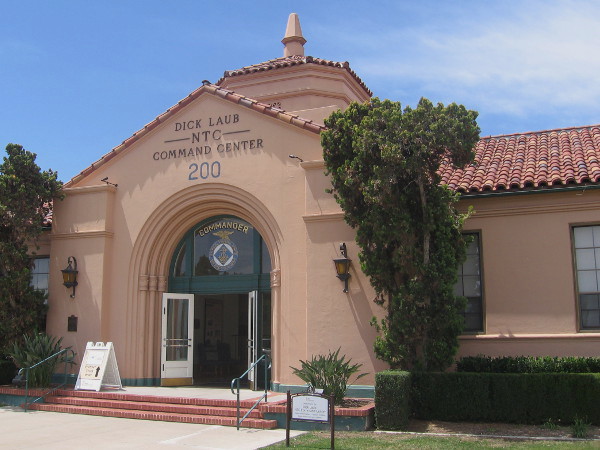
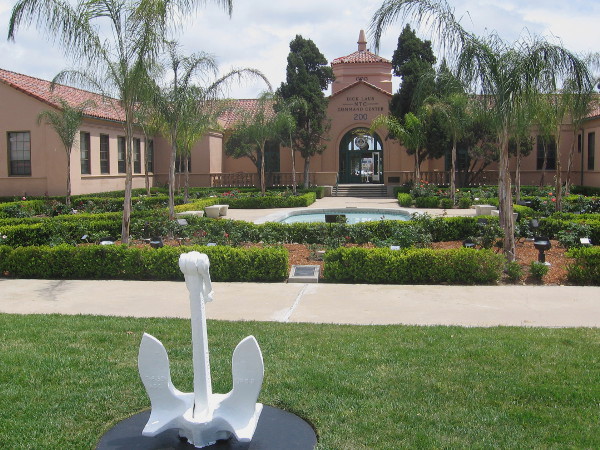
Historic Decatur Road entrance of Dick Laub NTC Command Center at Liberty Station in Point Loma.
Some time ago I visited the Command Center at NTC Liberty Station in Point Loma. Two interesting exhibits can be found along the main hallway that runs the length of the historic building. The Command Center was once the operational hub of former Naval Training Center San Diego.
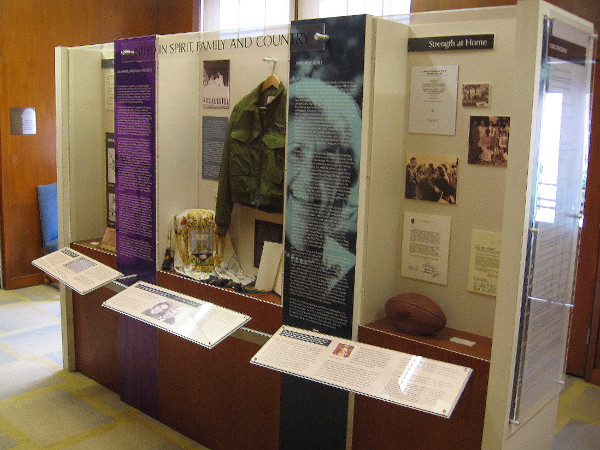
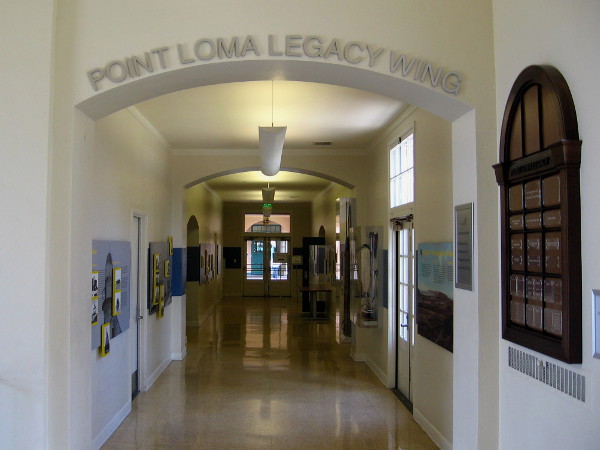
The museum-like Stockdale Family Exhibit concerns the life and history of celebrated Navy Vice Admiral James B. Stockdale and his wife Sybil. The Point Loma Legacy Wing contains many displays that provide insights into the fascinating history of San Diego’s Point Loma.
Should you visit, here’s what you’ll see…
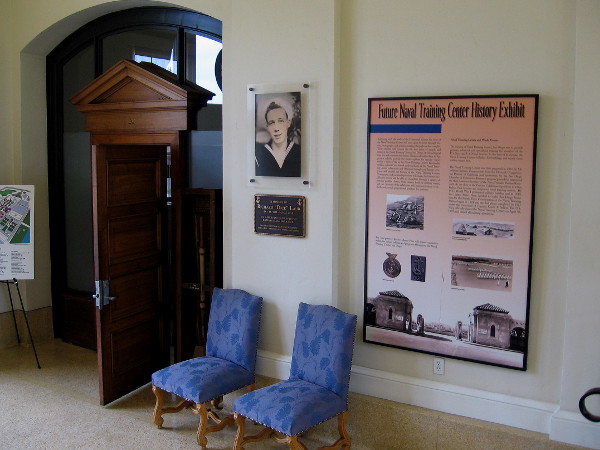
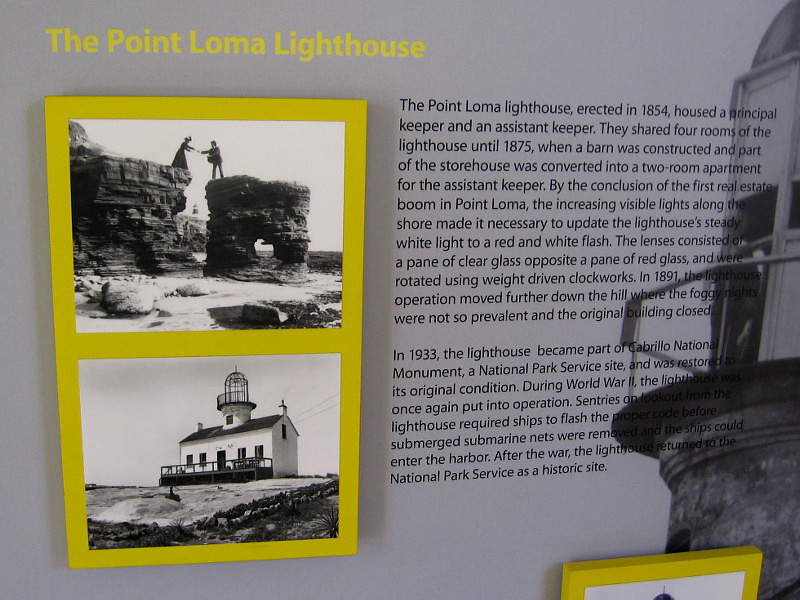
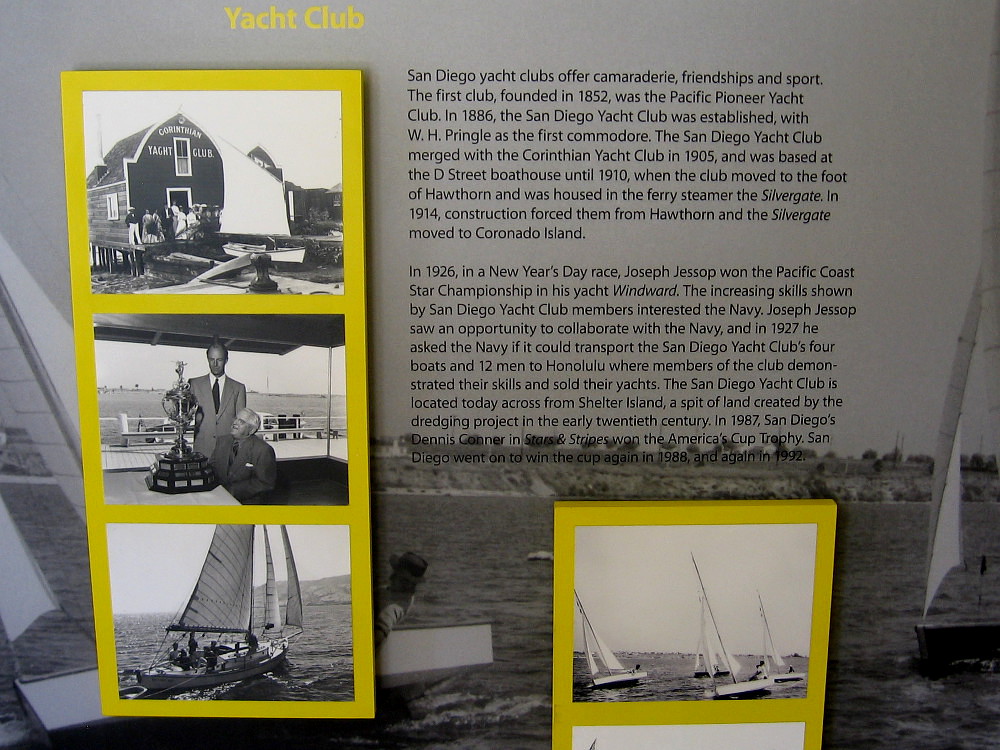
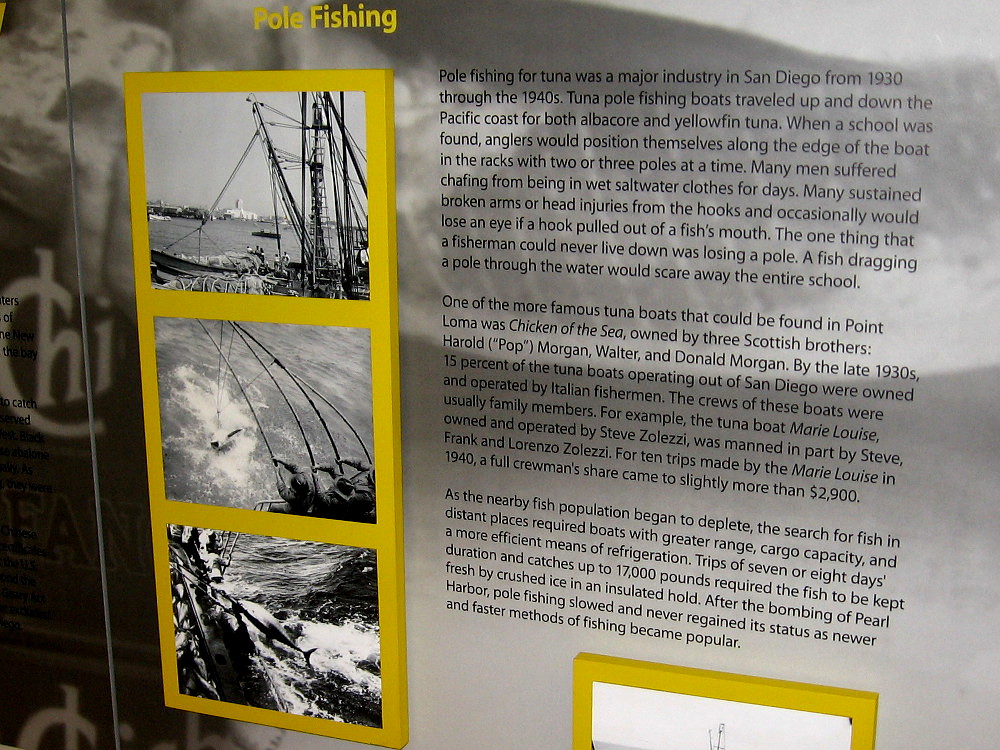
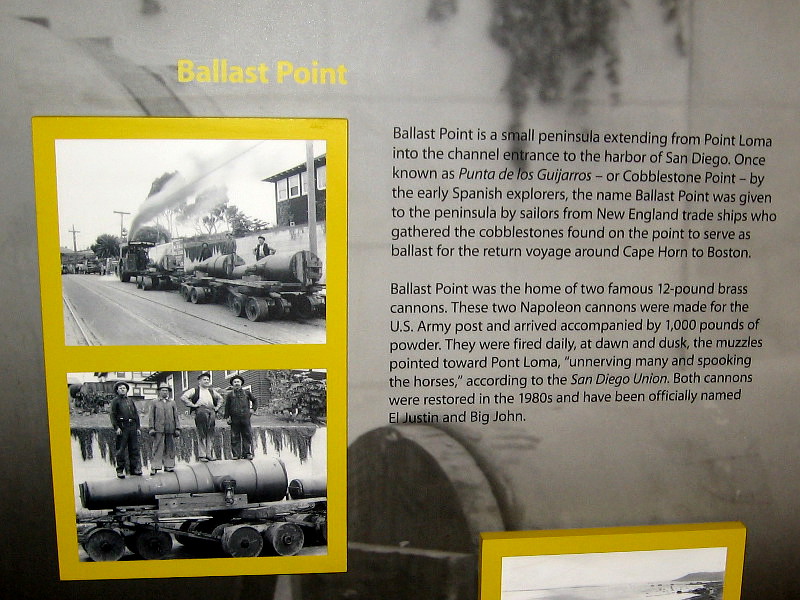
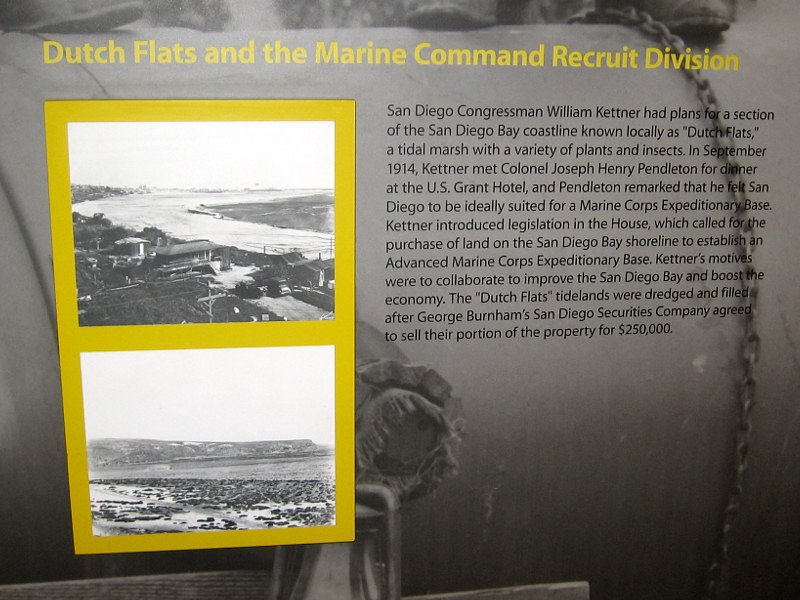
Built in 1941, The Command Center (Building 200) was the focal point of the base. These were offices for the highest-ranking officers, including the Admiral in Command of the Center.Looking from inside the Command Center southeast toward Preble Field and a large American flag.Inside the entrance to the Command Center. Various signs and free literature provide information about the converted military base and its many cultural attractions.Naval Training Center, San Diego. The recruit story is one of personal transformation; a recruit’s experience from arrival through graduation is the foundation for memories…In Memory Of Richard “Dick” Laub. Dick gave credit for much of his success to the G.I. Bill. His passion was the sea and fishing.One wing of the NTC Command Center today contains the Stockdale Family Exhibit. James and his wife Sybil are Navy heroes from the Vietnam War era.Vice Admiral James Stockdale, long-time resident of Coronado, obtained and conveyed important tactical information while imprisoned in North VietnamStockdale was candidate for United States Vice President in 1992 on Ross Perot’s independent ticket. During a debate, he famously said: “Who am I? Why am I here?”The exhibit contains photographs and objects from James and Sybil Stockdale’s family life.The Point Loma Legacy Wing at the NTC Command Center contains two walls of fascinating displays concerning this area’s history.The Point Loma lighthouse, erected in 1854, housed a principal keeper and an assistant keeper. In 1933, the lighthouse became part of Cabrillo National Monument and was restored.San Diego yacht clubs offer camaraderie, friendships and sport. The first club, founded in 1852, was the Pacific Pioneer Yacht Club. In 1886, the San Diego Yacht Club was established.Display case contains artifacts from the San Diego Maritime Museum, including model of a tuna boat.The first fish cannery was built in 1909 at La Playa designed for processing sardines. Albacore canning started in 1911.Pole fishing for tuna was a major industry in San Diego from 1930 through the 1940s. Tuna pole fishing boats traveled up and down the Pacific coast for both albacore and yellowfin.Ballast Point is a small peninsula extending from Point Loma into the channel entrance to the harbor of San Diego. Cobblestones on the point were used for ballast by early trade ships.The Point Loma kelp forest is part of one the largest kelp forests in the northern hemisphere. Giant kelp is a species of marine alga, which may grow up to 200 feet in length.Fort Rosecrans. In 1793, British Captain George Vancouver entered San Diego harbor. He noted the port would be better defended from the Point Loma peninsula.Dutch Flats and the Marine Command Recruit Division. Plans were devised by San Diego Congressman William Kettner. A tidal marsh would be dredged and filled.Anchor and Sybil Stockdale Rose Garden next to NTC Command Center. Photo taken from Legacy Plaza near the center of Liberty Station.
…
Follow this blog for more photos of cool stuff! Join me on Facebook or Twitter.
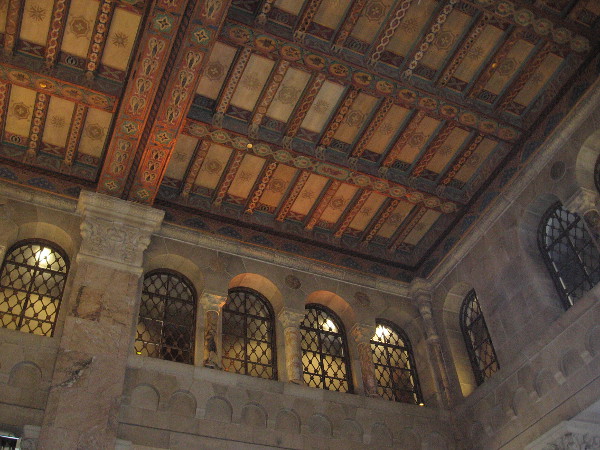
This astonishing ceiling impressed San Diego Trust and Savings Bank customers back in 1928, when it originally debuted.
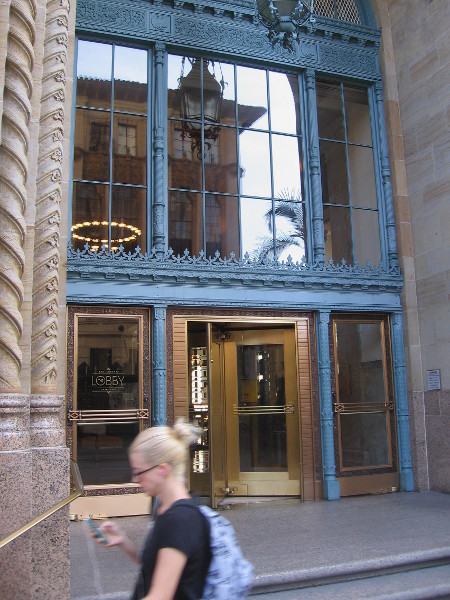
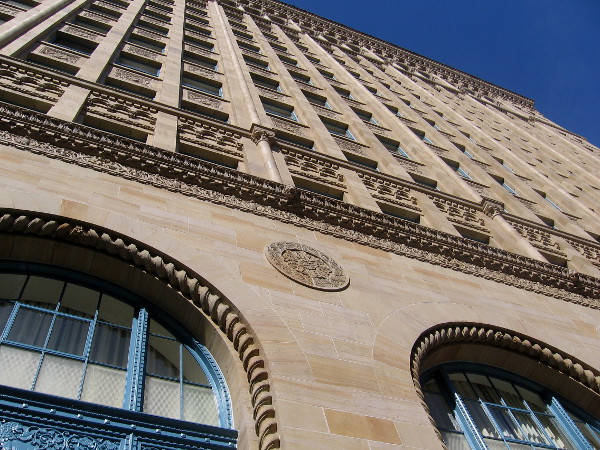
There are many amazing hotels around San Diego, especially downtown. Several of the hotels are located in historic old buildings. For several months, the San Diego Trust and Savings Bank Building (1928), now occupied by Courtyard by Marriott, has been undergoing outside restoration. A few days ago I noticed that much of the work has been completed, so I decided to go inside the lobby to ask a question or two. And wow!
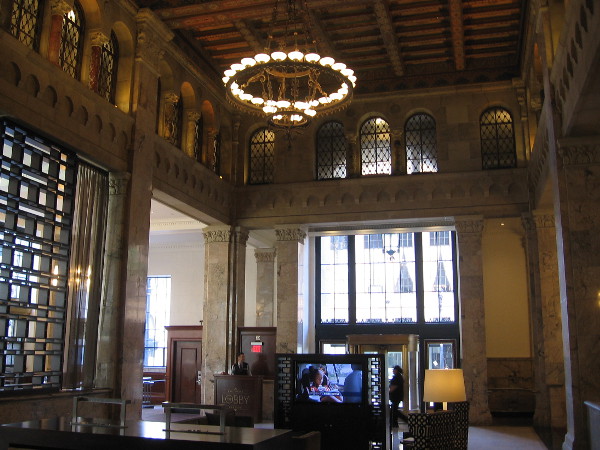
This was my first time inside the truly eye-popping lobby. Look at the ceiling! The old bank hall, which now welcomes hotel guests, appears almost like the interior of some medieval church, with its arches, vaulted doors, medallions, bronze window grilles and a 32-foot high colorfully painted coffered ceiling. Also reflecting the building’s Italian Romanesque Revival architectural style, the grand interior contains 35 decorative columns with Corinthian capitals, chiseled from 19 different types of marble from around the world. Additionally, the walls, counters, pilasters and floor all feature rich imported marble.
The elegant building, which was constructed with the finest materials available at the time, was designed by notable architect William Templeton Johnson, who is also credited for the San Diego Museum of Art and Natural History Museum buildings in Balboa Park, the Serra Museum in Presidio Park, and the La Jolla Athenaeum. He is also one of the architects responsible for the San Diego County Administration Center.
I was told by a friendly front desk clerk that the restoration involved patching cracks in the building’s exterior. Looks to me like somebody did a good job!
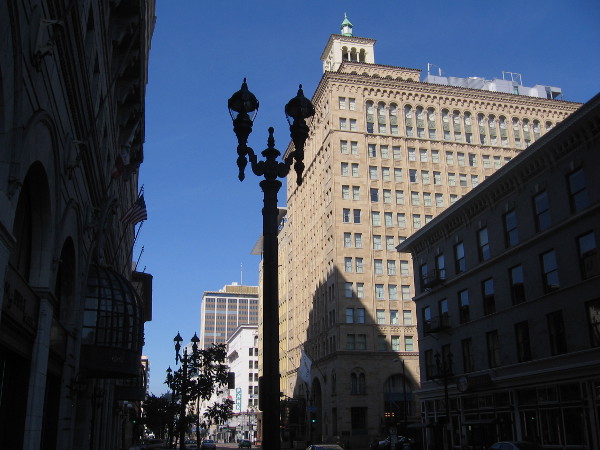
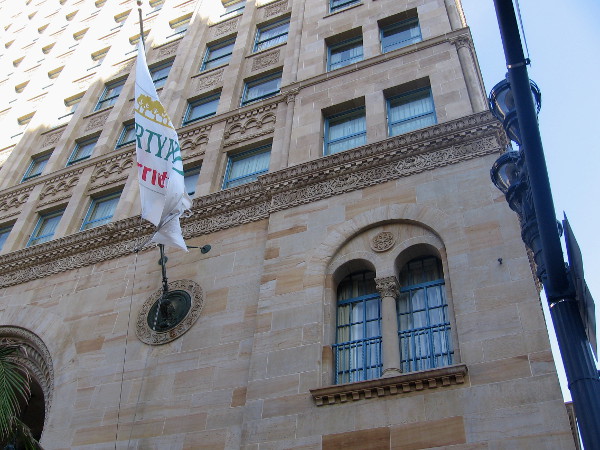
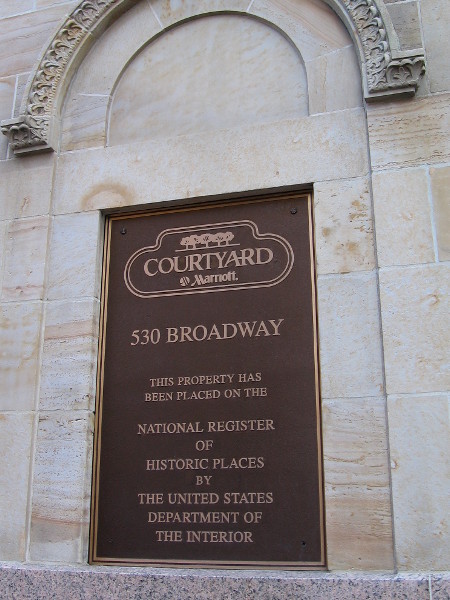
Photo of the San Diego Trust and Savings Bank Building taken from one block east on Broadway. The 14-story structure is topped with a two-story penthouse and cupola.Flag on stately exterior of Courtyard by Marriott San Diego Downtown.Plaque at 530 Broadway. This property has been placed on the National Register of Historic Places by the United States Department of the Interior.Elegant bronze and glass entrance to the eye-popping lobby of the Courtyard by Marriott San Diego Downtown.Stand inside the old bank hall and gaze upward. You’ll think your visiting a fantastic cathedral or medieval building in Europe.The welcoming interior of a modern hotel. An historical building smartly preserved and repurposed.I like this cheerful painting of a girl lying on a turtle behind the hotel’s front counter!Yet another cool sight in my amazing neighborhood: downtown San Diego!
UPDATE!
When I stepped into the hotel during the San Diego Architectural Foundation’s OPEN HOUSE 2017, I learned from a friendly event volunteer that I could head down to see the old bank’s vaults, which are now meeting rooms! Here are some photos!
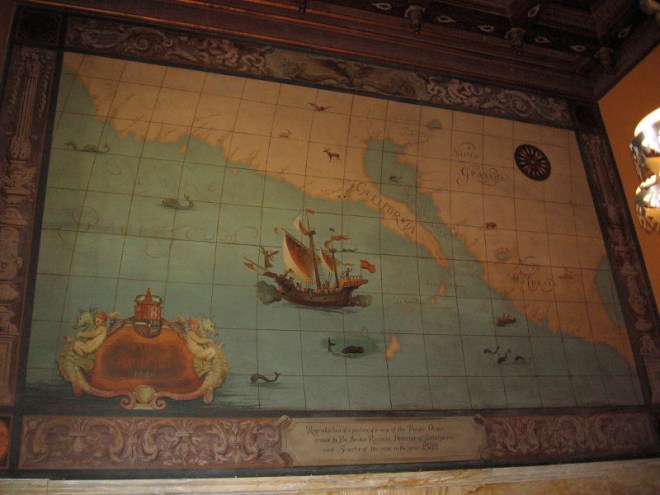
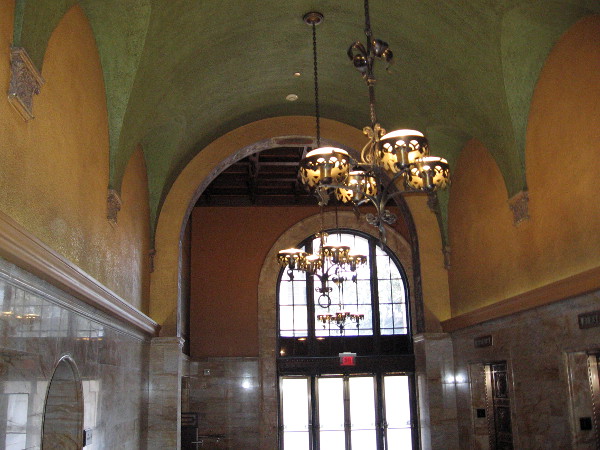
Map near the ceiling where steps descend from the lobby to elevators.The beautiful arched ceiling near the hotel’s bank of elevators.Elegant area near the entrance to The Safe Deposit Room.Formidable steel doors in a lower level hallway, leading to The Vault, a very unique meeting room. The San Diego Trust and Savings Bank Building has unusual historic features that hotel guests can enjoy.The Safe Deposit Room in the Courtyard by Marriott San Diego Downtown has a rather unusual entrance! The 1928 Mosler safe door weighs 47,000 pounds! Meetings can be held inside.
…
Follow this blog for more photos of cool San Diego places! Join me on Facebook or Twitter.





















































 Cool San Diego Sights!