Waka poems as art at Japanese Friendship Garden.

Waka poems are a type of poetry in classical Japanese literature. A waka poem is unique in that it consists of 31 syllables.

An exhibit at the Japanese Friendship Garden in Balboa Park contains examples of waka from Japan’s Heian period (794 – 1185) written in kana script. Each composition is beautiful, not merely as a poem, but as a visual work of art.

The exhibition is titled Love Letters from the Heian Period — Emotions in 31 Syllables.

A sign in the garden’s Exhibit Hall explains: “Among the aristocracy of the time, romantic relationships often began through the exchange of waka… Since men and women had limited opportunities to meet in person, emotions were conveyed through poetry…”

Learn more about this exhibition at the JFG website here.

I was completely unaware of this type of poetry before visiting the garden today. Spellbound, I stood before the examples on display and read translations of each Japanese poem.

The English translations do not contain 31 syllables, obviously, but they definitely convey feelings indicative of romance. I noticed these wakas often employ metaphors taken from nature.

Here are a few of the translations:

There are many villages where the cuckoo bird sings. It’s a bird that I find attractive, but I don’t feel close to it. I like it, but it’s not mine, so I feel a bit jealous. Poet: The Tales of Ise

I won’t allow you to meet me, even if you imitate the crow of a rooster before dawn. Poet: Sei Shōnagon

I was dying to see you, but after I met you I want to live forever. Poet: Fujiwara no Yoshitaka

Should my heart waver and betray our love, then even the impassable waves of a tsunami would cross over the mountains. In other words, I would never be unfaithful. Poet: Author unknown.

I post new blogs pretty often. If you like discovering new things, bookmark coolsandiegosights.com and swing on by occasionally!

I live in downtown San Diego and love to walk around with my camera! You can follow Cool San Diego Sights via Facebook or X.

Feel free to share!

Historical folk dance art in San Diego!

Last weekend the annual Harvest Festival at the Balboa Park Club featured folk dance and dancing workshops. Sadly, few people arrived for an event that has greatly faded in popularity over the years. I’m told young people are no longer taught folk dancing in school, as they once were years ago.

Shortly after entering the Balboa Park Club building, I discovered historical art painted on old signs, from the days when folk dancing brought both young and old together for a fun social gathering.

I learned that the wonderful graphics in my first photos were painted to promote the now defunct Kayso Folk Dance Club, which thrived in San Diego back in the 70’s and 80s. A gentleman named Kayso, originally from Armenia, painted the costumed dancing figures himself. The images might have become a bit worn over the years, but they still have great personality!

I also love the following old sign, which I learned is from the 1950s. It promotes the Cabrillo International Folk Dance Club, which is still alive and well!

The International Dance Association of San Diego County has a website here that lists dance clubs currently operating in Balboa Park and elsewhere around the city. You’ll find many opportunities to learn different dances, and to dance at every level of experience!

I post new blogs pretty often. If you like discovering new things, bookmark coolsandiegosights.com and swing on by occasionally!

I live in downtown San Diego and love to walk around with my camera! You can follow Cool San Diego Sights via Facebook or X.

Feel free to share!

March of Transportation mural in Balboa Park.

Visitors inside the world-famous San Diego Air & Space Museum in Balboa Park should look up. Not only will they see amazing aircraft exhibits suspended from the ceiling, but they might notice a very long mural painted along the museum’s circular inner wall.

The March of Transportation mural was created in 1936 for the California Pacific International Exposition. At over 9,300 square feet, it’s the largest mural of its kind found in North and South America.

Because so many cool aviation displays are jammed into the museum, I found it difficult to photograph large segments of the mural. But I’ve captured several glimpses, so you can get the idea of how the art appears.

A couple years ago I photographed the very end of the mural, which depicts futuristic forms of transportation (as conceived almost a hundred years ago). You can see those photos here.

Several murals decorated the Ford Building during the California Pacific Exposition in 1935. After the Exposition, the Ford Motor Company deeded the building to the City of San Diego for use as the “Great Hall of Transportation.” In preparation for the 1936 Exposition, this large mural was commissioned to express the theme–“The March of Transportation.”

The 1936 “Great Hall of Transportation” exhibits included vehicles of all ages, from reed boats, to the locomotive, to the concepts of air and space travel. The mural, 18 feet high, continues along the inner circular wall for 468 feet…

Master Artist Juan Larrinaga served as the Art Director for the 1935 and 1936 Expositions. He was assisted by New York illustrator, Charles B. Falls, and artists P.T. Blackburn, Mahlan Blane and Nicolas Reveles. Larrinaga labored long hours to produced the drawings from the artist assistants to fill in. More than 40 persons eventually contributed their talent and energy to the completion of the mural.

After years of deterioration, the building began a restoration in 1977. In 1979 the mural, too, was restored.

While this artwork depicts world history, it is also an important part of San Diego’s uniquely rich history.

So go visit the San Diego Air & Space Museum . . . and look up!

I post new blogs pretty often. If you like discovering new things, bookmark coolsandiegosights.com and swing on by occasionally!

I live in downtown San Diego and love to walk around with my camera! You can follow Cool San Diego Sights via Facebook or X.

Feel free to share!

Historical photos of Old Town at visitor center.

1955. Sixteen shade trees were planted at the Casa de Lopez, a San Diego landmark.

Did you know there’s a visitor information center in Old Town San Diego on the second floor of the La Paloma marketplace? In addition to useful tourist info, the center features a wall of interesting historical photographs.

Find the La Paloma marketplace near the intersection of Twiggs Street and San Diego Avenue. The building stands where Old Town Trolley Tours vehicles line up. Proceed through the front door, go up some stairs, and you’ve arrived at the Old Town San Diego Chamber of Commerce & Visitors Center.

During my last visit, I gazed at the old photos, trying to imagine how early San Diego once appeared. As you can see, the small town was established in a scrubby place in the middle of nowhere.

The Whaley house, the oldest brick house in California. Built in 1854.
About 1935. Casa de Lopez, located at Twiggs and Jefferson Streets. In the early days, the San Diego River flowed at its back where the Santa Fe Railroad track are now.
Old Town…1898. From Fort Stockton, now the site of Presidio Park, looking south toward Point Loma.
About 1880. Old Town Estudillo House, Ramona’s Marriage Place original condition.

I post new blogs pretty often. If you like discovering new things, bookmark coolsandiegosights.com and swing on by occasionally!

I live in downtown San Diego and love to walk around with my camera! You can follow Cool San Diego Sights via Facebook or X.

Feel free to share!

Victorians, mud and birds in National City!

Did you know National City in San Diego’s South Bay has a Historic Railcar Plaza?

The small museum-like building is located at the intersection of Bay Marina Drive and Marina Way. A train track running through the building is home to old Passenger Coach No. 1.

I posted a blog about the National City Historic Railcar Plaza almost ten years ago, after peeking inside. You can revisit that past blog post here.

From outside, anyone can peer through windows into four small display rooms at each corner of the building. When I walked by several weeks ago, it seemed that displays in two of the corner windows had changed. So I took photos!

In one window, dummies of passengers in Victorian-era attire stand or sit on a bench, as if waiting for a train or streetcar.

In a second window I found a variety of educational displays. They’re mostly about protecting the wetlands in National City and around the San Diego region.

According to one sign, the public is invited to participate in Creek Day on the last Saturday of every month, from 8 am to noon. The address where people meet is 1815 Hoover Avenue.

You can check out the Facebook page of Paradise Creek Educational Park by clicking here. (Unfortunately, that page doesn’t seem very active right now.)
Another sign inside the Historic Railcar Plaza indicates: “Display rooms are available to nonprofits to showcase artifacts and interpretive exhibits relating to the early railroads and local history. Contact the Port of San Diego Public Art Department for program information.”

What might I see the next time I walk past?

I post new blogs pretty often. If you like discovering new things, bookmark coolsandiegosights.com and swing on by occasionally!

I live in downtown San Diego and love to walk around with my camera! You can follow Cool San Diego Sights via Facebook or X.

Feel free to share!

Belmont Park exhibit celebrates 100 years!

Belmont Park has been a favorite destination for generations of fun lovers in San Diego.

In 1925 the beachside amusement park opened as the Mission Beach Amusement Center. Today, an exhibit under Belmont Park’s beloved Big Dipper wooden roller coaster celebrates one hundred years of history!

John D. Spreckels developed the Mission Beach Amusement Park, which he intended to be a “playground for the people of San Diego…” Spreckels expanded his streetcar line to connect Downtown, Ocean Beach and La Jolla to Mission Beach.

The first structure to open was the Mission Beach Roller Rink… The grand opening unveiled the Mission Beach Bath House (now Plunge Pool) and the Dance Hall…
The subsequent construction of the Giant Dipper Roller Coaster was completed in 45 days by a construction crew of 150 men… The Giant Dipper officially opened on July 4, 1925 and enjoyed immediate record-breaking success…

The amusement park was renamed Belmont Park and revitalized in the 1950s under the direction of John (Jack) C. Ray. The park’s footprint expanded further south to include a new main entrance and attractions like The Octopus, a Kiddie Boat Ride, the Wild Mouse coaster, and a double Ferris Wheel.

The largest installation…was “Enchanted Land,” an immersive 23,000-square-foot western ghost town filled with fun-house mazes, shifting staircases, and interactive optical illusions.

On February 2, 1955, a fire broke out at the Giant Dipper… Though the city pushed for demolition, Jack fought to restore the ride… Jack Ray was the coaster’s first savior and where much of Belmont’s modern story began.

Due to financial difficulties, Belmont Park closed in 1976. In 1981, the coaster was set on fire twice in 19 days. A demolition permit had been approved by the city in 1979 and the park’s demise seemed unavoidable.

Before the charred wood of the Giant Dipper had cooled, a local activist movement was already heating up. In October 1981, Carol Lindemulder founded the “Save The Coaster Committee…” Over the next nine years, the committee led an ambitious effort… On August 11, 1990, after a 14-year closure…the Giant Dipper Roller Coaster finally reopened…

The Plunge Pool, which in 1925 was the largest saltwater pool in the world, would reopen in 2019 after an extensive reconstruction effort.

Today just so happens to be Labor Day!

Why not head down to Mission Beach and wonderful Belmont Park? Be a part of history!

I post new blogs pretty often. If you like discovering new things, bookmark coolsandiegosights.com and swing on by occasionally!

I live in downtown San Diego and love to walk around with my camera! You can follow Cool San Diego Sights via Facebook or X.

Feel free to share!

Exhibit shows evolution of Hotel del Coronado.

Would you like to see an outstanding exhibition concerning the Hotel del Coronado?

The Jewel in Coronado’s Crown: Over a Century of Historic Preservation at the Hotel del Coronado can now be enjoyed at the Coronado Historical Association museum.

Numerous displays in the free museum show how the iconic Del was built in the late 1800s and has periodically evolved and expanded. Through old photographs and descriptions, visitors can observe how, over the past 137 years, preservation of the hotel’s unique heritage and architecture have remained a priority.

If you enjoy learning about the history of San Diego and Coronado, this exhibition is a must see.

A little of what you’ll find, including a detailed timeline…

The Victorian beach resort was designed by architect James W. Reid and debuted as one of the largest wooden buildings in the world. With 399 rooms, it was the world’s largest hotel resort. The Del made history as the first hotel to have electric lighting.

The charming architecture’s complexity and asymmetry help make the Hotel del Coronado one of California’s most recognizable and cherished landmarks.

Luxury and elegance. Since 1888, presidents, world leaders and celebrities have enjoyed staying at the Del, along with tourists vacationing by the beach in our sunny, temperate Southern California climate.

Postcards, menus and more ephemera are displayed.

Many historical photographs in the exhibit document how the hotel has changed and expanded as time rolls on.

The beautiful Coronation Window was finally moved to a prominent position viewable from both inside and outside the hotel.

This exquisite fresco was revealed by workers removing a low ceiling in the Ocean Ballroom.

A recent lobby renovation has made the Victorian hotel’s interior entrance lighter and even more attractive.

In San Diego? Enjoy a walk through and around the Hotel del Coronado, and experience its magnificence yourself!

I post new blogs pretty often. If you like discovering new things, bookmark coolsandiegosights.com and swing on by occasionally!

I live in downtown San Diego and love to walk around with my camera! You can follow Cool San Diego Sights via Facebook or X.

Feel free to share!

Archaic Passage at the Old Town Transit Center.

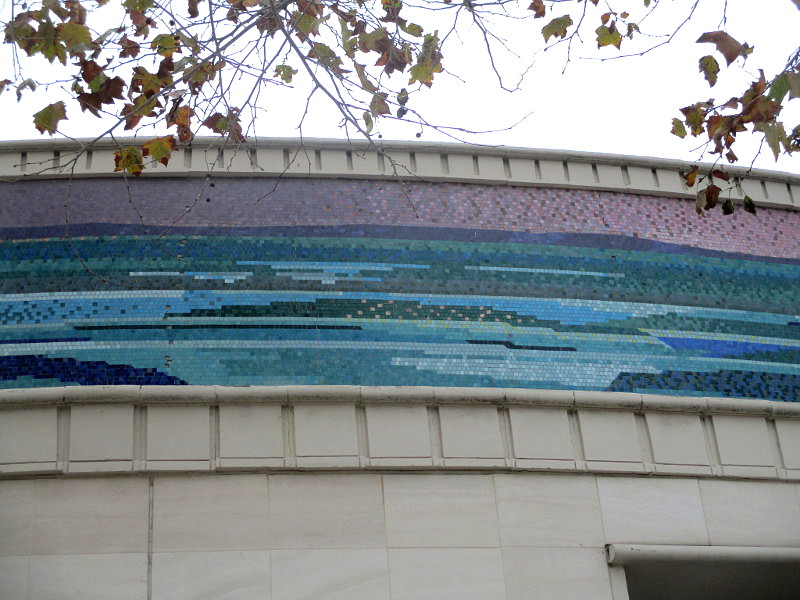
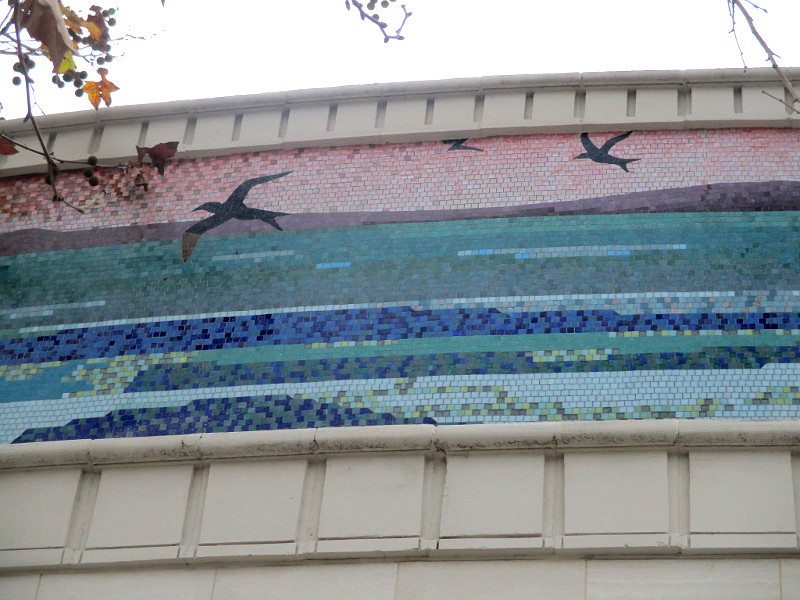
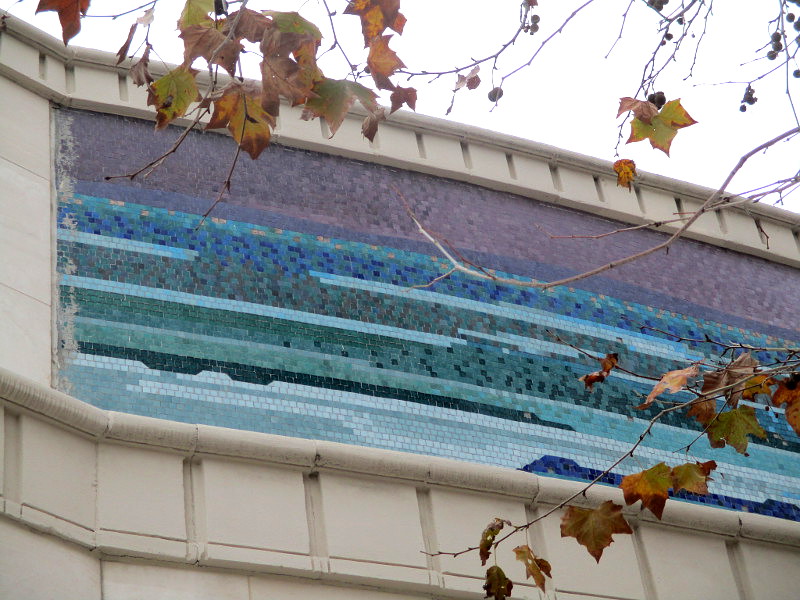
Travelers at the Old Town Transit Center might find themselves walking through an underground passageway. The tunnel safely crosses beneath the San Diego Trolley and train tracks. In this shadowy place curious eyes will encounter public art titled Archaic Passage.

Not in a hurry to catch your bus or other transportation? There are plaques on either end of the passageway that you can read. They provide information about this unique art…

“ARCHAIC PASSAGE”

COMMISSIONED BY SAN DIEGO METROPOLITAN TRANSIT DEVELOPMENT BOARD JUNE 1996

DESIGNED BY SAN DIEGO ARTIST PAUL HOBSON, “ARCHAIC PASSAGE” CELEBRATES THE ARCHITECTURAL HISTORY OF OLD TOWN, FROM NATIVE AMERICAN TO CONTEMPORARY TIMES. ART MATERIALS USED–CARRIZO CANE, WOOD, STUCCO, ADOBE, BRICK, CLAY ROOF AND DECORATIVE TILES–REPRESENT BUILDING MATERIALS USED TO BUILD OLD TOWN. EACH GEOLOGICAL STRATA-LIKE WAVE REFLECTS A SIGNIFICANT ARCHITECTURAL STYLE.

I post new blogs pretty often. If you like discovering new things, bookmark coolsandiegosights.com and swing on by occasionally!

I live in downtown San Diego and love to walk around with my camera! You can follow Cool San Diego Sights via Facebook or X.

Feel free to share!

Daguerreotypes in San Diego on World Photography Day!

Today is World Photography Day. I didn’t realize that until I met a photographer in Balboa Park, aiming an interesting camera at the Spreckels Organ Pavilion.

What sort of camera is that? I asked. Anton told me he was using a daguerreotype camera. He was utilizing photographic technology that was revolutionary and popular in the mid-1800s!

Daguerreotype was the first publicly available photographic process, producing the black and white images you’ve probably seen in historical exhibits or documentaries.

Anton was using a silver plate and briefly described the process, all of which was far over my head. Here’s the Wikipedia page concerning daguerrotype photography.

If you’d like to check out Anton’s fascinating The Photo Palace blog, here it is. His site features a variety of cool photographs he has taken.

Anton explains in his blog: Working with analog photographic methods, with concentration on daguerreotype and wet plate collodion methods, Photo Palace offers original art, commissions on location and in studio, as well as workshops, magic lantern shows, and other interactive programs.

I post new blogs pretty often. If you like discovering new things, bookmark coolsandiegosights.com and swing on by occasionally!

I live in downtown San Diego and love to walk around with my camera! You can follow Cool San Diego Sights via Facebook or X.

Feel free to share!

Exhibit will find San Diego’s Lost Neighborhoods.

A new exhibition is coming to the San Diego History Center in Balboa Park. It’s called San Diego’s Lost Neighborhoods.

The exhibit is now being installed in the museum, and will have its Opening Reception on September 25, 2025. The new exhibit is being produced in collaboration with the San Diego African American Museum of Fine Art.

San Diego’s Lost Neighborhoods will concern communities in the city that have been substantially changed due to freeway construction, development and other causes. Over the years, these changes have forced some long-time residents and businesses to move.

Yesterday I peeked into the San Diego History Center gallery that will contain the displays.

Time sweeps us all along, and people who have the means like to reshape their world. Change happens for better, or for worse. That’s history.

I post new blogs pretty often. If you like discovering new things, bookmark coolsandiegosights.com and swing on by occasionally!

I live in downtown San Diego and love to walk around with my camera! You can follow Cool San Diego Sights via Facebook or X.

Feel free to share!