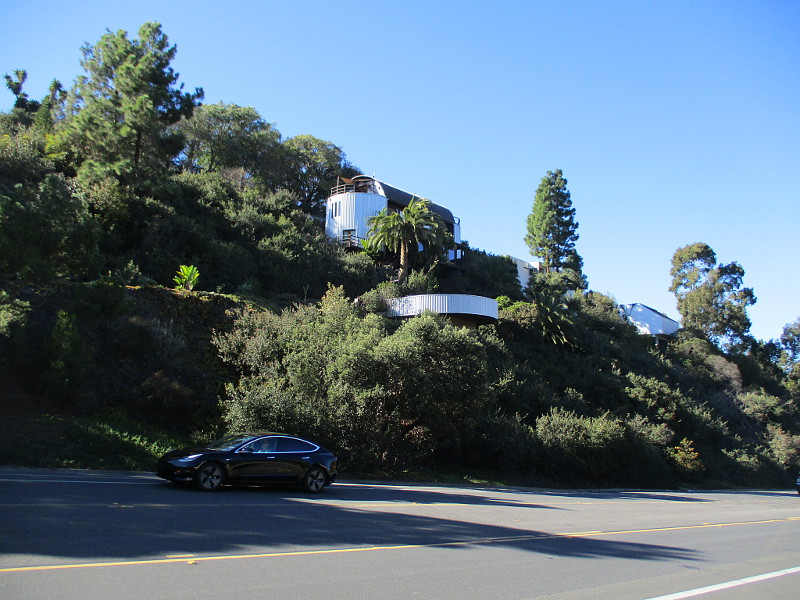
Perhaps you’ve seen that very unusual house perched high on a hillside in La Jolla. You can’t miss it when you drive west down Nautilus Street.
It was designed by Eugene Ray, a San Diego State University professor who taught Environmental Design from 1969 to 1996. He found his inspiration from UFOs and natural, organic shapes!
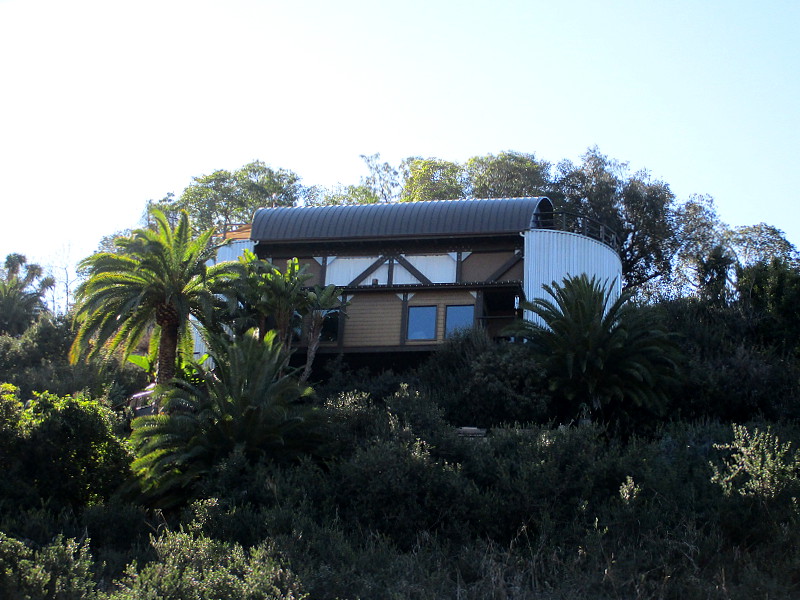
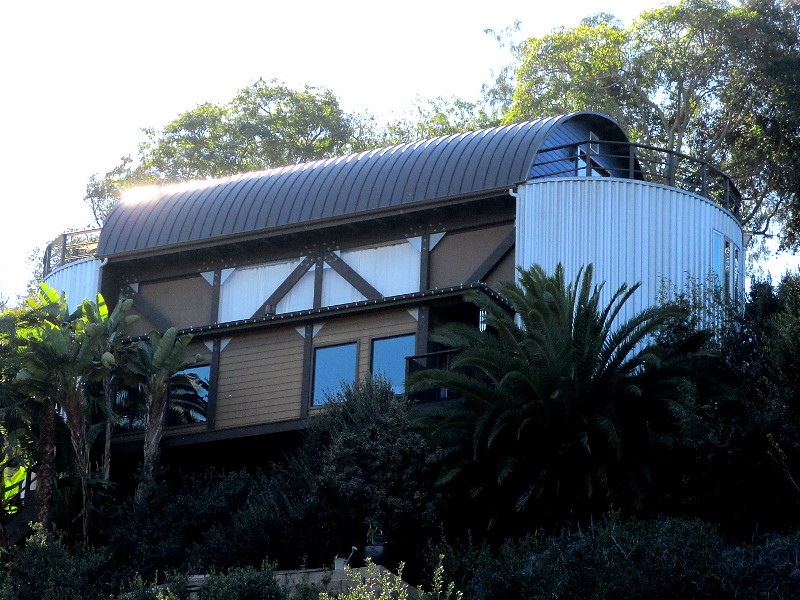
The house is called the Silver Ship.
Back in 1978, five SDSU students set to work building the unique structure. You can read about the project and see photographs of the construction on Eugene Ray’s blog here. For years it was his La Jolla home and studio.
I first learned about the Silver Ship in 2019 at an exhibition of Eugene Ray’s work at the SDSU Downtown Gallery. Like many of his designs, it’s form is simple and symmetric and consequently unusual. He observed a UFO in his youth, and it influenced his architectural concepts throughout his life. See more of his groundbreaking designs, learn more of his unique story, and see blueprints of the fantastic Silver Ship by visiting my old blog post here!
When you compare these to the original photographs, you can see how the Silver Ship appears different today. If I recall correctly, a new owner redesigned the house somewhat. Interesting that now it appears a little more like a . . . silver ship!
…
I live in downtown San Diego and love to walk around with my camera! You can follow Cool San Diego Sights via Facebook or Twitter!
One of the most fascinating museums in San Diego County is located in the city of Lemon Grove.
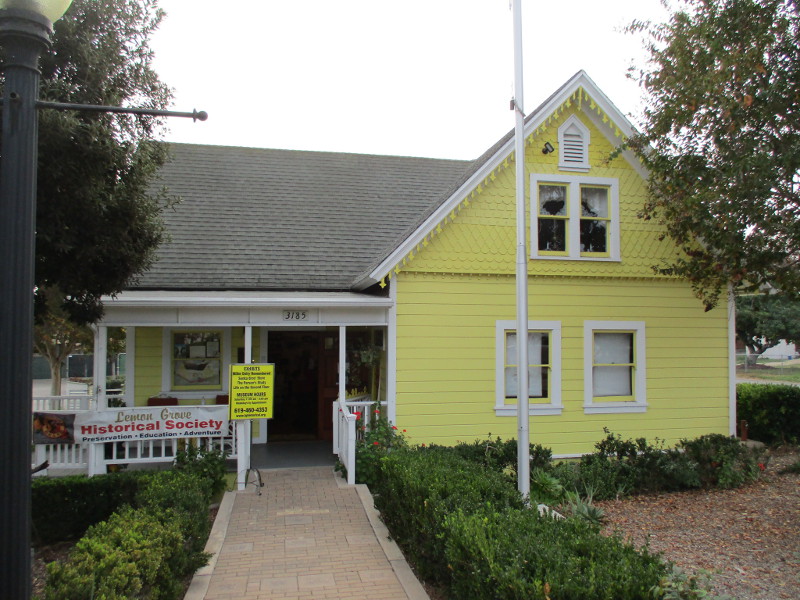
The Parsonage Museum, operated by the Lemon Grove Historical Society, occupies a beautifully restored Victorian building at Treganza Heritage Park. The building began as Lemon Grove’s first church, the 1897 Atherton Chapel.
The old church was eventually moved from its original location, served as a community meeting hall, then became a private residence. Today it houses a museum whose exhibits recall a time when Lemon Grove was a small agricultural town with citrus orchards and packing houses, a general store, and a boast of the Best Climate on Earth!
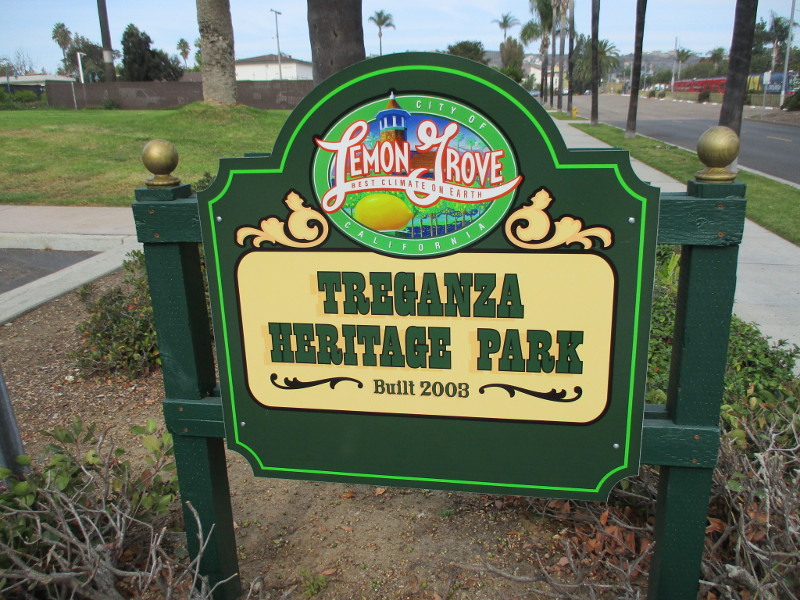
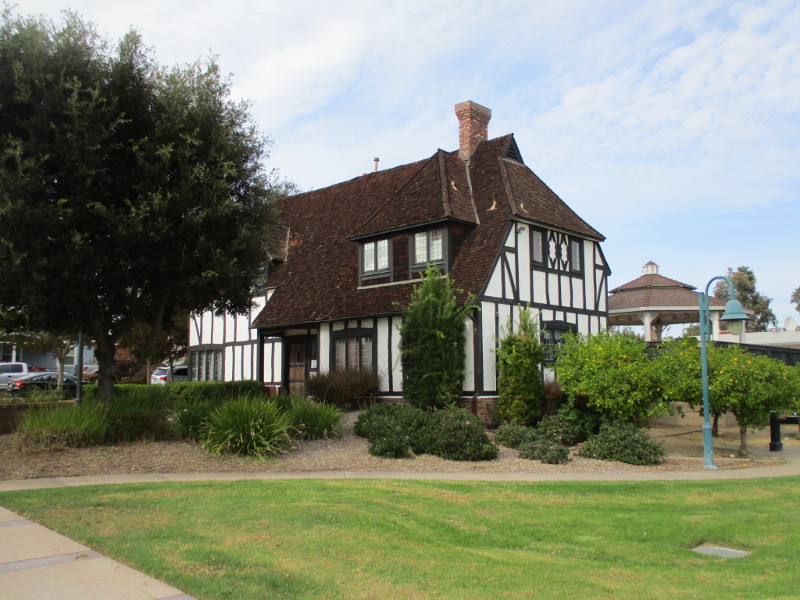
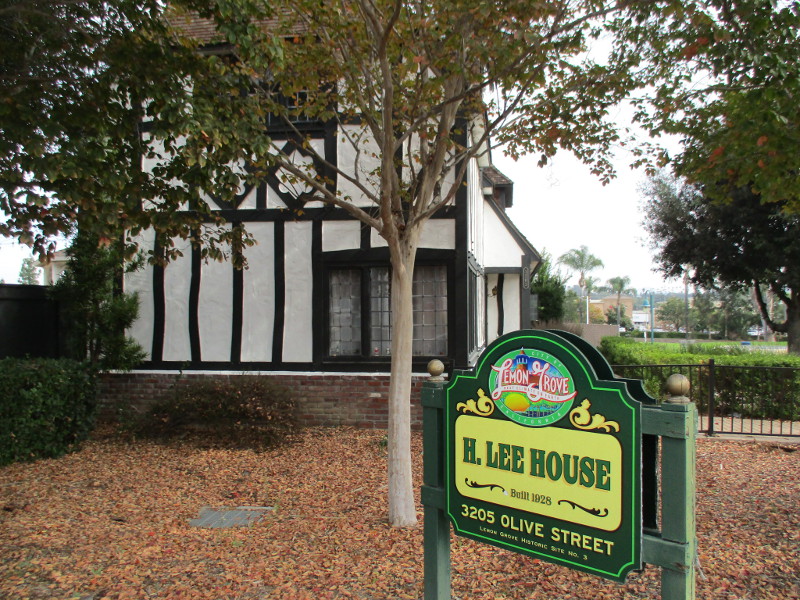
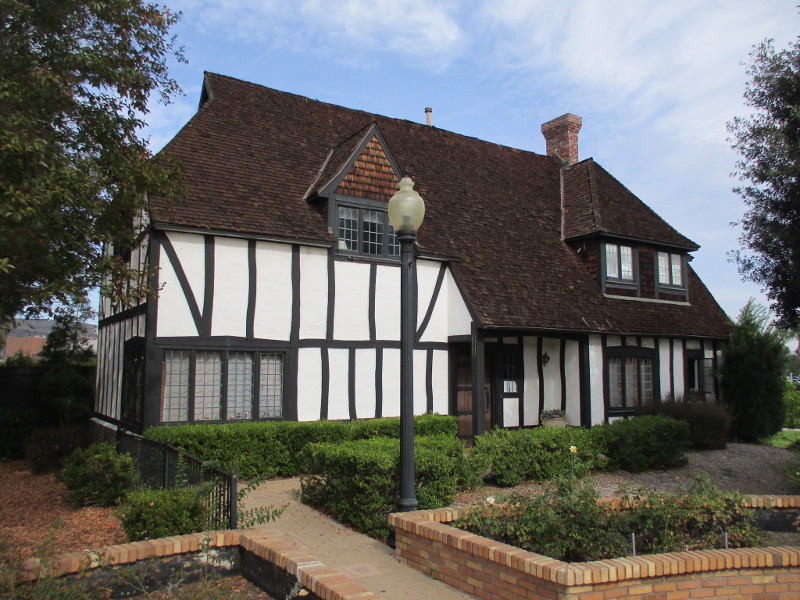
I walked about Treganza Heritage Park and visited the Parsonage Museum last weekend. I also took a quick look at the 1928 H. Lee House, a Tudor Revival structure that stands nearby in the park and serves as a cultural center.
I urge anyone interested in the history of San Diego and Lemon Grove to head to the Parsonage Museum on a day when they are open. See their website for more information here!
To get an idea of what you’ll discover, please read my photo captions!
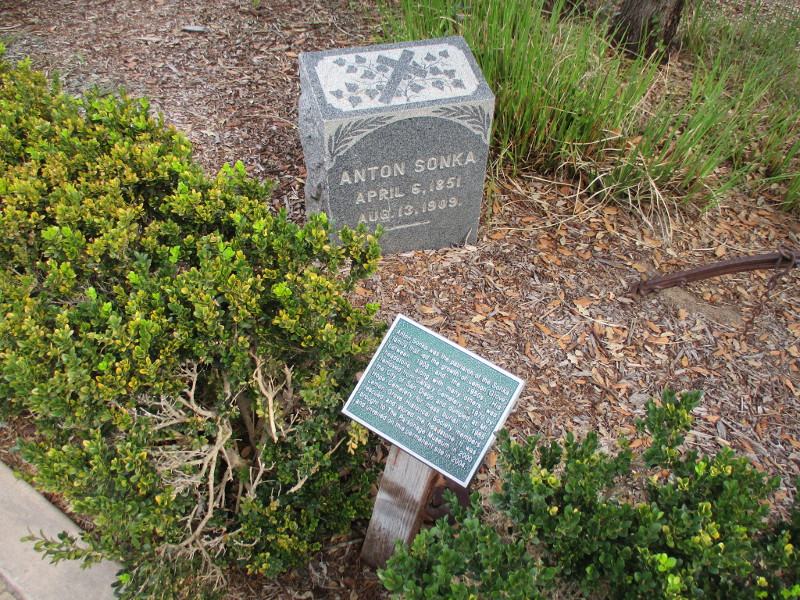
Treganza Heritage Park in Lemon Grove was first called Civic Center Park. It’s name was changed in 2020. The Treganza family was an influential pioneer family in Lemon Grove.A view of the H. Lee House. It was moved to this location to make way for the extension of State Route 125.The H. Lee House was built in 1928. It was designed by British architect Frederick C. Clemesha. Today it serves as a cultural center, where events such as History Alive lectures can be enjoyed. One more photo of the handsome H. Lee House.Lemon trees stand in a plaza between the H. Lee House and the Parsonage Museum.The small plaza welcomes visitors to Treganza Heritage Park.A 2002 dedication plaque from back when it was called Civic Center Park.Now turning to look at the Parsonage Museum. The restored Folk Victorian building, the 1897 Atherton Chapel, served as the only Lemon Grove church until 1912. Recovered grave marker of Anton Sonka just outside the museum entrance.
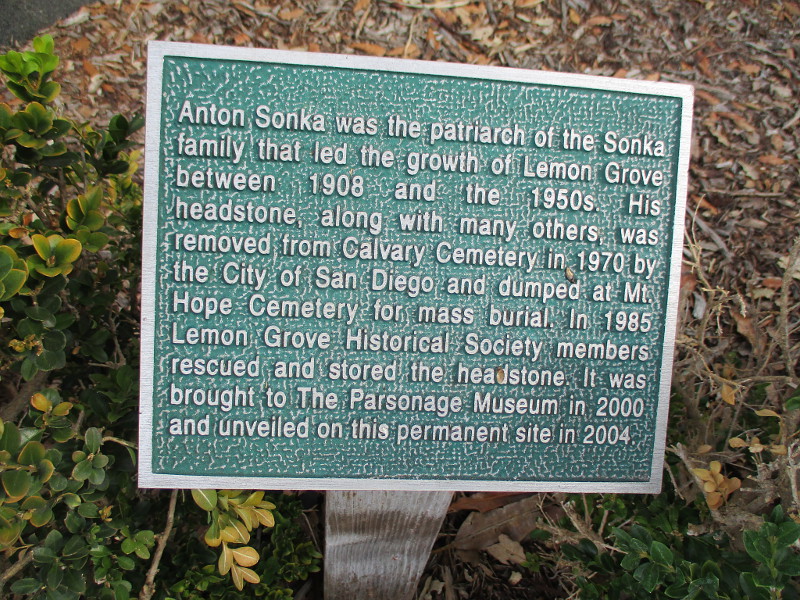
Anton Sonka was the patriarch of the Sonka family that led the growth of Lemon Grove between 1908 and the 1950s. His headstone, along with many others, was removed from Calvary Cemetery in 1970 by the City of San Diego and dumped at Mt. Hope Cemetery for mass burial. In 1985 Lemon Grove Historical Society members rescued and stored the headstone. It was brought to The Parsonage Museum in 2000 and unveiled on this permanent site in 2004.
(If you’d like to learn more about this callous dumping of gravestones, which were discovered in a gully at Mt. Hope Cemetery, I posted a blog concerning it here.)
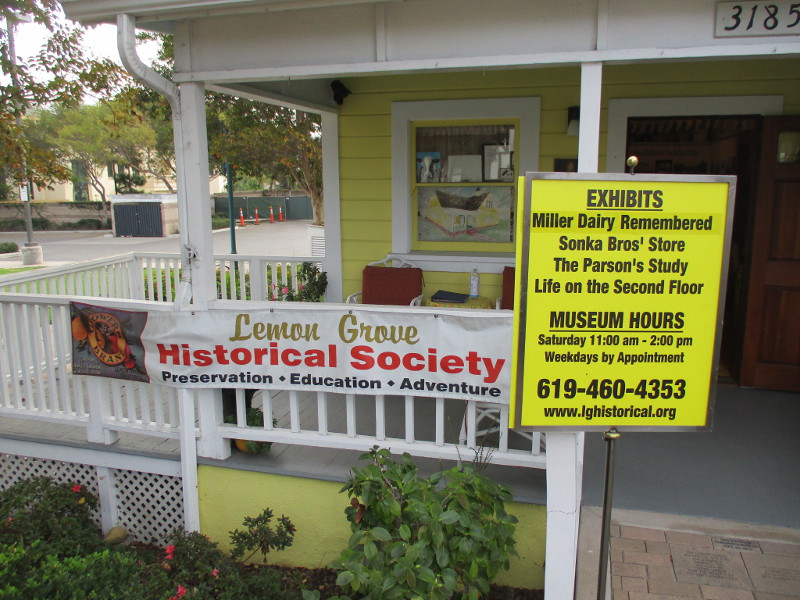
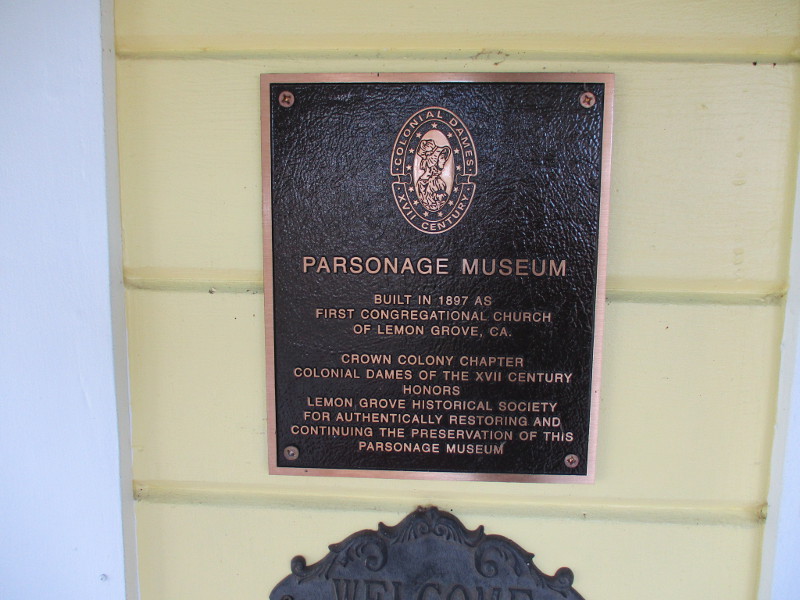
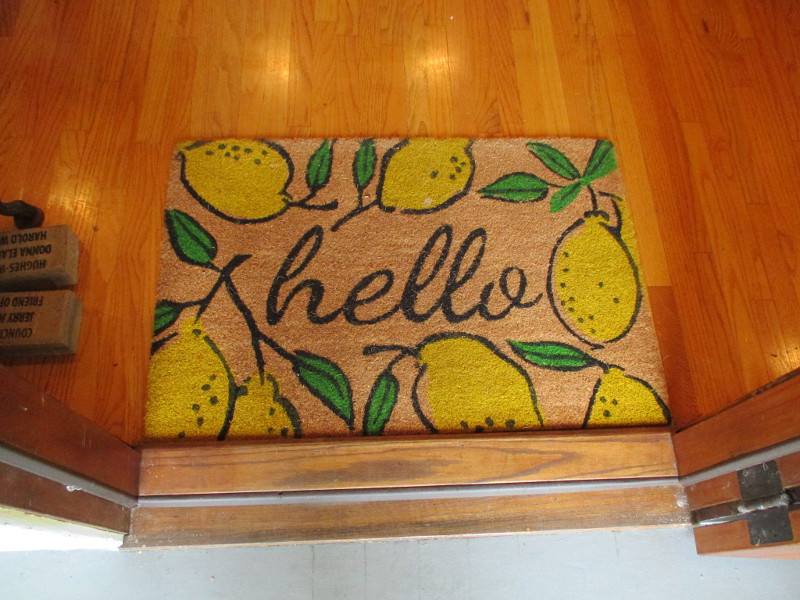
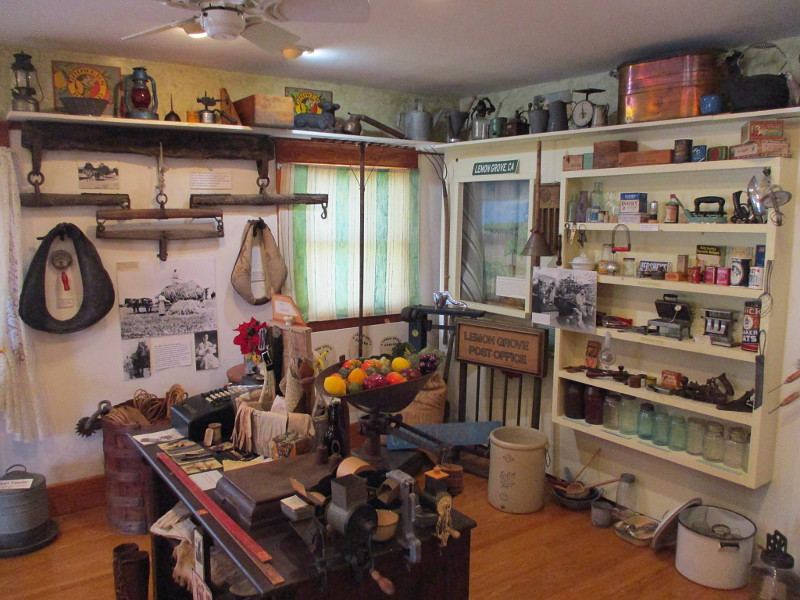
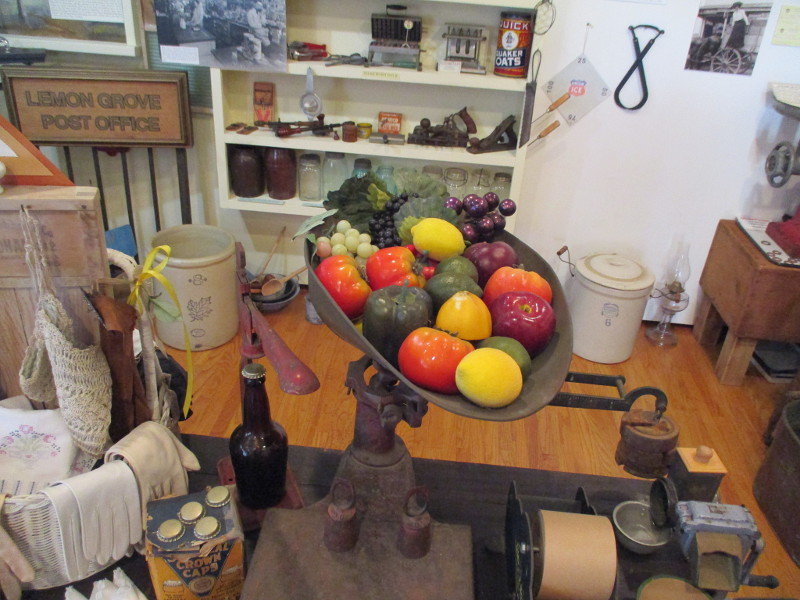
When I visited in November 2021, the Parsonage Museum was featuring several historical exhibits concerning Lemon Grove.The museum building was “Built in 1897 as First Congregational Church of Lemon Grove.”Stepping into the museum, greeted by a lemony, welcoming doormat!Look at what’s in the museum! A recreation of the Sonka Brothers General Store.Items on display recall Lemon Grove’s rural history, which includes general stores where the community would gather.
The Sonka Brothers General Store stood near the center of town for decades. You can see photos of the Lemon Grove History Mural that’s painted on the south side of the historic Sonka Brothers General Store building here!
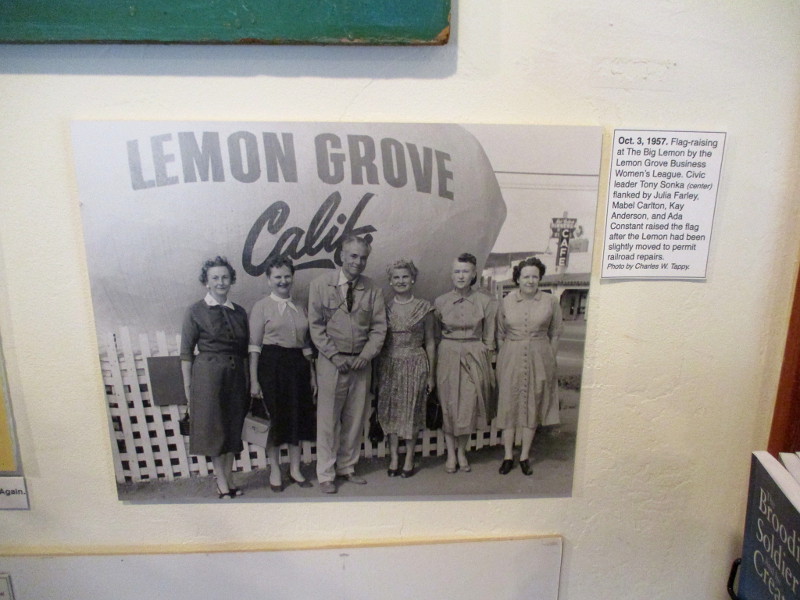
Photo from October 3, 1957 of The Big Lemon during a flag-raising. Civic leader Tony Sonka stands at the center.
If you like to see The Big Lemon today, which still stands on Broadway, check out these photos!
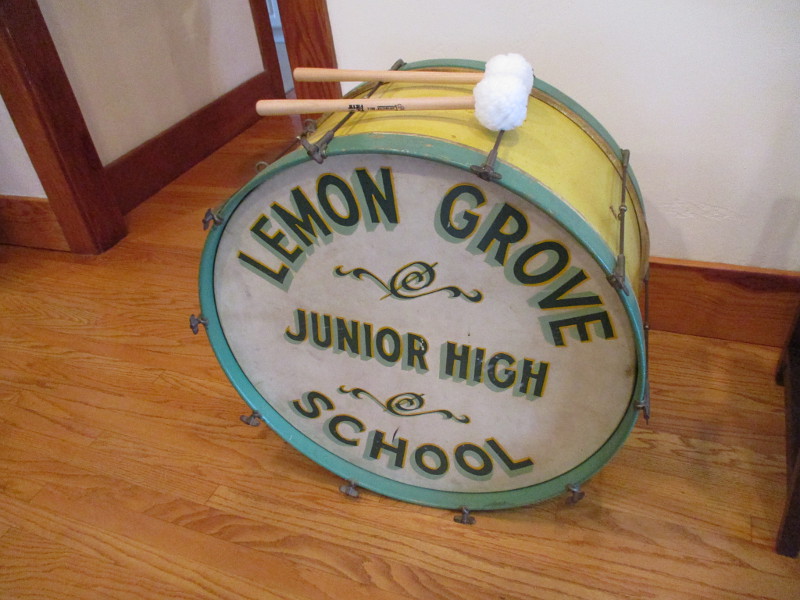
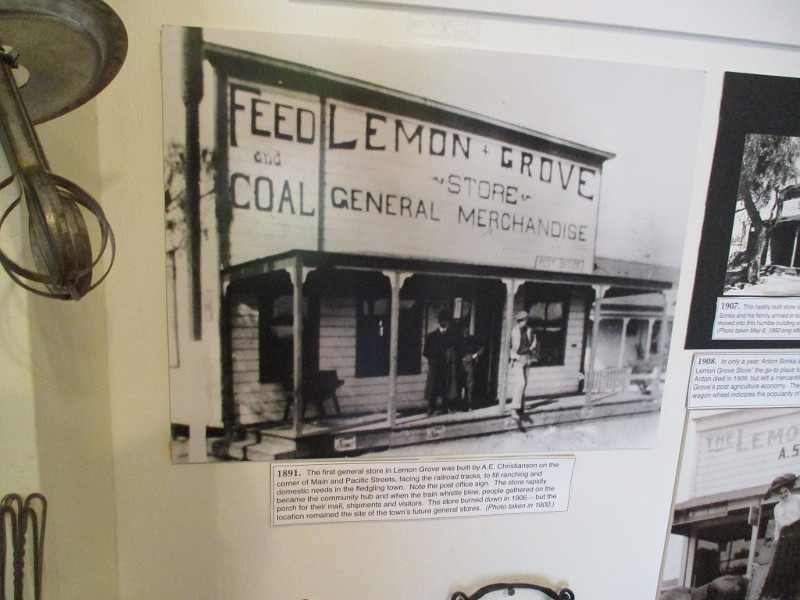
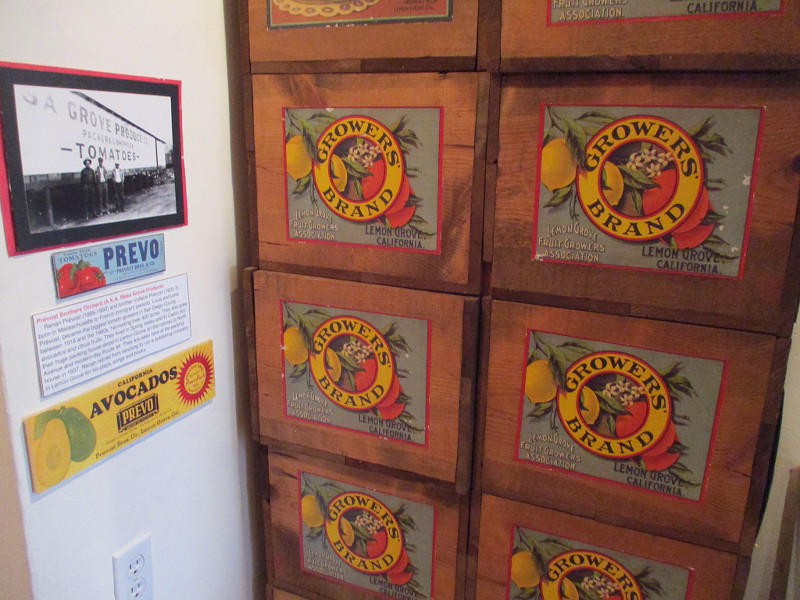
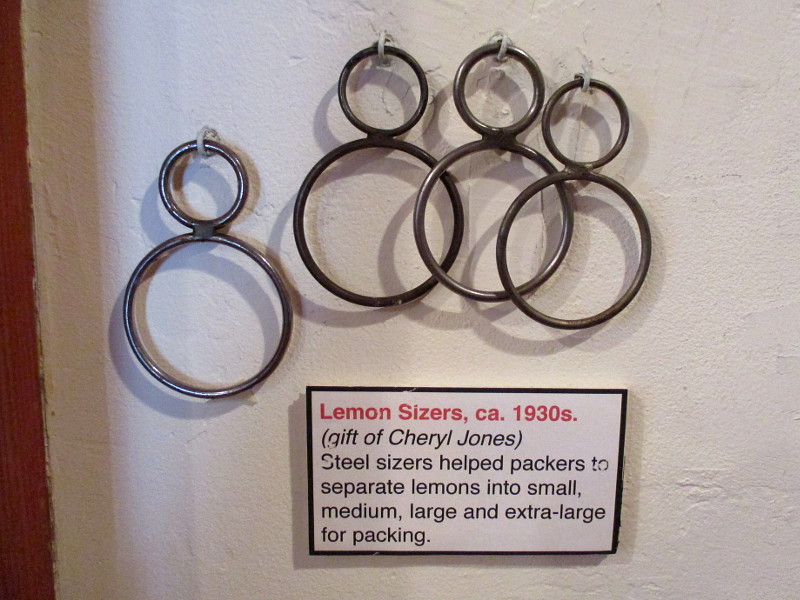
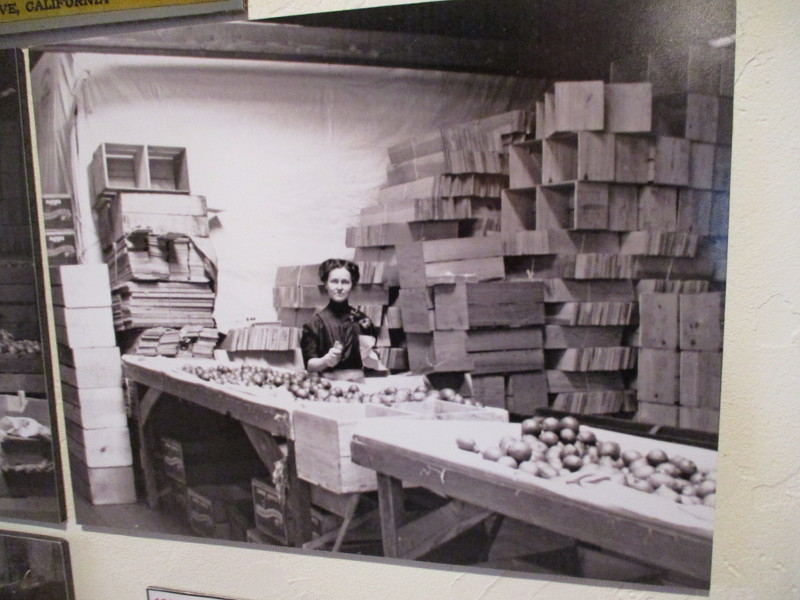
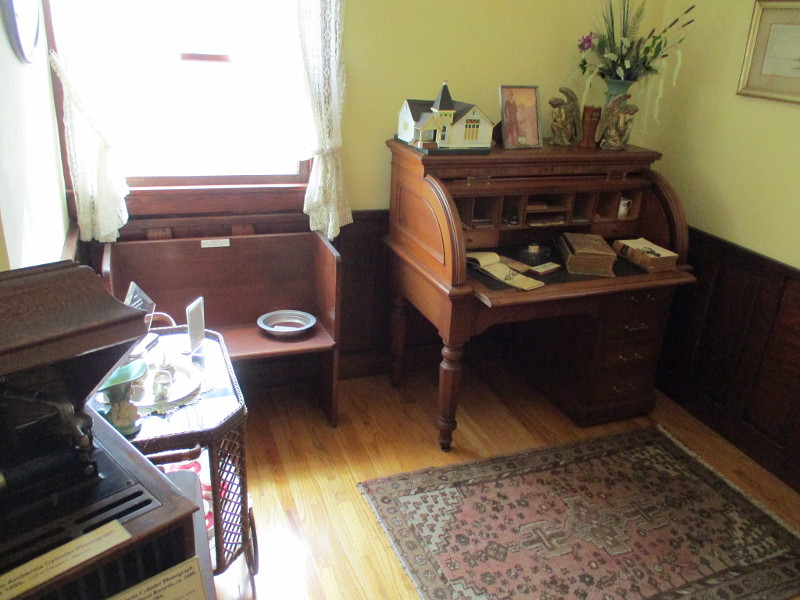
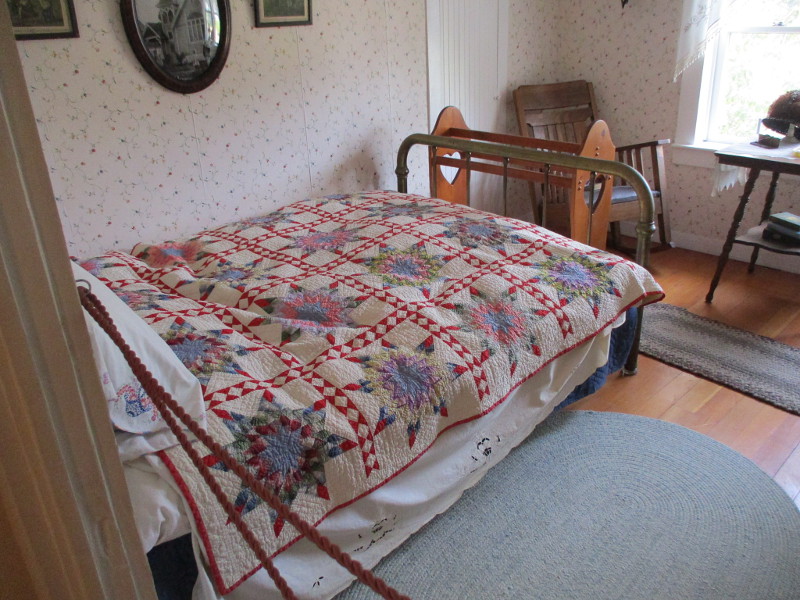
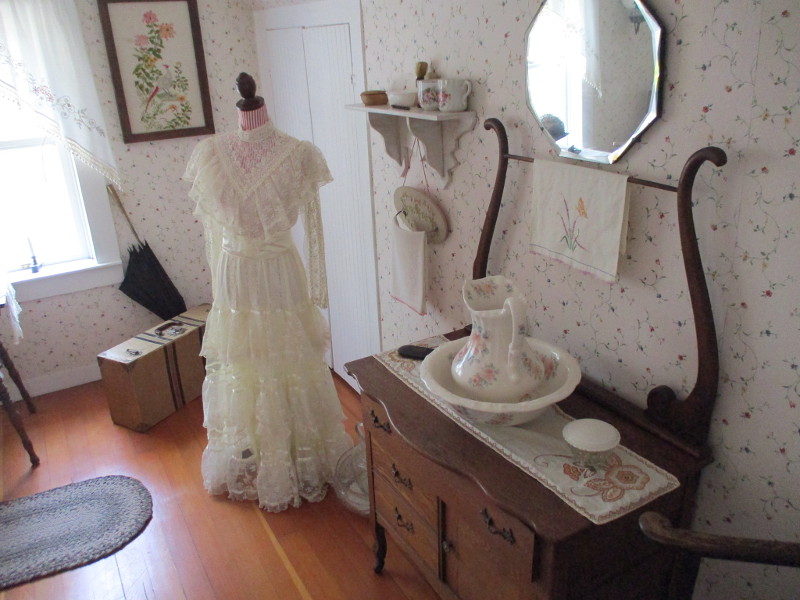
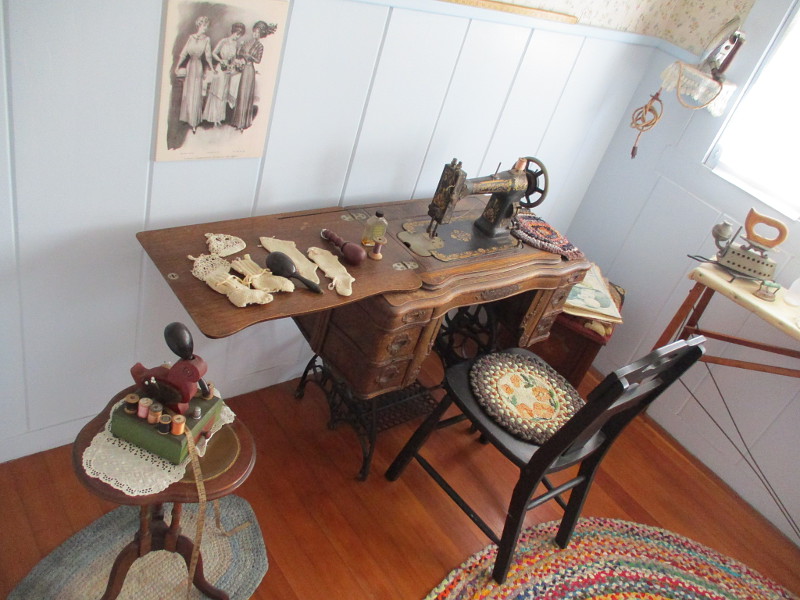
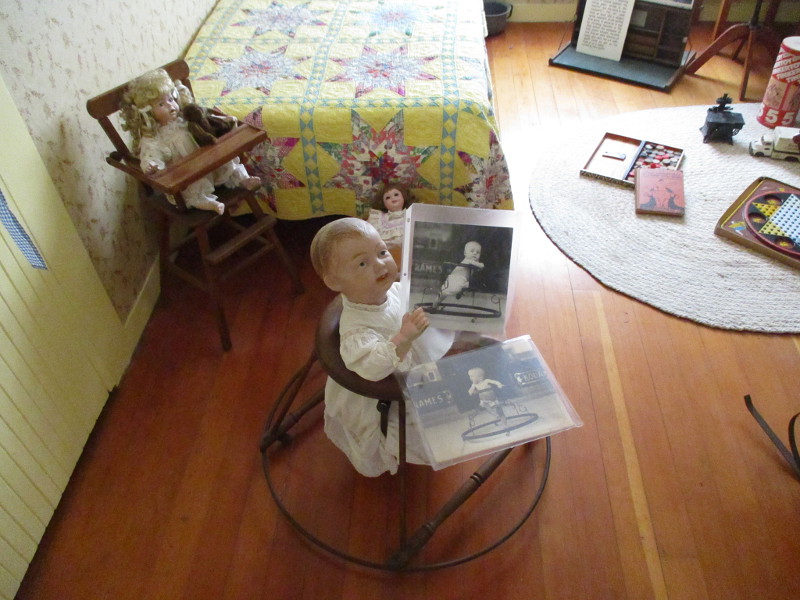
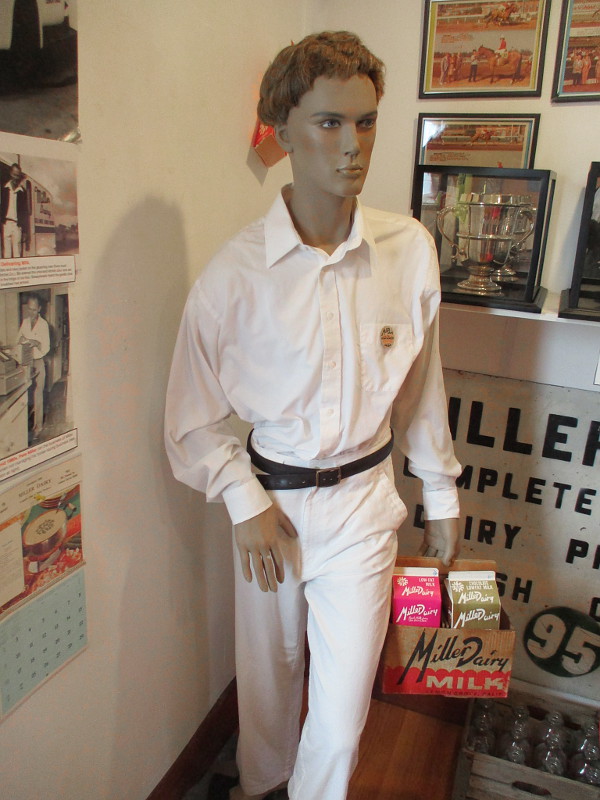
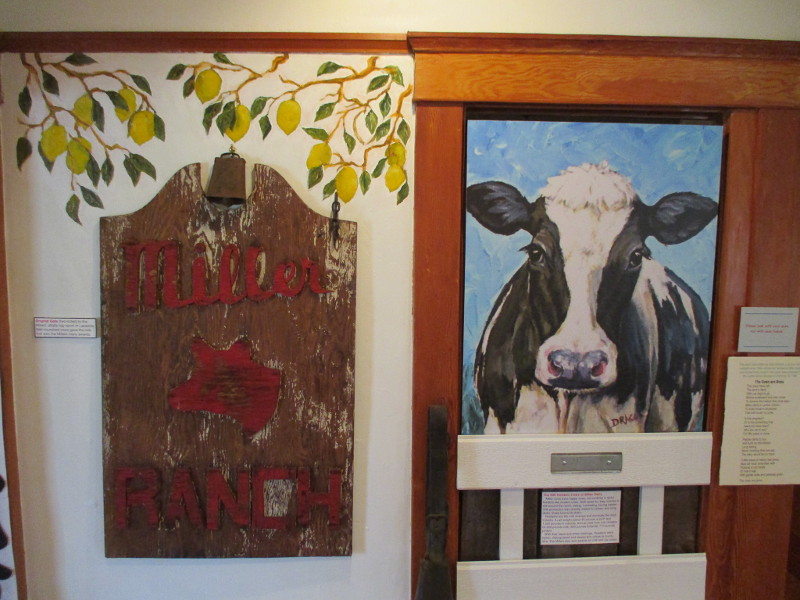
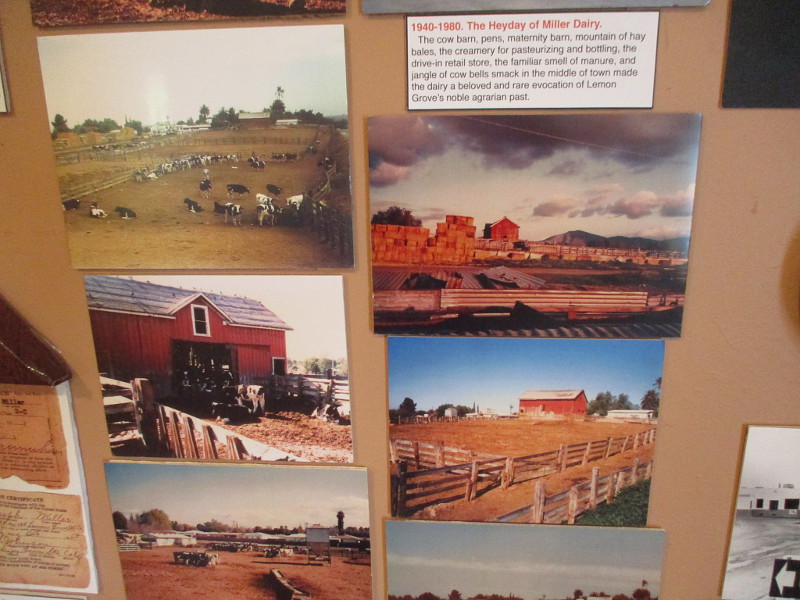
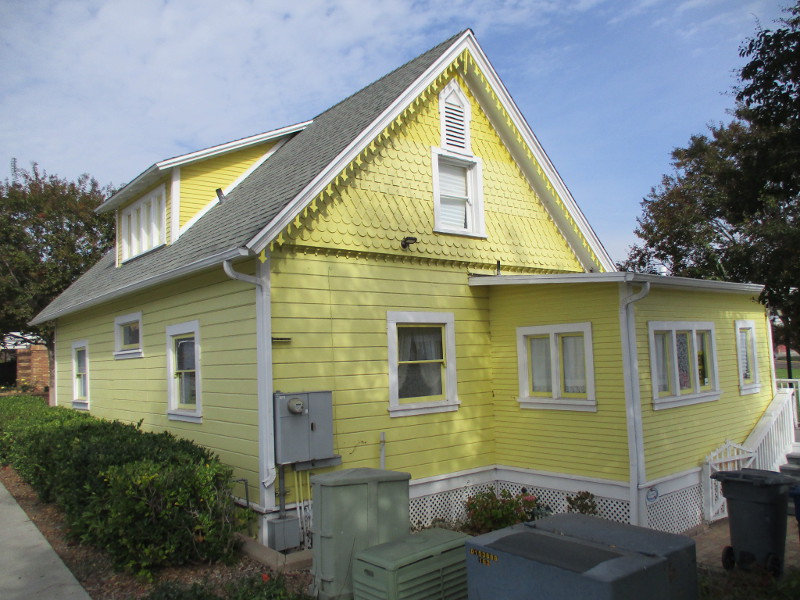
Old drum from the Lemon Grove Junior High School band.1891 photograph of the first general store in Lemon Grove, built by A. E. Christianson at Main and Pacific Streets.The many displays at the Parsonage Museum include these Lemon Grove Fruit Growers Association packing crates.Lemon sizers, circa 1930’s. Packers would separate lemons by size.Woman holding lemon sizer, with stacked ready-to-assemble crates nearby.A room on the ground floor of the Parsonage Museum recreates the Parson’s Study. Reverend Isaac Atherton established the First Congregational Church of Lemon Grove in 1894. The building was constructed in 1897.Several rooms can be viewed on the second floor of the Parsonage Museum, including this Parents’ Room, or bedroom.The Sewing Room.The Children’s Room.Back on the museum’s ground floor, in a corner gallery, the current exhibit is titled Miller Dairy Remembered. This local dairy sold its first milk in 1926. Houses were finally built on the ranch site in the 1980’s. An important chapter of Lemon Grove’s agrarian past is recalled.Lemon Grove’s old Miller Dairy and their 300 freely roaming Holstein cows are fondly remembered at the Parsonage Museum.Historical photos show the Miller Dairy in Lemon Grove, from 1940-1980.One last look at the lemon yellow Parsonage Museum!
…
I live in downtown San Diego and love to walk around with my camera! You can follow Cool San Diego Sights via Facebook or Twitter!
You can easily explore Cool San Diego Sights by using the search box on my blog’s sidebar. Or click a tag! There are thousands upon thousands of photos for you to enjoy!
Saturday, on my way to TwainFest, I walked a little around Old Town San Diego State Historic Park to see what I might see.
At the blacksmith shop, wood shop and nearby grounds, I observed some interesting activity!
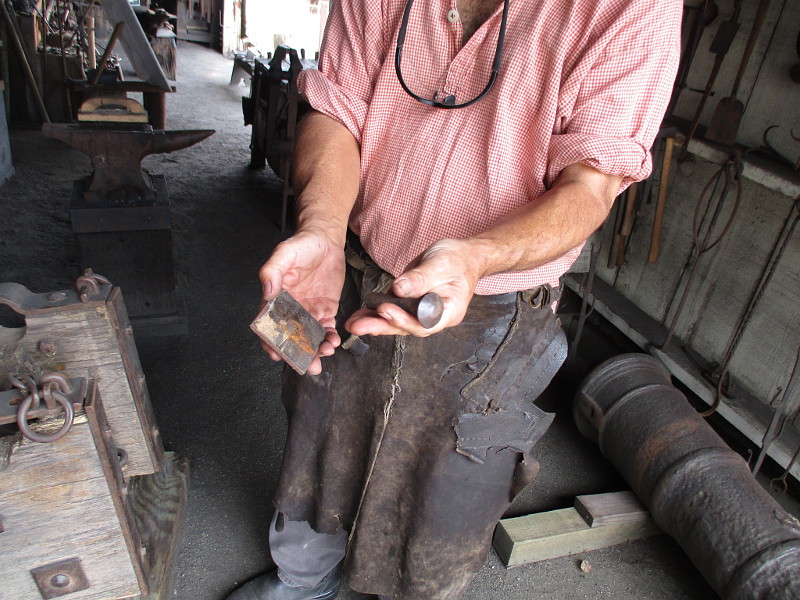
First, I learned from Todd in the blacksmith shop that a new carriage for Old Town plaza’s historic cannon will soon be built! I blogged about this project back in April here. I detail a little about the cannon’s history in that blog post.
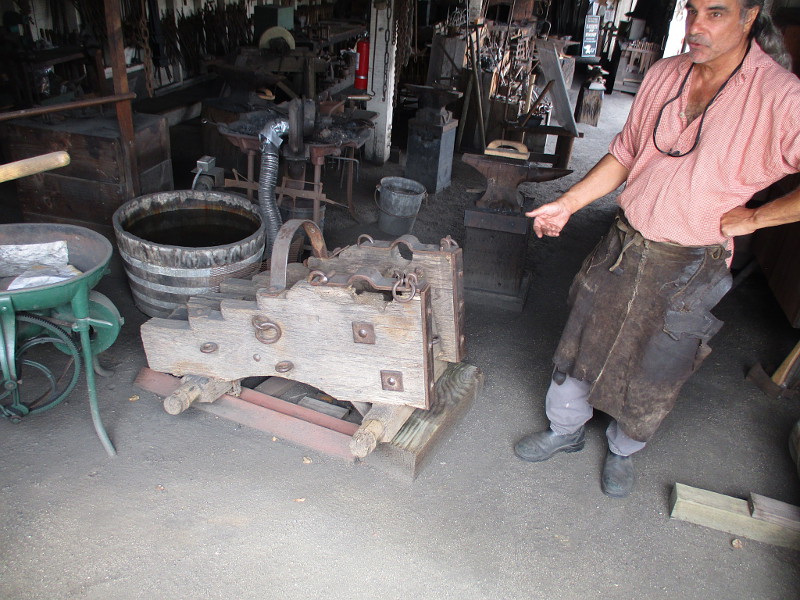
Todd showed me how he had removed some of the original iron fittings from the wooden carriage. All of the iron will be saved, then refitted to a brand new carriage once it’s built. Welds will be hidden to preserve the original appearance.
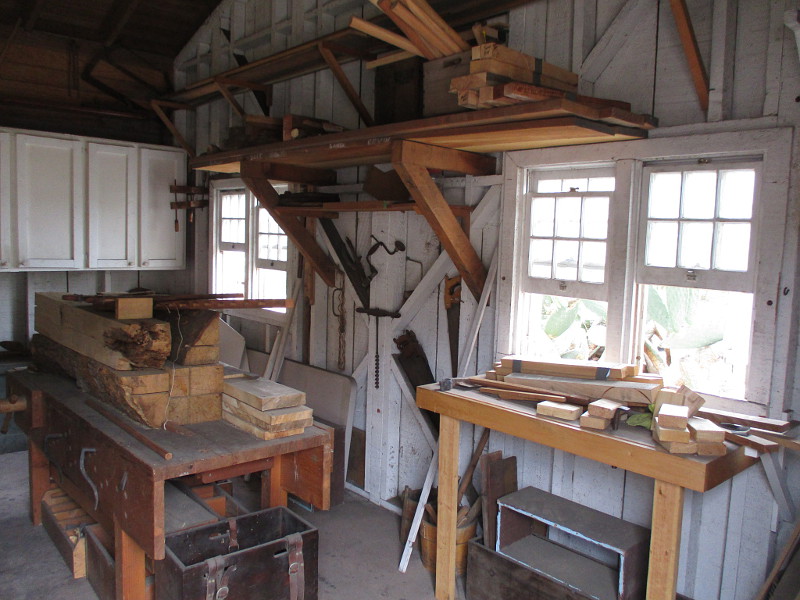
The carriage will be constructed in the wood shop, a small work room attached to the blacksmith shop.
Here are a few photos of the wood shop…
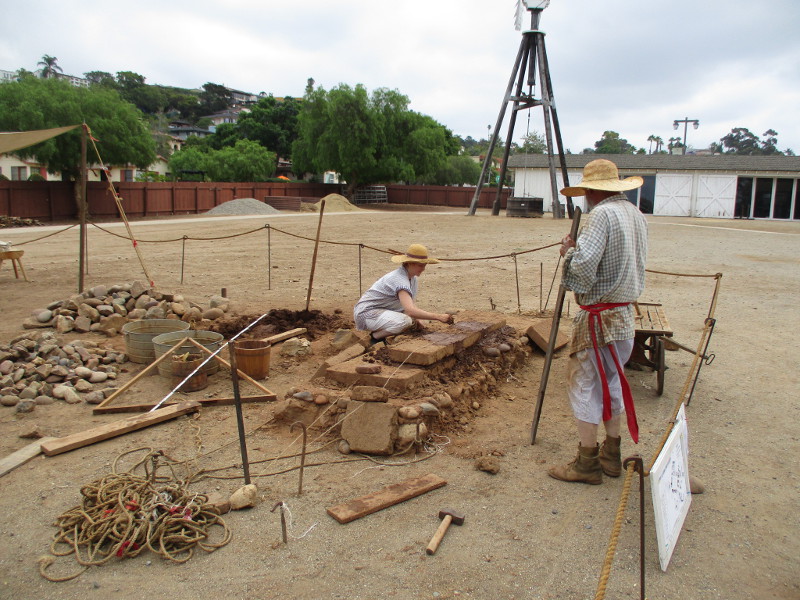
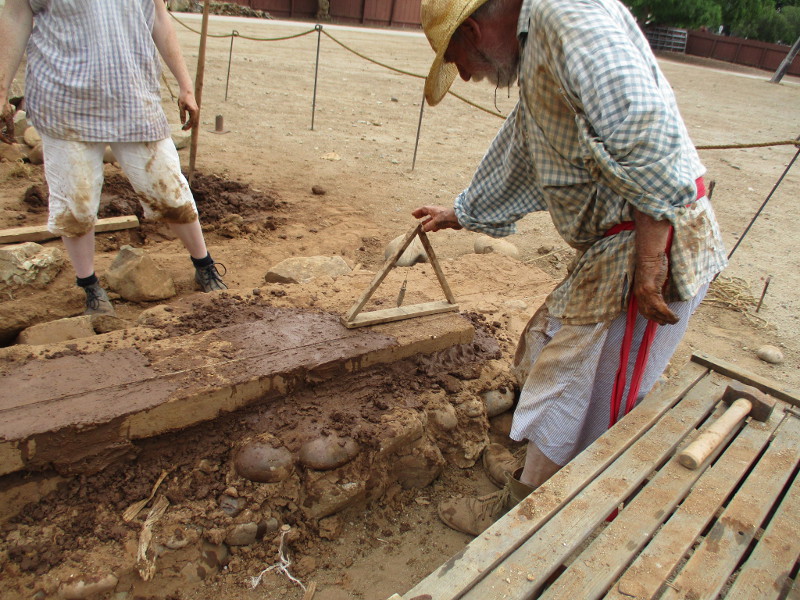
Then I noticed two people working in the dirt area outside the blacksmith shop, behind Seeley Stable. This is the new spot in the State Park where adobe wall-making is demonstrated.
I’ve been told the old adobe demonstration area, which I blogged about here, will be used in the future for a Kumeyaay interpretive display.
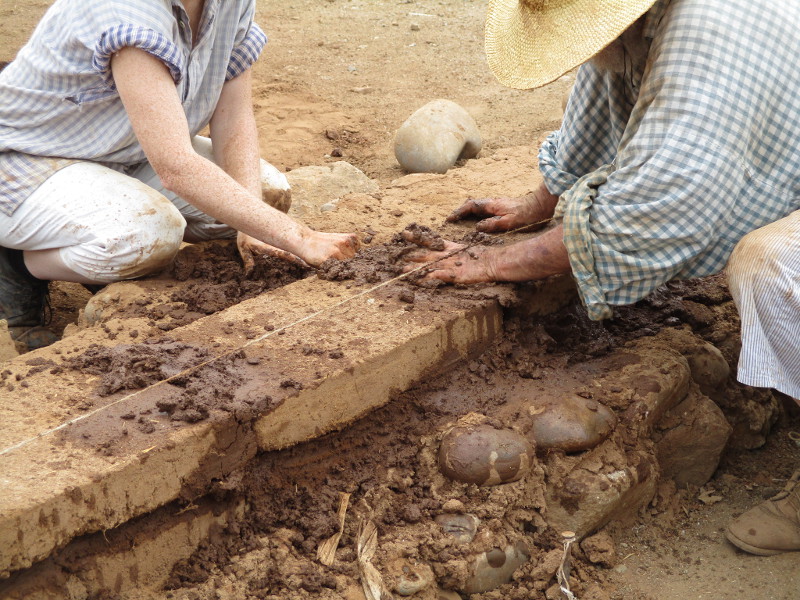
As I watched slimy fingers jam mud mortar between large sun-dried adobe blocks, I took a look at information concerning which structures in Old Town are original adobes, and which ones are reconstructed.
Six original adobe buildings shown are: Casa de Machado y Silvas, c. 1843; Casa de Machado y Stewart, c. 1830; Casa de Estudillo, c. 1827; Casa de Bandini/Cosmopolitan Hotel, c. 1829; Altamirano-Perdrorena House, c. 1869; and the oldest structure in San Diego, Casa de Carrillo (between Old Town San Diego State Historic Park and the Presidio), c. 1817.
Reconstructed adobe buildings are: Robinson-Rose Building, c. 1853; Casa de Wrightington, c. 1804; San Diego House, c. 1841; Casa de Rodriguez, c. 1830; Colorado House (Adobe Annex), c. 1854; Casa de Alvarado, c. 1830; and Alvarado Saloon, c. 1830.
Typical adobe wall construction involved a foundation and a layer of small stones and shards topped by adobe bricks, which are cemented with lime and sand or mud plaster.
…
I live in downtown San Diego and love to walk around with my camera! You can follow Cool San Diego Sights via Facebook or Twitter!
Those entering Balboa Park from Bankers Hill might notice this beautiful old house at the corner of Sixth Avenue and Laurel Street. During my walks I’ve often wondered about it.
After doing a little research, I discovered it’s called the William Clayton House. It was designed in 1907 by San Diego’s first female architect, Hazel Wood Waterman.
Hazel Wood Waterman got her start as one of renowned architect Irving J. Gill’s two chief draftspeople. With a particular love for the Arts and Crafts style, she would eventually design a number of houses and buildings around San Diego. Her most famous work was the 1910 restoration of the Casa de Estudillo in Old Town, a commission that came from John D. Spreckels.
You can learn more about Hazel Wood Waterman here.
The William Clayton House barely avoided demolition almost thirty years ago. You can read about that here. Today it is San Diego Historic Landmark #270 and location of the Vista Balboa Crisis Center.
…
I live in downtown San Diego and love to walk around with my camera! You can follow Cool San Diego Sights via Facebook or Twitter!
You can easily explore Cool San Diego Sights by using the search box on my blog’s sidebar. Or click a tag! There are thousands upon thousands of photos for you to enjoy!
Magee Park in Carlsbad is a special place where both history and beauty thrive.
I enjoyed a walk through the park recently, pausing frequently to admire its several historical structures.
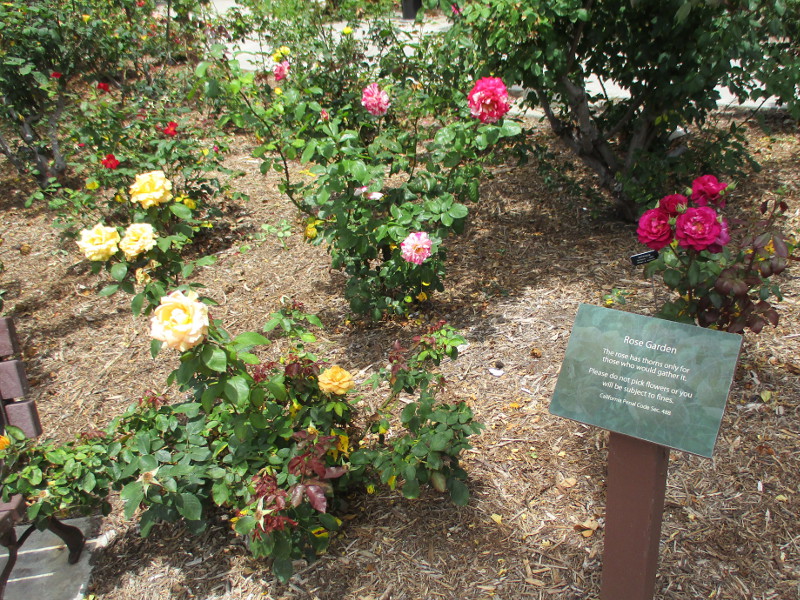
Everywhere I walked, it seemed, beds of roses greeted me. Magee Park’s rose garden is so beautiful and extensive that the American Rose Society called Carlsbad “An American Rose City” in 2002.
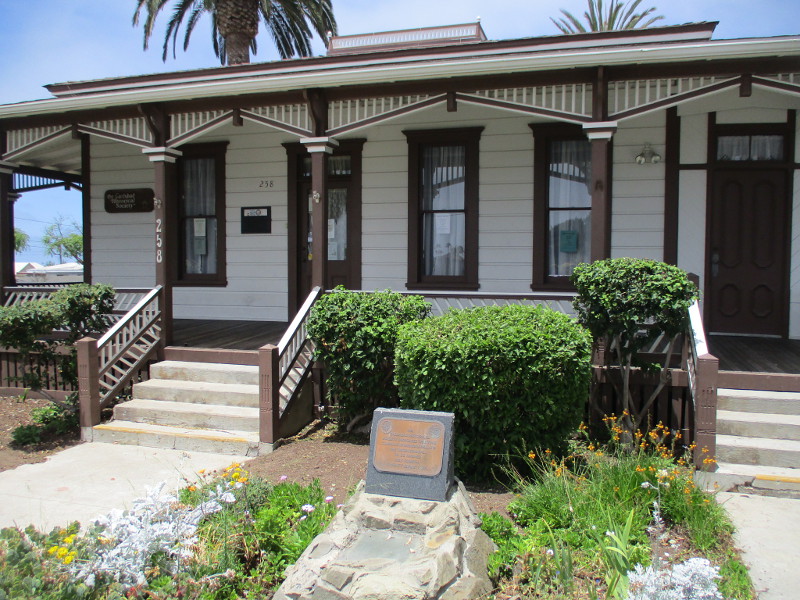
The centerpiece of the park is the 1887 Magee House, a handsome Craftsman-style house built by Samuel Church Smith, one of the founders of Carlsbad Land and Water Company. Today it is home to the Carlsbad Historical Society and their museum. Unfortunately, the museum was closed when I walked past. Read more about the Magee House’s history here.
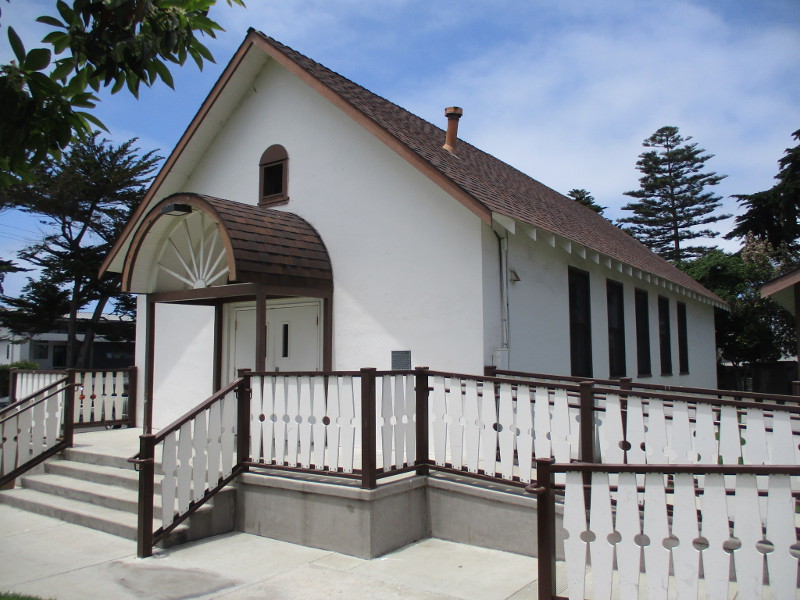
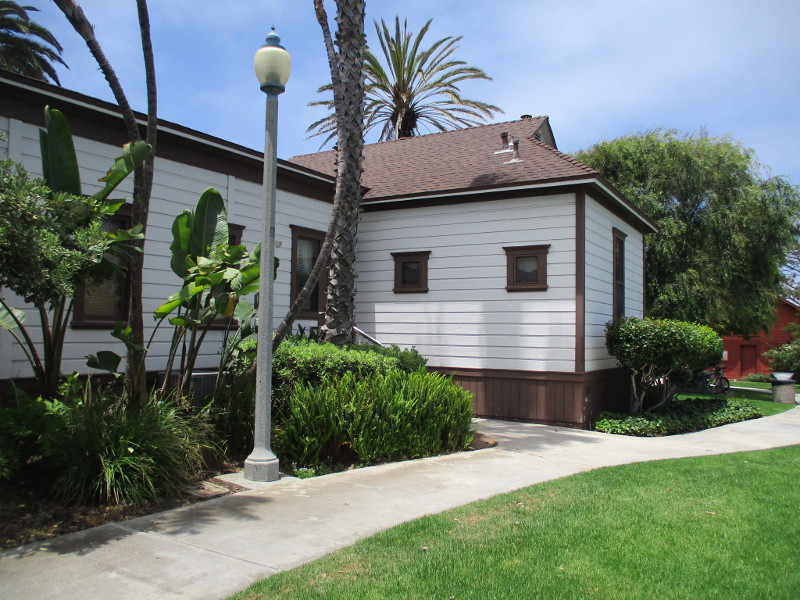
Other historic structures in Magee Park include the Shipley-Magee Barn, Heritage Hall, the Twin Inns Granary and the Twin Inns Gazebo.
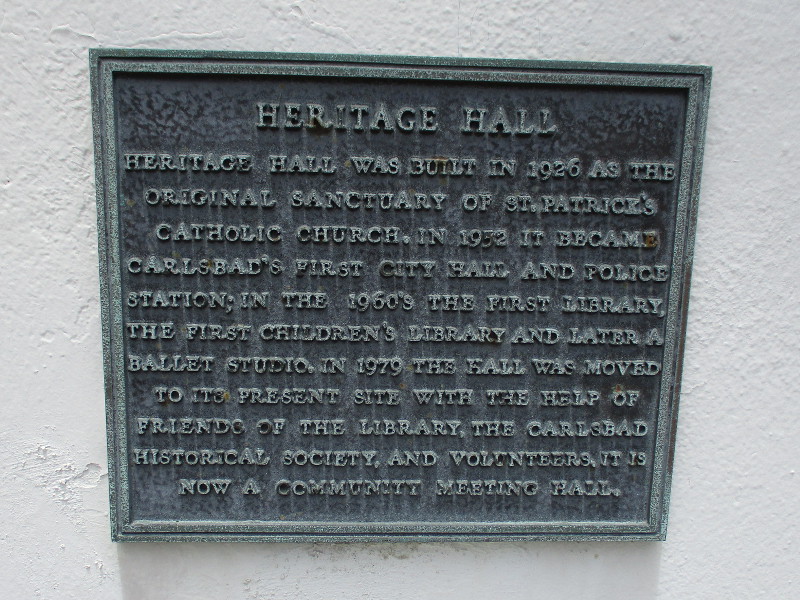
During my meandering walk, I photographed many of the informative signs and plaques that I came upon.
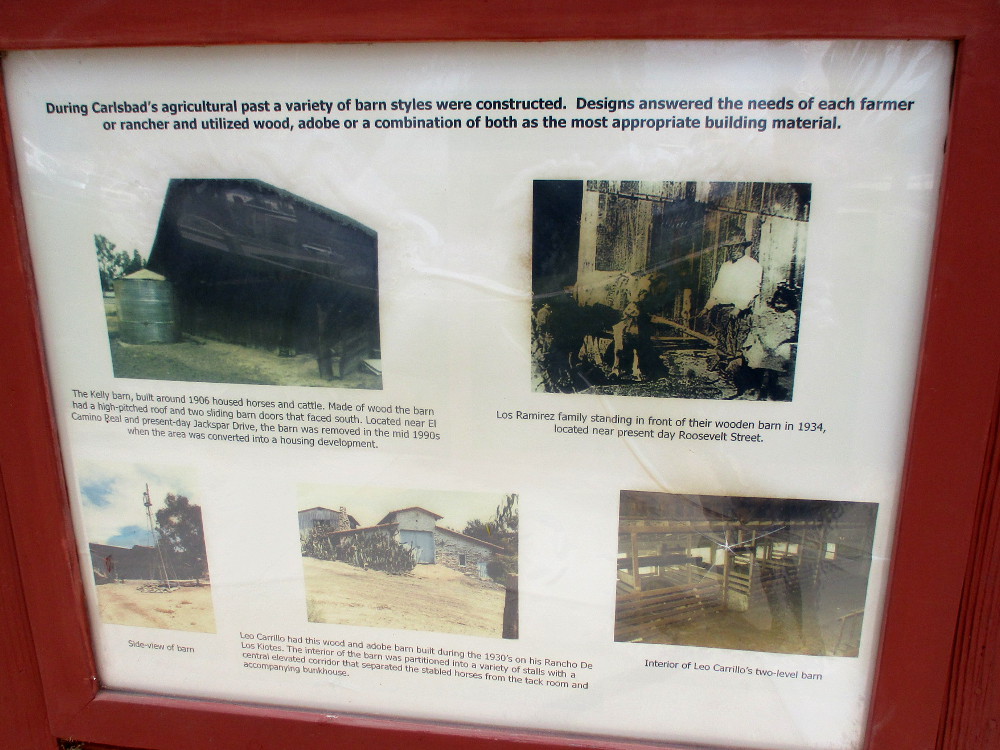
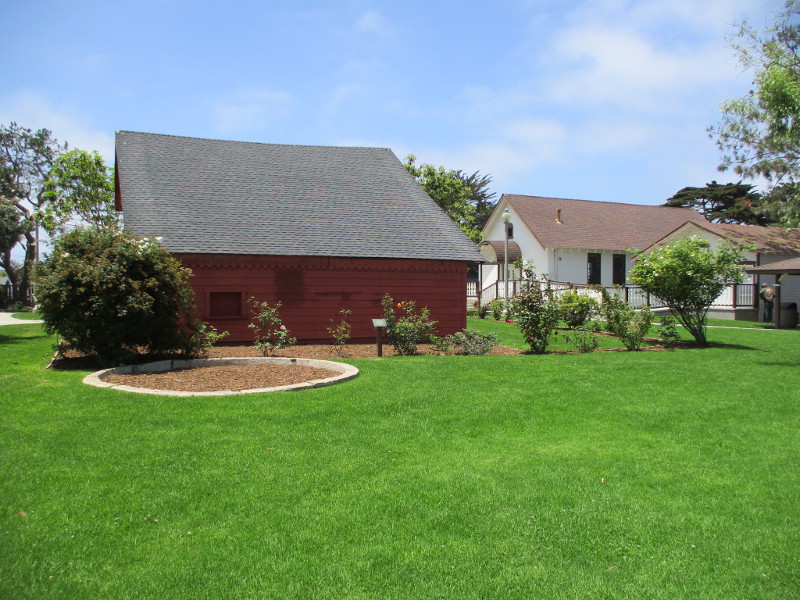
During Carlsbad’s agricultural past a variety of barn styles were constructed.The barn at Magee Historical Park is the oldest Carlsbad barn in existence. This sign on the barn’s side details its history, and tells a little about the life of Florence Shipley and her husband Hugh Magee.Vast areas of present day Carlsbad were once used to raise cattle and horses.Heritage Hall in Carlsbad, California.
HERITAGE HALL
HERITAGE HALL WAS BUILT IN 1926 AS THE ORIGINAL SANCTUARY OF ST. PATRICK’S CATHOLIC CHURCH. IN 1952 IT BECAME CARLSBAD’S FIRST CITY HALL AND POLICE STATION; IN THE 1960’S THE FIRST LIBRARY, THE FIRST CHILDREN’S LIBRARY AND LATER A BALLET STUDIO. IN 1979 THE HALL WAS MOVED TO ITS PRESENT SITE WITH THE HELP OF FRIENDS OF THE LIBRARY, THE CARLSBAD HISTORICAL SOCIETY, AND VOLUNTEERS. IT IS NOW A COMMUNITY MEETING HALL.
The Twin Inns Granary.
THE TWIN INNS GRANARY
ORIGINALLY BUILT BY EDDIE KENTNER, PROPRIETOR OF THE WORLD FAMOUS CARLSBAD TWIN INNS, THIS GRANARY WAS DONATED TO THE CITY OF CARLSBAD BY NEIMAN’S VILLAGE FAIRE AND MOVED TO MAGEE PARK IN 1985. IT WAS RESTORED THROUGH THE GENEROUS ASSISTANCE OF THE CARLSBAD EVENING ROTARY CLUB.
Now I’ve begun to walk around the Magee House…
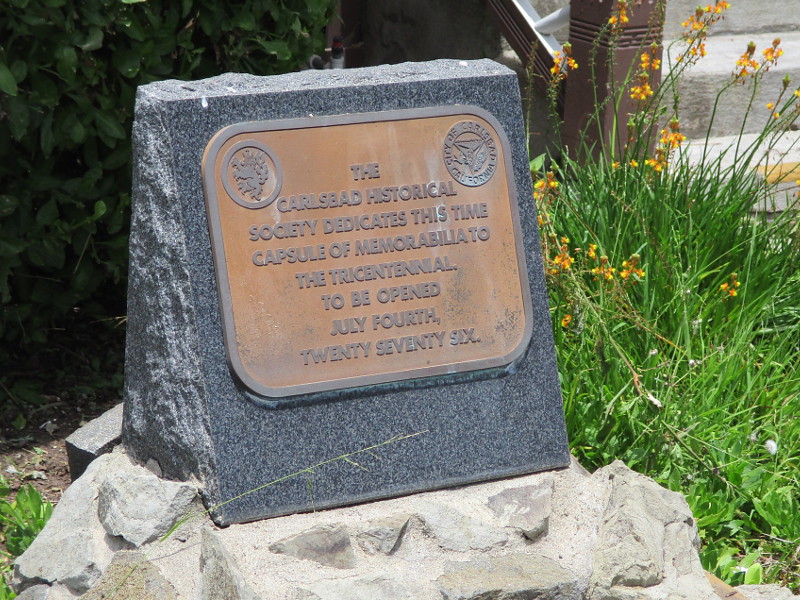
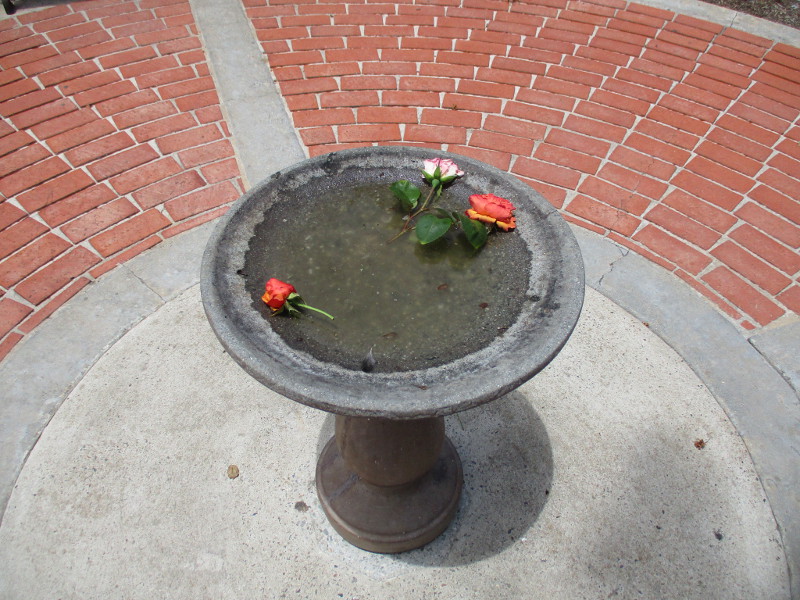
A time capsule in front of the Magee House placed by the Carlsbad Historical Society. It will be opened July 4, 2076, our nation’s Tricentennial.Roses by the Magee House’s welcoming veranda.Circular patio with birdbath beside the Magee House. More roses.The old Twin Inns Gazebo nearby.Continuing my walk around the Magee House.
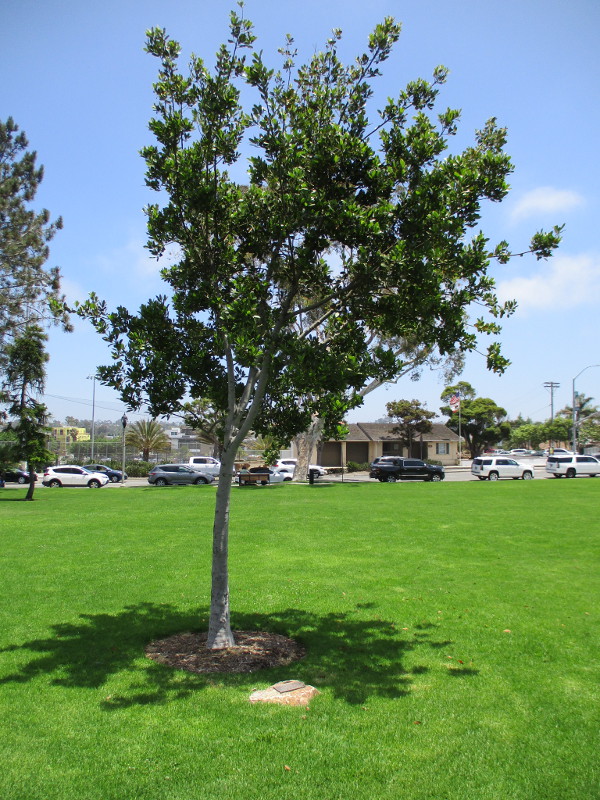
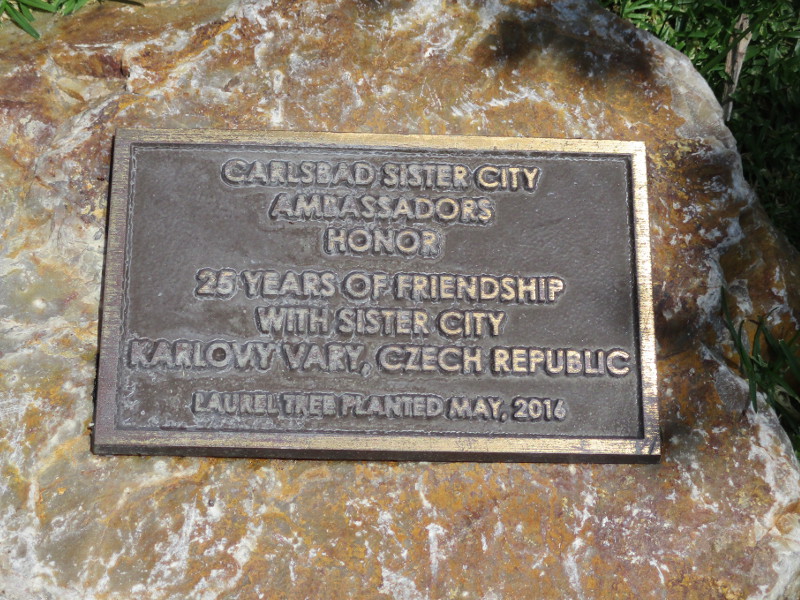
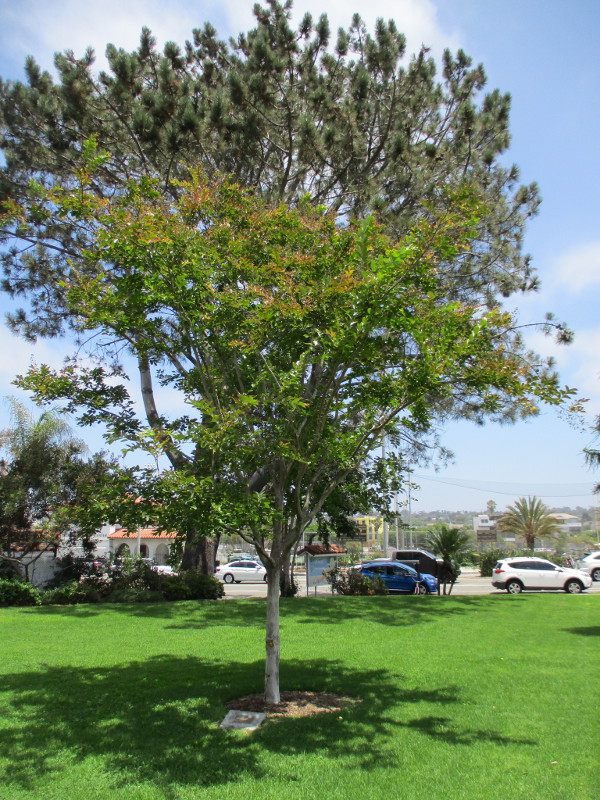
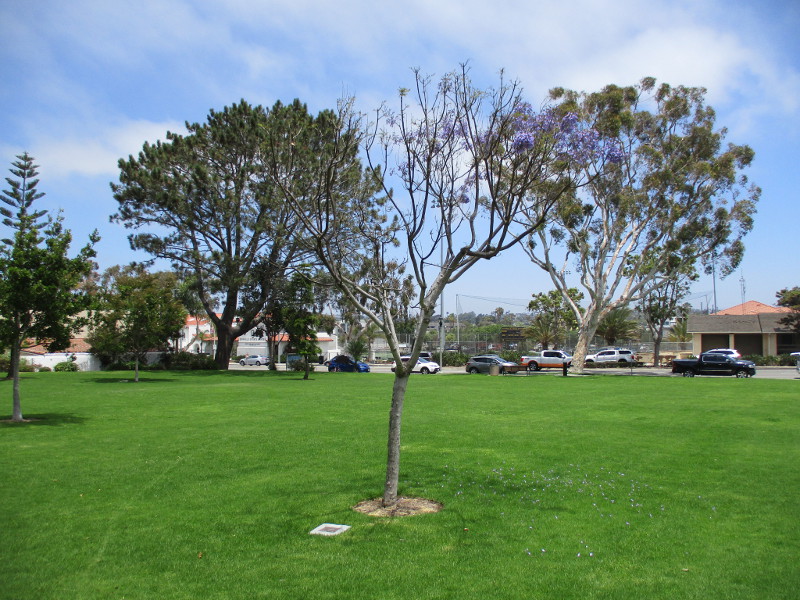
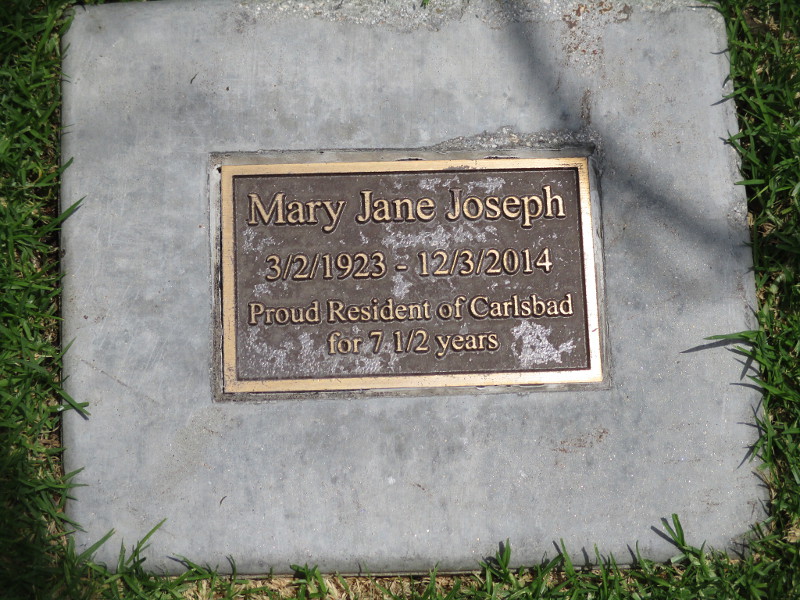
As I walked through wide, grassy Magee Park, I noticed it has several trees with dedication plaques.
I found three of them…
25 years of friendship with sister city Karlovy Vary, Czech Republic.In loving memory of Doris A. Gordon.Mary Jane Joseph. Proud resident of Carlsbad.
…
I live in downtown San Diego and love to walk around with my camera! You can follow Cool San Diego Sights via Facebook or Twitter!
You can easily explore Cool San Diego Sights by using the search box on my blog’s sidebar. Or click a tag! There are thousands upon thousands of photos for you to enjoy!
Yesterday my long walk included a stretch through Golden Hill. As I headed back down E Street, I enjoyed viewing the handsome exterior of the historic Alfred Haines House.
This renowned Craftsman-style home, built in 1908 for San Diego Judge Alfred Haines, is listed on the National Register of Historic Places. Master Architects William, Charles and Edward Quayle designed the house.
The Quayle Brothers are responsible for many other notable structures in San Diego, including the Neo-Classical style Salt Lake and Union Pacific Building, which used to stand east of the Organ Pavilion during the 1915 Panama‐California Exposition. They designed the North Park Theatre in 1928 and the San Diego Police Department in 1939. They also designed San Diego’s historic Balboa Stadium (originally called City Stadium) for the Panama-California Exposition. It was the second concrete stadium built west of the Mississippi River.
If you want to see photos of the Alfred Haines House’s very elegant interior, click here!
…
I live in downtown San Diego and love to walk around with my camera! You can follow Cool San Diego Sights via Facebook or Twitter!
You can easily explore Cool San Diego Sights by using the search box on my blog’s sidebar. Or click a tag! There are thousands upon thousands of photos for you to enjoy!
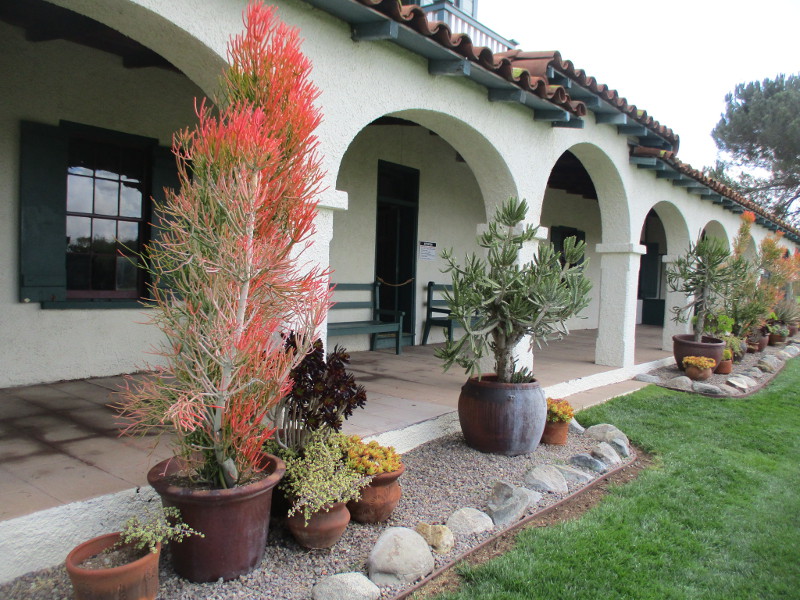
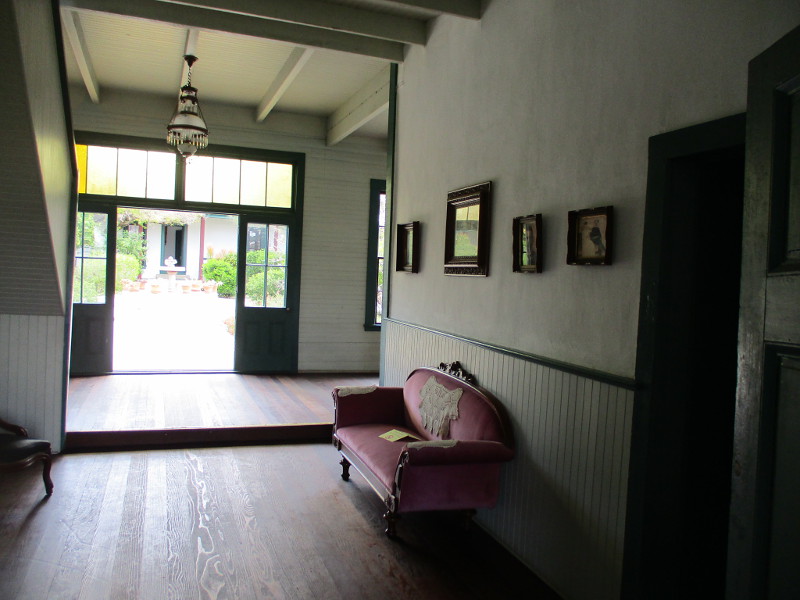
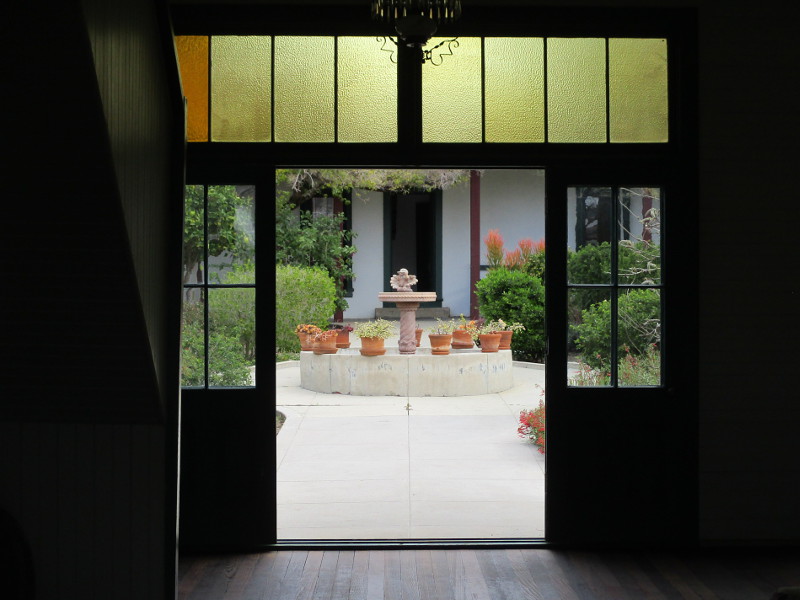
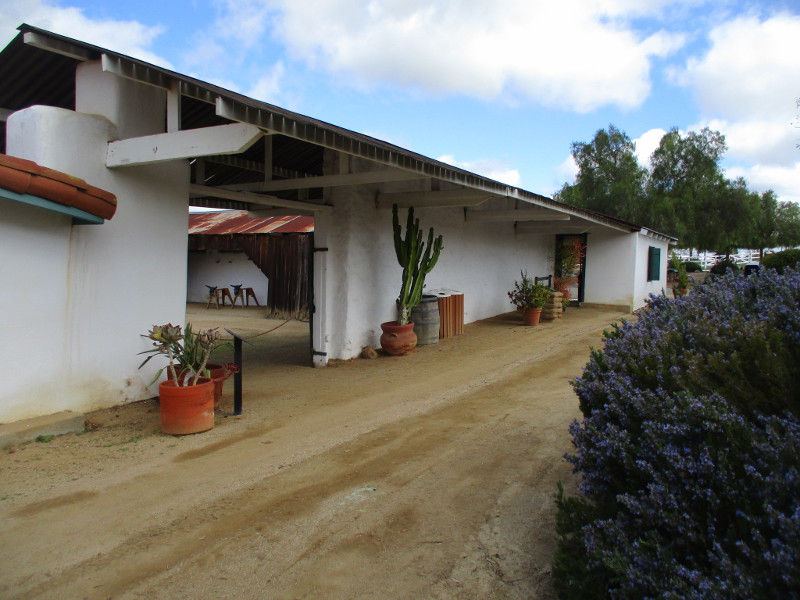
The Rancho Guajome Adobe is an architecturally and historically important 19th century ranch house located in Vista, California. I visited it a little over a week ago and walked around the grounds, learning about the fascinating history of the place while taking a few photographs.
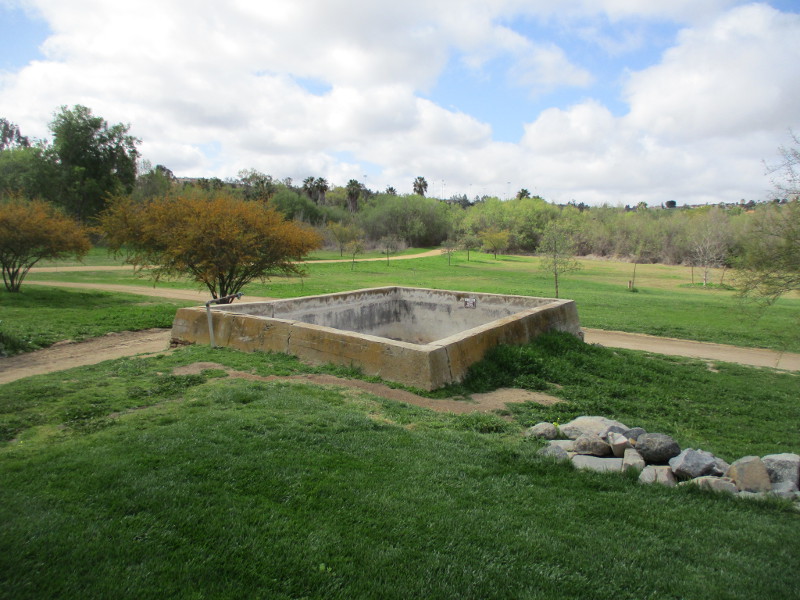
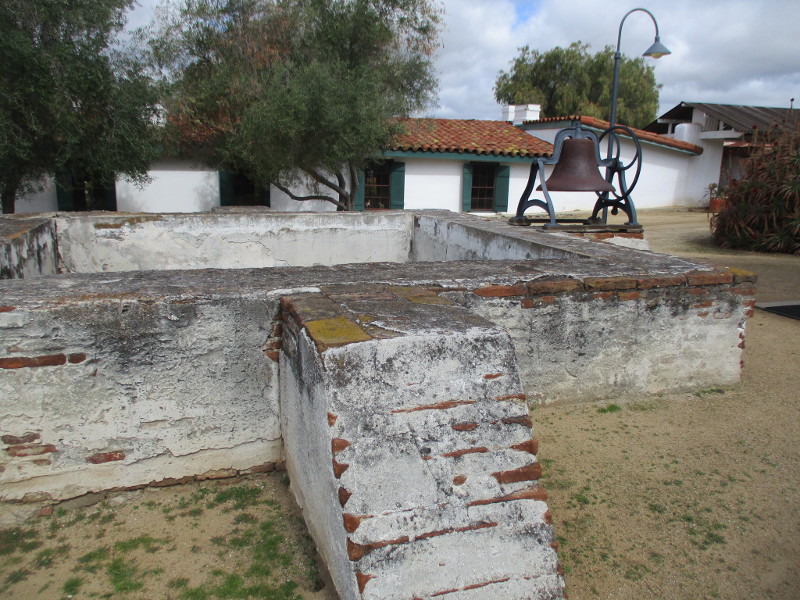
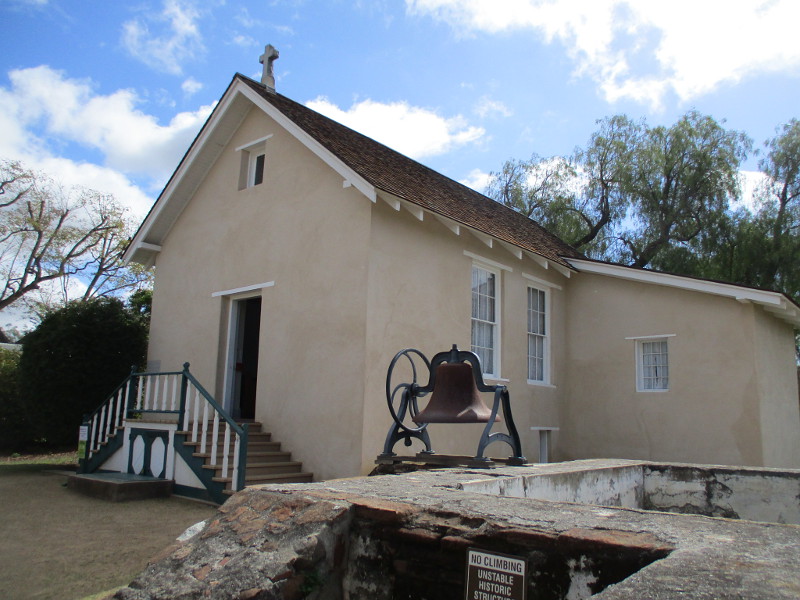
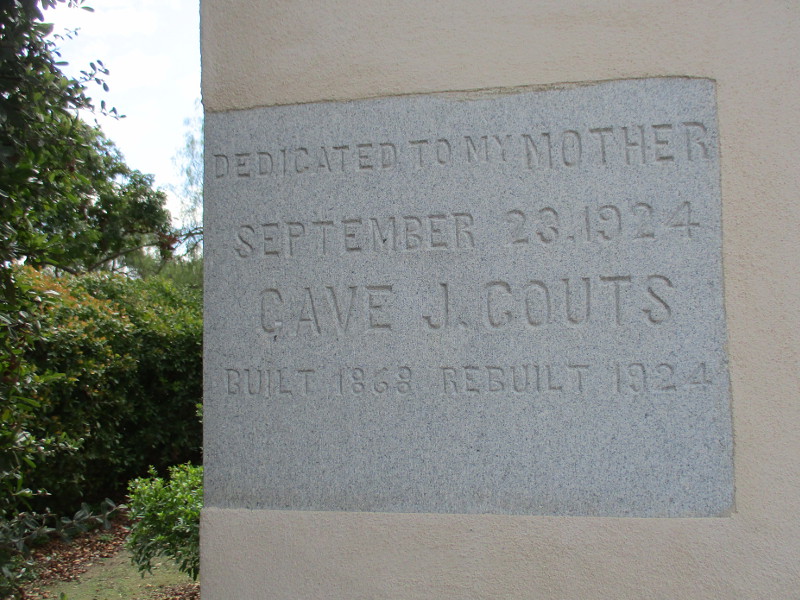
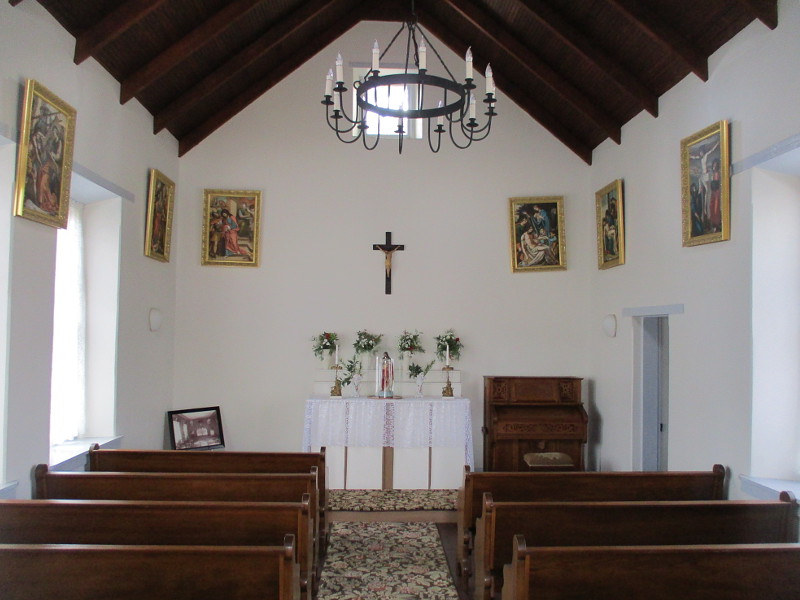
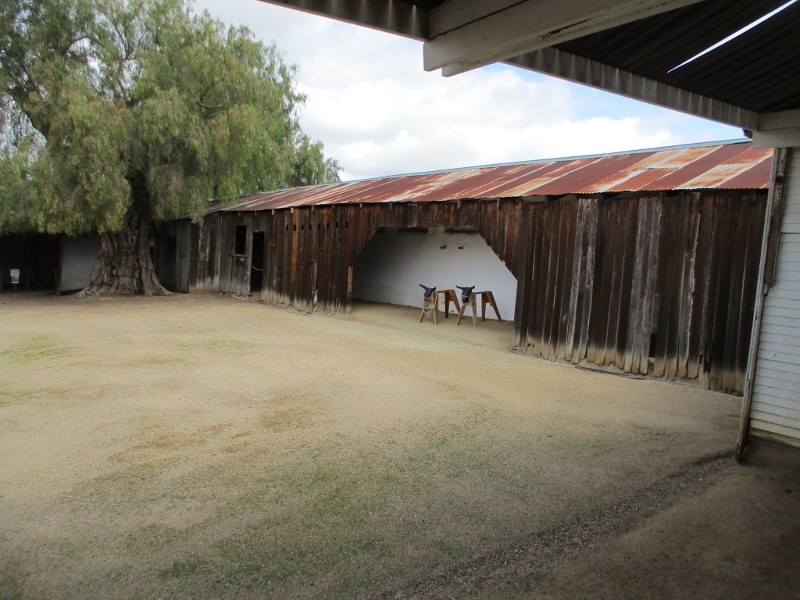
I approached the Guajome Ranch House from the Santa Fe Trail to its south, then circled counterclockwise around the complex, viewing the beautiful arcaded veranda, several cisterns fed by wells, the chapel, and other outbuildings. I spotted various signs and plaques relating the history of the ranch, which was once the home of prominent early San Diego resident Cave Johnson Couts and his wife Maria Ysidora Barbara Bandini.
As you can see, I also stepped into a small museum. That’s where you can purchase tickets to guided and self-guided house tours.
According to Wikipedia: “The adobe was built in 1852 and served as the headquarters of Rancho Guajome, a Mexican land grant. Abel Stearns had given the rancho to Ysidora Bandini (sister of his wife Arcadia Bandini), as a wedding gift when she married Lieutenant Cave Johnson Couts in 1851. It was built with the profits from the cattle boom of the 1850s, when many California ranchos supplied the Gold Rush miners and associated new American immigrants with meat and leather. Couts was appointed sub-agent for the native Luiseño people (San Luis Rey Mission Indians) in 1853. He used their labor to improve his properties in the area, including this one and nearby Rancho Buena Vista and Rancho Vallecitos de San Marcos…”
I didn’t venture inside the 22-room hacienda, but I most likely will at some future time. The old ranch house is located in Rancho Guajome Adobe County Park. Check out the parks website here to learn more.
The following photos provide a taste of what you’ll see should you visit this historic place.
Peering from the veranda through an open door…
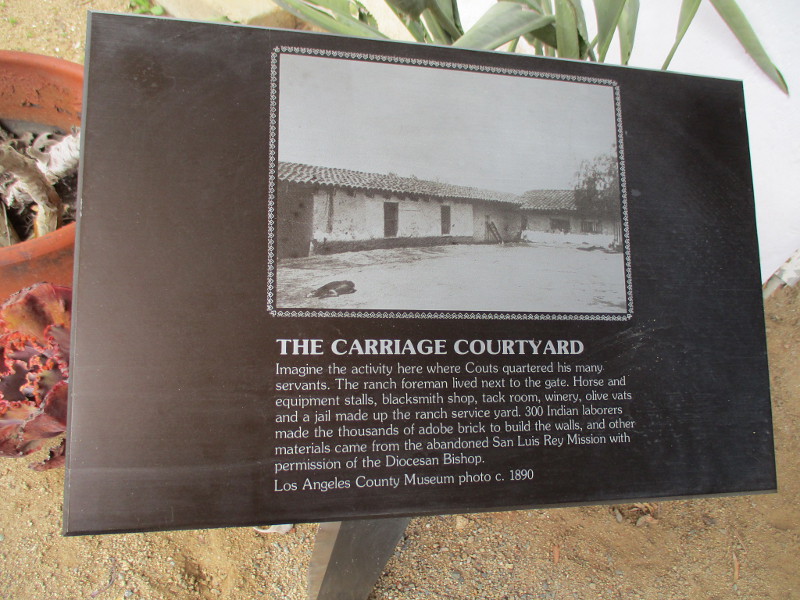
The sign reads:
The Carriage Courtyard.
Imagine the activity here where Couts quartered his many servants. The ranch foreman lived next to the gate. Horse and equipment stalls, blacksmith shop, tack room, winery, olive vats and a jail made up the ranch service yard. 300 Indian laborers made the thousands of adobe brick to build the walls, and other materials came from the abandoned San Luis Rey Mission with permission of the Diocesan Bishop.
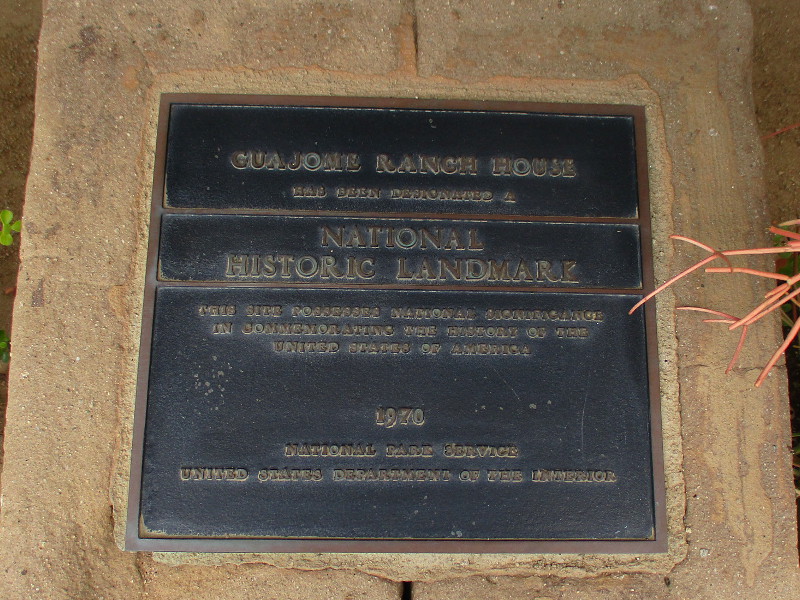
Guajome Ranch House has been designated a National Historic Landmark
This site possesses national significance commemorating the history of the United States of America
1970
National Park Service
United States Department of the Interior
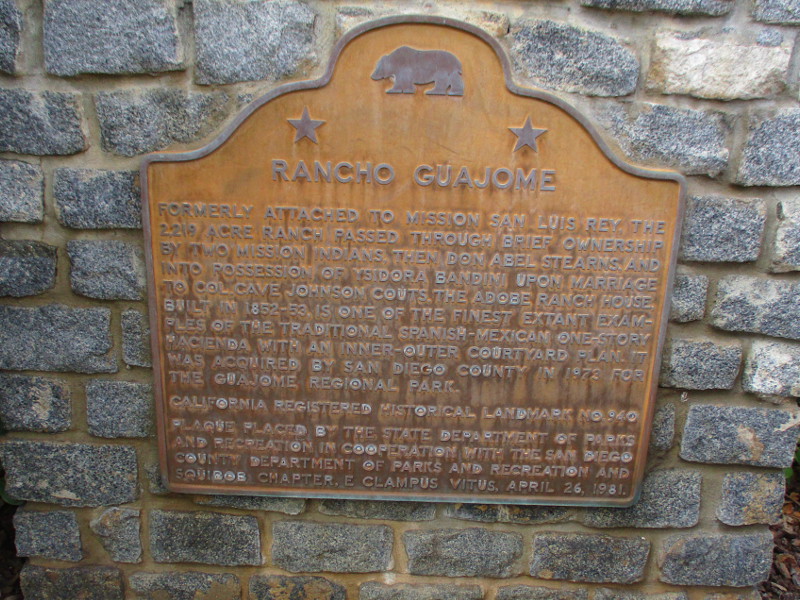
Rancho Guajome
Formerly attached to Mission San Luis Rey, the 2,219 acre ranch passed through brief ownership by two mission Indians, then Don Abel Stearns, and into possession of Ysidora Bandini upon marriage to Col. Cave Johnson Couts. The adobe ranch house built in 1852-53, is one of the finest extant examples of the traditional Spanish-Mexican one-story hacienda with an inner-outer courtyard plan. It was acquired by San Diego County in 1973 for the Guajome Regional Park.
California registered Historical Landmark No. 940
Plaque placed by the State Department of Parks and Recreation in cooperation with the San Diego County Department of Parks and Recreation and Squibob Chapter, E Clampus Vitus, April 26, 1981.
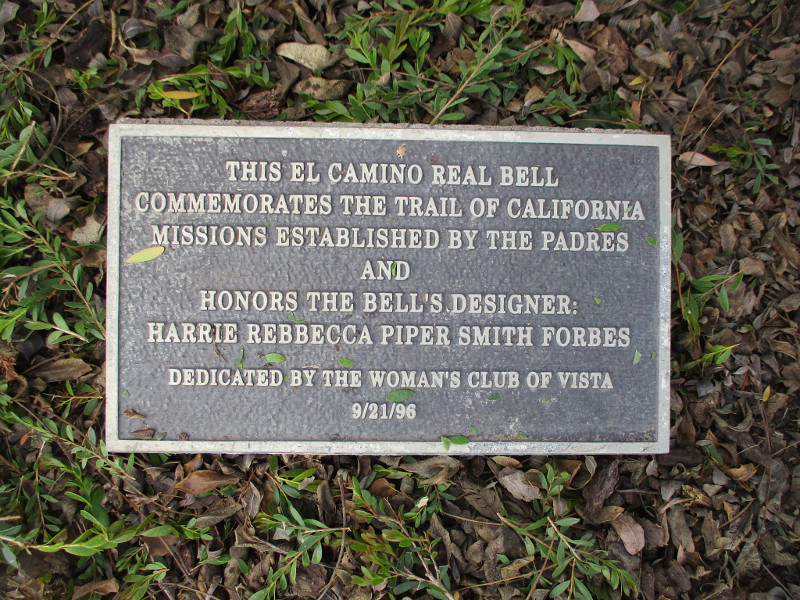
This El Camino Real Bell commemorates the trail of California missions established by the padres and honors the bell’s designer: Harrie Rebbecca Piper Smith Forbes
Dedicated by the Woman’s Club of Vista
9/21/96
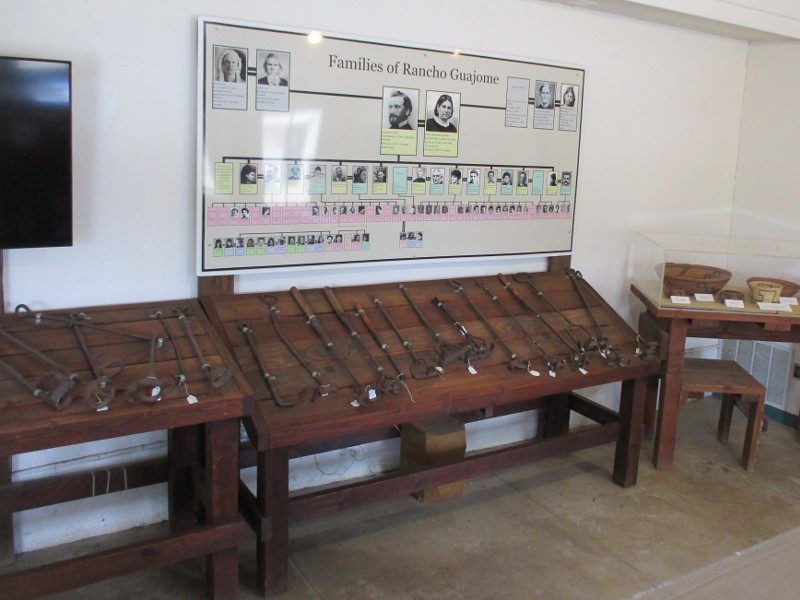
At its beginning, Rancho Guajome was a working cattle ranch. Because the West was dry, cattle owners like Cave Couts would turn their cattle out on unfenced pastures. However, during this “open range” period, sometimes cattle from different ranchos intermixed, making it difficult to determine which cattleman owned which cattle. The branding iron was invented as a solution…
Cave Johnson Couts was born in 1821 in Springfield, Tennessee, and died in 1874 in San Diego at the Horton House. His wife Maria Ysidora Barbara Bandini was born in 1828 in San Diego, was married in 1851 at the Casa de Bandini in Old Town (now the Cosmopolitan Hotel), and died in 1897 in Los Angeles.
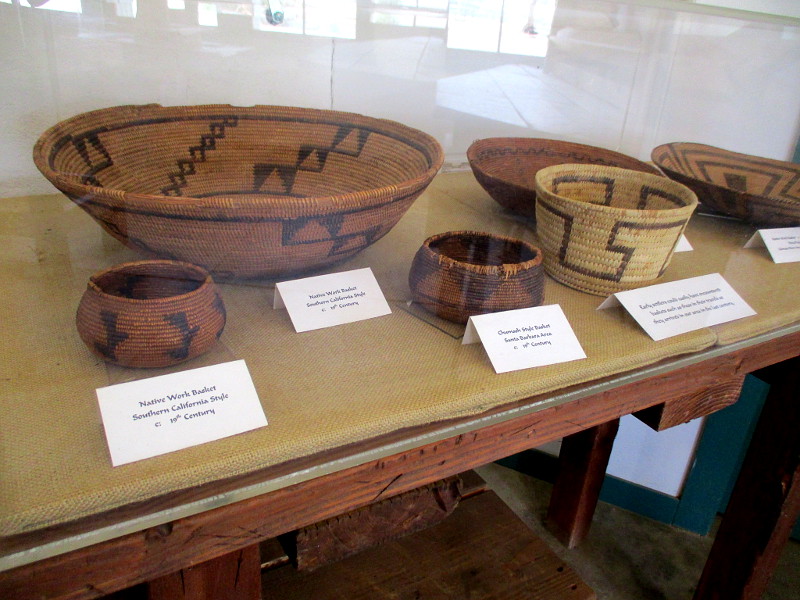
Included in the museum display are Native work baskets, Southern California style, circa 19th century.
Rancho Guajome Adobe farm equipment included a farm wagon, breaking carts for training horses, a broadcast seeder, a sulky used for racing horses, and a four-bottom Stockton plow used to turn soil to prepare fields for planting.
In the past I blogged about the Colorado House, a two-story hotel that was built in Old Town San Diego in 1851 by the very same Cave Couts. Today it serves as the Wells Fargo History Museum. Read that here.
I’ve also blogged about the El Campo Santo cemetery grave of Juan Mendoza, who was shot in the back by Cave Couts. See that here. (During one walk I spotted another mysterious wooden tombstone with the name Juan Mendoza by a parking lot, across the San Diego River from Old Town. Read that here!)
…
I live in downtown San Diego and love to walk around with my camera! You can follow Cool San Diego Sights via Facebook or Twitter!
You can easily explore Cool San Diego Sights by using the search box on my blog’s sidebar. Or click a tag! There are thousands upon thousands of photos for you to enjoy!
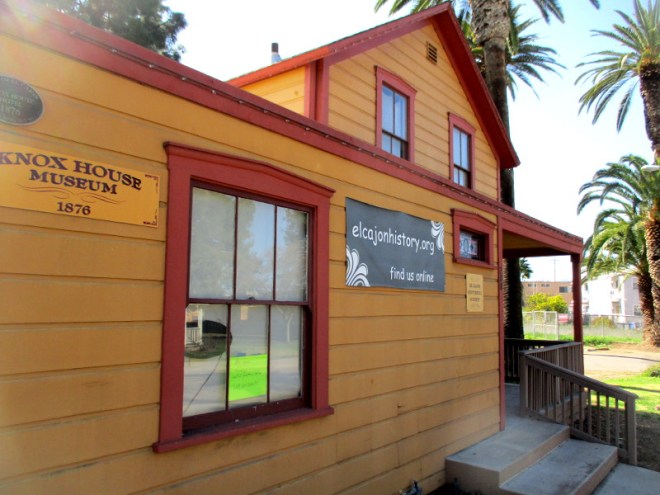
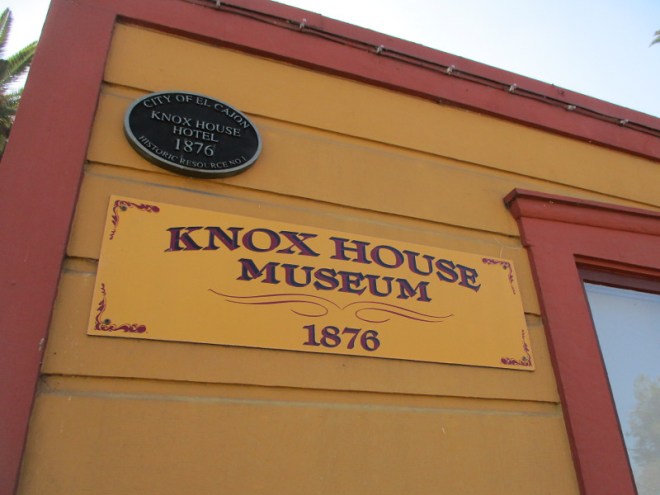
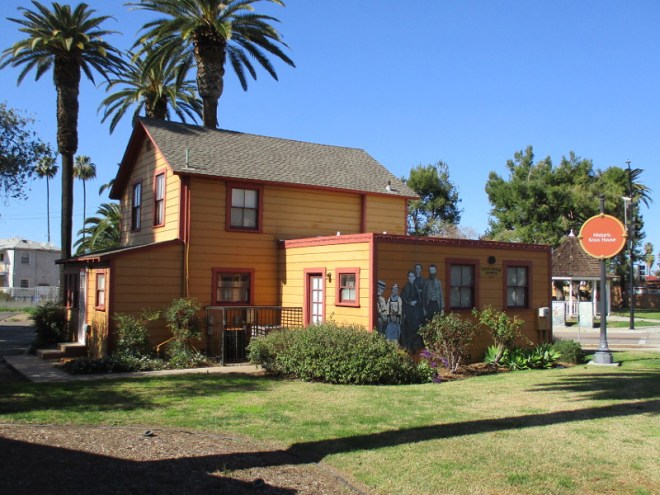
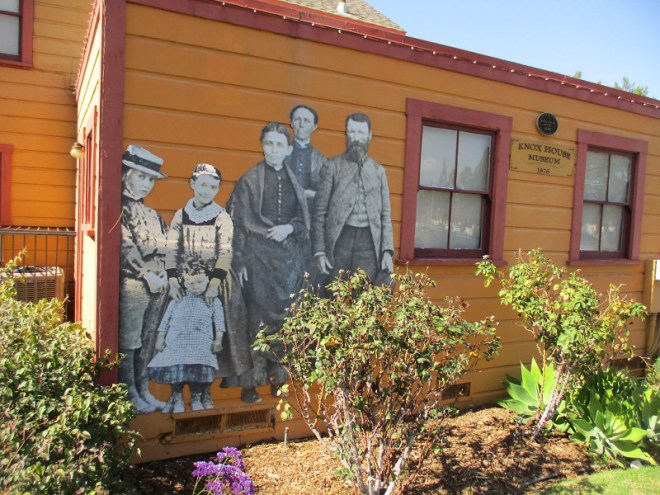
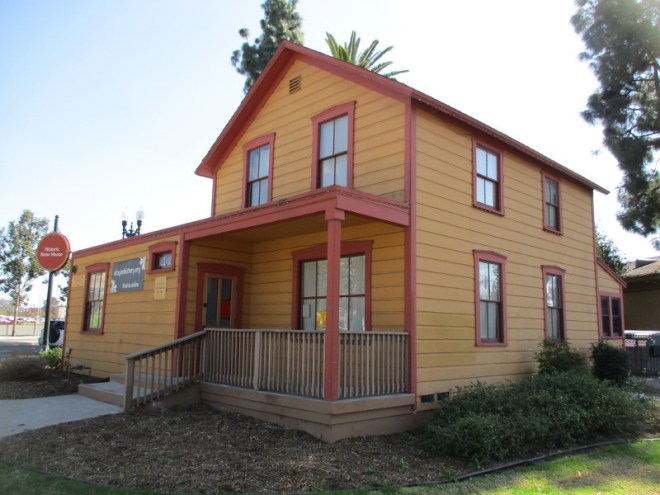
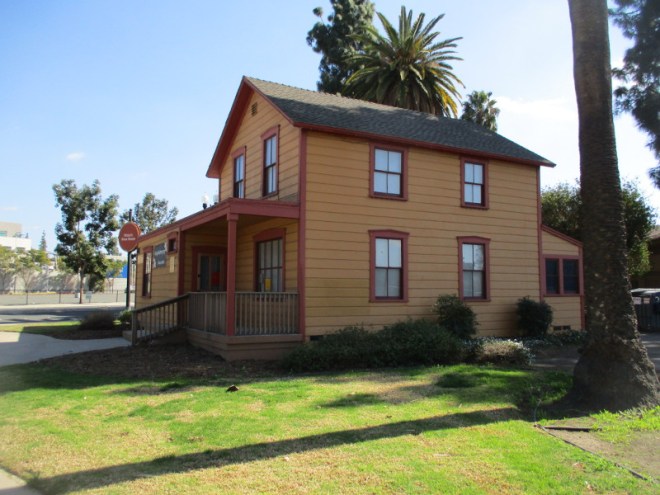
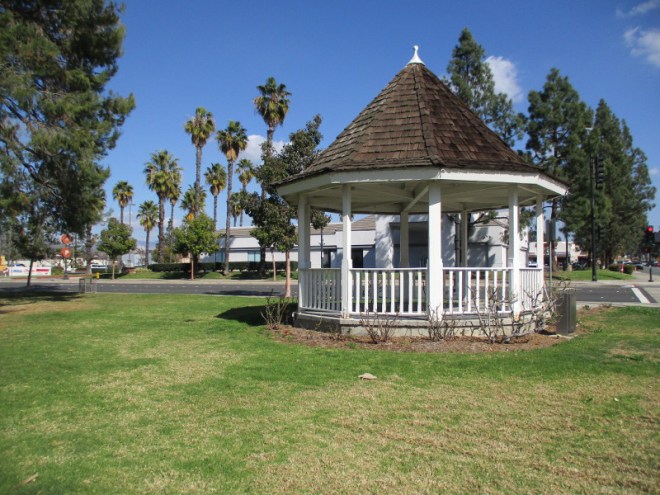
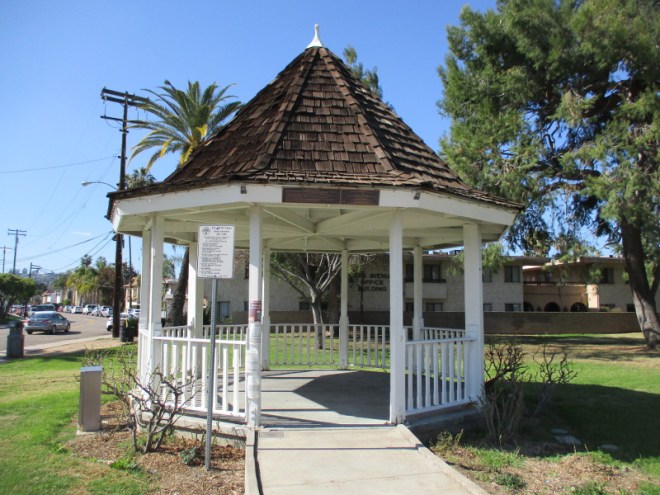
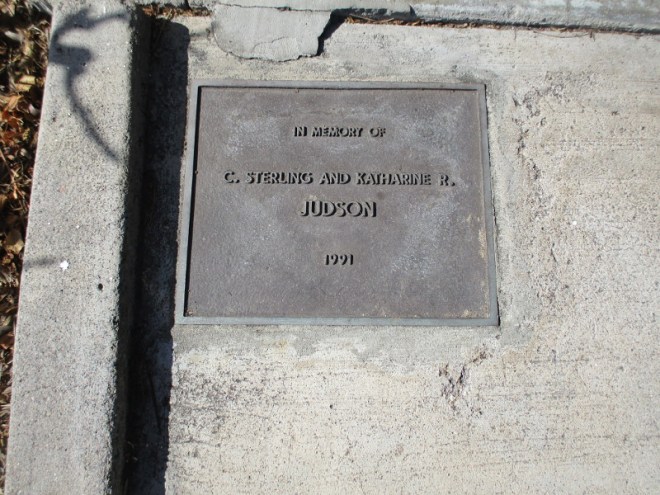
A few weeks ago, during my adventure in El Cajon, I walked around the Knox House Museum, which was closed at the time. I took a number of photographs of the historic structure, and the gazebo in small, grassy Judson Park to the north.
The Knox House Museum is operated by the El Cajon Historical Society. The building is a restoration of Amaziah Lord Knox’s original two-story, seven room El Cajon Hotel, which was built in 1876 near the present day corner of Main Street and Magnolia Avenue. The building also served as the Knox residence. In later years the hotel was altered in various ways and greatly enlarged. In 1972 the City of El Cajon purchased the original building and moved it to its present location, at the corner of Magnolia and Park Avenue.
To learn much, much more about the old hotel, the present day museum, and the history of El Cajon, which began in earnest with the discovery of gold in Julian in 1870, visit the El Cajon Historical Society’s website here! Among other things, you’ll learn why the Knox House Museum is painted in such unusual colors!
I spotted this old gazebo in Judson Park, across Park Avenue…
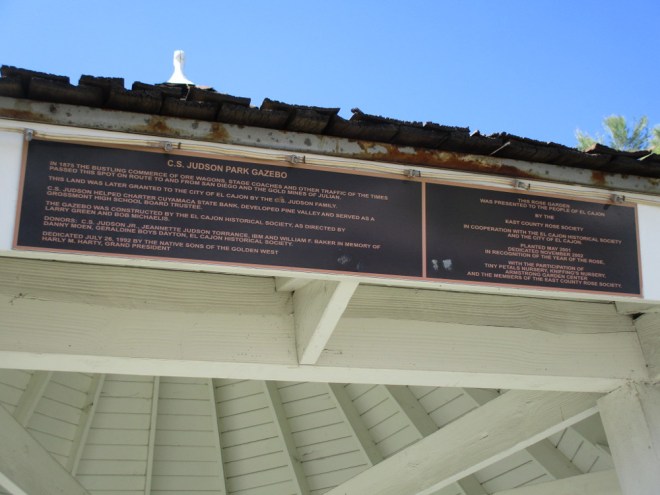
The plaque on the gazebo includes: In 1875 the bustling commerce of ore wagons, stage coaches and other traffic of the times passed this spot on route to and from San Diego and the gold mines of Julian. This land was later granted to the City of El Cajon by the C.S. Judson family…The gazebo was constructed by the El Cajon Historical Society…Dedicated July 26, 1992…This rose garden was presented to the people of El Cajon by the East County Rose Society…Dedicated November 2002…
…
This blog now features thousands of photos around San Diego! Are you curious? There’s lots of cool stuff to check out!
Here’s the Cool San Diego Sights main page, where you can read the most current blog posts. If you’re using a phone or small mobile device, click those three parallel lines up at the top–that opens up my website’s sidebar, where you’ll see the most popular posts, a search box, and more!
To enjoy future posts, you can also “like” Cool San Diego Sights on Facebook or follow me on Twitter.
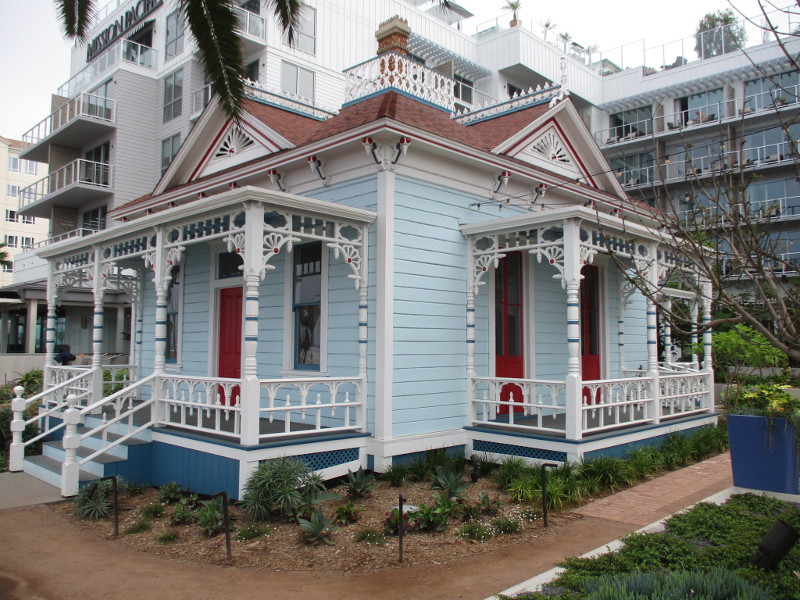
The famous Top Gun House, where Maverick ate dinner with Charlie in the popular 1980’s movie Top Gun, has been restored!
I passed the iconic house today during a long walk through Oceanside, and the beachfront cottage appears completely changed from a few years ago. When I last took a look at the Top Gun House, back in 2018, the color scheme and porch were quite different, as you can see in today’s photos and my old blog post here.
The beautiful little 1887 Queen Anne Cottage has been restored to its original appearance. Learn about the Graves House’s historical importance in Oceanside and see a photo of how it looked when built over a century ago by clicking here.
The house has not only been restored, but it has been relocated a short distance up North Pacific Street, to a spot in front of the newly built Oceanside Beach Resort, which is scheduled to open later this year.
The following photo is one that I took in August of 2018…
UPDATE!
When I walked past on Labor Day, 2021, the famous Top Gun House had been painted once again! This time the color scheme is lighter, and much more attractive in my opinion…
…
I live in downtown San Diego and love to walk around with my camera! You can follow Cool San Diego Sights via Facebook or Twitter!
You can easily explore Cool San Diego Sights by using the search box on my blog’s sidebar. Or click a tag! There are thousands upon thousands of photos for you to enjoy!
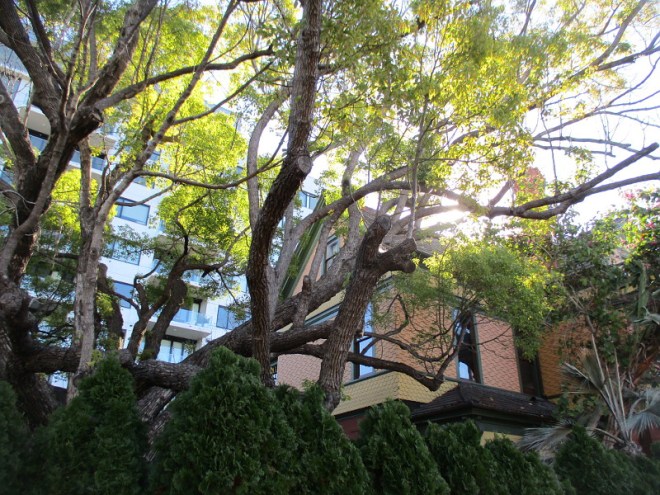
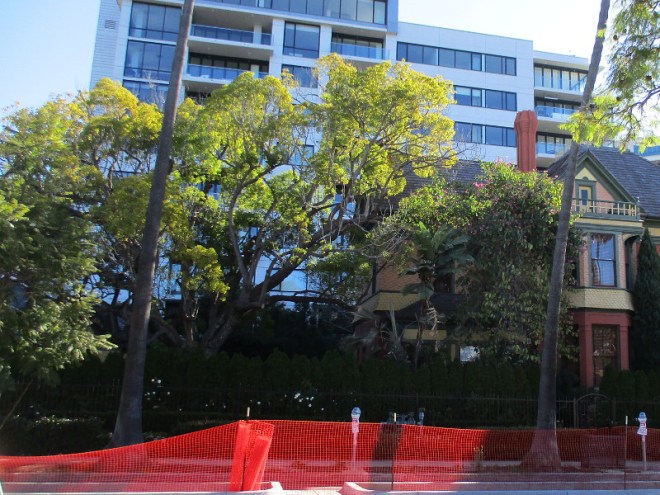
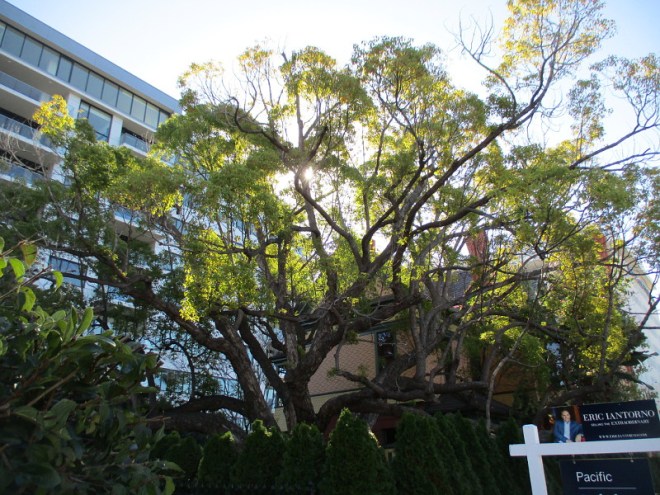
What you’re looking at is an historic tree. It’s the very first camphor tree planted in North America!
The now immense old camphor tree grows in the yard of the Britt-Scripps House in San Diego’s Bankers Hill!
I blogged about the Britt-Scripps House years ago here. The mansion was built in 1887 by Eugene Britt, then purchased in 1896 by newspaper publisher E.W. Scripps. (Today it’s for a sale again. And the price was recently reduced to under five million dollars. A bargain! To see photos of this historic house’s elegant interior, check out this page.)
The beautiful camphor tree was planted in 1885 by none other than horticulturist Kate Sessions, who introduced many of the majestic trees visitors see in Balboa Park today!
By the way, did you know one of the rarest plants in the entire world can be found in nearby Balboa Park?
A tree that is now extinct in the wild has found a home in the Botanical Building. A few years ago I blogged about that here!
…
I live in downtown San Diego and love to walk around with my camera! You can follow Cool San Diego Sights via Facebook or Twitter!
You can easily explore Cool San Diego Sights by using the search box on my blog’s sidebar. Or click a tag! There are thousands upon thousands of photos for you to enjoy!










































 Cool San Diego Sights!