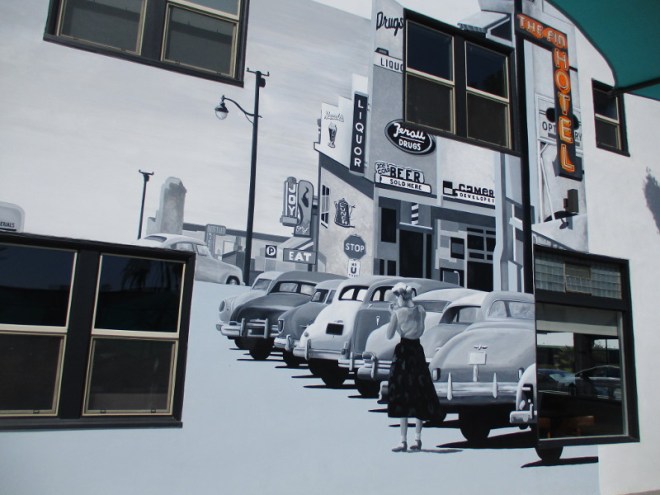
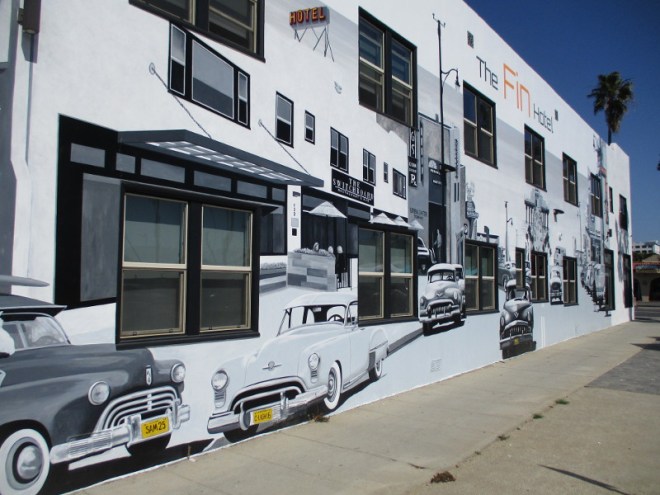
During my long walk through Oceanside yesterday, my very first cool discovery was this large nostalgic mural on the side of The Fin Hotel. It depicts a slice of Americana: a small town scene from the mid-20th century.
The Fin Hotel is a boutique hotel that began its life as the Keisker Hotel, built in 1927. Before it was The Fin it was The Dolphin. Today it’s an historic Oceanside landmark that has survived decades of change in the growing city.
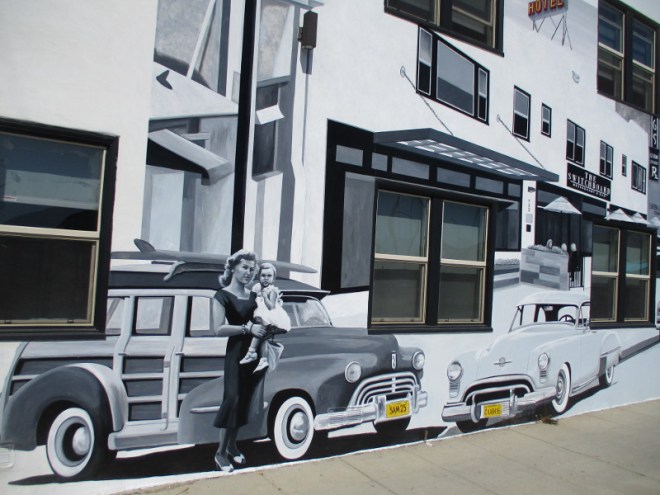
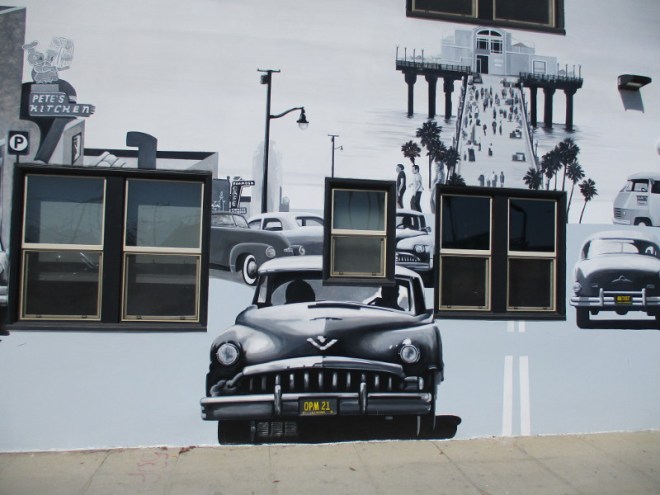
The mural, painted by Southern California artist Lisa Kelly, incorporates the cool The Fin Hotel neon sign, as you can see in the coming photos! It also features many classic cars, the Oceanside Pier, and a woodie with a surfboard on top!
…
I live in downtown San Diego and love to walk around with my camera! You can follow Cool San Diego Sights via Facebook or Twitter!
You can easily explore Cool San Diego Sights by using the search box on my blog’s sidebar. Or click a tag! There are thousands upon thousands of photos for you to enjoy!
Today I went for a very long walk through El Cajon, in San Diego’s East County. I took so many photographs, lots of interesting blog posts are on the way!
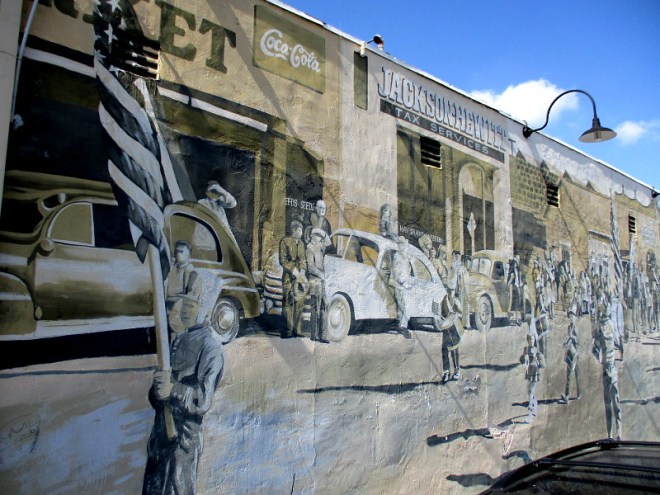
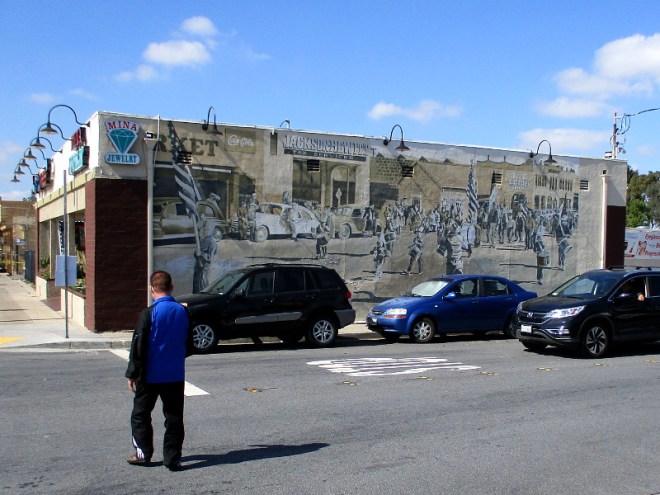
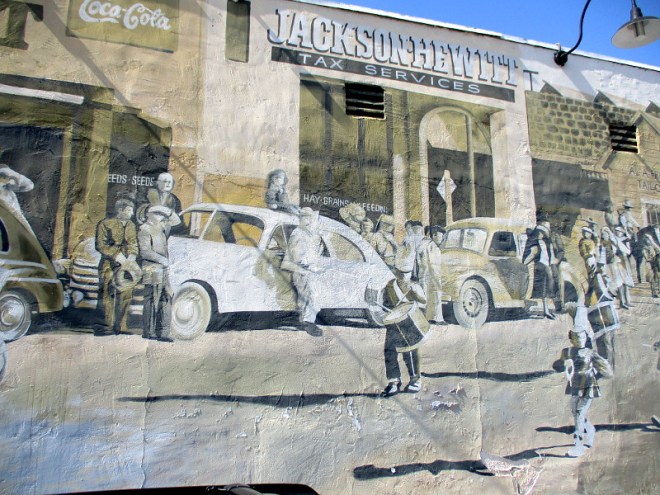
During my walk I came upon this faded mural on a building at the corner of East Main Street and Roanoke Road. It depicts an old-fashioned American parade, apparently from the mid-20th century. I’m assuming the parade is proceeding down El Cajon’s Main Street, but I don’t really know. I could find no date or artist signature. I believe Jackson Hewitt Tax Service used to occupy at least part of this building.
This artwork is so faded, I had to dramatically increase the contrast of my photos.
I’m sure somebody out there knows the history of this nostalgic old mural. If you know anything, please leave a comment!
…
I live in downtown San Diego and love to walk around with my camera! You can follow Cool San Diego Sights via Facebook or Twitter!
You can easily explore Cool San Diego Sights by using the search box on my blog’s sidebar. Or click a tag! There are thousands upon thousands of photos for you to enjoy!
A moment in San Diego history is captured in a photographic mural outside Rudford’s Restaurant in North Park.
The exterior of this popular all-American diner, which first opened in 1949, appears today much as it did back in 1963. The mural recalls how on June 6th of that year, President John F. Kennedy passed the restaurant as a crowd looked on.
A description of the event in a corner of the photo mural explains: “In a visit to San Diego…the president traveled down El Cajon Boulevard on his way to San Diego State College where he gave the commence address… This is an actual photo of the motorcade taken by local teenager James Daigh as it passed Rudford’s Restaurant on that Thursday morning…”
Rudford’s Restaurant remains just as popular as ever. The retro diner is open 24 hours a day and treats its customers with home-style cooking and nostalgic decor!
…
I live in downtown San Diego and love to walk around with my camera! You can follow Cool San Diego Sights via Facebook or Twitter!
You can easily explore Cool San Diego Sights by using the search box on my blog’s sidebar. Or click a tag! There are thousands upon thousands of photos for you to enjoy!
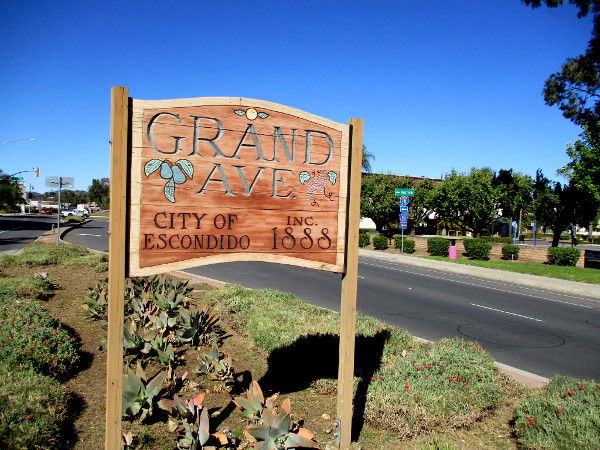
On Sunday I returned to Escondido. I wanted to explore Grand Avenue–the heart of historic downtown Escondido–a little more thoroughly.
Earlier this year I visited Maple Street Plaza on a Sunday and took a quick look from its south end up and down Grand Avenue. What I glimpsed wasn’t encouraging. Few people. Inactive storefronts. But had I walked a block or two east I would have found a much more lively scene!
Grand Avenue resembles the historic old main streets of many American towns. What used to be the central business district is now home to a multitude of cozy eateries, specialty shops, salons and antique stores. There’s an old restored movie theater, a Rotary Club street clock, a gazebo in a small sunny park, and a friendly feeling of community. During my walk I saw many families just walking along like me, enjoying a late Sunday morning.
I don’t pretend to know a whole lot about Escondido. If you don’t either, enjoy these photos of Grand Avenue as if we are walking together.
I started at the big Escondido landmark sign at Centre City Parkway and headed east. To see some great mosaics in the sidewalk at the intersection, check out my earlier blog post here!
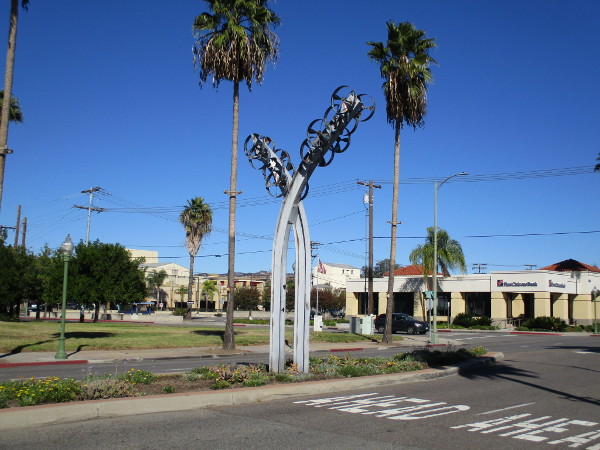
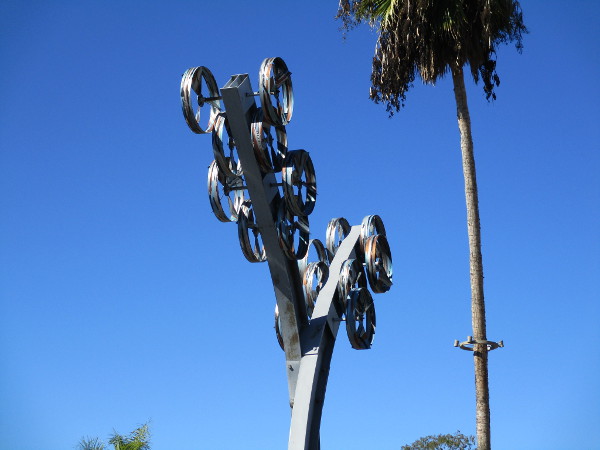
You see that unusual sculpture in the median? I know nothing about it!
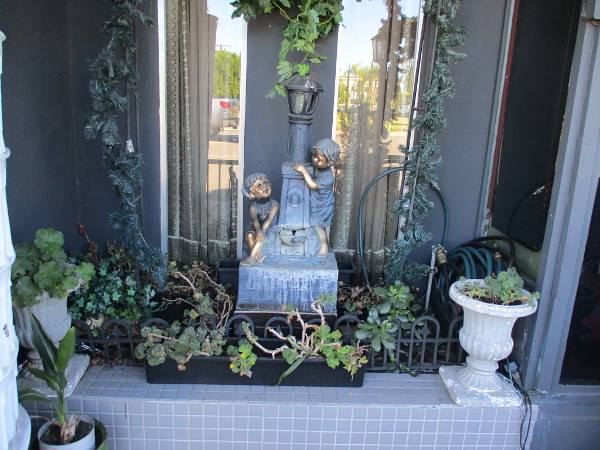
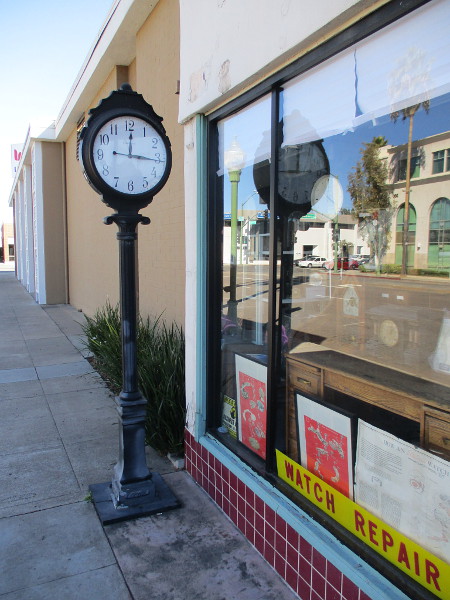
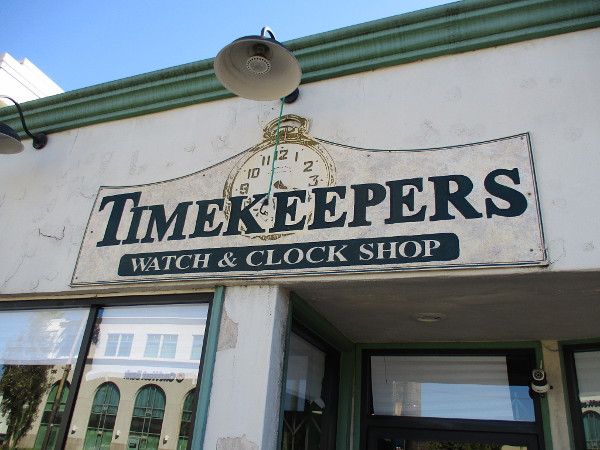
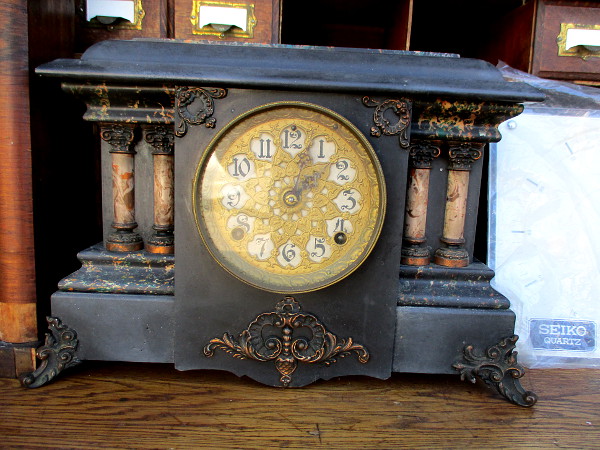
I really enjoyed peering into the window of the Timekeepers Watch and Clock Shop and took several photos. Indeed, my walk felt a little like travelling back in time.
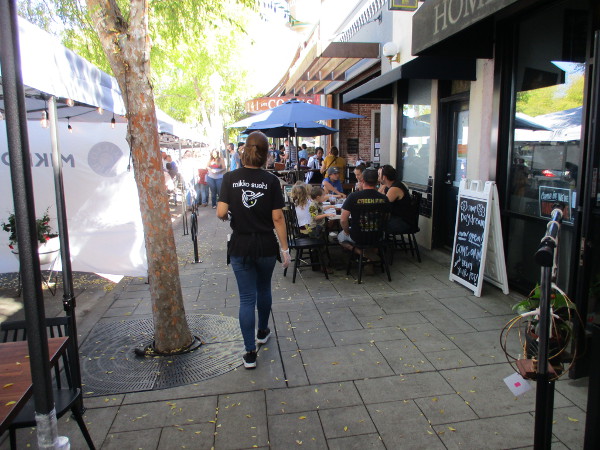
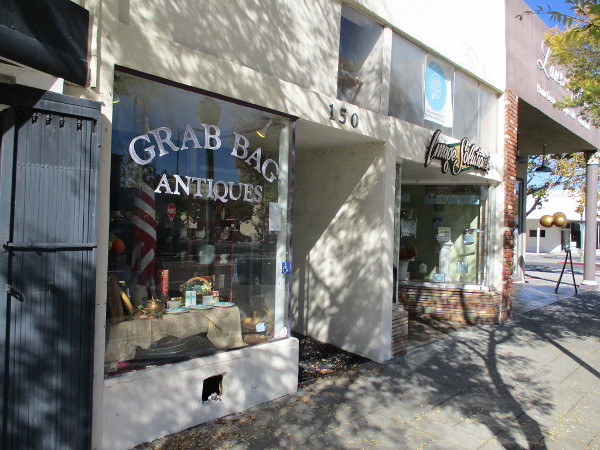
After I passed the south end of Maple Street Plaza, I enjoyed looking into the windows of more antique stores. I noticed more and more people sitting in front of various restaurants enjoying Sunday breakfast or an early lunch. (People are dining on sidewalks and streets this year because of the COVID-19 pandemic.)
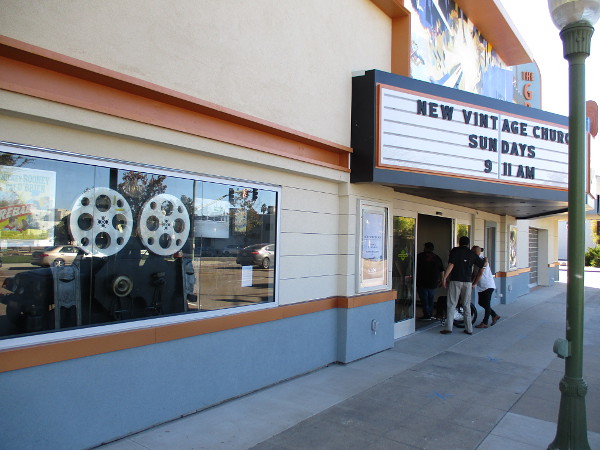
There’s a very cool display near the entrance to the restored The Ritz Theater, which originally opened in 1937. You can see old film reels and all sorts of interesting equipment that was used in this historic movie house. Unfortunately bright street reflections were impossible for my camera to overcome.
I turned around at Valley Boulevard and headed back west along the opposite sidewalk.
According to a nearby plaque, that great mural on the corner of a building is titled Escondido, the Hidden Valley. It’s by artist Daniel Hernandez.
Finally–you see that cool old car coming down the street near the end of my photos? Grand Avenue is probably best known for its popular Cruisin’ Grand vintage auto show event on Friday nights! (Something I haven’t experienced yet.)
Here we go…
…
This blog now features thousands of photos around San Diego! Are you curious? There’s lots of cool stuff to check out!
Here’s the Cool San Diego Sights main page, where you can read the most current blog posts. If you’re using a phone or small mobile device, click those three parallel lines up at the top–that opens up my website’s sidebar, where you’ll see the most popular posts, a search box, and more!
To enjoy future posts, you can also “like” Cool San Diego Sights on Facebook or follow me on Twitter.
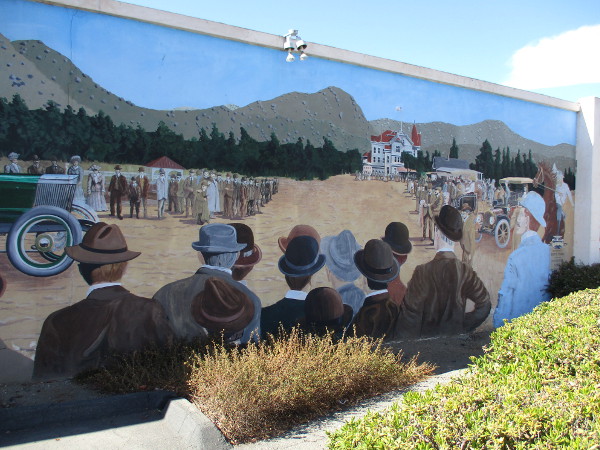
A fantastic mural painted in Lakeside at the corner of Woodside Avenue and Maine Avenue celebrates an important moment in this East County community’s surprising history.
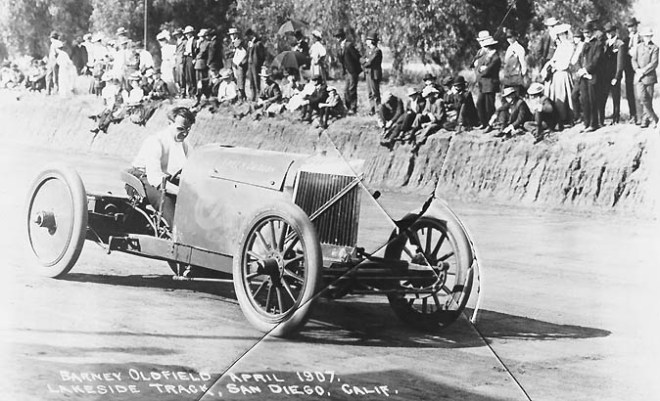
Spectators in old-fashioned garb watch an automobile race around Lindo Lake near the long-vanished Lakeside Inn, once called The Coronado of the Hills because of its architectural similarity to the Hotel del Coronado. On one historic day in 1907, race car driver Barney Oldfield set a new world land speed record.
A corner of the mural indicates this nostalgic artwork was painted by David E. Ybarra for the Ron Schafer Family.
I’ve included a vintage photograph of the race depicted in the mural!
Barney Oldfield driving the Peerless Green Dragon at the Lakeside Track, San Diego, California. April 7, 1907. (Public domain photo from Wikimedia Commons.)
…
I live in downtown San Diego and love to walk around with my camera! You can follow Cool San Diego Sights via Facebook or Twitter!
You can easily explore Cool San Diego Sights by using the search box on my blog’s sidebar. Or click a tag! There are thousands upon thousands of photos for you to enjoy!
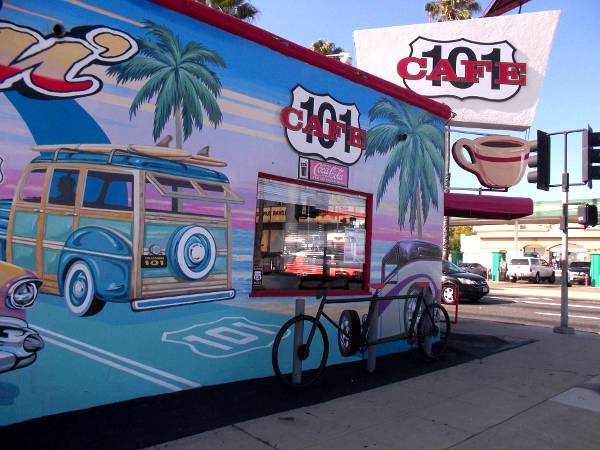
If you love cool cars and nostalgia you’ll like this mural. It’s painted on the south side of 101 Cafe in Oceanside. The mural depicts a carhop outside wearing roller skates. She’s serving food to customers in a woodie, hot rod and several other classic cars.
101 Cafe dates back to 1928. The original twenty seat diner was built on US Highway 101, the main road back then from Los Angeles to San Diego.
The small restaurant has gone through many changes over the years. At one time it was a drive-in. It’s now a diner specializing in breakfast, and features 1950’s decor–including this great mural!
…
I live in downtown San Diego and love to walk around with my camera! You can follow Cool San Diego Sights via Facebook or Twitter!
You can easily explore Cool San Diego Sights by using the search box on my blog’s sidebar. Or click a tag! There are thousands upon thousands of photos for you to enjoy!
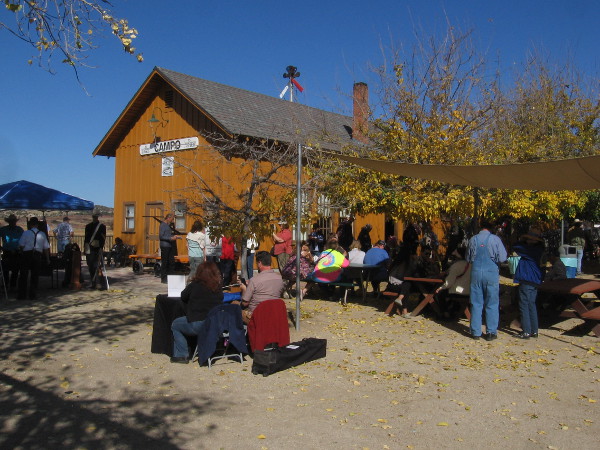
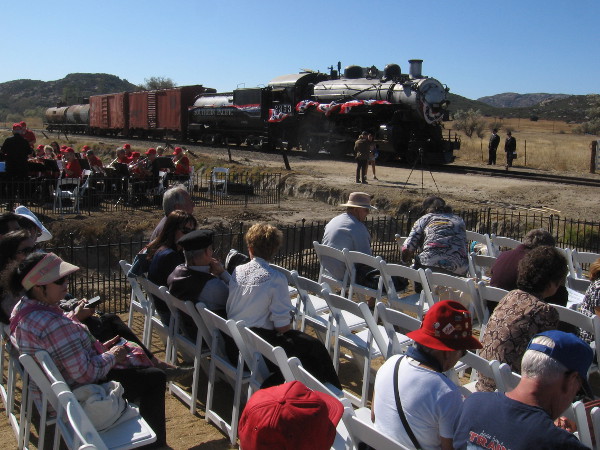
People gather for the 100th Anniversary celebration of the San Diego and Arizona Railway at the Pacific Southwest Railway Museum in Campo.
Yesterday I attended an extraordinary event. The 100th Anniversary of the San Diego and Arizona Railway was celebrated at the Pacific Southwest Railway Museum in Campo!
Hundreds came out to the museum to enjoy special attractions, historical displays and old-time entertainment. Almost everybody rode an excursion train through the nearby countryside (you can see photos of the ride here) before gathering for lunch and a gold spike ceremony that reenacted much of the original ceremony a century ago.
Please enjoy the following photographs. Read the captions if you’d like to learn a little more about the history of the San Diego and Arizona Railway. (Click the images of signs and they’ll enlarge for easier reading.)
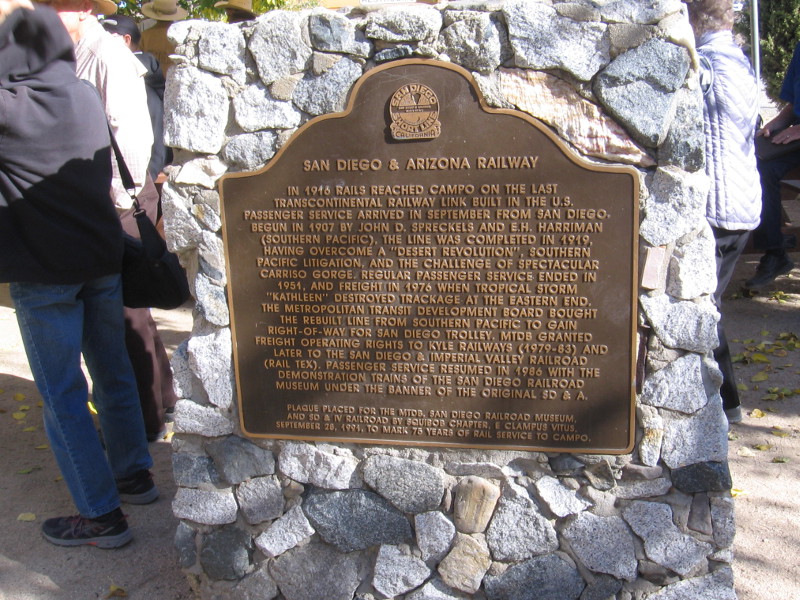
Many signs, plaques and historical markers can be found throughout the Pacific Southwest Railway Museum’s grounds.
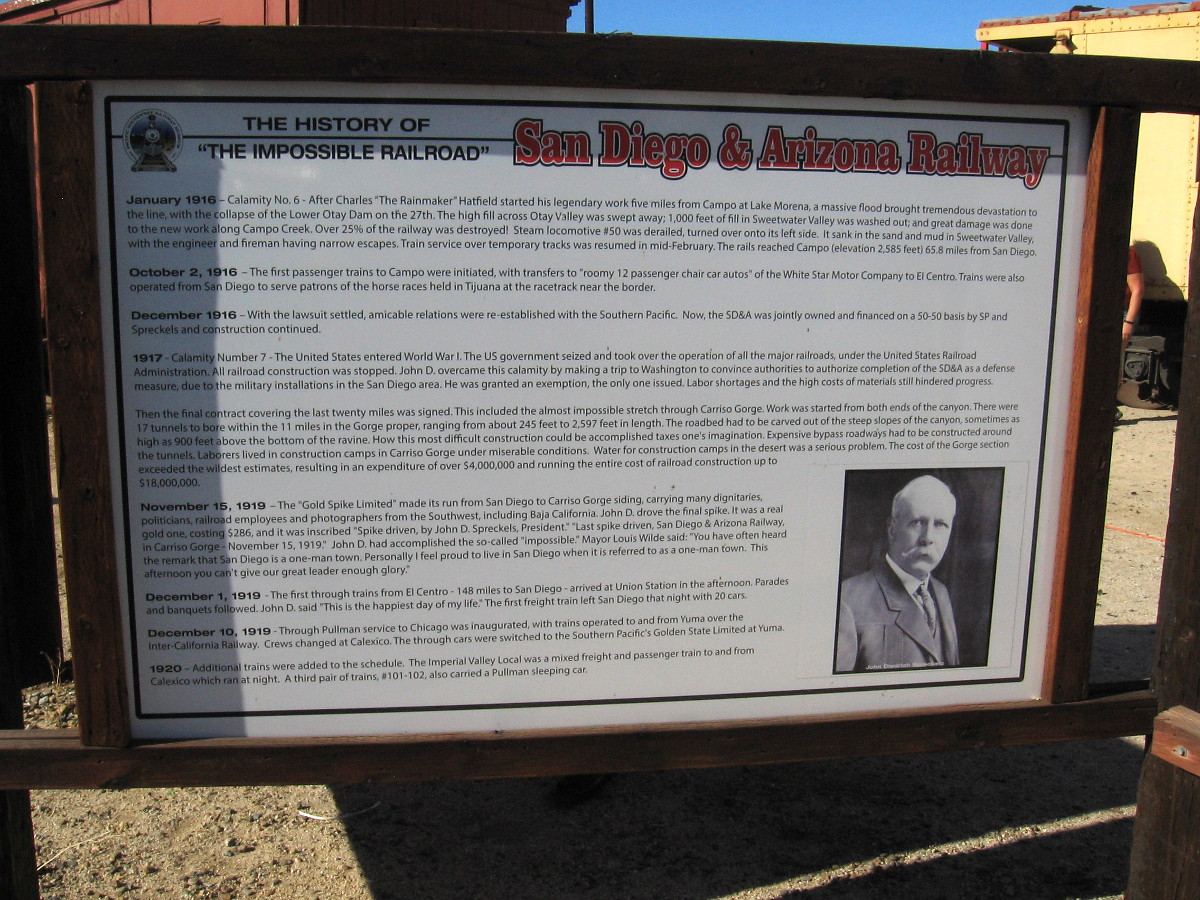
In 1916 rails reached Campo on the last transcontinental railway link built in the United States. The line was completed in 1919. The line was eventually purchased by MTS to gain right-of-way for the San Diego Trolley in the city of San Diego.
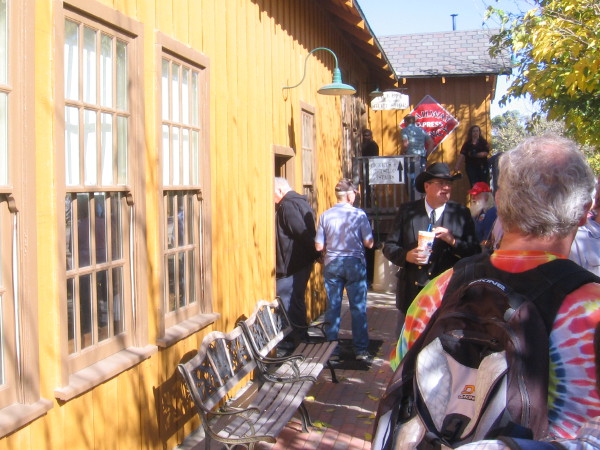
Visitors wait in line at the museum’s old Campo depot to pick up tickets for a train ride during the centennial event.
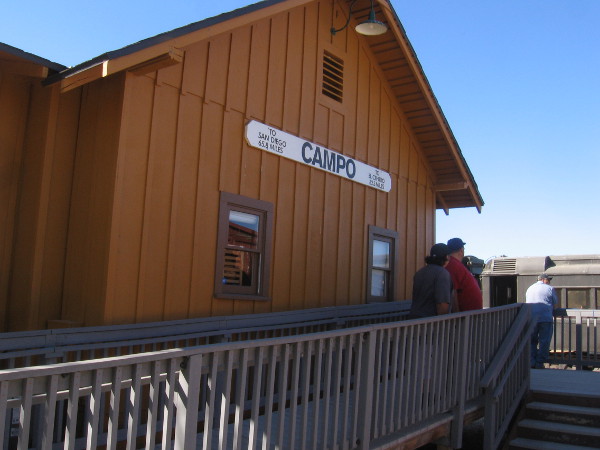
Heading around the Campo depot toward the passenger platform.
Gazing out at a few of the many old rail cars owned by the Pacific Southwest Railway Museum.
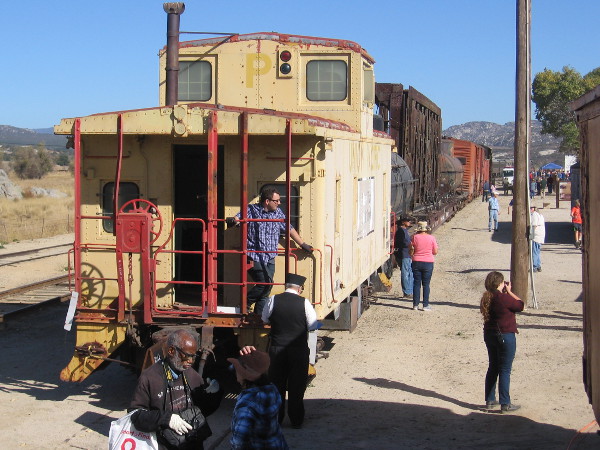
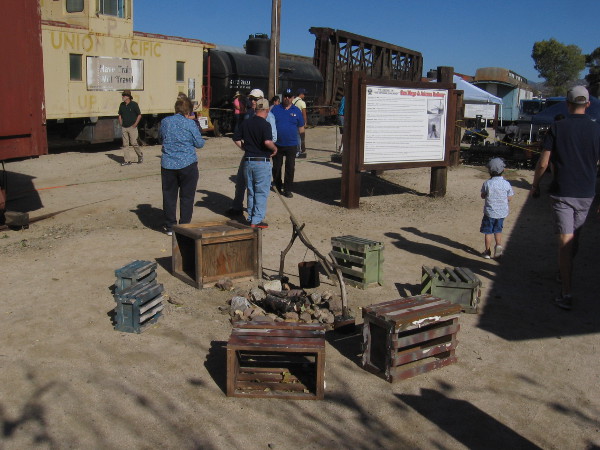
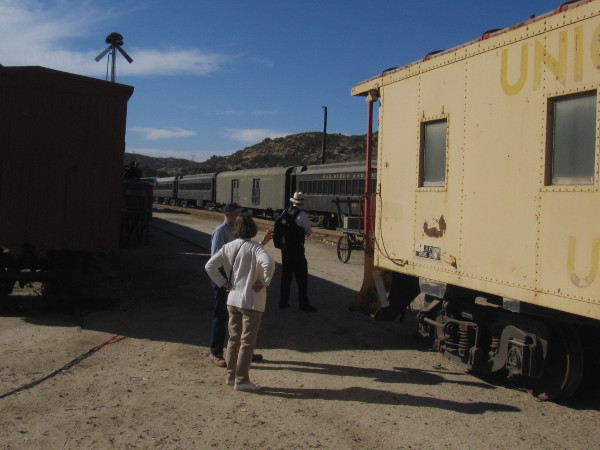
Visitors check out a caboose and more railroad cars to one side of the historic Campo train depot.
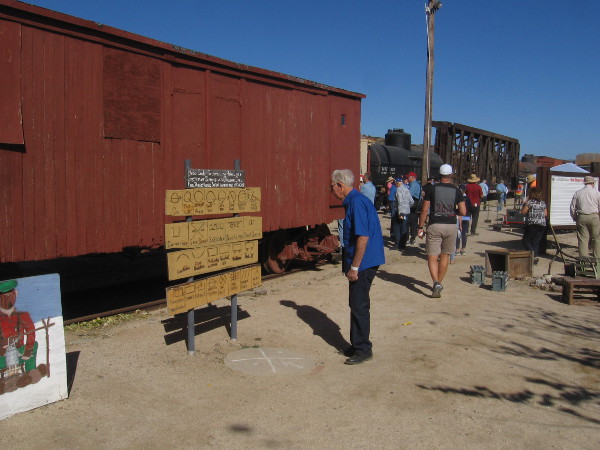
A simulated hobo camp and interesting sign attract the attention of one gentleman.
Hobo code used symbols made with chalk or coal to provide directions and warnings to other hobos.
A recreated hobo encampment with campfire.
On December 14, 1906 John D. Spreckels, with his brother Adolph, announced his intent to construct a railroad from San Diego to Yuma, Arizona.
On October 2, 1916 the first passenger trains to Campo were initiated. On November 15, 1919 the Gold Spike Limited brought dignitaries to Carriso Gorge siding. The Impossible Railroad was completed!
On February 5, 1950 the first diesel-electric locomotive pulled a freight train over the mountains, in place of a steam locomotive.
Checking out history at the Pacific Southwest Railway Museum, with its extensive collection of railroad rolling stock.
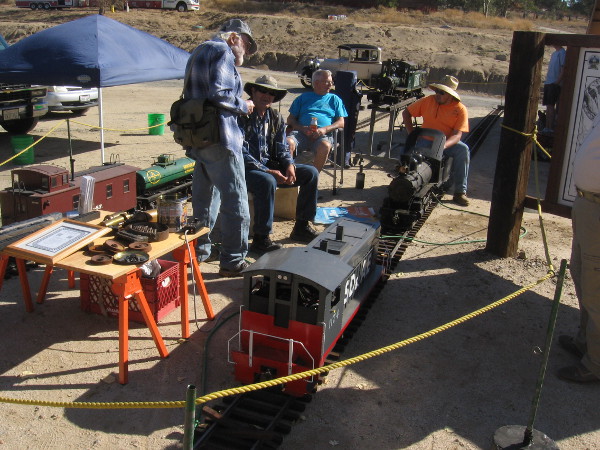
The Chula Vista Live Steamers were present for the event. They brought some of their 7.5 inch gauge operating steam trains.
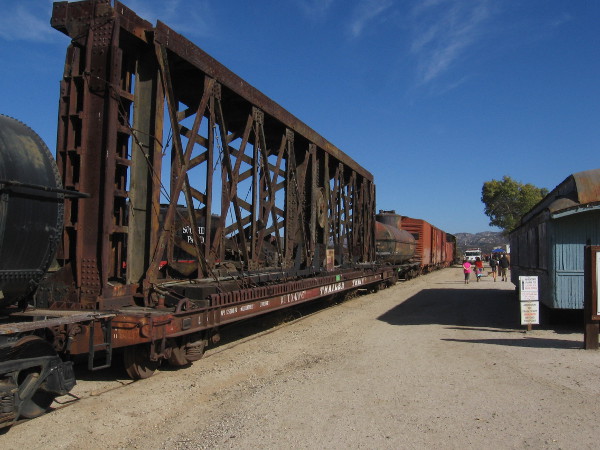
On top of one flatcar is a huge turntable that was once used for turning railroad locomotives and cars.
A cool photo of a nearby Southern Pacific locomotive through the transported turntable.
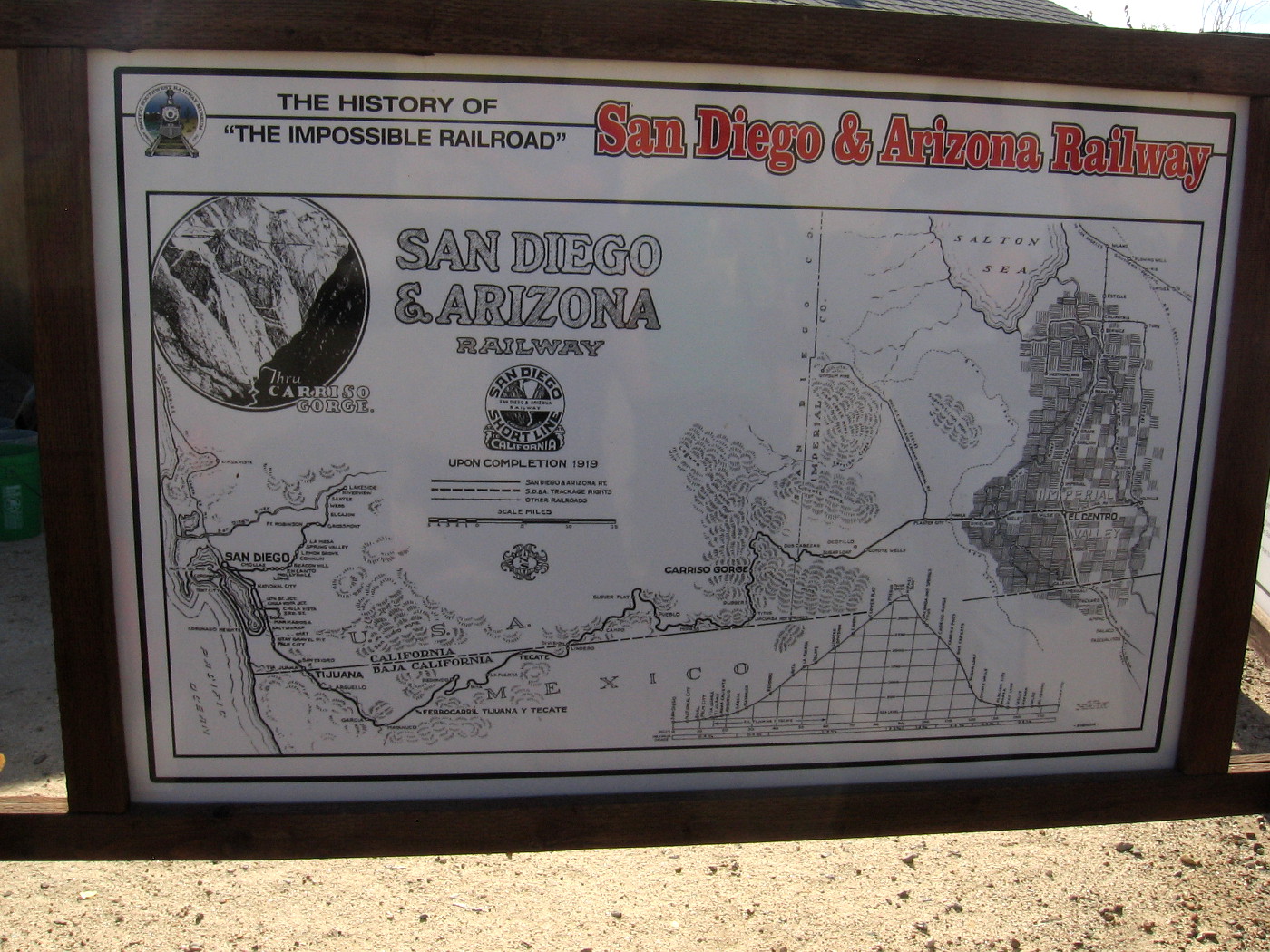
A sign maps the route of the San Diego and Arizona Railway from San Diego through Mexico to El Centro. There are plans to use this line for freight trains once again. There is also talk that a tourist train might in the future run between Tecate, Mexico and Campo, California.
A sign describes two wooden passenger coaches built in the late 19th century. Coach 239 is one of the oldest surviving railroad passenger car artifacts in the West.
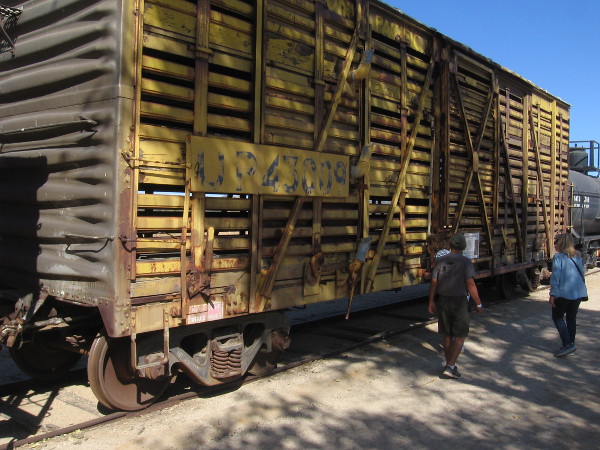
Visitors check out an enormous old freight car.
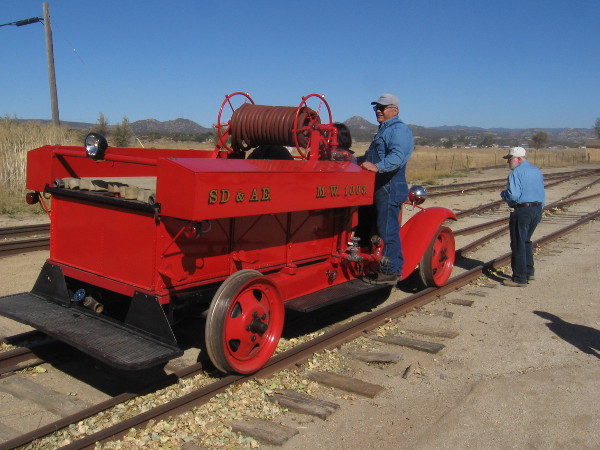
Here comes the San Diego & Arizona Eastern MW 1003 1931 Ford Model AA Rail Fire Engine.
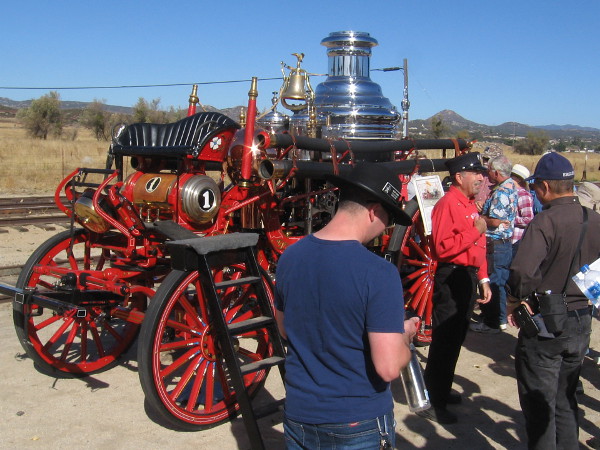
Visitors to the event check out a working 1902 American steam fire engine.
The American was built in 1902 by the American Fire Engine Company. It was restored with the help of the California State Firefighters’ Association, and is now valued at over half a million dollars!
People check out some of the railroad equipment on display on the museum grounds.
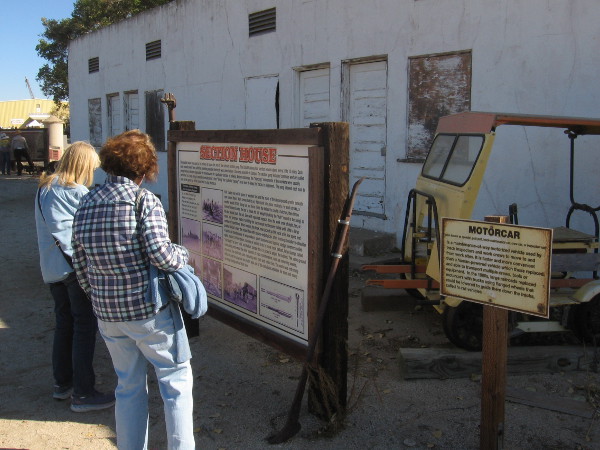
Reading a sign by the railway Section House, where railroad workers were housed along the track.
Passengers disembark from the day’s first excursion train and arrive at the outdoor venue for the gold spike event, near the museum’s Display Building.
A hay ride pulls up to the Display Building area.
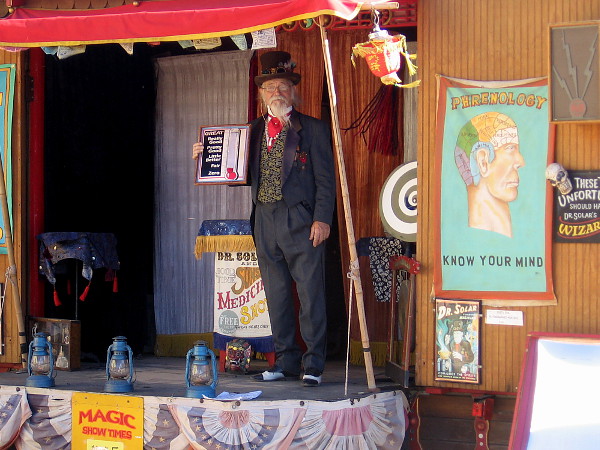
Dr. Solar was entertaining kids with his magical Good-Time, Sunshine, Traveling Medicine Show.
Dr. Solar holds his applause meter.
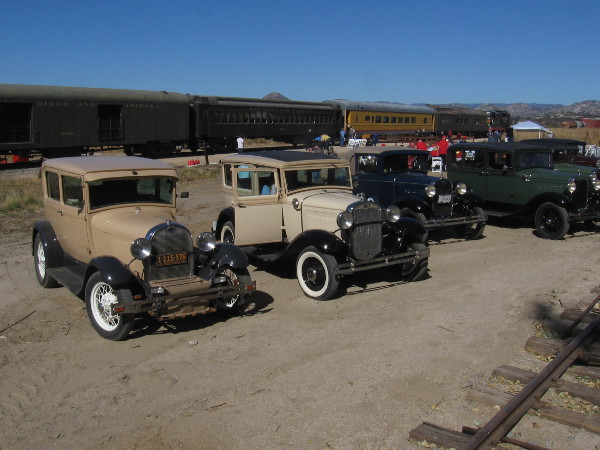
Vintage auto enthusiasts brought their Model A and Model T Fords and Horseless Carriages.
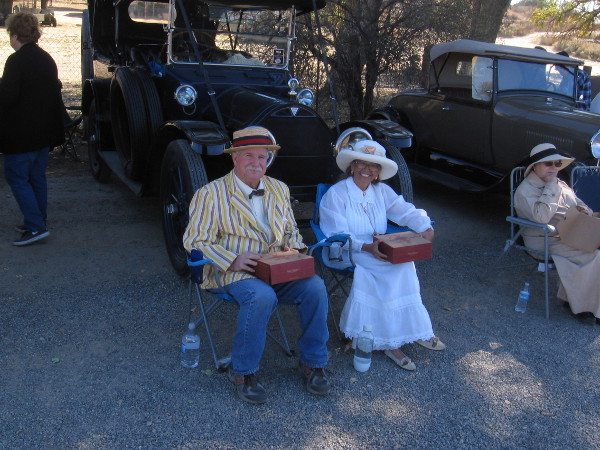
Some fancy period costumes!
Vintage automobiles and vintage trains!
People were lined up for lunch near some of the Pacific Southwest Railway Museum’s many outdoor railroad cars.
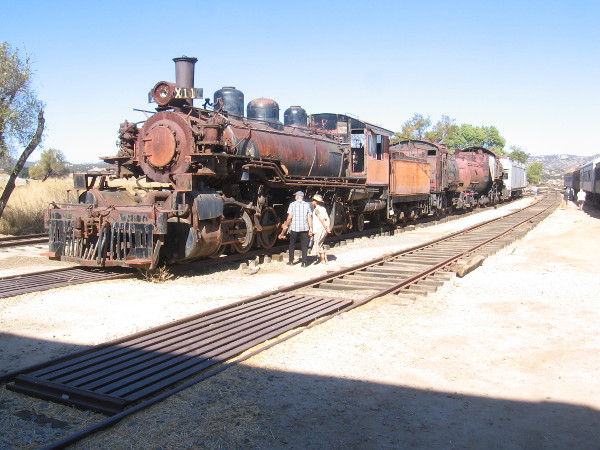
Checking out a very cool old steam locomotive!
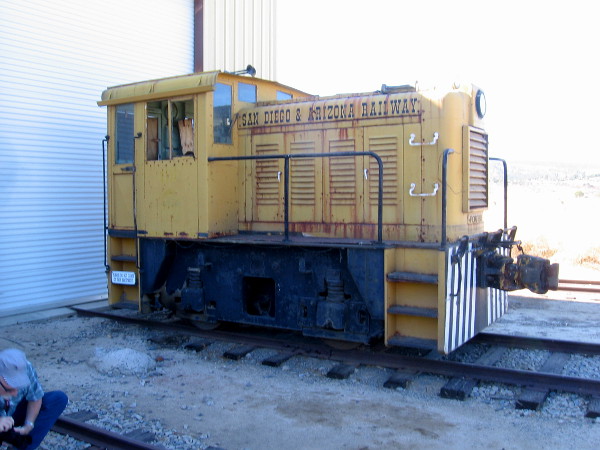
A little switch engine of the San Diego and Arizona Railway.
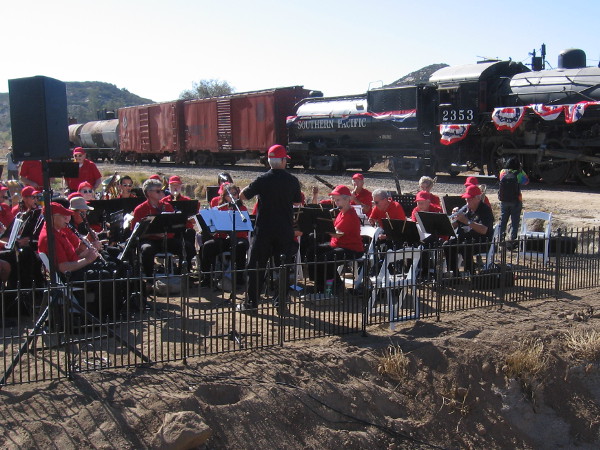
The 100th Anniversary gold spike ceremony is about to begin. A train with red, white and blue bunting on the nearby track will be part of the historical reenactment.
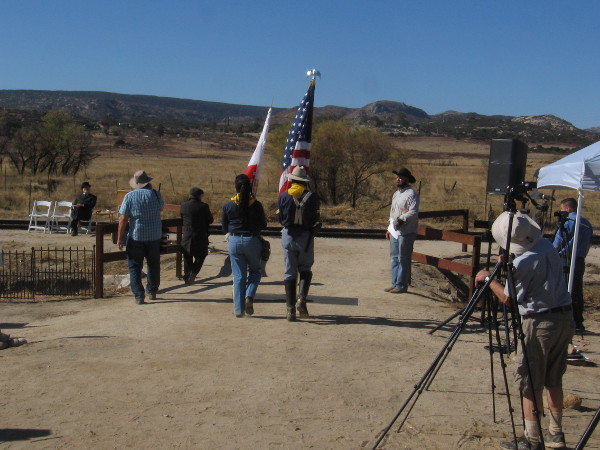
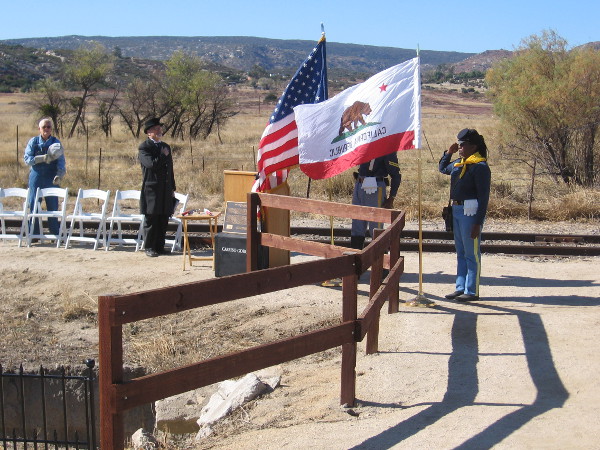
Buffalo Soldiers representing nearby Camp Lockett are the event’s color guard.
The gold spike ceremony begins.
Standing for the National Anthem.
The master of ceremonies would introduce numerous present-day dignitaries, and many speeches would follow.
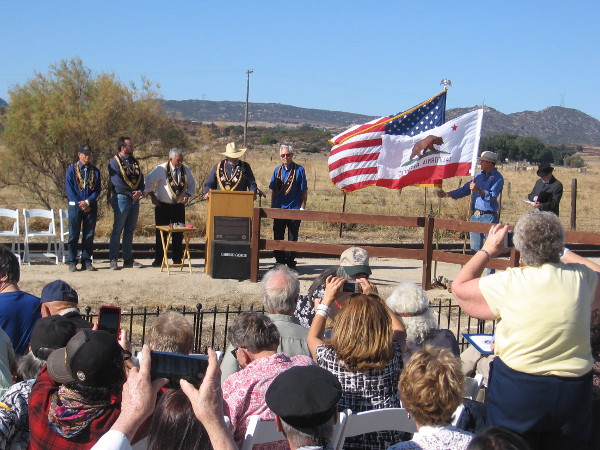
Native Sons of the Golden West dedicate a plaque celebrating the 100th anniversary of the San Diego and Arizona Railway’s completion.
Descendants of John D. Spreckels are asked to stand by Diana Hyatt, President of the Pacific Southwest Railway Museum Association.
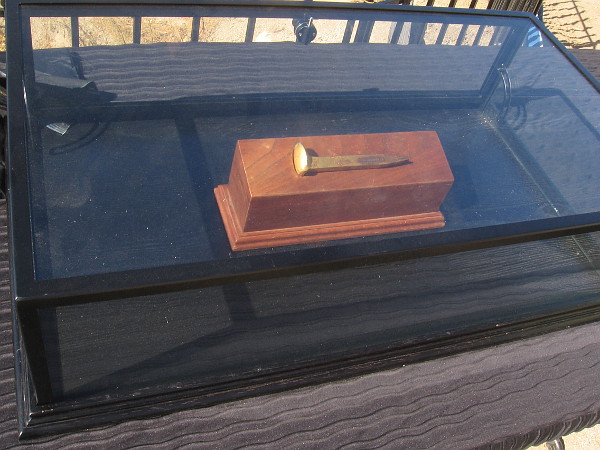
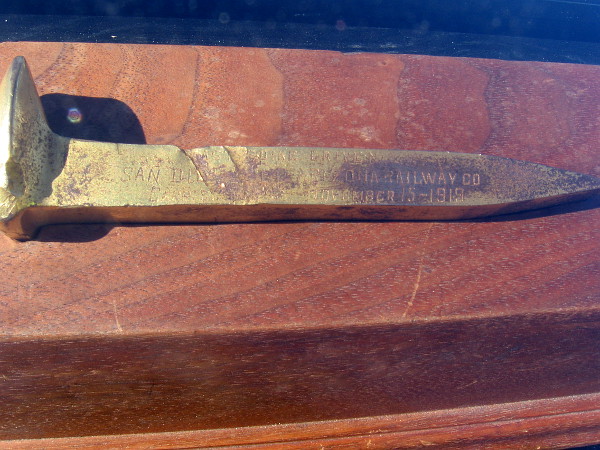
During the centennial ceremony, the original gold spike from 100 years ago was on display in a glass case nearby.
The original gold spike used to celebrate the completion of the San Diego and Arizona Railway in 1919.
The San Diego City Guard Band plays the San Diego Progress March, written for the railway’s completion 100 years ago and performed then by the 1919 version of the City Guard Band.
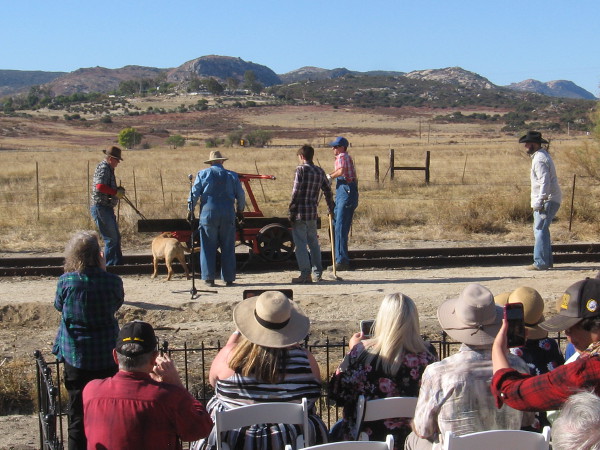
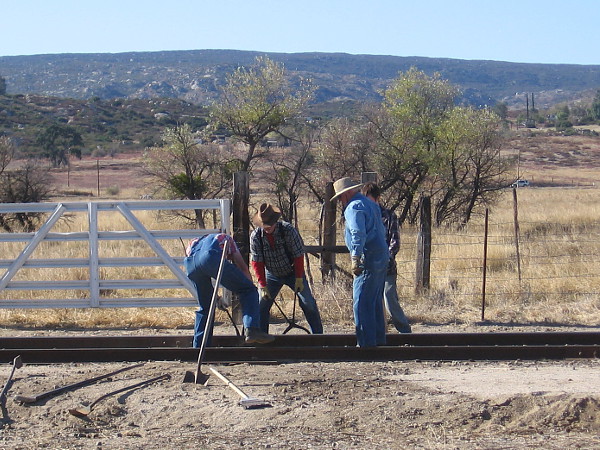
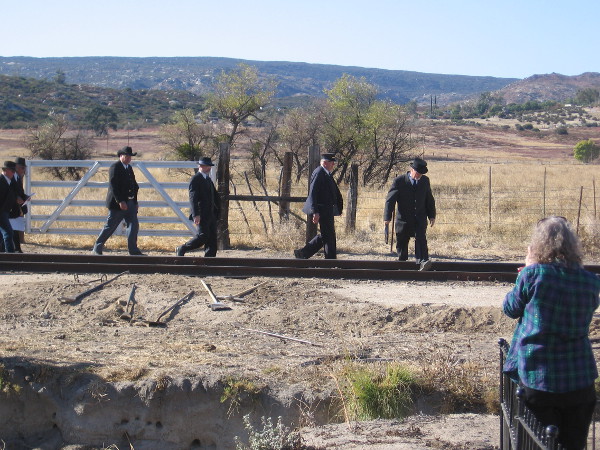
The gold spike reenactment begins. Railroad workers arrive by handcar.
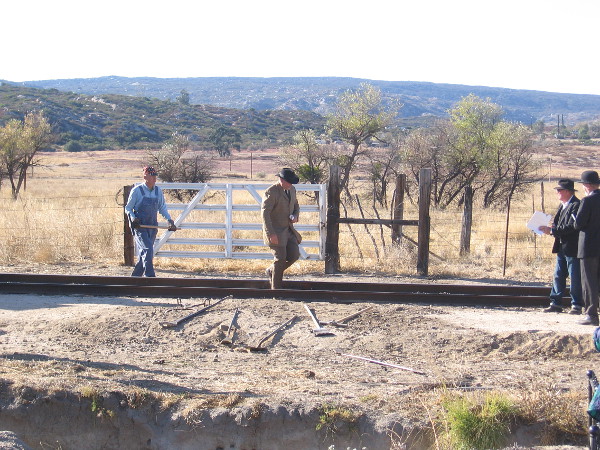
The railroad workers carry the last section of track to be laid.
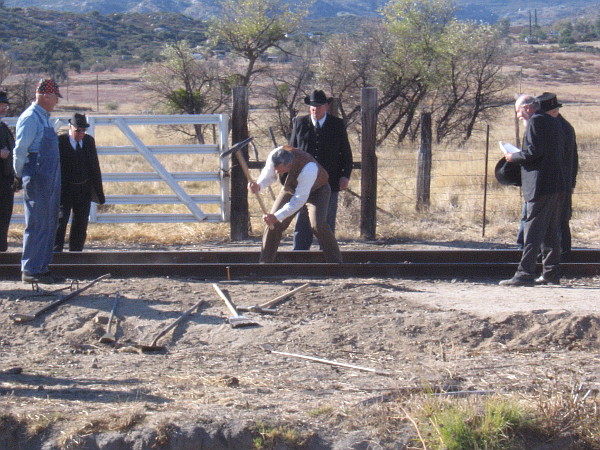
Reenactment of workers completing a transcontinental railroad route.
Railroad history comes to life in Campo, California.
Here come dignitaries from 1919, including San Diego Mayor Wilde and William Kettner.
Politicians and dignitaries from a century ago seem to return to life during the San Diego and Arizona Railway centennial. Each would read from the original speeches.
Photographers record today’s history from one side of the gold spike reenactment.
John D. Spreckels arrives from the Gold Spike Limited train.
The shiny gold spike is put into place.
John D. Spreckels, creator of the San Diego and Arizona Railway, hammers the final spike.
Those attending the big centennial celebration assemble around the John D. Spreckels reenactor for a photograph.
History is made again on a sunny November day in 2019.
…
I live in downtown San Diego and love to walk around with my camera! You can follow Cool San Diego Sights via Facebook or Twitter!
You can easily explore Cool San Diego Sights by using the search box on my blog’s sidebar. Or click a tag! There are thousands upon thousands of photos for you to enjoy!
Mural by artist Jonny Alexander at El Cajon Boulevard and Winona Avenue remembers old U.S. Highway 80.
A cool mural in San Diego celebrates old U.S. Highway 80. The street art reads “Cruise Historic Highway 80” and features an image of a motorcyclist crossing desert and mountains to reach the Pacific Ocean. The mural was painted near the intersection of El Cajon Boulevard and Winona Avenue in 2015 by Jonny Alexander.
U.S. Highway 80 was a legendary cross-country route that at one time ran 2671 miles from U.S. Route 101 in San Diego, California east all the way to Georgia. The segment through San Diego was eventually decommissioned in favor of a newly built Interstate 8.
Much of old U.S. Route 80 ran through San Diego where El Cajon Boulevard is today.
A motorcyclist riding west has reached the Pacific Ocean after crossing desert and mountains.
Much of Historic Route US 80 ran where El Cajon Boulevard is today.
Cruise Historic Highway 80. A celebration of the old days depicted in a cool mural in San Diego.
…
I live in downtown San Diego and love to walk around with my camera! You can follow Cool San Diego Sights via Facebook or Twitter!
You can easily explore Cool San Diego Sights by using the search box on my blog’s sidebar. Or click a tag! There are thousands upon thousands of photos for you to enjoy!
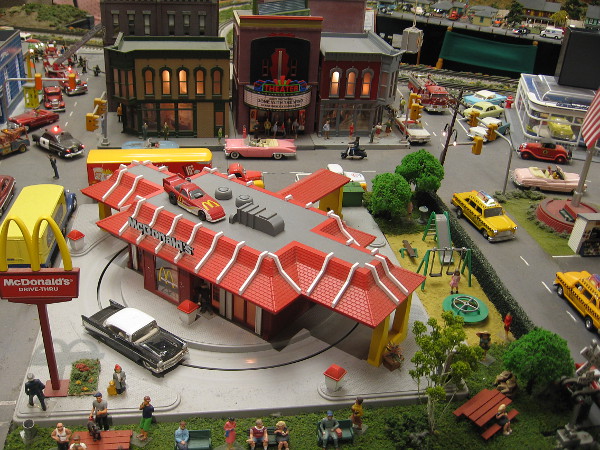
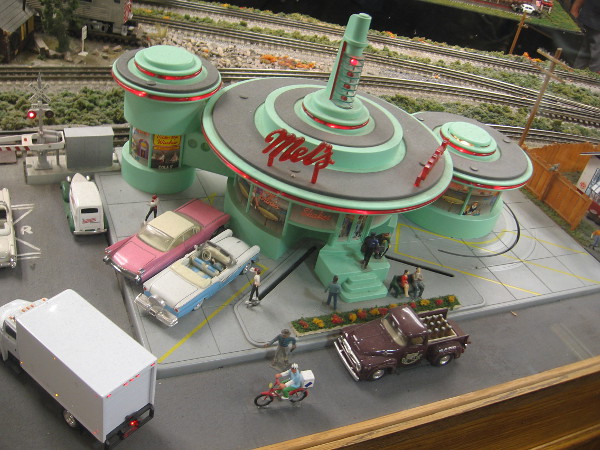
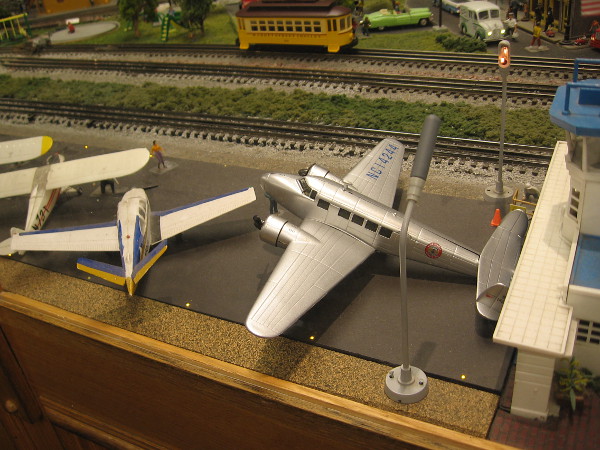
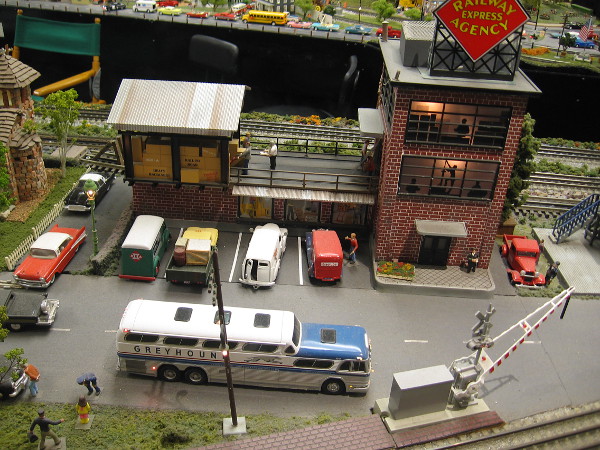
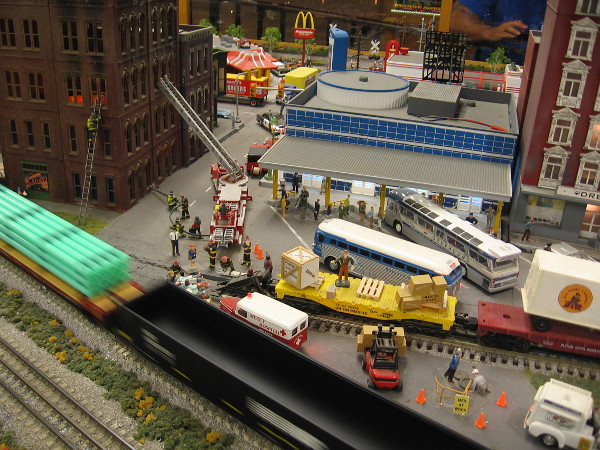
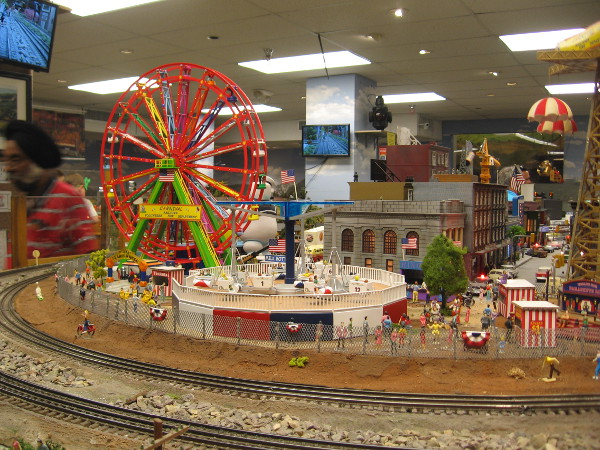
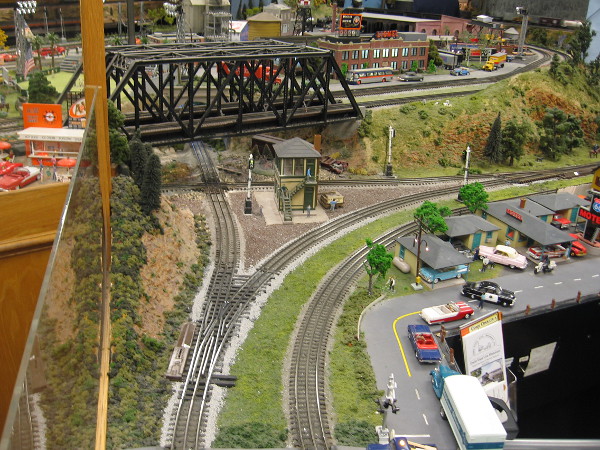
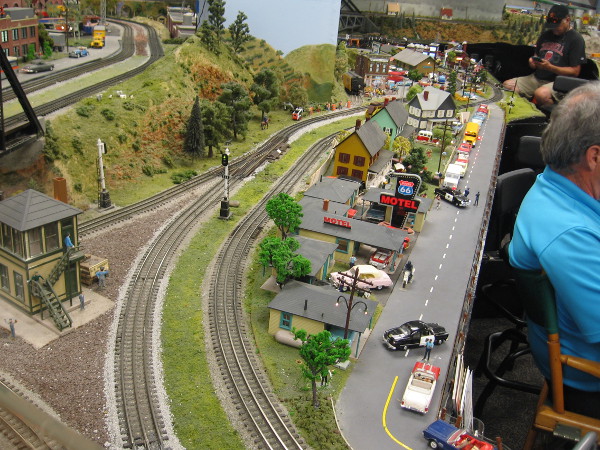
One of my favorite attractions in Balboa Park is the absolutely huge, incredible San Diego Model Railroad Museum. And my favorite room in the museum is the fantastic Toy Train Gallery!
Check out these quick photos of the gallery’s super fun toy train layout operated by the San Diego 3-Railers Club!
The colorful layout features O-Scale Lionel-type trains running through a world full of sound and movement. Signs and billboards light up. Cars pull in and out of driveways. People move back and forth. Ghostbusters contend with a rampaging Stay Puft Marshmallow Man.
A Choo-Choo Cam lets visitors experience an engineer’s perspective as one model train passes through tunnels, over bridges, and past nostalgic, often humorous scenery. The view is sure to delight children . . . and the child that hopefully remains within each of us!
If you or your family would like to visit the very cool San Diego Model Railroad Museum and their fantastic Toy Train Gallery, you can learn more here.
…
I live in downtown San Diego and love to walk around with my camera! You can follow Cool San Diego Sights via Facebook or Twitter!
You can easily explore Cool San Diego Sights by using the search box on my blog’s sidebar. Or click a tag! There are thousands upon thousands of photos for you to enjoy!
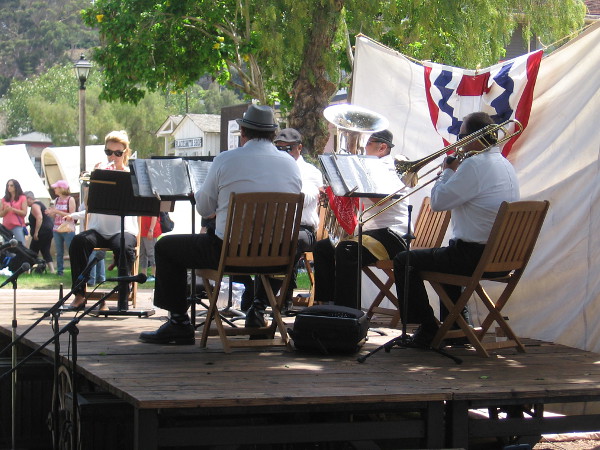
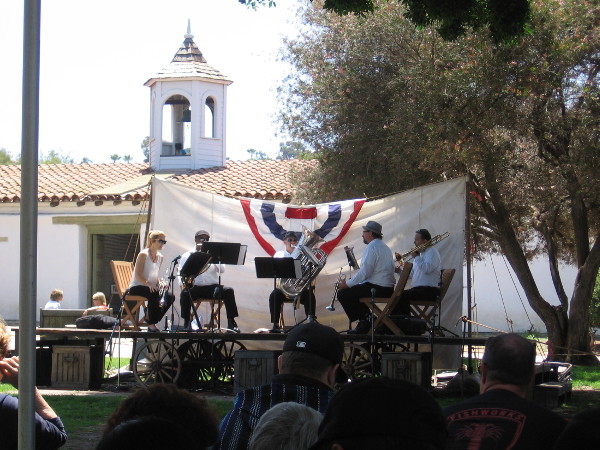
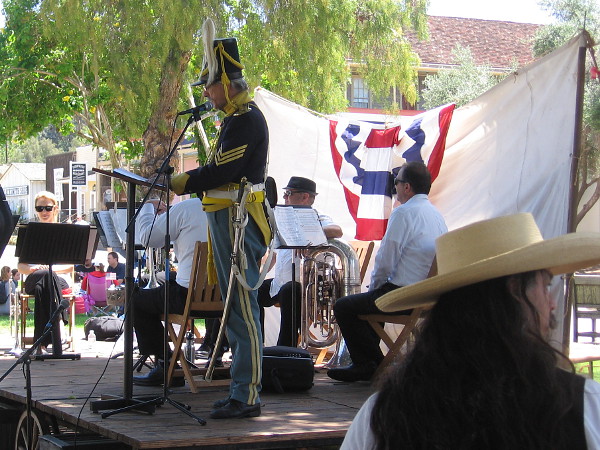
The Westwind Brass Ensemble plays in Old Town’s plaza during an 1800’s Fourth of July.
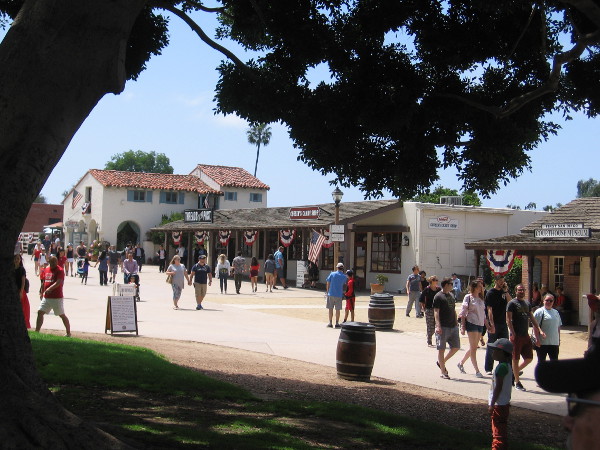
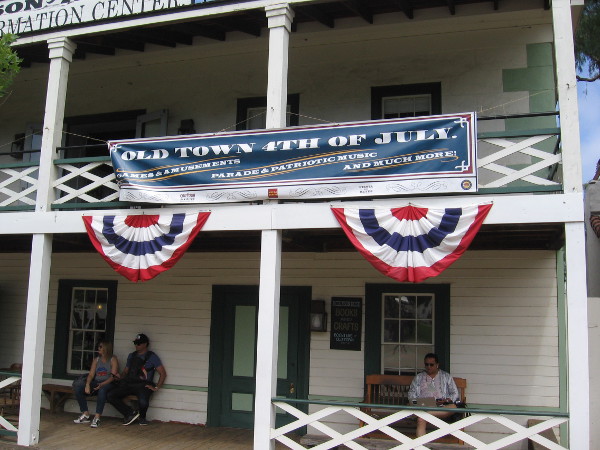
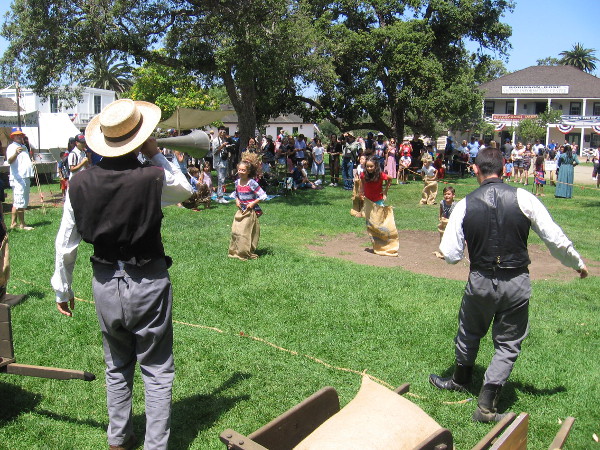
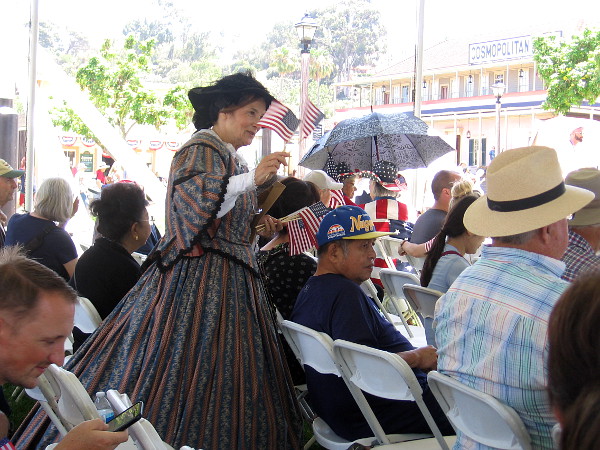
Today a good crowd turned out for a festive 4th of July in Old Town San Diego State Historic Park!
Every year this event provides a taste of what Independence Day would have been like in the 19th century. Fourth of July celebrations in San Diego would have officially commenced in 1848 when the small town became part of the United States.
If you remember some photographs that I posted three years ago, you might notice the event hasn’t changed much. But I love the color and history and the public participation so much I decided to go once again!
Many came out to Old Town San Diego State Historic Park to enjoy an old-fashioned Independence Day.
The Old Town 4th of July offered entertainments that would have been common in the 19th century, after San Diego became part of the United States.
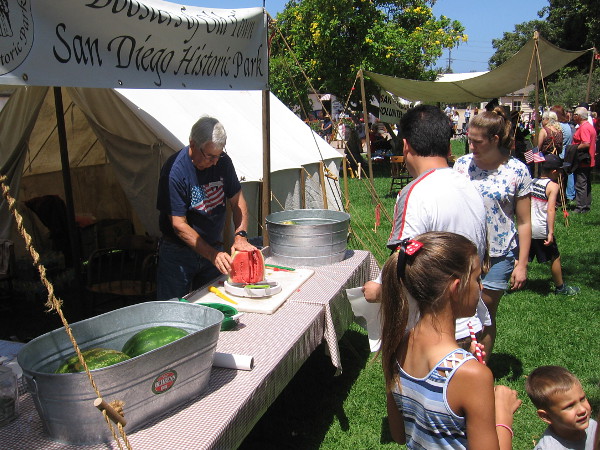
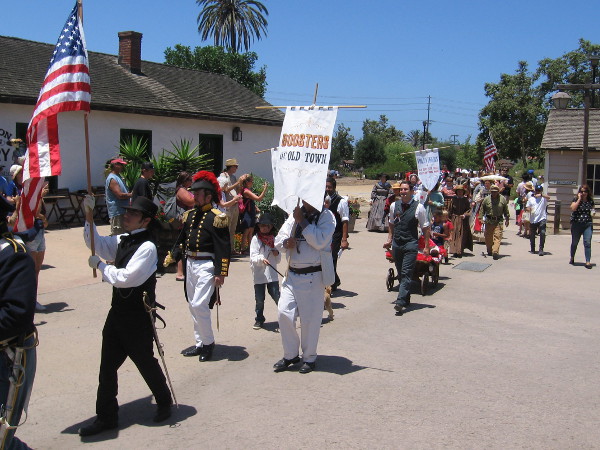
Boosters of Old Town San Diego Historic Park raise money by selling sliced watermelon and pies.
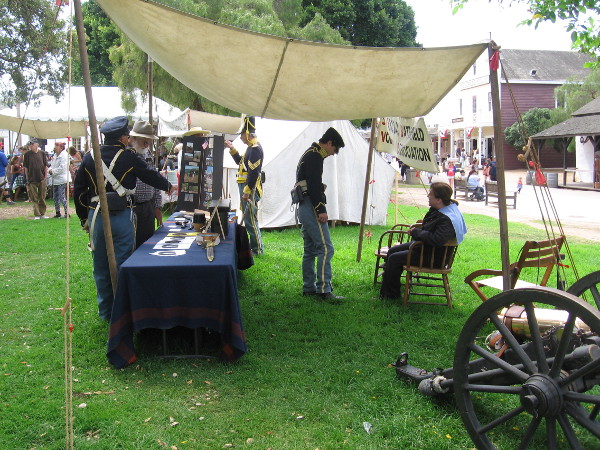
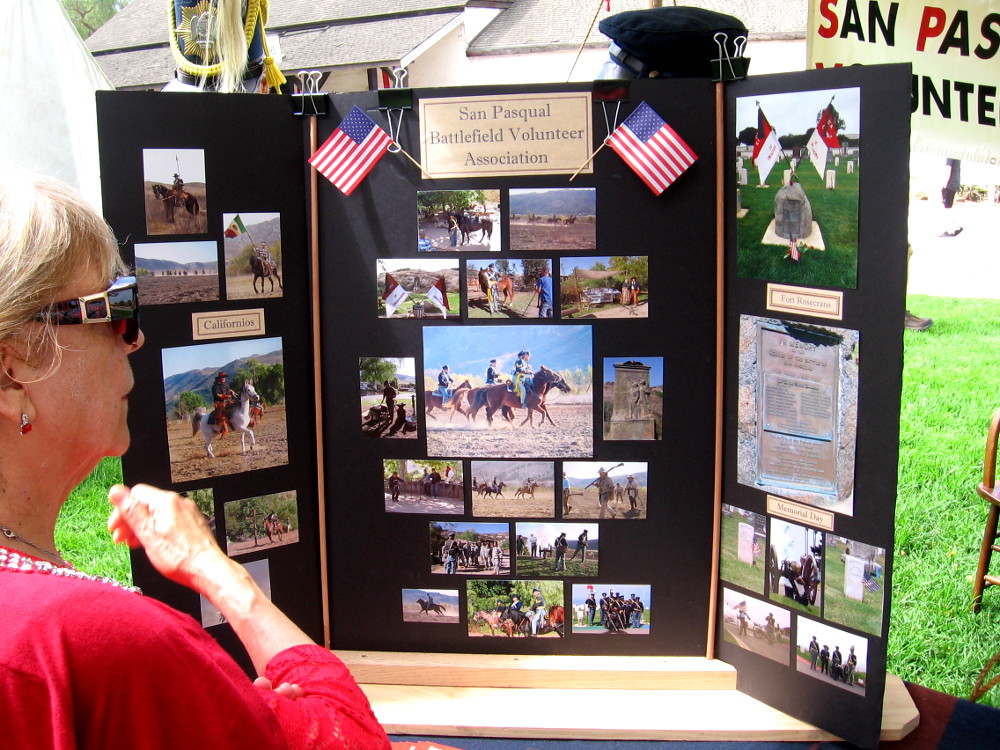
Members of the San Pasqual Battlefield Volunteer Association had a tent with historical displays.
Photos or reenacted history near San Diego, including the Battle of San Pasqual during the Mexican–American War.
A family at Old Town’s Fourth of July event learns all about spinning yarn.
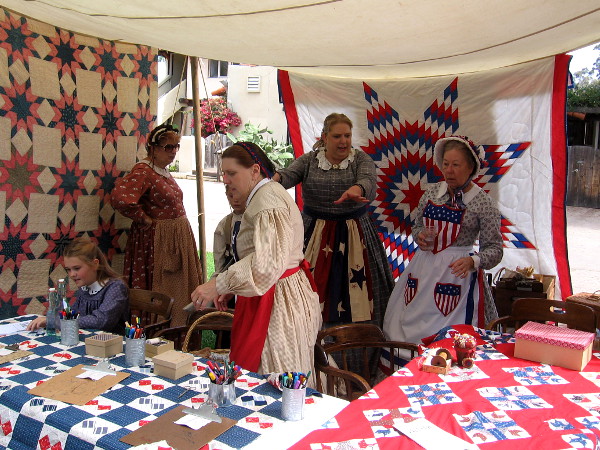
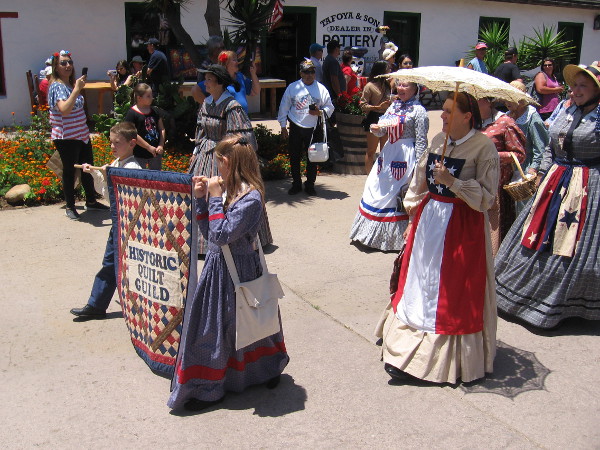
Members of the Historic Quilt Guild had some of their beautiful handiwork on display.
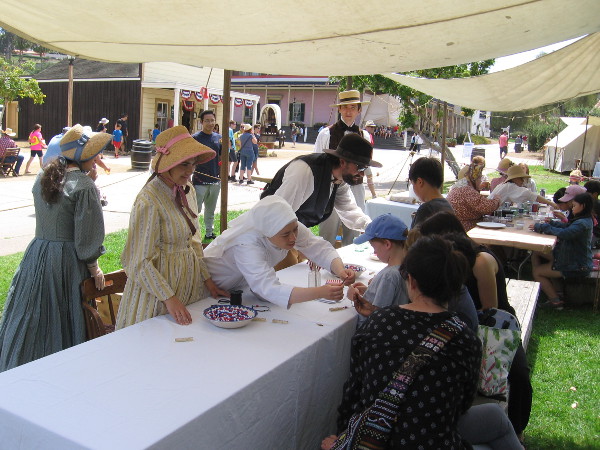
These kids were making stuff with beads.
Kids have fun with hoops on the grass. Simple play from an age long past.
A sack race has everyone laughing.
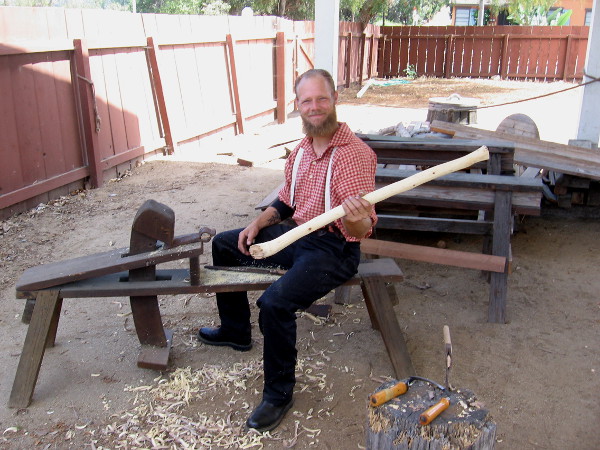
This friendly guy near the blacksmith shop was making an ax handle.
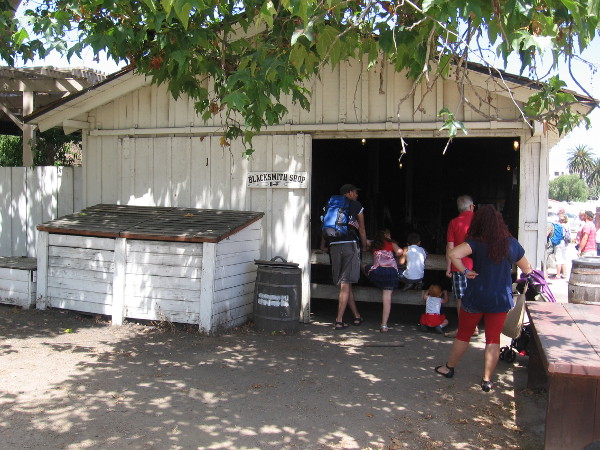
Families were peering into the active blacksmith shop.
Talking about how iron was shaped in Old Town San Diego in the 19th century.
All sorts of nostalgic music and dances and contests entertained the crowd.
Handing out small American flags to those in the audience.
The keynote address reminds everyone of the meaning of Independence Day.
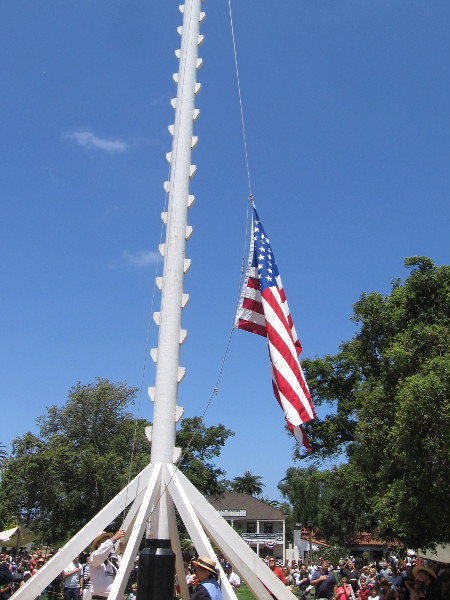
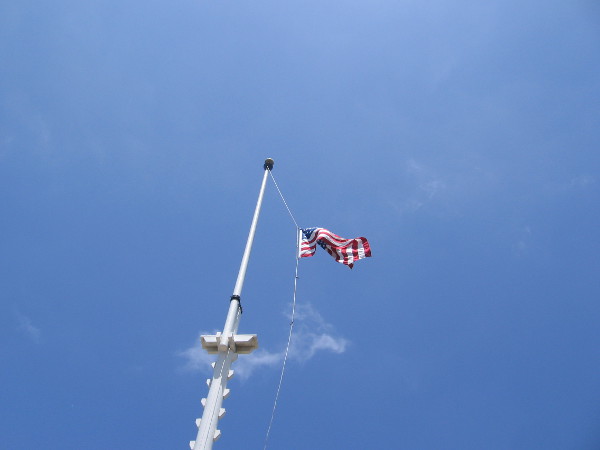
Old Glory readied to be raised on the plaza flagpole.
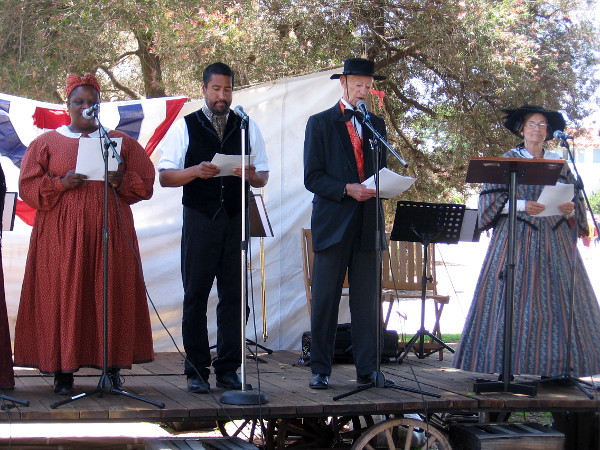
Diverse people in period costume read segments of the Declaration of Independence. Life, Liberty and the pursuit of Happiness.
Several people attending the event also volunteered to go on stage to read portions of the Declaration of Independence.
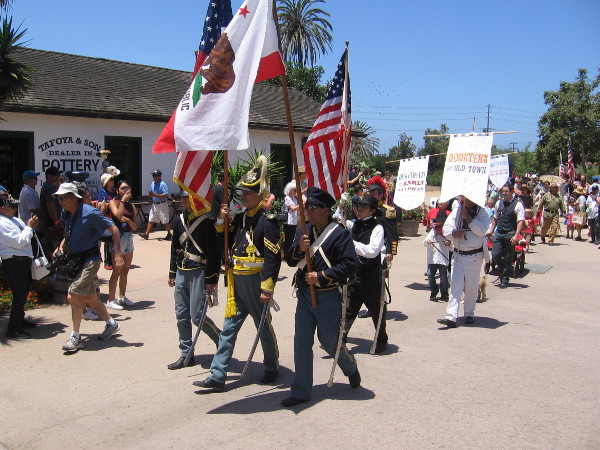
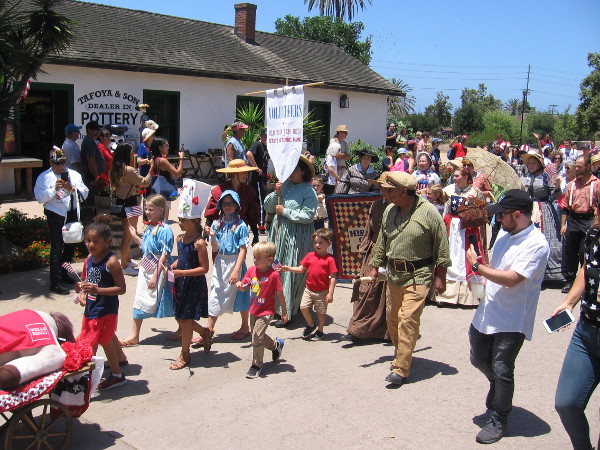
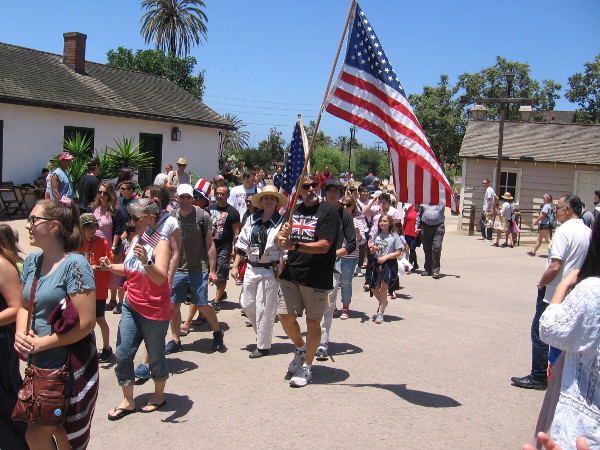
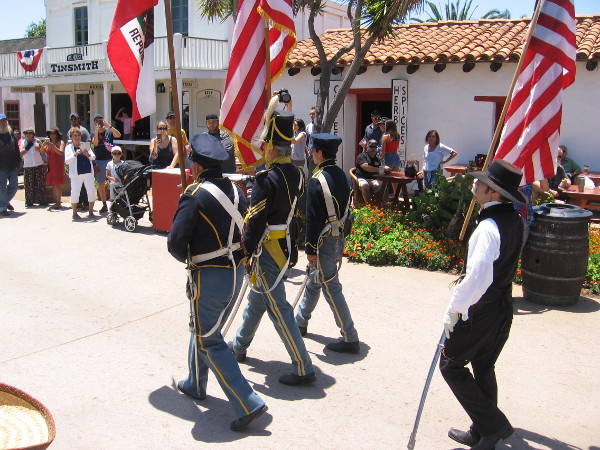
A patriotic parade for the Fourth of July commences around Old Town San Diego’s historic plaza.
Everyday ordinary Americans are invited to join the parade.
…
I live in downtown San Diego and love to walk around with my camera! You can follow Cool San Diego Sights via Facebook or Twitter!
You can easily explore Cool San Diego Sights by using the search box on my blog’s sidebar. Or click a tag! There are thousands upon thousands of photos for you to enjoy!






















































 Cool San Diego Sights!