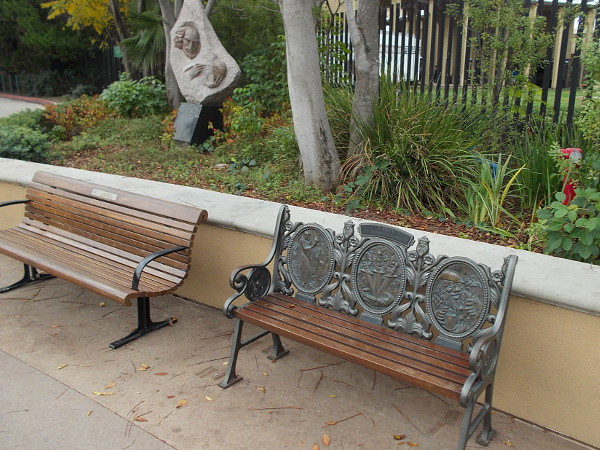
Three magic benches are visible in this photo. Can you spot them?
I discovered three magic benches during my walk through Balboa Park this afternoon! All three are situated in front of the Old Globe Theatre, one of San Diego’s great cultural treasures.
How do I know these benches are magic? It’s very easy to see! Just examine the following photos, and read the captions!
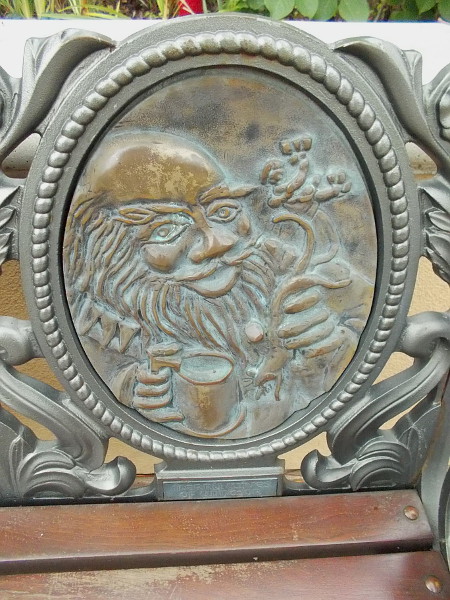
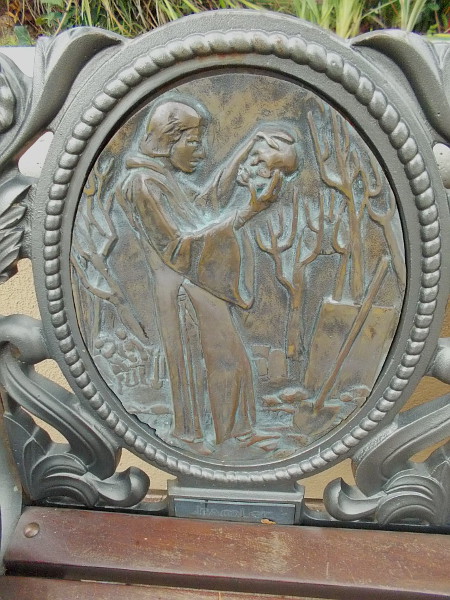
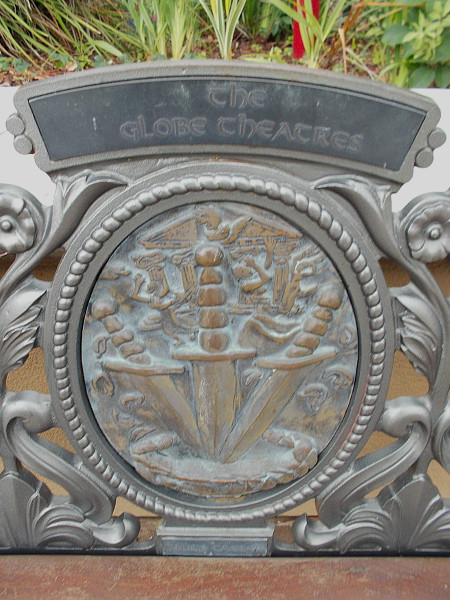
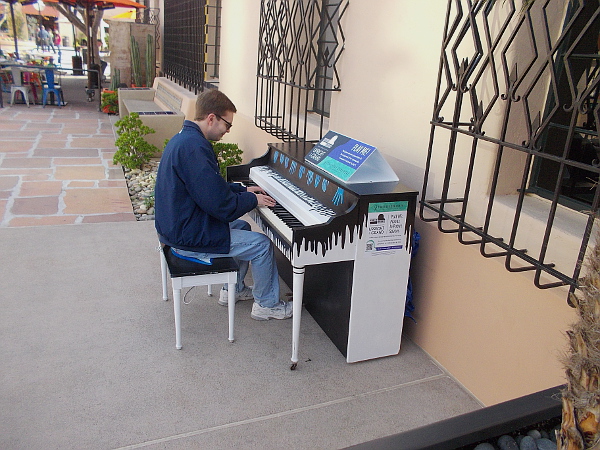
The first bench is dedicated to that magical playwright Shakespeare! As you might recall, the Bard is associated with the original Globe Theatre, which was in London.The iconic face of William Shakespeare on the side of a fantastic public bench in Balboa Park’s Old Globe Courtyard. Sit here and be inspired!A jolly character from the Shakespeare comedy The Merry Wives of Windsor.A famous scene from Hamlet. Alas, poor Yorick! I knew him, Horatio; a fellow of infinite jest, of most excellent fancy…The Old Globe Theatre in San Diego is where you want to see Shakespeare’s famous plays, including the tragedy Julius Caesar.Here’s the second magic bench. Looks ordinary? Don’t be deceived! Sit or lie here, and you might mysteriously be transported far away!And finally, the magic piano bench. Anybody can sit here and play music through January, courtesy of the San Diego Symphony’s PLAY ME: Pianos In Public Spaces event!
To learn more about the ten public pianos that have been placed around San Diego, check out my previous blog post!
To experience magic in wonderful Balboa Park, head over to the courtyard in front of the world famous Old Globe Theatre!The Old Globe has another great lineup for 2016. World-class entertainment in amazing Balboa Park!
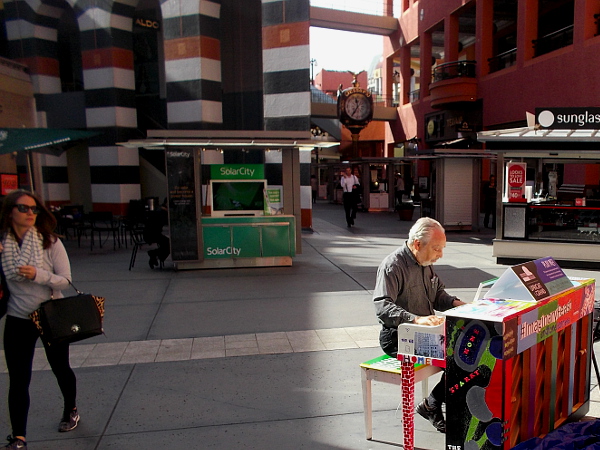
Gentleman who saw this fun piano in the middle of Horton Plaza sat down and started playing. The San Diego Symphony is spreading music around the city!
Ten pianos have been placed around San Diego for the public to play! Any ordinary person passing by can just sit down and perform music to their heart’s content!
This very cool and unique “event” is being put on by the San Diego Symphony. Their PLAY ME: Pianos In Public Spaces installation is part of this month’s Upright and Grand Piano Festival, and will continue through February 8.
Feeling inspired? Feeling musical? Feeling like a maestro? Would you like to play some wonderful piano selections for your admiring fans? Then head on over to one of the ten public locations! They are: the Symphony Towers lobby, the Quartyard, the downtown Central Library, Horton Plaza, The Headquarters, the Coronado Ferry Landing, the Museum of Contemporary Art San Diego (downtown location), Liberty Station, Balboa Park (by the Old Globe Theatre) and the California Center for the Arts Escondido!
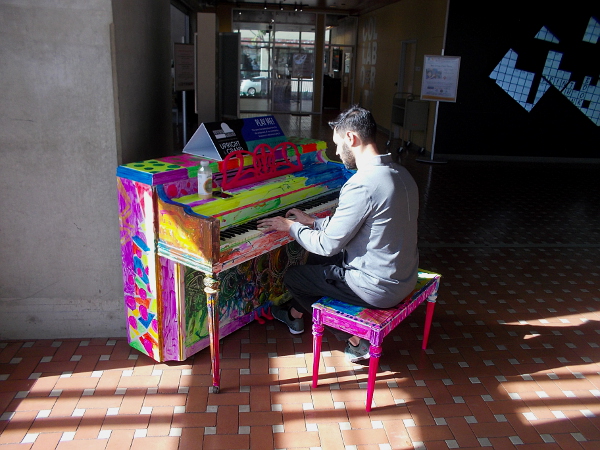
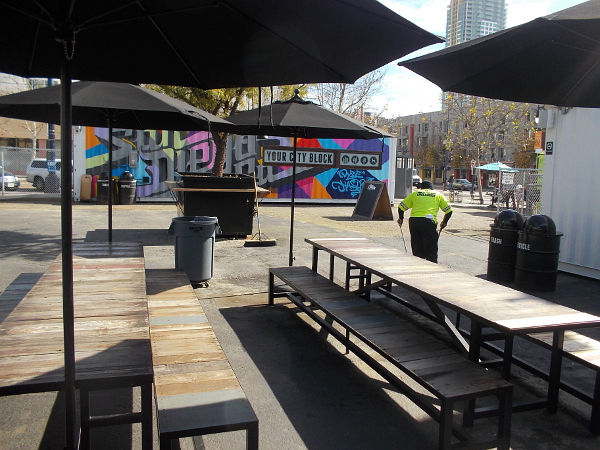
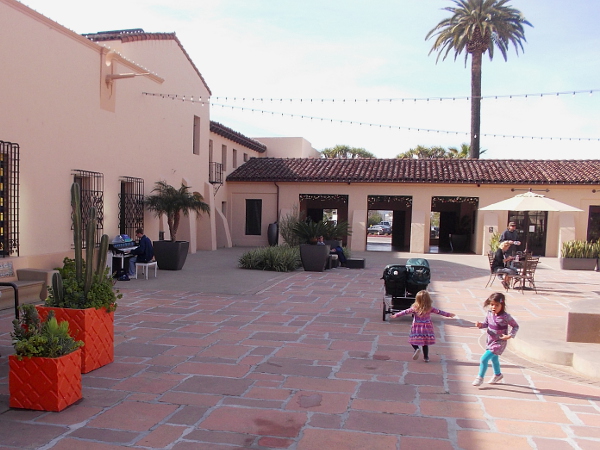
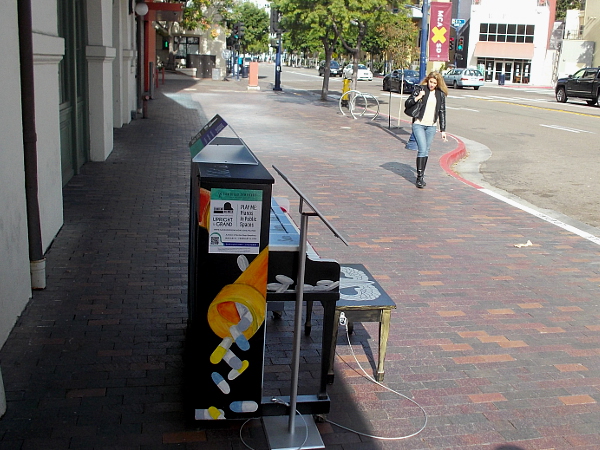
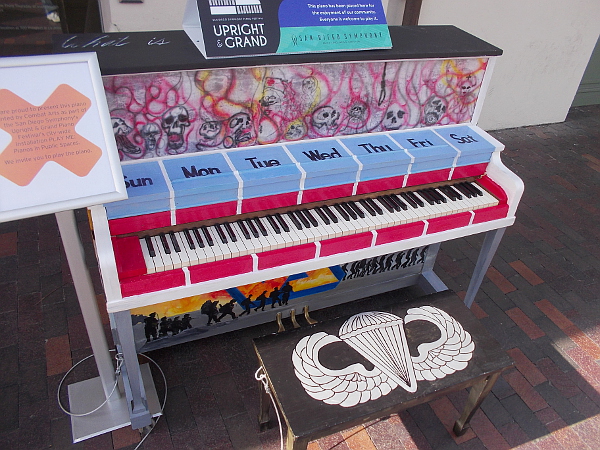
The San Diego Symphony’s PLAY ME: Pianos In Public Spaces program has placed ten pianos around the city for ordinary people to enjoy!A colorfully painted piano in the lobby of Symphony Towers in downtown San Diego. I swung by here in the very early morning when few people were around.A cool guy plays this public piano at the Central Public Library in downtown San Diego. He heard about this very unique event and came on down to tickle the ivories.One of ten pianos placed around San Diego for the public to enjoy. Many library patrons coming through the front door were treated to unexpected music!This piano has a big cyclops eye. It sits outside in the Quartyard in San Diego’s East Village.Few people were about the Quartyard on Saturday morning. It’s a cool eating and event venue that’s fairly new in this hip neighborhood.Amazing talent takes a seat in Horton Plaza. This gentleman was walking through the shopping mall and saw the piano. He sounded like a professional musician!This fellow enjoyed playing another public piano, which has been placed at The Headquarters, near Seaport Village.All ten pianos have unique artwork, painted by various local organizations. The instruments were tuned by experts at the San Diego Symphony–and they sound amazing!Kids twirl to piano music in the wide courtyard of The Headquarters, which is located in San Diego’s old police headquarters.Finally, I saw this piano in front of the Museum of Contemporary Art San Diego’s downtown location, which is next to the Santa Fe Depot.Sign says that we are proud to present this piano painted by Combat Arts as part of the San Diego Symphony’s Upright and Grand Piano Festival’s city-wide installation. We invite you to play!Piano in public for any random passerby to enjoy. Veterans who painted this instrument are part of an art-based museum program to help combat troops recover from PTSD.
…
Please join me for more cool sights on Facebook and Twitter!
Do you like to read original, thought-provoking fiction? Visit my Short Stories by Richard writing blog!
A variety of dried food hangs from the ceiling. The kitchen of the Commercial Restaurant museum in Old Town is a place where visitors are transported back in time.
There are dozens of cool things to see in Old Town San Diego State Historic Park. I’ve barely scratched the surface so far with my blog.
For example, there’s a small free museum right next to the central Plaza de Las Armas called Commercial Restaurant. A rather dull name, but a very interesting place jam-packed with history!
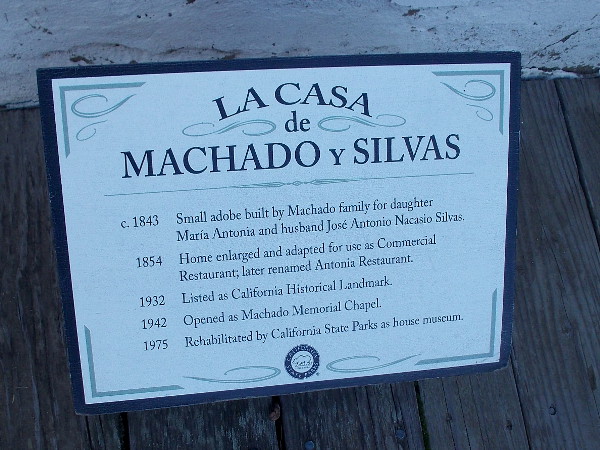
The small recreated restaurant shows what life was like in the mid 1800s, back when San Diego was downright tiny. The Commercial Restaurant is comprised of two rooms: one contains the dining area, the other, the kitchen. Originally called the Casa de Machado y Silvas, the house was built by José Manuel Machado and given as a wedding gift to his daughter María Antonia, and her husband, José Antonio Nicasio Silvas. The simple adobe building was converted into a modest restaurant by its owners in the early 1850s. Today it stands as one of the five historic adobes in Old Town San Diego.
I’ve provided a bit more info in the photo captions!
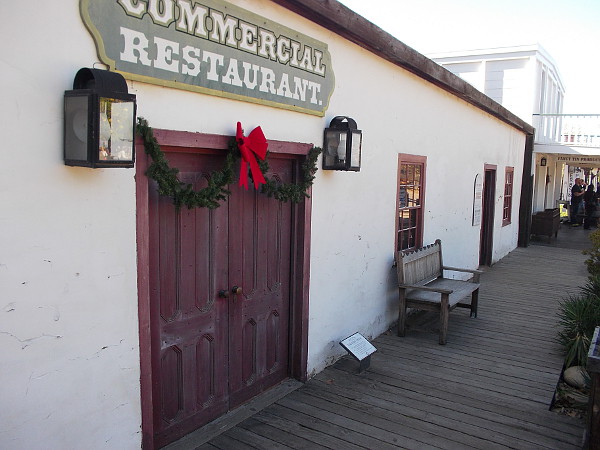
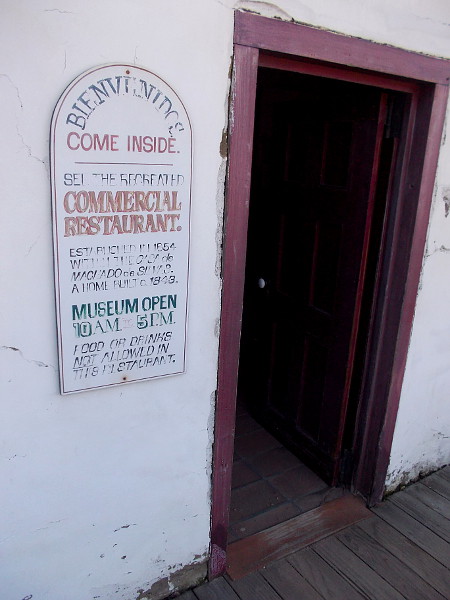
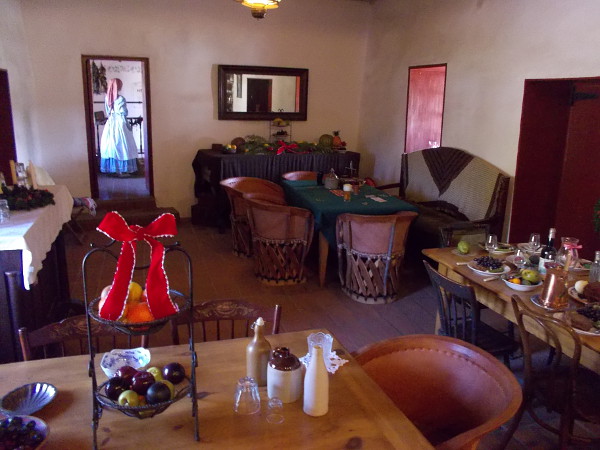
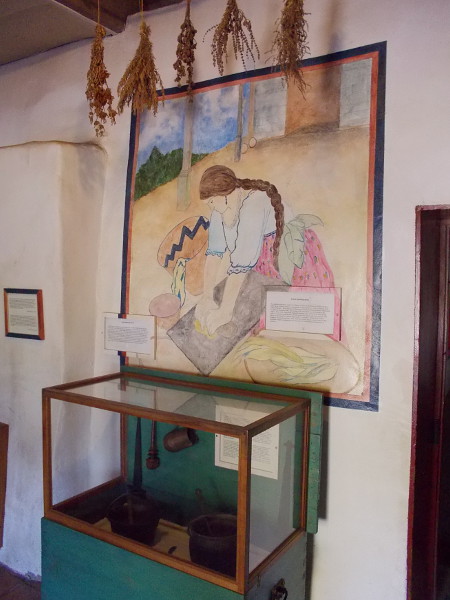
Photo shows the Commercial Restaurant museum, which is free and open to the public in Old Town San Diego State Historic Park.La Casa de Machado y Silvas in Old Town San Diego was turned into Commercial Restaurant, then later renamed Antonia Restaurant.Bienvenidos. Come inside. See the recreated Commercial Restaurant. Established in 1854 within the Casa de Machado y Silvas, a home built in 1843. Museum open 10-5.The dining area of the Commercial Restaurant. This is was what it was like to eat in style in the mid 1800s. Many exhibits along the walls recall the history of old San Diego.Art on one wall depicts the grinding of corn. Other nearby maps and graphics show how food is related to our city’s history.
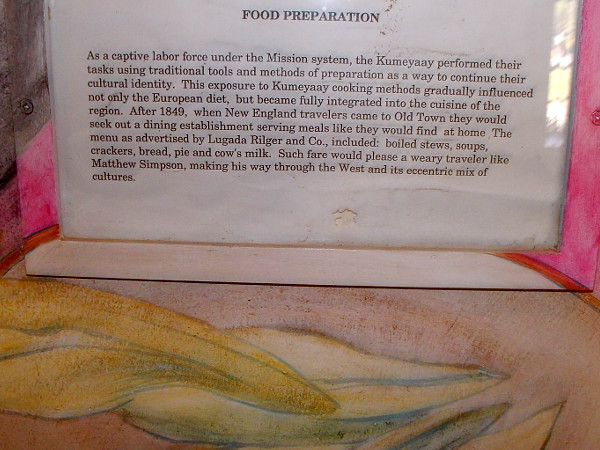
In the mid 1800’s, when New England travelers arrived by ship to Old Town, they sought out a dining establishment serving meals like they would find at home, including stews, soups, crackers, bread and cow’s milk. Over the years, exposure to native Kumeyaay cooking influenced the European diet and became integrated into the region’s cuisine.
As a captive labor force under the Mission system, the Kumeyaay performed their tasks using traditional tools and methods of preparation as a way to continue their cultural identity.Display case contains artifacts used in the daily life of San Diego residents almost two centuries ago.Shelves in the Commercial Restaurant contain old jars, goblets, bowls, bottles, plates and more.It was 1948 when a secret hiding place was discovered in one of the adobe’s window wells. Within the niche were two documents relating to life of an early Old Town San Diego resident.
Historical documents discovered by archeologists hidden in the Casa de Machado y Silvas shed light on the life of San Diego resident Allen B. Light. He was also know as the “Black Steward”. Allen arrived in California during the 1830s, aboard the sailing ship Pilgrim, the same vessel that brought Richard Henry Dana Jr. who would later write Two Years Before the Mast.
One document was “a sailor’s protection”, which proclaimed Light was a “coloured man, a free man, and a citizen of the United States of America”. The second document was his commission from the Mexican Governor of Alta California to investigate illegal sea otter hunting along the coast.
A peek into the recreated kitchen next to the dining room. Cooking was rather primitive in early San Diego.A table full of peppers and vegetables. What life was like many generations ago, in the kitchen of Old Town’s Commercial Restaurant museum.
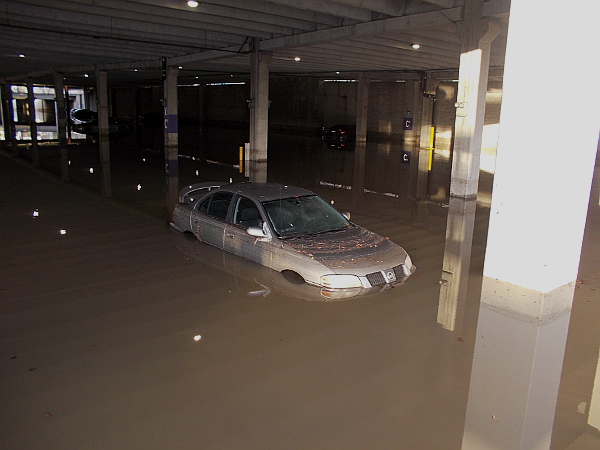
Car deep in the water. The flooded lower level of a Fashion Valley mall parking garage in San Diego’s Mission Valley.
Occasionally I post not-so-cool photos on my blog. Here are some that are noteworthy. I took these this morning while walking through a section of Mission Valley on my way to work. Because it lies right next to the San Diego River, the area is notorious for catastrophic flooding.
Yesterday we had a storm that brought intense rain to our region. It was the second winter storm of this El Nino year. Today we’re having our third storm, and it looks to be fairly rainy for many days to come.
Of course, after California’s long drought, we need the water. Unfortunately, the rain that falls in Mission Valley and many other parts of San Diego isn’t captured–it simply runs off into the ocean. I hope there isn’t too much damage caused this winter by El Nino. To my blog’s followers who are affected, take care!
The morning after an early winter storm during an El Nino year. The sun is out as people cross the San Diego River near the Fashion Valley Transit Center.Areas along the San Diego River are notorious for flooding. Yesterday a long deluge raised the water to an unusually high level.A couple dozen cars were spotted flooded at the Fashion Valley shopping mall. This one was stranded not far from Macy’s, which also suffered some flooding inside the store.More cars abandoned in the flood. Many storms are in line to strike San Diego in the coming days during this El Nino year.The bike and pedestrian pathway beneath Highway 163 flooded and was impassable. The nearby river was swollen with the recent rain.A beautiful morning photo of the San Diego River taken from Mission Center Road. This spot floods during severe storms and traffic must be diverted.A barrier stands ready for the next storm. It looks to be a long, watery winter!
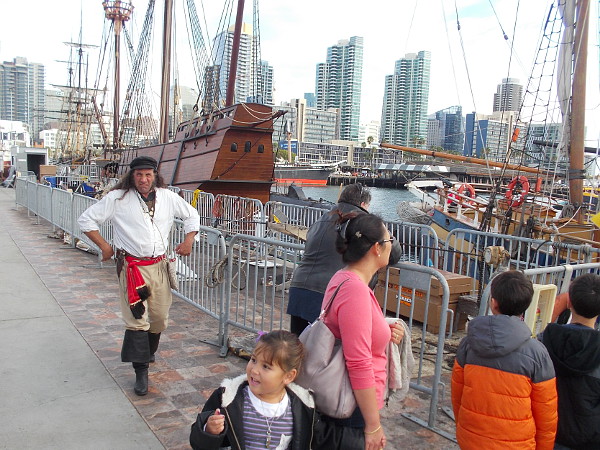
A smiling, innocent-looking pirate just walks along. People suspect nothing.
Did I actually see what I thought I saw?
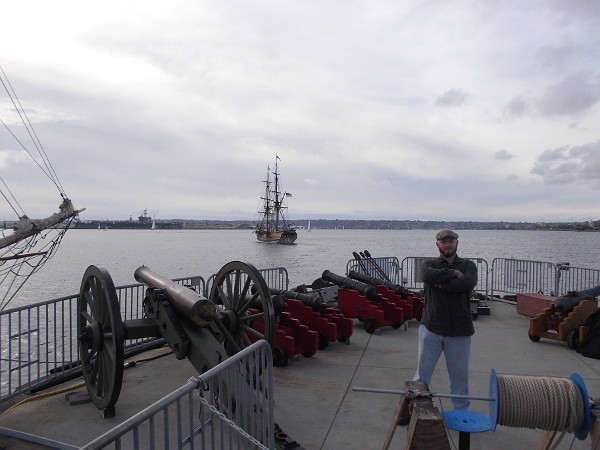
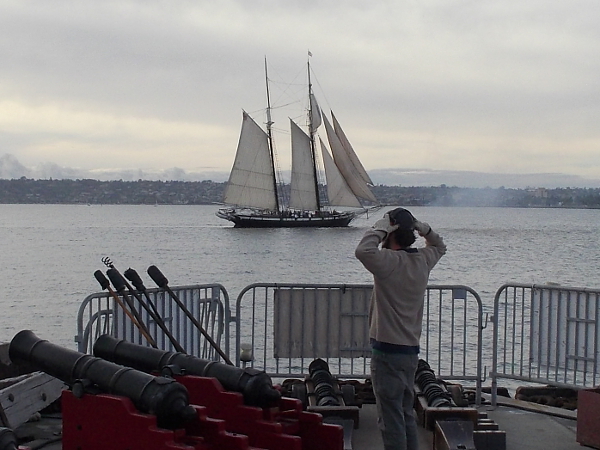
Two tall ships were scheduled to have a mock cannon battle today on San Diego Bay. The reenactment was to be between the Maritime Museum of San Diego’s replica Revenue Cutter Californian (the official tall ship of the State of California) and the Lady Washington, a tall ship visiting from the Grays Harbor Historical Seaport Authority.
What happened?
Pirates!
Two very rascally pirates!
Read the photo captions and tell me where I am wrong!
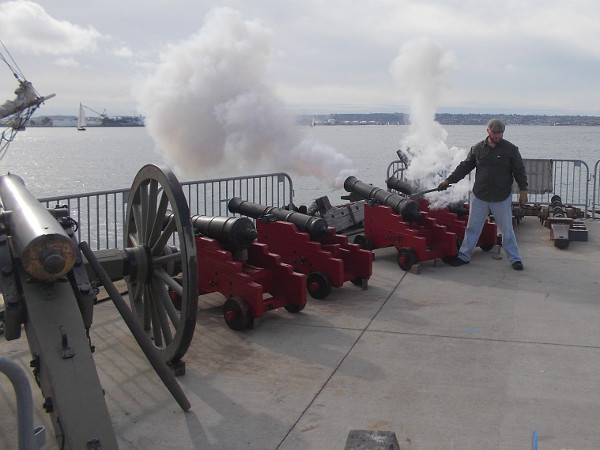
Visitors to the Maritime Museum of San Diego have boarded the tall ship Californian, to engage in a mock cannon battle with visiting tall ship Lady Washington.In case you want to learn a bit more about Californian’s sails and rigging, click this photo. Unfortunately, pirates know all about this stuff.Notorious Captain Swordfish, that pirate who makes Blackbeard look perfectly civilized, comes striding along. He must have another evil scheme in mind.Captain Swordfish makes a crazy scene, distracting those who are boarding the Lady Washington. Nobody notices what that first innocent-looking pirate is up to.That first pirate has taken control of Californian! It’s heading out into San Diego Bay while a museum employee’s back is turned!Turn around! Turn around! That rascal is stealing your ship!The Californian comes about and launches an attack on the Maritime Museum! The insolence! Deadly cannons thunder and echo throughout downtown San Diego!Oh, dear! Oh, dear!The Maritime Museum employee quickly loads one of the land battery cannons, and gets ready to fire! That pirate won’t get away so easily!An epic battle begins!
The Junipero Serra Museum of the San Diego History Center was built in 1928 on Presidio Hill, where European civilization was established in Alta California.
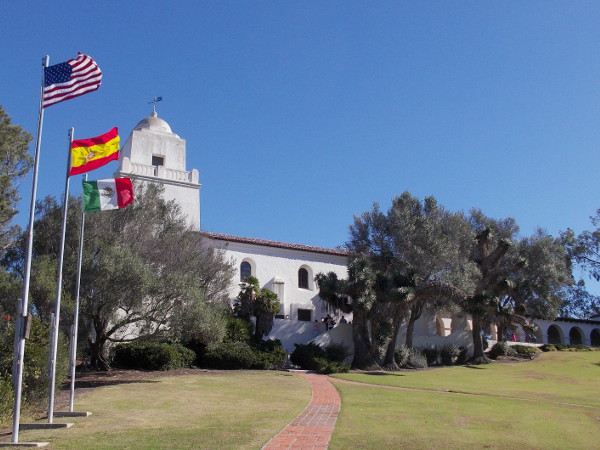
I recently visited one of San Diego’s most fascinating museums. The Junipero Serra Museum is located atop Presidio Hill, in a distinctive Mission Revival architectural style building overlooking San Diego Bay and the San Diego River, just east of Old Town. It stands near the site of San Diego’s historic Spanish presidio, built in 1769. The presidio was the birthplace of European civilization in Alta California.
The Serra Museum is operated by the San Diego History Center, which is headquartered today in Balboa Park. Back in 1929, when the building was dedicated, it became home of what was then called the San Diego Historical Society. The important San Diego institution was established by civic leader George W. Marston.
Can you believe it? I’ve lived in San Diego for 15 years . . . and this was the very first time I ventured into the Serra Museum. (I can thank my blog for that!)
What I discovered was an absolutely amazing place that both residents and visitors to San Diego should definitely not miss.
Here’s a sample of what you’ll see…
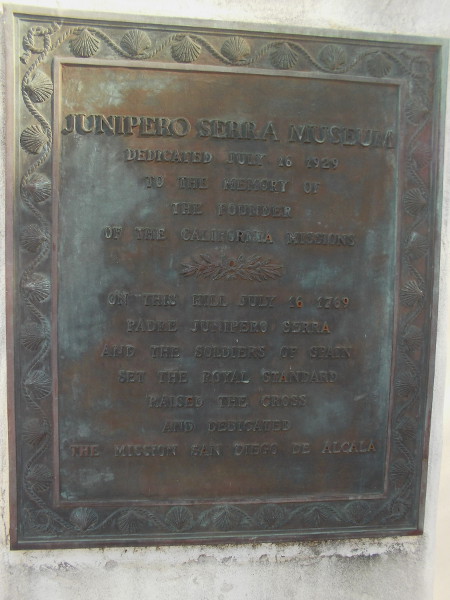
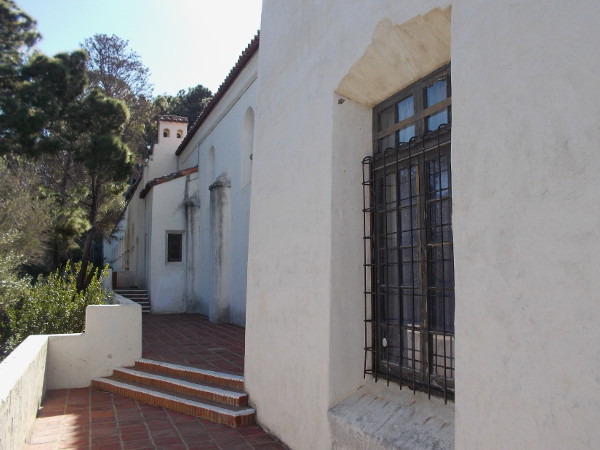
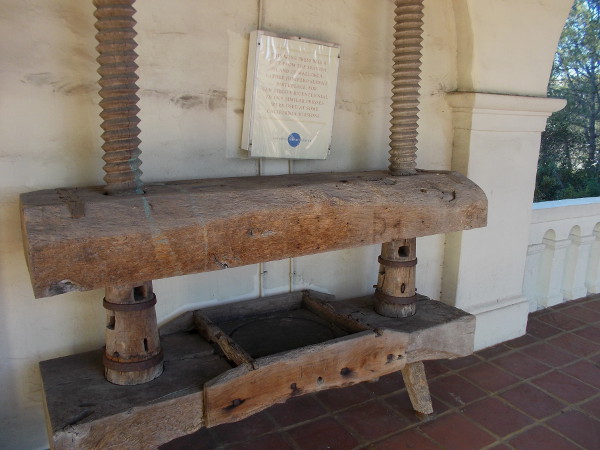
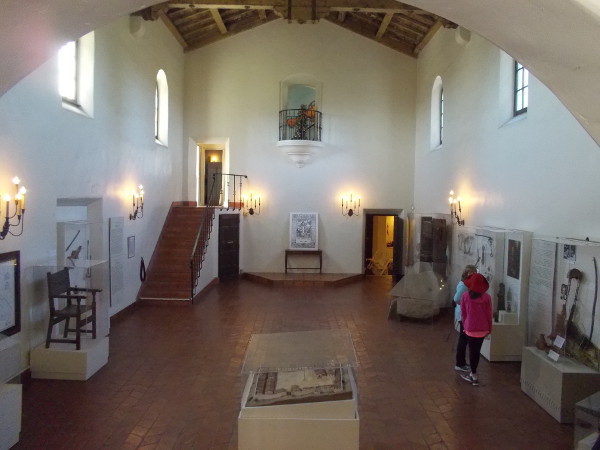
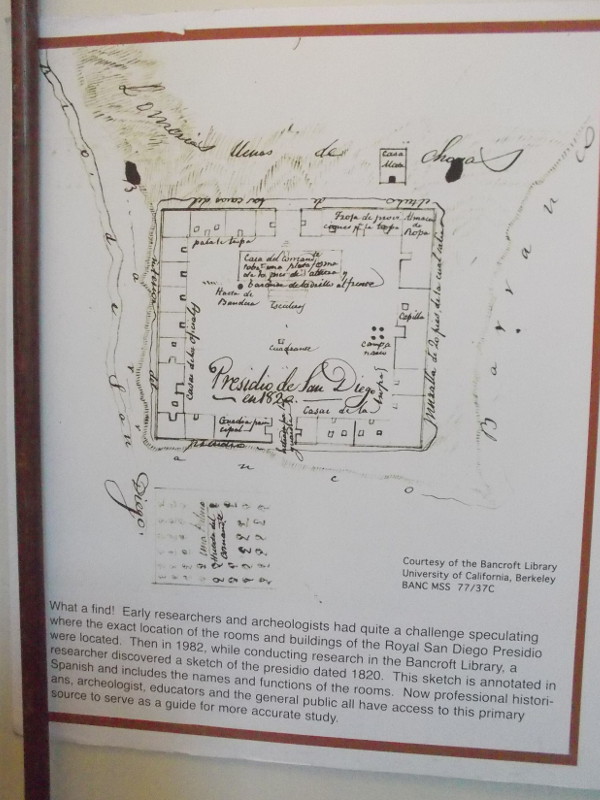
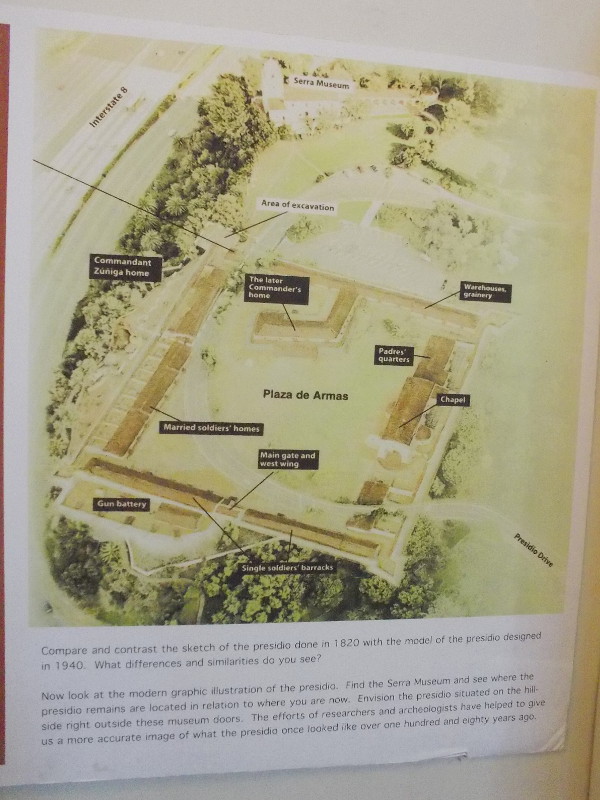
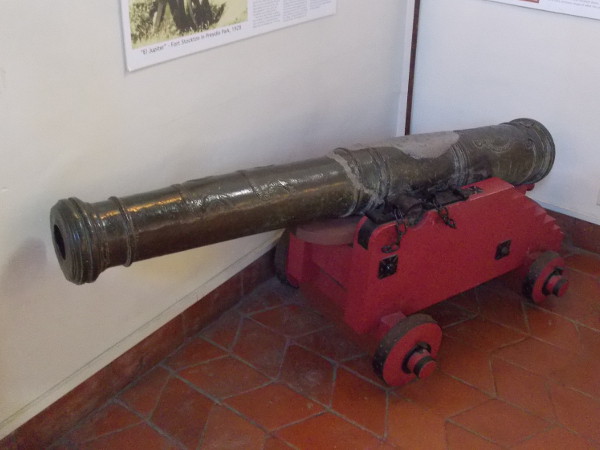
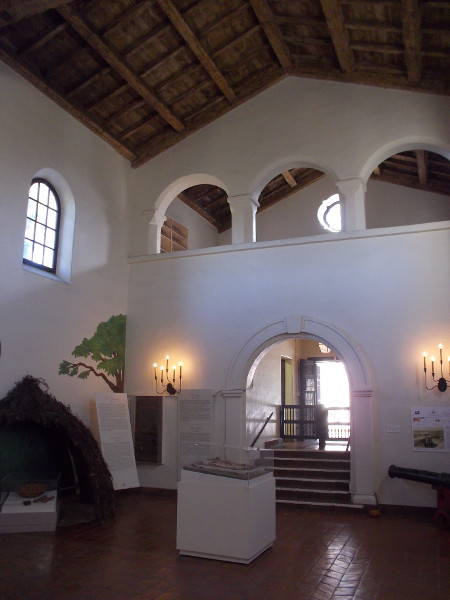
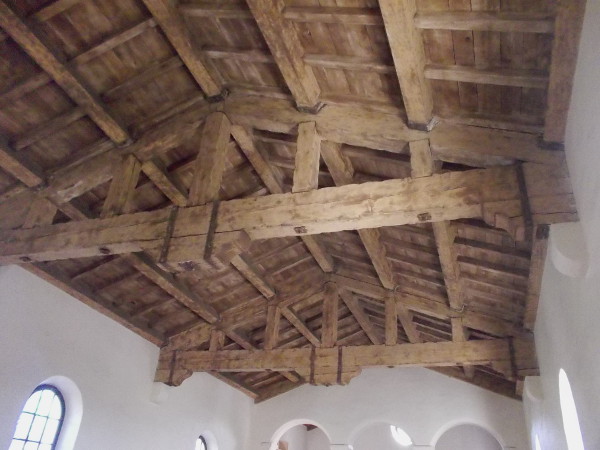
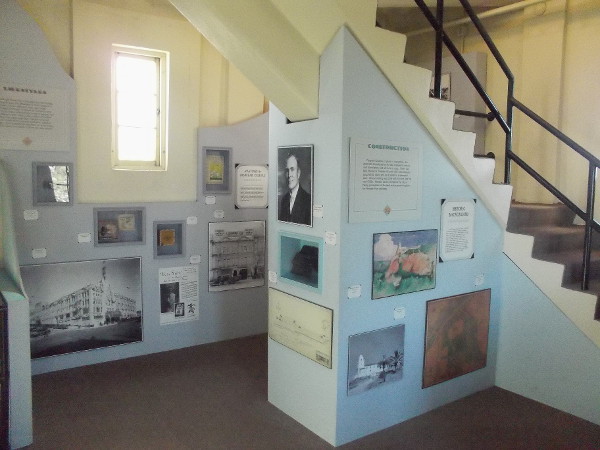
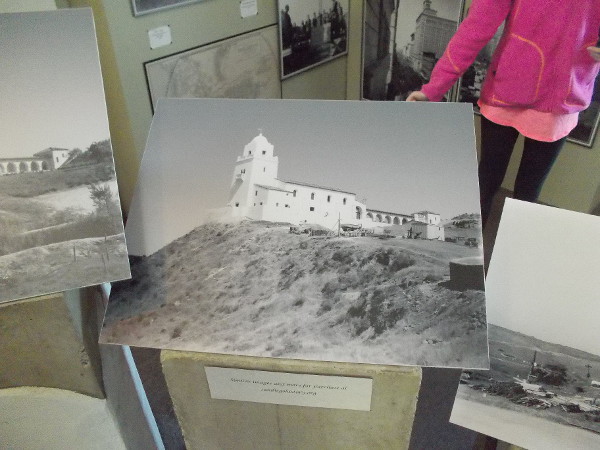
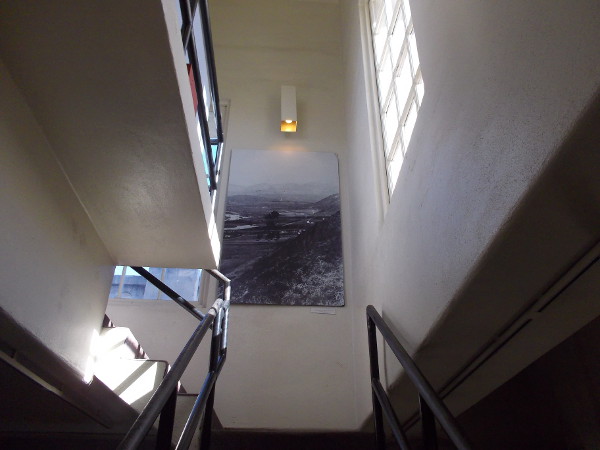
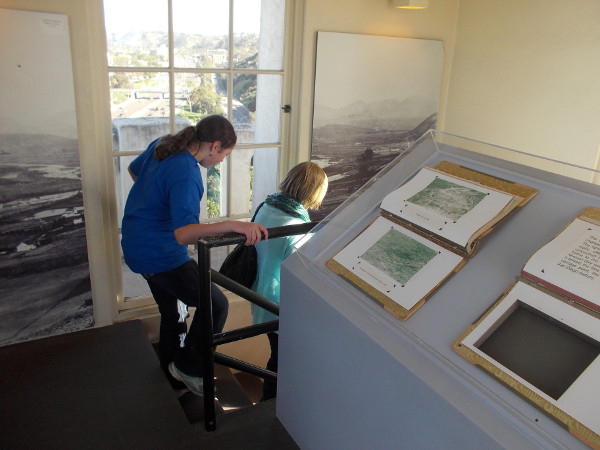
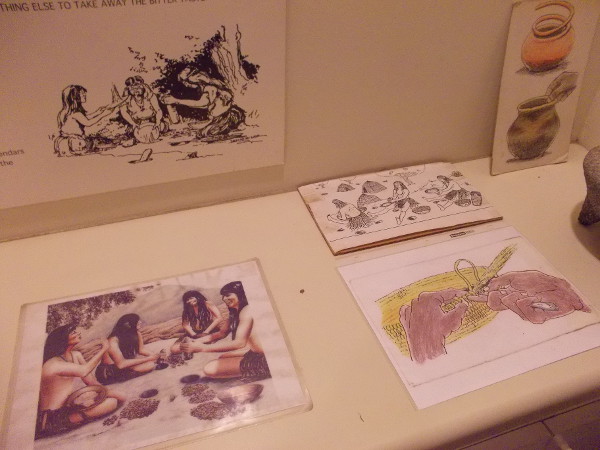
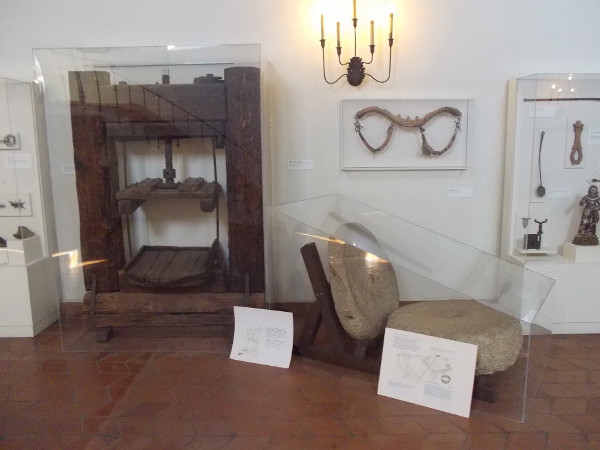
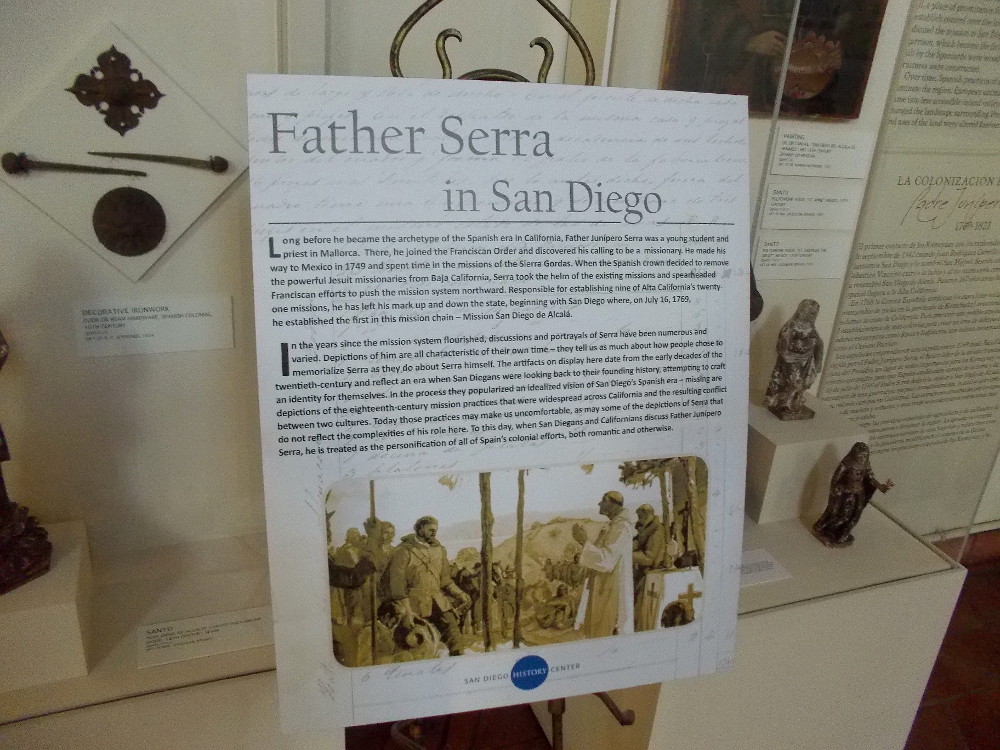
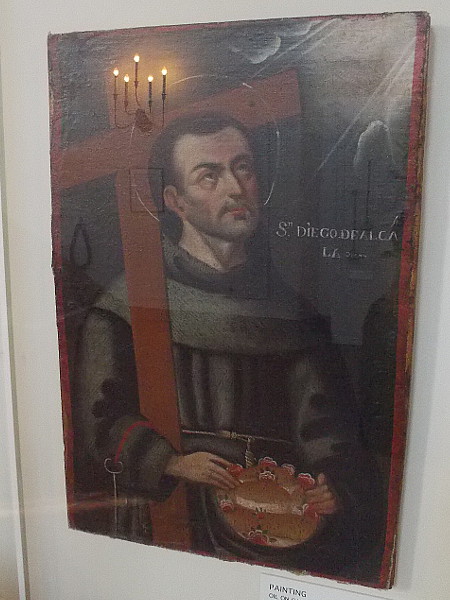
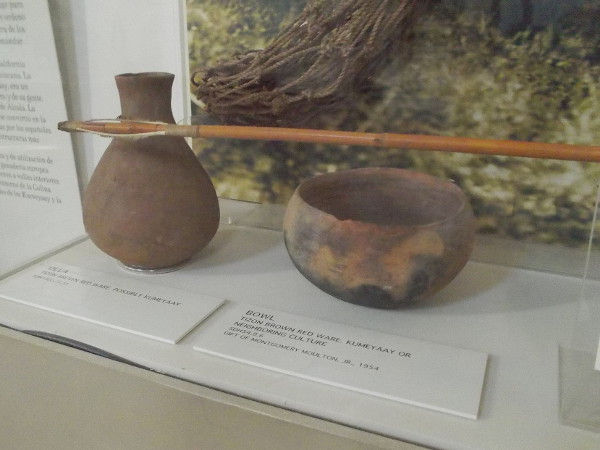
People arrive at the Serra Museum, where San Diego’s early Spanish history comes alive.Junipero Serra Museum dedicated July 16, 1929 to the memory of the founder of the California missions. The original Mission San Diego de Alcalá was established nearby in 1769.A quick look at the rear of the museum.The Serra Museum building was designed by noted architect William Templeton Johnson. It reflects Mission Revival style architecture.Large wine press in front of the museum was a gift from the Spanish island of Mallorca, Father Junipero Serra’s birthplace.Plaque near entrance reads George White Marston 1850-1946. FRIEND OF HIS FELLOW MEN – LOVER OF ALL GROWING THINGS. Piece by piece through many years he acquired these acres…Elegant interior of the Serra Museum contains many exhibits pertaining to San Diego’s early Spanish history.Researchers discovered this sketch of the Royal San Diego Presidio dated 1820. It shows the layout of the old buildings which no longer exist.Modern graphic illustration of the fortified presidio, which was located a short distance below the Serra Museum’s front entrance.Old Spanish cannon named El Jupiter, cast in Manila in the 18th century. El Jupiter stood in Fort Guijarros at Ballast Point, the first defensive fortifications for San Diego Bay.Leather armchair made in Catalan, Spain in the 17th century. This “friar’s chair” was part of the original Serra Museum’s furnishings.Old violin with bow, a branding iron used by rancheros to identify cattle, and iron spurs are among the many historical objects on display.Another look at the beautiful interior of the Serra Museum in San Diego.Large wooden beams in a truly amazing ceiling.Stairs lead up to the Serra Museum’s tower. Painted on the wall is a map showing the sea journey of the Spanish expedition which founded San Diego in 1769.March 9-20, 1769. Desperate to replace drinking water which leaked from the ship’s casks, Captain Vicente Vila commands the tacking Spanish galleon San Carlos near Isla de Cedros.A room halfway up the tower. Numerous displays recall San Diego’s history, most notably around the time when the Serra Museum was dedicated in 1929.Old photo of the crowd attending the Serra Museum’s dedication ceremony on July 16, 1929.A fascinating look at Presidio Hill almost a century ago.A lovely watercolor sketch of the Junipero Serra Museum atop Presidio Hill.On the wall are many historical photos and artifacts, including an image from around 1930 of a cigar factory on 4th Street in San Diego.A reproduction of the west elevation drawing of the Serra Museum by architect William Templeton Johnson.Now we’re heading up to the very top of the tower.Looking west from the Serra Museum tower along Interstate 8. Point Loma is on the left and Mission Bay is to the right.Looking east into Mission Valley.Visitors at the Serra Museum head back down from the tower, after looking at old photos which show a much less-developed surrounding landscape.A small theater in the Serra Museum contains additional exhibits about life in and around the old Presidio.Examples of what life was like for the Native American Kumeyaay, who occupied this region long before it was discovered by the Spanish.Stories of two people who lived on a local Rancho. Click the image to enlarge, if you’d like to read it.Map of the old Presidio’s archaeological site. You can see where the fort was located in relation to the Serra Museum.Explanation of the excavation process utilized by researchers. Some artifacts that were unearthed are on display in the museum.Artistic rendition of a Mexican presidio soldier circa 1830, and a horse bit.An olive press, granite mill stones, and an ox yoke.Small artifacts include this carved polychrome wood San Diego de Alcala Santo from 18th century Spain.Sign describes the life of Franciscan missionary Father Junipero Serra, and his work to establish the California Missions under the flag of Spain. He was recently made a Catholic Saint.Painting. Oil on canvas. San Diego del Alcala de Henares. Mid 18th century, Spanish or Mexican.Olla and bowl. Kumeyaay or neighboring culture.The Junipero Serra Museum in San Diego provides a fascinating look at our culturally diverse city’s very early history.
The Pegasus Rising Project, based in San Diego County, assists U.S. military personnel recovering from Post-Traumatic Stress Disorder and Traumatic Brain Injury.
Every year, Pegasus Rising works to heal around 1000 veterans suffering from trauma. The San Diego County-based organization uses horse therapy to help U.S. military personnel recover and return to civilian life after experiencing Post-Traumatic Stress Disorder or Traumatic Brain Injury.
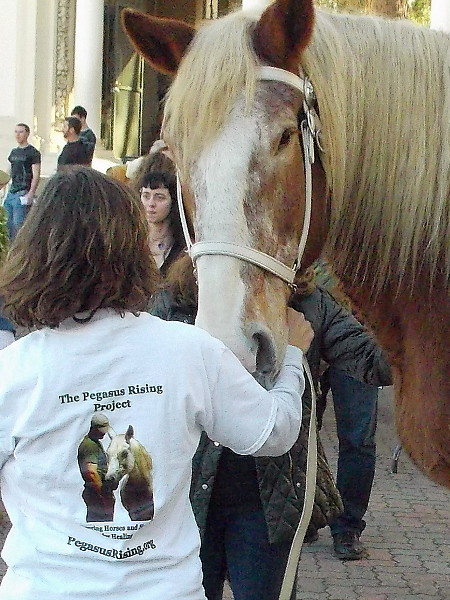
Today, in Balboa Park, a fundraiser was held in conjunction with a special New Year’s Day concert at the Spreckels Organ Pavilion. A good crowd turned out to learn about this very important organization.
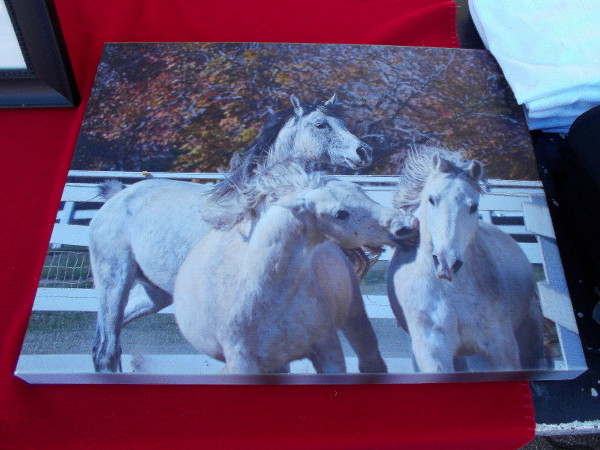
Pegasus Rising’s small herd is comprised of Polish Arabians, who were themselves rescued. The descendants of champion horses, they had been found suffering from severe neglect. The full story can be read here. Amazingly, one of the horses “was a descendant of the great stallion Lotnik, who had been imported previously by General Patton.”
While everyone at Pegasus Rising is a volunteer, caring for and feeding horses requires money. Perhaps you or someone you know can help out. Please click on their website to donate, or learn more about their fascinating, inspiring story.
A special fundraiser for Pegasus Rising was held on New Year’s Day at the Spreckels Organ Pavilion, during the afternoon concert. Jay the friendly horse was present.Please visit the Pegasus Rising website. You can find out how you can assist this worthy organization as it helps to heal a thousand veterans every year.An image of three Polish Arabian rescue horses in the herd at Pegasus Rising. Horse therapy greatly helps humans recover from trauma.Jay, the kindly Belgian draft horse ambassador, and a volunteer from Pegasus Rising, on a beautiful day in Balboa Park.
Urban artwork depicts professional baseball scandals.
Over the years, in San Diego’s bustling Gaslamp Quarter, countless businesses have come and gone. Restaurants, bars and nightclubs crowd the streets, so there always seems to be some construction or renovation taking place.
In professional baseball, over the decades, headlines have come and gone concerning a variety of scandals.
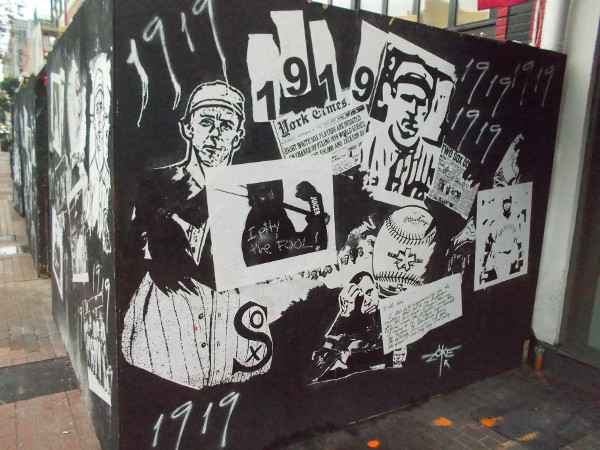
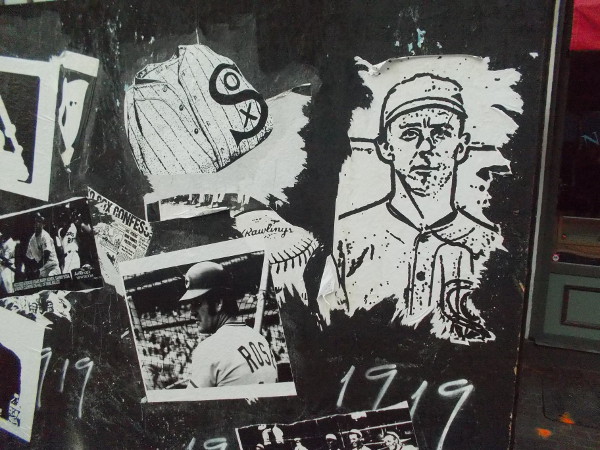
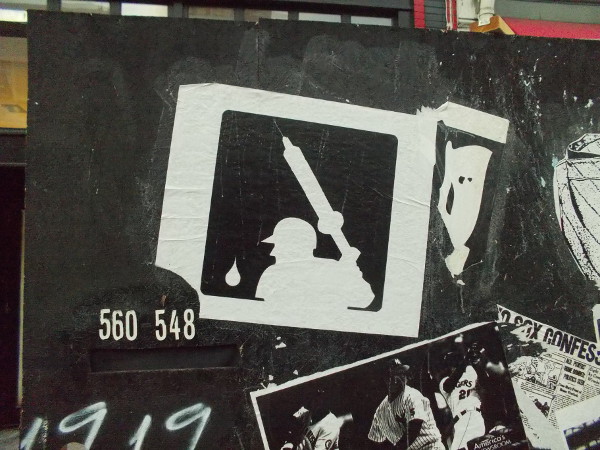
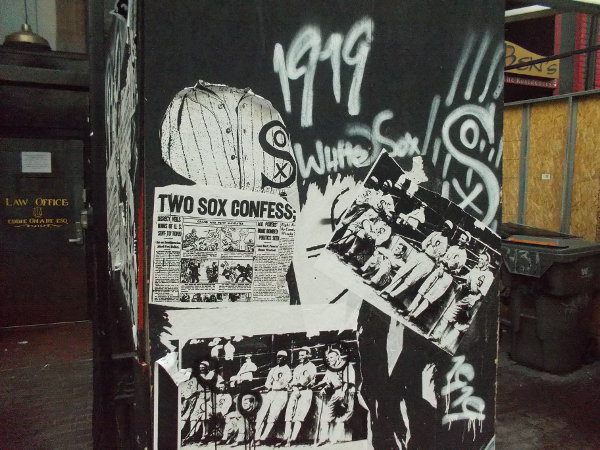
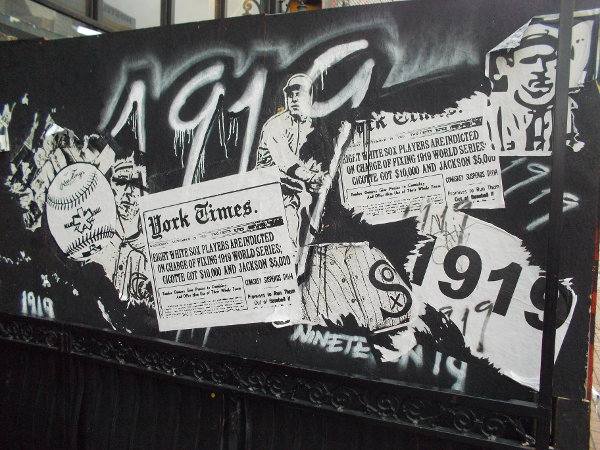
A temporary wall surrounds some current construction activity in the Gaslamp. The wall features a collage of images depicting baseball’s history of scandals. The two themes that I noted are gambling and doping. There is particular emphasis on the Black Sox Scandal of 1919.
I took some photos a week or so ago…
Unusual street art at a construction site on Fifth Avenue in San Diego’s Gaslamp Quarter.Images in the collage include Pete Rose and the 1919 World Series Black Sox Scandal.The MLB logo is transformed. A doping baseball player holds a syringe. Images also include Barry Bonds, Sammy Sosa and Roger Clemens.1919 is spray painted repeatedly on this bold street art in downtown San Diego.During the 1919 World Series, Chicago White Sox players were paid by gamblers to lose games.A collage of baseball scandals on a temporary construction wall in the Gaslamp Quarter.
…
Join me for more fascinating discoveries on Facebook and Twitter!
Do you like to read original, thought-provoking fiction? Visit my Short Stories by Richard writing blog!
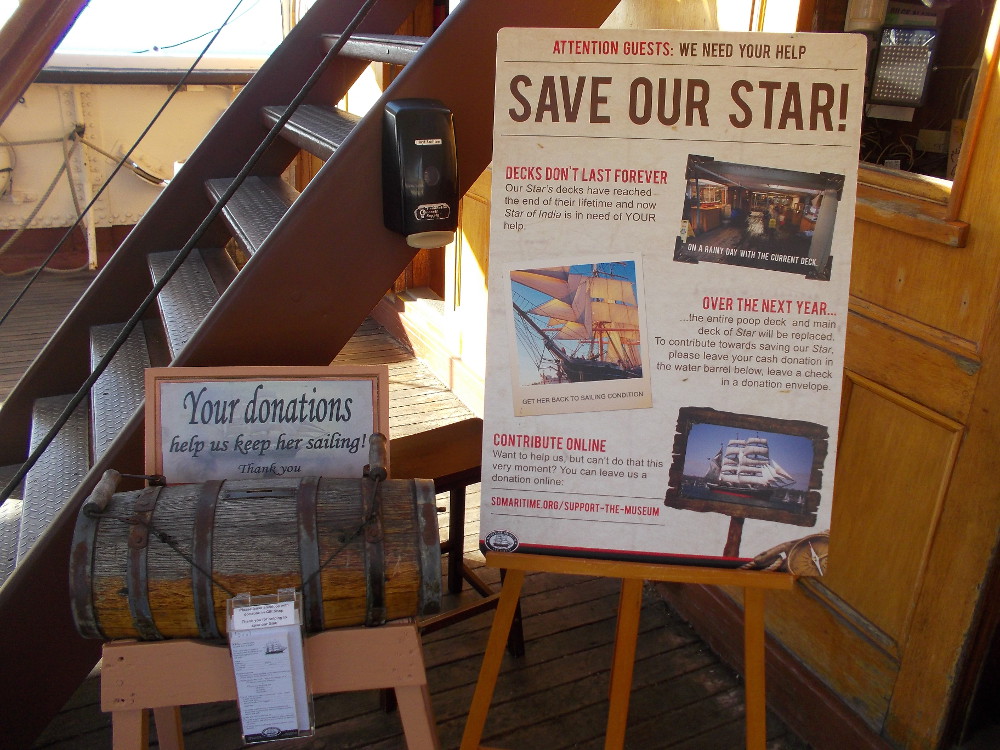
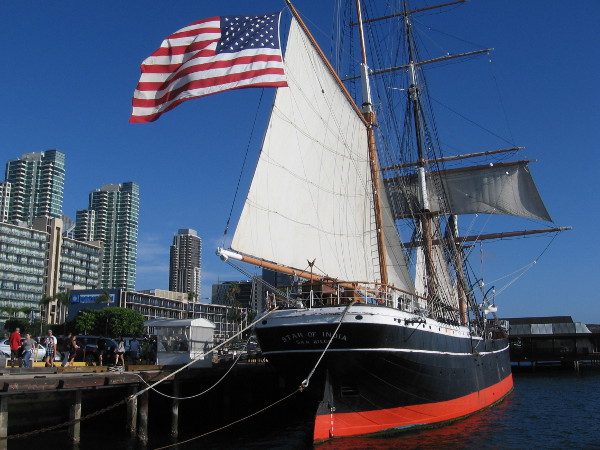
Decks don’t last forever. Our Star’s decks have reached the end of their lifetime and now Star of India is in need of YOUR help.
The Star of India is one of the most famous and important historic ships afloat. Built in 1863, she’s the oldest active sailing vessel in the world and the oldest iron-hulled merchant ship still on the water. She has sailed twenty-one times around the world, surviving the tempests of Cape Horn. She has been caught in a devastating cyclone, trapped in Alaskan ice, and even went aground in Hawaii. She still plies the Pacific Ocean with a volunteer crew. And her hull, cabins and equipment are almost completely original.
So it isn’t surprising the deck needs a bit of help.
“…Our museum is working as part of an international effort to see Star of India inscribed, along with other great historic ships, by UNESCO as a multi-national world heritage site. Like the Parthenon, the Pyramids, and the Great Wall of China, such a distinction would…see that she lives forever.”
Wow!
Right now, the main deck and poop deck need replacing. The wooden decks have come to the end of their lifetime. The Star of India “was recently awarded a $192,000 National Parks Service Maritime Heritage Grant, one of very few such awards and a testimony to both her historical significance and to the viability of the project for extending her life. However, these funds are available to Star of India only if they are matched by an equal amount contributed by those who love her and want to see her sail for generations to come.”
With YOUR contribution, you can become part of an eternal legacy and help to preserve an important part of world (and San Diego) history. That’s big, very important stuff!
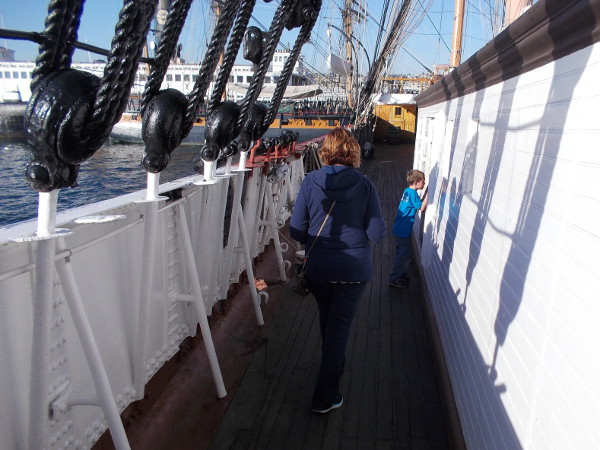
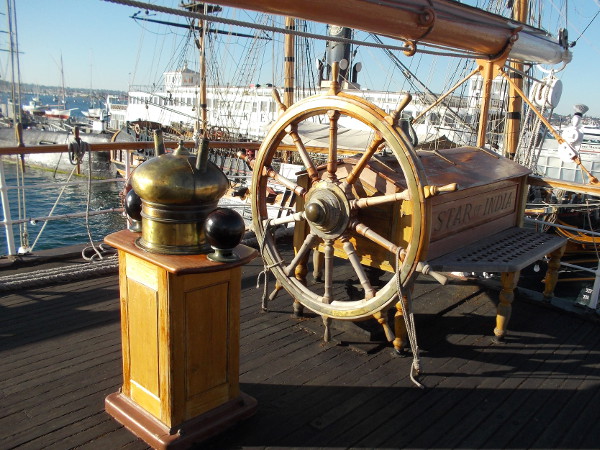
Looking along the length of the main deck of Star of India. Deck replacement is needed and so is the generous help of the public.Parts of the wooden deck are in pretty bad shape. Feet, salt, sun and rain have taken their toll.The Star of India is a National Historic Landmark. The oldest active sailing ship in the world, it’s a treasured part of San Diego and world history.Visitors descend from the poop deck. Beautiful woodwork is found all about the ship. But the elements can be harsh.A very old photo of Star of India’s launching day in 1863. Originally it was named Euterpe.Photo of Euterpe, later renamed Star of India, docked at Port Chalmers, Otago, New Zealand in 1883.Exquisite section of the stained glass skylight in the teak and oak paneled saloon of the Star of India.Peeking into Star of India’s forward house, which contains ropes, tools and instruments which were necessary to maintain and operate the tall ship.I believe that long timber supported by the forward house and forecastle is the top section of the foremast, which is being refurbished. But I might be mistaken.The Star of India’s steering wheel and binnacle on the poop deck.The Star of India needs YOUR help! Donate today to help replace the deck, and to preserve this amazing ship for generations to come.
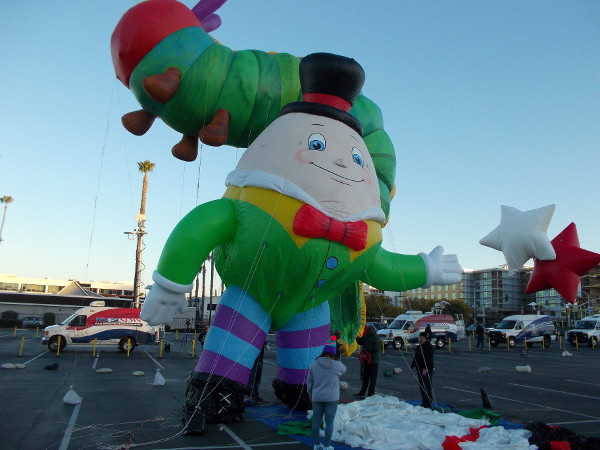
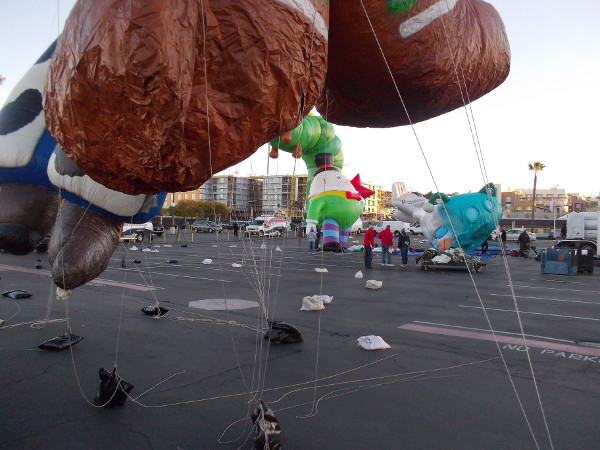
Getting a balloon ready for today’s Holiday Bowl “Big Bay Balloon Parade” in San Diego!
The Port of San Diego Holiday Bowl Parade kicks off this morning at 10 o’clock on Harbor Drive near the County Administration Building!
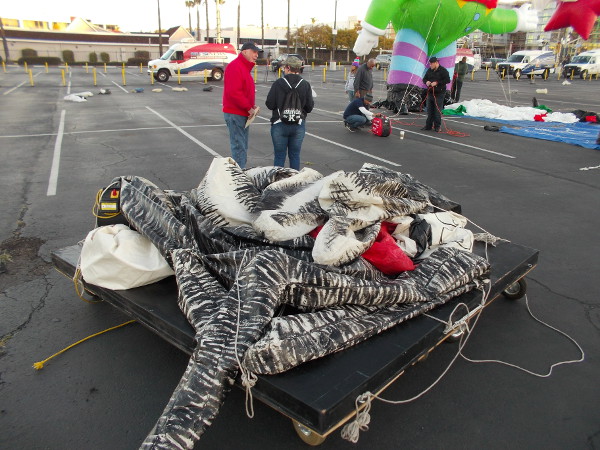
At this very moment, folks are busily inflating the many fun balloons that will be parading down the Embarcadero to the delight of thousands of onlookers.
I can’t make it to the Big Bay Balloon Parade this year because I have to work. But I did get some cool photos that you all might enjoy!
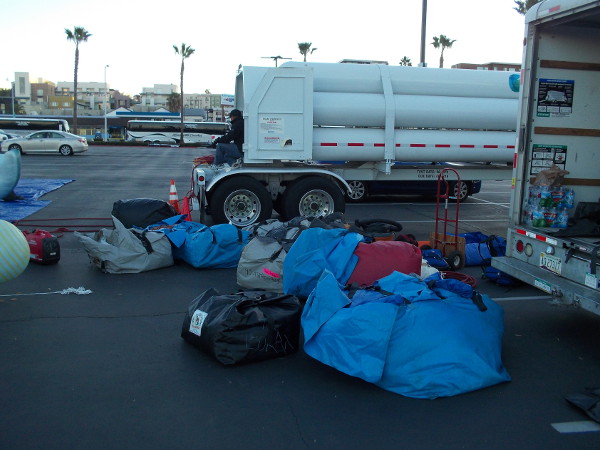
People were out early this morning filling balloons with helium in the parking lot north of the County Administration Center.A truck hauling helium. Numerous big balloons await, ready to be filled.This fun-looking one is inflating!Looks to me like Humpty Dumpty. With all that gas inside, I think he’ll bounce should he fall.A balloon has been wheeled on a platform across the parking lot, waiting its turn to be inflated.Meanwhile, on Pacific Highway next to the County Administration Building, marching bands have begun to arrive for the parade! Highland High School came all the way from Ewing, Missouri!Band members get off the bus with instruments.The balloon-filling had just begun when I walked by. Then I had to rush home to share my pics!It’s a happy Gingerbread Man rising in the blue San Diego sky!





















































 Cool San Diego Sights!