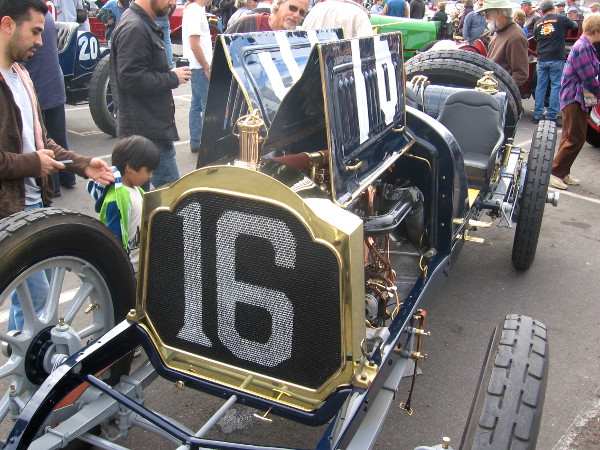
Kid checks engine of vintage car at Balboa Park show commemorating 1915 race.
One hundred years ago a famous road race took place in San Diego. Many of the world’s greatest race drivers took part. The 1915 San Diego Exposition Road Race was a thrilling, dangerous 300 mile race around the streets of Point Loma. Those streets still exist today.
This morning, dozens of vintage cars took part in a rally along the old race route. The event was part of Balboa Park’s Centennial celebration, which is being held all year long to remember the 1915 Panama-California Exposition.
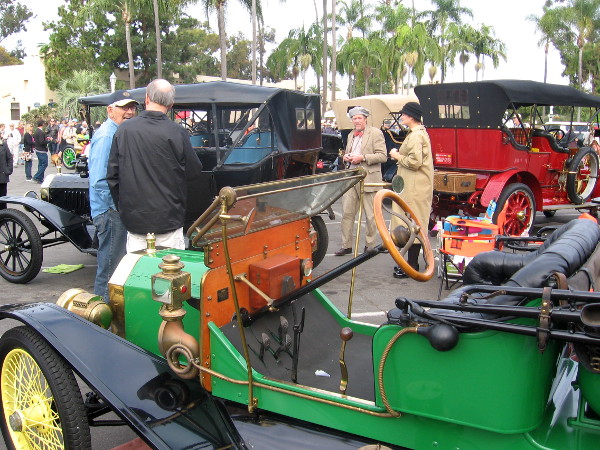
Before the rally, the participating cars gathered in Balboa Park in front of the San Diego Automotive Museum for a special car show. I walked up to the park this morning to check things out.
Wow! Double wow!
Please enjoy these photos. While I love looking at classic cars, I’m very far from being an expert. If you detect an error in the captions, or have something interesting to add, please leave a comment!
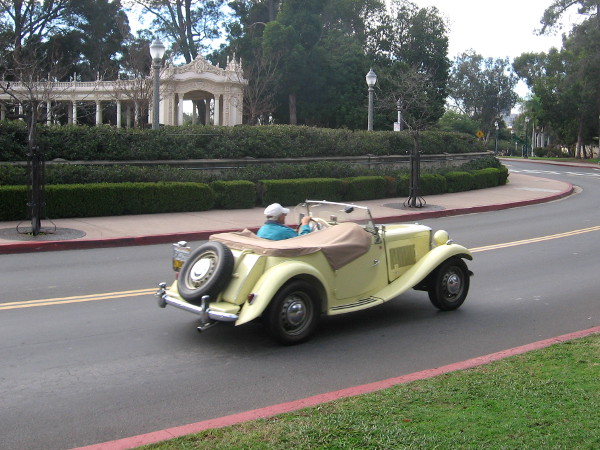
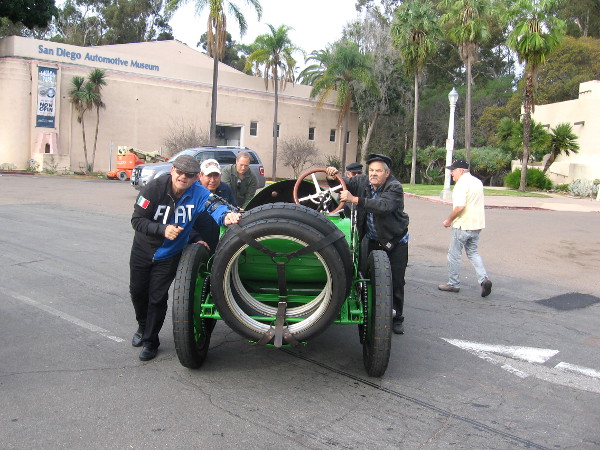
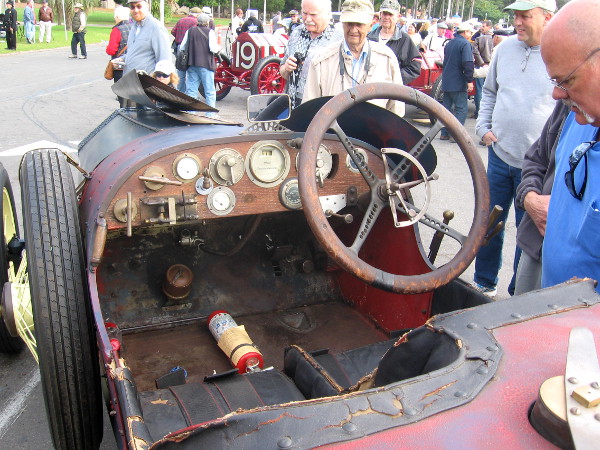
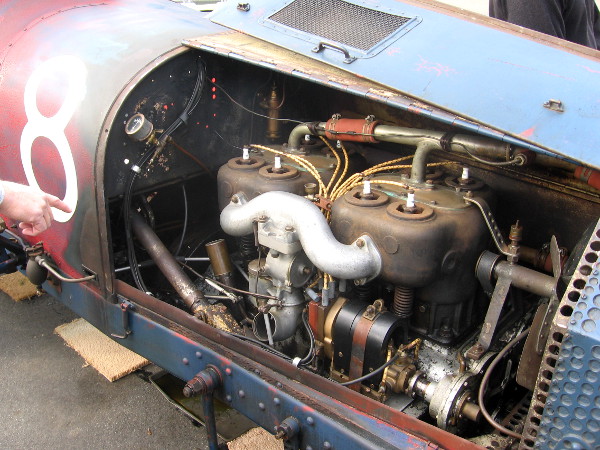
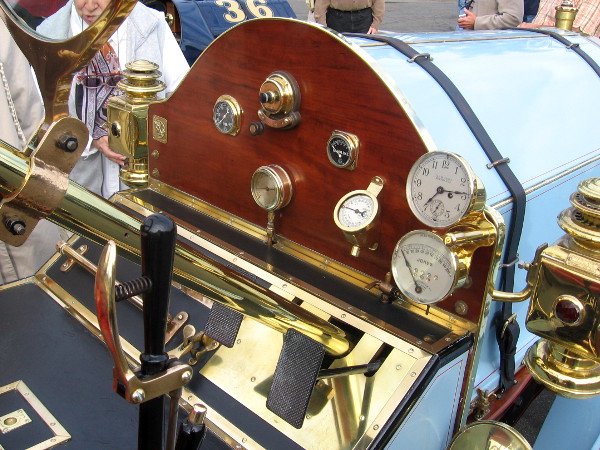
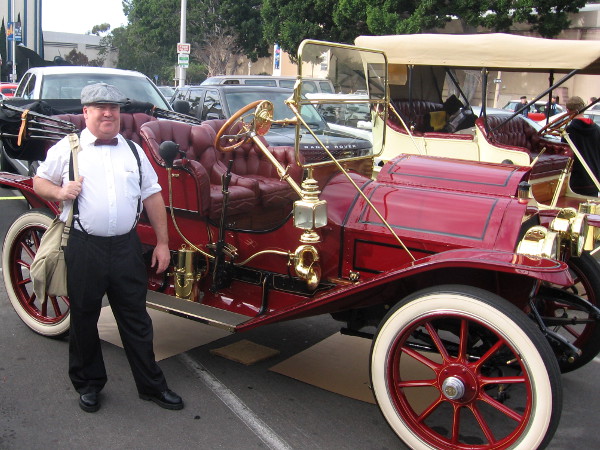
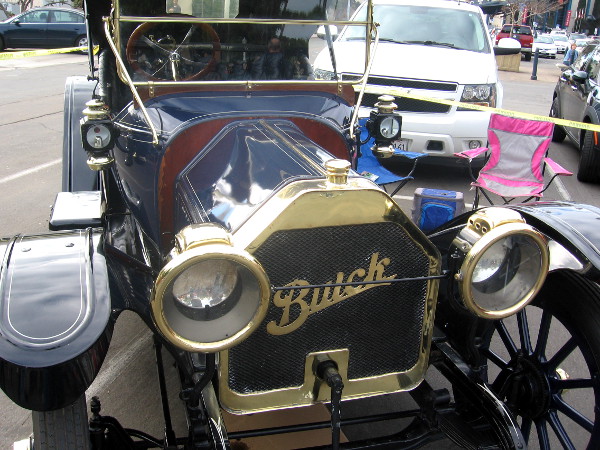
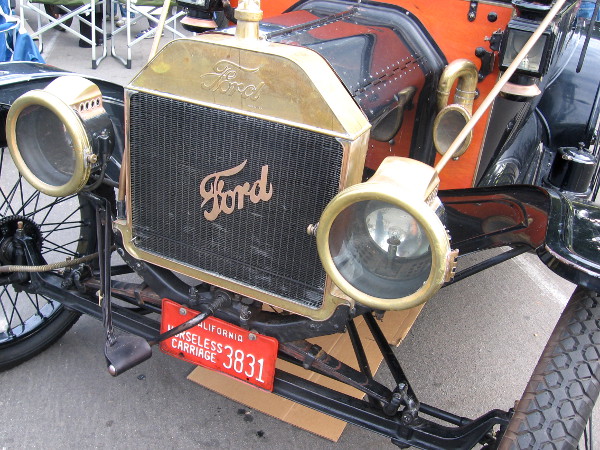
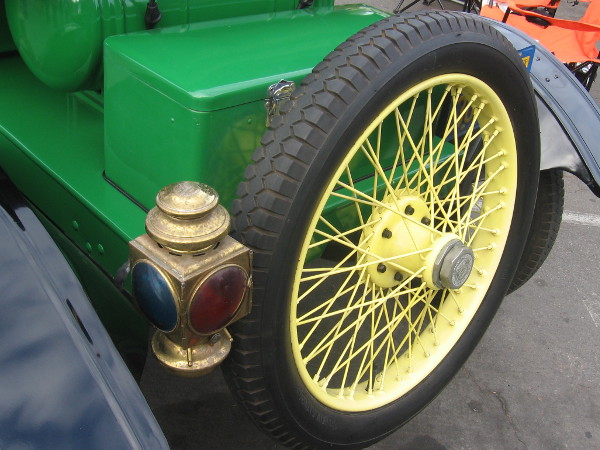
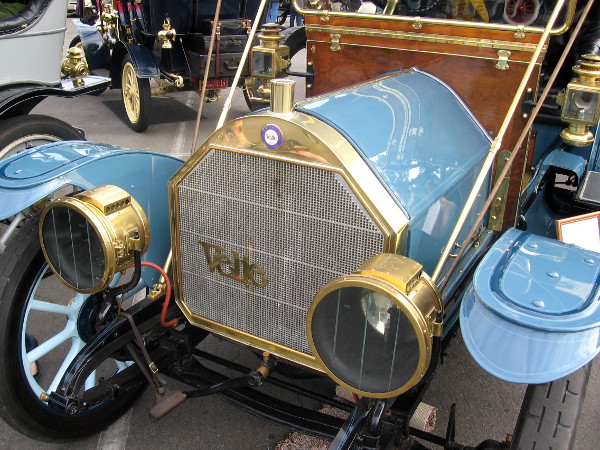
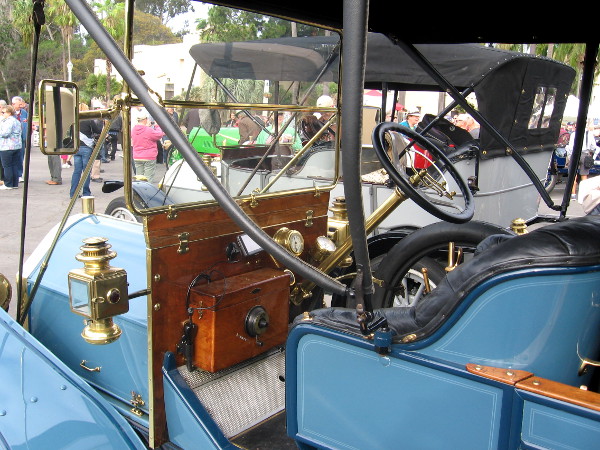
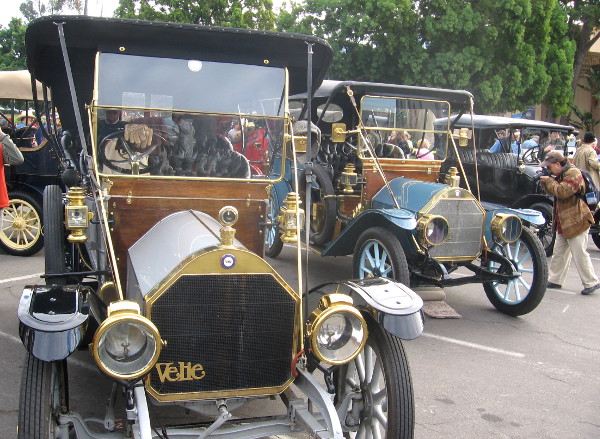
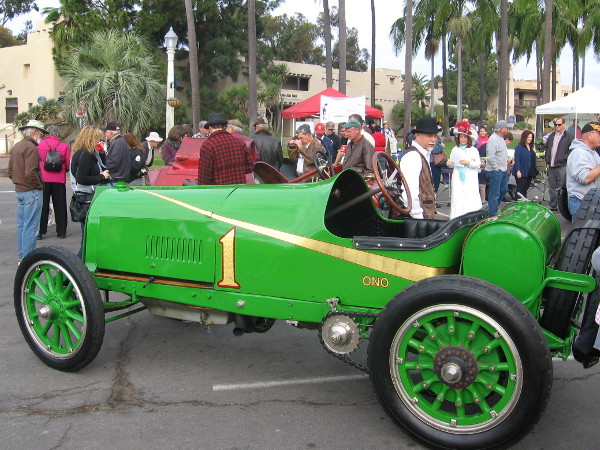
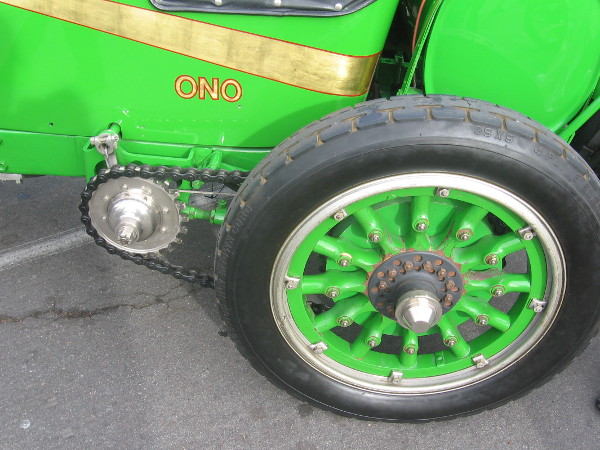
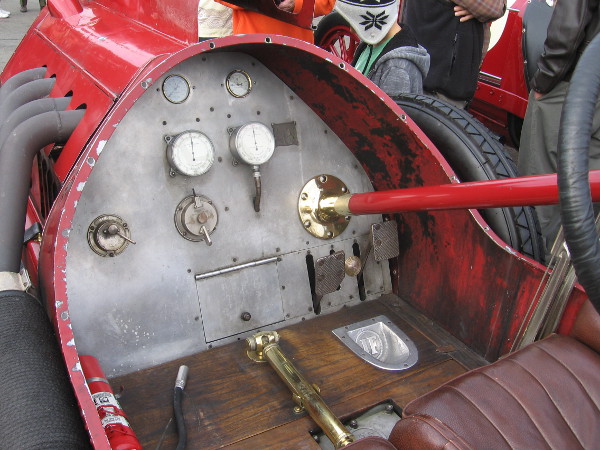
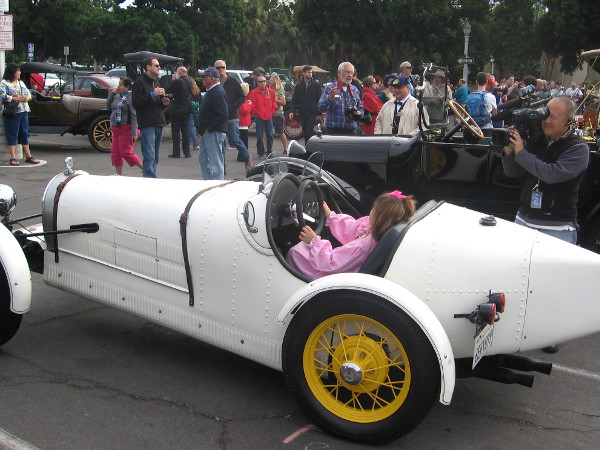
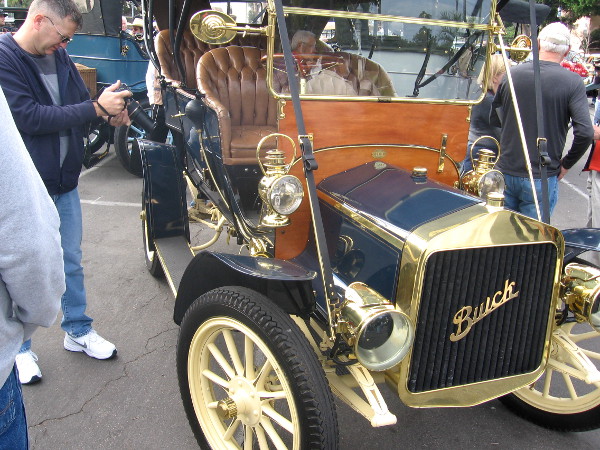
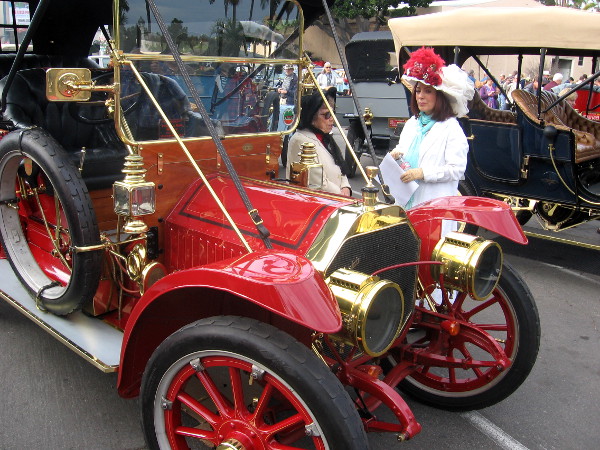
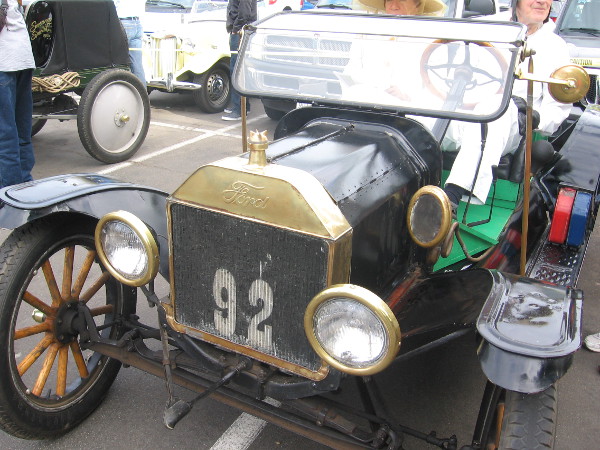
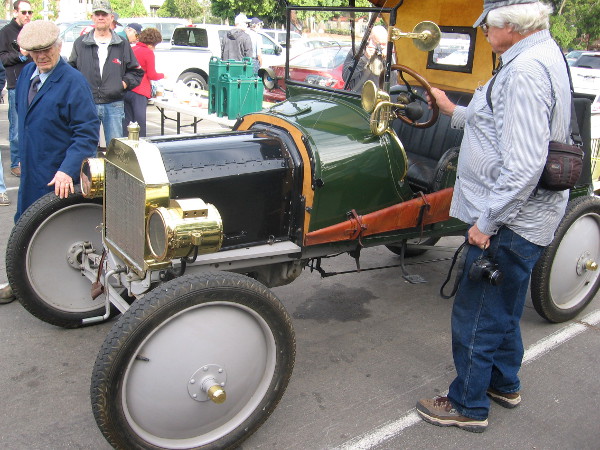
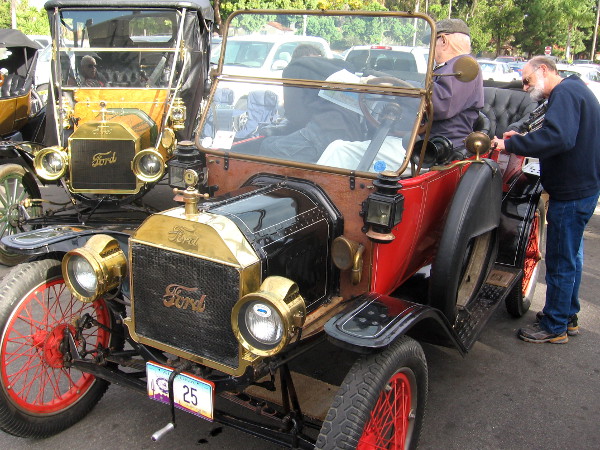
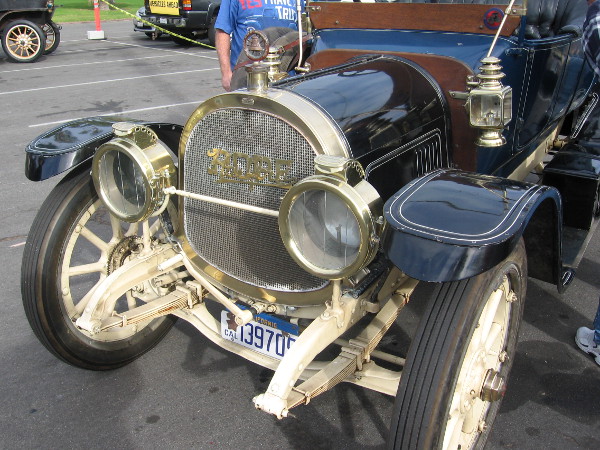
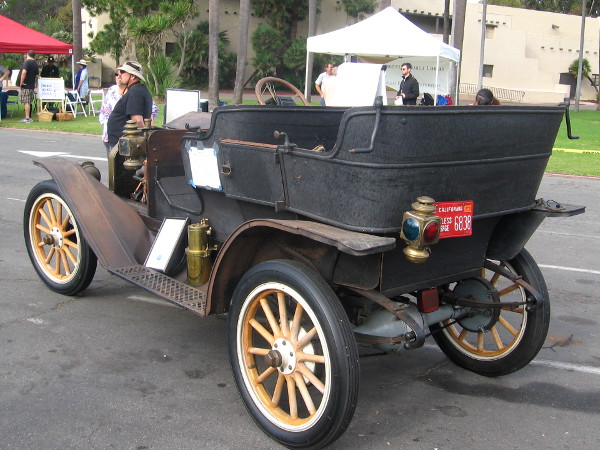
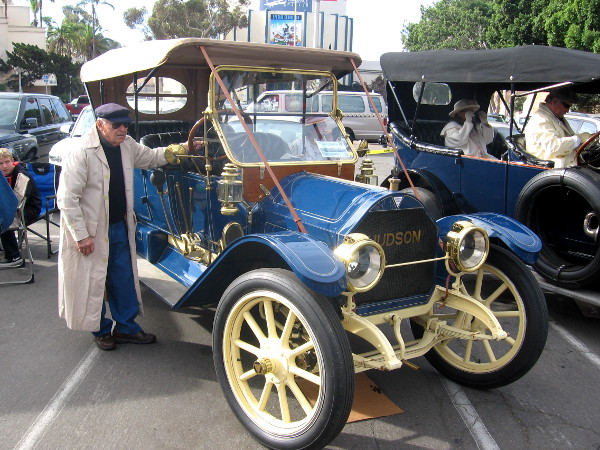
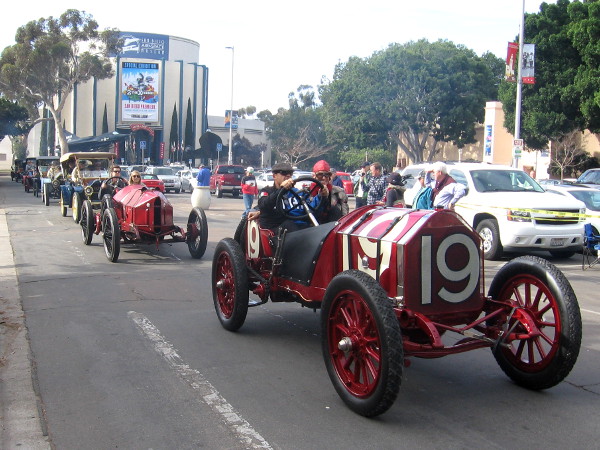
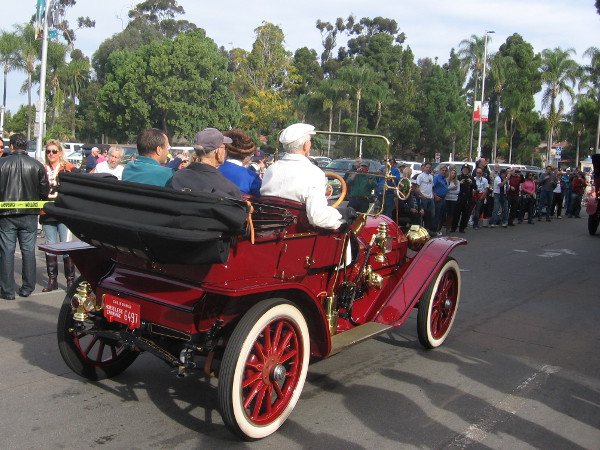
Guy drives his classic automobile through Balboa Park, heading to a special car show.Old race car is pushed into position. San Diego Automotive Museum is in the background.Vintage cars from era of Point Loma road race that began 1915 Panama-California Exposition.Someone checks out Fiat racing car at special Balboa Park Centennial event.Wooden dashboard full of knobs looks almost prehistoric compared to modern cars!Engine of 1914 Tahis Special that competed in many races!Collectibles from 1915 road race in Point Loma that kicked off Panama-California Exposition!People can still ride in style in this elegant Pierce-Arrow.Pierce-Arrow luxury automobiles in early 1900s were owned by many movie stars and tycoons.So many amazing cars were lined up in the parking lot it was hard to take it all in!1910 REO Model D Touring car has a very classic look.Check out this awesome vintage Cadillac!1909 Pope Hartford on display at Balboa Park Centennial special car show.This isn’t your father’s Buick. But it might have been driven by your grandparents!Walking around, I felt like I’d stepped back in time one hundred years!Here’s the grill of a cool Ford. License plate is for a Horseless Carriage.Colorful Ford is painted orange and green. Awesome!Red and green signal light near spare tire on back.1910 Velie Model D Touring cars were popular. Velie race cars were also successful.Many of these beautiful old cars contain lots of wood, brass and leather.Dozens of classic cars were out on public display!Inspecting another Velie, made early last century in Moline, Illinois.Very cool 1911 Ono, a vintage chain-driven race car.Someone nearby joked: It’s a motorcycle chain!And here’s a guy checking out the engine of an Italian Isotta Fraschini.Makes my own extremely modest car look downright futuristic!Chests full of tools that car mechanics would use back in the old days.Kid checks out a 1912 Packard race car in Balboa Park.Many refurbished motors were open for people to investigate.A large crowd enjoys many super cool cars in front of San Diego Automotive Museum.News cameraman gets a shot of young girl in pink pretending to race a vintage car.Racing goggles lie ready on leather seat. The road rally will begin in a few minutes!I’ve never seen so many cameras taking so many photographs in one place!Fun historical costumes were everywhere you turned.This fellow is ready to go! It’s a perfect Saturday morning for a road trip!It might have a dent or two, but it still runs!One guy checks out the steering wheel, another the unusual wheels on the asphalt!Getting the engine started with the old hand crank!Gentlemen, take your seats! We’re about to get started!Don’t touch this fancy car unless you are nude! (And showered, presumably.)I love this shiny oval grill on a Pope-Hartford.Not sure how this old horseless carriage would fare in a race.That’s as primitive a motorcar as you’re likely to ever see.Folks are shooting the breeze and having a whole lot of fun!This guy is getting ready to climb aboard a gorgeous classic Hudson.Car show disbands and crowds have scattered to make way.Here they come! That’s the San Diego Air and Space Museum in the background.Many drivers and onlookers wore fashion styles from early 20th century.A long line of beautifully restored hundred-year-old autos rumbles past.Heading out of Balboa Park for Point Loma, where historic 1915 race will be commemorated.
…
To enjoy future posts, you can “like” Cool San Diego Sights on Facebook or follow me on Twitter.
Cool utility box in Hillcrest shows tall buildings on planet Earth.
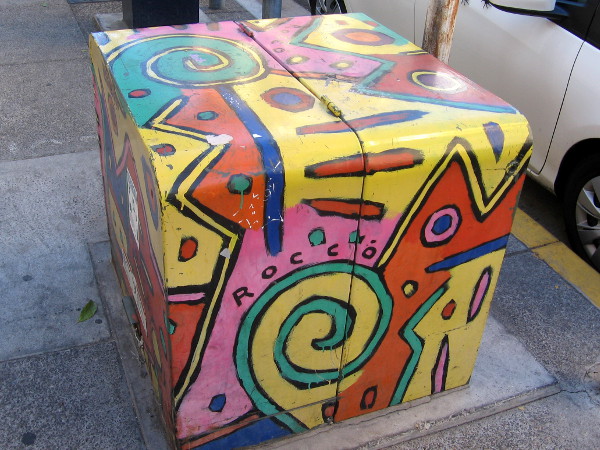
During my walks about San Diego, I spy all sorts of cool art on utility boxes and electrical transformers. Most of the painted artwork is super creative and colorful. You never know what you’ll find!
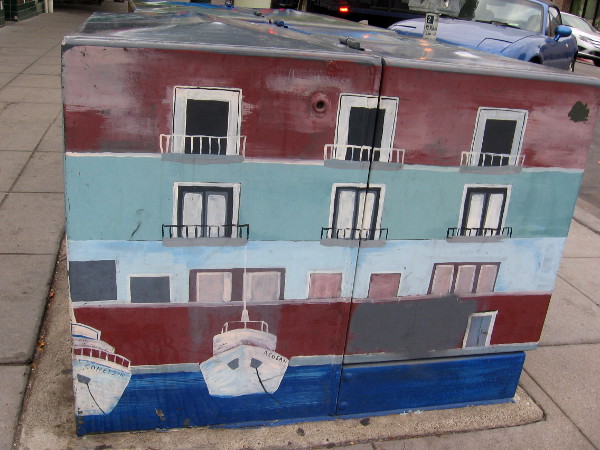
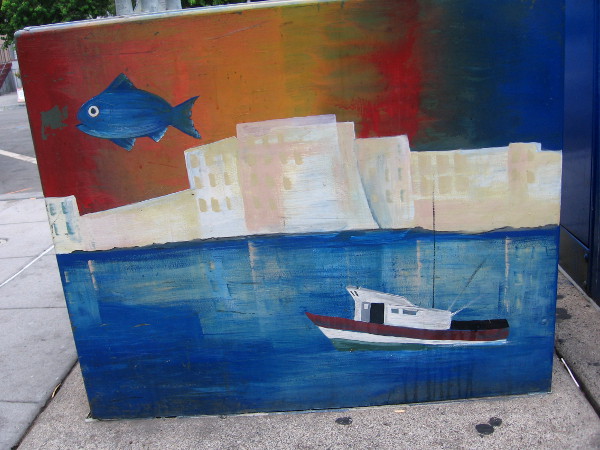
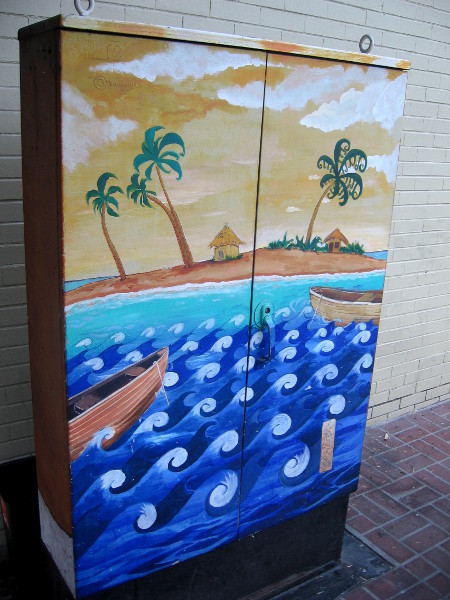
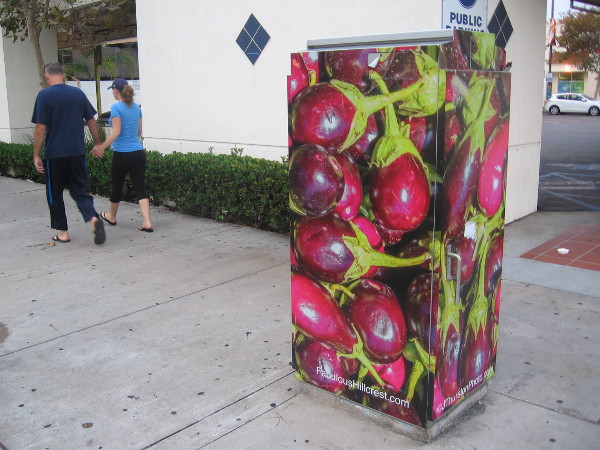
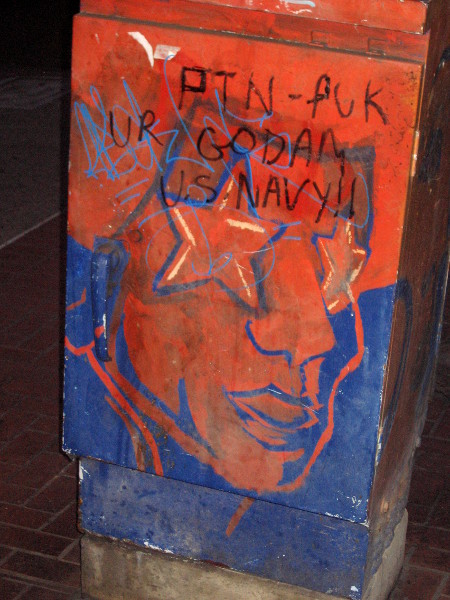
Little Italy art on utility box shows boats in water beneath row of windows.Fish and fishermen are big themes on Little Italy utility boxes.Tropical beach island scene on a fun, eye-catching Gaslamp utility box.Soft and peaceful beach image on this Imperial Beach utility box.Cool abstract face on an imaginative Hillcrest utility box.Some large utility boxes in Hillcrest feature photos of fruits and vegetables.This Hillcrest electrical transformer has a bold blue eye.East Village utility box art has been vandalized with angry words.Very colorful artwork on an East Village transformer.
…
To enjoy future posts, you can “like” Cool San Diego Sights on Facebook or follow me on Twitter.
Unusual street sign on Park Boulevard shows the road in someone’s hand.
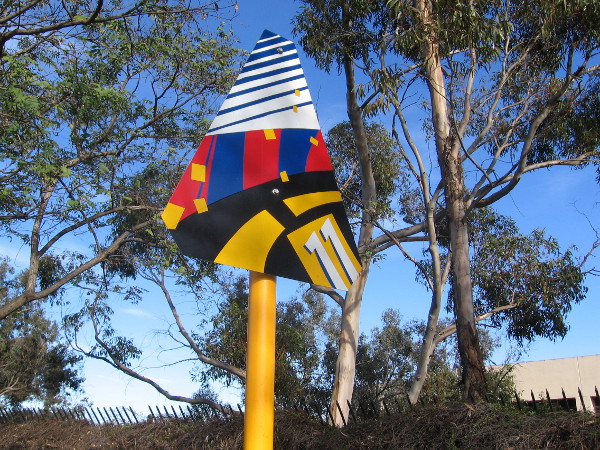
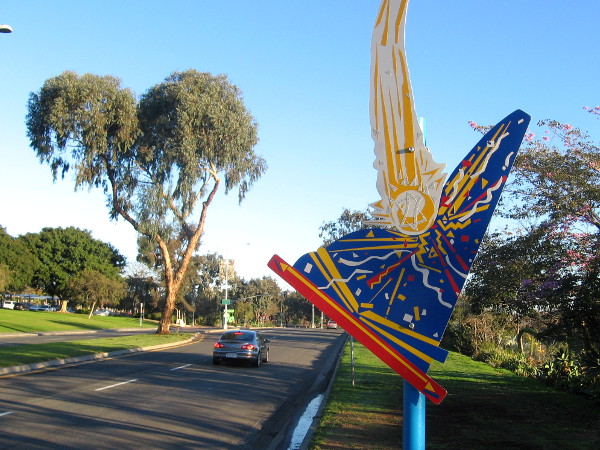
A dozen very unusual, artistic street signs line Park Boulevard in the vicinity of Balboa Park. Drive north and you’ll see them standing at intervals, all the way from Presidents Way up to Upas Street. For many years I’ve noted them.
I’m not sure how passing drivers respond to all the crazy artwork. I’m pretty sure these unique signs aren’t included in the Department of Motor Vehicles driving test! I hope not!
UPDATE!
I’ve learned this installation of art is titled Night Visions, by artist Roberto Salas. They first appeared in 1988, a year our city hosted the Super Bowl. According to what I read, in 1989 Night Visions was the very first acquisition of public art by the City of San Diego.
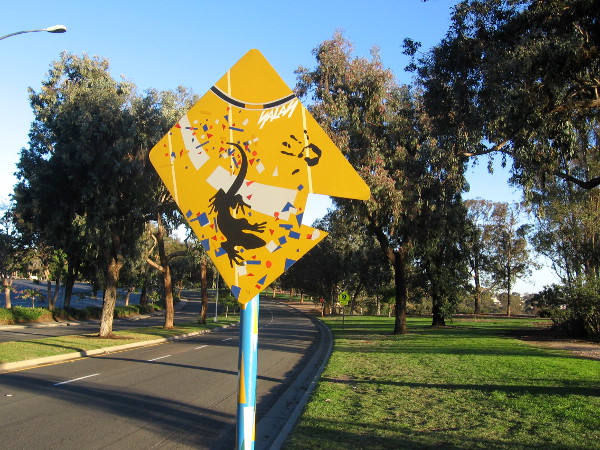
This funny sign shows a magician pulling a rabbit from hat.Drivers might think the speed limit here is 11 miles per hour!Odd, speckled sign stands beside Balboa Park’s rose garden.This crazy sign is a meteoric explosion of creativity.Car near San Diego Zoo entrance heeds artistic street sign, I’m sure.Does this sign indicate that a lizard is crossing?This unofficial street sign is open for interpretation.
…
To enjoy future posts, you can “like” Cool San Diego Sights on Facebook or follow me on Twitter.
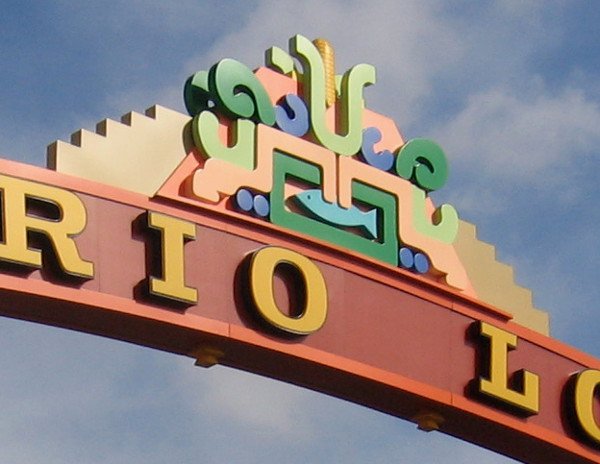
The colorful new Barrio Logan gateway sign arches over Cesar Chavez Parkway.
A little over a week ago, the new Barrio Logan gateway sign had a dedication ceremony. The welcoming sign, arching over Cesar Chavez Parkway between Harbor Drive and Interstate 5, is similar to others that can be spotted in various communities around San Diego. Its design, however, is notably different. The cornice contains a variety of symbolic elements inspired by this neighborhood’s complex history.
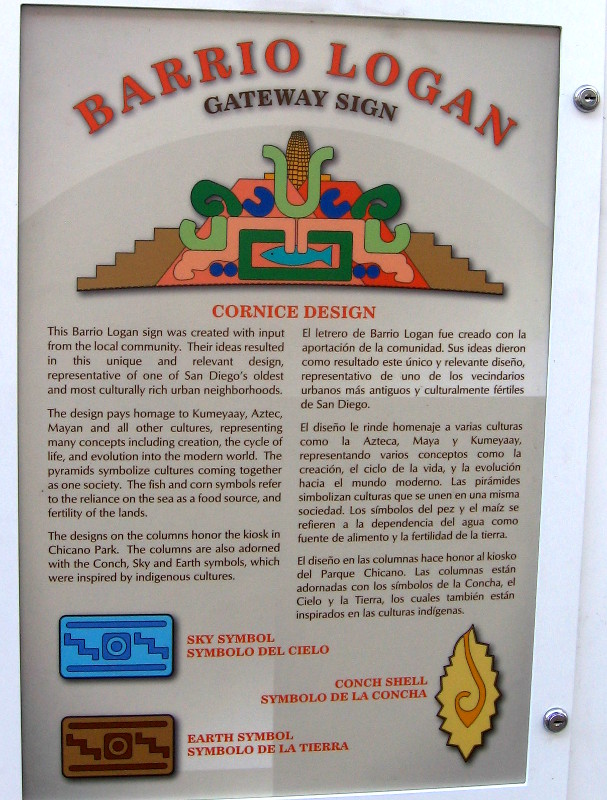
The cornice contains a variety of combined symbols that represent the community.One of two displays on either column that explains the design.
Small displays near the base of each column can be read from either sidewalk. They explain the significance of the cornice design:
“This Barrio Logan sign was created with input from the local community. Their ideas resulted in this unique and relevant design, representative of one of San Diego’s oldest and most culturally rich urban neighborhoods.
The design pays homage to Kumeyaay, Aztec, Mayan and all other cultures, representing many concepts including creation, the cycle of life, and evolution into the modern world. The pyramids symbolize cultures coming together as one society. The fish and corn symbols refer to the reliance on the sea as a food source, and fertility of the lands.
The designs on the columns honor the kiosk in Chicano Park. The columns are also adorned with the Conch, Sky and Earth symbols, which were inspired by indigenous cultures.”
View of the gateway sign as one approaches from the Barrio Logan trolley station.
…
To enjoy future posts, you can “like” Cool San Diego Sights on Facebook, or follow me on Twitter.
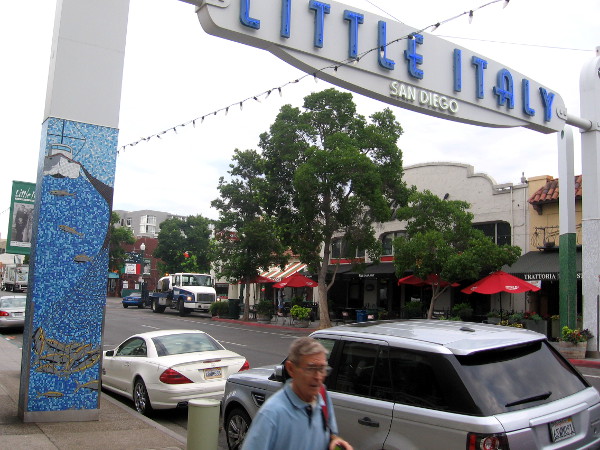
Pedestrian passes Little Italy sign on India Street in San Diego.
Today, if you were to walk through downtown San Diego’s historic Little Italy neighborhood, you’d probably see a number of very interesting street banners and plaques. These commemorate the Legends of Little Italy.
Early one morning while I walked to a nearby trolley station, I took a few quick photographs along India Street. You might enjoy looking at them. I transcribed much of what appears on the plaques.
Plaque explains the history of the Little Italy Landmark Sign.
The Little Italy Landmark Sign was dedicated and lit at the 7th Annual Little Italy Festa on the evening of October 8, 2000. The landmark sign was constructed as a tribute to this immigrant neighborhood which, until the late 1960s, was the hub of the world’s tuna fishing and canning industry. The nautical theme can be seen in the portholes at the top of the pillars, the blue neon of the lettering and the cable span which holds up the sign. The mosaic tile work on each side of the street tells how this immigrant community is historically tied to the bay, the church and the Italian homeland. This sign is a testament to the preservation of Little Italy’s cultural heritage and to the ongoing revitalization of this dynamic urban ethnic neighborhood in Downtown San Diego.
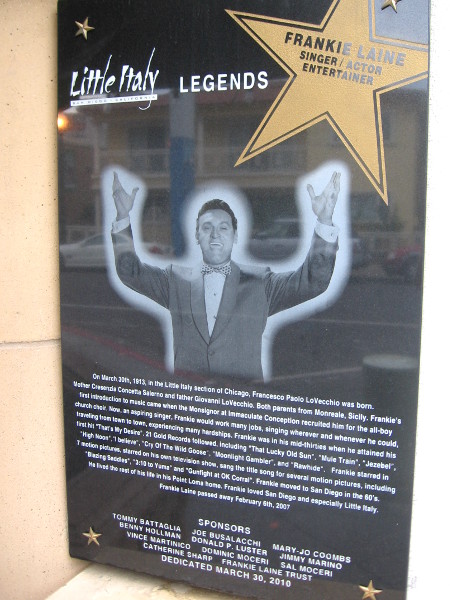
Mosaic tiles show the community’s ties to Italy and traditions.Singing and acting legend Frankie Laine lived in San Diego.
On March 30th, 1913, in the Little Italy section of Chicago, Francesco Paolo LoVecchio was born. Mother Cresenzia Concetta Salerno and father Giovanni LoVecchio. Both parents from Monreale, Sicily. Frankie’s first introduction to music came when the Monsignor at Immaculate Conception recruited him for the all-boy church choir. Now, an aspiring singer, Frankie would work many jobs, singing wherever and whenever he could, traveling from town to town, experiencing many hardships. Frankie was in his mid-thirties when he attained his first hit “That’s My Desire”. 21 Gold Records followed, including “The Lucky Old Sun”, “Mule Train”, “Jezebel”, “High Noon”, “I believe”, “Cry of the Wild Goose”, “Moonlight Gambler”, and “Rawhide”. Frankie starred in 7 motion pictures, starred in his own television show, sang the title song for several motion pictures, including “Blazing Saddles”, “3:10 to Yuma” and “Gunfight at OK Corral”. Frankie moved to San Diego in the 60’s. He lived the rest of his life in his Point Loma home. Frankie loved San Diego and especially Little Italy. Frankie Laine passed away February 6th, 2007.
Tony and Rose Bernadino used to live on Date Street.Tony Bernardini was an Italian immigrant who settled in San Diego.
Tony Bernardini left his native Bari, Italy to sail to America in 1907. He came with little money, but his heart was full of hope and enthusiasm for the opportunities that awaited him in his New World. Passing through Ellis Island, he quickly made his way to San Diego, where he found a climate and a neighborhood that reminded him of the place he had left. Tony took a job with the San Diego Electric Railway Company, maintaining the tracks for San Diego’s extensive streetcar lines. He worked hard, saved his money, and sent for his future wife, Rosa Monteleone, in 1911.
Tony and Rosa married shortly after her arrival in San Diego. They went on to have seven children; Clara, Fred, Lily, Vito, Matha, Nick, and Angelina. With hard work, Tony was able to bring several other members of their families to America to join them. In the early 1930’s, he got an opportunity to buy the building located on this corner from an acquaintance, who offered to finance the transaction for him. He opened the Civic Center Liquor House. Rosa and all of the children helped him run the business. During the first seven years he ran the business, he was only able to pay the interest on the Property’s note. But with the Declaration of World War II in 1941, San Diego’s economy heated up dramatically. Despite the fact that all three of their sons joined the Army to fight in the War, Tony, Rosa, and their daughters continued to work in the business, and by the end of the War, Tony had managed to pay off the note completely. he had achieved the American dream!
The story of love, hard work, and strong family life.
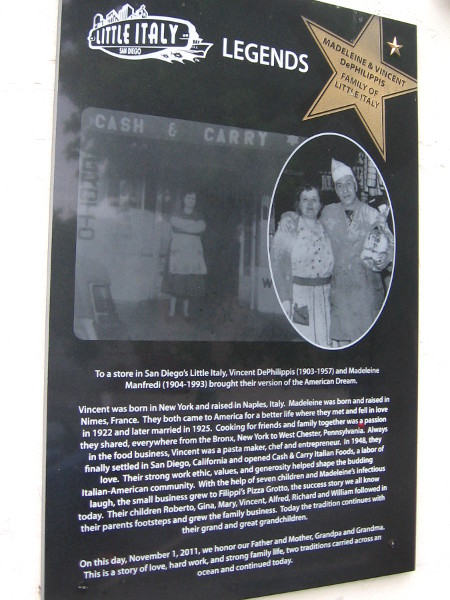
To a store in San Diego’s Little Italy, Vincent DePhilippis (1903-1957) and Madeleine Manfredi (1904-1993) brought their version of the American Dream.
Vincent was born in New York and raised in Naples, Italy. Madeleine was born and raised in Nimes, France. They both came to America for a better life where they met and fell in love in 1922 and later married in 1925. Cooking for friends and family together was a passion they shared, everywhere from the Bronx, New York to West Chester, Pennsylvania. Always in the food business, Vincent was a pasta maker, chef and entrepreneur. In 1948, they finally settled in San Diego, California and opened Cash & Carry Italian Foods, a labor of love. Their strong work ethic, values, and generosity helped shape the budding Italian-American community. With the help of seven children and Madeleine’s infectious laugh, the small business grew to Filippi’s Pizza Grotto, the success story we all know today. Their children Roberto, Gina, Mary, Vincent, Alfred, Richard and William followed in their parents footsteps and grew the family business. Today the tradition continues with their grand and great grandchildren.
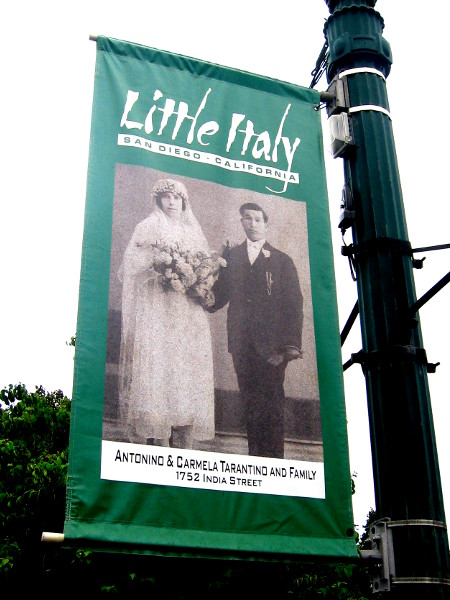
Banner on street lamp shows Tarantino family.Past lives become legends in the annals of Little Italy’s history.Morning coffee and companionship on a Little Italy sidewalk.
UPDATE!
During another walk through Little Italy I discovered another fascinating plaque:
Plaque shows Rose and Salvatore Cresci, Family of Little Italy.The story of Rose and Salvatore “Sal” Cresci, Little Italy Legends. (Click photo to enlarge for easy reading.)
UPDATE!
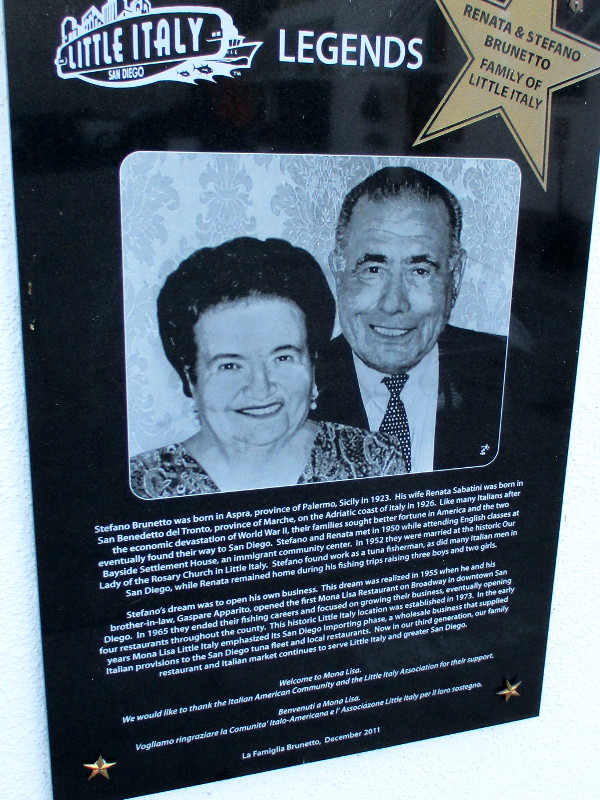
Here come two more signs that I found! The first concerns Pietro and Cristina Busalacchi, Italian immigrants who established restaurants in San Diego. The second concerns Renata and Stefano Brunetto. Stefano, a tuna fisherman, opened Mona Lisa Restaurant with his brother-in-law Gaspare Apparito.
…
To enjoy future posts, you can “like” Cool San Diego Sights on Facebook, or follow me on Twitter.
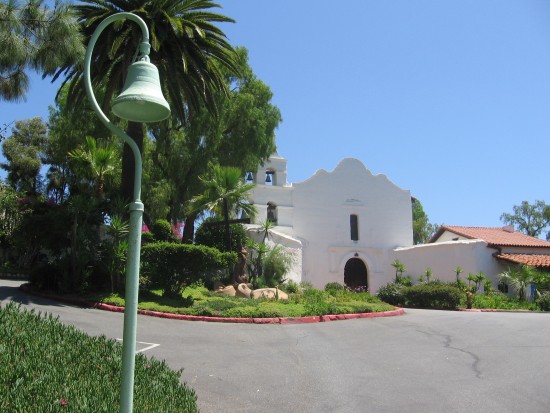
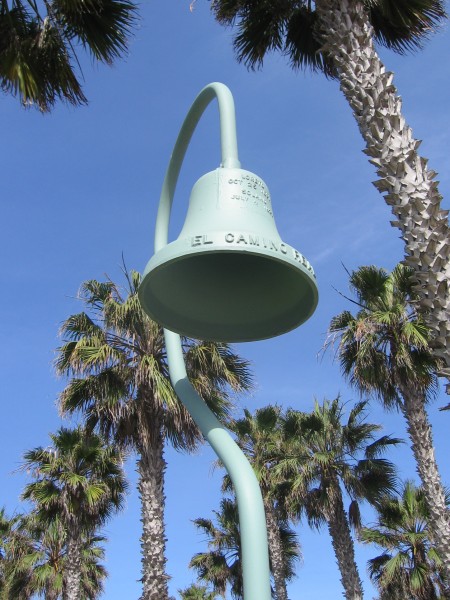
El Camino Real bell in front of California’s first Spanish mission.
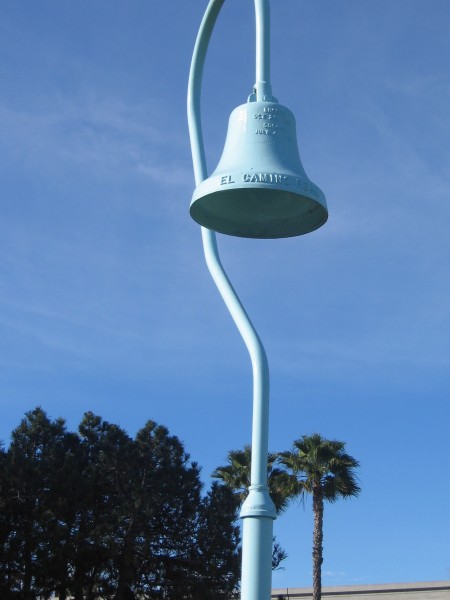
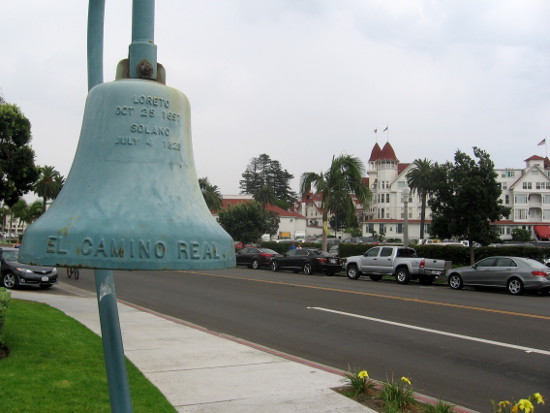
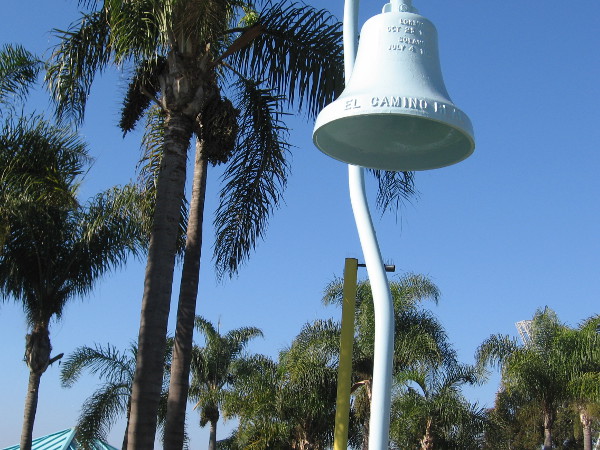
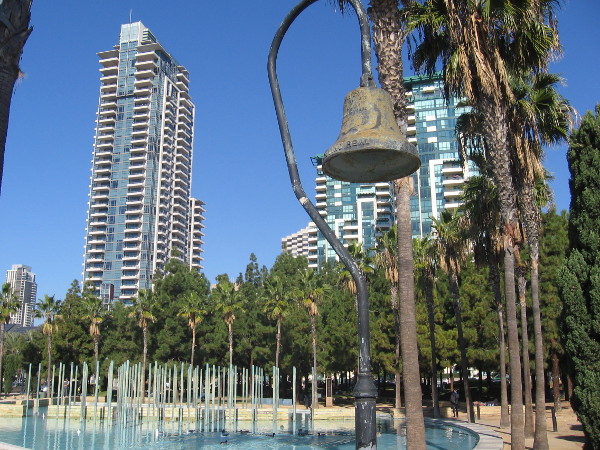
Here are just a few random pics of El Camino Real bells around San Diego. During my walks, I’m often surprised to discover a new bell.
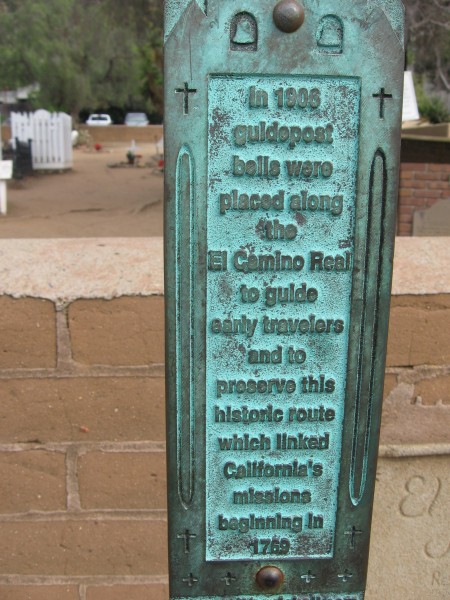
Many of these guidepost bells were placed in 1906 by the California Federation of Women’s Clubs. They marked the primitive roads that connected the old Spanish missions in California. El Camino Real, which means the Royal Road or King’s Highway in Spanish, led to 21 missions in Alta California, plus a variety of sub-missions, presidios and pueblos. The bells stand on tall posts in the shape of a shepherd’s crook. In subsequent years, bells have been removed or added to the California landscape.
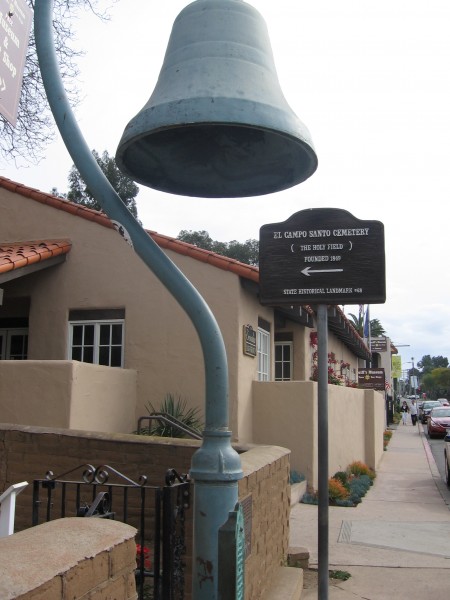
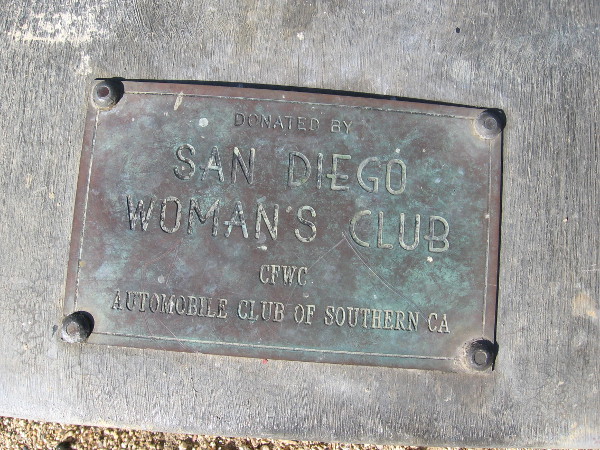
Bell in front of Old Town’s historic El Campo Santo cemetery.Plaque explains history of the guidepost bells.El Camino Real bell spotted on Harbor Island.El Camino Real bell by the downtown County Administration Building.Historic bell and palm trees in Imperial Beach.I found an El Camino Real bell near the Hotel del Coronado!El Camino Real bell in Cesar Chavez Park in Barrio Logan.Plaque on Harbor Drive reveals that a nearby bell was donated by San Diego Woman’s Club.
El Camino Real bell on Martin Luther King Jr. Promenade by Children’s Park.
…
To enjoy future posts, you can “like” Cool San Diego Sights on Facebook, or follow me on Twitter.
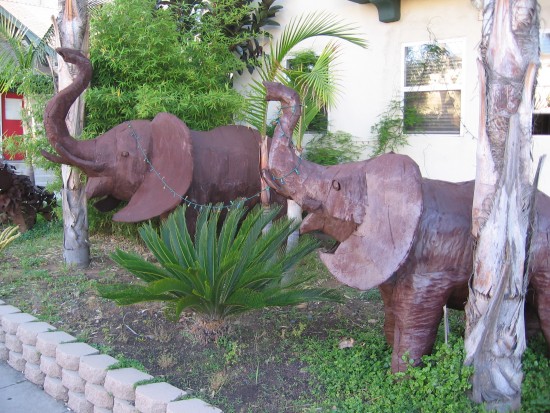
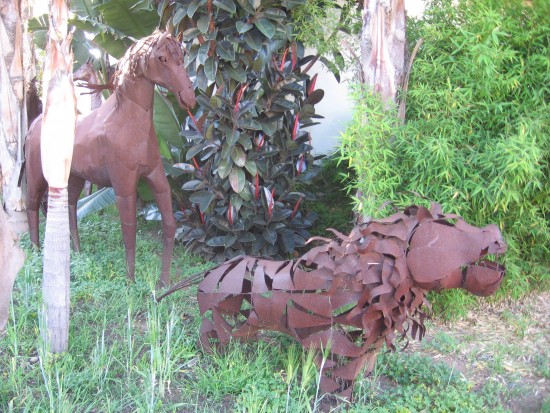
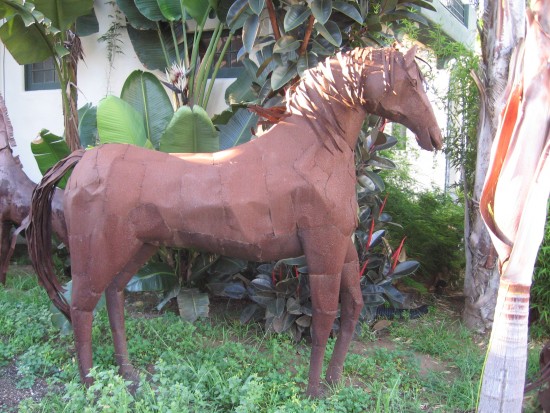
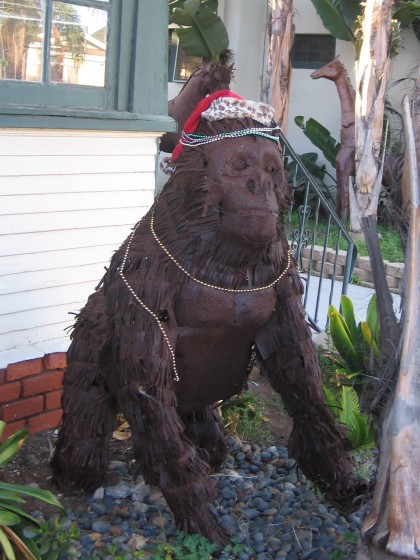
Several large and dangerous wild animals have escaped the San Diego Zoo and are running loose in nearby Hillcrest!
Huh? You don’t believe me? I’ve got some photographic proof!
Okay, okay, I’m kidding. These super cool metal sculptures stand in front of a residence on First Avenue. They appear to be made of rusted steel, but I’m not sure. I spotted them during my walk to work this morning, so I whipped out my trusty old camera!
Animal sculptures in front of a residence in Hillcrest.Handsome metal horse looks out toward street.Funny gorilla poses in front of someone’s window.
…
To enjoy future posts, you can “like” Cool San Diego Sights on Facebook, or follow me on Twitter.
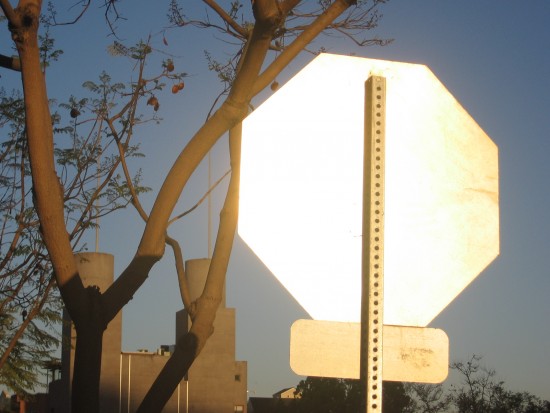
Back of stop sign flashes silver in the morning sunlight.
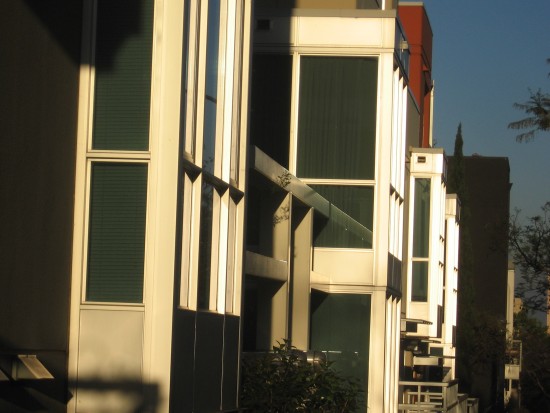
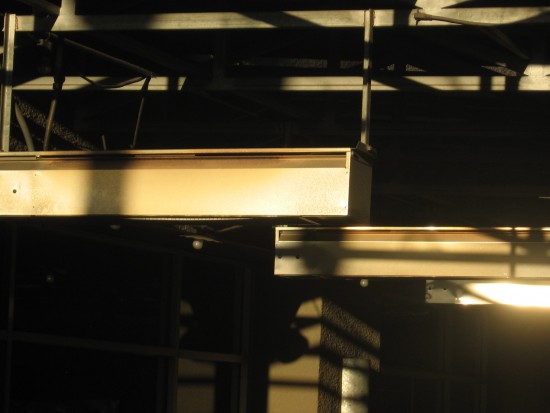
Early yesterday morning I walked west down Cedar to catch the trolley in Little Italy. The sun had just risen above the horizon and its rays were slanting through the cityscape almost horizontally. Metal surfaces were shining and shadows were still deep. It made for some very interesting photos!
Slanting sunshine on building highlights layered geometry.Light and shadow angled and entangled.Shadows on wall cast by tree and street light.Early sunlight begins to penetrate dark places.
North part of the Horton Plaza Park construction site behind fence.
A large area between Broadway and the Horton Plaza shopping mall is fenced off for construction. One end of the downtown mall has already been demolished and leveled to the bare ground. The long-neglected Horton Plaza Park is being enlarged!
On the fence surrounding the construction site are a number of interesting old photographs showing the park’s history.
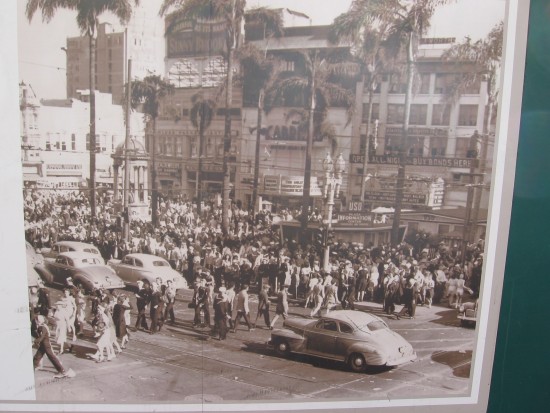
When real estate developer Alonzo Horton built the Horton House hotel (now the U.S. Grant Hotel) in his “New Town” in 1870, he included a small plaza on the hotel grounds. In 1895 he sold the half block plaza to the growing city of San Diego, stating his objective was “to provide a central, commodious and attractive place for public meetings, public announcements, public recreation and for any other proper public purposes, a place where all public questions might be discussed with comfort, where public open-air concerts might be given, where the people might rest, and where children might play in safety.” In 1909 the first fountain in the United States to feature electric lights was installed in the park.
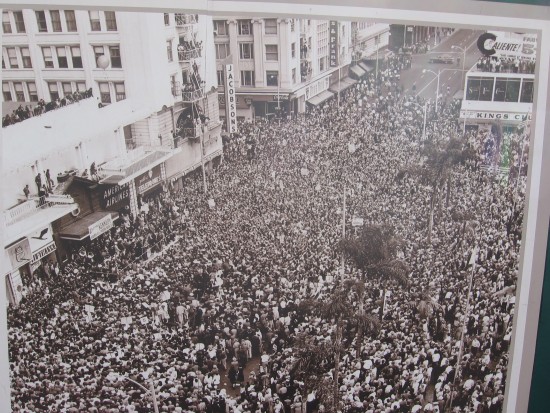
Over the years, the small park has seen a whole lot of history, as the following photographs at today’s construction site demonstrate. Horton Plaza Park was designated a historical landmark by the City of San Diego in 1971.
Horton Plaza Park during 1935 California Pacific International Exposition.Horton Plaza Park crowded for V-J Day celebration.
The streets were crowded with a spontaneous celebration when World War II finally ended.
Thousands attend rally for John F. Kennedy in Horton Plaza Park.
On November 2, 1960, Senator John F. Kennedy spoke at Horton Plaza Park, seeking votes in the upcoming presidential election. A huge crowd turned out.
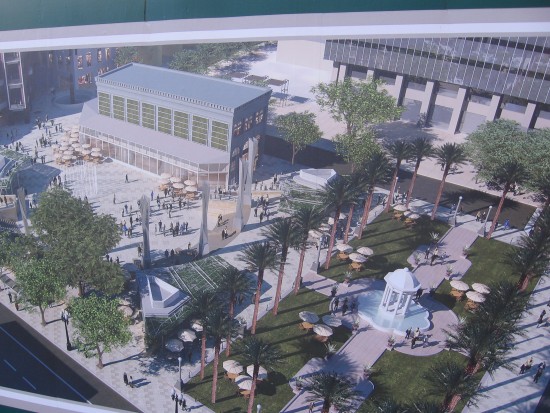
Sign shows how the new Horton Plaza Park will look at completion.
The beautifully renovated park will include lots of space for public events, including outdoor concerts!
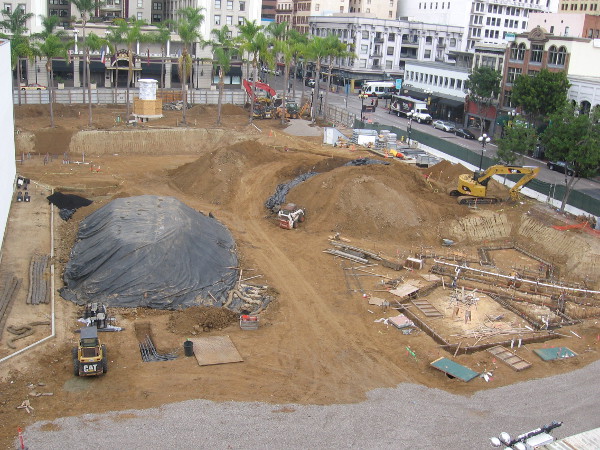
A huge area has been cleared to make way for the new park.
Here’s a pic I took on January 31, 2015…
Construction of the new Horton Plaza Park is well underway in early 2015.
Homeless and graffiti beneath Highway 163 in Mission Valley.
These two pics aren’t very cool. But they are important. They show another world that many often don’t see.
I took these photos where Highway 163 crosses over Camino de la Reina in Mission Valley. I climbed up a hill of dirt under the overpass and emerged between the opposing lanes of traffic.
Numerous homeless people live along the San Diego River in Mission Valley. Some of them hunker down in shelter provided by this makeshift concrete roof.
Another world in the shadows beneath lanes of busy traffic.
UPDATE!
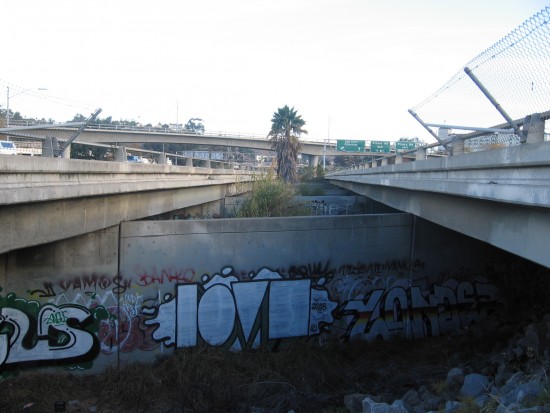
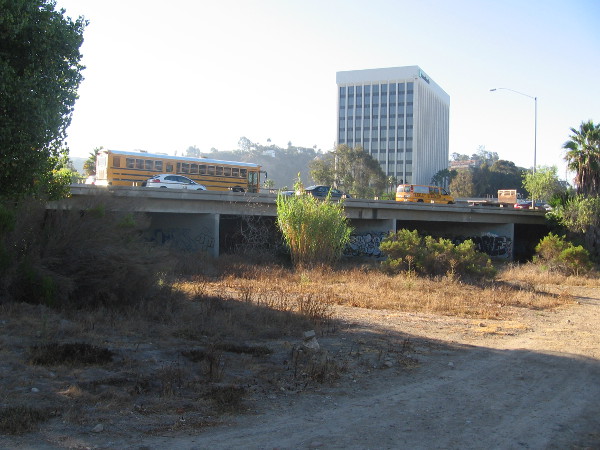
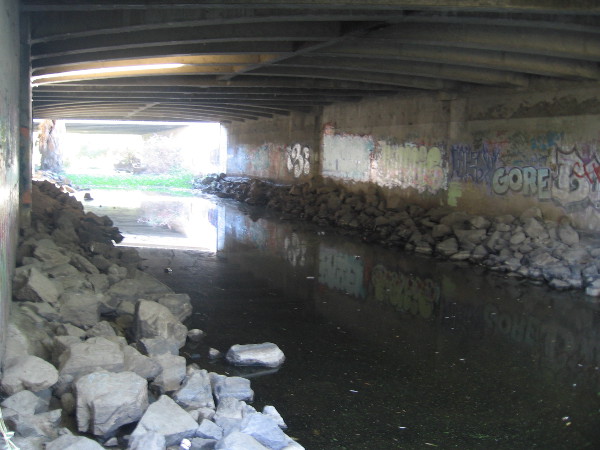
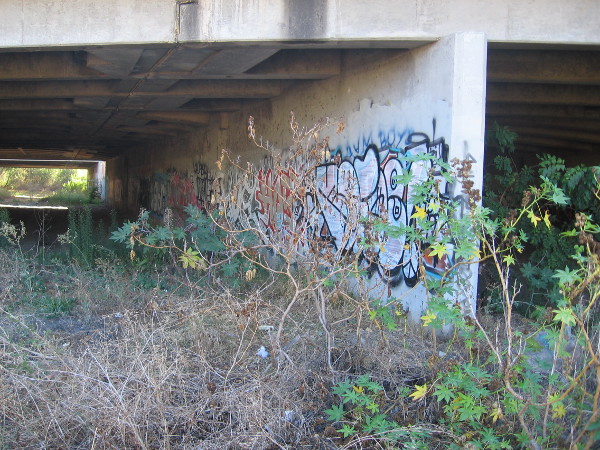
I got the following three pics late in the summer. I didn’t see anyone, but obviously numerous people pass through.
Looking under Highway 163 where the homeless often pass or gather.This is where Highway 163 crosses over the San Diego River.Weeds and graffiti beneath the concrete.
















































 Cool San Diego Sights!