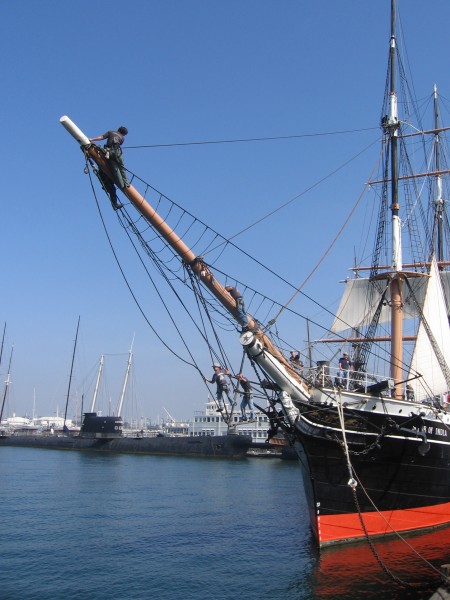
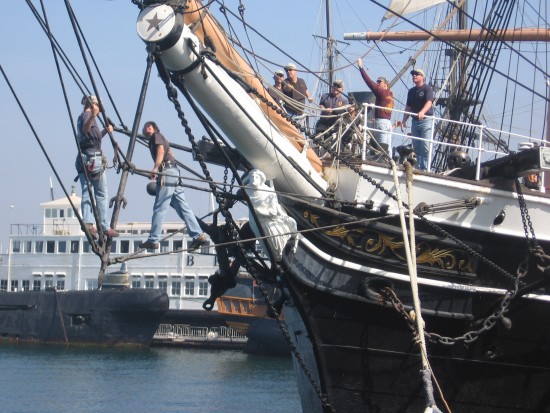
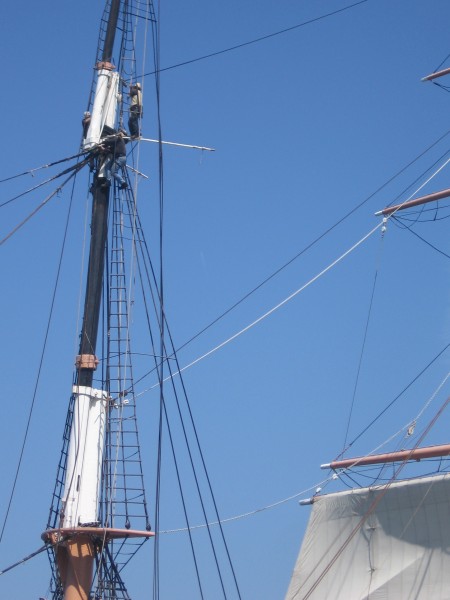
Dedicated members of San Diego’s Maritime Museum were hard at work yesterday, working in the Star of India’s rigging like busy spiders on a web.
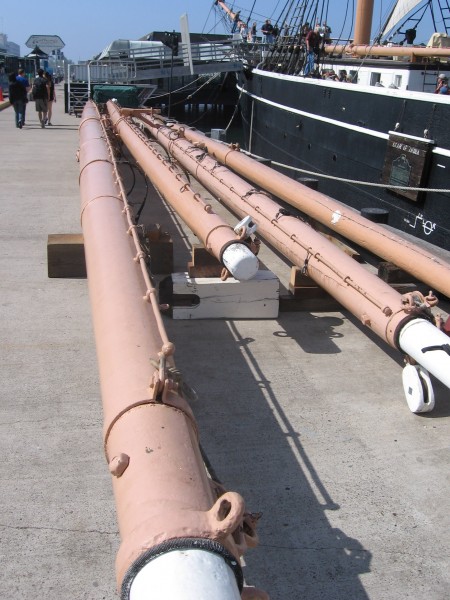
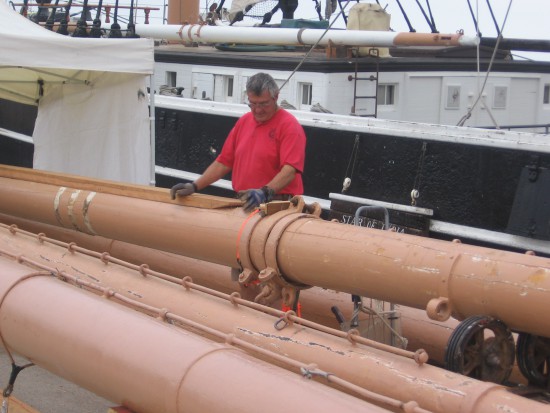
The rigging of the historic three-masted bark is undergoing an overhaul, a project that is expected to take a full year. That’s according to the person selling tickets. The large yards of the foremast have already been removed and are lying on the sidewalk awaiting inspection and a new coat of paint. I was told the ship’s trees (platforms on the masts) are infested with termites. They’ll have to be repaired. To maintain the 150 year old Star of India, the oldest active sailing ship in the world, requires a lot of work!
People tangled in picturesque ship’s rigging.Like highwire artists on the slender ropes.Looks like a lot of hard work.Yards from foremast wait on sidewalk to be painted.Maritime Museum members at work on Star of India.High up in the blue San Diego sky.
I got a quick photo of a San Diego Maritime Museum volunteer working on the yards on an early July morning!
Volunteer works on Star of India’s yards.
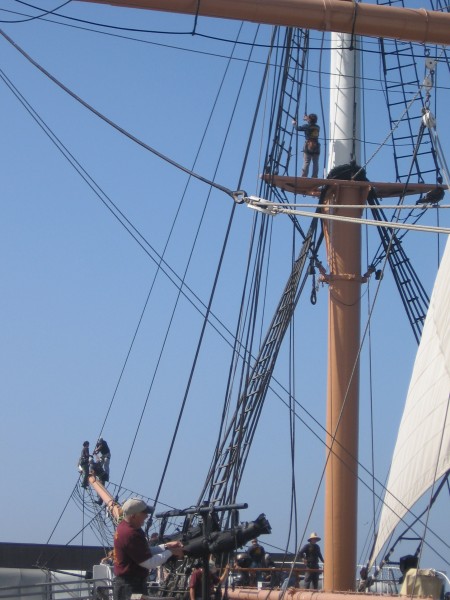
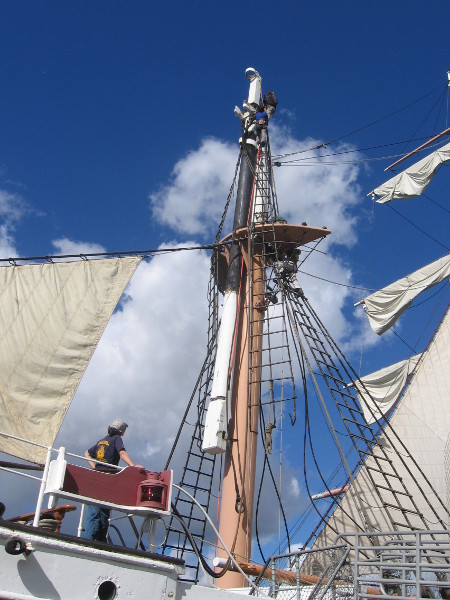
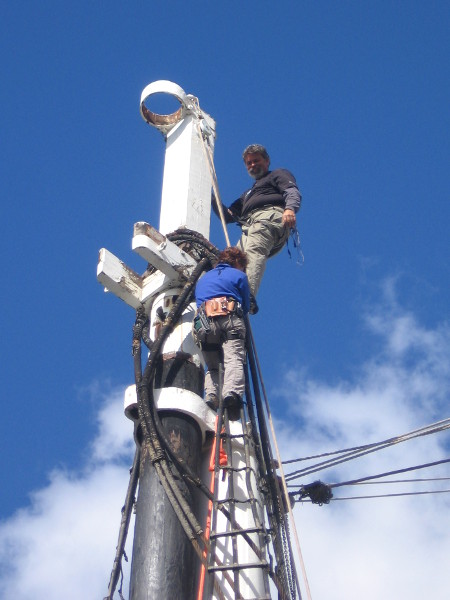
Here come several more pics taken in October. The top third of the foremast has been removed!
Top portion of Star of India foremast has been removed in October of 2014.Maritime Museum of San Diego workers high up on the foremast of the historic Star of India.On a shroud, in a tangle of ropes and cables between masts.
…
To enjoy future posts, you can “like” Cool San Diego Sights on Facebook, or follow me on Twitter.
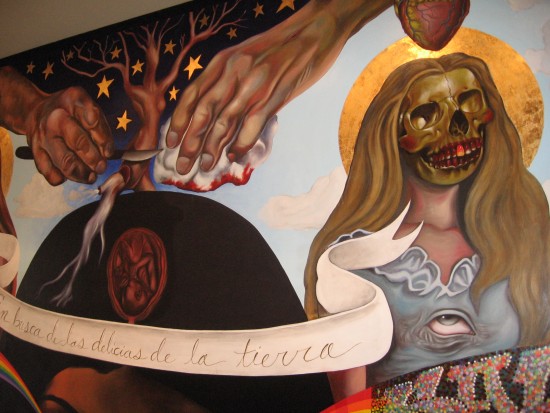
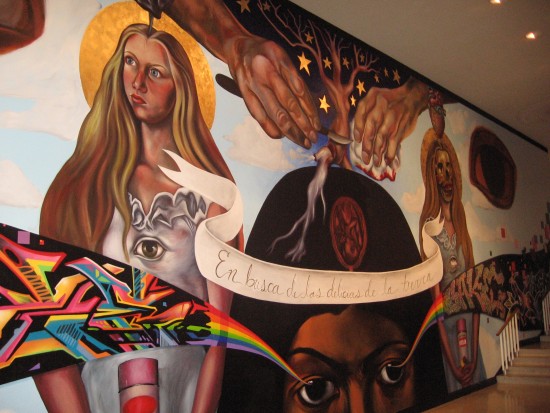
In Search of Earthly Delights mural at San Diego Museum of Art.
If you’re walking around Balboa Park and feeling adventurous, you can sneak into a portion of the San Diego Museum of Art and enjoy a stunning indoor mural. Just enter the unlocked door near the Sculpture Garden’s outdoor cafe! Like the sculpture garden, this area of the museum is free to the public!
The 70 foot mural is named En Busca de las Delicias de la Tierra/In Search of Earthly Delights. Created by Writerz Blok, an innovative graffiti mural organization, it was painted by young artists Sake, Daze, Izze and Krown. Pieces from the museum’s collection of Mexican modern art were used for reference and inspiration.
San Diego Museum of Art visitor walks past large indoor mural.San Diego organization Writerz Blok helped to create this amazing mural.
Sculpture and cannon at entrance to the Mormon Battalion Historic Site.
Just east of Old Town San Diego State Historic Park one can find the Mormon Battalion Historic Site, an attraction created by The Church of Jesus Christ of Latter-day Saints. The location itself seems a bit arbitrary, as the Mormon Battalion manned Fort Stockton up on the hill by the old, abandoned Presidio when they arrived in San Diego in 1847.
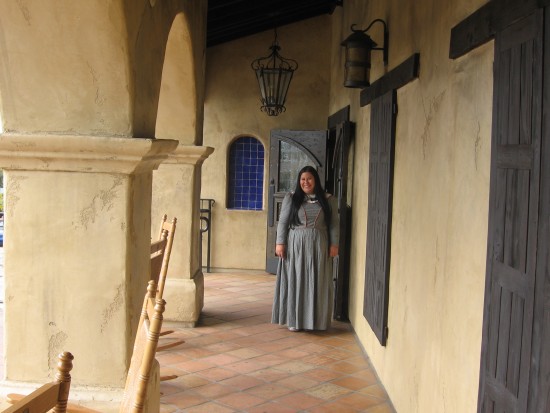
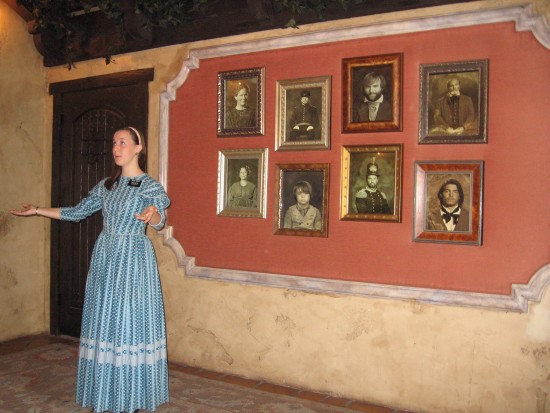
Young lady missionaries guide visitors through a series of rooms and outdoor areas which are designed to tell a sympathetic version of the Mormon Battalion’s difficult 2000 mile march from Iowa. The ulterior motive is to promote their beliefs, and there are frequent religious references, but there is no hard sell and the tour guides are warm and friendly. One can absorb a little bit of history while experiencing a good-humored, Disney-like presentation.
A friendly missionary lady comes outside to welcome a new visitor.Girl in a pioneer dress begins the tour with talking, moving portraits.
Much of the tour is spent watching professionally produced dramatic videos. Several real historical artifacts can be found near the tour’s end.
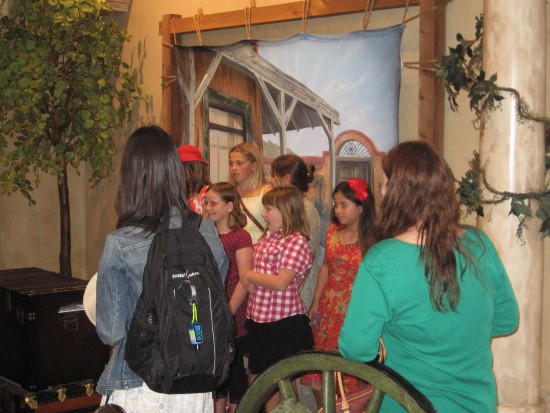
Taking pictures of visitors with a large antique camera.Girls pose for a picture in front of a western scene.
A lot of families and kids were smiling and enjoying the tour. Many appeared to be members of the LDS Church.
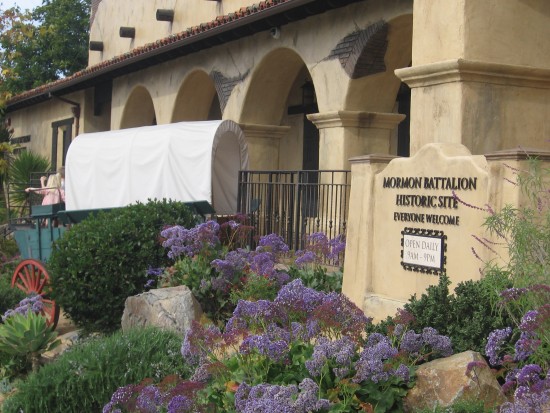
Young visitors near end of the tour pan for glittery iron pyrite.Covered wagon in front of the Mormon Battalion Historic Site.
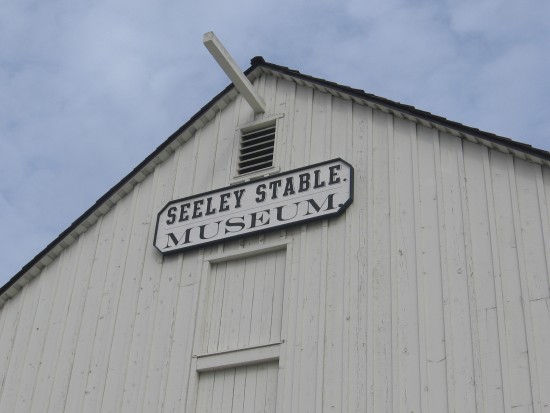
Front of the Seeley Stable Museum in Old Town San Diego.
Perhaps my favorite part of Old Town San Diego State Historic Park is the Seeley Stable Museum.
The huge old barn and surrounding area were once owned by Albert Seeley, who ran the San Diego-Los Angeles Stage Line from 1868 to 1877. His Concord stagecoaches left San Diego at 5 am, stopped overnight at San Juan Capistrano, and arrived in Los Angeles at 4 pm the next day. Eventually competition with the railroad put him out of business.
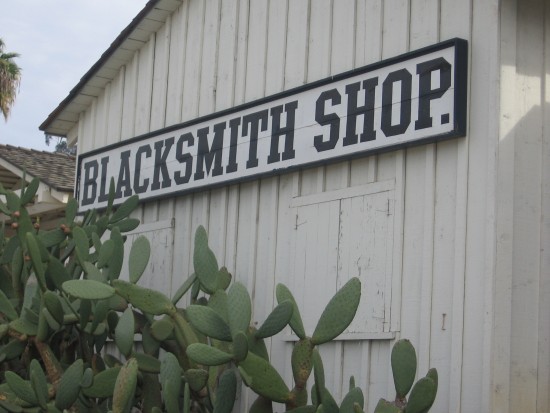
Sign on the Blacksmith Shop behind Seeley Stable.
Behind the Seeley Stable is a cool blacksmith shop, where tourists can watch skilled hobbyists demonstrate the shaping of red hot iron. The hammers ring loudly and the sparks fly! Unfortunately it wasn’t open the day I took these photos.
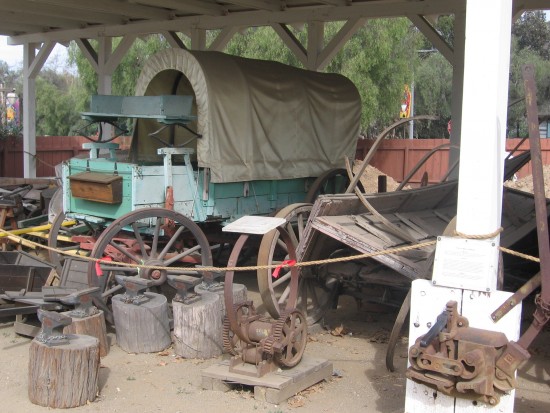
Covered wagon, anvils and relics of the Old West behind Seeley Stable.
Across from the blacksmith you’ll find this. Very cool!
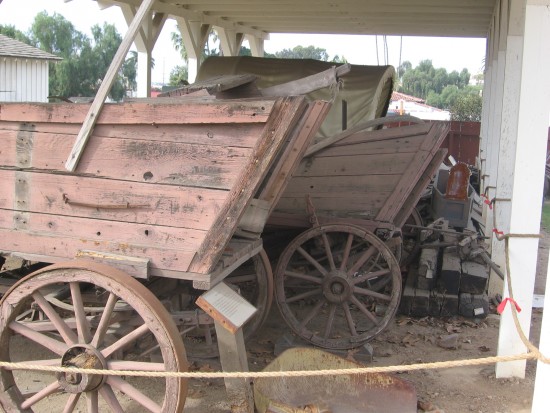
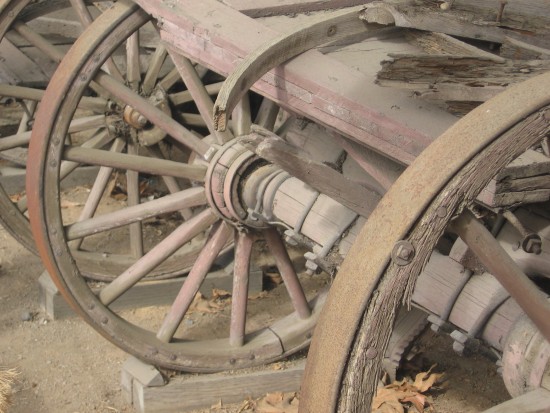
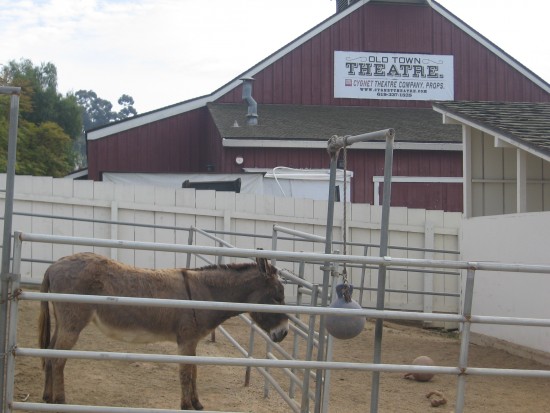
Several unrestored wagons.Peering through old wagon wheels.Donkey awaits young visitors to historic Seeley Stable.
On the south side of the stable you’ll find a couple of donkeys, which are used by park rangers to teach children about life in the Old West.
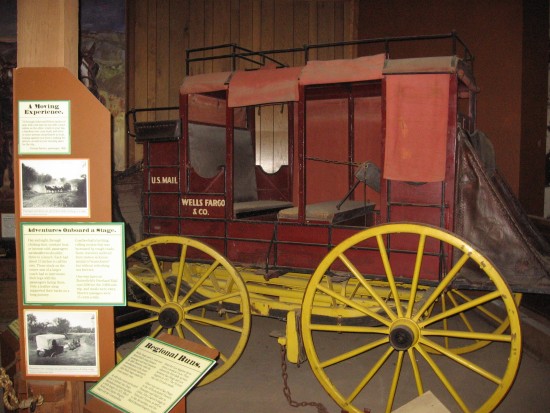
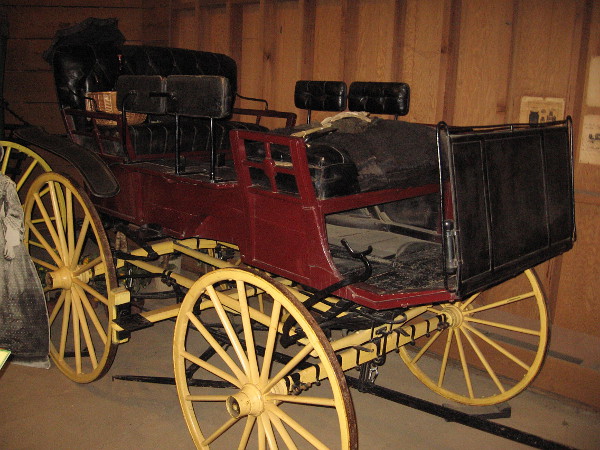
Concord stagecoach from the Los Angeles to San Diego route.
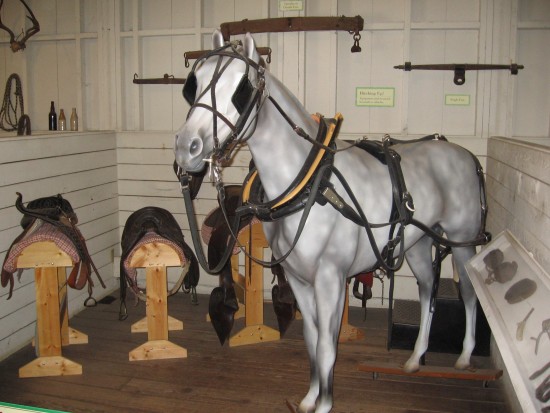
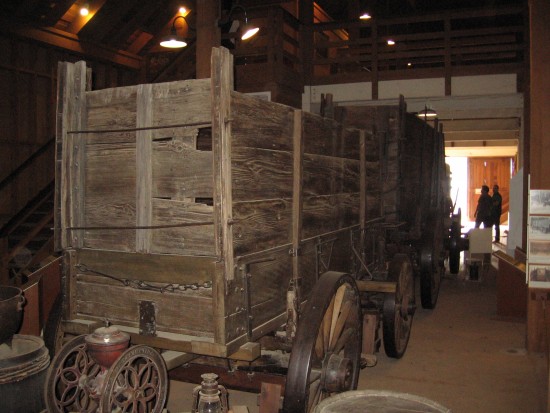
Finally, we’re inside the museum! You can see many different wagons and stagecoaches inside the dark old barn, plus other artifacts from life one and a half centuries ago.
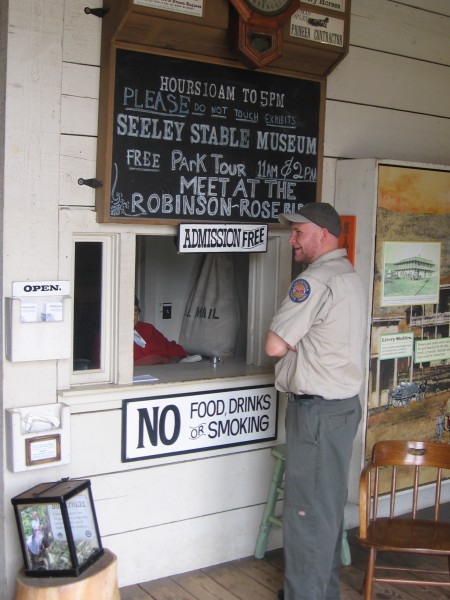
Museum display with horse and saddles recreates the old stable.Huge freight wagon on display at Seeley Stable.Old Wells Fargo wagon once used to transport the mail.Old Town San Diego State Historic Park ranger chats with friendly lady at the ticket window.
The Seeley Stable Museum is free!
UPDATE!
Here are a few more interesting and informative photos that I took inside the museum in August 2017…
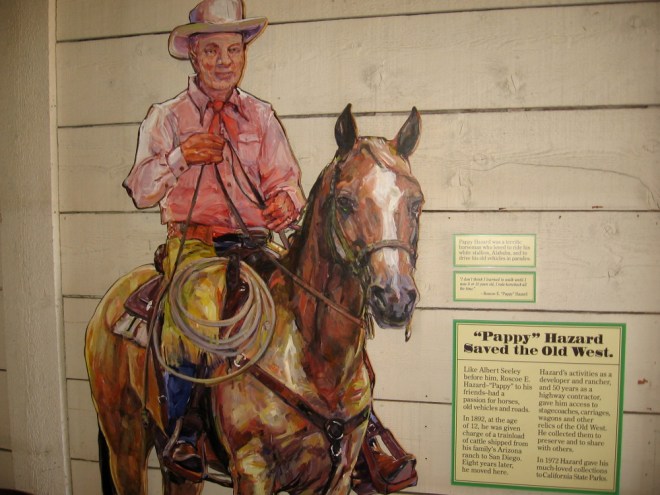
Roscoe E. “Pappy” Hazard was a developer and rancher who collected stagecoaches, carriages and wagons from the Old West. Many are displayed today in Old Town’s Seeley Stable Museum.In 1869, Albert L. Seeley transformed the nearby Bandini adobe into the two-story Cosmopolitan Hotel, which became Old Town’s stage depot and social center.Photo of Seeley Stable’s barn and yard taken from Presidio Hill in 1872. The Cosmopolitan Hotel can be seen on the right.Map shows important stagecoach routes, including the Butterfield Overland, and the Birch’s Line from San Antonio to San Diego.Signs and old photos concerning freight wagons in the Old West, which often employed large teams of mules.Spaniards introduced mules to America along with the horse. Hardy pack mules were used by trappers to haul furs, and by gold miners to move supplies and equipment.This delivery wagon was brought to San Diego by Frank Kimball in 1868. It was used to show passengers land that he had for sale in National City.This old Park Wagon was used by cattle rancher Walter Vail. He owned a land in Arizona, Santa Rosa island off the coast of California, and Warner’s Ranch northeast of San Diego.How a corner of the stable might have once appeared. Stable hands had many chores, including feeding, watering and grooming animals, and cleaning stalls.
…
This blog now features thousands of photos around San Diego! Are you curious? There’s lots of cool stuff to check out!
Here’s the Cool San Diego Sights main page, where you can read the most current blog posts. If you’re using a small mobile device, click those three parallel lines up at the top–that opens up my website’s sidebar, where you’ll see the most popular posts, a search box, and more!
To enjoy future posts, you can also “like” Cool San Diego Sights on Facebook or follow me on Twitter.
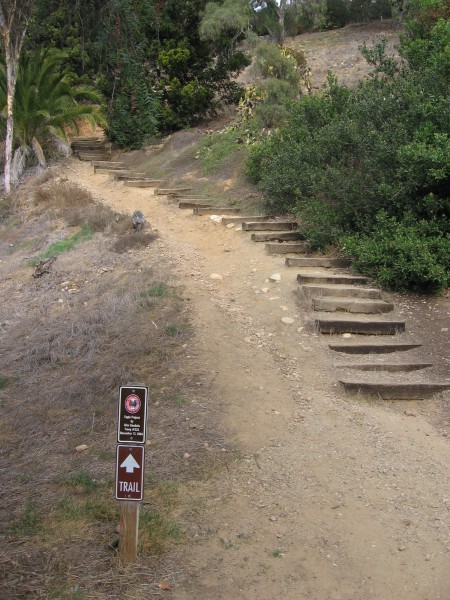
The Old Presidio Trail leads up a steep hill from San Diego’s historic Old Town.
Please join me as I walk from San Diego’s Old Town up a short but very steep trail to Presidio Park. We’ll see all sorts of interesting monuments, views, and of course, the location of the old Spanish presidio, whose ruins are no longer visible. The top of Presidio Hill is now home to the Junipero Serra Museum. Follow me!
We begin near the trailhead, beside the small Presidio Hills Golf Course, on the east edge of historic Old Town.
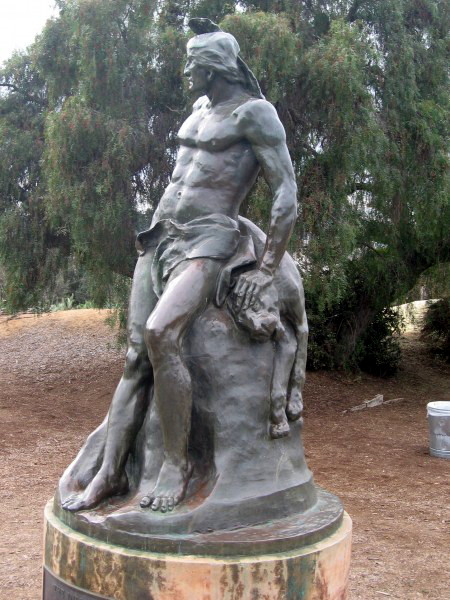
One of several signs along the Old Presidio Historic Trail. This one explains that soldiers and families used to walk down from the Spanish presidio to tend gardens and livestock near the Casa de Carrillo, which is now the pro shop at Presidio Hills Golf Course.The Indian sculpture by Arthur Putnam in Presidio Park.
The first interesting thing we see is this sculpture, titled The Indian. It was created by famous American artist Arthur Putnam in 1905 and placed at the site of an ancient Indian village. The small village was discovered and named San Miguel by the explorer Juan Rodriguez Cabrillo in 1542.
The Padre Cross was erected near the spot where Junipero Serra established California’s first mission.
Up the hill from The Indian stands the Padre Cross. It was raised in 1913 by the Order of Panama and is made up of tiles from the Presidio ruins. The cross marks the strategic location overlooking San Diego Bay where Franciscan friar Junipero Serra chose to establish a Spanish Catholic mission in 1769. (The mission was moved several miles up the San Diego River 5 years later.)
Bronze statue titled The Padre by Arthur Putnam.
Nearby among some trees we find a memorial to the mission’s friars. It’s a bronze statue titled The Padre, completed in 1908 by renowned sculptor Arthur Putnam.
The Serra Museum rises beyond billowing Spanish flag.
Our legs are starting to feel the climb as we reach three flagpoles overlooking Mission Valley.
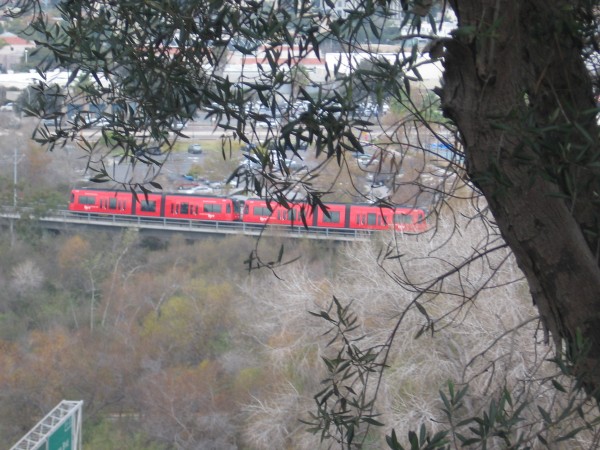
Looking down at a red trolley in Mission Valley.
Turning north for a moment, we see the trolley!
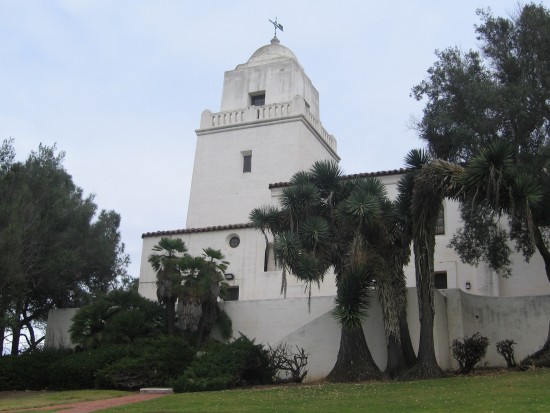
View of the Serra Museum on Presidio Hill in San Diego.
Now we’re getting close to the Serra Museum, which was built in 1928 on this historically very important hill. The museum was built, and the land containing Presidio Park was purchased and preserved for posterity, by philanthropist George Marston.
San Diego was born in 1769 at the old Presidio, a Spanish fort in a desert-like wilderness very far from European civilization. It was located just below the Serra Museum.
Serra Museum employee looks down the grassy hill.
Not many people are about at the moment. Most tourists never venture up this way.
The Serra Museum is packed with numerous historical exhibits. You can climb the tower for views of San Diego Bay, the San Diego River and Mission Valley.
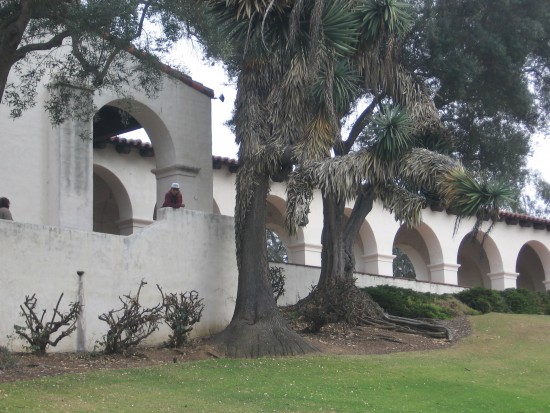
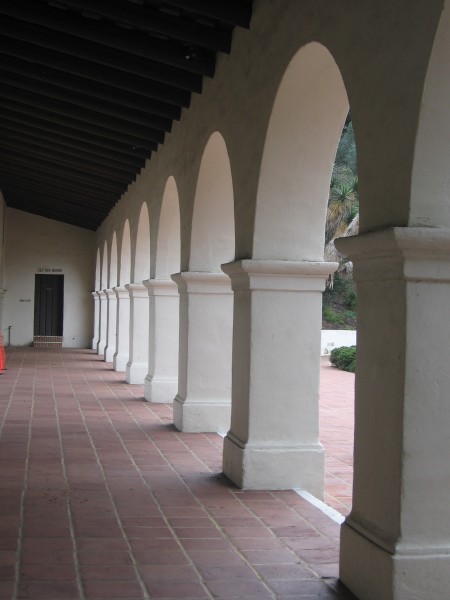
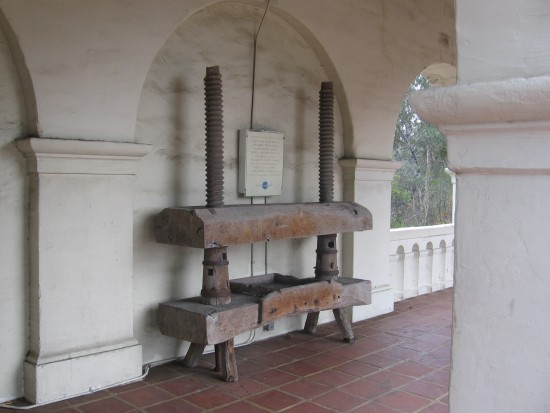
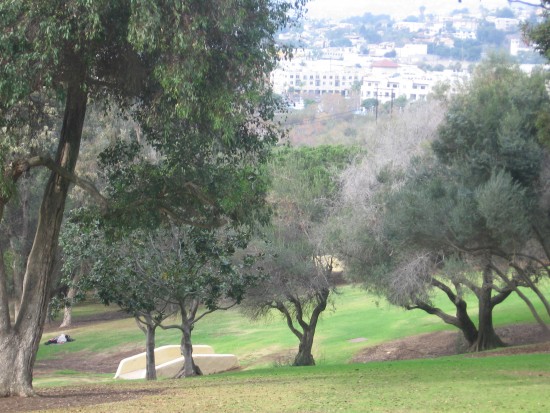
Row of Mission Revival style arches.Large wine press outside San Diego’s fascinating Junipero Serra Museum.Looking downhill from atop grassy Presidio Park.
Now we’ll wander along the hilltop to nearby Fort Stockton, the short-lived camp of the famous Mormon Battalion.
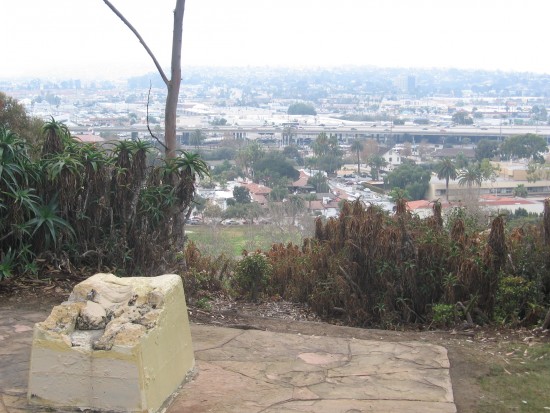
Where a cannon once overlooked Old Town at Fort Stockton.
Decades ago, when I was a young man, I remember seeing a cannon set in this concrete overlooking Old Town. I believe that same cannon is now on display in the nearby Serra Museum. Given the name El Jupiter, it was one of ten cannons that originally protected the old Spanish Fort Guijarros on San Diego Bay at Ballast Point.
(A second surviving cannon from the fort is named El Capitan. Today it can be found near the center of Old Town San Diego’s Plaza de las Armas.)
Mural at Fort Stockton of the Mormon Battalion.
In 1846, President James K. Polk asked Brigham Young of the Mormons to send a few hundred men to San Diego to help in the Mexican-American war effort. On January 29, 1847 five hundred men and about eighty women and children arrived at Fort Stockton after a very difficult 2,000-mile march from Council Bluffs, Iowa.
Mormon Battalion Monument by Edward J. Fraughton.
I hope you enjoyed our walk!
UPDATE!
In 2021 the two sculptures The Indian and The Padre were moved from Presidio Hill to the San Diego History Center in Balboa Park. To see my blog post concerning this, click here.
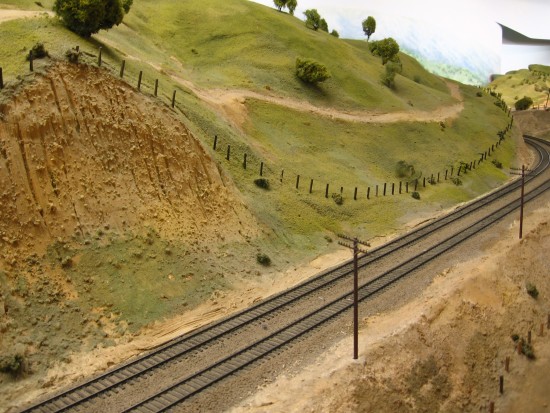
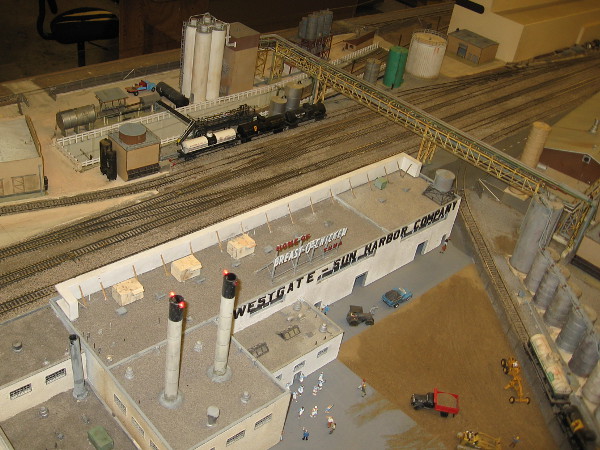
HO Scale model train travels through Tehachapi Pass exhibit.
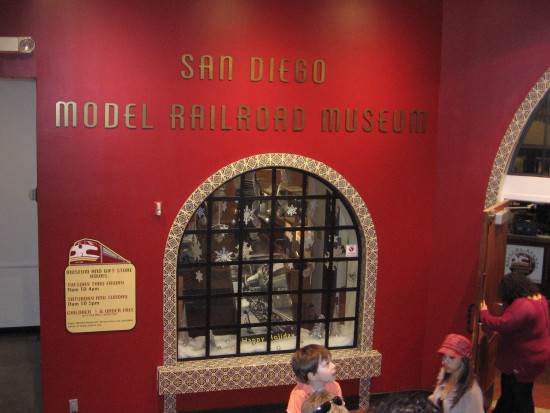
I could happily spend many hours at the San Diego Model Railroad Museum. Not only is it the largest such museum in North America, but it features some of the coolest, most realistic model train layouts you’ll ever see!
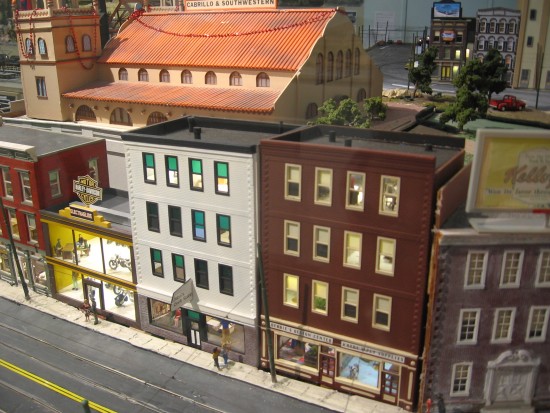
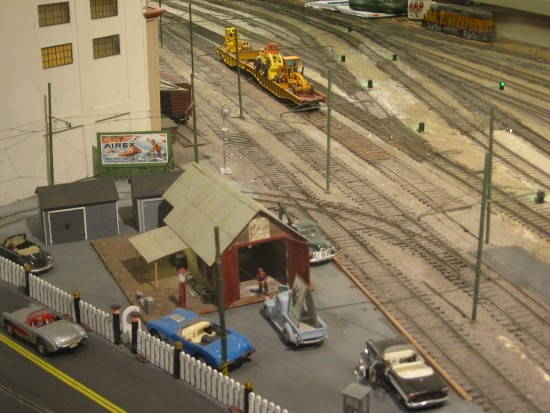
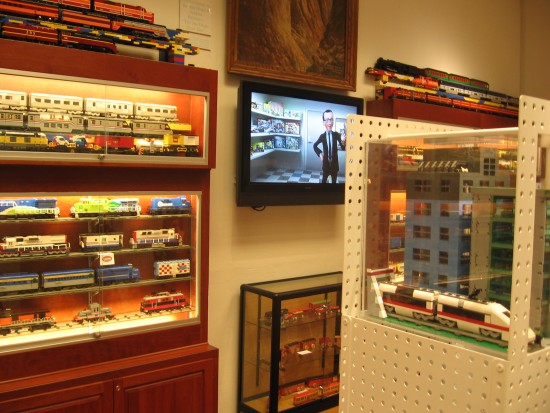
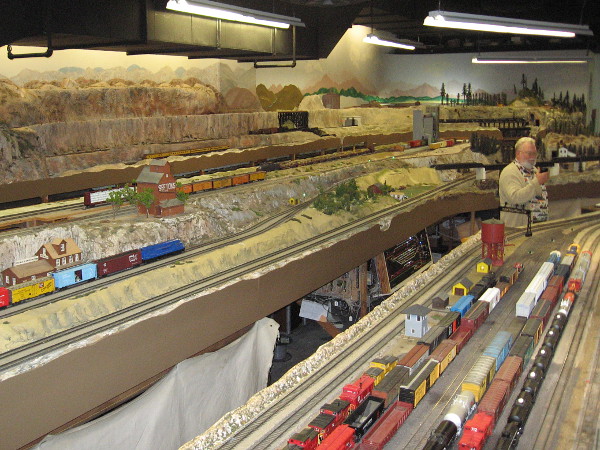
Located in Balboa Park, the model train museum contains five huge sections. The Cabrillo Southwestern exhibit is in O Scale, the same size as Lionel toy trains. The San Diego and Arizona Eastern, and the Southwestern Pacific-Santa Fe Tehachapi Pass exhibits are both in the popular HO Scale. The Pacific Desert Lines exhibit is in tiny N Scale. Finally, there’s a toy train gallery crammed with Lionel-type trains and many amazing moving accessories, including cars and people. One train is mounted with a Choo-Choo Cam which provides an engineer’s moving view of the dazzling layout.
I took lots of pics yesterday afternoon. Many of the shots taken through glass or in darkness didn’t come out so great. But I did get some fairly good ones. Enjoy!
Kids love the San Diego Model Railroad Museum.
Windows to the big Cabrillo Southwestern O Scale exhibit.
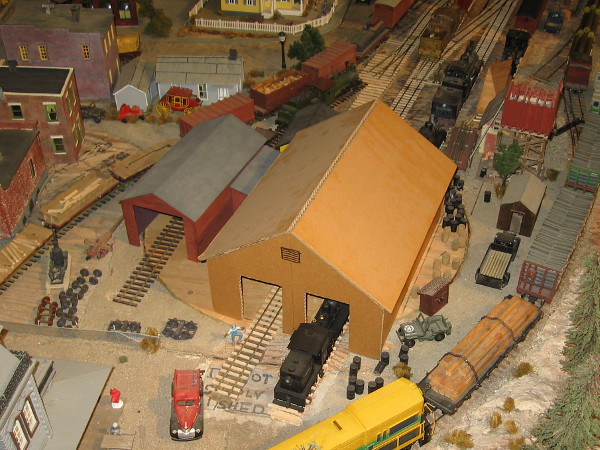
Large O Scale model train exhibit includes many detailed buildings.
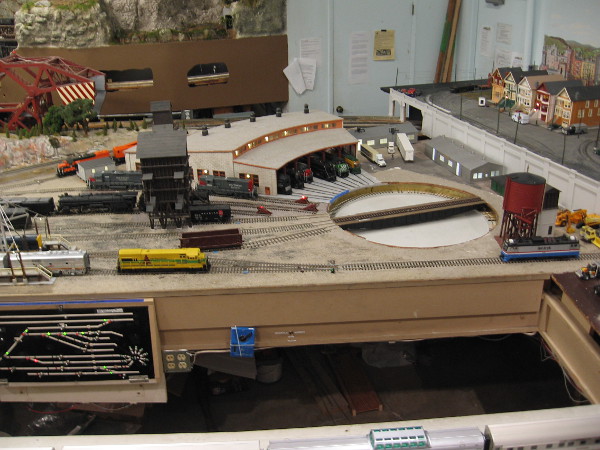
Rail yard action at the Cabrillo Southwestern exhibit.
Tiny human figures at work near some trolley tracks.
The elaborate O Scale exhibit is full of train action!
Men work on unfinished San Diego and Arizona Eastern exhibit.
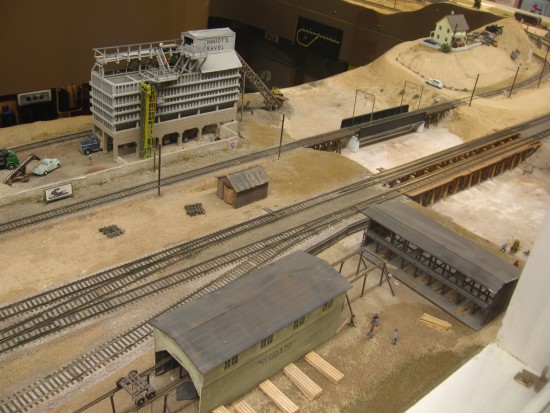
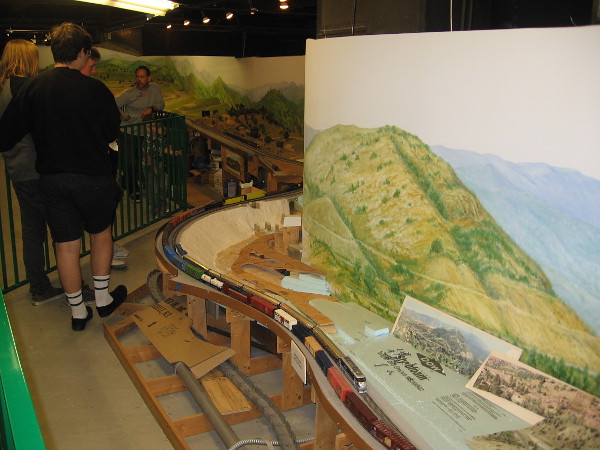
HO Scale bridges and a detailed mountain scene.
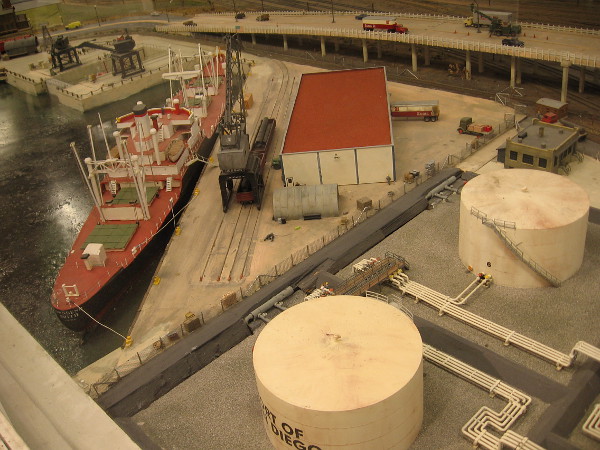
Attention to detail makes these model train exhibits lifelike.
Tracks under construction climb to Tehachapi Pass Mezzanine.
Pacific Beach Club Room with trains, videos and Lego exhibits.
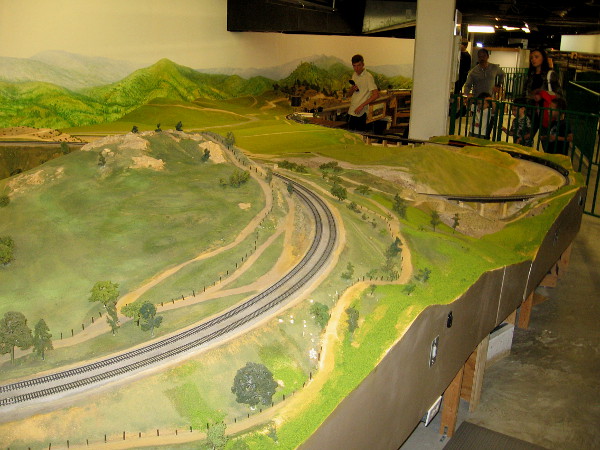
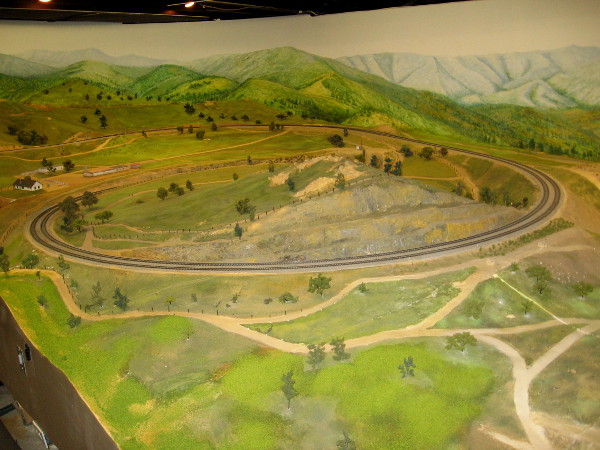
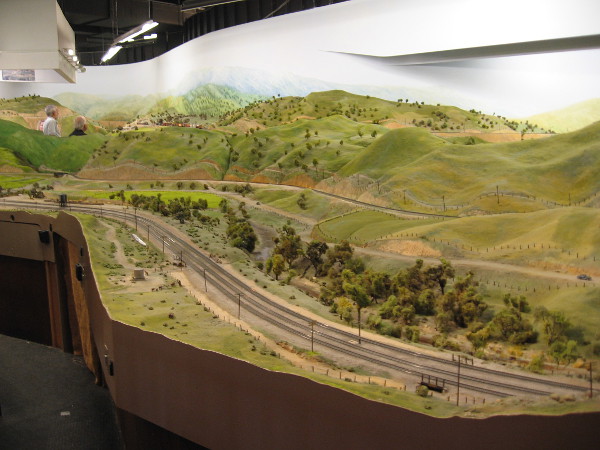
The famous Tehachapi Pass HO Scale exhibit is amazing.
Train tracks meander through highly realistic hillside scenes.
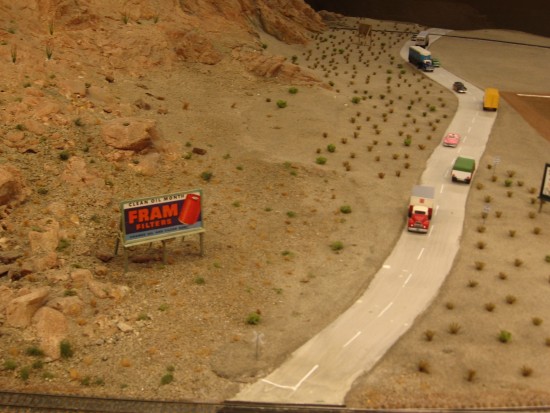
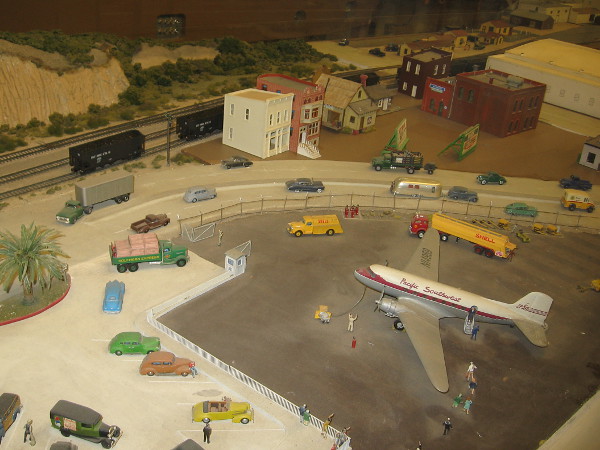
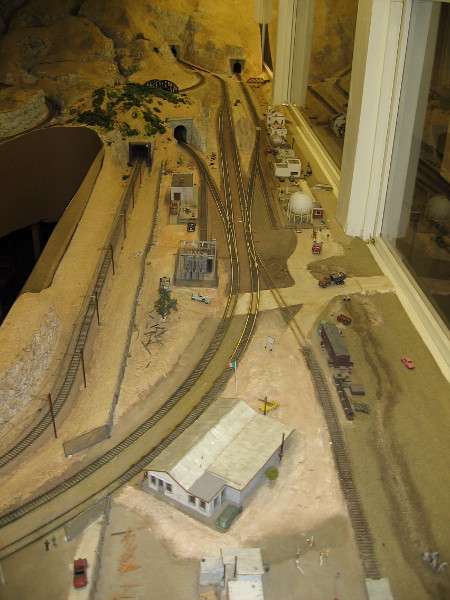
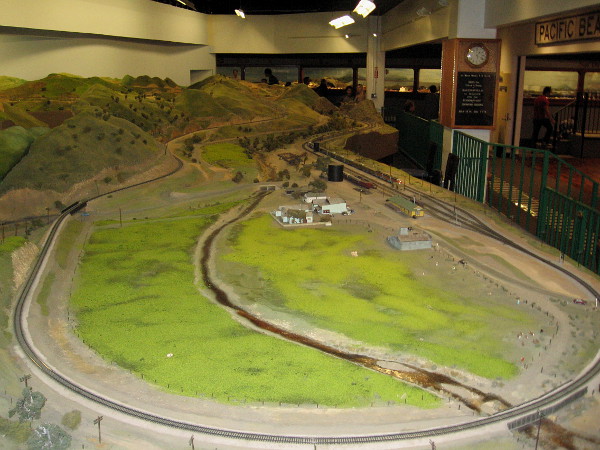
A stretch of desert highway in HO Scale.
Model of a desert town at San Diego Model Railroad Museum.
These huge train exhibits are a child’s fantasy come to life!
Member of Model Railroad Museum attends to derailed train.
UPDATE!
Almost every day this blog post is receiving visitors from Pinterest.
Welcome!
I decided to visit the museum again in May 2017 to get more photos!
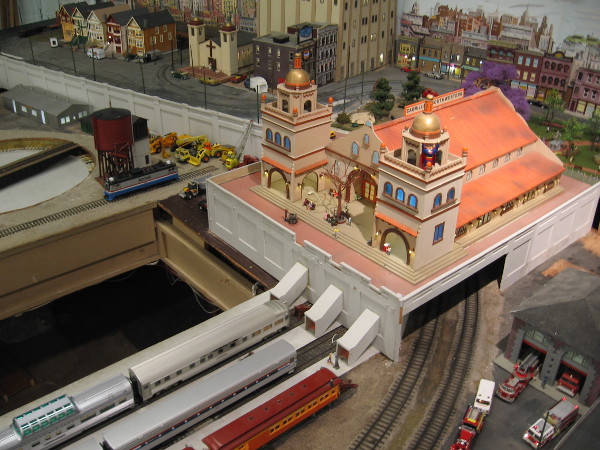
The layouts are so huge and detailed it would take some time to describe exactly what the photos depict and from what position they were taken. So I’m just going to insert a bunch of random photos for you all to enjoy.
Feel free to share any of these photos if you’d like. It’s all for fun! And if you ever have a chance, make sure to visit the San Diego Model Railroad Museum in Balboa Park. The place is truly incredible!
Are you a railroad or streetcar enthusiast? Do you love railway history?
I live in downtown San Diego and love to walk around with my camera! You can follow Cool San Diego Sights via Facebook or Twitter!
You can easily explore Cool San Diego Sights by using the search box on my blog’s sidebar. Or click a tag! There are thousands upon thousands of fun photos for you to share and enjoy!
People near Visitor Center enjoy Cabrillo National Monument’s centennial.
Here are some pics I took Sunday during the second day of Cabrillo National Monument’s centennial celebration.
Cabrillo National Monument is located at the tip of the Point Loma peninsula. The hilly peninsula helps to enclose San Diego Bay and is a perfect lookout over both the ocean and harbor. The park includes most notably the historic Old Point Loma Lighthouse and a 1988 replica of the original statue of Juan Rodriguez Cabrillo that was commissioned by the Portuguese government in 1935. It also includes military bunkers that were used to protect the bay during World War II, and a very popular whale-watching lookout.
The park this year turned one hundred years old. In 1913 Woodrow Wilson reserved a portion of Fort Rosecrans on the Point Loma peninsula for a statue of Cabrillo. Unfortunately, a statue was not immediately forthcoming, and the park’s development became the work of many decades.
The work in progress continues today. My last visit was a few years ago, and this time I noticed many big changes and improvements!
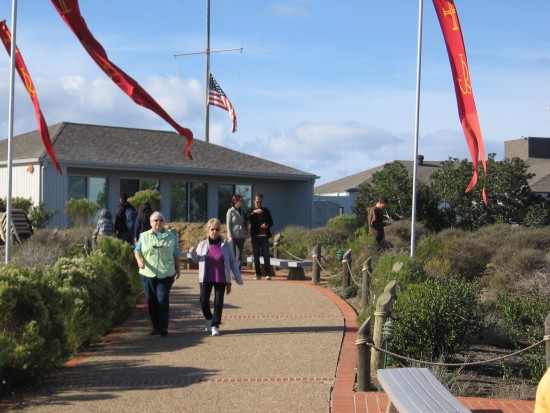
The first photo shows a bunch of people near the Visitor Center, on the walkway that leads out to the Cabrillo statue.
Various informative displays in front of Visitor Center for the centennial event.
For the centennial event, many community and government organizations had exhibits near the entrance to the Visitor Center. This pic shows what appeared to be the most popular table. The friendly lady had numerous snakes that fascinated young and old alike.
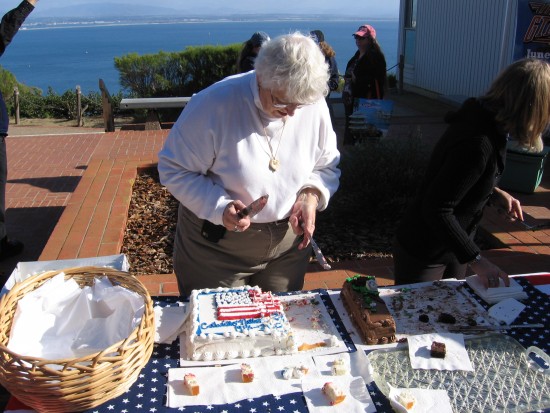
Yummy centennial cake was served to all park visitors.
Everybody enjoyed a small slice of birthday cake!
Statue of Juan Rodriguez Cabrillo overlooks the ocean.
Here’s the iconic statue of Juan Rodriguez Cabrillo, the Portuguese explorer who sailed into San Diego Bay on behalf of Spain nearly five hundred years ago. It stands not far from the Visitor Center overlooking both the bay and Pacific Ocean.
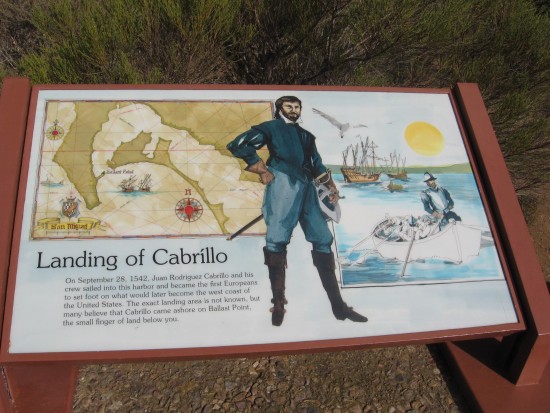
Park sign shows where Cabrillo entered San Diego Bay in 1542.
Distant view of Cabrillo statue and Coronado Island.
As I walked up the hill to observe a reenacted air raid drill from World War II, I looked back at this beautiful view. Great views can be had at Cabrillo National Monument looking in almost any direction!
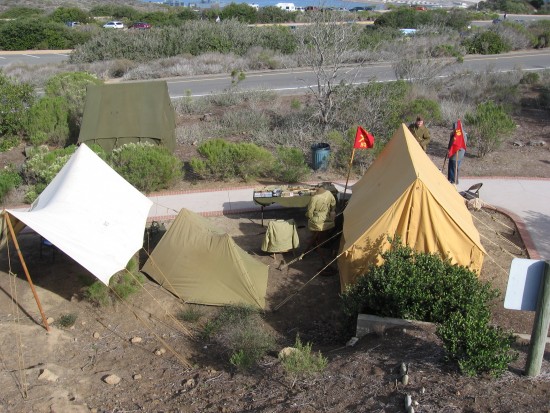
Tents of Army camp set up as historical reenactment.
These tents and some nearby vehicles were on display for the centennial. During World War II, after the Japanese attacked Pearl Harbor, many feared an attack on San Diego. So defenses were quickly erected. In addition to a number of observation bunkers, a few gun emplacements were situated along the end of Point Loma to defend the mainland and bay.
A small museum nearby includes many photographs, recordings and artifacts from that period in San Diego’s history.
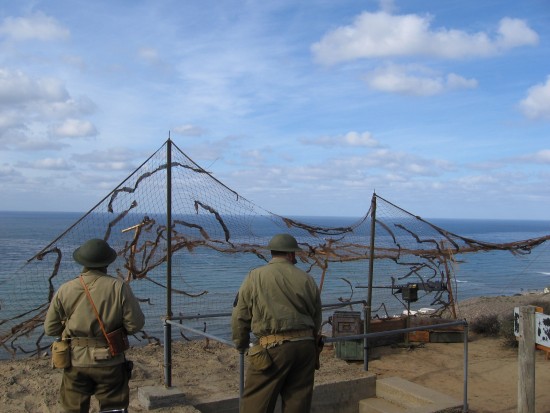
Mock air raid drill recalls duties during World War II.
At eleven o’clock, a mock air raid was staged! An aircraft from nearby Naval Air Station North Island swept over the bluffs as World War II veterans and enthusiasts looked on from the hilltop near some old bunkers.
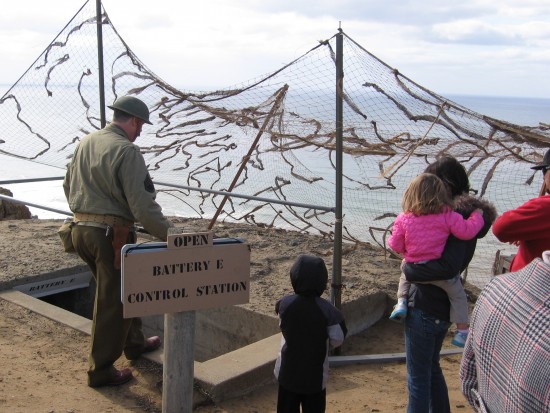
Visitors head into Battery E bunker used during World War II.
After the air raid, we all took turns going down into Battery E.
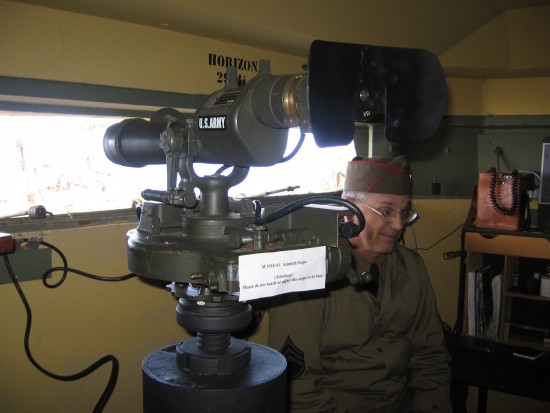
A look inside Battery E and equipment to sight enemy ships.
We were surprised at what we found! The flash of my camera illuminated the small semi-dark bunker, capturing this instrument used to scan the horizon for Japanese warships during World War II.
A chart inside the bunker identifies Japanese warships.
Down a nearby ladder was a second small room containing beds for those who stood watch at all hours.
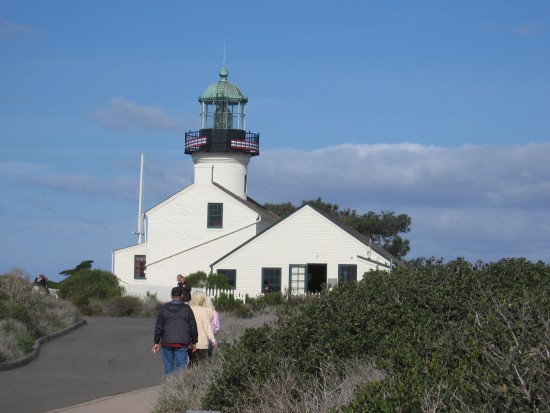
People walk toward the old Cabrillo lighthouse.
A short distance from Battery E is the historic Old Point Loma Lighthouse. From 1855 to 1891 it stood as a beacon for those entering San Diego Bay, before being replaced by an automated lighthouse down near the water. This old lighthouse is one of San Diego’s most well-known sights!
A museum by the old lighthouse includes the first Fresnel lens to be used by the automated New Point Loma Lighthouse.
A small museum near the lighthouse’s entrance is worth a quick look. It includes an amazing Fresnel lens that magnified light to help sailors out at sea.
Front of the historic lighthouse and its large rainwater basin.
A large flat area in front of the lighthouse was used by the keeper and his family to capture rainwater. Back then this lighthouse stood isolated, far from the small town across the water that grew into metropolitan San Diego.
Recreated family room in Cabrillo lighthouse includes Christmas tree.
Several furnished rooms in the lighthouse are on display behind glass. Very little space was available to accommodate the keeper and his family. In addition to this main room, there’s a kitchen area, closet, and two bedrooms up the winding stairs.
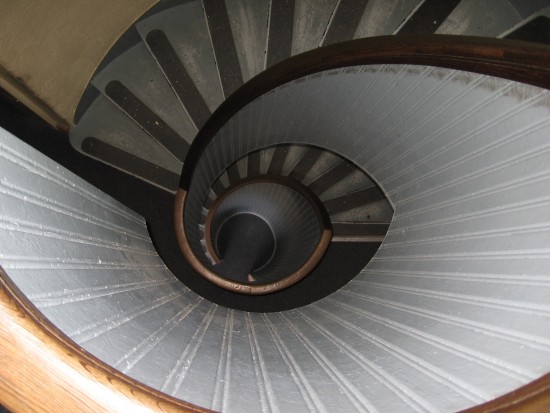
Looking down winding stairs from top of Cabrillo lighthouse.
Speaking of the stairs, I couldn’t resist taking this pic!
Another view of Point Loma’s historic old lighthouse.
Another great look.
Grey whale sculpture near Pacific Ocean overlook.
Interesting sculptures, artwork and signs can be found at the Pacific Ocean overlook. During the winter months, you can see gray whales spouting as they travel between the Arctic and Baja California.
A good place to spot migrating gray whales during the winter months.
You can see where the tidepools are below. I didn’t go down to the water on this trip, but it’s a fun place to see all sorts of sea creatures!
Walking down to Bayside Trail and folks who will talk about history.
At noon there was a guided hike down the Bayside Trail. We walked down a short road to the trailhead, where an old military truck waited with some folks dressed in historic uniforms. They would show us some interesting stuff down the trail.
Group walks down Cabrillo Bayside Trail on a December day.
Here we go down the Bayside Trail. The lady park ranger showed us a large number of native plants, including Coastal Sage, Lemonade Berry, Prickly Pear and more. The flora you see here is what is natural to the area. San Diego is located in a semi-arid zone, with very little precipitation. Most of the trees and other plants you see around town are not native.
A spotlight protected San Diego Bay during World War II.
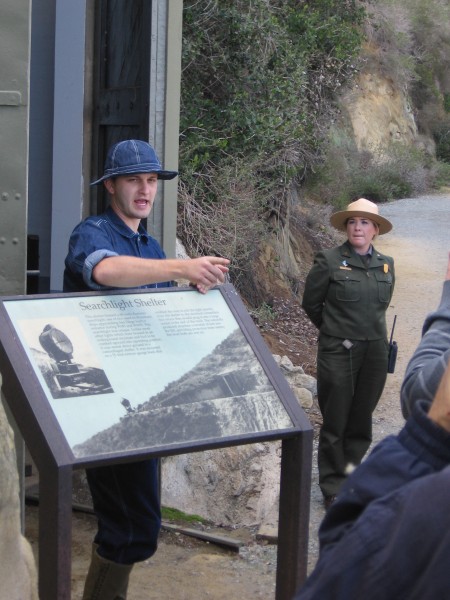
We’ve come to a small structure built into the hillside that houses an old electric spotlight. The huge lamp was used to watch the San Diego Bay’s entrance during World War II. It rolled out on a pair of tracks and plugged into an outlet that you can see by the trail.
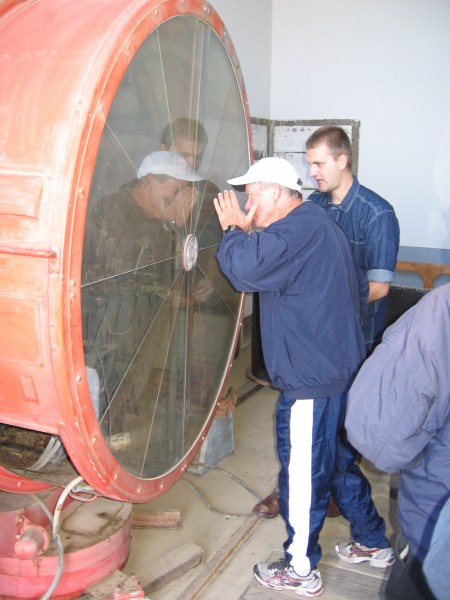
Inside the small structure we look at the huge wartime spotlight.
My camera’s flash brightly illuminated the old spotlight inside.
Further down the trail is the spotlight’s generator building.
Now we’ve walked down to the electrical generator building–really just two small empty rooms. Usually these structures are closed to the public.
Rounding a corner of the sandstone cliff San Diego comes into view.
The group turned back, but I walked on…
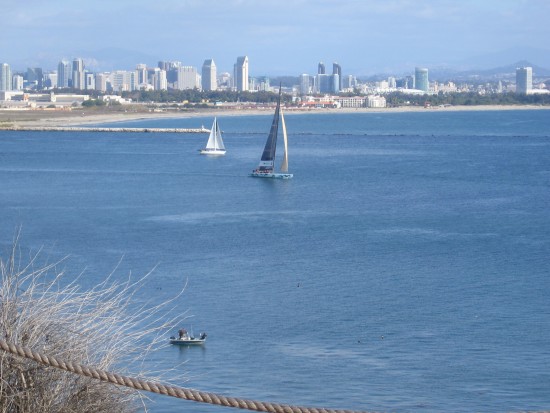
America’s Cup boat Abracadabra sails down the San Diego channel.
And I was rewarded with this view. Having lived in San Diego a good many years, I recognized the large sailboat leaving San Diego Bay. It’s the Abracadabra, a boat used in a past America’s Cup. I also spotted the Stars and Stripes, just out of this picture.
Beyond downtown San Diego I could see numerous mountains, from Cuyamaca on down to Otay. When it snows in the mountains, San Diego has a snow-capped backdrop viewed from here!
One last fond look at the beautiful Cabrillo National Monument lighthouse.
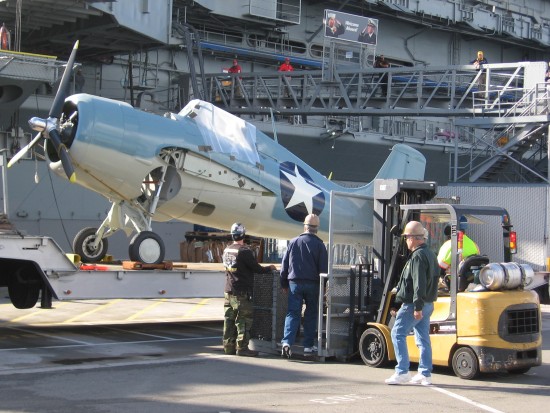
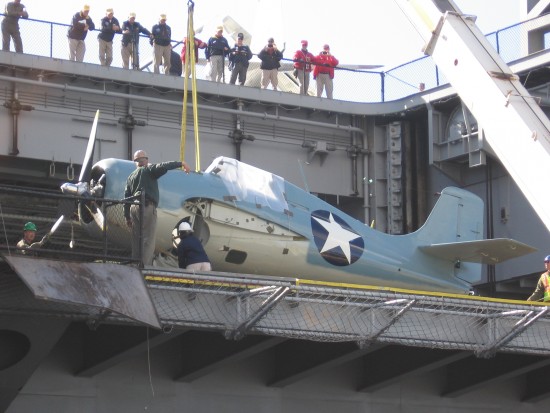
Every so often a new plane is added to the Midway Museum collection. The historic aircraft carrier USS Midway, active from 1945 to 1992, now has a couple dozen restored airplanes among its exhibits. Today the latest addition was hoisted up onto the dockside elevator by crane from the pier below! I was there to snap a few cool pics!
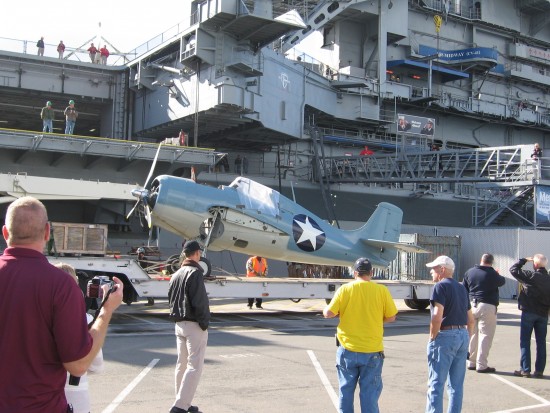
The last time I saw an airplane brought over from North Island, where the restorations take place, it was by barge. So I was surprised this time when a plane arrived on the back of a truck. This F4F Wildcat is a specimen of the small carrier-based fighter that helped to win the Battle of Midway during World War II. This particular plane was salvaged from the bottom of Lake Michigan. Restoration in a special hangar at Naval Air Station North Island, across San Diego Bay, took three years. You’ll notice the wings are missing from the fuselage. They came in on a second truck!
The first photo shows the Wildcat arriving on the opposite side of Navy pier.
Historic airplane transported by truck to USS Midway.
The truck has pulled alongside USS Midway’s dockside elevator, which is lowered and ready to receive the new exhibit.
Preparing to lift Wildcat onto USS Midway’s elevator.
A small crane waits off to the left to lift the airplane. Here we see some preliminary preparations.
Crane begins to lift F4F Wildcat onto USS Midway.
Up it goes! Everybody was extremely careful that no mishaps occurred!
Aircraft is placed on USS Midway while people watch from flight deck.
And finally the F4F Wildcat is aboard its new home! This plane will be part of a three dimensional theater exhibit called Battle of Midway Experience. I can’t wait to see it!
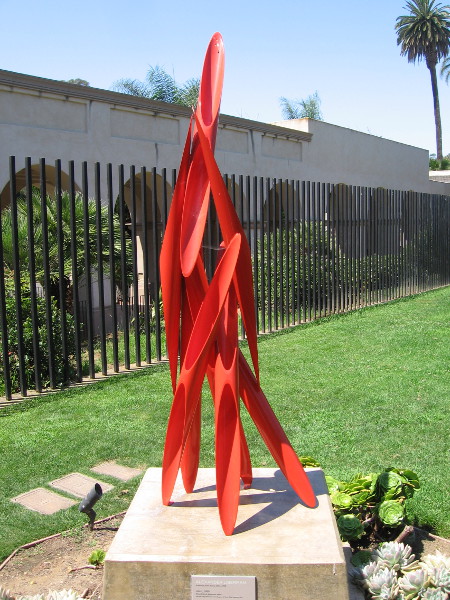
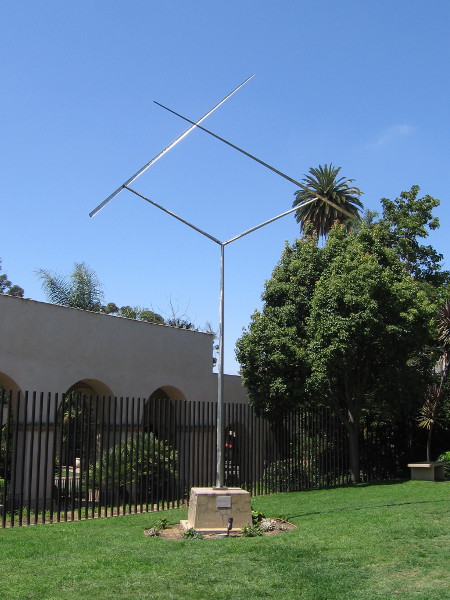
An opening in a fence near Balboa Park’s theatre complex leads back south into the San Diego Museum of Art’s grassy Sculpture Garden. Step through with me!
After slowly crossing the outdoor space, gazing at interesting, often organic abstract artwork, we pause in the shade of the Sculpture Court and turn back for a photo. Here it is!
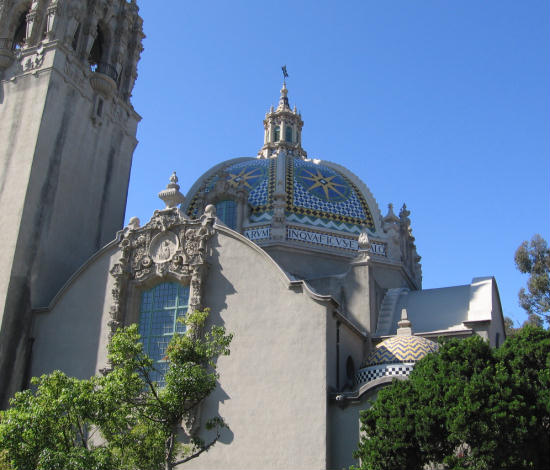
In the background, you can see the Museum of Man’s colorful dome and the California Tower. Behind us is an open air cafe.
UPDATE! Here are more photos that I took during various future visits!
California Tower high in the blue sky behind unusual, thought-provoking art.
Aim I, Alexander Liberman, 1980. Biased sliced aluminum tubes.
Cubi XV, David Smith, 1964-64. Stainless steel.
Two Lines Oblique: San Diego, George Rickey, 1993. Stainless steel.
These interesting abstract sculptures are free to view in Balboa Park.
Figure for Landscape, Barbara Hepworth, 1960. Bronze.
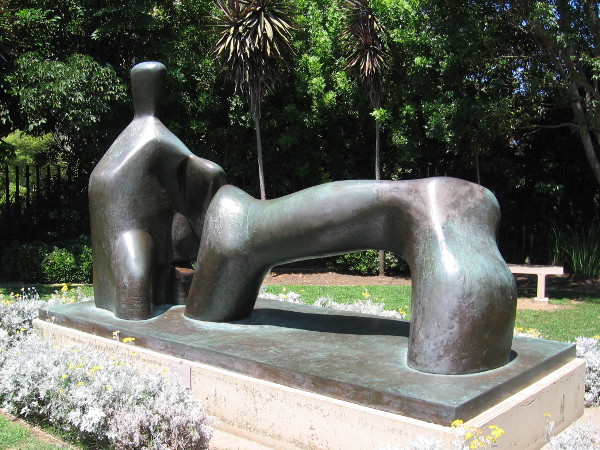
Reclining Figure: Arch Leg, Henry Moore, 1969. Bronze.
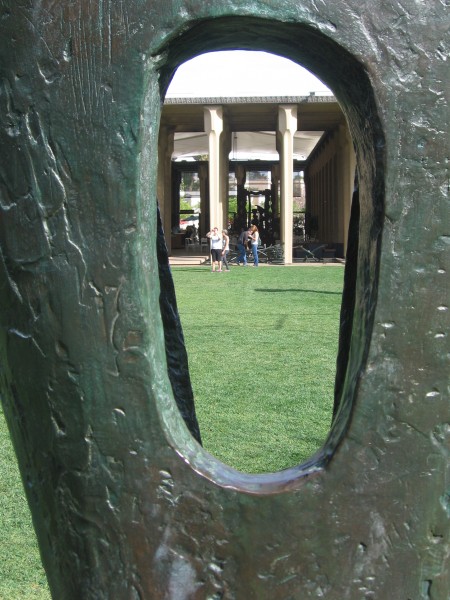
Peeking through one sculpture back across the lawn.
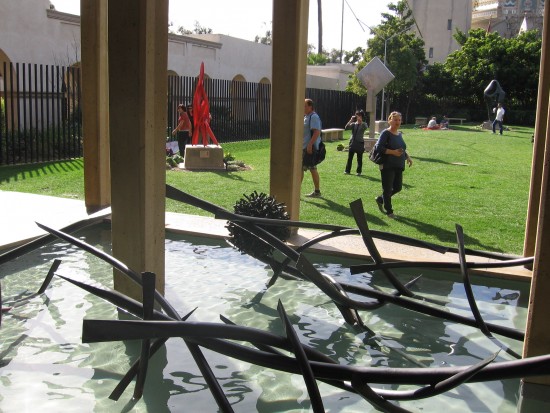
Another view of the Sculpture Garden on a day with lots of people about. In this shallow pool is Accelerated Point, made of copper, by artist Claire Falkenstein.
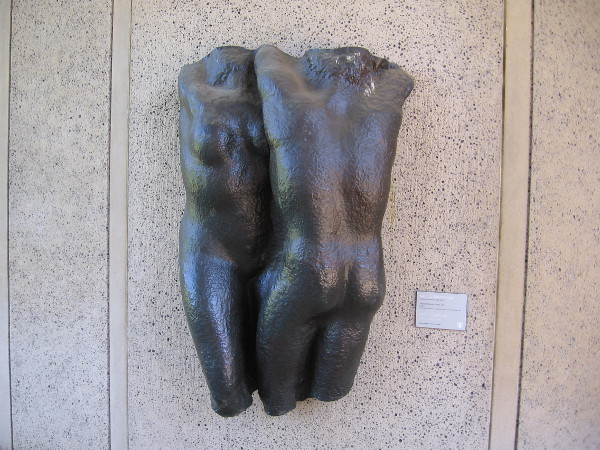
Turning to the north, we see more artwork in the Sculpture Court.
Sonata Primitive, Saul L. Baizerman, 1940-48. Copper.
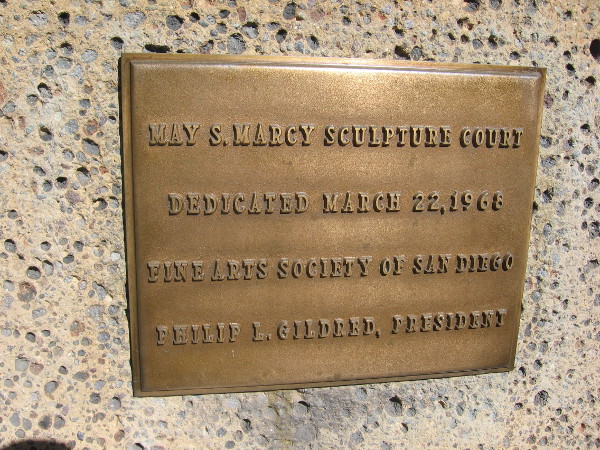
The May S. Marcy Sculpture Court was dedicated in 1968.
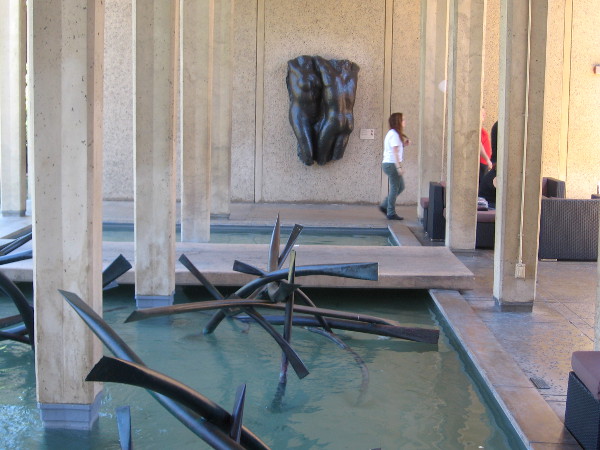
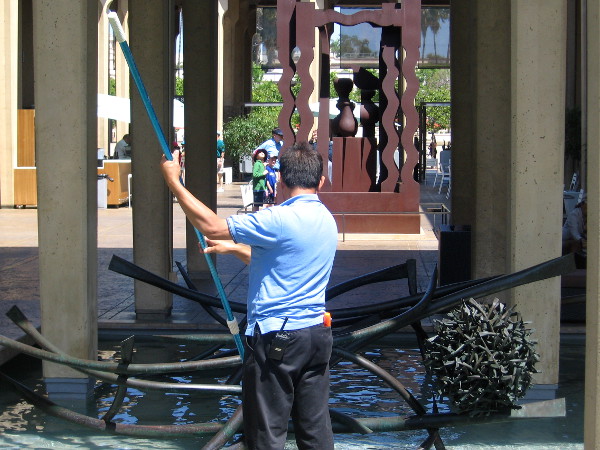
Man cleans small pool containing fascinating art.
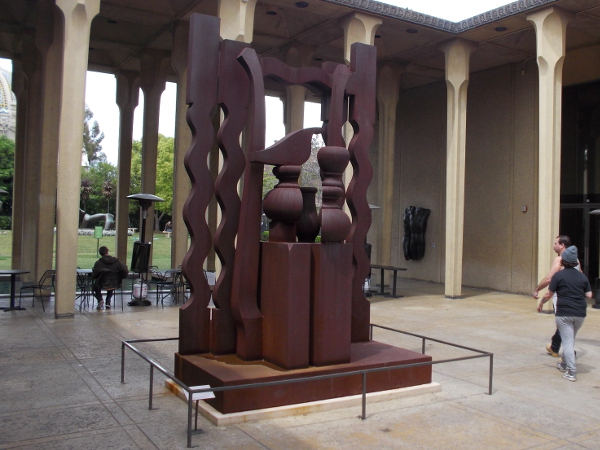
This sculpture is titled Night Presence II, 1976, by artist Louise Nevelson.
The cafe in San Diego Museum of Art’s unique Sculpture Court.
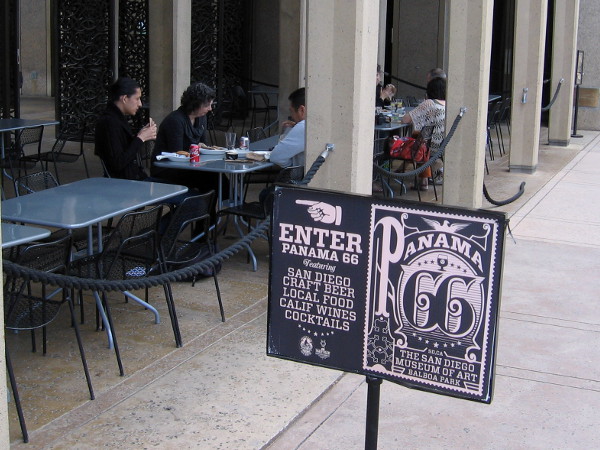
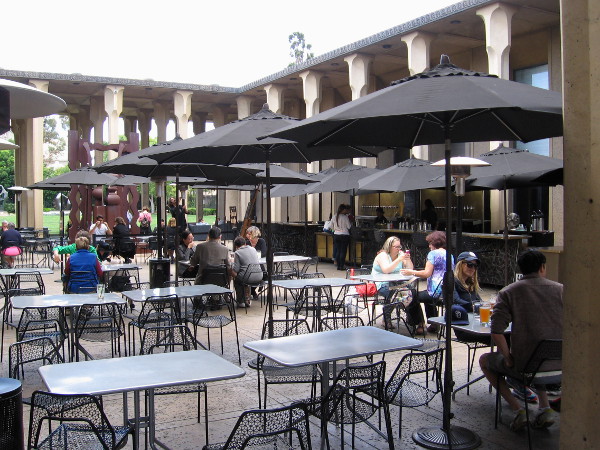
Here come two bonus pics taken in early 2015! A cool new eatery, Panama 66, has been operating now for many months in the Sculpture Court…
Sign directs people to Panama 66 in Balboa Park.
Diners enjoy Panama 66 food and refreshment in the Sculpture Court of the San Diego Museum of Art.
…
I live in downtown San Diego and love to walk around with my camera! You can follow Cool San Diego Sights via Facebook or Twitter!
You can easily explore Cool San Diego Sights by using the search box on my blog’s sidebar. Or click a tag! There are thousands upon thousands of fun photos for you to share and enjoy!
Here comes the famous Old Globe Theatre into view! It’s the round Tudor-style building there on the left. More about it in my next blog post…
Turning for a moment to the left, we see the east side of the Museum of Man’s colorful dome and the picturesque California Tower.
A pleasant nook below with benches. That’s the Craig Noel Garden, named after the Old Globe Theatre’s founding director. This is a great place to take a rest, or read a book!
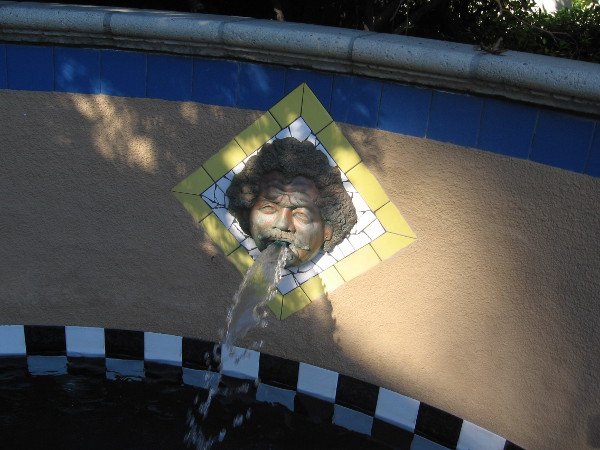
Water splashes from face in fountain at west end of the Craig Noel Garden.
Plaque explains how Craig Noel helped to found the Old Globe Theatre.
Passage by Museum of Man leads back toward El Prado.






















































 Cool San Diego Sights!