San Diego history: World War II and the Tuna Fleet.

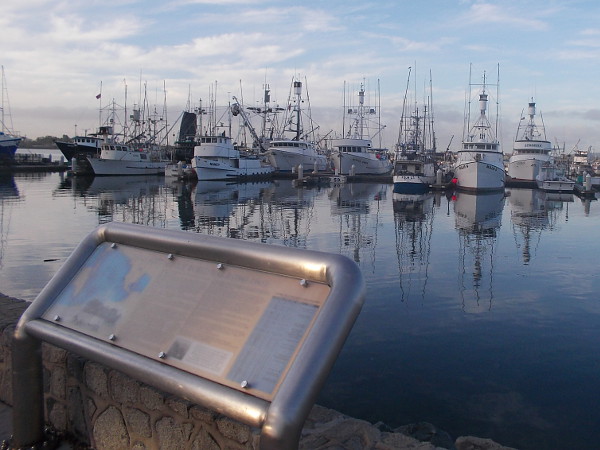
Information sign beside Tuna Harbor, in downtown San Diego, describes how local tuna boats were utilized in the Pacific Ocean theater of World War II.

Some fascinating historical information can be found on San Diego’s Embarcadero, right next to Tuna Harbor where many commercial fishing boats dock downtown. The sign, erected by the San Diego Port Commission in 2008, is titled Tuna Fleet Service World War II (1941-1945). It provides a glimpse of how dozens of San Diego-based Tuna Clippers joined the American war effort during the Second World War.

Here is the text on the sign:

During World War II, 600 fishing vessels were taken by the Navy, Army, and Coast Guard, including 52 “Tuna Clippers”.

On Pearl Harbor Day, the U.S. canned tuna industry was located almost exclusively in Southern California, and canners received most of their tunas from “baitboats”. Fishermen on these boats chum live bait (sardines, anchovies) to attract the tunas into a feeding frenzy and then use rigged bamboo poles to pull the hooked tunas aboard. Dating from 1924, a fleet of large “baitboats” was developed and became know as “Tuna Clippers”. These large ships, equipped with powerful diesel engines and newly developed brine refrigeration, fished for tunas found migrating thousands of miles from San Diego on trips of 90 days or more. During the 1930s, this San Diego high seas fleet was studies by the U.S. Navy, resulting in wartime plans that included the conversion of Tuna Clippers to minesweepers.

At the time Pearl Harbor was attacked, there were 90 vessels in the California baitboat fleet, including 76 Tuna Clippers plus 3 under construction. The 49 Tuna Clippers taken by the Navy and 3 by the Army represented about 55% of the fish carrying capacity of the entire baitboat fleet.

After war was declared, the Government ordered the Tuna Fleet to make port in California or Panama. Ten of the Tuna Clippers entering the Canal Zone in December 1941, were immediately taken for temporary patrol duty. The U.S. Army took three Clippers for use in the Panama Sea region, the SHASTA and CAPE HORN as tugs and the INVADER as a supply ship.

On February 16, 1942, tuna fishermen attended a meeting conducted by Commander W. J. Morcott, USN (Ret.) at the Naval Reserve Armory. 600 tuna fishermen signed up, with Skippers and Engineers receiving warrant ratings, and others given petty officer ratings according to age and experience. Within 10 days, a fleet of 16 Tuna Clippers, painted gray and marked with YP number designations as Yard Patrol vessels, left San Diego harbor on February 25, 1942. Their destination was the “Panama Sea Frontier” for picket duty to protect the Canal.

In May 1942, a convoy of six YP Clippers left San Diego for the “Hawaiian Sea Frontier”. These YPs transported supplies to French Frigate Shoals, the islands of Midway, Johnston, Fanning, Christmas, Palmyra, and Canton. In June 1942, seven YP Clippers left San Diego, for service at Efate Island or Samoa, or Auckland, New Zealand. In November 1942, another group of five headed for the U.S. Naval base at Tutuilla, Samoa. As the conflict moved towards Japan, YP Tuna Clippers were sent on missions to other Islands and Atolls of the Western Pacific.

The Navy discovered that “Yippies” were able to transport troops, gasoline, ammunition, and refrigerated cargoes and capable of navigation within shallow atolls and over minefields, of towing damaged warships, and rescuing downed pilots. This is why “Yippies” were also called the “Pork Chop Express” or “Errand Boys of the Pacific” or the “Solomon Island Ferry”. During the Solomon Island Campaign in 1942, the PARAMOUNT (YP 289) and the PICOROTO (YP 290) delivered frozen turkeys and all the fixings for a traditional holiday feast at Guadalcanal Island. In 1943, frozen turkeys were also delivered to the Marines fighting on Bougainville in time for Thanksgiving by the AMERICAN BEAUTY (YP-514).

“Yippies” were equipped with CW radios, fathometers, Navy radar and Navy sonar. Armament included machineguns, and other gun gear to fire Depth charges. The YP crew of tuna fishermen and regular Navy ran from 4 to 20 men.

Two YPs were destroyed in the Solomon Islands campaign by enemy surface ships: On 9 September 1942, off Tulagi Island, the PROSPECT (YP-346), and on 25 October 1942, off Guadalcanal Island, the ENDEAVOR (YP-284). The number of casualties sustained is unknown.

Two YPs were lost in the Midway region: On 23 May 1942, the TRIUNFO (YP 277) was destroyed by fire and explosions enroute to French Frigate Shoals (North of Hawaii), and then scuttled to avoid enemy capture. Only two crewmembers survived. During October 1942, the YANKEE (YP-345), with 17 crewmembers, on a voyage from Pearl Harbor to Midway Island via French Frigate Shoals, was “lost without a trace from causes unknown”.

Four YPs were lost at sea: CALIFORNIA (YP-235) on 1 April 1943, after fire and beaching in the Gulf of Mexico from an explosion of undetermined origin; NAVIGATOR (YP-279), 5 September 1943, foundered in heavy weather enroute to Townsville, Australia; CAPE SAN VINCENT (YP-280), on 24 April 1946, sank near Saipan Island; SAN SALVADOR (YP-281) on 9 January 1944, was destroyed after the foundering in Force 9 storm, with crew of 19 and one dog rescued, near Wallis Island, South Pacific. After transfer to the U.S. Army in July, 1943 the SEA TERN (ex YP-269) was lost at sea off Baja California.

Three YPs were destroyed during October 1945, because of a typhoon off Okinawa: PARAMOUNT (YP-289); CONTE GRANDE (YP-520) and CHALLENGER (YP-239).

The Navy destroyed 7 YPs after the War during 1946 and 1947: AMERICAN VOYAGER (YP-287), CIPANGO (YP-504), EUROPA (YP-236), FALCOM (YP-515), QUEEN AMELIA (YP-516), QUEEN ELIZABETH (YP-519), and YVONNE LOUISE (YP-282).

The successful wartime experience of the “Yippies” caused the Navy to build 30 wood-hull vessels patterned on the Tuna Clipper design. Each of 30 newly constructed wood hull Navy YPs was of 128 in length, of 14 feet draft, and powered with a 500 H.P. diesel main engine. They were built during 1945, two each by 15 different shipyards located in California, Oregon, and Washington.

Commencing in 1947, 24 of these YPs were added to the U.S. Tuna Fleet.

After the war, the Navy and Army transferred 33 surviving former Tuna Clippers to the War Shipping Administration (WSA) for buy-back by the previous owners. Three of these surviving vessels never returned to the U.S. tuna fishery: CABRILLO, FISHERMAN II, AND THEODORE FOSS.

Additional information on the sign:

Tuna clippers joined the navy too and were painted a dull slate grey, while the stalwart Portuguese descendants learned to fire the guns that were mounted upon the deck. Equipped with the finest refrigeration systems, these trim craft became “errand boys” of the Pacific, delivering food and fuel to the fronts. One day these tunaboats will be convoying a fleet of small ships to Panama. Next month, perhaps, they’ll be off to Midway Island with gasoline for navy PBYs. Two months later, they’ll be down in the Solomons running the “milk route” between Guadalcanal and Tulagi with supplies – part of the saga of men and boats.

excerpt from San Diego Union
July 23, 1943

Scores of converted tuna clippers slipped out of San Diego bay on their way to do valiant work in Pacific battle areas. First boats sailed from here Feb. 25, 1942. These small, sturdy diesel-powered boats are ideal for convoying and patrolling as well as for transporting needed war supplies to defeat the Japanese.

excerpt from San Diego Union
July 23, 1943

Today's commercial fishing fleet in San Diego includes picturesque boats that provide fresh seafood for restaurants and a Saturday dockside market.
Today’s commercial fishing fleet in San Diego includes picturesque boats that provide fresh seafood for restaurants and a Saturday dockside market. (The USS Midway aircraft carrier, now a popular museum) is visible in the background of this photograph.)
Someone walking down the Embarcadero near Tuna Harbor pauses to read a bit of fascinating information concerning the Second World War.
Left part of the sign depicts map of the Pacific theater of World War II in relation to San Diego. Pictured are some vessels that participated.
A detailed description of how the local Tuna Fleet served valiantly during World War II.
A detailed description of how the local Tuna Fleet served in various capacities during World War II.
California Tuna Clippers: Military Service World War II. (Click the image to enlarge.)
Commercial fishing vessel Dalena in San Diego's present-day Tuna Harbor.
Commercial fishing vessel Dalena in San Diego’s present-day Tuna Harbor.

I live in downtown San Diego and love to walk! You can follow Cool San Diego Sights via Facebook or Twitter!

You can easily explore Cool San Diego Sights by using the search box on my blog’s sidebar. Or click a tag! There are thousands upon thousands of unique photos for you to enjoy!
Helping veterans heal through creative art.

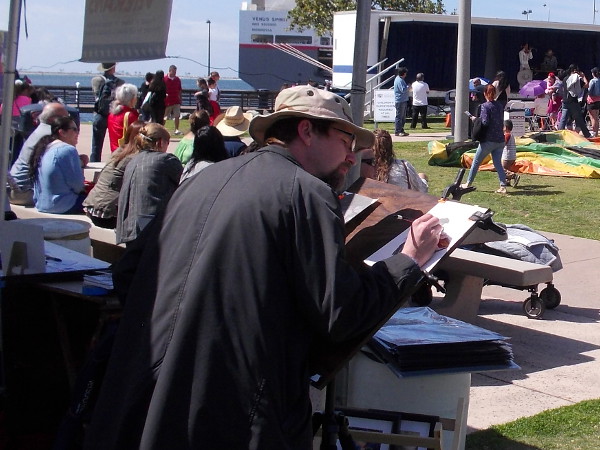
A U.S. military veteran creates art while watching folklorico dancing at a popular festival in San Diego's South Bay.
A U.S. military veteran creates art while watching folklorico dancing at a popular festival in San Diego’s South Bay.

Today I met Anthony A. LoBue for the second time. With a great big smile, he was manning his Arts For Veterans tent at the International Mariachi Festival and Competition in National City. (I chatted briefly with him once before at the Spreckels Organ Pavilion, during a special concert raising funds for Operation Rebound.)

“Tony the Vet” helps other veterans heal through creative art. He’s the founder of Support Our Veterans Association and the Arts for Veterans Project. The latter organization’s purpose is to: Engage, Educate, Employ and Empower Veterans in the Creative Arts. He provides art classes for military veterans at the Veterans Museum in Balboa Park, Veterans Village, and other places where healing, hope, wholeness and art education are welcome.

He believes the healing power of art dramatically changes lives. It’s an enormous benefit for those returning from war with psychological trauma. Art provides connection, joy, self-empowerment. Art literally saves lives.

Tony has a huge positive vision. He wants to expand his Arts for Veterans program so that it might benefit as many people as possible.

Would you please visit his website and see it you can help in some way?

Art heals. Art provides joy, connection, hope. Art helps to give life meaning and purpose.

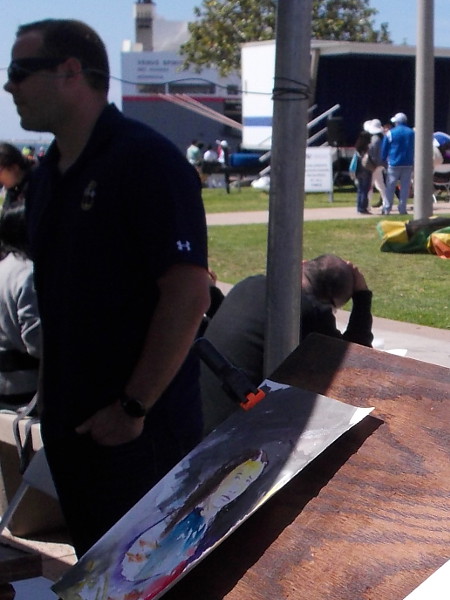
Brian Meyer was painting at the Arts For Veterans tent. I spoke to him. He’s a veteran of Desert Storm. He’s a super guy and deeply thoughtful. And his watercolors are amazing. That’s a glimpse of a work-in-progress above.  He frequently paints the live musicians at Panama 66 next to the San Diego Museum of Art. Please check out his website!

Hand-drawn art cards with hearts and flags thank service members for their sacrifice.
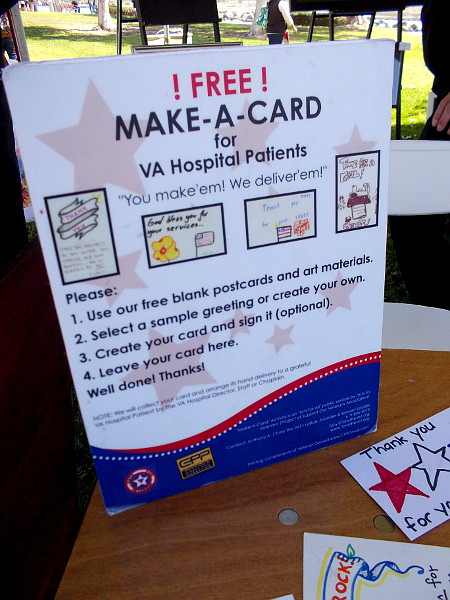
People at the International Mariachi Festival and Competition in National City were making special greeting cards for patients at the VA Hospital.
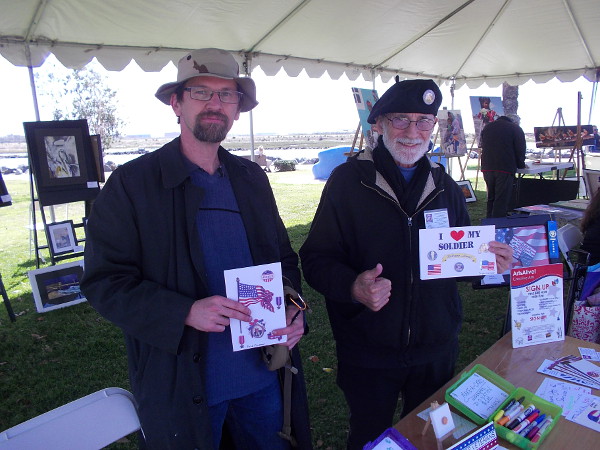
Gifted watercolor painter Brian Meyer and Anthony A. LoBue of Arts For Veterans.
Gifted watercolor painter Brian Meyer, and Anthony A. LoBue of Arts For Veterans.

I live in downtown San Diego and love to walk! You can follow Cool San Diego Sights via Facebook or Twitter!

Are you a blogger? Do you want to make the world a better place? Please join Bloggers Lifting Others Generously.

Horse therapy helps veterans recover from trauma.

The Pegasus Rising Project, based in San Diego County, assists U.S. military personnel recovering from Post-Traumatic Stress Disorder and Traumatic Brain Injury.

Every year, Pegasus Rising works to heal around 1000 veterans suffering from trauma. The San Diego County-based organization uses horse therapy to help U.S. military personnel recover and return to civilian life after experiencing Post-Traumatic Stress Disorder or Traumatic Brain Injury.

Today, in Balboa Park, a fundraiser was held in conjunction with a special New Year’s Day concert at the Spreckels Organ Pavilion. A good crowd turned out to learn about this very important organization.

Pegasus Rising’s small herd is comprised of Polish Arabians, who were themselves rescued. The descendants of champion horses, they had been found suffering from severe neglect. The full story can be read here. Amazingly, one of the horses “was a descendant of the great stallion Lotnik, who had been imported previously by General Patton.”

While everyone at Pegasus Rising is a volunteer, caring for and feeding horses requires money. Perhaps you or someone you know can help out. Please click on their website to donate, or learn more about their fascinating, inspiring story.

A special fundraiser for Pegasus Rising was held on New Year's Day at the Spreckels Organ Pavilion during the afternoon concert. Jay the friendly horse was present.
A special fundraiser for Pegasus Rising was held on New Year’s Day at the Spreckels Organ Pavilion, during the afternoon concert. Jay the friendly horse was present.
Please visit the Pegasus Rising website. You can find out how you can help this worthy organization as it helps to heal a thousand veterans each year.
Please visit the Pegasus Rising website. You can find out how you can assist this worthy organization as it helps to heal a thousand veterans every year.
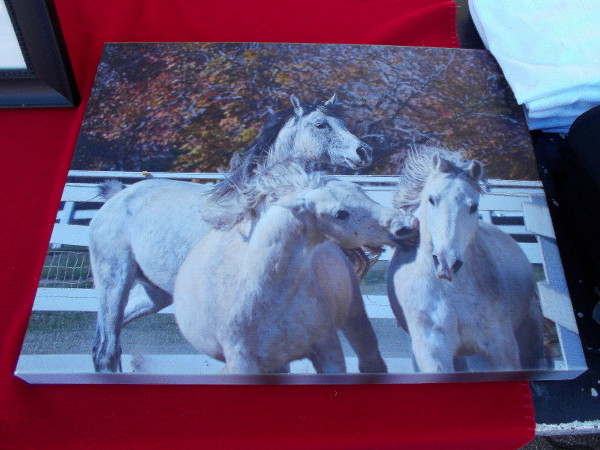
An image of three Polish Arabian rescue horses in the herd at Pegasus Rising. Horse therapy greatly helps humans recover from trauma.
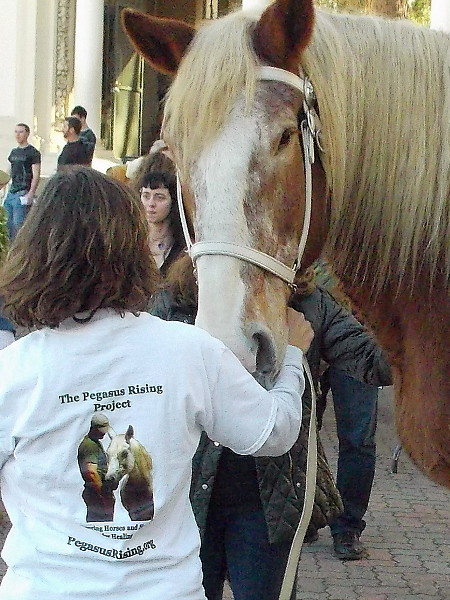
Jay the kindly Belgian draft horse and a volunteer from Pegasus Rising, on a beautiful day in Balboa Park.
Jay, the kindly Belgian draft horse ambassador, and a volunteer from Pegasus Rising, on a beautiful day in Balboa Park.

Join me for more cool sights on Facebook and Twitter!

Are you a blogger? Do you want to make the world a better place? Please join Bloggers Lifting Others Generously.

Veteran’s Day celebrated in Balboa Park.

Getting ready for the Veteran's Day Memorial Program at the House of USA Cottage in Balboa Park.
Getting ready for the Veteran’s Day Memorial Program at the House of USA Cottage in Balboa Park.

Today I enjoyed a special Veteran’s Day program in Balboa Park. It was held on the lawn at the House of Pacific Relations International Cottages. The City Guard Band of San Diego played some great music, including a composition titled San Diego Exposition March, written by Gunner Tolbert for the 1915 Panama-California Exposition held in Balboa Park. Some other pieces I heard were selections from South Pacific, Victory at Sea, and, of course, the Star Spangled Banner.

I took a number of photos, and ventured into the House of USA Cottage to absorb some of the atmosphere. I thought you’d might like to have a look. Please read the captions for some more interesting information.

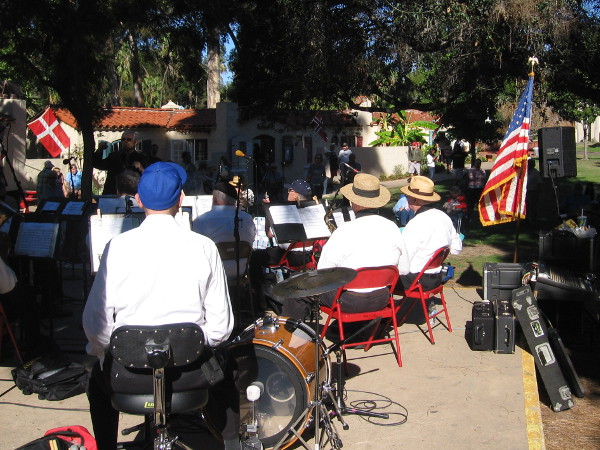
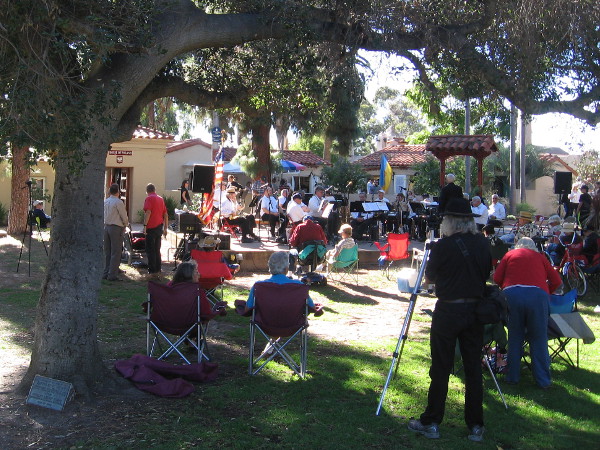
The band is ready to play as people gather around the stage in the lawn area of the International Cottages. It's a Sunday afternoon in San Diego's beautiful Balboa Park.
The band is ready to play as people gather around the stage in the lawn area of the International Cottages. It’s a Sunday afternoon in San Diego’s beautiful Balboa Park.
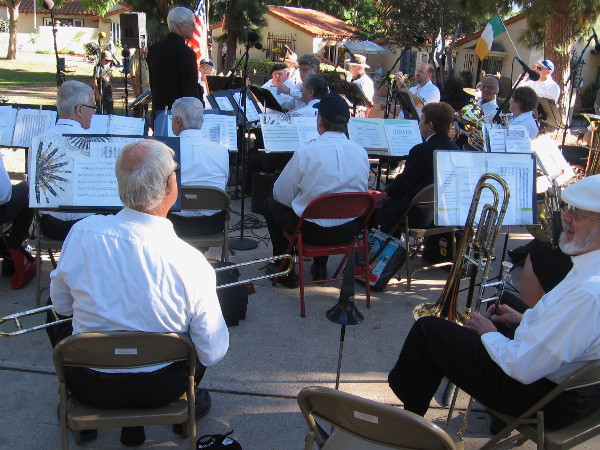
City Guard Band of San Diego plays during a special Veteran's Day program. The band originated in 1880, when members were part of a local volunteer militia.
City Guard Band of San Diego plays during a special Veteran’s Day program. The band originated in 1880, when members were part of a local volunteer militia.
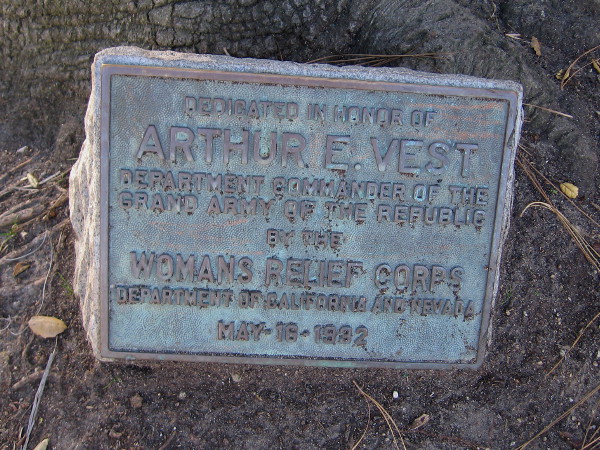
Old plaque at base of large tree in the middle of the surrounding cottages. Dedicated in honor of Arthur E. Vest, Department Commander of the Grand Army of the Republic.
Old plaque at base of large tree near the center of the surrounding cottages. Dedicated in honor of Arthur E. Vest, Department Commander of the Grand Army of the Republic.
A small Veteran's Day gathering in Balboa Park's friendly House of Pacific Relations International Cottages.
A relaxed Veteran’s Day gathering at Balboa Park’s peaceful House of Pacific Relations International Cottages.
Folks at a table in front of the House of USA Cottage listen to the band play patriotic and other popular tunes.
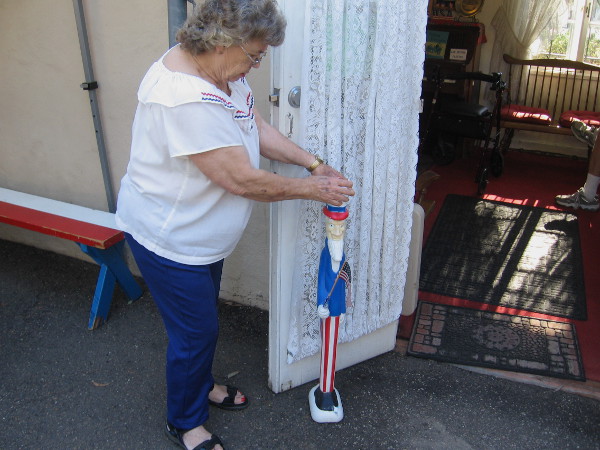
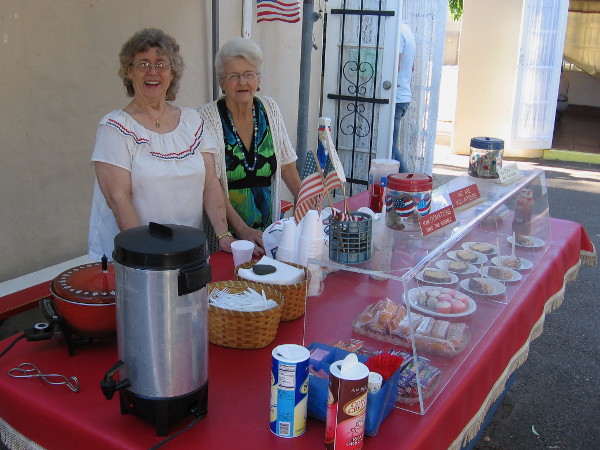
These fine ladies smiled for my camera! Those treats on the table are well known to this blogger!
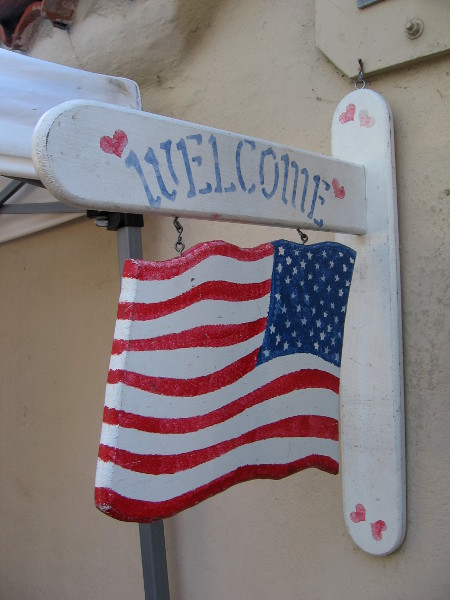
American flag and a Welcome at the front door of the USA cottage in Balboa Park.
Inside the USA cottage. Welcome home all the brave men and women of the United States Armed Forces.
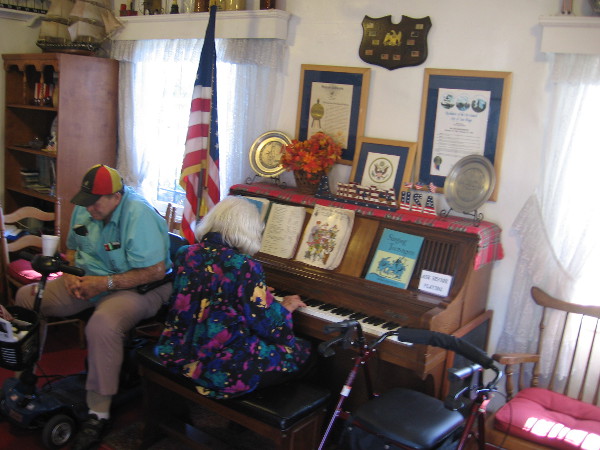
Famous portraits and memorabilia from American history cover walls and fill shelves in the House of USA Cottage.
Playing the piano for anyone who wanders in on another perfect sunny San Diego day. Someone was whistling nearby.
The Stars and Stripes and books concerning Americana.
The Stars and Stripes and various books celebrating Americana.
Playing joyful music, from marches to musicals, celebrating those who've served to protect our freedom.
Playing sparkling music, from marches to musicals, celebrating those who’ve served to protect our freedom.

Follow this blog for more photos of unique events! Join me on Facebook or Twitter.

Creating a plaque: Navy history in San Diego revealed!

Molten bronze is poured in the foundry of the USS Ajax. Historical photograph of the Navy Bicentennial Commemorative Plaque being created. Photo credit: United States Navy.

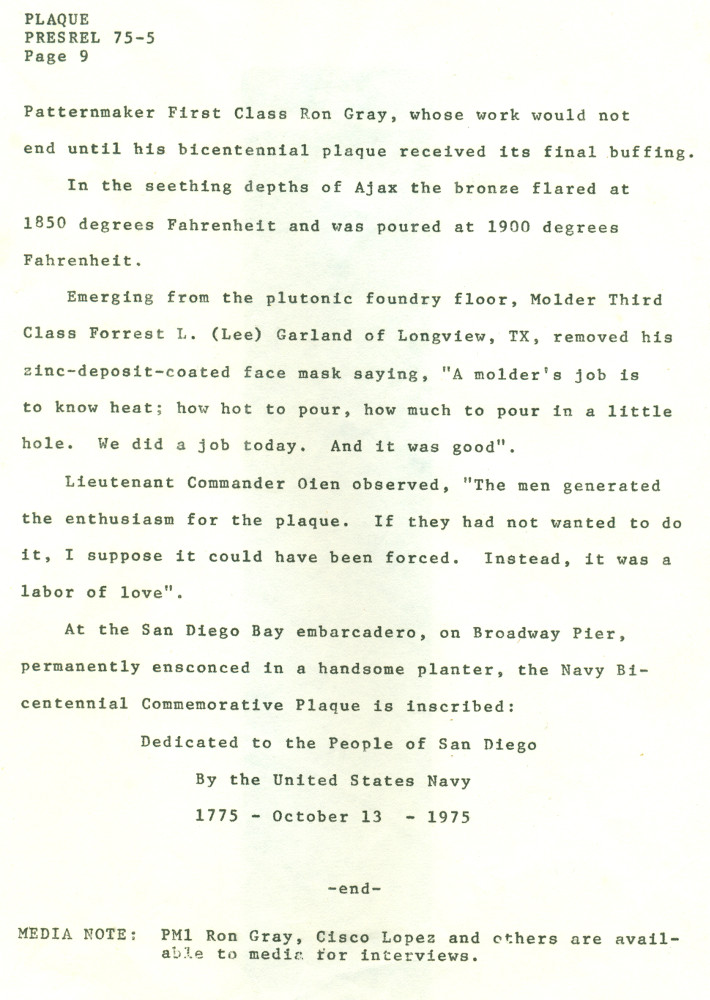
A few days ago I received new information about an important bronze plaque, which was created in 1975 to commemorate the United States Navy’s 200 year anniversary. The historic Navy Bicentennial Commemorative Plaque stands today on San Diego’s Embarcadero, on the Greatest Generation Walk next to the USS Midway Museum. Thousands of people breeze past it every day.

People pass the Navy Bicentennial Commemorative Plaque, displayed on San Diego's Embarcadero, on the Greatest Generation Walk near the USS Midway Museum. Photo taken October 17, 2015.
People pass the Navy Bicentennial Commemorative Plaque, displayed on the Greatest Generation Walk near the USS Midway Museum. Photo taken October 17, 2015.
Photo of Navy 200 year commemoration plaque courtesy the Port of San Diego.

When I first saw the old plaque, I could find absolutely nothing about it on the internet. So I originally posted this blog. As new information trickled in–sometimes out of the blue–I posted this and this.

I was recently contacted by one of the plaque’s creators. He has provided detailed information about its history, including three amazing photographs and nine scans of a typed News Release from 40 years ago. The text of the News Release does not appear online, so I carefully transcribed the words. That way a very important bit of San Diego and Navy history won’t be lost.

(I tried to transcribe exactly, including possible misspellings. I’m not certain about the spelling of some names in the photo captions.)

If you know more about this plaque and would like to add some information, please leave a comment below. If you’d like to contact me, but don’t want to have your comment published, then please tell me that and I’ll email you.

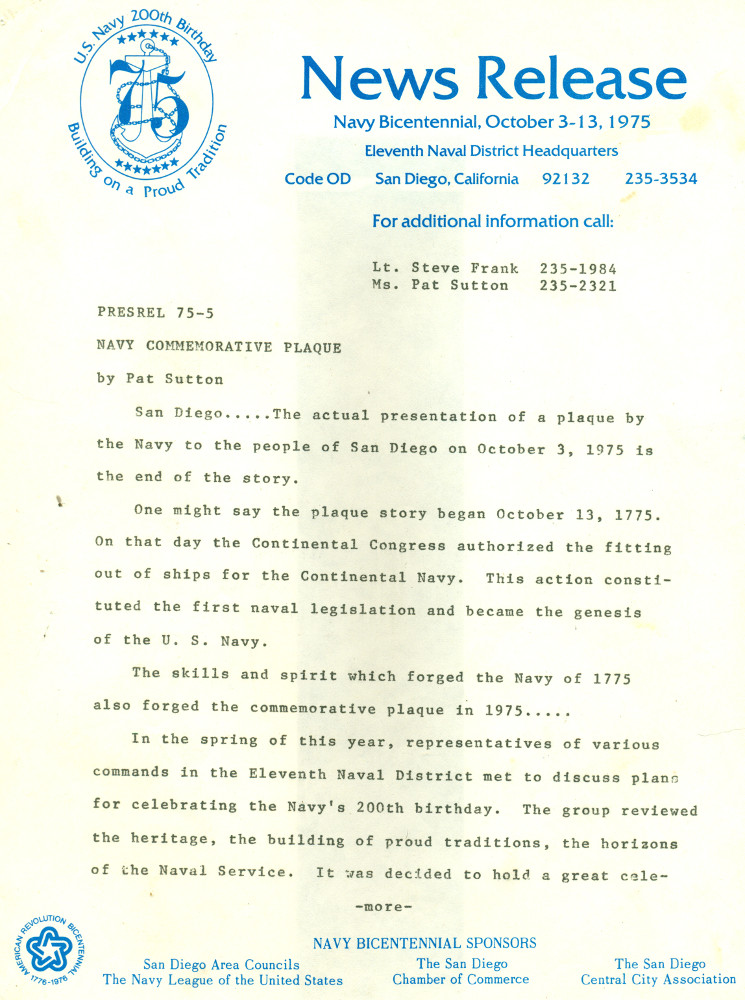
Navy Commemorative Plaque News Release. Navy Bicentennial, October 3-13, 1975. Page 1.

NAVY COMMEMORATIVE PLAQUE

by Pat Sutton

San Diego . . . . . The actual presentation of a plaque by the Navy to the people of San Diego on October 3, 1975 is the end of the story.

One might say the plaque story began October 13, 1775. On that day the Continental Congress authorized the fitting out of ships for the Continental Navy. This action constituted the first naval legislation and became the genesis of the U. S. Navy.

The skills and spirit which forged the Navy of 1775 also forged the commemorative plaque in 1975 . . . . .

In the spring of this year, representatives of various commands in the Eleventh Naval District met to discuss plans for celebrating the Navy’s 200th birthday. The group reviewed the heritage, the building of proud traditions, the horizons of the Naval Service. It was decided to hold a great celebration

Navy Commemorative Plaque News Release. Navy Bicentennial, October 3-13, 1975. Page 2.

to honor the Navy, its members past and present, the nation and San Diego – so long a part of the life, the heritage and tradition of the Navy.

The plaque story developed in an uniquely traditional Navy way. The Navy’s microcosmic capabilities began to surface and swing into action.

Civilian Mrs. Jo Palm is the Visual Information Specialist for the Commander Naval Surface Force, Pacific. She also chaired the Navy Bicentennial exhibits committee. Jo conceived the idea that there should be some lasting remembrance of the occasion for the people of San Diego – perhaps a commemorative plaque would be appropriate.

Civilian Francisco (Cisco) Lopez is a designer with the General Atomic Company of San Diego. He is also a First Class Draftsman in the Navy Reserve. Tall, 28-years-old, Cisco is a 12-year Navyman, combining four years active duty with eight years in the Reserve. Last June he served his annual two weeks active duty in the Naval Surface Force Public Affairs graphics shop, reporting from his Reserve Unit with the Fleet Intelligence Center, Pacific.

“Jo told me her idea and we decided I should design something depicting 200 years of Navy history – along the lines of a plaque, but not like the usual plaque.”

Navy Commemorative Plaque News Release. Navy Bicentennial, October 3-13, 1975. Page 3.

Cisco was raised in San Francisco and has lived in San Diego the past five years. He graduated from San Francisco State and hopes eventually to be a research historian or teacher.

“I have almost a passion for history. I’m taking a month off work in June ’76, I’ll be in Philadelphia on the Fourth of July. As an armchair military historian I really relished the opportunity to be a part of today’s history by designing a representation of our Navy over a span of 200 years”.

At the suggestion of her student husband, Mel, Jo Palm went aboard Mel’s former ship, USS Ajax (AR-6), with Cisco’s drawing and the question, “Can you make it a reality?”

For a fleet repair ship like Ajax, “can” is a reality because she is designed for heavy duty hull repair; to provide a full range of repair services to Navy units in remote areas.

On her way to see the Repair Officer, Lieutenant Commander Harley M. Oien, Jo Palm passed through the Patternmaker/Carpenter Shop, remarkably clean despite the several huge saws rasping, whining and spewing sawdust. She was escorted through the Heavy Machine and Shipfitter’s shops where expert Navy operators can literally rebuild a whole ship.

Navy Commemorative Plaque News Release. Navy Bicentennial, October 3-13, 1975. Page 4.

Twelve-year Navy veteran, Chief Molder Marvin E. (Tex) Feasell of Baytown, TX, is in charge of the Ajax foundry. He recounts the meeting below decks in Mr. Oien’s office where he and a few key men, including Patternmaker First Class Ronald Gray, held a conference with Jo.

“We hashed, squabbled, explained our methods, discussed time frames, costs to the Bicentennial Birthday Fund, and most of all, the making of the pattern. That’s the critical area. That’s the make or break of the job”.

Tex Feazell learned his profession when he was sent to the Moulder “A” school right out of Boot Camp in 1963. He reported aboard Ajax in May 1974. He has a keen appreciation of the expertise of the Ajax crew, and a keen pride in its performance.

“We have one of the most hard charging crews in the fleet. The people are hard charging – hit it! Hit it! We wanted to show our skills. We wanted to make that plaque for the Navy and for San Diego. We didn’t know for over a week if we would get the job. It made us feel proud when we heard we were going to do it”.

And so the “make or break” responsibility of the Navy’s bicentennial birthday memento to San Diego was enthusiastically assumed by Patternmaker Ronald Gray, who applied his

Navy Commemorative Plaque News Release. Navy Bicentennial, October 3-13, 1975. Page 5.

Navy-learned skills to transform from drawing to working pattern the impression of 200 years of the United States Navy.

Ron has not always served in the time honored rate of Patternmaker. He joined the Navy shortly after he graduated from high school in Olympia, WA, and served his first hitch as a Commissaryman. A friend, appreciative of his carving hobby, suggested Ron reenlist under the Navy’s SCORE (Selective Conversion) program and be schooled as a Patternmaker.

Now, after 7 1/2 years in the Navy, 2 1/2 aboard Ajax, this craftsman laid the historical design out, carved his first figures in bas relief, glued them on board, then build up the other details. The pattern for the 30″ x 24″, 150 pound metal plaque would end up basically wood and plaster, however, the rope detail was real rope!

The Spirit of ’75, the hallmark of the Navy, nowhere better manifested itself than aboard the USS Ajax as the work progressed.

Patternmaker Third Class Roger Richie of Denver, CO, was a millman in civilian life and when he joined the Navy he wanted to be a carpenter. But at the time, there was no billet open at the carpenter school.

Navy Commemorative Plaque News Release. Navy Bicentennial, October 3-13, 1975. Page 6.

“Now I think I got lucky, because I was sent to Patternmaker’s School. There’s not too many of us in the Navy, or in the country, for that matter. So by what you might call a ‘freak accident’ I was here to help Ron on the plaque. There’s pride in this job”.

The Ajax Dental Department loaned Ron Gray tools for working on the intricate wax carvings, and a dental drill for final sanding. The ship’s Dental Officer, Commander Roger E. Bisson of Helena, MT, enjoys woodworking and asked to carve the plaque’s Navy aircraft with his precision instruments.

“We all want to contribute. Gray is so willing to share the glory with the team, even though he has done most of the work”, Bisson said.

Below the gleaming metal decks, at the very keel of Ajax on the concrete deck of the foundry, Molder First Class William McCoy of Coshocton, OH, and his men were ready. McCoy spent his first four years in the Navy as a destroyer torpedoman. Then for ten years he was a civilian molder. Unable to wash the salt from his veins, he returned to the Navy a year and a half ago.

McCoy described his work, “The molding art is fairly unchanged since the middle ages. We use primitive tools, primitive casting methods. A person with an understanding of the primitive makes an excellent molder”.

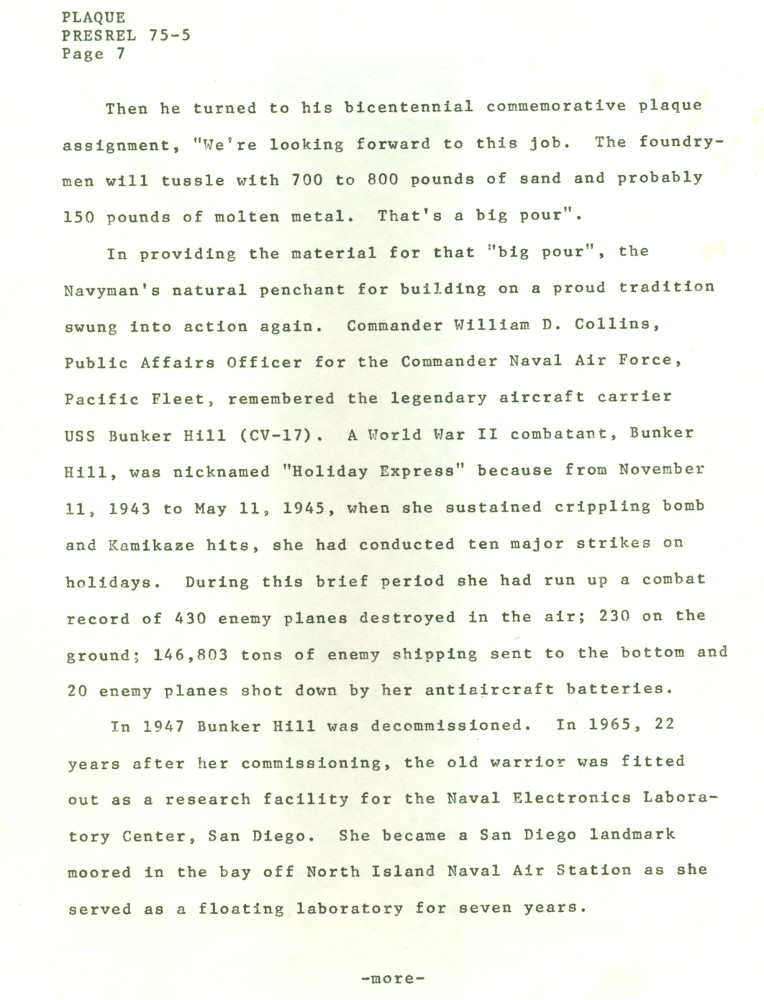
Navy Commemorative Plaque News Release. Navy Bicentennial, October 3-13, 1975. Page 7.

Then he turned to his bicentennial commemorative plaque assignment, “We’re looking forward to this job. The foundrymen will tussle with 700 to 800 pounds of sand and probably 150 pounds of molten metal. That’s a big pour”.

In providing the material for that “big pour”, the Navyman’s natural penchant for building on a proud tradition swung into action again. Commander William D. Collins, Public Affairs Officer for the Commander Naval Air Force, Pacific Fleet, remembered the legendary aircraft carrier USS Bunker Hill (CV-17). A World War II combatant, Bunker Hill, was nicknamed “Holiday Express” because from November 11, 1943 to May 11, 1945, when she sustained crippling bomb and Kamikaze hits, she had conducted ten major strikes on holidays. During this brief period she had run up a combat record of 430 enemy planes destroyed in the air; 230 on the ground; 146,803 tons of enemy shipping sent to the bottom and 20 enemy planes shot down by her antiaircraft batteries.

In 1947 Bunker Hill was decommissioned. In 1965, 22 years after her commissioning, the old warrior was fitted out as a research facility for the Naval Electronics Laboratory Center, San Diego. She became a San Diego landmark moored in the bay off North Island Naval Air Station as she served as a floating laboratory for seven years.

Navy Commemorative Plaque News Release. Navy Bicentennial, October 3-13, 1975. Page 8.

“The Bunker Hill was stripped of her brass and bronze fittings prior to her scraping in late 1972”, Commander Collins reported at a Bicentennial Committee meeting, “this was molded into ingots. Some of the ingots still remain and are stored at the Naval Station in Honolulu. We would be honored to have Bunker Hill permanently a part of San Diego. The Pacific Naval Air Force will provide her brass and bronze for the plaque”.

And so it was done.

In August Jo Palm called Cisco Lopez with the news that the plaque was to become a reality. Cisco told Jo of an uniquely Navy coincidence. “For my 1975 active duty tour I was stationed on Ajax! I designed ducting for ventilation of a spray booth. Great crew! I never expected to work with them again”.

On September tenth, after the sand had been rammed around the pattern and the pattern removed, leaving its historic impression (the negative), the excitement of expectancy on the Ajax foundry deck rose even as the metal of old Bunker Hill rose toward the proper temperature to pour.

Participants, both active and anticipating, ranged from Jo Palm and Cisco Lopez; Navy combat cameramen and photographers; to the molders, firemen, and as from the beginning,

Navy Commemorative Plaque News Release. Navy Bicentennial, October 3-13, 1975. Page 9.

Patternmaker First Class Ron Gray, whose work would not end until his bicentennial plaque received its final buffing.

In the seething depths of Ajax the bronze flared at 1850 degrees Fahrenheit and was poured at 1900 degrees Fahrenheit.

Emerging from the plutonic foundry floor, Molder Third Class Forrest L. (Lee) Garland of Longview, TX, removed his zinc-deposit-coated face mask saying, “A molder’s job is to know hear; how hot to pour, how much to pour in a little hole. We did a job today. And it was good.”

Lieutenant Commander Oien observed, “The men generated the enthusiasm for the plaque. If they had not wanted to do it, I suppose it could have been forced. Instead, it was a labor of love”.

At the San Diego Bay embarcadero, on Broadway Pier, permanently ensconced in a handsome planter, the Navy Bicentennial Commemorative Plaque is inscribed:

Dedicated to the People of San Diego

By the United States Navy

1775 – October 13 – 1975

Tex Feasell and Ron Gray with the first wood carving and the original drawing. Photo credit: United States Navy.
Tex Feazell and Ron Gray with the first wood carving and the original drawing. Photo credit: United States Navy.
Patternmaker Kevin O'Connor, Molder Jessie Lopez, Molder Lee Garland, Patternmaker Roger Richie, two unidentified Molders, Bill McCoy and Ron Gray. Photo credit: United States Navy.
Patternmaker Kevin O’Connor, Molder Jessie Lopez, Molder Lee Garland, Patternmaker Roger Richie, two unidentified Molders, Bill McCoy and Ron Gray. Photo credit: United States Navy.

Follow this blog for more amazing, unexpected discoveries! Join me on Facebook or Twitter.

USS Bennington Memorial Oak Grove in Balboa Park.

A beautiful live oak grove in Balboa Park honors men who died tragically on the USS Bennington in 1905.

Balboa Park is without a doubt one of America’s national treasures. Located just north of downtown San Diego, its 1,200 acres is the home of magnificent museums, gardens, architectural marvels, many recreational facilities and perhaps the world’s most famous zoo. The amazing urban park is so gigantic most visitors see only a small fraction of it. Some out-of-the-way corners of Balboa Park are enjoyed by locals who live nearby; other overlooked areas seem almost forgotten.

The USS Bennington Memorial Oak Grove is one such area. While many drive by it on any given day, as they travel along 26th Street just before it turns into Florida Drive, and a few joggers pass through the shady grove, I’d wager only a handful of San Diegans know of the oak grove’s existence or historical significance.

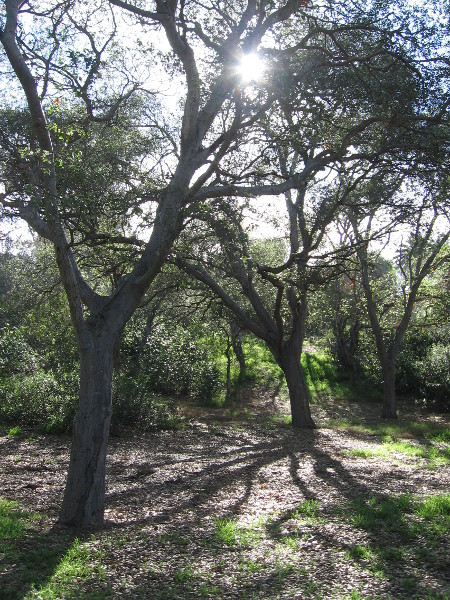
There are 66 live oak trees in this grove. They were planted to memorialize 66 men killed on the USS Bennington on the morning of July 21, 1905, when the gunboat’s boiler suddenly exploded and the ship nearly sank in San Diego’s harbor. No markers in the grove indicate the significance of the large gnarled oaks. (A 60 foot high granite obelisk stands at Fort Rosecrans National Cemetery in Point Loma, a memorial to those sailors who died on the USS Bennington. Most of the dead are buried there.)

The USS Bennington was a warship with a long and proud history. Commissioned in 1891, she was the ship that claimed Wake Island for the United States. After the boiler explosion in San Diego Bay, eleven men were awarded the Medal of Honor for extraordinary heroism.

Earlier this year, when I visited an exhibit in Balboa Park created by The Daughters of the American Revolution San Diego Chapter, I learned the local DAR would like to place plaques in the grove to memorialize the USS Bennington and the men who tragically died. If you, your business or organization would like information about the project, or to help, you might contact them from their page.  Should this project come to fruition, I’ll be very pleased to blog about it!

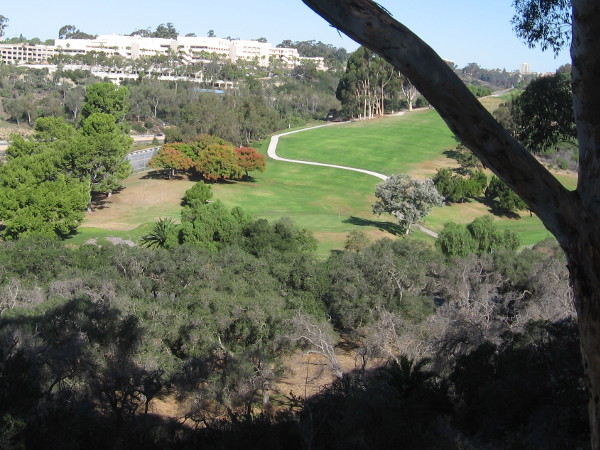
View of the Bennington Memorial Oak Grove from Golden Hill Park, located near the southeast corner of Balboa Park. The Balboa Park Golf Club and Naval Medical Center San Diego are also visible.
View of the Bennington Memorial Oak Grove from Golden Hill Park, located near Balboa Park’s southeast corner. Balboa Park’s public golf course and Naval Medical Center San Diego are also visible.
Wooden footbridge along 26th Street leads to a little-used trail through USS Bennington Memorial Oak Grove in Balboa Park.
Sixty large old oak trees memorialize 60 sailers killed in 1905 when the USS Bennington's boiler exploded in San Diego's nearby harbor.
Beautiful old oak trees memorialize 66 sailors killed in 1905 when the USS Bennington’s boiler exploded in San Diego’s nearby harbor.
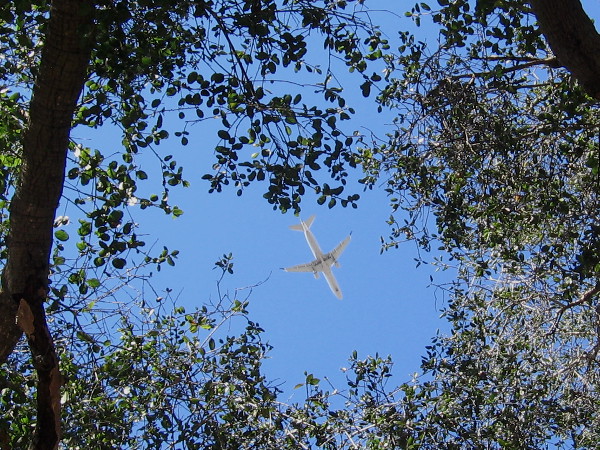
Looking up through the leaves of the live oak trees at blue sky and clouds.
These trees, honoring fallen men, remind us of a sudden tragic moment in San Diego history.
These trees, honoring fallen men, remind us of a sudden tragic moment in San Diego’s military history.
A commercial airplane flies overhead as it crosses Balboa Park heading in toward Lindbergh Field.
A jogger enjoys the shady old trees on a warm day in early October.

Follow this blog for more unique discoveries in San Diego! Join me on Facebook or Twitter.

Liberty Station Command Center’s historical exhibits.

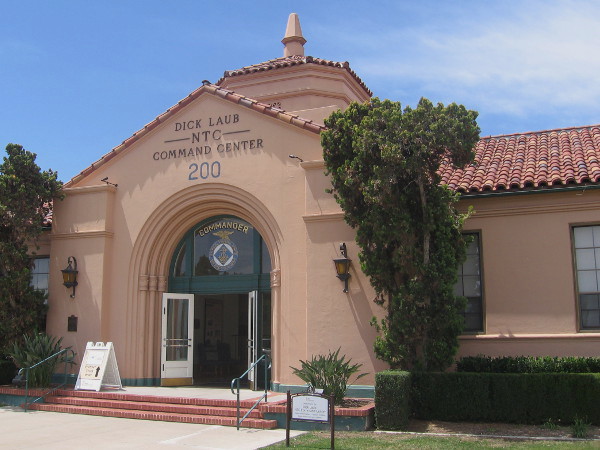
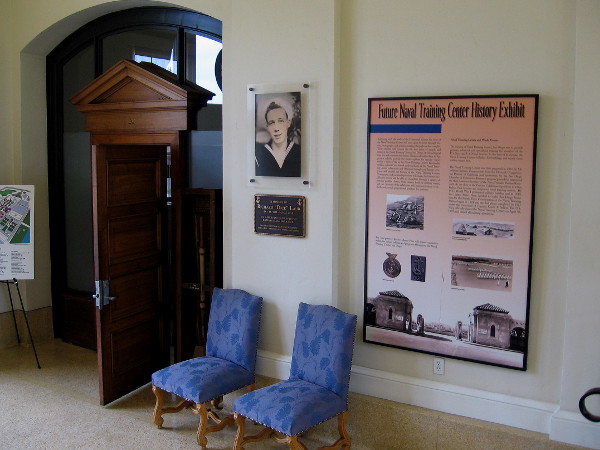
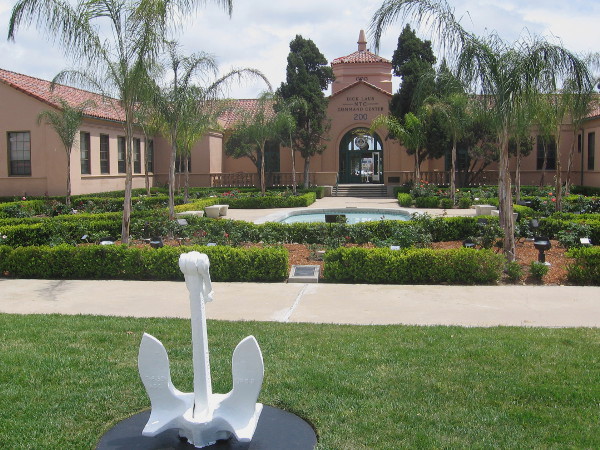
Historic Decatur Road entrance of Dick Laub NTC Command Center at Liberty Station in Point Loma.

Some time ago I visited the Command Center at NTC Liberty Station in Point Loma. Two interesting exhibits can be found along the main hallway that runs the length of the historic building. The Command Center was once the operational hub of former Naval Training Center San Diego.

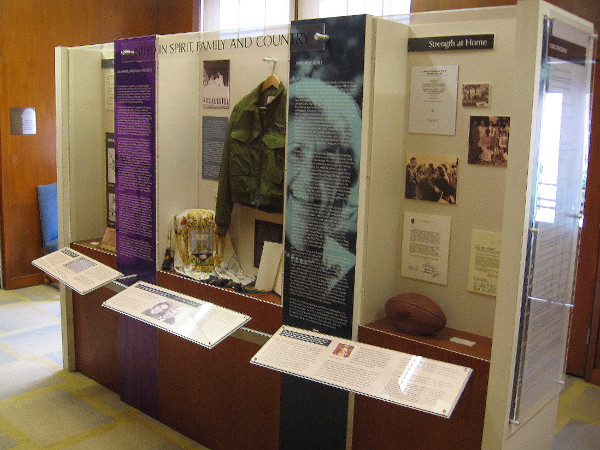
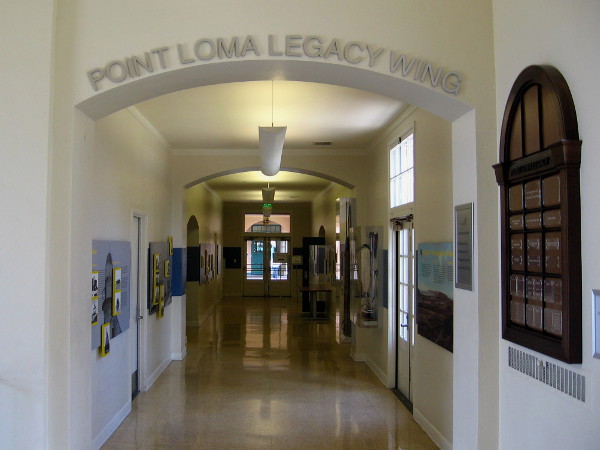
The museum-like Stockdale Family Exhibit concerns the life and history of celebrated Navy Vice Admiral James B. Stockdale and his wife Sybil. The Point Loma Legacy Wing contains many displays that provide insights into the fascinating history of San Diego’s Point Loma.

Should you visit, here’s what you’ll see…

Built in 1941, The Command Center (Building 200) was the focal point of the base. These were offices for the highest-ranking officers, including the Admiral in Command of the Center.
Looking from inside the Command Center southeast toward Preble Field and a large American flag.
Inside the entrance to the Command Center. Various signs and free literature provide information about the converted military base and its many cultural attractions.
Naval Training Center, San Diego. The recruit story is one of personal transformation; a recruit's experience from arrival through graduation is the foundation for memories...
Naval Training Center, San Diego. The recruit story is one of personal transformation; a recruit’s experience from arrival through graduation is the foundation for memories…
In Memory Of Richard Dick Laub. Dick gave credit for much of his success to the G.I. Bill. His passion was the sea and fishing.
In Memory Of Richard “Dick” Laub. Dick gave credit for much of his success to the G.I. Bill. His passion was the sea and fishing.
One wing of the NTC Command Center today contains the Stockdale Family Exhibit. James and his wife Sybil are Navy heroes from the Vietnam War era.
Vice Admiral James Stockdale, long-time resident of Coronado, obtained and conveyed important tactical information while imprisoned in Vietnam
Vice Admiral James Stockdale, long-time resident of Coronado, obtained and conveyed important tactical information while imprisoned in North Vietnam
Stockdale was candidate for United States Vice President in 1992 on Ross Perot's independent ticket. During a debate, he famously said Who am I Why am I here.
Stockdale was candidate for United States Vice President in 1992 on Ross Perot’s independent ticket. During a debate, he famously said: “Who am I? Why am I here?”
The exhibit contains photographs and objects from James and Sybil Stockdale's family life.
The exhibit contains photographs and objects from James and Sybil Stockdale’s family life.
The Point Loma Legacy Wing at the NTC Command Center contains two walls of fascinating displays concerning this area's history.
The Point Loma Legacy Wing at the NTC Command Center contains two walls of fascinating displays concerning this area’s history.
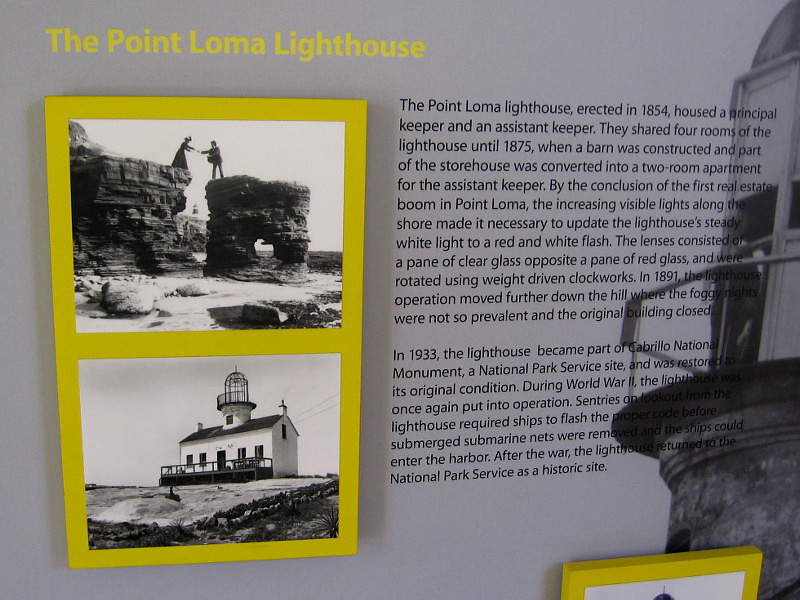
The Point Loma lighthouse, erected in 1854, housed a principal keeper and an assistant keeper. In 1933, the lighthouse became part of Cabrillo National Monument and was restored.
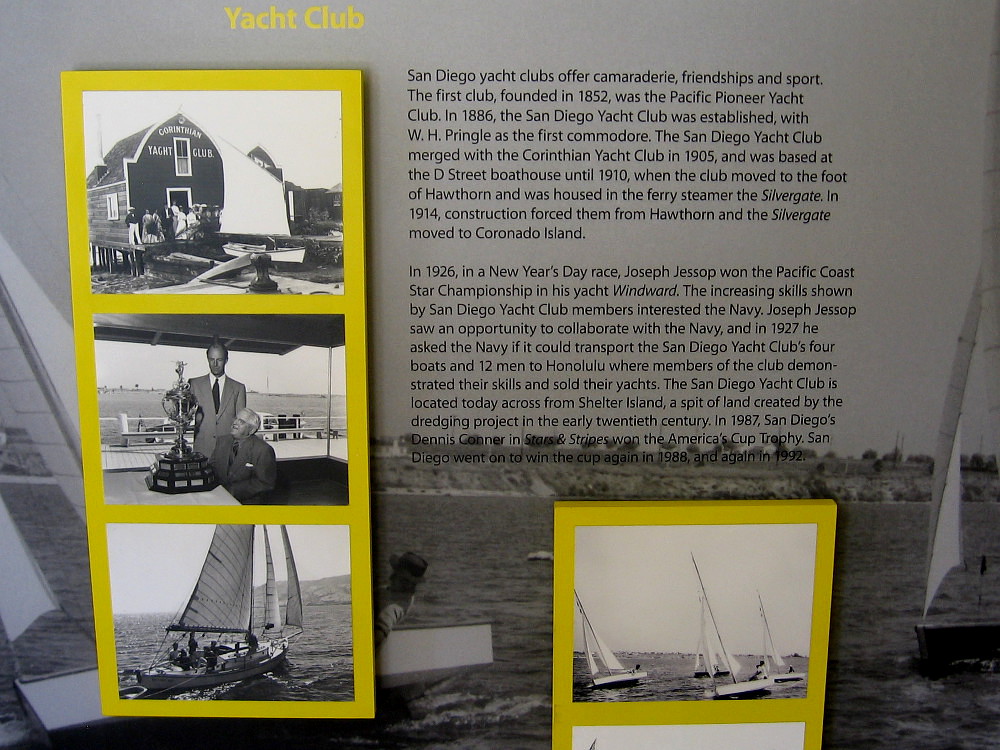
San Diego yacht clubs offer camaraderie, friendships and sport. The first club, founded in 1852, was the Pacific Pioneer Yacht Club. In 1886, the San Diego Yacht Club was established.
Display case contains artifacts from the San Diego Maritime Museum, including model of a tuna boat.
The first fish cannery was built in 1909 at La Playa designed for processing sardines. Albacore canning started in 1911.
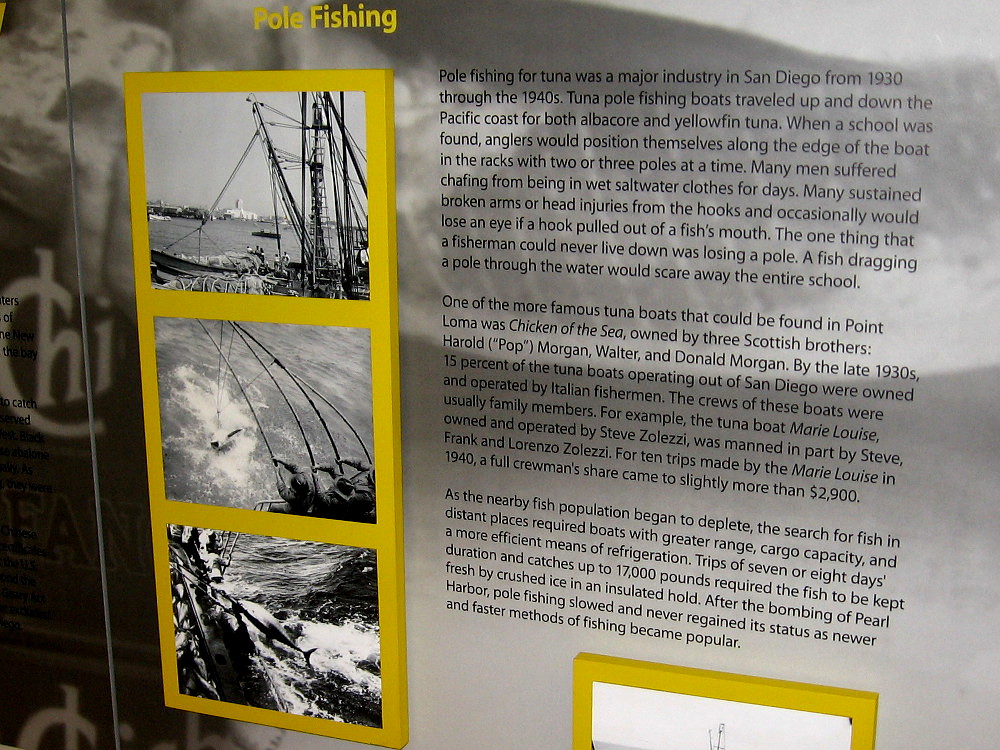
Pole fishing for tuna was a major industry in San Diego from 1930 through the 1940s. Tuna pole fishing boats traveled up and down the Pacific coast for both albacore and yellowfin.
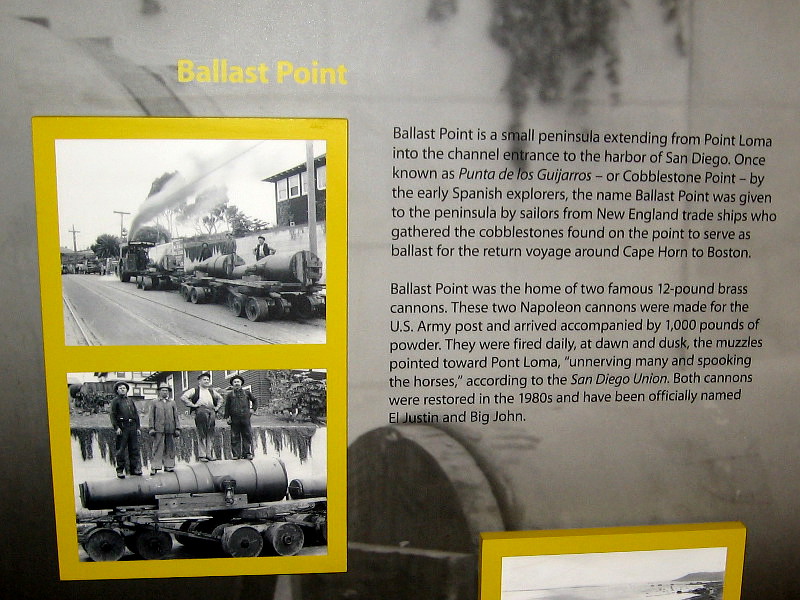
Ballast Point is a small peninsula extending from Point Loma into the channel entrance to the harbor of San Diego. Cobblestones on the point were used for ballast by early trade ships.
The Point Loma kelp forest is part of one the largest kelp forests in the northern hemisphere. Giant kelp is a species of marine alga, which may grow up to 200 feet in length.
Fort Rosecrans. In 1793, British Captain George Vancouver entered San Diego harbor. He noted the port would be better defended from the Point Loma peninsula.
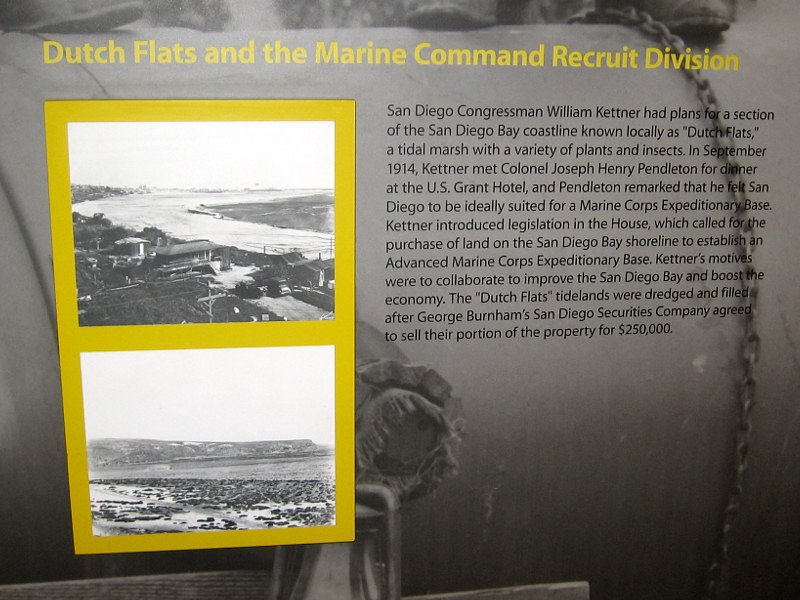
Dutch Flats and the Marine Command Recruit Division. Plans were devised by San Diego Congressman William Kettner. A tidal marsh would be dredged and filled.
Anchor and Sybil Stockdale Rose Garden next to NTC Command Center. Photo taken from Legacy Plaza near the center of Liberty Station.

Follow this blog for more photos of cool stuff! Join me on Facebook or Twitter.

Letters home from troops: love, loss, reflection.

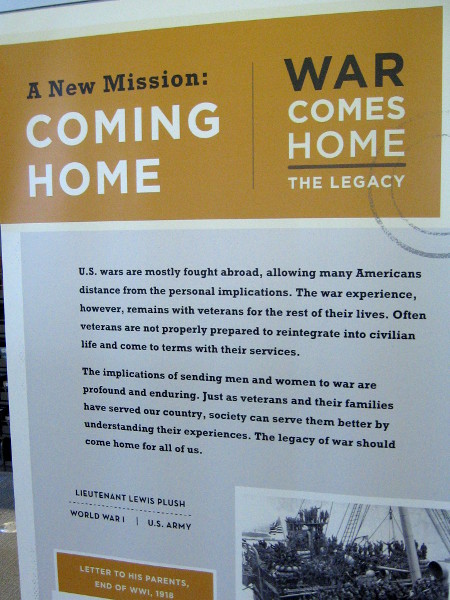
War Comes Home: The Legacy. A collection of letters written by veterans and their families.

A poignant exhibit is now on public display at San Diego’s downtown Central Library. It’s titled War Comes Home: The Legacy. Through a number of emotionally charged letters to and from troops abroad, one can begin to feel how war changes lives. Included is personal correspondence, including email, from almost every major conflict in United States history. This exhibition is put on in partnership with Cal Humanities, and its stated purpose is to promote greater understanding of our veterans and explore the impact of war on communities.

The exhibit can be found on the first floor of the library and will run through August 16.

I'm coming home! I'm looking forward to seeing you again...but I'm in no hurry to see the expressions on your faces when you see me. You might even ask me for proof that I'm your son.
I’m coming home! I’m looking forward to seeing you again…but I’m in no hurry to see the expressions on your faces when you see me. You might even ask me for proof that I’m your son.
U.S. wars are mostly fought abroad, allowing many Americans distance from the personal implications. The war experience, however, remains with veterans for the rest of their lives.
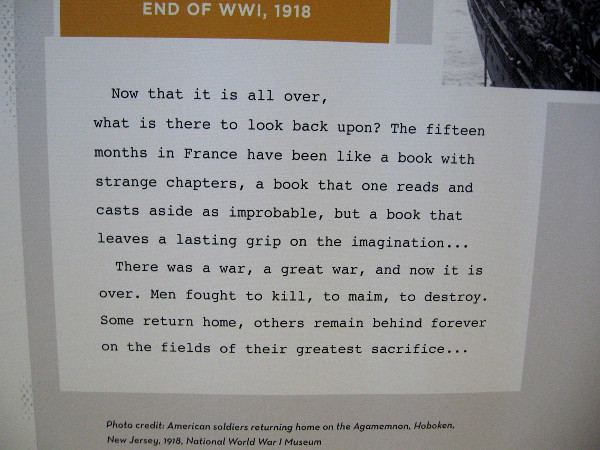
Now that it is all over, what is there to look back upon? The fifteen months in France have been like a book with strange chapters...
Now that it is all over, what is there to look back upon? The fifteen months in France have been like a book with strange chapters…
Although most people think that they are War Conscious, are they really? So far removed from the battle fronts, can they be?
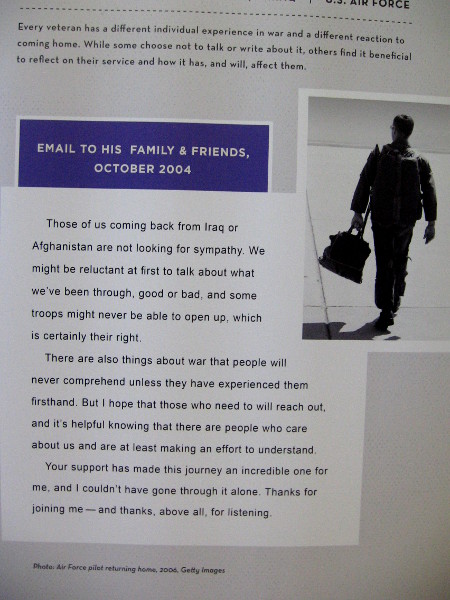
Those of us coming back from Iraq or Afghanistan are not looking for sympathy. We might be reluctant at first to talk about what we've been through, good or bad...
Those of us coming back from Iraq or Afghanistan are not looking for sympathy. We might be reluctant at first to talk about what we’ve been through, good or bad…
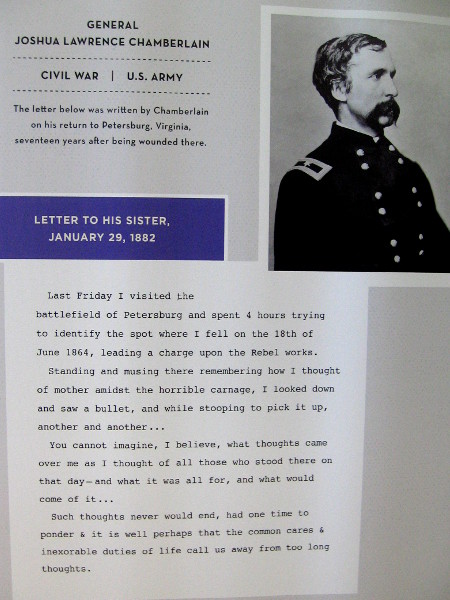
You cannot imagine, I believe, what thoughts came over me as I thought of all those who stood there on that day--and what it was all for, and what would come of it...
You cannot imagine, I believe, what thoughts came over me as I thought of all those who stood there on that day–and what it was all for, and what would come of it…
Not a day goes by that I don't think of you. I never know that love could hurt so much.
Not a day goes by that I don’t think of you. I never know that love could hurt so much.
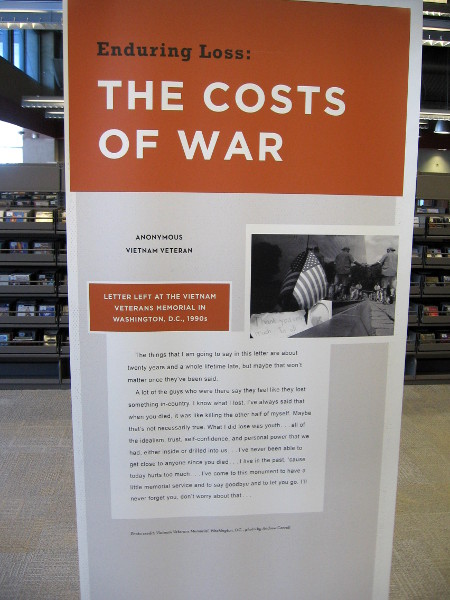
Enduring Loss: The Costs of War.
The things that I am going to say in this letter are about twenty years and a whole lifetime late, but maybe that won't matter once they've been said.
The things that I am going to say in this letter are about twenty years and a whole lifetime late, but maybe that won’t matter once they’ve been said.
Coming home to normal life from a war zone can be a jarring experience for many troops.
Coming home to “normal” life from a war zone can be a jarring experience for many troops.
Ultimately, your loved one should start to feel normal after about five to six months--just in time to be deployed again.
Ultimately, your loved one should start to feel “normal” after about five to six months–just in time to be deployed again.
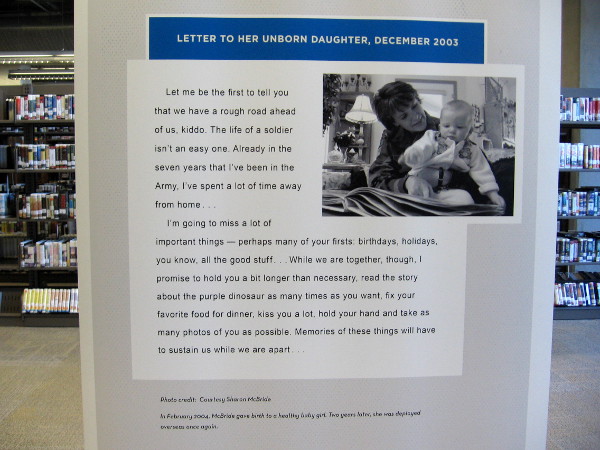
Let me be the first to tell you that we have a rough road ahead of us, kiddo. The life of a soldier isn't an easy one.
Let me be the first to tell you that we have a rough road ahead of us, kiddo. The life of a soldier isn’t an easy one.
My son: you are missed in our home. There is a silence and a sadness because of your absence.
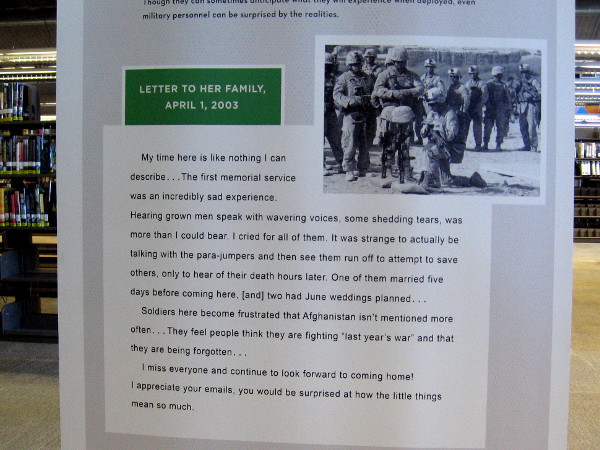
Hearing grown men speak with wavering voices, some shedding tears, was more than I could bear.
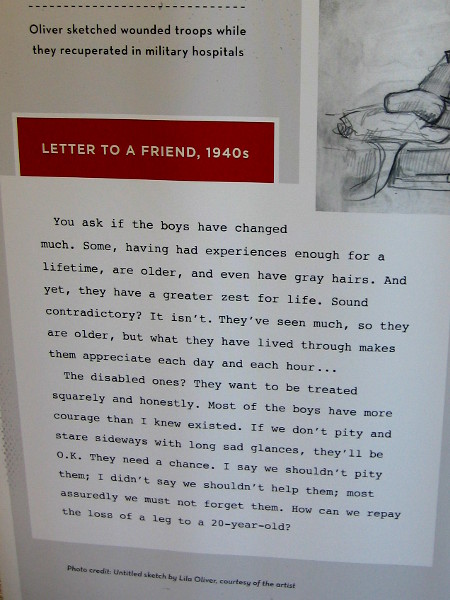
You ask if the boys have changed much. Some, having had experience enough for a lifetime, are older...and yet, they have a greater zest for life...
You ask if the boys have changed much. Some, having had experience enough for a lifetime, are older…and yet, they have a greater zest for life…
Sketch of servicemember in military hospital with amputated leg, reading or writing a letter.

Receive thought-provoking glimpses of things in and around San Diego. Join me on Facebook or Twitter.

Lots of photos from Coronado’s Fourth of July parade!

Color guard leads the way during the Coronado Independence Day parade on Orange Avenue.

While this blog post contains a whole bunch of photos, they only represent a small fraction of today’s Independence Day parade in Coronado. This Fourth of July parade is one of the biggest and best in the nation. Coronado is about as apple pie as a town can get, as it’s home to two very important military bases: Naval Air Station North Island and the Naval Amphibious Base.

Before the parade began, I walked about checking out the sights, smells and sounds. Hopefully I captured a bit of the experience with these photographs…

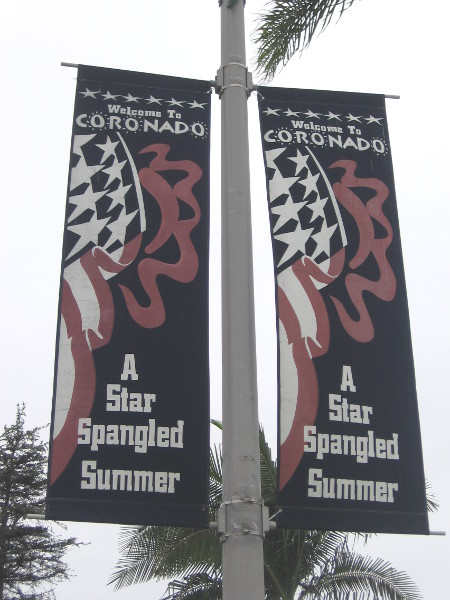
Welcome to Coronado . . . A Star Spangled Summer!
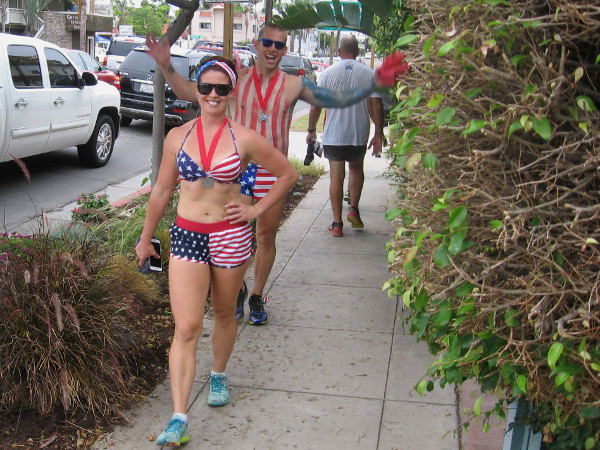
I believe these runners raced earlier in the Crown City Classic that started and ended at Tidelands Park, a few blocks away.
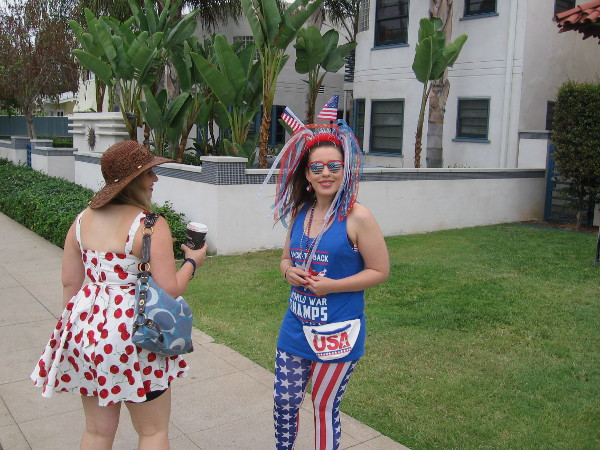
Almost everyone I saw was wearing clothing or costumes befitting a Fourth of July celebration!
Someone wrote on the sidewalk with chalk: Happy Fourth of July!
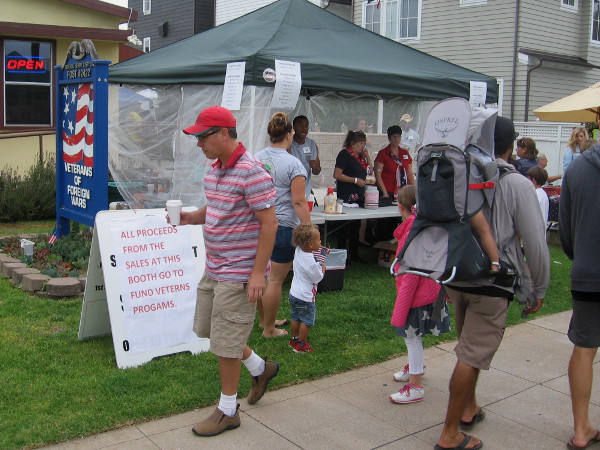
Tent in front of the Veterans of Foreign Wars on Orange Avenue was raising money selling parade-worthy treats.
The Lions Club had a stand at Spreckels Park near the center of patriotic Coronado.
People check out art on display in Spreckels Park.
What could be more American than tossing a baseball while waiting for the big parade to begin.
What could be more American than tossing a baseball while waiting for the big parade to begin?
A shop window had a dog with a red, white and blue bow!
Humans and canines were all decked out for the occasion!
And what could be more American than a hot dog. A hot dog draped by a flag!
And what could be more American than a hot dog? A hot dog draped by a flag!
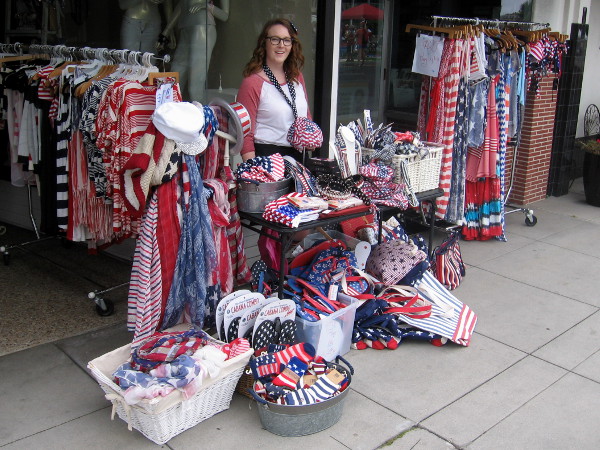
The businesses along Orange Avenue had all sorts of Independence Day wares and decorations outside.
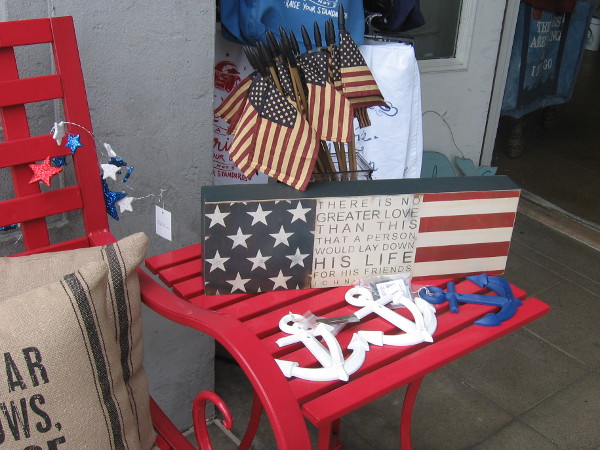
There is no greater love than this--that a person would lay down his life for his friends.
There is no greater love than this: That a person would lay down his life for his friends.
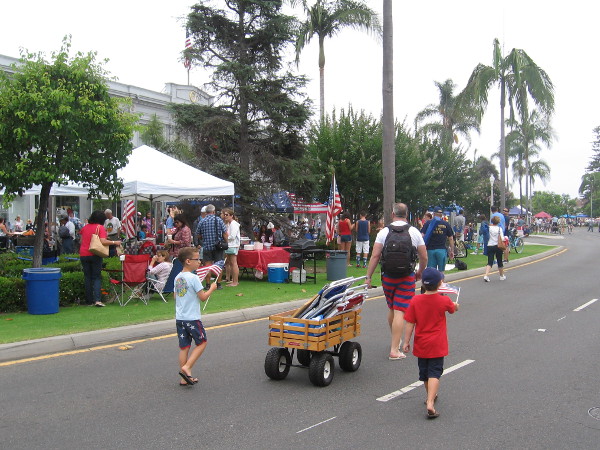
Kids with flags follow a big wagon full of lawn chairs, as the parade is almost ready to start.
Finishing touches are put on the poop circles. Should a horse poop in your chalk circle, you win a special prize!
Tens of thousands are ready now along the entire length of Coronado. I think I hear the parade coming.
Tens of thousands are ready now along the entire length of Coronado. I think I hear the distant parade approaching.
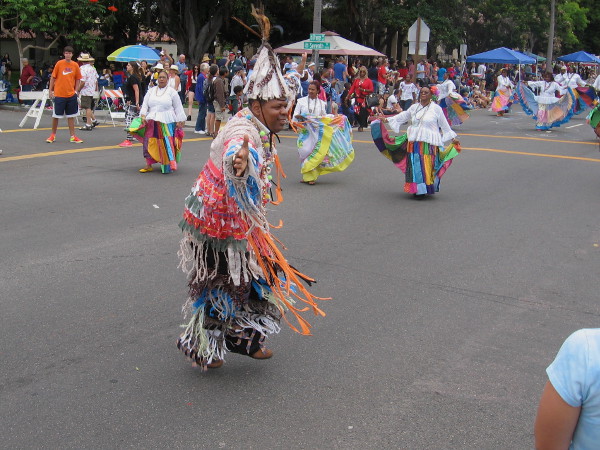
Actually, it's the pre-parade entertainment. These performers are swirling and dancing to the delight of the crowd!
Actually, it’s the pre-parade entertainment. These performers are swirling and dancing to the delight of the crowd!
A colorful costume gets onlookers in the mood for a big, fun parade.
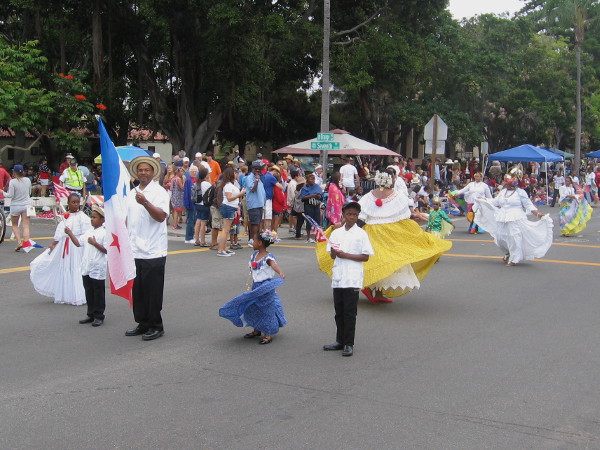
These guys are the Emilio Wallace Panamanian Marching Band of California!
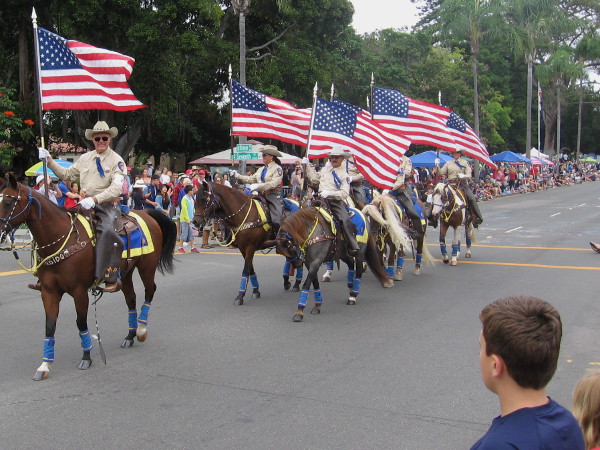
The Escondido Mounted Posse carry flags.
The official parade has begun.  The Escondido Mounted Posse carries flags.
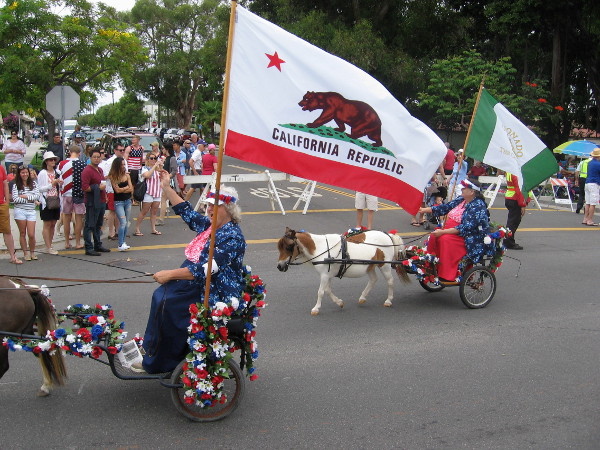
Red, white and blue flowery carts are pulled by miniature horses!
The Grand Marshall this year was Vice Admiral Thomas Rowden, Commander, Naval Surface Forces, U.S. Pacific Fleet.
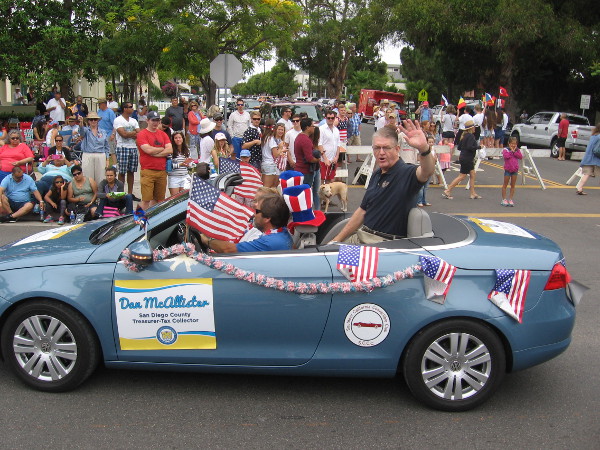
And here comes the San Diego County tax collector, waving cheerfully to all!
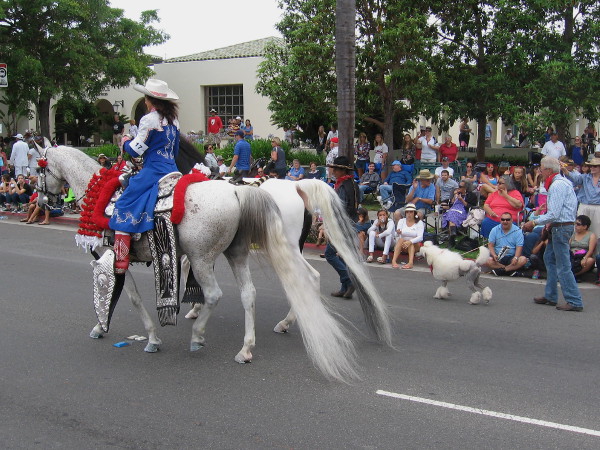
Beautifully groomed long-tailed horses and a poodle strut their stuff down the parade route.
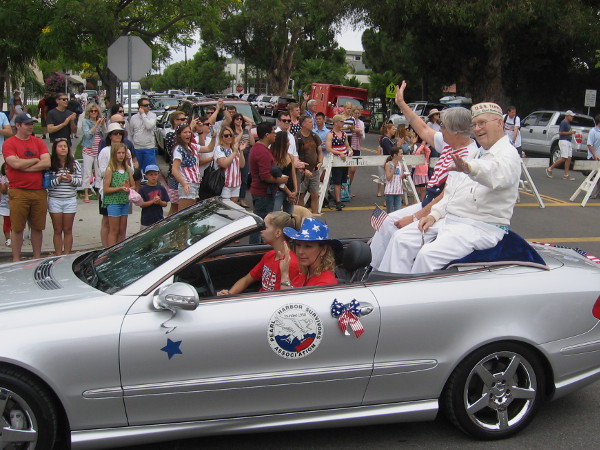
A color guard precedes honored Pearl Harbor survivors.
A veteran who served during Pearl Harbor. He and other fellow heroes received the loudest applause all day.
A Pearl Harbor survivor waves to a crowd. Many were shouting Thank You.
A Pearl Harbor survivor waves to the crowd. Many were shouting “Thank You”.
Applause for the Pearl Harbor survivors as they pass on by for the Fourth of July.
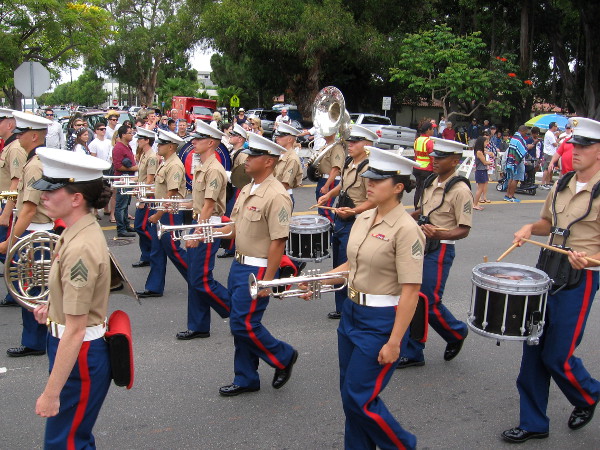
Here comes the Marine Corps band!
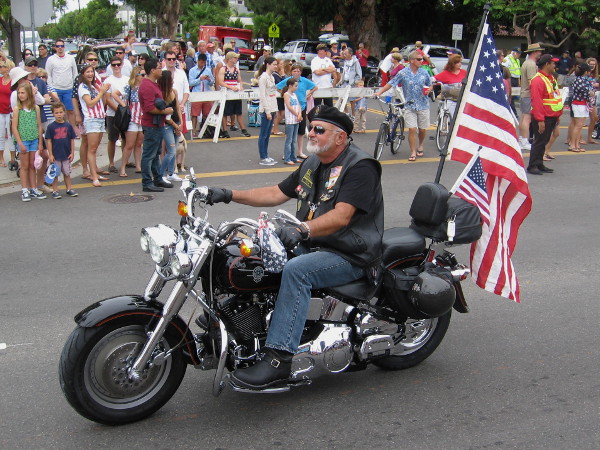
An American military veteran rides his motorcycle down Orange Avenue.
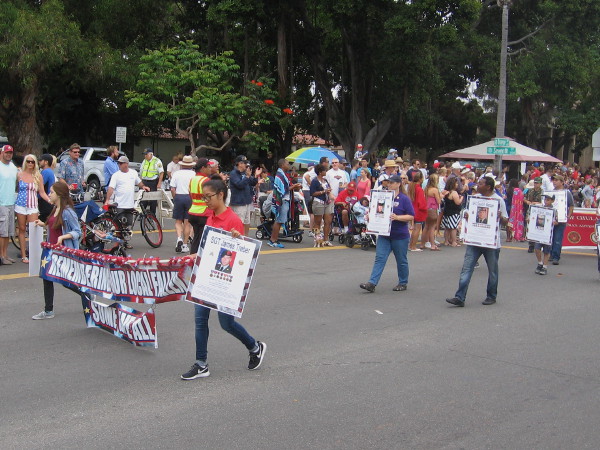
Gold Star Mothers, with signs of loved ones killed in action. The people of Coronado understand that defending freedom can require sacrifice.
Wounded Warriors are welcomed home.
Remembering our local fallen. Some gave all.
San Diego Young Marines march. A future generation of heroes.
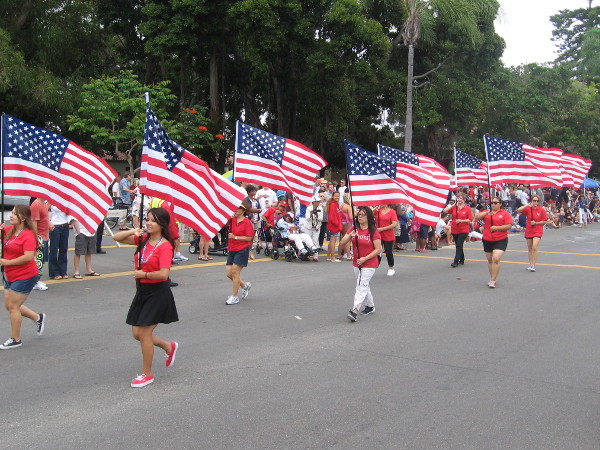
An avenue of proud, billowing flags.
Reenacting raising the flag at Iwo Jima, The United States Marine Corps War Memorial.
San Diego heroes carry a large American flag.
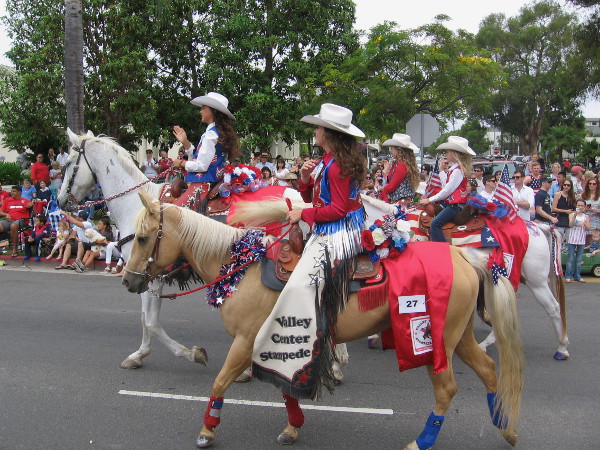
Here come the Valley Center Rodeo Queens on horseback.
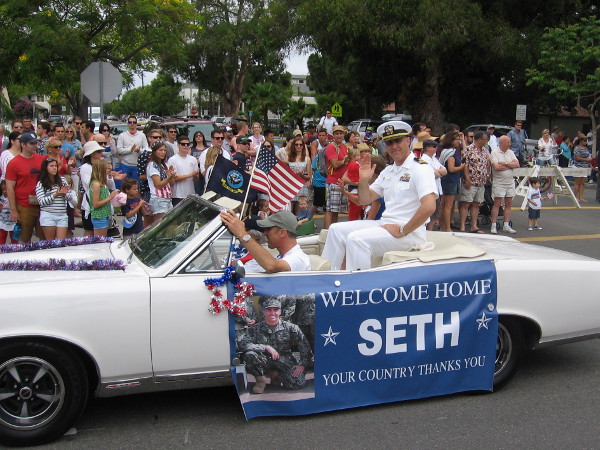
Welcome Home Seth. Your country thanks you.
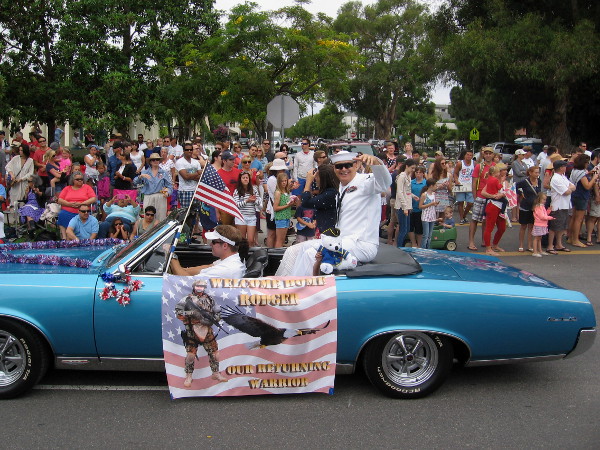
Welcome Home Rodger. Our returning warrior.
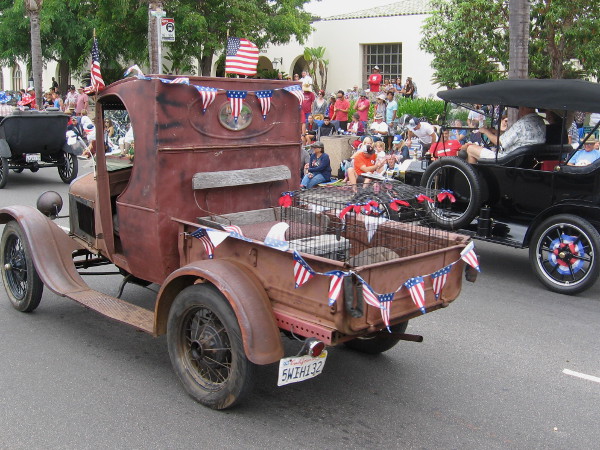
Cool old cars from the Avenue of Heroes.
Now that's an antique.
Now that’s an antique.
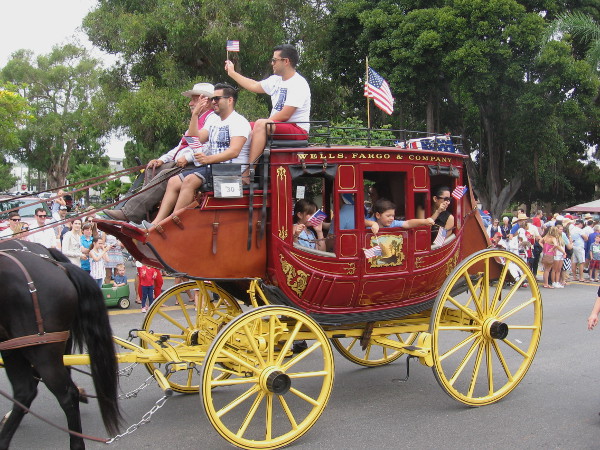
Of course, the big parade includes the Wells Fargo stagecoach.
Even the Coronado Lawn Bowling Club was a part of the big Independence Day parade.
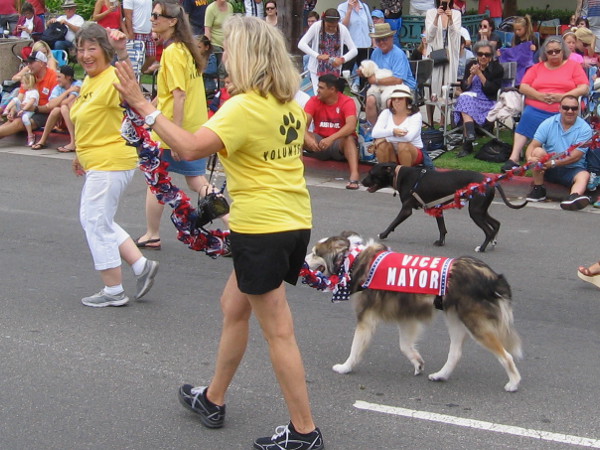
Meet the canine Vice Mayor of Coronado. I'm not sure which dog is the Mayor.
Meet the canine Vice Mayor of Coronado. I’m not sure which dog is the Mayor.
It's the Castle Park High School marching band.
It’s the Castle Park High School marching band.
Some medieval knights did battle on the parade route. Seems one has emerged the victor.
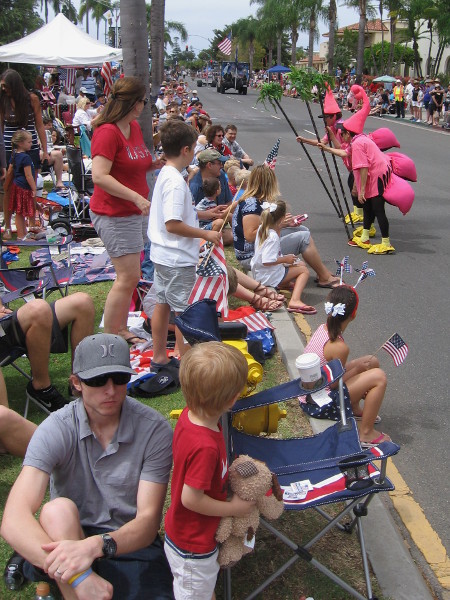
Pink flamingos greet the crowd. I wonder if they wandered over here from the Marriott Coronado Resort's flamingo pond.
Pink flamingos greet the crowd. I wonder if they wandered over here from the Marriott Coronado Resort’s flamingo pond.
Coronado is one of the most patriotic places you'll find. Naval Air Station North Island and the Naval Amphibious Base where Seals train are located here.
Coronado is one of the most patriotic places you’ll find. Naval Air Station North Island and the Naval Amphibious Base where Seals train are located here.
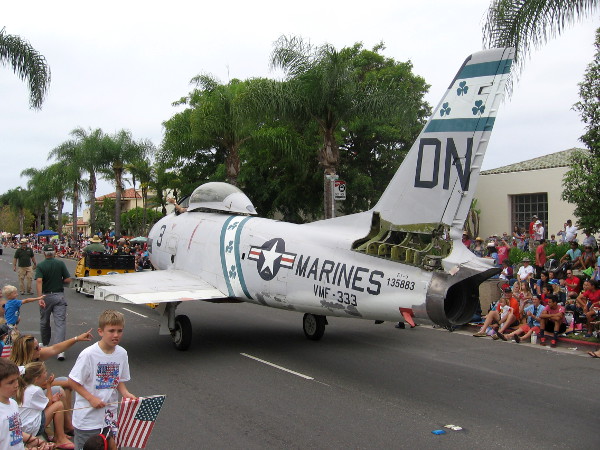
An unrestored FJ-3 Fury from the Flying Leatherneck Aviation Museum at MCAS Miramar was towed to Coronado for the parade!
Historic fighter jet heads down Orange Avenue as Fourth of July parade onlookers honor the troops.

Join me on Facebook or Twitter!

Planes and people on USS Midway’s flight deck.

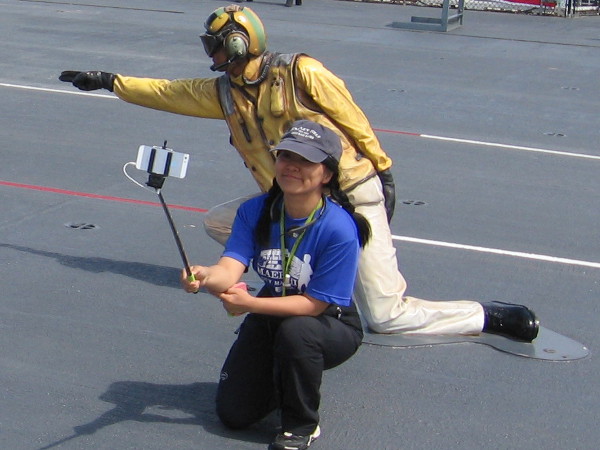
USS Midway visitor takes photograph with selfie stick next to aircraft launching Shooter mannequin.
USS Midway visitor takes photograph with selfie stick next to aircraft-launching Shooter mannequin.

I hope you enjoy a few photos I took recently of planes and people (and helicopters) on the flight deck of San Diego’s USS Midway Museum. The historic aircraft carrier served longer than any other American carrier in the 20th century, spanning five decades from 1945 to 1992. Countless amazing stories have been lived by thousands serving aboard the USS Midway, and many of those stories continue today as docents and volunteers relate their personal shipboard experiences to visitors from around the world. San Diego’s unique aircraft carrier museum, now over ten years old, hosts over a million visitors a year.

Midway’s large flight deck, enlarged from 2.8 to 4 acres in 1966, today features a couple dozen restored aircraft that represent different eras of modern military history. The internet is jammed with pages showing and describing these aircraft in detail, so I thought I’d just provide a quick flavor of what it’s like to walk out on the flight deck on a typical San Diego day. If you’d like to take the cool self-guided tour of the ship, which I highly recommend, plan to spend at least an hour!

Lady walks past F-14 Tomcat fighter jet on USS Midway aircraft carrier's flight deck.
Lady walks past F-14 Tomcat fighter jet on USS Midway aircraft carrier’s flight deck.
Tourists at USS Midway Museum walk out onto one of the two horns that project over San Diego Bay.
Sign describes how to read Navy flag signals.
Man lingers near F-8 Crusader, the US Navy's first supersonic fighter.
Man lingers near F-8 Crusader, the US Navy’s first supersonic fighter.
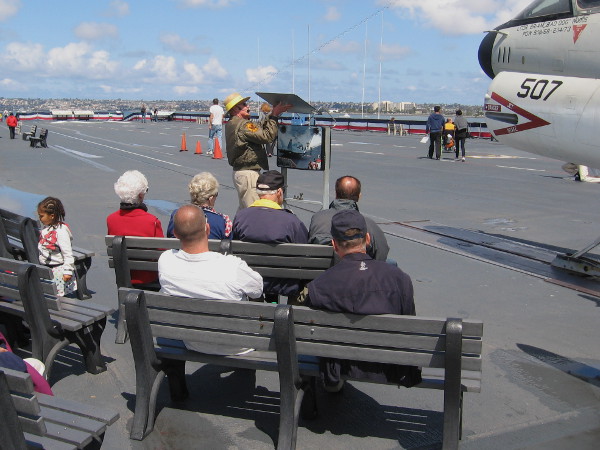
People sit on benches listening to a docent talk about launching airplanes from Midway's two steam-powered catapults.
People sit on benches listening to a docent talk about launching airplanes from Midway’s two steam-powered catapults.
Guy checks out A-7 Corsair ready to be launched from powerful catapult, which accelerated aircraft to 170 mph in about 3 seconds!
Guy checks out A-7 Corsair positioned to be launched from powerful catapult, which accelerated aircraft to 170 mph in about 3 seconds!
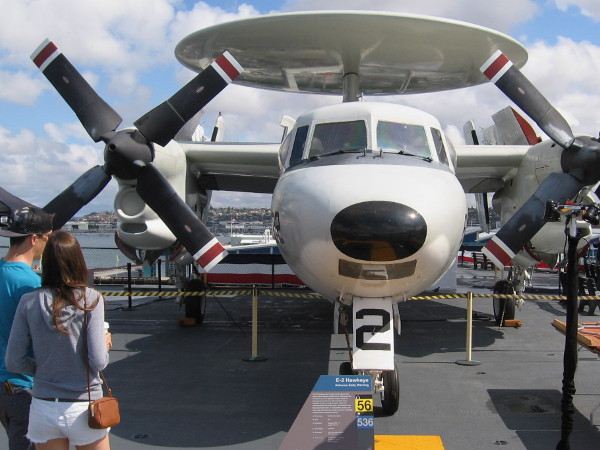
Young couple takes a look at E-2 Hawkeye, an Airborne Early Warning aircraft.
Looking south from atop the flight deck. Seen are the Unconditional Surrender statue, Tuna Harbor, and the Coronado Bay Bridge.
USS Midway visitors enjoy a sunny San Diego day near EKA-3 Skywarrior.
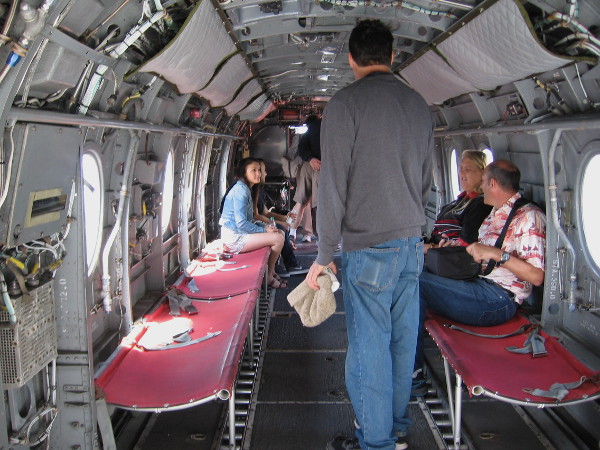
Visitors find out what it's like inside a CH-46 Sea Knight helicopter.
Visitors find out what it’s like inside a CH-46 Sea Knight helicopter.
Peering through cockpit of HO3S utility helicopter at the nearby HUP Retriever.
This HO3S Dragonfly, first helicopter aboard the USS Midway in 1948, is undergoing restoration.
Docent veteran talks about how aircraft landed on the flight deck using tailhooks and arresting cables.
Docent veteran talks about how aircraft landed on the flight deck using a tailhook and multiple arresting cables.
Exhibit on Midway's LSO Platform shows how Navy pilots landed in difficult conditions, relying on optical guidance.
Exhibit on Midway’s LSO Platform shows how Navy pilots landed in difficult conditions, relying on optical guidance.
Navy pilot mannequin in flight suit stands near FA-18 Hornet, painted as a TOPGUN enemy aircraft.
A-6 Intruder bomber on display near USS Midway's superstructure.
A-6 Intruder bomber on display near USS Midway’s superstructure.
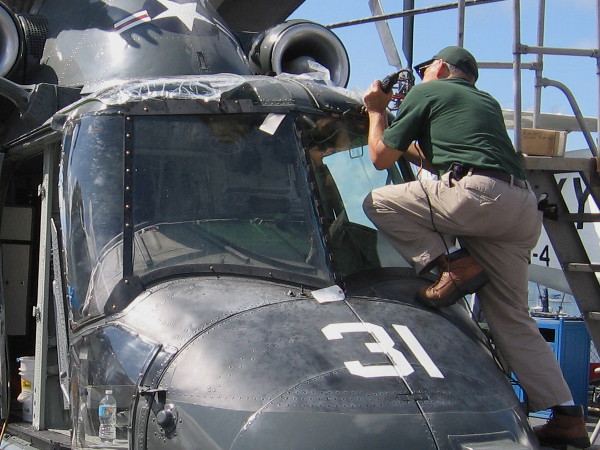
Volunteers work to restore SH-2 Seasprite, beyond orange nose of H-34 Seabat.
The huge flight deck of the USS Midway Museum hosts visitors from around the world, special military-related events, decades of history, and never-ending activity on San Diego Bay.

Join me on Facebook or Twitter!