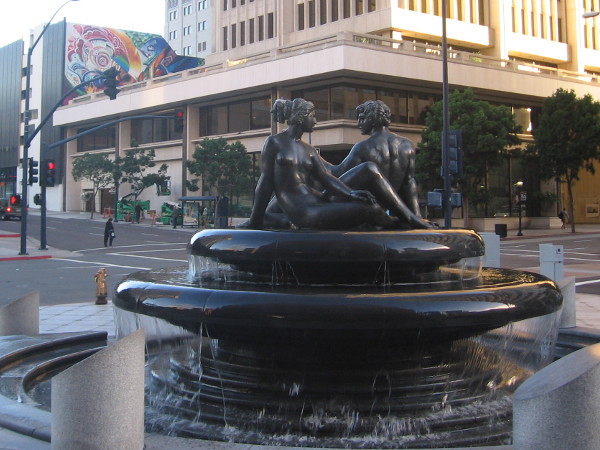
Fountain of Two Oceans sculpture in front of Wells Fargo building in downtown San Diego.
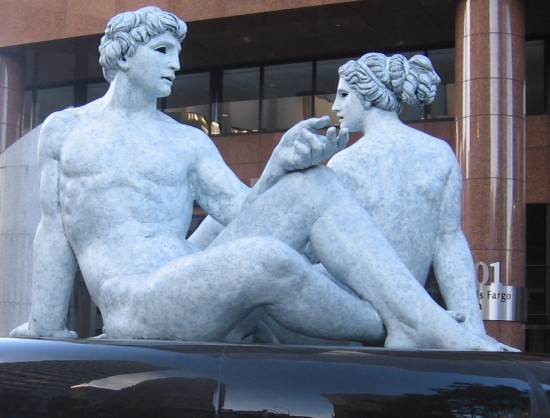
Perhaps you recall my blog post from early in the summer, where I was astonished at how the Fountain of Two Oceans sculpture in front of downtown’s Wells Fargo building had suddenly turned white! Well, yesterday I saw it has changed colors once again!
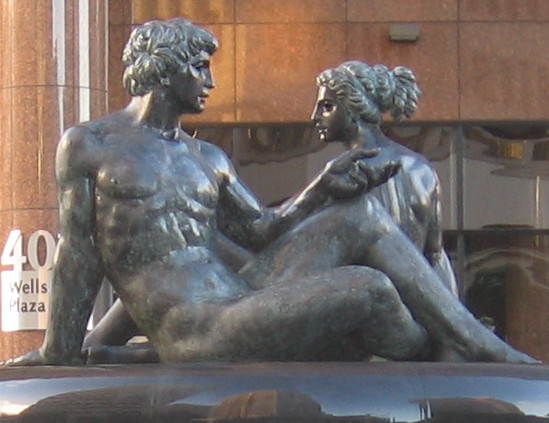
I’m guessing a number of people found the weird, mottled white color unattractive. (Personally, I thought it was ghastly.) Today, the human figures appear bronze again, but much darker than before, without the heavily tarnished surface. In my opinion, this is a big improvement. What do you think?
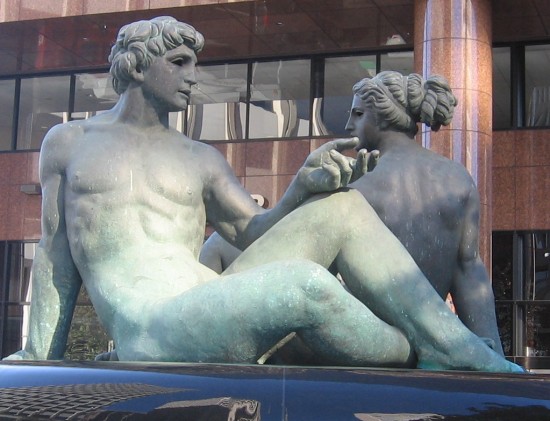
Before the figures were painted white:
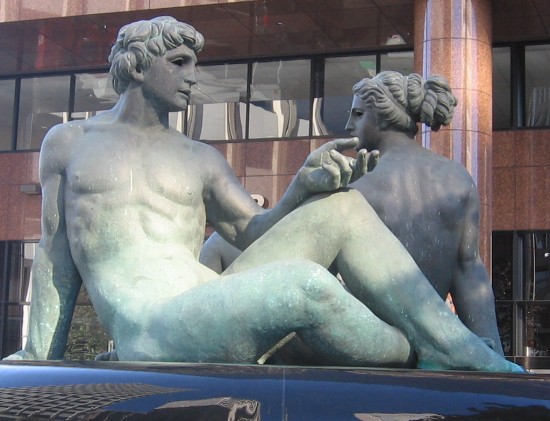
Bronze nudes of Sergio Benvenuti’s Fountain of Two Oceans.
Painted white, possibly to resemble marble:
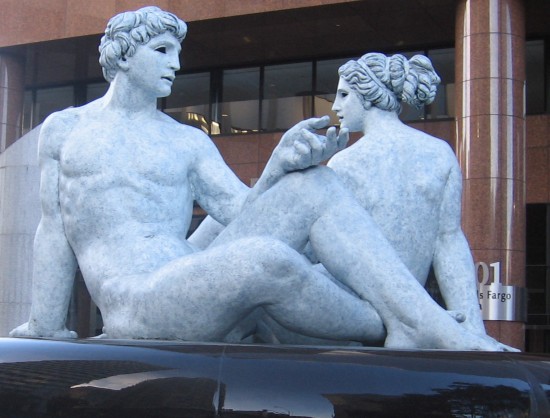
Fountain of Two Oceans sculpture suddenly becomes white!
Now much darker, matching the fountain’s base:
The reclining human figures today have a dark, new bronze appearance!
…
To enjoy future posts, you can “like” Cool San Diego Sights on Facebook, or follow me on Twitter.
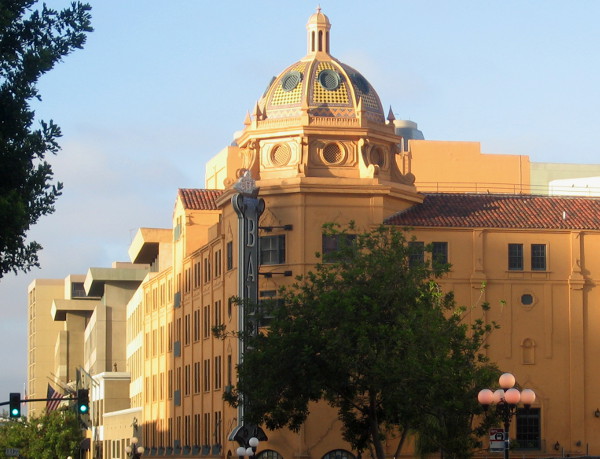
Distinctive dome of the restored Balboa Theatre seen from Broadway.
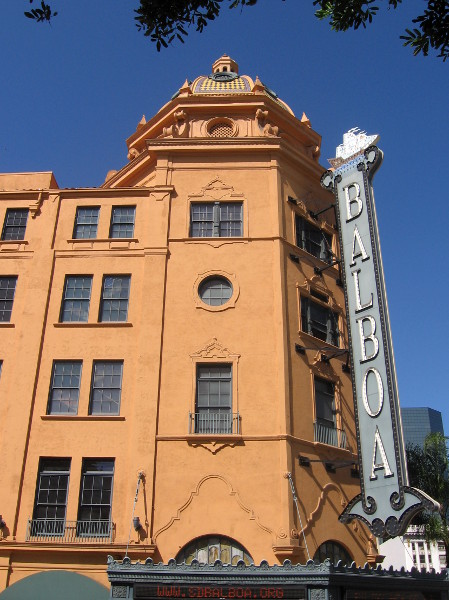
It’s going to be chilly and drizzly today, so I might not be going out for my customary walk. Instead, I thought I’d share a few photos of downtown’s beautiful Balboa Theatre that I took at various times last summer.
The Balboa Theatre has a long and interesting history. Built in 1924 as a vaudeville and movie palace, the large multi-story building containing offices overlooking Fourth Avenue has undergone a complex series of transformations. During World War II, it was used to house sailors waiting to ship out from San Diego. At one point the aging building was saved from demolition; finally it was nominated to the National Register of Historic Places. In 2008, the Balboa Theatre reopened after a thorough remodel, and it is now considered one of the foremost performance venues in the world. It was recently named by CNN Travel as one of the world’s 15 most spectacular theatres! Not bad!
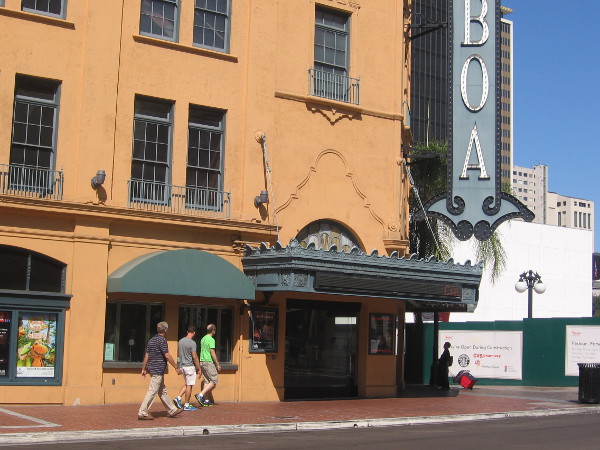
Here are a few more pics of the exterior. I often steer my feet so that I walk past this beautiful building!
Balboa Theatre sign is a landmark in San Diego’s Gaslamp.People walk past box office of the historic Balboa Theatre.Close look at artwork on Balboa Theatre’s cool marquee.The Balboa Theatre is on the National Register of Historic Places.The Balboa Theatre stands next to downtown’s equally cool Horton Plaza.
One more pic I added on a later date:
Window display of old photograph and letter B from Balboa Theatre sign. These can be seen a short distance down the sidewalk.
…
To enjoy future posts, you can “like” Cool San Diego Sights on Facebook. or follow me on Twitter.
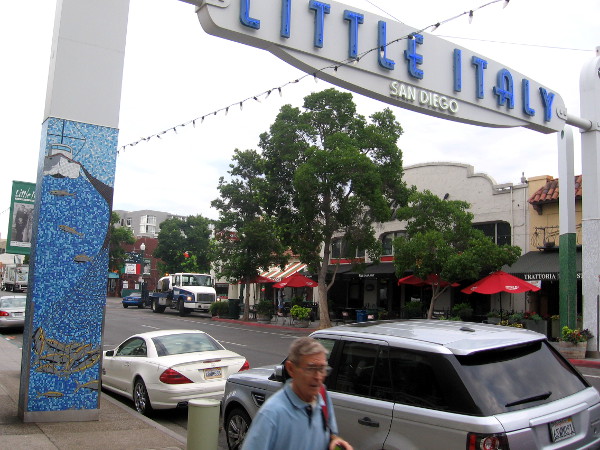
Pedestrian passes Little Italy sign on India Street in San Diego.
Today, if you were to walk through downtown San Diego’s historic Little Italy neighborhood, you’d probably see a number of very interesting street banners and plaques. These commemorate the Legends of Little Italy.
Early one morning while I walked to a nearby trolley station, I took a few quick photographs along India Street. You might enjoy looking at them. I transcribed much of what appears on the plaques.
Plaque explains the history of the Little Italy Landmark Sign.
The Little Italy Landmark Sign was dedicated and lit at the 7th Annual Little Italy Festa on the evening of October 8, 2000. The landmark sign was constructed as a tribute to this immigrant neighborhood which, until the late 1960s, was the hub of the world’s tuna fishing and canning industry. The nautical theme can be seen in the portholes at the top of the pillars, the blue neon of the lettering and the cable span which holds up the sign. The mosaic tile work on each side of the street tells how this immigrant community is historically tied to the bay, the church and the Italian homeland. This sign is a testament to the preservation of Little Italy’s cultural heritage and to the ongoing revitalization of this dynamic urban ethnic neighborhood in Downtown San Diego.
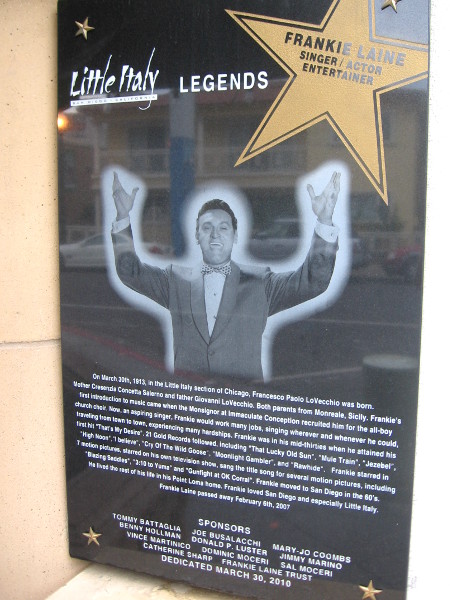
Mosaic tiles show the community’s ties to Italy and traditions.Singing and acting legend Frankie Laine lived in San Diego.
On March 30th, 1913, in the Little Italy section of Chicago, Francesco Paolo LoVecchio was born. Mother Cresenzia Concetta Salerno and father Giovanni LoVecchio. Both parents from Monreale, Sicily. Frankie’s first introduction to music came when the Monsignor at Immaculate Conception recruited him for the all-boy church choir. Now, an aspiring singer, Frankie would work many jobs, singing wherever and whenever he could, traveling from town to town, experiencing many hardships. Frankie was in his mid-thirties when he attained his first hit “That’s My Desire”. 21 Gold Records followed, including “The Lucky Old Sun”, “Mule Train”, “Jezebel”, “High Noon”, “I believe”, “Cry of the Wild Goose”, “Moonlight Gambler”, and “Rawhide”. Frankie starred in 7 motion pictures, starred in his own television show, sang the title song for several motion pictures, including “Blazing Saddles”, “3:10 to Yuma” and “Gunfight at OK Corral”. Frankie moved to San Diego in the 60’s. He lived the rest of his life in his Point Loma home. Frankie loved San Diego and especially Little Italy. Frankie Laine passed away February 6th, 2007.
Tony and Rose Bernadino used to live on Date Street.Tony Bernardini was an Italian immigrant who settled in San Diego.
Tony Bernardini left his native Bari, Italy to sail to America in 1907. He came with little money, but his heart was full of hope and enthusiasm for the opportunities that awaited him in his New World. Passing through Ellis Island, he quickly made his way to San Diego, where he found a climate and a neighborhood that reminded him of the place he had left. Tony took a job with the San Diego Electric Railway Company, maintaining the tracks for San Diego’s extensive streetcar lines. He worked hard, saved his money, and sent for his future wife, Rosa Monteleone, in 1911.
Tony and Rosa married shortly after her arrival in San Diego. They went on to have seven children; Clara, Fred, Lily, Vito, Matha, Nick, and Angelina. With hard work, Tony was able to bring several other members of their families to America to join them. In the early 1930’s, he got an opportunity to buy the building located on this corner from an acquaintance, who offered to finance the transaction for him. He opened the Civic Center Liquor House. Rosa and all of the children helped him run the business. During the first seven years he ran the business, he was only able to pay the interest on the Property’s note. But with the Declaration of World War II in 1941, San Diego’s economy heated up dramatically. Despite the fact that all three of their sons joined the Army to fight in the War, Tony, Rosa, and their daughters continued to work in the business, and by the end of the War, Tony had managed to pay off the note completely. he had achieved the American dream!
The story of love, hard work, and strong family life.
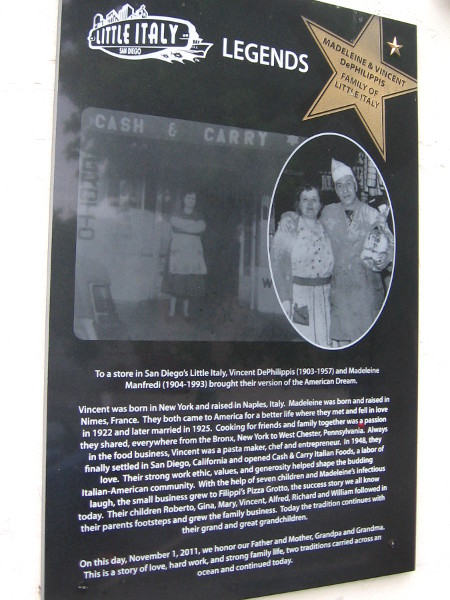
To a store in San Diego’s Little Italy, Vincent DePhilippis (1903-1957) and Madeleine Manfredi (1904-1993) brought their version of the American Dream.
Vincent was born in New York and raised in Naples, Italy. Madeleine was born and raised in Nimes, France. They both came to America for a better life where they met and fell in love in 1922 and later married in 1925. Cooking for friends and family together was a passion they shared, everywhere from the Bronx, New York to West Chester, Pennsylvania. Always in the food business, Vincent was a pasta maker, chef and entrepreneur. In 1948, they finally settled in San Diego, California and opened Cash & Carry Italian Foods, a labor of love. Their strong work ethic, values, and generosity helped shape the budding Italian-American community. With the help of seven children and Madeleine’s infectious laugh, the small business grew to Filippi’s Pizza Grotto, the success story we all know today. Their children Roberto, Gina, Mary, Vincent, Alfred, Richard and William followed in their parents footsteps and grew the family business. Today the tradition continues with their grand and great grandchildren.
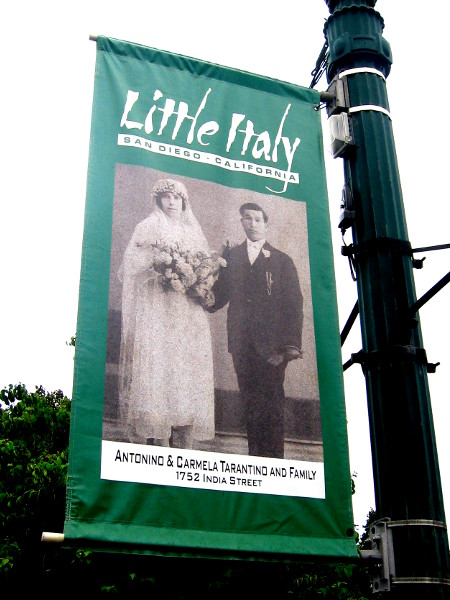
Banner on street lamp shows Tarantino family.Past lives become legends in the annals of Little Italy’s history.Morning coffee and companionship on a Little Italy sidewalk.
UPDATE!
During another walk through Little Italy I discovered another fascinating plaque:
Plaque shows Rose and Salvatore Cresci, Family of Little Italy.The story of Rose and Salvatore “Sal” Cresci, Little Italy Legends. (Click photo to enlarge for easy reading.)
UPDATE!
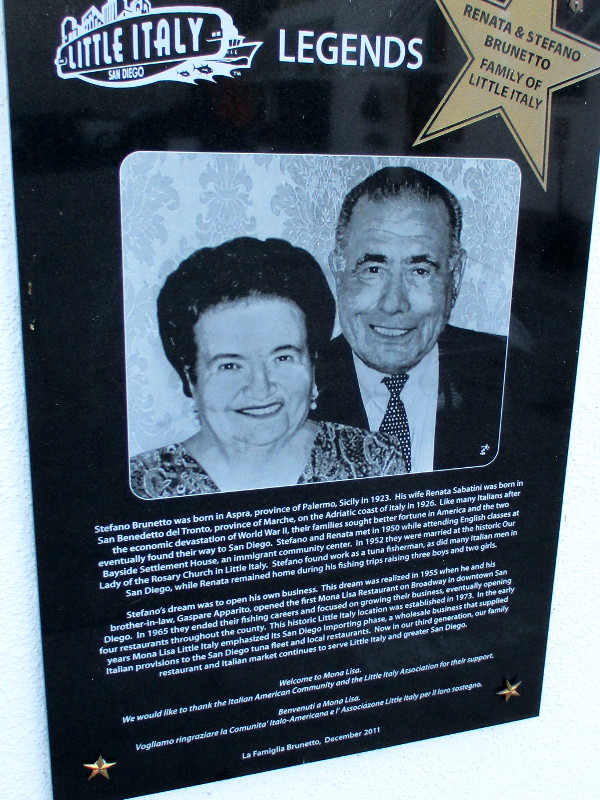
Here come two more signs that I found! The first concerns Pietro and Cristina Busalacchi, Italian immigrants who established restaurants in San Diego. The second concerns Renata and Stefano Brunetto. Stefano, a tuna fisherman, opened Mona Lisa Restaurant with his brother-in-law Gaspare Apparito.
…
To enjoy future posts, you can “like” Cool San Diego Sights on Facebook, or follow me on Twitter.
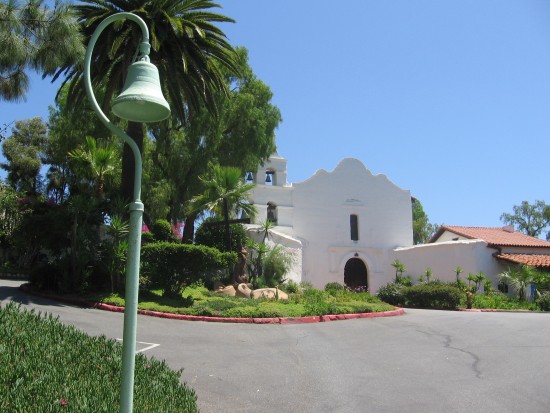
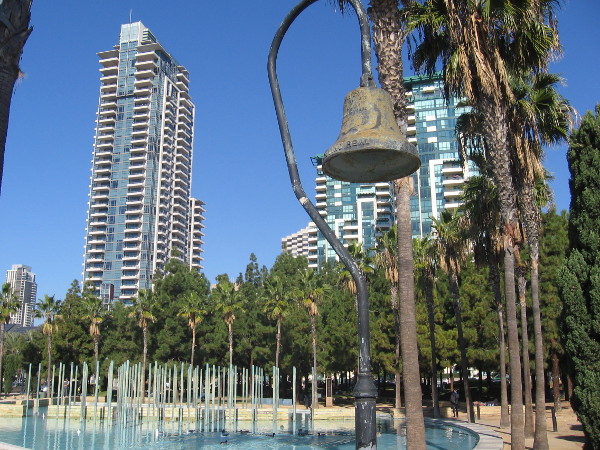
El Camino Real bell in front of California’s first Spanish mission.
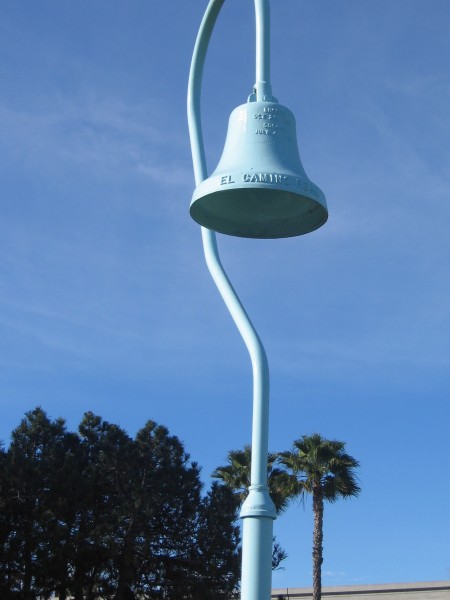
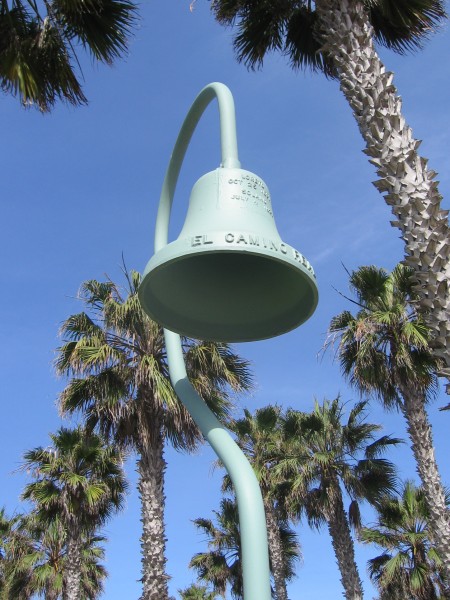
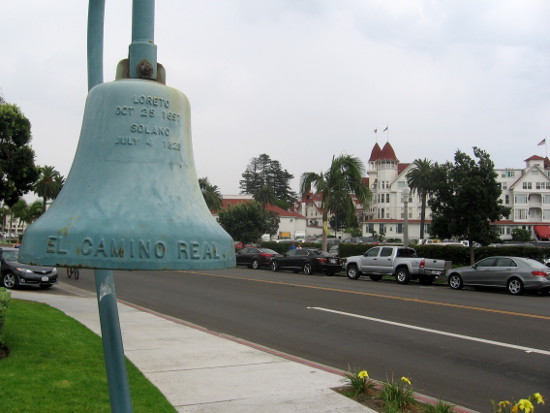
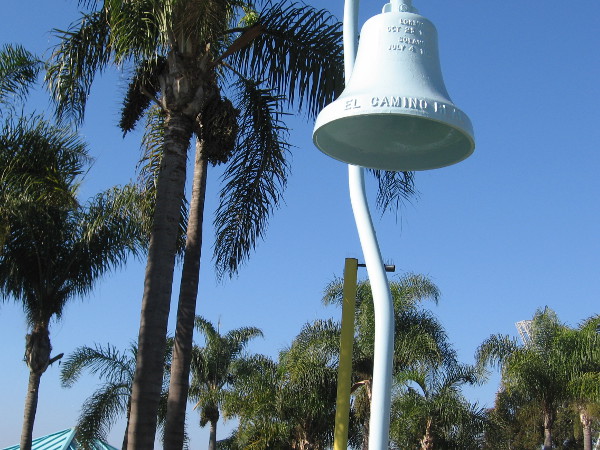
Here are just a few random pics of El Camino Real bells around San Diego. During my walks, I’m often surprised to discover a new bell.
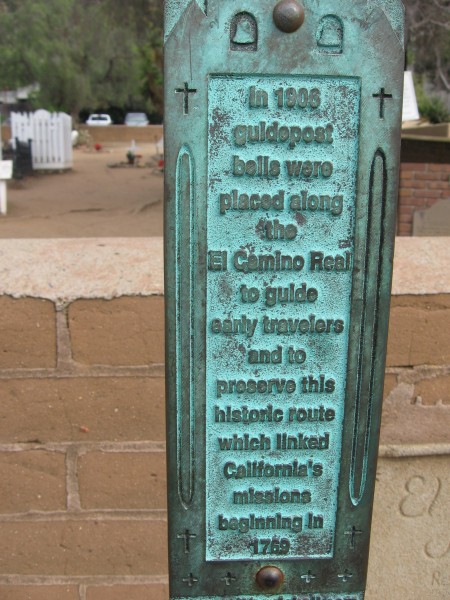
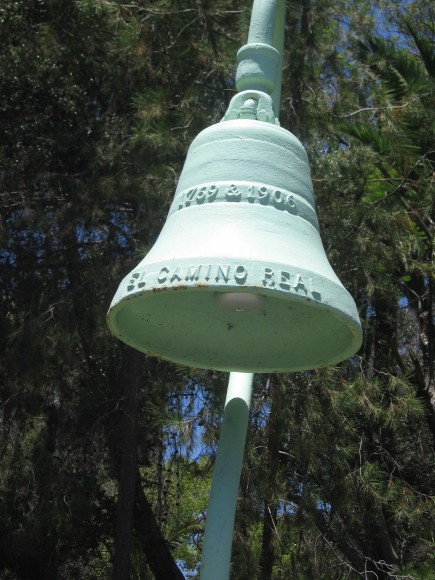
Many of these guidepost bells were placed in 1906 by the California Federation of Women’s Clubs. They marked the primitive roads that connected the old Spanish missions in California. El Camino Real, which means the Royal Road or King’s Highway in Spanish, led to 21 missions in Alta California, plus a variety of sub-missions, presidios and pueblos. The bells stand on tall posts in the shape of a shepherd’s crook. In subsequent years, bells have been removed or added to the California landscape.
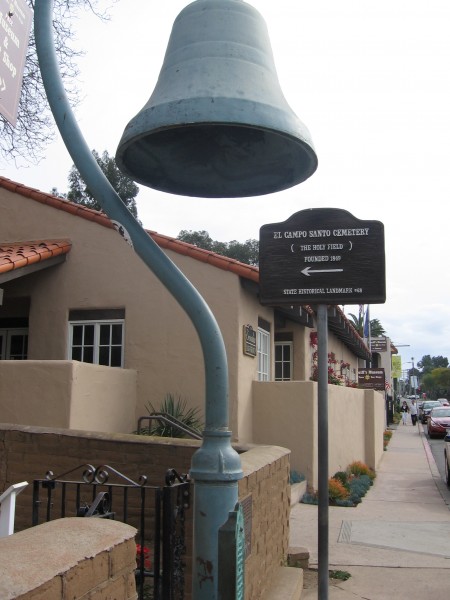
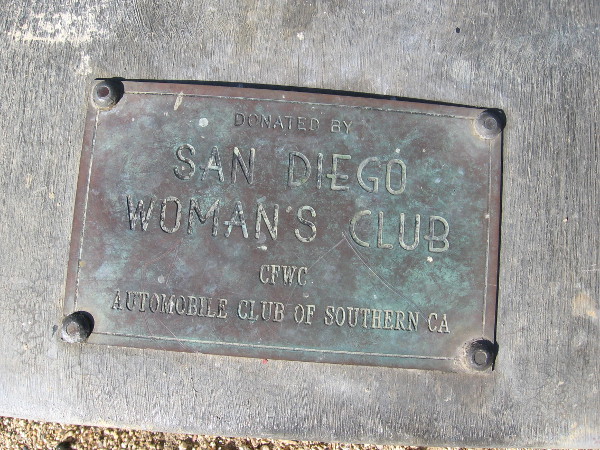
Bell in front of Old Town’s historic El Campo Santo cemetery.Plaque explains history of the guidepost bells.El Camino Real bell spotted on Harbor Island.El Camino Real bell by the downtown County Administration Building.Historic bell and palm trees in Imperial Beach.I found an El Camino Real bell near the Hotel del Coronado!El Camino Real bell in Cesar Chavez Park in Barrio Logan.Plaque on Harbor Drive reveals that a nearby bell was donated by San Diego Woman’s Club.
El Camino Real bell on Martin Luther King Jr. Promenade by Children’s Park.
…
To enjoy future posts, you can “like” Cool San Diego Sights on Facebook, or follow me on Twitter.
Facade of old Mission San Diego seen from parking lot below.
A month or so ago I finally visited the famous Mission San Diego de Alcala. I’ve lived in San Diego for many years, and have driven past this important historical landmark many times, but I’d never stepped inside. Writing this blog compels me to check out new sights!
Built in 1774 by the Franciscan priest Junipero Serra, Mission San Diego de Alcala was first of 21 Spanish missions in California. It was constructed several miles inland of the Pacific Ocean near the San Diego River. (The very first mission was actually built in 1769 at the old Presidio, but later relocated to this more fertile location, where presidio soldiers were less likely to come. The soldiers often abused the native people who lived near the presidio.)
In 1775, just one year after it was built, the mission was burned to the ground by the native Kumeyaay people. Father Junipero Serra returned the next year to rebuild the church and mission buildings.
Over the years the San Diego Mission became very prosperous, with vineyards, orchards and thousands of cattle in its possession. Hundreds of baptized Native American Kumeyaay, whom the friars named Dieguenos, performed almost all of the labor.
History is rich here. The mission was claimed by Mexico in 1821, then used by the United States Cavalry after the US-Mexican War. As the original mission buildings have aged and decayed, they have been rebuilt and restored. Today the unique facade is one of the most iconic sights in San Diego. Unfortunately, the mission is located in a slightly out-of-the-way place that relatively few tourists visit.
In case you can’t stop by, I took a few photos!
El Camino Real bell just outside California’s first mission.
These bells on posts mark the primitive road, the King’s Highway, that connected the Spanish missions in California.
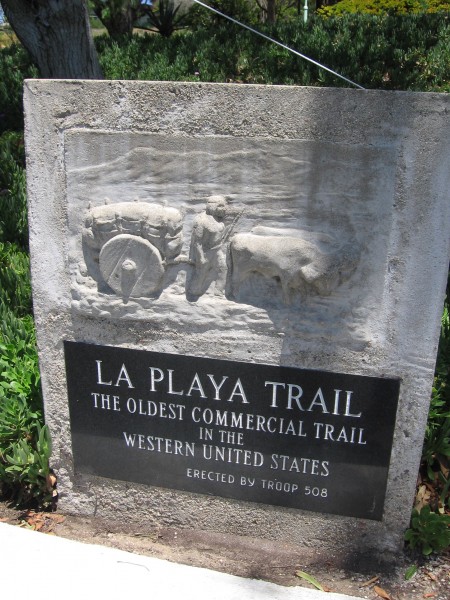
La Playa Trail ran along parts of San Diego Bay and the San Diego River.
Without realizing it, you might have read about the La Playa Trail in Two Years Before the Mast. Richard Henry Dana, Jr. would ride horseback down the trail to Old Town. With his friend, he also rode farther east to the old mission to enjoy a meal. The west end, La Playa, located just inside San Diego Bay, is the place where Dana worked for several months in 1835 drying cattle hides.
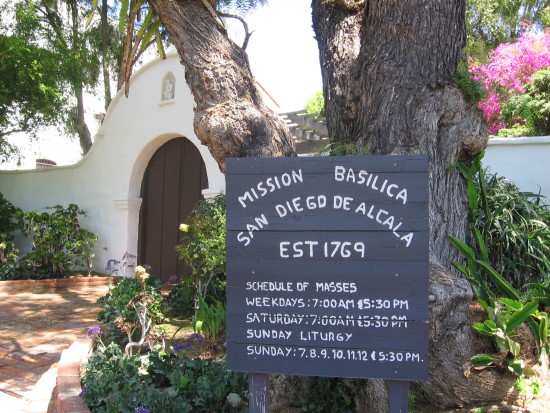
Sculpture of Padre Serra with cross in front of the campanario, containing the mission bells.Mission Basilica San Diego de Alcala holds regular Catholic Mass.
The historic church has remained active for many centuries.
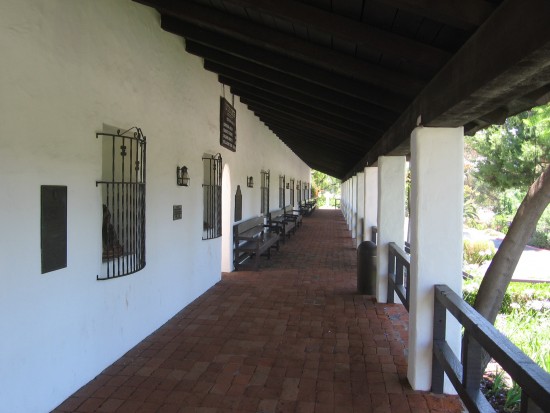
Corridor in front of mission has plaques and statues of saints.
Small statues of saints in the small nooks along the wall represent the nine missions that Father Junipero Serra founded.
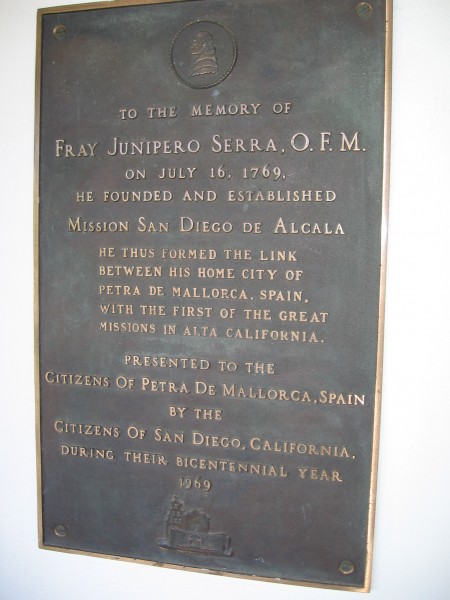
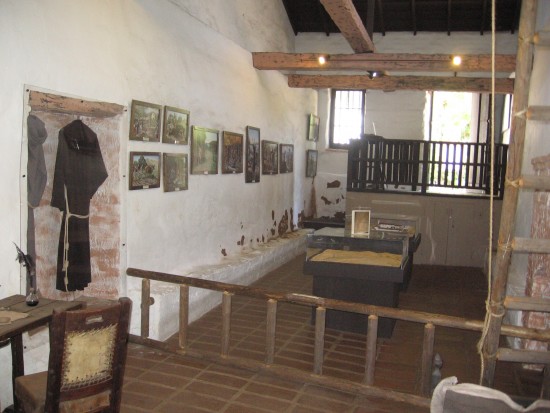
Petra de Mallorca, Spain linked to Father Junipero Serra.Padres’ living quarters with adobe walls and wooden beams.
Now we’re inside one of the various mission buildings. The self-guided tour proceeds clockwise around the central square.
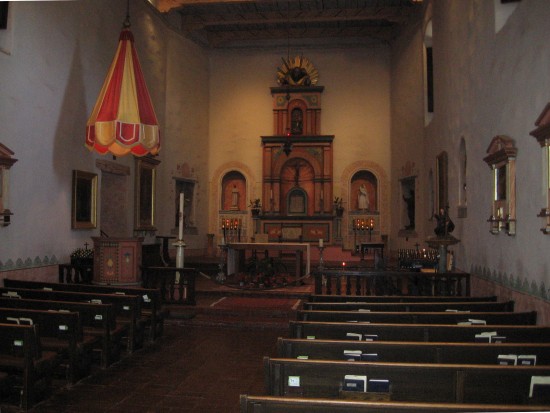
Beautiful radiant altar inside the quiet church sanctuary.
The church inside is beautiful and invites reflection.
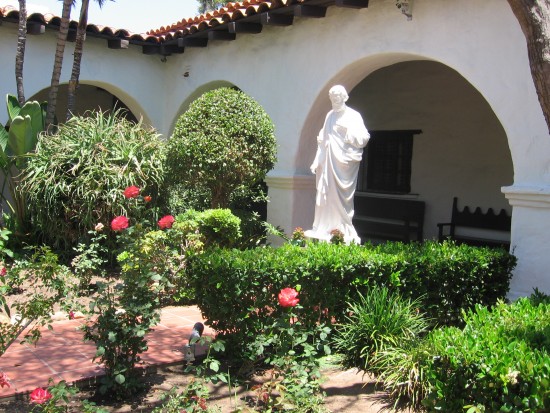
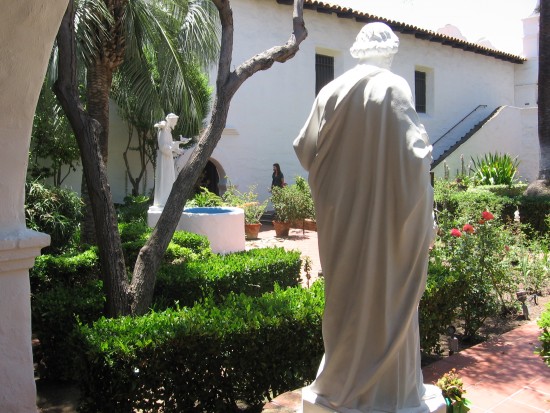
Garden courtyard by sanctuary contains sunlit statues.Flowers and peaceful walkways lead to holy figures.
Many birds were about and almost no weekend visitors.
Rear view of the Mission San Diego bell tower, or campanario.Small tile-roofed shine with Christ on the cross.Modern abstract mural lines wall above wood bench.
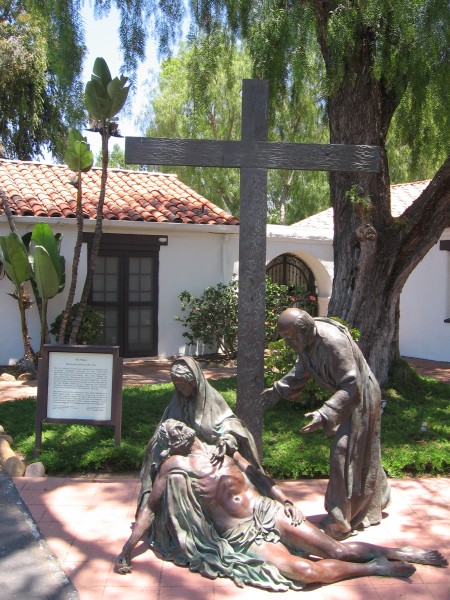
This and the following photo were taken in a space between the garden and a small one-room museum.
Sculpted Pieta with Virgin Mary and Jesus.Inside the small mission chapel.
This small chapel can be found at one corner of the central square.
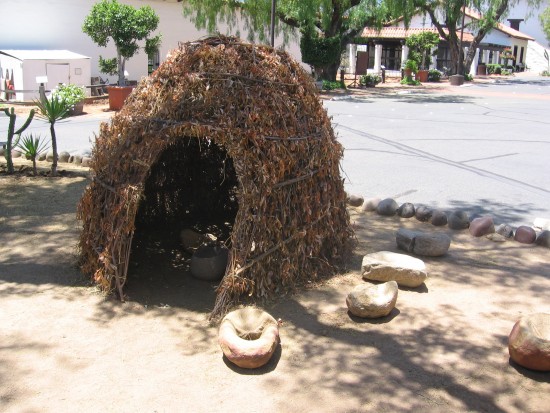
Fountain at center of San Diego mission’s central square.Moving sculpture of Christ after the crucifixion.Native American Kumeyaay hut built of willow branches.
The local Kumeyaay provided the labor that enriched the mission. This hut near an excavation site is an example of where they lived while the friars enjoyed greater comforts.
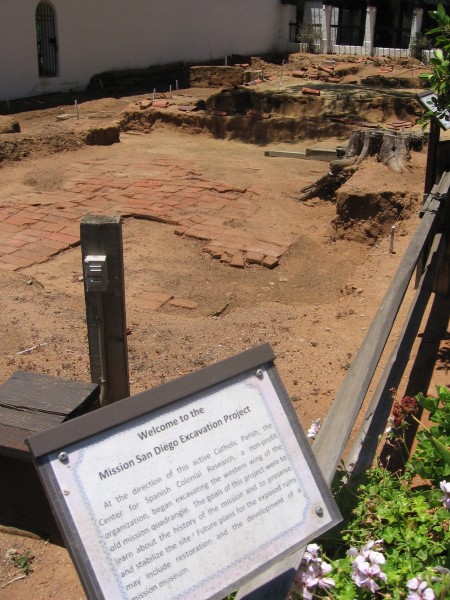
Mission’s old foundation investigated by archaeologists.The distinctive facade of California’s first Spanish mission.
In San Diego, those who hunger for colorful sights and local history should remember to swing by California’s very first Spanish mission in–you guessed it–Mission Valley!
…
To enjoy future posts, you can “like” Cool San Diego Sights on Facebook, or follow me on Twitter.
Bronze nudes of Sergio Benvenuti’s Fountain of Two Oceans.
This blog post is long overdue. The interesting pics you see here have been sitting idle on my computer’s hard drive, accidentally forgotten.
I was astonished several months ago to see that the Fountain of Two Oceans sculpture in front of downtown’s Wells Fargo building had completely changed. For the last 30 years, the two bronze figures reclining in the fountain’s basin have looked exactly like…bronze. Then–poof–one day I noticed they’d turned white!
I’m not sure if that’s white paint, or what exactly. It seems the intent was to make the figures stand out more, and appear like marble. To my eye, however, the white coating makes them garish, black-eyed, and almost ghostly. At a distance they look bland and formless.
According to an internet search, The Fountain of Two Oceans was placed in downtown San Diego in 1984. The art, now a familiar San Diego landmark, was created by Sergio Benvenuti, a sculptor from Florence, Italy.
Fountain of Two Oceans sculpture is now white.White coating makes bronze sculpture seem ghostly.
…
To enjoy future posts, you can “like” Cool San Diego Sights on Facebook, or follow me on Twitter.
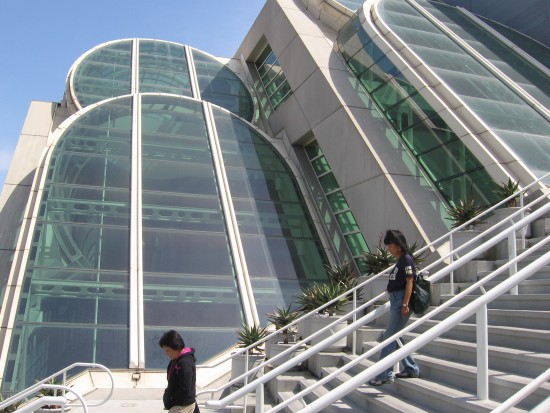
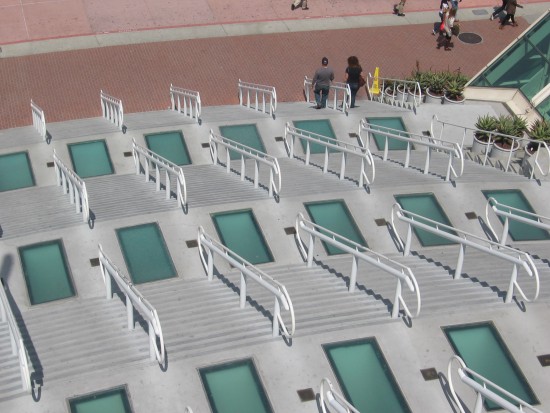
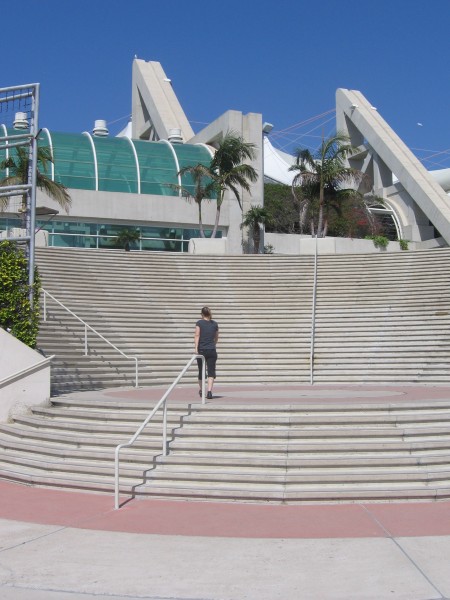
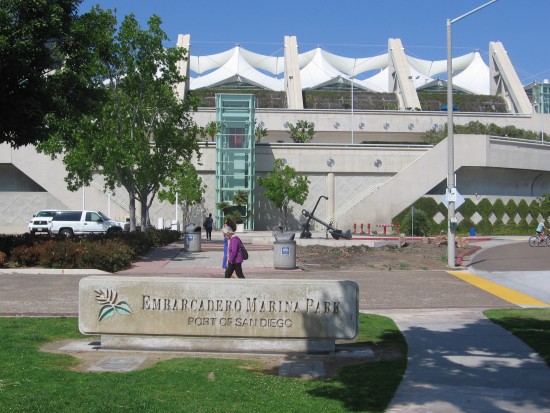
View of plaza on southeast end of convention center.
I recently took a stroll around the San Diego Convention Center and took a number of cool pics. I know, I know…millions of photos have been taken of the place already. Well, anyway, here come a few more…
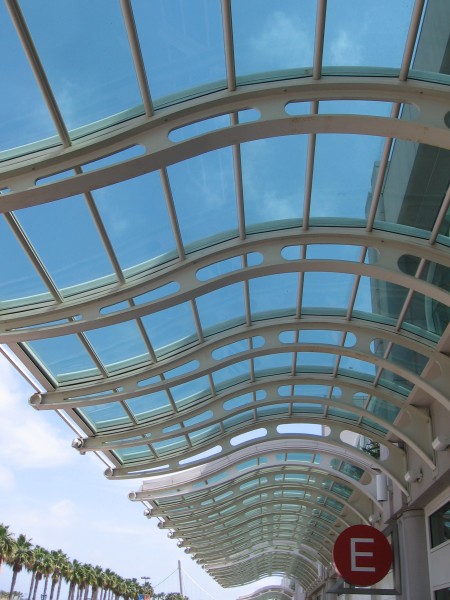
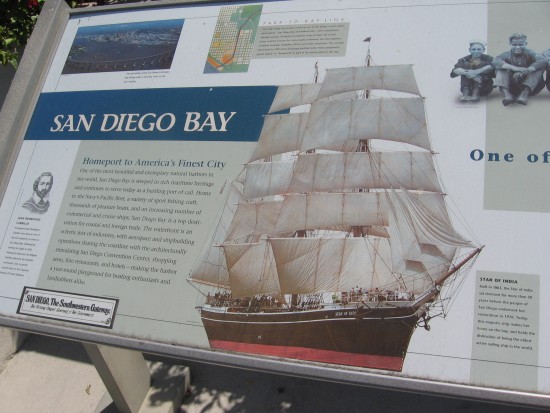
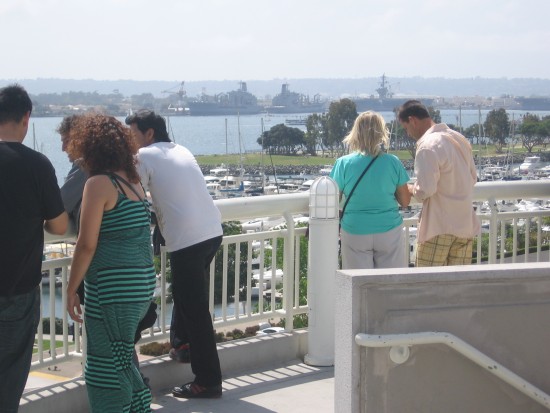
Interesting arches at San Diego Convention Center.Looking up at glass awning above main entrance.People descend stairs from building’s uppermost level.Cool round glass elevator at top of incline.Looking down a patterned expanse of outside steps.Steps on the bay side lead up from Marriott Marina.Convention center seen from Embarcadero Marina Park South.A glass elevator nestled among trees.Gazing from an upper level toward big Hilton hotel.Sign on scenic terrace shows San Diego’s own Star of India.Looking over San Diego Convention Center’s rooftop sails.People enjoy amazing view of San Diego Bay and Coronado.
…
To enjoy future posts, you can “like” Cool San Diego Sights on Facebook, or follow me on Twitter.
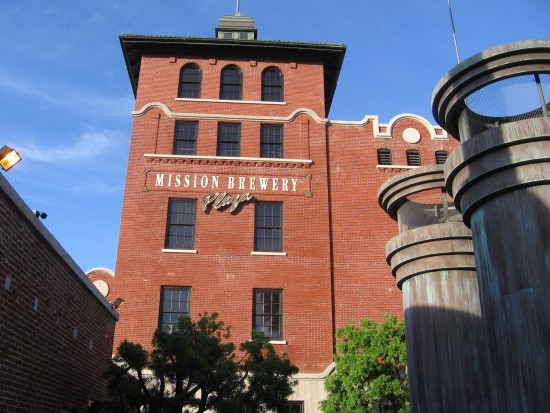
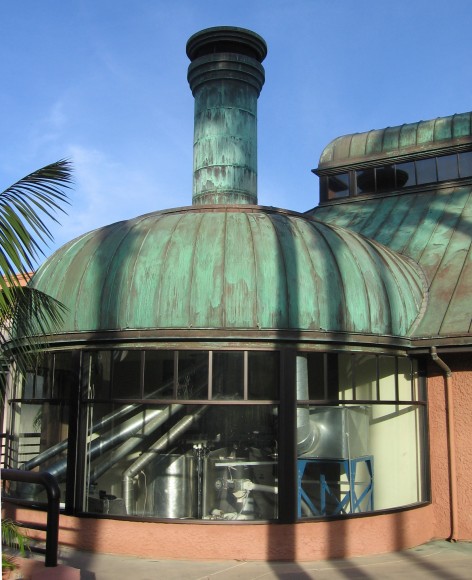
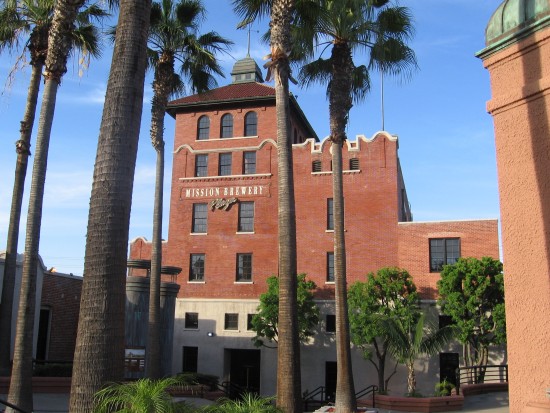
A very cool building is located in San Diego’s Middletown neighborhood, near the intersection of Washington Street and Interstate 5. Here are a few photos I took the other morning!
The historic building, dating from 1912, was the first brewery in the United States to be built in the Mission Revival Style. Today it remains the only Mission Revival industrial building in San Diego.
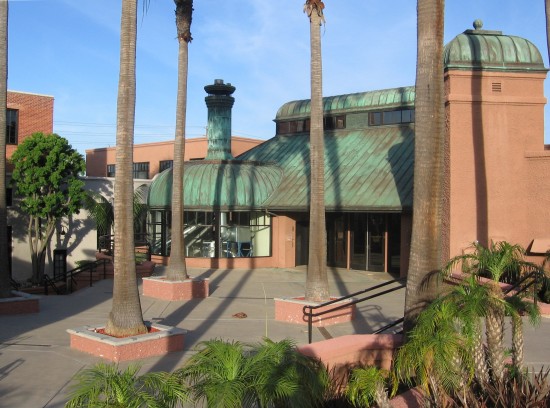
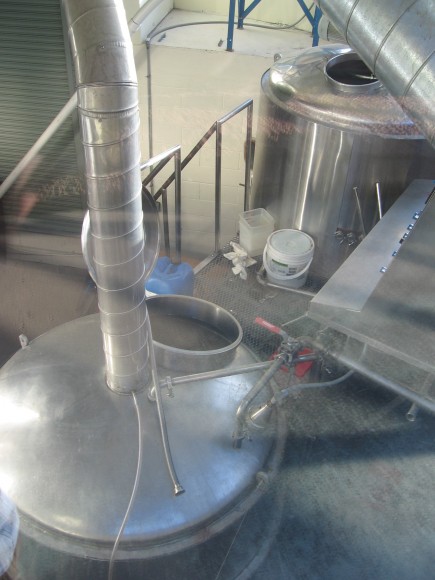
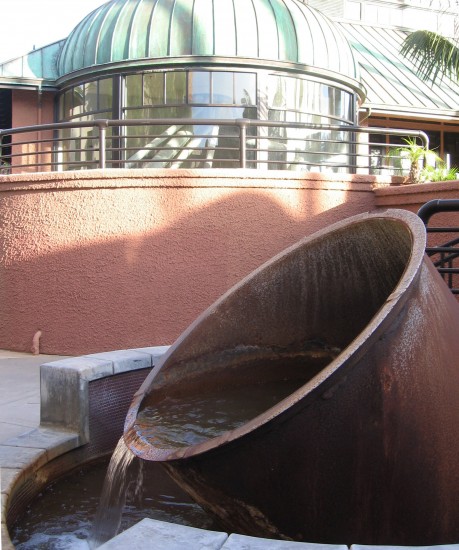
Briefly, prior to Prohibition, a non-alcoholic drink called Hopski was produced here. The large building then served as an isolation hospital during the 1918 flu pandemic. Later it was converted into an agar plant. Today the historic landmark is a part of Mission Brewery Plaza, whose buildings contains professional offices and a new craft brewery called Acoustic Ales Brewing Experiment.
The building has served many purposes over the years.Acoustic Ales Brewing Experiment now occupies this area.Where beer is made today.Old production vat now is an outside fountain.A very cool building!
…
To enjoy future posts, you can “like” Cool San Diego Sights on Facebook, or follow me on Twitter.
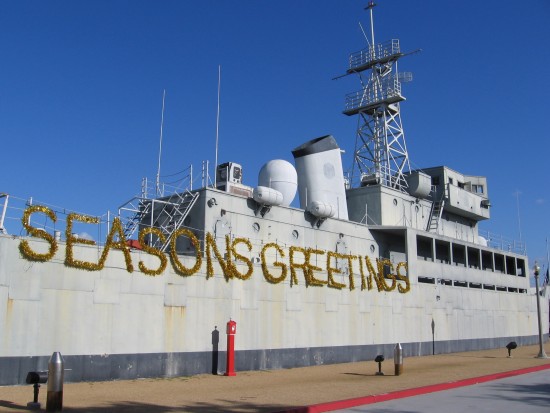
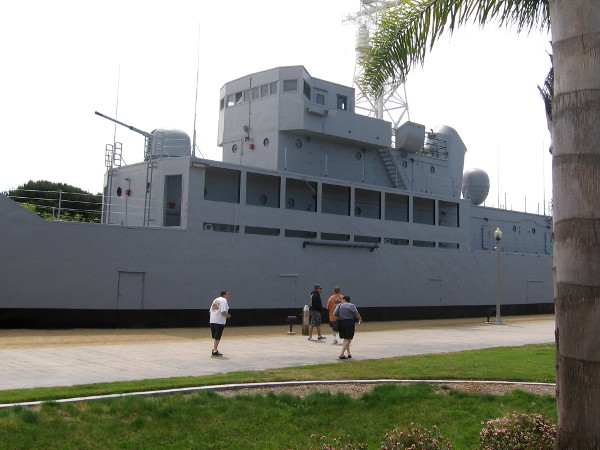
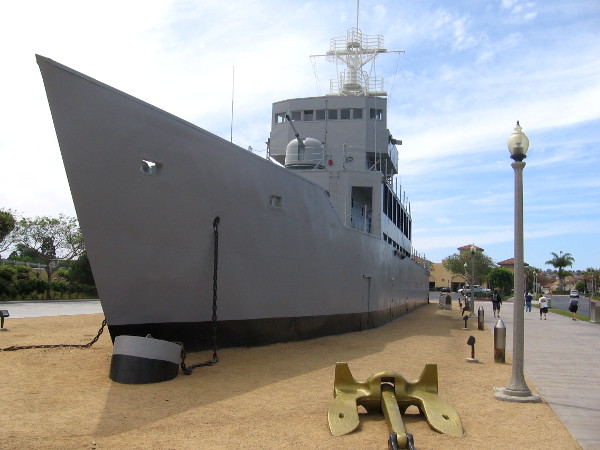
How did this guided missile frigate end up sitting on the ground? Why does it have a tinsel sign that spells out Seasons Greetings? Did Santa drop it like an oversized toy from the sky?
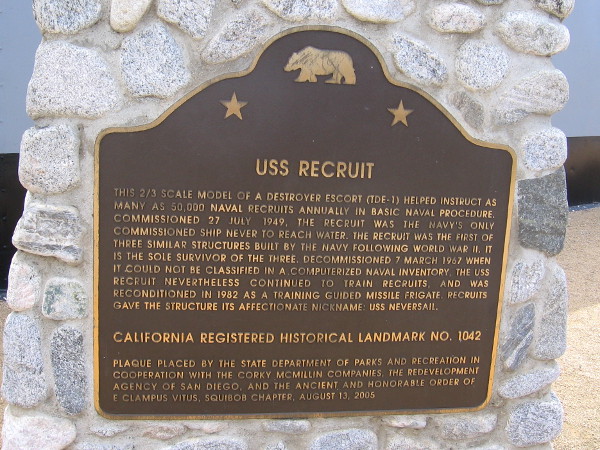
This unusual sight is often glimpsed by San Diegans motoring along Harbor Drive between downtown and Point Loma. Built right there on the ground in 1949 to train Navy recruits, today this two-thirds model of a real warship is situated at the southwest end of the redeveloped NTC Liberty Station. The landlocked “non-ship” is officially named the USS Recruit and was originally modeled after a destroyer, and commissioned as a regular Navy ship!
Nicknamed by sailors the USS Neversail, she’s become something of a San Diego landmark. And every year around Christmas she wishes passersby a happy holiday!
UPDATE!
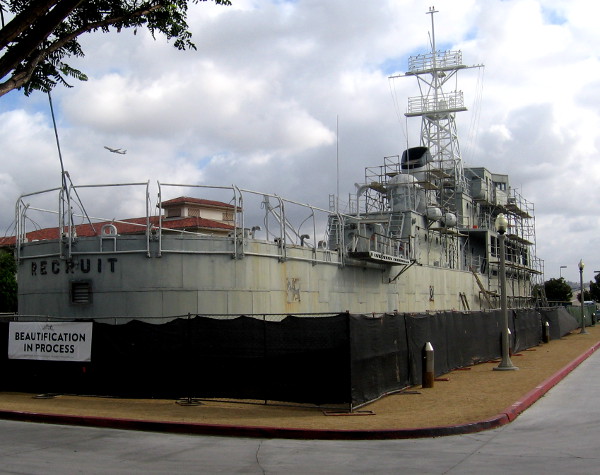
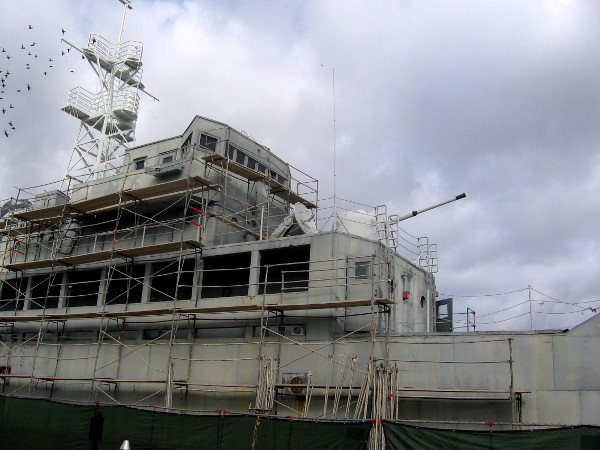
Here are a few pics taken during a walk in late September of 2014. The USS Recruit appears to be awaiting a new coat of paint!
Beautification in progress in late September 2014.Scaffolding along the side of the weathered old USS Recruit in Point Loma.A bicyclist passing the USS Recruit heads into Liberty Station.
I walked past the USS Recruit in early March, 2015. The ship has a new paint job! Of course, I had to take more photos…
This model of a destroyer escort helped instruct as many as 50,000 naval recruits annually in basic naval procedure. The Recruit was the Navy’s only commissioned ship never to reach water.People walk past the newly painted USS Recruit at one end of Liberty Station.Nicknamed the USS Neversail, this ship is an unusual sight that captures the attention of visitors to San Diego.
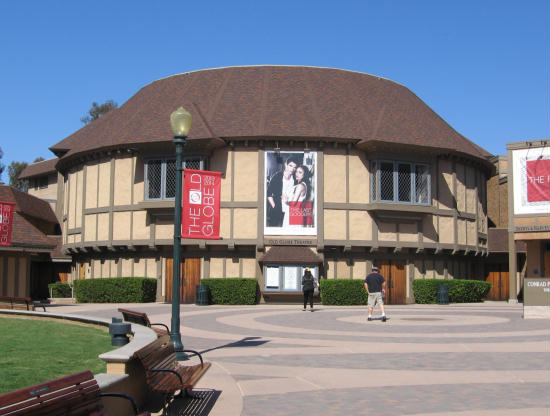
You’re looking at the Old Globe Theatre. It’s modeled after the original Globe Theatre in London, where Shakespeare enjoyed watching many plays that he’d penned. This beloved building is a popular San Diego landmark.
The Tudor-style building was originally constructed in 1935, and was first used for the California Pacific International Exposition to stage Shakespearean plays. In 1978 it was burned down by an arsonist. A nearby festival stage was quickly erected so that performances could go on, then the Old Globe was rebuilt with the generous help of many San Diegans.
Since 1949, The Old Globe has hosted an annual summer Shakespeare Festival. During the summer and winter, the theatre puts on about 15 different shows including modern plays, comedies, musicals and classics.
Many productions that originated here have gone on to Broadway. These shows have won nine Tony Awards and almost 60 nominations!
Karen and Donald Cohn Education Center next to Old Globe Theatre.
























 Cool San Diego Sights!