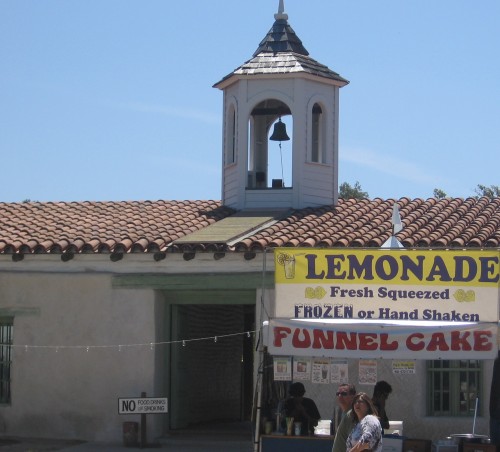
Front of Casa de Estudillo seen during Cinco de Mayo.
Ramona, written by Helen Hunt Jackson in 1884, is one of the most popular American novels in history. The book has had more than 300 printings. It’s been made into a movie four times. Today, few remember it.
Those who walk through La Casa de Estudillo in San Diego’s historic Old Town, however, are seeing with their own eyes a remnant of Ramona’s fame. Without that novel, and past generations’ fondness for its main character, this handsome old building and possibly others around it would have been torn down and utterly obliterated.
The Casa de Estudillo was built in 1827. It was the property of José María Estudillo, an early settler of San Diego. Captain Estudillo was twice Commandant of the Presidio of San Diego. This large, many-roomed adobe was one of finest houses in all of Mexican California, and remains one of the oldest surviving examples of Spanish Colonial architecture in California.
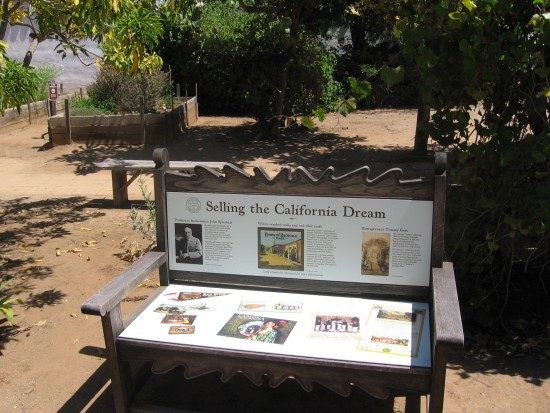
Shortly after the publication of Ramona, the house, in the hands of a caretaker, enjoyed a burst of popularity with tourists when San Diego’s newspaper, the San Diego Union, declared that the Estudillo house was the title character’s wedding place. Helen Hunt Jackson never stated this was so; the novel described a similar location, but was fictional.
As decades went by the old adobe fell into disrepair and might have been razed. In 1906, John D. Spreckels, owner of the San Diego Electric Railway Company and the Union newspaper, purchased the house and preserved it, transforming it into a true tourist attraction. He altered the building to make it seem more compatible with the description of Ramona’s marriage place, while adding electricity and other conveniences.
The building eventually was given National Historic Landmark status. It’s exaggerated association with the novel caused it to be officially described as “Casa Estudillo/Ramona’s Marriage Place.”
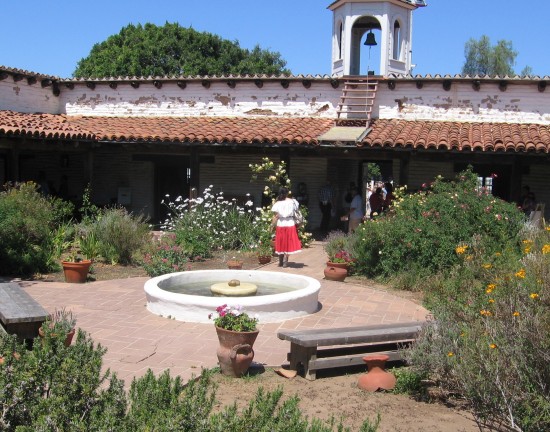
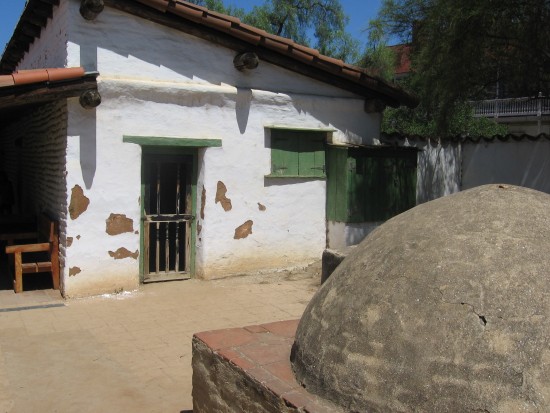
Just inside the courtyard looking up at bell tower.Courtyard fountain of historic Casa de Estudillo.Outdoor oven and one end of old U-shaped adobe house.The house was heavily promoted as the wedding place of Ramona.Walking along the outdoor corridor of old Spanish Colonial home.Camera’s flash illuminates one interior room.Trees and flowers in the beautiful courtyard.Ramona, a famous novel, saved history in Old Town.
…
To enjoy future posts, you can “like” Cool San Diego Sights on Facebook, or follow me on Twitter.
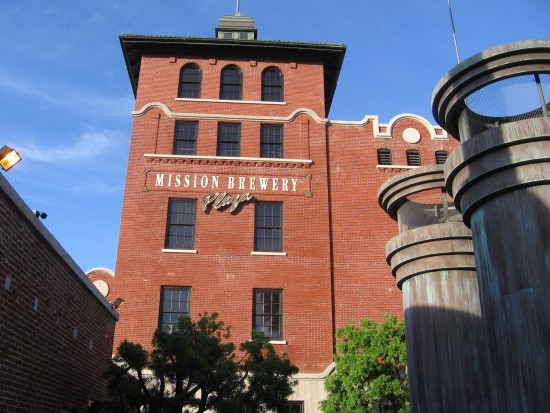
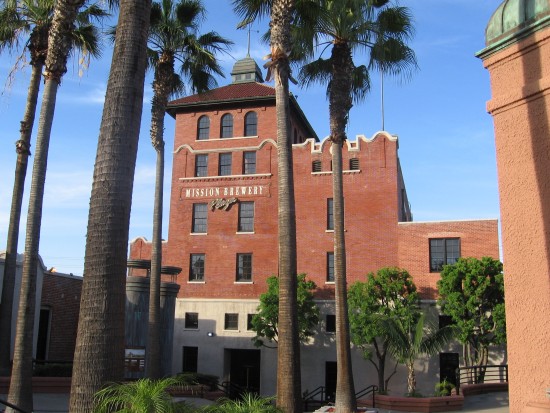
A very cool building is located in San Diego’s Middletown neighborhood, near the intersection of Washington Street and Interstate 5. Here are a few photos I took the other morning!
The historic building, dating from 1912, was the first brewery in the United States to be built in the Mission Revival Style. Today it remains the only Mission Revival industrial building in San Diego.
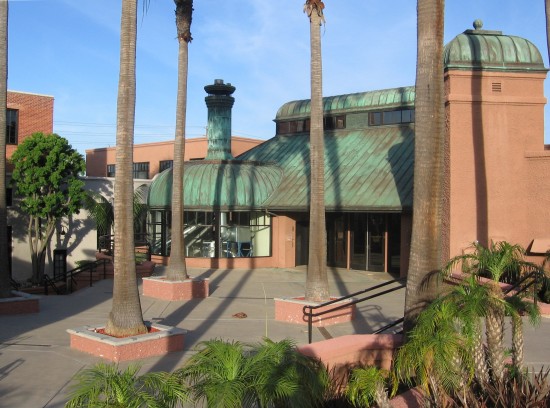
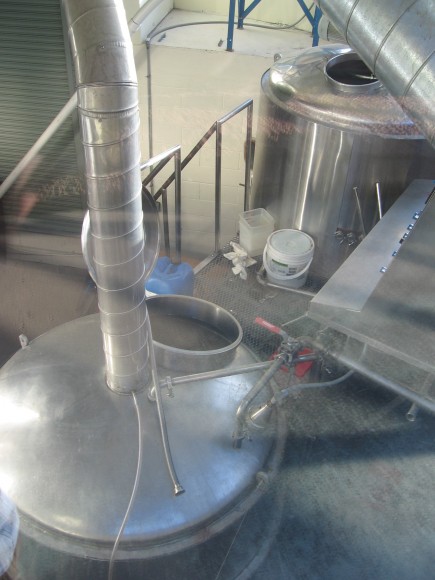
Briefly, prior to Prohibition, a non-alcoholic drink called Hopski was produced here. The large building then served as an isolation hospital during the 1918 flu pandemic. Later it was converted into an agar plant. Today the historic landmark is a part of Mission Brewery Plaza, whose buildings contains professional offices and a new craft brewery called Acoustic Ales Brewing Experiment.
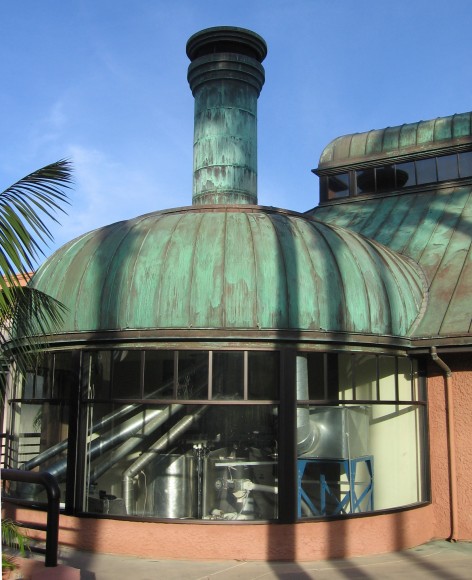
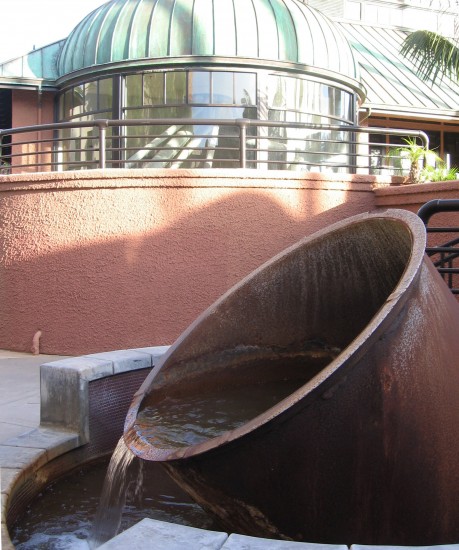
The building has served many purposes over the years.Acoustic Ales Brewing Experiment now occupies this area.Where beer is made today.Old production vat now is an outside fountain.A very cool building!
…
To enjoy future posts, you can “like” Cool San Diego Sights on Facebook, or follow me on Twitter.
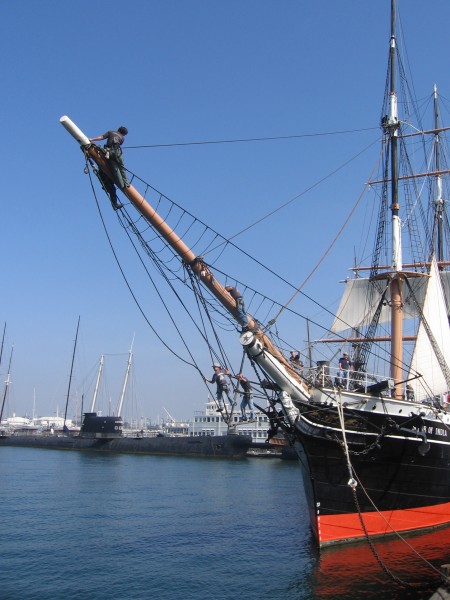
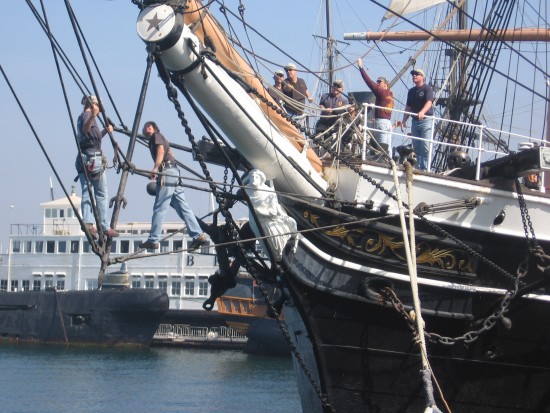
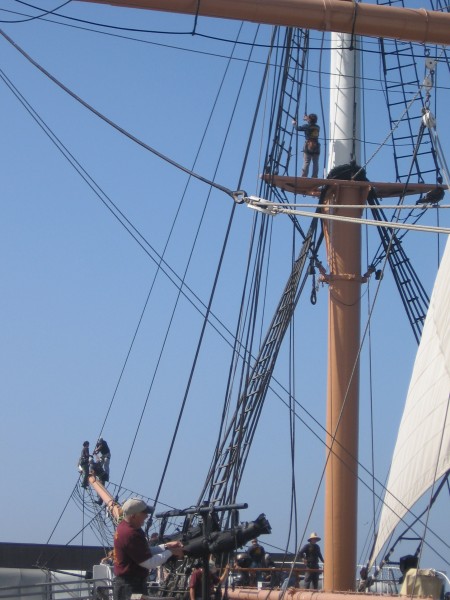
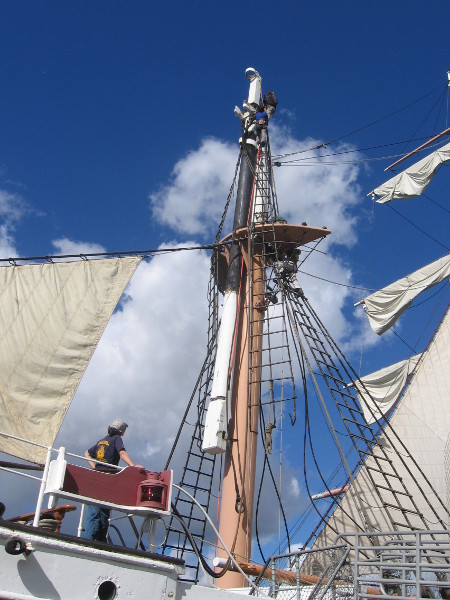
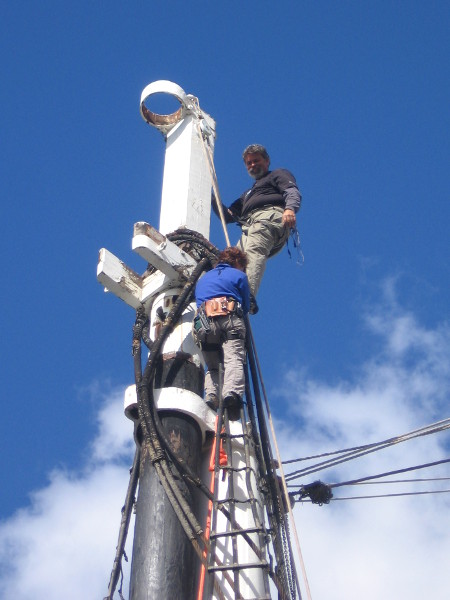
Dedicated members of San Diego’s Maritime Museum were hard at work yesterday, working in the Star of India’s rigging like busy spiders on a web.
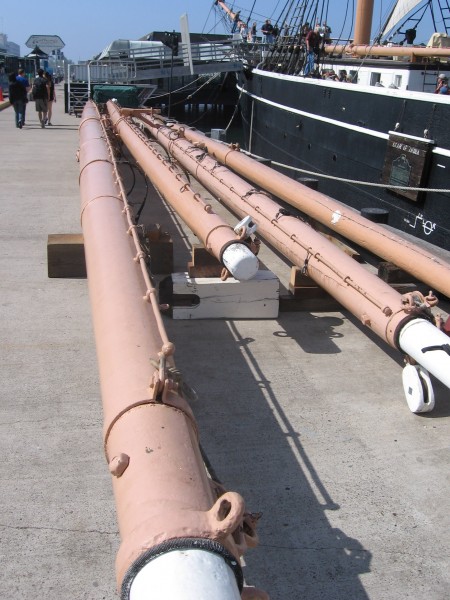
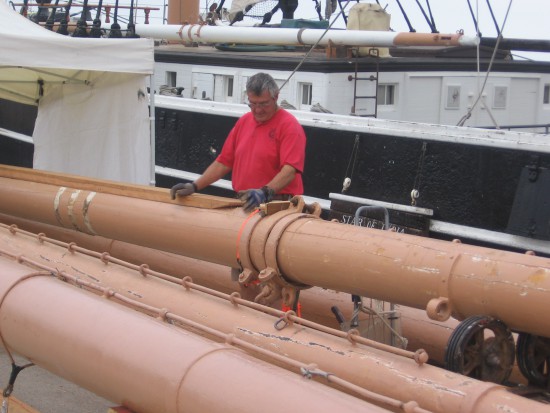
The rigging of the historic three-masted bark is undergoing an overhaul, a project that is expected to take a full year. That’s according to the person selling tickets. The large yards of the foremast have already been removed and are lying on the sidewalk awaiting inspection and a new coat of paint. I was told the ship’s trees (platforms on the masts) are infested with termites. They’ll have to be repaired. To maintain the 150 year old Star of India, the oldest active sailing ship in the world, requires a lot of work!
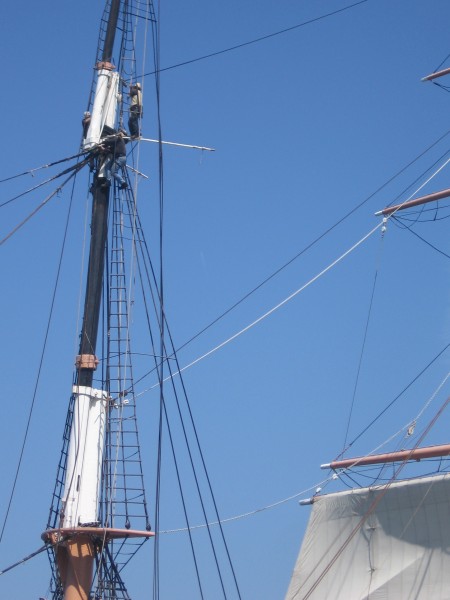
People tangled in picturesque ship’s rigging.Like highwire artists on the slender ropes.Looks like a lot of hard work.Yards from foremast wait on sidewalk to be painted.Maritime Museum members at work on Star of India.High up in the blue San Diego sky.
I got a quick photo of a San Diego Maritime Museum volunteer working on the yards on an early July morning!
Volunteer works on Star of India’s yards.
Here come several more pics taken in October. The top third of the foremast has been removed!
Top portion of Star of India foremast has been removed in October of 2014.Maritime Museum of San Diego workers high up on the foremast of the historic Star of India.On a shroud, in a tangle of ropes and cables between masts.
…
To enjoy future posts, you can “like” Cool San Diego Sights on Facebook, or follow me on Twitter.
Bankers Hill is dotted with a variety of grand historic mansions. One of the most opulent–and one of my favorites–is the Long-Waterman House. It stands directly across the street from the barn-like Farm House that I photographed for an earlier blog post.
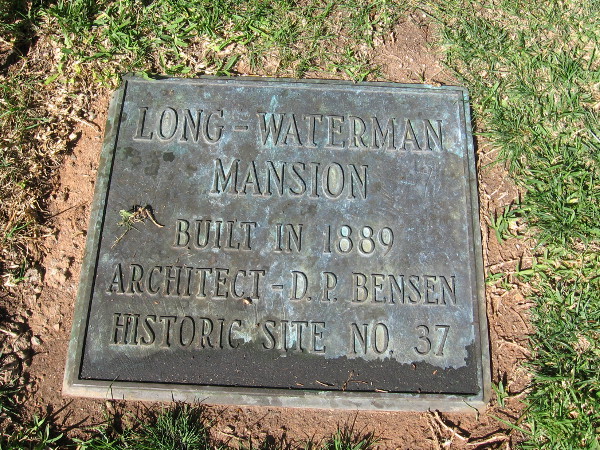
The Long-Waterman House was built in 1889 by famed architect D. B. Benson and is a superb example of the American Queen Anne style. The first owner was John Long, who headed the Coronado Fruit Package Company. He also owned a business which imported exotic woods and manufactured hardwood veneer. As you might expect, the interior of this house, which I’ve been fortunate to briefly see, is absolutely filled with warm, beautiful woodwork.
In 1891 the mansion was purchased by Robert Whitney Waterman, who’d just finished a term as Governor of California. He died only a few months later.
Plaque in front yard of 1889 Long-Waterman mansion.Delightful architecture on Bankers Hill.
…
To enjoy future posts, you can “like” Cool San Diego Sights on Facebook, or follow me on Twitter.
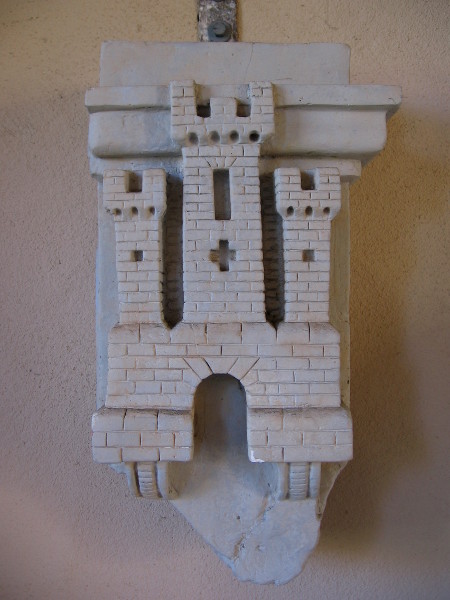
Original staff plaster memorial to Fray Junipero Serra, founder of the Franciscan missions in Alta California. Was part of the 1915 Exposition’s Food Products Building.
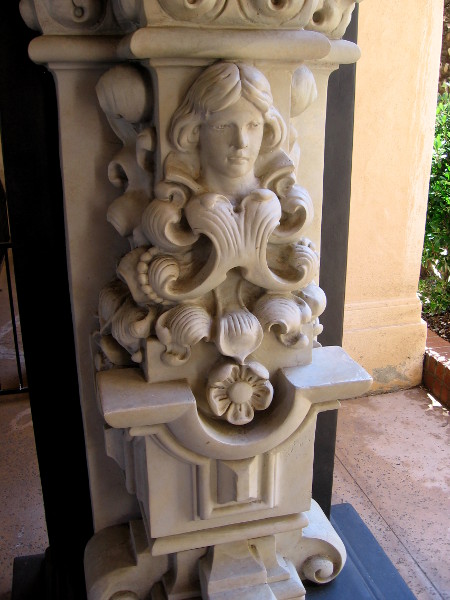
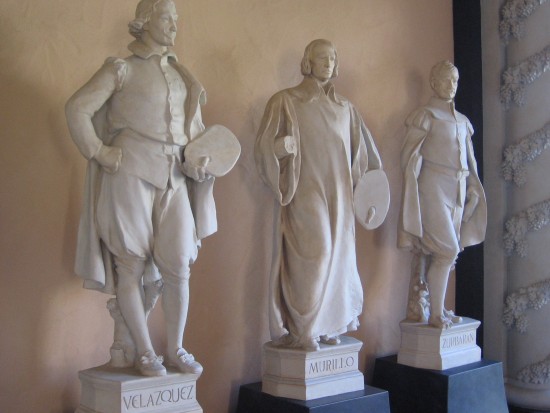
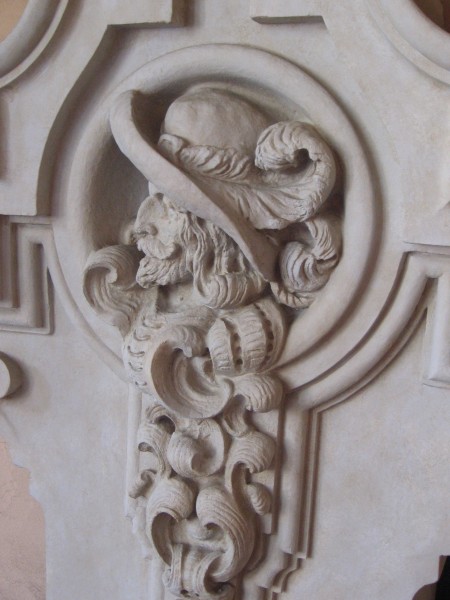
In the outdoor Panama-California Sculpture Court at Balboa Park’s Casa del Prado you’ll discover a small collection of rescued art. Most of these sculptures and decorative motifs are made of staff, which is gypsum plaster mixed with hide glue, reinforced with fibers. They were found in 1975 dumped in an unused corner of the nearby Casa de Balboa. Many are remnants of the old Food and Beverage Building from Balboa Park’s 1915 Panama-California Exposition and were designed by architect Carleton Monroe Winslow. Visitors today can admire these beautiful historical pieces up close.
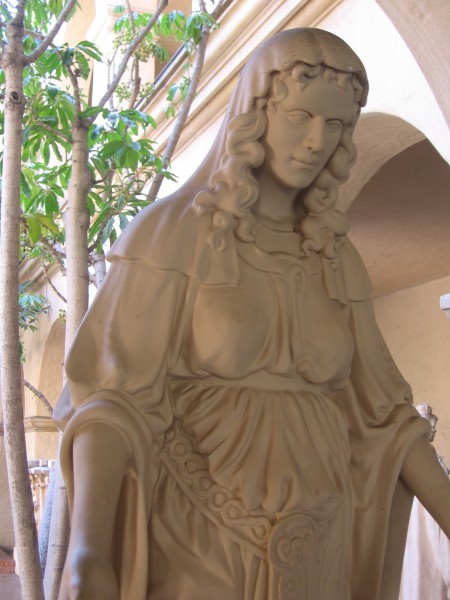
Castle, which was located on the left side of the Serra Memorial, depicts the heraldic emblem of the former Spanish Kingdom of Castile.One of four identical heads created in 1914 for the Panama-California Exposition. It was located on the Varied Industries Building facade.Plaster models designed in 1924 of famous 17th century Spanish painters Velazquez, Murillo and Zurbaran. Used to cast sculptures above what is now the San Diego Museum of Art.This round staff plaster Spanish Conquistador vignette, dated 1914, formed a pendant beneath sculptural groups on the Varied Industries Building.Freestanding figure of a woman in flowing robes titled Religion. It stood atop the 1914 retablo of the Varied Industries Building.Unused cast concrete replica of an original 1914 angel head finial. Created for the 1971 reconstruction of the Casa del Prado.Beautiful works of art in Panama-California Sculpture Court at the Casa del Prado.Angelic column seen through arch of Casa del Prado.
…
To enjoy future posts, you can “like” Cool San Diego Sights on Facebook, or follow me on Twitter.
I hope you enjoyed my last blog post, where I described a hike around the Guy Fleming Trail in Torrey Pines State Reserve. Now I’d like to take you up to see the Lodge.
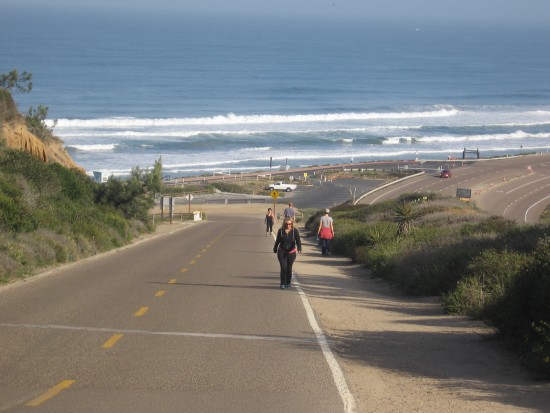
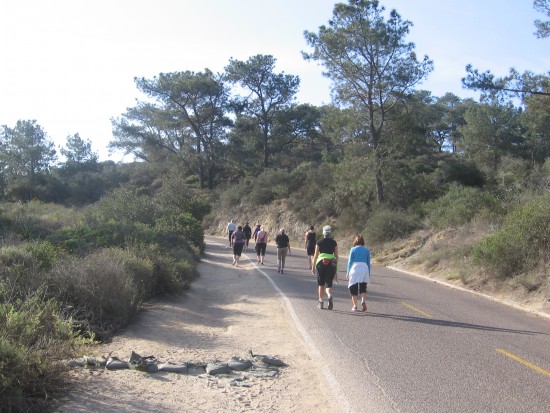
We’re going to start at the entrance of Torrey Pines State Reserve, just off the Pacific Coast Highway. We’ll be climbing the steep Torrey Pines Park Road all the way to the historic Lodge.
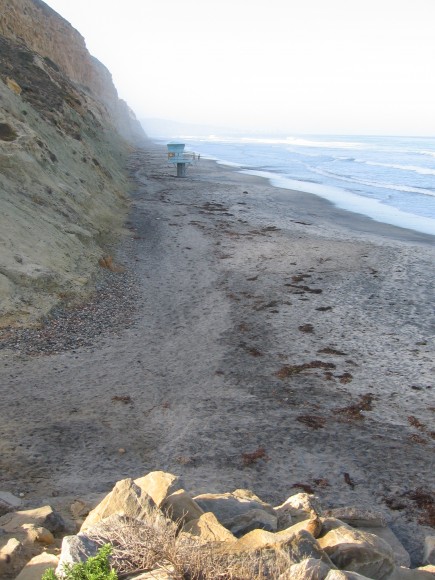
Looking south along Torrey Pines State Beach.
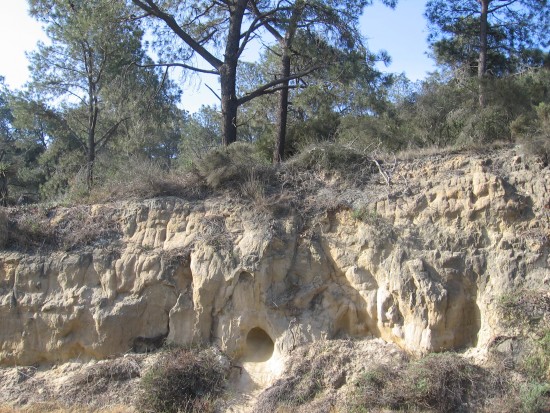
As we begin our climb we bend away from the beach, but pause for a moment to observe the high sandstone cliffs to our south. This wonderful beach, which extends for many miles, will be the subject of a future blog post!
Heading up steep Torrey Pines Park Road.Entering a zone full of endangered Torrey pines.Torrey pines stand atop eroded sandstone cliffs.
The Torrey pine is an endangered tree found only here and on Santa Rosa island. We’ll learn more about it shortly…
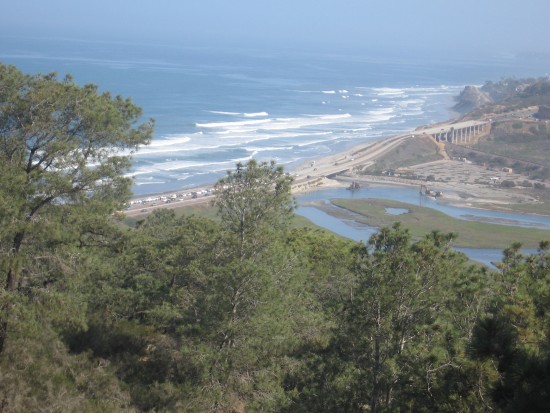
View of lagoon and ocean from High Point Overlook.
Near the top of the road we come to High Point Overlook, a short trail that heads up some steps for a 360 degree view. Here we’re looking north and seeing a bit of the Los Peñasquitos Lagoon.
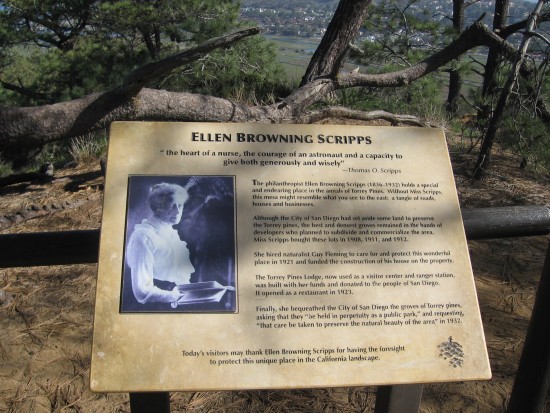
Sign about philanthropist Ellen Browning Scripps.
This sign stands among some Torrey pines at the top of the overlook. It reads:
The philanthropist Ellen Browning Scripps (1836-1932) holds a special and endearing place in the annals of Torrey Pines. Without Miss Scripps, this mesa might resemble what you see to the east: a tangle of roads, houses and businesses.
Although the City of San Diego had set aside some land to preserve the Torrey pines, the best and densest groves remained in the hands of developers who planned to subdivide and commercialize the area. Miss Scripps bought these lots in 1908, 1911, and 1912.
She hired naturalist Guy Fleming to care for and protect this wonderful place in 1921 and funded the construction of his house on the property.
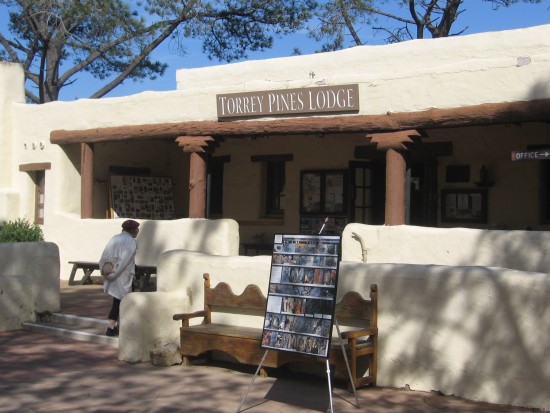
The Torrey Pines Lodge, now used as a visitor center and ranger station, was built with her funds and donated to the people of San Diego. It was designed by noted architects Richard Requa and Herbert Lewis Jackson. It opened as a restaurant in 1923.
Finally, she bequeathed the City of San Diego the groves of Torrey pines, asking that they “be held in perpetuity as a public park,” and requesting, “that care be taken to preserve the natural beauty of the area” in 1932.
Today’s visitors may thank Ellen Browning Scripps for having the foresight to protect this unique place in the California landscape.
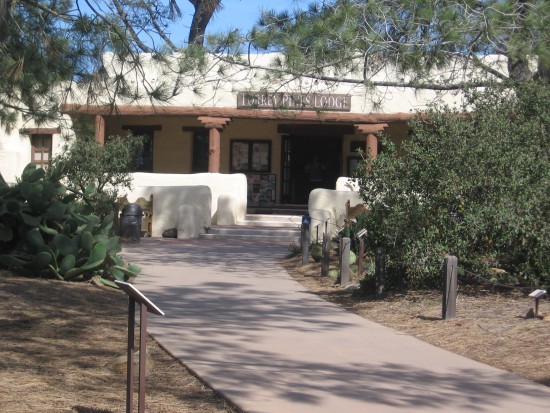
Nearing Torrey Pines State Reserve’s historic Lodge.
A little more walking takes us to our main destination, the Lodge. An old adobe built in 1922, it originally served as a restaurant! According to the official website, it had stumpy tables, chintz curtains, lampshades made of Torrey Pine needles, and a jukebox! Back in those days, Model T cars had difficulty going up the steep hill, because they didn’t have a fuel pump, and instead relied on a gravity system. When the steeply climbing cars conked out, drivers were told to continue up the hill in reverse!
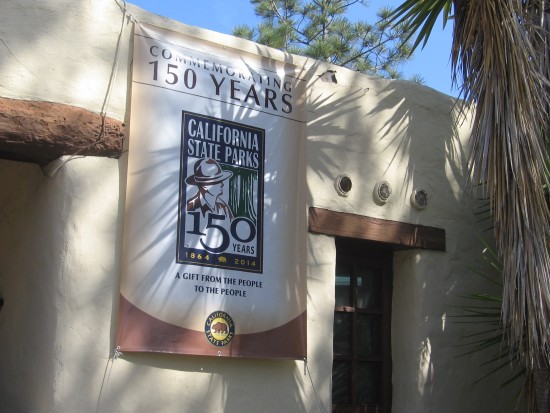
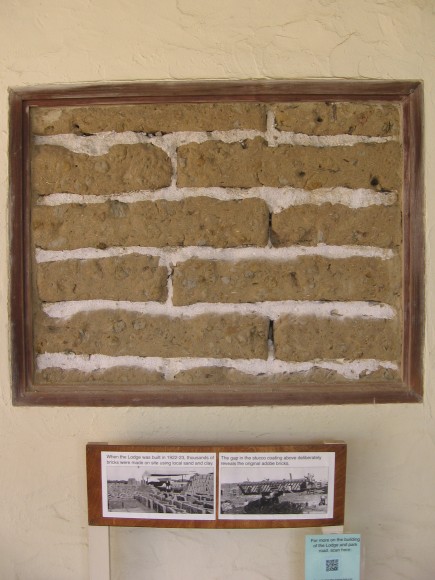
Banner commemorates 150 years of California State Parks.Gap in Lodge’s stucco shows original adobe bricks.
This is near the front door. The sign below reads:
When the Lodge was built in 1922-23, thousands of bricks were made on site using local sand and clay. The gap in the stucco coating above deliberately reveals the original adobe bricks.
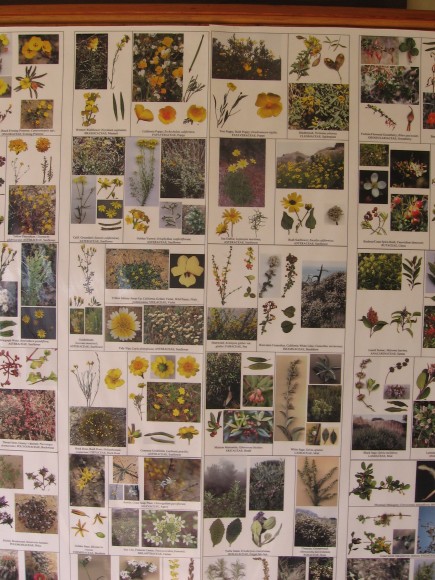
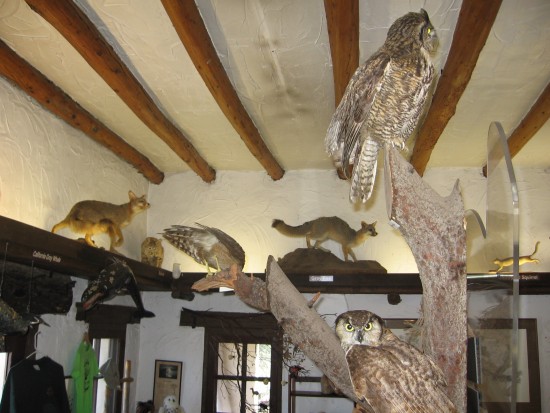
Portion of large sign outside describing coastal flowers.Interior of Lodge is a museum and visitor center.
I love the interior of the Lodge. There’s so much interesting stuff to see, and so much history and natural charm jammed into one place. The Lodge is open daily 9 AM to 6 PM during summer daylight saving time and 10 AM to 4 PM during winter standard time. Ranger guided hikes are available on weekends.
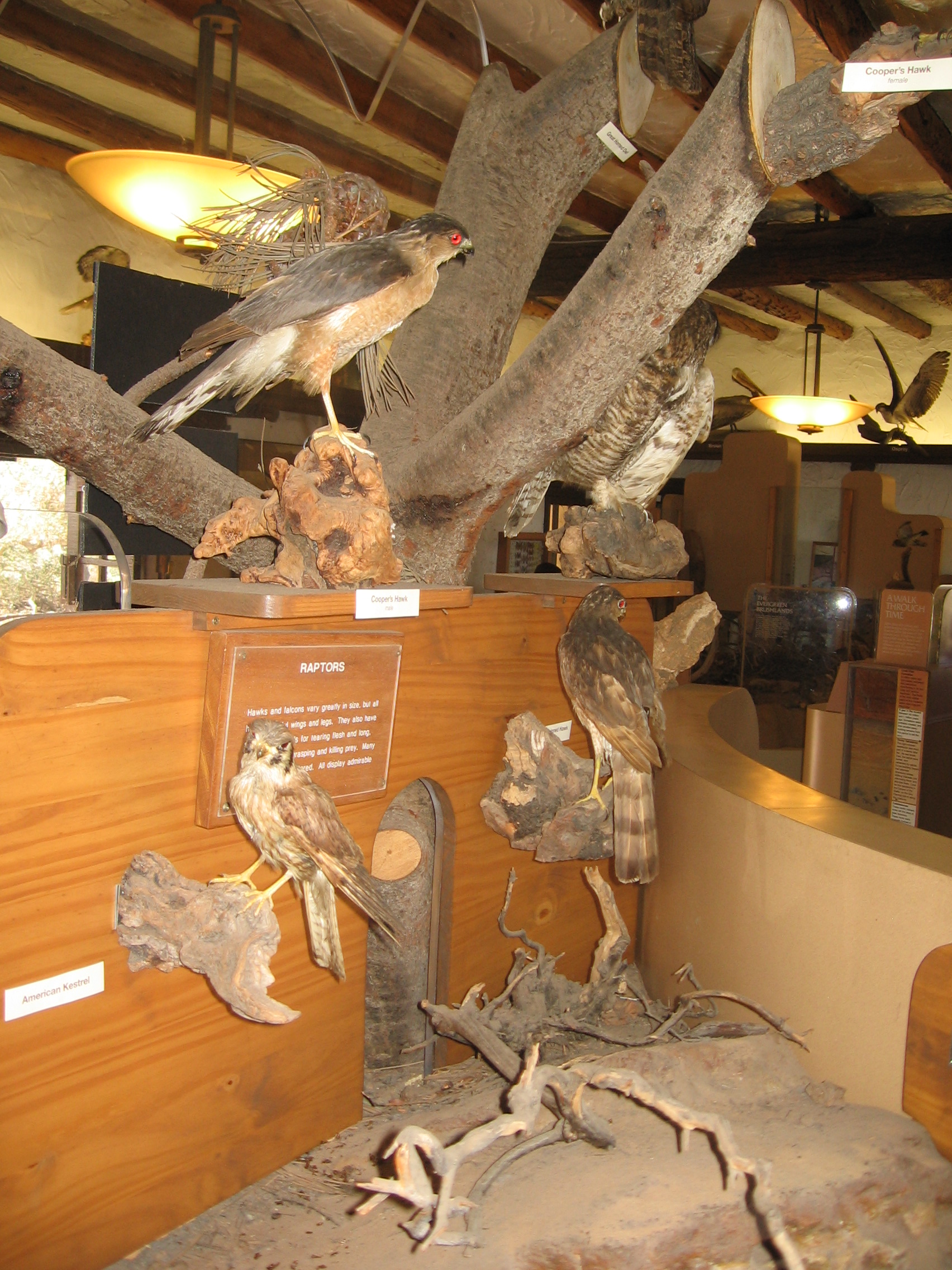
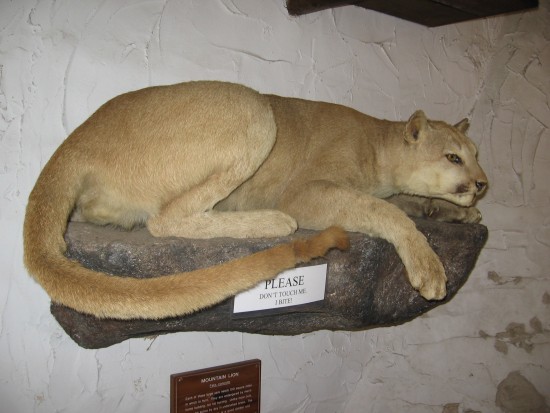
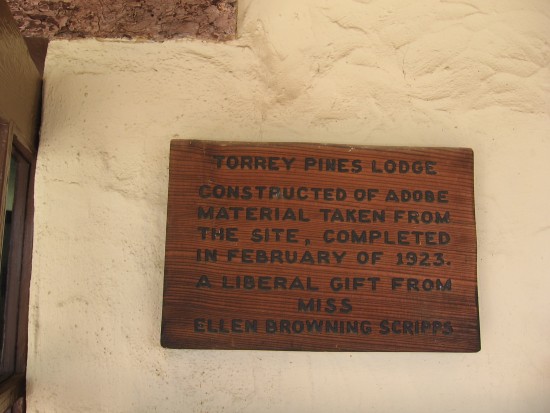
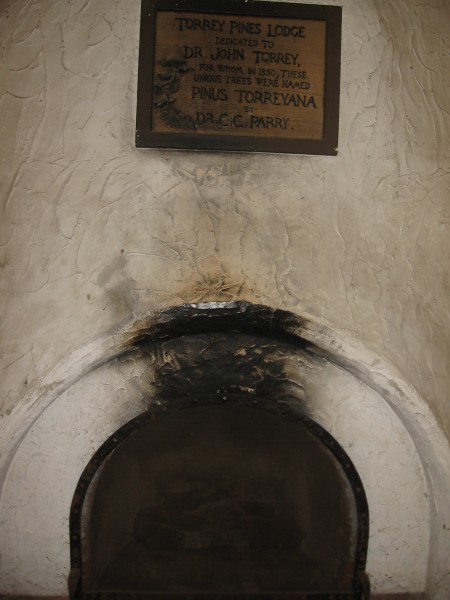
One of many educational exhibits.Mountain lion patiently watches visitors to the Lodge.Plaque in Lodge credits Ellen Browning Scripps.Old fireplace shows decades of use.
The plaque above the old fireplace reads:
Torrey Pines Lodge dedicated to Dr. John Torrey, for whom, in 1850, these unique trees were named Pinus torreyana by Dr. C. C. Parry.
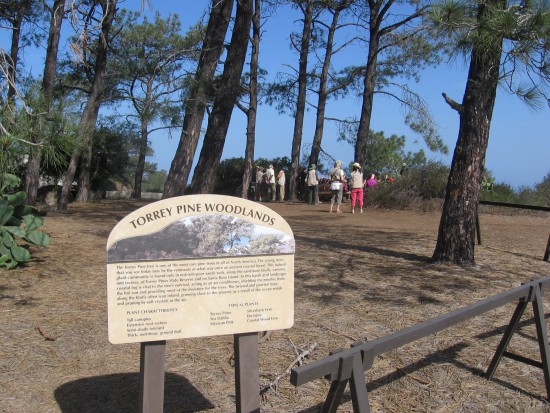
Sign behind Lodge describes Torrey Pine Woodlands.
Now we’ve headed back outside, around the back of the Lodge. Numerous Torrey pines are all around us, and benches are sprinkled here and there with sweeping views eastward toward developed Carmel Valley and Interstate 5.
This sign reads:
The Torrey Pine tree is one of the most rare pine trees in all of North America. The young trees that you see today may be the remnants of what was once an ancient coastal forest. This natural plant community is found only in nutrient-poor sandy soils, along the sandstone bluffs, canyons, and ravines, of Torrey Pines State Reserve and on Santa Rosa Island. In this harsh arid landscape, coastal fog is vital to the tree’s survival, acting as an air conditioner, shielding the needles from the hot sun and providing most of the moisture for the trees. The twisted and gnarled trees along the bluffs often lean inland, growing close to the ground, as a result of the ocean winds and pruning by salt crystals in the air.
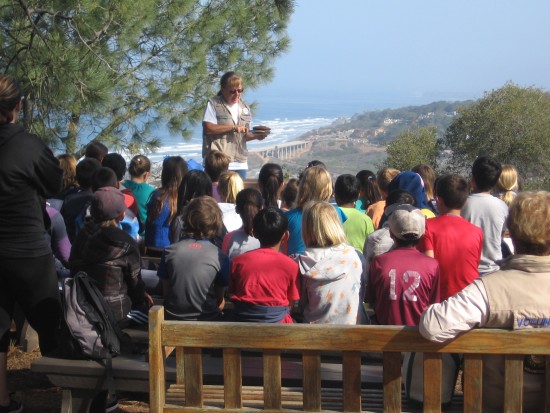
School kids learn about local flora and fauna.
A ranger was giving a bunch of school kids a talk about Torrey Pines State Reserve. They’ll remember this special place for the rest of their lives.
The Lodge at Torrey Pines State Reserve is a must see!
…
To enjoy future posts, you can “like” Cool San Diego Sights on Facebook, or follow me on Twitter.
Bronze plaque in Coronado marks birthplace of naval aviation.
In Coronado’s beautiful Centennial Park, just north of the Coronado Ferry Landing, you can find this relatively new bronze plaque. It marks the birthplace of naval aviation, Rockwell Field, which no longer exists.
The historical marker reads:
BIRTHPLACE OF NAVAL AVIATION
In 1910, on the unoccupied brushland of North Coronado Island, inventor and entrepreneur Glenn Hammond Curtiss opened his winter flying school for prospective “aeroplane pilots.” Among his first class of students was Navy Lieutenant Theodore G. “Spuds” Ellyson, who would become the first Naval Aviator. In 1917, the U.S. Congress appropriated the island to support the World War I effort and two airfields occupied its sandy flats–the Navy’s “Camp Trouble” and the Army Signal Corps’ Rockwell Field. The Army vacated Rockwell Field in 1935, at which time the Navy expanded its operations to cover the whole island. Many aviation milestones originated from North Island including the first seaplane flight in the United States in 1911.
San Diego, California was designated the “Birthplace of Naval Aviation” by the Armed Services Committee of the United States House of Representatives on 24 March 1961.
Marker Placed By
California State Society, Daughters of the American Revolution
2011
Historical marker is located near east end of Centennial Park.Rockwell Field in 1924.
…
To enjoy future posts, you can “like” Cool San Diego Sights on Facebook, or follow me on Twitter.
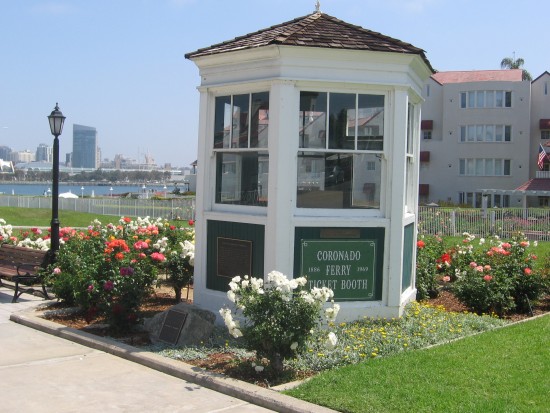
Original Coronado ferry ticket booth remains as historical artifact.
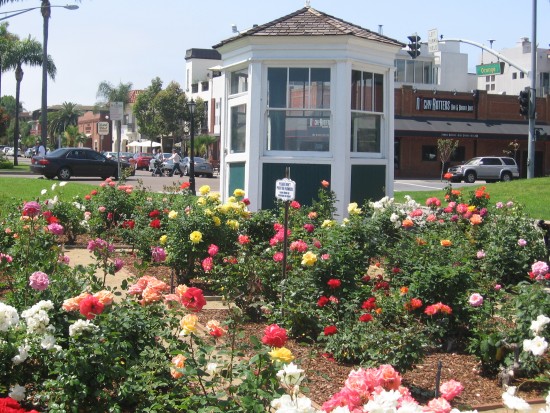
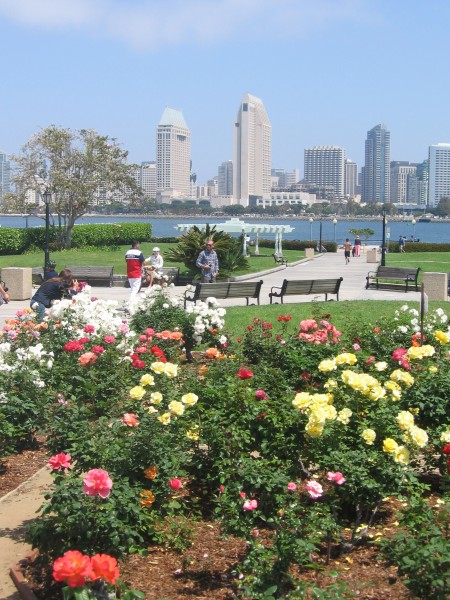
About a block north of today’s touristy Coronado Ferry Landing, you’ll find the old ticket booth of Coronado’s original ferry. It stands beside a garden full of colorful roses and a pleasant walkway that runs from the end of Orange Avenue east to San Diego Bay. This beautiful area is called Centennial Park.
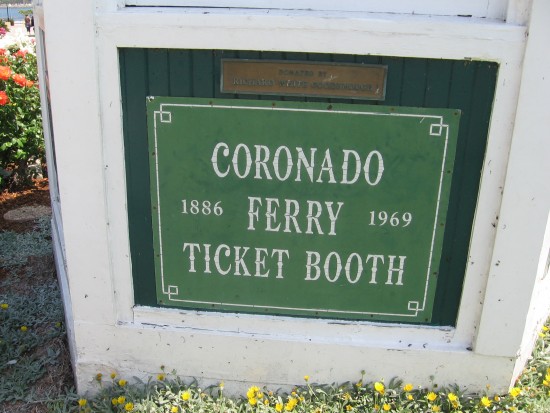
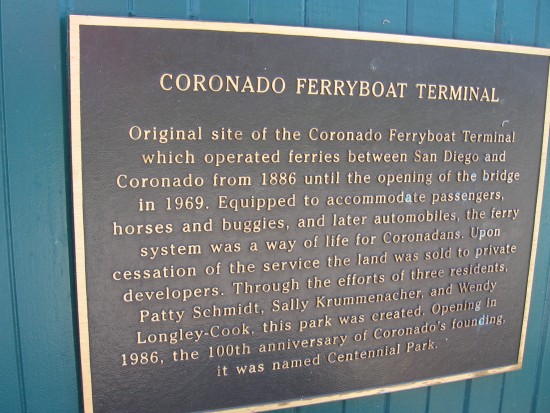
The original ferry was designed to transport horses and buggies; later ferries took automobiles across the bay. This vital link to downtown San Diego ran from 1886 to 1969, the year the Coronado Bay Bridge finally opened.
Looking over roses near the nostalgic old ticket booth.Sign reminds passersby of nearly a century of history.Plaque describes the history of the once vital Coronado ferry.Old Coronado ferry ticket booth surrounded by flowers.
…
To enjoy future posts, you can “like” Cool San Diego Sights on Facebook, or follow me on Twitter.
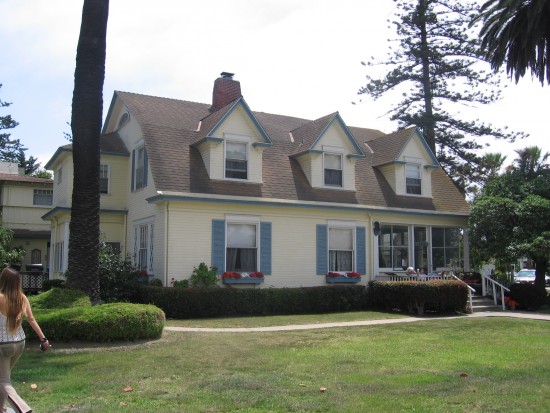
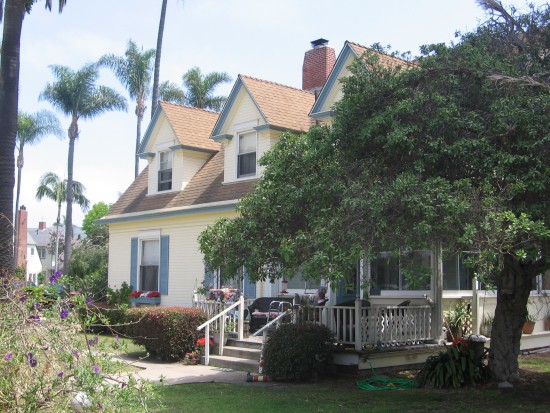
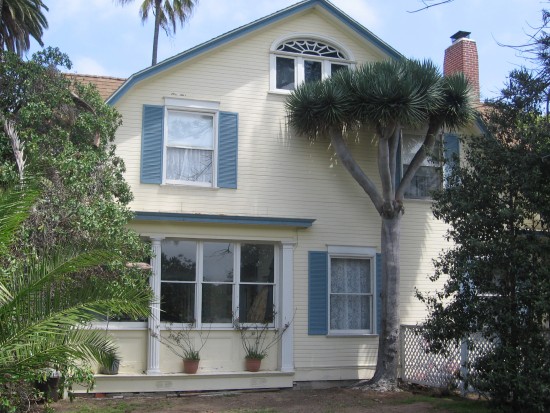
Wizard of Oz author L. Frank Baum rented this house in Coronado.
L. Frank Baum is one of America’s most beloved authors. He wrote the Wizard of Oz series of novels.
Baum, who lived in South Dakota, spent many winters at this rented house in Coronado, where he wrote three novels: Dorothy and the Wizard of Oz, The Emerald City of Oz and The Road to Oz, plus significant portions of The Marvelous Land of Oz.
When not writing, he enjoyed himself at the nearby Hotel del Coronado. The Victorian architecture of the famous beach resort is said to be the inspiration for much of the fantastic imagery in the Oz novels. He personally designed the huge crown-shaped chandeliers in the hotel’s grand Crown Room.
Today, the island city of Coronado has two nicknames: the Crown City and the Emerald City.
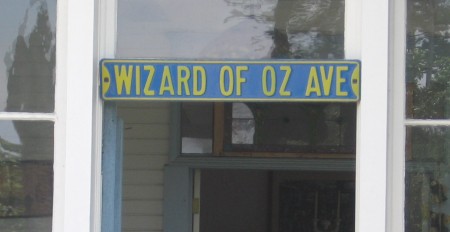
Wizard of Oz Ave sign above front door.L. Frank Baum wrote several Wizard of Oz novels at this house.The Wizard of Oz house is located in Coronado, the Emerald City.
…
To enjoy future posts, you can “like” Cool San Diego Sights on Facebook, or follow me on Twitter.
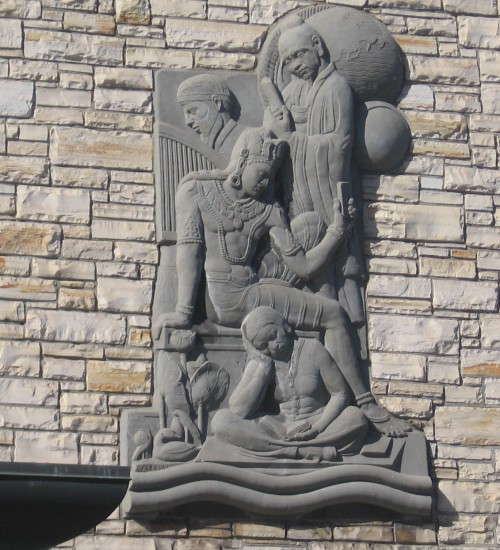
Figures associated with books linger in relief above entrance of old San Diego Central Library. Literature East, by famed local artist Donal Hord, 1953.
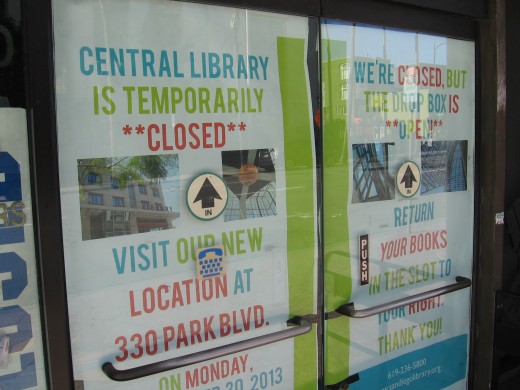
San Diego’s old Central Library on E Street was never really much to look at–in my opinion, at least. It was just a small, nondescript, almost colorless building across from the downtown Post Office. When the brand new gleaming Central Library opened in East Village, the doors of the old library were shut forever. But a few notable images–beautiful works of art near the entrance–still remain.
The classic Literature Panels at either side of the library entrance were created in 1953, when the building was new, by important San Diego artist Donal Hord, whose iconic works can be seen throughout the city. These reliefs depict readers and writers of books in human history.
Because of poor health as a child, he spent many hours in the San Diego Public Library and developed a love for reading.
Timeless art by an internationally renowned San Diego sculptor depicts books and their association with history, music and culture. Literature West, by Donal Hord, 1953.
Clock shows midnight on east side of closed San Diego library.
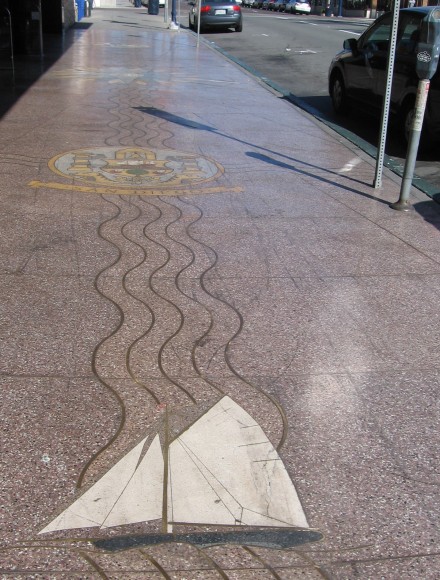
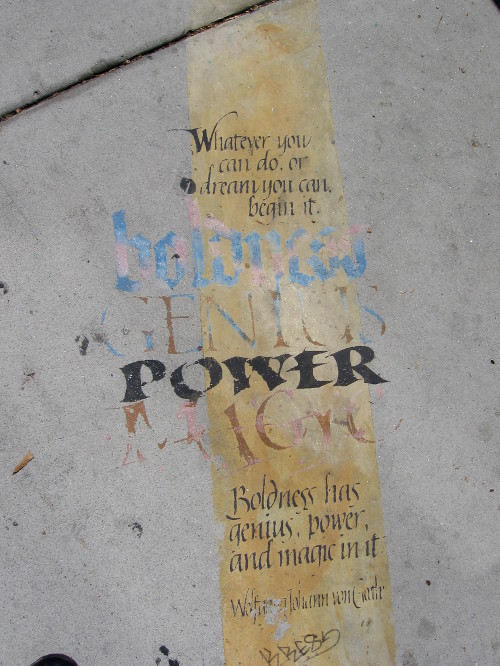
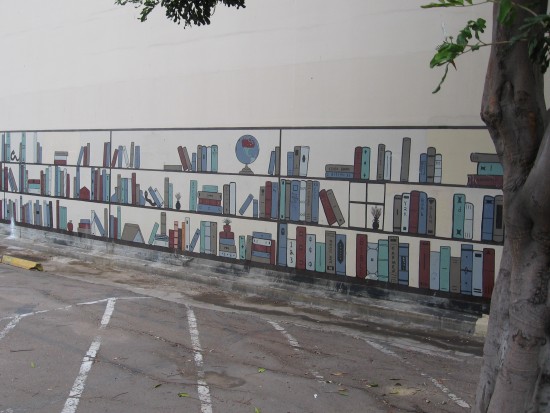
A lamp still burns on the vacant library’s front sidewalk.The empty sidewalk contains images once tread by many feet.Graphic on sidewalk in front of old library tells of dreams, boldness and genius.Books still line the parking lot behind vacant library.Little else remains to be seen at the old Central Library.
















 Cool San Diego Sights!