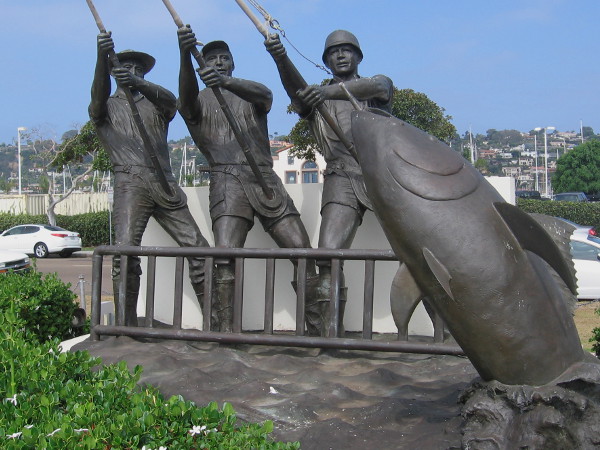
Three bronze fishermen on Shelter Island together reel in a large tuna.
A monumental bronze sculpture in Shoreline Park on Shelter Island has become an iconic image. The Tunaman’s Memorial, by artist Franco Vianello, dedicated in 1988, honors the courage and hard work of generations of tuna fishermen in San Diego. The 9,000 pound sculpture depicts three individuals pole fishing from a boat of the once-large tuna fleet out on the Pacific Ocean. The history of San Diego’s tuna fishing industry contains generations of life stories. These unwritten stories involve fishermen who immigrated from many different nations, including Italy, Portugal and Japan.
One polished side of the sculpture contains names of fishermen who were pioneers in our region, and those who were lost at sea. An inscription reads: Tunaman’s Memorial honoring those that built an industry and remembering those that departed this harbor in the sun and did not return. Anthony Mascarenhas.
The Tunaman’s Memorial on Shelter Island is a 9,000 pound bronze sculpture honoring generations of diverse fishermen.Tuna fishing in local waters was once a major industry in San Diego.Polished side of Tunaman’s Memorial contains names of San Diego fishing pioneers, and those who were lost at sea.This iconic sight on Shelter Island provides a glimpse back in history, at those in our community who worked the sea.
…
Follow this blog for more photos of cool stuff! Join me on Facebook or Twitter.
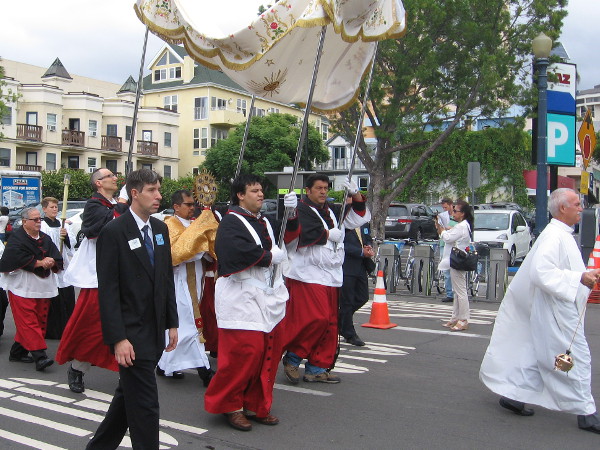
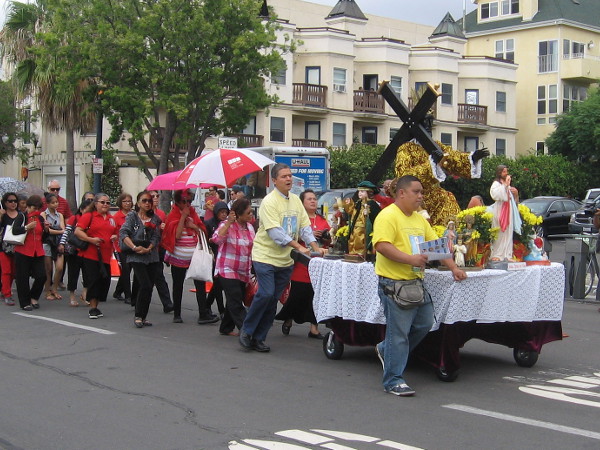
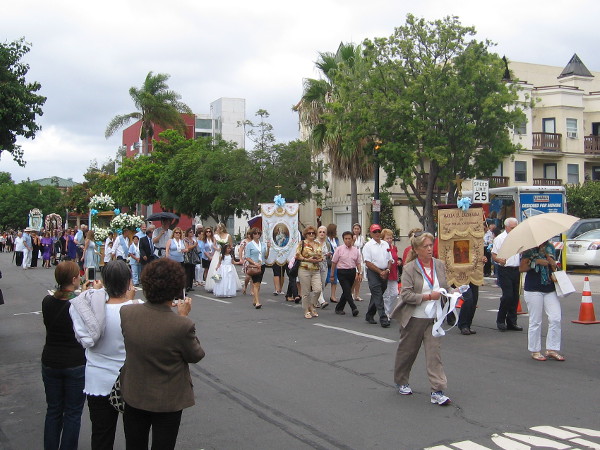
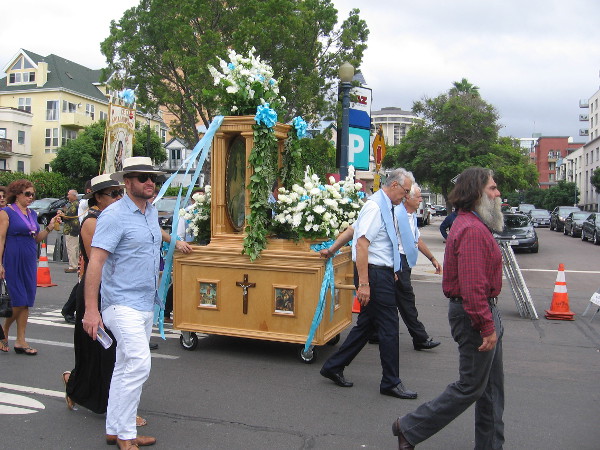
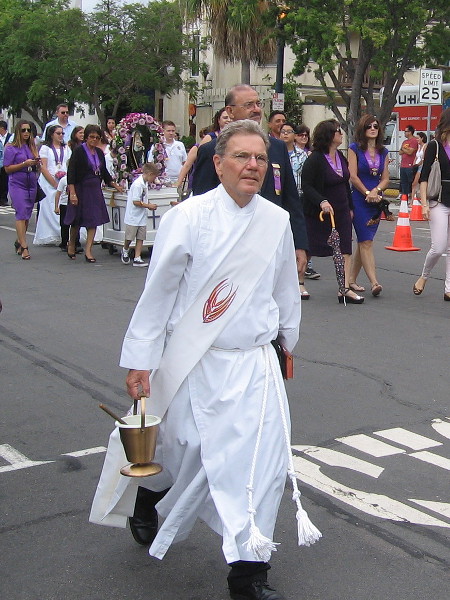
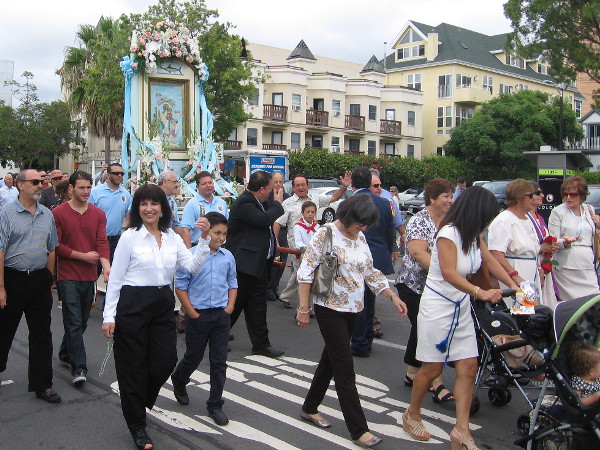
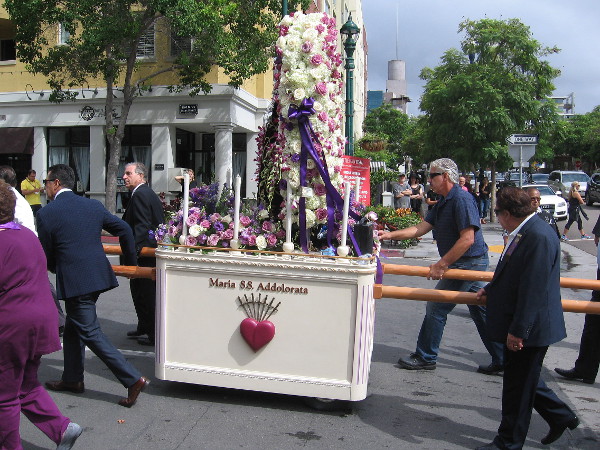
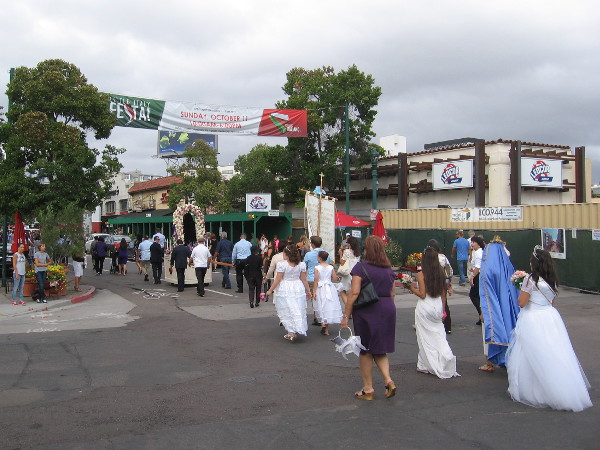
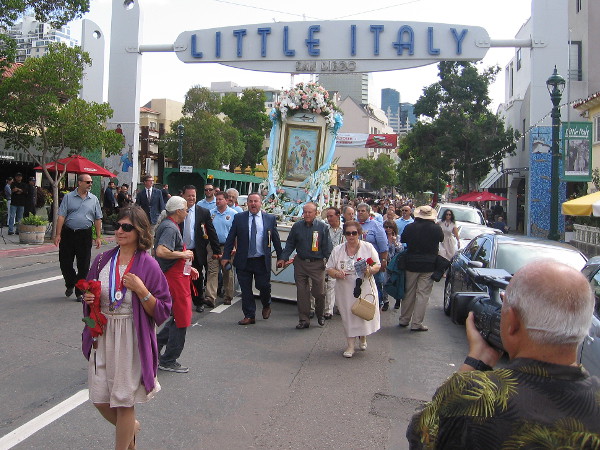
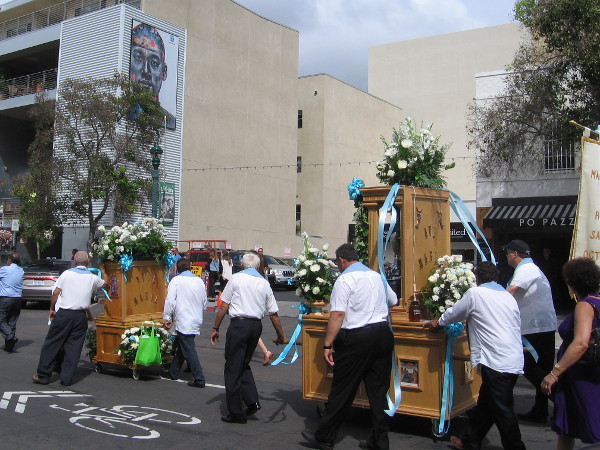
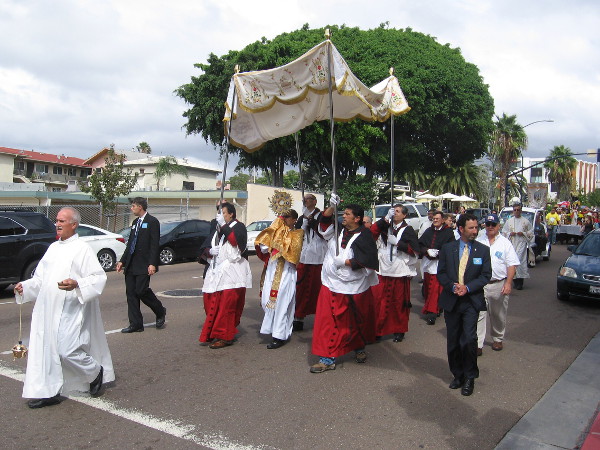
A colorful religious procession makes its way through San Diego’s culturally rich Little Italy neighborhood.
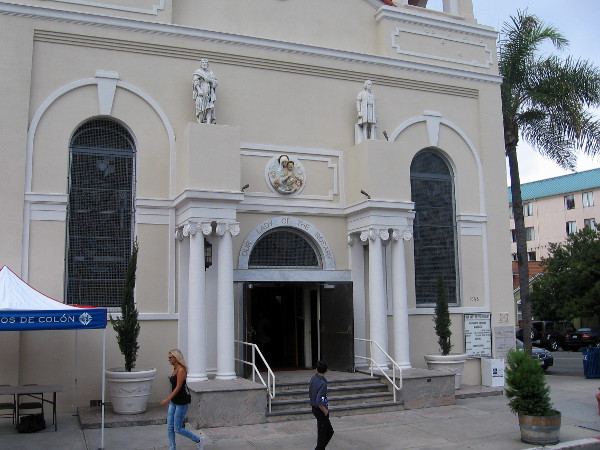
Early this afternoon, the historic Our Lady of the Rosary Parish in Little Italy celebrated Catholic Mass then held a grand procession. Parishioners marched from State Street in front of their church down to San Diego’s Embarcadero, where a fishing boat representing the local tuna fleet was blessed. I witnessed the procession a few years ago, but took no photos. So today I decided to walk along the sidewalk with my camera.
Forgive me for not knowing the details of the religious procession. I do know a large host of the faithful, in all manner of dress, many of Italian descent, and many carrying images of Jesus and Virgin Mary, marched joyfully north up India Street, then turned west down Hawthorn Street until they reached Harbor Drive. At the Hornblower dock, the fishing boat Patty Jo, which is a common sight out on San Diego Bay, was blessed by the priests of Our Lady of the Rosary. It’s a unique San Diego tradition that dates from the early 50s. At the completion of the religious ceremony, which was not open to the public, fireworks resounded in the overcast October sky!
In the early afternoon few were near the front entrance of the Our Lady of the Rosary Church in Little Italy. That would soon change.Plaque on Our Lady of the Rosary Church. Historical monument dedicated December 20, 1925.Banner declares Sunday, October 4 is Our Lady of the Rosary Catholic Church’s much anticipated Festa 2015.Mass was celebrated at noon in a large outside tent in nearby Amici Park.
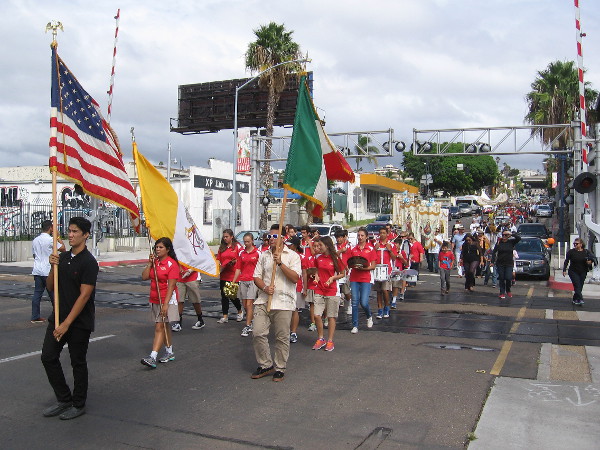
The procession slowly assembles after Mass in front of the church.An elegant canopy emerges from the Catholic Church.The colorful religious procession, led by a youthful band, is ready to begin.
The procession is now heading north up India Street.
Approaching a banner announcing that next Sunday is Little Italy’s popular neighborhood Festa.Passing under the landmark Little Italy sign on India Street.
I caught an airplane coming over Bankers Hill preparing to land at Lindbergh Field.Now proceeding down Hawthorn. The threatened rain held off for the event!You can see that hundreds participated in this truly grand spectacle.
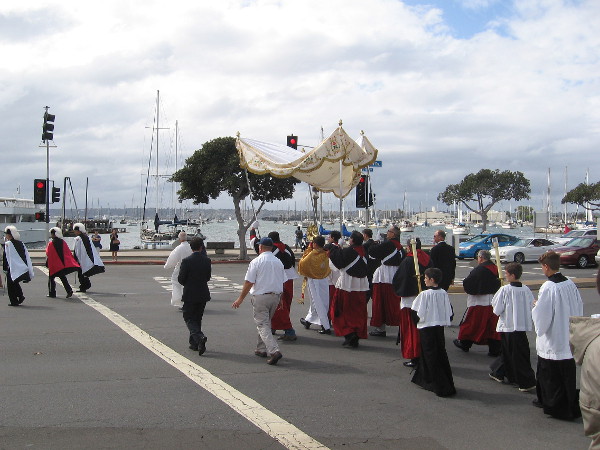
Finally arriving at San Diego Bay.A Harbor Patrol boat gives a water cannon salute for the occasion.Priests and those instrumental in blessing the tuna boats head onto the Hornblower dock at Grape Street.My camera could just catch a glimpse of the elaborate Catholic ritual beside the Patty Jo fishing boat.Fireworks launched from a nearby pier burst loudly in the air like exultant sparks.Little puffs of smoke hover in the heavens after the fireworks.The Patty Jo now confidently heads off across the gray water, hoping for safe ocean journeys and bountiful catches.
…
Follow this blog for more photos of uniquely interesting stuff! Join me on Facebook or Twitter.
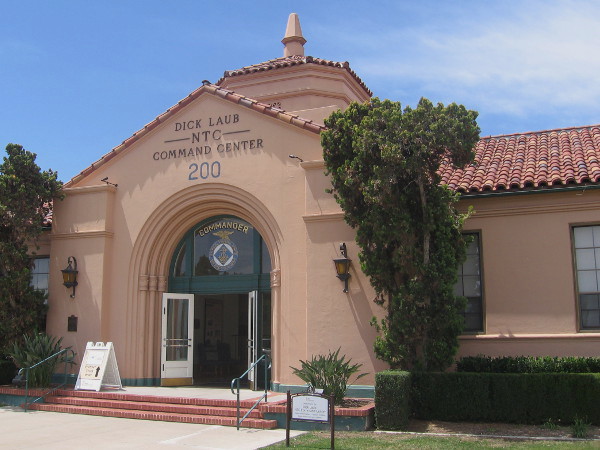
Historic Decatur Road entrance of Dick Laub NTC Command Center at Liberty Station in Point Loma.
Some time ago I visited the Command Center at NTC Liberty Station in Point Loma. Two interesting exhibits can be found along the main hallway that runs the length of the historic building. The Command Center was once the operational hub of former Naval Training Center San Diego.
The museum-like Stockdale Family Exhibit concerns the life and history of celebrated Navy Vice Admiral James B. Stockdale and his wife Sybil. The Point Loma Legacy Wing contains many displays that provide insights into the fascinating history of San Diego’s Point Loma.
Should you visit, here’s what you’ll see…
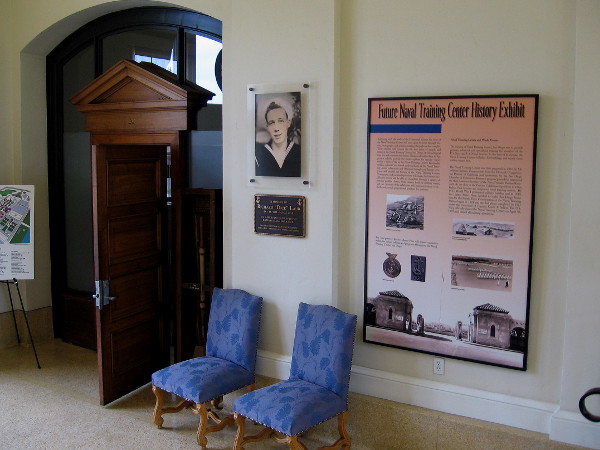
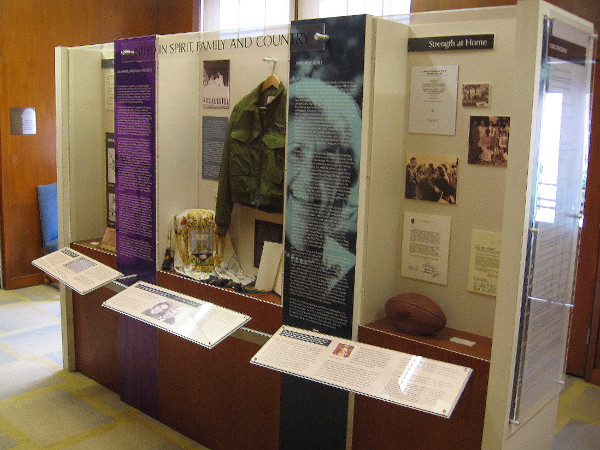
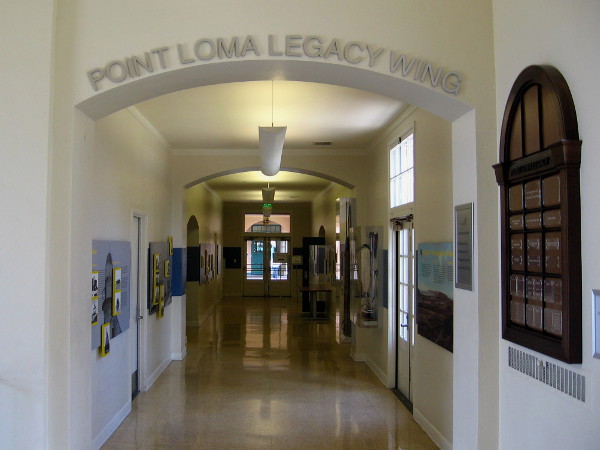
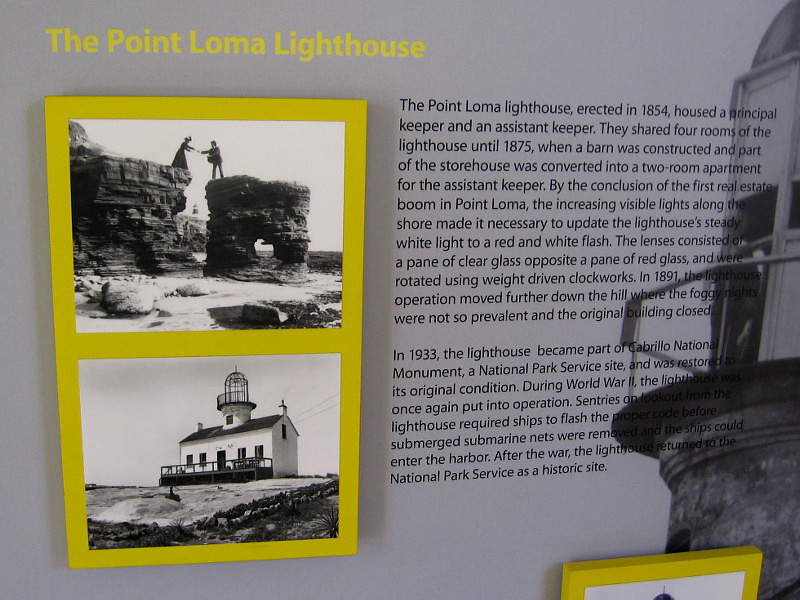
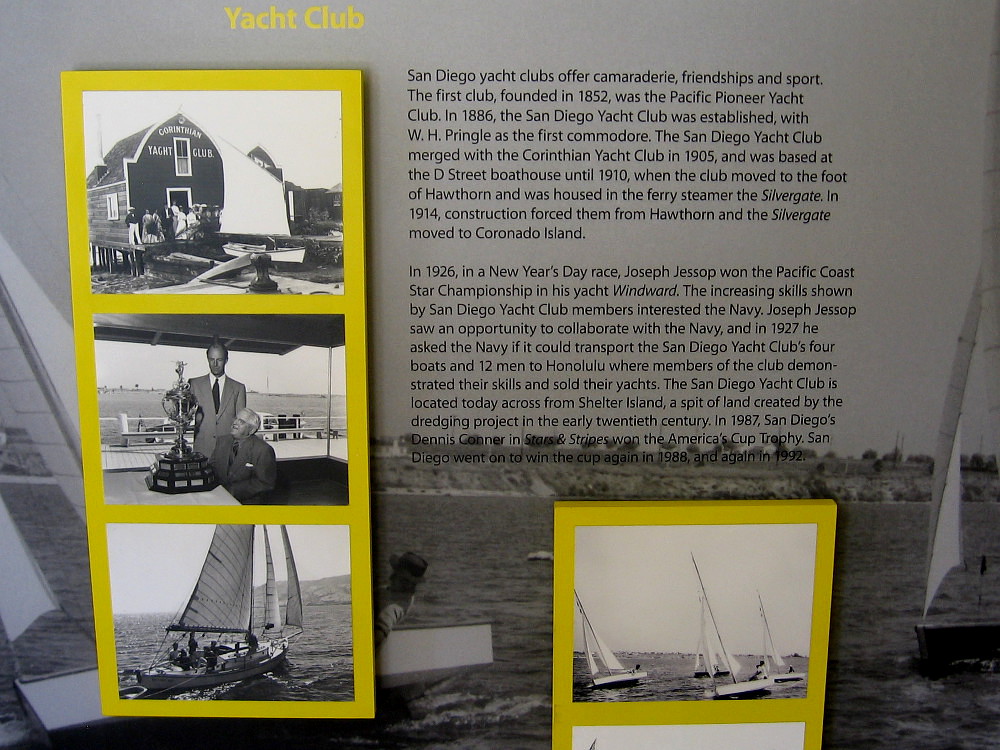
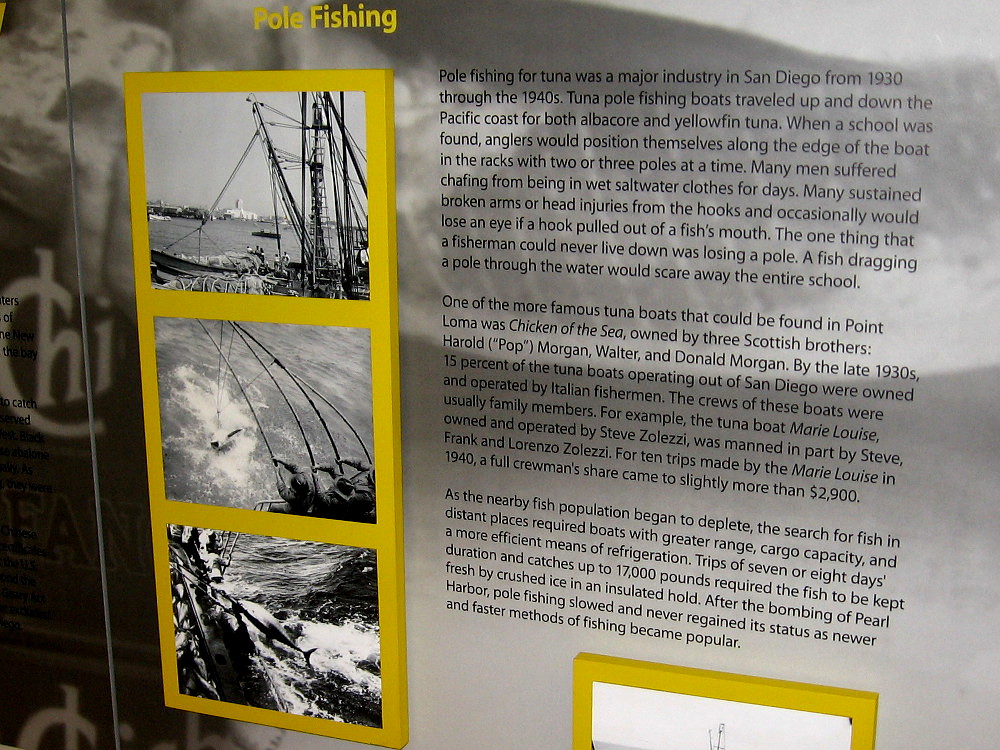
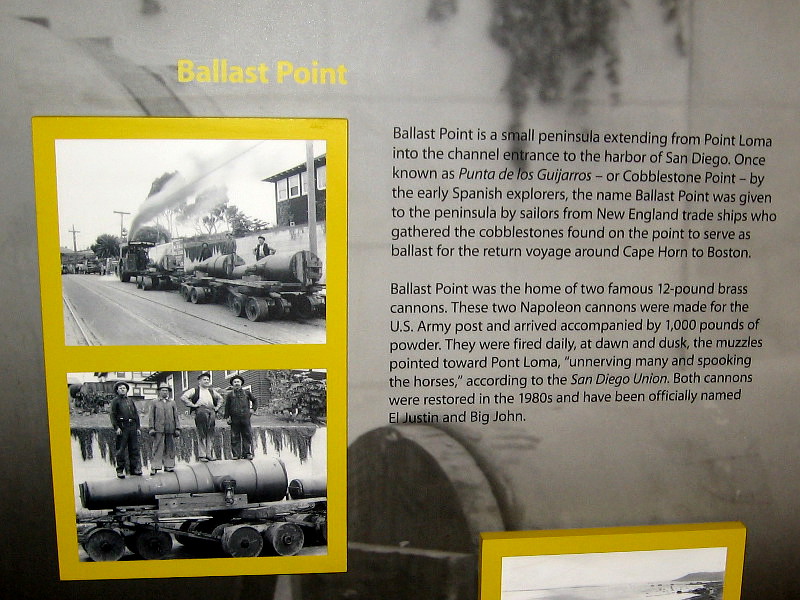
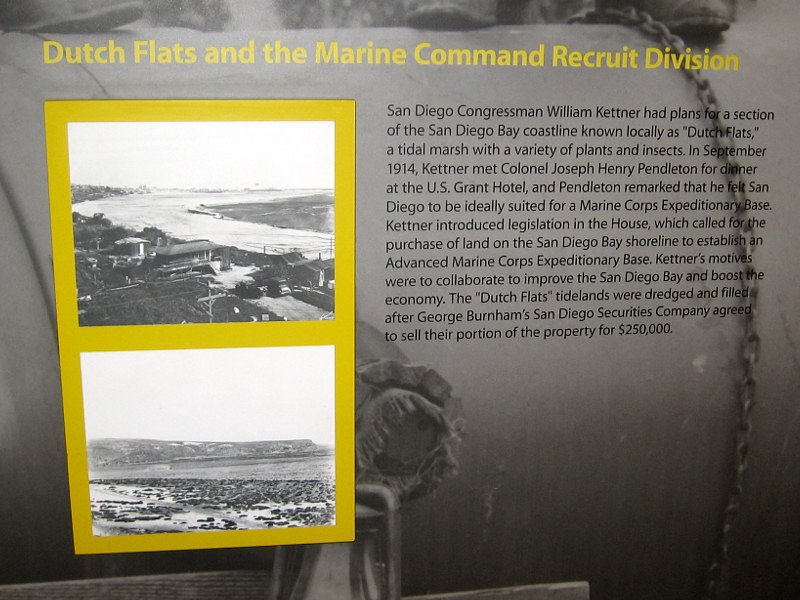
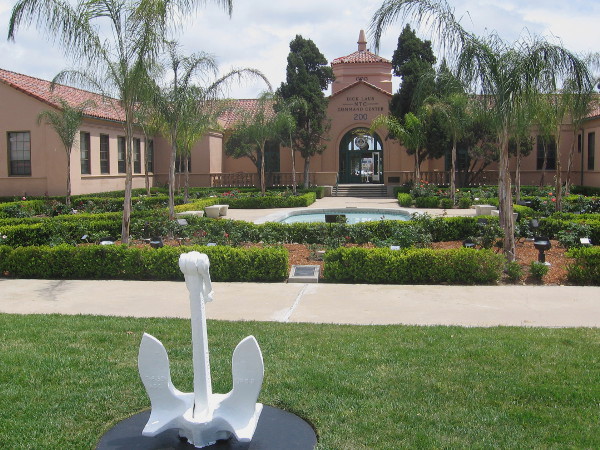
Built in 1941, The Command Center (Building 200) was the focal point of the base. These were offices for the highest-ranking officers, including the Admiral in Command of the Center.Looking from inside the Command Center southeast toward Preble Field and a large American flag.Inside the entrance to the Command Center. Various signs and free literature provide information about the converted military base and its many cultural attractions.Naval Training Center, San Diego. The recruit story is one of personal transformation; a recruit’s experience from arrival through graduation is the foundation for memories…In Memory Of Richard “Dick” Laub. Dick gave credit for much of his success to the G.I. Bill. His passion was the sea and fishing.One wing of the NTC Command Center today contains the Stockdale Family Exhibit. James and his wife Sybil are Navy heroes from the Vietnam War era.Vice Admiral James Stockdale, long-time resident of Coronado, obtained and conveyed important tactical information while imprisoned in North VietnamStockdale was candidate for United States Vice President in 1992 on Ross Perot’s independent ticket. During a debate, he famously said: “Who am I? Why am I here?”The exhibit contains photographs and objects from James and Sybil Stockdale’s family life.The Point Loma Legacy Wing at the NTC Command Center contains two walls of fascinating displays concerning this area’s history.The Point Loma lighthouse, erected in 1854, housed a principal keeper and an assistant keeper. In 1933, the lighthouse became part of Cabrillo National Monument and was restored.San Diego yacht clubs offer camaraderie, friendships and sport. The first club, founded in 1852, was the Pacific Pioneer Yacht Club. In 1886, the San Diego Yacht Club was established.Display case contains artifacts from the San Diego Maritime Museum, including model of a tuna boat.The first fish cannery was built in 1909 at La Playa designed for processing sardines. Albacore canning started in 1911.Pole fishing for tuna was a major industry in San Diego from 1930 through the 1940s. Tuna pole fishing boats traveled up and down the Pacific coast for both albacore and yellowfin.Ballast Point is a small peninsula extending from Point Loma into the channel entrance to the harbor of San Diego. Cobblestones on the point were used for ballast by early trade ships.The Point Loma kelp forest is part of one the largest kelp forests in the northern hemisphere. Giant kelp is a species of marine alga, which may grow up to 200 feet in length.Fort Rosecrans. In 1793, British Captain George Vancouver entered San Diego harbor. He noted the port would be better defended from the Point Loma peninsula.Dutch Flats and the Marine Command Recruit Division. Plans were devised by San Diego Congressman William Kettner. A tidal marsh would be dredged and filled.Anchor and Sybil Stockdale Rose Garden next to NTC Command Center. Photo taken from Legacy Plaza near the center of Liberty Station.
…
Follow this blog for more photos of cool stuff! Join me on Facebook or Twitter.
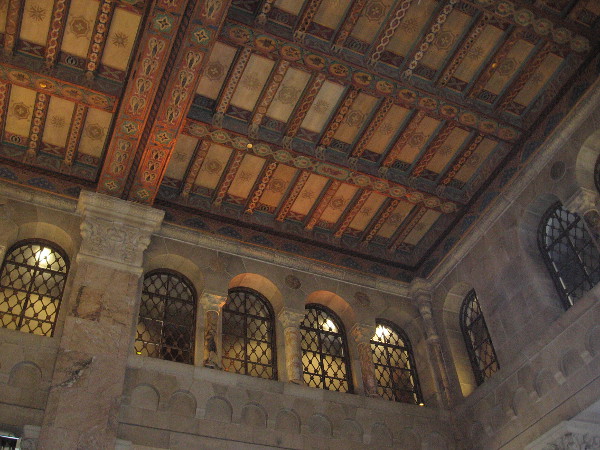
This astonishing ceiling impressed San Diego Trust and Savings Bank customers back in 1928, when it originally debuted.
There are many amazing hotels around San Diego, especially downtown. Several of the hotels are located in historic old buildings. For several months, the San Diego Trust and Savings Bank Building (1928), now occupied by Courtyard by Marriott, has been undergoing outside restoration. A few days ago I noticed that much of the work has been completed, so I decided to go inside the lobby to ask a question or two. And wow!
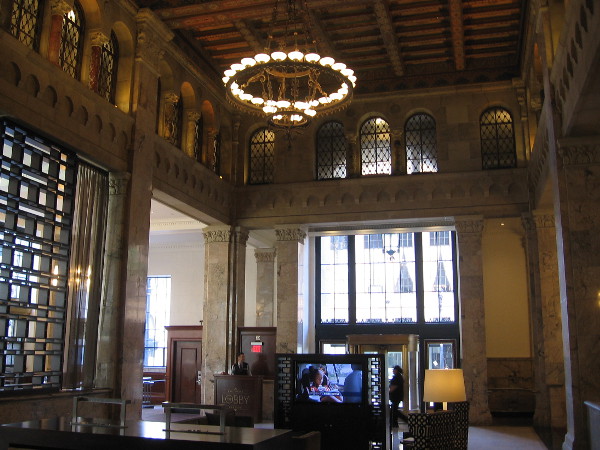
This was my first time inside the truly eye-popping lobby. Look at the ceiling! The old bank hall, which now welcomes hotel guests, appears almost like the interior of some medieval church, with its arches, vaulted doors, medallions, bronze window grilles and a 32-foot high colorfully painted coffered ceiling. Also reflecting the building’s Italian Romanesque Revival architectural style, the grand interior contains 35 decorative columns with Corinthian capitals, chiseled from 19 different types of marble from around the world. Additionally, the walls, counters, pilasters and floor all feature rich imported marble.
The elegant building, which was constructed with the finest materials available at the time, was designed by notable architect William Templeton Johnson, who is also credited for the San Diego Museum of Art and Natural History Museum buildings in Balboa Park, the Serra Museum in Presidio Park, and the La Jolla Athenaeum. He is also one of the architects responsible for the San Diego County Administration Center.
I was told by a friendly front desk clerk that the restoration involved patching cracks in the building’s exterior. Looks to me like somebody did a good job!
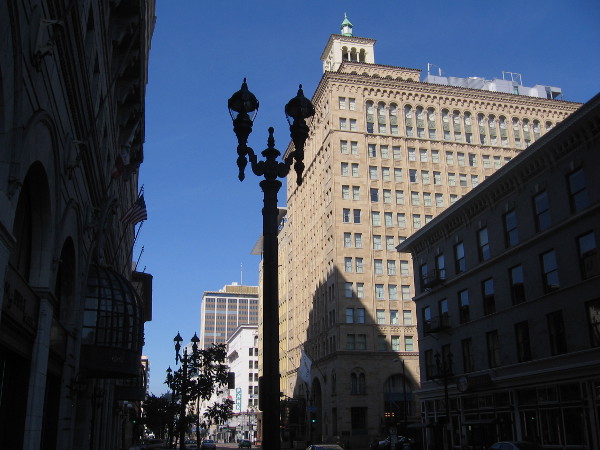
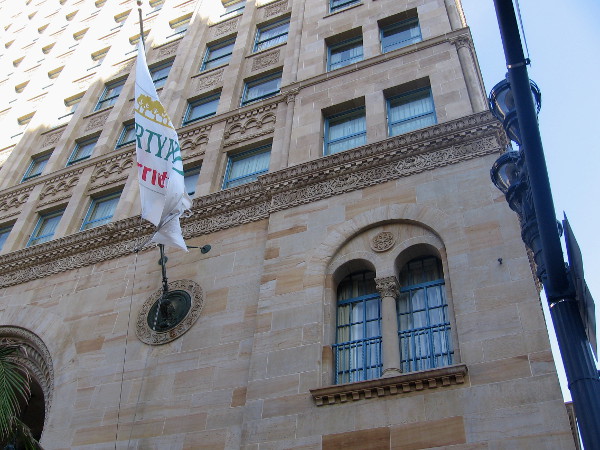
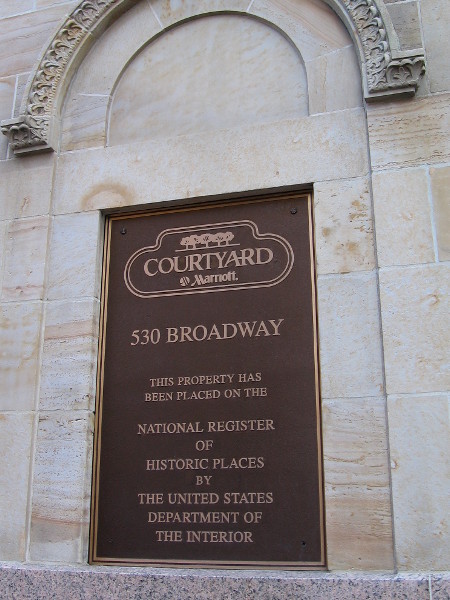
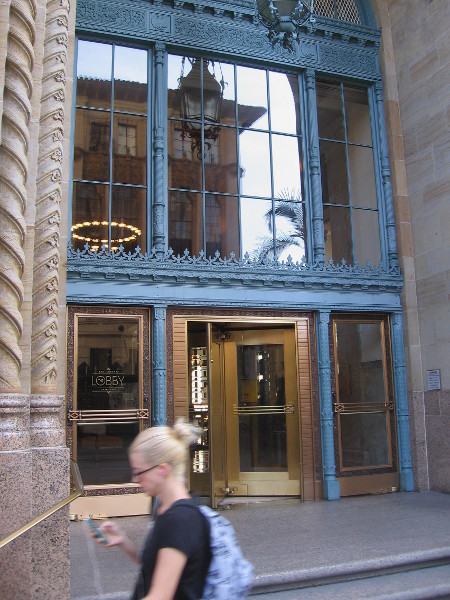
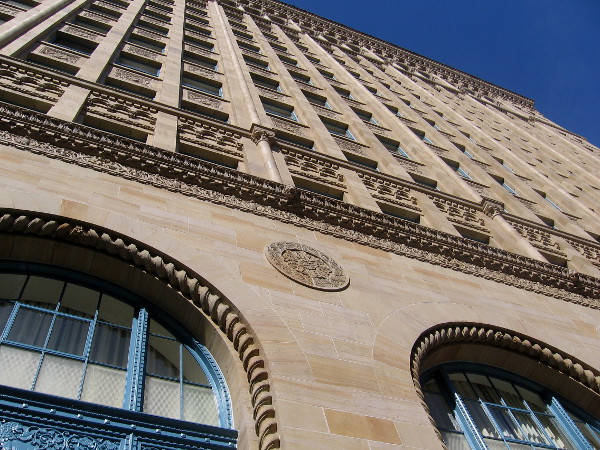
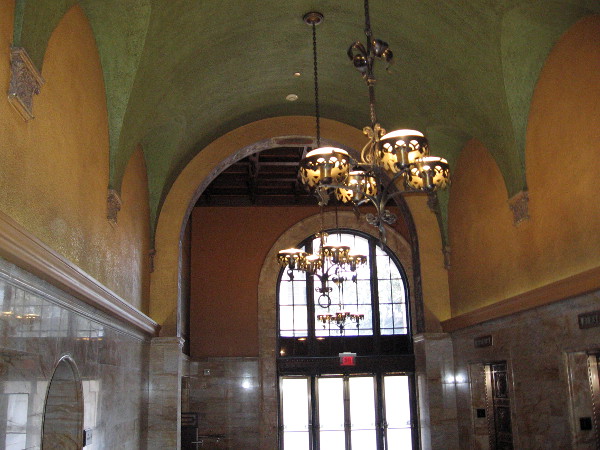
Photo of the San Diego Trust and Savings Bank Building taken from one block east on Broadway. The 14-story structure is topped with a two-story penthouse and cupola.Flag on stately exterior of Courtyard by Marriott San Diego Downtown.Plaque at 530 Broadway. This property has been placed on the National Register of Historic Places by the United States Department of the Interior.Elegant bronze and glass entrance to the eye-popping lobby of the Courtyard by Marriott San Diego Downtown.Stand inside the old bank hall and gaze upward. You’ll think your visiting a fantastic cathedral or medieval building in Europe.The welcoming interior of a modern hotel. An historical building smartly preserved and repurposed.I like this cheerful painting of a girl lying on a turtle behind the hotel’s front counter!Yet another cool sight in my amazing neighborhood: downtown San Diego!
UPDATE!
When I stepped into the hotel during the San Diego Architectural Foundation’s OPEN HOUSE 2017, I learned from a friendly event volunteer that I could head down to see the old bank’s vaults, which are now meeting rooms! Here are some photos!
Map near the ceiling where steps descend from the lobby to elevators.The beautiful arched ceiling near the hotel’s bank of elevators.Elegant area near the entrance to The Safe Deposit Room.Formidable steel doors in a lower level hallway, leading to The Vault, a very unique meeting room. The San Diego Trust and Savings Bank Building has unusual historic features that hotel guests can enjoy.The Safe Deposit Room in the Courtyard by Marriott San Diego Downtown has a rather unusual entrance! The 1928 Mosler safe door weighs 47,000 pounds! Meetings can be held inside.
…
Follow this blog for more photos of cool San Diego places! Join me on Facebook or Twitter.
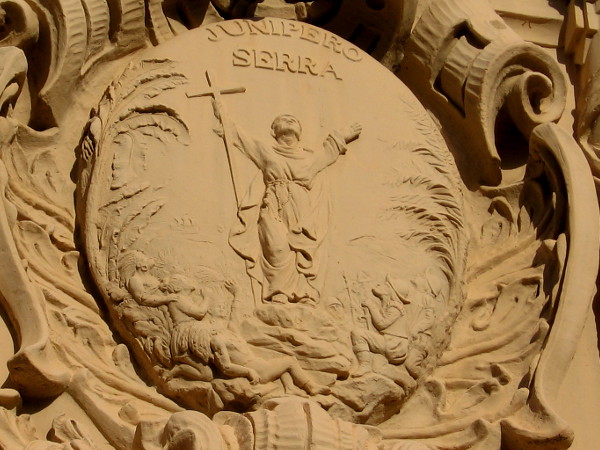
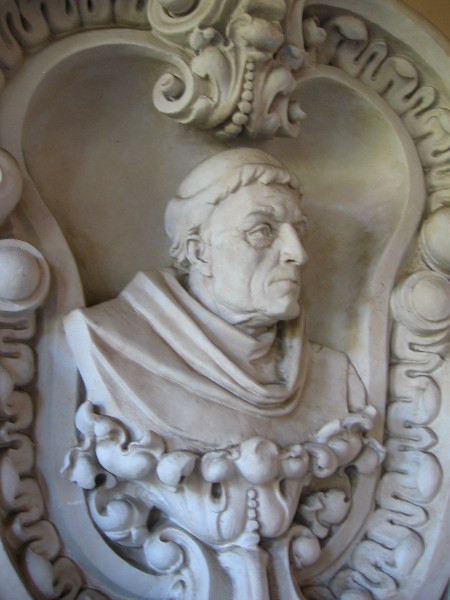
Molded plaster figure of Saint Junipero Serra at top of the California Building’s facade in Balboa Park. The Museum of Man occupies this landmark building. The ornate facade contains many sculpted historical figures and busts created by the Piccirilli brothers, famous marble carvers who immigrated from Italy in 1888.
Today, during Pope Francis’ historic first visit to the United States, Junipero Serra was canonized by the Roman Catholic Church. Father Serra was declared a saint by the Holy See at a ceremony conducted by Pope Francis at the Basilica of the National Shrine of the Immaculate Conception in Washington, D.C.
Saint Junipero Serra played a large role in San Diego’s early history. The Franciscan friar established the first nine of 21 Roman Catholic Spanish missions in what today is California. The very first of those nine, founded on July 16, 1769, was located in San Diego. The primary purpose of the missions was to convert the native peoples to Christianity; another purpose was to solidify a claim over this valuable corner of the New World for Spain.
The Mission Basilica San Diego de Alcalá is located in Mission Valley and remains to this day an active church. It’s popularity as a destination for tourists and the faithful will likely increase with the canonization of Serra.
Because of Saint Junipero Serra’s historical importance in San Diego, many images of him are found throughout our city. Some of the most prominent and well known representations can be seen in Balboa Park. The park’s Spanish Colonial Revival Style buildings created for the 1915 Panama-California Exposition include lavish ornamentation, with many illustrations of people and scenes important to San Diego history.
The following notable bits of art in Balboa Park depict Saint Junipero Serra during his time in San Diego.
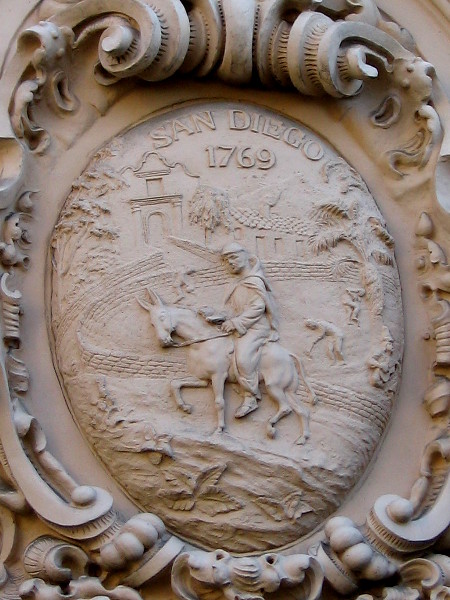
Ornamental art on Balboa Park’s Casa del Prado shows Saint Junipero Serra holding a cross among Spanish soldiers and native peoples in what today is California. In 1769, San Diego was part of Alta California in the Province of Las Californias in New Spain.More artwork seen on Balboa Park’s historic El Prado shows Franciscan friar on a horse near the Mission San Diego de Alcalá, which was built near the San Diego River, several miles inland from San Diego Bay.Junipero Serra Memorial, created in 1914. Staff plaster original ornamentation from the Food Products Building, of the Panama-California Exposition. This elegant work of art was preserved and is now located in the Casa del Prado’s Sculpture Court.
…
Follow this blog to see more photos related to San Diego’s fascinating history! Join me on Facebook or Twitter.
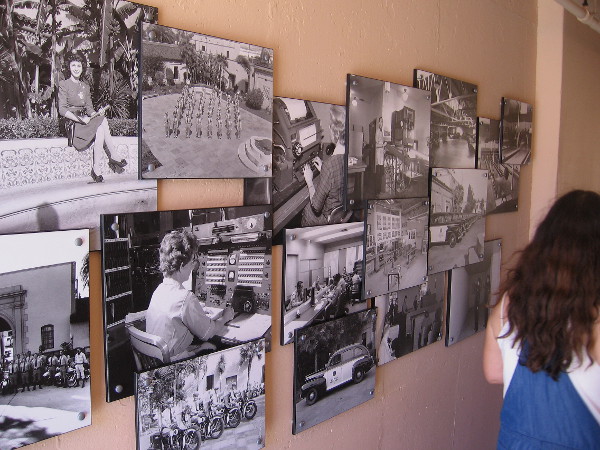
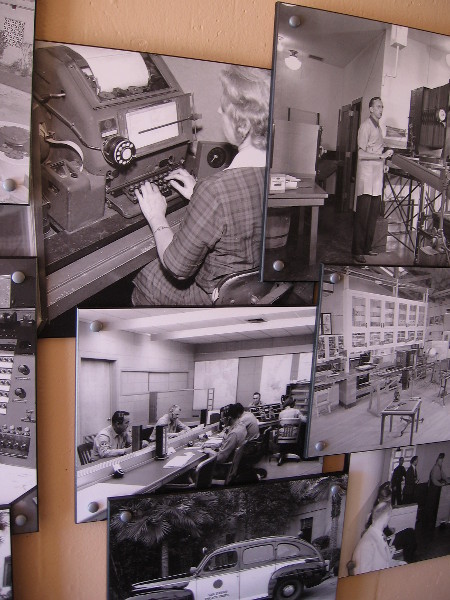
People view photos and memorabilia in corridor of the old San Diego Police Headquarters located near Seaport Village.
In downtown San Diego, one can enter a highly secure jail cell, then turn around and easily walk right out! How? Simply visit the old police headquarters!
The Headquarters at Seaport is the official name of a relatively new shopping center on Harbor Drive, located right next to Seaport Village. The unique complex features several fine restaurants and specialty shops, housed in a restored building that was originally built in 1939. For almost half a century–until its closure in 1987–the fortress-like building with its large courtyard was home to San Diego’s police headquarters.
Anyone visiting The Headquarters can enjoy a free glimpse of San Diego history by checking out a modest exhibit in a corridor that leads to the old cell block and some restrooms. I took photographs during one walk that you might find interesting.
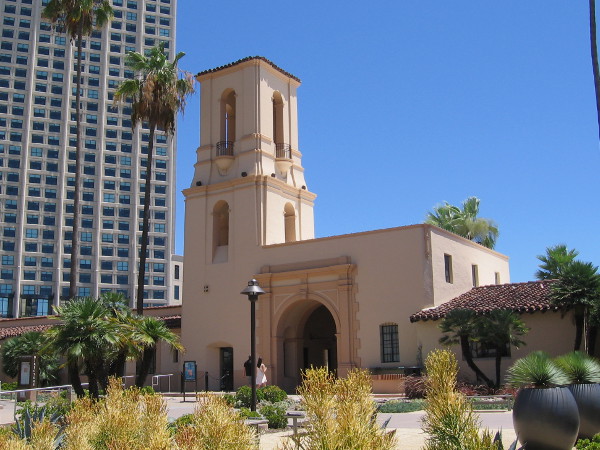
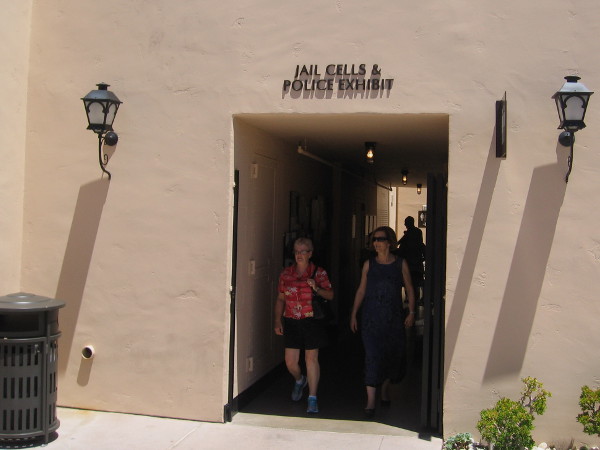
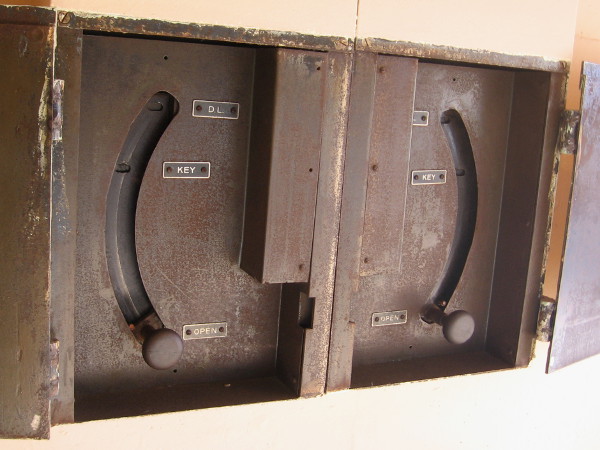
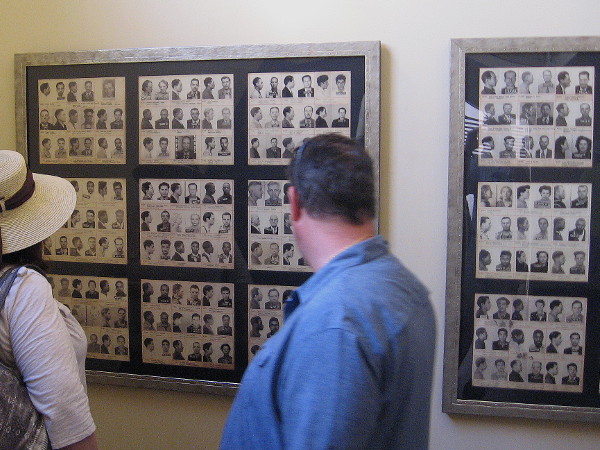
This beautifully restored building now contains shops and restaurants on San Diego’s waterfront. Built in 1939, it served for half a century as the city’s central police station.People amble past a doorway which leads into the past. A bit of San Diego history beckons the curious.Old jail cells and an interesting police department exhibit are inside!Fascinating photographs on one corridor wall show scenes from the old police headquarters.Many operations were under one roof, including administrative offices, jails, a law library, crime lab, pistol range, and even a police car maintenance facility.This photo shows officers posing in front of the iconic tower. The historic building is a mixture of architectural styles often seen in San Diego and Southern California.Display cases in this preserved hallway contain artifacts from local law enforcement decades ago.Vintage police shields and badges are among the interesting items in this museum-like display.Handcuffs, documents and law enforcement equipment educate visitors about police history in San Diego.Some patches that were worn proudly.Image shows original construction of the police headquarters in 1939.I believe someone who was arrested is being photographed. I see a clock, calendar, lights and identifying placard.The door of a holding cell in the old police headquarters corridor.Cells for prisoners and suspects were securely locked and unlocked using this mechanism.A look inside the eight cell, two level jail block. If you want to see what life was like behind bars, that last door is wide open!These jail cells are very simple and primitive. Comfort is not a priority.A few bare essentials and a pretty face.Visitors to The Headquarters old cell block look at mug shots on one wall.Prisoner Information. Personal property is surrendered, necessities are provided, hours for lights out and visitors, and two telephone calls are granted at the time of booking.Kids are photographed at the lineup wall. They look slightly suspicious!
…
Follow this blog for more photos of interesting stuff! Join me on Facebook or Twitter.
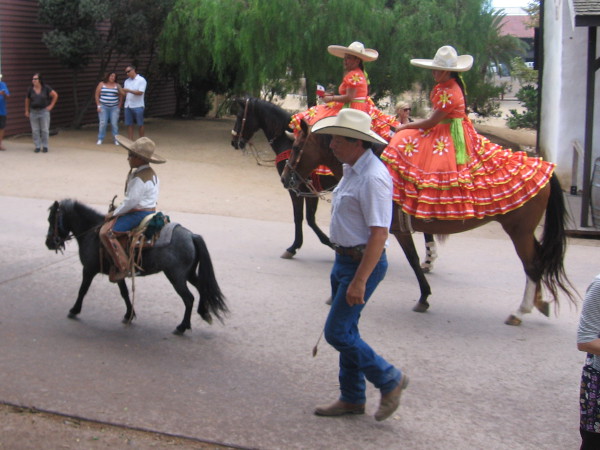
A small parade during 2015 Fiestas Patrias (September 16 is Mexico’s Independence Day) in Old Town San Diego State Historic Park.
Here are some photos of Fiestas Patrias in Old Town San Diego State Historic Park. Mexico began their war for independence from Spain on September 16, 1810, and the occasion was celebrated today with music, food, games, an equestrian demonstration and traditional Mexican dance. I caught a bit of it!
San Diego’s fascinating history includes a Mexican period, which followed the early years of settlement and rule by Spain. Mexico and San Diego share a common border and a great deal of history. A blending of culture and friendly people adds to the richness of our city.
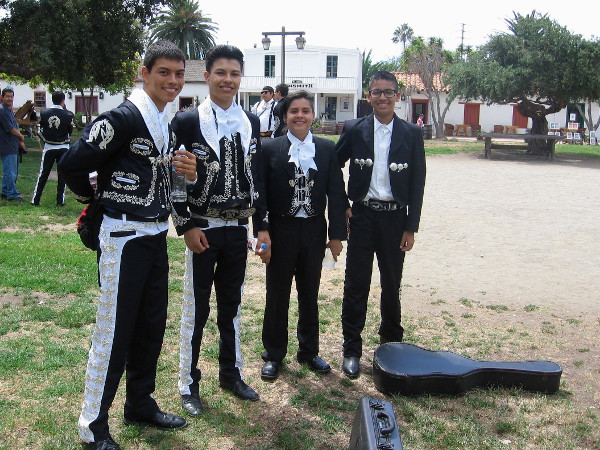
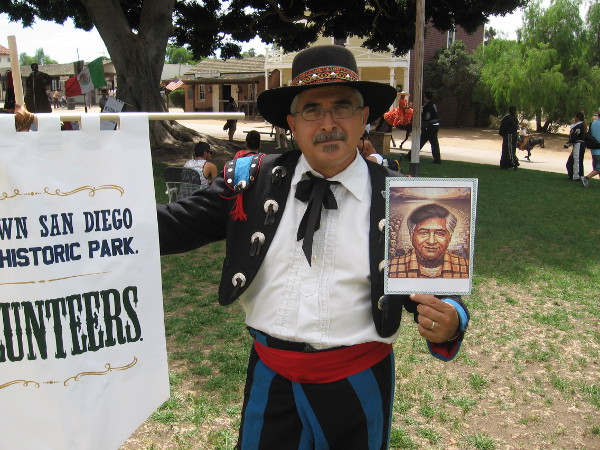
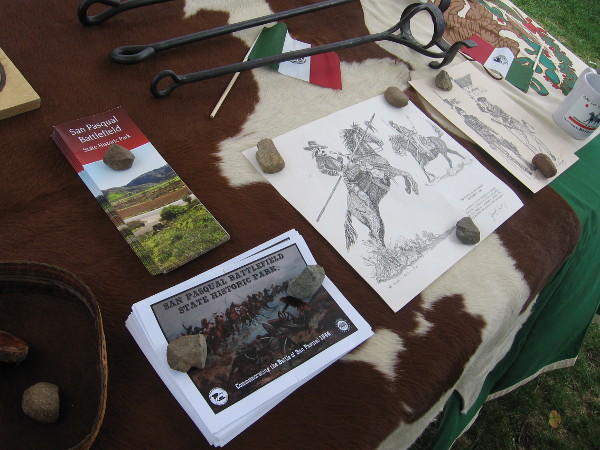
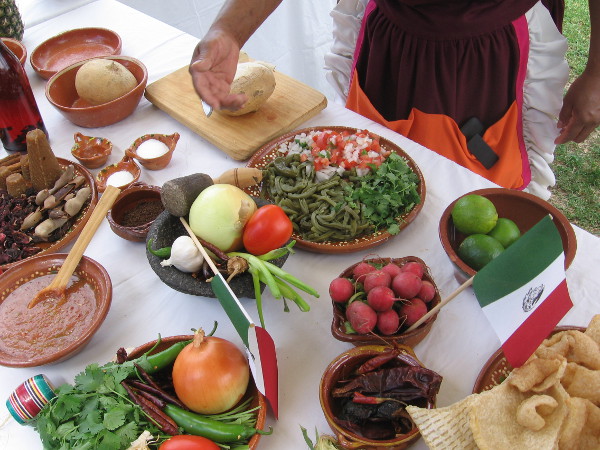
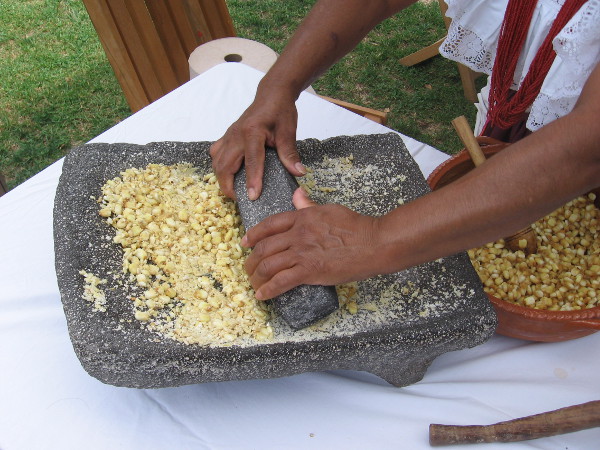
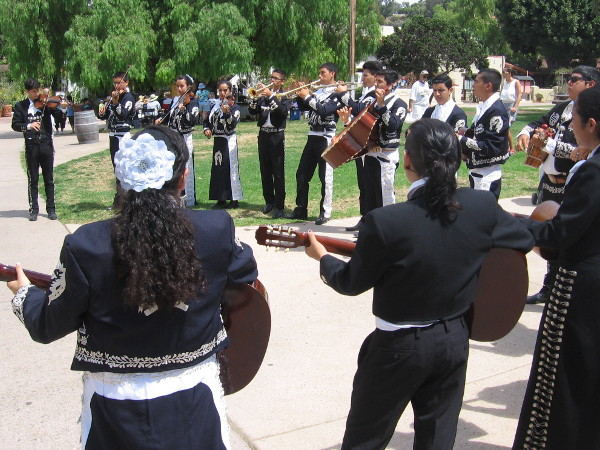
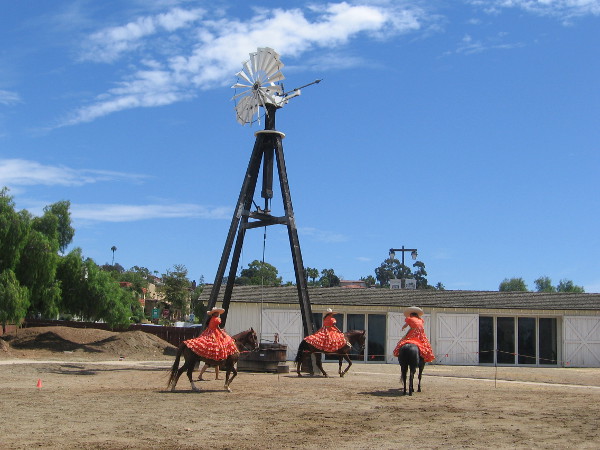
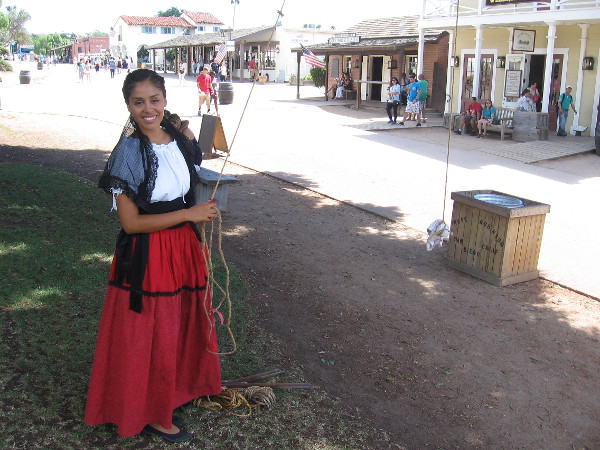
Fiestas Patrias in Old Town San Diego included many cool events flavored with Mexican culture and history.Young musicians from Chula Vista High School Mariachi band smile for the camera!Many event participants carried photos and images of important Mexicans in history. This gentleman holds a tribute to activist Cesar Chavez.Tables contained interesting info and exhibits. This one featured sketches from the Battle of San Pasqual and some cattle brands from historic Mission San Diego de Alcalá.Here are many colorful, often spicy ingredients used in Mexican cuisine. Yum!A super nice lady demonstrates grinding corn with a stone metate, a common practice long ago.Someone paints during the lively festival. Historic Old Town is a picturesque place that inspires artists, at any time!The award-winning Chula Vista High School Mariachi performers warm up before going on stage.Everyone is ready for some traditional Mexican music!These student musicians were incredibly talented. Voices and instruments conveyed stirring emotion. They all received big applause!Beautifully costumed riders of the female equestrian group Escaramuza Las Golondrinas warm up behind Seeley Stable Museum in Old Town San Diego.One rider prepares her horse for a sidesaddle riding demonstration in the afternoon.This rider was nice enough to smile! It’s a perfect, sunny day for a fiesta!A smiling California State Park employee throws a rope over a tree branch, getting ready to hang a piñata. She’s got an awesome job!Fiestas Patrias in Old Town celebrates a rich Mexican heritage and the unique, diverse history of San Diego.
…
Follow this blog for more photos of cool stuff! Join me on Facebook or Twitter.
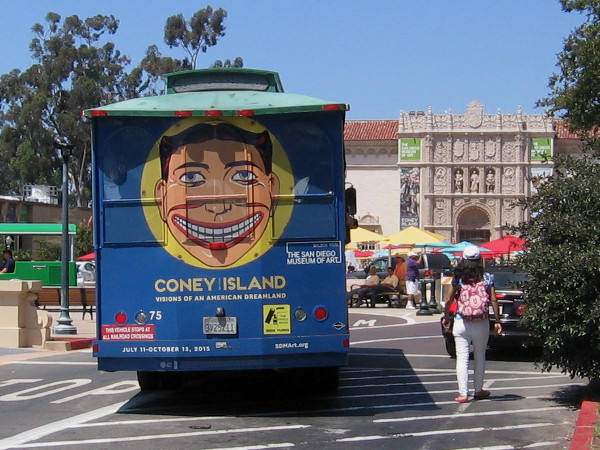
Grinning face of Tillie, symbol of Coney Island, on the back of a tour bus heading toward the San Diego Museum of Art in Balboa Park.
An extraordinary exhibit recently opened at the San Diego Museum of Art. It’s called Coney Island: Visions of an American Dreamland, 1861-2008. Last Saturday, I enjoyed a very special tour, courtesy of my docent friend Catherine!
The exhibit features a collection of more than a hundred objects that depict 150 years of Coney Island’s amusement parks, boardwalk, beach and people. It includes paintings, photographs, videos, carnival posters, sideshow banners, carved wooden carousel horses, and a wide range of colorful, unique artifacts.
From its early days as a peaceful beach getaway for wealthy New Yorkers, to the rise and fall of amusement parks, years of decay, political wrangling, then modern renewal, Coney Island has been interpreted by artists through the years in a variety of surprising ways. Some artists portray an innocent playland for common people. Others, something more complex, and less innocent.
Most of the exhibit’s artwork centers on Coney Island’s legendary amusement parks. Many images resemble exuberant scenes from a carnival or circus. They’re full of energy, laughter, humanity, wonder–but often base, superficial, disturbing, despairing. Many painting are dark, almost gaudy with a crowded press of people seeking pleasure. A symbol adopted by Coney Island–the unnatural, exaggerated grin of Tillie–seems to be a taunting reminder that the purchased thrills are artificial. The grin is strangely maniacal and mindless, one part Joker, one part Cheshire Cat.
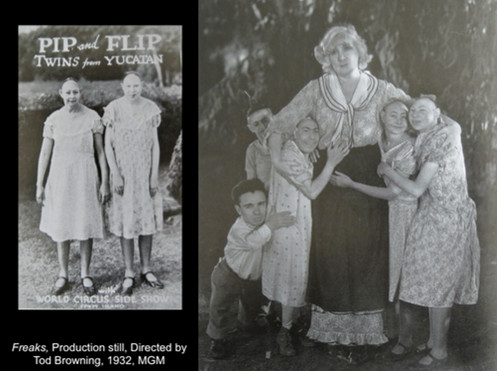
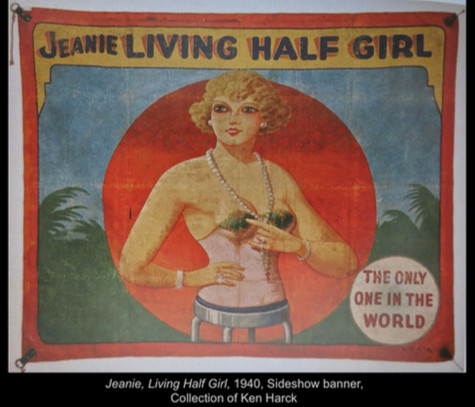
Fantastic imagery abounds in the exhibit, which is sure to delight many kids. They’ll see huge cyclops heads, videos of romping midgets, a banner promising a sideshow freak with inhuman tentacles. The adults will see images of lust, insatiability, scattered litter, dripping blood.
I suppose we humans like to be both excited and terrified.
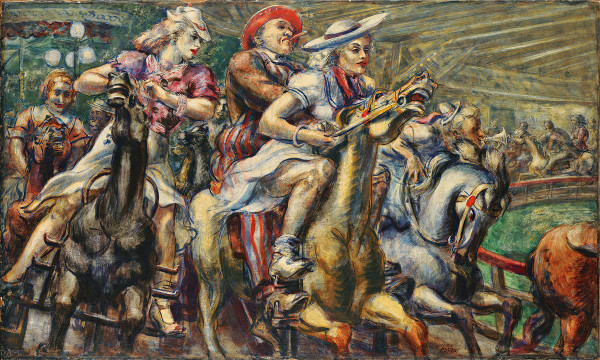
One Impressionist painting by the important American artist William Merritt Chase shows a landscape of sunlight and natural, unspoiled beauty; the egg tempera painted canvases of Reginald Marsh are dark, crammed with unabated appetite, bold kinetic energy and human expression; photographs by Arthur Fellig (Weegee) show people crowded onto the beach like fleshy, happy sardines.
Personally, as I took my amazing tour, I saw life’s wonderful jumble and a sample of our world’s endless variety. All the emotions, the complexity–but mostly I recognized the sunlit memories of ordinary good-natured neighbors heading to the beach and boardwalk, and some exciting, brief amusements, on a sunny weekend day.
This isn’t a typical art museum exhibit. It’s more like taking an instant journey to a place you already know. A Coney Island in your mind. And your vivid experiences in the San Diego Museum of Art will make the journey seem very real.
Coney Island: Visions of an American Dreamland, 1861-2008, has come to San Diego from the Wadsworth Athenium Museum of Art in Hartford, Connecticut. This special exhibition continues through October 13, 2015.
Here are just a few things that you’ll see…
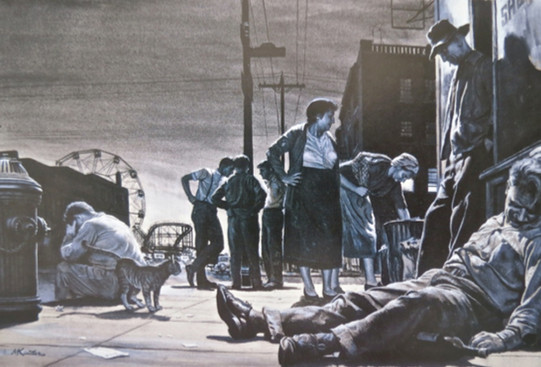
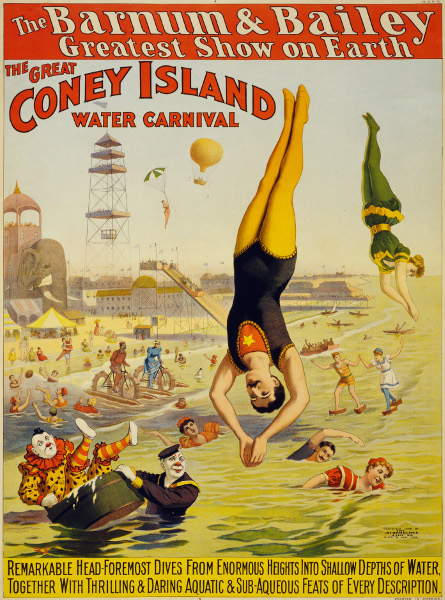
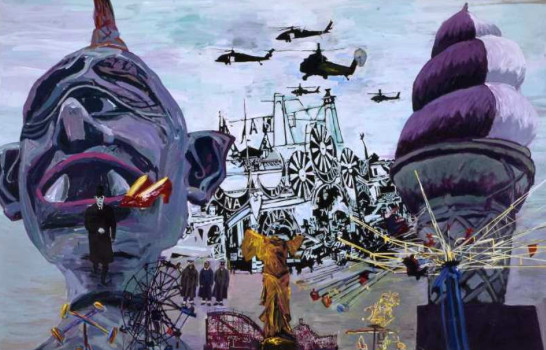
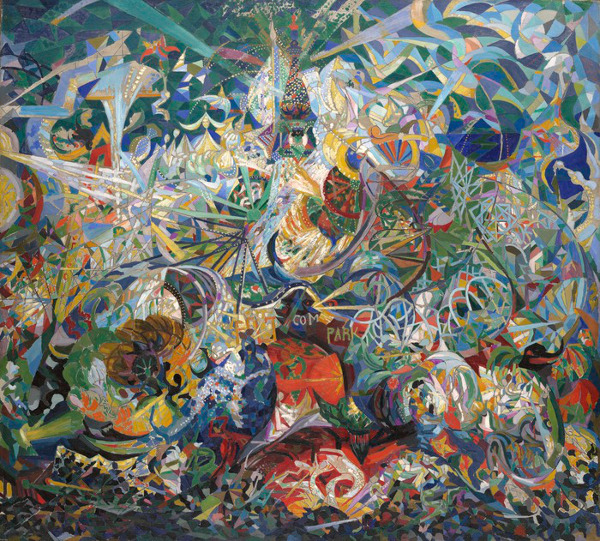
Reginald Marsh, Wooden Horses, 1936, Tempera on board. Wadsworth Atheneum Museum of Art.Pip and Flip, Twins from Yucatan with World Circus Side Show, Coney Island, 1929, Photographic reproduction. Georgia Archives, Vanishing Georgia Collection.Jeanie, Living Half Girl, 1940, Sideshow banner. Collection of Ken Harck.Mort Künstler, Coney Island, 1953, Gouache on paper. Collection of the artist.Barnum & Bailey Greatest Show on Earth, the Great Coney Island Water Carnival poster. Thrilling and daring feats of every description!Arnold Mesches, Anomie 1991: Winged Victory, 1991, Acrylic on canvas. San Diego Museum of Art.Joseph Stella, Battle of Lights, Coney Island, Mardi Gras, 1913, Oil on canvas. Yale University Art Gallery.
The San Diego Museum of Art in Balboa Park is simply jammed with fantastic, provocative Coney Island art. This is a once-in-a-lifetime opportunity. So go see it!
Coney Island, Visions of an American Dreamland, 1861–2008, at the San Diego Museum of Art.
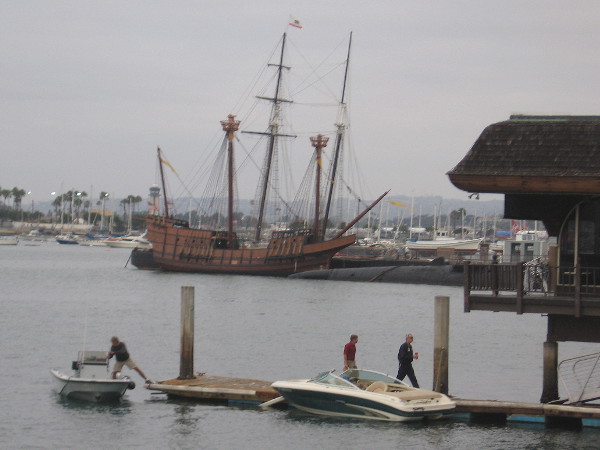
The amazing replica of explorer Juan Rodriguez Cabrillo’s galleon San Salvador is now docked at the Maritime Museum of San Diego, adjacent to their B-39 Soviet submarine.
The San Salvador, a full size replica of the historic Spanish galleon sailed by explorer Juan Rodriguez Cabrillo up the coast of California, is now docked at the Maritime Museum of San Diego! I believe the museum’s newest ship arrived a couple days ago!
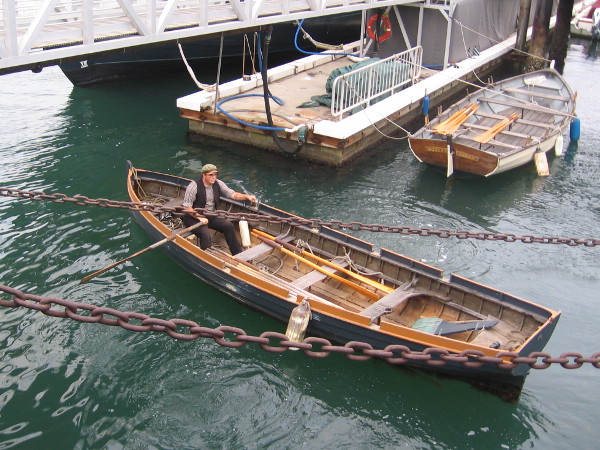
This morning was the very first time I saw the vessel on San Diego’s Embarcadero. Docked next to the museum’s B-39 Soviet-era Russian submarine, the San Salvador appears small compared to the other nearby tall ships. But the gentleman rowing the longboat in the next photograph informed me that she’ll really blossom once fully rigged and under sail. The San Salvador will then appear almost as large and amazing as the Californian, which is docked right across from it!
Looks like the San Salvador is ready in time for this Labor Day weekend’s Festival of Sail. On Friday she will lead a magnificent parade of visiting tall ships across San Diego Bay!
Gentleman from the Maritime Museum rows a longboat under ramp which leads to the HMS Surprise and other historic ships.Full size replica of Spanish galleon San Salvador, seen beyond the dock of Anthony’s Fish Grotto on San Diego’s Embarcadero.
…
Follow this blog for more photos of cool stuff! Join me on Facebook or Twitter.
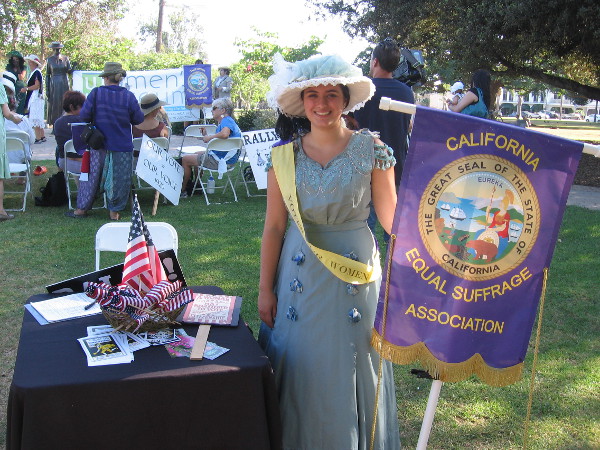
A smile, a Votes For Women sash, American flags, and a California Equal Suffrage Association banner.
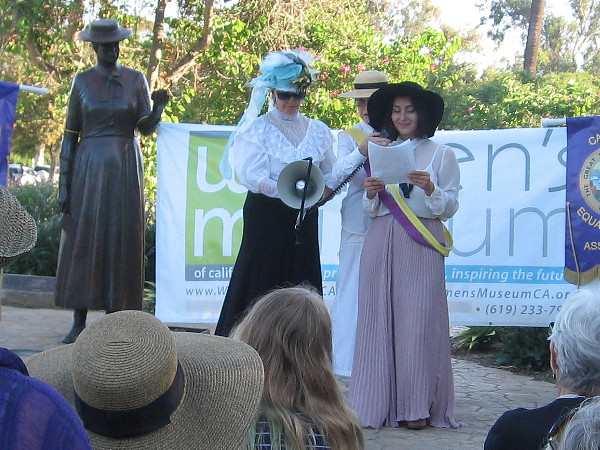
Early this evening a rally and parade celebrating the ratification of the 19th Amendment were held in Balboa Park. As the sun descended toward the horizon, a small crowd gathered in Sefton Plaza to hear a variety of interesting, often stirring speeches. The speakers portrayed notable women in American history who have worked to further the cause of women’s equal civil rights. Wearing period costumes, the historical personalities included Elizabeth Cady Stanton, Susan B. Anthony, Alice Paul and Eleanor Roosevelt, plus important local San Diegans Dr. Charlotte Baker, our city’s first female practicing physician, and prominent philanthropist and journalist Ellen Browning Scripps. The event was sponsored by the Women’s Museum of California in Point Loma.
Here are a few photos!
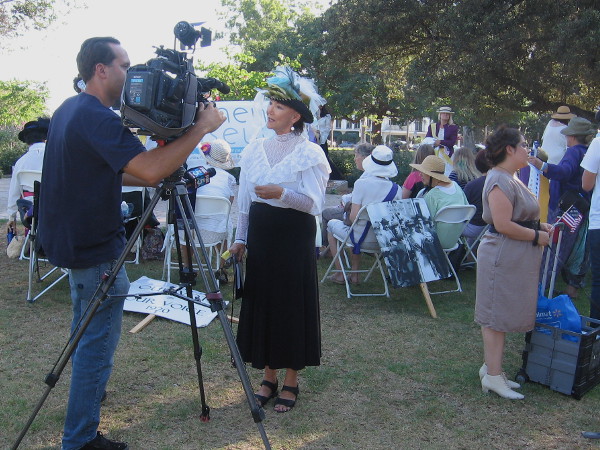
Two women head for Sefton Plaza in Balboa Park, where a suffrage rally would celebrate the anniversary of the 19th Amendment.The 19th Amendment to the United States Constitution was ratified on August 18, 1920. It guarantees all American women the right to vote.Historical sign proclaims a woman living here has registered to vote thereby assuming the responsibility of citizenship.In period attire, the person being interviewed played the role of San Diego philanthropist and trailblazer Ellen Browning Scripps during the rally.The woman with the microphone portrayed American suffragist and social activist Elizabeth Cady Stanton, who wrote many of Susan B. Anthony’s speeches.Many wore historical sashes, hats and costumes to commemorate suffragettes and leaders who have fought for equal women’s rights.One participant reenacted Eleanor Roosevelt, speaking about her life and accomplishments. The statue is of Kate Sessions, one of the founders of Balboa Park.The suffrage parade begins. Participants march toward the heart of Balboa Park, down El Prado and over the Cabrillo Bridge.
…
Follow this blog for more photos of unique and interesting events! Join me on Facebook or Twitter.



















































 Cool San Diego Sights!