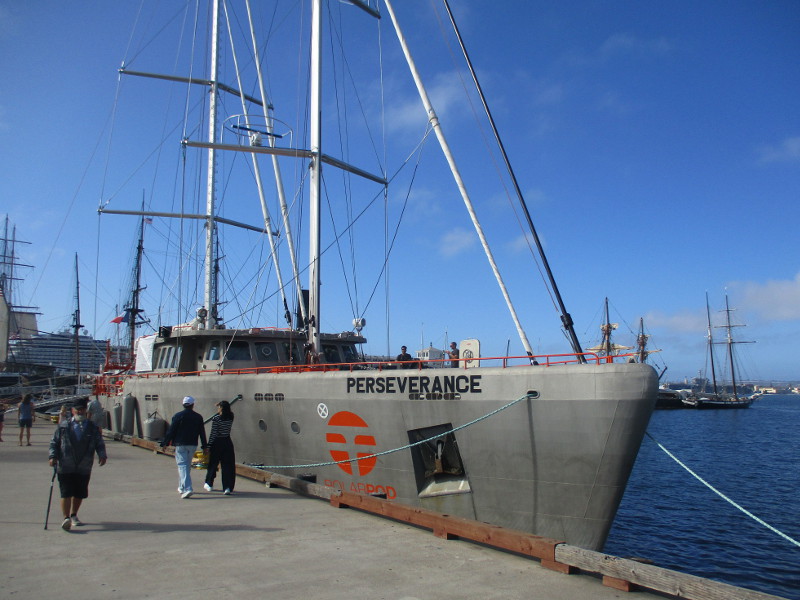
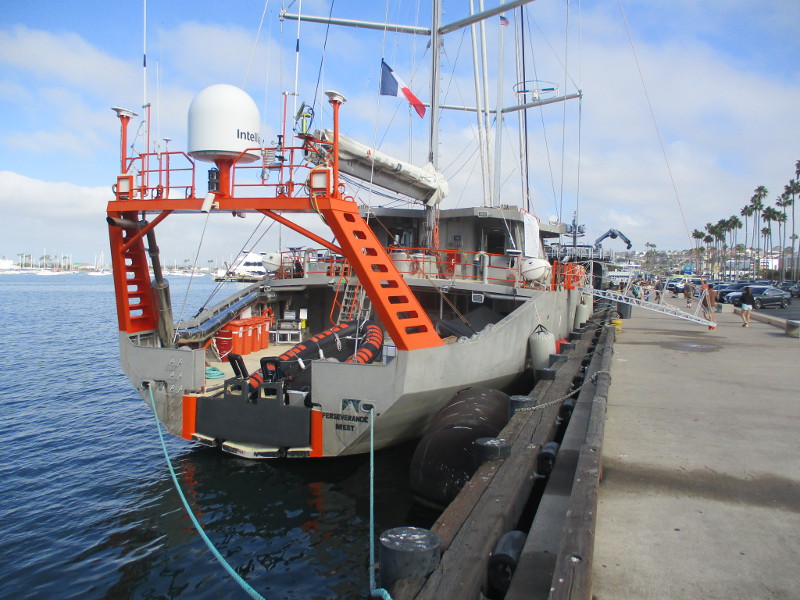
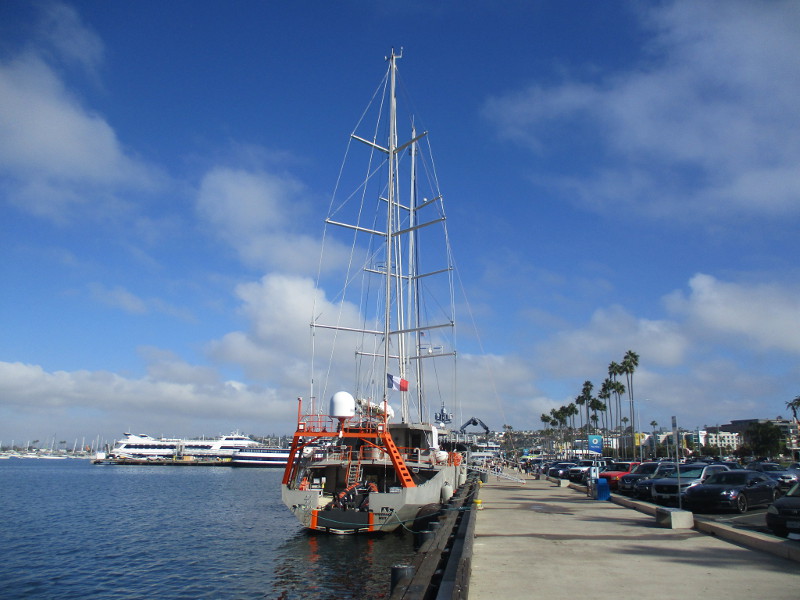
Have you seen the enormous sailboat Persévérance docked in San Diego?
I saw the amazing boat this morning. It was a little north of the Maritime Museum of San Diego. I was told it has been in San Diego the past few days.
The Persévérance is a research vessel operated by world-renowned French explorer and polar expedition pioneer Jean-Louis Étienne.
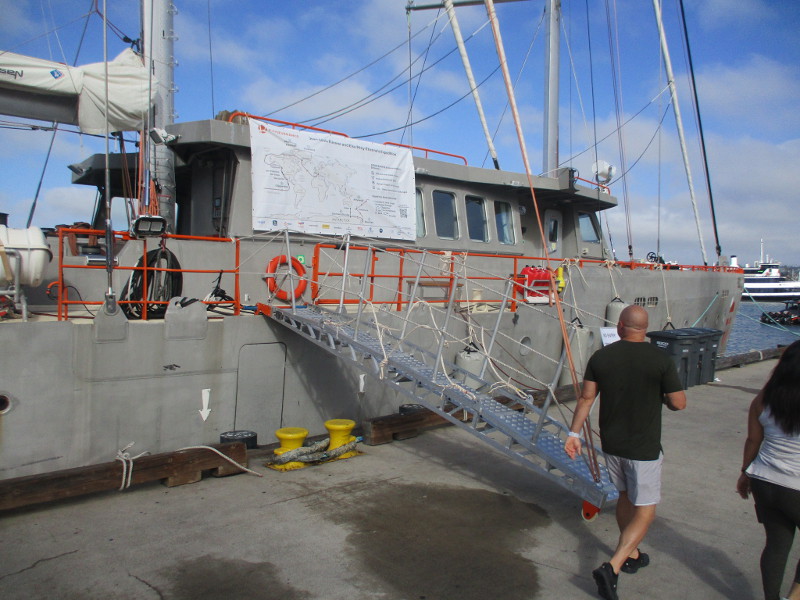
According to a map displayed on the boat, the 2025-2026 Jean-Louis Étienne and Elsa Pény-Étienne’s Expedition has has already visited Greenland and the Arctic region via the Northwest Passage. After leaving the West Coast it will cross the Pacific Ocean and head south to study Antarctica!
The unique oceanographic schooner gathers data on climate and ocean currents, visits Marine Protected Areas, and seeks to analyze human impact on the oceans. Marine Protected Areas on the itinerary include Clipperton, French Polynesia, Ross Sea, and the proposed Dumon d’Urville MPA in East Antarctica.
I asked whether there will be public tours of this remarkable sailboat, but was told, unfortunately, no.
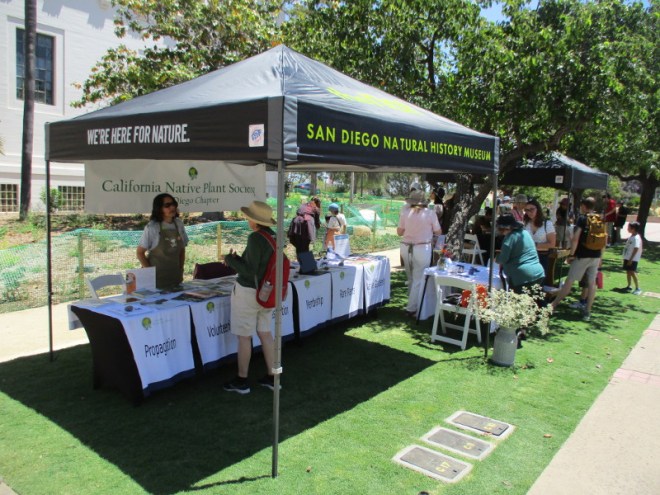
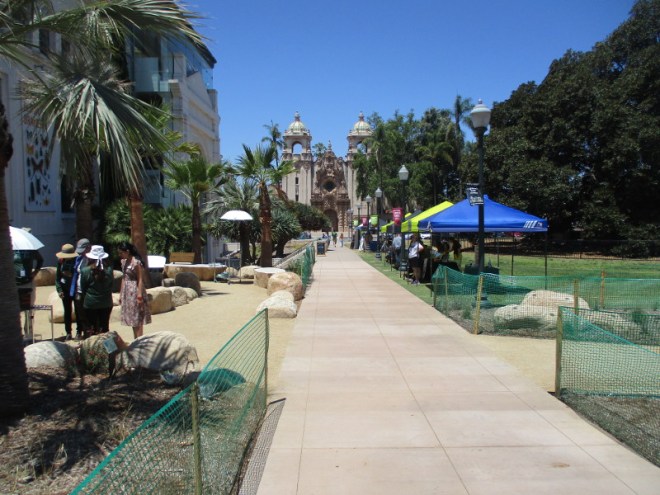
A very fun and informative Garden Fair was held today outside the San Diego Natural History Museum in Balboa Park. The event coincides with the recent opening of the nature trail that now encircles the museum.
The interpretive nature trail, which leads visitors past a wide variety of native Southern California plants, is a cornerstone of the San Diego Natural History Museum’s 150 year anniversary celebration!
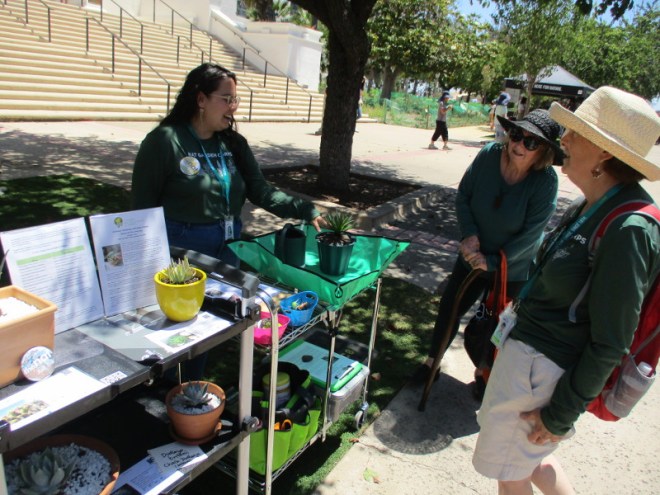
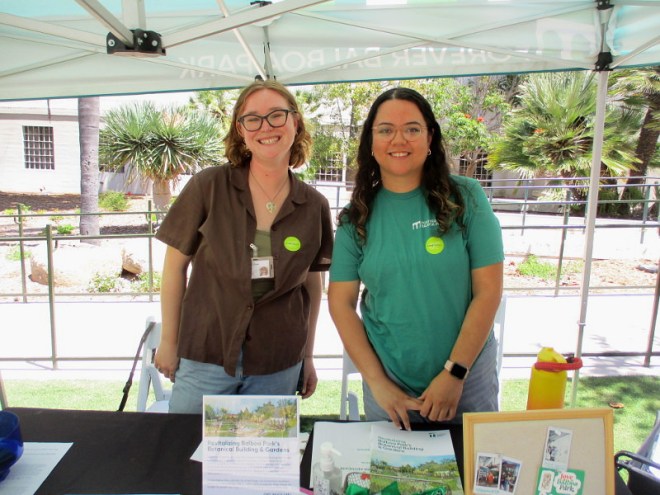
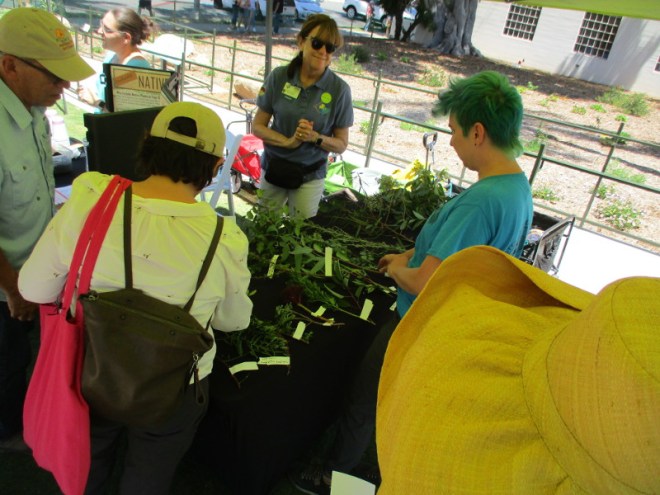
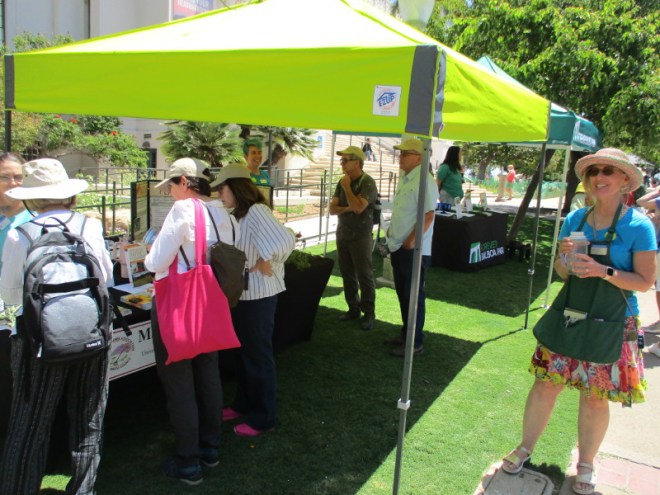
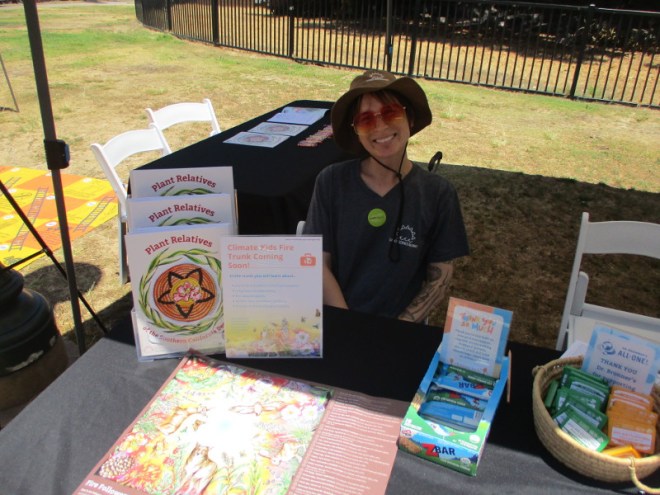
All sorts of booths were set up on both the south and north sides of the museum. Organizations who care about protecting our natural environment provided information for curious passersby. I took these photographs…
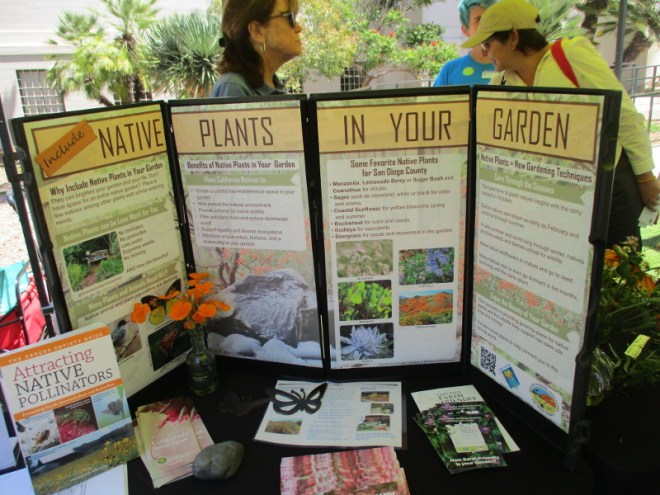
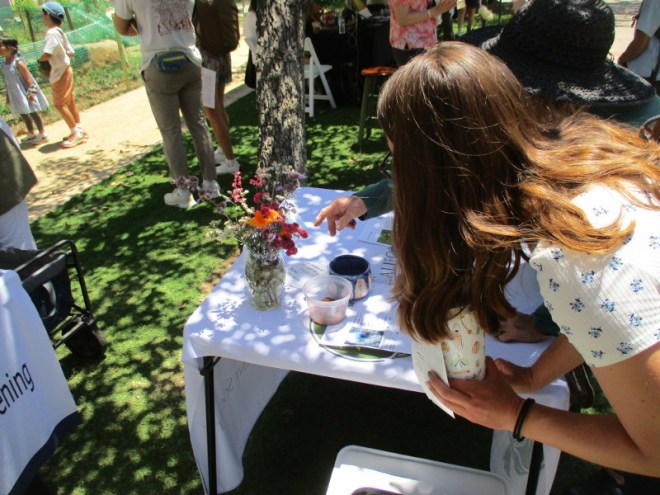
Smiles from Forever Balboa Park. They are working to revitalize Balboa Park’s Botanical Building and gardens.The California Native Plant Society was educating the public about conserving our local flora.Activity at the Master Gardener table.Poster provides suggestions for native plants in your garden.Lots of sunshine and smiles today in Balboa Park!Table features seeds for native plants.Kids learn about bees and other pollinators.
Balboa Park Alive! has a cool app in the beta stage, developed by smiling folks from the Arthur C. Clarke Center for Human Imagination at UC San Diego.
The augmented reality mobile app transforms Balboa Park into an interactive biodiversity adventure. On your smartphone, you can plant virtual flora, release butterflies, and simulate pollinator behavior. I was told that so far you can explore Balboa Park’s Zoro Garden and the Natural History Museum’s new nature trail. Very cool!
Learn more about Balboa Park Alive! by clicking here.
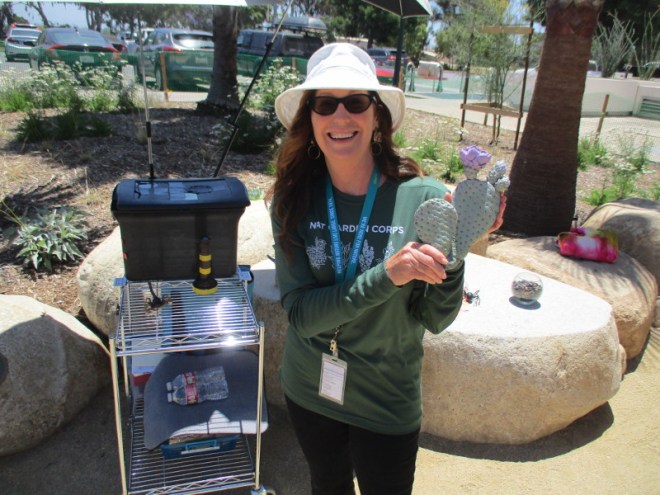
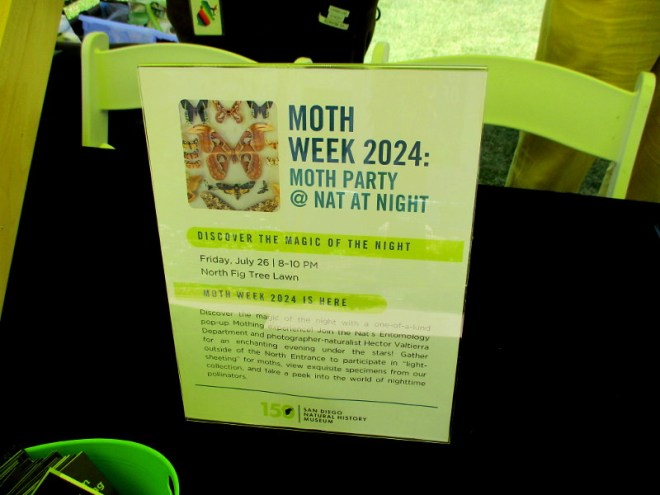
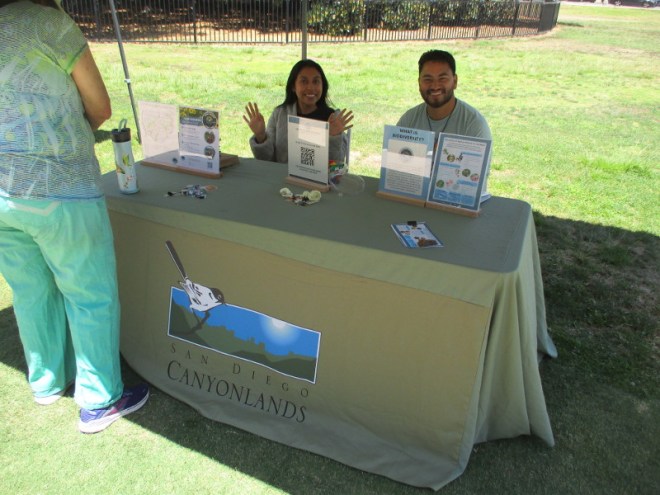
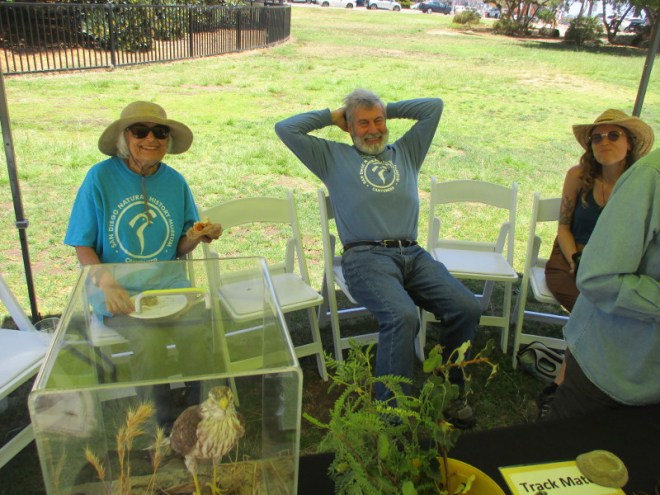
Technology helps bring nature in Balboa Park to life.More booths for the Garden Fair, along the new nature trail on the north side of the San Diego Natural History Museum.Member of the NAT Garden Corps tells me various facts concerning the cactus wren and prickly pear. While she spoke a hummingbird came by.How cool! Moth Week 2024 has a night party outside the museum on Friday, July 26, after 8 pm. A naturalist will attract moths near the Moreton Bay Fig for photography.San Diego Canyonlands focuses on the canyons in City Heights around Azalea Park. They support youth education and environmental job training in underserved communities. They also have an urban hike-a-thon event.Smiles from some San Diego Natural History Museum Canyoneers. They offer free guided hikes throughout the county. Enjoy nature and become a citizen scientist!The San Diego Habitat Conservancy currently manages 33 open space preserves in Southern California.The Climate Science Alliance mission is to safeguard natural and human communities in the face of a changing climate.
…
Thanks for visiting Cool San Diego Sights!
I post new blogs pretty often. If you like discovering new things, bookmark coolsandiegosights.com and swing on by occasionally!
I live in downtown San Diego and love to walk around with my camera! You can follow Cool San Diego Sights via Facebook or X.
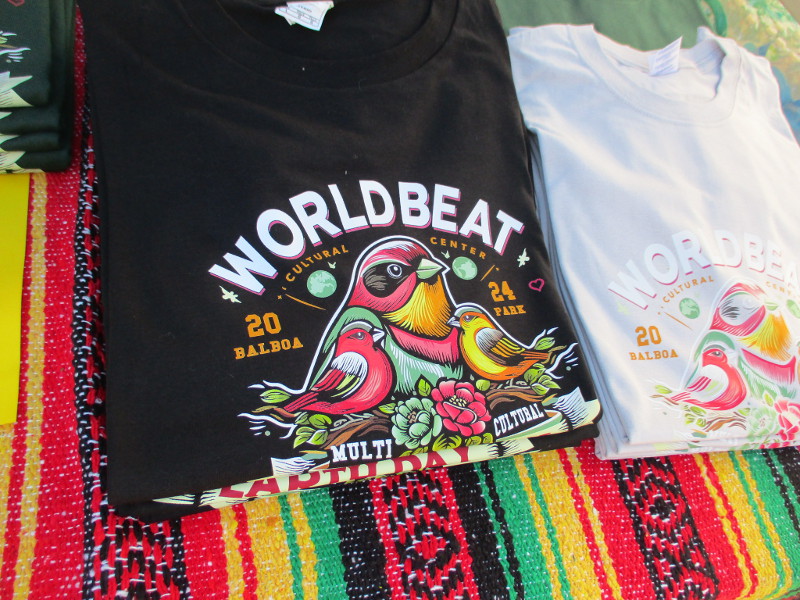
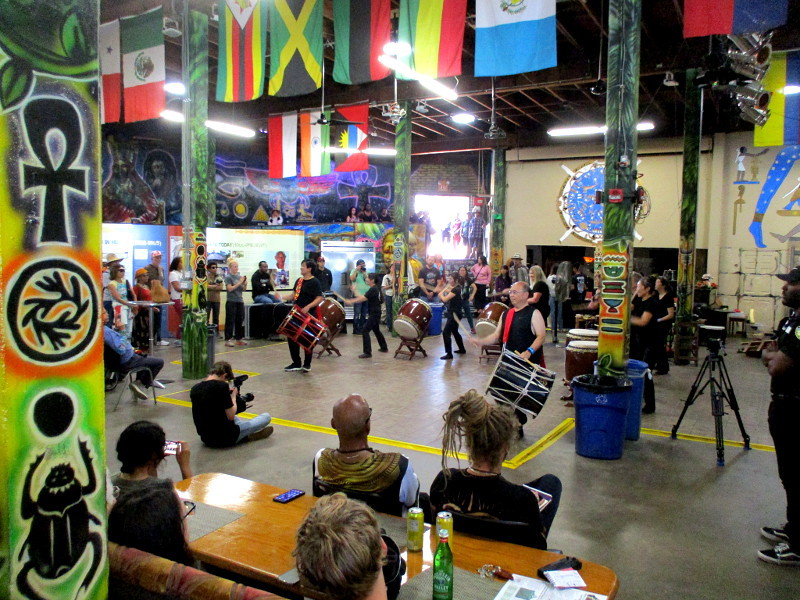
A good sized crowd came out today to Balboa Park’s WorldBeat Cultural Center. The public was invited to take part in the 32nd Annual Multi-Cultural Earth Day!
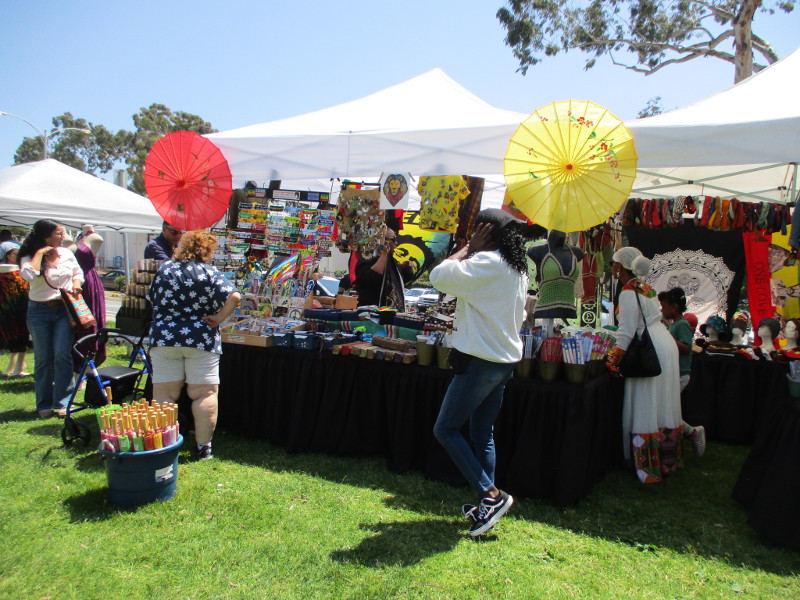
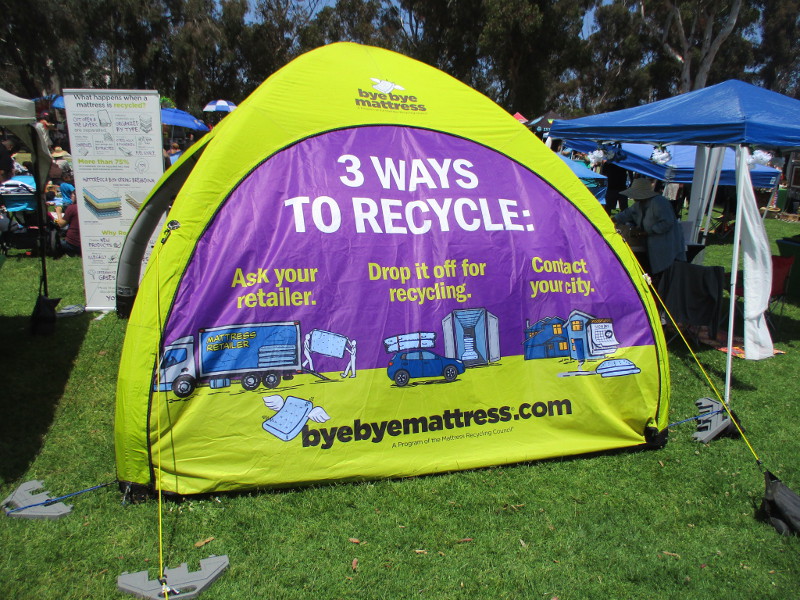
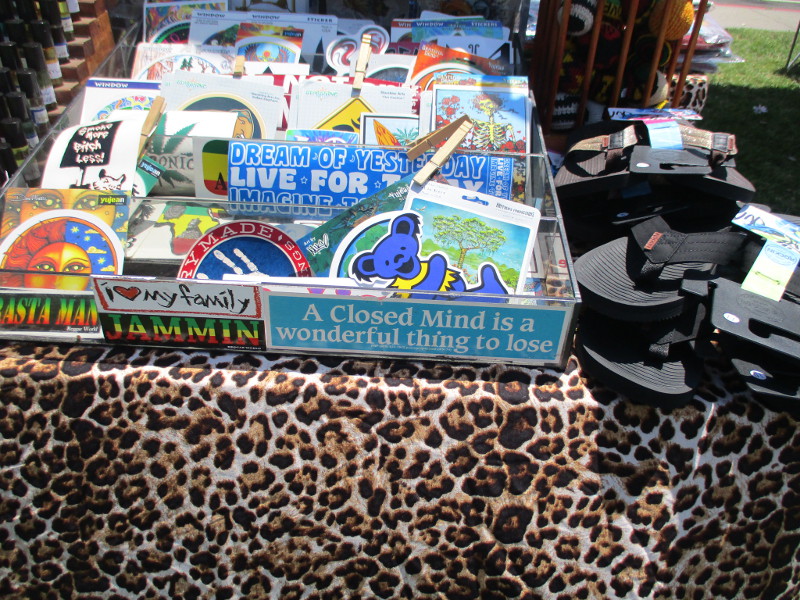
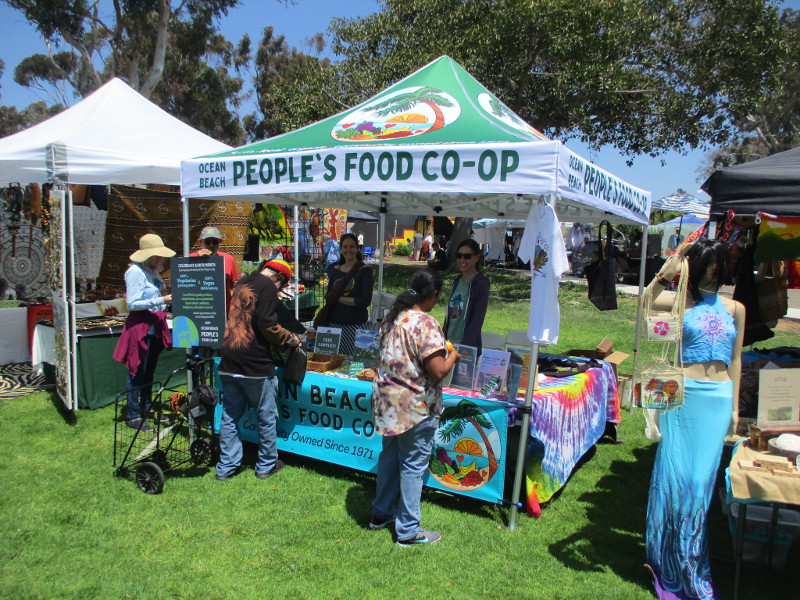
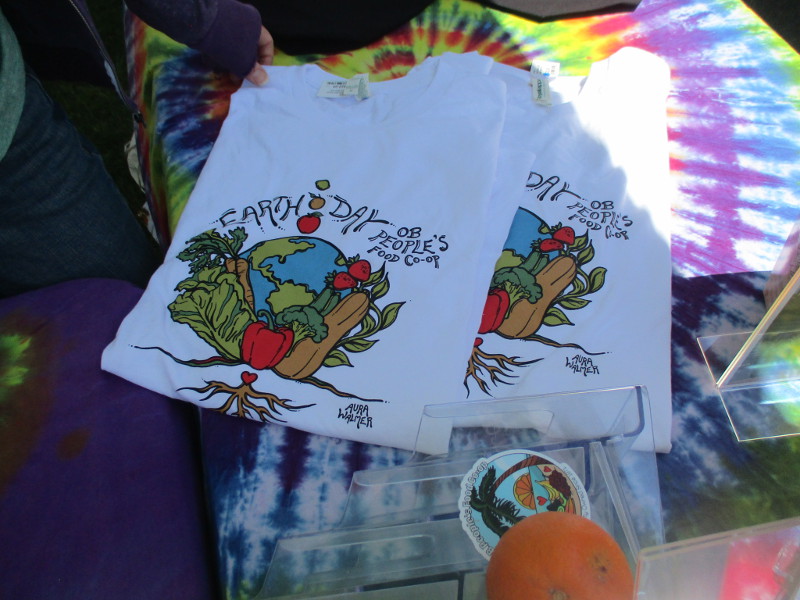
Visitors to this unique Earth Day festival were not only treated to colorful multi-cultural entertainment, but had the opportunity to learn about two issues in particular: the changing climate and food accessibility. Visitors could also support organizations and local businesses that are trying in their own unique way to improve education, sustainability, and protect the environment. Artists and more ordinary vendors were present, too.
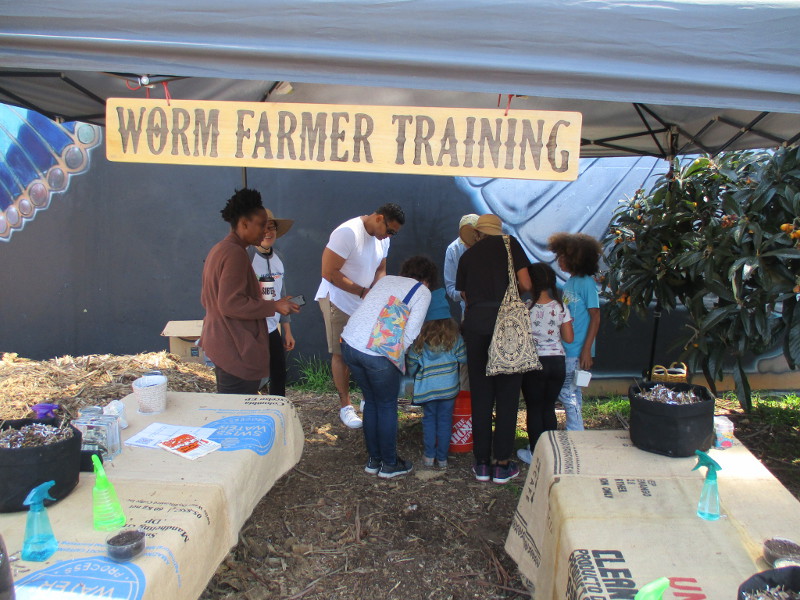
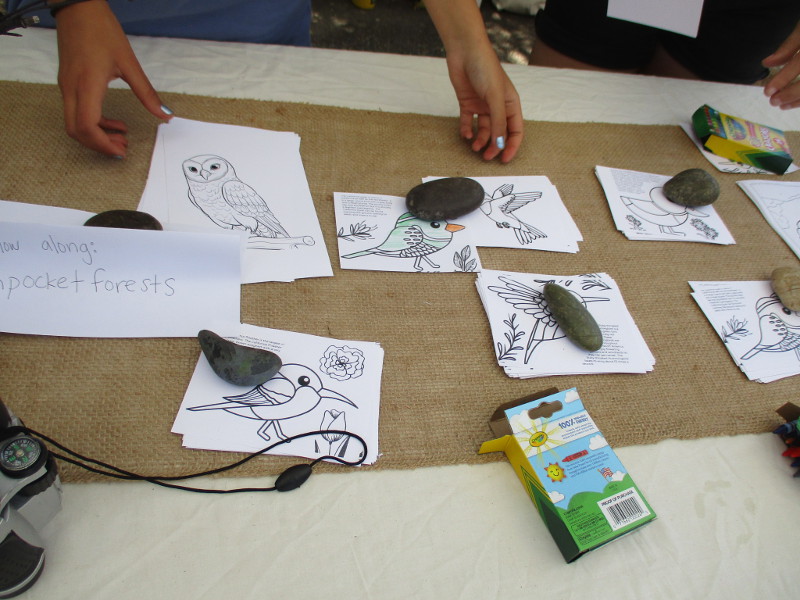
Special activities included a seed swap, a lesson on how to create and maintain a worm farm, and compost workshops. Kids could color fun artwork, too!
For the hungry crowd gathered outside in the San Diego sunshine, ethnic and vegetarian food vendors offered their special menus to choose from.
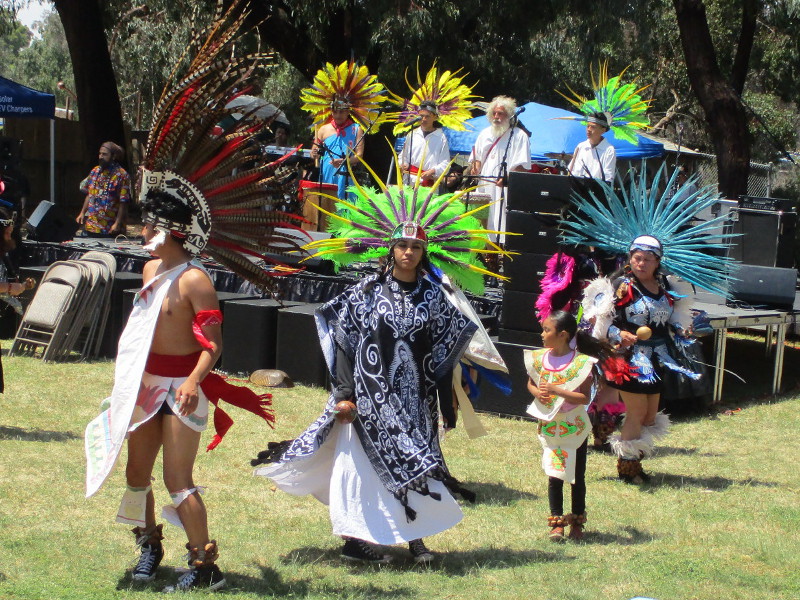
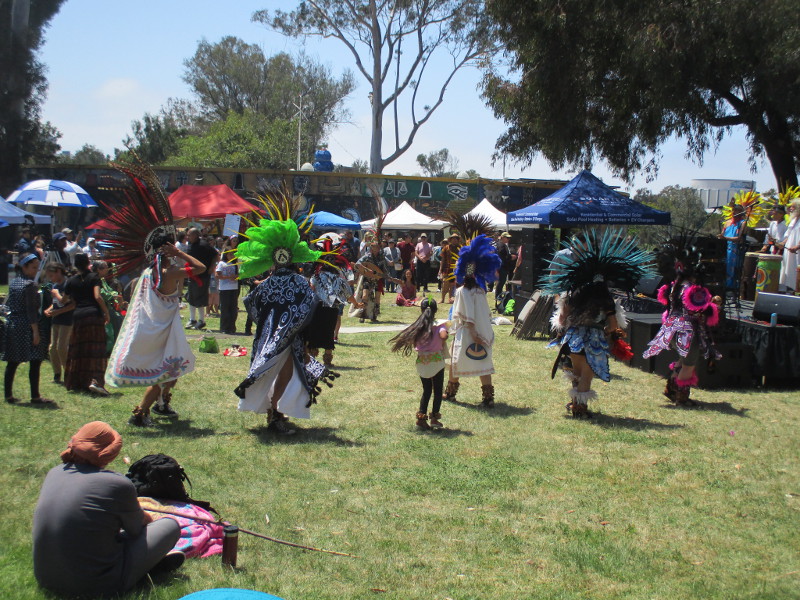
As you can see from my photos, I watched Azteca dancers perform for the crowd. They followed an impassioned speech by a holy man who once met the Dalai Lama. We need to raise our consciousness was his message.
Inside the WorldBeat Cultural Center I watched and listened to the joyful music of San Diego Taiko. I personally love energetic taiko drumming!
Other performances during the event would include Middle Eastern belly dance, West African drum and dance, Brazilian samba, and Native American drumming.
There were also tours of the center’s lush garden. I’ll have to do that next time.
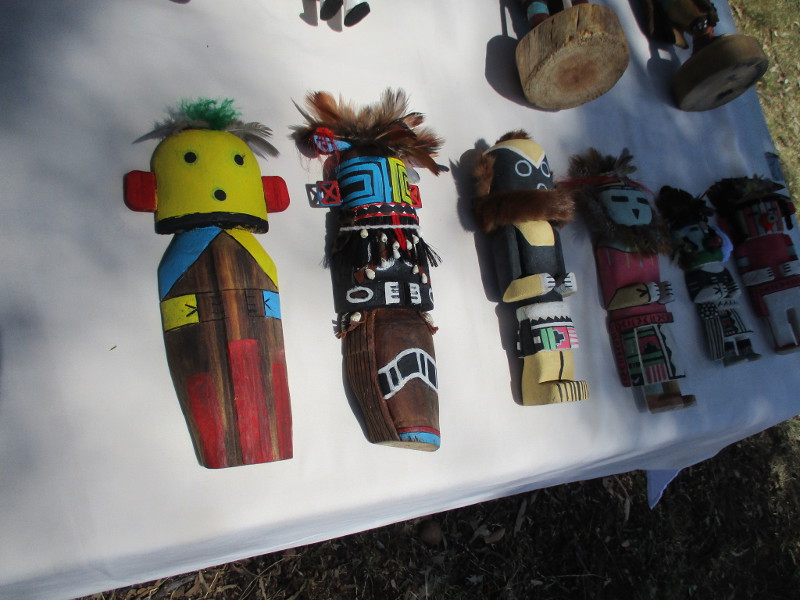
I loved these Hopi Kachina dolls, made of cottonwood. They were hand carved by Arizona-based artist Elroy Kewanyama…
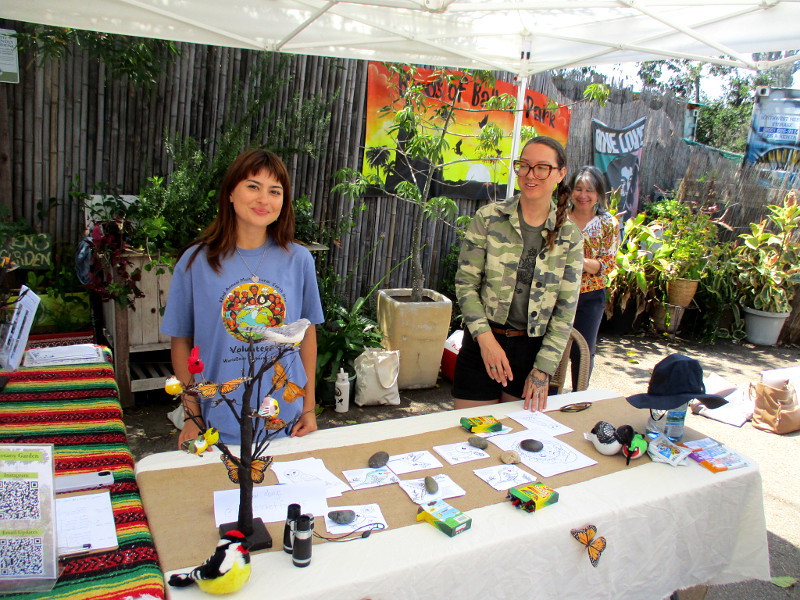
The following two ladies explained how Green Pocket Forest has partnered with the WorldBeat Cultural Center to create a 320 square meters Children’s Nature Zone, designed with the innovative Miyawaki method to spotlight 1000 native plants, providing habitat for 20+ species of birds and insects. Wow!
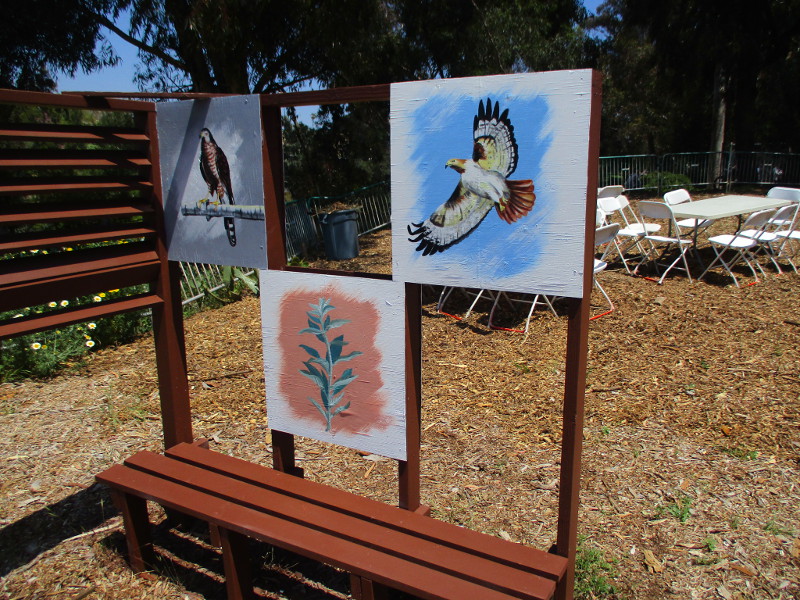
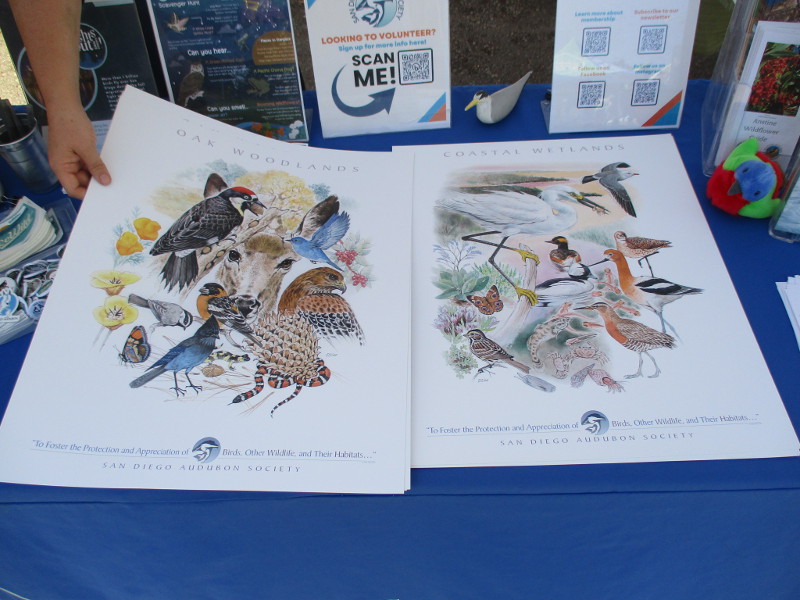
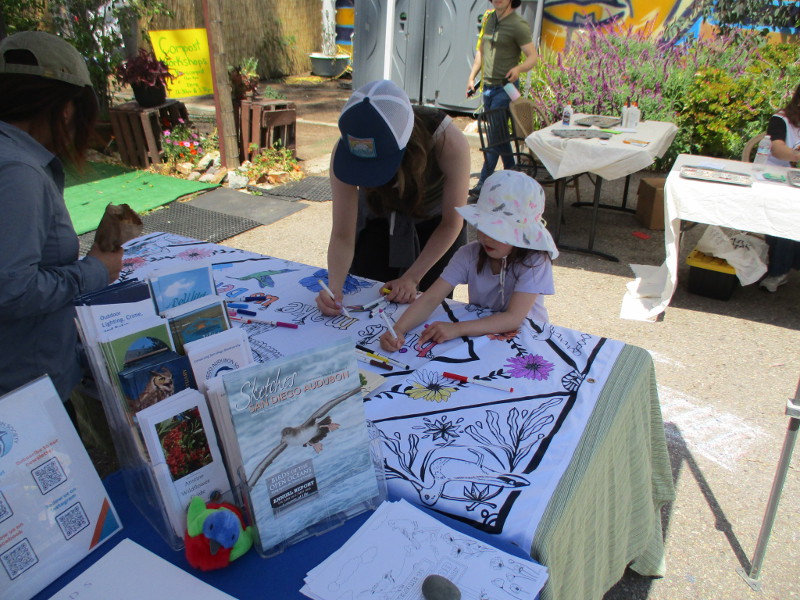
The San Diego Audubon Society table had tons of information about their current activities, plus beautiful bird artwork and a mural coloring station. (I learned their Bird Festival this year was a big success!)
…
Thanks for visiting Cool San Diego Sights!
I post new blogs pretty often. If you like discovering new things, bookmark coolsandiegosights.com and swing on by occasionally!
I live in downtown San Diego and love to walk around with my camera! You can follow Cool San Diego Sights via Facebook or X (formerly known as Twitter)!
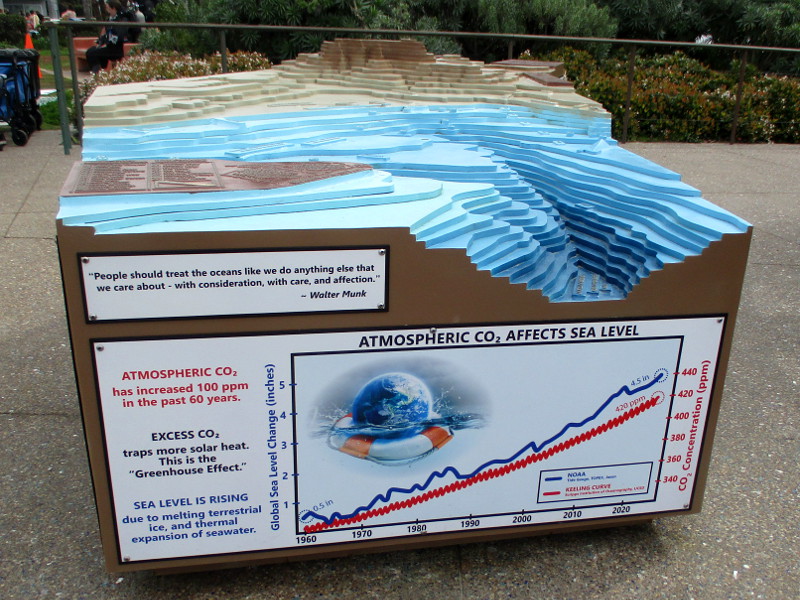
Kellogg Park at La Jolla Shores features environmental displays in an outdoor plaza by the busy beach boardwalk. A three dimensional model of underwater canyons in the Pacific Ocean is one part of The Map of the Grand Canyons of La Jolla Educational Plaza.
I blogged about this amazing plaza a couple years ago. See those images (which include stunning mosaic art) and read descriptions by clicking here.
During that previous walk, the three-dimensional, topographic model that you see in the above photo was under construction. Well, it was finished when I and some friends walked by recently!
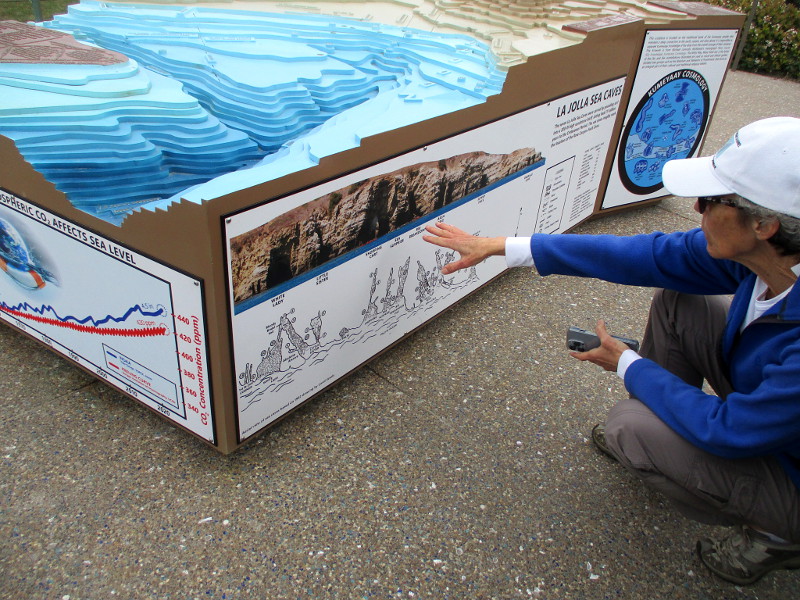
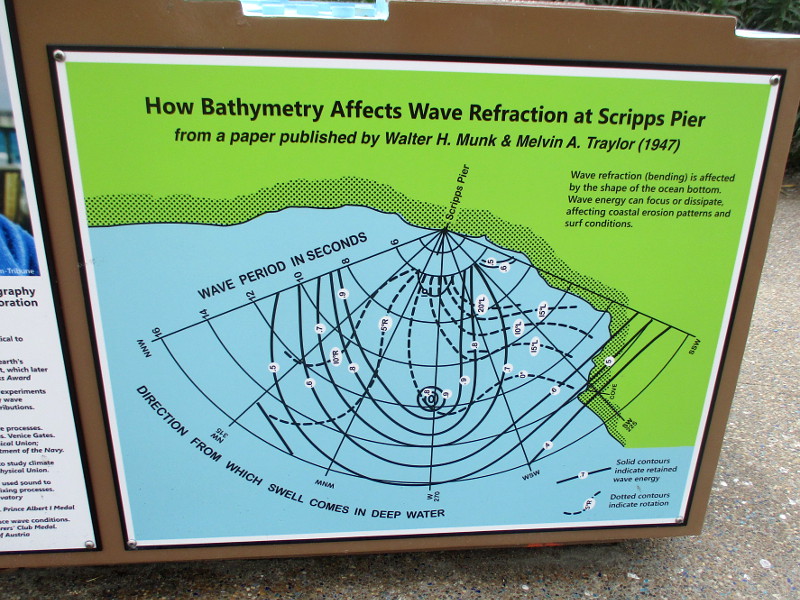
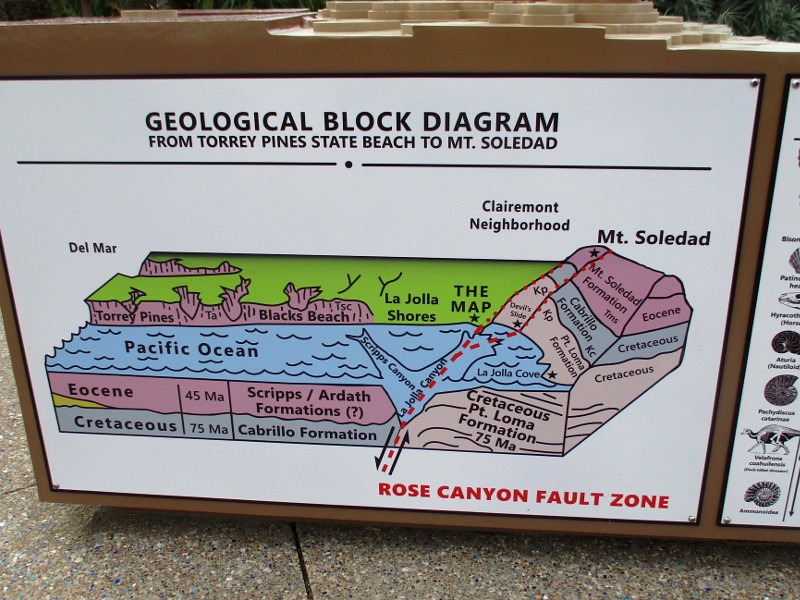
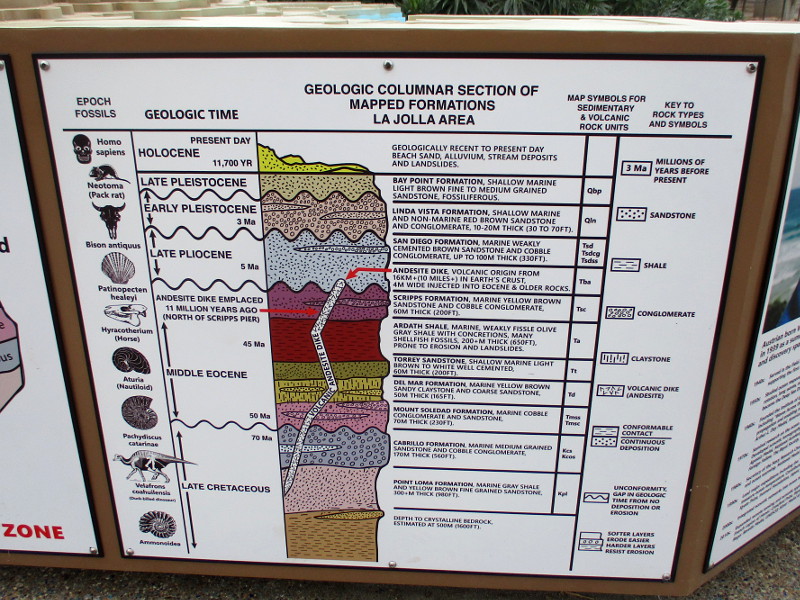
The fascinating model depicts canyons running down from Mount Soledad into the ocean. On the sides of the model, plaques present information concerning the geology of the canyons, ocean wave dynamics, and other related environmental issues.
Should you ever walk past Kellogg Park in La Jolla Shores, pause for a few moments and learn a good deal about oceanographic history, our local environment, and this planet we live on.
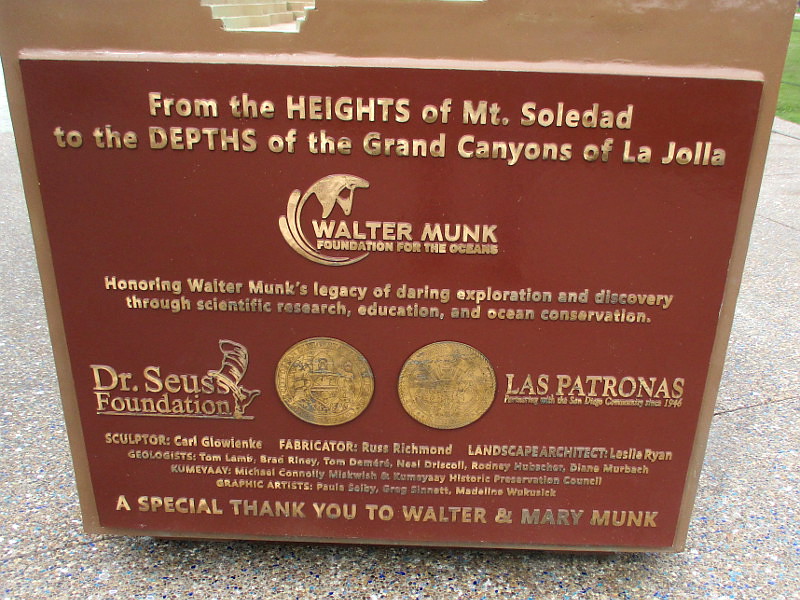
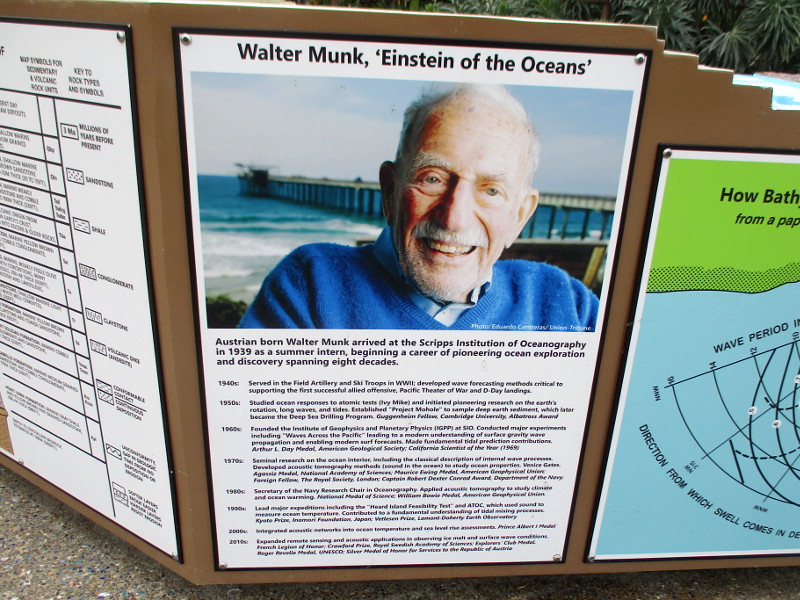
From the HEIGHTS OF Mt. Soledad to the DEPTHS of the Grand Canyons of La Jolla – Walter Munk Foundation for the Oceans – Honoring Walter Munk’s legacy of daring exploration and discovery through scientific research, education, and ocean conservation… A SPECIAL THANK YOU TO WALTER & MARY MUNKChecking out information about the La Jolla Sea Caves, and Native American Kumeyaay Cosmology.Walter Munk, “Einstein of the Oceans” – Austrian born Walter Munk arrived at the Scripps Institution of Oceanography in 1939 as a summer intern, beginning a career of pioneering ocean exploration and discovery spanning eight decades…How Bathymetry Affects Wave Refraction at Scripps Pier from a paper published by Walter H. Munk & Melvin A. Traylor (1947) – Wave refraction (bending) is affected by the shape of the ocean bottom. Wave energy can focus or dissipate, affecting coastal erosion patterns and surf conditions.Geologic Block Diagram From Torrey Pines State Beach To Mt. SoledadGeologic Columnar Section of Mapped Formations La Jolla Area (from Late Cretaceous to Holocene)Graph shows how Atmospheric CO2 (carbon dioxide) Affects Sea Level.
“People should treat the oceans like we do anything else that we care about–with consideration, with care, and affection.” –Walter Munk
…
Thanks for visiting Cool San Diego Sights!
I post new blogs pretty often. If you like discovering new things, bookmark coolsandiegosights.com and swing on by occasionally!
I live in downtown San Diego and love to walk around with my camera! You can follow Cool San Diego Sights via Facebook or X (formerly known as Twitter)!
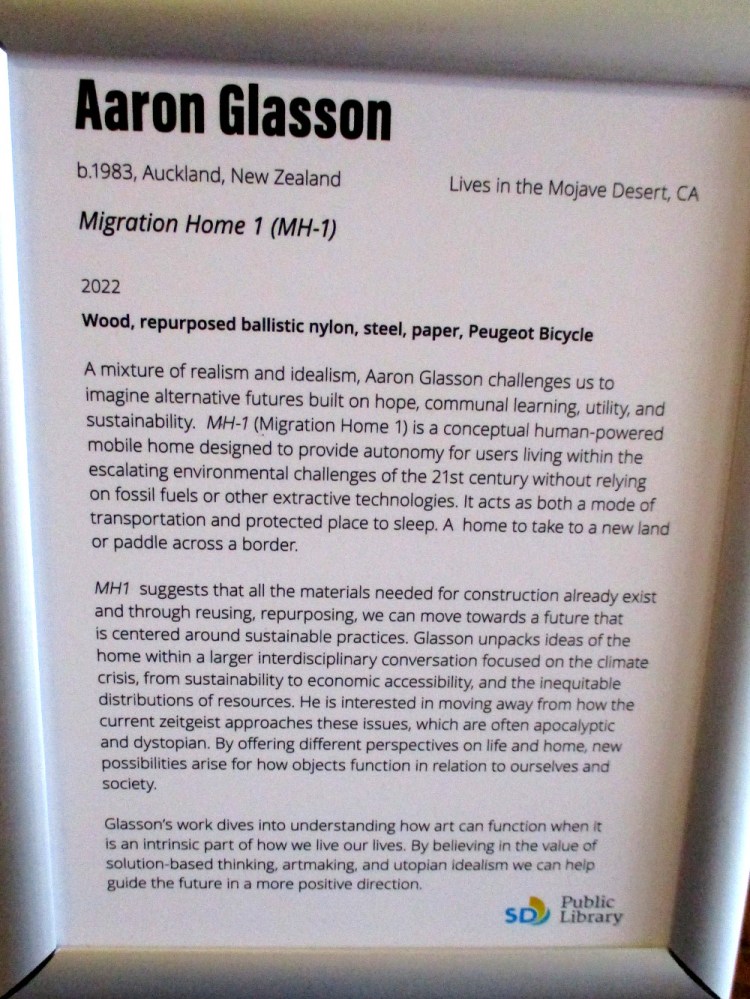
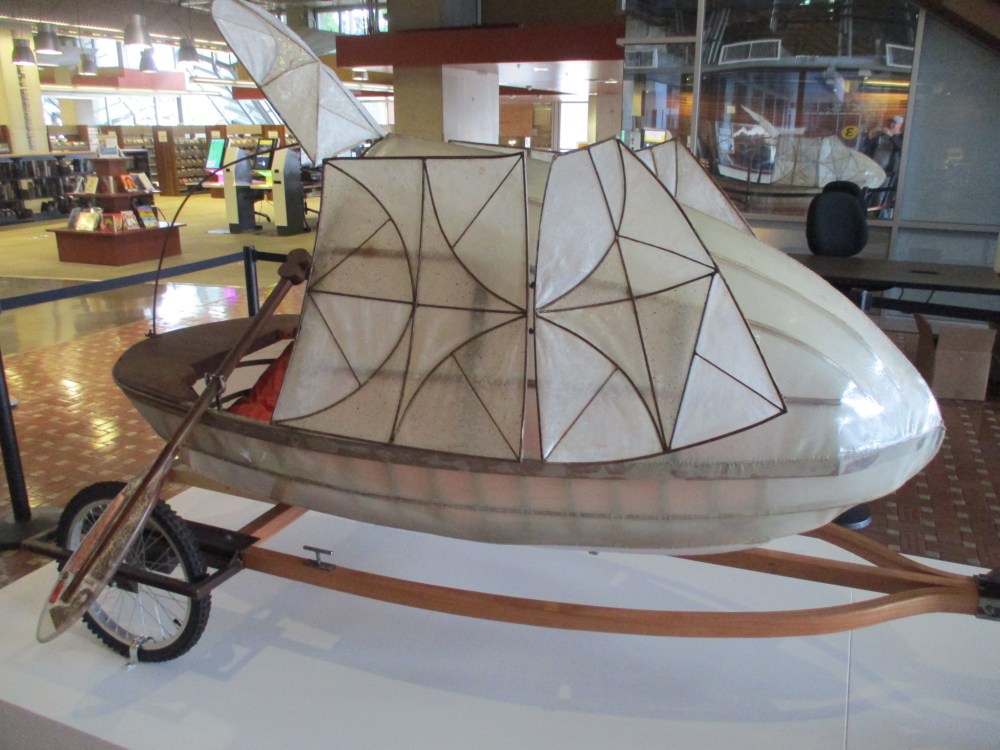
A unique trailer towed by bicycle is now on display near the front counter of the San Diego Central Library. It’s called Migration Home 1 (MH-1).
According to its description, this tiny “mobile home” that doubles as a rowboat was crafted with repurposed materials, and designed with a mixture of realism and idealism.
The artist, Aaron Glasson, seems to envision a bleak future where humans can’t rely on technological progress to solve problems, but must live a more primitive existence.
Can a vehicle such as this carry an idealist toward utopia?
The statement concludes: By believing in the value of solution-based thinking, artmaking, and utopian idealism we can help guide the future in a more positive direction.
…
Thanks for visiting Cool San Diego Sights!
I post new blogs pretty often. If you like discovering new things, bookmark coolsandiegosights.com and swing on by occasionally!
I live in downtown San Diego and love to walk around with my camera! You can follow Cool San Diego Sights via Facebook or Twitter!
An important reforestation effort is underway at Torrey Pines State Natural Reserve.
In recent years the critically endangered Torrey pine population has been reduced significantly by bark beetles, particularly in the park’s North Grove. So over 450 Torrey pine seedlings and 581 native shrubs grown in the nursery at the San Diego Safari Park are being planted in different locations around the Reserve.
You can read more about the project, an effort of California State Parks, the San Diego Zoo Wildlife Alliance, and the U.S. Forest Service, by clicking here.
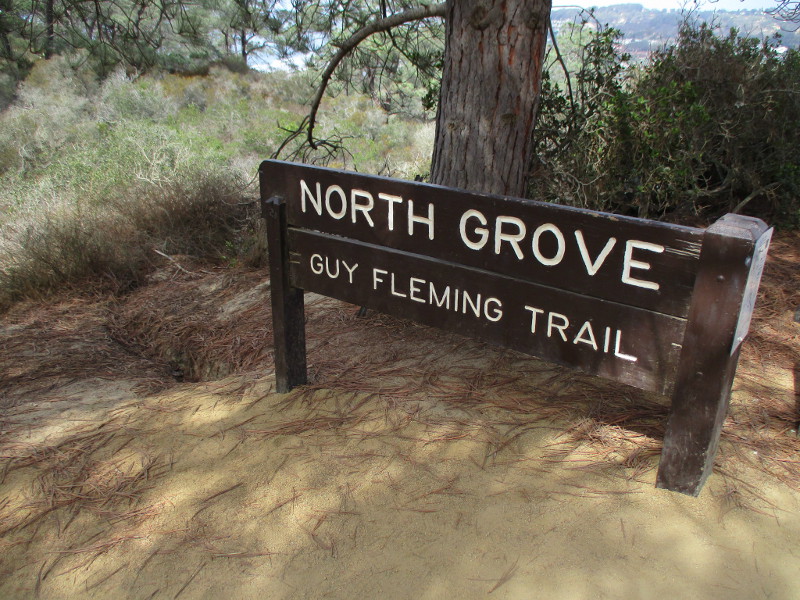
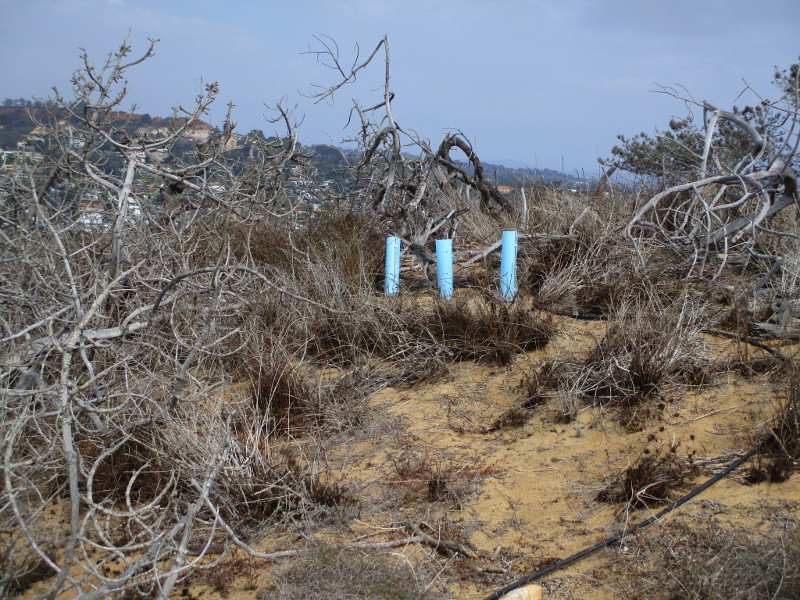
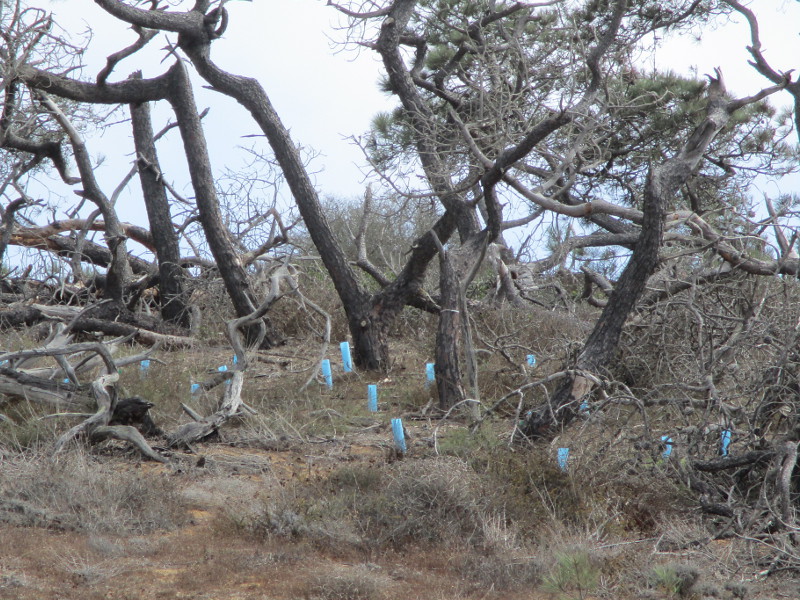
I walked the loop of the Guy Fleming Trail yesterday, where visitors can see many of the dead Torrey pines. Among dead trees, clustered close to the ground, stand strange blue tubes. These plastic protectors shield growing trees and other plants from animals and drying winds.
Native shrubs that have also been planted, mostly above the west-facing bluffs facing the Pacific Ocean, include sea dahlia, jojoba, lanceleaf liveforever, fingertips (San Diego dudleya), lemonade berry, coast lilac, and San Diego mountain mahogany.
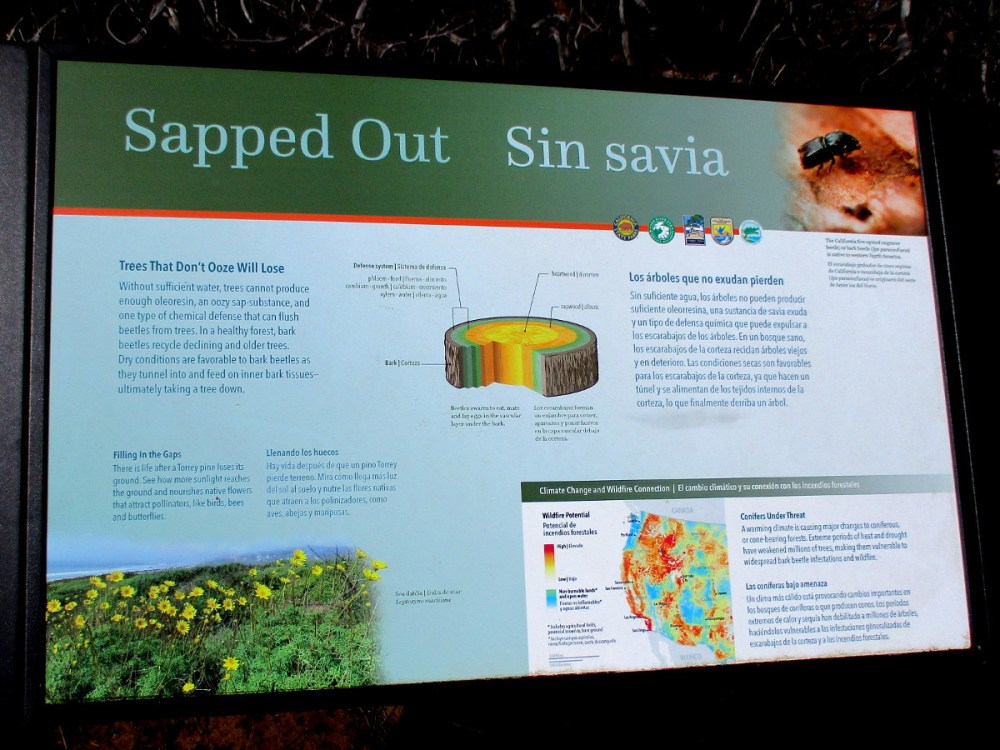
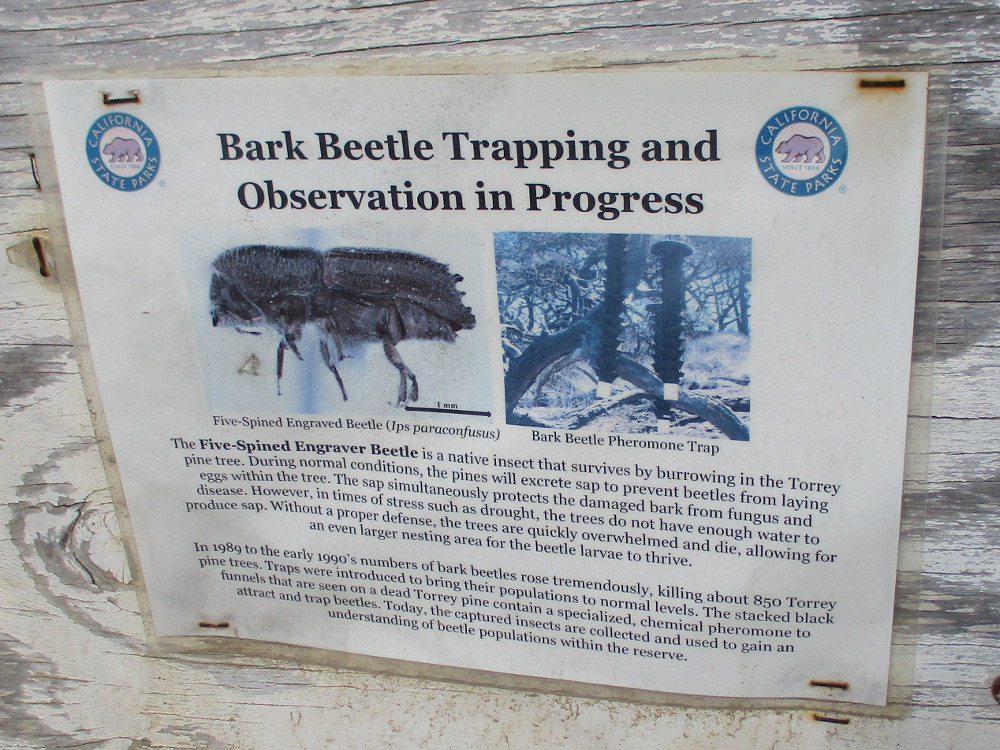
As I walked along, observing all those blue tubes, I paused to read signs that explain how bark beetles kill the rare and beautiful Torrey pine. This tree’s natural protection against beetle infestation is sap. During drought trees produce less sap than usual and become especially vulnerable.
Without sufficient water, trees cannot produce enough oleoresin, an oozy sap-substance, and one type of chemical defense that can flush beetles from trees…
Bark Beetle Trapping and Observation in Progress.
The Five-Spined Engraver Beetle is a native insect that survives by burrowing in the Torrey pine tree. During normal conditions, the pines will excrete sap to prevent beetles from laying eggs within the tree. The sap simultaneously protects the damaged bark from fungus and disease…
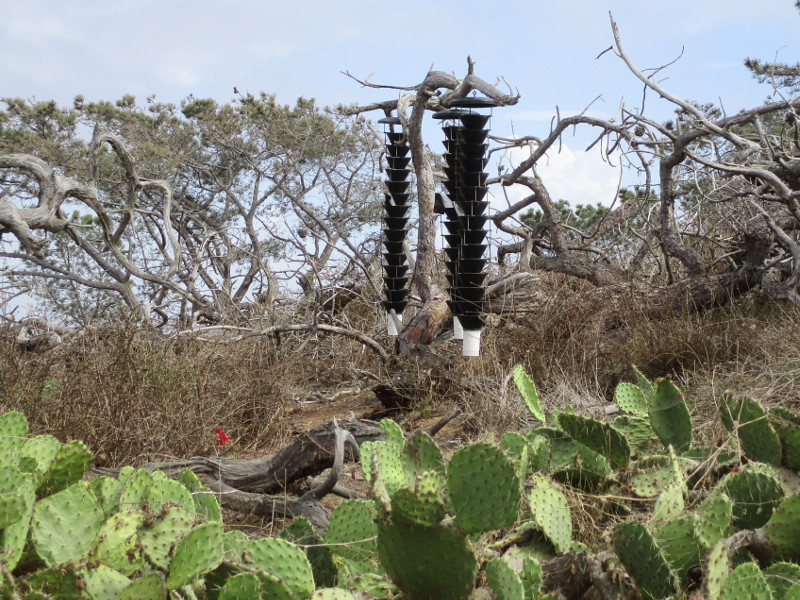
…The stacked black funnels that are seen on a dead Torrey pine contain a specialized chemical pheromone to attract and trap beetles…
…
I live in downtown San Diego and love to walk around with my camera! You can follow Cool San Diego Sights via Facebook or Twitter!
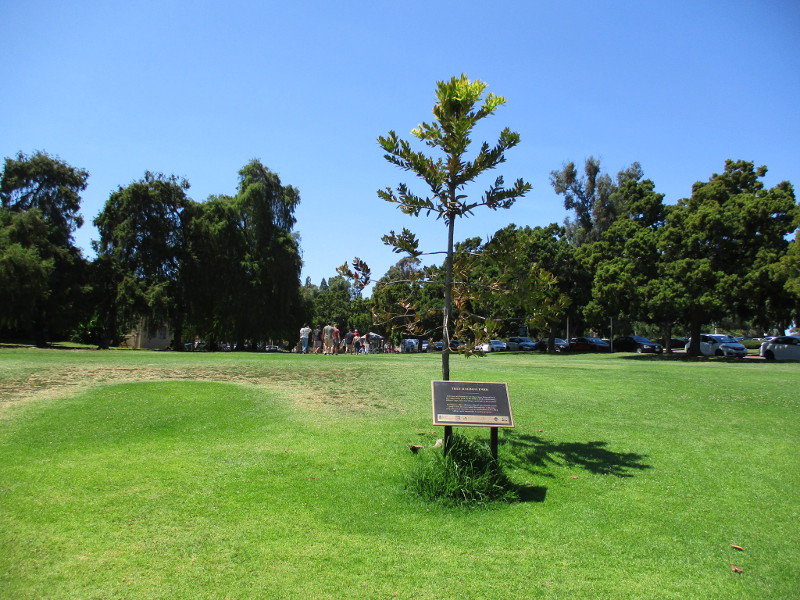
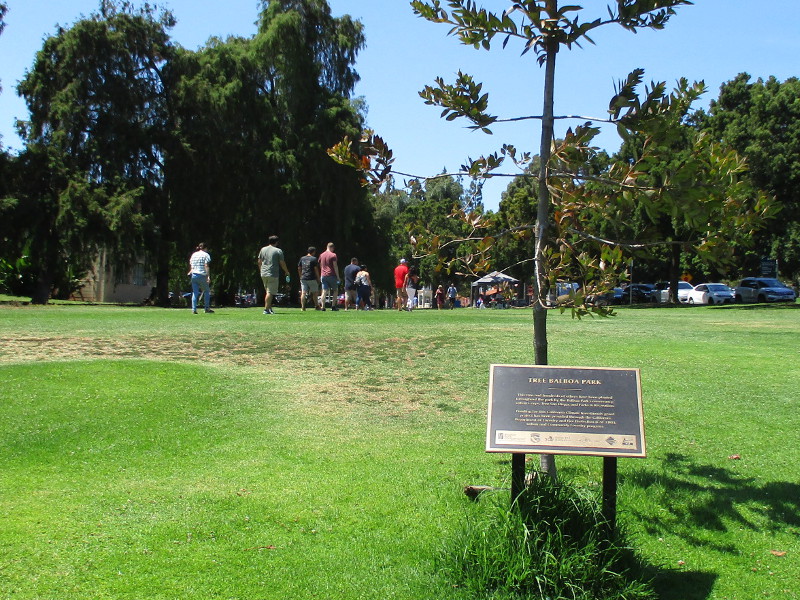
I was walking through Balboa Park on Sunday, making my way toward Park Boulevard, when I noticed a newly planted tree with a shiny plaque beside it.
I veered across the grass to investigate…
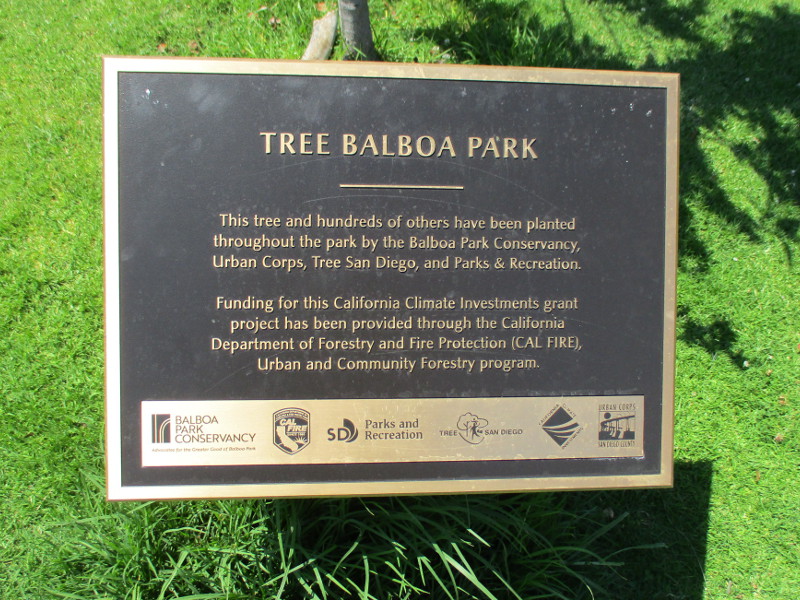
The plaque states:
TREE BALBOA PARK
This tree and hundreds of others have been planted throughout the park by the Balboa Park Conservancy, Urban Corps, Tree San Diego, and Parks & Recreation.
Funding for this California Climate Investments grant project has been provided through the California Department of Forestry and Fire Protection (CAL FIRE), Urban and Community Forestry program.
…
I live in downtown San Diego and love to walk around with my camera! You can follow Cool San Diego Sights via Facebook or Twitter!
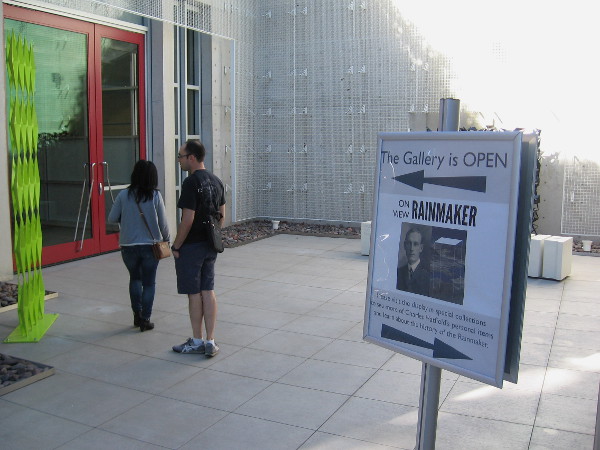
The 9th floor gallery at San Diego’s Central Library features an art exhibit called RAINMAKER. The theme is water, drought and climate change.
RAINMAKER is a fascinating, thought-provoking art exhibition at downtown San Diego’s Central Library. Because it will be coming to a close this weekend, I recently headed to the library’s 9th floor gallery to check it out.
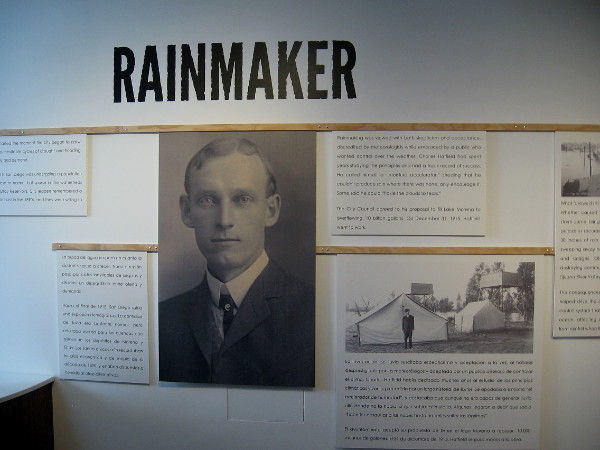
Charles Hatfield was hired by the city of San Diego a hundred years ago to produce much-needed precipitation in order to fill Lake Morena. He might or might not have created the torrential rains and catastrophic flooding that followed his efforts at “moisture acceleration”. Was Hatfield an actual scientist or a charlatan? The question remains open.
This art exhibition focuses on the importance of water in our arid region, and how people affect and are influenced by the environment. Twelve local artists have contributed pieces which touch upon this theme. RAINMAKER is especially relevant today, considering San Diego’s current long drought, and the threat of coming winter storms caused by a strong El Niño that has developed in the Pacific Ocean.
Charles Hatfield, self-proclaimed rainmaker, was hired by the city of San Diego in 1915 to fill Lake Morena reservoir during a severe drought. Record rain and floods ensued. Was this a coincidence?
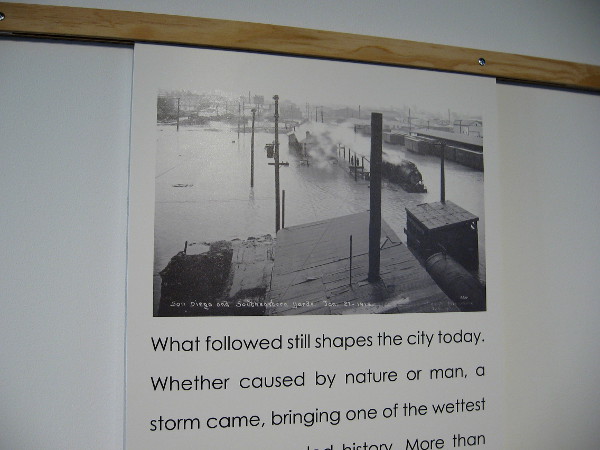
Photo at RAINMAKER exhibition shows catastrophic San Diego flooding caused by over 30 inches of rain in 1915.
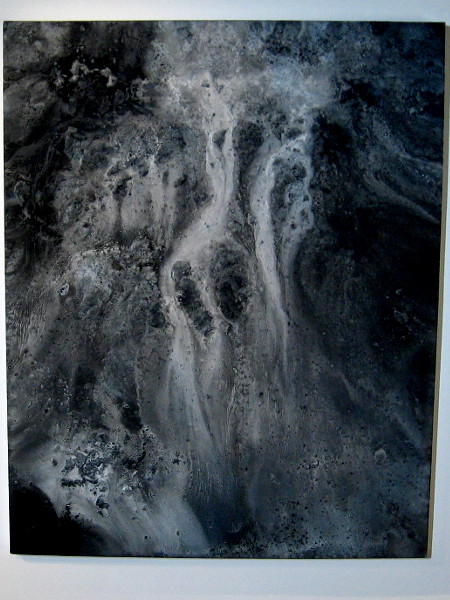
Adam Belt, Willow Wash, 2015. Paint, graphite and reflective powder on canvas. Where is the boundary between science and magic?
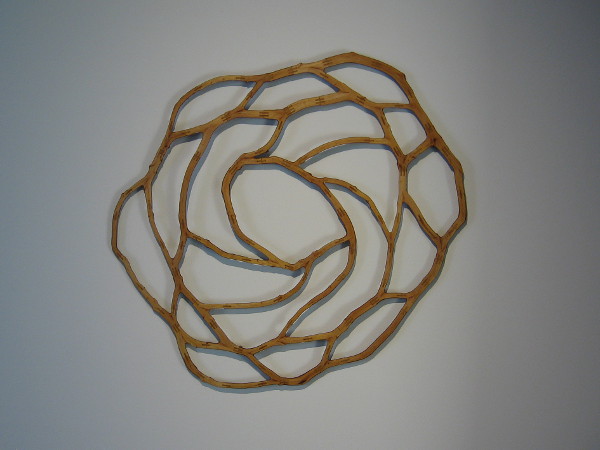
Roman de Salvo, Joinery Blossom, 2013. Chinese elm, glue. Metaphor of Earth’s ecosystem, with networks of family, community, interdependence.
Eva Struble, Navy Yard, 2011. Oil and acrylic on canvas. This piece emerged from a trek through Brooklyn’s Navy Yard. A vision of decay that is also expansive, waiting.
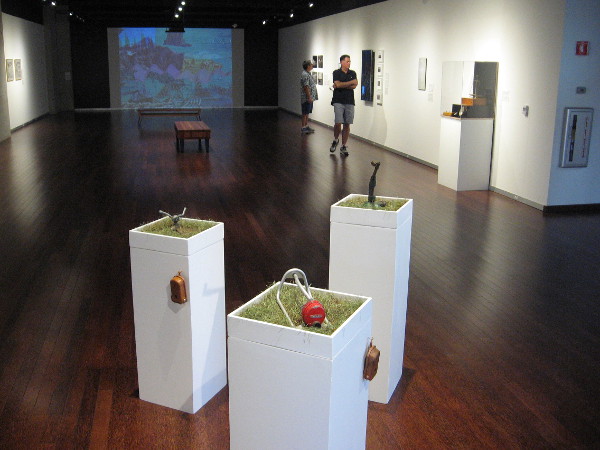
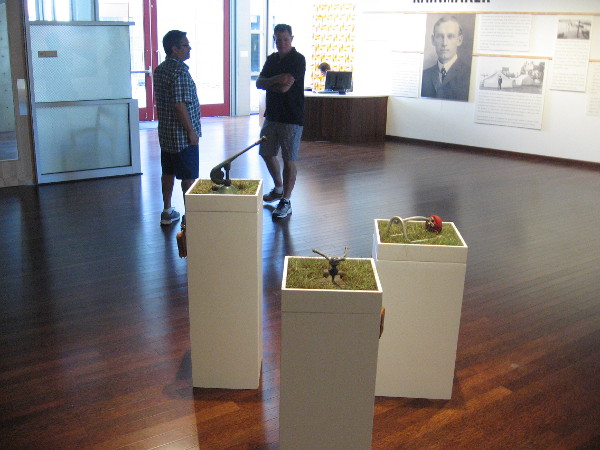
Margaret Noble, I Have Arrived, 2015. Mixed media installation with 3 pedestals, 3 plant boxes, 3 sprinklers, and 3 handheld audio players. Lawns have been a symbol of status in society.
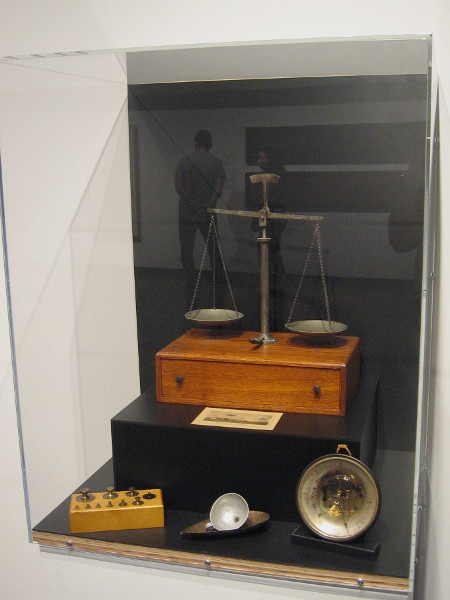
Tools of the Rainmaker. The scales, measuring scoops and barometer in this case were donated to the San Diego Library in 1972 by Paul A. Hatfield, brother of rainmaker Charles M. Hatfield.
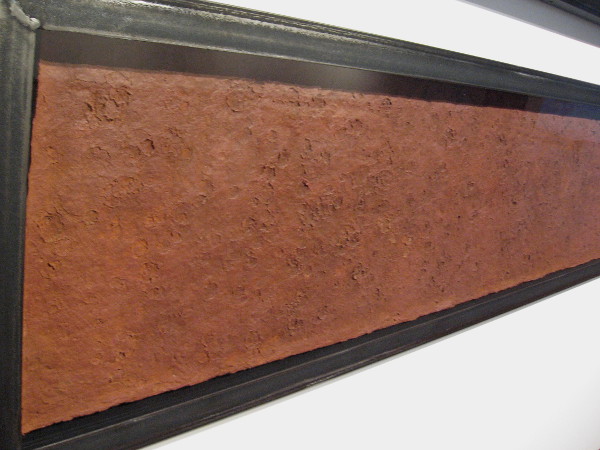
Jim Wilsterman, Rain Event #10, 2011. Earth, fiber, raindrops. Somewhere between photograph, sculpture and painting, this art has recorded rainfall using clay and mud.
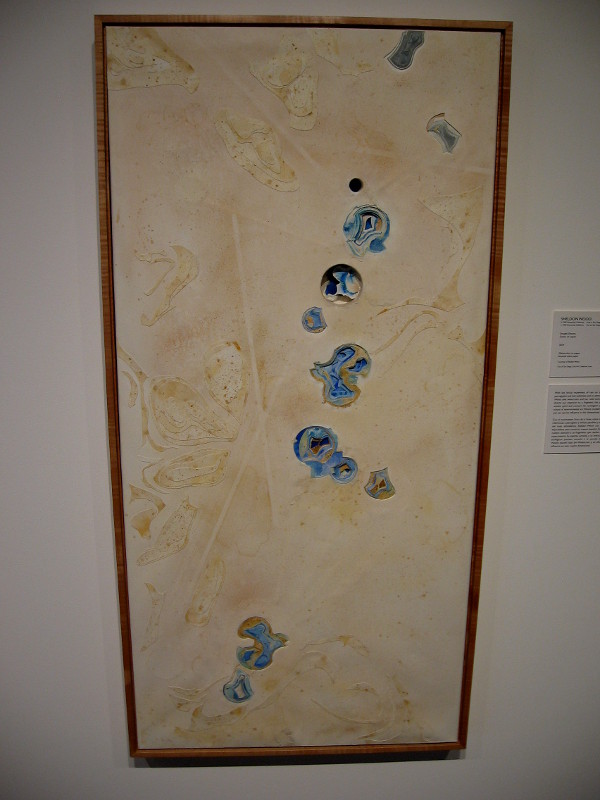
Sheldon Wood, Drought Dreams, 2014. Watercolor on paper. With the lyrical movement of rain on a hot surface, references to petroglyphs and lost sinkholes, and an atmospheric perspective…
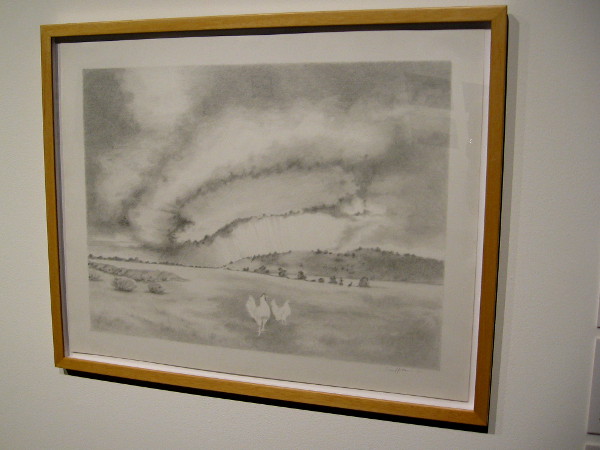
Lisa Hutton, Supercell with Chickens, 2013. Graphite on paper. Environmental artwork depicts storm clouds.
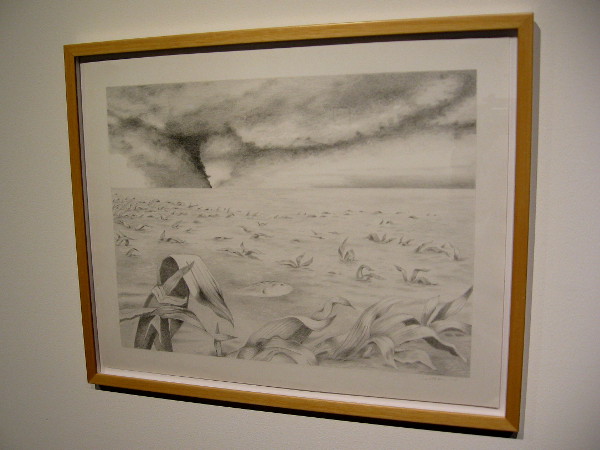
Lisa Hutton, A Flood and a Fire, 2013. Graphite on paper. The catastrophic effects of environmental disasters.
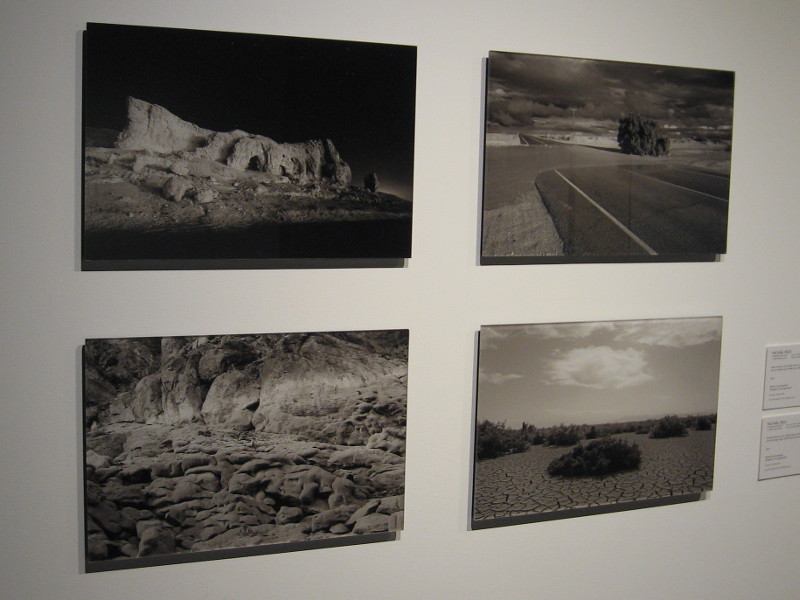
Four pigment ink photographs of desert environment by Michael Feld record beauty and natural history.
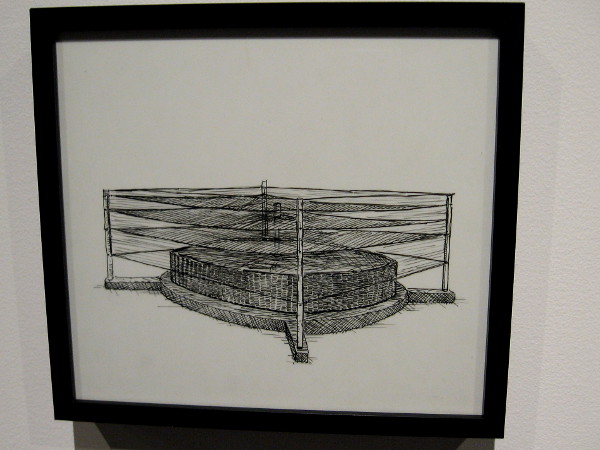
Dominic Paul Miller, rain gatherer, 2008. Ink on mylar. Part of a larger body of work concerning uranium mining and the Navajo Nation, who have scant access to running water.
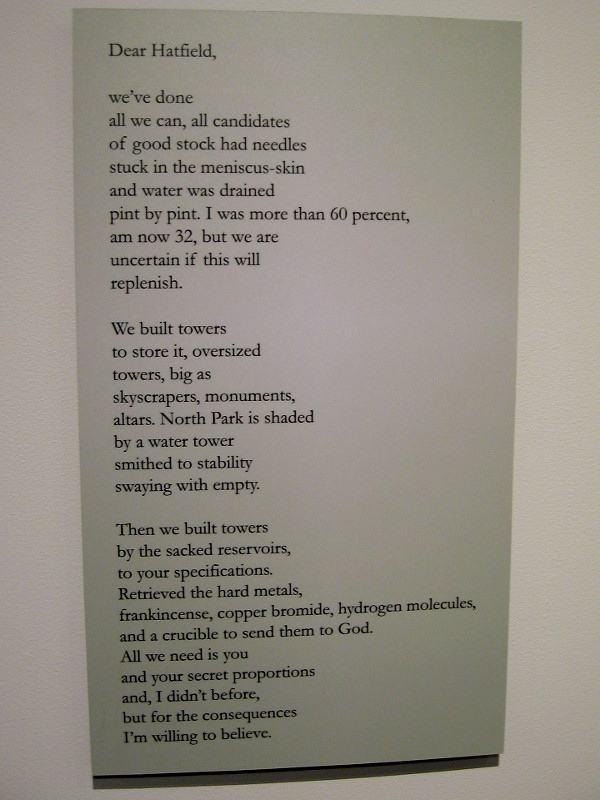
Gabriel Kalmuss-Katz, Dear Hatfield, 2015. Speculative writing. Reflects modern anxiety associated with urbanization.
RAINMAKER, a fascinating art exhibition at San Diego’s Central Library, continues through November 29.




















 Cool San Diego Sights!