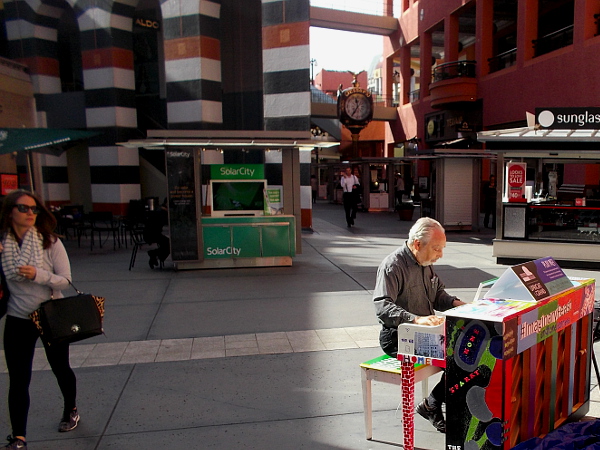
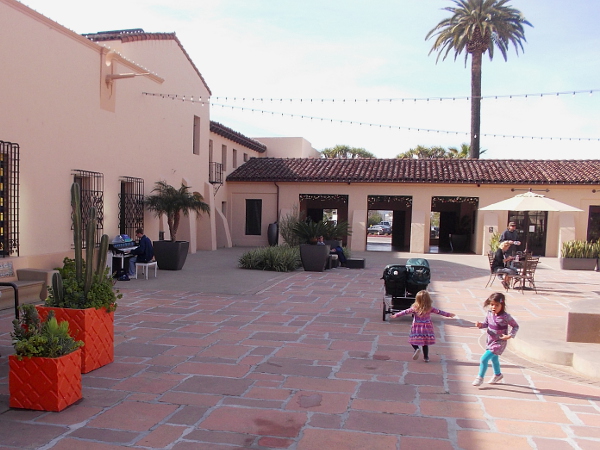
Gentleman who saw this fun piano in the middle of Horton Plaza sat down and started playing. The San Diego Symphony is spreading music around the city!
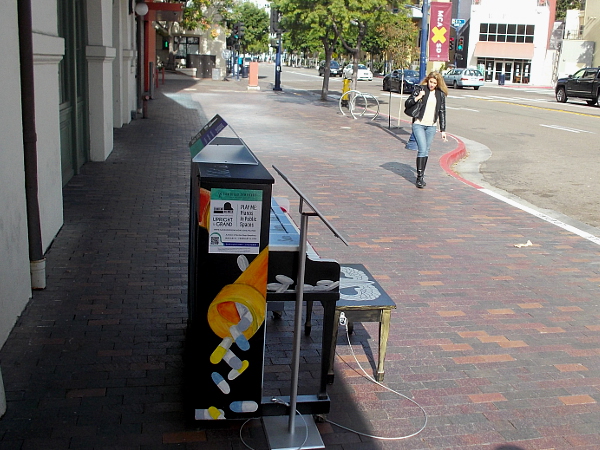
Ten pianos have been placed around San Diego for the public to play! Any ordinary person passing by can just sit down and perform music to their heart’s content!
This very cool and unique “event” is being put on by the San Diego Symphony. Their PLAY ME: Pianos In Public Spaces installation is part of this month’s Upright and Grand Piano Festival, and will continue through February 8.
Feeling inspired? Feeling musical? Feeling like a maestro? Would you like to play some wonderful piano selections for your admiring fans? Then head on over to one of the ten public locations! They are: the Symphony Towers lobby, the Quartyard, the downtown Central Library, Horton Plaza, The Headquarters, the Coronado Ferry Landing, the Museum of Contemporary Art San Diego (downtown location), Liberty Station, Balboa Park (by the Old Globe Theatre) and the California Center for the Arts Escondido!
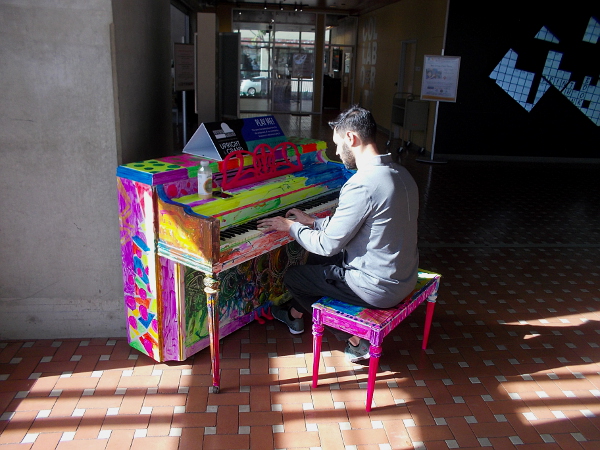
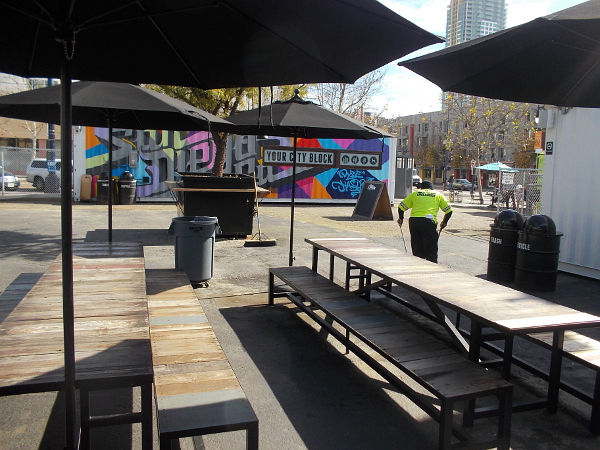
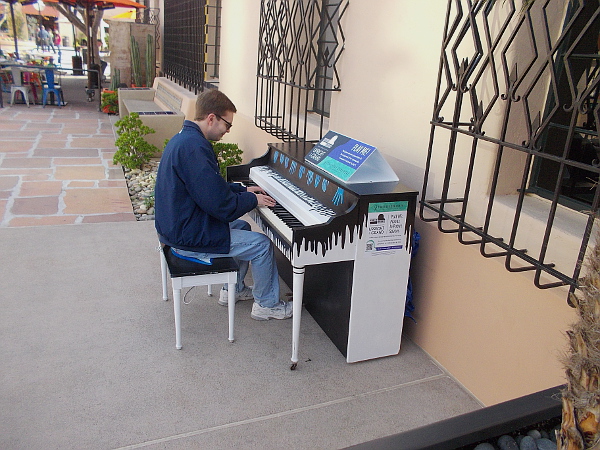
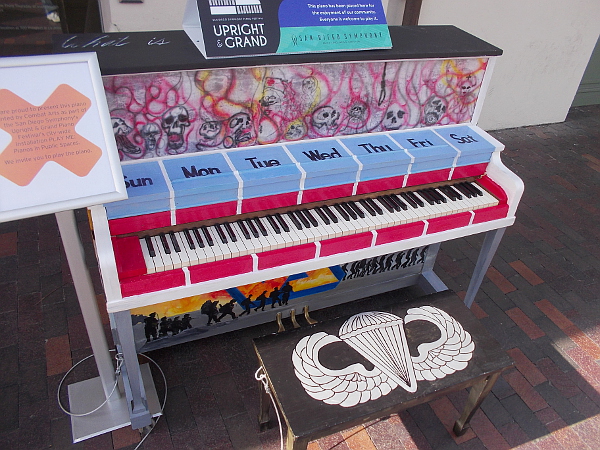
The San Diego Symphony’s PLAY ME: Pianos In Public Spaces program has placed ten pianos around the city for ordinary people to enjoy!A colorfully painted piano in the lobby of Symphony Towers in downtown San Diego. I swung by here in the very early morning when few people were around.A cool guy plays this public piano at the Central Public Library in downtown San Diego. He heard about this very unique event and came on down to tickle the ivories.One of ten pianos placed around San Diego for the public to enjoy. Many library patrons coming through the front door were treated to unexpected music!This piano has a big cyclops eye. It sits outside in the Quartyard in San Diego’s East Village.Few people were about the Quartyard on Saturday morning. It’s a cool eating and event venue that’s fairly new in this hip neighborhood.Amazing talent takes a seat in Horton Plaza. This gentleman was walking through the shopping mall and saw the piano. He sounded like a professional musician!This fellow enjoyed playing another public piano, which has been placed at The Headquarters, near Seaport Village.All ten pianos have unique artwork, painted by various local organizations. The instruments were tuned by experts at the San Diego Symphony–and they sound amazing!Kids twirl to piano music in the wide courtyard of The Headquarters, which is located in San Diego’s old police headquarters.Finally, I saw this piano in front of the Museum of Contemporary Art San Diego’s downtown location, which is next to the Santa Fe Depot.Sign says that we are proud to present this piano painted by Combat Arts as part of the San Diego Symphony’s Upright and Grand Piano Festival’s city-wide installation. We invite you to play!Piano in public for any random passerby to enjoy. Veterans who painted this instrument are part of an art-based museum program to help combat troops recover from PTSD.
…
Please join me for more cool sights on Facebook and Twitter!
Do you like to read original, thought-provoking fiction? Visit my Short Stories by Richard writing blog!
Architectural details on several of the Egyptian Quarter’s buildings include pharaohs, scarabs and other exotic designs. This photo was taken at the Pharaoh’s Court Apartments.
Last weekend I took a long looping walk through North Park. Many cool images are coming soon!
To reach North Park from downtown, I walked through a corner of Hillcrest called the Egyptian Quarter. When you take a look at the following photos, you’ll understand the origin of the unusual name.
These several blocks in San Diego were heavily influenced by the Egyptian Revival and Art Nouveau styles, which where very popular back in the 1920s. In recent years, businesses in the area have banded together to re-emphasize this neighborhood’s exotic identity. Walk anywhere near the corner of Park Boulevard and University Avenue, and you’re bound to think you’ve traveled back in time to ancient Egypt!
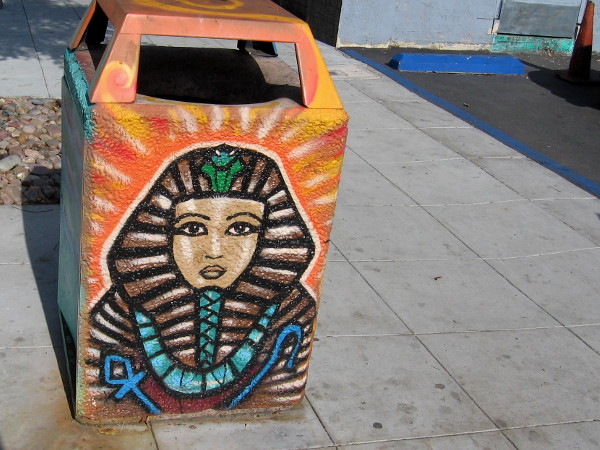
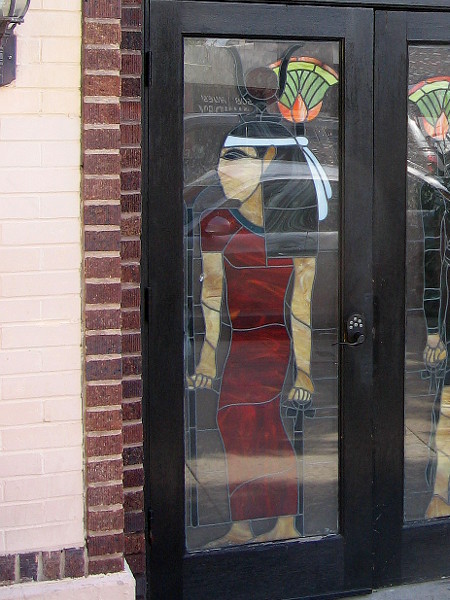
An ancient pharaoh seems to look over the Egyptian Quarter. One almost expects to see a pyramid nearby!One of several trashcans on Park Boulevard and University Avenue painted with colorful Egyptian motifs.Cool Egyptian-themed street mural recently painted by local graffiti artist Fizix.A stylish stained glass door at the Nile Apartments in San Diego’s unique Egyptian Quarter.Unexpected cool sights abound in the Egyptian Quarter, located in Hillcrest at the geographic edge of North Park.
Finn, heroic character in Star Wars: The Force Awakens, holds a lightsaber. Cool spray paint art by William J. Dorsett.
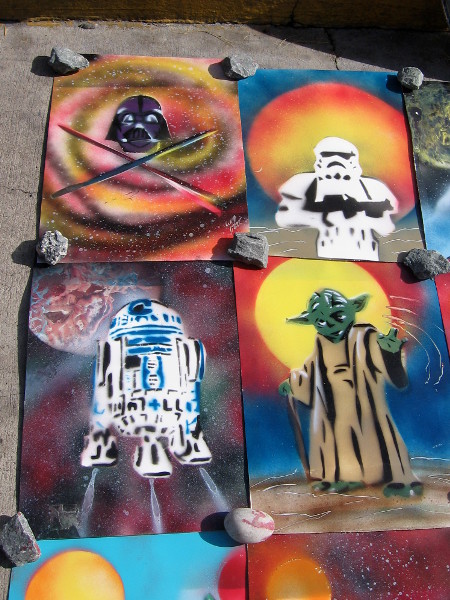
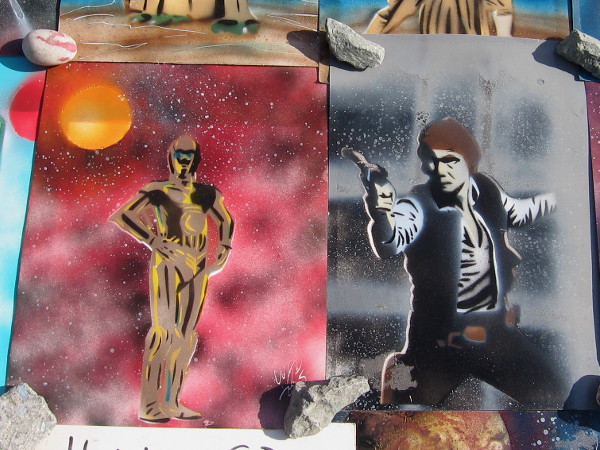
Check out these super cool Star Wars images! They were created by a talented guy named William J. Dorsett. He’s a great spray paint artist and busker who is frequently seen on San Diego’s Embarcadero, in front of Anthony’s Fish Grotto.
William also happens to be a really nice guy. I’ve seen him working his magic for years during my walks. Not only does he create very unique spray paint artwork, but he also fashions amazing small works of sculpture using corn husks.
And, as you can plainly see, he’s a huge fan of Star Wars!
William loves to demonstrate his unbounded creativity, and did so recently at a local school for excited students. Check out his website to learn more!
William J. Dorsett is a talented busker who often displays his cool artwork on San Diego’s Embarcadero. In this photo he’s handing a corn husk rose to a passerby!Small, colorful spray paint images include a Darth Vader helmet, an Imperial Stormtrooper, R2-D2 and Yoda.It’s Chewbacca with his Bowcaster blaster under a distant galaxy’s stars and a colorful planet.More cosmic, bold spray paint artwork depicts popular Star Wars characters.C-3PO and Han Solo in classic Star Wars poses! Awesome!
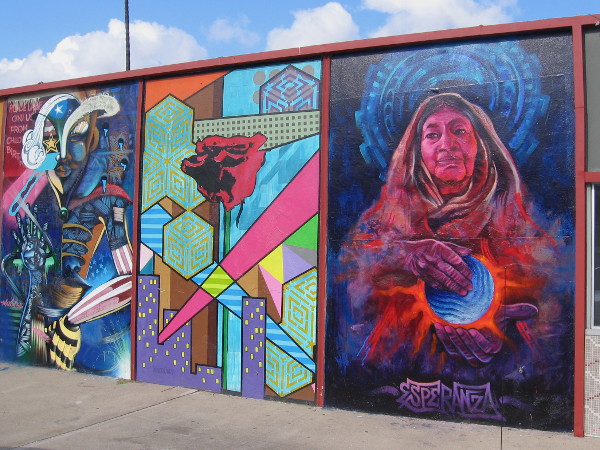
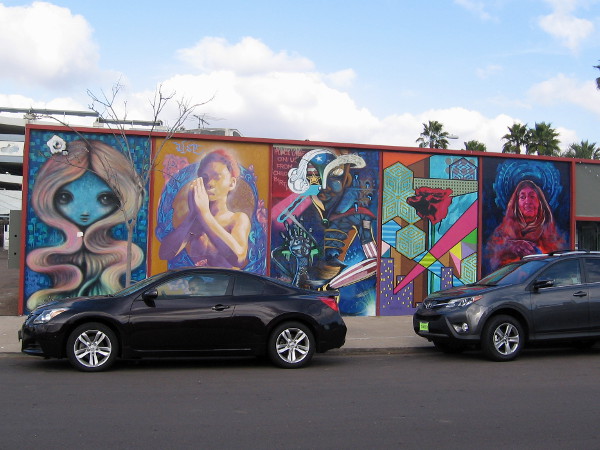
Super cool mural in North Park at the intersection of 30th Street and Gunn Street.
This morning, before the threatened rain could begin, I took a long walk through San Diego’s very cool North Park neighborhood. I took lots of pics! I’ll be sharing many of them in the days ahead.
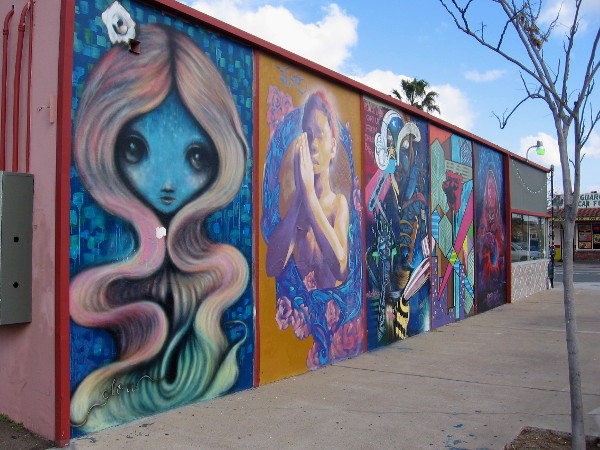
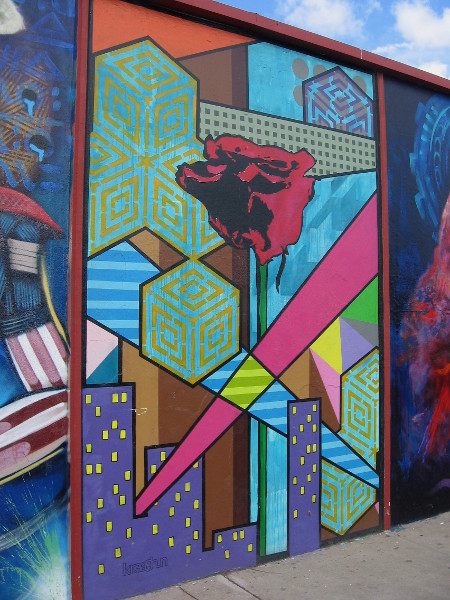
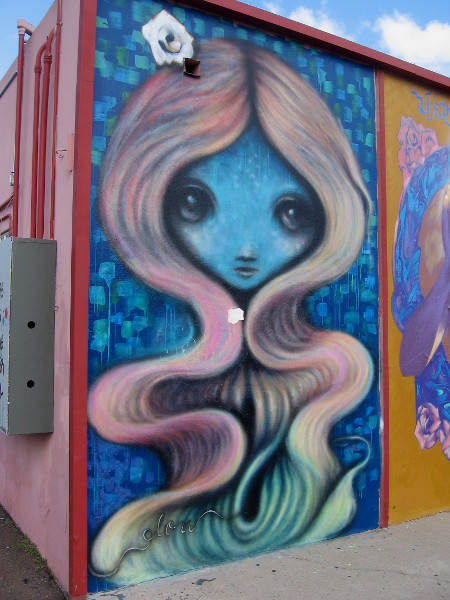
I’ve often admired this super colorful mural while driving down 30th Street. As the years have passed, I’ve also noted that the images have changed. After a little searching on Google, I see this mural is part of the “North Park Mural Project” and I identified a few of the artists. Check out the captions!
Right panel of awesome North Park mural contains the word Esperanza, which is Spanish for Hope.Another section of this cool public artwork depicts a large red rose, among buildings and interesting patterns. Created by Kreashun.Spray paint art by San Diego artist Maxx Moses. A character composed of many diverse elements, beneath the words Place Labels on Us From Childbirth.A beautiful figure seems to pray in a wreath of roses.A childlike blue face and long, colorful wavy hair, created by Gloria “GLOW” Muriel.This street art is on the same building. It reads Reality is Wrong. Dreams Are For Real. Hooligan Arts.Cool street art at 30th and Gunn, part of the North Park Mural Project.
The Art of Music is a cool exhibition “now playing” at the San Diego Museum of Art. Depicted in this poster is Fernando Botero’s painting Dancing in Columbia, 1980.
Do you love beautiful music? Do you appreciate fine art?
Answer yes to both questions, and you have two compelling reasons to visit an exhibition “now playing” at the San Diego Museum of Art!
The Art of Music explores the intersection of art and music throughout world history, from ancient times to the present. Visitors to the San Diego Museum of Art will experience a large variety of paintings, posters, sculptures and film, depicting musicians, dancers and various aspects of life that are splashed with the colors of music. Visitors will also enjoy seeing many extraordinarily beautiful musical instruments, historical objects related to music, and encounter surprising sounds at every turn.
My museum docent friend Catherine recently provided another great tour! There was so much to absorb, so many cool sights and sounds, that I hardly know how to translate my feelings into words. I could’ve spent many hours just lingering. The experience was almost like standing on stage during a symphony orchestra’s performance, and turning slowly around with eyes and ears wide open.
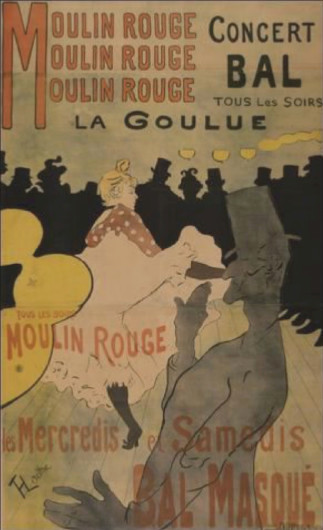
I was absolutely floored by the impressive sweep of this exhibit, and the number of pieces by important artists. I noted works by Henri Matisse, Pablo Picasso, Edgar Degas, Salvador Dalí, William Hogarth, Toulouse-Lautrec, Jasper Johns and John Baldessari, a highly regarded artist who grew up in National City in San Diego’s South Bay.
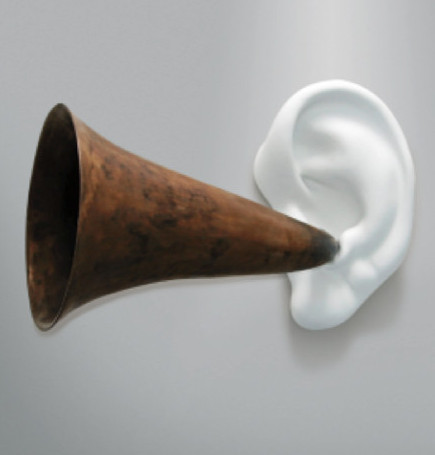
The very first piece visitors encounter is Baldessari’s Beethoven’s Trumpet (with Ear) Opus #127, a fun sculpture which perfectly captures the essence of what is to come. Press your own ear against the ear trumpet and you’ll hear musical notes penned centuries ago by Beethoven, as if they’re emerging from the famous composer’s brain!
In other rooms, visitors can listen to a statuette of a satyr playing the pipes of Pan, a qin from China dating from the 19th century, or an absolutely gorgeous 18th century harpsichord that was converted to a piano.
One amazing room in the exhibit contains the Microtonal Wall, created by Tristan Perich in 2011. A large section of wall contains 1,500 small speakers, which are tuned individually to create a complex and interesting continuum of pitch. The interactive experience was so fascinating, I ended up walking with my ear close to the wall bobbing up and down like a mesmerized chicken!
Another dazzling room is filled to the brim with psychedelic concert posters from the 1960s! Aficionados of this type of artwork will find themselves in heaven!
The Art of Music features so much cool stuff, and such variety, I couldn’t possibly describe it all here. You really have to go see for yourself. I’m no expert when it comes to either art or music, but I found myself completely enthralled!
Here are a few samples of what you’ll experience…
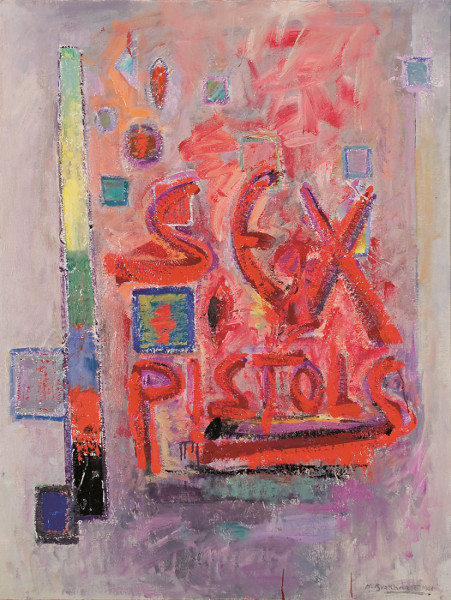
People head up steps from Balboa Park’s Plaza de Panama to visit the wonderful San Diego Museum of Art.Neck-Amphora with Apollo Playing the Cithara, and Hermes, Athena and Dionysus. Greece, Attica, circa 510 B.C. Los Angeles County Museum of Art.Shiv Chand, Madhumadhavi Ragini of Bhairav, ca. 1690. The San Diego Museum of Art.Lyre Guitar, early 19th century. The Crosby Brown Collection of Musical Instruments, 1889. The Metropolitan Museum of Art.Childe Hassam, The Sonata, 1893. Nelson-Atkins Museum of Art.Henri de Toulouse-Lautrec’s first poster, Moulin Rouge – La Goulue, which introduced into poster design a bold simplification of form, space and composition learned from Japanese woodblock prints.Beauford Delaney, Marian Anderson, 1965. J. Harwood and Louise B. Cochrane Fund for American Art. Depicts renowned singer who was the first African American artist to perform at the White House, in 1936.Hans Burkhardt, Sex Pistols, 1981. Courtesy Jack Rutberg Fine Arts Hans G. and Thordis W. Burkhardt Foundation.John Baldessari, Beethoven’s Trumpet (with Ear) Opus #127, 2007. Beyer Projects.
The Art of Music lives in San Diego!
Go check it out! The Art of Music, at the San Diego Museum of Art in Balboa Park, runs through February 7, 2016.
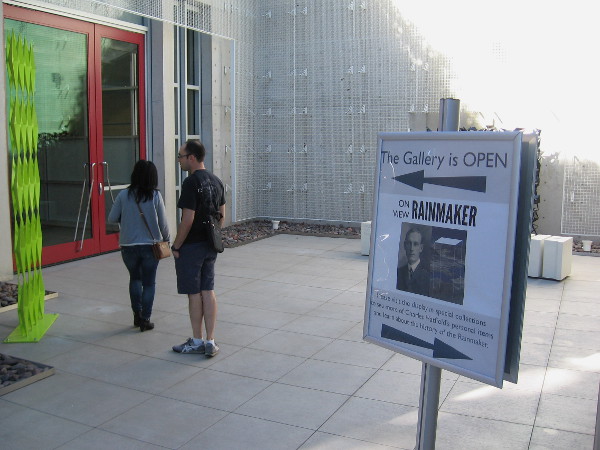
The 9th floor gallery at San Diego’s Central Library features an art exhibit called RAINMAKER. The theme is water, drought and climate change.
RAINMAKER is a fascinating, thought-provoking art exhibition at downtown San Diego’s Central Library. Because it will be coming to a close this weekend, I recently headed to the library’s 9th floor gallery to check it out.
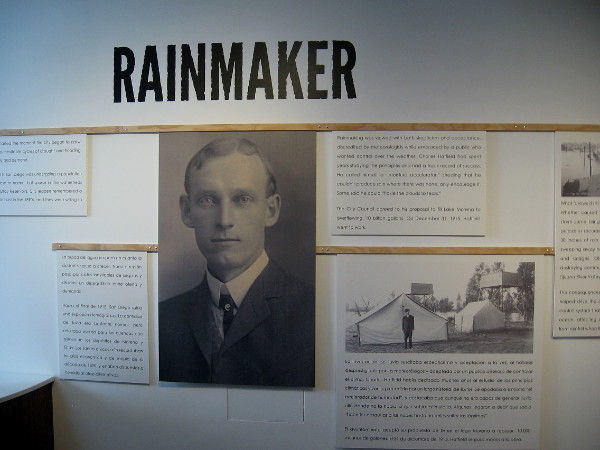
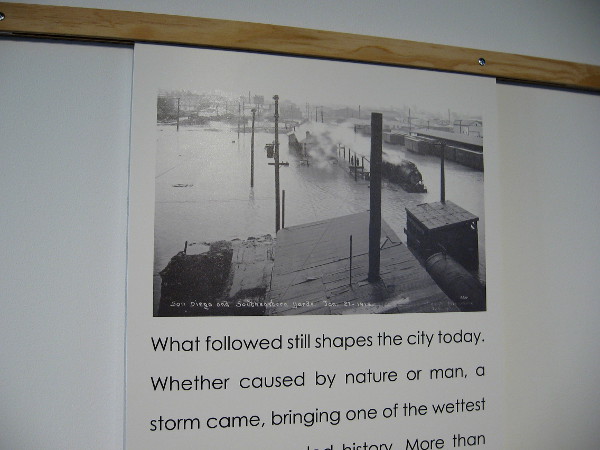
Charles Hatfield was hired by the city of San Diego a hundred years ago to produce much-needed precipitation in order to fill Lake Morena. He might or might not have created the torrential rains and catastrophic flooding that followed his efforts at “moisture acceleration”. Was Hatfield an actual scientist or a charlatan? The question remains open.
This art exhibition focuses on the importance of water in our arid region, and how people affect and are influenced by the environment. Twelve local artists have contributed pieces which touch upon this theme. RAINMAKER is especially relevant today, considering San Diego’s current long drought, and the threat of coming winter storms caused by a strong El Niño that has developed in the Pacific Ocean.
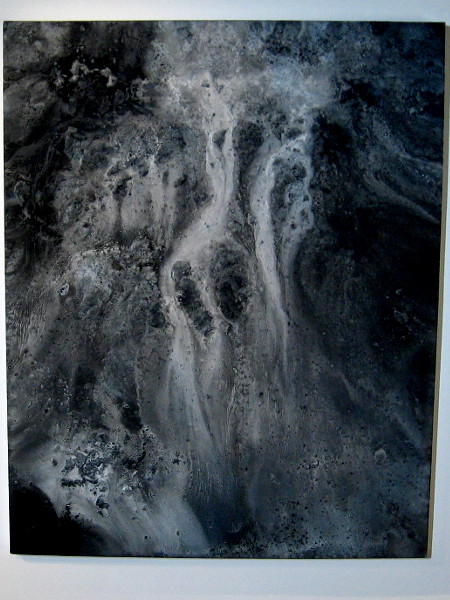
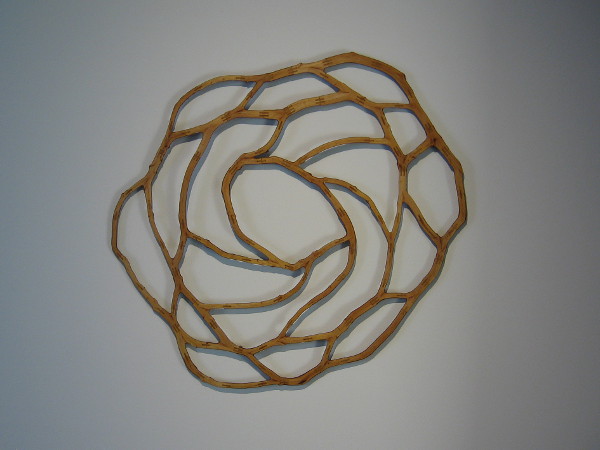
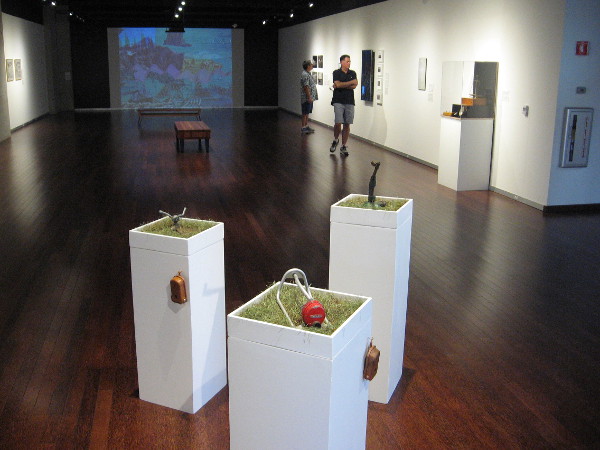
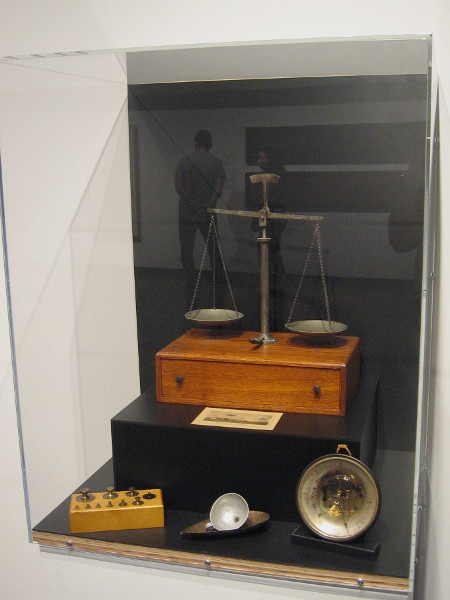
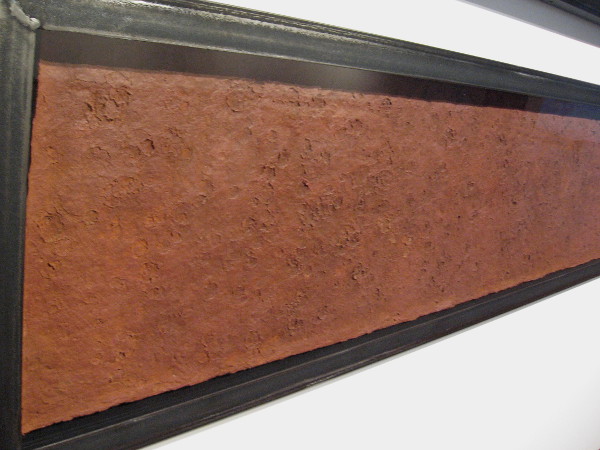
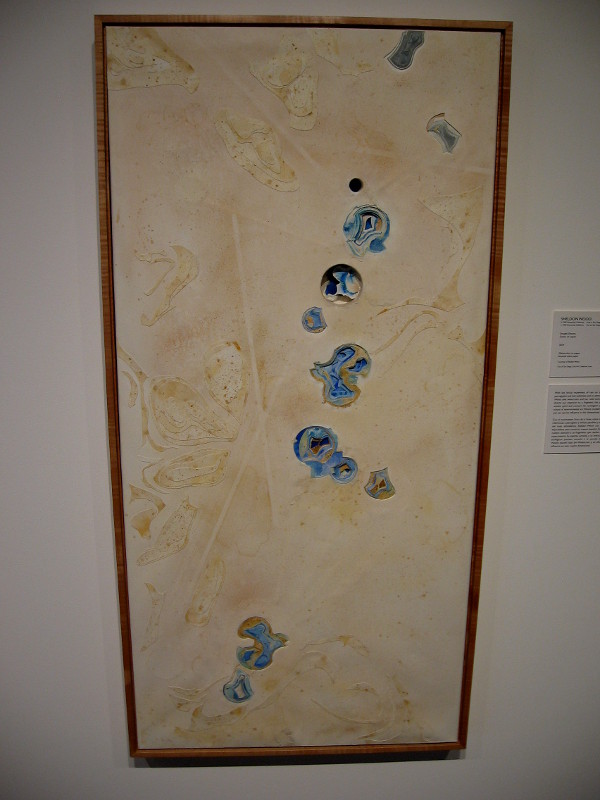
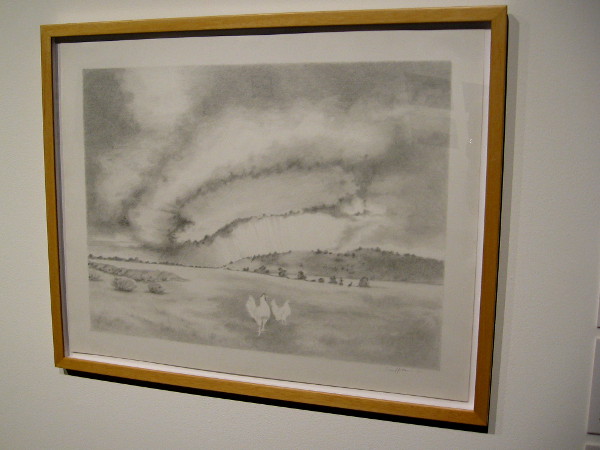
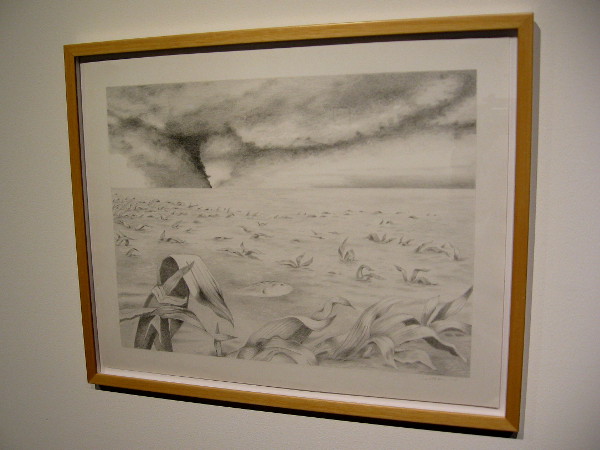
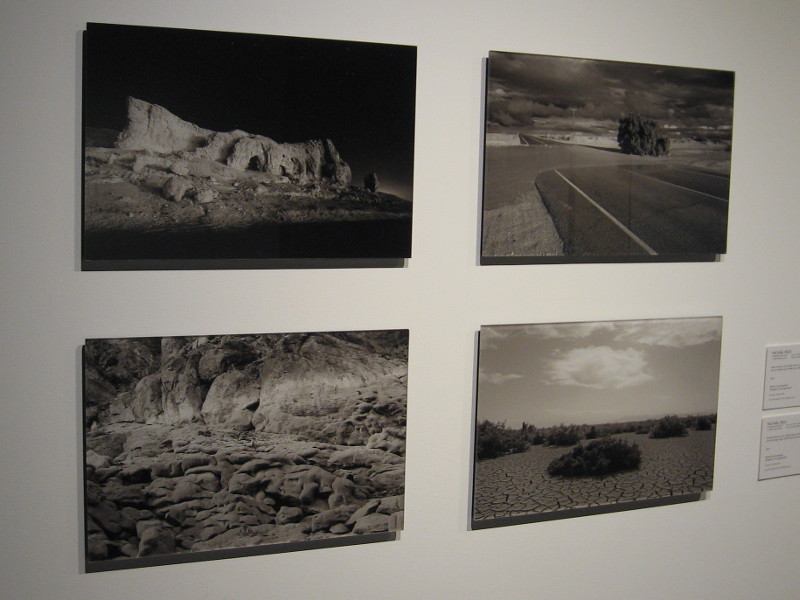
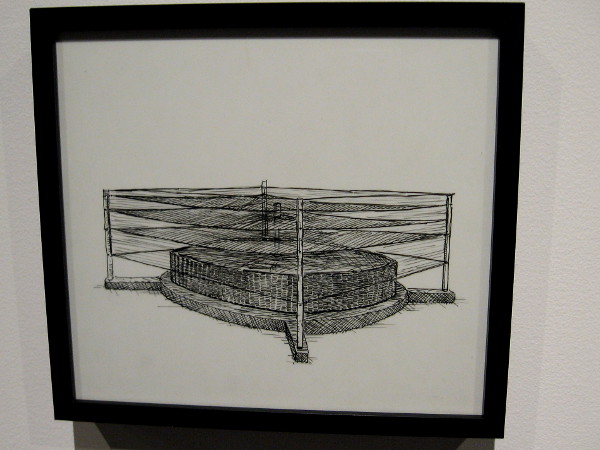
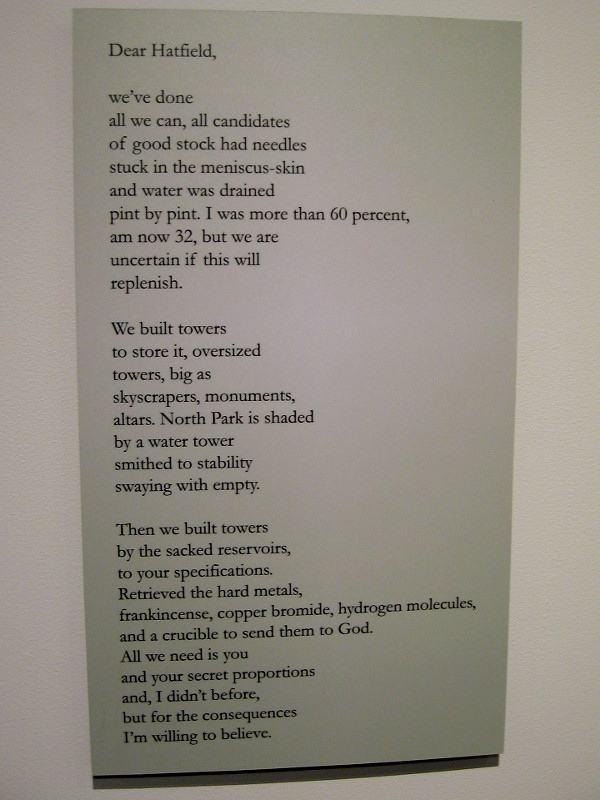
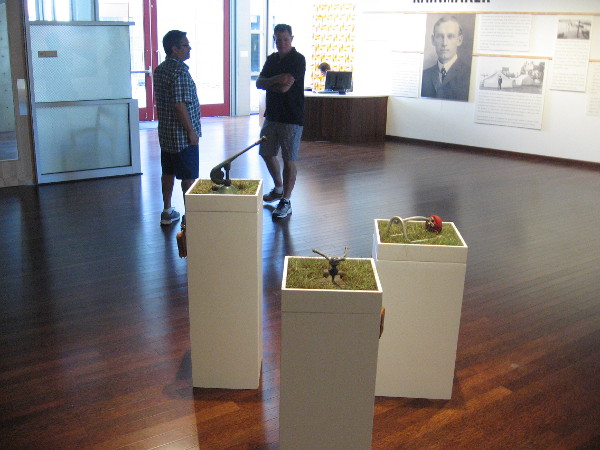
Charles Hatfield, self-proclaimed rainmaker, was hired by the city of San Diego in 1915 to fill Lake Morena reservoir during a severe drought. Record rain and floods ensued. Was this a coincidence?Photo at RAINMAKER exhibition shows catastrophic San Diego flooding caused by over 30 inches of rain in 1915.Adam Belt, Willow Wash, 2015. Paint, graphite and reflective powder on canvas. Where is the boundary between science and magic?Roman de Salvo, Joinery Blossom, 2013. Chinese elm, glue. Metaphor of Earth’s ecosystem, with networks of family, community, interdependence.Eva Struble, Navy Yard, 2011. Oil and acrylic on canvas. This piece emerged from a trek through Brooklyn’s Navy Yard. A vision of decay that is also expansive, waiting.Margaret Noble, I Have Arrived, 2015. Mixed media installation with 3 pedestals, 3 plant boxes, 3 sprinklers, and 3 handheld audio players. Lawns have been a symbol of status in society.Tools of the Rainmaker. The scales, measuring scoops and barometer in this case were donated to the San Diego Library in 1972 by Paul A. Hatfield, brother of rainmaker Charles M. Hatfield.Jim Wilsterman, Rain Event #10, 2011. Earth, fiber, raindrops. Somewhere between photograph, sculpture and painting, this art has recorded rainfall using clay and mud.Sheldon Wood, Drought Dreams, 2014. Watercolor on paper. With the lyrical movement of rain on a hot surface, references to petroglyphs and lost sinkholes, and an atmospheric perspective…Lisa Hutton, Supercell with Chickens, 2013. Graphite on paper. Environmental artwork depicts storm clouds.Lisa Hutton, A Flood and a Fire, 2013. Graphite on paper. The catastrophic effects of environmental disasters.Four pigment ink photographs of desert environment by Michael Feld record beauty and natural history.Dominic Paul Miller, rain gatherer, 2008. Ink on mylar. Part of a larger body of work concerning uranium mining and the Navajo Nation, who have scant access to running water.Gabriel Kalmuss-Katz, Dear Hatfield, 2015. Speculative writing. Reflects modern anxiety associated with urbanization.RAINMAKER, a fascinating art exhibition at San Diego’s Central Library, continues through November 29.
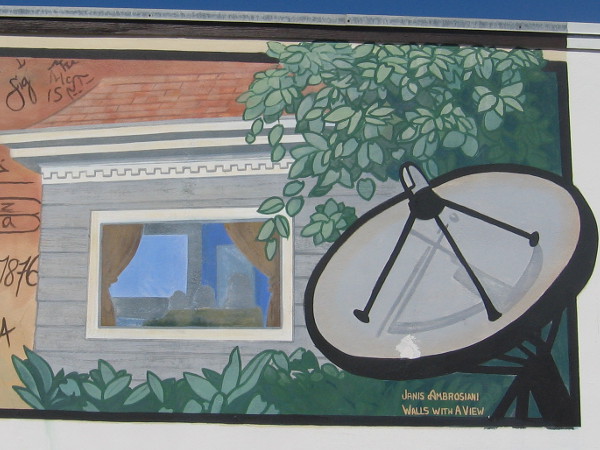
Benjamin Franklin with his famous kite, and Thomas Edison, inventor of the light bulb and phonograph, are depicted on a very unique mural in Ocean Beach.
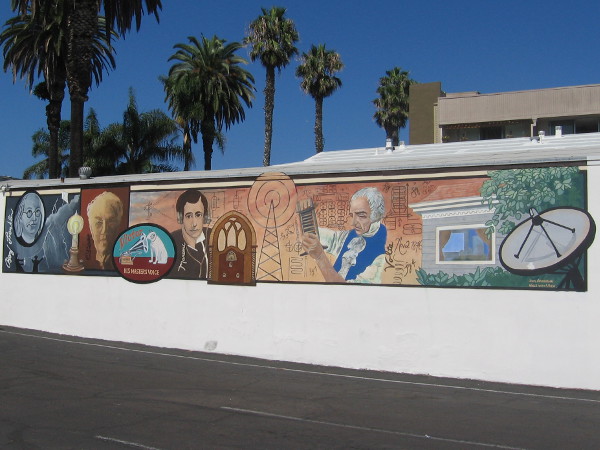
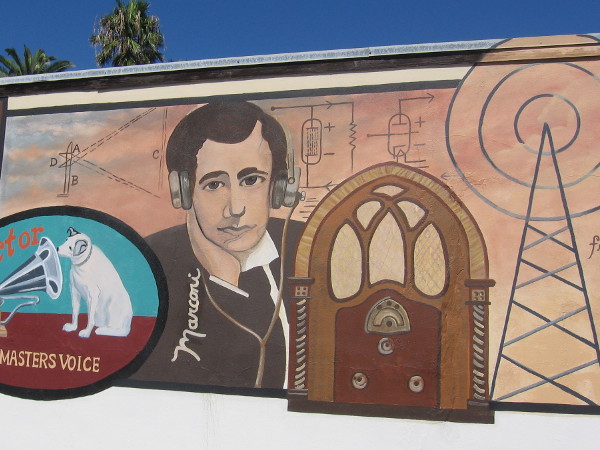
Here’s a cool (and somewhat unusual) mural that I spotted on a wall next to a parking lot in Ocean Beach. It’s called History of Electricity! Benjamin Franklin, Thomas Edison, Guglielmo Marconi and Alessandro Volta share the OB streets with images of pop culture icons and surfers!
This artwork was created by Janis Ambrosiani of Walls With A View. Take a look!
Janis Ambrosiani of Walls With A View painted History of Electricity in Ocean Beach. OB is a cool, laid-back neighborhood with lots of colorful street art.Guglielmo Marconi was instrumental in the development of the radio.Alessandro Volta invented the electrical battery.Electricity has become a modern necessity. Technology is the backbone of our day-to-day living and central feature of 21st century culture.
…
Follow this blog for more photos of cool stuff! Join me on Facebook or Twitter.
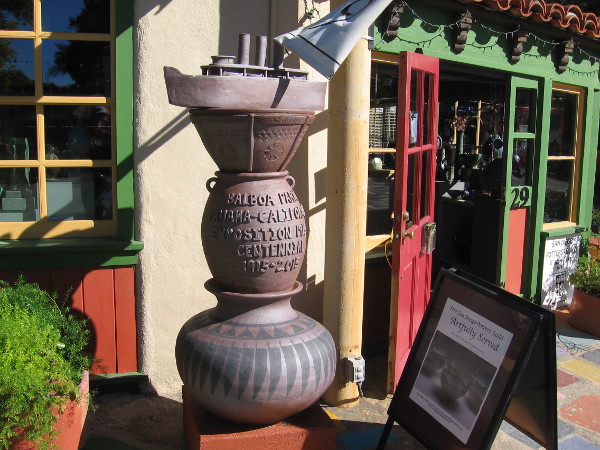
The San Diego Potter’s Guild in Spanish Village recently created this artistic tribute to the 1915 Panama-California Exposition and Balboa Park’s centennial.
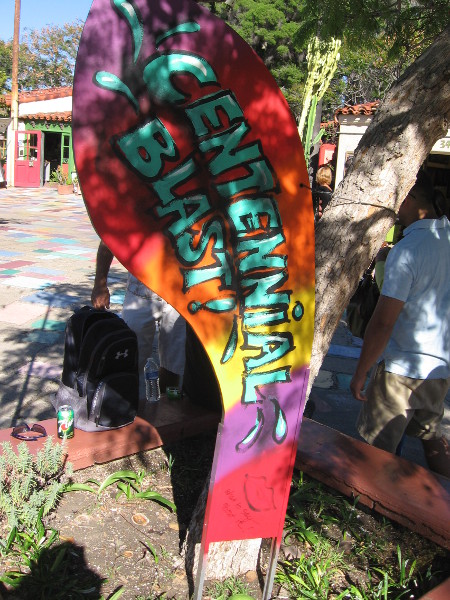
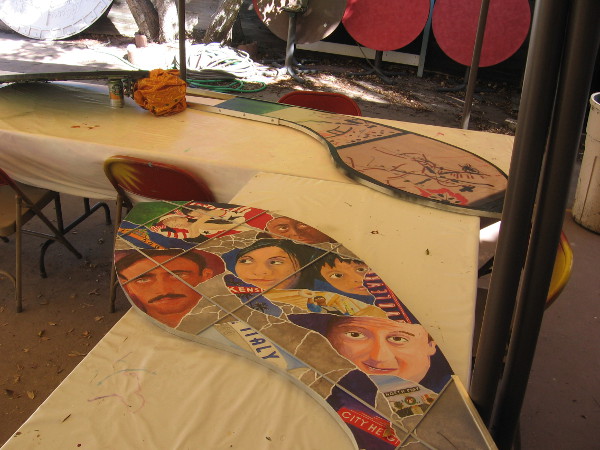
A fun exhibit debuted today in Spanish Village’s large outdoor patio courtyard. It’s called Dance through the Decades of Art! Colorful works by local artists jut out of various planters, representing the history of art styles over the past century. It’s another creative offshoot resulting from Balboa Park’s centennial, which is being celebrated throughout this year! The cool exhibit lasts through November 25.
I walked about and took these photos…
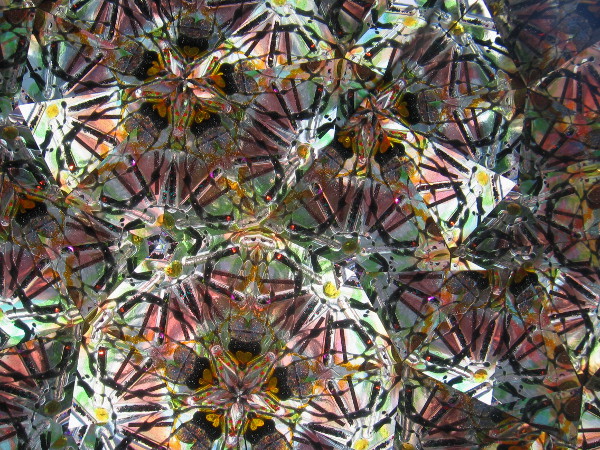
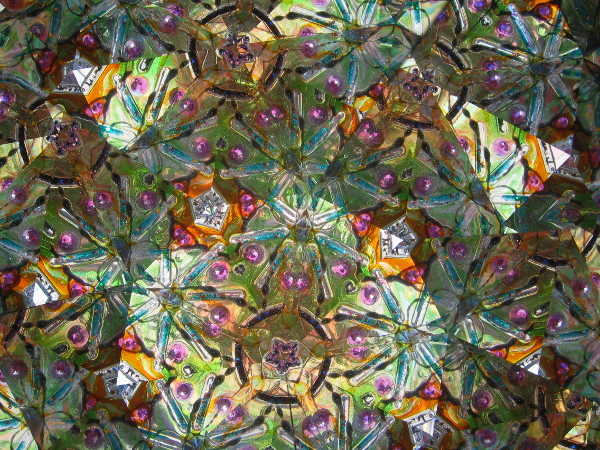
Spanish Village in Balboa Park has a new Dance through the Decades of Art exhibit in their patio courtyard. It celebrates the evolution of art over the past hundred years. This bold piece represents the graffiti art style!I was allowed to photograph these works of art being created on Saturday (the day before the exhibit opened) in a hidden Spanish Village work area!This artwork represents the 1930s, when the Works Progress Administration provided artists with employment during the Great Depression.This work very loosely represents photorealism, a distinctly American genre of painting that originated in the late 1960s.This fun art in Spanish Village contains elements of steampunk, a sub-genre of science fiction that highlights 19th century Victorian and industrial themes.Visitors to Balboa Park look into a double kaleidoscope! This wildly colorful sculpture represents psychedelic art, which originated from 1960s counterculture.Here’s a photo I took after turning a dial of the kaleidoscope.I turned the dial again!These splashes of bold color are a tribute to Abstract expressionism, which originated in the late 1940s, the first specifically American movement to achieve international influence.Someone sits on a planter which contains artwork representing minimalism, a literalist movement that arose during the 1960s.This panel celebrates the Art Deco style with images of musical instruments popular during the Jazz Age.This creation for the outdoor exhibit represents Cubism, an early 20th century avant-garde movement, which revolutionized painting and other art forms.Dance through the Decades of Art enlivens Spanish Village! Painted pieces trace art’s history and development over the past 100 years.
…
Follow this blog for more photos of cool, creative stuff! Join me on Facebook or Twitter.
Super cool street art on side of building on University Avenue in Hillcrest.
A month or so ago I enjoyed a pleasant walk down University Avenue in Hillcrest, a neighborhood just north of downtown San Diego. I spotted a whole bunch of colorful artwork, which I’d like to now share. In no particular order:
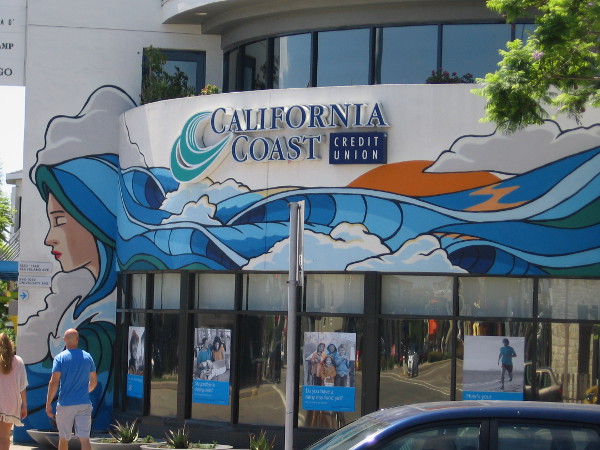
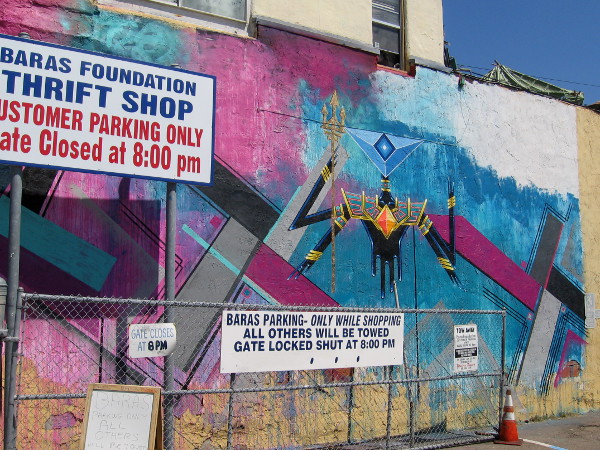
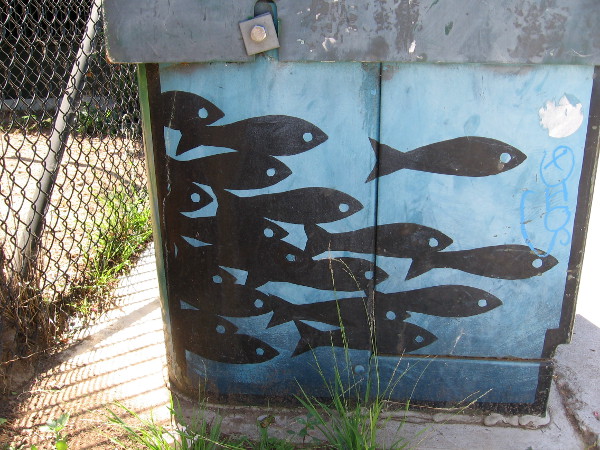
I don’t know if this qualifies as street art, but I like this cool Jack in the Box sign.Exist1981 street art on a corner of University Avenue in Hillcrest, San Diego.Fun chalk art sign in front of Fiji Yogurt.Long blue hair becomes ocean surf. Artwork painted on California Coast Credit Union.A colorful image of wine and grapes seen during a walk through Hillcrest.Filter…Where good things happen!More cool street art in Hillcrest has a mythical, possibly Egyptian appearance.I was told by a worker at this thrift store that the rainbow-like mural is a work in progress.This large bold spray paint mural on University Avenue is signed by artists Fizix, Revolver, Eyemax 2015.This is the best photo I could get of a really long colorful mural along a rooftop. I see James Dean and Muttley!Live a great story. Sticker on a utility box.A school of fish on an electrical transformer box.A windtorn mountaintop meditation, face in hands.
…
Follow this blog for more photos of cool stuff! Join me on Facebook or Twitter.
Molten bronze is poured in the foundry of the USS Ajax. Historical photograph of the Navy Bicentennial Commemorative Plaque being created. Photo credit: United States Navy.
A few days ago I received new information about an important bronze plaque, which was created in 1975 to commemorate the United States Navy’s 200 year anniversary. The historic Navy Bicentennial Commemorative Plaque stands today on San Diego’s Embarcadero, on the Greatest Generation Walk next to the USS Midway Museum. Thousands of people breeze past it every day.
People pass the Navy Bicentennial Commemorative Plaque, displayed on the Greatest Generation Walk near the USS Midway Museum. Photo taken October 17, 2015.Photo of Navy 200 year commemoration plaque courtesy the Port of San Diego.
When I first saw the old plaque, I could find absolutely nothing about it on the internet. So I originally posted this blog. As new information trickled in–sometimes out of the blue–I posted this and this.
I was recently contacted by one of the plaque’s creators. He has provided detailed information about its history, including three amazing photographs and nine scans of a typed News Release from 40 years ago. The text of the News Release does not appear online, so I carefully transcribed the words. That way a very important bit of San Diego and Navy history won’t be lost.
(I tried to transcribe exactly, including possible misspellings. I’m not certain about the spelling of some names in the photo captions.)
If you know more about this plaque and would like to add some information, please leave a comment below. If you’d like to contact me, but don’t want to have your comment published, then please tell me that and I’ll email you.
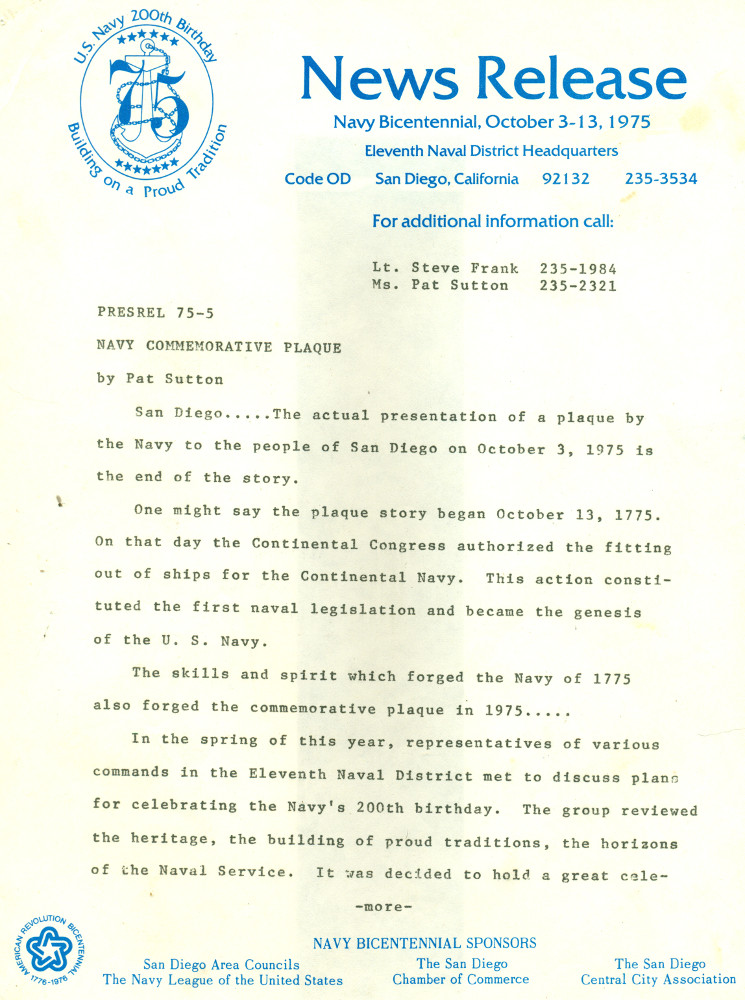
Navy Commemorative Plaque News Release. Navy Bicentennial, October 3-13, 1975. Page 1.
NAVY COMMEMORATIVE PLAQUE
by Pat Sutton
San Diego . . . . . The actual presentation of a plaque by the Navy to the people of San Diego on October 3, 1975 is the end of the story.
One might say the plaque story began October 13, 1775. On that day the Continental Congress authorized the fitting out of ships for the Continental Navy. This action constituted the first naval legislation and became the genesis of the U. S. Navy.
The skills and spirit which forged the Navy of 1775 also forged the commemorative plaque in 1975 . . . . .
In the spring of this year, representatives of various commands in the Eleventh Naval District met to discuss plans for celebrating the Navy’s 200th birthday. The group reviewed the heritage, the building of proud traditions, the horizons of the Naval Service. It was decided to hold a great celebration
Navy Commemorative Plaque News Release. Navy Bicentennial, October 3-13, 1975. Page 2.
to honor the Navy, its members past and present, the nation and San Diego – so long a part of the life, the heritage and tradition of the Navy.
The plaque story developed in an uniquely traditional Navy way. The Navy’s microcosmic capabilities began to surface and swing into action.
Civilian Mrs. Jo Palm is the Visual Information Specialist for the Commander Naval Surface Force, Pacific. She also chaired the Navy Bicentennial exhibits committee. Jo conceived the idea that there should be some lasting remembrance of the occasion for the people of San Diego – perhaps a commemorative plaque would be appropriate.
Civilian Francisco (Cisco) Lopez is a designer with the General Atomic Company of San Diego. He is also a First Class Draftsman in the Navy Reserve. Tall, 28-years-old, Cisco is a 12-year Navyman, combining four years active duty with eight years in the Reserve. Last June he served his annual two weeks active duty in the Naval Surface Force Public Affairs graphics shop, reporting from his Reserve Unit with the Fleet Intelligence Center, Pacific.
“Jo told me her idea and we decided I should design something depicting 200 years of Navy history – along the lines of a plaque, but not like the usual plaque.”
Navy Commemorative Plaque News Release. Navy Bicentennial, October 3-13, 1975. Page 3.
Cisco was raised in San Francisco and has lived in San Diego the past five years. He graduated from San Francisco State and hopes eventually to be a research historian or teacher.
“I have almost a passion for history. I’m taking a month off work in June ’76, I’ll be in Philadelphia on the Fourth of July. As an armchair military historian I really relished the opportunity to be a part of today’s history by designing a representation of our Navy over a span of 200 years”.
At the suggestion of her student husband, Mel, Jo Palm went aboard Mel’s former ship, USS Ajax (AR-6), with Cisco’s drawing and the question, “Can you make it a reality?”
For a fleet repair ship like Ajax, “can” is a reality because she is designed for heavy duty hull repair; to provide a full range of repair services to Navy units in remote areas.
On her way to see the Repair Officer, Lieutenant Commander Harley M. Oien, Jo Palm passed through the Patternmaker/Carpenter Shop, remarkably clean despite the several huge saws rasping, whining and spewing sawdust. She was escorted through the Heavy Machine and Shipfitter’s shops where expert Navy operators can literally rebuild a whole ship.
Navy Commemorative Plaque News Release. Navy Bicentennial, October 3-13, 1975. Page 4.
Twelve-year Navy veteran, Chief Molder Marvin E. (Tex) Feasell of Baytown, TX, is in charge of the Ajax foundry. He recounts the meeting below decks in Mr. Oien’s office where he and a few key men, including Patternmaker First Class Ronald Gray, held a conference with Jo.
“We hashed, squabbled, explained our methods, discussed time frames, costs to the Bicentennial Birthday Fund, and most of all, the making of the pattern. That’s the critical area. That’s the make or break of the job”.
Tex Feazell learned his profession when he was sent to the Moulder “A” school right out of Boot Camp in 1963. He reported aboard Ajax in May 1974. He has a keen appreciation of the expertise of the Ajax crew, and a keen pride in its performance.
“We have one of the most hard charging crews in the fleet. The people are hard charging – hit it! Hit it! We wanted to show our skills. We wanted to make that plaque for the Navy and for San Diego. We didn’t know for over a week if we would get the job. It made us feel proud when we heard we were going to do it”.
And so the “make or break” responsibility of the Navy’s bicentennial birthday memento to San Diego was enthusiastically assumed by Patternmaker Ronald Gray, who applied his
Navy Commemorative Plaque News Release. Navy Bicentennial, October 3-13, 1975. Page 5.
Navy-learned skills to transform from drawing to working pattern the impression of 200 years of the United States Navy.
Ron has not always served in the time honored rate of Patternmaker. He joined the Navy shortly after he graduated from high school in Olympia, WA, and served his first hitch as a Commissaryman. A friend, appreciative of his carving hobby, suggested Ron reenlist under the Navy’s SCORE (Selective Conversion) program and be schooled as a Patternmaker.
Now, after 7 1/2 years in the Navy, 2 1/2 aboard Ajax, this craftsman laid the historical design out, carved his first figures in bas relief, glued them on board, then build up the other details. The pattern for the 30″ x 24″, 150 pound metal plaque would end up basically wood and plaster, however, the rope detail was real rope!
The Spirit of ’75, the hallmark of the Navy, nowhere better manifested itself than aboard the USS Ajax as the work progressed.
Patternmaker Third Class Roger Richie of Denver, CO, was a millman in civilian life and when he joined the Navy he wanted to be a carpenter. But at the time, there was no billet open at the carpenter school.
Navy Commemorative Plaque News Release. Navy Bicentennial, October 3-13, 1975. Page 6.
“Now I think I got lucky, because I was sent to Patternmaker’s School. There’s not too many of us in the Navy, or in the country, for that matter. So by what you might call a ‘freak accident’ I was here to help Ron on the plaque. There’s pride in this job”.
The Ajax Dental Department loaned Ron Gray tools for working on the intricate wax carvings, and a dental drill for final sanding. The ship’s Dental Officer, Commander Roger E. Bisson of Helena, MT, enjoys woodworking and asked to carve the plaque’s Navy aircraft with his precision instruments.
“We all want to contribute. Gray is so willing to share the glory with the team, even though he has done most of the work”, Bisson said.
Below the gleaming metal decks, at the very keel of Ajax on the concrete deck of the foundry, Molder First Class William McCoy of Coshocton, OH, and his men were ready. McCoy spent his first four years in the Navy as a destroyer torpedoman. Then for ten years he was a civilian molder. Unable to wash the salt from his veins, he returned to the Navy a year and a half ago.
McCoy described his work, “The molding art is fairly unchanged since the middle ages. We use primitive tools, primitive casting methods. A person with an understanding of the primitive makes an excellent molder”.
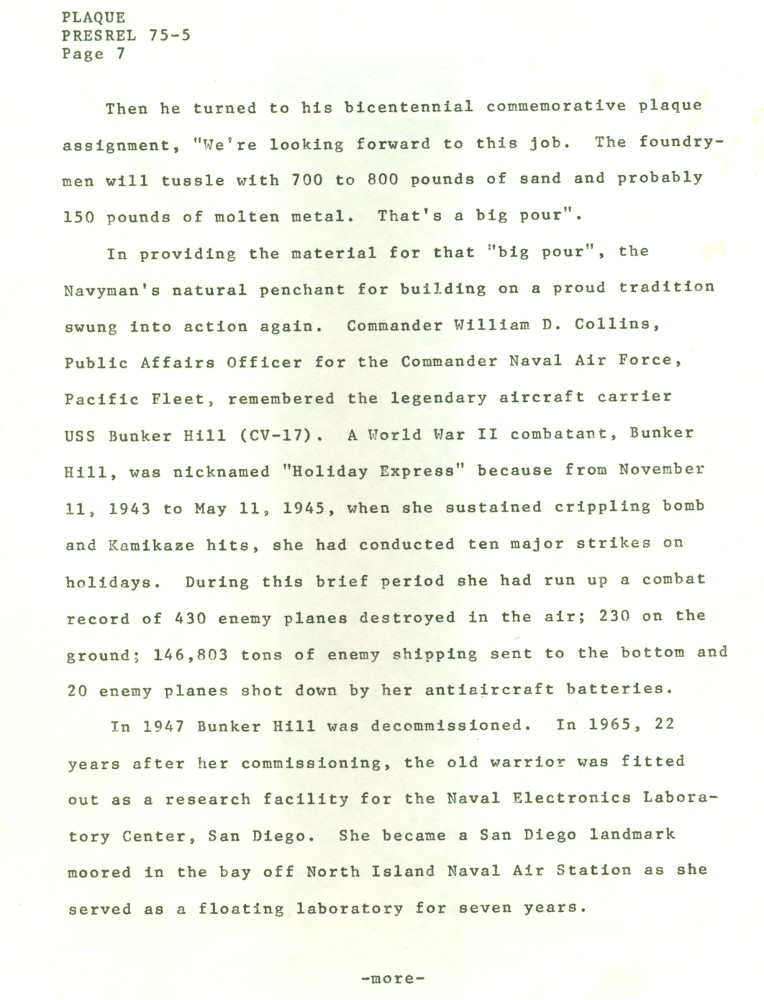
Navy Commemorative Plaque News Release. Navy Bicentennial, October 3-13, 1975. Page 7.
Then he turned to his bicentennial commemorative plaque assignment, “We’re looking forward to this job. The foundrymen will tussle with 700 to 800 pounds of sand and probably 150 pounds of molten metal. That’s a big pour”.
In providing the material for that “big pour”, the Navyman’s natural penchant for building on a proud tradition swung into action again. Commander William D. Collins, Public Affairs Officer for the Commander Naval Air Force, Pacific Fleet, remembered the legendary aircraft carrier USS Bunker Hill (CV-17). A World War II combatant, Bunker Hill, was nicknamed “Holiday Express” because from November 11, 1943 to May 11, 1945, when she sustained crippling bomb and Kamikaze hits, she had conducted ten major strikes on holidays. During this brief period she had run up a combat record of 430 enemy planes destroyed in the air; 230 on the ground; 146,803 tons of enemy shipping sent to the bottom and 20 enemy planes shot down by her antiaircraft batteries.
In 1947 Bunker Hill was decommissioned. In 1965, 22 years after her commissioning, the old warrior was fitted out as a research facility for the Naval Electronics Laboratory Center, San Diego. She became a San Diego landmark moored in the bay off North Island Naval Air Station as she served as a floating laboratory for seven years.
Navy Commemorative Plaque News Release. Navy Bicentennial, October 3-13, 1975. Page 8.
“The Bunker Hill was stripped of her brass and bronze fittings prior to her scraping in late 1972”, Commander Collins reported at a Bicentennial Committee meeting, “this was molded into ingots. Some of the ingots still remain and are stored at the Naval Station in Honolulu. We would be honored to have Bunker Hill permanently a part of San Diego. The Pacific Naval Air Force will provide her brass and bronze for the plaque”.
And so it was done.
In August Jo Palm called Cisco Lopez with the news that the plaque was to become a reality. Cisco told Jo of an uniquely Navy coincidence. “For my 1975 active duty tour I was stationed on Ajax! I designed ducting for ventilation of a spray booth. Great crew! I never expected to work with them again”.
On September tenth, after the sand had been rammed around the pattern and the pattern removed, leaving its historic impression (the negative), the excitement of expectancy on the Ajax foundry deck rose even as the metal of old Bunker Hill rose toward the proper temperature to pour.
Participants, both active and anticipating, ranged from Jo Palm and Cisco Lopez; Navy combat cameramen and photographers; to the molders, firemen, and as from the beginning,
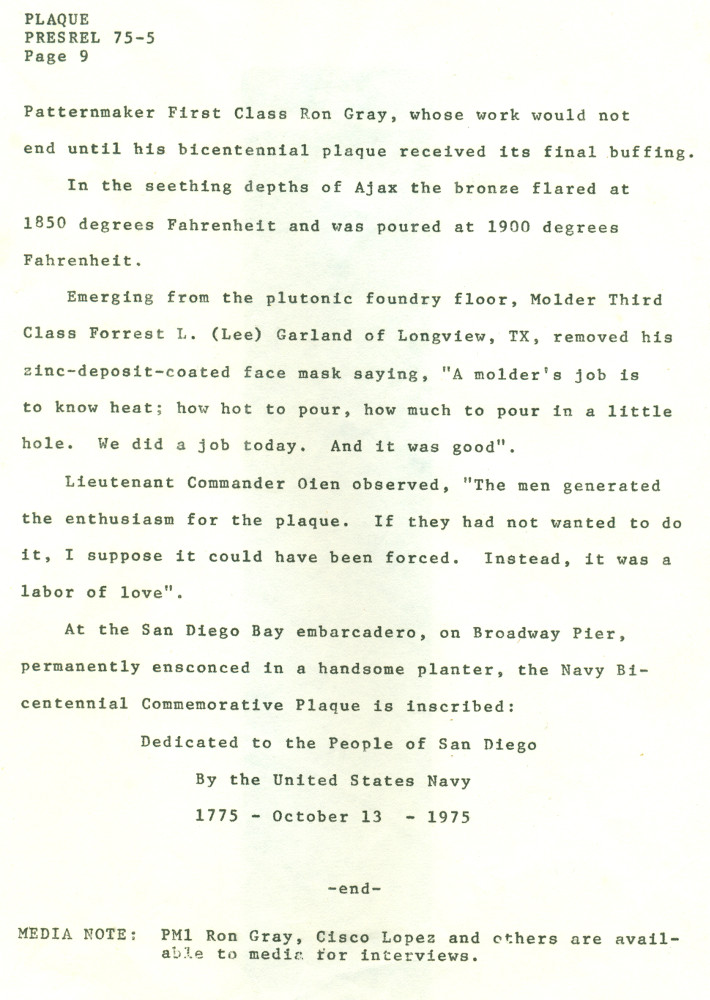
Navy Commemorative Plaque News Release. Navy Bicentennial, October 3-13, 1975. Page 9.
Patternmaker First Class Ron Gray, whose work would not end until his bicentennial plaque received its final buffing.
In the seething depths of Ajax the bronze flared at 1850 degrees Fahrenheit and was poured at 1900 degrees Fahrenheit.
Emerging from the plutonic foundry floor, Molder Third Class Forrest L. (Lee) Garland of Longview, TX, removed his zinc-deposit-coated face mask saying, “A molder’s job is to know hear; how hot to pour, how much to pour in a little hole. We did a job today. And it was good.”
Lieutenant Commander Oien observed, “The men generated the enthusiasm for the plaque. If they had not wanted to do it, I suppose it could have been forced. Instead, it was a labor of love”.
At the San Diego Bay embarcadero, on Broadway Pier, permanently ensconced in a handsome planter, the Navy Bicentennial Commemorative Plaque is inscribed:
Dedicated to the People of San Diego
By the United States Navy
1775 – October 13 – 1975
Tex Feazell and Ron Gray with the first wood carving and the original drawing. Photo credit: United States Navy.Patternmaker Kevin O’Connor, Molder Jessie Lopez, Molder Lee Garland, Patternmaker Roger Richie, two unidentified Molders, Bill McCoy and Ron Gray. Photo credit: United States Navy.
…
Follow this blog for more amazing, unexpected discoveries! Join me on Facebook or Twitter.








































 Cool San Diego Sights!