San Diego history: World War II and the Tuna Fleet.

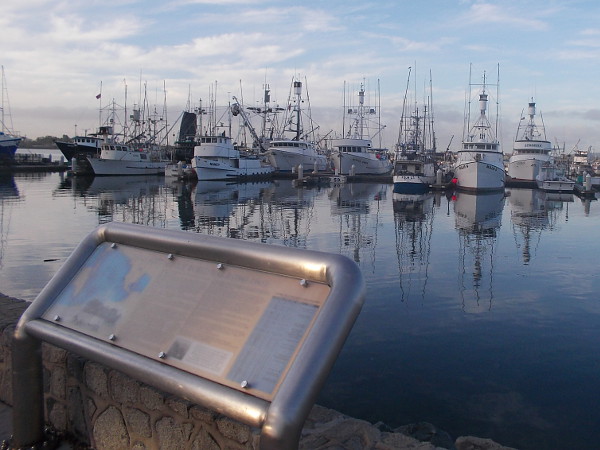
Information sign beside Tuna Harbor, in downtown San Diego, describes how local tuna boats were utilized in the Pacific Ocean theater of World War II.

Some fascinating historical information can be found on San Diego’s Embarcadero, right next to Tuna Harbor where many commercial fishing boats dock downtown. The sign, erected by the San Diego Port Commission in 2008, is titled Tuna Fleet Service World War II (1941-1945). It provides a glimpse of how dozens of San Diego-based Tuna Clippers joined the American war effort during the Second World War.

Here is the text on the sign:

During World War II, 600 fishing vessels were taken by the Navy, Army, and Coast Guard, including 52 “Tuna Clippers”.

On Pearl Harbor Day, the U.S. canned tuna industry was located almost exclusively in Southern California, and canners received most of their tunas from “baitboats”. Fishermen on these boats chum live bait (sardines, anchovies) to attract the tunas into a feeding frenzy and then use rigged bamboo poles to pull the hooked tunas aboard. Dating from 1924, a fleet of large “baitboats” was developed and became know as “Tuna Clippers”. These large ships, equipped with powerful diesel engines and newly developed brine refrigeration, fished for tunas found migrating thousands of miles from San Diego on trips of 90 days or more. During the 1930s, this San Diego high seas fleet was studies by the U.S. Navy, resulting in wartime plans that included the conversion of Tuna Clippers to minesweepers.

At the time Pearl Harbor was attacked, there were 90 vessels in the California baitboat fleet, including 76 Tuna Clippers plus 3 under construction. The 49 Tuna Clippers taken by the Navy and 3 by the Army represented about 55% of the fish carrying capacity of the entire baitboat fleet.

After war was declared, the Government ordered the Tuna Fleet to make port in California or Panama. Ten of the Tuna Clippers entering the Canal Zone in December 1941, were immediately taken for temporary patrol duty. The U.S. Army took three Clippers for use in the Panama Sea region, the SHASTA and CAPE HORN as tugs and the INVADER as a supply ship.

On February 16, 1942, tuna fishermen attended a meeting conducted by Commander W. J. Morcott, USN (Ret.) at the Naval Reserve Armory. 600 tuna fishermen signed up, with Skippers and Engineers receiving warrant ratings, and others given petty officer ratings according to age and experience. Within 10 days, a fleet of 16 Tuna Clippers, painted gray and marked with YP number designations as Yard Patrol vessels, left San Diego harbor on February 25, 1942. Their destination was the “Panama Sea Frontier” for picket duty to protect the Canal.

In May 1942, a convoy of six YP Clippers left San Diego for the “Hawaiian Sea Frontier”. These YPs transported supplies to French Frigate Shoals, the islands of Midway, Johnston, Fanning, Christmas, Palmyra, and Canton. In June 1942, seven YP Clippers left San Diego, for service at Efate Island or Samoa, or Auckland, New Zealand. In November 1942, another group of five headed for the U.S. Naval base at Tutuilla, Samoa. As the conflict moved towards Japan, YP Tuna Clippers were sent on missions to other Islands and Atolls of the Western Pacific.

The Navy discovered that “Yippies” were able to transport troops, gasoline, ammunition, and refrigerated cargoes and capable of navigation within shallow atolls and over minefields, of towing damaged warships, and rescuing downed pilots. This is why “Yippies” were also called the “Pork Chop Express” or “Errand Boys of the Pacific” or the “Solomon Island Ferry”. During the Solomon Island Campaign in 1942, the PARAMOUNT (YP 289) and the PICOROTO (YP 290) delivered frozen turkeys and all the fixings for a traditional holiday feast at Guadalcanal Island. In 1943, frozen turkeys were also delivered to the Marines fighting on Bougainville in time for Thanksgiving by the AMERICAN BEAUTY (YP-514).

“Yippies” were equipped with CW radios, fathometers, Navy radar and Navy sonar. Armament included machineguns, and other gun gear to fire Depth charges. The YP crew of tuna fishermen and regular Navy ran from 4 to 20 men.

Two YPs were destroyed in the Solomon Islands campaign by enemy surface ships: On 9 September 1942, off Tulagi Island, the PROSPECT (YP-346), and on 25 October 1942, off Guadalcanal Island, the ENDEAVOR (YP-284). The number of casualties sustained is unknown.

Two YPs were lost in the Midway region: On 23 May 1942, the TRIUNFO (YP 277) was destroyed by fire and explosions enroute to French Frigate Shoals (North of Hawaii), and then scuttled to avoid enemy capture. Only two crewmembers survived. During October 1942, the YANKEE (YP-345), with 17 crewmembers, on a voyage from Pearl Harbor to Midway Island via French Frigate Shoals, was “lost without a trace from causes unknown”.

Four YPs were lost at sea: CALIFORNIA (YP-235) on 1 April 1943, after fire and beaching in the Gulf of Mexico from an explosion of undetermined origin; NAVIGATOR (YP-279), 5 September 1943, foundered in heavy weather enroute to Townsville, Australia; CAPE SAN VINCENT (YP-280), on 24 April 1946, sank near Saipan Island; SAN SALVADOR (YP-281) on 9 January 1944, was destroyed after the foundering in Force 9 storm, with crew of 19 and one dog rescued, near Wallis Island, South Pacific. After transfer to the U.S. Army in July, 1943 the SEA TERN (ex YP-269) was lost at sea off Baja California.

Three YPs were destroyed during October 1945, because of a typhoon off Okinawa: PARAMOUNT (YP-289); CONTE GRANDE (YP-520) and CHALLENGER (YP-239).

The Navy destroyed 7 YPs after the War during 1946 and 1947: AMERICAN VOYAGER (YP-287), CIPANGO (YP-504), EUROPA (YP-236), FALCOM (YP-515), QUEEN AMELIA (YP-516), QUEEN ELIZABETH (YP-519), and YVONNE LOUISE (YP-282).

The successful wartime experience of the “Yippies” caused the Navy to build 30 wood-hull vessels patterned on the Tuna Clipper design. Each of 30 newly constructed wood hull Navy YPs was of 128 in length, of 14 feet draft, and powered with a 500 H.P. diesel main engine. They were built during 1945, two each by 15 different shipyards located in California, Oregon, and Washington.

Commencing in 1947, 24 of these YPs were added to the U.S. Tuna Fleet.

After the war, the Navy and Army transferred 33 surviving former Tuna Clippers to the War Shipping Administration (WSA) for buy-back by the previous owners. Three of these surviving vessels never returned to the U.S. tuna fishery: CABRILLO, FISHERMAN II, AND THEODORE FOSS.

Additional information on the sign:

Tuna clippers joined the navy too and were painted a dull slate grey, while the stalwart Portuguese descendants learned to fire the guns that were mounted upon the deck. Equipped with the finest refrigeration systems, these trim craft became “errand boys” of the Pacific, delivering food and fuel to the fronts. One day these tunaboats will be convoying a fleet of small ships to Panama. Next month, perhaps, they’ll be off to Midway Island with gasoline for navy PBYs. Two months later, they’ll be down in the Solomons running the “milk route” between Guadalcanal and Tulagi with supplies – part of the saga of men and boats.

excerpt from San Diego Union
July 23, 1943

Scores of converted tuna clippers slipped out of San Diego bay on their way to do valiant work in Pacific battle areas. First boats sailed from here Feb. 25, 1942. These small, sturdy diesel-powered boats are ideal for convoying and patrolling as well as for transporting needed war supplies to defeat the Japanese.

excerpt from San Diego Union
July 23, 1943

Today's commercial fishing fleet in San Diego includes picturesque boats that provide fresh seafood for restaurants and a Saturday dockside market.
Today’s commercial fishing fleet in San Diego includes picturesque boats that provide fresh seafood for restaurants and a Saturday dockside market. (The USS Midway aircraft carrier, now a popular museum) is visible in the background of this photograph.)
Someone walking down the Embarcadero near Tuna Harbor pauses to read a bit of fascinating information concerning the Second World War.
Left part of the sign depicts map of the Pacific theater of World War II in relation to San Diego. Pictured are some vessels that participated.
A detailed description of how the local Tuna Fleet served valiantly during World War II.
A detailed description of how the local Tuna Fleet served in various capacities during World War II.
California Tuna Clippers: Military Service World War II. (Click the image to enlarge.)
Commercial fishing vessel Dalena in San Diego's present-day Tuna Harbor.
Commercial fishing vessel Dalena in San Diego’s present-day Tuna Harbor.

I live in downtown San Diego and love to walk! You can follow Cool San Diego Sights via Facebook or Twitter!

You can easily explore Cool San Diego Sights by using the search box on my blog’s sidebar. Or click a tag! There are thousands upon thousands of unique photos for you to enjoy!
Photos of National City Depot museum and streetcars!

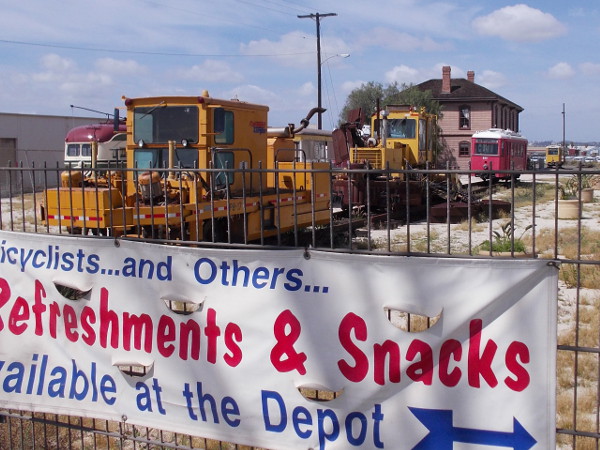
There's more than refreshments and snacks at the National City Depot. There's a huge, cool collection of local railroad and trolley history!
There’s more than refreshments and snacks at the National City Depot. There’s a huge, cool collection of local railroad and trolley history!

If you’re a train or streetcar lover, prepare to go nuts! The friendly guys at the National City Depot, which is home to the Trolley and Railroad Museum operated by the San Diego Electric Railway Association, allowed me to take loads of photographs a couple weekends ago! The place is so crammed with cool stuff, I hardly know where to start!

(Before I get started, however, I learned the National City Depot is in desperate need of volunteer docents and cashiers. So if you live around San Diego and have some free time, please consider this opportunity. Railroading enthusiasts would be in heaven. If you’d like, you might actually roll up your sleeves and help work to revitalize several vintage streetcars. You can have a great time preserving and enlivening our local history of trolleys by explaining exhibits and sharing knowledge with curious visitors, tourists and school students. SDERA’s stated mission is to restore and preserve the history of electric railways and trolleys in the San Diego region. Click here for more info.)

As you can see from the first photo, the depot has a number of old railroad cars and streetcars sitting outside on either side of it. The San Diego Metropolitan Transit System, MTS, has provided the private association with three old Vienna streetcars and one Presidents Conference Committee (PCC) streetcar. The latter is undergoing restoration, and will eventually be used as a cool tourist attraction, running over the Coronado Belt Line of the San Diego and Arizona Eastern Railroad!

You might recognize the name San Diego Electric Railway. It was the mass transit system built by locally famous “sugar heir” and entrepreneur John D. Spreckels. His network of railroads was established in 1892, and active streetcars served a large area of the city for many decades. The San Diego Electric Railway Association proudly displays some examples of the rolling stock that were utilized in those glory years of electric streetcars.

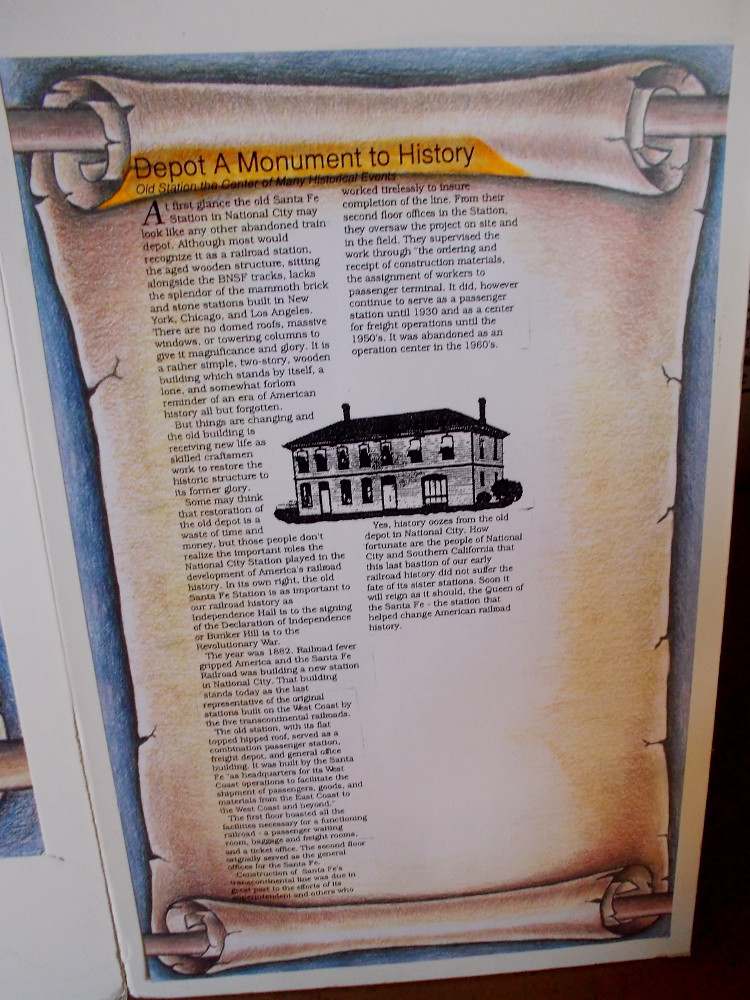
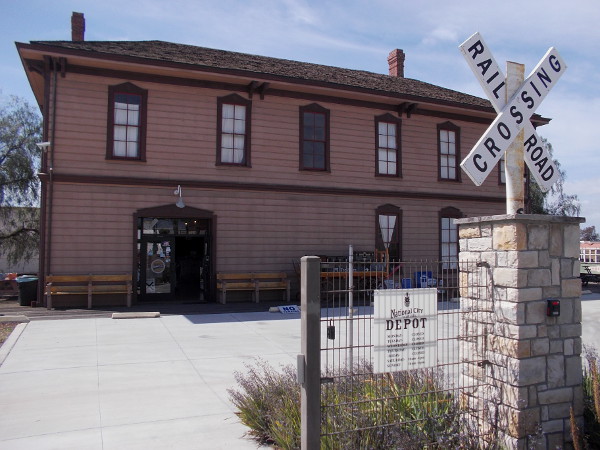
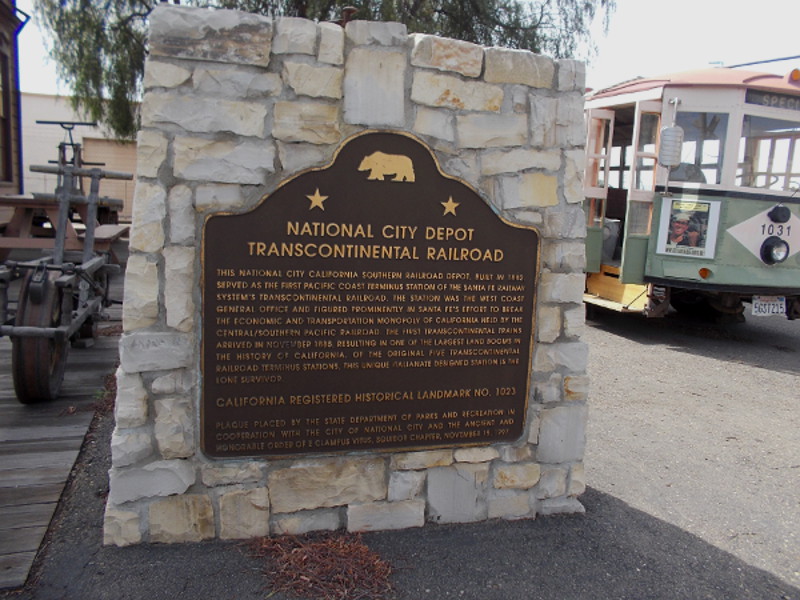
The National City Depot has its own fascinating history. It was built in 1882 by the Santa Fe Railroad, and became the first Pacific Coast terminus station of their transcontinental line. Today, it’s the last representative of the original stations built on the West Coast by the five different transcontinental railroads. After various changes in its operations over the decades, the depot was abandoned in the 1960s and suffered severe neglect. Before finally reopening as a museum, it was also used as a unique building for a couple of restaurants. It’s now owned by the city of National City.

I learned so much during my visit, my brain is still whirling. If I’ve captioned the photos incorrectly, or have made some sort of factual error, please leave a comment!

Here come the photos, just a taste of what you might see should you swing on by.  Enjoy!

The National City Depot was built in 1882. It was the western terminus of the Santa Fe Railroad's transcontinental line.
The National City Depot was built in 1882. It was the first Pacific Coast terminus station of the Santa Fe Railroad’s transcontinental line.
Plaque in front of National City Depot, the West Coast station of Santa Fe's transcontinental railroad. California Registered Historical Landmark No. 1023.
Plaque in front of National City Depot, the first Pacific Coast terminus station of Santa Fe’s transcontinental railroad. California Registered Historical Landmark No. 1023.
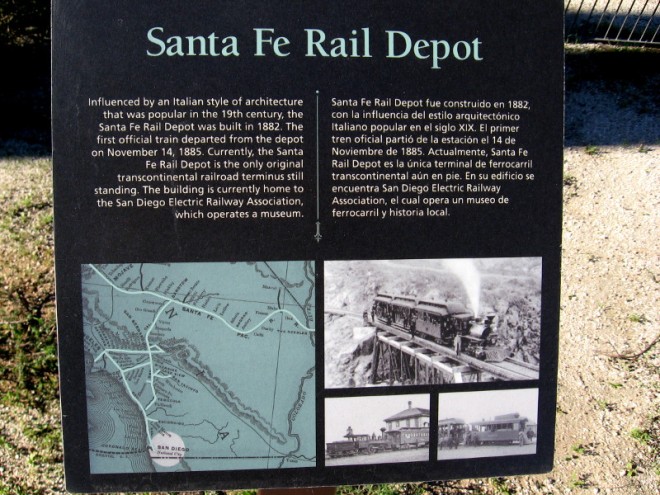
Sign concerns Santa Fe Rail Depot. It's the only original transcontinental railroad terminus still standing.
Sign describes Santa Fe Rail Depot in National City. It’s the only original transcontinental railroad terminus still standing.
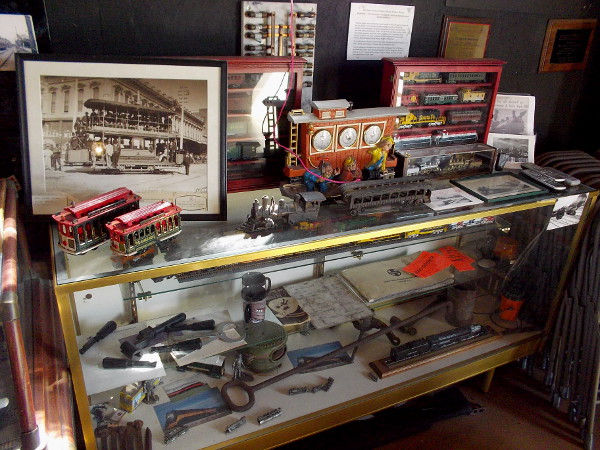
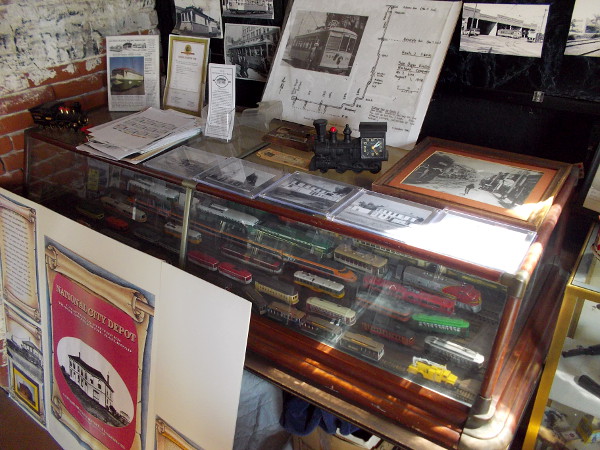
Inside the small depot are display cases full of model trains and streetcars, plus artifacts and memorabilia. The walls are covered with old photos and historical information.
The famous old train station sits alongside BNSF tracks which are still active. The National City Depot played in instrumental role in American railroad history.
There's so much cool stuff crammed inside the museum, a railfan could spend hours closely examining all of it!
There’s so much cool stuff crammed inside the museum, a railfan could spend hours closely examining all of it!
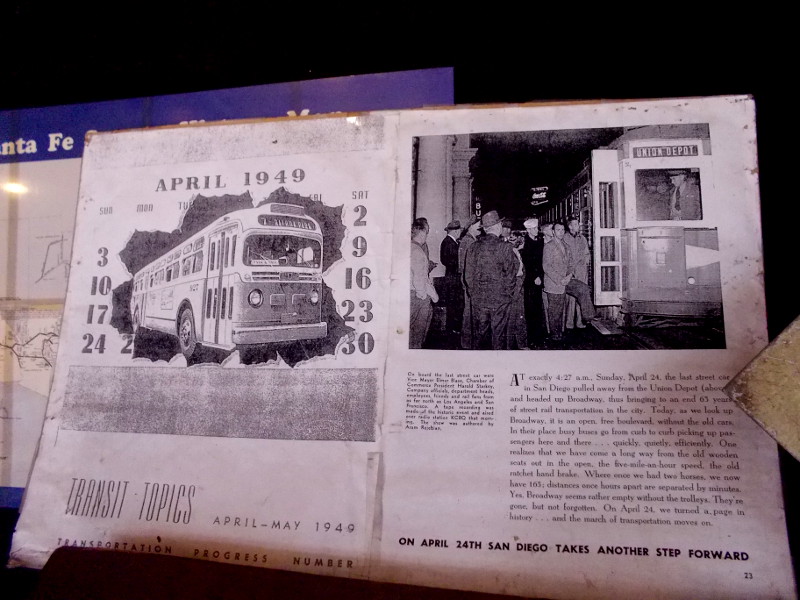
A magazine article on display for train buffs and history enthusiasts to check out. Buses replace the old network of trolleys in 1949.
A magazine article on display for train buffs and history enthusiasts to check out. Buses finally replaced the old network of San Diego trolleys in 1949.
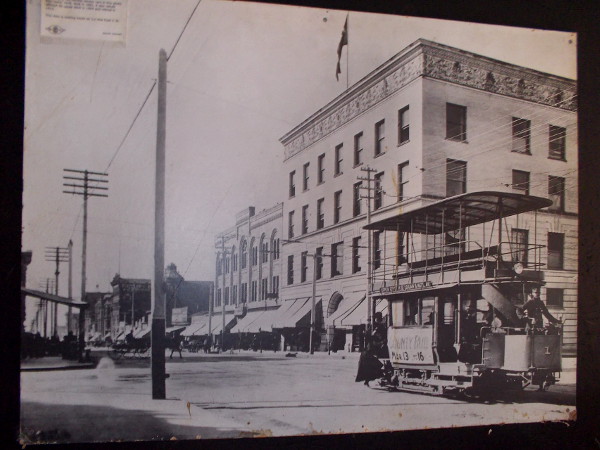
One of many old photos in the museum depicting San Diego's very rich electric streetcar history.
One of many old photos in the museum depicting San Diego’s very rich electric streetcar history.
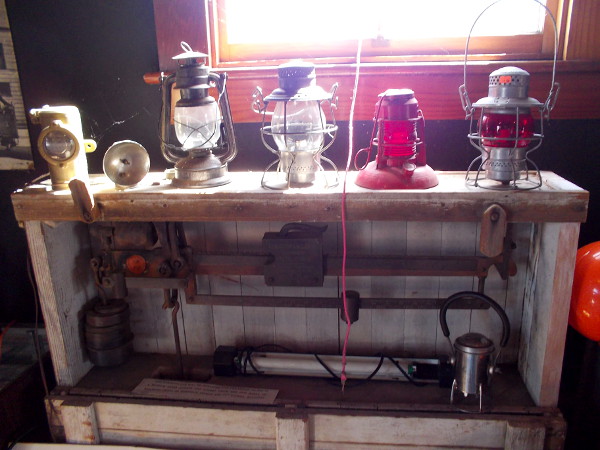
A collection of old lanterns. Everything imaginable concerning San Diego railroads and trolleys can be found inside the National City Depot.
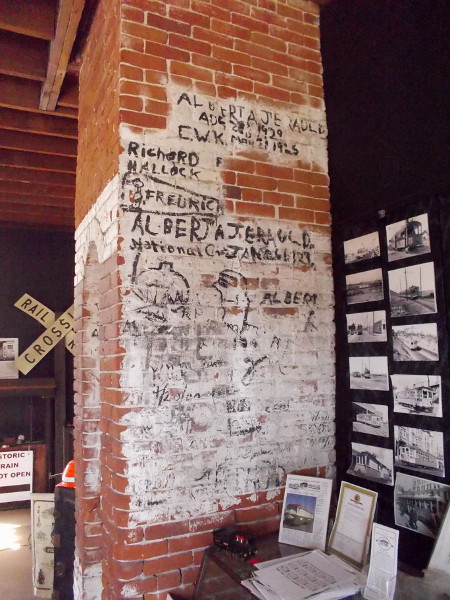
Faded writing on the brick fireplace recalls when the eventually abandoned depot was used as a restaurant. Black panels on the walls cover graffiti.
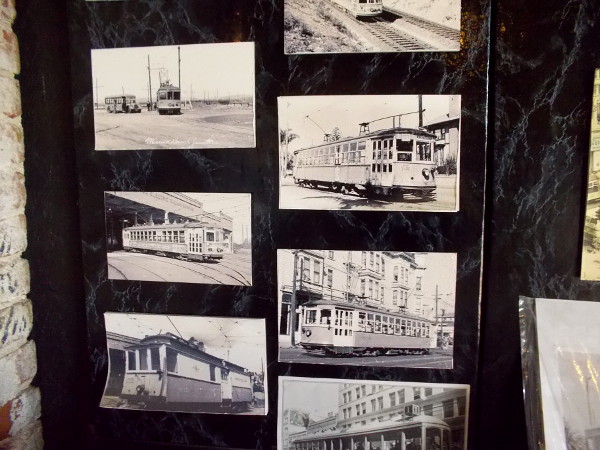
One section of a wall has lots of photos of vintage streetcars and trolleys.
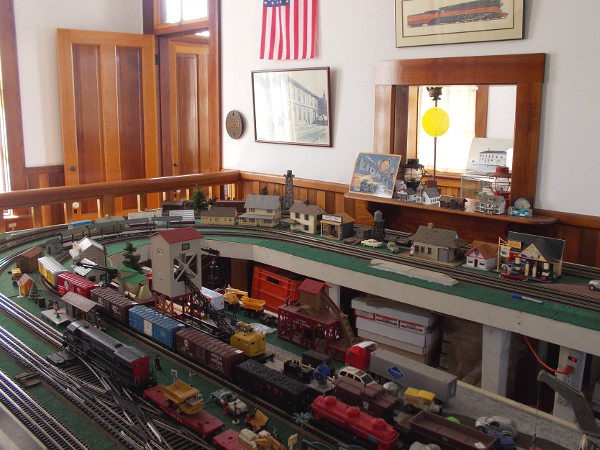
A second room inside the National City Depot contains a huge model train layout! The exhibit is run when the depot is open Thursdays to Sundays from 9am to 5pm. It appears that SDERA members have a lot of fun!
The best photo I could get of a big antique Raymond and Wilshire safe in the historic transcontinental depot. I had to squeeze up against the model train layout.
Now we're outside beside the depot at a picnic bench! I liked these two planters in the shape of steam locomotives!
Now we’re outside beside the depot at a picnic bench! I like these two planters in the shape of steam locomotives!
Two of National City Depot's three old Austrian streetcars. These were going to be used by MTS for the San Diego Trolley in the Gaslamp Quarter, but couldn't meet ADA standards, as I understand it.
Two of National City Depot’s three old Austrian streetcars. These were going to be used by MTS for the San Diego Trolley in the Gaslamp Quarter, but couldn’t meet ADA standards, as I understand it.
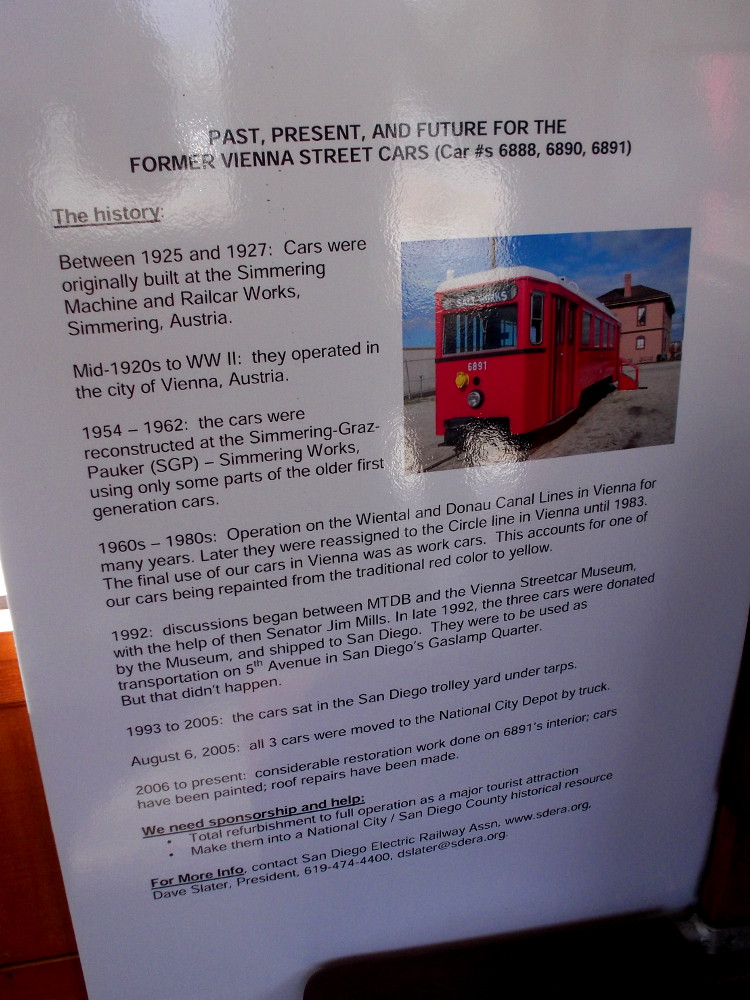
Sign inside one Vienna street car details the history. They were originally built at the Simmering Machine and Railcar Works, Simmering, Austria.
Now we're stepping into one of the old Austrian streetcars!
Now we’re stepping like a passenger into one of the old Austrian streetcars!
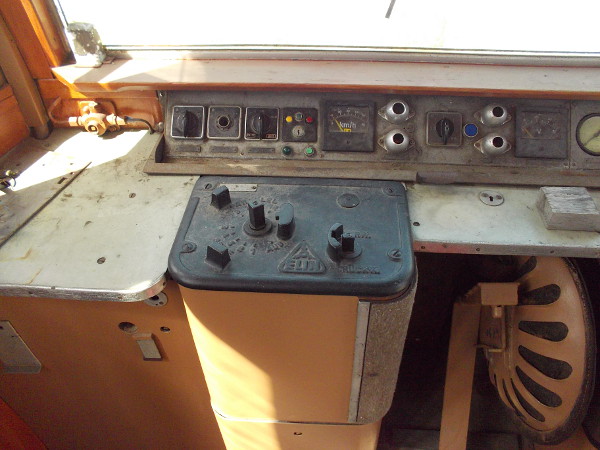
The controls used by the electric streetcar operator. Notice the chair which folds under the dash.
The controls used by this electric streetcar’s operator. Notice a seat that folds under the dashboard.
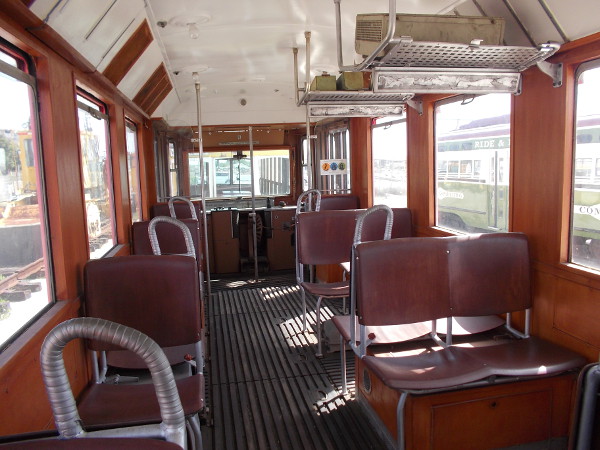
Looking back where passengers would sit. There didn't seem to be much capacity in the small cars.
Looking back where passengers would sit. There didn’t seem to be much capacity in the small cars.
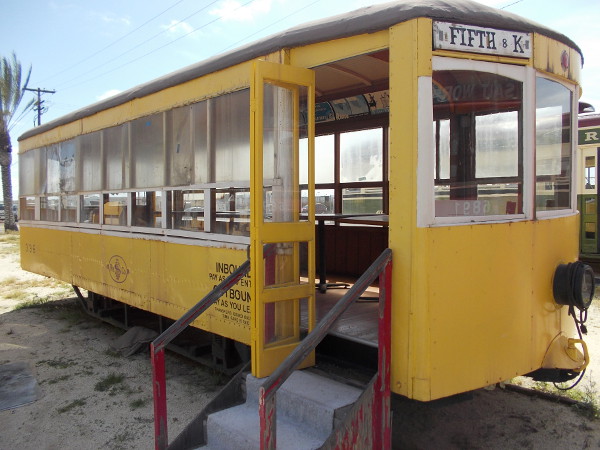
Now we're checking out Birney Car 336, out in the open lot beside the National City Depot. This is one type of streetcar that transported people in San Diego decades ago.
Now we’re checking out Birney Car 336, out in the open lot beside the National City Depot. This is one type of streetcar that transported people in San Diego decades ago.
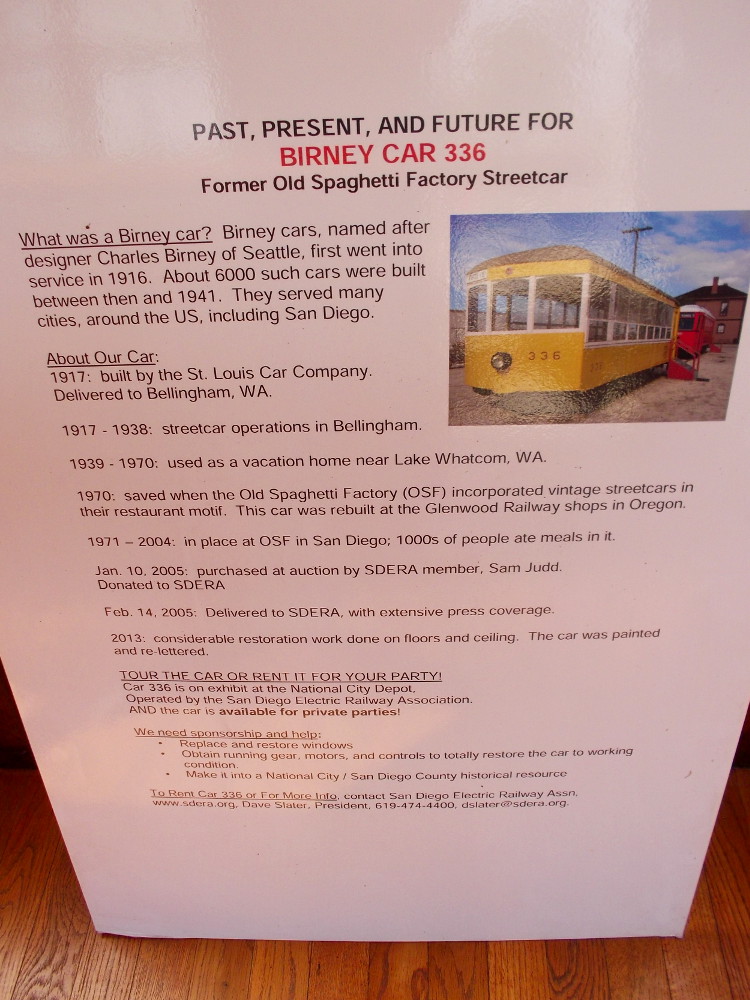
Birney Car 336 was built by the St. Louis Car Company in 1917, and first served in Bellingham, WA. It later was used for dining inside the Old Spaghetti Factory in San Diego, from 1971 to 2004!
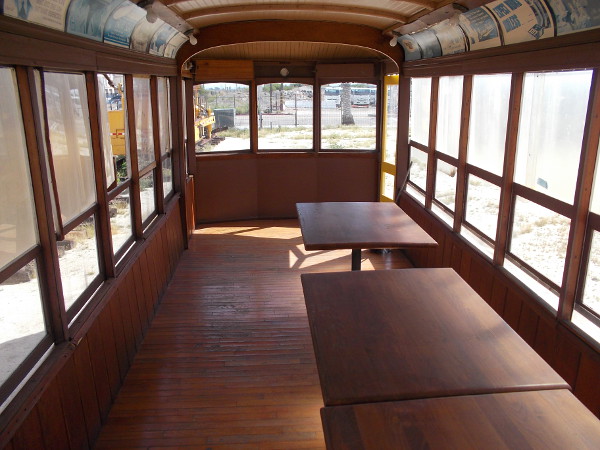
Inside the old Birney Car. I'm hungry for some spaghetti! Where are the chairs?
Inside the old Birney Car. I’m hungry for some spaghetti! Where are the chairs?
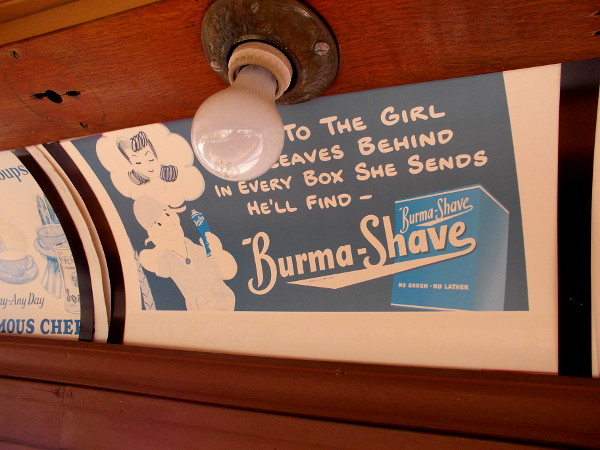
Cool vintage advertisements along the car's ceiling include this one for Burma-Shave.
Cool vintage advertisements along the car’s ceiling include this one for Burma-Shave.
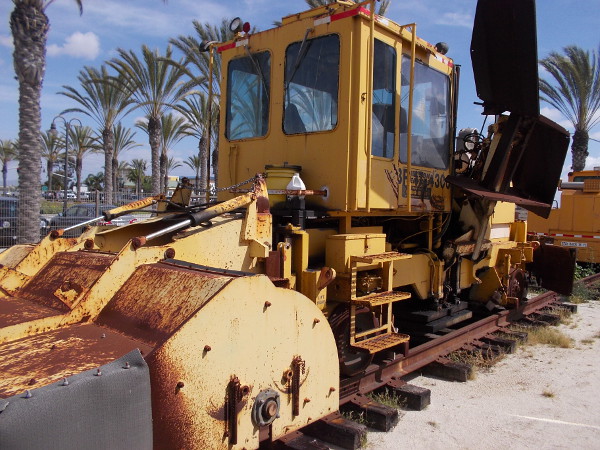
A big, heavy tamping machine used for maintaining railroad tracks and placing them more firmly onto packed ballast.
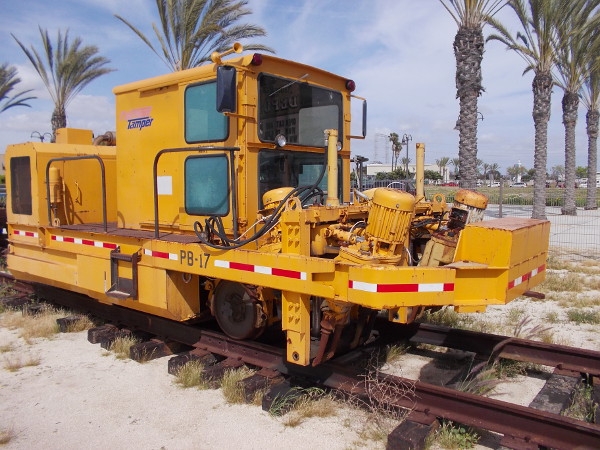
A second ballast tamper outside the National City Depot. I always wondered what these unusual machines that you see on train tracks were for.
A second ballast tamper outside the National City Depot. I always wondered what these unusual machines that you see on train tracks are for.
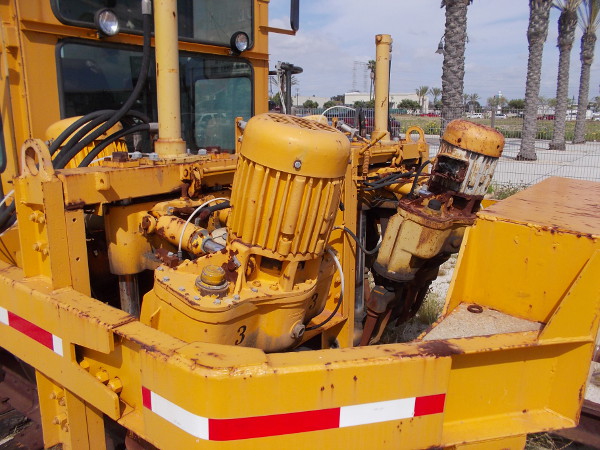
Part of the machinery that pushes down on the steel rails and ties. This makes sure train tracks are solidly in place.
Part of the machinery that pushes down on the steel rails and ties. This makes sure train tracks are solidly in place and level.
Gazing back north past various rail exhibits outside the National City Depot.
Gazing back north past various rail exhibits outside the National City Depot. Isn’t this fun?
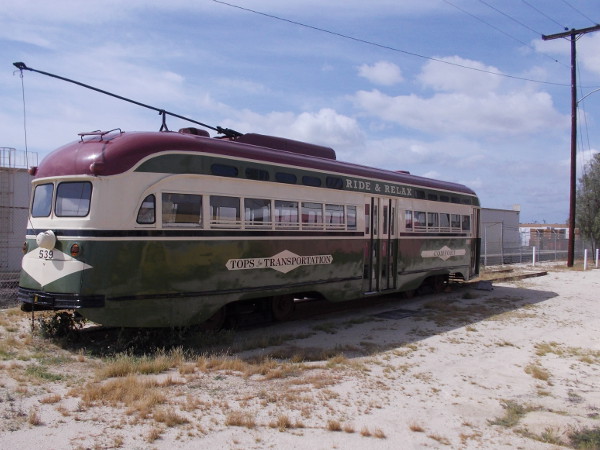
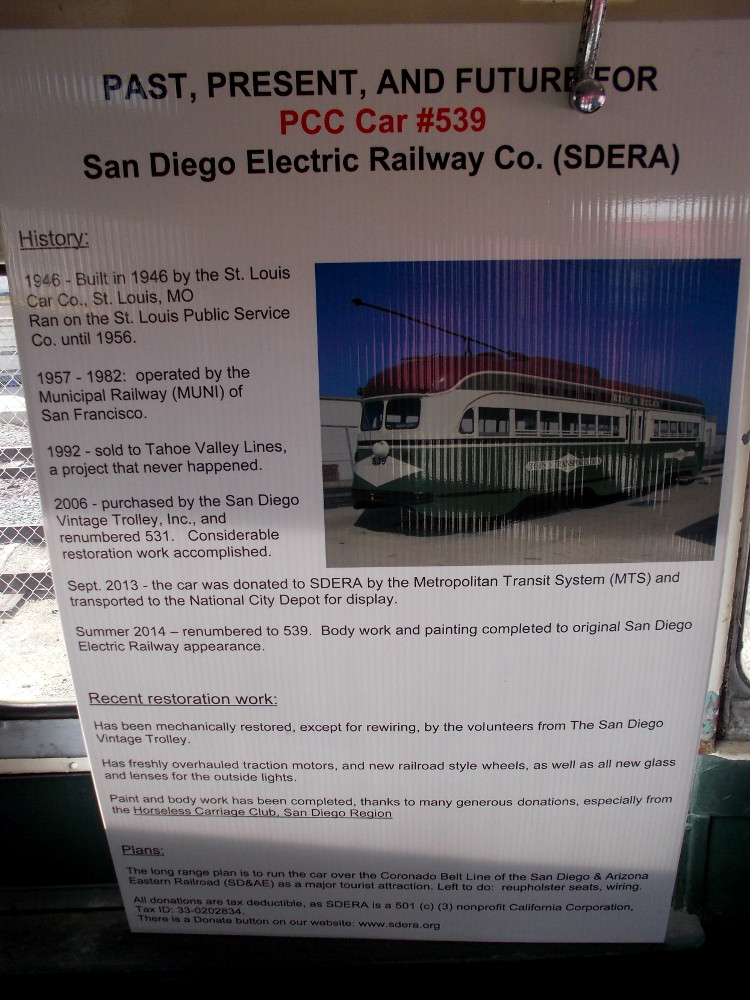
Now we'll check out PCC Car 539, which was donated to SDERA by the Metropolitan Transit System.
Now we’ll check out PCC Car 539, which was donated to SDERA by the Metropolitan Transit System.
PCC Car 539 was built in 1946 by the St. Louis Car Company. It served as a streetcar in St. Louis until 1956. Restoration is underway. One day it might run nearby as a tourist attraction.
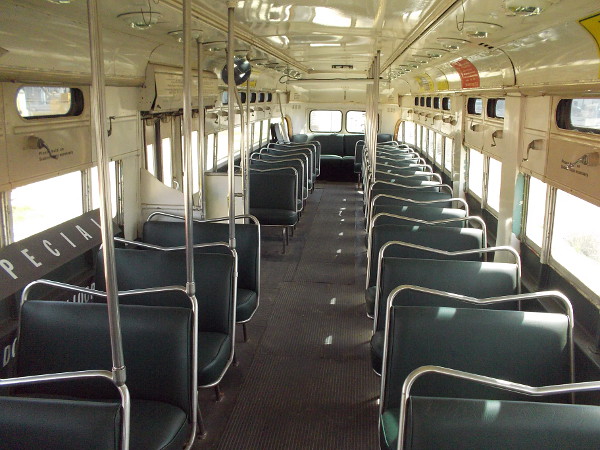
Inside the fabulous PCC car. The San Diego Trolley has two completely restored cars of this type, now running on downtown's Silver Line.
Inside the fabulous PCC car. The San Diego Trolley now has two completely restored cars of this type, running in a downtown loop called the Silver Line.
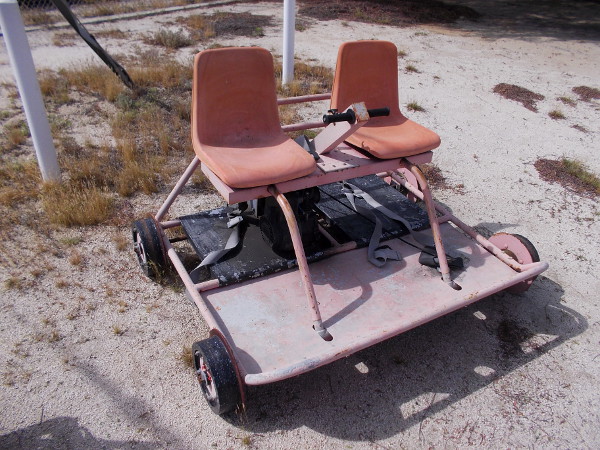
I believe this is a Fairmont Speeder Car. Tiny crew cars were used to transport a few individual workers up and down tracks. I'd love to ride one!
I believe this is a Fairmont Speeder Car. Tiny crew cars were used to transport a few individual workers up and down tracks. I’d love to ride one!
Oh, man! I bet you'd love to sit in one of these seats and ride the rails! Just turn the throttle to go!
Oh, man! I bet you’d love to sit in one of these seats and ride the rails! Just turn the throttle to go!
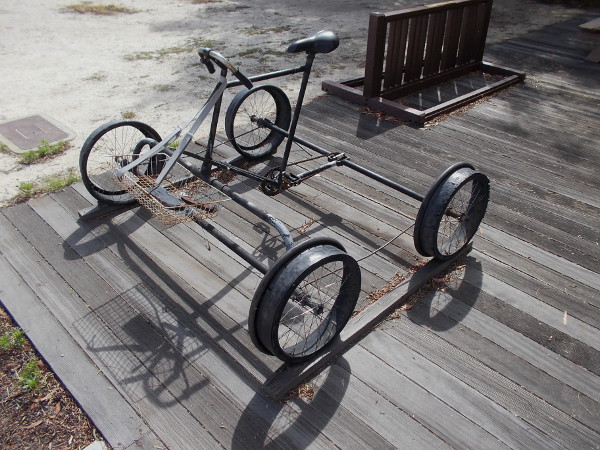
Seriously? This one is basically a bicycle for train tracks! Except it has four wheels! And a bike chain, of course!
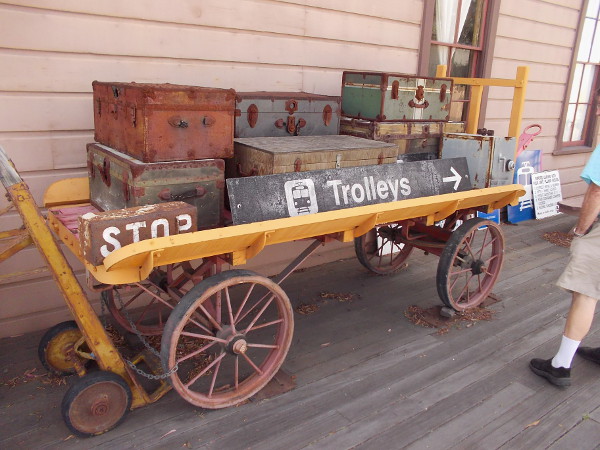
This luggage cart near the entrance to the National City Depot was donated by the Maritime Museum of San Diego--it evidently was aboard the steamboat Berkeley at one time.
This luggage cart near the entrance to the National City Depot was donated by the Maritime Museum of San Diego–it evidently was aboard the steam ferry Berkeley at one time.
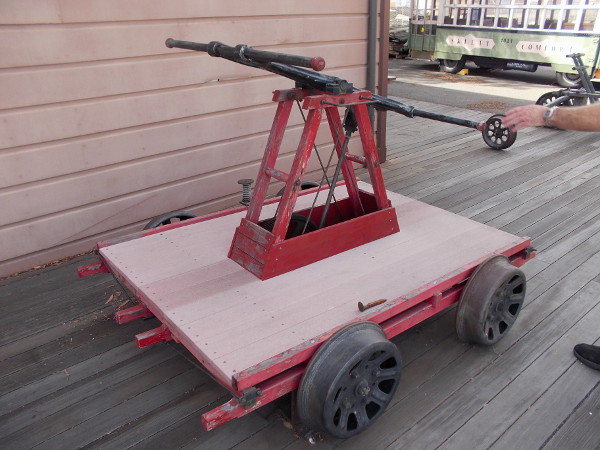
One of several cool vintage handcars. Just like you see in those old Western movies.
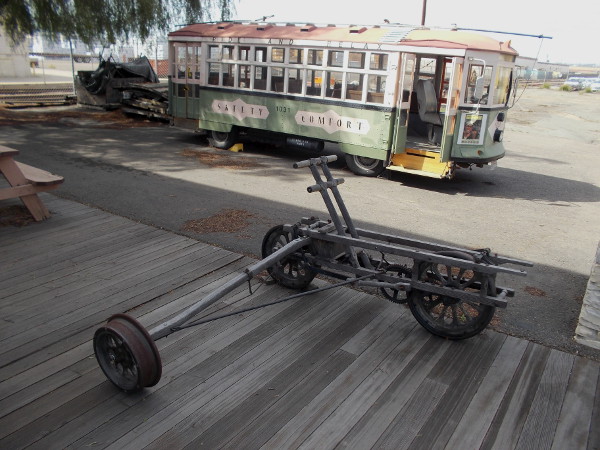
This unusual three-wheeled handcar reminds me of a canoe outrigger!
San Diego Electric Railway Association's fun Herbie is a Brill streetcar replica. A parade and car show's popular Streetcar on Wheels!
San Diego Electric Railway Association’s fun Herbie is a Brill streetcar replica. A parade and car show’s popular Streetcar on Wheels!
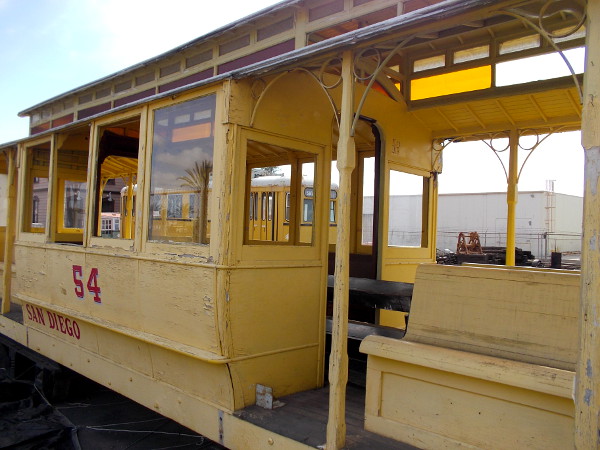
An antique open air streetcar at the National City Depot. This a grip car, like the cable cars in San Francisco. Few people realize that San Diego had a cable car line that briefly ran from the Gaslamp to University Heights in the early 1890s!
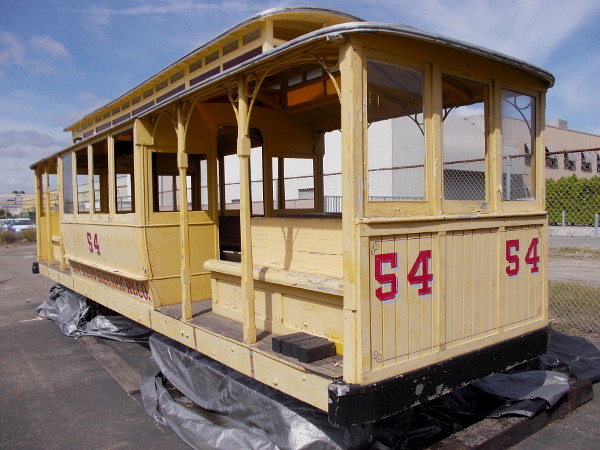
Elegant number 54 was operated by the San Diego Electric Railway Company according to its markings. The yellow paint is peeling.
Elegant number 54 is a unique composite, built using two different San Diego Cable Railway cars. I see panes of stained glass. The yellow paint is peeling.
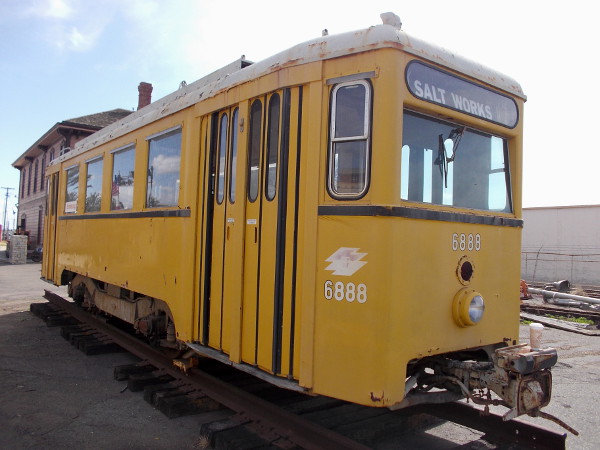
The third Vienna streetcar in the National City Depot's collection, number 6888, is yellow.
The third Vienna streetcar in the National City Depot’s collection, number 6888, is yellow.
There's a lot of very cool stuff to see at the National City Depot, in San Diego's South Bay!
There’s a ton of very cool stuff to see at the National City Depot, in San Diego’s South Bay!

I live in downtown San Diego and walk all over the place! You can follow Cool San Diego Sights via Facebook or Twitter!

You can easily explore Cool San Diego Sights by using the search box on my blog’s sidebar. Or click a tag. There are thousands upon thousands of fun images (including lots of model and historical train photographs) for you to enjoy! Feel free to share! Have some fun!

A short nature walk along a National City wetland.

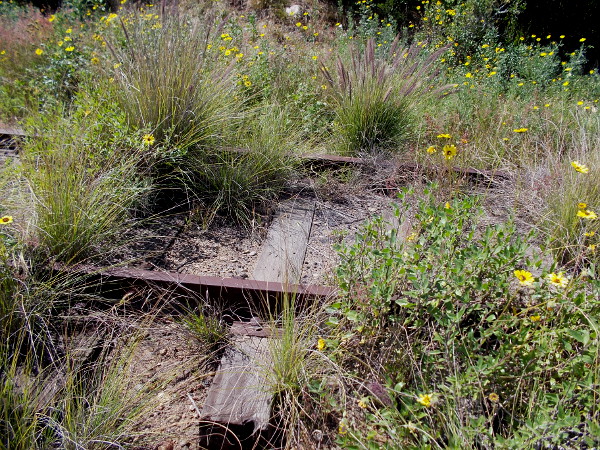
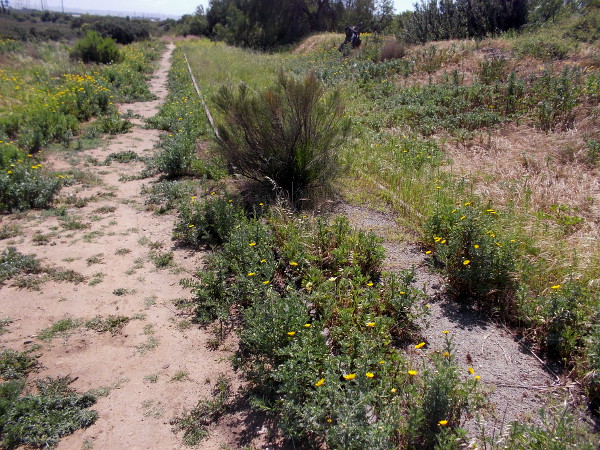
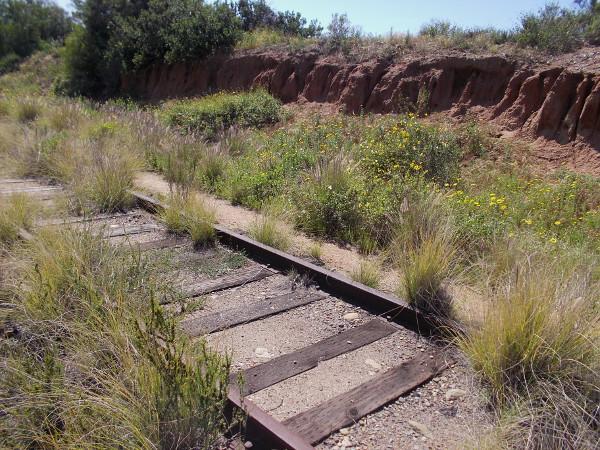
Rusty old train tracks are overgrown with wild vegetation, including many California sunflowers.
Rusty old train tracks are overgrown with wild vegetation, including many California bush sunflowers.

I made a cool discovery the other day. A little-known hiking path in San Diego’s South Bay provides a view of a beautiful natural wetland.

According to signs that I saw, the small estuary between Bay Marina Drive, Marina Way, Interstate 5 and the Sweetwater River is a protected wildlife refuge. I believe, after looking at Google Maps, that the water flows from Paradise Creek. But I’m not certain. Perhaps someone reading this knows.

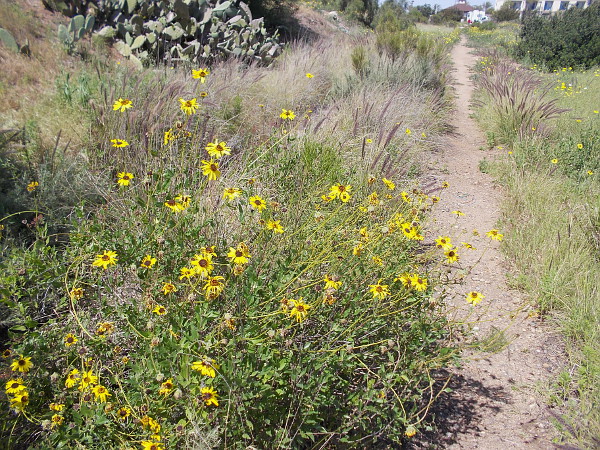
Long-unused train tracks that are partially concealed by vegetation run along the edge of the wetland, and so does a narrow footpath. I didn’t see any signs naming the trail, or any that prohibited a short hike. So I walked down it a bit, enjoying the fresh air and peaceful surroundings.

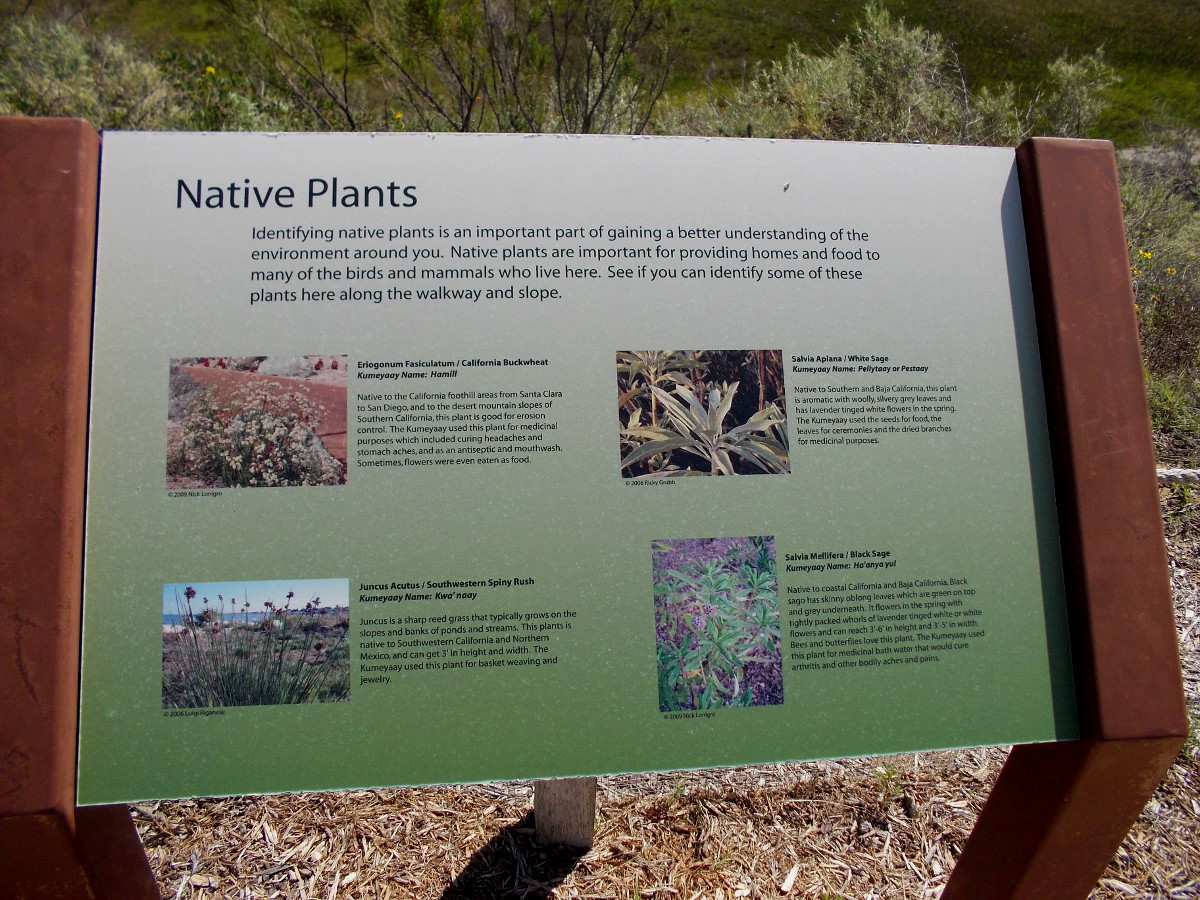
Information sign near edge of estuary identifies native plants. California Buckwheat, White Sage, Southwestern Spiny Rush, and Black Sage.
View of National City wetland from observation area south of the Best Western Marina Gateway hotel parking lot.
Beginning down the footpath on a sunny weekend day.
Some eroded sandstone adds beauty to the scene.
Prickly pear and chaparral yucca above a green estuary.
Beyond the sign lies a fragile wetland where native plants and animals are protected. I saw some birds out in the wildlife refuge.
I turned about after a short hike and headed on back to the hotel parking lot.

UPDATE!

On a later visit I discovered additional signs beside the hotel parking lot. They contain more interesting information.

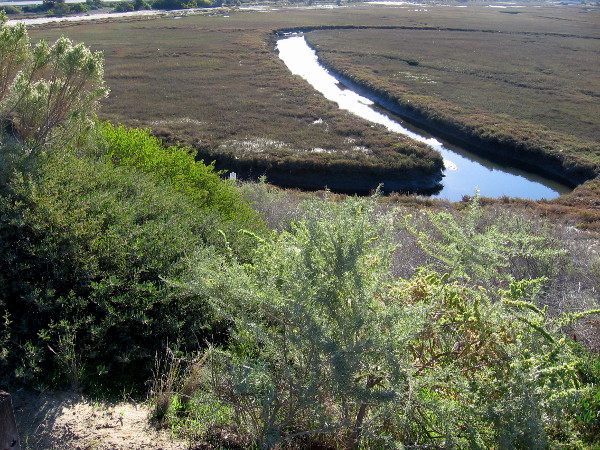
I learned this wetland is called Paradise Marsh. It’s an environmentally important tidal salt marsh that’s part of the much larger San Diego Bay National Wildlife Refuge.

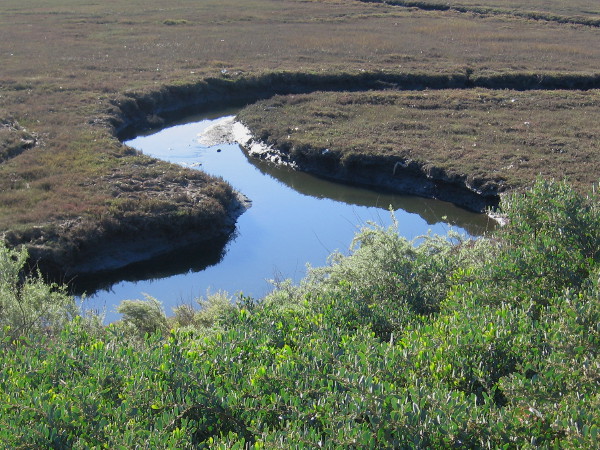
Water reflects bright sunlight in National City's Paradise Marsh.
Water reflects bright sunlight in National City’s Paradise Marsh.
Paradise Marsh is a small part of the 2600 acre San Diego Bay National Wildlife Refuge
The birds of Paradise Marsh include the Willet, Mallard, American Avocet and the Great Blue Heron.
For hundreds of years, Native American tribes such as the Kumeyaay, Iapi or Tipai made their homes around the estuaries of San Diego Bay.
A beautiful tidal salt marsh wetland can be viewed in National City.

I live in downtown San Diego and love to walk! You can follow Cool San Diego Sights via Facebook or Twitter!

Do you enjoy beautiful things? Visit my photography blog which I call A Small World Full of Beauty.

Reflection, geometry, complexity. One iconic dome.

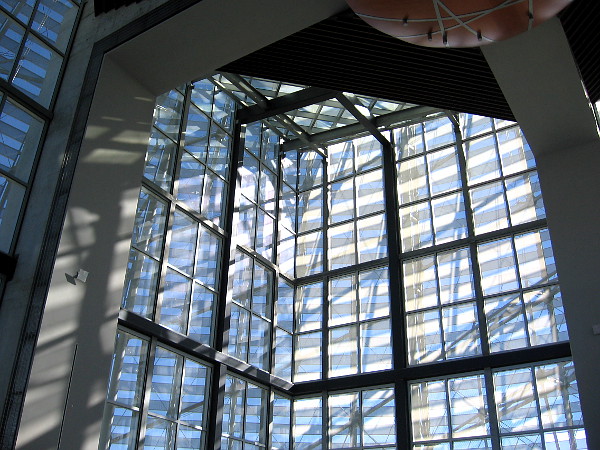
Photo of a unique downtown landmark. The shining lattice dome of the San Diego Central Library, as seen from the ninth floor's outside deck.
Photo of a unique downtown landmark. The shining lattice dome of the San Diego Central Library, as seen from the ninth floor’s outside deck.

Many old redundant photos are being purged from my computer this weekend. But I had to definitely share these!

I’ve blogged about San Diego’s relatively new downtown library several times. I’ve posted more than a few pics of its unique lattice dome. You might recall some weirdly halo-like photos I took in the darkness early one night last year.

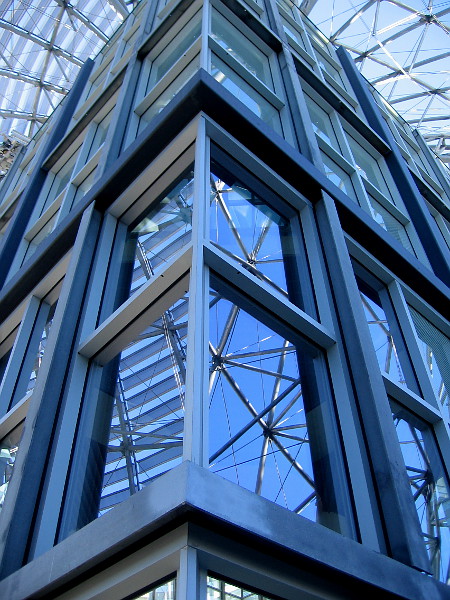
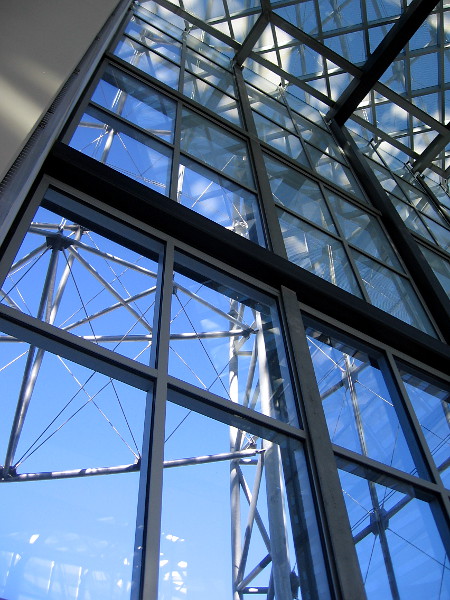
Well, check these out! The curving lines of steel reflected in the building’s windows look like a lesson in complex geometry. You know, in a strange way the dome reminds me of a graph or diagram demonstrating how time and space can be warped by gravity! Am I crazy? What does it look like to you?

A collection of rare books is housed in a room on the ninth floor of San Diego's public library.
A collection of rare books is housed in a room on the ninth floor of San Diego’s public library.
The visually impressive steel lattice dome tops an airy two-story high library reading room. An architectural marvel.
Reflections in the windows create a fantastic, mysterious image.
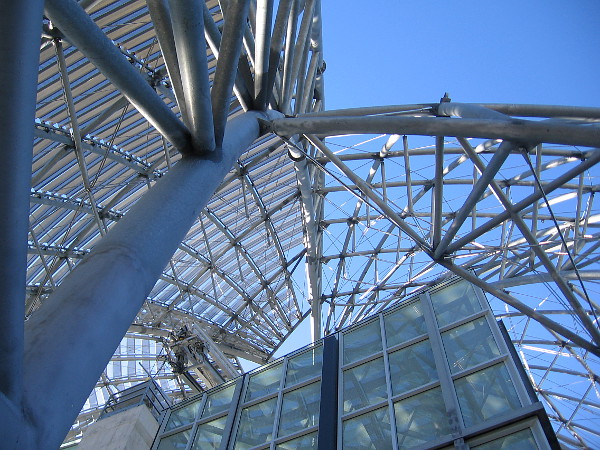
Looking upward at the metal dome and blue sky. Amazing views can be had of downtown from the library's ninth floor.
Looking upward at the metal dome and blue sky. Amazing views can be had of downtown from the library’s ninth floor.
Lots of geometric complexity and dazzling light for my camera's lens.
Lots of geometric complexity and dazzling light for my camera’s lens.
Peering down into the spacious reading room on a bright sunshiny day.
Filtered light and shadows form unusual grid-like patterns inside the reading room. The perfect place to study a math book, maybe.
A three-dimensional delight. Intersecting lines fascinate the eye.
One last cool photo. I feel like I'm floating through some sort of mathematical dreamscape.
One last cool photo. I feel like I’m floating through some sort of mathematical dreamscape.

I live in downtown San Diego and love to walk! You can follow Cool San Diego Sights via Facebook or Twitter!

Do you like to read short pieces of thought-provoking fiction? You might enjoy checking out Short Stories by Richard.

A peek inside National City’s Historic Railcar Plaza.

National City's unique Historic Railcar Plaza. One can peek inside the barn and see a few exhibits that recall 19th century rail service in San Diego's South Bay.
National City’s unique Historic Railcar Plaza. One can peek inside the barn and see a few exhibits that recall 19th century rail service in San Diego’s South Bay.

During my excursion last weekend to National City, I saw several very cool sights. Here’s one!

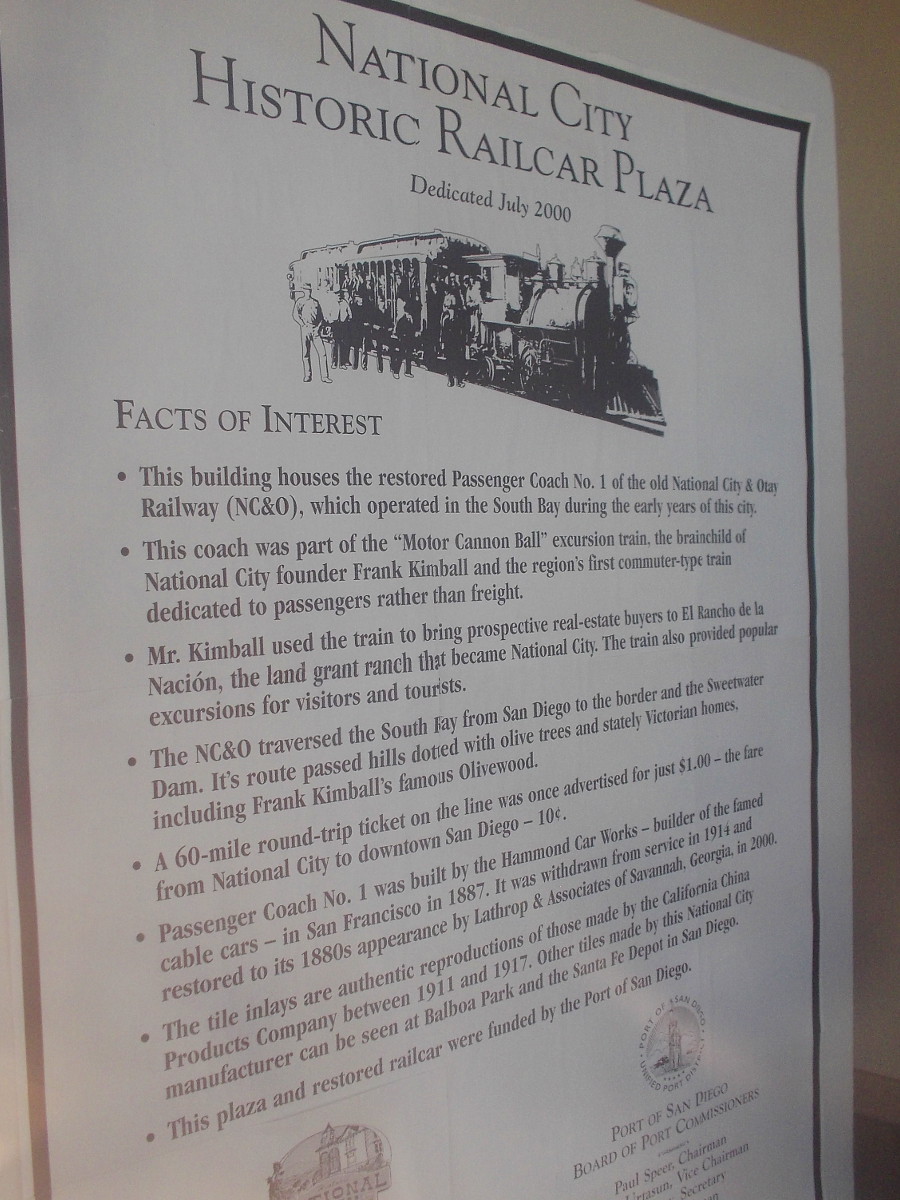
Those interested in San Diego’s rich history of trains and streetcars should visit the Historic Railcar Plaza, which is located at the intersection of Bay Marina Boulevard and Harrison Avenue. (It’s right across from National City’s awesome Old Depot museum, which I’ll blog about as soon as my photos are ready!)

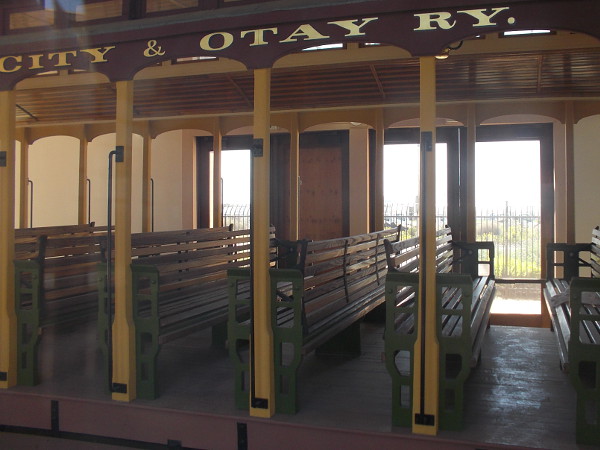
In addition to several displays dedicated to past railroads that serviced San Diego’s South Bay, the Historic Railcar Plaza features the fantastic, restored Passenger Coach No. 1. The old coach can be rolled outside of a small train barn on special occasions. Passenger Coach No. 1 was originally built in 1887 and carried passengers up and down the National City and Otay Railway (NC&O) until 1914. The beautiful open railcar used to seat up to 58 passengers in varnished redwood splendor.

The Historic Railcar Plaza’s small barn was built in 2000. The day I peeked through the windows it was padlocked shut. The windows were rather dirty and a few of the displays within had toppled over, which seems to indicate a degree of neglect. Apparently the cool car is rolled outside on the short track from time to time. I hope to see that one day!

Many of my photos were through those dirty windows. I did my best to adjust the images for clarity.

Mysterious stretch of train track emerges from the barn's door. A very cool bit of history can be rolled outdoors during special occasions..
Mysterious stretch of train track emerges from the barn’s door. A very cool bit of history can be rolled outdoors during special occasions.
That bit of history is the restored Passenger Coach No. 1, of the long-defunct National City and Otay Railway.
The restored coach features outdoor bench seating and beautiful woodwork. Passengers could ride this car from San Diego through National City and Chula Vista to the Mexican border.
A mannequin inside the Historic Railcar Plaza of The Millionaire Hobo, J.B. King, Esq. His one burning ambition was to write his name on every car of every train in the country!
A mannequin inside the Historic Railcar Plaza depicts the legendary Millionaire Hobo, J.B. King, Esq. His one burning ambition was to write his name on every car of every train in the country!
A century ago, a ticket for the sixty mile round trip on the National City and Otay Railway could be purchased for just one dollar!
A century ago, a ticket for the sixty mile round trip on the National City and Otay Railway could be purchased for just one dollar.
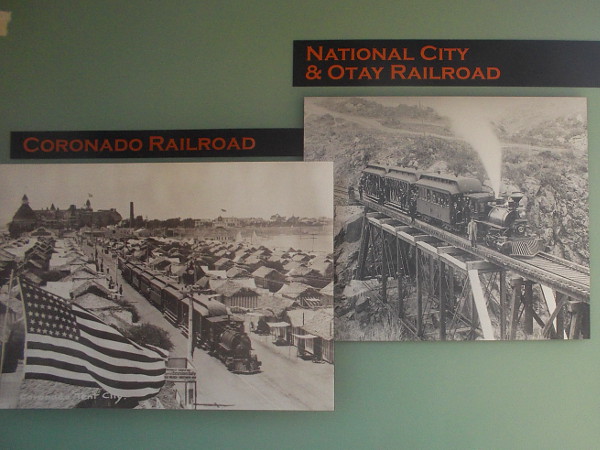
Two old photographs. On the left, the old Coronado Railroad went through Imperial Beach and up the Silver Strand to Tent City in Coronado. One can see the Hotel del Coronado!
Two old photographs. On the left, the old Coronado Railroad traveled through Imperial Beach and up the Silver Strand to Tent City in Coronado. One can see the splendid Hotel del Coronado in the distance!
Map inside the Historic Railcar Plaza shows the various railways that once serviced San Diego, when transportation by train was very popular.
Map inside the Historic Railcar Plaza shows the various railways that once serviced San Diego, when transportation by train was extremely popular.
A key to the above map includes evolving railroads. The California Southern, the National City and Otay, the Coronado, the San Diego Southern, the San Diego and Southeastern. the San Diego and Arizona.
Key to the above map includes the region’s evolving railroads: the California Southern, the National City and Otay, the Coronado, the San Diego Southern, the San Diego and Southeastern. and the San Diego and Arizona.

I live in downtown San Diego and love to walk! You can follow Cool San Diego Sights via Facebook or Twitter!

You can easily explore Cool San Diego Sights by using the search box on my blog’s sidebar. Or click on a tag! There are thousands upon thousands of fun photos for you to enjoy!

History comes alive during tour of Spanish Village.

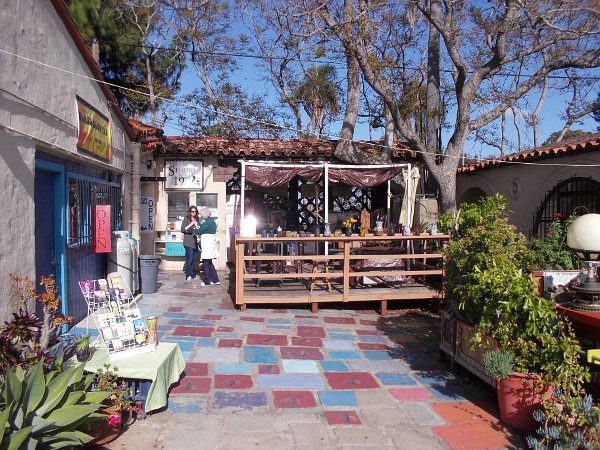
Tour guide Jeff explains that today's Studio 36 Sculpture Guild was an outdoor theatre in the early years of Spanish Village. The front was a lobby and ticket booth. Writers, actors and set designers would act out plays on the inner patio.
Tour guide Jeff explains that today’s Studio 36 Sculptors Guild was an outdoor theatre in the early years of Spanish Village. The front was a lobby and ticket booth. Writers, actors and set designers would act out plays on the inner patio.

Spanish Village Art Center, in beautiful Balboa Park, is where you’ll find the colorful studios of many fine San Diego artists. Last year I blogged about the history of this fascinating place. A small exhibit in Gallery 21 recounted how Spanish Village was created for the 1935 California Pacific International Exposition, and traced the village’s evolution over subsequent decades. Unfortunately, that exhibit no longer exists. But I did record much of it. To enjoy an overview of the history, you can revisit my old blog post by clicking here.

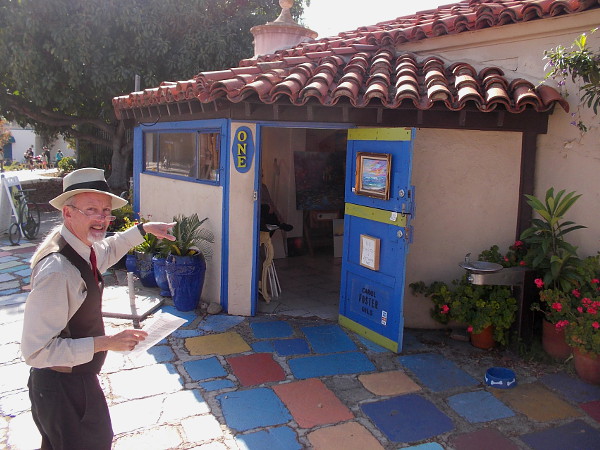
Last Saturday I was given a terrific tour of Spanish Village by a super friendly guy named Jeff. During the tour, Jeff showed me some unusual, unexpected features of Spanish Village and delved into its often surprising history.

(Fortunately, Jeff gave me some notes that I will reference in this blog. Should you enjoy a tour yourself, you can probably obtain your own copy!)

Please read the photo captions where I provide descriptions and very short explanations. As you’ll see, many interesting changes in Spanish Village have taken place over the years. And I’ve barely begun to scratch the surface!

If something I’ve written is inaccurate, or needs some elaboration, leave a comment! What memories do you have?

Click here to check out the Spanish Village Art Center blog! Support these great artists!

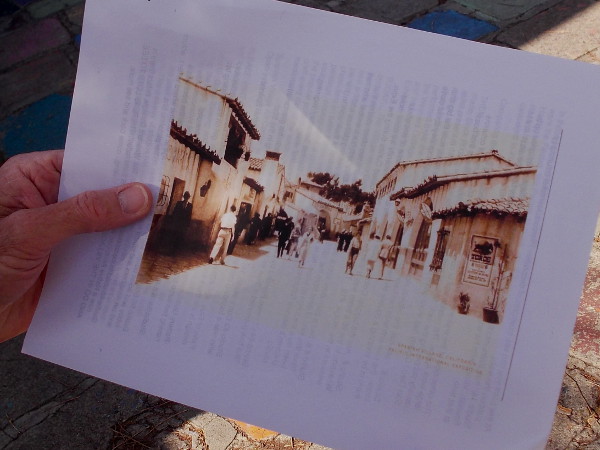
An old photograph of how Spanish Village appeared around the time of the California Pacific International Exposition of 1935.

In 1935, when Spanish Village opened, visitors strolled down simulated Old World streets, which featured restaurants and shops in picturesque, open-arched buildings. The architecture was inspired by the Andalusian region of southern Spain. In addition to wine shops, a cocktail lounge and a Chinese Bazaar, one could buy flowers and enjoy music, art . . . and even a high wire trapeze act!

You can see in the above old photograph a no-longer-existing building at the center of today’s large patio. It separated Spanish Village into two “streets” that visitors could enjoy.

Over the years, resident artists have built out the small open air shops to create practical but unique enclosed spaces. Some of the open arches have been filled in, or can now be seen inside certain studios.

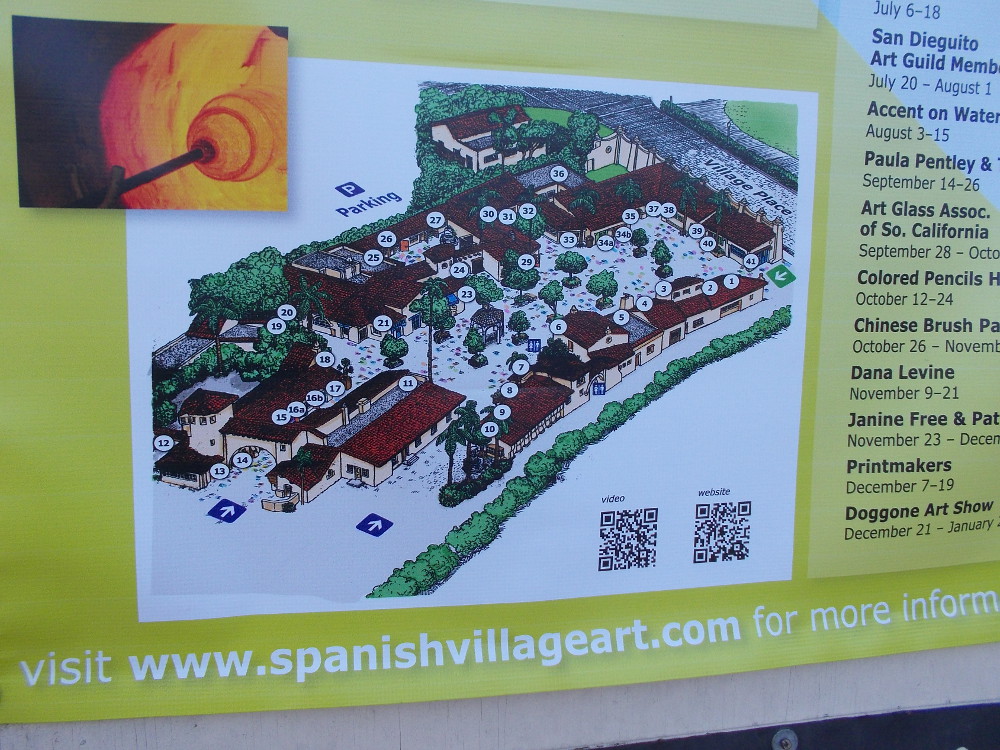
A current map of Spanish Village shows how it appears today. You can find this wonderful part of Balboa Park between the Natural History Museum and the San Diego Zoo.
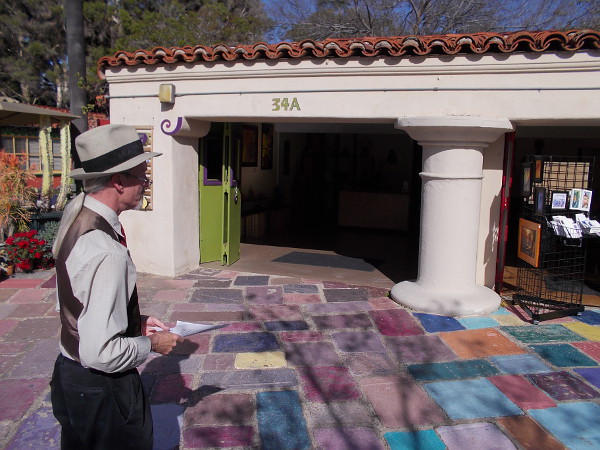
Jeff shows me Studios 34 A and 34 B, which were originally one space featuring a puppet show.
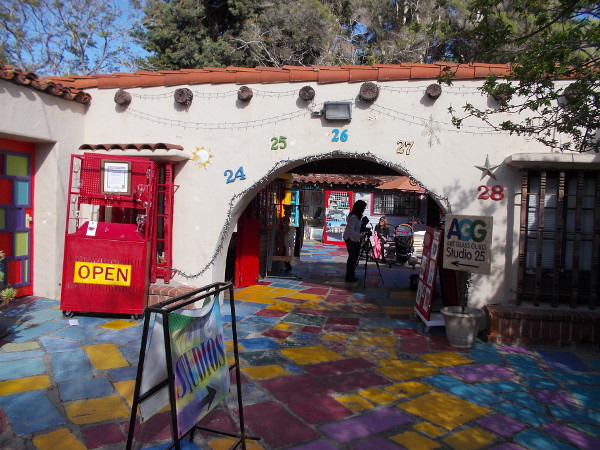
Studios 24 through 28 surround a small inner courtyard. This area in Spanish Village originally contained a wishing well and actual horse stalls!
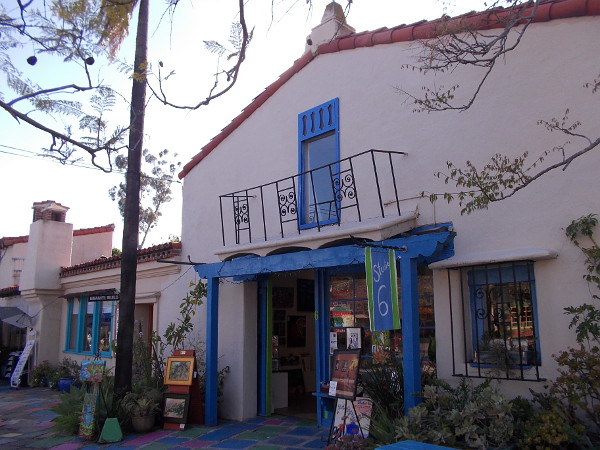
Studio 6 has a sliding barn door! Two other studios dating from the 1935 California Pacific International Exposition have similar doors.
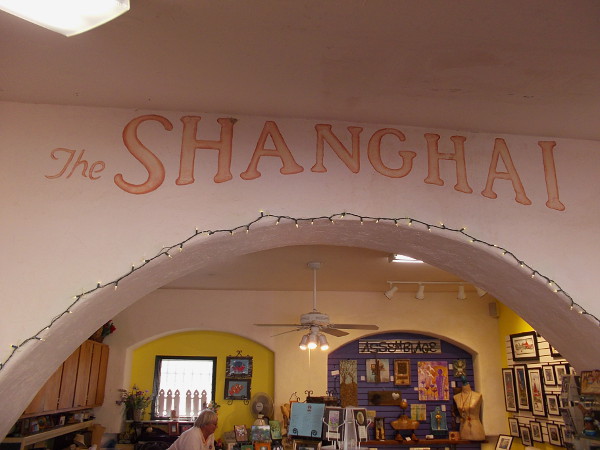
Studio 8, like many others in Spanish Village, was built out from the original open archway to provide more space for the artists. The words The SHANGHAI are from 1935. It evidently used to be a bar.
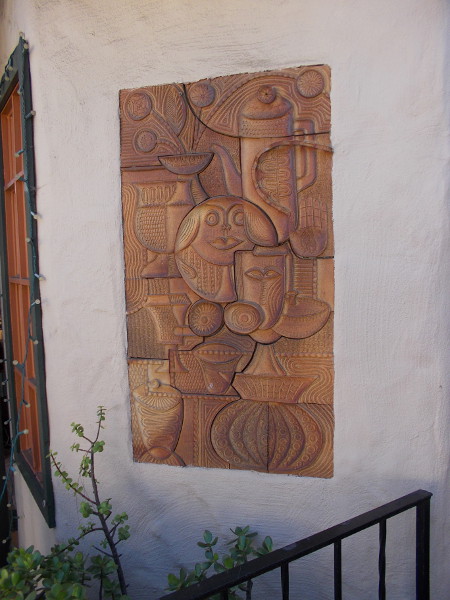
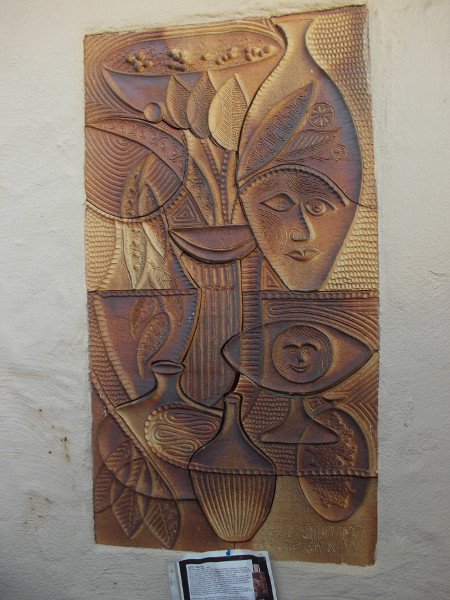
Near Studio 8's entrance are two amazing works of art. Here's one. It was created by John Novy, a potter who was a member of Spanish Village from 1969 to 1977.
Near Studio 8’s entrance are two amazing works of art. Here’s one. It was created by John Novy, a potter who was a member of Spanish Village from 1969 to 1977.
Second amazing installation of ceramic tiles on exterior of Studio 8 in Spanish Village. This art was created by professional potter John Novy.
Second installation of ceramic tiles on exterior of Studio 8 in Spanish Village. This art was created by professional potter John Novy.
This used to be the east entrance into Spanish Village. Today you'll find outdoor glassblowers creating amazing glass art while visitors gather around to watch.
This used to be the east entrance into Spanish Village. Today you’ll find outdoor glassblowers creating amazing glass pieces while visitors gather around to watch.
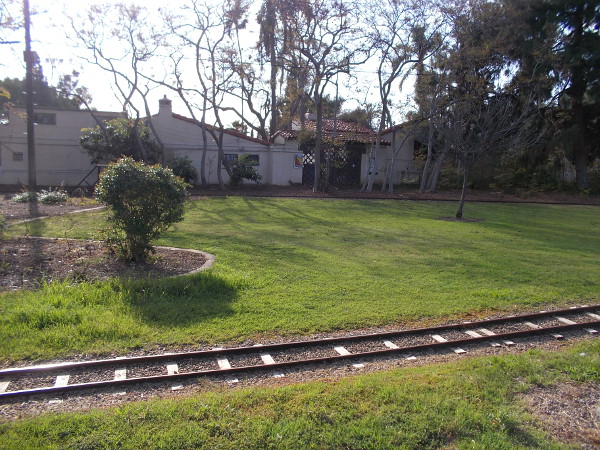
The old east entrance (under the tiles) is now blocked off. Much of the grassy area used by today's Balboa Park Miniature Railroad used to be a parking lot.
The old east entrance (under the tiles) is now blocked off. Much of the grassy area occupied by today’s Balboa Park Miniature Railroad used to be a parking lot.
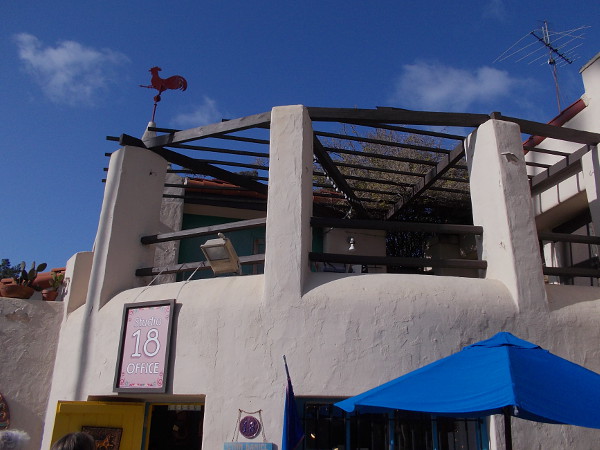
Studio 18 is now the office of Spanish Village Art Center. In the early years a caretaker lived here. That rooster weather vane can be seen in many old photographs.
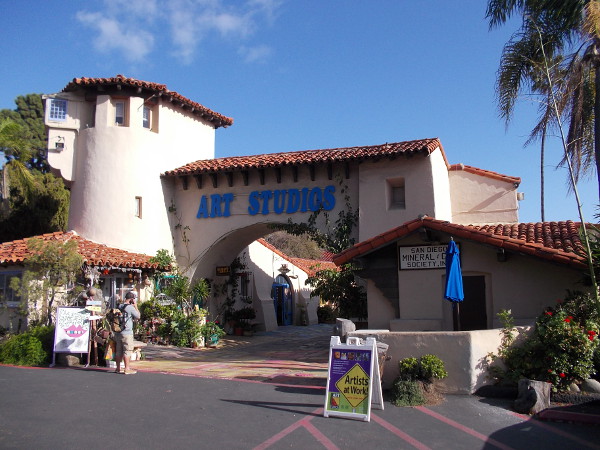
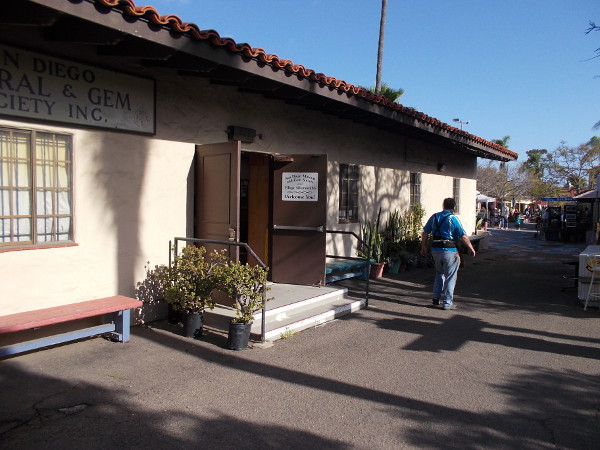
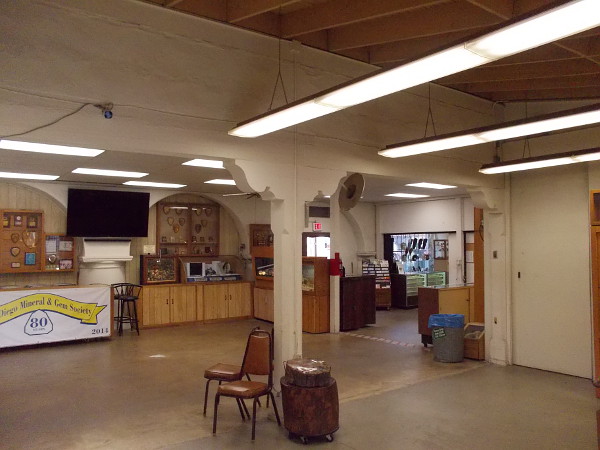
The south end of the San Diego Mineral and Gem Society building used to extend a bit into today's patio area. You can see an old wooden beam on the present-day exterior.
The south end of the San Diego Mineral and Gem Society building used to extend a bit into today’s large patio area. You can see an old wooden beam on the present-day exterior.
This quaint little street, during the 1935 California Pacific International Exposition, led into the Fun Zone! Now it leads to a small parking lot.
Gazing back south from the parking lot at today's Spanish Village in Balboa Park.
Gazing back south from the parking lot at today’s Spanish Village artist co-op in Balboa Park.
This west side of the San Diego Mineral and Gem Society building was built sometime after the 1935 Expo.
The extended west side of the San Diego Mineral and Gem Society building was built sometime after the 1935 Expo.
Originally, the building terminated where you see the arches.
Originally, the building terminated where you see the column.
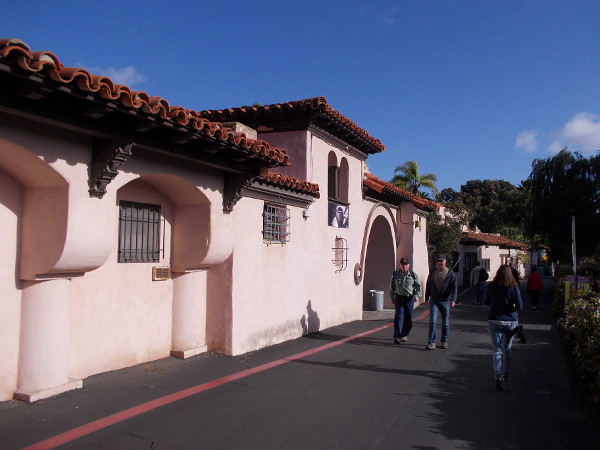
Walking along the west edge of Spanish Village. Many historic columns and arches provide this artist's co-op with unique character.
Walking along the west edge of Spanish Village. Many decorative columns and arches provide this artist’s co-op with unique character.
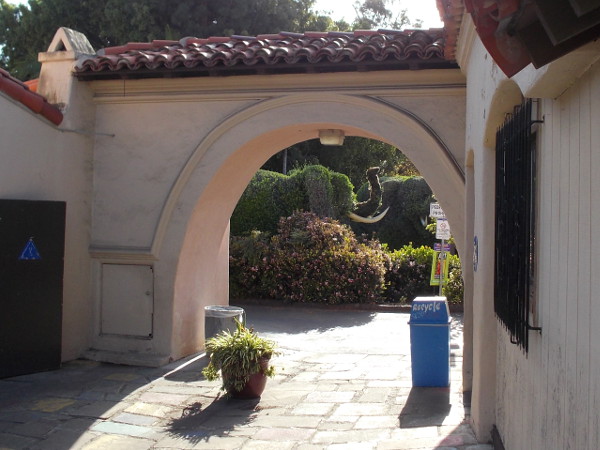
Looking through the west archway toward a shrub elephant, which stands on a nearby, newly improved walkway the heads north to the San Diego Zoo.
Looking through the west archway toward a shrub elephant, which stands on a nearby, newly improved walkway that heads north to the San Diego Zoo.
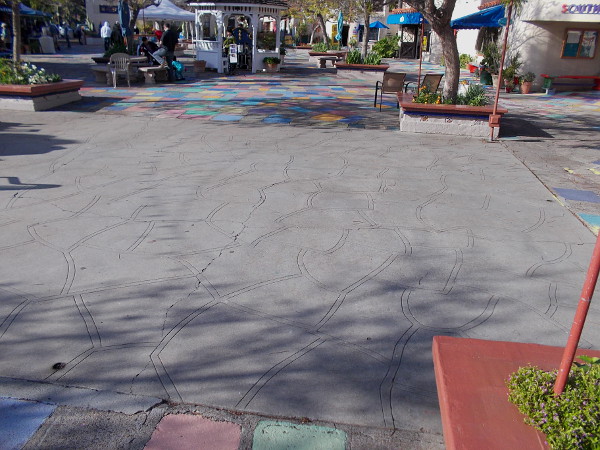
This large dance floor (and the area where I'm standing) at the center of the colorful Spanish Village patio was once occupied by a large building. It seems there is some debate what that building was, exactly.
This large dance floor (and the area where I’m standing) at the center of the colorful Spanish Village patio was once occupied by a large building. It seems there is some debate as to what that building was, exactly.
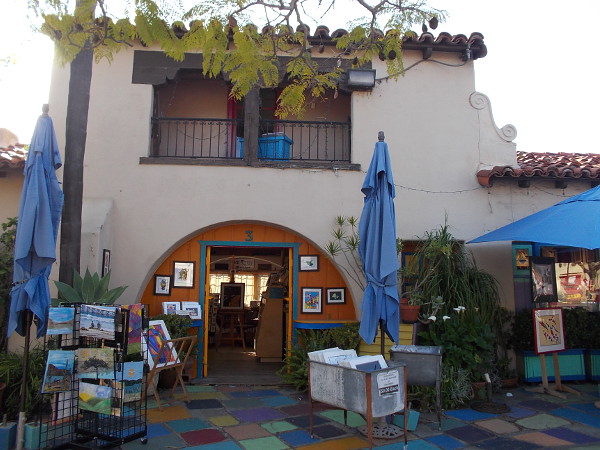
Studio 3 is occupied by artist Don Knapp. He arrived at Spanish Village as a child! His grandmother was a founding member in the 1930s.
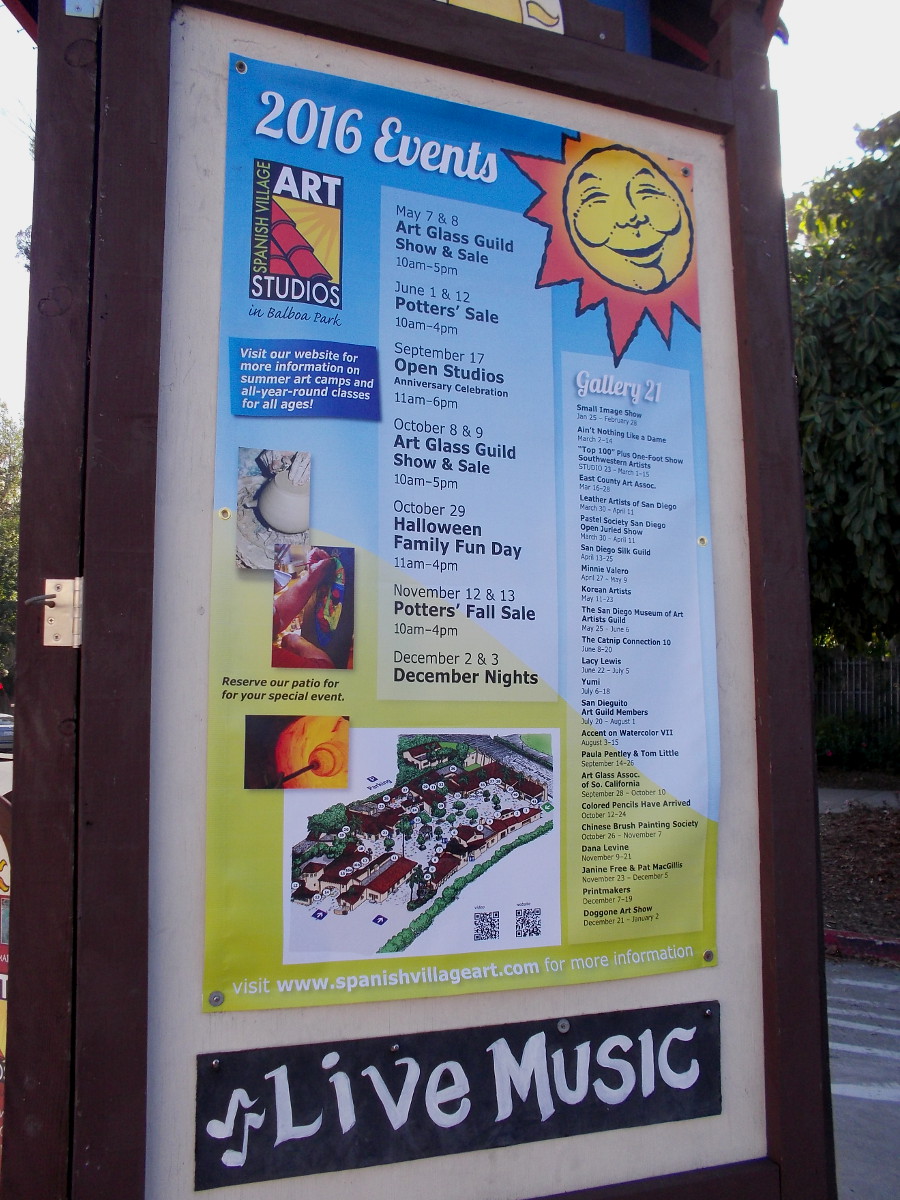
Loads of fun, creative stuff is going on in Spanish Village Art Center in 2016. Please click the image to enlarge it and then mark your calendar!
Loads of fun, creative stuff is going on in Spanish Village Art Center in 2016. Please click the image to enlarge it, and then mark your calendar!
Jeff provides a really interesting tour. Look for his friendly smile if you happen to find yourself in wonderful Spanish Village!
Jeff provides a really interesting tour. Look for his friendly smile if you happen to find yourself in wonderful, historic Spanish Village!

I live in downtown San Diego and walk like crazy! You can follow Cool San Diego Sights via Facebook or Twitter!

Do you like to read short pieces of thought-provoking fiction? You might enjoy checking out Short Stories by Richard.

Is Balboa Park one of your favorite places? Follow my special new blog, which I call Beautiful Balboa Park!

Funny Irish pub signs in San Diego.

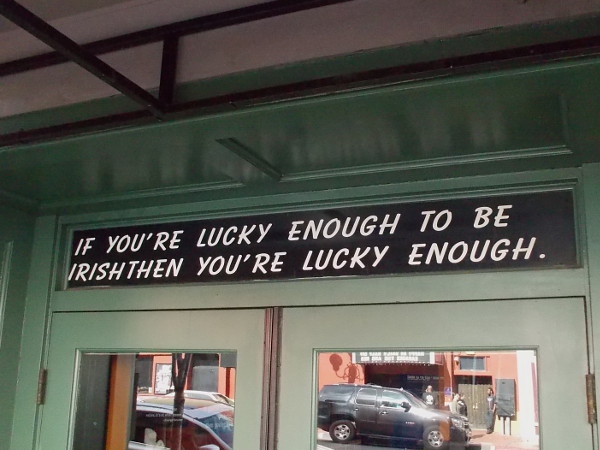
If you're lucky enough to be Irish, then you're lucky enough.
If you’re lucky enough to be Irish, then you’re lucky enough.

St. Patrick’s Day is almost upon us! Here are a few warm and funny Irish pub signs that I’ve spotted while walking around downtown San Diego.

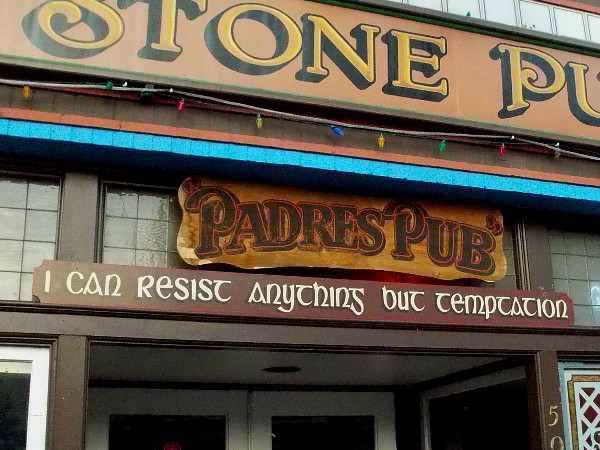
I can resist anything but temptation.
Sláinte! A toast to good luck and good health. Whatever your beverage, be sure and raise a glass in toast to St. Patrick, to the Irish and to yourself.
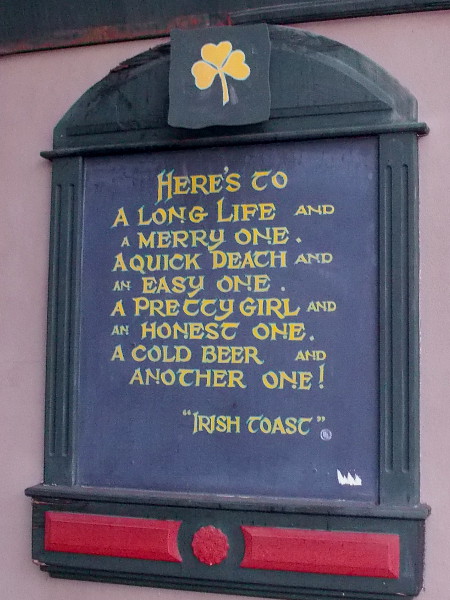
Here's to a long life and a merry one. A quick death and an easy one. A pretty girl and an honest one. A cold beer and another one!
Here’s to a long life and a merry one. A quick death and an easy one. A pretty girl and an honest one. A cold beer and another one!
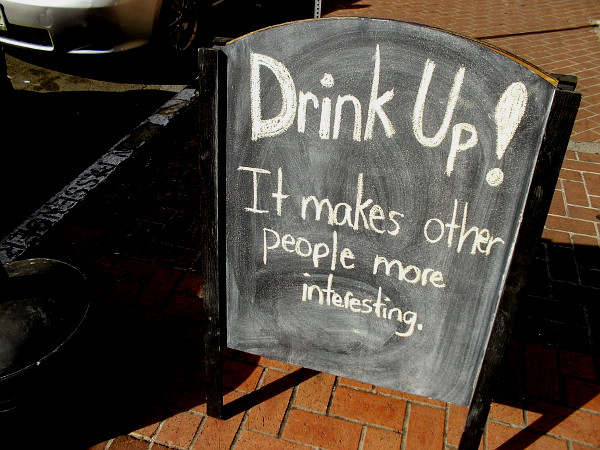
Drink up! It makes other people more interesting. (I think I spotted this in front of an Irish pub. Or perhaps it was just an ordinary San Diego bar.)
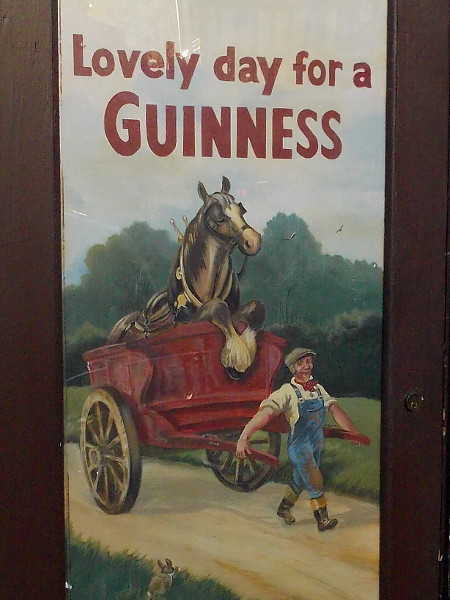
Lovely day for a Guinness. Especially if you're a horse enjoying a nice leisurely ride.
Lovely day for a Guinness. Especially if you’re a horse enjoying a nice leisurely ride.

I live in downtown San Diego and love to walk! You can follow Cool San Diego Sights via Facebook or Twitter!

Do you like to read short pieces of thought-provoking fiction? Please visit Short Stories by Richard.

A beautiful city of silver and gold.

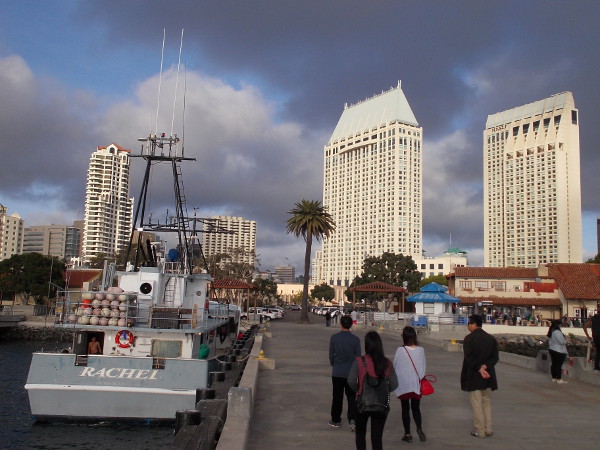
Late afternoon stroll on the pier between Tuna Harbor and Seaport Village. The Manchester Grand Hyatt towers are glowing in a dramatic sky.

Late this afternoon I took a stroll through a beautiful city of silver and gold. Here are the photos…

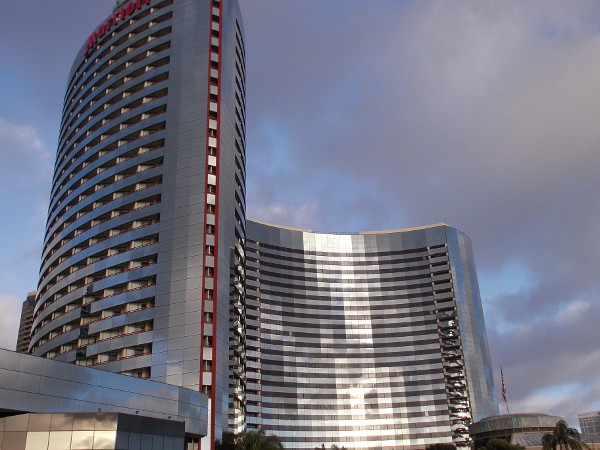
Walking through Seaport Village toward the Marriott Marquis and Marina. The beautiful hotel is shining like precious silver.
Late afternoon sunlight reflected off the two silvery sail-like towers of the Marriott Marquis on San Diego Bay.
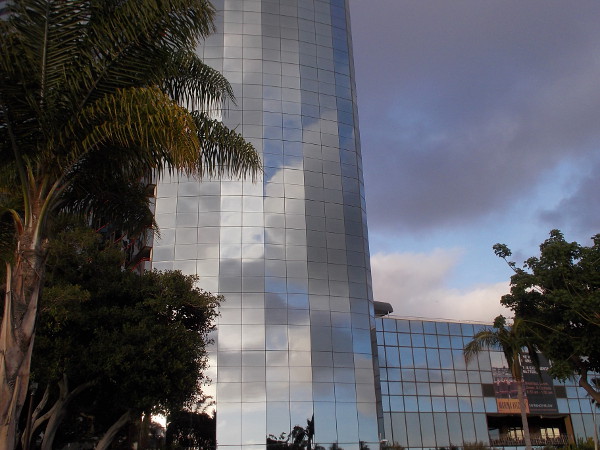
Blue sky, white and dark clouds, and fantastic patterns created by reflection off the beautiful glass building.
Blue sky, white and dark clouds, and fantastic patterns created by light reflected on the amazing glass building.
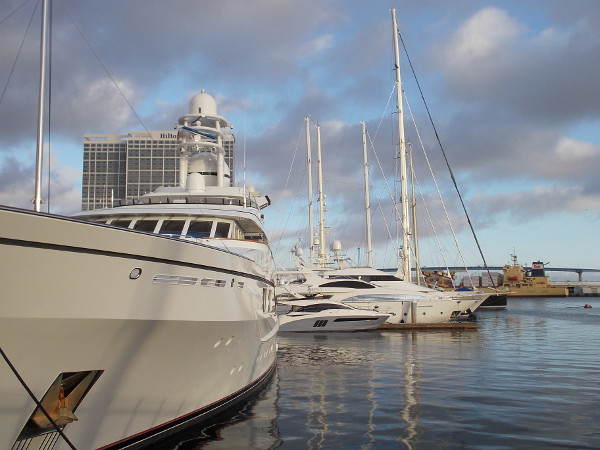
White superyachts docked behind the San Diego Convention Center are bathed in late afternoon light.
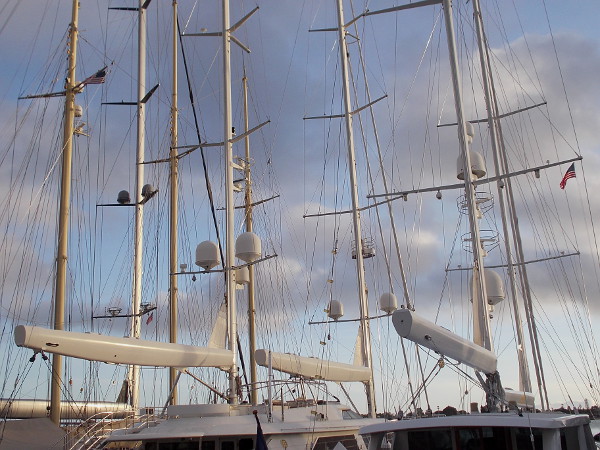
The masts of three large yachts in a row, like vertical beams of light.
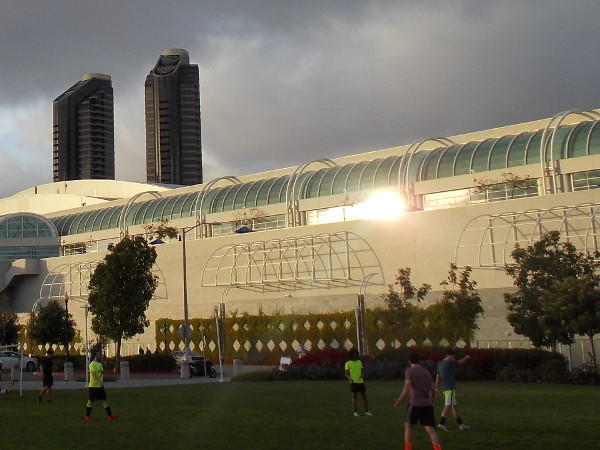
End of day approaches. The sun sets fire to a glass portion of the San Diego Convention Center.
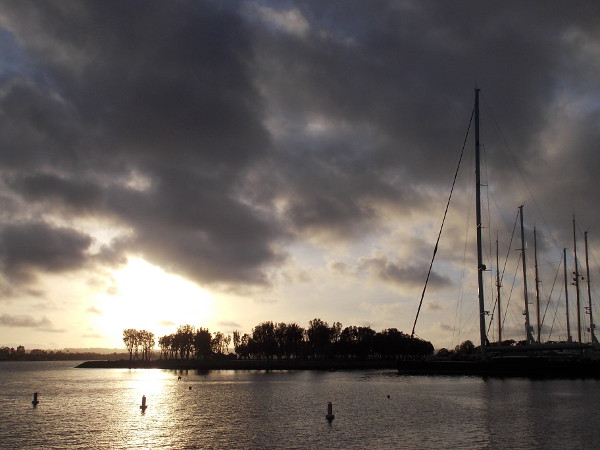
The sun is almost ready to set over San Diego Bay. Golden light now prevails.
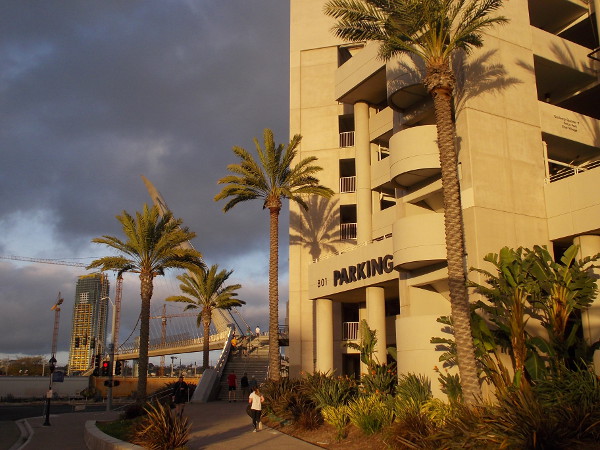
The parking structure of the Hilton San Diego Bayfront has turned gold.
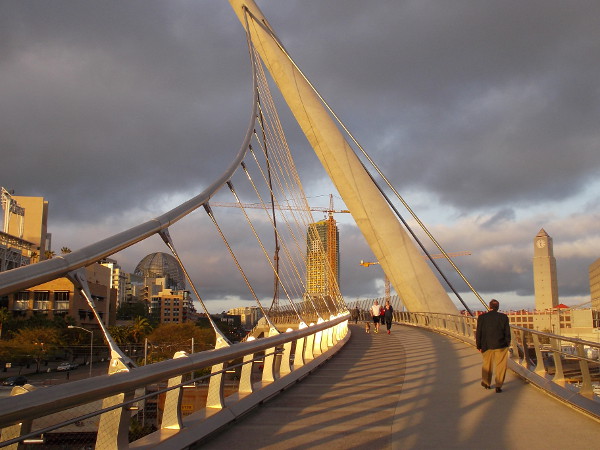
A golden pathway through the city. Amazing beauty seen during a late afternoon walk on the bridge over Harbor Drive.
A golden pathway through the city. Amazing beauty seen during a late afternoon walk on the pedestrian bridge over Harbor Drive.

I live in downtown San Diego and love to walk! You can follow Cool San Diego Sights via Facebook or Twitter!

You can easily explore Cool San Diego Sights by using the search box on my blog’s sidebar. Or click on a tag! There are thousands upon thousands of unique photos for you to enjoy!
Photos of International Mariachi Festival in National City.

A friendly Mariachi band smiles as photos are taken!
Today I rode the trolley down to the South Bay to enjoy the big 2016 National City International Mariachi Festival and Competition.

The annual cultural event takes place in Pepper Park, which is located close to where the Sweetwater River empties into San Diego Bay.

I was absolutely amazed by the color, the energy, the sheer happiness of those participating and watching. Hopefully my photos provide a taste…

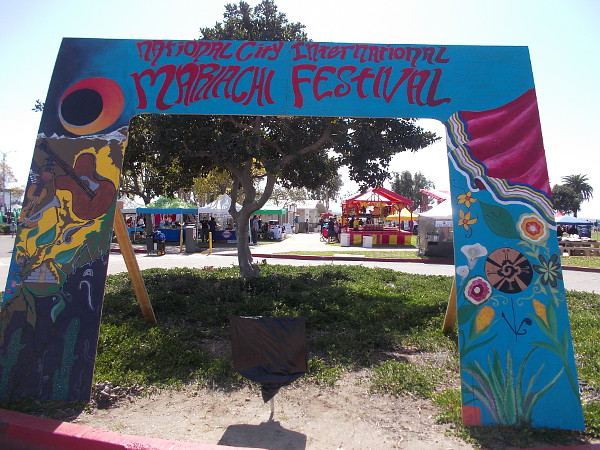
A colorful arch welcomes visitors to Pepper Park and the 2016 National City International Mariachi Festival!
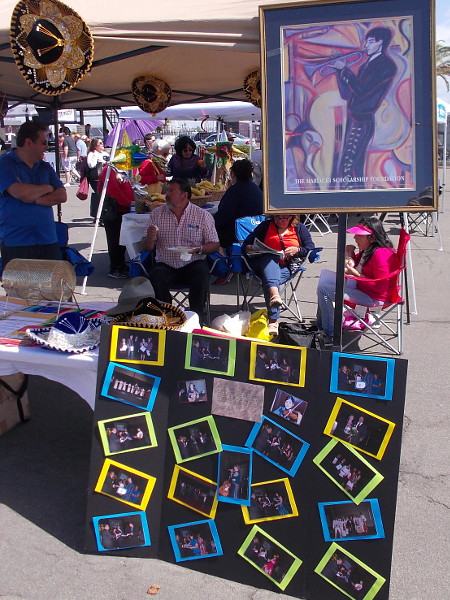
The Mariachi Scholarship Foundation has benefited many music-loving students in San Diego County.
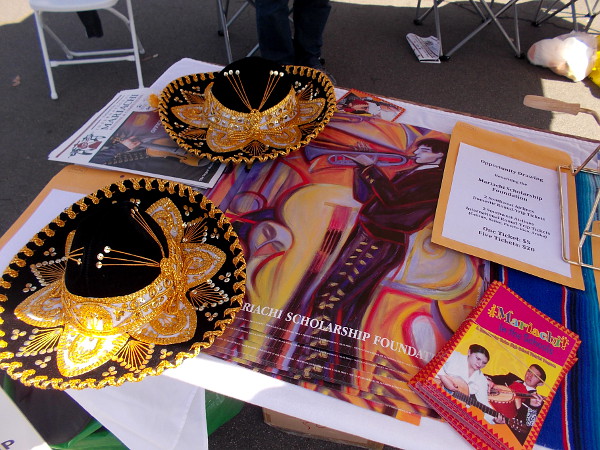
Fantastic sombreros attracted my camera at the festival's Mariachi Scholarship Foundation table.
Fantastic sombreros attracted my camera at the festival’s Mariachi Scholarship Foundation table.
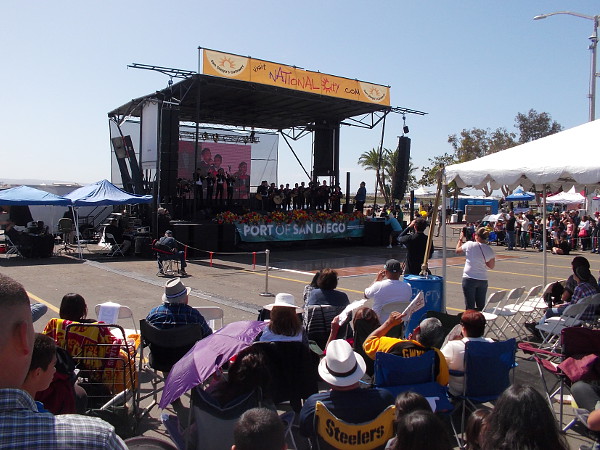
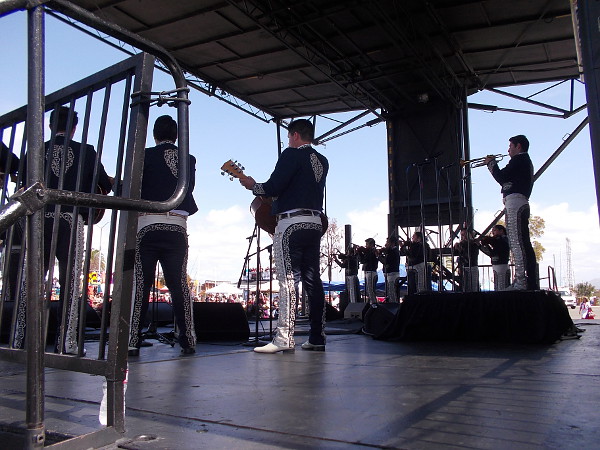
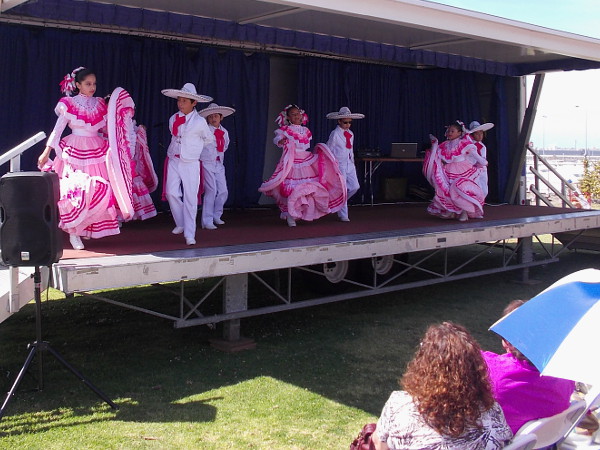
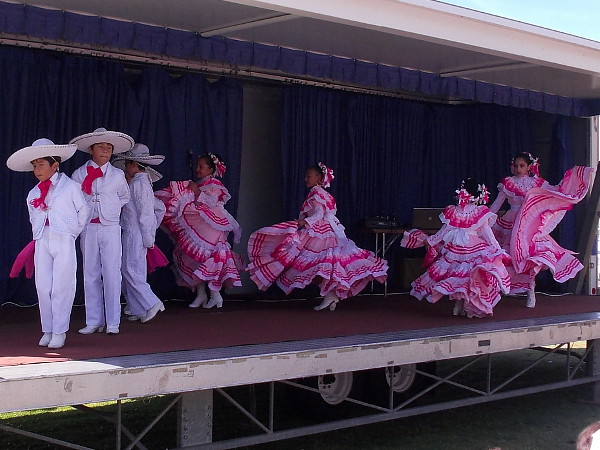
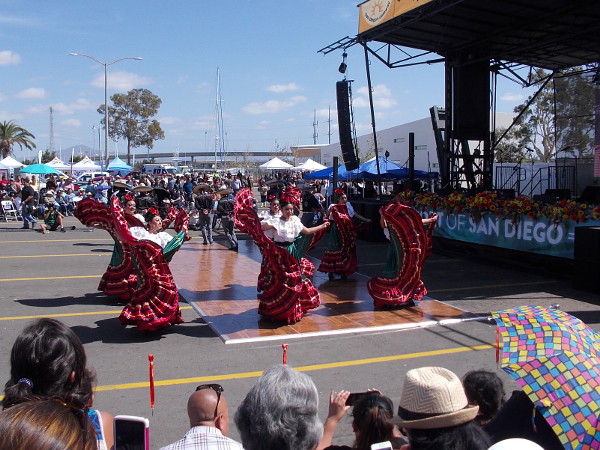
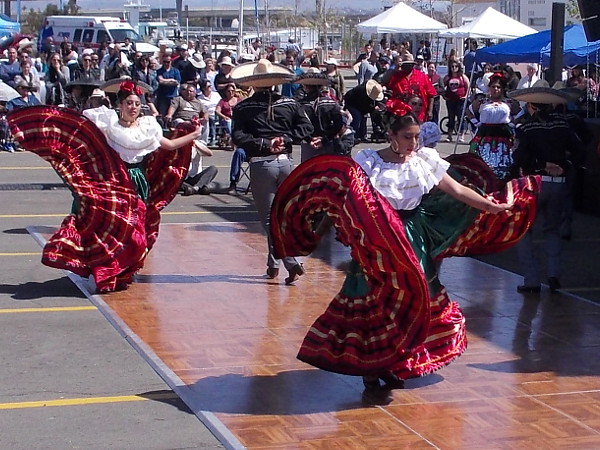
The grand stage drew the largest crowd. Many excellent Mariachi groups and baile folklorico dancers wowed the audience.
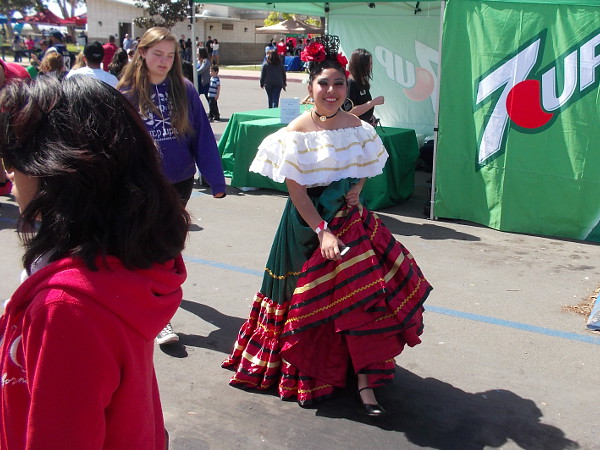
A smiling senorita at the International Mariachi Festival and Competition in National City.
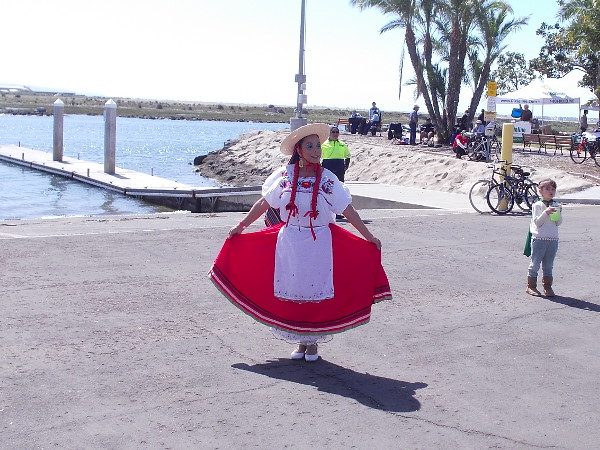
Members of Danza Folklorico Las Florecitas perform Mexican folk dances in Pepper Park.
Mariachi musicians perform on the main stage at the 2016 National City International Mariachi Festival and Competition. They received loud cheers.
A cheerful dress on a beautiful day in San Diego's South Bay. A nearby boat ramp leads into the channel of the Sweetwater River.
A cheerful dress on a beautiful day in San Diego’s South Bay. A nearby boat ramp leads into the channel of the Sweetwater River.
Colorful, energetic folklorico dancing on a smaller, non-competitive stage.
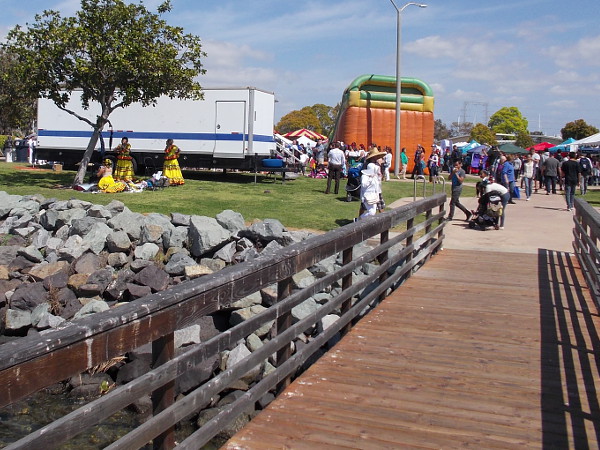
A diverse audience from San Diego, Tijuana and the surrounding region. Even many of the participants enjoyed the non-stop entertainment.
A diverse audience from San Diego, Tijuana and the surrounding region. Many of the participants also enjoyed the non-stop entertainment.
Taking a break to stretch my legs, I walked out on the short pier in National City's Pepper Park. Visible is a huge car carrier ship docked in San Diego Bay. It transported imported vehicles from Asia.
Taking a break to stretch my legs, I walked out onto the short pier in National City’s Pepper Park. Visible is a huge car carrier ship docked in San Diego Bay. It transported imported vehicles from Asia.
Looking back at the smaller stage. Some dancers wearing bright yellow are getting ready for their turn to perform.
Looking back at the rear of the smaller stage. Some dancers wearing bright yellow are getting ready for their turn to perform.
Young dancers on stage whirled, stepped smartly, then whirled again.
Mexican culture is warm, happy and lots of fun.
These ladies in costume were taking their turns at one of the festival's many prize wheels!
These ladies in traditional costume were taking their turns at one of the festival’s many prize wheels!
Dancing with joy.
Dancing with joy.
A typical scene from the annual Mariachi festival in National City.

I live in downtown San Diego and love to walk! You can follow Cool San Diego Sights via Facebook or Twitter!

Do you like to read short pieces of thought-provoking fiction? Please visit Short Stories by Richard.

Helping veterans heal through creative art.

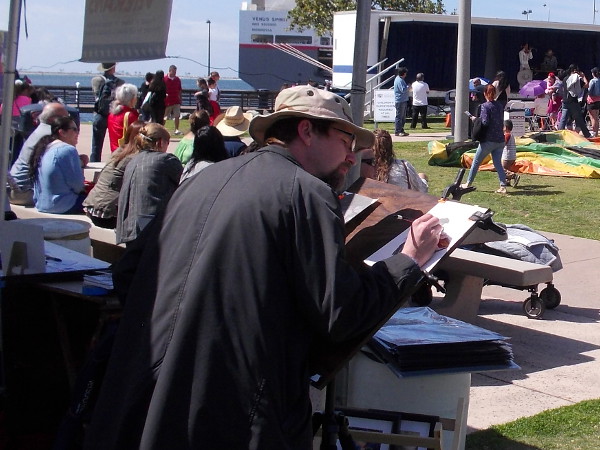
A U.S. military veteran creates art while watching folklorico dancing at a popular festival in San Diego's South Bay.
A U.S. military veteran creates art while watching folklorico dancing at a popular festival in San Diego’s South Bay.

Today I met Anthony A. LoBue for the second time. With a great big smile, he was manning his Arts For Veterans tent at the International Mariachi Festival and Competition in National City. (I chatted briefly with him once before at the Spreckels Organ Pavilion, during a special concert raising funds for Operation Rebound.)

“Tony the Vet” helps other veterans heal through creative art. He’s the founder of Support Our Veterans Association and the Arts for Veterans Project. The latter organization’s purpose is to: Engage, Educate, Employ and Empower Veterans in the Creative Arts. He provides art classes for military veterans at the Veterans Museum in Balboa Park, Veterans Village, and other places where healing, hope, wholeness and art education are welcome.

He believes the healing power of art dramatically changes lives. It’s an enormous benefit for those returning from war with psychological trauma. Art provides connection, joy, self-empowerment. Art literally saves lives.

Tony has a huge positive vision. He wants to expand his Arts for Veterans program so that it might benefit as many people as possible.

Would you please visit his website and see it you can help in some way?

Art heals. Art provides joy, connection, hope. Art helps to give life meaning and purpose.

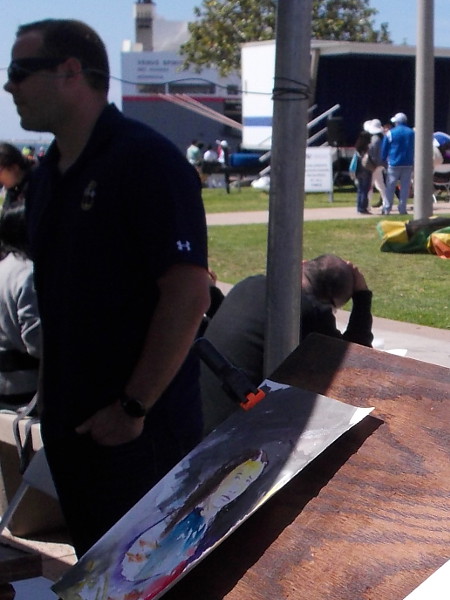
Brian Meyer was painting at the Arts For Veterans tent. I spoke to him. He’s a veteran of Desert Storm. He’s a super guy and deeply thoughtful. And his watercolors are amazing. That’s a glimpse of a work-in-progress above.  He frequently paints the live musicians at Panama 66 next to the San Diego Museum of Art. Please check out his website!

Hand-drawn art cards with hearts and flags thank service members for their sacrifice.
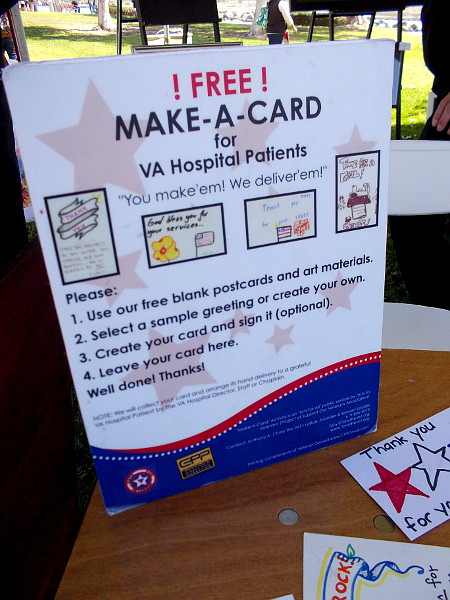
People at the International Mariachi Festival and Competition in National City were making special greeting cards for patients at the VA Hospital.
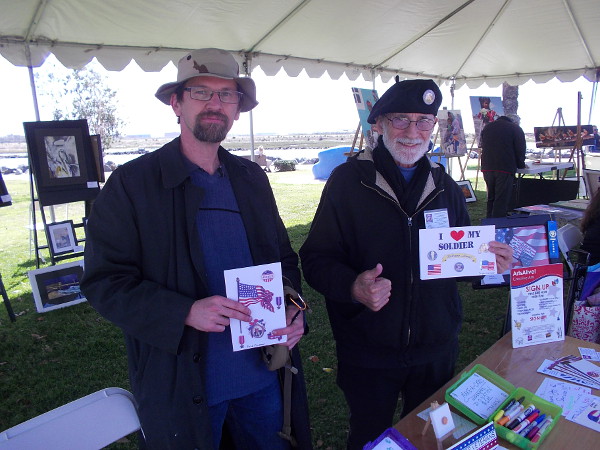
Gifted watercolor painter Brian Meyer and Anthony A. LoBue of Arts For Veterans.
Gifted watercolor painter Brian Meyer, and Anthony A. LoBue of Arts For Veterans.

I live in downtown San Diego and love to walk! You can follow Cool San Diego Sights via Facebook or Twitter!

Are you a blogger? Do you want to make the world a better place? Please join Bloggers Lifting Others Generously.