
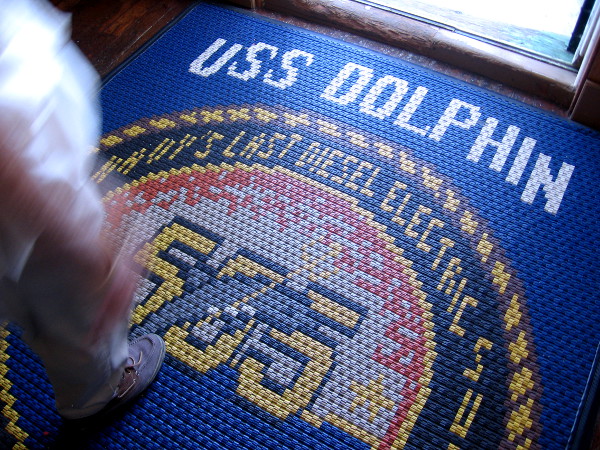
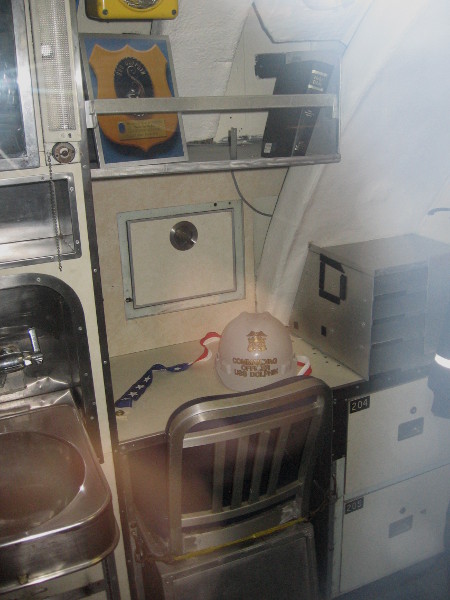
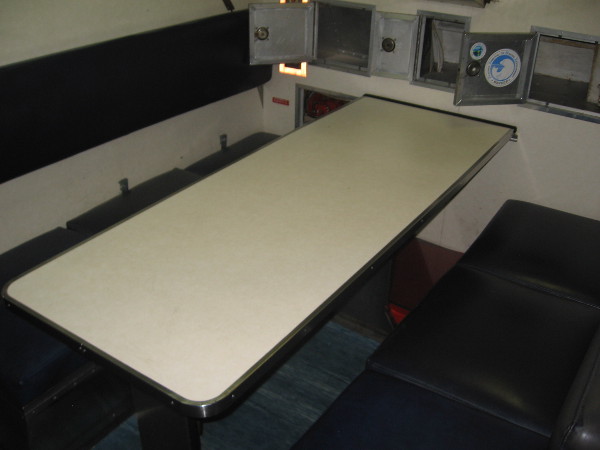
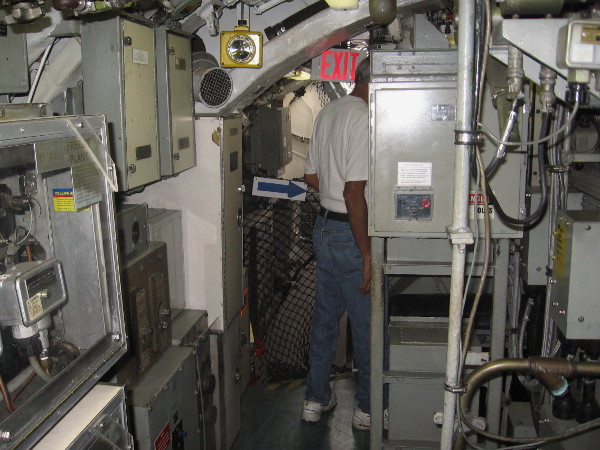
Here come some photographs taken inside the USS Dolphin, the world record deepest diving submarine!
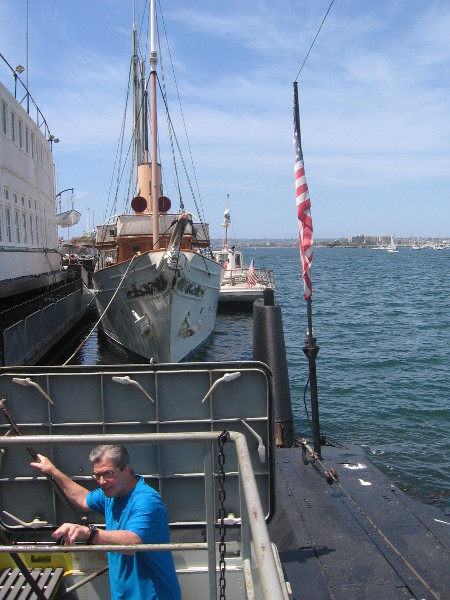
Anyone can tour the Dolphin when visiting the Maritime Museum of San Diego. The museum, located downtown on the waterfront, is home to a world-class collection of unique and historic ships.
I personally know very little about submarines. My descriptions come from various signs and a little searching performed on the internet. If you spot an error or would like to provide some info, please leave a comment at the bottom of this post!


The above Maritime Museum display includes the following information:
On November 24, 1968, barely two months after commissioning, the USS Dolphin dove to a depth in excess of three thousand feet to become the world’s deepest diving submarine…this record still stands today. The following year, in August 1969, the Dolphin achieved another world record by launching a torpedo from a depth never equaled by another submarine.
Built exclusively for research, Dolphin is responsible for many achievements. Most significant among these is her unique deep diving capability… Employed by both Navy and civilian researchers, she is equipped with an impressive array of instruments that can support multiple missions…. She is currently configured to conduct extensive deep water acoustic research, oceanic survey work, sensor trials, and engineering evaluations.
…With her decommissioning on January 15, 2007, the United States retired its last active diesel-electric submarine.

This second sign inside the Berkeley indicates:
SPECIFICATIONS
Length: 165 feet
Beam: 18 feet
Surface displacement: 860 tons
Submerged displacement: 950 tons
Propulsion: Diesel-electric
2 x GM V71 12-cylinder diesel engines, 425 hp
2 x electric main motors
2 x 126-cell main storage batteries
Submerged speed: 10 knots (short duration), 2-4 knots (sustained)
Scientific payload: 12 tons+
External mounting pads: 6 port, 6 starboard, forward and aft of sail
Crew compliment: 3 officers, 18 enlisted, 4 scientists (46 crew, all are not deployed)
Operational endurance: Over 15 days (for long deployments, Dolphin can be towed at 9-10 knots)
ACHIEVEMENTS AND CONTRIBUTIONS
First successful submarine-to-aircraft optical communication
Development of a Laser Imaging system of photographic clarity
Development of an Extreme Low Frequency (ELF) antenna
Evaluation of various non-acoustic Anti-Submarine Warfare techniques
Evaluation of various “low probability of interception” active sonars
First submarine launch of a mobile submarine simulator (MOSS) system
First successful submarine test of BQS-15 sonar system
Development of a highly accurate towed body position monitoring system
Development of a highly accurate target management system
Evaluation of a possible “fifth force of nature”
First successful submarine-to-aircraft two-way laser communication



This sign inside the submarine answers some common questions and includes the following fascinating facts:
Dolphin’s hull material is HY-80 steel…her hull is a ring-stiffened cylinder without pressure bulkheads (if she has a leak the whole boat will flood)…
When she had her torpedo tube installed, Dolphin could carry four torpedoes… After initial tests and the launch of a torpedo in 1969 from the deepest depth ever recorded, Dolphin was refitted for other research purposes, and never carried torpedoes again.
There are no visual viewing ports in this submarine…. Dolphin did carry imaging electronics for observing the bottom.
Dolphin did not have any claws for picking items off the seafloor as she was restricted to a minimum altitude of fifty feet above the bottom. One experiment launched an ROV (remote operated vehicle) with power and communication cable attached to Dolphin while submerged…


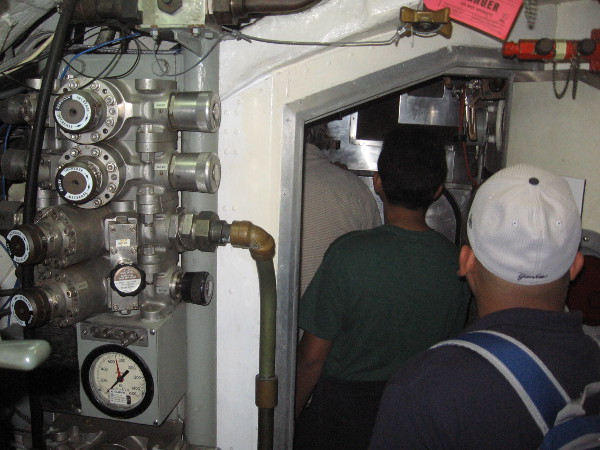


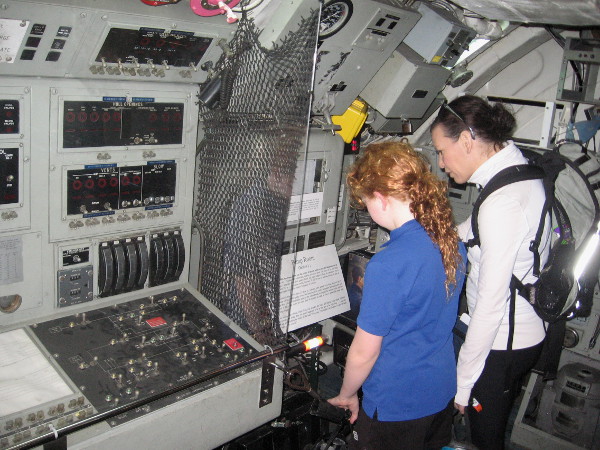
On May 21, 2002, the room below was the center of heroic action to save the submarine and crew. On that day, Dolphin was conducting training exercises about 100 miles off the San Diego coastline when a torpedo shield door gasket failed, and water began to flood the submarine…
Chief Machinist’s Mate (SW) John D. Wise Jr., realizing what needed to be done, dove into the 57 degree water of the flooded pump room…with less than a foot of breathable space…he aligned the seawater valves and then remained in the pump room for more than 90 minutes…
For his courageous efforts, Chief Wise was awarded the Navy and Marine Corps Medal.






…
To enjoy future posts, you can “like” Cool San Diego Sights on Facebook, or follow me on Twitter.

 Cool San Diego Sights!
Tight, very tight…hehe on toilet, must have been a great experience, jealous. Thanks.
LikeLiked by 1 person
If you’re tall, you’ve got to do a lot of stooping! I seriously can’t imagine being on a sub for an extended period. I’d go nuts!
LikeLiked by 1 person
One surely need to have strong mindset.
LikeLiked by 1 person
Wow, great how you could visit and look around the submarine. Must’ve been great fun to see everything, looks very cramped mind, great photos!
LikeLiked by 1 person
I kept blocking the hallway because I stood there reading signs and looking at stuff! The museum also has a Soviet submarine used during the Cold War which I’ll blog about someday!
LikeLiked by 1 person
There must have so much great stuff to see in the submarine. What a great museum, bet it will be interesting to have a look around the Soviet submarine as well!
LikeLike
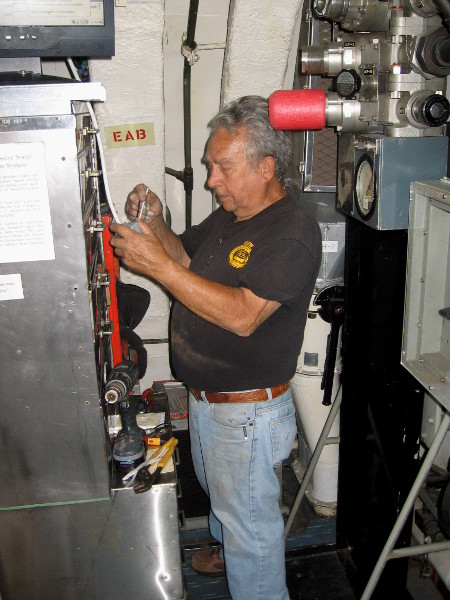
I visited the Soviet sub years ago and it was fascinating. It reminded me of many classic submarine movies. Ed, the retired submariner electrician I photographed, said he might have been tracking the exact same Soviet sub years ago, but one couldn’t tell for certain.
LikeLike
Here’s that video of San Diego, I told you about.
CR
LikeLiked by 1 person
Cool! I’ll check it out!
LikeLike
Wow! I finally had time to watch it. Incredible! Makes me love San Diego all that much more!
LikeLike
It’s not “cramped”, it’s COZY!
LikeLiked by 1 person