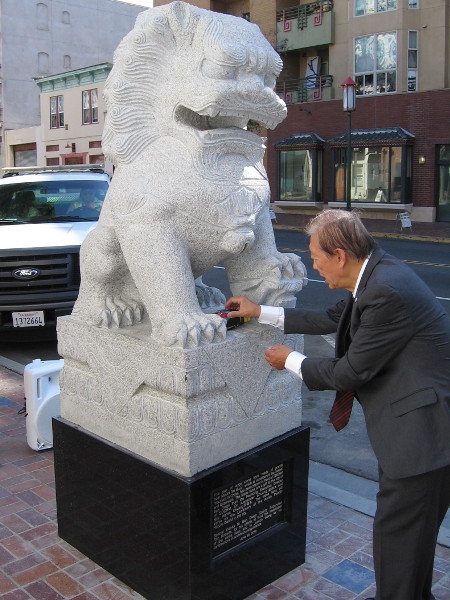
Founder of the San Diego Chinese Historical Museum, Dr. Alexander Chuang, prepares one of two stone lions for their unveiling ceremony.
This morning a ceremony was held in front of the San Diego Chinese Historical Museum. Two large stone lions were unveiled at the intersection of J Street and Third Avenue. That’s in the very heart of downtown’s Asian Pacific Historic District.
I missed the unveiling, because I had a long-reserved ticket for another nearby event which took place at the exact same time. But I did get photos of the two amazing sculptures being prepared!
The founder of the Chinese Historical Museum, Dr. Alexander Chuang, had the two beautiful lions made in China then brought to the City of San Diego. It was a generous gift and a wonderful addition to our diverse city. I was told Dr. Chuang spent 7 or 8 years on this project. The lions are carved from stone taken from Mount Tai, which is said to be the holiest mountain in China. Now I have yet another reason to look forward to walks through this fascinating part of downtown San Diego!
I briefly spoke to Dr. Alexander Chuang while he prepared the statues, and to other members of the museum. They were so very gracious! One day I’ll venture into the museum–it’s on my list of things to do. When I do, I’ll definitely share the experience.
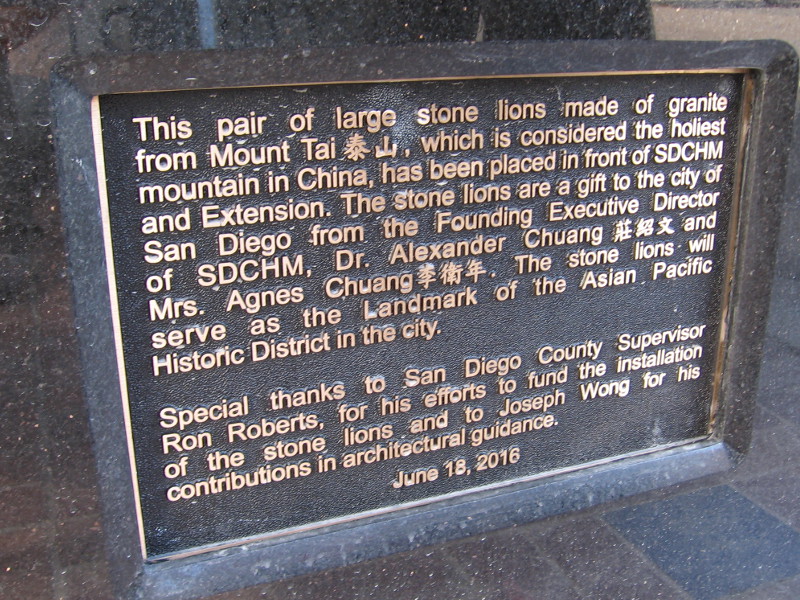
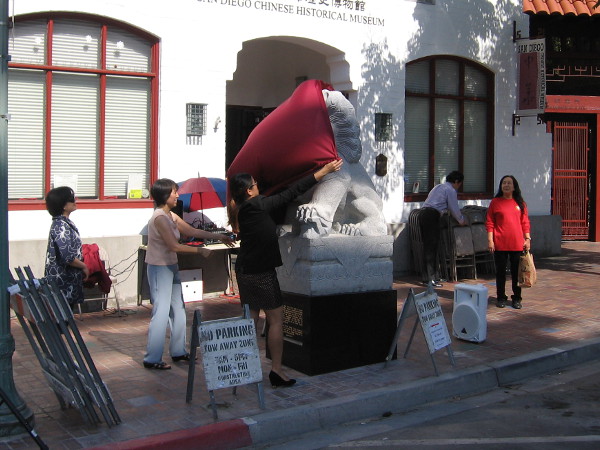
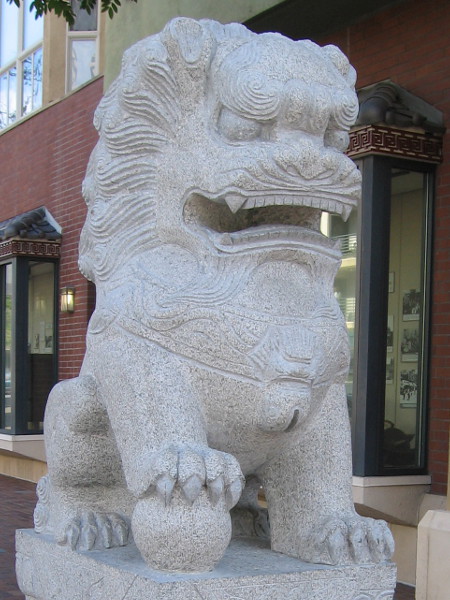
Plaque describes pair of large stone lions made of granite from Mount Tai, considered the holiest mountain in China. They will be a landmark of the Asian Pacific Historic District of San Diego.Final preparations are made about an hour before the unveiling. I got a sneak peek just by walking around with my camera!Members of the San Diego Chinese Historical Museum drape one of the two stone lions. I got my early photos just in time!On the opposite side of Third Avenue, the second lion stands guard. Another very cool sight has been added to the city of San Diego!
…
I live in downtown San Diego and love to walk! You can follow Cool San Diego Sights via Facebook or Twitter!
You can easily explore Cool San Diego Sights by using the search box on my blog’s sidebar. Or click a tag! There are thousands upon thousands of fun photos for you to enjoy!
View of skyscrapers from Pantoja Park in San Diego’s Marina District.
Downtown San Diego might be a bit more laid back than other big cities, but it’s still a bustling place. And so it feels good once in a while to just sit in a quiet, green place to relax.
Pantoja Park is a welcome patch of tranquility in the Marina District of downtown San Diego. Registered as a San Diego Historic Landmark, it was created in 1850 and is the city’s oldest park. The park was named after Don Juan Pantoja y Arriola, a Spanish navigator who drew the first map of San Diego Bay in 1782. A couple centuries ago ships would periodically enter the bay to supply the old Spanish presidio.
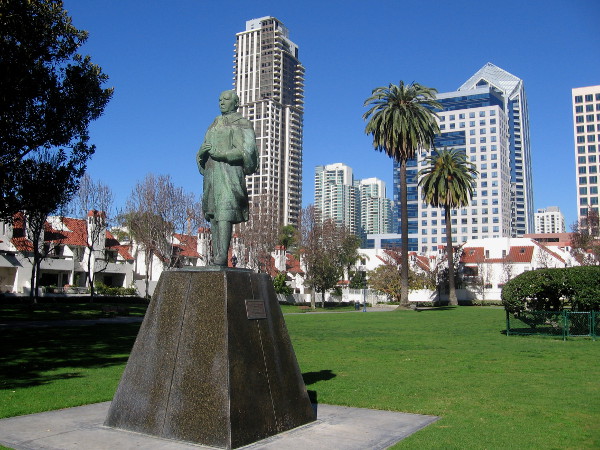
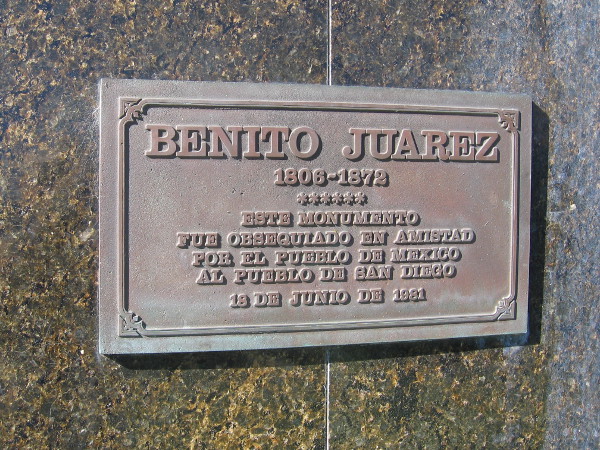
Fringed with gleaming skyscrapers, Pantoja Park today contains one notable sight: a statue of Benito Juarez, by Mexican artist Ernesto Tamariz, which was a gift to San Diego from the Mexican government in 1981.
I happened to walk through recently, so I took several pics…
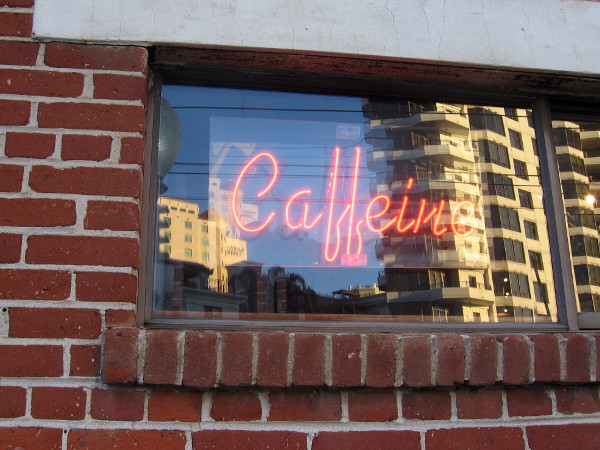
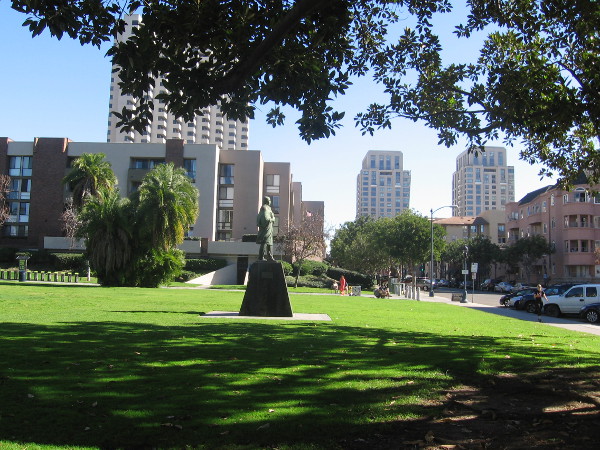
Statue of Benito Juarez, a friendly gift from the Mexican government.Plaque on bronze statue of Benito Juarez, who served as the president of Mexico for five terms.Some cool public art on a trash can in Pantoja Park.Caffeine can be found across the street near the Seaport Village trolley station.Pantoja Park is a welcome, quiet grassy area in the midst of downtown San Diego’s bustle.
UPDATE!
Here’s a better pic of the statue I took on a later date…
…
To enjoy future posts, you can “like” Cool San Diego Sights on Facebook or follow me on Twitter.
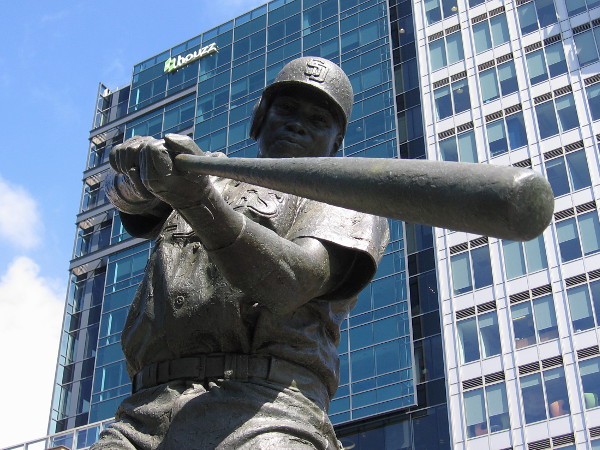
New Cisterra building rises behind Tony Gwynn statue at Petco Park in East Village.
As the local economy has improved, I’ve noticed a spate of new construction underway in downtown San Diego. Several skyscrapers are on the rise!
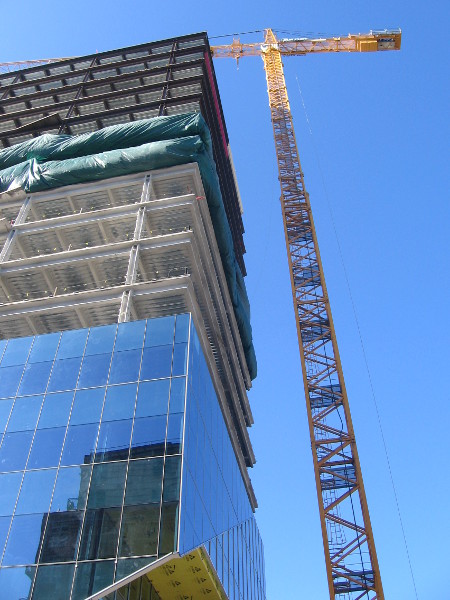
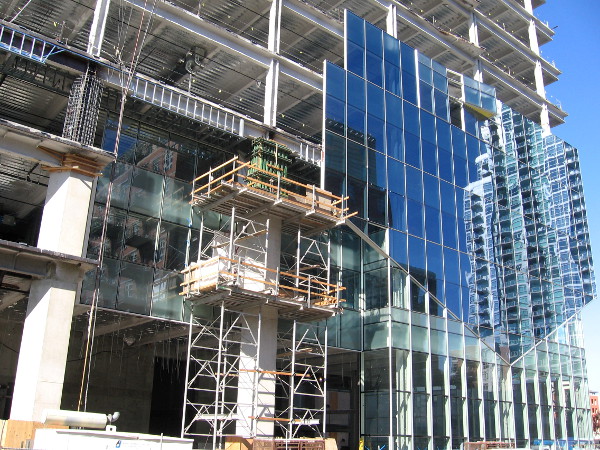
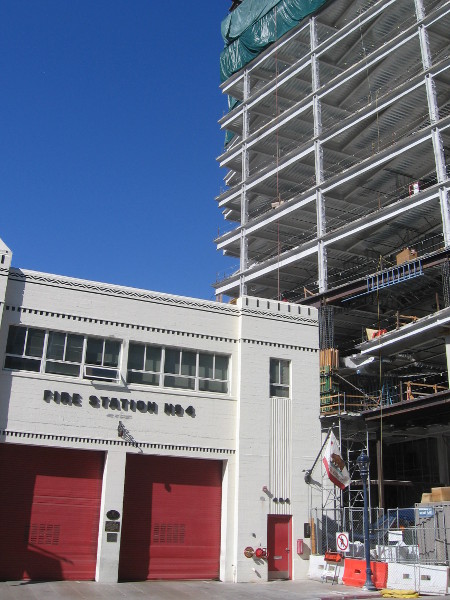
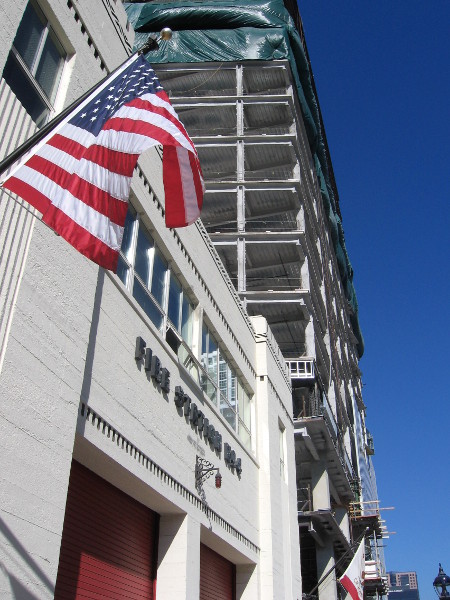
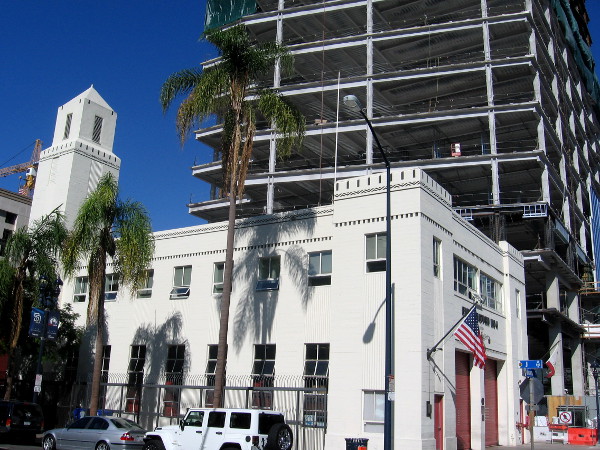
Last weekend I walked past the rapidly progressing Cisterra building which will overlook East Village. It stands just a block north of Petco’s Park at the Park. The future home of gigantic Sempra Energy, the high-rise is being built directly next to one of San Diego’s most interesting old buildings: Fire Station 4. The beautiful little firehouse is San Diego’s oldest, dating from the 1930’s. Once the shiny new skyscraper is completed, the two buildings side-by-side will create quite a contrast!
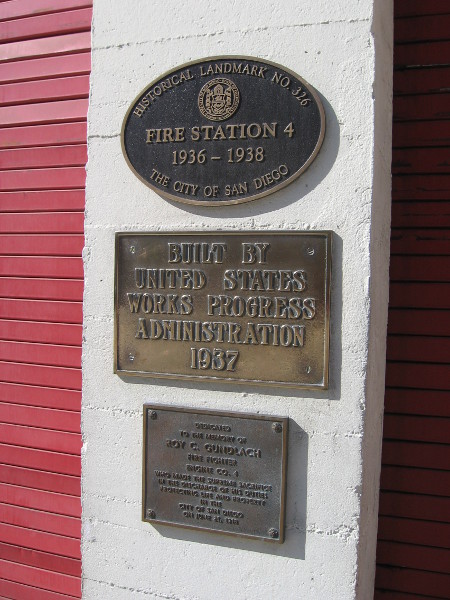
New skyscraper in San Diego to be headquarters of Sempra Energy.Steel lattice, glass grid and odd reflections make for an interesting photo.Construction of this gleaming high-rise can be observed in downtown San Diego.Stately little Fire Station No. 4 beside new modern skyscraper.This is the oldest firehouse in San Diego, in service since 1938.Fire Station 4, built as a New Deal WPA project, is a designated historical landmark.Beautiful old San Diego firehouse at the foot of what will be a shiny new skyscraper.
Here’s a bonus pic which I took on a morning in early February…
A rising skyscraper shines brightly in the early morning.
…and another I took in March…
Fire Station Number 4 at base of silvery, shiny new skyscraper.
…
To enjoy future posts, you can “like” Cool San Diego Sights on Facebook or follow me on Twitter.
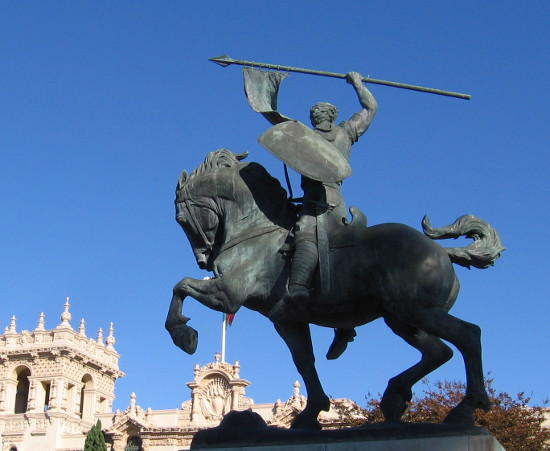
El Cid sculpture in Balboa Park, by artist Anna Hyatt Huntington.
Near the center of Balboa Park, between the San Diego Museum of Art and the Spreckels Organ Pavilion, you’ll find a 23-foot high bronze statue of El Cid. The legendary hero of Spain is mounted on his horse Babieca and proudly holds a spear and shield.
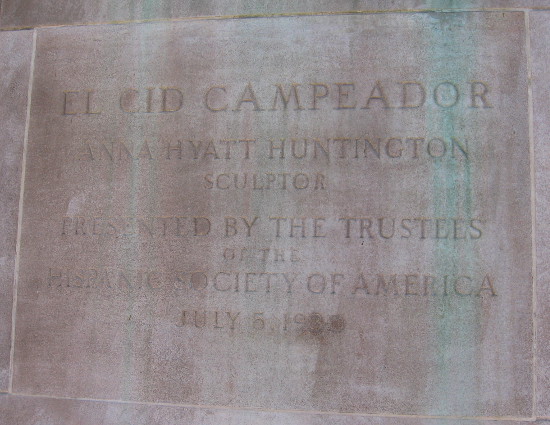
The striking sculpture is formally called El Cid Campeador and was created in 1927 by Anna Hyatt Huntington, a famous American sculptor who during her life won numerous awards and commissions. Most known for her lifelike animal sculptures, she is remembered for being the first woman to create a public monument in New York City. Her Joan of Arc was also New York City’s first monument dedicated to a female historical figure.
Anna Hyatt Huntington was married to Archer Milton Huntington, a wealthy philanthropist and art enthusiast, who founded The Hispanic Society of America. He made the very first contribution to the nearby San Diego Museum of Art, in the form of the painting María at La Granja, by famed Spanish post-impressionist painter Joaquín Sorolla y Bastida.
The El Cid in Balboa Park is one of several identical statues. The original stands in front of the Hispanic Society in New York City. Other copies stand in Seville, San Francisco, and Buenos Aires.
It seems that when the statue was installed in Balboa Park in 1930, there was a good deal of public comment about the horse’s unsightly posterior, and a debate over the direction it should face! To the relief of many, the horse’s rear end faces away from the central square and nearby buildings!
A much smaller horse sculpture by Anna Hyatt Huntington can be enjoyed a short distance to the north of El Cid, right next to the San Diego Museum of Art. It’s called Youth Taming the Wild.
El Cid Campeador, presented by the Hispanic Society of America in 1930.El Cid, with Balboa Park’s House of Hospitality in the background.East side of El Cid. The Mingei Museum is in background.Balboa Park’s free shuttle passes the El Cid statue on a sunny day.
…
To enjoy future posts, you can “like” Cool San Diego Sights on Facebook, or follow me on Twitter.
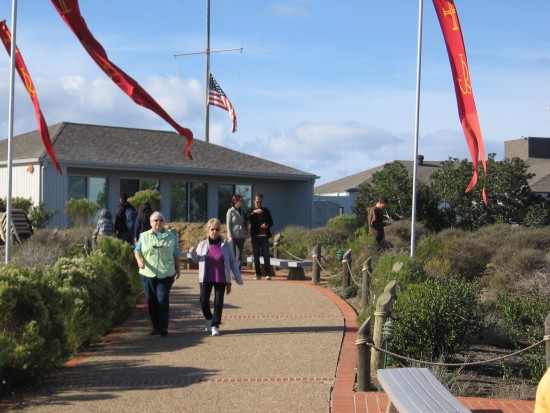
People near Visitor Center enjoy Cabrillo National Monument’s centennial.
Here are some pics I took Sunday during the second day of Cabrillo National Monument’s centennial celebration.
Cabrillo National Monument is located at the tip of the Point Loma peninsula. The hilly peninsula helps to enclose San Diego Bay and is a perfect lookout over both the ocean and harbor. The park includes most notably the historic Old Point Loma Lighthouse and a 1988 replica of the original statue of Juan Rodriguez Cabrillo that was commissioned by the Portuguese government in 1935. It also includes military bunkers that were used to protect the bay during World War II, and a very popular whale-watching lookout.
The park this year turned one hundred years old. In 1913 Woodrow Wilson reserved a portion of Fort Rosecrans on the Point Loma peninsula for a statue of Cabrillo. Unfortunately, a statue was not immediately forthcoming, and the park’s development became the work of many decades.
The work in progress continues today. My last visit was a few years ago, and this time I noticed many big changes and improvements!
The first photo shows a bunch of people near the Visitor Center, on the walkway that leads out to the Cabrillo statue.
Various informative displays in front of Visitor Center for the centennial event.
For the centennial event, many community and government organizations had exhibits near the entrance to the Visitor Center. This pic shows what appeared to be the most popular table. The friendly lady had numerous snakes that fascinated young and old alike.
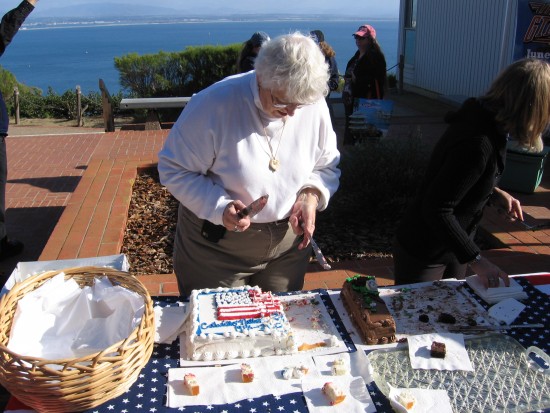
Yummy centennial cake was served to all park visitors.
Everybody enjoyed a small slice of birthday cake!
Statue of Juan Rodriguez Cabrillo overlooks the ocean.
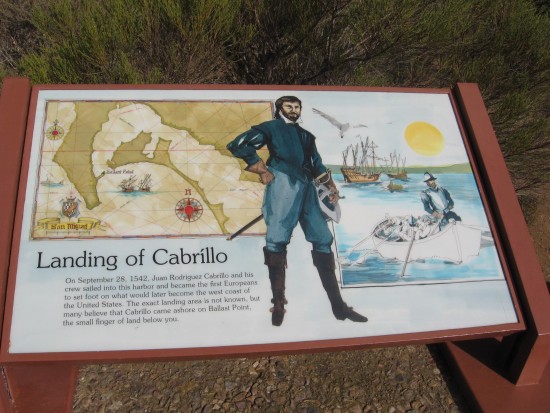
Here’s the iconic statue of Juan Rodriguez Cabrillo, the Portuguese explorer who sailed into San Diego Bay on behalf of Spain nearly five hundred years ago. It stands not far from the Visitor Center overlooking both the bay and Pacific Ocean.
Park sign shows where Cabrillo entered San Diego Bay in 1542.Distant view of Cabrillo statue and Coronado Island.
As I walked up the hill to observe a reenacted air raid drill from World War II, I looked back at this beautiful view. Great views can be had at Cabrillo National Monument looking in almost any direction!
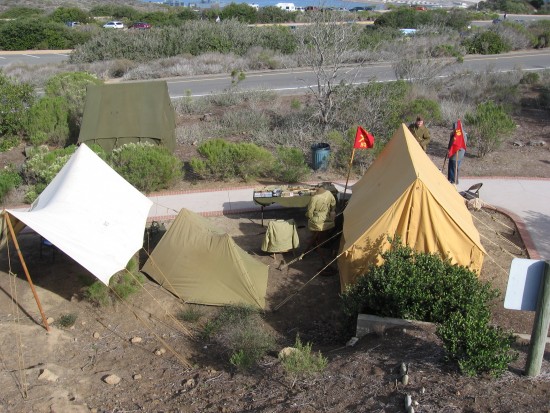
Tents of Army camp set up as historical reenactment.
These tents and some nearby vehicles were on display for the centennial. During World War II, after the Japanese attacked Pearl Harbor, many feared an attack on San Diego. So defenses were quickly erected. In addition to a number of observation bunkers, a few gun emplacements were situated along the end of Point Loma to defend the mainland and bay.
A small museum nearby includes many photographs, recordings and artifacts from that period in San Diego’s history.
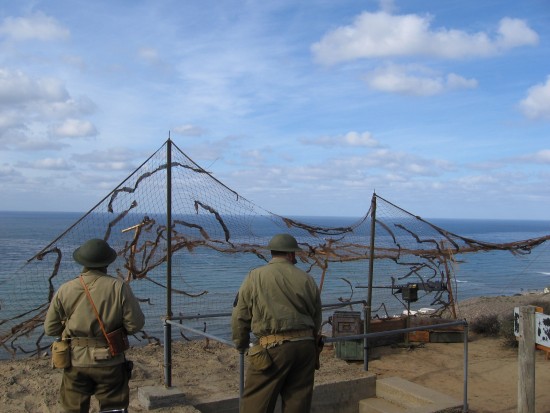
Mock air raid drill recalls duties during World War II.
At eleven o’clock, a mock air raid was staged! An aircraft from nearby Naval Air Station North Island swept over the bluffs as World War II veterans and enthusiasts looked on from the hilltop near some old bunkers.
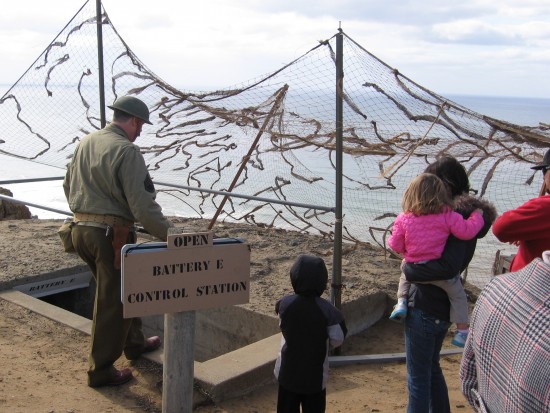
Visitors head into Battery E bunker used during World War II.
After the air raid, we all took turns going down into Battery E.
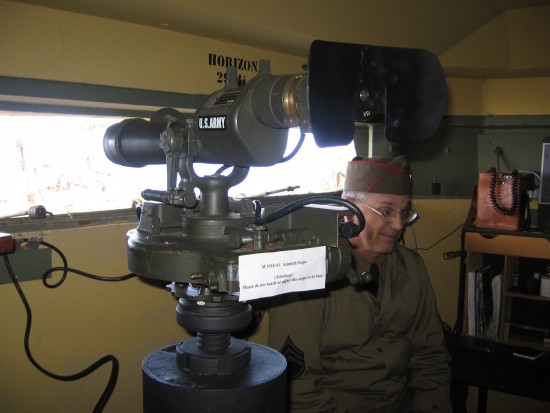
A look inside Battery E and equipment to sight enemy ships.
We were surprised at what we found! The flash of my camera illuminated the small semi-dark bunker, capturing this instrument used to scan the horizon for Japanese warships during World War II.
A chart inside the bunker identifies Japanese warships.
Down a nearby ladder was a second small room containing beds for those who stood watch at all hours.
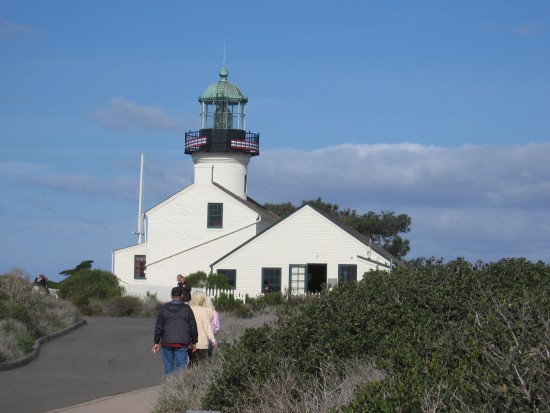
People walk toward the old Cabrillo lighthouse.
A short distance from Battery E is the historic Old Point Loma Lighthouse. From 1855 to 1891 it stood as a beacon for those entering San Diego Bay, before being replaced by an automated lighthouse down near the water. This old lighthouse is one of San Diego’s most well-known sights!
A museum by the old lighthouse includes the first Fresnel lens to be used by the automated New Point Loma Lighthouse.
A small museum near the lighthouse’s entrance is worth a quick look. It includes an amazing Fresnel lens that magnified light to help sailors out at sea.
Front of the historic lighthouse and its large rainwater basin.
A large flat area in front of the lighthouse was used by the keeper and his family to capture rainwater. Back then this lighthouse stood isolated, far from the small town across the water that grew into metropolitan San Diego.
Recreated family room in Cabrillo lighthouse includes Christmas tree.
Several furnished rooms in the lighthouse are on display behind glass. Very little space was available to accommodate the keeper and his family. In addition to this main room, there’s a kitchen area, closet, and two bedrooms up the winding stairs.
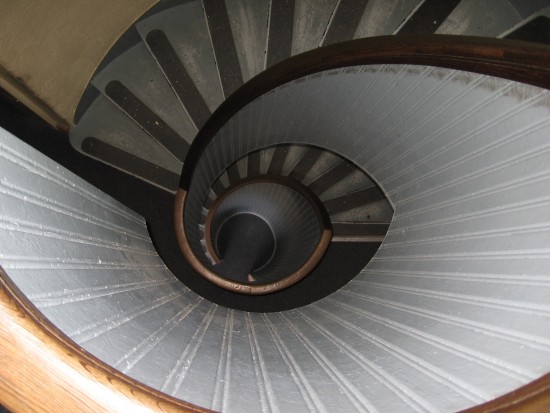
Looking down winding stairs from top of Cabrillo lighthouse.
Speaking of the stairs, I couldn’t resist taking this pic!
Another view of Point Loma’s historic old lighthouse.
Another great look.
Grey whale sculpture near Pacific Ocean overlook.
Interesting sculptures, artwork and signs can be found at the Pacific Ocean overlook. During the winter months, you can see gray whales spouting as they travel between the Arctic and Baja California.
A good place to spot migrating gray whales during the winter months.
You can see where the tidepools are below. I didn’t go down to the water on this trip, but it’s a fun place to see all sorts of sea creatures!
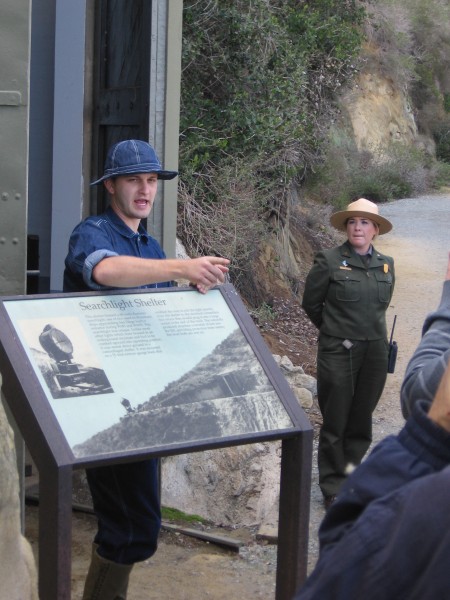
Walking down to Bayside Trail and folks who will talk about history.
At noon there was a guided hike down the Bayside Trail. We walked down a short road to the trailhead, where an old military truck waited with some folks dressed in historic uniforms. They would show us some interesting stuff down the trail.
Group walks down Cabrillo Bayside Trail on a December day.
Here we go down the Bayside Trail. The lady park ranger showed us a large number of native plants, including Coastal Sage, Lemonade Berry, Prickly Pear and more. The flora you see here is what is natural to the area. San Diego is located in a semi-arid zone, with very little precipitation. Most of the trees and other plants you see around town are not native.
A spotlight protected San Diego Bay during World War II.
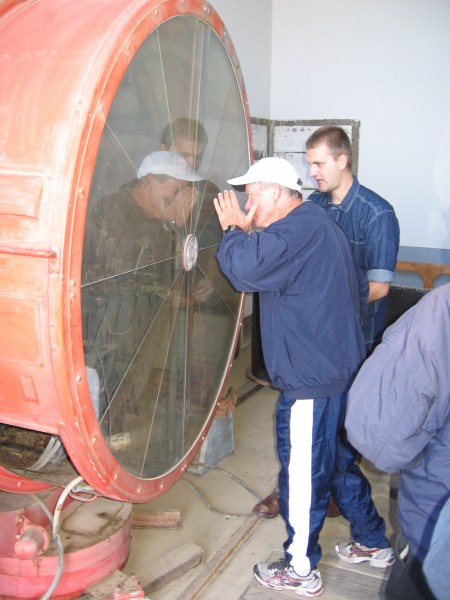
We’ve come to a small structure built into the hillside that houses an old electric spotlight. The huge lamp was used to watch the San Diego Bay’s entrance during World War II. It rolled out on a pair of tracks and plugged into an outlet that you can see by the trail.
Inside the small structure we look at the huge wartime spotlight.
My camera’s flash brightly illuminated the old spotlight inside.
Further down the trail is the spotlight’s generator building.
Now we’ve walked down to the electrical generator building–really just two small empty rooms. Usually these structures are closed to the public.
Rounding a corner of the sandstone cliff San Diego comes into view.
The group turned back, but I walked on…
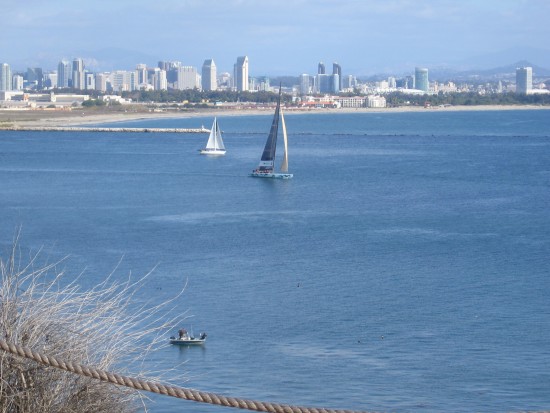
America’s Cup boat Abracadabra sails down the San Diego channel.
And I was rewarded with this view. Having lived in San Diego a good many years, I recognized the large sailboat leaving San Diego Bay. It’s the Abracadabra, a boat used in a past America’s Cup. I also spotted the Stars and Stripes, just out of this picture.
Beyond downtown San Diego I could see numerous mountains, from Cuyamaca on down to Otay. When it snows in the mountains, San Diego has a snow-capped backdrop viewed from here!
One last fond look at the beautiful Cabrillo National Monument lighthouse.
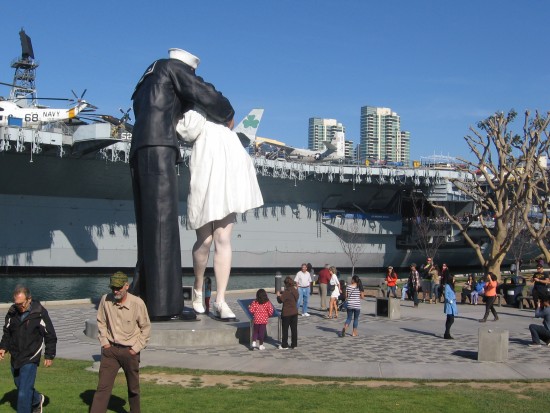
Unconditional Surrender statue on San Diego’s Embarcadero near the USS Midway Museum.
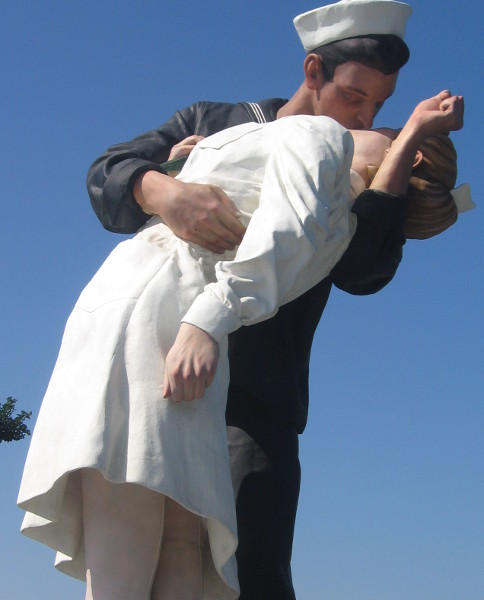
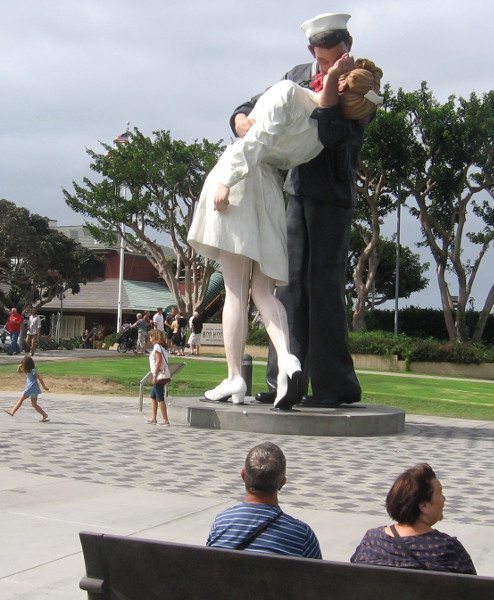
This large statue is amazingly popular with tourists visiting San Diego’s Embarcadero. Tour buses park in the nearby parking lot and throngs of people stand beneath the kissing sailor and nurse, snapping photos. Many couples joyfully imitate the dramatic pose. Critics say the statue is too kitsch, but I disagree! It perfectly represents a moment in time: the end of the Second World War.
Referred to by many as The Kiss, this huge sculpture was created by the artist Seward Johnson. Its proper name is Unconditional Surrender. It’s based on a photograph taken during V-J day in New York’s Times Square. An American sailor, overjoyed at the news of the war’s end, grabbed a random nurse nearby and gave her a spontaneous kiss. The photograph became world famous.
A temporary Unconditional Surrender statue was originally placed at this site, but it was replaced with a permanent bronze version in 2012. Unlike most other monuments and memorials located on the Greatest Generation Walk, just south of the USS Midway, this statue is so enormous it can be glimpsed from several points on San Diego Bay.
Sailor overjoyed that war is over plants a big kiss!Sailor applies The Kiss to a nurse at the end of World War II.Sitting on nearby bench on a cloudy day.People gather about Seward Johnson’s Unconditional Surrender.
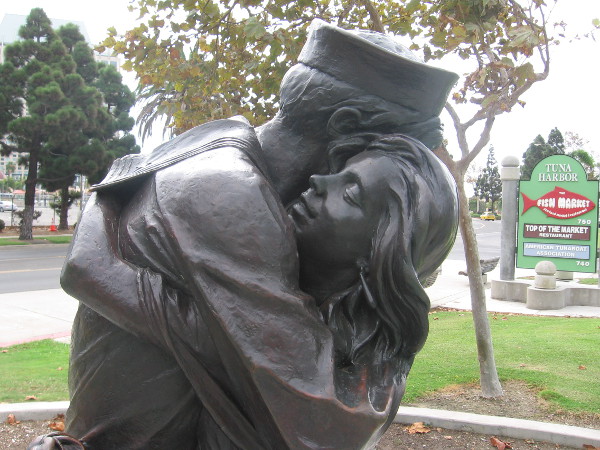
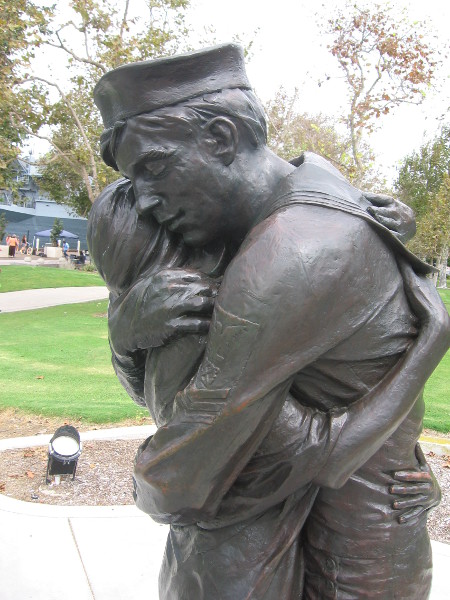
I love this statue. It’s located on the Embarcadero a little south of the USS Midway, just off a bike and pedestrian path, in an area called the Greatest Generation Walk. Other statues, plaques and memorials can be found in the vicinity, but this bronze sculpture expresses such genuine feeling and humanity, it’s hard to take one’s eyes from it.
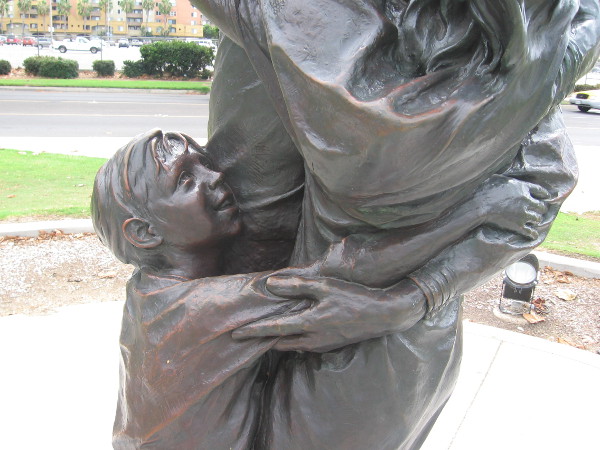
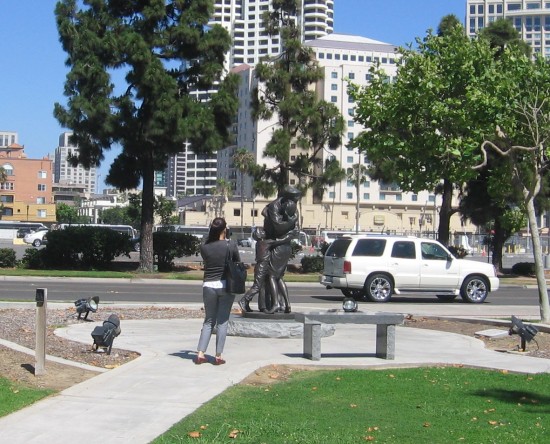
It’s called Homecoming. It depicts a sailor newly returned from deployment, reunited with his wife and small child. It’s a scene often televised by local news stations. San Diego is home to several large Navy bases, and is the homeport of many naval ships.
The artist who created this is named Stanley Bleifeld. According to the Port of San Diego website, this sculpture is identical to the artist’s original work, which is featured at the entrance to the Naval Heritage Center next to the Navy Memorial in Washington, D.C.
View of touching public art from different direction.Love and thankfulness depicted on face of a Navy wife.Sailor’s expression of love.Child is happy that Dad is home from deployment.Woman photographs Homecoming sculpture.
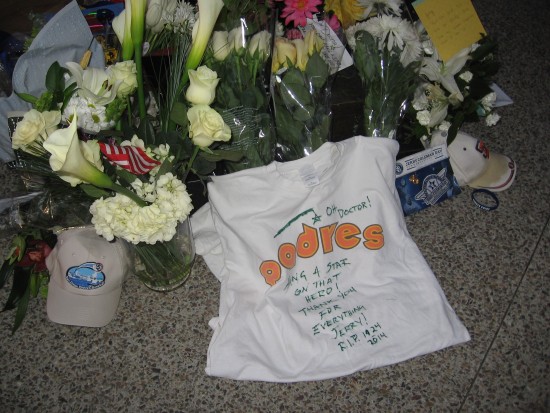
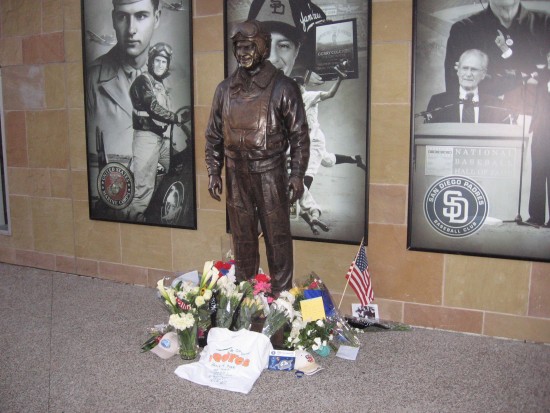
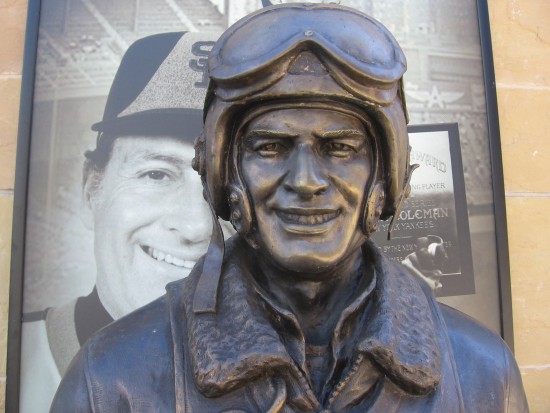
Another very well-liked person in San Diego is Padres radio announcer Jerry Coleman. His accomplishments have been so impressive, he’s got a statue and memorial at Petco Park, just inside the east entrance to the Park at the Park.
I remembering listening to Jerry when I was a kid. At the time he did the Padres radio play-by-play, and was teamed with Dave Campbell who provided color commentary. Today, at the lively age of 89, he takes part in the broadcast during day games.
Jerry, also known as “The Colonel”, was named major league baseball Rookie of the Year in 1949 as Yankees second baseman. In 1950 his defensive plays made him most valuable player in the World Series.
As a Marine aviator, Lieutenant Colonel Jerry Coleman interrupted his baseball career to serve in the Korean War. He flew 120 combat missions and received two Distinguished Flying Crosses. He also flew during World War II, making him the only major league baseball player to serve in two wars.
Jerry, famous for his enthusiastic phrases “Oh, Doctor!” and “You can hang a star on that baby!” was inducted into the National Radio Hall of Fame in 2007.
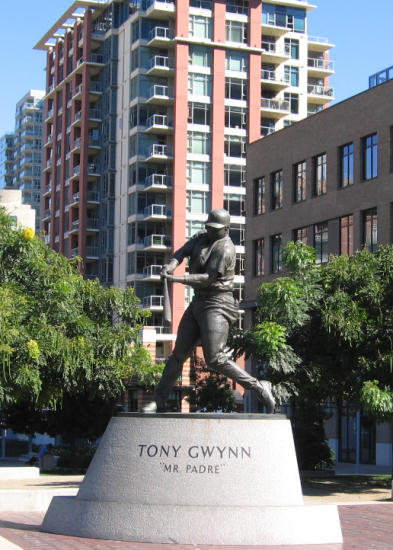
A good argument can be made that the most-liked person in San Diego is Tony Gwynn. He’s one of the friendliest, most good-natured guys you’ll ever find, not to mention one of the best hitters ever in the history of baseball. He was voted to the National Baseball Hall of Fame the first year he was eligible. He’s also got a great statue in East Village at the center of Petco’s Park at the Park. You’re looking at it!
Tony Gwynn, affectionately called Mr. Padre, played 20 years for the San Diego Padres, winning eight batting titles and five Gold Glove awards. He appeared in the Major League Baseball All-Star Game 15 times! Today he’s the head baseball coach for San Diego State University.
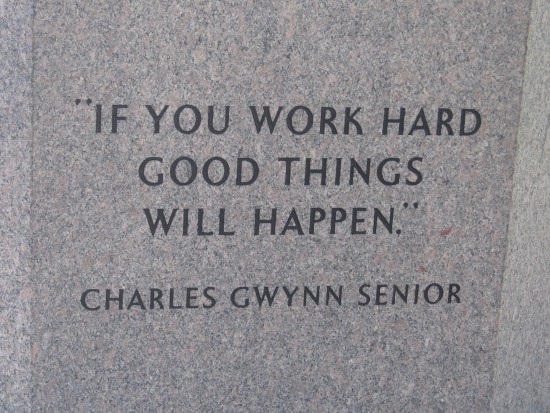
Tony Gwynn statue with Showley Bros. Candy Factory in background.Inspirational words of Tony Gwynn’s father.
A quote from Tony’s father Charles appears on the statue’s base: “If you work hard good things will happen.” These words inspired one of the greatest hitters in the history of professional baseball.
UPDATE…
Here are a few closer photos that I took years later, after the tragic passing of Tony.





























 Cool San Diego Sights!