Photos of amazing model train layout in Old Town!

A jaw-dropping night scene in a huge model train layout in Old Town San Diego!
The jaw-dropping night scene of a gigantic model train layout in Old Town San Diego!

During my walk through Old Town San Diego today, I stepped through an ordinary door into a fantastic dream! Before me stretched a positively enormous model train layout!

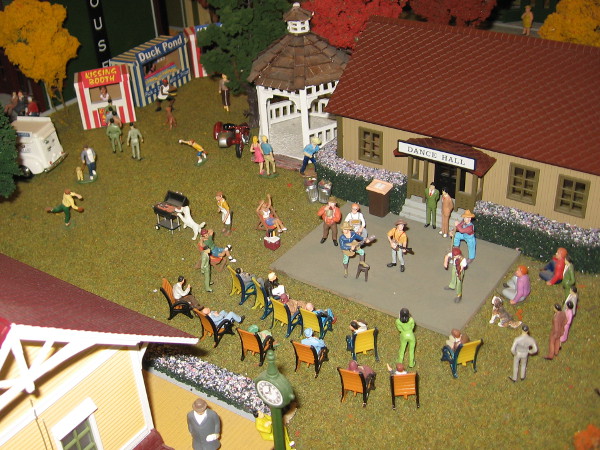
The Old Town Model Railroad Depot is a truly amazing attraction that anyone would enjoy seeing. The gigantic layout features O-Scale model trains, and as you can see in these photos, just lots of fun buildings, landscapes, moving figures and special effects.

I must say, in my opinion this layout even beats the two awesome O-Scale layouts at the San Diego Model Railroad Museum in Balboa Park. Now that really took some doing!

And the two guys I spoke to at the Old Town Model Railroad Depot were really friendly! Next time I walk past, you can be sure I’ll venture inside again!

The Old Town Model Railroad Depot is a cool attraction featuring a gigantic 2500 square feet layout for O-Scale model trains!
The Old Town Model Railroad Depot is a cool attraction featuring a gigantic room full of working model trains!  It’s one of the largest O-Scale layouts in the country!
Fun gifts, artwork and items for model train hobbyists can also be purchased at San Diego's unique Old Town Model Railroad Depot.
Fun gifts, artwork and items for model train hobbyists can also be purchased at San Diego’s unique Old Town Model Railroad Depot.
A locomotive for sale among other fascinating stuff.
A locomotive for sale among other unique and fascinating stuff.
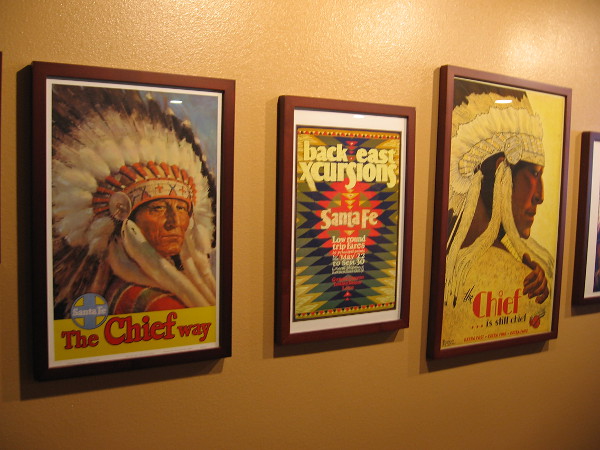
Lots of nostalgic railway artwork decorates the walls.
Lots of nostalgic historical railway posters decorate one wall.
The huge train layout has two halves--one represents daytime, the other night. Kids can stand on platforms to see--and hear--all the action.
The huge train layout has two halves–one represents daytime, the other night. Kids can stand on platforms to see–and hear–all of the exciting action.
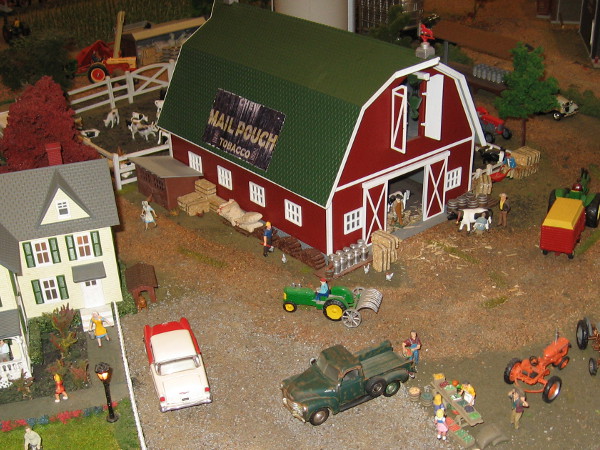
Many model buildings populate the O-Scale train layout. It's the same scale used by classic Lionel Trains.
Many model buildings populate the O-Scale train layout. It’s the same scale used by classic Lionel Trains.
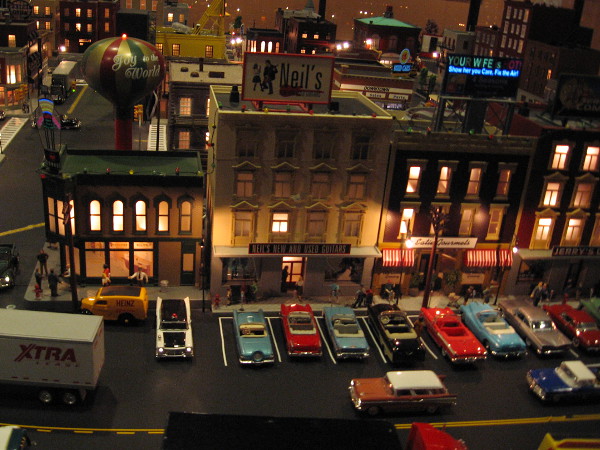
Tiny human figures and vehicles can be spotted everywhere one looks on the realistic layout.
I really enjoyed the night side of the layout. It seemed even more realistic and dynamic. Special lighting effects include fireworks bursting over a stadium and lightning stabbing down from clouds!
A tiny mechanic works in a tiny garage on a tiny truck.
A tiny mechanic works in a tiny garage at night on a tiny truck.
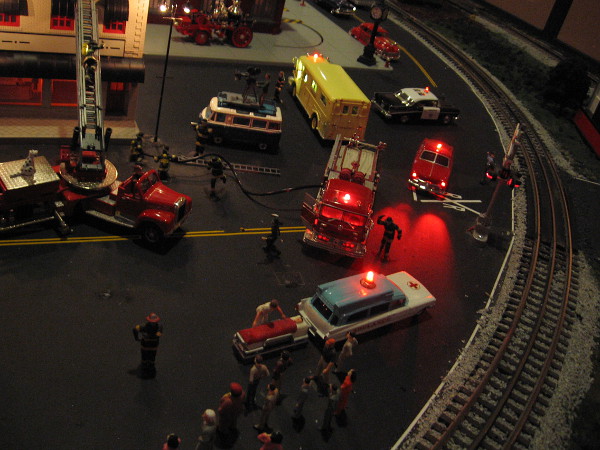
A detailed scene recreates firemen fighting a fire at night.
A detailed scene recreates firemen fighting a fire at night. I see miniature police, an ambulance, reporters and a small crowd of evacuated people!
Your kids will go crazy. You have to see it to believe it. And it's free! But leave a donation!
Your kids will go crazy. You have to see it to believe it. And it’s free! But leave a donation!

UPDATE!

I stepped into the Old Town Model Railroad Depot a second time! And I loved it even more than my first visit!

I met Gary Hickok, the creator of this stupendous layout, and learned he has been collecting the various pieces you see for 15 years. There are hundreds of tiny unique human figures, and they all seem to tell a story. Their unique poses are all part of a huge, bustling scene. The stories are often humorous!

Here are some more random photos that came out okay. These were all taken on the “day side” of the O-Scale model train layout. I hope you enjoy them!

IMG_3451z

IMG_3455z

IMG_3457z

IMG_3463z

IMG_3479z

IMG_3481z

IMG_3497z

I live in downtown San Diego and love to walk around with my camera! You can follow Cool San Diego Sights via Facebook or Twitter!

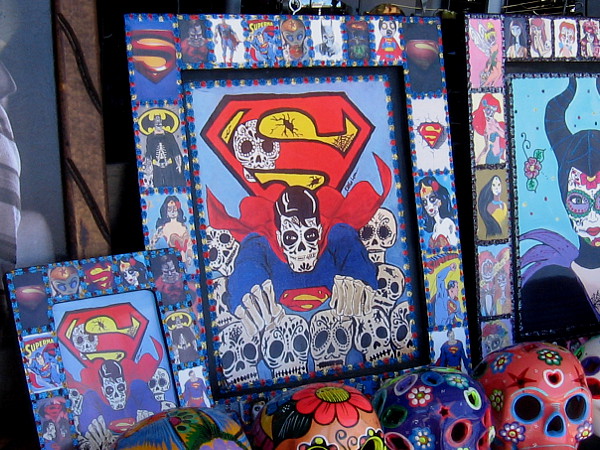
Day of the Dead characters from Justice League!

Day of the Dead (Día de los Muertos) art rendition of Justice League heroes, including Superman and Batman.

A good number of pop culture fans follow Cool San Diego Sights, because every year I cover San Diego Comic-Con and post tons of cosplay photos. So here’s something I saw today during my walk through Old Town that DC Comics readers might really enjoy!

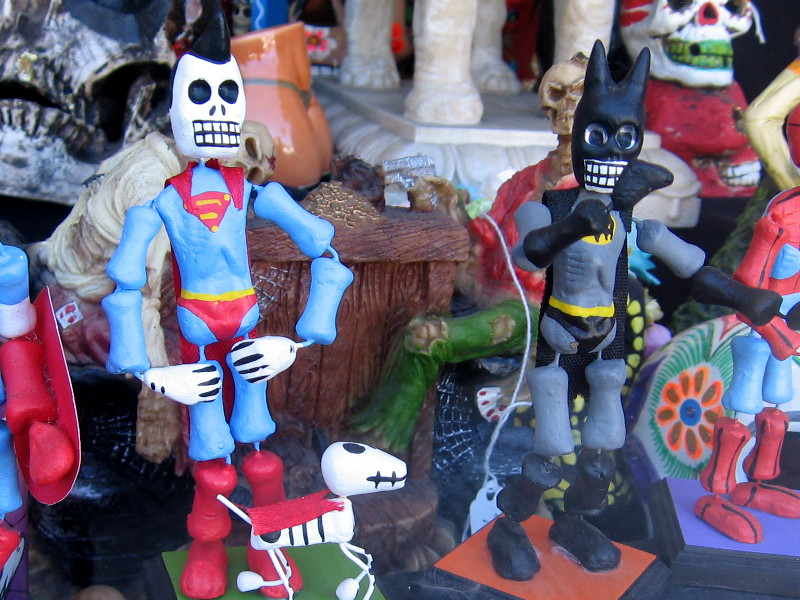
In the window of a shop called Cielito Lindo were all sorts of Day of the Dead ornaments and gifts. And among all the colorful artwork were Batman, Wonder Woman, Superman, and his super-dog Krypto!

Day of the Dead is a beloved Mexican holiday that is very popular here in San Diego. In Spanish it’s called Día de los Muertos. Skulls and skeletons, which abound during the Day of the Dead, traditionally represent deceased loved ones.

As you can see, Day of the Dead inspires all sort of creative, unexpected art! No subject matter escapes its decorative influence! Even the mighty Justice League!

Day of the Dead (Día de los Muertos) art depicts DC Comics super-heroine Wonder Woman.
Day of the Dead (Día de los Muertos) art depicts popular DC Comics super-heroine Wonder Woman.
A skeletal Superman flying through skulls.
Fun skeleton artwork celebrating Day of the Dead (Día de los Muertos). The figures are Superman, his dog Krypto, and Batman!

I live in downtown San Diego and love to walk around with my camera! You can follow Cool San Diego Sights via Facebook or Twitter!

You can easily explore Cool San Diego Sights by using the search box on my blog’s sidebar. Or click a tag! There are thousands upon thousands of photos–including many of Comic-Con and all sorts of cosplay–for you to share and enjoy!

History comes alive at Mormon Battalion Commemoration Day.

Folks enjoy taking a ride in an old-fashioned covered wagon in Old Town San DIego during 2017 Mormon Battalion Commemoration Day.
Folks enjoy taking a ride in an old-fashioned covered wagon in Old Town San Diego during 2017 Mormon Battalion Commemoration Day.

I’ve got lots of colorful photos! The annual Mormon Battalion Commemoration Day was held today in Old Town San Diego State Historic Park. I covered this event last year, but I love history and scenes from the Old West so much that I swung by again!

San Diego’s history is remarkably diverse, considering our city is relatively new, and that it is situated in what for a long time was a thinly populated, desert-like wilderness. Many peoples and cultures have converged to help shape our dynamic city, including the original Native American Kumeyaay, missionaries from Spain, Mexicans who have called San Diego home, immigrants from Asia, an influx of Italian and Portuguese fishermen, and among many others, the Mormons.

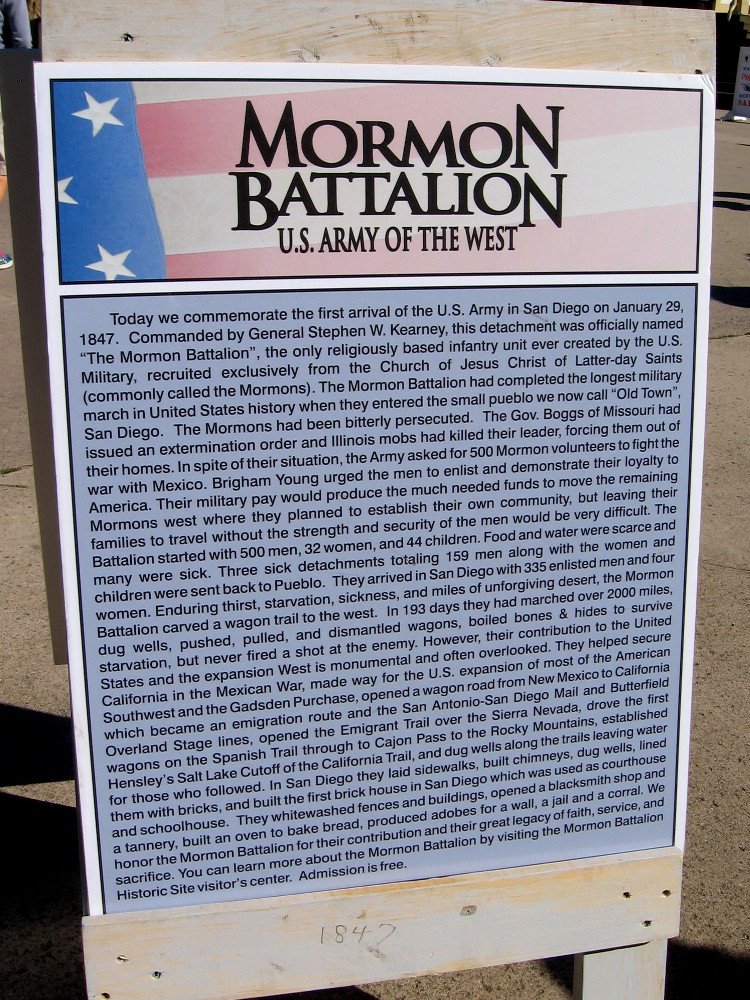
Please enjoy these photos and click the big sign that provides a little more background about the event and the historical importance of the Mormon Battalion in San Diego. More information can also be found on my previous blog post concerning the event last year. Check the related links below!

The public was welcome to swing by the annual Mormon Battalion Commemoration in Old Town. There were many historical reenactments and costumes to see.
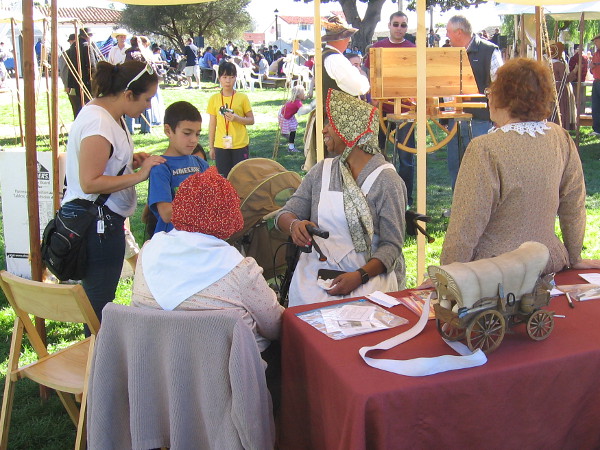
One tent concerned letters home, featuring historical journals, maps and genealogy.
Today we commemorate the first arrival of the U.S. Army in San Diego on January 29, 1847. This detachment was called The Mormon Battalion, recruited from the Church of Jesus Christ of Latter-day Saints. (Click image to enlarge the sign if you'd like to read it.)
Today we commemorate the first arrival of the U.S. Army in San Diego on January 29, 1847. This detachment was called The Mormon Battalion, recruited from the Church of Jesus Christ of Latter-day Saints. (Click image to enlarge the sign if you’d like to read it.)
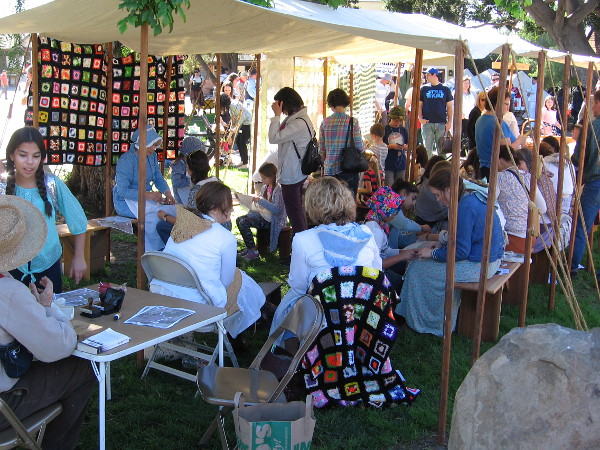
Lots of interesting historical activities were being enjoyed by a large, enthusiastic crowd.
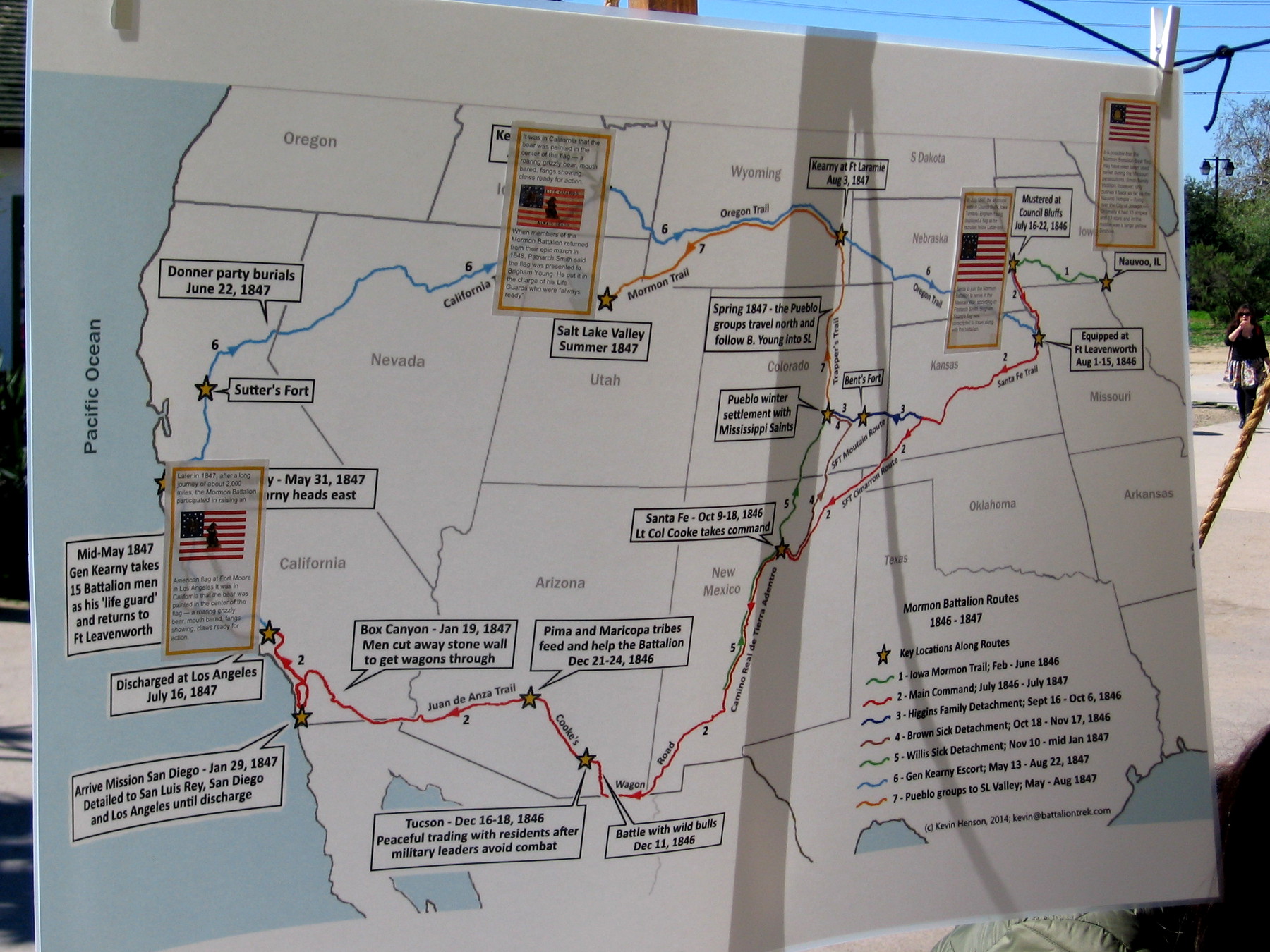
Map shows Mormon Battalion Routes 1846 - 1847. The soldiers, recruited by the U.S. Army to fight in the Mexican-American War, undertook the longest military march in United States history.
Map shows Mormon Battalion Routes 1846 – 1847. The soldiers, recruited by the U.S. Army to fight in the Mexican-American War, undertook the longest military march in United States history.  After arriving, they helped to build early San Diego.
People draw the star and bear symbols of the California Republic.
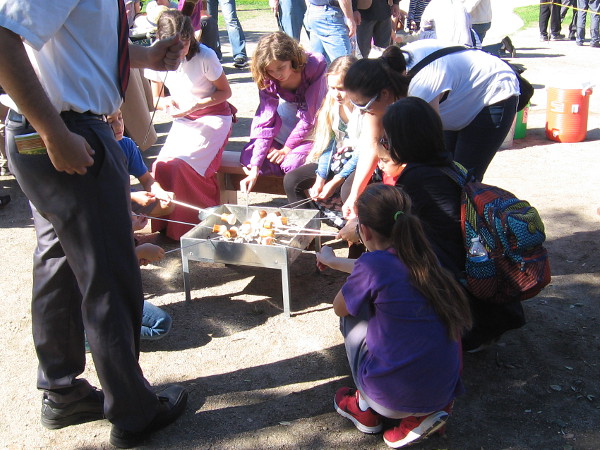
I believe these folks were making biscuits, a staple of the Old West.
I believe these families were making biscuits, a staple of the Old West.
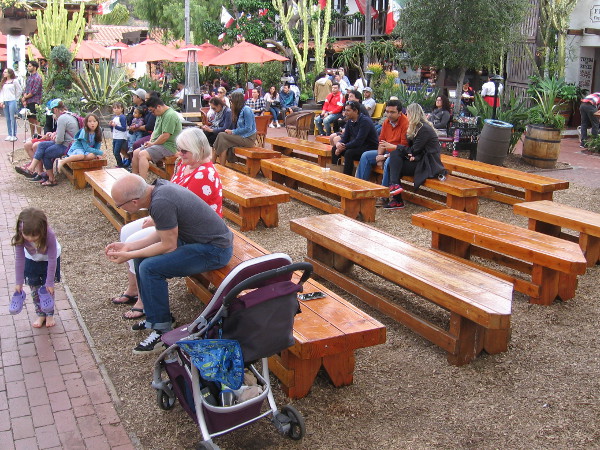
Guys in pioneer clothing just kick back in plastic chairs and watch some dancing and musical entertainment during the event.
Guys in pioneer clothing just kick back by plastic chairs and watch some dancing and musical entertainment during the event.
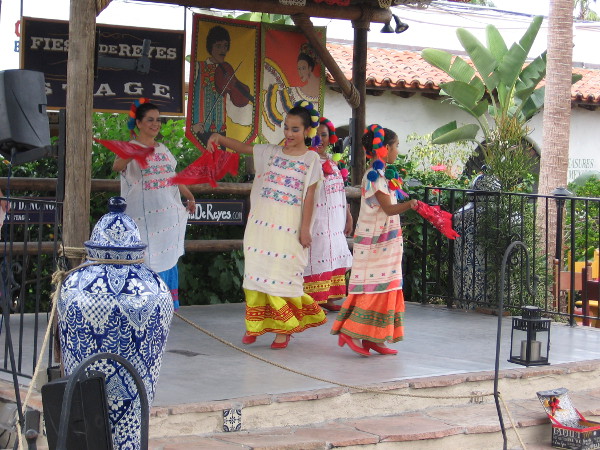
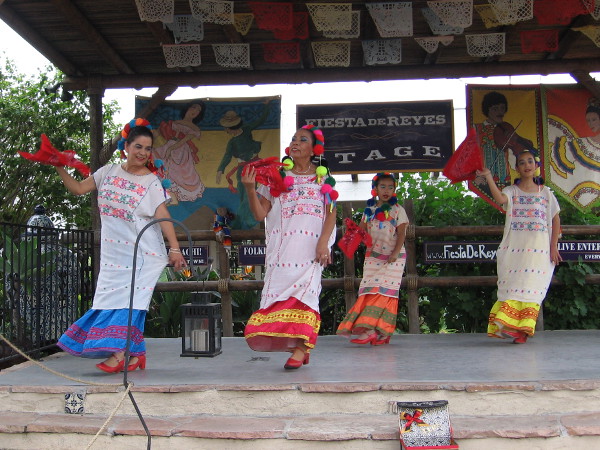
Some colorful, joyful Mexican folklorico dancing on stage in Old Town San Diego!
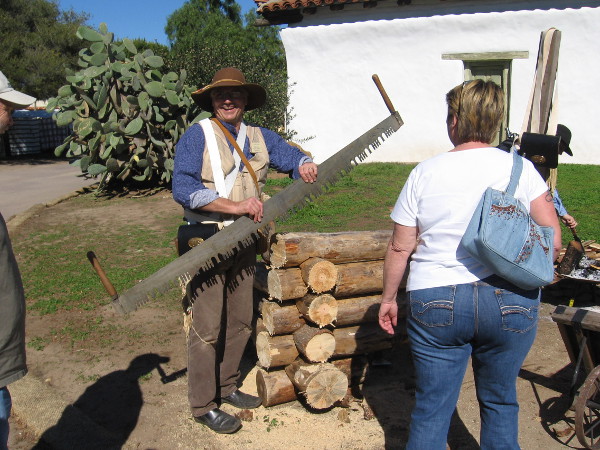
This guy with the huge saw was demonstrating another aspect of life in old San Diego.
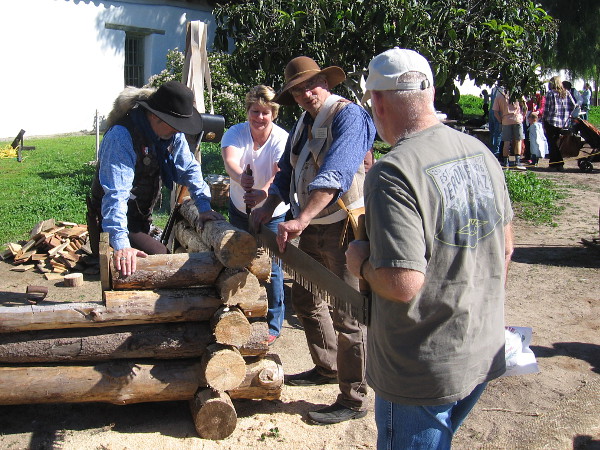
Visitors to Mormon Battalion Commemoration Day try their hand at sawing a thick log!
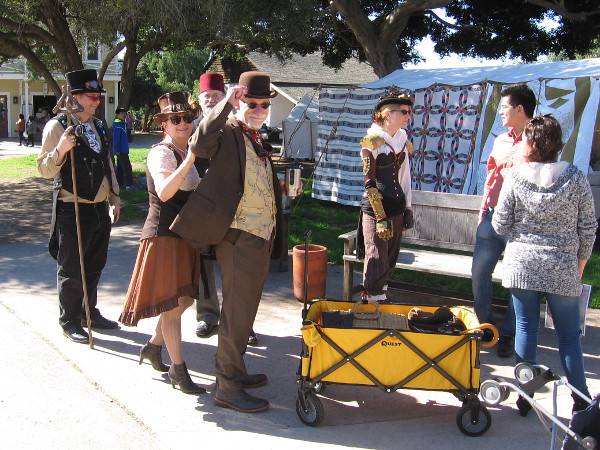
A bunch of steampunk enthusiasts were attending the historical event!
A fez and a golden arm. These guys should be in some sort of cool adventure movie!
A fez and a golden arm. These guys should be in some sort of cool adventure movie!  Perhaps they belong in a blimp!
Like last year, a tent showed people how bricks were once made in San Diego.
These assembled bigwigs were judging a Dutch Oven Bake-off!
Scouts and other youth learn how rope was once made, using twisted fibers from native Yucca cacti.
Lots of folks were in one tent learning about and making frontier dolls.
Lots of folks, old and young, were in one tent learning about and making frontier dolls.
Some mountain men were camped at the Black Hawk Livery Stable, near the Old Town blacksmith shop.
A sign tells about various Western trailblazers, including Jedediah Smith, Kit Carson and Jean Baptiste Charbonneau.
Five anvils!
Five anvils!
Shaping red hot iron in the old blacksmith shop.
These guys are keeping the ancient art of blacksmithing alive in a high tech world.
Running out onto the wide grassy area behind Seeley Stable. Like travelling back in time.
Some beautiful quilts on display during Mormon Battalion Commemoration Day in Old Town San Diego.
Kids were learning how acorns were mashed by the Kumeyaay and others in San Diego's early history.
Kids were learning how acorns were mashed by the Kumeyaay and others in San Diego’s early history.
Someone poses for a photo with an old rifle.
History, culture and period costumes. I saw many smiles in Old Town.
History, culture, bonnets and period dress. I saw many smiles in Old Town.
People in nostalgic frontier garb and a modern t-shirt with a jolting urban message pose together for an unusual photo.
Playing old frontier music.
Playing lively old frontier music.
Playing simple, old-fashioned games.
Kids playing simple, old-fashioned games.
Another unique and memorable scene from Mormon Battalion Commemoration Day in Old Town San Diego!

This blog now features thousands of photos around San Diego! Are you curious? There’s lots of unique stuff to check out!

Here’s the Cool San Diego Sights main page, where you can read the most current blog posts.  If you’re using a small mobile device, click those three parallel lines up at the top–that opens up my website’s sidebar, where you’ll see the most popular posts, a search box, and more!

To enjoy future posts, you can also “like” Cool San Diego Sights on Facebook or follow me on Twitter.

San Diego history at Old Town’s Wells Fargo museum.

Stagecoach on display at the Wells Fargo History Museum in Old Town San Diego State Historic Park.

I recently visited the Wells Fargo History Museum in Old Town. The exhibits inside concern early San Diego history. When our city was in its infancy, Wells Fargo ran a stagecoach line, and their Express Office was an essential part of local business life.

I took loads of photos in this very cool museum. Read the captions to learn much more!

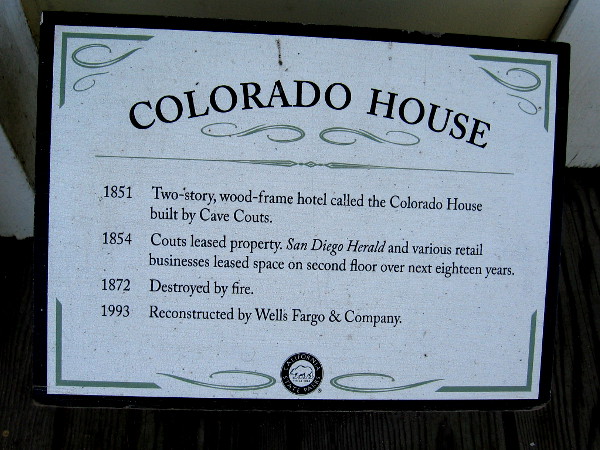
The restored Colorado House in Old Town San Diego is home to a fascinating Wells Fargo museum.
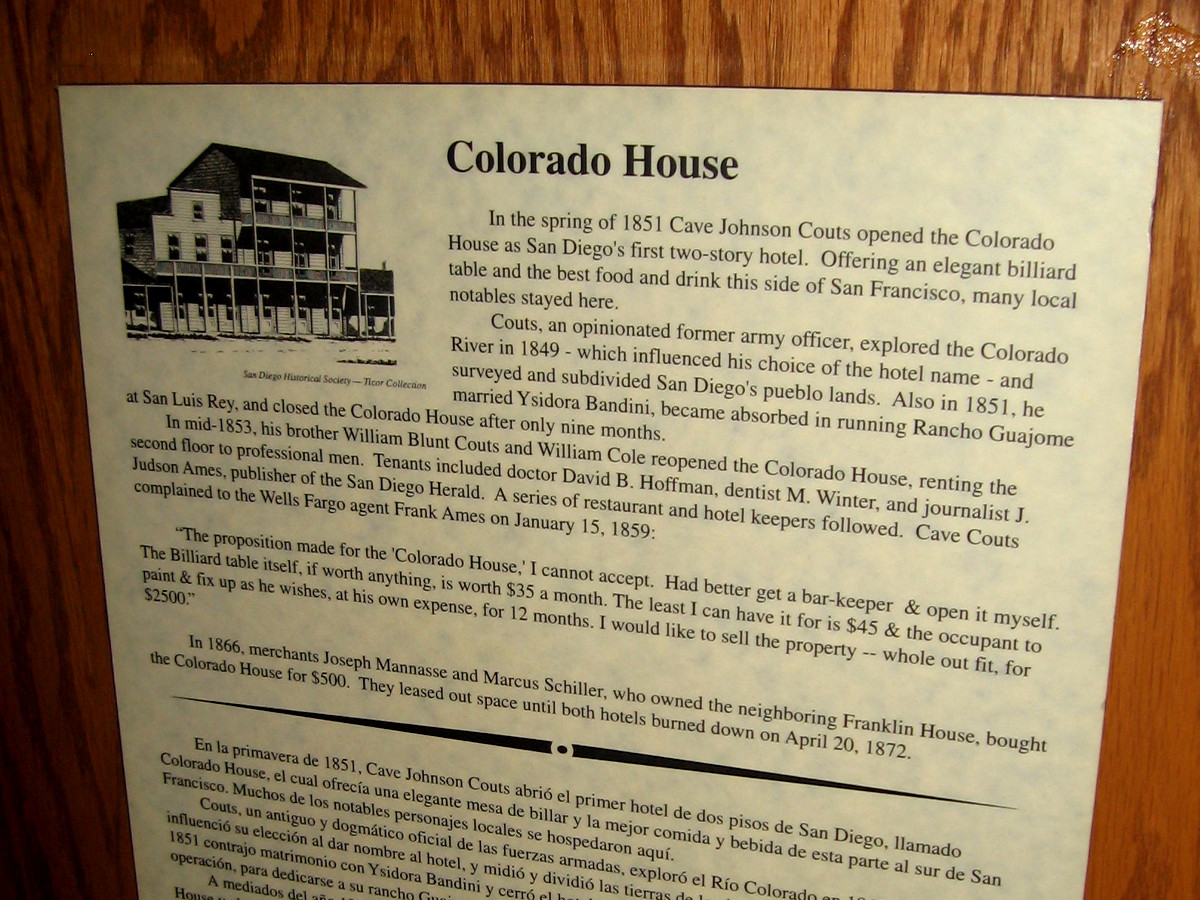
The two-story, wood frame hotel called the Colorado House was built in Old Town San Diego in 1851 by Cave Couts.
The two-story, wood frame hotel called the Colorado House was built in Old Town San Diego in 1851 by Cave Couts. The original building was destroyed by fire in 1872.
The Wells Fargo History Museum in San Diego is open daily from 10-5. Admission is free!
Tourists in Old Town check out a red Wells Fargo stagecoach, which transported mail, gold, goods and passengers in the Old West.
Tourists in Old Town check out an iconic red Wells Fargo stagecoach, which transported mail, gold, goods and passengers in the Old West.
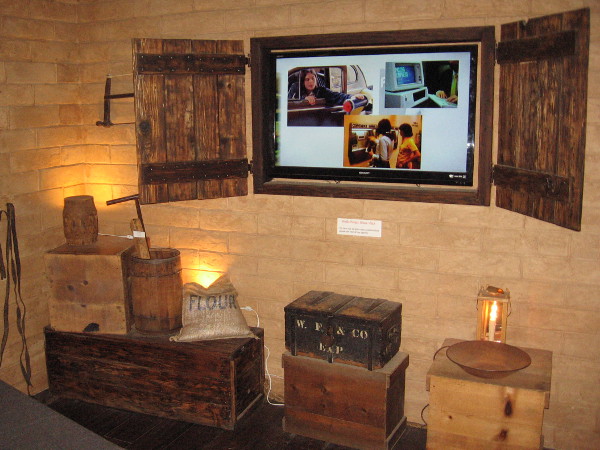
Old photo on video screen shows the Wells, Fargo and Co's Express Office in downtown San Diego, in 1911.
Old photo on video screen shows the Wells, Fargo and Co’s Express Office in downtown San Diego, in 1911.
Historical artifacts in a glass display case include books, bottles and a photo of Cave J. Couts.
In the spring of 1851 Cave Johnson Couts opened the Colorado House as San Diego's first two-story hotel. It had an elegant billiard table and fine food.
In the spring of 1851 Cave Johnson Couts opened the Colorado House as San Diego’s first two-story hotel. It had an elegant billiard table and fine food.
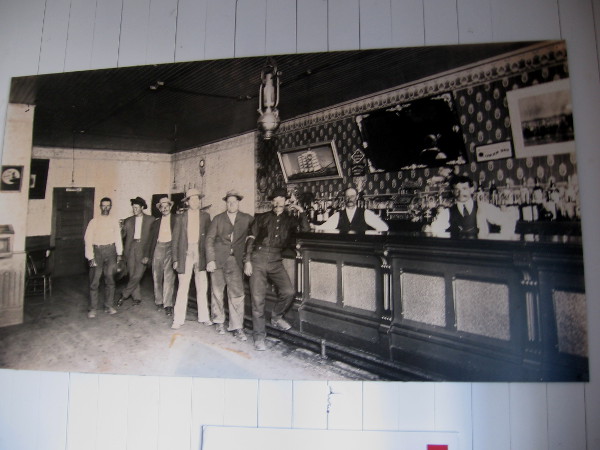
Old photograph shows bar in Colorado House.
Old photograph shows bar and patrons in Colorado House.
Antique telegraph key once used to send messages and money across the continent.
Colorful mural high on one wall shows a small town in the Old West. I believe I recognize many buildings in Old Town.
Colorful mural high on one wall shows a small town by a blue bay. I believe I recognize many buildings in Old Town.
Article from the Omaha Herald published in 1877 provides Hints for Plains Travelers. When the driver asks you to get off and walk, do it without grumbling!
Old plaque in the museum: Silas St. John carried the first eastbound overland mail out of San Diego, from Carrizo Creek to Fort Yuma, November 16, 1857. On September 9, 1858, in a lone-handed defense of the Butterfield-Wells Fargo Overland Stage station at Dragoon, Arizona, St. John was horribly wounded and lost his left arm. He recovered to continue in Wells Fargo service. Of his stuff the West was made.
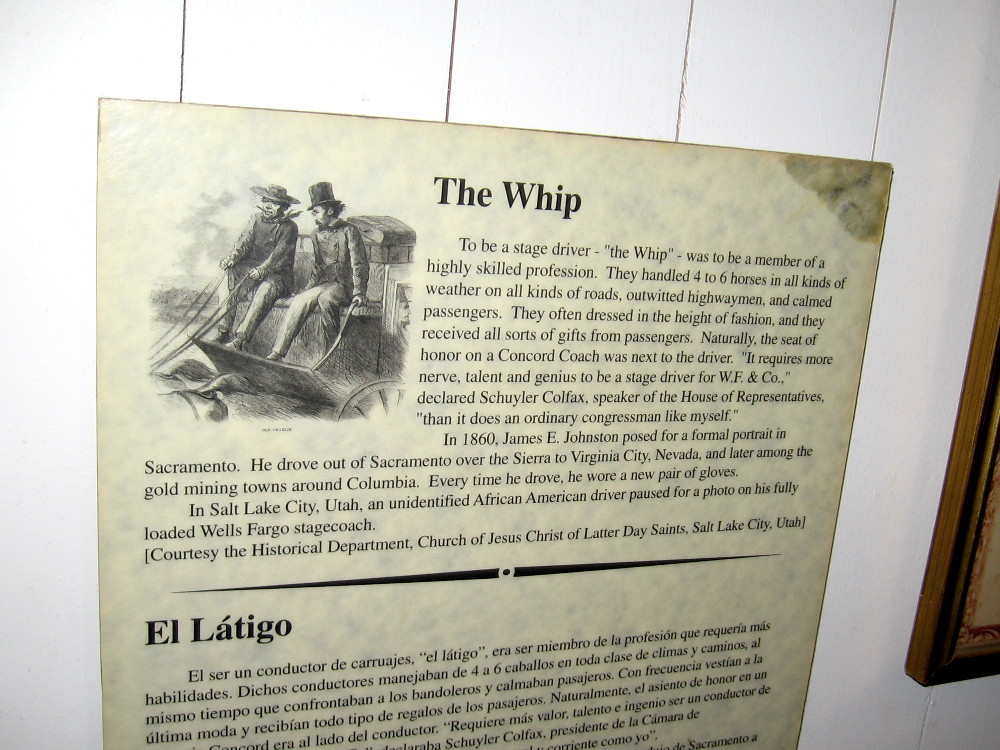
To be a stage driver--the Whip--was to be a member of a highly skilled profession. They handled 4 to 6 horses in all kinds of weather on all kinds of roads, outwitted highwaymen, and calmed passengers.
To be a stage driver–the Whip–was to be a member of a highly skilled profession. They handled 4 to 6 horses in all kinds of weather on all kinds of roads, outwitted highwaymen, and calmed passengers.
Passengers on board the Overland Mail Company stages were allowed 40 pounds of baggage.
Advertisement shows Ladies' and Gentlemen's traveling trunks and valises, also packing trunks of every description.
Advertisement shows Ladies’ and Gentlemen’s traveling trunks and valises, also packing trunks of every description.
Map shows the historic Butterfield Overland Mail Route. Wells Fargo's experience in Western transportation led it to finance and eventually run the Butterfield stage line's operations in the west.
Map shows the historic Butterfield Overland Mail Route. Wells Fargo’s experience in Western transportation led it to finance and eventually run the Butterfield stage line’s operations in the west. (Click image to enlarge.)
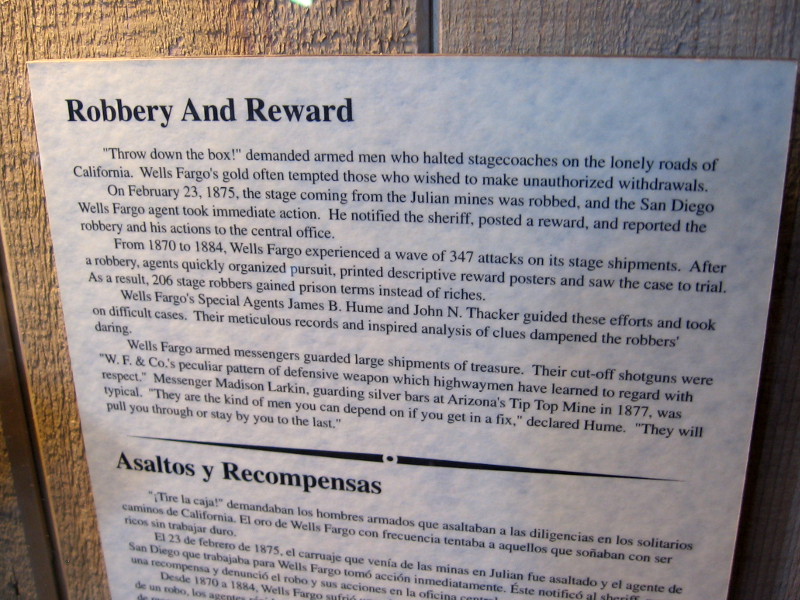
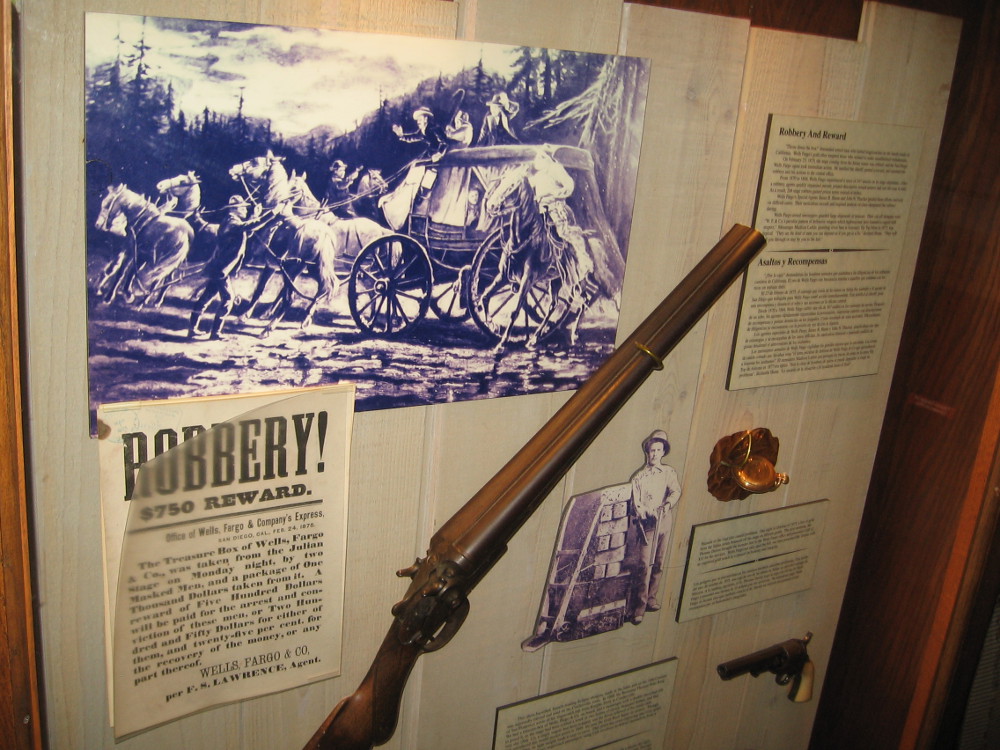
On February 23, 1875, the stage coming from the Julian mines was robbed, and the San Diego agent took action. He immediately notified the sheriff, posted a reward, and reported the robbery and his actions to the central office.
Cool display inside the Wells Fargo History Museum in Old Town San Diego shows how stagecoaches and their cargo was protected from bandits.
Cool display inside the Wells Fargo History Museum in Old Town San Diego shows how stagecoaches and their cargo were protected from bandits.
The most infamous stage robber was Black Bart. He left bits of poetry and called himself the
The most infamous stage robber was Black Bart. He left bits of poetry and called himself the “Po8” to distance himself from the common thief. He robbed 28 stagecoaches from 1875 to 1883. Once identified, authorities learned he was actually Charles E. Boles, a “respectable” mine owner!
A museum recreation of the Vallecito Stage Station, a stop on the Overland Mail Company's southern route, 1858-1861. Thick adobe walls provided relief from desert heat.
A museum recreation of the Vallecito Stage Station, a stop on the Overland Mail Company’s southern route, 1858-1861. Thick adobe walls provided relief from desert heat.
Table in the stage station used for rest, serving food and games of cards.
Table in the stage station used for rest, serving food and games of cards to pass the time.
Gold was discovered at Julian in San Diego's mountains, triggering a small rush into the area.
Gold was discovered at Julian in San Diego’s mountains, triggering a small rush into the area.
Miners from placer diggings on the Colorado River and hard-rock mines at Julian brought their gold dust and bars to the Wells, Fargo and Co. agency in Old Town San Diego.
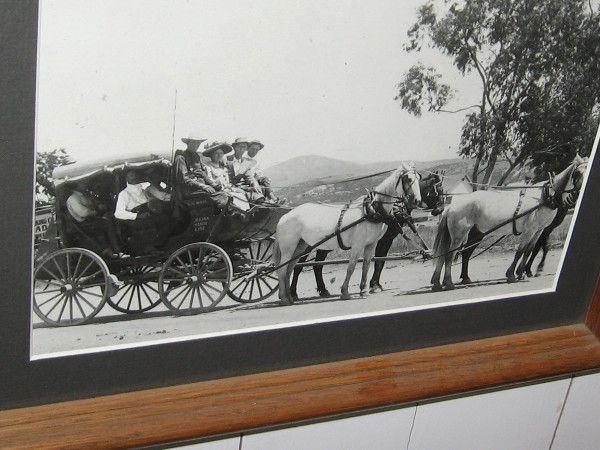
The Julian Stage Line carried miners and other passengers to this gold mining town in east San Diego County.
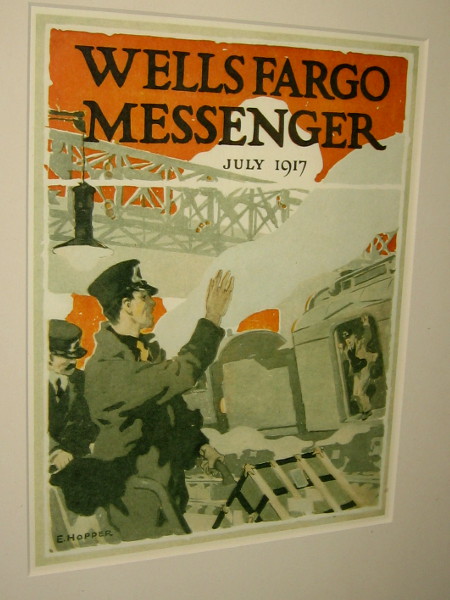
Cover of the Wells Fargo Messenger, dated July 1917.
Wells Fargo published a monthly magazine calls the Wells Fargo Messenger between September 1912 and June 1918. Edward Hopper, an illustrator, went on to become a famous painter.
Wells Fargo published a monthly magazine calls the Wells Fargo Messenger between September 1912 and June 1918. Edward Hopper, an illustrator, went on to become a famous American realist painter.
On her travels she uses Wells Fargo Checks.
Cover of the Wells Fargo Messenger, dated April 1918.
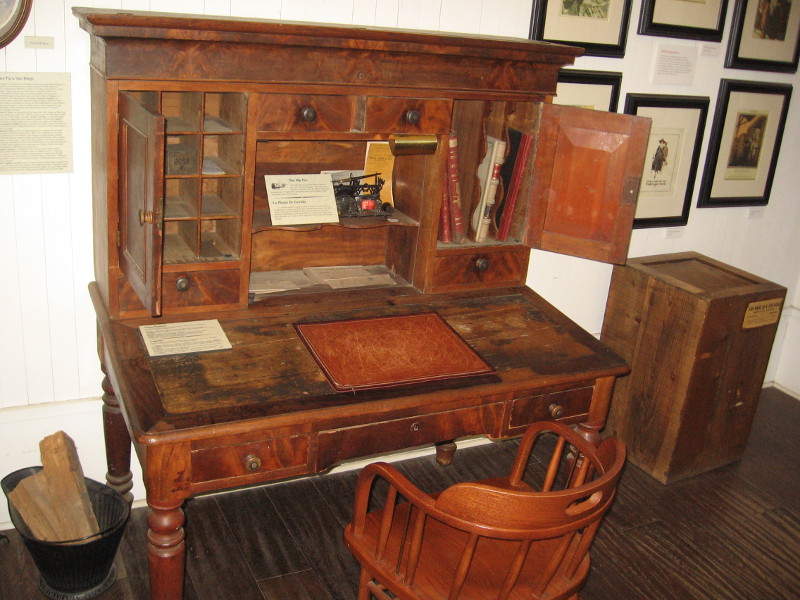
Antique desk used by a Wells Fargo agent.
During a typical day, a Wells Fargo agent saw many types of business, reflecting the Company's varied and essential services.
During a typical day, a Wells Fargo agent saw many types of business, reflecting the Company’s varied and essential services.
Nooks in this desk hold dip pens, receipts, letters and accounting ledgers.
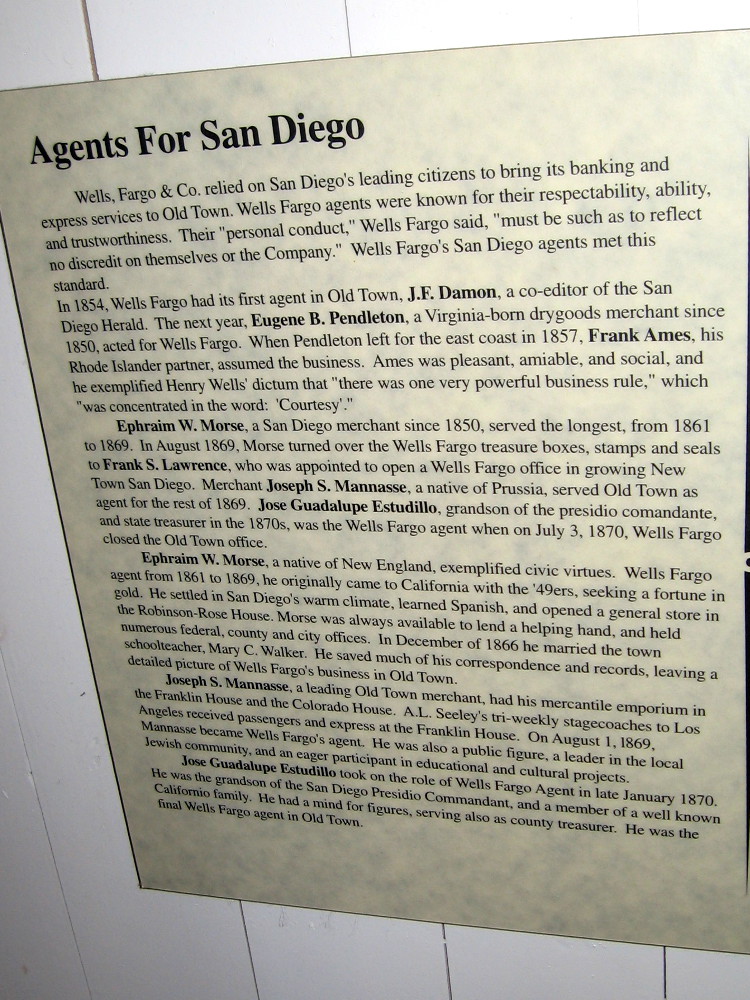
Wells Fargo agents were known for their respectability, ability, and trustworthiness. The first Old Town agent was J.F. Damon, co-editor of the San Diego Herald.
Agent William A. Biglow works in his express office which included an agent's cabinet and iron safe.
Wells Fargo agent William A. Biglow works in his express office which included an agent’s cabinet and iron safe.
A large old letterpress sits atop a cast iron safe. The safe, made by Herring, Hall, Marvin and Co. in 1885, is filled with concrete and weighs over a ton.
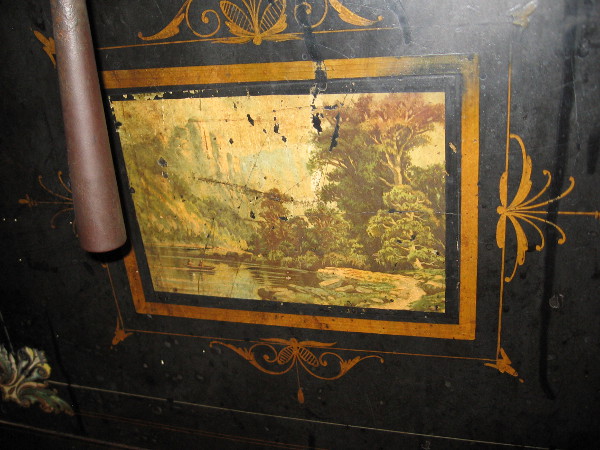
Some art on the face of the safe door.
Some pastoral art on the face of the safe door.
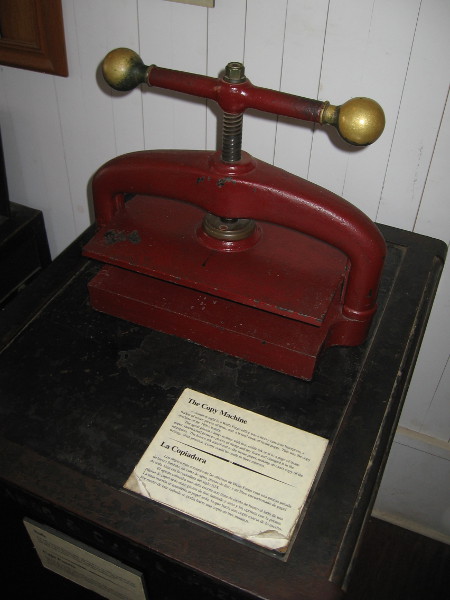
The copy machine of the 19th Century. Pressure from this heavy cast-iron letterpress transferred brown ink to tissue paper.
A collection of old letters, certificates and small packages exhibited at the Wells Fargo History Museum in San Diego.
If you ever visit Old Town San Diego State Historic Park, check out the interesting Wells Fargo History Museum in the Colorado House!

I live in downtown San Diego and love to walk around with my camera! You can follow Cool San Diego Sights via Facebook or Twitter!

You can easily explore Cool San Diego Sights by using the search box on my blog’s sidebar. Or click a tag! There are thousands upon thousands of fun photos for you to enjoy!

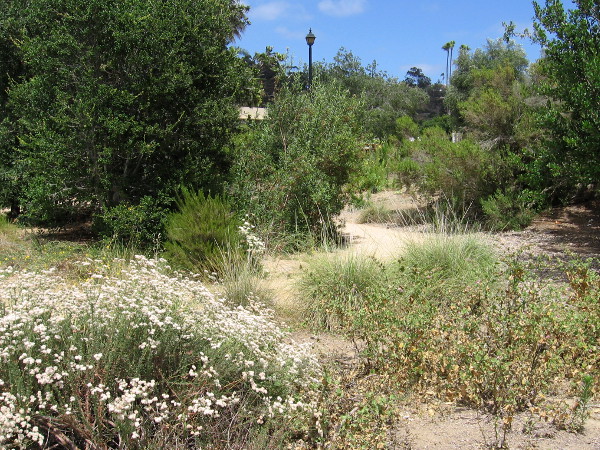
Native garden near Old Town San Diego’s McCoy House.

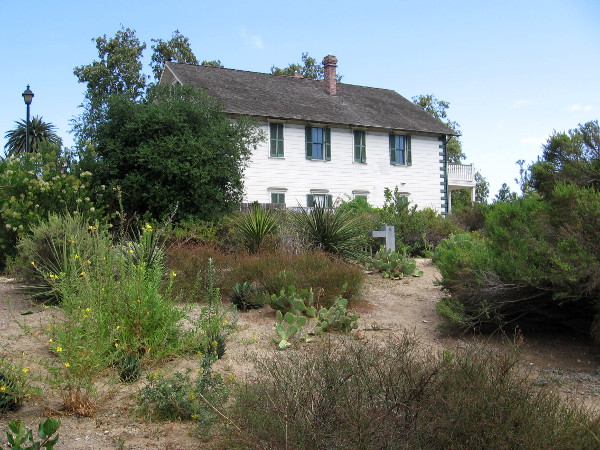
Photo of historic McCoy House in Old Town San Diego from the Native Garden. Today's garden is located in a spot once close to the San Diego River, before it was diverted to the north, through Mission Valley.
Photo of historic McCoy House in Old Town San Diego from the Native Garden. Today’s garden is located in a spot that was once very close to the San Diego River, before the river was diverted to the north, through Mission Valley.

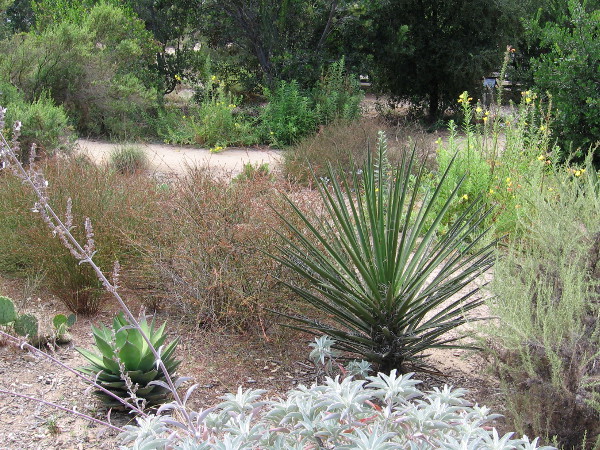
A small, ragged but beautiful native garden can be found in the northwest corner of San Diego’s Old Town, next to the McCoy House Museum. The Native Plant Garden contains vegetation that grows naturally along the rivers of our semi-arid region.

Long before Europeans arrived in Southern California, the Native American Kumeyaay lived where Old Town was eventually established; the Kumeyaay village at the base of Presidio Hill was called KOSA’AAY, or Cosoy. Many of the plants in the garden were used by the Kumeyaay people in everyday life.

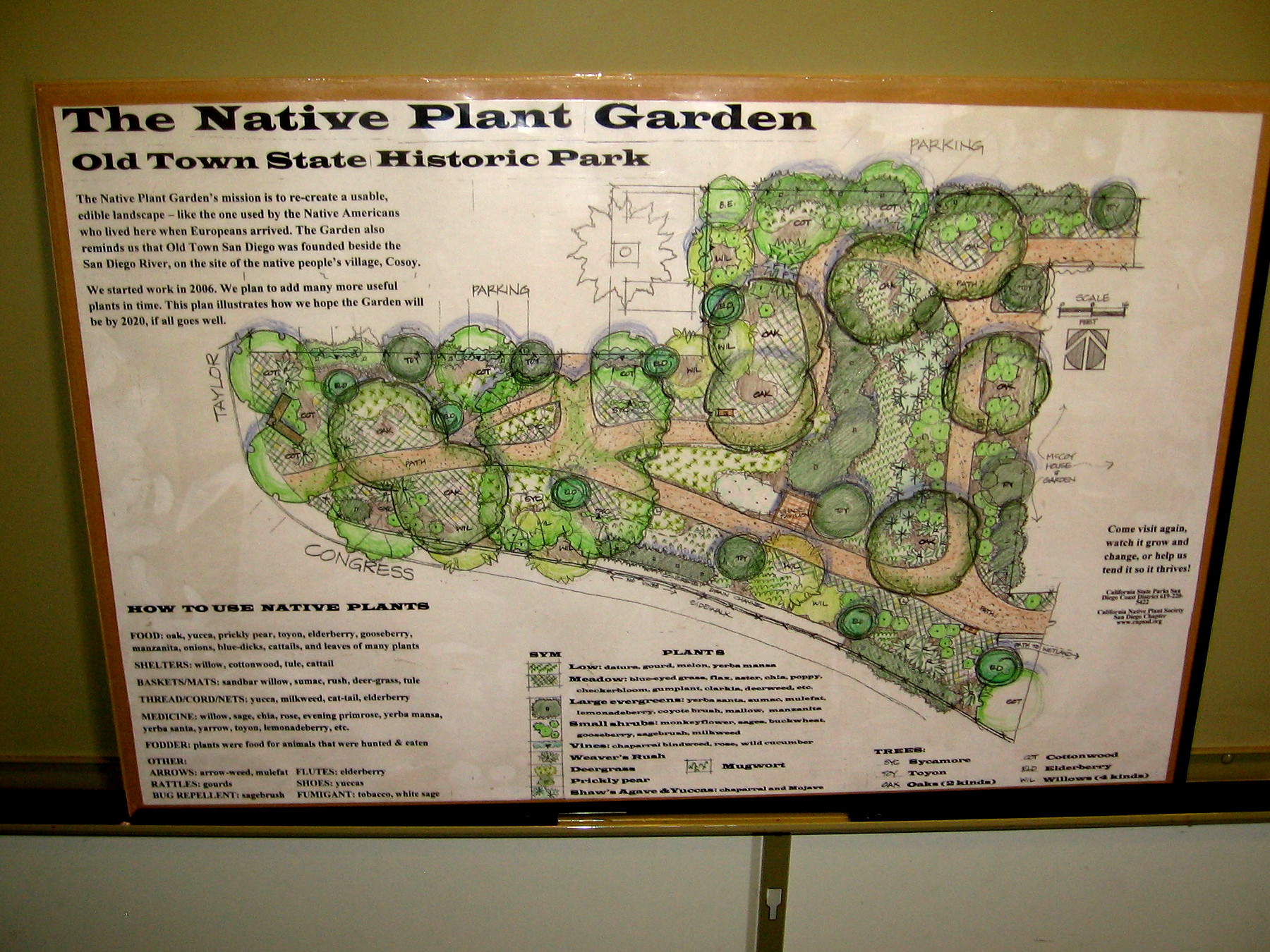
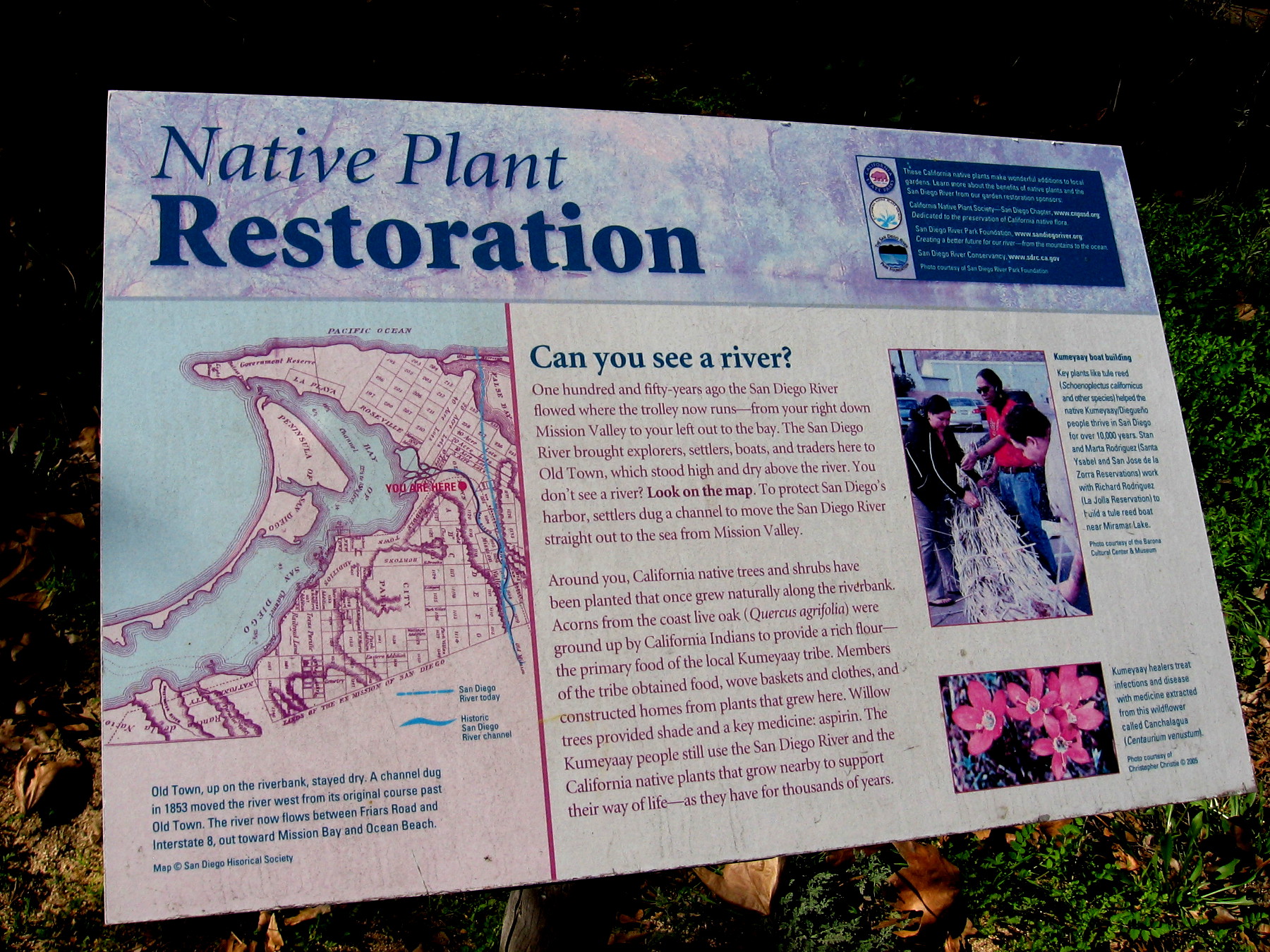
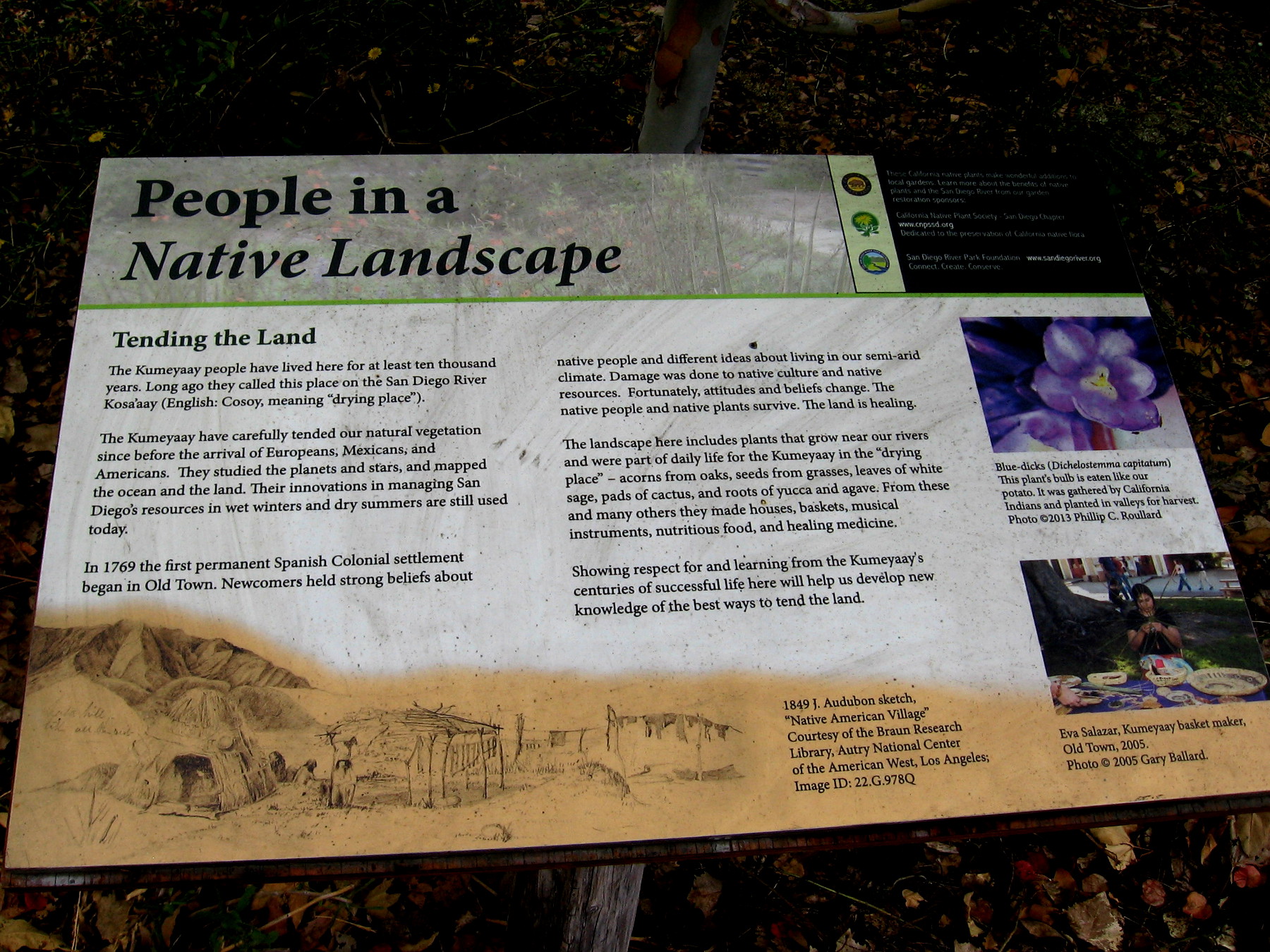
Read the photo captions to learn much more. Click the garden plans and the two signs, and those images will expand providing additional information!

Plans of the Native Plant Garden in Old Town State Historic Park. Included are species used by the Native American Kumeyaay for food, shelter and medicine. Their village Cosoy was located here.
Plans of the Native Plant Garden in Old Town San Diego State Historic Park. Included are species used by the Native American Kumeyaay for food, shelter and medicine. Their village Cosoy was located here.
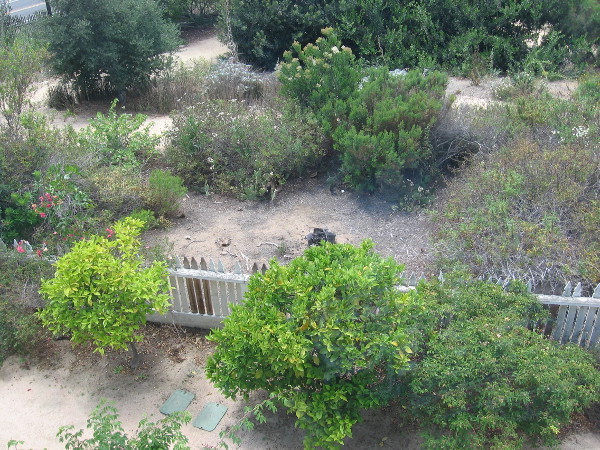
Looking northwest from the second floor of the McCoy House Museum in Old Town San Diego. The Native Garden is a bit dry and scraggly--but that's how local vegetation naturally appears.
Looking northwest from the second floor of the McCoy House Museum in Old Town San Diego. The Native Garden beyond the fence is a bit dry and scraggly–but that’s how local vegetation naturally appears.
150 years ago the San Diego River flowed nearby, bringing explorers, settlers, boats and traders to Old Town. California native trees and shrubs have been planted that once grew along the riverbank.
Dirt paths meander through the small Native Garden at the northwest corner of Old Town San Diego State Historic Park.
Dirt walking paths meander through the small Native Garden at the northwest corner of Old Town San Diego State Historic Park.
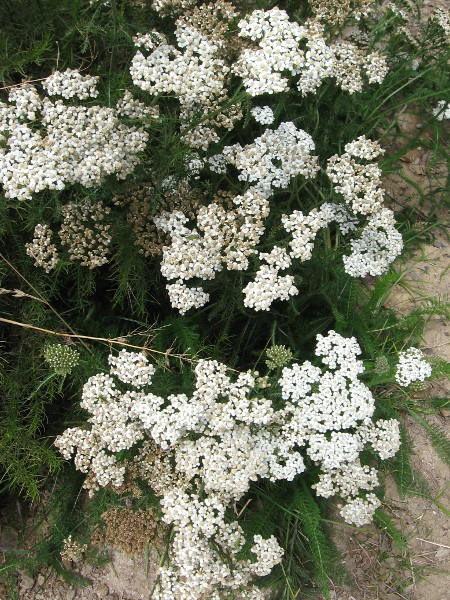
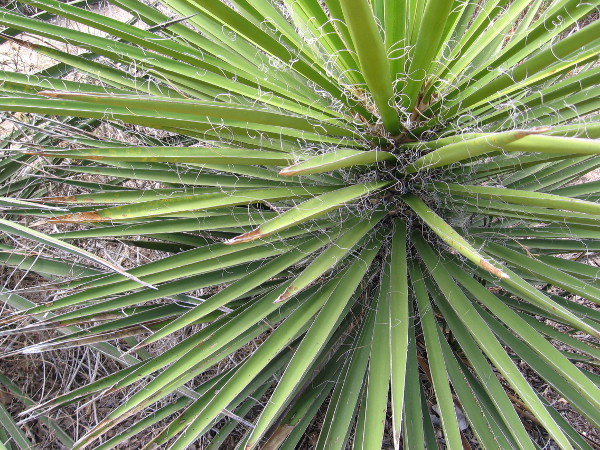
Yarrow was used by the Kumeyaay as a treatment for various medical conditions, including burns, inflammation, and pain from toothache, headache and arthritis.
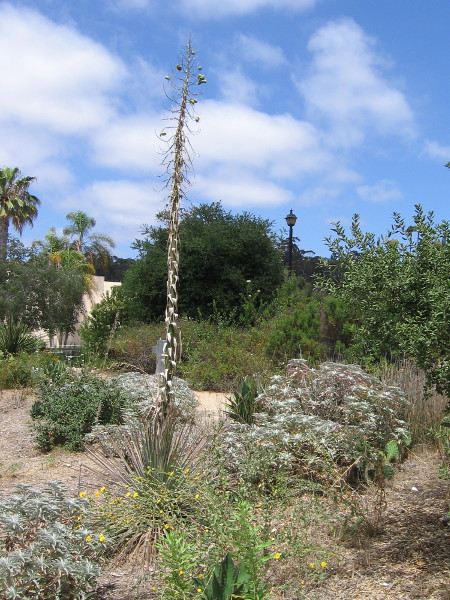
Tall stalk of a yucca that already flowered still juts into the sky in Old Town San Diego.
The Kumeyaay people have lived here for at least ten thousand years. Their innovations in managing San Diego's resources in wet winters and dry summers are still used today.
The Kumeyaay people have lived here for at least ten thousand years. Their innovations in managing San Diego’s resources in wet winters and dry summers are still used today.
A variety of native plants found naturally in coastal San Diego's semi-arid climate.
A variety of native plants found naturally in coastal San Diego’s semi-arid climate, including sages and prickly pear cactus.
Fibers from the yucca were used by the Kumeyaay to produce cords, nets, shoes and other useful items.

I live in downtown San Diego and love to walk around with my camera! You can follow Cool San Diego Sights via Facebook or Twitter!

The oldest building in San Diego is a golf Pro Shop!

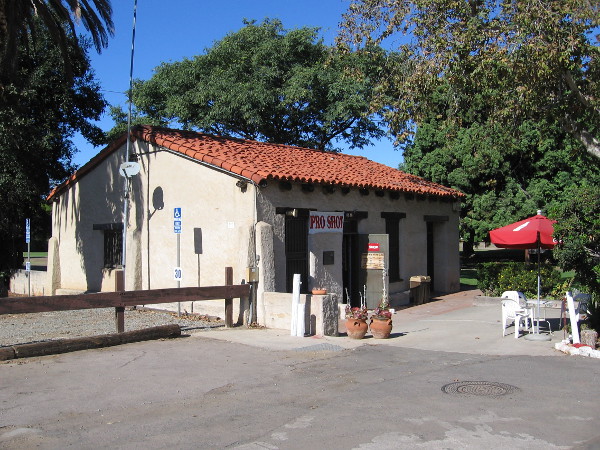
The Pro Shop at Presidio Hill Golf Course can be found inside San Diego's oldest building, La Casa de Carrillo.
The Presidio Hills Golf Course Pro Shop can be found inside San Diego’s oldest building, La Casa de Carrillo.

Believe it or not, the oldest structure that still exists in San Diego (outside of the walls of the Mission Basilica San Diego de Alcalá) contains a golf Pro Shop!

The two-century-old Casa de Carrillo, located near the base of historic Presidio Hill, was built in 1817, according to the Save Our Heritage Organisation.  (Plaques at the location provide two different years.)  It was built by the Spanish presidio’s commander, Francisco Maria Ruiz, for Joaquin Carrillo, a relative and fellow soldier stationed in San Diego. The adobe house stood beside the Comandante’s pear garden. Today the rather simple building, which was restored in 1931, is the home of the Presidio Hills Golf Course Pro Shop!

The small Presidio Hills Golf Course has its own unique history. Occupying what was once a scrubby plot of land at the foot of Presidio Hill, just east of Old Town, the pitch-and-putt golf course was developed in the early 1930s by George Marston, a visionary San Diego businessman and philanthropist who also worked to develop Balboa Park, the San Diego Public Library, and the San Diego Historical Society. Marston created the Junipero Serra Museum which rises today just above the site of the original 1769 Spanish presidio, so-called birthplace of California.

Over the years, the Presidio Hills Golf Course has hosted several world famous golfers, most notably Phil Mickelson, a resident of San Diego. When they were kids, Phil and his sister Tina would play all day at the small golf course. I was told by the super friendly young gentleman working in the pro shop that Phil Mickelson returns to visit every few years, just for old time’s sake.

A young Tiger Woods also won two Junior World trophies at Presidio Hills Golf Course!

Read the photo captions for a bit more information . . .

Photo of the small, historic adobe across the parking lot of the Presidio Hills Golf Course. Built around 1810, it's the oldest structure that is still standing in San Diego.
A photo of the small, historic adobe taken from the parking lot of the Presidio Hills Golf Course. Casa de Carrillo is the oldest structure that is still standing in San Diego.
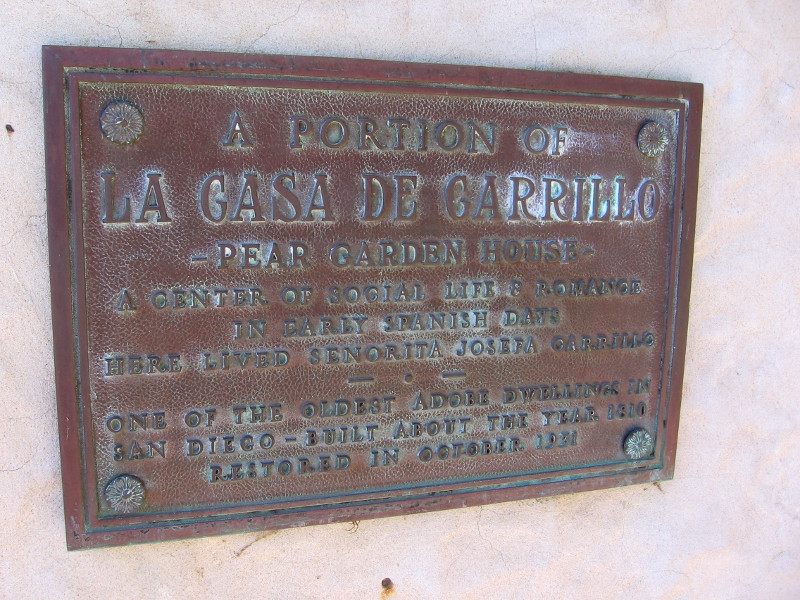
A portion of La Casa De Carrillo - Pear Garden House. A center of social life and romance in early Spanish days. Here lived Senorita Josefa Carrillo. One of the oldest adobe dwellings in San Diego. Built about the year 1810. Restored in October 1931.
Bronze plaque near the front door reads:  A portion of La Casa De Carrillo – Pear Garden House. A center of social life and romance in early Spanish days. Here lived Senorita Josefa Carrillo. One of the oldest adobe dwellings in San Diego. Built about the year 1810. Restored in October 1931.
Photo of La Casa de Carrillo taken from a golf green just east of the structure.
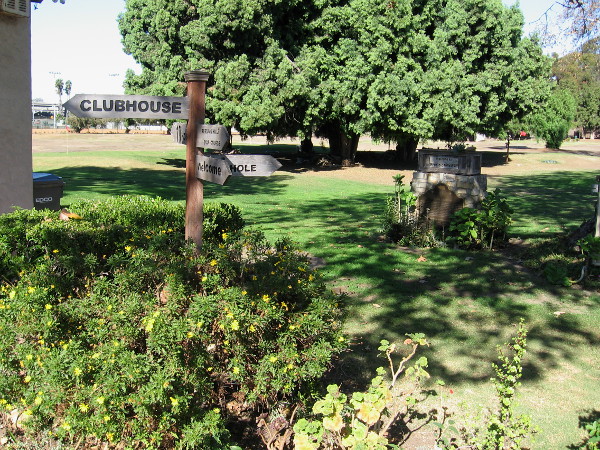
Sign near historical marker for Casa de Carrillo points to the golf course clubhouse and first hole.
Presidio Comandante Francisco Maria Ruiz built this house next to his 1808 pear garden late in 1821 for his close relative and fellow soldier, Joaquin Carrillo, and his large family.
The easy Presidio Hills Golf Course is a great place to learn golf--ideal for families and kids. And one gets a history lesson, too!
Enter the old adobe and you will find the Pro Shop.  The easy Presidio Hills Golf Course is a great place to learn golf–ideal for families and kids. And one gets a history lesson, too!
A look inside the restored adobe. I'm not sure which parts of the historically important building are original.
Another look inside the restored adobe. I’m not sure which parts of the historically important building are original.
An old newspaper article displayed in the pro shop includes a photo of 8-year-old Tiger Woods. He is showing off his Junior World trophy captured at Presidio Hills, where he won two titles.
An old newspaper article displayed in the pro shop includes a photo of 8-year-old Tiger Woods. He is showing off a Junior World trophy captured at Presidio Hills, where he won two titles.
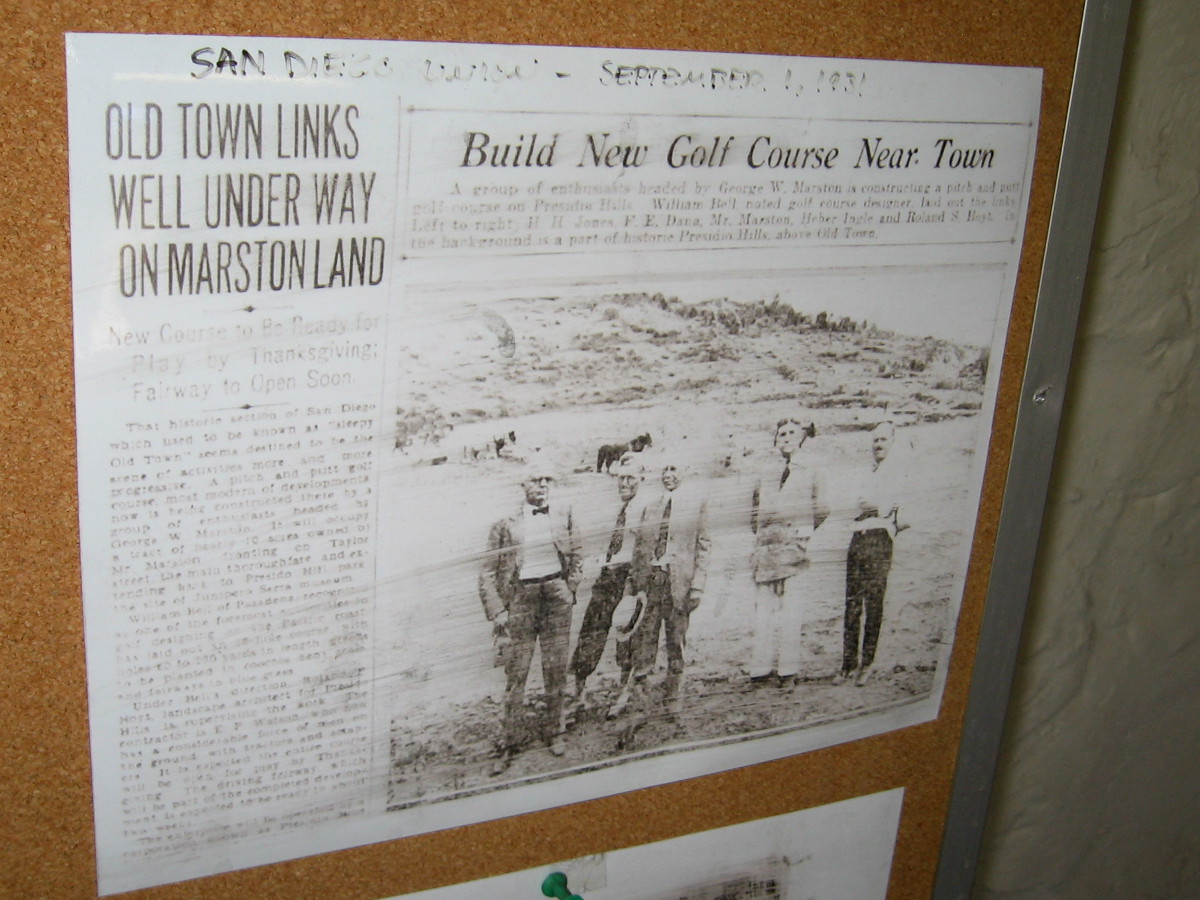
San Diego Union September 1, 1931. Old Town Links Well Under Way On Marston Land.
Various photos of Presidio Hills Golf Course history inside the Pro Shop. Phil Mickelson and Craig Stadler are two notable golfers from San Diego.
Old photo shows Don and Al Abrego Presidio Hills Tiny Tots Golf School. The school has faded into history.
Another photo shows Don and Al Abrego Presidio Hills Tiny Tots Golf School. The defunct school has faded into history.
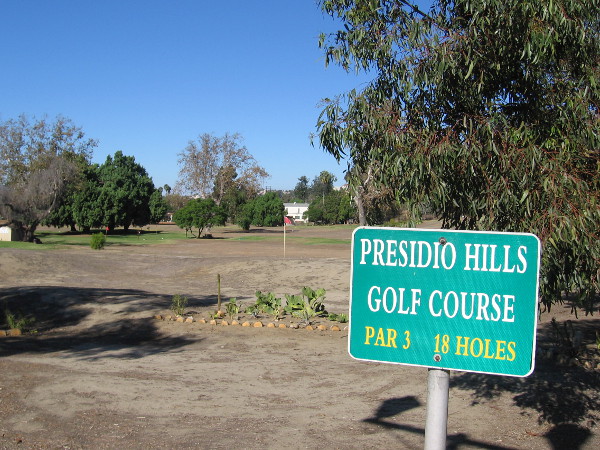
The modest Presidio Hills Golf Course is Par 3, 18 Holes. It's located at the east edge of San Diego's Old Town.
The modest Presidio Hills Golf Course is Par 3, 18 Holes. It’s located at the east edge of San Diego’s Old Town.
Another look across the small, easy golf course. The course appears to be a bit neglected. Regrettably, I saw no players out on a Sunday afternoon.
Another look across the small, easy golf course. It appears to be a bit neglected. Regrettably, I saw no players out on a Sunday afternoon.
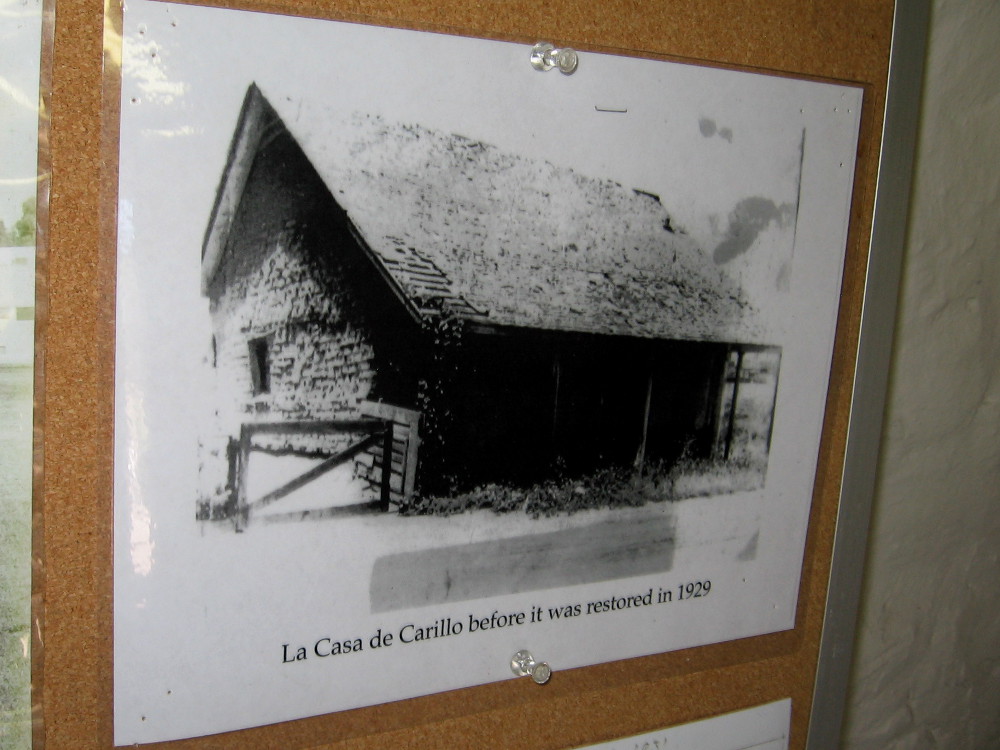
Historical photograph in the Presidio Hills Golf Course Pro Shop. La Casa de Carillo before it was restored in 1929.
Old black-and-white photograph inside the Presidio Hills Golf Course Pro Shop shows La Casa de Carillo (note the different spelling) before it was restored in 1929.

I live in downtown San Diego and love to walk! I also love history! You can follow Cool San Diego Sights via Facebook or Twitter!

Pumpkins, pumpkins everywhere!

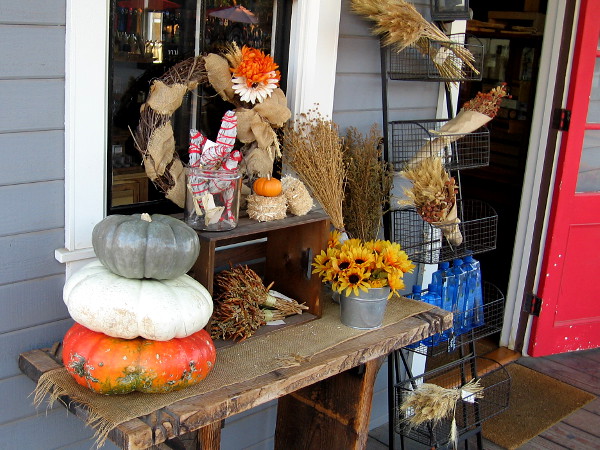
Pottery pumpkins smile outside a gift shop in San Diego's festive Old Town.
Pottery pumpkins smile outside a gift shop in San Diego’s festive Old Town.

I see pumpkins! Everywhere! It must be mid-October in San Diego!

Pumpkins, pumpkins everywhere! Big ones and little ones! It must be October.
Pumpkins, pumpkins everywhere! Big ones and little ones! Grocery stores are overflowing.  It must be mid-October.
A fun display of pumpkins and Autumn characters on a street corner in Little Italy. Halloween is on the way! Boo!
A beautiful arrangement of flowers, pumpkins and gourds graces a rustic Old Town boardwalk.
More golden Autumn colors suggest it's time to harvest the good things in life.
More golden Autumn colors suggest it’s time to harvest the good things in life.
A pumpkin and warm flowers on an antique cart in Old Town San Diego.

I live in downtown San Diego and love to walk! You can follow Cool San Diego Sights via Facebook or Twitter!
Elegantly dressed skeletons discovered in old hotel!

Two elegantly dressed skeletons can be seen seated just inside the front entrance of the Cosmopolitan Hotel in Old Town.
Two elegantly dressed skeletons have been discovered seated inside the front entrance of the Cosmopolitan Hotel in Old Town.

I was stunned to observe that a large number of skeletons have been discovered in an old San Diego hotel. The Cosmopolitan Hotel, to be exact. The elegantly dressed skeletons, wearing frilly dresses or top hats, were seen standing about the hotel’s entrance, in the saloon, even seated on chairs behind a large wedding cake.

Huh?

I’m just having a bit of fun! The Cosmopolitan Hotel is part of Old Town, and dozens of elegantly dressed skeletons appear in Old Town San Diego State Historic Park every year as Día de los Muertos approaches.

Día de los Muertos, or Day of the Dead, is actually a celebration of ancestors and loved family members who have passed away. In Mexico, the deceased are remembered and prayed for, and certain joyful traditions are observed. One unusual tradition is derived from La Calavera Catrina, a famous etching by Mexican artist José Guadalupe Posada, which depicts a female skeleton dressed in a fancy hat. Even though the image was originally created as satire, the Catrina has become a familiar sight in many places where Día de los Muertos is observed.

I snapped these photos at the historic Cosmopolitan Hotel in Old Town. The original building dates back to the late 1820s, when the wealthy Californio cattle rancher Juan Bandini built a “mansion” among the simple adobes in Old Town. When Bandini’s fortunes faded, he sold the house to Albert Seeley in 1869, who built a second story and converted the house into a hotel for a new San Diego stagecoach stop, which he also built nearby.

I believe I photographed a couple of the same skeletons a year or two ago, but I simply couldn’t help myself. They’re so much fun!

A covered wagon in front of the Cosmopolitan Hotel in Old Town San Diego State Historic Park.
In celebration of Día de los Muertos, or Day of the Dead, two lady skeletons wearing frilly dresses greet visitors to the Cosmopolitan Hotel. Here's one.
In celebration of Día de los Muertos, or Day of the Dead, two lady skeletons wearing frilly dresses greet visitors to the Cosmopolitan Hotel. Here’s one!
Here's the other!
Here’s the other!
Inside the Cosmopolitan Hotel's saloon, more extremely elegant but skeletal customers are observed.
Inside the Cosmopolitan Hotel’s saloon, another lavishly elegant but skeletal customer is observed.
A shy skeleton in quite fancy attire stands silently in the corner of the Old West 1800s saloon.
A shy skeleton in very fancy attire stands silently in the corner of the Old West 1800s saloon.
A bony customer at the bar. That must have been a stiff drink.
A wedding cake for a skeleton bride and groom! Día de los Muertos is a joyful holiday that celebrates past life.
A wedding cake for a skeleton bride and groom! Día de los Muertos is a joyful holiday that celebrates the past lives of loved ones.

I live in downtown San Diego and love to walk! You can follow Cool San Diego Sights via Facebook or Twitter!

You can easily explore Cool San Diego Sights by using the search box on my blog’s sidebar. Or click a tag! There are thousands upon thousands of fun photos for you to enjoy!

The people and legacy of Old Town San Diego.

Visitor to the second floor of the McCoy House Museum learns about some notable early residents of Old Town San Diego.

Should you visit the McCoy House Museum in Old Town San Diego State Historic Park, be sure to venture up the stairs to the second floor. There you’ll discover several fascinating exhibits. In addition to old photographs of notable early residents of San Diego, you’ll find an explanation of Old Town’s gradual decline as competing New Town (the site of modern downtown San Diego) grew and became the center of government and commerce. You will also learn about Old Town’s continuing legacy, including the events that led to the creation of Old Town San Diego State Historic Park in 1968.

If you’d like to read the displays, click the images to enlarge them.

(You might recall that I recently blogged about the many interpretive displays on the first floor of the McCoy House Museum. They provide a great deal of detailed information about Old Town’s early history.)

From a window on the museum’s second floor one can also look down upon the scraggly native plant garden just northwest of the McCoy House. A map near the window shows the location of Sycamore, Toyon, Oak, Cottonwood, Elderberry and Willow trees. Other native plants include Yerba Mansa, Datura, Aster, Poppy, Deerweed, Sumac, Lemonadeberry, Manzanita, Monkeyflower, different Sages, Deergrass, Prickly Pear and Yucca. Many of these plants were used by the Native American Kumeyaay in their daily lives long before explorer Juan Rodriguez Cabrillo discovered San Diego Bay in 1542.

Pio Pico settled in San Diego in 1819 after the death of his father, a soldier assigned to the Presidio. Merchant and rancher, he later lived in Los Angeles and became the last governor of Mexican Alta California.
In 1865, Mary Chase Walker became Old Town's first school teacher. She taught at the one room Mason Street schoolhouse and described early San Diego as a desolate place. She went on to join the suffragette movement.
In 1865, Mary Chase Walker became Old Town’s first school teacher. She taught at the one room Mason Street schoolhouse and described early San Diego as a desolate place. She went on to join the suffragette movement.
Agoston Haraszthy, born in Hungary, led a fascinating life. As an American pioneer, businessman and wine expert, he became San Diego's first town marshal and the first county sheriff.
Agoston Haraszthy, born in Hungary, led a fascinating life. As an American pioneer, businessman and wine expert, he became San Diego’s first town marshal and the first county sheriff.
Fire devastated Old Town in 1872. At the time only one water pump existed, and it was broken. Firefighters watched helplessly. The fire and many other factors helped to bring about the rise of competing New Town.
Various fascinating historical exhibits can be explored on the second floor of the McCoy House Museum in Old Town San Diego State Historic Park.
In the early 20th century, neglected, ruined buildings in Old Town were fixed up and converted into tourist attractions. Entrepreneur John D. Spreckels extended his streetcar line to Old Town.
Artifacts found under the rebuilt McCoy House date from the 1830's to 1850's. They include fragments of daily life from that era
Artifacts found under the rebuilt McCoy House date from the 1830’s to 1850’s. They include fragments of daily life from that era
Archaelogists analyze each find, record every detail. These objects probably came from the time when Eugenia Silvas owned this site. Descendents still live in San Diego and are involved in Old Town's a
Archaeologists analyze each find, record every detail. These objects probably came from the time when Eugenia Silvas owned this site. Family descendants still live in San Diego and are involved in Old Town’s activities.
Archaeologist's tools on display in the McCoy House Museum.
Archaeologist’s tools on display in the McCoy House Museum.
Once again, Old Town became a tourist destination in the 1930's when San Diego Avenue became connected to the new Coast Highway.
Once again, Old Town became a tourist destination in the 1930’s when San Diego Avenue became connected to the new Coast Highway.
Old Town languished during World War II. After the war, some suggested setting aside Old Town as a historic community. In 1968, Old Town became a state historic park.
Old Town languished during World War II. After the war, some suggested setting aside Old Town as a historic community. In 1968, Old Town San Diego became a state historic park.
Photographs in the McCoy House Museum recall Old Town San Diego's colorful past.
Photographs in the McCoy House Museum recall Old Town San Diego’s colorful past.

I live in downtown San Diego and love to walk! You can follow Cool San Diego Sights via Facebook or Twitter!
You can easily explore Cool San Diego Sights by using the search box on my blog’s sidebar. Or click a tag! There are thousands upon thousands of unique photos for you to enjoy!

San Diego history in Old Town’s McCoy House.

The McCoy House Museum, in Old Town San Diego State Historic Park, is a reconstruction of a home built in 1869 for Sheriff James McCoy.

While there are many small museums and historical attractions that visitors can enjoy in Old Town San Diego State Historic Park, the McCoy House Museum is the best place to see an extensive series of interpretive displays that describe the complete history of early San Diego.

The McCoy House, standing on the north end of Old Town, is a reconstruction of a home built in 1869 for Sheriff James McCoy and his family. James McCoy, who lived from 1821 to 1895, like many early San Diego residents was an ambitious man, working diverse jobs, filling many roles. At the age of 21 he sailed from Ireland to America seeking opportunity. He became a soldier, then a stagehand, then San Diego county assessor, then county sheriff in 1861. He acquired substantial real estate holdings and finally won election to the state senate in 1871.

The interpretive displays in the McCoy House Museum provide a good look back at San Diego’s formative years. They detail the life of the Native American Kumeyaay who’ve lived in the region for thousands of years, the first Spanish explorers, the establishment of the Spanish mission, the Mexican period and the subsequent American period.

If you’d like to read the displays, click my photographs to enlarge them.

This blog post covers the first floor of the museum. I’ll cover the second floor exhibits in a later post. After heading up some stairs, one can find information about the more prominent residents of Old Town, plus the town’s later history as it competed with New Town, which eventually rose to become downtown San Diego as we know it today.

Anyone who is a history buff must visit the McCoy House Museum. You’ll be transported back in time and see how life was exciting, difficult, and altogether different many, many years ago in San Diego.

Sign lists important dates concerning the McCoy House. Today it's a museum containing exhibits that depict the fascinating history of Old Town San Diego.
Sign lists important dates concerning the McCoy House. Today it’s a museum containing exhibits that explain the fascinating history of Old Town San Diego.
Just inside the front door, this might have resembled the parlor of the original McCoy House, occupied by an upper middle class family in San Diego's Old Town.
Just inside the front door, this might have resembled the parlor of the original McCoy House, occupied by an upper middle class family in San Diego’s Old Town.
Framed photo on one wall from the San Diego Historical Society shows the original McCoy House.
Interpretive exhibits inside the McCoy House Museum begin with the Spanish period of San Diego, from 1769 to 1821.
Quotes from the journeys of Juan Rodriguez Cabrillo, Sebastian Vizcaino and Gaspar de Portola.
A string of missions was created by Spain in California to secure its claim to new territory. The first mission, in San Diego, was on Presidio Hill near the native Kumeyaay village of Cosoy.
A string of missions was created by Spain in California to secure its claim to new territory. The first mission, in San Diego, was originally established on Presidio Hill near the native Kumeyaay village of Cosoy.
An artistic representation of life among the Kumeyaay people. They often visited the nearby coast to hunt and gather food.
For thousands of years, the Kumeyaay lived along the coast and interior valleys of what is now San Diego County. They moved with the seasons to take advantage of available resources.
The Kumeyaay built dome-shaped houses from oak, willow or sycamore branches. The simple structures were called ee-wahs.
The Kumeyaay saw the physical and spiritual world as one and the same.
Exhibit in the McCoy House Museum shows artifacts associated with the Kumeyaay, including a bark skirt, arrows, rabbit stick, child's sandals, gourd rattle and war club.
Exhibit in the McCoy House Museum shows artifacts associated with the Kumeyaay, including a bark skirt, arrows, rabbit stick, child’s sandals, gourd rattle and war club.
The Kumeyaay revolted against the Spanish missionaries in 1775, a year after the San Diego mission was relocated inland very close to a large Kumeyaay village.
Once baptized, converted Kumeyaay followed a strict life. Mission bells signaled the day's activities, including the singing of hymns, Mass, meals and work assignments.
Once baptized, converted Kumeyaay followed a strict life. Mission bells signaled the day’s activities, including the singing of hymns, Mass, meals and work assignments.
Mexico gained its independence from Spain in 1821 after a decade of bloodshed. Changes included a decline in support for the presidio and freedom from Spain's trade regulations.
Mexico gained its independence from Spain in 1821 after a decade of bloodshed. Changes included a decline in support for the presidio and freedom from Spain’s trade regulations.
After the breakup of the Spanish missions, the era of the great ranchos began. Californios were often racially mixed descendants of soldier-settler families.
Vaqueros were the original cowboys. They worked on the extensive ranches and handled the large herds of stock.
A fanciful picture of life on a rancho, with vaqueros at work and children at play.
The Californios loved to celebrate feast days, weddings and religious festivals.
Cattle by the thousands roamed San Diego's hills. Their dried hides were used in trade and were sometimes referred to as California banknotes.
Cattle by the thousands roamed San Diego’s hills. Their dried hides were used in trade and were sometimes referred to as California banknotes.
Illustration of loading cow hides onto a carreta. Hides were gathered by ships along the coast to be transported around Cape Horn to the eastern United States.
Exhibit inside the McCoy House Museum recreates the small shop of a Boston trader. The brig Pilgrim of Two Years Before the Mast brought people aboard to buy wares and finished goods that weren't available in San Diego.
Exhibit inside the McCoy House Museum recreates the small shop of a Boston trader. The brig Pilgrim of Two Years Before the Mast brought people aboard to buy wares and finished goods that weren’t available in San Diego.
Illustrations of cow hides being cured. This activity took place at La Playa, a point on San Diego Bay near Ballast Point in Point Loma.
Diagram of the brig Pilgrim, made famous in Richard Henry Dana Jr.'s classic Two Years Before the Mast. Dana collected cattle hides up and down the California coast.
Diagram of the brig Pilgrim, made famous in Richard Henry Dana Jr.’s classic Two Years Before the Mast. As an ordinary seaman, Dana collected cattle hides up and down the California coast.
Exhibit in the McCoy House Museum details local history during the Mexican–American War from 1846 to 1848.
During the war, U.S. occupation of San Diego divided the loyalty of the Californios. The two sides fought briefly at the Battle of San Pasqual.
Around the time of the Gold Rush, San Diego saw an influx of emigrants from all over, including New England, the American South, Mexico, South America, Ireland, Great Britain and Germany.
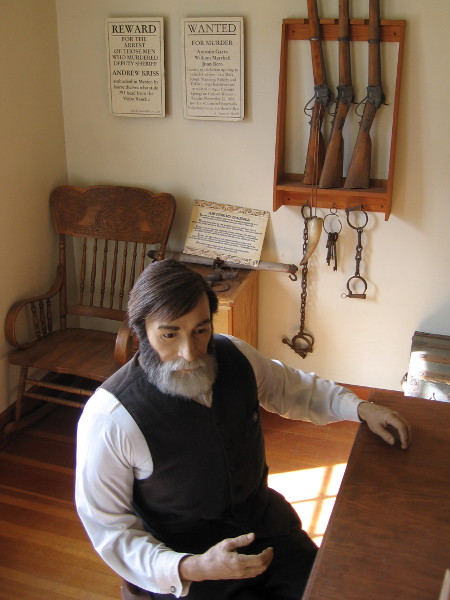
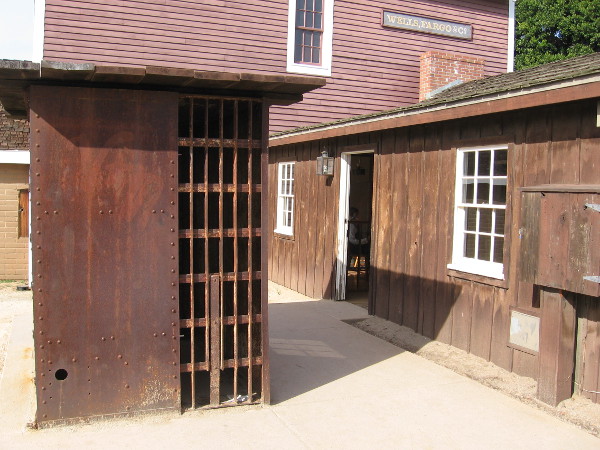
Old Town tales include the construction of the first jail in 1850. The walls were so poorly made, the first prisoner, Roy Bean, easily dug himself out, then celebrated at a nearby saloon!
Grog shops became popular gathering places. They were a social hub of San Diego life, providing customers with news and provisions.
A recreated Old Town grog shop can be found inside the McCoy House Museum.
After the California Gold Rush of 1849, San Diego became more developed. A courthouse and newspaper were established. Transportation included clipper ships, stage lines and steamships.
Poster advertises a new clipper ship route. A very quick trip may be relied upon!
Between 1865 and 1872, Old Town San Diego continued to grow. The first public school opened, and the town welcomed its first theatrical company in the Whaley house.
The first overland coach to San Diego began service in 1854. Additional stage lines came into existence, allowing for the delivery of mail, express packages and passengers.
Visitors to the McCoy House Museum can step into a replica stage stop and see what life was like in Old Town during San Diego's early history.
Visitors to the McCoy House Museum can step into a replica stage stop and see what life was like in Old Town during San Diego’s rugged early history.

I live in downtown San Diego and love to walk! You can follow Cool San Diego Sights via Facebook or Twitter!

You can easily explore Cool San Diego Sights by using the search box on my blog’s sidebar. Or click a tag! There are thousands upon thousands of interesting photos for you to enjoy!