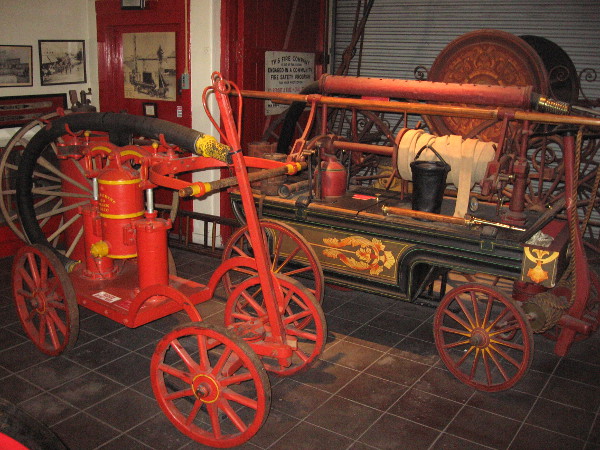
“Old La Jolla” hand drawn fire engine dating from 1886, on display at The San Diego Firehouse Museum.
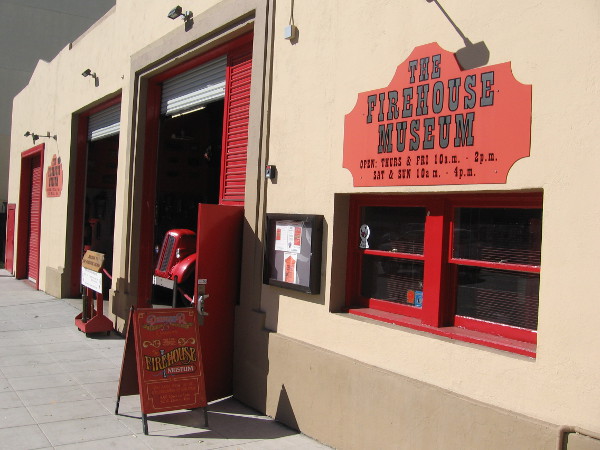
A simple but elegant old firehouse stands in downtown San Diego at the corner of Columbia Street and Cedar Street. Those who step inside are in for a very big surprise.
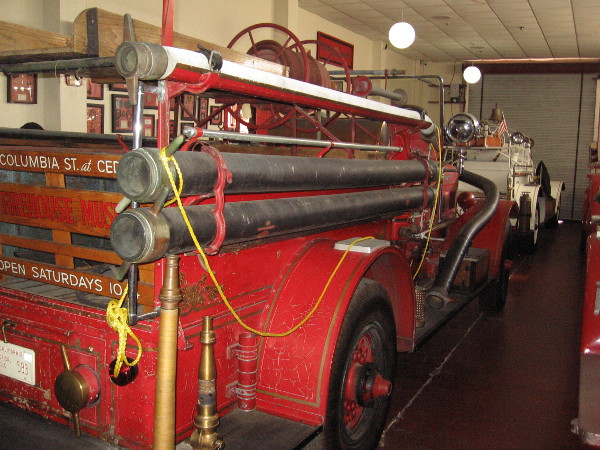
The San Diego Firehouse Museum today occupies what was once an active fire station–San Diego Fire Station No. 6. Located in Little Italy, this unique museum isn’t large, but it’s crammed with so much cool stuff and so much fascinating history, you could easily spend an hour enjoying the many exhibits. There are shiny red vintage fire engines, a steamer equipped with a huge boiler, antique hand pumpers, firefighting apparatus of every sort, helmets, badges, a big display of model vehicles, historical photographs . . . and just lots and lots of firefighting artifacts, dating as far back as the mid 1800s. Much of what you’ll see represents the history of firefighting in San Diego; other objects in the museum come from fire departments around the United States.
Here are some photos which I took during a recent visit. The volunteer on duty was very friendly and provided some interesting historical information. I learned that private events can be held in the old firehouse, and that kids love having birthday parties among all the fire engines. Museum admission is only 3 dollars for adults and 2 dollars for children and seniors. Quite a bargain!
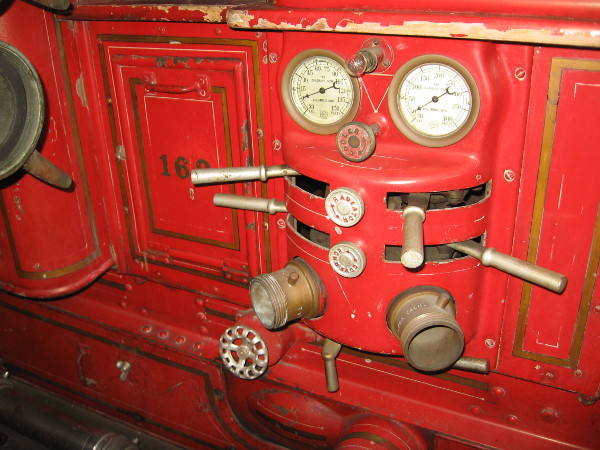
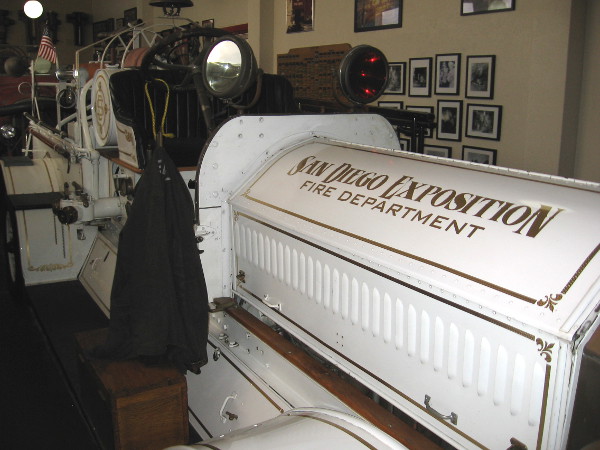
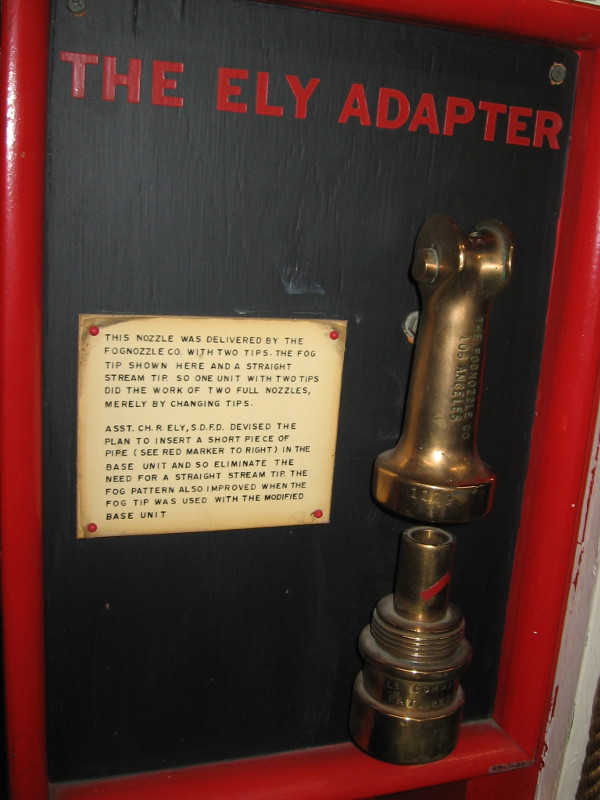
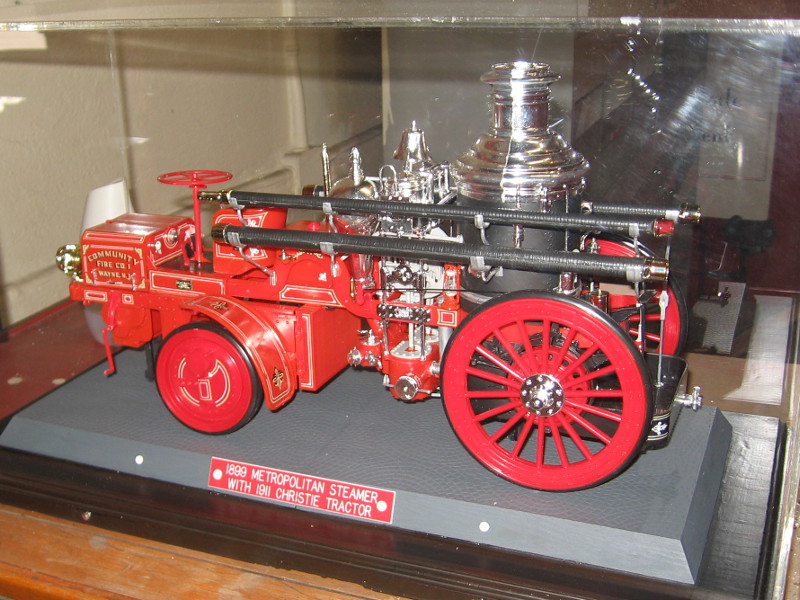
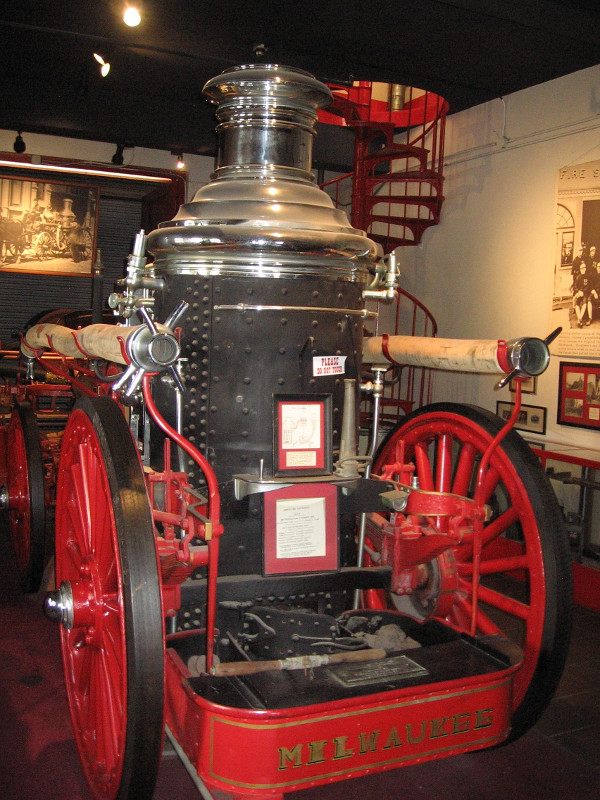
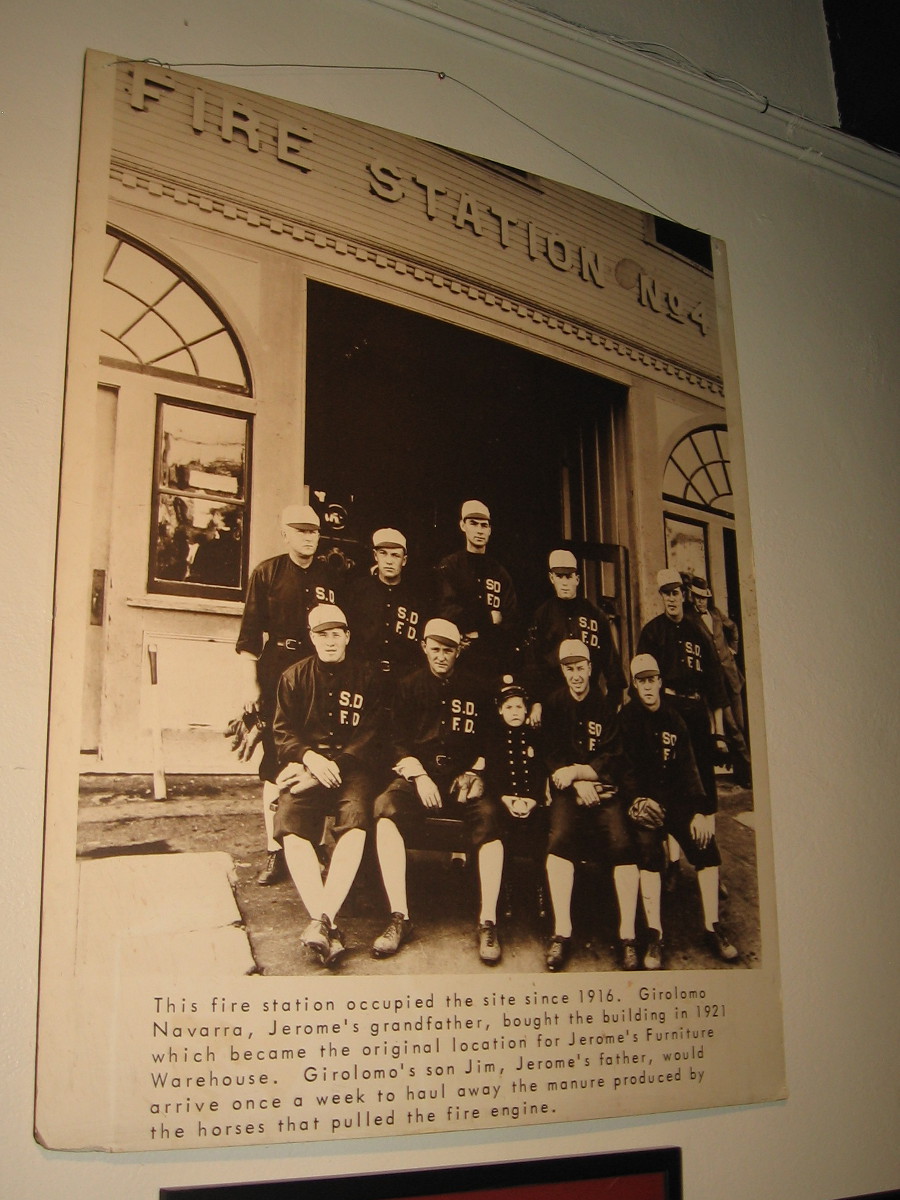
The San Diego Firehouse Museum is manned by friendly firefighter volunteers. It’s located in old Fire Station No. 6 at 1572 Columbia Street in Little Italy.A look inside the Firehouse Museum, which is absolutely jam-packed with cool historical exhibits. Kids love this place.Two of the many vintage fire engines in the old firehouse. The museum’s walls are lined with interesting objects that tell the story of firefighting since the mid-1800s.The San Diego Firehouse Museum was founded in 1962 and is operated by the nonprofit Pioneer Hook and Ladder Company.A closer look at a 1914 Seagrave Pumper. During my visit, I learned that fire engines are also called pumpers.Even more old fire engines can be seen in a second room inside old Fire Station No. 6.Water pressure controls on the side of one pumper.This white fire engine was stationed at the 1915 Panama-California Exposition in Balboa Park. It can be seen in old photographs and postcards.Another look at the historic 1915 Panama-California Exposition fire engine. This section of the Firehouse Museum is a bit dark and close, which makes it hard to take a good wide photo.This glass display case in the museum contains all sorts of old fire fighter helmets and protective headgear.One corner of the Firehouse Museum showcases many old fire insurance marks which were affixed to buildings. One of these marks dates back to 1714.Smokey Bear welcomes visitors to The San Diego Firehouse Museum.One wall features a collection of old fire extinguishers.The Ely Adapter was invented by San Diego Fire Department’s Assistant Chief Robert Ely.Felt and paper stovepipe hats once worn by firefighters during parades.Model of 1899 Metropolitan Steamer with 1911 Christie tractor.Another display case at The San Diego Firehouse Museum contains all sorts of interesting old artifacts.A third room in the Firehouse Museum contains this 1903 coal burning steamer. Fire heats the boiler water, making steam, which activates a piston that pumps water.Stairs once used by scrambling firefighters when old Fire Station No. 6 was operational.An old photo of San Diego Fire Station No. 4 and its personnel.Photos of the San Diego Fire Department testing their new Ahrens Steamer at the courthouse on Broadway and Front Street in 1906.A collection of colorful antique hand pumpers at The San Diego Firehouse Museum.The San Diego Firehouse Museum is fantastic place to learn a bit about San Diego and the history of firefighting.
…
I live in downtown San Diego and love to walk! You can follow Cool San Diego Sights via Facebook or Twitter!
You can easily explore Cool San Diego Sights by using the search box on my blog’s sidebar. Or click a tag! There are thousands upon thousands of interesting photos for you to enjoy!
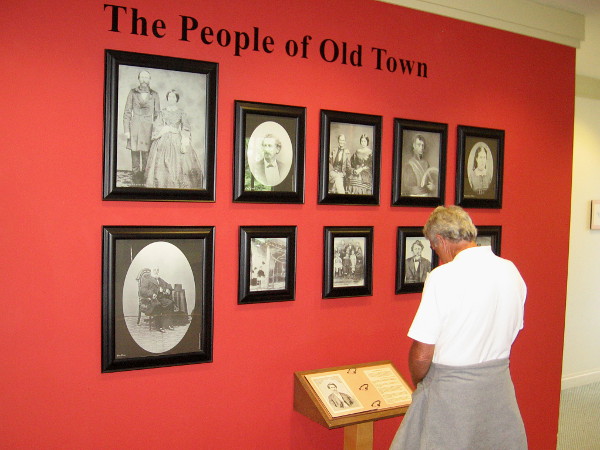
Visitor to the second floor of the McCoy House Museum learns about some notable early residents of Old Town San Diego.
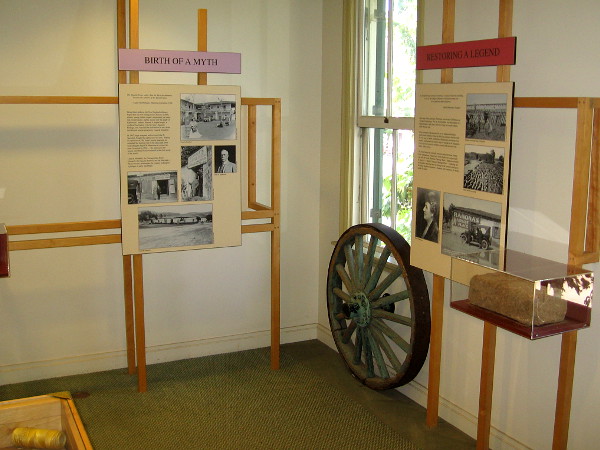
Should you visit the McCoy House Museum in Old Town San Diego State Historic Park, be sure to venture up the stairs to the second floor. There you’ll discover several fascinating exhibits. In addition to old photographs of notable early residents of San Diego, you’ll find an explanation of Old Town’s gradual decline as competing New Town (the site of modern downtown San Diego) grew and became the center of government and commerce. You will also learn about Old Town’s continuing legacy, including the events that led to the creation of Old Town San Diego State Historic Park in 1968.
If you’d like to read the displays, click the images to enlarge them.
From a window on the museum’s second floor one can also look down upon the scraggly native plant garden just northwest of the McCoy House. A map near the window shows the location of Sycamore, Toyon, Oak, Cottonwood, Elderberry and Willow trees. Other native plants include Yerba Mansa, Datura, Aster, Poppy, Deerweed, Sumac, Lemonadeberry, Manzanita, Monkeyflower, different Sages, Deergrass, Prickly Pear and Yucca. Many of these plants were used by the Native American Kumeyaay in their daily lives long before explorer Juan Rodriguez Cabrillo discovered San Diego Bay in 1542.
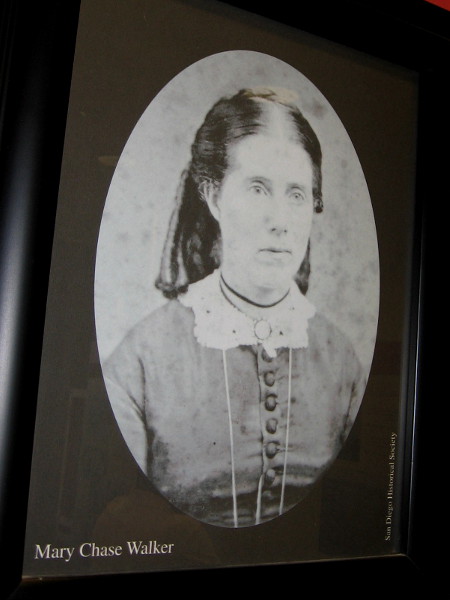
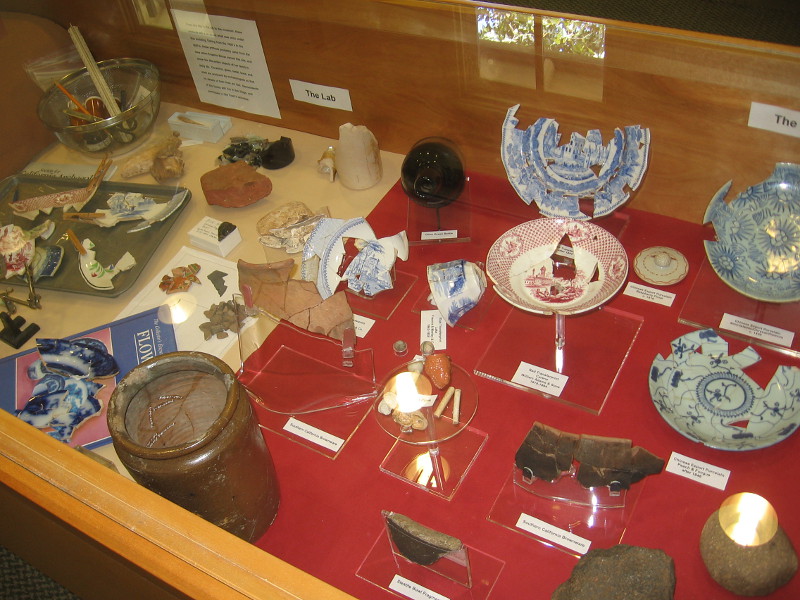
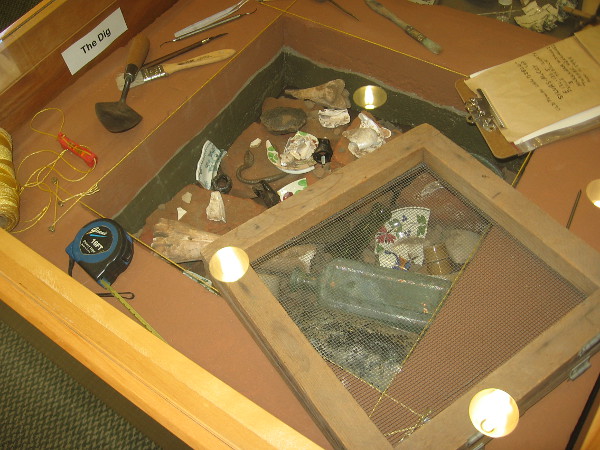
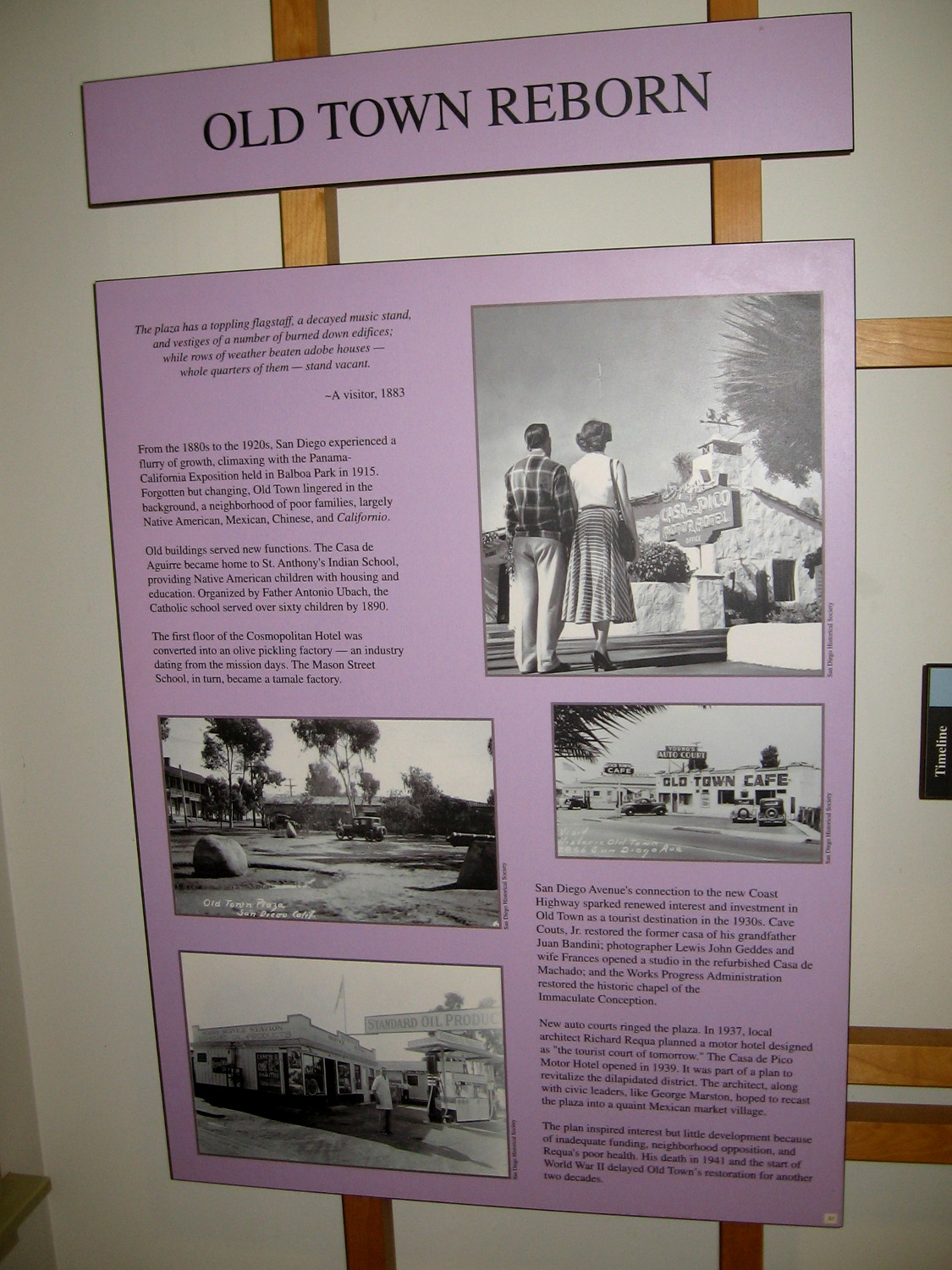
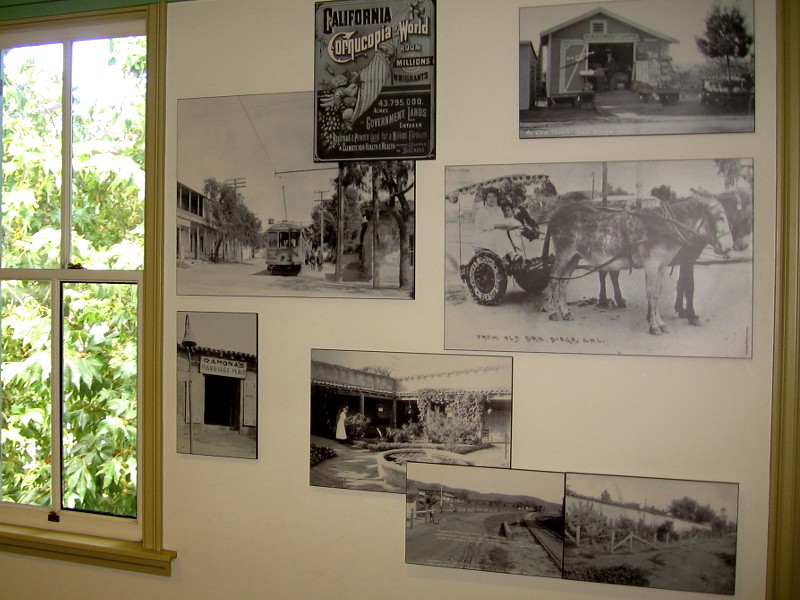
Pio Pico settled in San Diego in 1819 after the death of his father, a soldier assigned to the Presidio. Merchant and rancher, he later lived in Los Angeles and became the last governor of Mexican Alta California.In 1865, Mary Chase Walker became Old Town’s first school teacher. She taught at the one room Mason Street schoolhouse and described early San Diego as a desolate place. She went on to join the suffragette movement.Agoston Haraszthy, born in Hungary, led a fascinating life. As an American pioneer, businessman and wine expert, he became San Diego’s first town marshal and the first county sheriff.Fire devastated Old Town in 1872. At the time only one water pump existed, and it was broken. Firefighters watched helplessly. The fire and many other factors helped to bring about the rise of competing New Town.Various fascinating historical exhibits can be explored on the second floor of the McCoy House Museum in Old Town San Diego State Historic Park.In the early 20th century, neglected, ruined buildings in Old Town were fixed up and converted into tourist attractions. Entrepreneur John D. Spreckels extended his streetcar line to Old Town.Artifacts found under the rebuilt McCoy House date from the 1830’s to 1850’s. They include fragments of daily life from that eraArchaeologists analyze each find, record every detail. These objects probably came from the time when Eugenia Silvas owned this site. Family descendants still live in San Diego and are involved in Old Town’s activities.Archaeologist’s tools on display in the McCoy House Museum.Once again, Old Town became a tourist destination in the 1930’s when San Diego Avenue became connected to the new Coast Highway.Old Town languished during World War II. After the war, some suggested setting aside Old Town as a historic community. In 1968, Old Town San Diego became a state historic park.Photographs in the McCoy House Museum recall Old Town San Diego’s colorful past.
…
I live in downtown San Diego and love to walk! You can follow Cool San Diego Sights via Facebook or Twitter!
You can easily explore Cool San Diego Sights by using the search box on my blog’s sidebar. Or click a tag! There are thousands upon thousands of unique photos for you to enjoy!
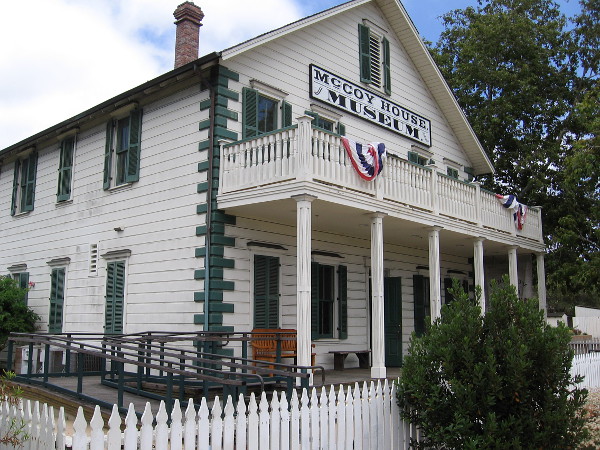
The McCoy House Museum, in Old Town San Diego State Historic Park, is a reconstruction of a home built in 1869 for Sheriff James McCoy.
While there are many small museums and historical attractions that visitors can enjoy in Old Town San Diego State Historic Park, the McCoy House Museum is the best place to see an extensive series of interpretive displays that describe the complete history of early San Diego.
The McCoy House, standing on the north end of Old Town, is a reconstruction of a home built in 1869 for Sheriff James McCoy and his family. James McCoy, who lived from 1821 to 1895, like many early San Diego residents was an ambitious man, working diverse jobs, filling many roles. At the age of 21 he sailed from Ireland to America seeking opportunity. He became a soldier, then a stagehand, then San Diego county assessor, then county sheriff in 1861. He acquired substantial real estate holdings and finally won election to the state senate in 1871.
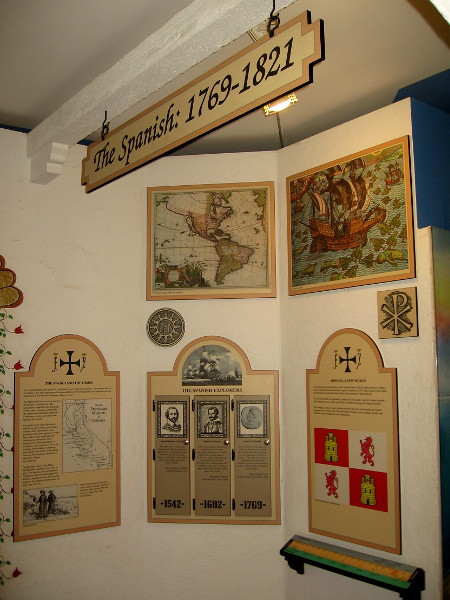
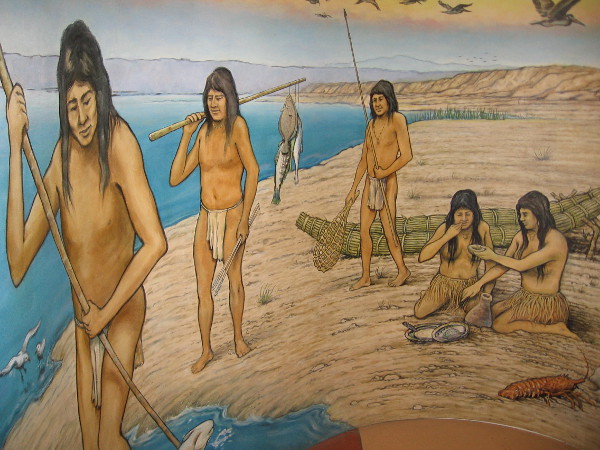
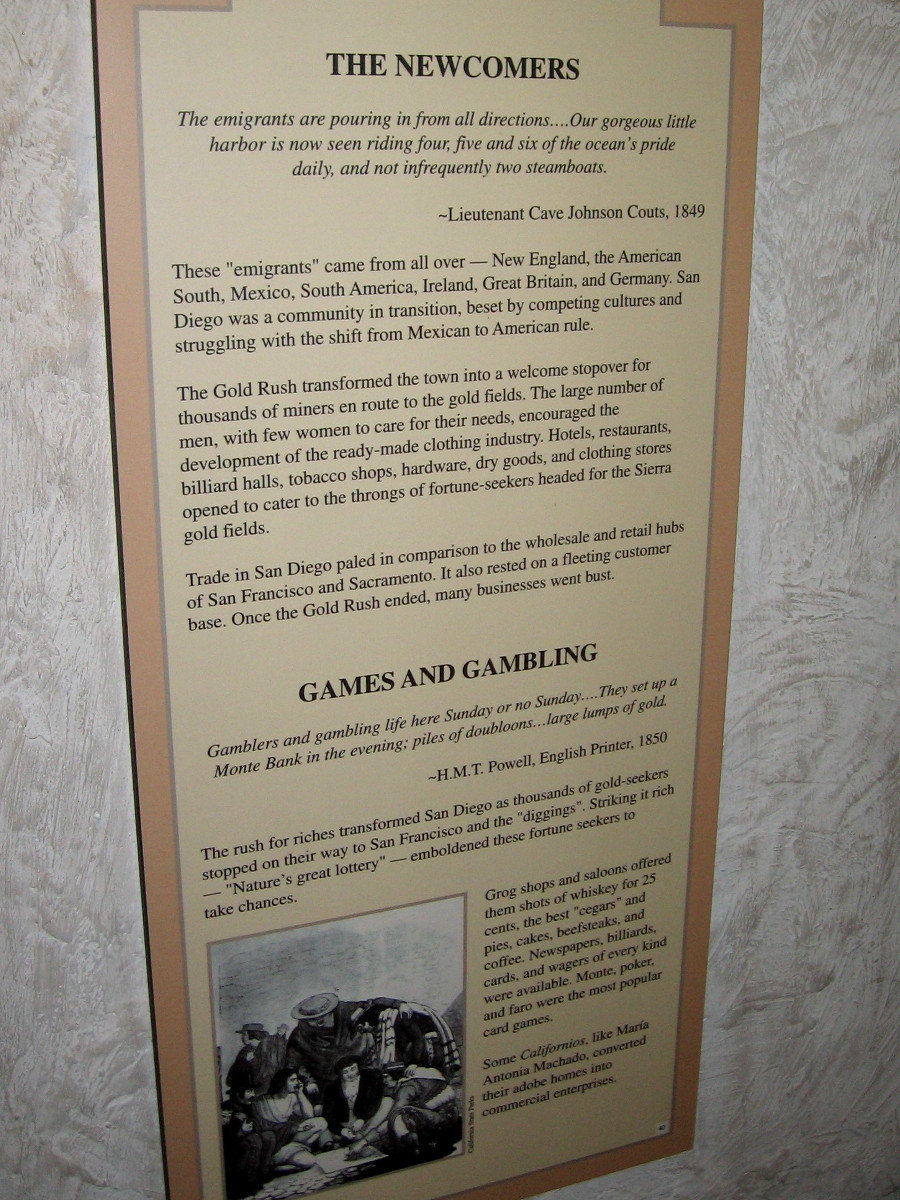
The interpretive displays in the McCoy House Museum provide a good look back at San Diego’s formative years. They detail the life of the Native American Kumeyaay who’ve lived in the region for thousands of years, the first Spanish explorers, the establishment of the Spanish mission, the Mexican period and the subsequent American period.
If you’d like to read the displays, click my photographs to enlarge them.
This blog post covers the first floor of the museum. I’ll cover the second floor exhibits in a later post. After heading up some stairs, one can find information about the more prominent residents of Old Town, plus the town’s later history as it competed with New Town, which eventually rose to become downtown San Diego as we know it today.
Anyone who is a history buff must visit the McCoy House Museum. You’ll be transported back in time and see how life was exciting, difficult, and altogether different many, many years ago in San Diego.
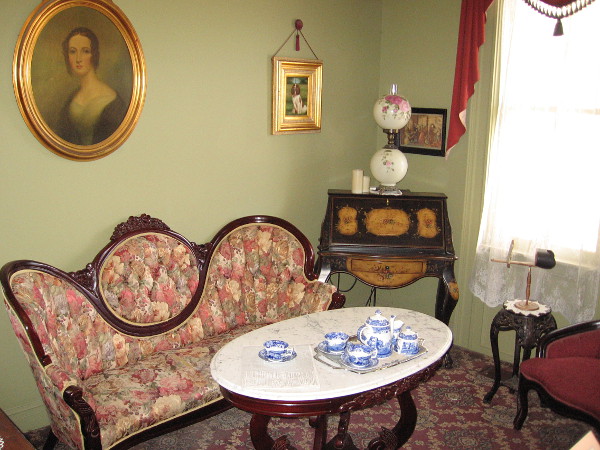
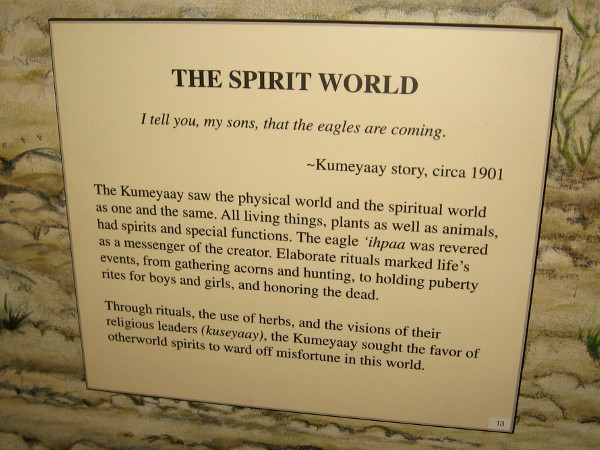
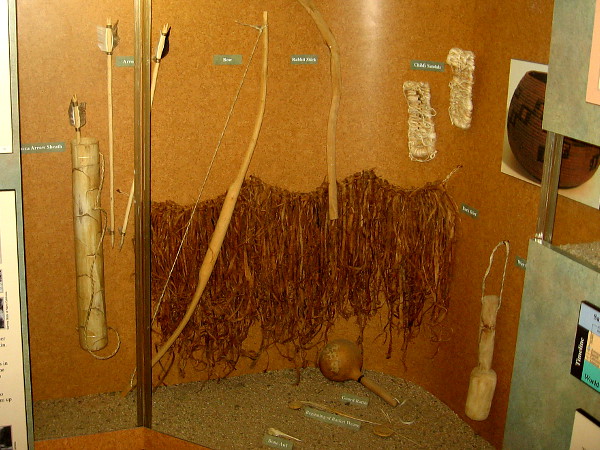
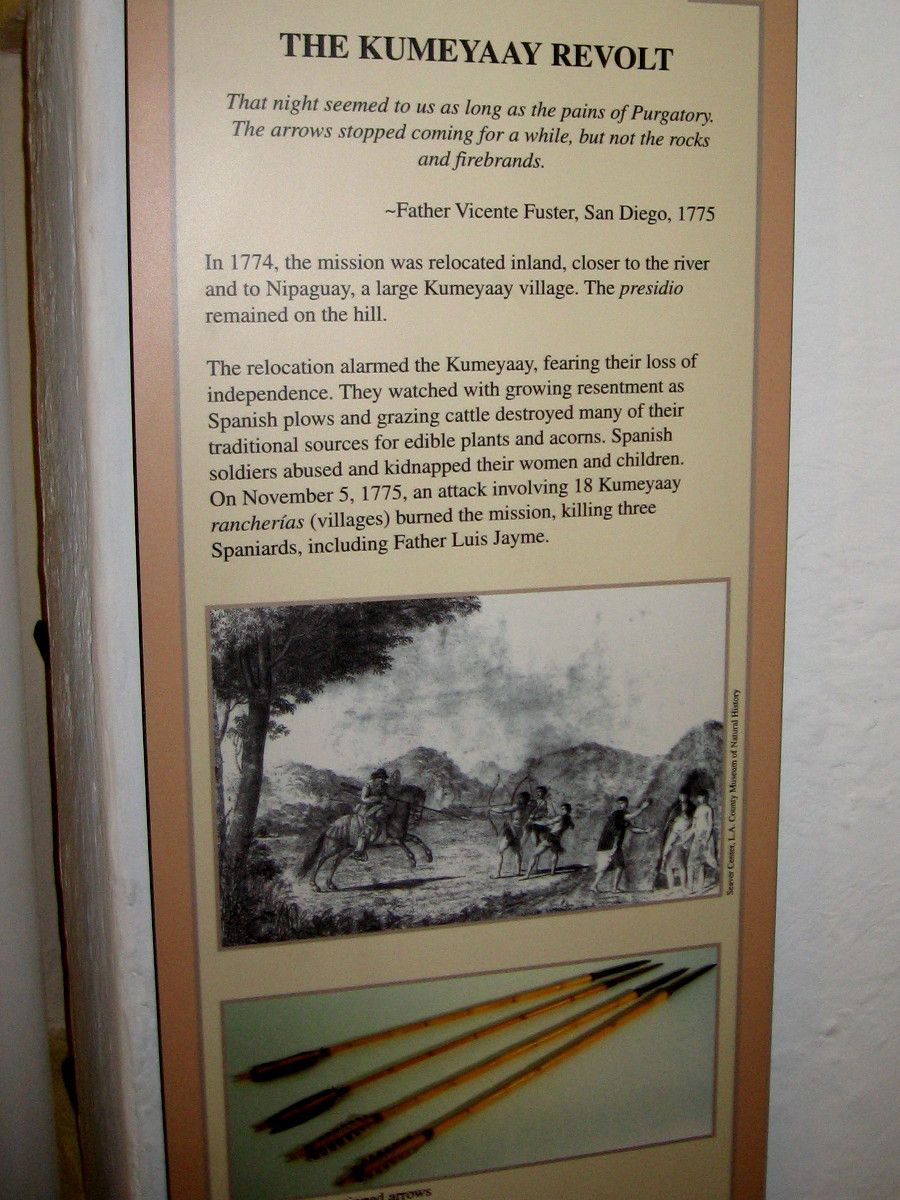
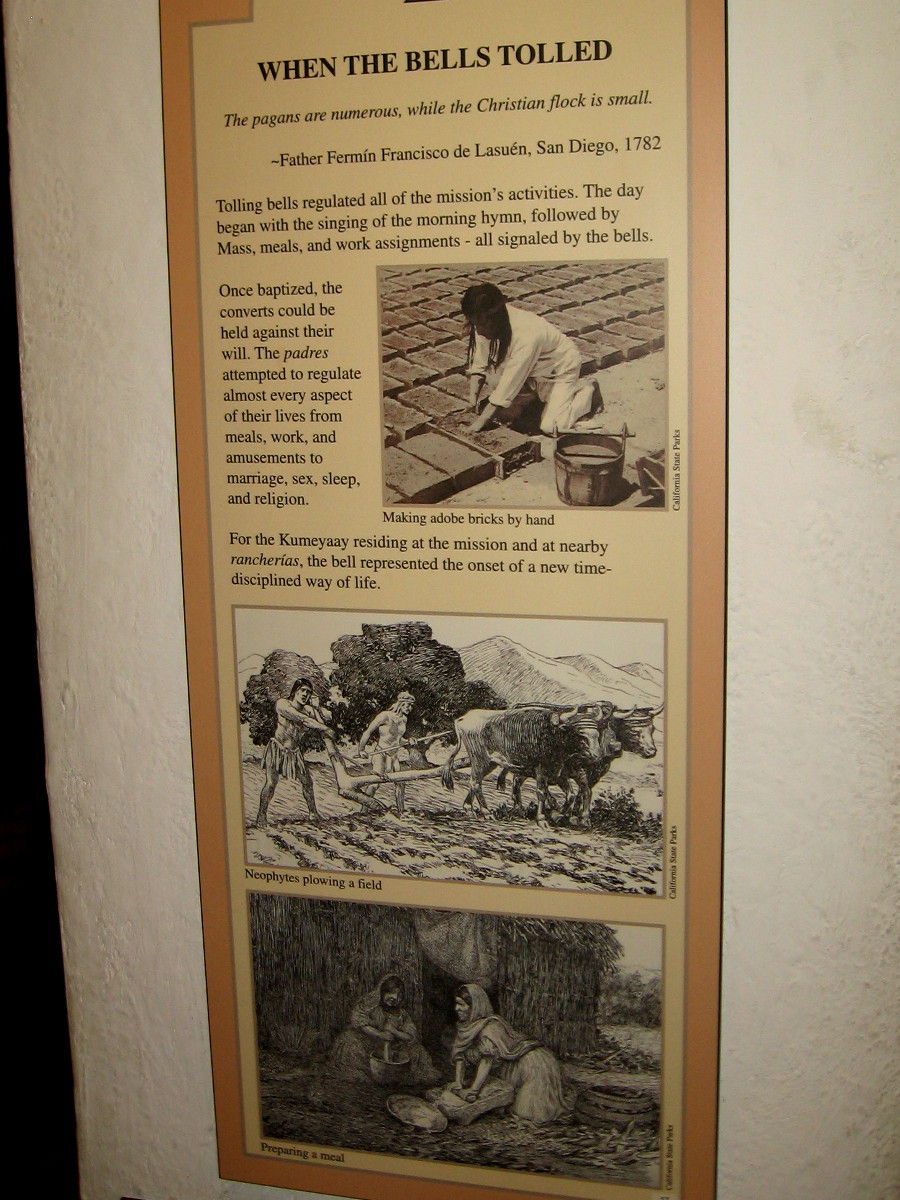
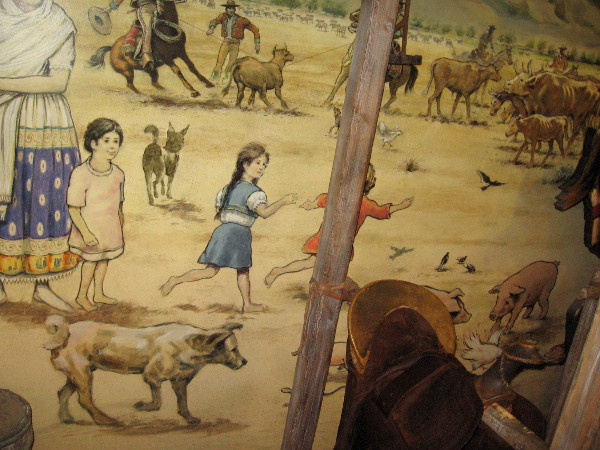
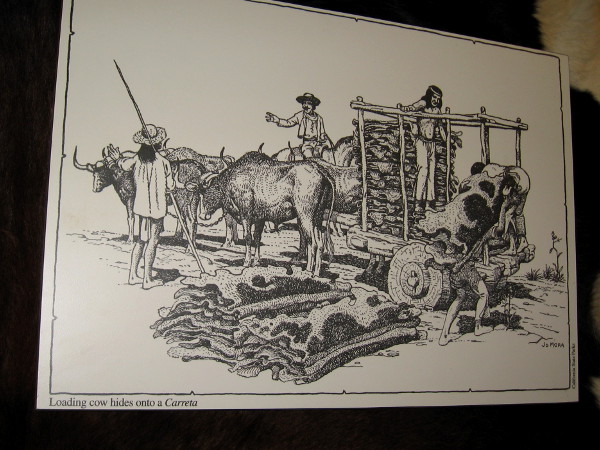
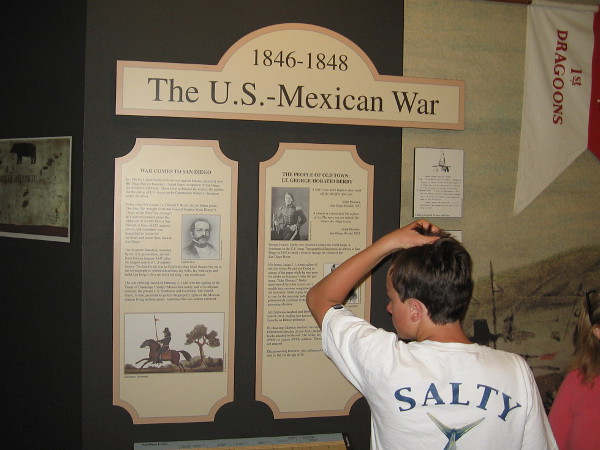
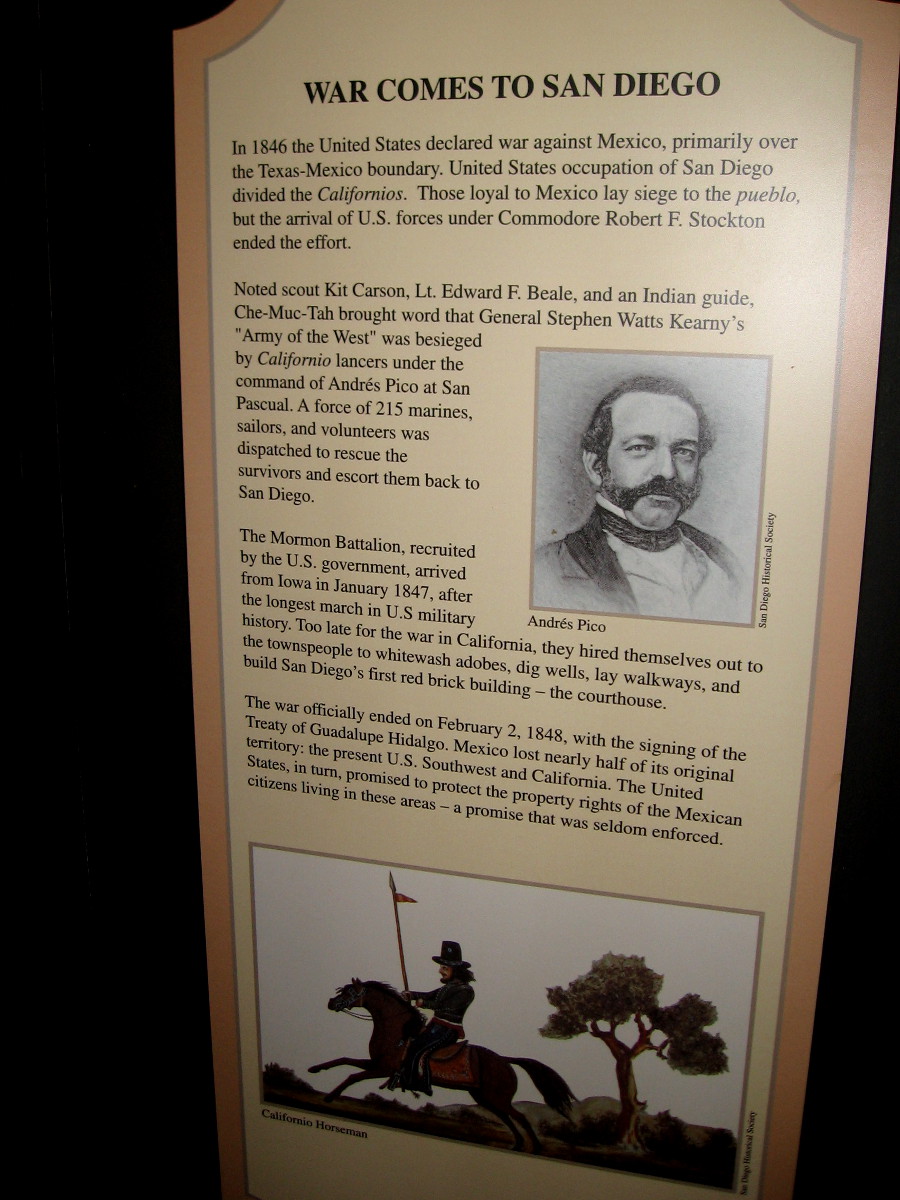
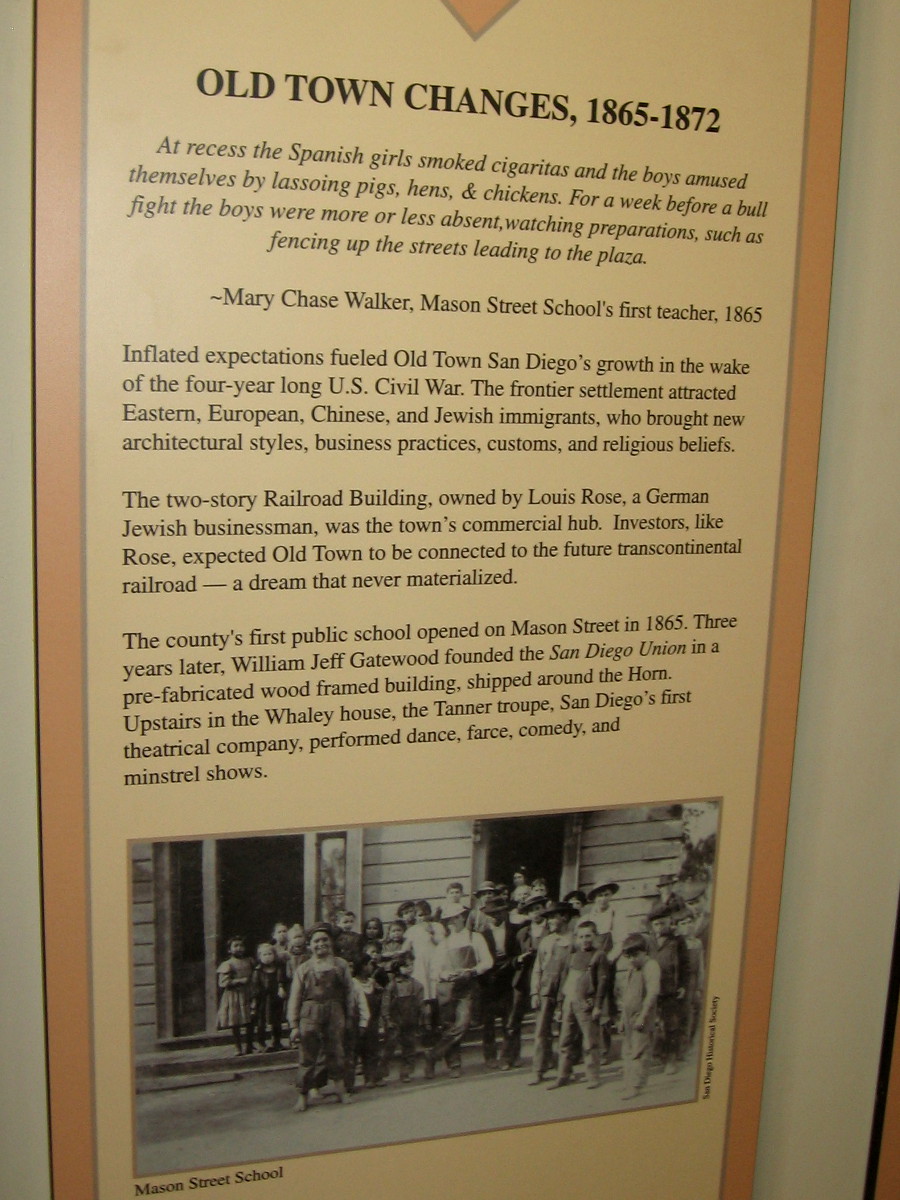
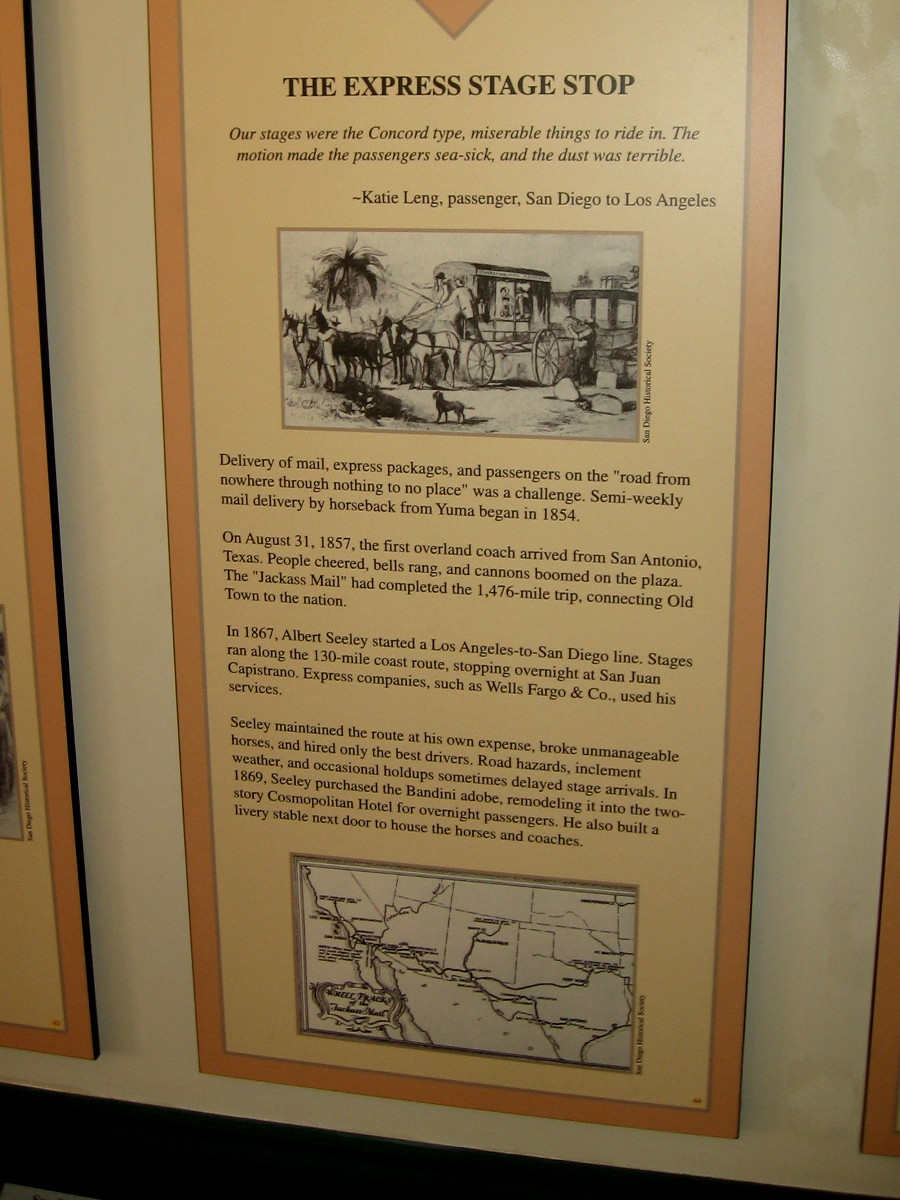
Sign lists important dates concerning the McCoy House. Today it’s a museum containing exhibits that explain the fascinating history of Old Town San Diego.Just inside the front door, this might have resembled the parlor of the original McCoy House, occupied by an upper middle class family in San Diego’s Old Town.Framed photo on one wall from the San Diego Historical Society shows the original McCoy House.Interpretive exhibits inside the McCoy House Museum begin with the Spanish period of San Diego, from 1769 to 1821.Quotes from the journeys of Juan Rodriguez Cabrillo, Sebastian Vizcaino and Gaspar de Portola.A string of missions was created by Spain in California to secure its claim to new territory. The first mission, in San Diego, was originally established on Presidio Hill near the native Kumeyaay village of Cosoy.An artistic representation of life among the Kumeyaay people. They often visited the nearby coast to hunt and gather food.For thousands of years, the Kumeyaay lived along the coast and interior valleys of what is now San Diego County. They moved with the seasons to take advantage of available resources.The Kumeyaay built dome-shaped houses from oak, willow or sycamore branches. The simple structures were called ee-wahs.The Kumeyaay saw the physical and spiritual world as one and the same.Exhibit in the McCoy House Museum shows artifacts associated with the Kumeyaay, including a bark skirt, arrows, rabbit stick, child’s sandals, gourd rattle and war club.The Kumeyaay revolted against the Spanish missionaries in 1775, a year after the San Diego mission was relocated inland very close to a large Kumeyaay village.Once baptized, converted Kumeyaay followed a strict life. Mission bells signaled the day’s activities, including the singing of hymns, Mass, meals and work assignments.Mexico gained its independence from Spain in 1821 after a decade of bloodshed. Changes included a decline in support for the presidio and freedom from Spain’s trade regulations.After the breakup of the Spanish missions, the era of the great ranchos began. Californios were often racially mixed descendants of soldier-settler families.Vaqueros were the original cowboys. They worked on the extensive ranches and handled the large herds of stock.A fanciful picture of life on a rancho, with vaqueros at work and children at play.The Californios loved to celebrate feast days, weddings and religious festivals.Cattle by the thousands roamed San Diego’s hills. Their dried hides were used in trade and were sometimes referred to as California banknotes.Illustration of loading cow hides onto a carreta. Hides were gathered by ships along the coast to be transported around Cape Horn to the eastern United States.Exhibit inside the McCoy House Museum recreates the small shop of a Boston trader. The brig Pilgrim of Two Years Before the Mast brought people aboard to buy wares and finished goods that weren’t available in San Diego.Illustrations of cow hides being cured. This activity took place at La Playa, a point on San Diego Bay near Ballast Point in Point Loma.Diagram of the brig Pilgrim, made famous in Richard Henry Dana Jr.’s classic Two Years Before the Mast. As an ordinary seaman, Dana collected cattle hides up and down the California coast.Exhibit in the McCoy House Museum details local history during the Mexican–American War from 1846 to 1848.During the war, U.S. occupation of San Diego divided the loyalty of the Californios. The two sides fought briefly at the Battle of San Pasqual.Around the time of the Gold Rush, San Diego saw an influx of emigrants from all over, including New England, the American South, Mexico, South America, Ireland, Great Britain and Germany.Old Town tales include the construction of the first jail in 1850. The walls were so poorly made, the first prisoner, Roy Bean, easily dug himself out, then celebrated at a nearby saloon!Grog shops became popular gathering places. They were a social hub of San Diego life, providing customers with news and provisions.A recreated Old Town grog shop can be found inside the McCoy House Museum.After the California Gold Rush of 1849, San Diego became more developed. A courthouse and newspaper were established. Transportation included clipper ships, stage lines and steamships.Poster advertises a new clipper ship route. A very quick trip may be relied upon!Between 1865 and 1872, Old Town San Diego continued to grow. The first public school opened, and the town welcomed its first theatrical company in the Whaley house.The first overland coach to San Diego began service in 1854. Additional stage lines came into existence, allowing for the delivery of mail, express packages and passengers.Visitors to the McCoy House Museum can step into a replica stage stop and see what life was like in Old Town during San Diego’s rugged early history.
…
I live in downtown San Diego and love to walk! You can follow Cool San Diego Sights via Facebook or Twitter!
You can easily explore Cool San Diego Sights by using the search box on my blog’s sidebar. Or click a tag! There are thousands upon thousands of interesting photos for you to enjoy!
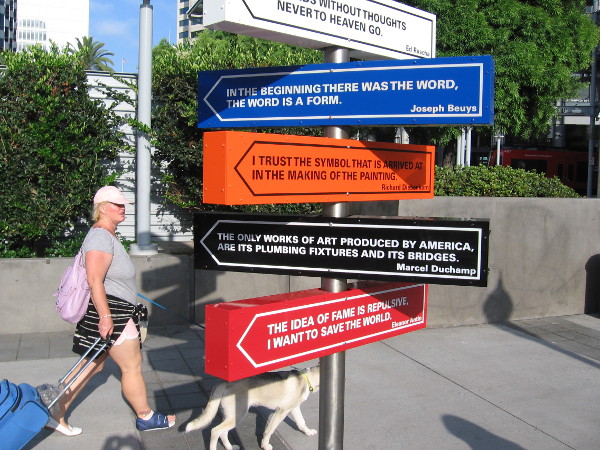
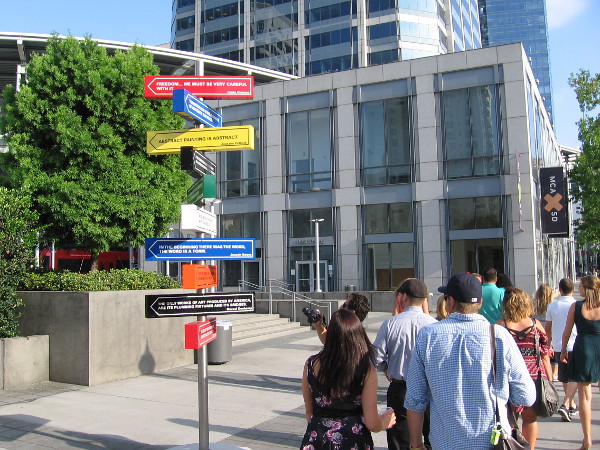
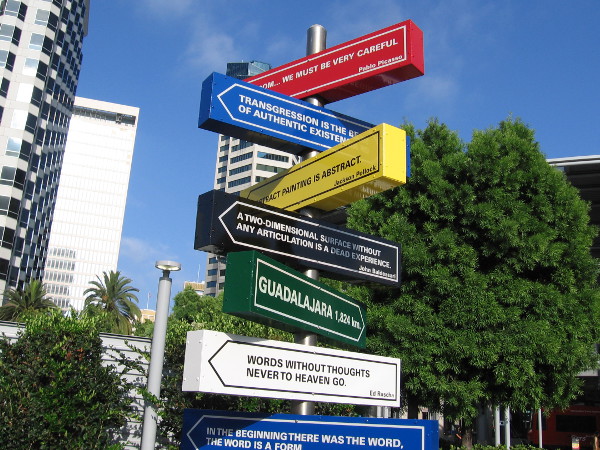
Unusual signs near America Plaza contain quotes from famous modern artists. This thought-provoking art was installed by the Museum of Contemporary Art San Diego, which is located across the street.
Look what I discovered this evening! I had disembarked from the trolley at the Santa Fe Depot and was making my way to America Plaza when my eyes were ensnared by a very cool sight.
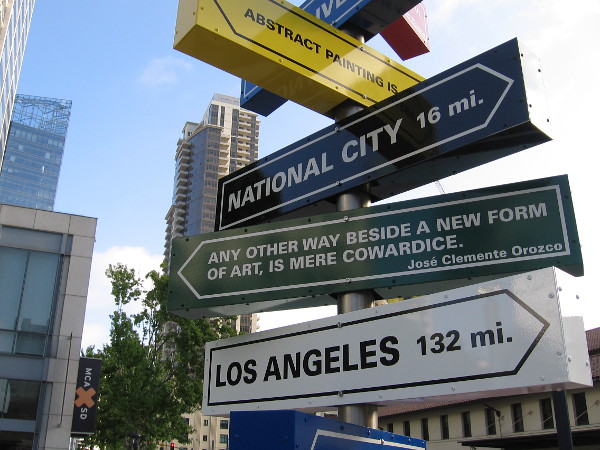
At first glance I thought it was a cluster of directional signs that point every which way to cities around the world. Then I realized these signs were far more interesting!
On one side each sign contains a thought-provoking quote from a modern artist. The cities shown on the reverse side are those associated with the artists.
The modern artists quoted are: Pablo Picasso, Jeff Wall, Jackson Pollock, John Baldessari, Jose Clemente Orozco, Edward Ruscha, Joseph Beuys, Richard Diebenkorn, Henri-Robert-Marcel Duchamp and Eleanor Antin.
I walked back across Kettner Boulevard to the Museum of Contemporary Art San Diego and learned that these unusual signs were installed by the museum about two weeks ago!
People walk down the sidewalk along Kettner Boulevard. A few glance up at what appears to be a cluster of strangely colorful directional street signs.Quotes from ten notable modern artists are featured on the MCASD signs. The reverse side of each directional sign contains a city associated with the artist.Provocative public art rises from a downtown sidewalk, across the street from the Museum of Contemporary Art San Diego.
…
I live in downtown San Diego and love to walk! You can follow Cool San Diego Sights via Facebook or Twitter!
Carpenter’s Wheel quilt, Mennonite, about 1890. Made by Mrs. Miller in Easton, Pennsylvania.
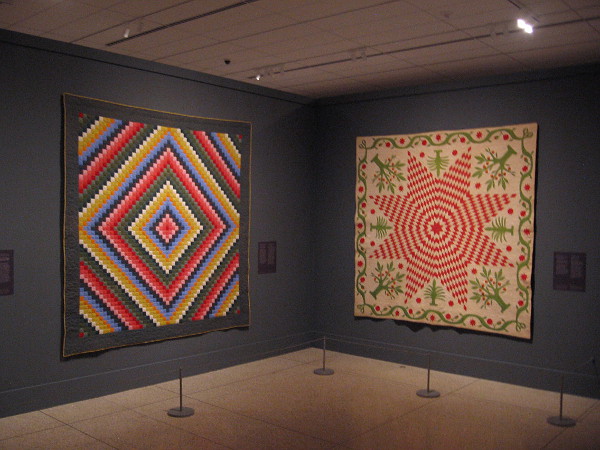
My eyes opened wide with amazement last weekend, when my docent friend provided another special tour at the San Diego Museum of Art. This time we had a good look at a surprising exhibition of early American quilts from the Museum of Fine Arts, Boston.
These quilts, which date mostly from the 19th century, created in many instances by lone Amish and Mennonite quiltmakers, are so dazzling with brilliant colors and inventive, abstract designs that they seem thoroughly modern, like hung works of art by the greatest 20th century Abstract Expressionists.
I know relatively little about quiltmaking. All I know is that when I gazed at these vibrant works of art, I felt that I was peering into the inner life of a spiritual people, where joy, memories and dreams are represented with magically combined bits of color. These delights for the eye were created to be a warming family treasure, meant to last for generations.
In this blog post you can see just a few photos of the nearly 50 quilts on display. The craftmanship is intricate. I can’t imagine the many hours of persistent dedication, patience and love a quiltmaker required to create just one of these examples. They lived in a very different time and place. In their world living was more simple, and beauty was quietly formed from single threads.
All of these old quilts were discovered over several decades by collectors Gerald Roy and Paul Pilgrim, who also played an important role in the creation of the The National Quilt Museum in Paducah, Kentucky. Many of these quilts were collected solely for their aesthetic appeal. Paul Pilgrim, now deceased, was also an innovative quiltmaker.
Head to Balboa Park to visit the San Diego Museum of Art and you’ll be astounded by many of these quilts. If you do plan to visit, do so by September 5, 2016, when this very unique exhibition comes to an end.
Quilts and Color from the Museum of Fine Arts, Boston. This special exhibition can be enjoyed at the San Diego Museum of Art in Balboa Park.Amazing early American quilts on display at the San Diego Museum of Art feature beautifully contrasted colors and fascinating abstract designs.Spider Web quilt dazzles the eye. Many of the quilts feature unique visual effects or optical illusions.Fans quilt, Amish, 1900-1910. Made in Pennsylvania.Field of Diamonds quilt, about 1860. The design is achieved by creatively combining differently colored hexagons.Close-up photograph of fantastic, radiant Sunburst quilt.
…
I live in downtown San Diego and love to walk! You can follow Cool San Diego Sights via Facebook or Twitter!
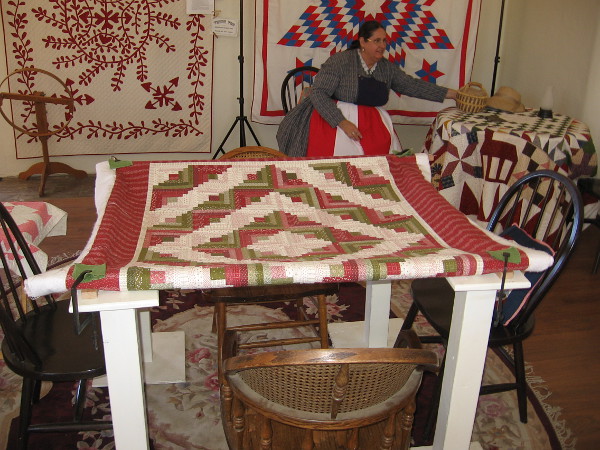
These beautiful quilts are on public display at Threads of the Past, in Old Town San Diego State Historic Park.
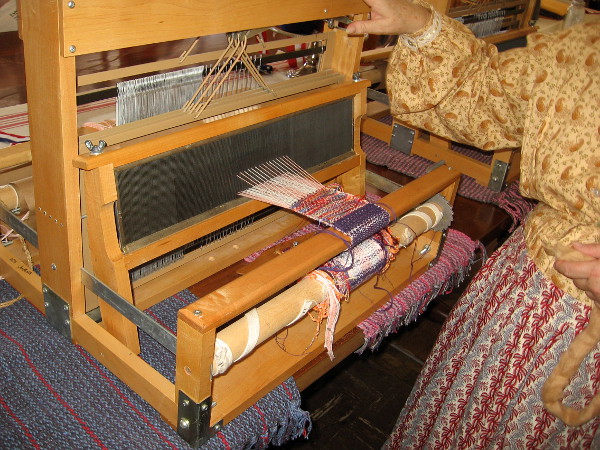
I recently visited Threads of the Past, a living history exhibition in Old Town San Diego State Historic Park. Not only did I see a number of beautiful quilts, but I learned about spinning and weaving. I was even able to watch a skilled artisan work an old-fashioned loom!
Here are some fascinating photos that I took inside Threads of the Past. I know very little about weaving and needlework, so I’m afraid I can’t provide much commentary. I do know that I really enjoyed looking at all the colors and patterns. I also learned a bit about San Diego’s past from the friendly members of Old Town’s Historic Quilt Guild and Fiber Arts Guilds. They’re keeping history alive! With great skill, they have produced beautiful textile artwork that visitors to Old Town can appreciate with their own eyes!
Threads of the Past is located near San Diego’s first courthouse. You can find it among the many other museums and historical attractions in Old Town San Diego State Historic Park.
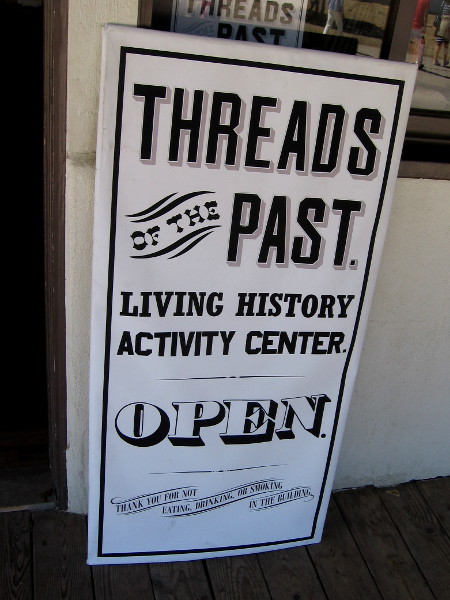
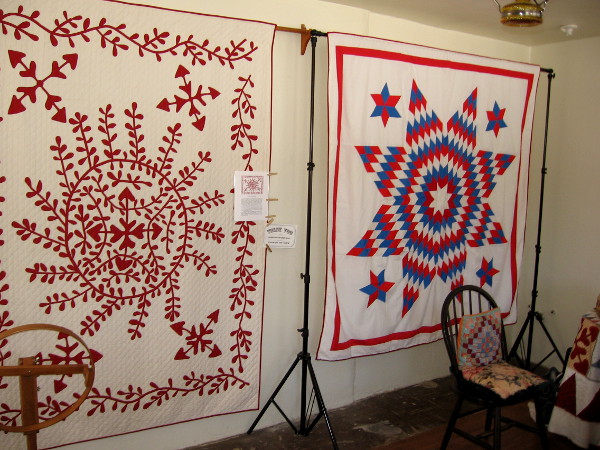
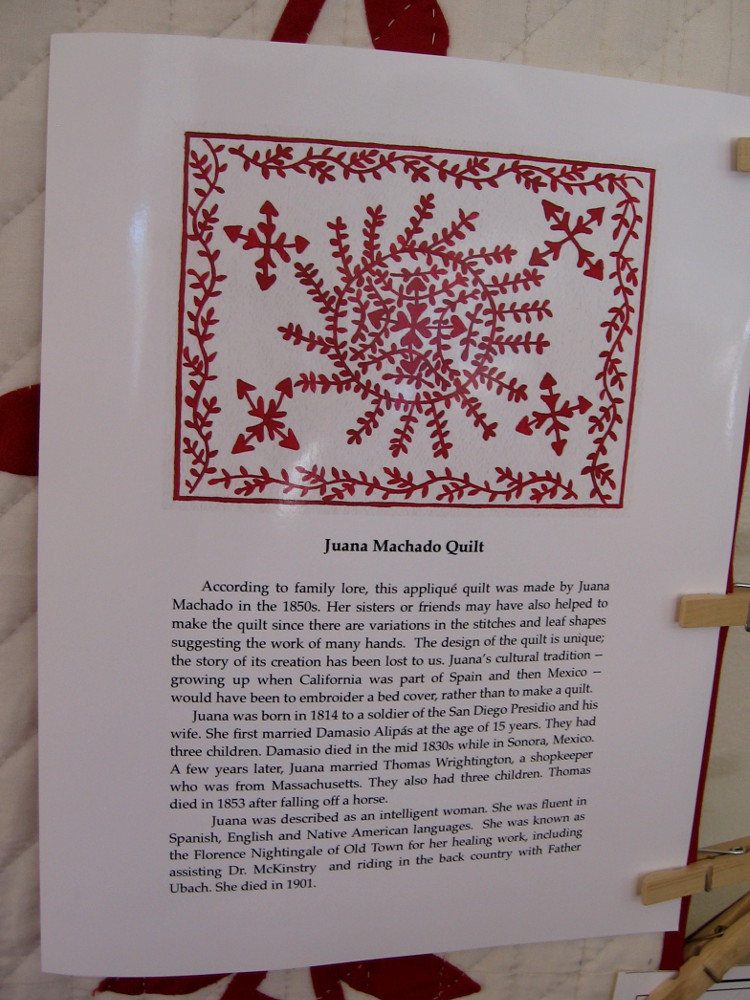
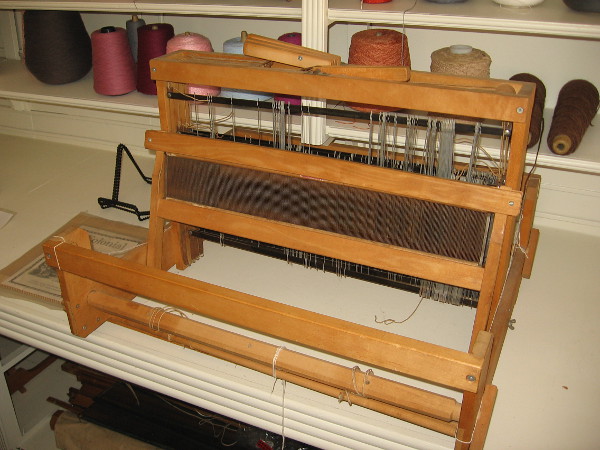
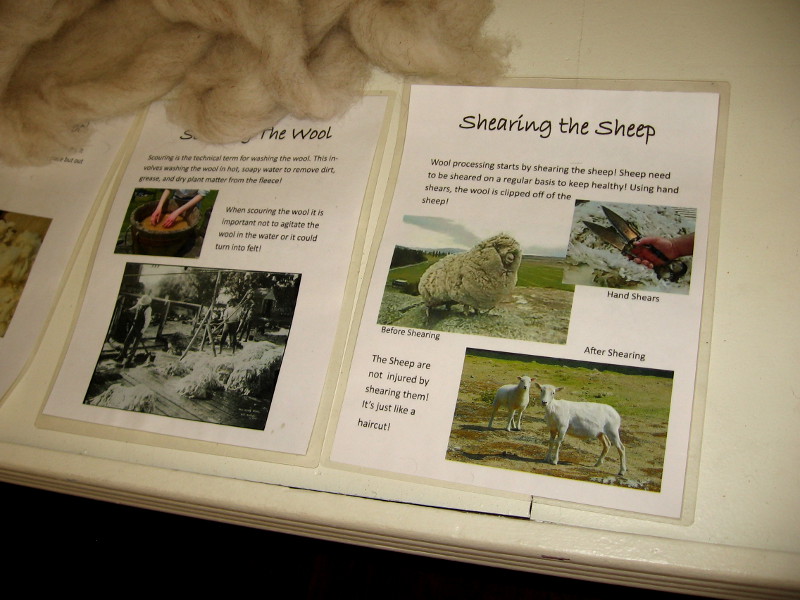
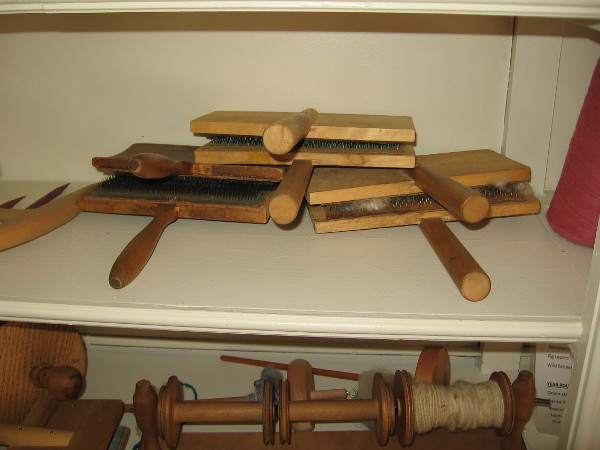
Should you visit San Diego’s Old Town, look for this sign outside the Threads of the Past living history activity center.Shelves full of colorful fabric woven with geometric patterns.Two quilts on one wall greet visitors as they enter Threads of the Past. On the left is a modern version of the 1850s Juana Machado Quilt.According to family lore, this applique quilt was made by Juana Machado in the 1850s. Juana was born in 1814 to a soldier of the San Diego Presidio and his wife.Threads of the Past contains several small looms and a variety of educational displays.Some colorful fabric circles arranged on a table.As you can see, this Inkle Loom is quite narrow. It’s used to make woven bands for belts and straps.A rather simple wood Colonial Loom on display in Threads of the Past.One display explains shearing sheep for wool, then carding, combing, and spinning wool.Several hand carders. Carding is gently spreading washed and dried wool in preparation for future processing, like spinning.All sorts of very colorful threads!A living demonstration of an old-fashioned hand loom at Threads of the Past, in Old Town San Diego State Historic Park.
…
I live in downtown San Diego and love to walk! You can follow Cool San Diego Sights via Facebook or Twitter!
You can easily explore Cool San Diego Sights by using the search box on my blog’s sidebar. Or click a tag! There are thousands upon thousands of fun photos for you to enjoy!
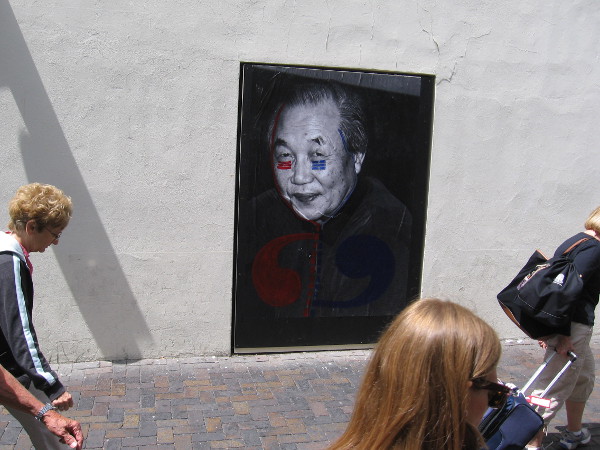
People walk through the breezeway between MCASD and the Santa Fe Depot. Three large portraits address the theme of political and domestic violence.
Unusual, thought-provoking works of art are currently on public display in the outdoor breezeway between the Museum of Contemporary Art San Diego and the Santa Fe Depot. I happened to see them the other day while walking through downtown to catch the trolley.
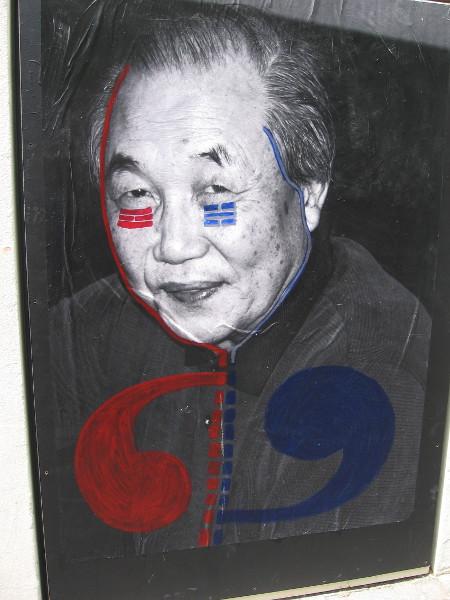
Close family members who have survived domestic and political violence appear in three large photographic portraits. The photos have been boldly augmented with paint to highlight human resilience and courage. According to a nearby description, these works are part of the FOCUS Binational Exhibition and were created by MCASD’s Teen Advisory Group. The artwork reflects an exploration of strategies for coping with violence and trauma.
This thought-provoking work of art suggests an older gentleman has a complex, deeply personal story to be told.A proud portrait augmented with laurels suggests one woman’s story ends in triumph.An arresting work of art glimpsed in downtown San Diego near the Santa Fe Depot. A strong woman rises from the turbulent ocean. Part of MCASD’s FOCUS Binational Exhibition.
…
I live in downtown San Diego and love to walk! You can follow Cool San Diego Sights via Facebook or Twitter!
You can easily explore Cool San Diego Sights by using the search box on my blog’s sidebar. Or click a tag! There are thousands upon thousands of unique photos for you to enjoy!
Through this door is where the tour of the Villa Montezuma begins. Once inside, visitors turn left into a reception room, then proceed into truly magnificent performance and drawing rooms.
Four times a year, people are allowed inside the amazing Villa Montezuma. That’s part of the agreement between the City of San Diego Park and Recreation Department and the Friends of the Villa Montezuma, who are working hard to restore this historic gem in San Diego’s Sherman Heights neighborhood. I went on one of those half hour tours yesterday. Wow!
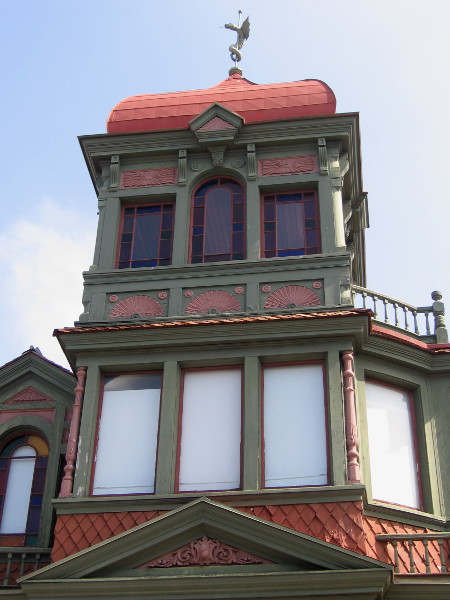
A couple years ago I walked past this eye-popping 1887 Queen Anne Victorian mansion, built by famed musican and spiritualist Jesse Shepard. I then posted a blog with a few outside photos. Well, guess what? All I can present today are more outside photos! Because photography isn’t allowed inside the Villa Montezuma at this time. But I can provide a little info about the tour, and try to convince you to go on one yourself.
Stepping into the Villa Montezuma is like stepping into a tiny royal palace. I’m not exaggerating. When I was young, I was fortunate to visit many of the most elegant palaces and chateaus of Europe, and the interior of Jesse Shepard’s home, which includes a splendid reception room, performance hall and drawing room, easily matches those esteemed places when it comes to lavish, luxurious decoration. Jesse Shepard (who later wrote under the pen name of Francis Grierson) was a pianist and composer who performed for many of Europe’s royalty, including the Czar of Russia and the Prince of Wales in England. So he was no stranger to a kingly lifestyle!
Should you enjoy an inside tour of the elaborate Villa Montezuma, which is built entirely of redwood, you’ll see fantastic art glass created by John Mallon of San Francisco. (Mallon also created the stained glass windows for San Diego’s 1889 courthouse, each window representing the Great Seals of the 42 states. You can see those windows today in downtown’s Hall of Justice.)
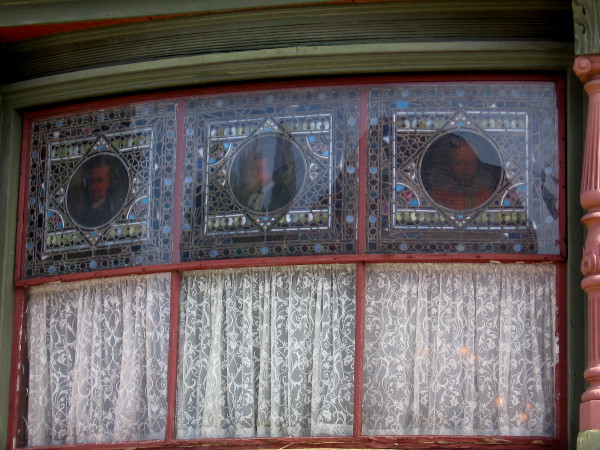
Jesse Shepard loved art, music and literature, and the stained glass windows in his mansion pay homage to his favorite artists. In the splendid room where he performed concerts for guests, windows feature the faces of Beethoven and Mozart, Raphael and Rubens; you’ll also see an expansive window devoted to Sappho, the classic Greek lyric poet, and four windows representing the four seasons. In the drawing room you can see more stained glass featuring Shakespeare, Goethe and Corneille.
The effect of these windows is truly astonishing. Their magical light shines on warm, ornate woodwork and wood floors, an embossed silvery ceiling, satin curtains, a variety of beautiful fireplaces, and artful touches that include influences from Innsbruck and Japonism. Stepping into the Villa Montezuma almost seems like falling into a dream of long ago.
Restoration of the Villa Montezuma is ongoing. The foundation was recently strengthened, along with the roof and chimneys. Still to go is the repainting of the exterior, fence restoration and landscaping the grounds. Once all is complete, it is hoped the mansion will be open full time as a permanent museum!
Meanwhile, go on a tour if you’re in San Diego. The guide was knowledgeable and entertaining. You’ll see much of the house, even some less elevated parts like the kitchen and washing room. You’ll learn all about Jesse Shepard, including strange mysteries concerning his life and the absolutely magnificent way he died!
Folks gather for a free half hour tour. The public can venture inside the Villa Montezuma four times every year. (The upper floor isn’t open to the public yet.)The Friends of the Villa Montezuma is a nonprofit dedicated to restoring and maintaining the amazing Villa Montezuma mansion in San Diego.Photo of southeast corner of the Villa Montezuma Museum. The 1887 Queen Anne Victorian mansion contains numerous beautiful stained glass windows.Looking upward at the elaborate tower. I was allowed to closely approach this outside part of the Villa Montezuma on a tour day.A balcony just outside Jesse Shepard’s bedroom, which is adjacent to the elegant drawing room!Unusual curved bay window of the drawing room features stained glass images of Shakespeare, Goethe and Corneille. One must be inside to appreciate the grand effect.A light-filled chapel-like nook in one corner of Jesse Shepard’s performance room features stained glass depicting the four seasons.
…
I live in downtown San Diego and love to walk! You can follow Cool San Diego Sights via Facebook or Twitter!
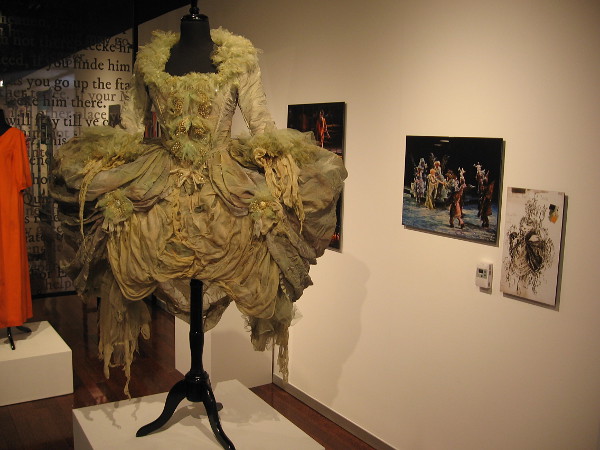
Costumes used in the production of Shakespearean plays are displayed at the First Folio exhibit in the San Diego Central Library art gallery. To the right is a costume worn by Othello.
Here are some truly amazing costumes! They’re on display in the ninth floor art gallery at San Diego’s downtown Central Library. But not for much longer! The blockbuster First Folio exhibition, of which they are part, comes to a conclusion on July 7.
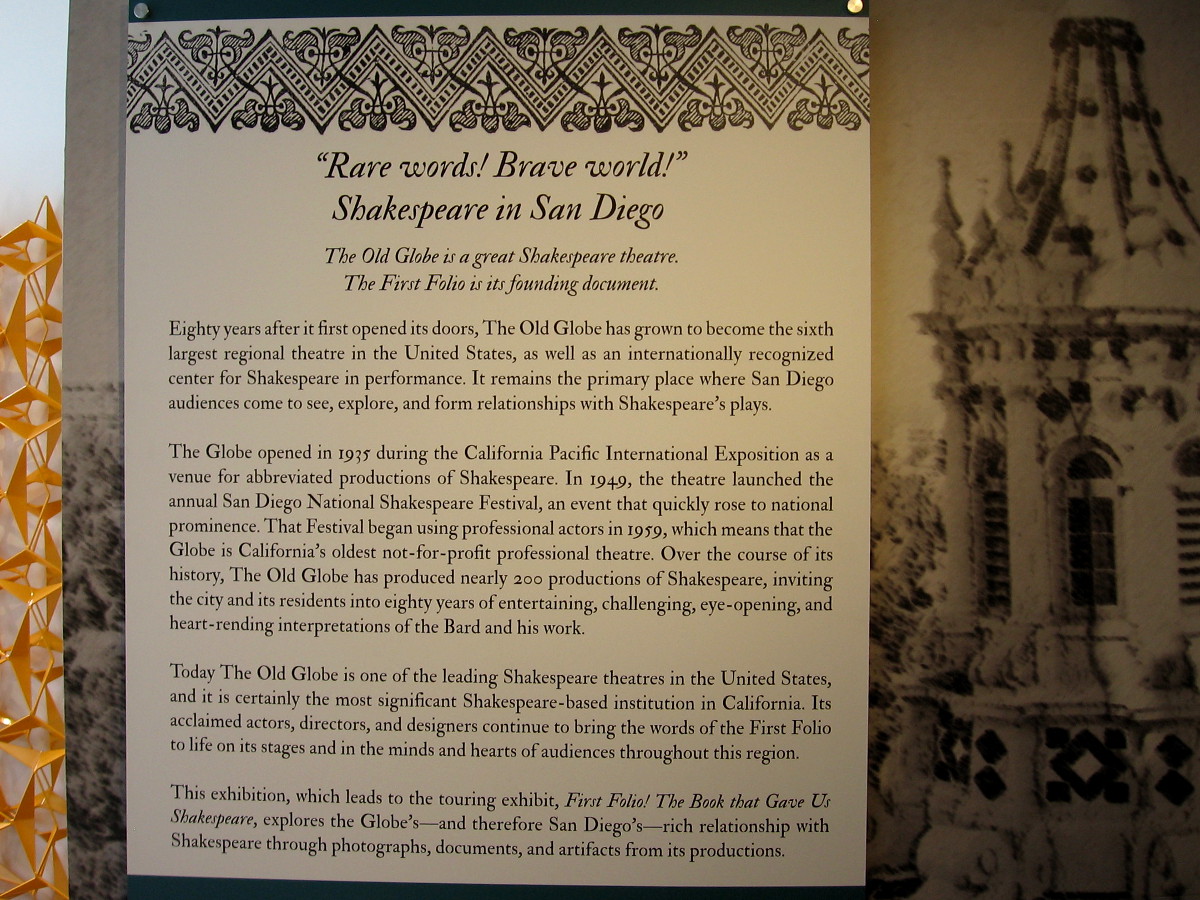
This blog post focuses on the world famous Old Globe Theatre’s contribution to this museum quality exhibit. The Old Globe has been a beloved destination in San Diego’s Balboa Park for just over 80 years, and has become one of the leading regional Shakespeare theatres in the United States.
Should you enjoy a visit to the gallery, after looking in person at these Shakespearean costumes, stage props, programs, scripts, artwork, historical photos and other fascinating material, go take a close look at one of 233 First Folios that are known to exist in the world! It’s one of the most important literary works (some would argue THE most important literary achievement) ever produced, containing 36 of Shakespeare’s immortal plays. You might not ever get this chance again!
You can see photos of the actual First Folio and much more from the rest of the exhibit here.
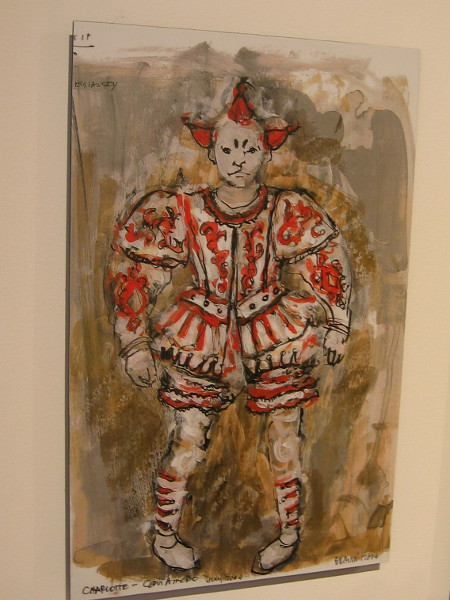
Visitor to First Folio special exhibit examines photos from the history of the Old Globe, one of the leading Shakespeare theatres in the United States. The cloak is from a production of Henry IV, Part 1.The Old Globe has grown to become the sixth largest regional theatre in the United States. It opened in Balboa Park in 1935 during the California Pacific International Exposition. (Click image to enlarge.)Craig Noel, Founding Director, helped the Old Globe grow from a small community organization into one of America’s great regional theatres.Props used in Old Globe production of Richard III include a simple crown, scepter and wooden throne.Newspaper articles recall how the Old Globe Theatre burned down in 1978 due to arson, then was rebuilt. Pages from a script of Hamlet were recovered from the fire.Bust of William Shakespeare. This Carrier-Belleuse sculpture was rescued from the Old Globe Theatre in 1978 as it was burning. It became a symbol of the Old Globe’s survival.One display case at the First Folio exhibit contains assorted Old Globe programs and publications from 1935 to today.Costume designed by Robert Morgan for character Moth, a Faerie, in Shakespeare’s A Midsummer Night’s Dream.Headpiece and photos from Old Globe production of The Winter’s Tale.Costume for Hermione, Queen of Sicilia, in Shakespeare’s The Winter’s Tale.Fun costume designed by Lewis Brown for court jester Touchstone, in Shakespeare’s As You Like It.Artwork depicts Touchstone, court jester in Shakespeare’s As You Like It. (To me he appears both ridiculous . . . and unsettling.)Costume designed by David Israel Reynoso for Viola, in Shakespeare’s Twelfth Night.One display case contains an assortment of cool props from past Old Globe productions.Yorick’s skull, with pages from a Hamlet script and photo of Lucas Hall in the title role.Costume from 2007 Old Globe production of Hamlet worn by the title character.Costumes for Claudius and Gertrude, used in Shakespeare’s immortal tragedy Hamlet.
…
I live in downtown San Diego and love to walk! You can follow Cool San Diego Sights via Facebook or Twitter!
To read a few philosophical short stories that might make you wipe a tear, visit Short Stories by Richard.
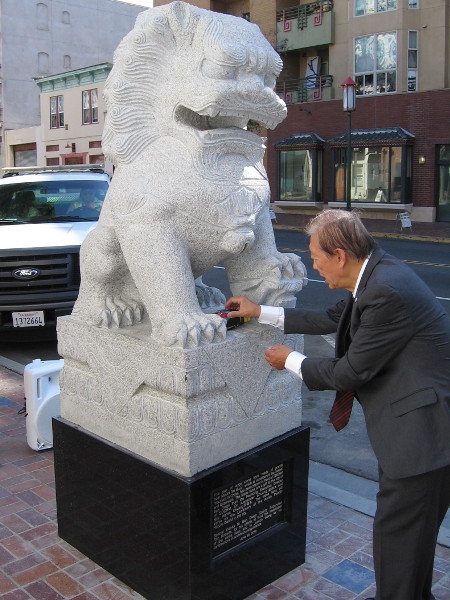
Founder of the San Diego Chinese Historical Museum, Dr. Alexander Chuang, prepares one of two stone lions for their unveiling ceremony.
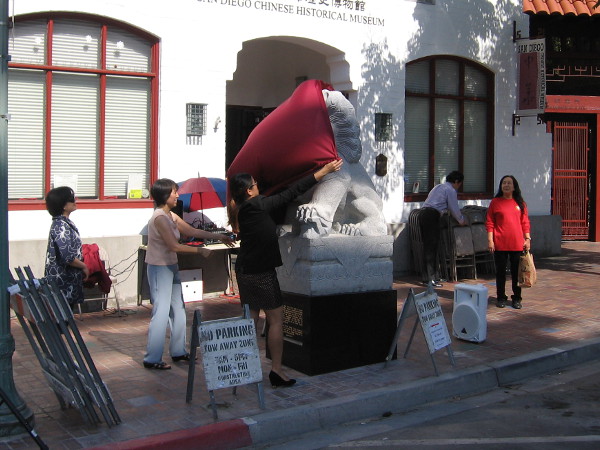
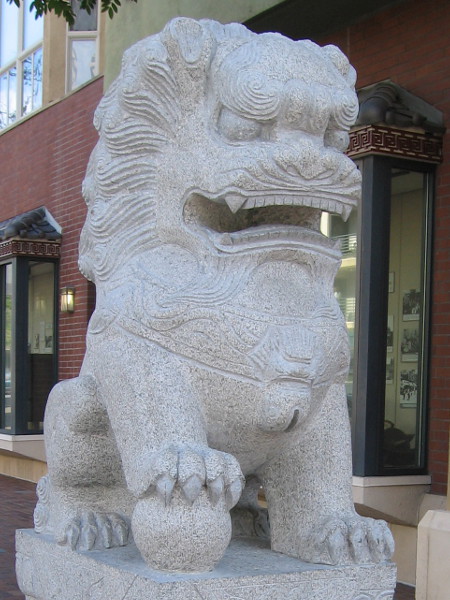
This morning a ceremony was held in front of the San Diego Chinese Historical Museum. Two large stone lions were unveiled at the intersection of J Street and Third Avenue. That’s in the very heart of downtown’s Asian Pacific Historic District.
I missed the unveiling, because I had a long-reserved ticket for another nearby event which took place at the exact same time. But I did get photos of the two amazing sculptures being prepared!
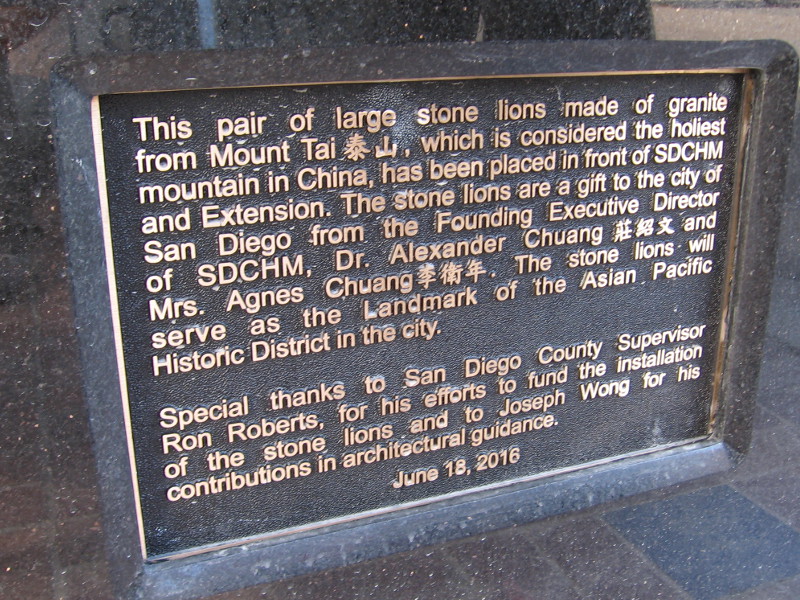
The founder of the Chinese Historical Museum, Dr. Alexander Chuang, had the two beautiful lions made in China then brought to the City of San Diego. It was a generous gift and a wonderful addition to our diverse city. I was told Dr. Chuang spent 7 or 8 years on this project. The lions are carved from stone taken from Mount Tai, which is said to be the holiest mountain in China. Now I have yet another reason to look forward to walks through this fascinating part of downtown San Diego!
I briefly spoke to Dr. Alexander Chuang while he prepared the statues, and to other members of the museum. They were so very gracious! One day I’ll venture into the museum–it’s on my list of things to do. When I do, I’ll definitely share the experience.
Plaque describes pair of large stone lions made of granite from Mount Tai, considered the holiest mountain in China. They will be a landmark of the Asian Pacific Historic District of San Diego.Final preparations are made about an hour before the unveiling. I got a sneak peek just by walking around with my camera!Members of the San Diego Chinese Historical Museum drape one of the two stone lions. I got my early photos just in time!On the opposite side of Third Avenue, the second lion stands guard. Another very cool sight has been added to the city of San Diego!
…
I live in downtown San Diego and love to walk! You can follow Cool San Diego Sights via Facebook or Twitter!
You can easily explore Cool San Diego Sights by using the search box on my blog’s sidebar. Or click a tag! There are thousands upon thousands of fun photos for you to enjoy!


















































 Cool San Diego Sights!