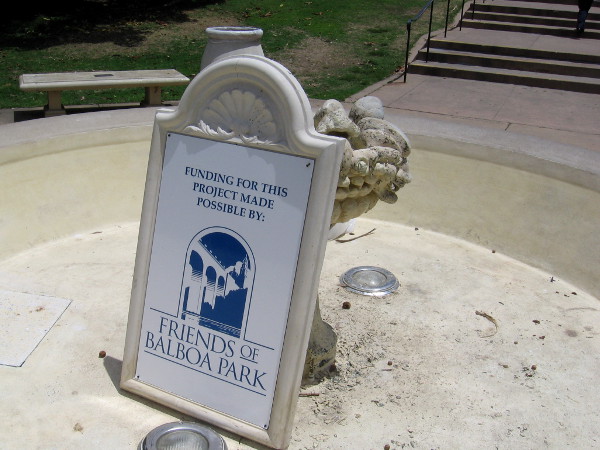
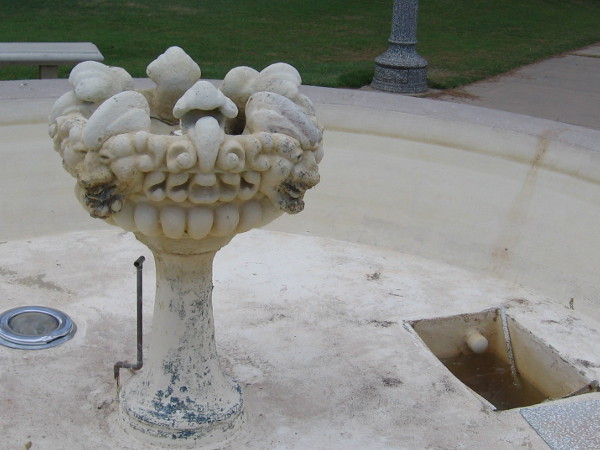
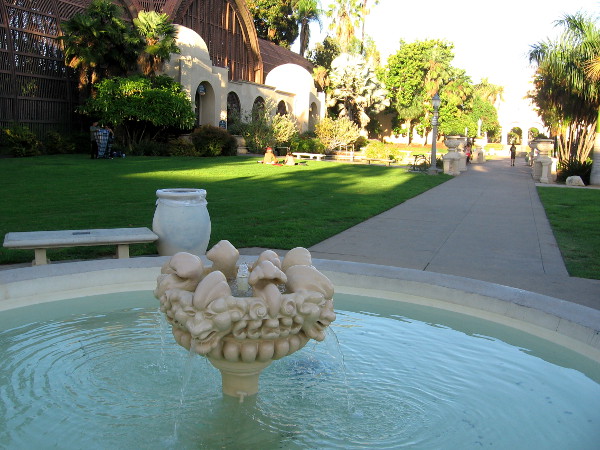
Two fountains near the reflecting pool, at either end of the Botanical Building, have fallen into disrepair.
This year Balboa Park is celebrating its centennial. A hundred years ago, for the 1915 Panama-California Exposition, many event structures were created out of plaster, with the idea that they would be temporary. But San Diego fell in love with the park as it was and changed its mind. It would be a shame to lose so much beauty. Today much of Balboa Park, after many years of maintenance and restoration, is like a glowing vision preserved from San Diego’s past. But time marches on. And more work always needs to be done.
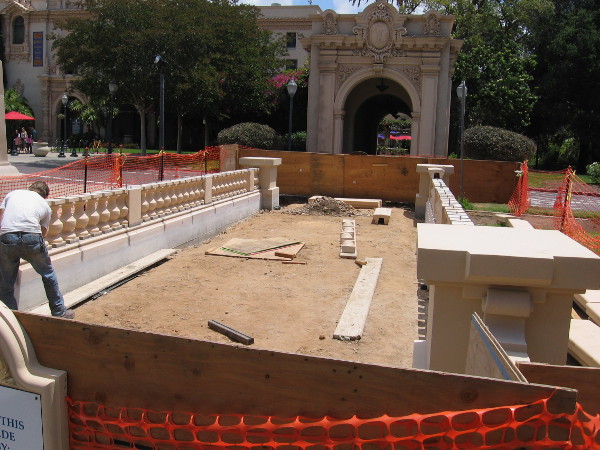
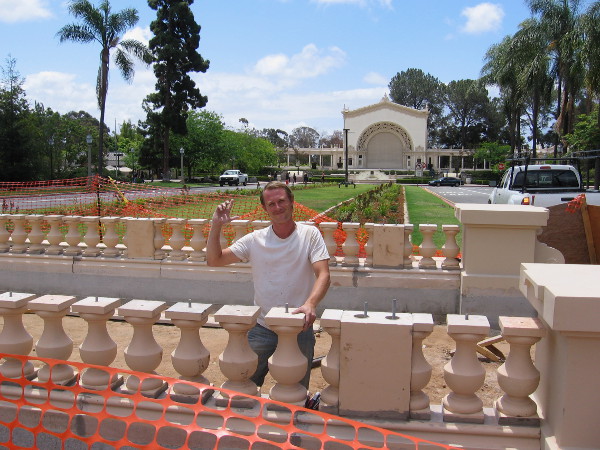
During a quick walk this afternoon through Balboa Park, I paused to look at some construction that is underway near the monumental El Cid statue, at the south edge of the Plaza de Panama. A friendly guy who was working there told me a little bit about three current restoration projects.
Here are my pics! Please read the captions, where I provide some more information.
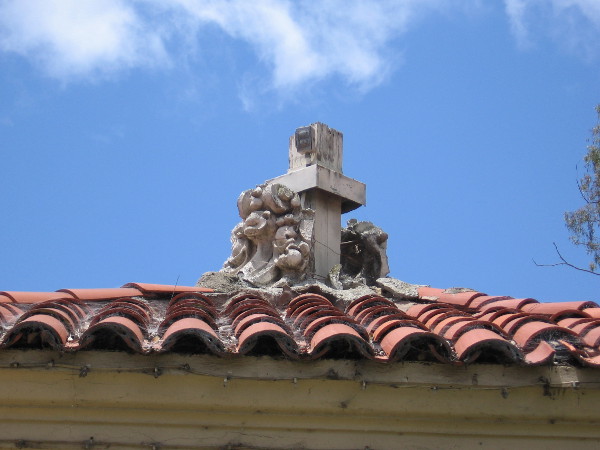
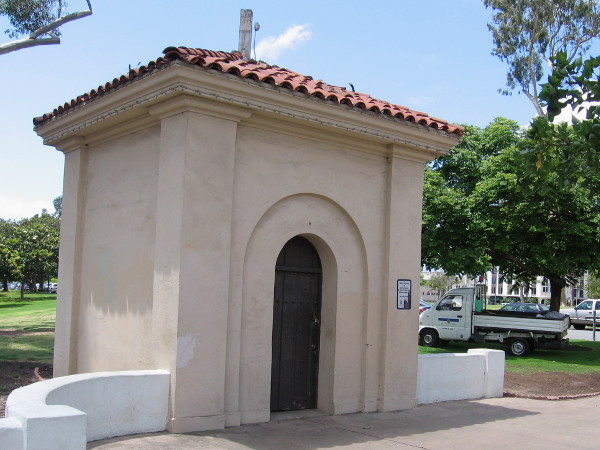
Funds for many Centennial restorations and improvements have been provided by the Friends of Balboa Park.Plaque recalls how a second identical fountain (next to the Timken Museum of Art) was restored back in 1965 by The Thursday Club.The passage of time has been unkind to the impish faces on two fun Balboa Park fountains.One of two guardhouses on either side of El Prado, at the west end of the Cabrillo Bridge.The stately guardhouses are being repaired this summer. The plaster ornamentation on top is in bad shape.A close up photo of the plaster finial at the apex of one tile roof. The hundred year old material has crumbled.The decorative finial has already been removed from the second guardhouse, and is being reconstructed.Guy working on restoring the balustrade next to the El Cid statue. The walkway will soon be ADA accessible.The old wooden balustrade is being replaced with modern material that should last much longer. Hopefully another hundred years!This hard-working guy at the balustrade construction site was nice enough to talk to me and smile for the camera!
UPDATE!
During a walk in mid-September, I noted the balustrade is completely finished, and so are the two fountains! They look awesome–like new!
Both fountains–on either side of the Botanical Building–have been beautifully restored!
…
To enjoy future posts, you can “like” Cool San Diego Sights on Facebook. or follow me on Twitter.
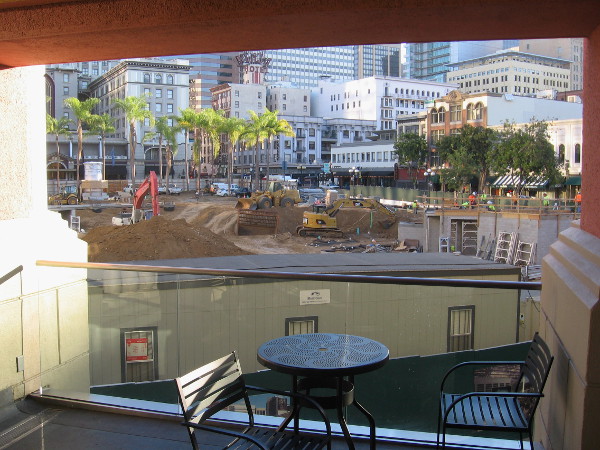
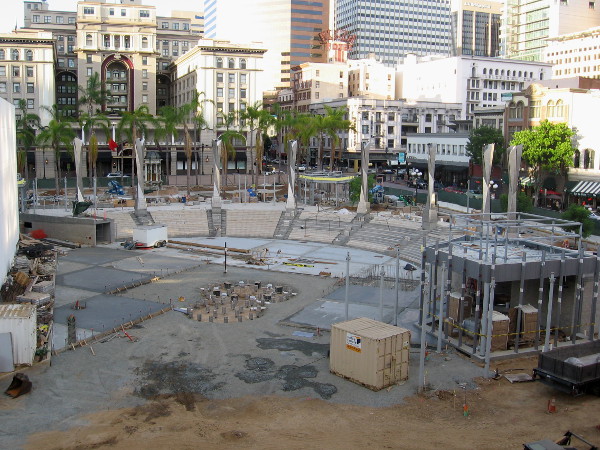
Photo of park construction from an upper level of downtown’s Horton Plaza shopping mall.
Today at sunrise it was already warm outside, so I began my walk extra early. Because it’s a simple thing to catch a trolley at any station downtown, I had plenty of time to get to work.
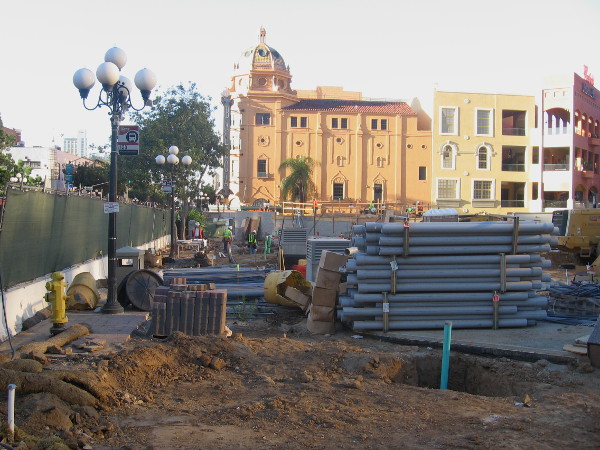
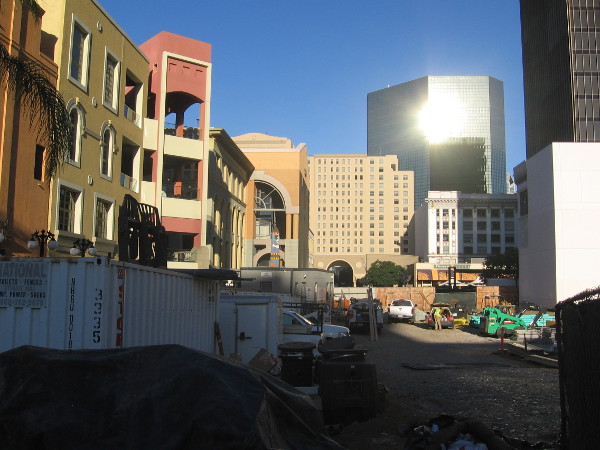
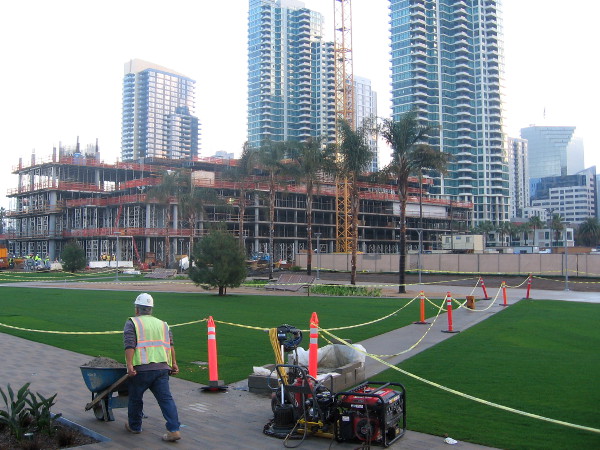
For no particular reason my legs pulled me past the Horton Plaza Park construction site. Work there appears to be full steam ahead!
Artwork on the construction fence right next to the Horton Plaza shopping mall shows how this enlarged city park will eventually appear. According to Todd Gloria, a San Diego City Councilmember, “When it is completed, it will be the new heart of our city, the central point, and a gathering place for San Diegans to come together to celebrate.”
Conceptual artwork on the construction site fence. This image shows a San Diego Comic-Con event taking place downtown at the future Horton Plaza Park.Zooming in, I spot several superheroes!Another bit of art on the temporary surrounding fence shows a Fourth of July celebration in the finished park.A good wide view of construction progress. This functional public space will be a major addition to downtown San Diego.The corner of a large plaza that will be used for concerts and special events.Early morning sunlight on the Balboa Theatre and a section of the Horton Plaza mall in the background.A fantastic area in downtown San Diego is about to become even more amazing!
UPDATE!
Here’s a pic I took in late June 2015…
Photo of Horton Plaza Park construction taken in late June 2015.
And another two months later…
Photo of Horton Plaza Park construction in late August 2015.
And another in early October…
Horton Plaza Park is making great progress by the beginning of October 2015.
And two more pics from mid-November…
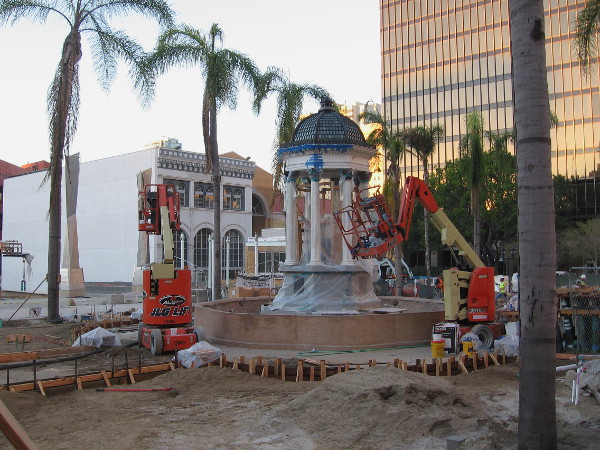
Construction workers prepare the new, expanded Horton Plaza Park in downtown San Diego.Historic fountain in Horton Plaza Park being renovated in November 2015.
…
To enjoy future posts, you can “like” Cool San Diego Sights on Facebook or follow me on Twitter.
A tiny barn and rabbits in a narrow garden, located between the sidewalk and a local acupuncture and wellness center.
I recently walked through Bankers Hill, a historic neighborhood just north of downtown San Diego. During my small adventure I got a few interesting photos on and around Olive Street. Like the sights in any city, they form a mixture. Here’s a flavor of Olive in the San Diego cocktail!
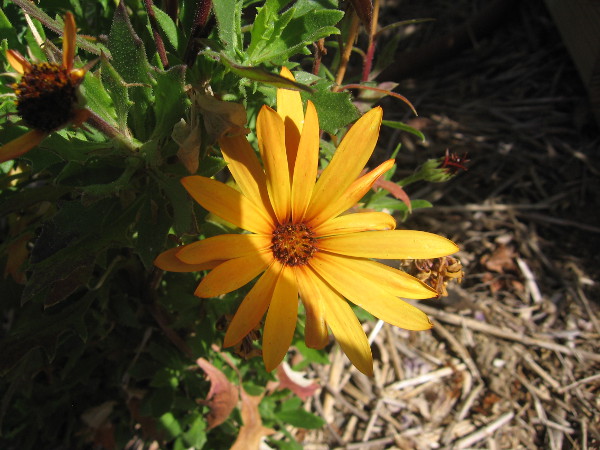
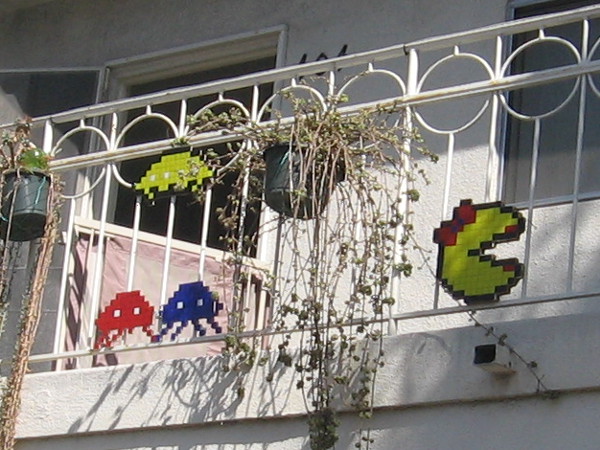
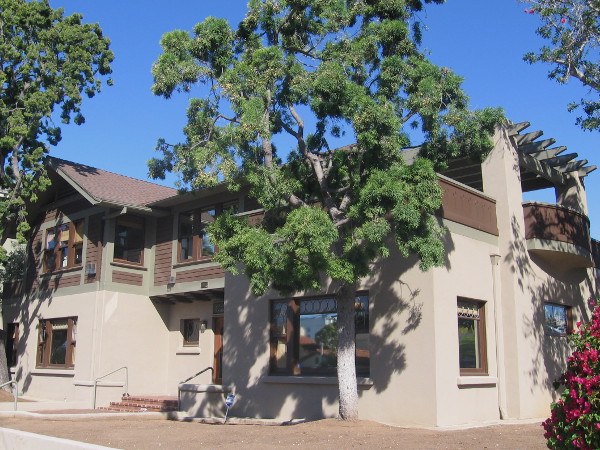
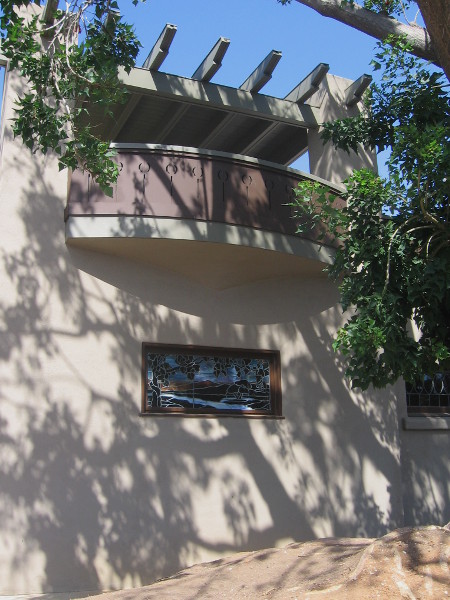
Flower at the HERBIN Community Garden Project, among plots where many herbs are grown.Ms. Pacman, Space Invaders and other video game legends hang out on a porch railing.The Amy Strong House, built in 1906 on Olive Street by an enterprising San Diego dressmaker, or couturier.Amy Strong lived here until 1912. The house is in the early 20th century Craftsman architectural style.A few unusual features anticipated the highly eccentric Amy Strong Castle at Mt. Woodson, which she built years later.Future site of Olive Street Park. This small plot of land for years has been the object of contention, as you might have seen on KUSI News’ Turko Files.Huge medical office building between Fifth and Sixth Avenue just north of Olive being demolished.Cool art hangs on residential building at corner of Fourth and Olive.
…
To enjoy future posts, you can “like” Cool San Diego Sights on Facebook or follow me on Twitter.
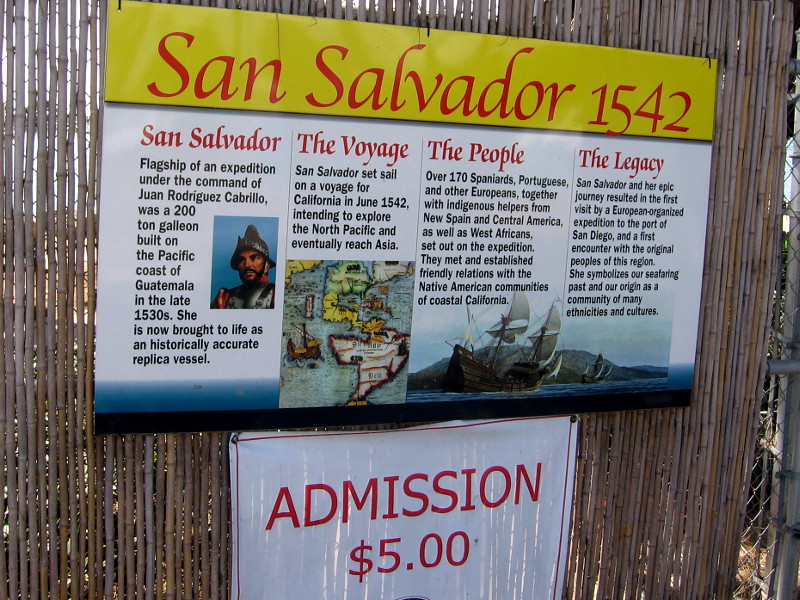
Sign at entrance to San Salvador build site. You have a couple more weeks to visit before the replica galleon’s historic launch into San Diego Bay.
Yesterday I enjoyed a tour of something so unbelievably cool it almost defies description. Along with my photographs I took some notes, but what I’m about to write might not be perfectly accurate. I’m relying to an extent on memory, which with my advancing age isn’t quite what it used to be. So if anyone reading my captions spots an error, PLEASE write a comment at the bottom of this blog post!
Later this month, the Maritime Museum of San Diego will be launching its absolutely fantastic, historically accurate, seaworthy replica of the galleon San Salvador. The original San Salvador was the ship that Portuguese explorer Juan Rodriguez Cabrillo sailed in during his voyage of discovery up the California coast on behalf of Spain. The famous galleon entered San Diego Bay in 1542, making Cabrillo the first European to visit the large, natural harbor. What we call San Diego today he named San Miguel.
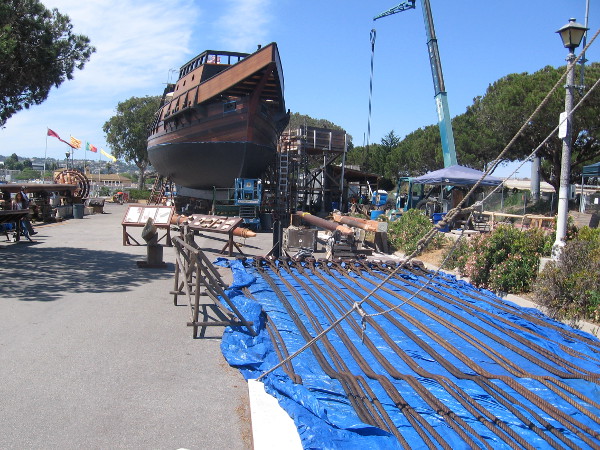
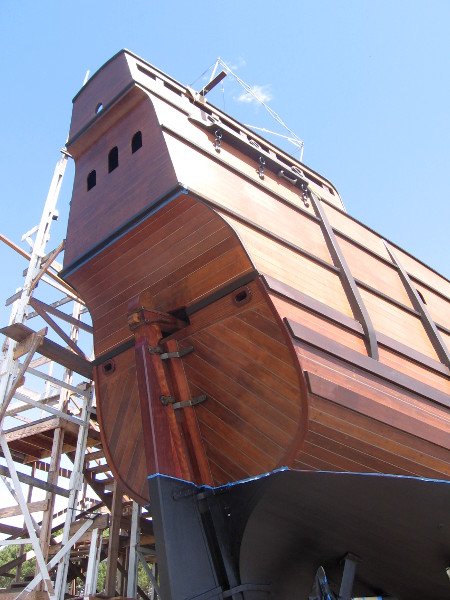
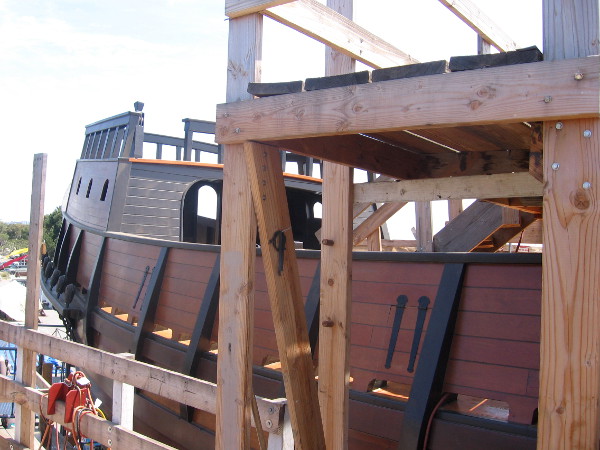
Today, the full-size working replica of Cabrillo’s ship is being built at the west end of Spanish Landing, in an area called San Salvador Village, between Harbor Island and San Diego International Airport. The finished ship will be 92 feet long with a beam of 24 feet. As I understand it, construction has been underway for about four years, and for a variety of reasons has taken a couple years longer than originally projected. But once the decks are re-caulked, the shrouds tarred, and a few other things finished, the ship’s exterior will finally be ready for its imminent introduction into San Diego Bay!
The galleon, which without ballast weighs about 130 tons, will be slowly towed to the Broadway Pier downtown, then lifted by a huge crane into the bay. While docked beside the other ships of the Maritime Museum, the interior will be finished, about 60 more tons of lead ballast added, and the vessel’s ability to remain upright thoroughly tested by the Coast Guard.
(Don’t quote me on the 130 tons and 60 tons. Those figures came entirely from my leaky memory.)
There’s simply too much awesome stuff to describe in a few paragraphs, so let me now show you my photographs and I’ll include in the captions some of the cool stuff I learned or observed…
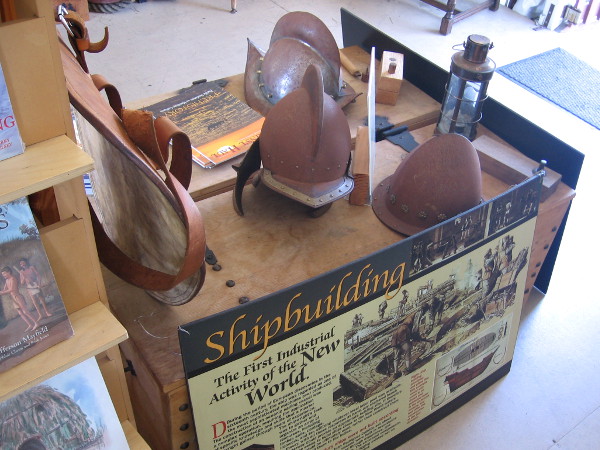
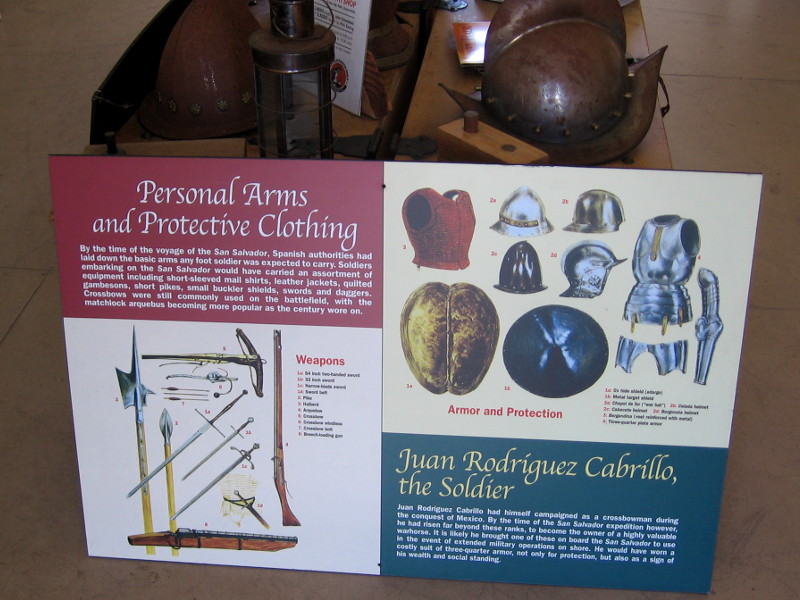
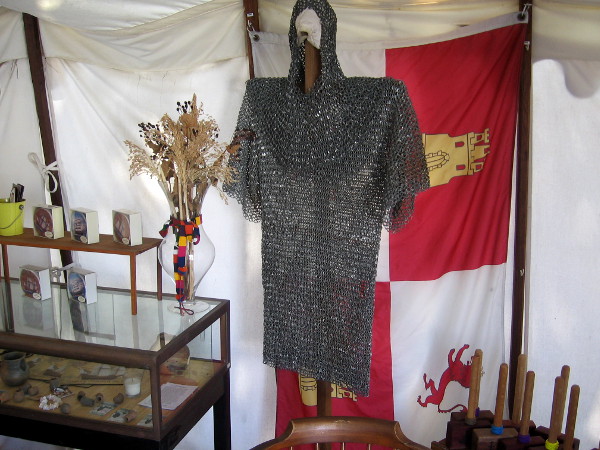
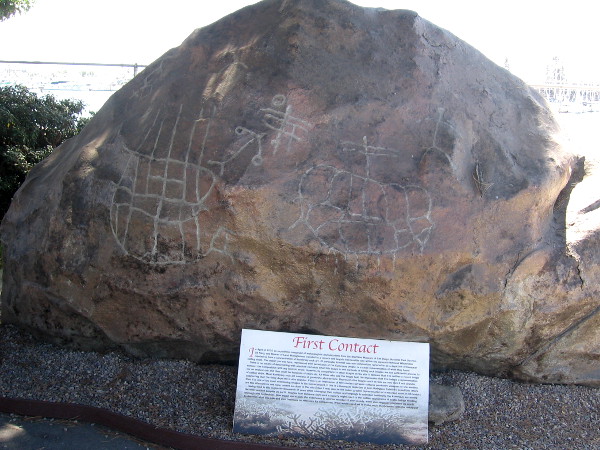
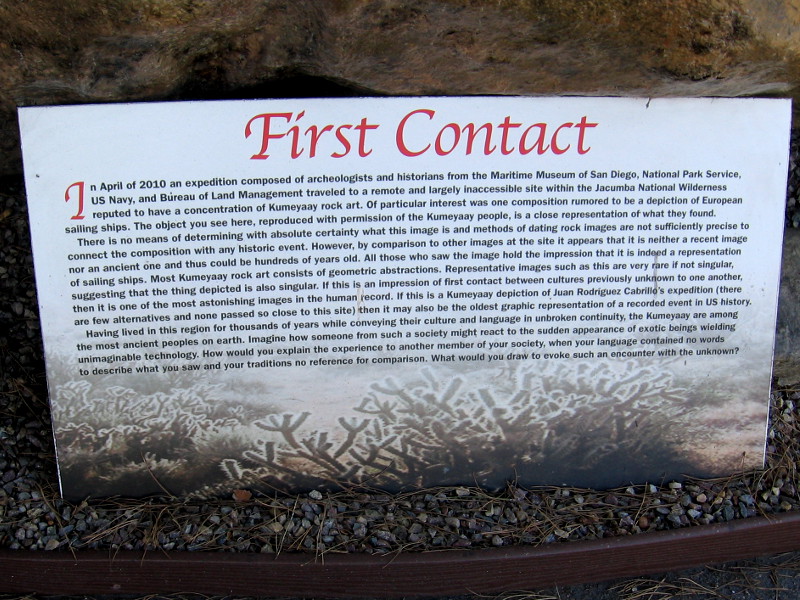
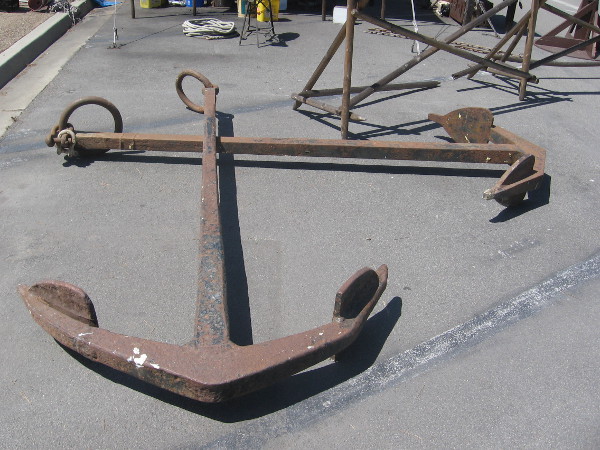
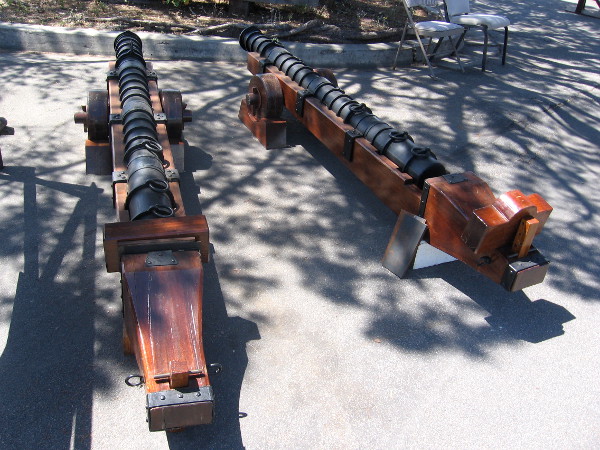
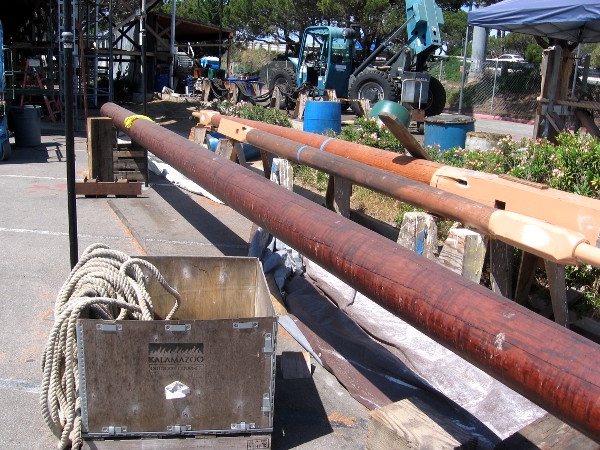
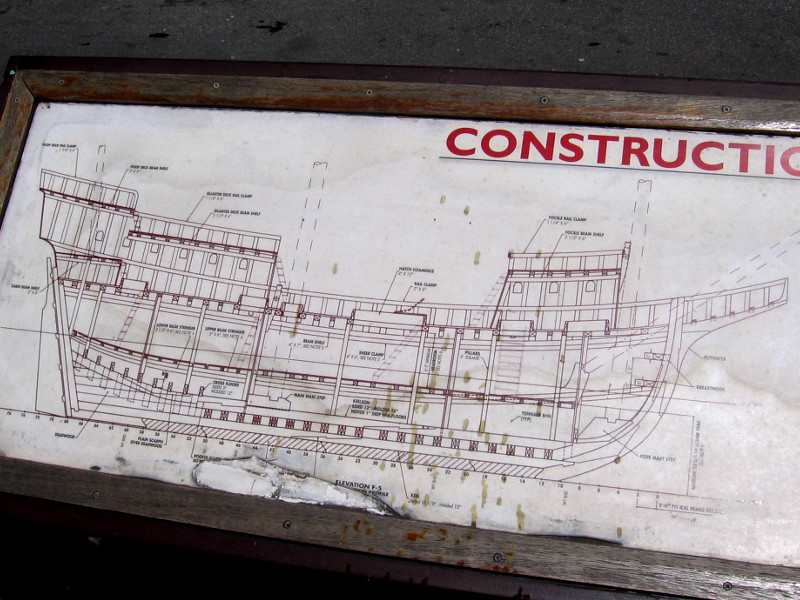
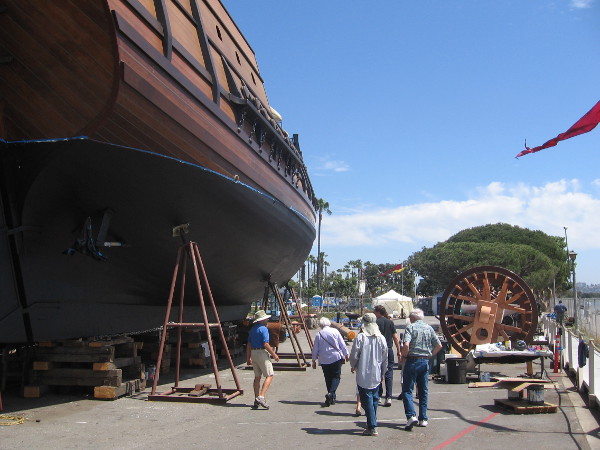
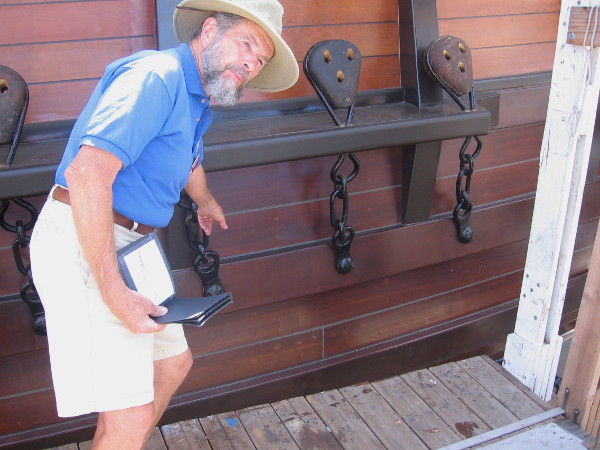
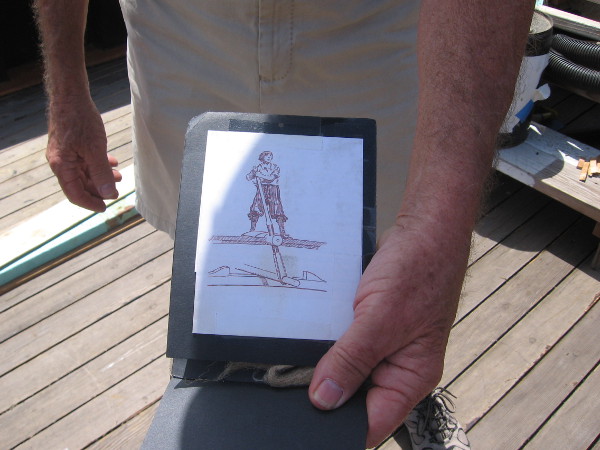
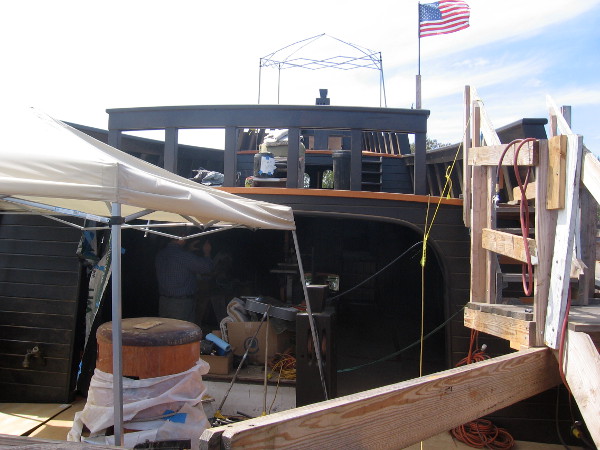
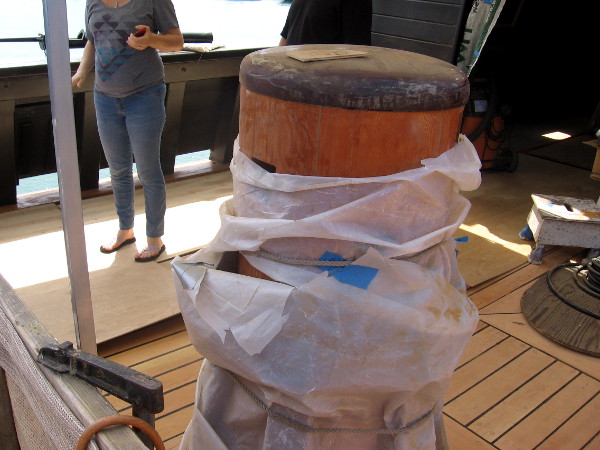
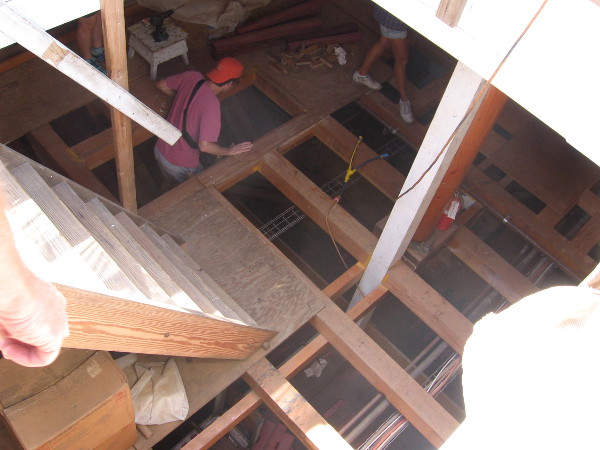
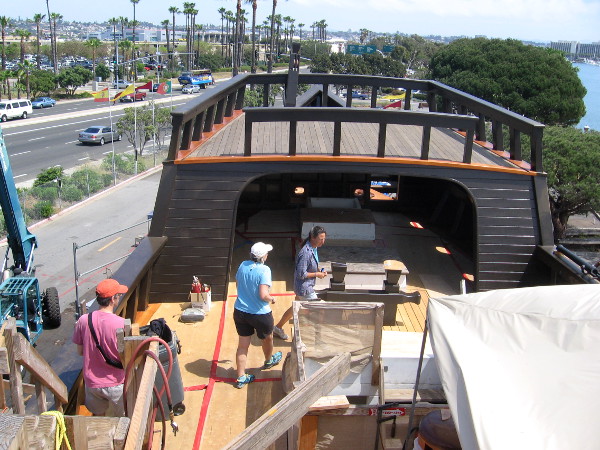
Shipbuilding was the first industrial activity of the New World. Gift shop at site entrance includes Spanish conquistador helmets and breastplate.Poster shows personal arms and protective clothing used by the men who sailed with Juan Rodriguez Cabrillo five centuries ago.A small museum and gift shop includes many interesting sights, including a shirt of chain mail and flag of the Spanish Empire.Diagram shows the sail plan for historic galleon San Salvador.Various items on display include lantern, candle, bottle, ship’s food and native Kumeyaay artifacts.Outside, at the build site, there are many more exhibits. This reproduction of found rock art seems to show sailing ships. The native Kumeyaay people often visited San Diego Bay.First Contact. If this rock art is a Kumeyaay depiction of Cabrillo’s expedition, it might be the oldest graphic representation of a recorded event in American history.Here’s a huge anchor! I didn’t ask, but I assume it will be used by the San Salvador.San Salvador carries six sails totaling a little less than 5000 square feet. The sails are not only used to propel the ship, but exert a larger influence on steering than the rudder.View of a small sail suspended from a yard, with Harbor Drive in the background north of the build site.Suspended from a crane is a shroud (rigging that helps hold a mast) that’s being tarred. The bow of the galleon comes to a sharp point at its beak.Iron in an undeveloped region of the New World was a precious commodity. Imported ingots were often used to forge various fittings and hardware.Hooks, chain links and other iron instruments were crucial to sail and maintain a large ship.The San Salvador carried armament to defend the expedition from potential threats. The cannon-like bombard and swivel gun could be fired from the deck.Two bombards on display at the San Salvador build site. They could fire shot about five pounds in weight and were mounted on wheels.Detailed map of Cabrillo’s route up the California coast. He found neither treasure, nor a passage to the Atlantic.There are no blueprints for the galleon San Salvador. To reconstruct the 16th century ship, the Maritime Museum of San Diego used scarce historical clues.It was difficult to find the right kinds of wood for different parts of the vessel. Both old and modern shipbuilding techniques were used.Wood mast segments and yards are coasted with linseed oil, I believe. They’ll be installed once the ship is afloat in San Diego Bay.Approaching the impressive reproduction of the historic galleon. Just imagine going for an ocean sail in this!Detailed schematic shows framework and beams that support decking and hull.The master builder sets up keel, stem, sternpost and deadwood, locked together with long iron drifts. The master frame is then built.I believe these are the lower halves of two masts (main and fore), each ending in a crow’s nest.A look at the super hard wood hull of the galleon San Salvador at Spanish Landing.Volunteer tour guide shows how six segments of heavy lead are attached to the keel.Each piece of lead weighs over 6000 pounds. The lead was originally used for the drop hammers of Rohr Industries in Chula Vista to form aircraft parts.A small tour group investigates the amazing galleon on a sunny San Diego day!The high stern of San Salvador. The rudder is attached to a tiller. That propeller below (and an eventual engine) is a modern convenience unknown by Cabrillo!Our group climbed the steps of scaffolding to check out the hull, upper deck and aftcastle.We’re shown where a shroud connects to the ship’s side. The darker looking lower portion of the hull is made of hard wood, which is heavier than water.We’re almost on top!View of the San Salvador galleon while standing atop the aftcastle. Work to finish the vessel’s deck and interior is underway.This deck will be re-caulked soon using cotton, hemp rope and synthetic tar. Earlier caulking with less modern materials was unsuccessful, if I recall correctly.Sketch of helmsman steering the galleon with a vertical lever attached to the rudder’s tiller. He had a window to look through in the aftcastle.Looking back at the aftcastle and rearmost poop deck from the center of the upper deck. You can see the window through which the helmsman peered.Capstan is a revolving vertical timber that projects through the deck. Bars will be inserted and used by sailors to turn the capstan, hauling ropes or chains.This is one of five separate water-tight compartments being worked on below. Bunks will be contained here, for journeys out to the Channel Islands eventually.Under the forecastle, looking toward the bow’s beak. The two holes beside the rectangular chain locker are hawseholes, through which the anchor chain is lifted or lowered.Looking straight down here you can see where the foremast and bowsprit are seated.Wow! Is this cool! How often does one get to walk around an actual honest-to-goodness working galleon!
…
To enjoy future posts, you can “like” Cool San Diego Sights on Facebook or follow me on Twitter.
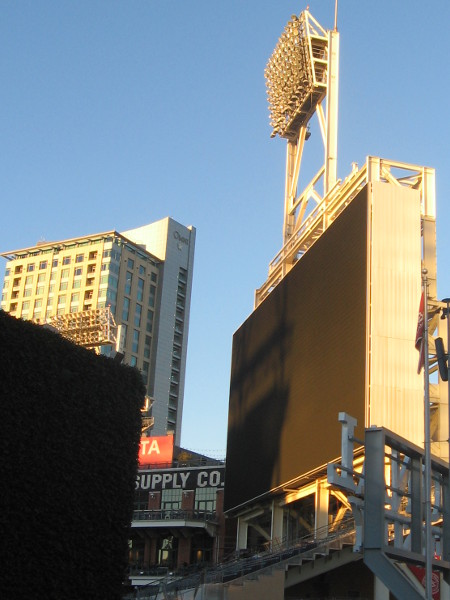
Giant crane in Petco Park’s outfield has installed a huge new scoreboard!
As you might have read in my last blog post, this morning I walked around Petco Park, home of the San Diego Padres. Guess what I saw! An absolutely hugemungous, super ginormous new scoreboard has been installed for the upcoming 2015 season! The high resolution board is the third largest in Major League Baseball, surpassed in size only by videoboards in Seattle and Kansas City. With a screen so big, why bother watching the action on the field? (Just kidding.)
I noticed a variety of other preparations underway around San Diego’s cool downtown stadium. Here are a few more pics…
This massive high resolution videoboard is the third largest in Major League Baseball!Guys get some ticket readers ready for the upcoming 2015 baseball season.Hosing down seats behind the Beach. The ball field is being prepped for professional baseball after the recent Monster Jam event.
…
To enjoy future posts, you can “like” Cool San Diego Sights on Facebook or follow me on Twitter.
At the Little Italy trolley station, a very strange shadow climbs up the wall.
Early this morning, shortly after sunrise, as I waited for the San Diego Trolley at the Little Italy station, I was confronted by a momentary mystery. A very odd spidery shadow was climbing up the wall on the other side of the tracks.
I walked toward the shadow and turned about. A few photos show the mystery solved!
Construction crew is building a new parking garage next to busy trolley station.
The rising parking garage, at the corner of Cedar Street and Kettner Boulevard, will provide 645 spaces for those who work at the nearby County Administration Center, in addition to paid public parking for visitors to Little Italy. The project is supposed to be finished this summer.
The ten-level parking structure will serve county employees who work nearby.Silhouette of worker as morning sun lights the downtown San Diego sky.
…
To enjoy future posts, you can “like” Cool San Diego Sights on Facebook or follow me on Twitter.
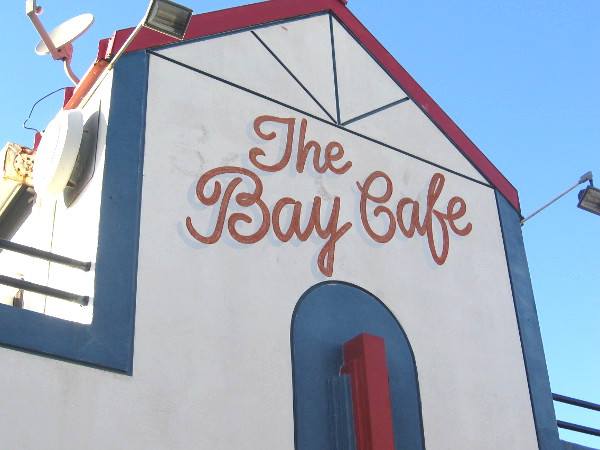
The Bay Cafe is making way for an observation platform on San Diego Bay.
The Bay Cafe is almost gone.
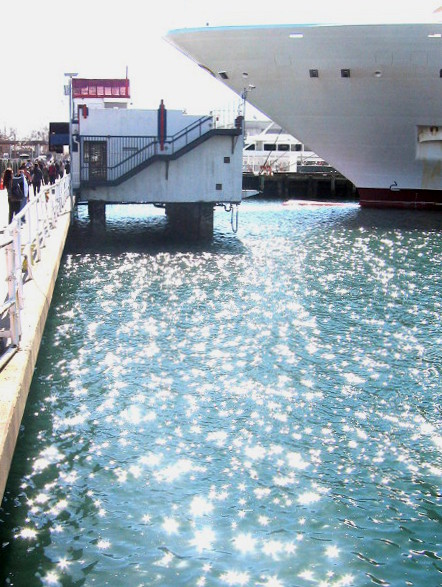
Many years ago, I loved to grab some food in the small waterfront cafe and bring it up onto the rooftop. From a table beneath an umbrella, I’d gaze out at the sparkling water. I’d observe passing sailboats, people on the Broadway Pier, and cruise ships docked at the nearby terminal. When two or more huge cruise ships were in port, I’d watch with interest as the departing Coronado ferry and harbor tour boats navigated the narrow space between them. In those days, the Bay Cafe also served as an embarkation hub for San Diego Harbor Excursion, now called Flagship. A ramp from inside the deli plunged down to a floating dock, where a gift shop was housed in a special boat. On this small dock a harbor cruise photographer asked guests to pose by a life preserver.
Up on the roof, if I wanted a change of view, I’d grab another table where I could gaze back toward downtown and watch tourists flow along Harbor Drive. There were almost always several empty tables. Few people seemed to realize the rooftop was open.
The Bay Cafe’s roof was also used for many years by broadcasters covering parades down Harbor Drive. From up there you could see everything.
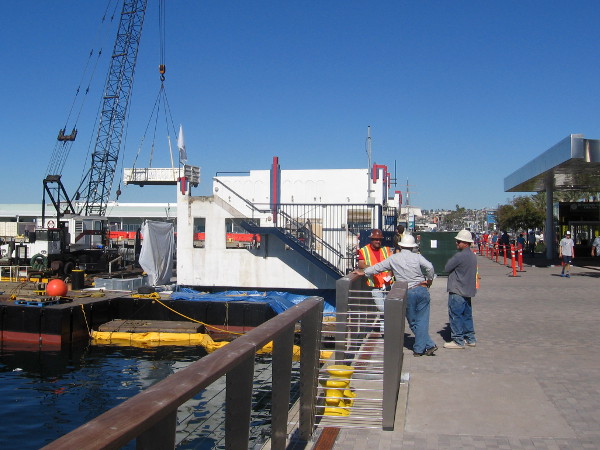
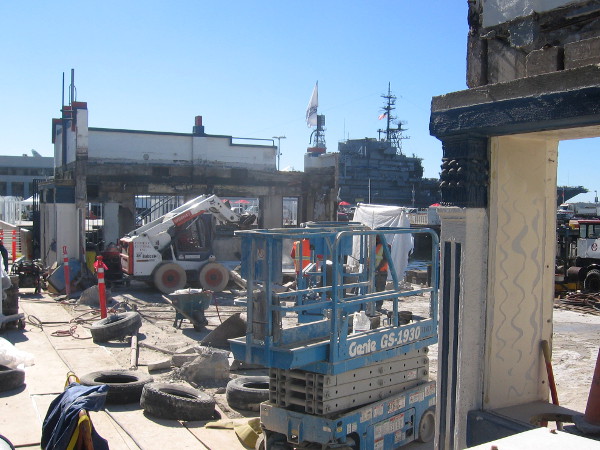
My walk this morning brought back those memories. And a bit of sadness. The Bay Cafe is being demolished as I type these very words. The structure will be removed, but the concrete pad and pilings will remain, as part of an observation platform jutting over the water. It’s just one small part of the Embarcadero’s recent renovation. I’m sure the change will be great. I believe there are supposed to be benches where folks can just sit and enjoy the views. If there are, I’ll surely enjoy them. But time and progress march on. The Bay Cafe is almost just a memory.
Demolition of the old waterfront cafe and harbor tour embarkation hub is underway.Many years ago dining could be enjoyed on the sunny roof, with views of the water, sailboats and downtown skyscrapers.Improvements on the Embarcadero consign this wonderful place to memory.
…
To enjoy future posts, you can “like” Cool San Diego Sights on Facebook or follow me on Twitter.
Lanefield Park under construction at corner of Broadway and Harbor Drive.
This morning I walked past a huge project under construction at the corner of Broadway and Harbor Drive. I’m a tall guy, so I could easily peer over the surrounding fence.
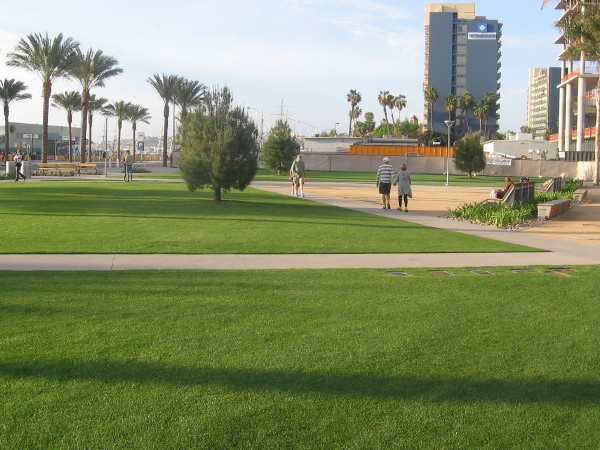
The site of historic Lane Field is green with beautiful new grass!
It’s been many years since this hallowed spot in downtown San Diego needed a periodic mowing. I don’t recall ever seeing anything here but a large ugly asphalt parking lot. But once upon a time, half a century ago, this corner on San Diego’s waterfront featured a ballpark where the Pacific Coast League Padres played to large, enthusiastic crowds.
In 1925 the site was established as a Navy athletic field; it was also used for motorcycle and auto races. In 1936 the Works Progress Administration rebuilt the field to accommodate baseball. On March 31 of that year the first game was played, and the Padres beat Seattle 6-2. Lane Field would remain open for 22 exciting seasons.
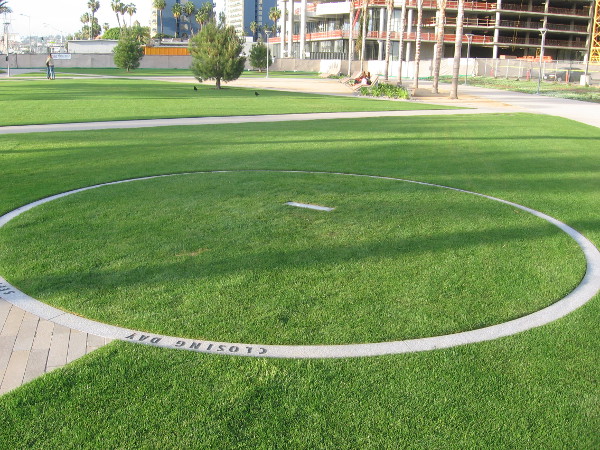
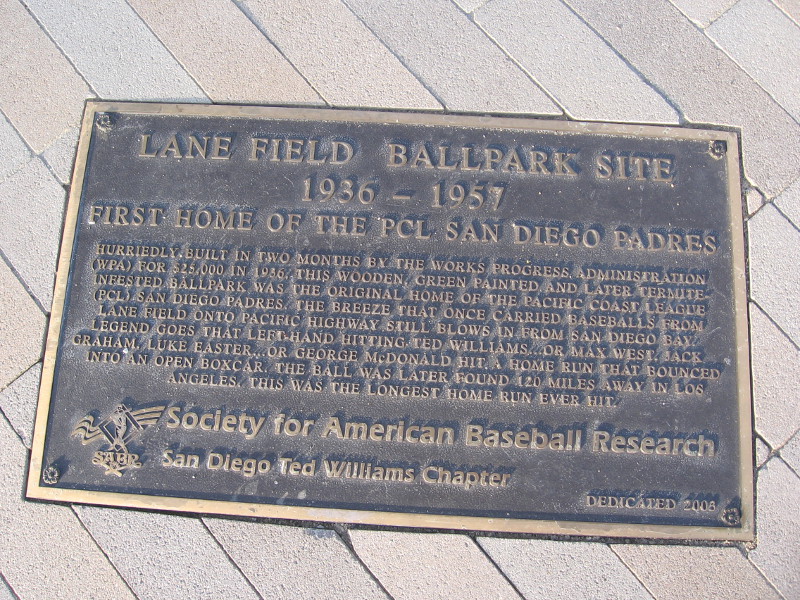
Today, the old location of Lane Field is undergoing another transformation. It soon will feature a new hotel and public park. The 2-acre Lanefield Park includes a small grassy area shaped like a baseball diamond. As I gazed and took photos over the fence, I also noted a monument at home plate and a nearby plaque. Check out the above pic!
Here are two more pics I snapped early this morning…
New grassy park at site of Lane Field, where Pacific Coast League baseball Padres played.Hotel being built next to Lanefield Park on San Diego’s Embarcadero.
Lastly, here’s a pic of a cool mural on 11th Avenue not far from Petco Park, the present home of the Padres. The photo mural shows the construction of Lane Field in 1936. As you can see, the ballfield was located right next to the bay!
East Village street mural shows photo of Lane Field under construction in 1936.
UPDATE! The park, which now seems to be officially called Lane Field Park, is open! Here are some pics…
Lane Field Park is now open on San Diego’s Embarcadero.A small part of the park resembles a baseball diamond with flat pitcher’s mound.Monument and plaque commemorate original Lane Field in downtown San Diego.Legendary player Ted Williams of the Padres advises hitters to get mad.Lane Field Ballpark Site 1936-1957. First home of the PCL San Diego Padres.
…
To enjoy future posts, you can “like” Cool San Diego Sights on Facebook or follow me on Twitter.
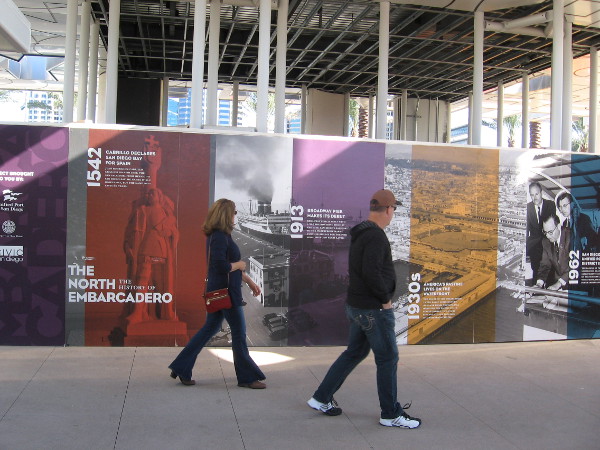
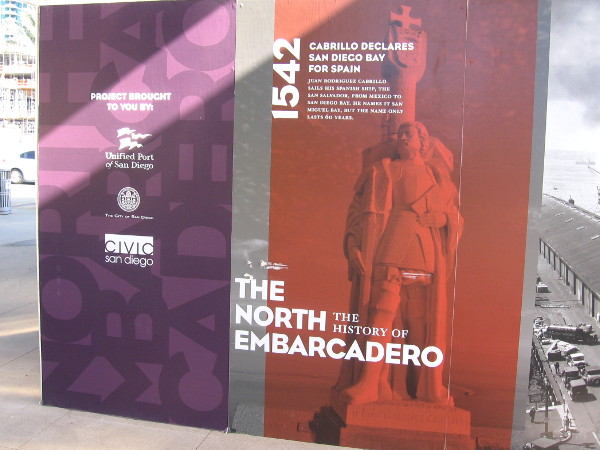
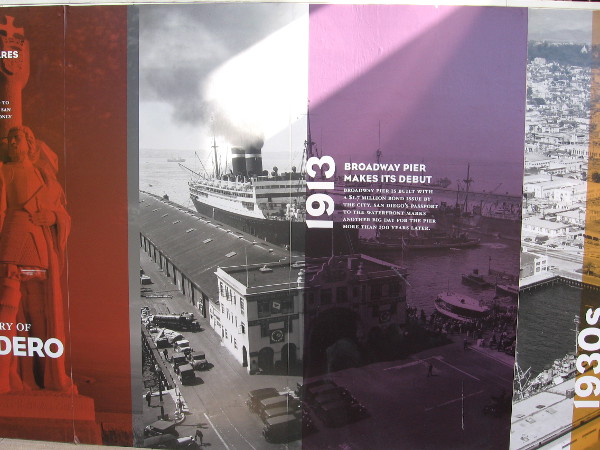
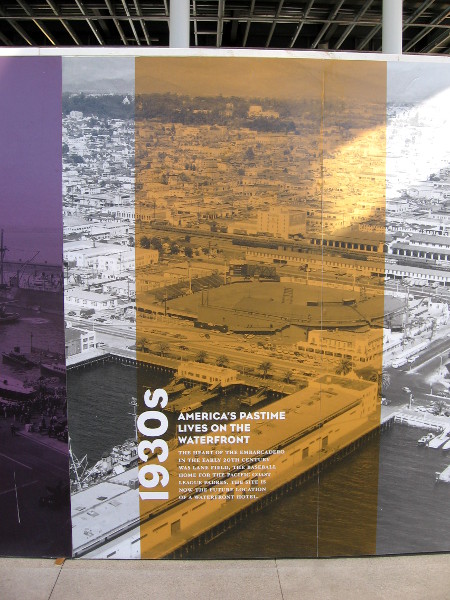
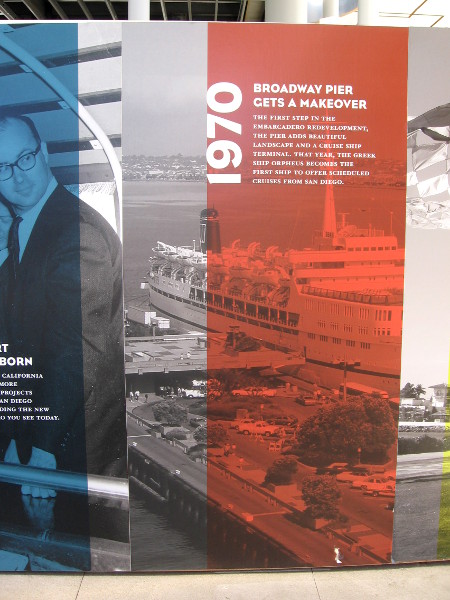
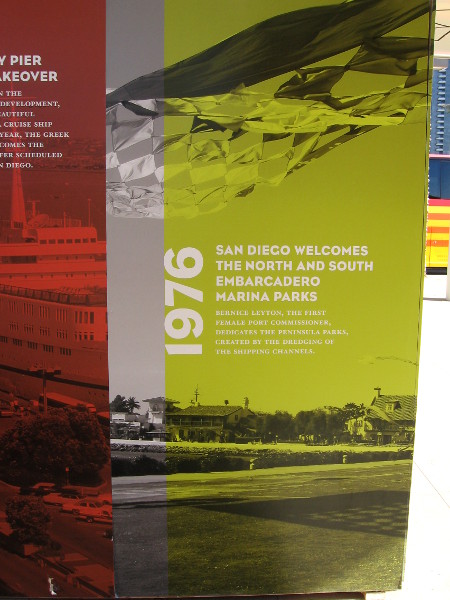
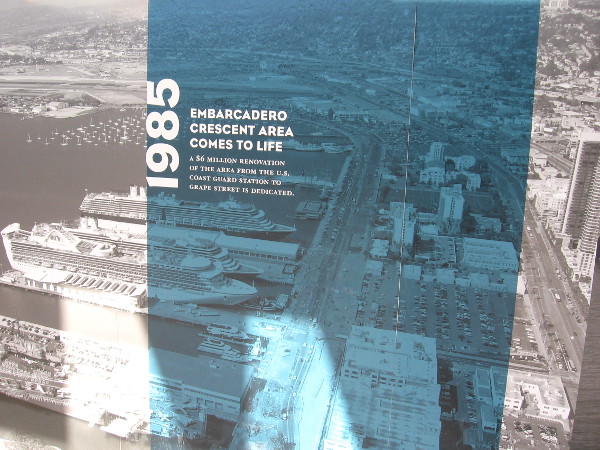
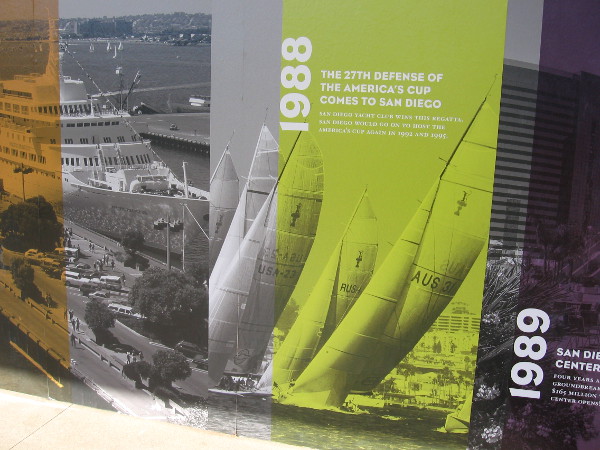
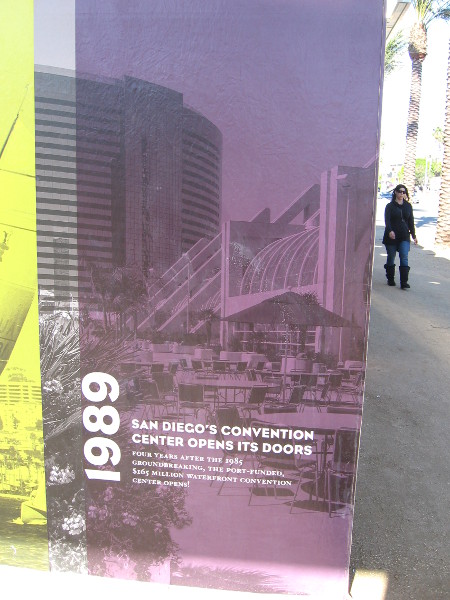
Images around a new pavilion near Broadway Pier show history of the Embarcadero.
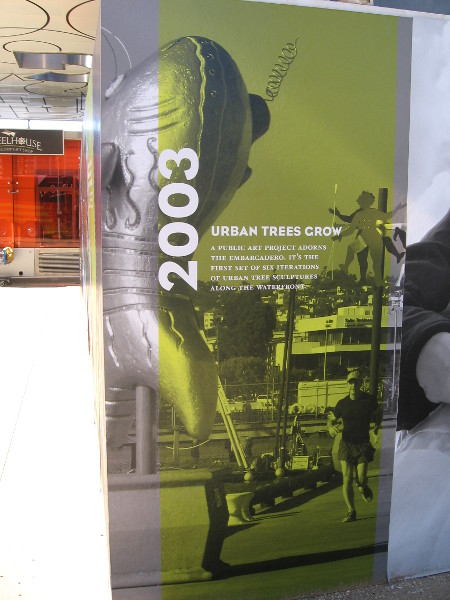
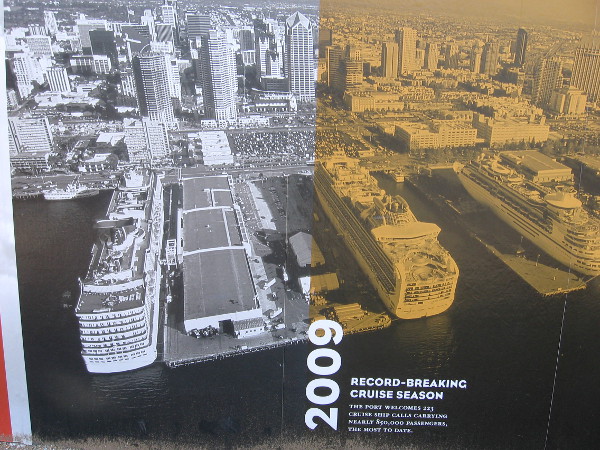
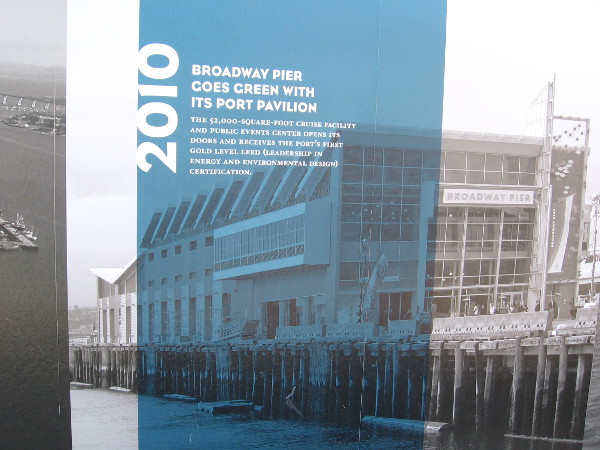
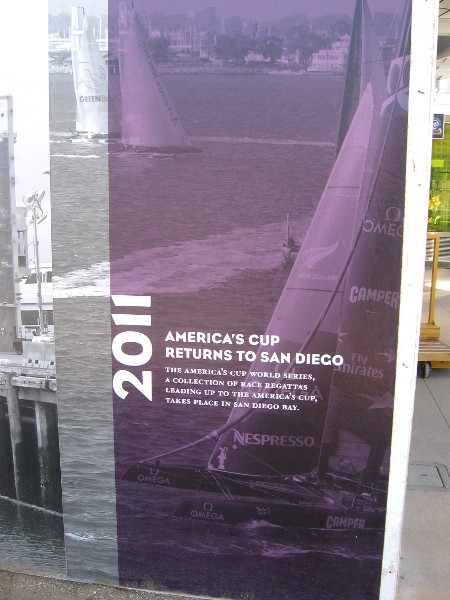
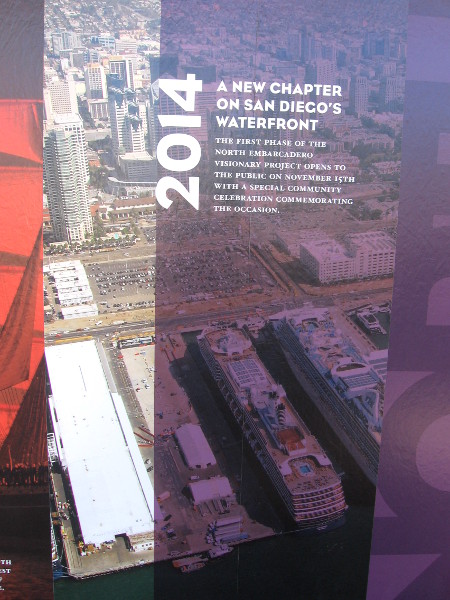
San Diego’s Embarcadero has undergone some major renovations. One of the new pavilions still under construction near the Broadway Pier features a large display that provides a timeline of the area’s history. Notable developments along the waterfront through the passing years are documented with historical photographs.
While many of these images concern more recent events, it still makes a fascinating visual time capsule. Here are some pics that I took!
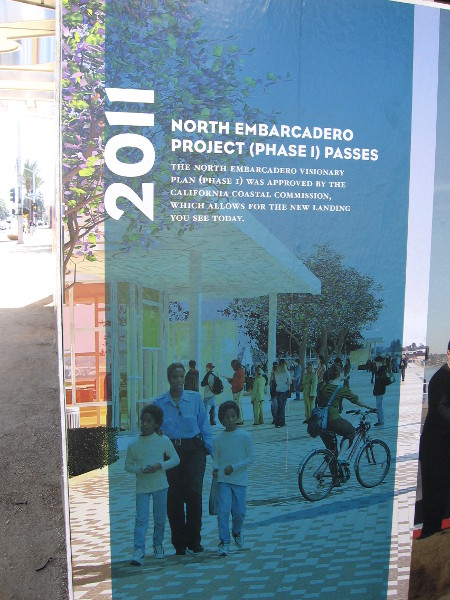
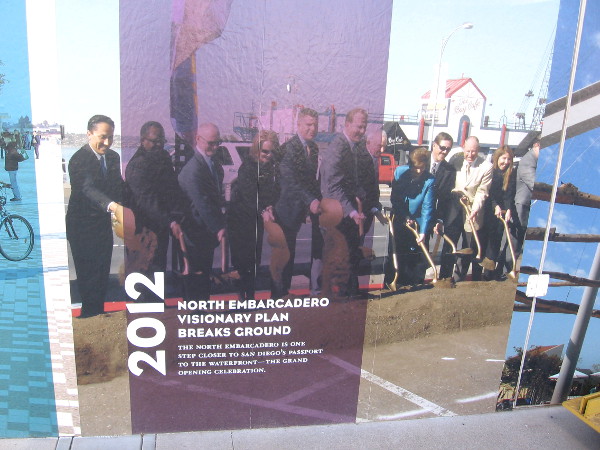
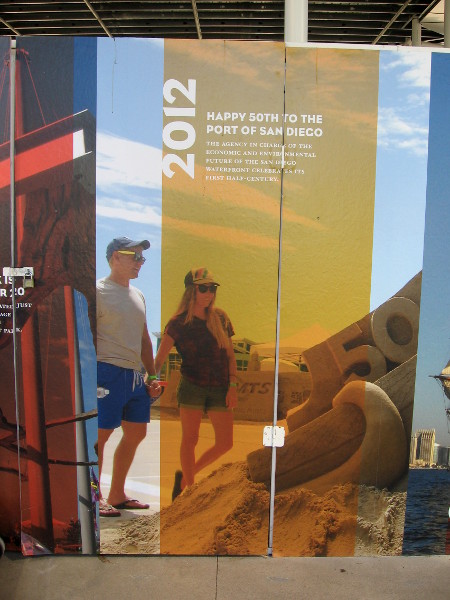
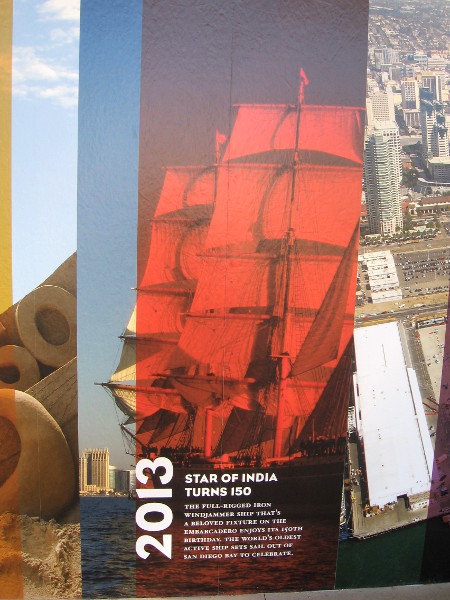
1542: Juan Rodriguez Cabrillo claims San Diego Bay for Spain. He named it San Miguel Bay.1913: San Diego’s Broadway Pier makes its debut. It certainly looks different today!1930s: Baseball played across street. Lane Field was home of Pacific Coast League Padres.1962: San Diego Unified Port District is established.1970: Broadway Pier gets a makeover. A cruise ship terminal is added.1976: North and South Embarcadero Marina Parks are dedicated.1980: Seaport Village becomes the newest San Diego attraction.1985: North Embarcadero’s Crescent area renovated.1985: Princess Cruises bases its “Love Boat” in San Diego.1988: San Diego Yacht Club successfully defends America’s Cup.1989: San Diego Convention Center opens.2003: First of six Urban Trees art exhibits along the Embarcadero.2007: Seward Johnson’s Unconditional Surrender statue goes on display near USS Midway.2009: A record-breaking cruise ship season!2010: Port Pavilion opens on Broadway Pier. It’s been over four years already? Time flies!2011: America’s Cup World Series regatta takes place on San Diego Bay.2011: North Embarcadero Project (Phase 1) passes.2012: North Embarcadero Visionary Plan breaks ground nearby.2012: Ruocco Park immediately north of Seaport Village is dedicated.2012: Port of San Diego is 50 years old.2013: San Diego’s historic Star of India tall ship turns 150 years old.2014: Lots of cool waterfront improvements opened, including this pavilion!
…
To enjoy future posts, you can “like” Cool San Diego Sights on Facebook, or follow me on Twitter.










































 Cool San Diego Sights!