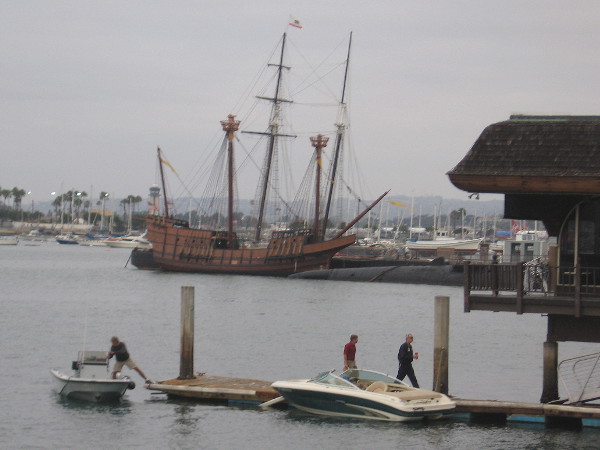
The amazing replica of explorer Juan Rodriguez Cabrillo’s galleon San Salvador is now docked at the Maritime Museum of San Diego, adjacent to their B-39 Soviet submarine.
The San Salvador, a full size replica of the historic Spanish galleon sailed by explorer Juan Rodriguez Cabrillo up the coast of California, is now docked at the Maritime Museum of San Diego! I believe the museum’s newest ship arrived a couple days ago!
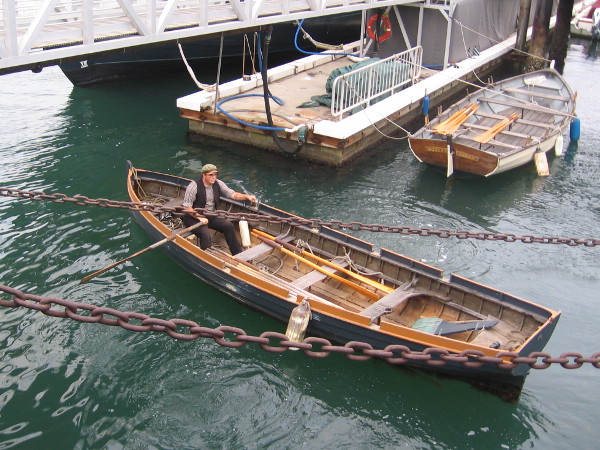
This morning was the very first time I saw the vessel on San Diego’s Embarcadero. Docked next to the museum’s B-39 Soviet-era Russian submarine, the San Salvador appears small compared to the other nearby tall ships. But the gentleman rowing the longboat in the next photograph informed me that she’ll really blossom once fully rigged and under sail. The San Salvador will then appear almost as large and amazing as the Californian, which is docked right across from it!
Looks like the San Salvador is ready in time for this Labor Day weekend’s Festival of Sail. On Friday she will lead a magnificent parade of visiting tall ships across San Diego Bay!
Gentleman from the Maritime Museum rows a longboat under ramp which leads to the HMS Surprise and other historic ships.Full size replica of Spanish galleon San Salvador, seen beyond the dock of Anthony’s Fish Grotto on San Diego’s Embarcadero.
…
Follow this blog for more photos of cool stuff! Join me on Facebook or Twitter.
The elegant Jessop’s Street Clock stands like a vision from the past at the center of San Diego’s popular Horton Plaza.
San Diego’s top tourist attraction in 1907 wasn’t a zoo, a park, a popular building or location. It was an amazing clock. Word traveled far and wide about the elegant, beautiful, one-of-a-kind Jessop’s Street Clock, which debuted that year in downtown San Diego. San Diego at the time was a very small town. The large clock stood on the sidewalk in front of the J. Jessop and Sons jewelry store at 952 Fifth Avenue.
The idea for this street clock sprang from the imagination of Joseph Jessop, a jeweler who immigrated to America from England. He’d seen many beautiful public clocks in Europe. especially in Switzerland. Joseph hired mechanic Claude D. Ledger to build the complex clock, which took fifteen months of meticulous, precise work to complete. The fine clock has almost never stopped working. One memorable day the clock did mysteriously stop–the same day that Claude died.
The Jessop’s Street Clock was first displayed at the 1907 Sacramento State Fair, where it was awarded a gold medal. (The large medal of real gold was stolen, and so was the first bronze replacement!) Since then the clock has occupied several different spots in San Diego. The clock stands 22 feet tall and features 20 separate dials and 300 moving parts. It has an estimated worth of several million dollars. Much of the shining movement is gold-plated. The elegant clock contains tourmaline, agate, topaz and jade, local gems extracted from the Jessop Mine on Mount Palomar.
Today the historic clock occupies a prominent position near the center of Horton Plaza, where many shoppers breeze by with hardly a glance. I suppose very few people realize the importance of this clock, and how at one time, over a century ago, it was one of San Diego’s most well-known landmarks.
Shoppers walk past the beautiful Jessop’s Street Clock, a landmark in downtown San Diego for over a hundred years.Intricate, exquisite gold-plated movement of the historic Jessop’s Street Clock. The massive mechanism extends twelve feet down into the Horton Plaza parking garage!J. Jessop and Sons jewelers created this amazing clock, which over a century ago was San Diego’s top attraction!Thousands of hours have been spent over the decades maintaining, rehabilitating, moving and reconstructing the fine clock.The Jessops Street Clock was exhibited at the 1907 Sacramento State Fair. This is a bronze replica of the gold medal awarded to the master clock. The clock is property of the Jessop family.Base of the 1907 Jessop Clock in downtown’s Horton Plaza shopping mall. Plaque indicates Historical Landmark No. 372, The City of San Diego.Twelve dials on one face tell time in New York, London, Paris, Berlin, Milan, St. Petersburg, Calcutta, Capetown, Tokyo, Hong Kong, Melbourne, Mexico City.
…
See photos of some random cool stuff! Join me on Facebook or Twitter.
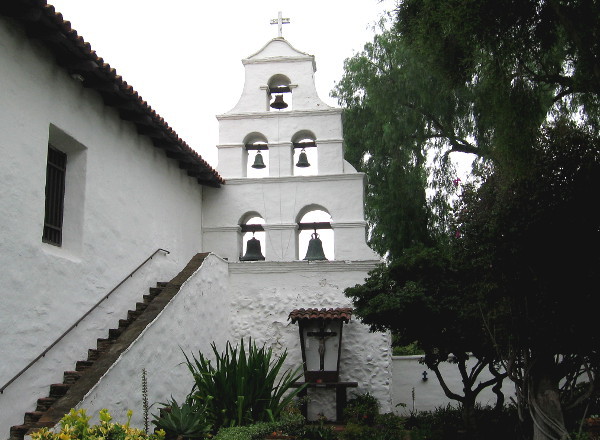
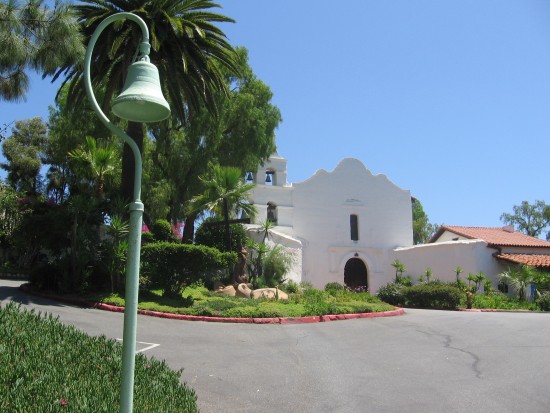
Five church bells hang in the distinctive facade of the historic Mission San Diego de Alcalá, founded by Junipero Serra.
Sometimes it’s easy to forget that our lives will soon become history. And that the lives of people, no matter how imperfect, create a rich, varied tapestry that reaches centuries back in time, and forward into the future.
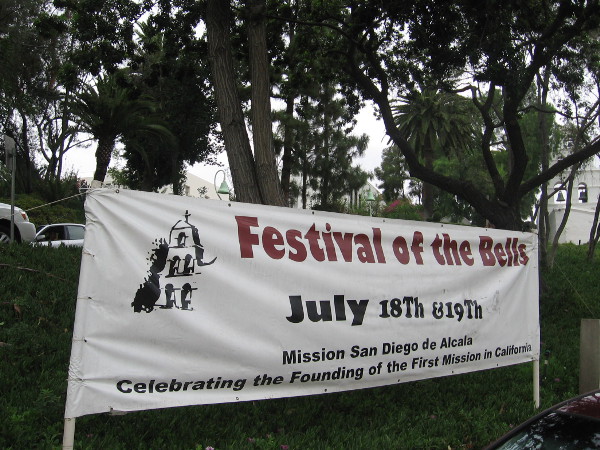
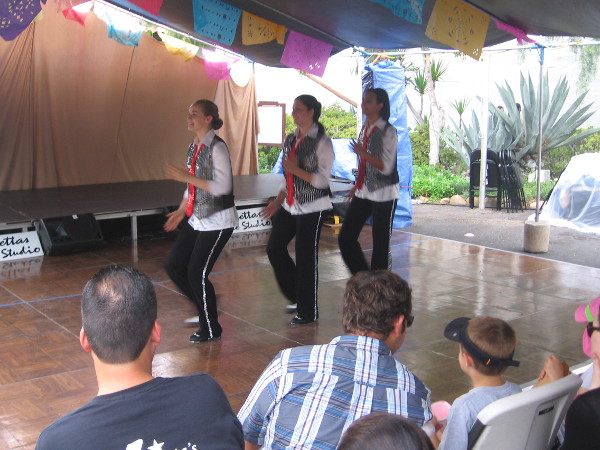
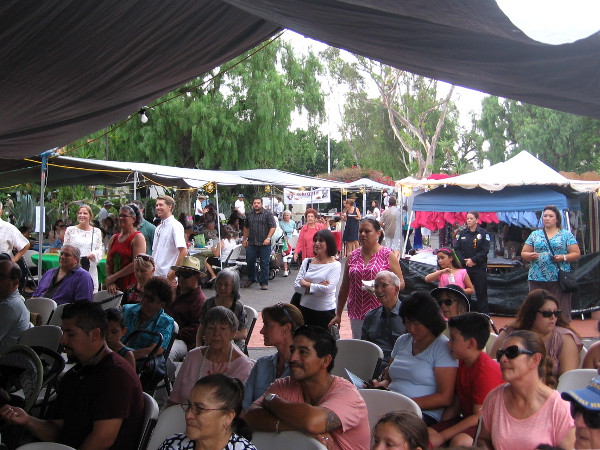
Young and old–representatives from several generations–came together this weekend in San Diego to again celebrate the Festival of the Bells. The annual event is held at Mission San Diego de Alcalá, the first Spanish mission to be built in California. Food, song and dancing accompanied colorful religious rituals such as the Blessing of the Bells and the Blessing of the Animals. Everyone was welcome to enjoy the free festival.
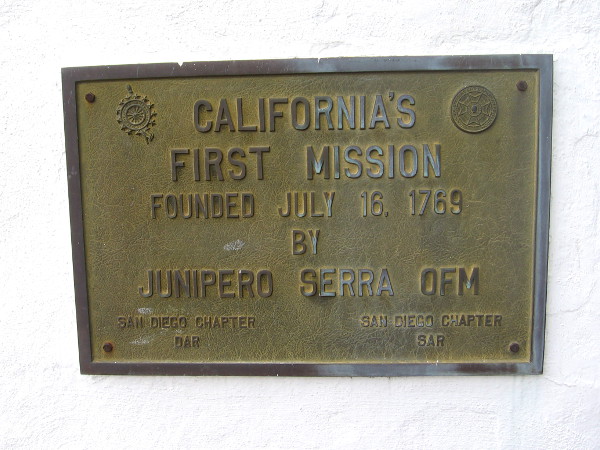
The original San Diego del Alcala was founded in 1769–almost 250 years ago–at the site of the old Spanish presidio, near the edge of San Diego Bay. The current mission building was erected by Father Serra in 1774, a few miles up the San Diego River where the land was more fertile.
The distinctive facade and bells of this historical landmark are often used as a symbol for our city, and the ringing of the bells are like echoes from a complex, often strife-filled, but fascinating past. The youngest generation, seeing this old world with fresh, optimistic eyes, jumping free and loving life in the festival’s bounce house, will remember today decades in the future as just another small moment in the journey of history. Hopefully that memory is good.
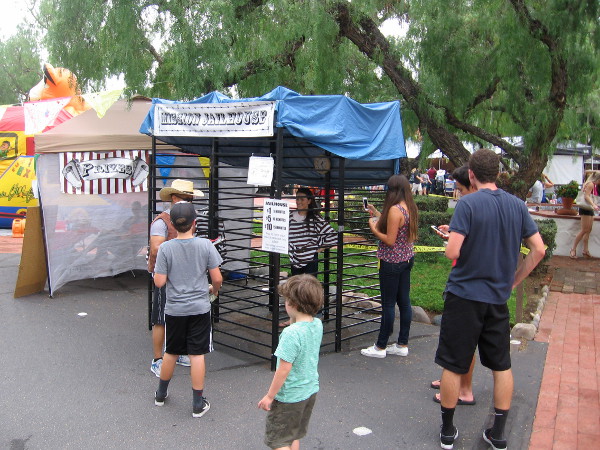
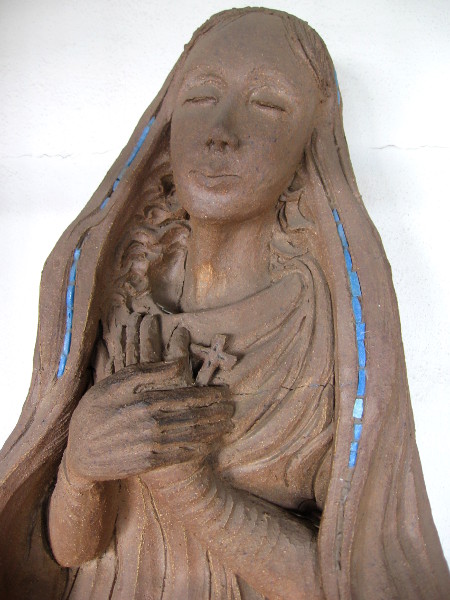
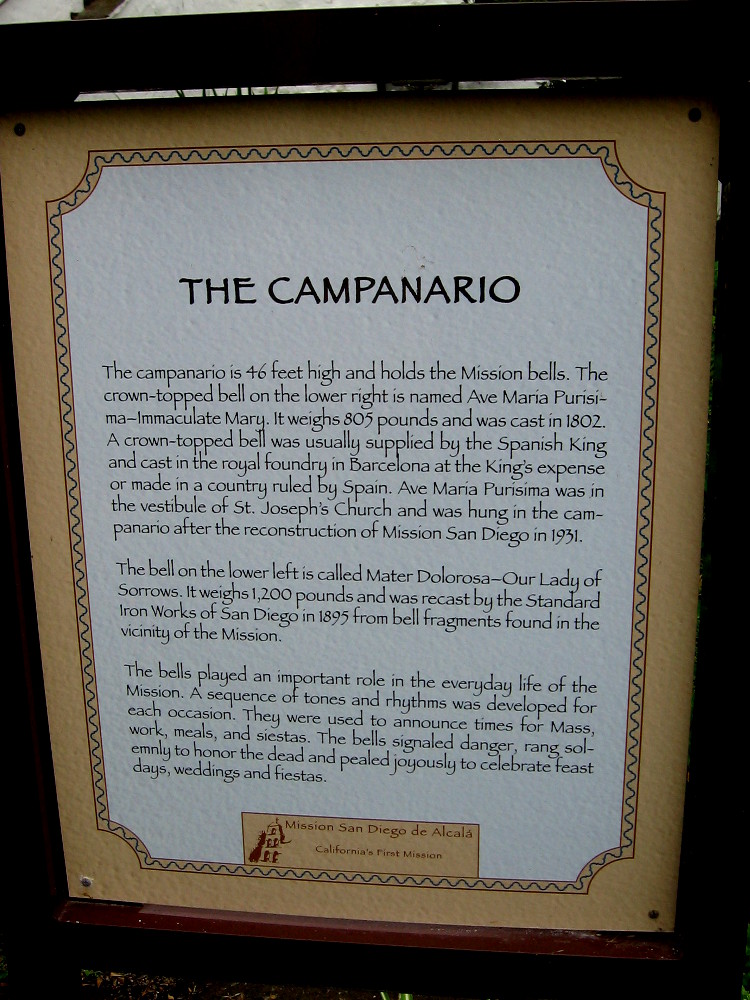
The Festival of the Bells is an annual celebration which memorializes the establishment and long history of California’s first Spanish mission.Young people provide family entertainment free to the public at the 2015 Festival of the Bells.A large audience had gathered in the mission’s spacious courtyard-like quadrangle, even as rain threatened on Sunday afternoon.Folks hang out around the central fountain, eating food and taking in sights, smells and sounds during a lively San Diego tradition.Proceeds from sales of food, crafts and gifts benefited Mission Basilica San Diego de Alcala, which is an active Catholic church.Who can resist root beer floats?Put a friend in the jailhouse to raise some money!San Diego de Alcalá was the first of 21 Spanish missions in California, established by Father Junipero Serra in 1769.Small statues along walkway at front of San Diego de Alcala depict Saints who inspired California mission names. This is for Mission Santa Clara de Asis, founded 1777.Sign in the mission’s garden explains The Campanario. (Click to enlarge.)
The campanario is 46 feet high and holds the Mission bells. The crown-topped bell on the lower right is named Ave Maria Purisima–Immaculate Mary. It weights 805 pounds and was cast in 1802 . . . The bells played an important role in the everyday life of the Mission . . . They were used to announce times for Mass, work, meals and siestas. The bells signaled danger, rang solemnly to honor the dead, and pealed joyously to celebrate feast days, weddings and fiestas.
Of the five church bells, one original bell dates back to 1802.
…
San Diego is an endlessly interesting place! You can enjoy photos from many varied walks by following on Facebook or Twitter.
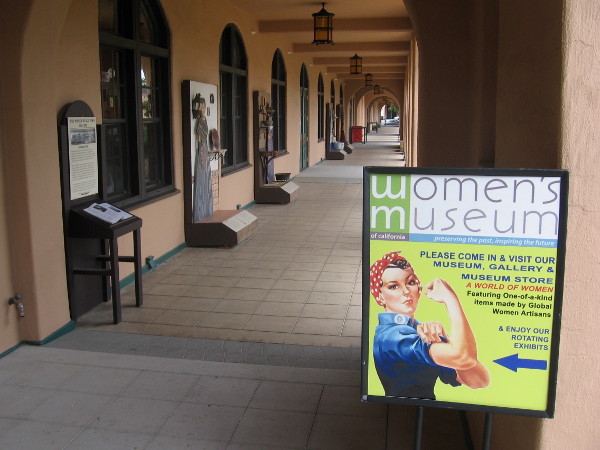
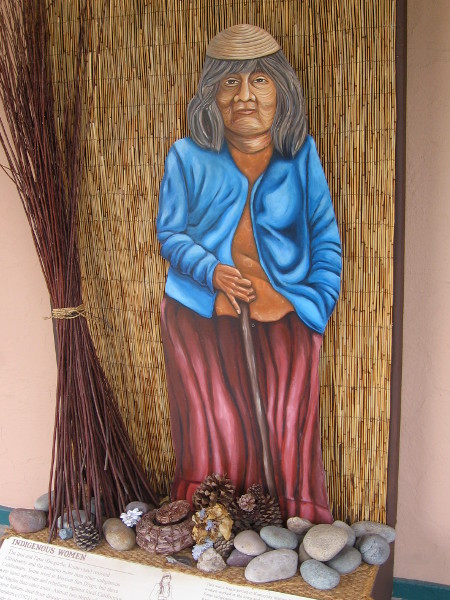
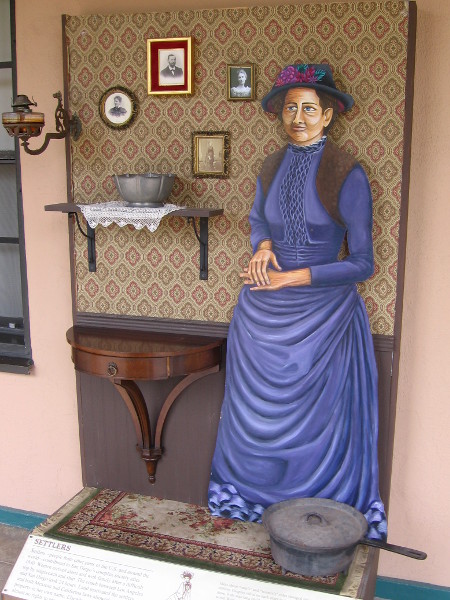
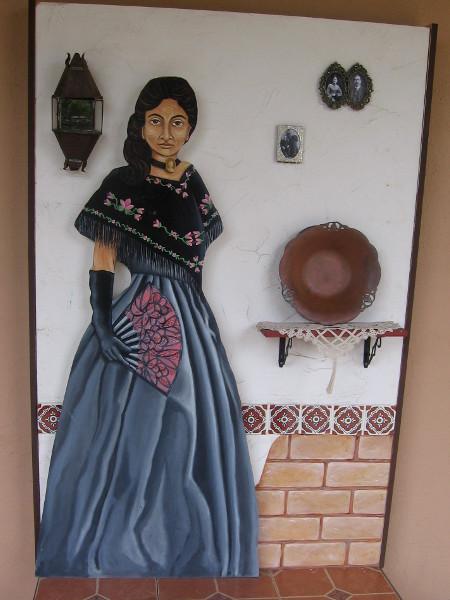
Important stories from local history are preserved at the Women’s Museum of California.
The Women’s Museum of California is one of many cultural attractions that can be enjoyed at Liberty Station in Point Loma. I took some photos of a historical exhibit just outside their front door.
This unique museum was founded by Mary Maschal, a collector of memorabilia and artifacts pertaining to women. The collection has moved to different locations and evolved over the years; today it has grown into an important museum that features art shows, live performances, lectures and other educational events. Its mission is summarized by the slogan: Preserving the past…inspiring the future.
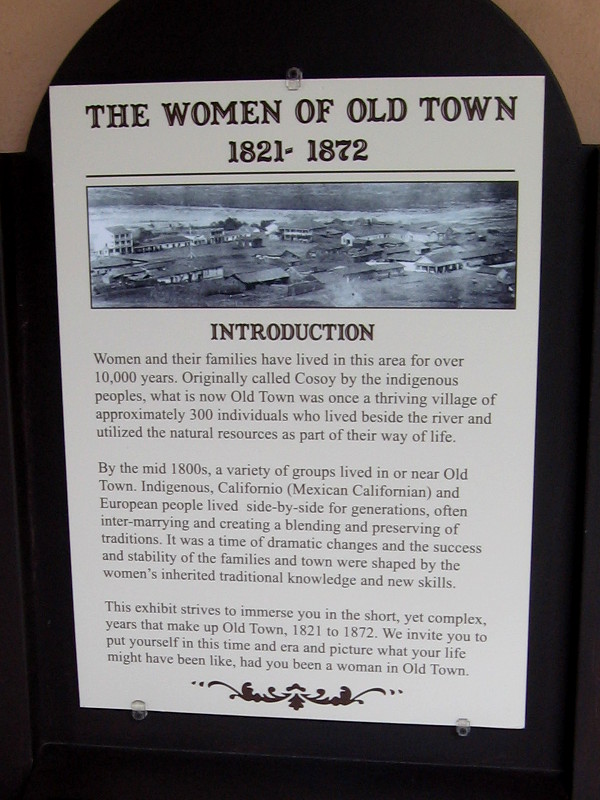
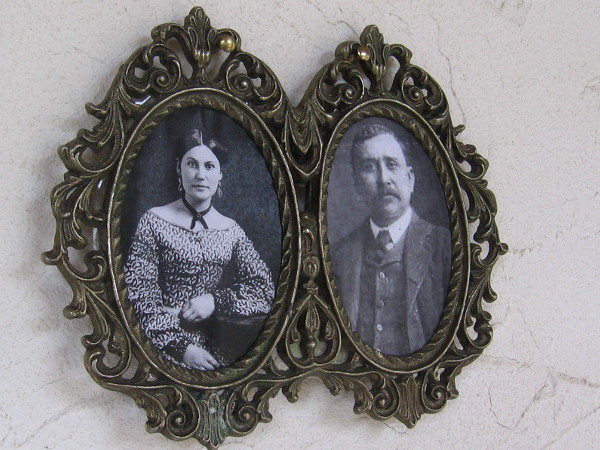
The women of Old Town, 1821-1872. Women and their families have lived in this area, called Cosoy by indigenous people, for over 10,000 years. This exhibit focuses on a short period.The historical experiences and accomplishments of local women are preserved at this unique San Diego museum.The Ipai and Tipai (Diegueño, Kumeyaay) resisted Christianity and the missions more than other indigenous Californians. Moved off their land, the women worked in the town and ranchos.The few women in Old Town had more opportunities to earn money than in the Eastern U.S. They did traditional work: laundry, baking, cooking, sewing, tending to children and livestock.Settlers contributed to San Diego’s complex society after 1830. Women arrived alone and with family after a difficult trip by stagecoach and ship.Californios were a diverse group whose culture created el pueblo San Diego. They were descendants of mixed Spanish and indigenous peoples, often given land grants by Mexico.Old photographs in an artifact help modern San Diegans remember their rugged, fascinating past.
…
To enjoy future posts, you can “like” Cool San Diego Sights on Facebook or follow me on Twitter.
From the South Bay to the World Series, a very special exhibit at the New Americans Museum.
It’s been over five years already? Time flies!
I can still remember the excitement throughout San Diego as a bunch of local kids stole our hearts and battled their way to become Little League World Series Champions in 2009!
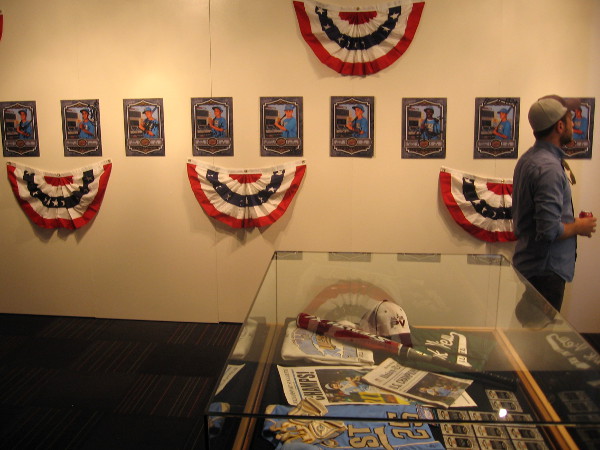
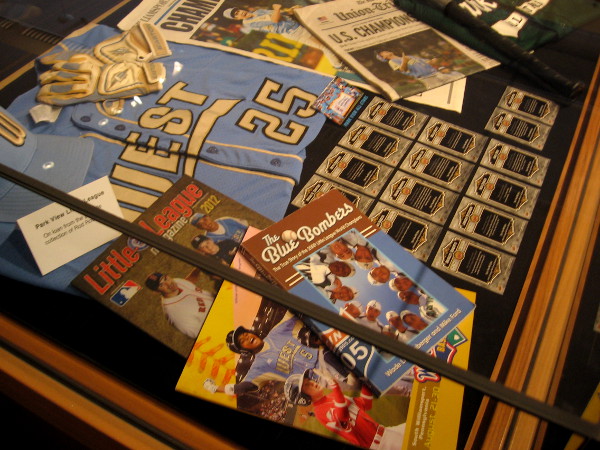
During my visit to the New Americans Museum today, I checked out a special exhibit which relives and commemorates the historic victory. The Park View team, based in Chula Vista, California (in San Diego’s South Bay not far from the Mexican border), scored a dramatic, storybook 6-3 come-from-behind victory over Chinese Taipei.
Super cool!
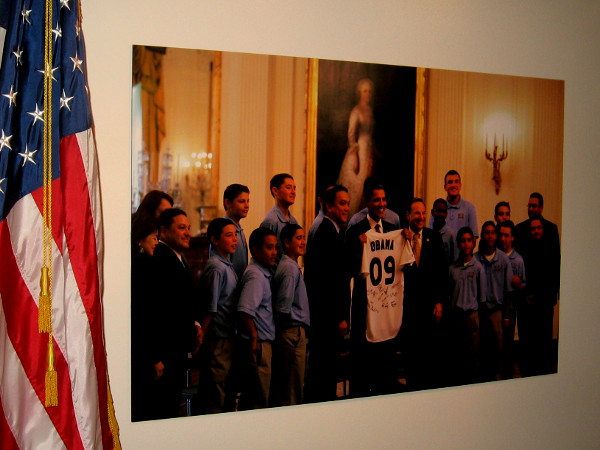
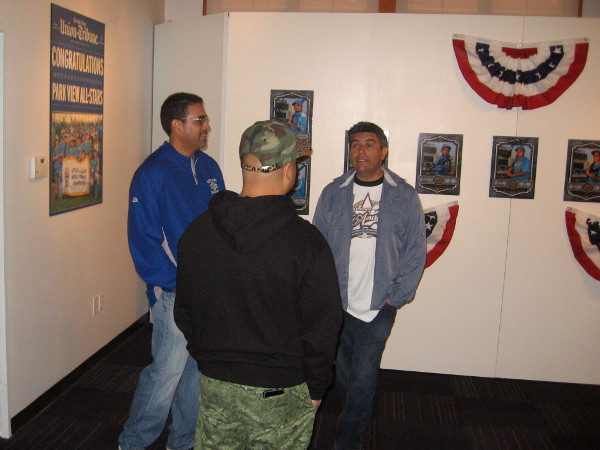
San Diegans rooted for our local kids as they battled the world’s best baseball teams.Photo shows President Obama honoring the 2009 Little League World Series champs.Memorabilia on display in San Diego museum recalls the historic victory of young Park View baseball players.Park View Little League 2009 coach Ric Ramirez talks with visitors at New Americans Museum exhibit.Kids from San Diego’s proud Chula Vista community won the 2009 Little League World Series in Williamsport, Pennsylvania.
…
To enjoy future posts, you can “like” Cool San Diego Sights on Facebook or follow me on Twitter.
Seaworthy replica of galleon San Salvador built by San Diego Maritime Museum.
On my way to the Cabrillo Festival yesterday, I swung by Spanish Landing across from the airport to check out the San Salvador. As you might recall from my blog post from early last December, the San Salvador is a replica of the galleon sailed by explorer Juan Rodriguez Cabrillo in 1542. The San Diego Maritime Museum is building it.
I was surprised to see the cool ship is nearly completed! Check out some pics I took over the surrounding fence! I spoke to a young volunteer who was working near the ship, and she told me the San Salvador is expected to launch in early 2015. The galleon will be sailing up the coast of California, recreating the historic trip by the famous explorer. And a documentary will be filmed during the voyage!
The peculiar-looking vessel will be able to navigate the open ocean, she assured me, and is ready to go today, but the folks building her are doing as much additional detail work as they can while the ship remains on dry land.
Bow modeled after historic galleon sailed by explorer Cabrillo in 1542.Stern of the wooden galleon that will sail on the Pacific Ocean in early 2015.View of the San Salvador and a huge mast from Harbor Drive sidewalk.People on the upper deck of the almost finished galleon.
…
To enjoy future posts, you can “like” Cool San Diego Sights on Facebook, or follow me on Twitter.
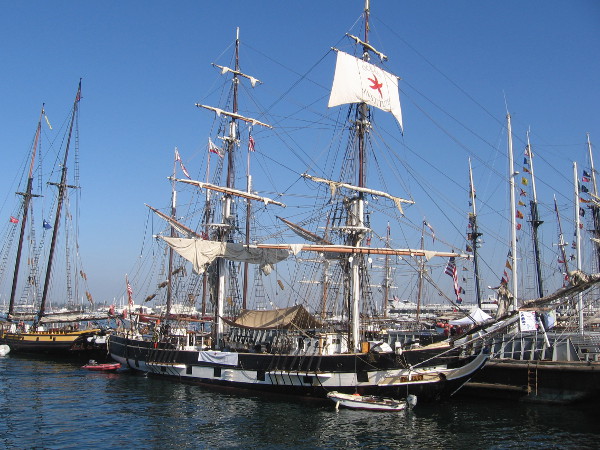
Replica of Richard Henry Dana’s brig Pilgrim at the 2014 Festival of Sail!
One of the world’s most famous sailing ships has returned to San Diego after 180 years!
Well–ahem–actually, a replica of the Pilgrim, the ship that became immortal in Richard Henry Dana Jr.’s classic book Two Years Before the Mast, sailed into San Diego Bay a few days ago. It’s one of many beautiful tall ships participating in this Labor Day weekend’s 2014 Festival of Sail.
This morning I got a bunch of pics of the festival and all the amazing ships along the Embarcadero. But I decided to start off by writing a blog post about the Pilgrim, which has a warm spot in my heart.
Every so often I reread Two Years Before the Mast, when I get a hankering to revisit the true, very interesting and adventurous tale written by Dana about his difficult voyage around Cape Horn and along the mostly uninhabited California coast as a common sailor. For some reason I feel a strange kinship with the author. Whenever I enjoy the book, I always try to envision what his hardy cattle hide trading ship looked like.
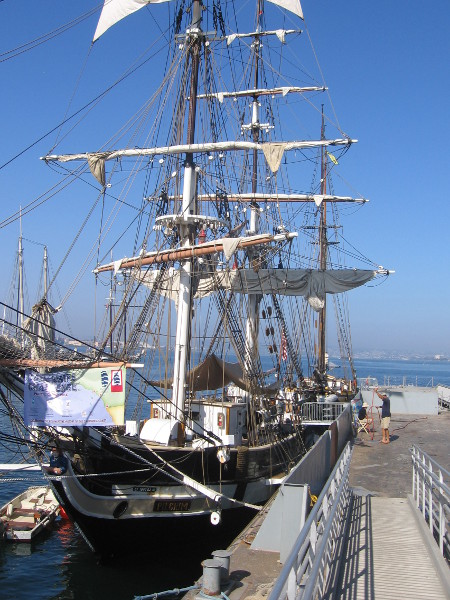
Today’s replica of the brig Pilgrim began as a three-masted schooner built in 1945 in Denmark; it was then converted to a brig in 1975 in Portugal. Now it’s a floating classroom with the Ocean Institute in Dana Point, California. The ship was used in Amistad, a movie directed by Steven Spielberg. While no one knows precisely how the original Pilgrim appeared, it quite likely resembled the ship I visited this morning.
The Pilgrim became immortalized in the classic book Two Years Before the Mast.Walking down to the Pilgrim, docked among many cool sailing ships.Wooden figurehead of the Pilgrim is a representation of Richard Henry Dana Jr.
I assume the figurehead of Dana holds a scroll because he went on to become a Harvard-educated lawyer. He advocated for groundbreaking laws which protected the common sailor and made life at sea for many a bit less dangerous and unfair.
San Diego Festival of Sail includes this historic, very interesting tall ship.
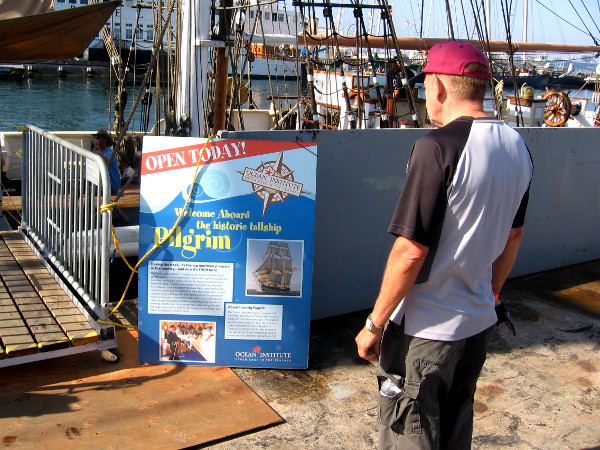
Sadly, the gentleman welcoming visitors on board (not the guy pictured) apparently had never read Two Years Before the Mast. He didn’t seem to know anything about Dana’s stay in San Diego, cleaning and curing cattle hides just inside the bay at Point Loma, riding with his friend inland to the old Mission, and having memorable good times in Old Town when San Diego was in its infancy.
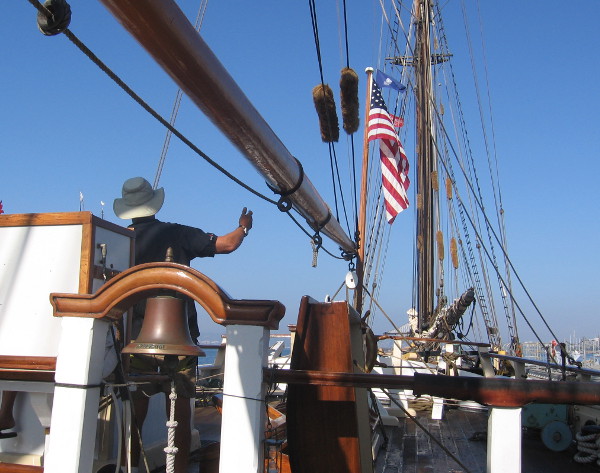
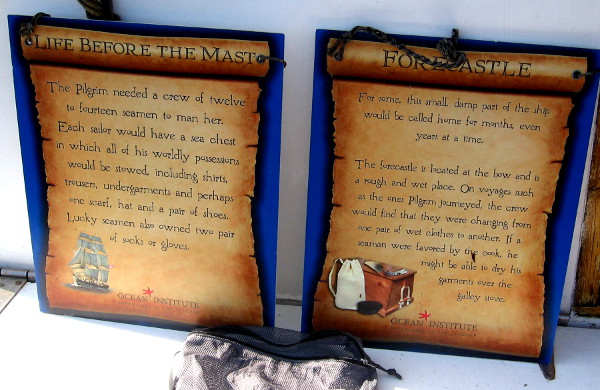
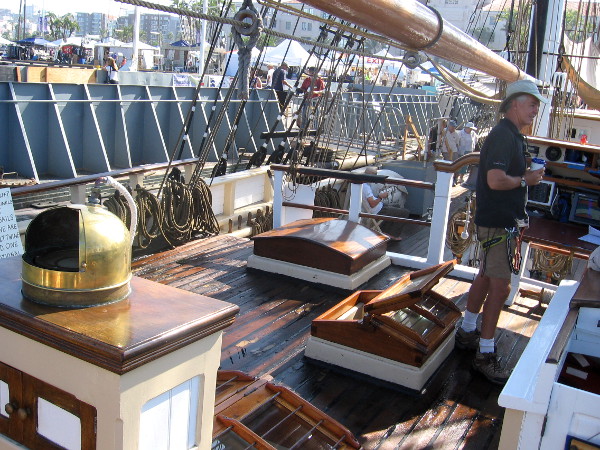
In the shade of a canvas sail, people from the Ocean Institute and visitors chat.Sign stresses the critical importance of correct line handling.Gazing toward the bow past ship’s bell and American flag.The Pilgrim needed a crew of twelve to fourteen seamen to man her.I was one of the first aboard, before the big Labor Day weekend crowd arrived!That fuzzy stuff is called baggywrinkle!Beyond the ship’s wheel, several tall ships are docked at the San Diego Maritime Museum.Advice from the cook–eat good hearty salt beef!
I like the passages in Two Years Before the Mast where Dana describes his difficult adjustment to the seafaring life.
The above sign includes his reaction after following the cook’s advice: “I got a huge piece of strong, cold salt beef from the cook and kept gnawing upon it until twelve o’clock. When we went on deck, I felt somewhat like a man, and could begin to learn my sea duty with considerable spirit.”
Pilgrim crew member works at a knot during San Diego’s tall ship festival.
The West Coast was a mostly desolate, seldom-visited frontier in those days long ago. It was a place of danger, difficult undertakings and true discovery. Sometimes during my easy walks around and about San Diego, I try to imagine the glorious horizons and raw natural beauty unaltered by modern development. It’s a place in time that now exists only in memory. And in great books.
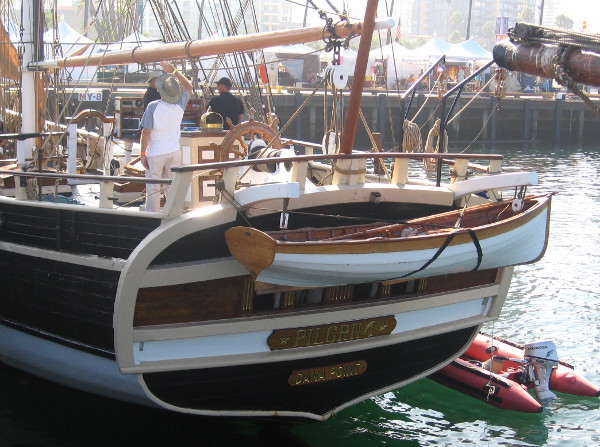
Stern of the brig Pilgrim at the 2014 Festival of Sail.
…
To enjoy future posts, you can “like” Cool San Diego Sights on Facebook, or follow me on Twitter.
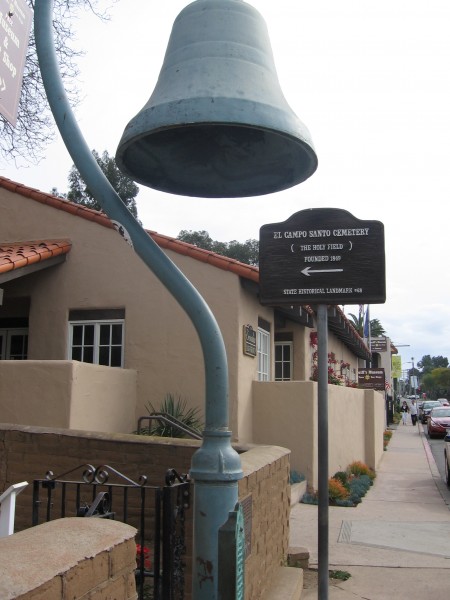
El Camino Real bell in front of California’s first Spanish mission.
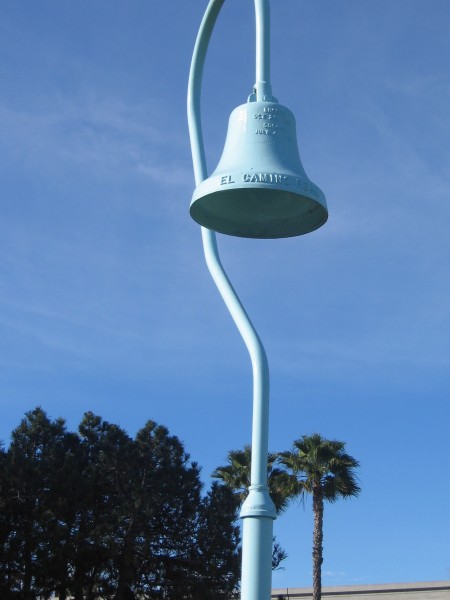
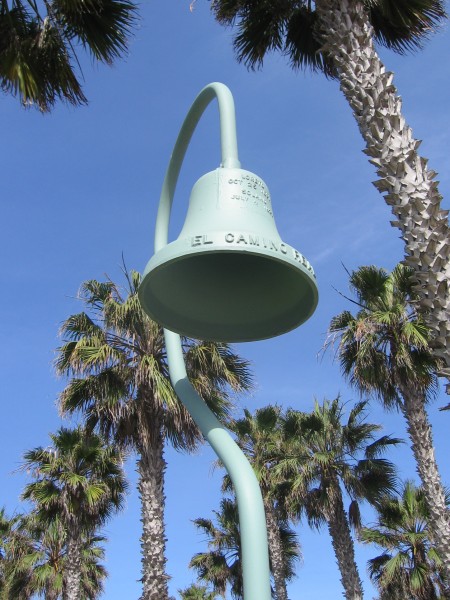
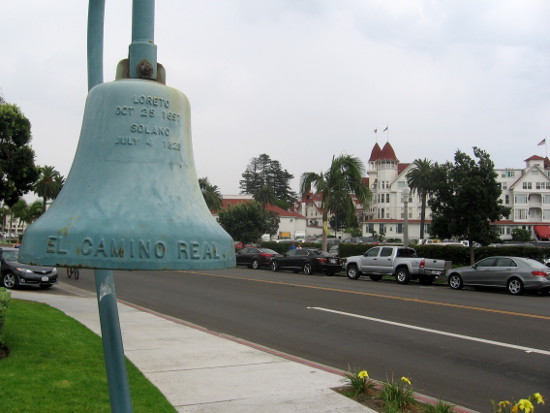
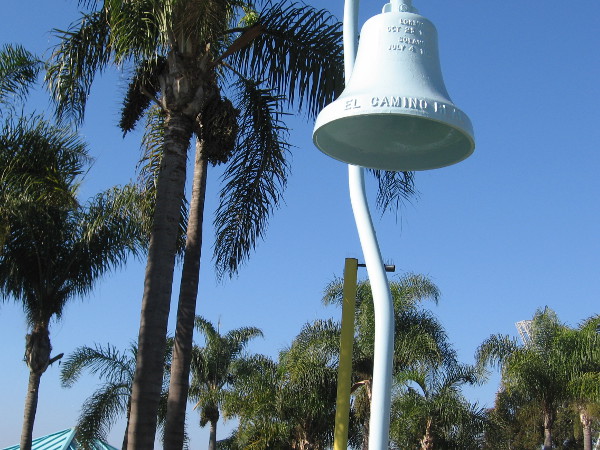
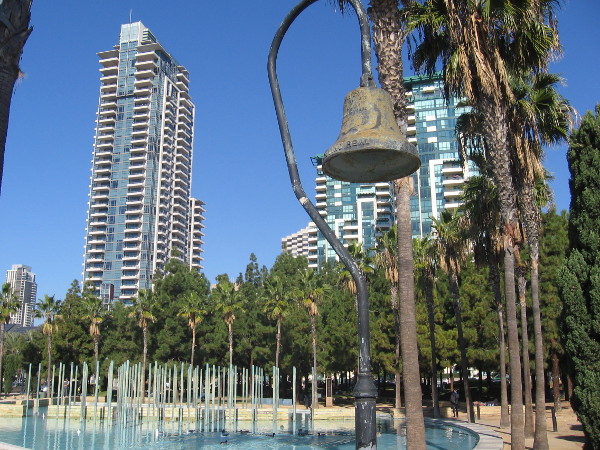
Here are just a few random pics of El Camino Real bells around San Diego. During my walks, I’m often surprised to discover a new bell.
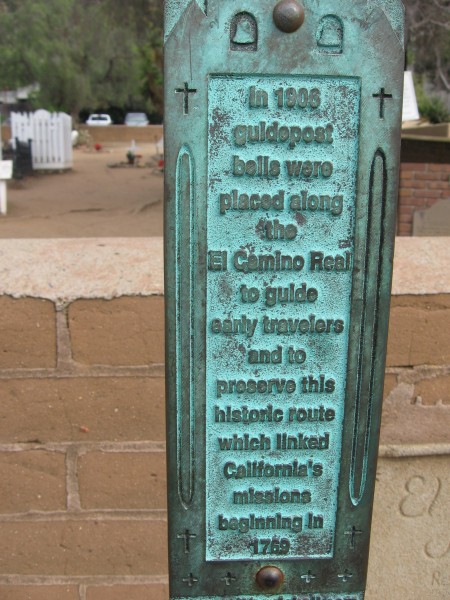
Many of these guidepost bells were placed in 1906 by the California Federation of Women’s Clubs. They marked the primitive roads that connected the old Spanish missions in California. El Camino Real, which means the Royal Road or King’s Highway in Spanish, led to 21 missions in Alta California, plus a variety of sub-missions, presidios and pueblos. The bells stand on tall posts in the shape of a shepherd’s crook. In subsequent years, bells have been removed or added to the California landscape.
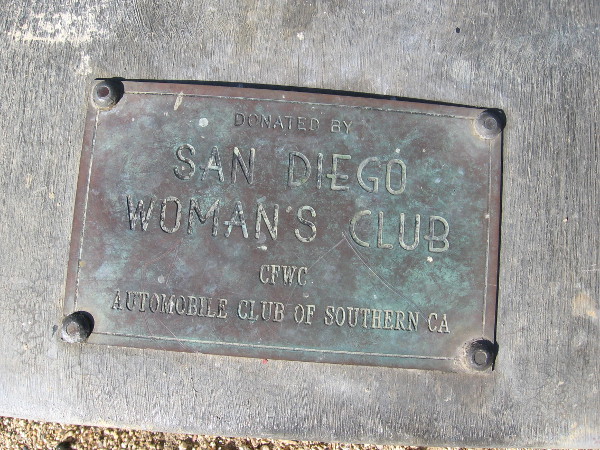
Bell in front of Old Town’s historic El Campo Santo cemetery.Plaque explains history of the guidepost bells.El Camino Real bell spotted on Harbor Island.El Camino Real bell by the downtown County Administration Building.Historic bell and palm trees in Imperial Beach.I found an El Camino Real bell near the Hotel del Coronado!El Camino Real bell in Cesar Chavez Park in Barrio Logan.Plaque on Harbor Drive reveals that a nearby bell was donated by San Diego Woman’s Club.
El Camino Real bell on Martin Luther King Jr. Promenade by Children’s Park.
…
To enjoy future posts, you can “like” Cool San Diego Sights on Facebook, or follow me on Twitter.
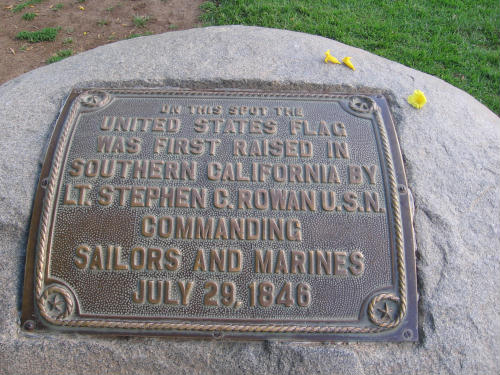
This historical plaque, located in Old Town San Diego State Historic Park’s grassy central Plaza de Las Armas, reads:
On this spot the United States Flag was first raised in Southern California by Lt. Stephen C. Rowan U.S.N. commanding Sailors and Marines July 29, 1846
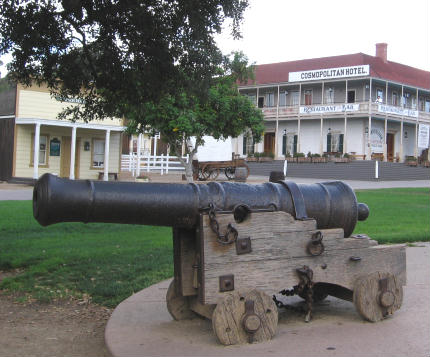
Looking past the bronze plaque at a few Old Town buildings.
One of my favorite areas in San Diego is Old Town. There’s so much to see and enjoy wherever you turn. For lovers of history, it’s a treasure trove of discoveries.
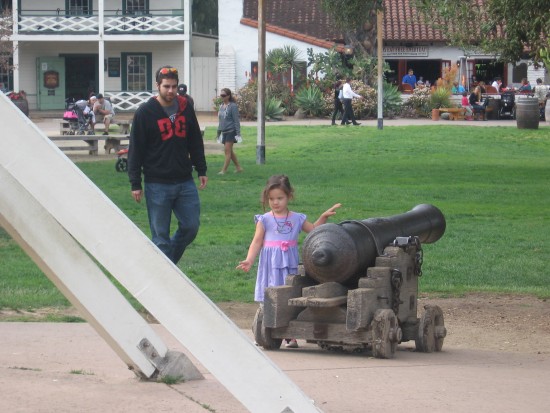
Here’s a photo taken inside the central Plaza de las Armas, the heart of Old Town San Diego State Historic Park. This old Spanish cannon is called El Capitan. It was one of ten cannons that long ago protected Fort Guijarros near the entrance to San Diego Bay. The Spanish fort was built in 1797 on Ballast Point out of adobe.
El Capitan was likely fired during the Battle of San Diego in 1803, when the Spanish attacked the American brig Lelia Byrd which was smuggling otter skins. This cannon was likely fired again at the American smuggler ship Franklin in 1828, when the fort was under Mexican control. The only other surviving cannon from Fort Guijarros is called El Jupiter, and can be seen in the Serra Museum atop nearby Presidio Hill.
Old Town is all about history. The grassy plaza, containing the cannon, historical plaques, a high flagpole and picnic benches, is surrounded by old adobe buildings preserved and recreated from the early 1800’s. San Diego originated right here, at the base of a bluff where a Spanish military outpost stood. The outpost, called the Presidio, was built by Gaspar de Portola in 1769. That same year, Mission San Diego de Alcala was founded on Presidio Hill by the ambitious Spanish Franciscan friar, Father Junipero Serra. This made Old Town the site of the very first European settlement in California.
Around the Plaza de las Armas visitors can check out numerous interesting small museums, including the original one-room schoolhouse, an old blacksmith shop, San Diego’s very first newspaper office, an early courthouse, and a stable with a large collection of antique wagons and stagecoaches. Tourists can find gifts and souvenirs in a smattering of craft-filled shops. Families can dine at several colorful restaurants. Plus, there are many additional historical and commercial attractions along San Diego Avenue to the south of the plaza.
Can you guess another thing I like? Admission to Old Town San Diego State Historic Park and all of its museums is free!
Girl walks past a cannon named El Capitan in Old Town San Diego State Historic Park.


















 Cool San Diego Sights!