Two vaqueros chat during an event in Old Town San Diego that reenacts fascinating Californio history.
I enjoyed the Trades That Shaped the West event in Old Town San Diego last Saturday so much, I decided to return today to experience another Stagecoach Days event: Days of the Vaqueros!
Days of the Vaqueros invited curious visitors to experience what life was like when San Diego was a part of Spain, then Mexico. The emphasis was on the vaqueros–the first true cowboys. During the era of the Californios, wealthy ranch owners employed vaqueros to manage their stock.
For a couple of decades–from the early 1820s to the mid-1840s–cattle hides were the primary export of Alta California. Merchant ships from the East Coast (and other places about the Pacific Ocean) would trade the plentiful hides for finished goods that were in high demand in early, geographically isolated, sparsely populated towns like San Diego.
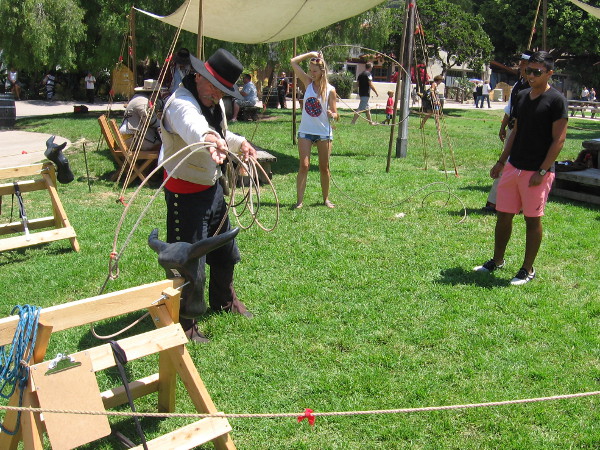
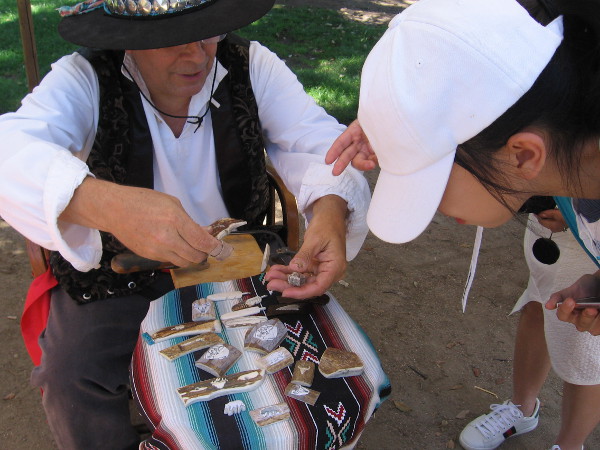
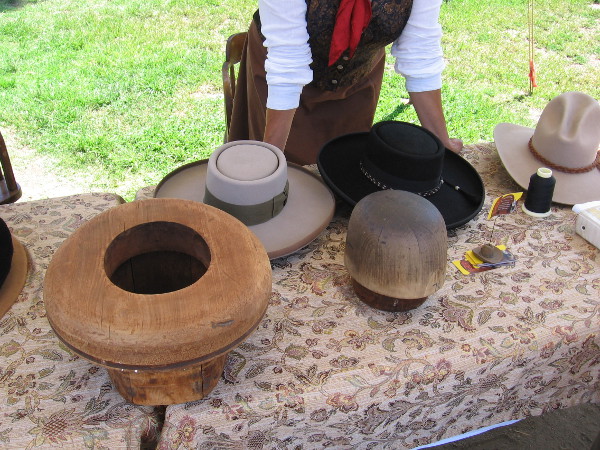
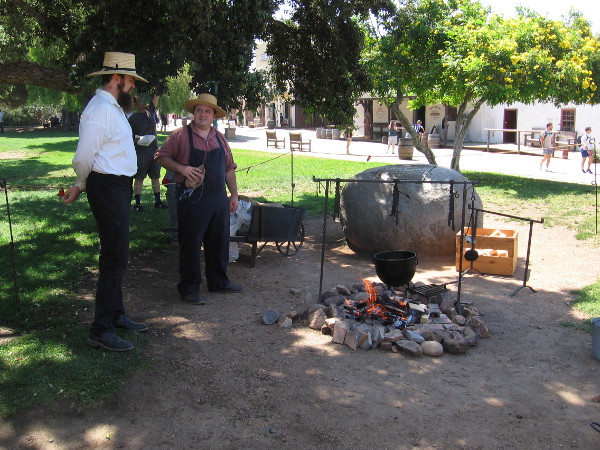
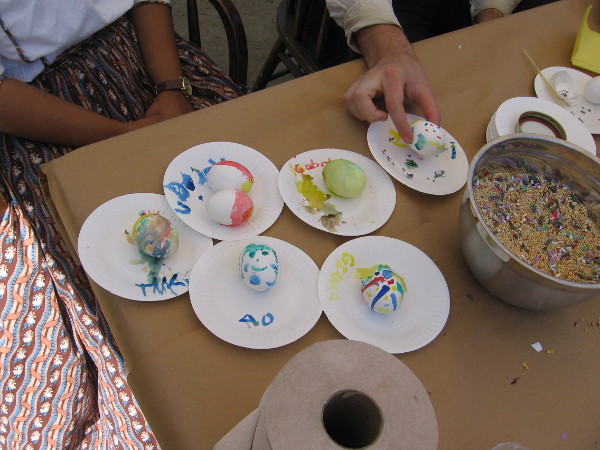
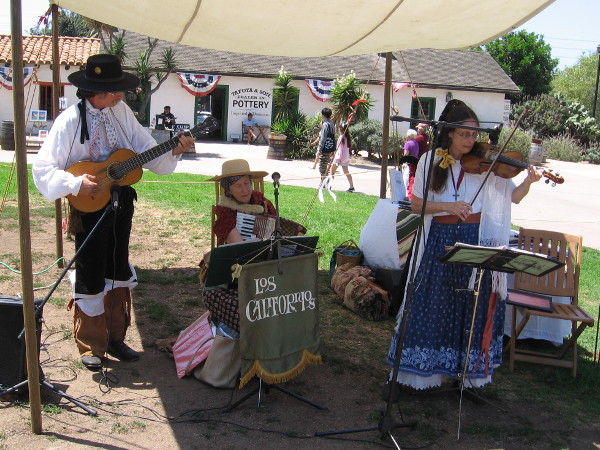
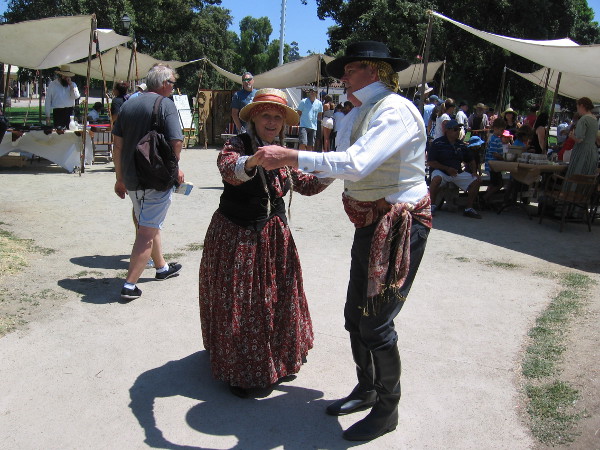
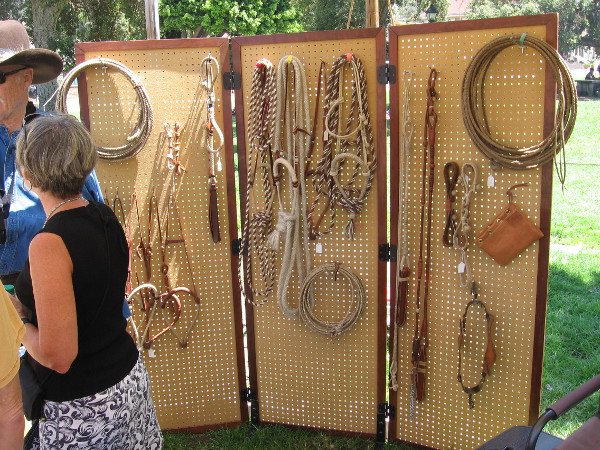
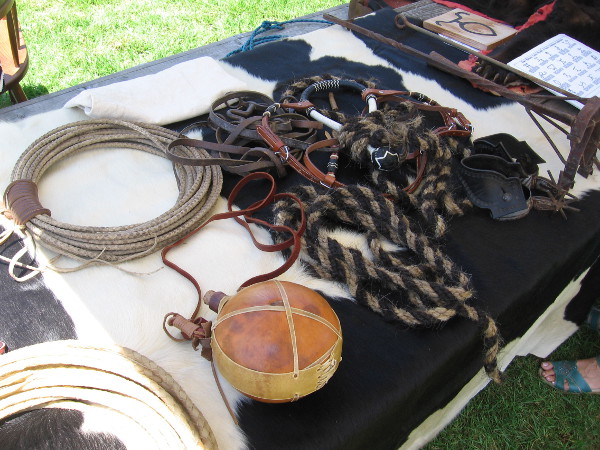
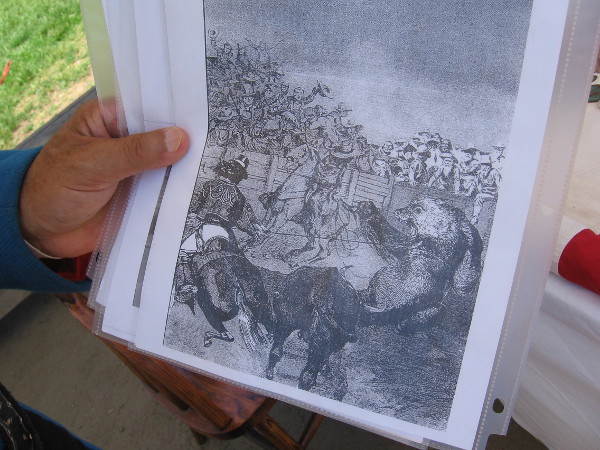
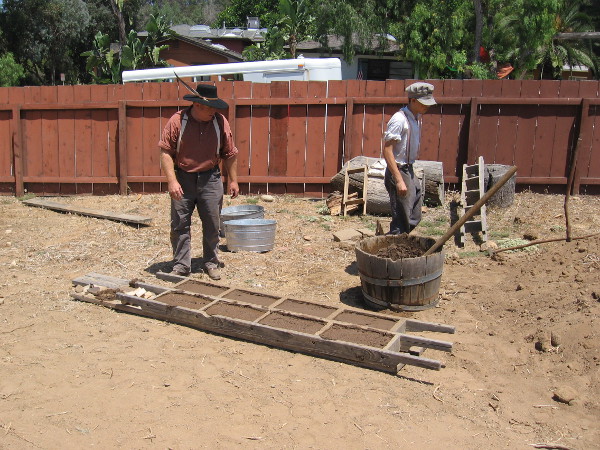
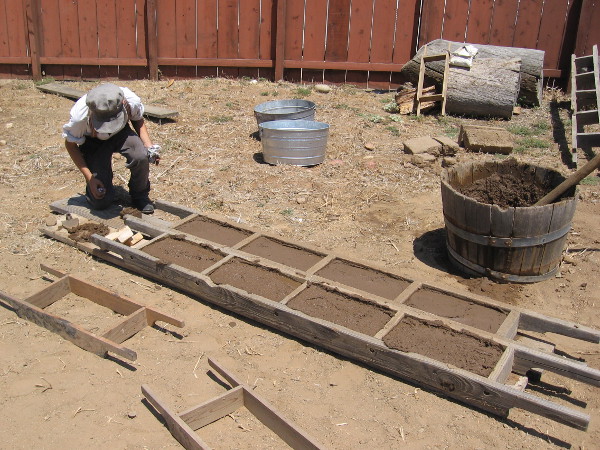
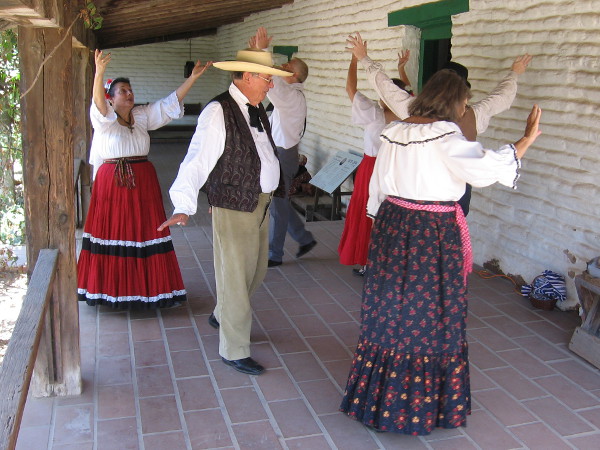
Someone checks out Days of the Vaqueros activities. The banner hangs on the Robinson Rose House in Old Town San Diego State Historic Park.Taking place during Old Town’s summer weekend Stagecoach Days, today’s event primarily celebrated life in San Diego when the small town and Alta California were part of Mexico.Ladies pass by in period dresses. One of many cool sights at the Days of the Vaqueros event in Old Town San Diego.Tables contained information about life during the era of huge Mexican land grant ranches worked by vaqueros. Vaqueros, the first true cowboys, were mostly indigenous people employed to manage cattle by the wealthy land owners.A vaquero shows a visitor to Old Town how to properly handle a rope.The visitor successfully lassoes his cow–the rear end, that is–first try!A gentleman who used to work for Buck Knives makes unique knife handles out of elk antlers. He has developed his own technique, which takes great skill and precision.A hat maker shows how beaver felt material was steamed then pushed over a hat-form block.What’s cooking on the campfire? Some tasty pozole, I was told!Pozole is a traditional Mexican soup or stew, made from hominy, meat and various vegetable seasonings.Decorating eggshell cascarones. Near the end of a fiesta, Californios flirted by cracking eggs filled with scented water or confetti over the startled head of someone they liked.A group called Los Californios played authentic early California music–tunes that were preserved over a century ago on wax cylinder sound recordings made by Charles Lummis.A couple dances to the happy, gentle music.Publications by a nonprofit project called San Diego Friends of Old Time Music. Author Vykki Mende Gray is helping to preserve the musical history of California.A display of braided ropes and rawhide, once commonly used by vaqueros as they worked on the large cattle ranches around San Diego.On this table I see more ropes, a canteen, iron brands and boot spurs.A gentleman who teaches school students visiting Old Town about history holds up an illustration of bear-baiting, which early Californians found entertaining.These guys were making adobe bricks. I learned earth and water are mixed, and straw or manure are often added for strength and cohesion.Authentic adobe bricks take weeks or months to properly dry. When hard, these bricks will possibly be used in new construction or to restore existing exhibits inside Old Town San Diego State Historic Park.Traditional dancing in the courtyard of Casa de Estudillo of Los Camotes (which translates the sweet potatoes), a tune from old Mexican and Spanish California.
…
This blog now features thousands of photos around San Diego! Are you curious? There’s lots of cool stuff to check out!
Here’s the Cool San Diego Sights main page, where you can read the most current blog posts. If you’re using a small mobile device, click those three parallel lines up at the top–that opens up my website’s sidebar, where you’ll see the most popular posts, a search box, and more!
To enjoy future posts, you can also “like” Cool San Diego Sights on Facebook or follow me on Twitter.
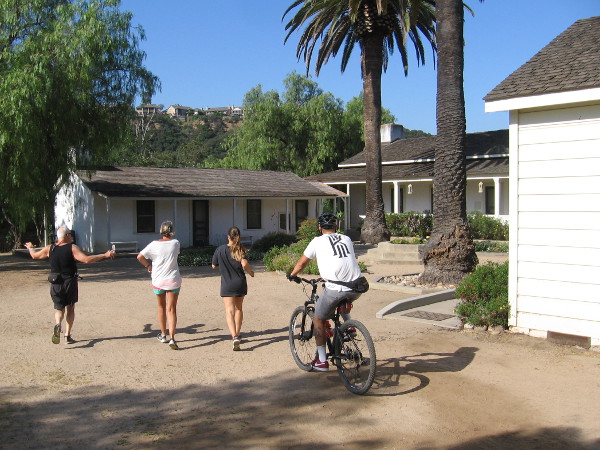
Jogging and biking past the historic adobe ranch house in Los Peñasquitos Canyon Preserve.
The second oldest residence in San Diego County can be found inside Los Peñasquitos Canyon Preserve. The adobe ranch house was built in 1824 by Captain Francisco María Ruiz, who was Commandante of San Diego’s presidio. He built two small adobe buildings on Rancho Santa Maria de Los Peñasquitos, his large 8,486-acre Mexican land grant north of the Presidio and Mission San Diego de Alcalá. It was the first land grant by the Mexican government in this area. The grant was made in 1823, just two years after Mexico became independent from Spain.
The historic adobe ranch house has been modified, enlarged and restored by various owners over the years, and today is a popular destination for visitors to Los Peñasquitos Canyon Preserve. People often bike or hike through the picturesque ranch, and motorists can park in a nearby lot. Picnic tables are plentiful; there are goats and chickens to captivate children; and guided tours are available on weekends.
I toured the ranch recently and took photos of its various features. There are a variety of interpretive exhibits within the adobe house. Please read these informative displays (click to enlarge the images) to learn more about this fascinating place’s long and colorful history.
(What is the oldest structure in San Diego County? You’ll be completely surprised! I blogged about that here.)
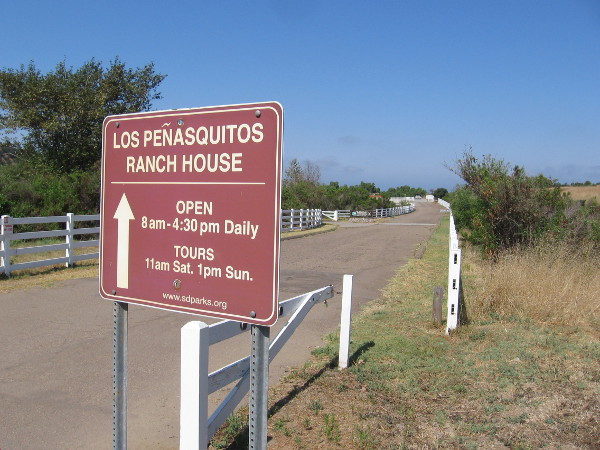
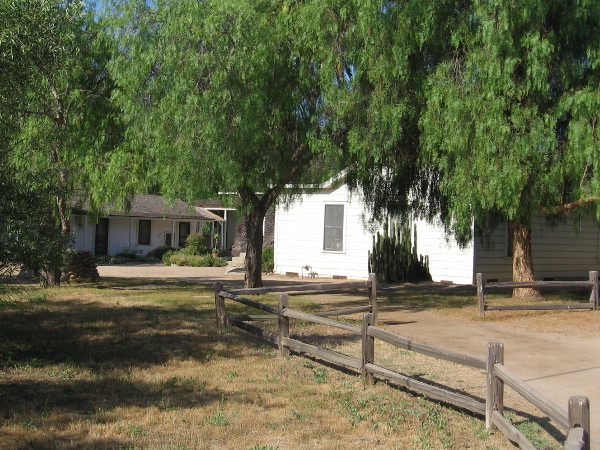
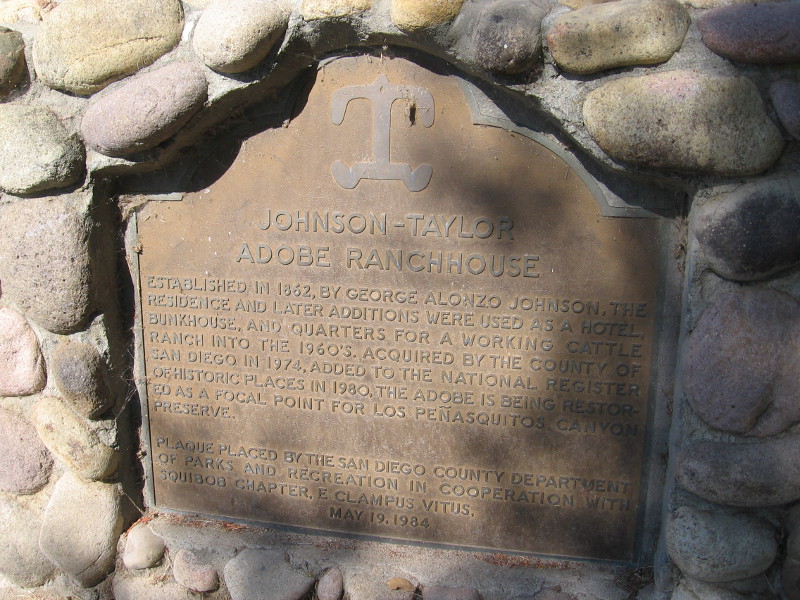
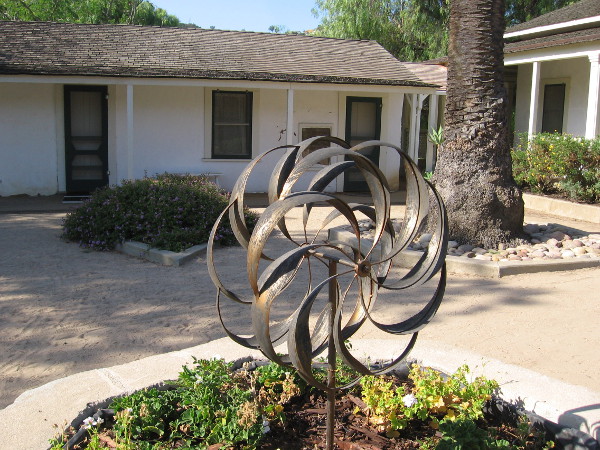
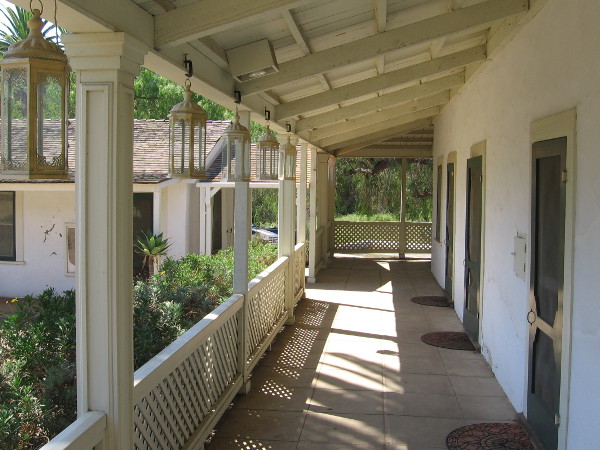
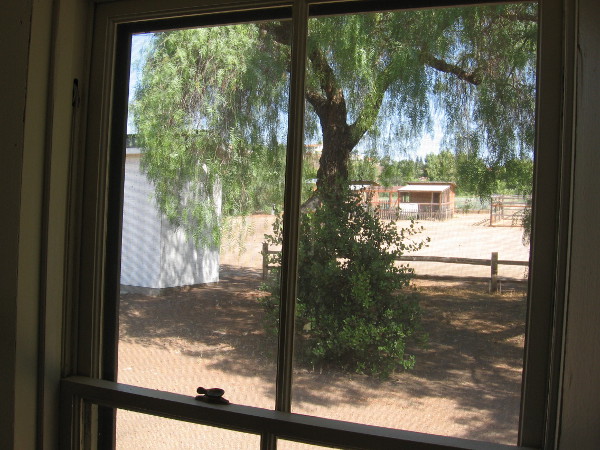
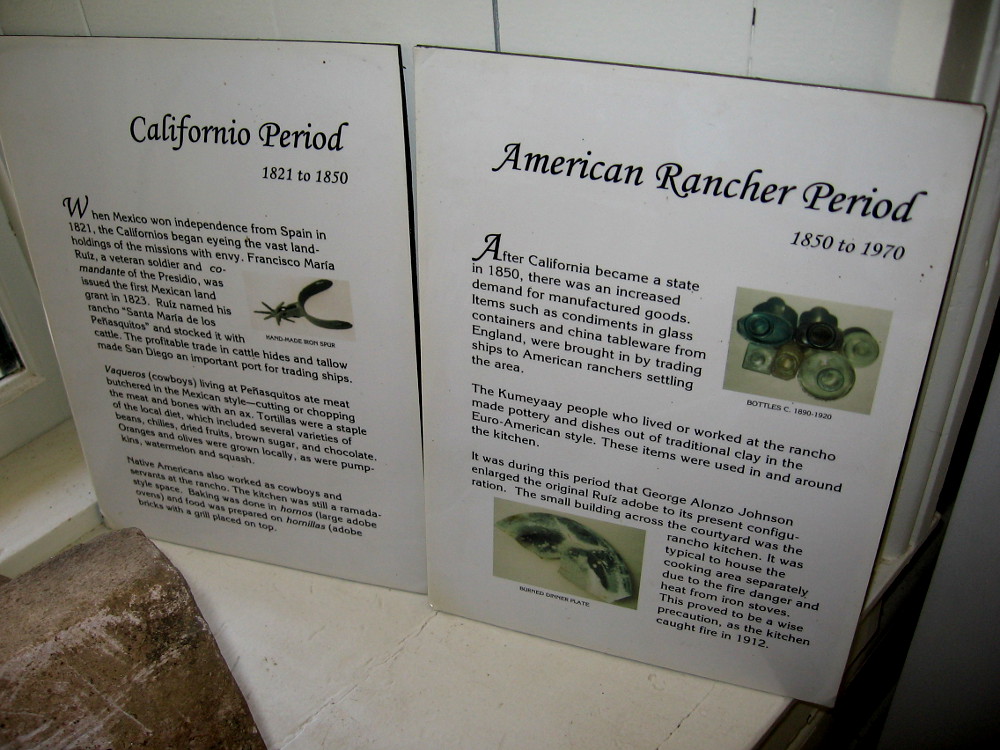
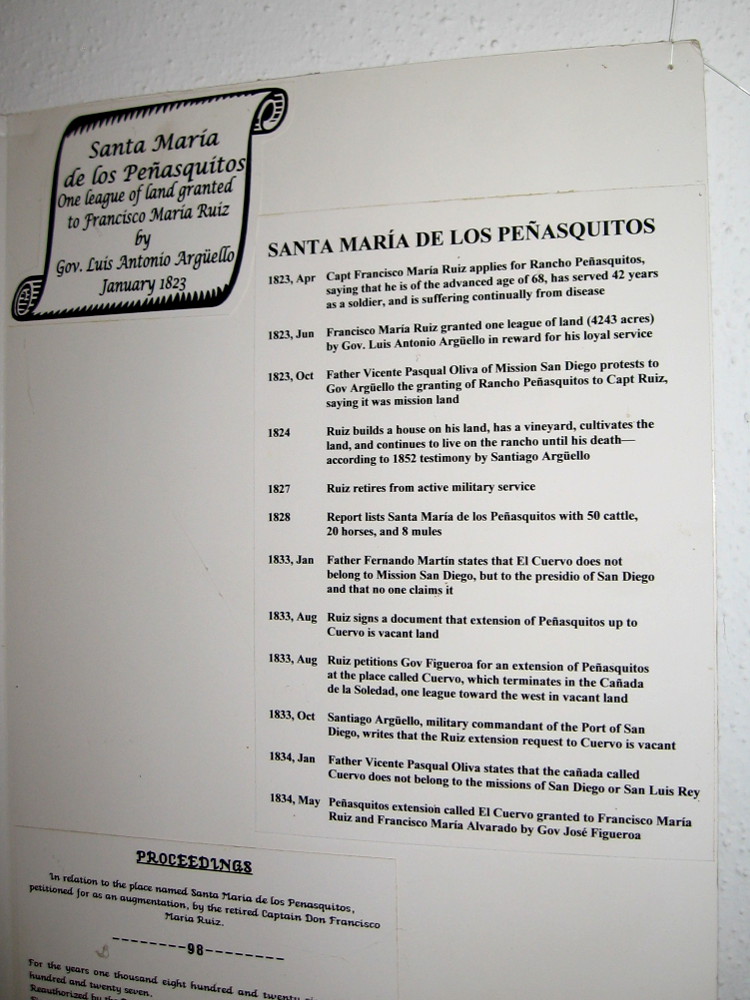
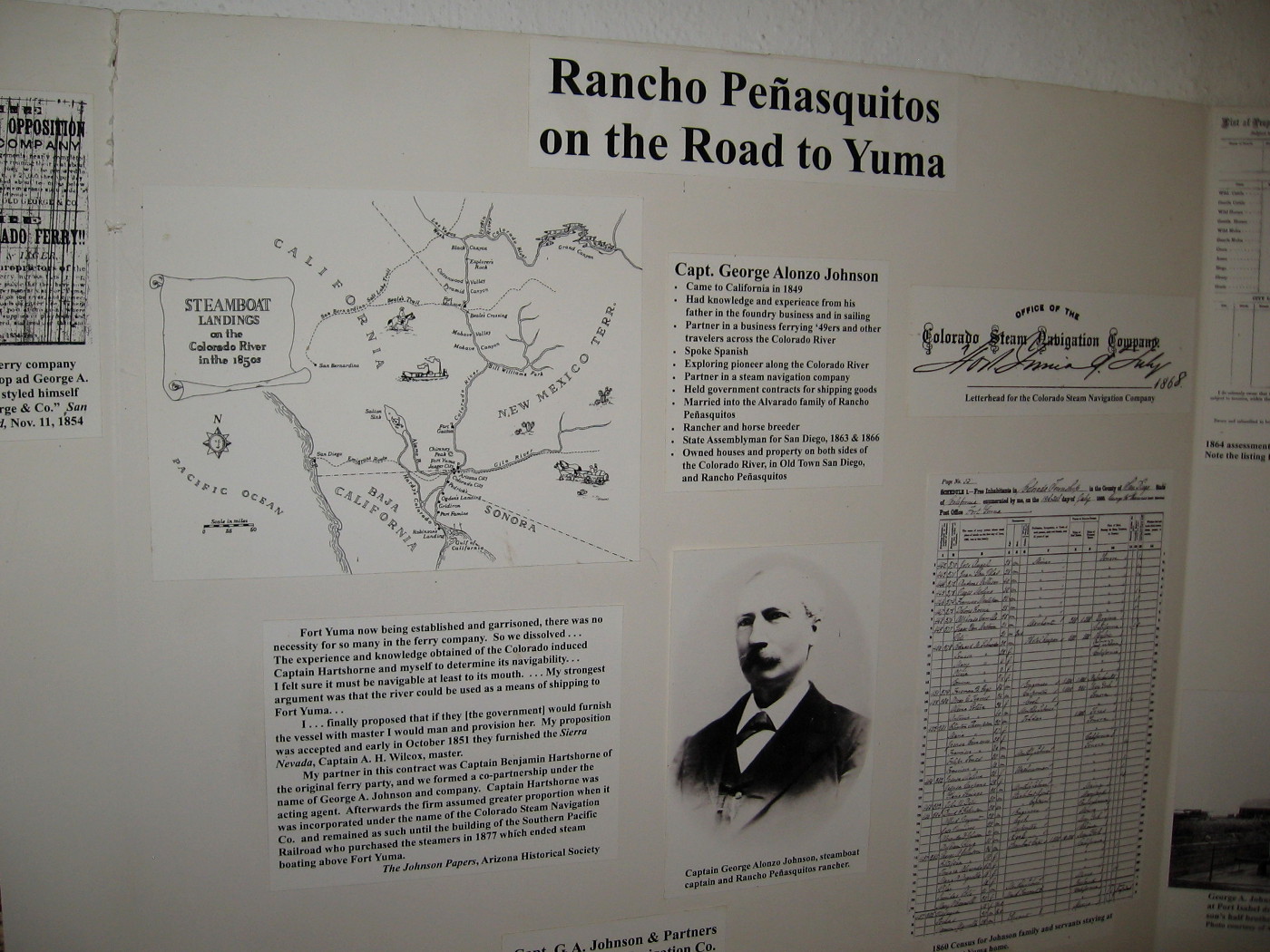
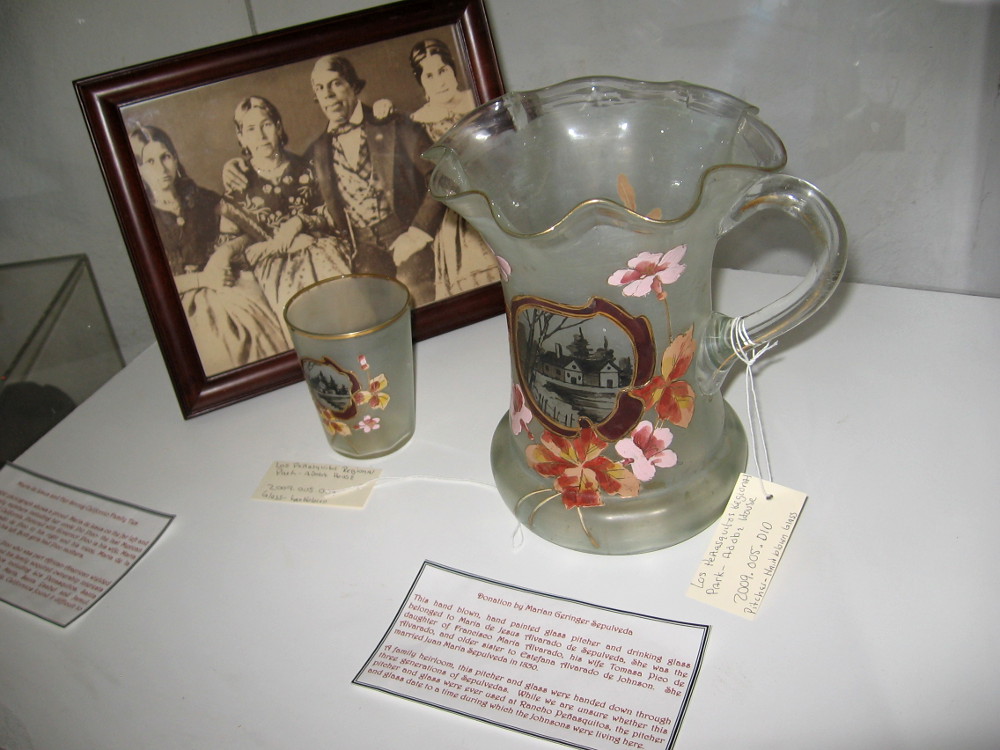
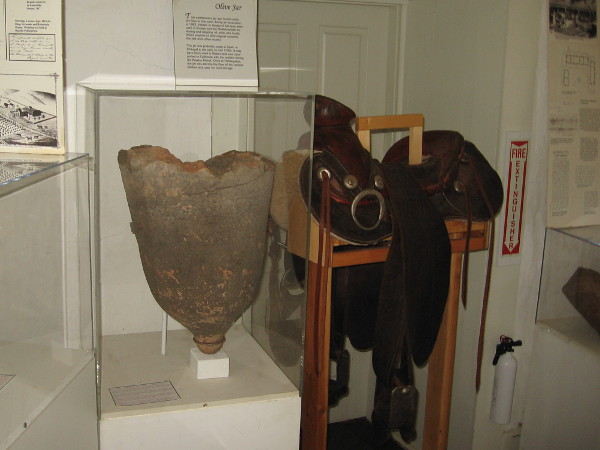
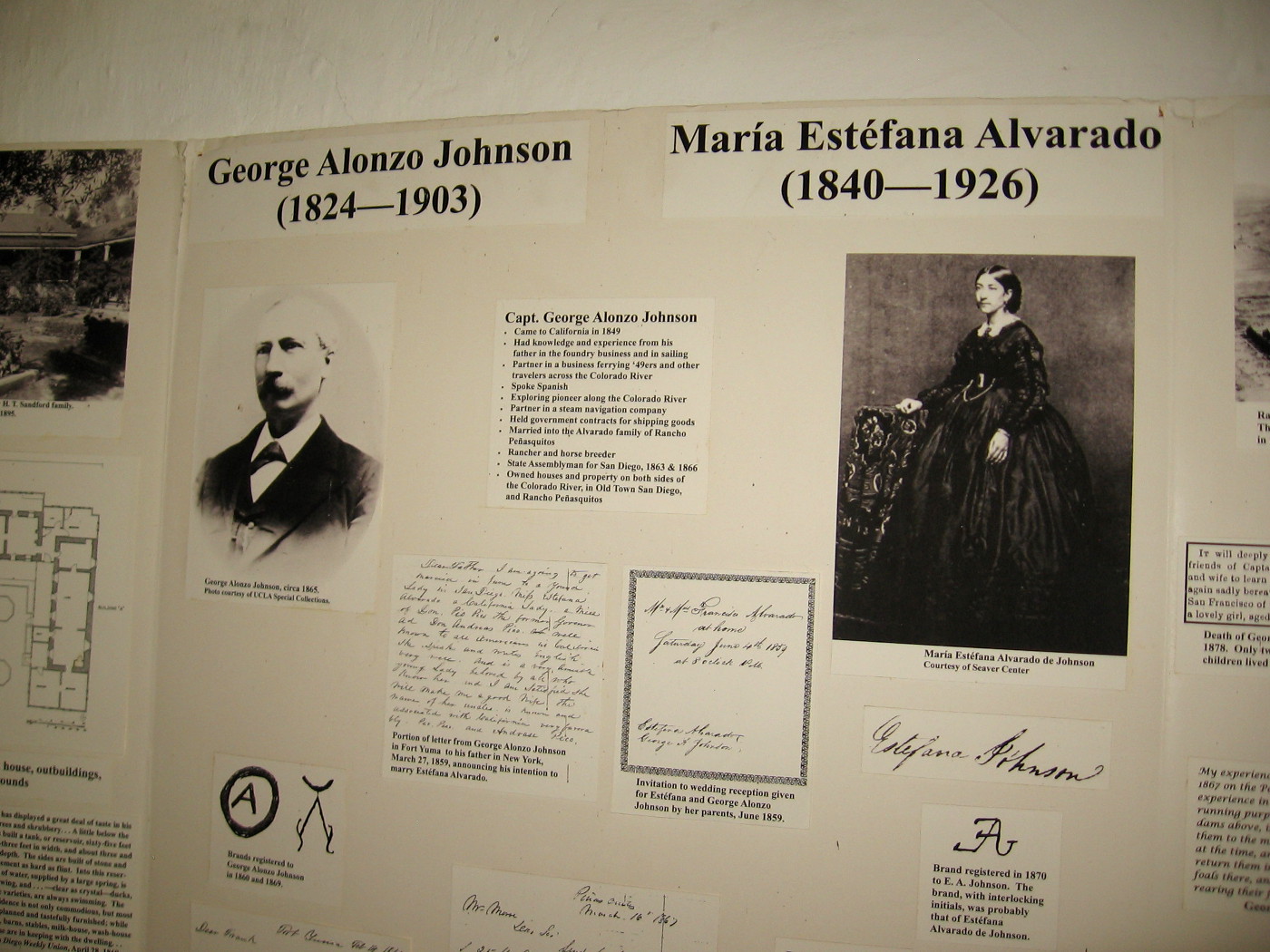
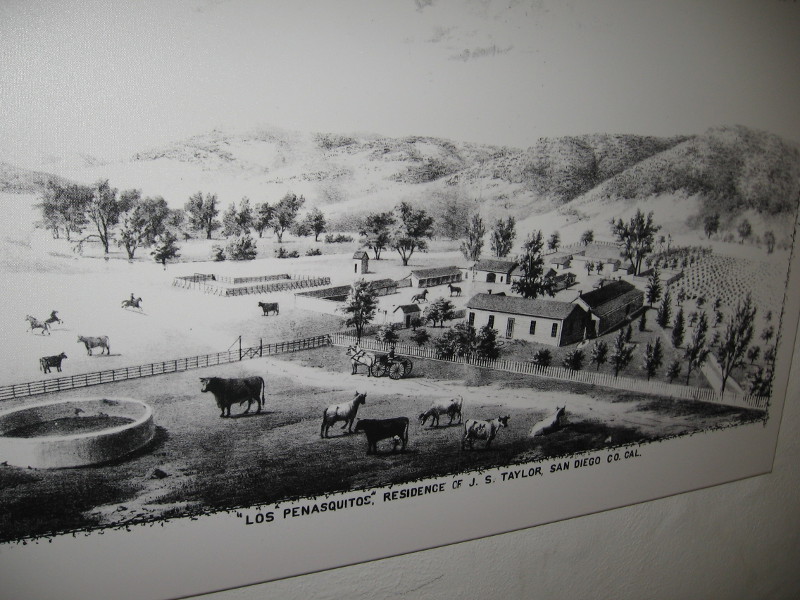
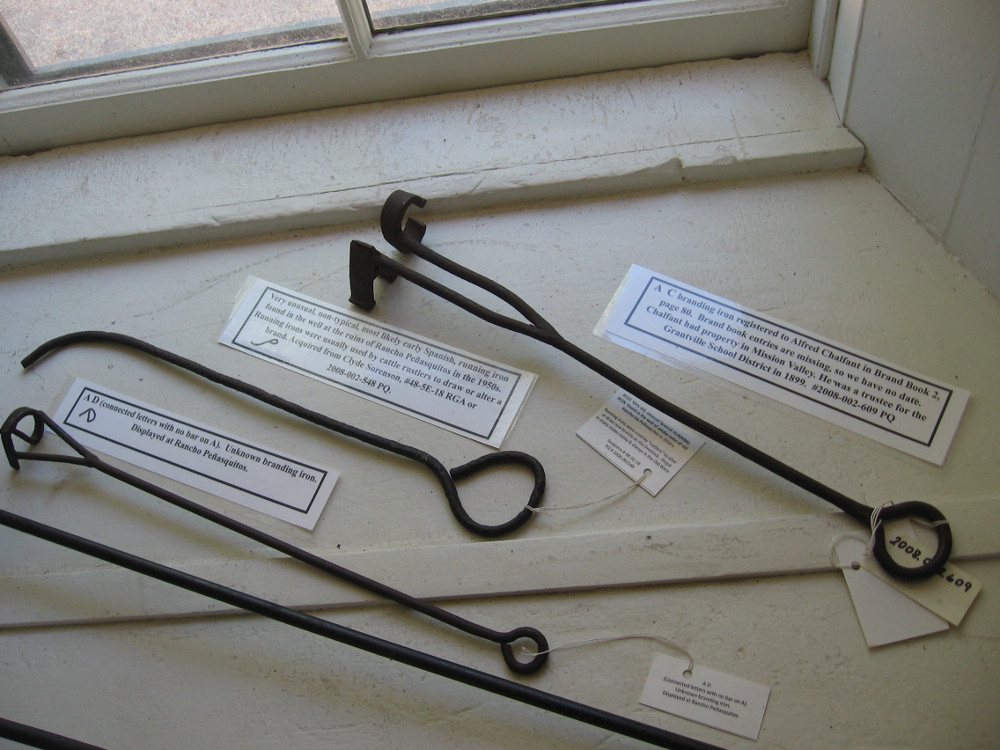
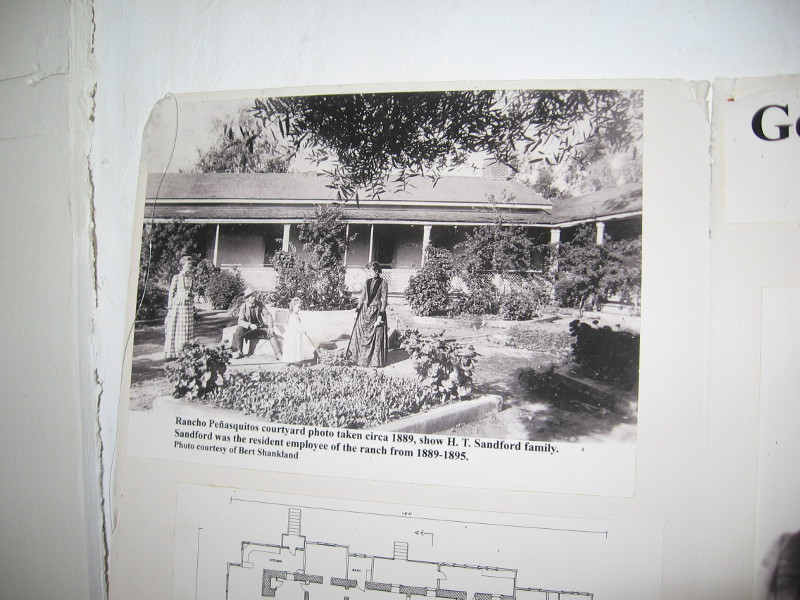
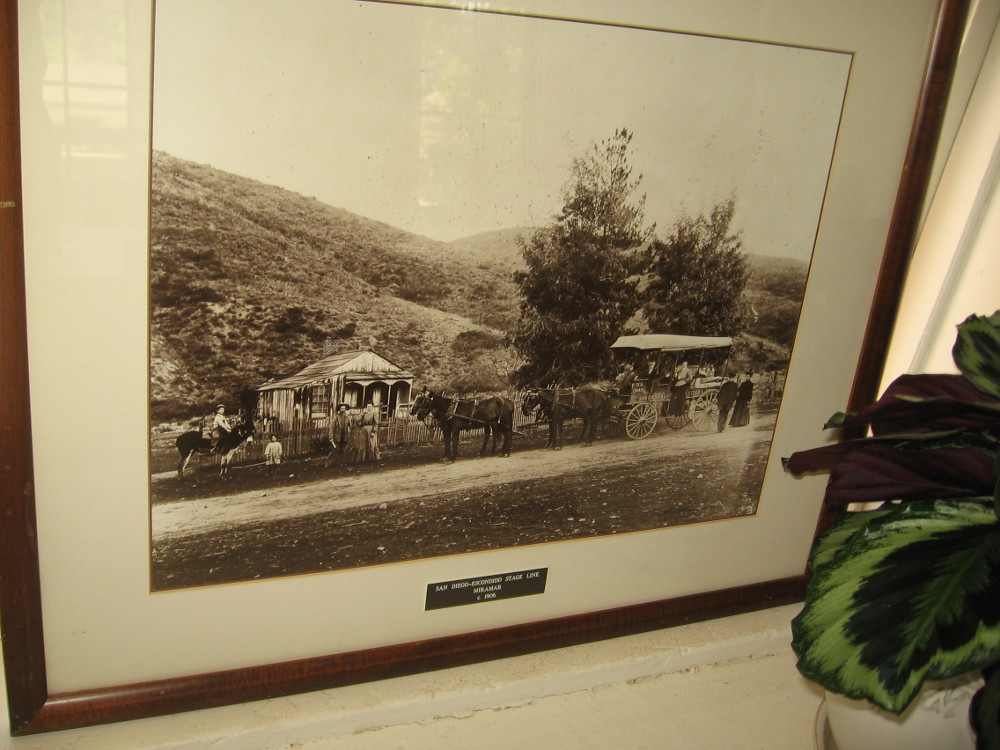
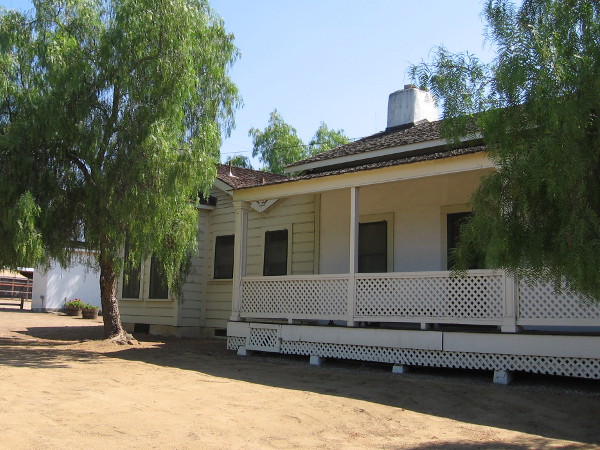
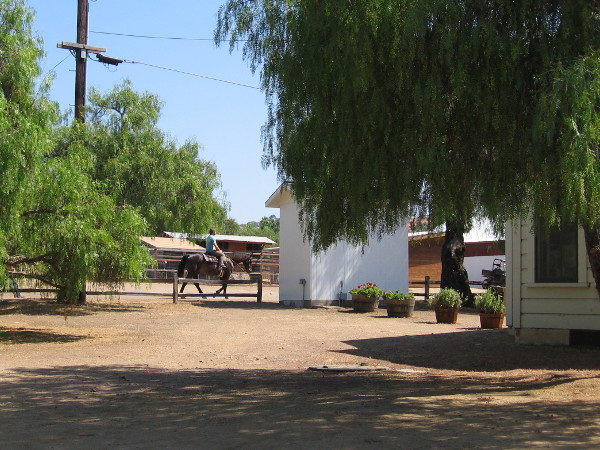
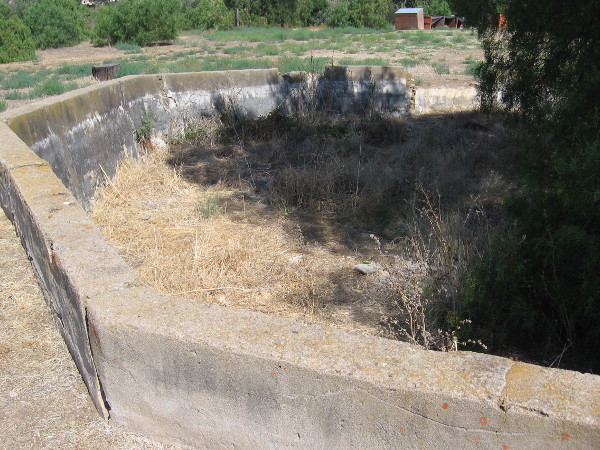
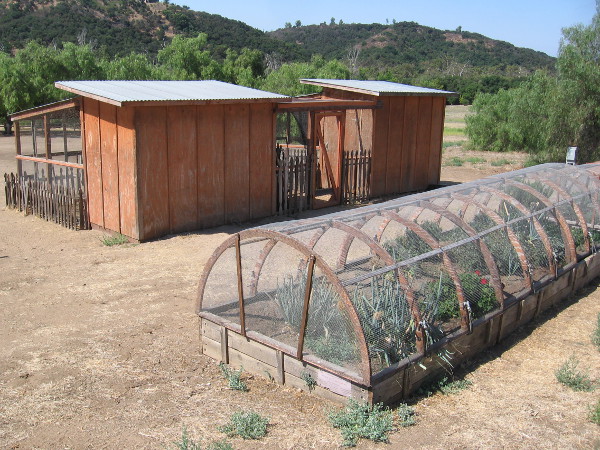
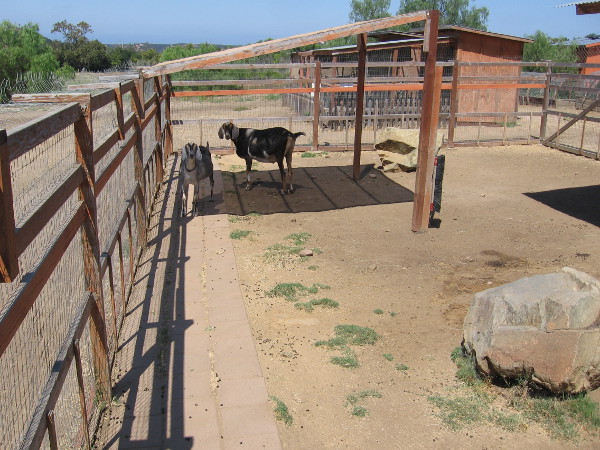
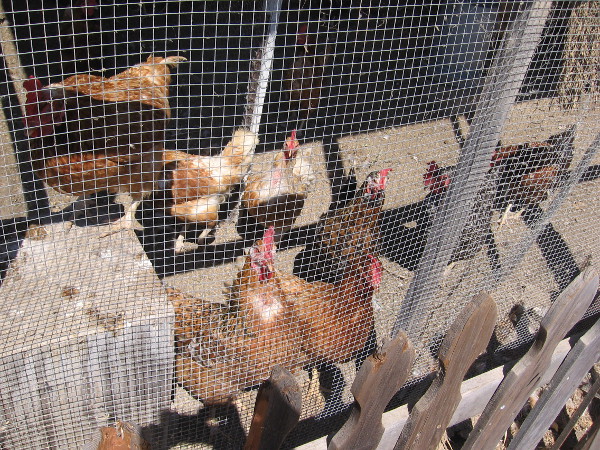
The Los Peñasquitos Ranch House is open daily from 8:00 am to 4:30 pm. Guided tours are at 11:00 am on Saturday and 1:00 pm on Sunday.The ranch house is nestled among some shady trees. Two small adobe buildings were originally built in 1824. The house was enlarged by Captain George Alonzo Johnson in 1862.Plaque describes the establishment of the Johnson-Taylor Adobe Ranchhouse in 1862. The residence and later additions were used as a hotel, bunkhouse, and quarters for a working cattle ranch into the 1960s.A sculpture inside the courtyard, located on the east side (rear) of the ranch house. The planters were probably used by the residents to grow herbs and flowers.Part of the ranch house’s long porch beside the courtyard.Inside a living room that today contains museum-like exhibits, looking north out a window at various small structures on the ranch, including a chicken coop and goat pen.The Californio Period, 1821 to 1850, included vaqueros (cowboys) living at Peñasquitos. The American Rancher Period, 1850-1970, began after California became a state.1823-1834 timeline of the Mexican land grant of Santa Maria de Los Peñasquitos, that was made to Captain Francisco María Ruiz.In 1859 Captain George Alonzo Johnson married Maria Estéfana Alvarado, daughter of Francisco María Alvarado, who bought the ranch from Ruiz in 1837.A hand blown and painted glass pitcher and drinking glass that belonged to Maria de Jesus Alvarado de Sepulveda, daughter of Francisco María Alvarado.The large earthenware olive jar was found under the ranch house floor during an excavation in 1983. Used for food storage, it was probably made in Spain or Portugal in the early to mid 1700s.Captain George Alonzo Johnson, a pioneer and businessman, came to California in 1849 during the Gold Rush. He became a rancher and horse breeder.Historical newspaper articles describe the ranch house, outbuildings and grounds of George Alonzo Johnson’s ranch.Floor plan of Rancho Peñasquitos from 1975 HABS survey.A drawing of the Los Peñasquitos residence of Colonel Jacob Shell Taylor, who purchased the property in 1882. He raised Durham cattle and thoroughbred horses and would found Del Mar.Various branding irons on display in the adobe house that were discovered around the ranch. Included are early Spanish irons used by rustlers.Rancho Peñasquitos courtyard photo taken circa 1889, showing ranch employee H. T. Sandford and his family.Photo of the San Diego-Escondido Stage Line circa 1906. In the mid-1800s, Peñasquitos was a way station on the wagon road between San Diego and Warner’s Ranch.Porch along the front (or west) side of the adobe ranch house, which faced the so-called Road to Yuma.I spotted someone riding a horse past the ranch house. Los Peñasquitos Canyon Preserve is an ideal place for those who love to ride down peaceful trails.Looking west at a meadow north of Peñasquitos Creek. I posted photos of those sycamores in the distance a few weeks ago.An artificial pond south of the ranch house was filled with water from the adjacent spring house for irrigation of a nearby citrus grove.The rock Spring House was constructed around an artesian spring. Water from the spring was used by the Native American Kumeyaay for as many as 12,000 years!The Mohnike Barn was constructed in 1912 of adobe and wood. Charles Mohnike, a rancher who purchased the property in 1910, was the builder.The Mohnike Barn is now listed on the National Register of Historic Places along with other ranch structures.An octagonal concrete reservoir to the north, uphill from the ranch house. Photographic evidence shows water might have been pumped up here by windmill.More ranch structures just west of the barn.These friendly Nubian goats like to greet hikers and those on bicycles.These chickens were wondering what I was up to.The southeast corner of the adobe ranch house.One last photo of the courtyard, a focal point of the ranch house, which has seen many lives, much history.
…
I live in downtown San Diego and love to walk around with my camera! You can follow Cool San Diego Sights via Facebook or Twitter!
You can easily explore Cool San Diego Sights by using the search box on my blog’s sidebar. Or click a tag! There are thousands upon thousands of fun photos for you to share and enjoy!
Hikers descend from the summit of Cowles Mountain, which rises above San Diego’s San Carlos neighborhood.
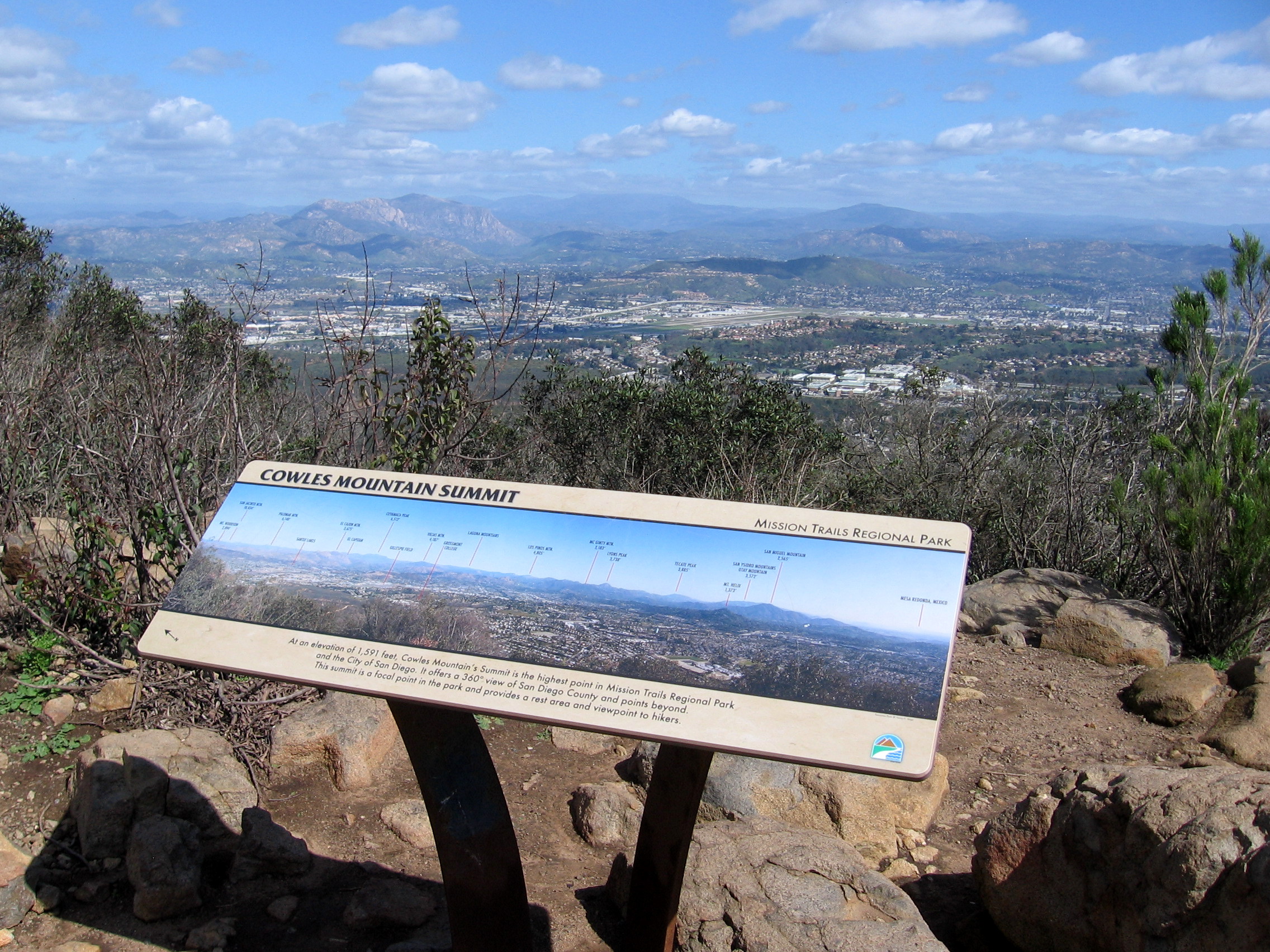
Please enjoy the following photos. They are from a hike that I took yesterday to the summit of Cowles Mountain in Mission Trails Regional Park. Cowles Mountain, elevation 1,593 feet, is the highest peak in the city of San Diego. Because it’s located near so many urban residents, hundreds of hikers can be found on its trails on any given day.
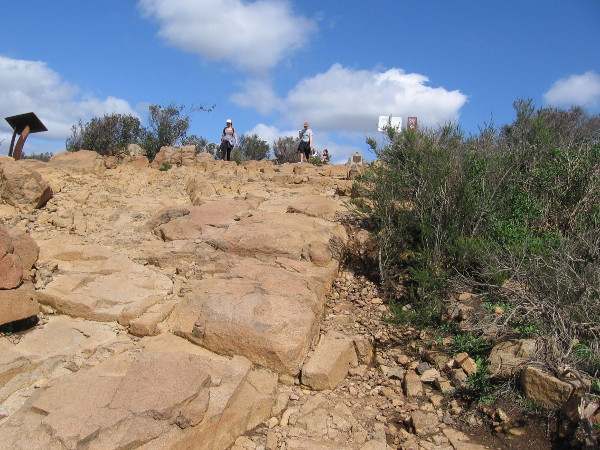
Yesterday, around noon, I started from the trailhead at the Cowles Staging Area on Golfcrest Drive, and I slowly climbed the zigzagging trail to the summit. It’s a fairly steep ascent–one gains 950 feet in just 1.5 miles. Furthermore, yesterday the footing was more difficult than usual. A small stream was flowing down much of the muddy trail, due to the recent rain.
But the climb was definitely worth the effort!
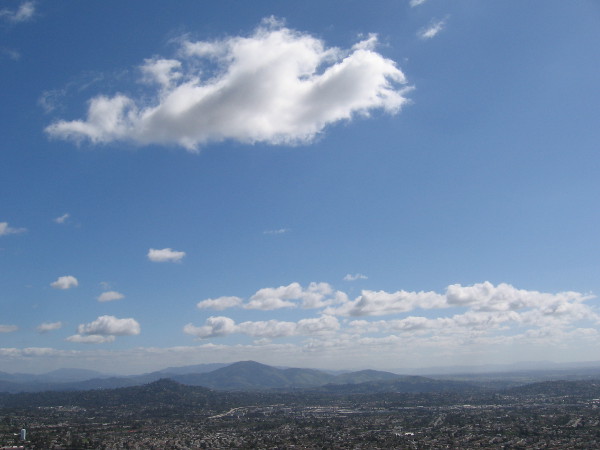
The higher I ascended, the more fantastic the views became. At the top I could survey nearly all of San Diego and much of the surrounding region. From mountains to ocean, Mexico to North County and beyond–the spectacular views stretched in every direction!
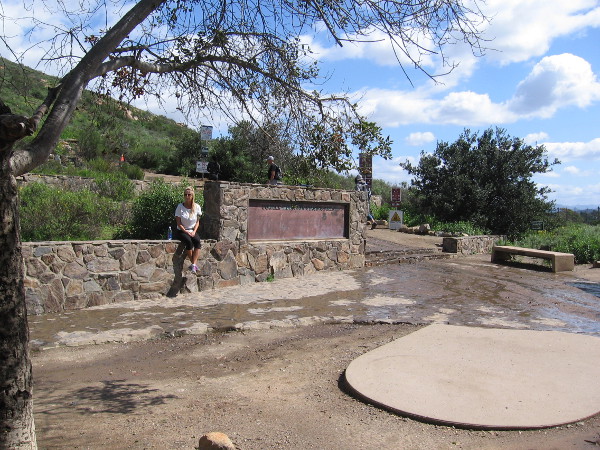
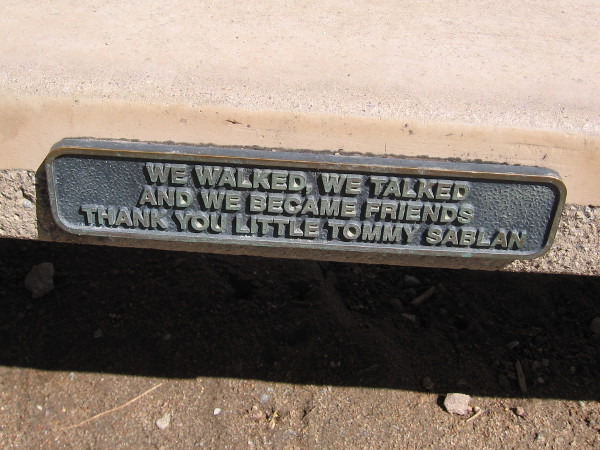
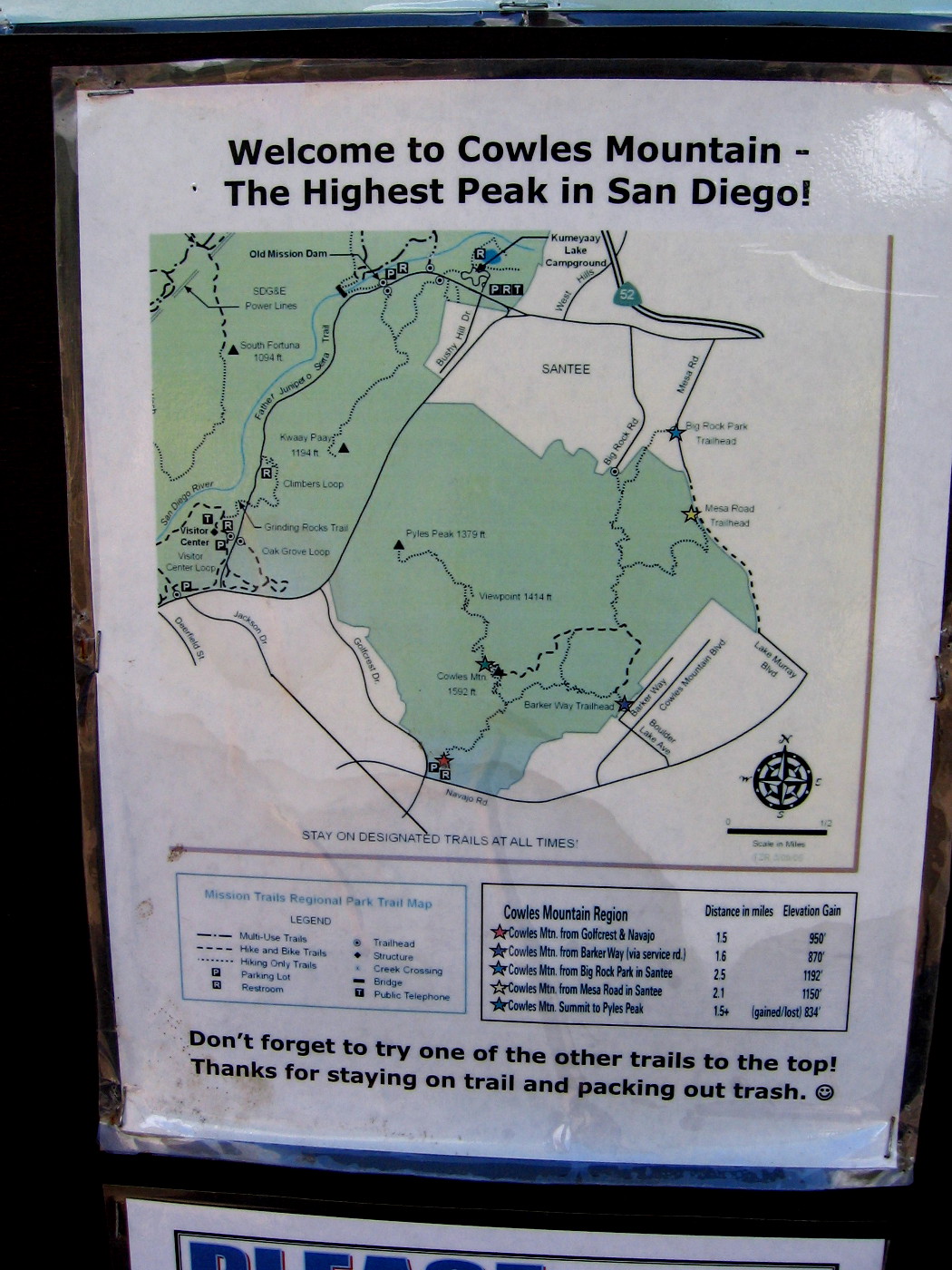
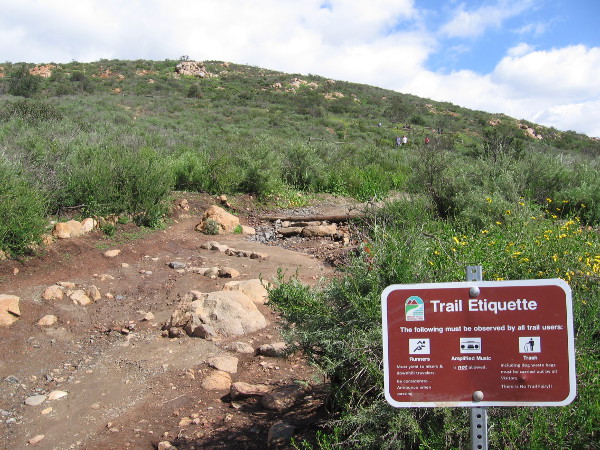
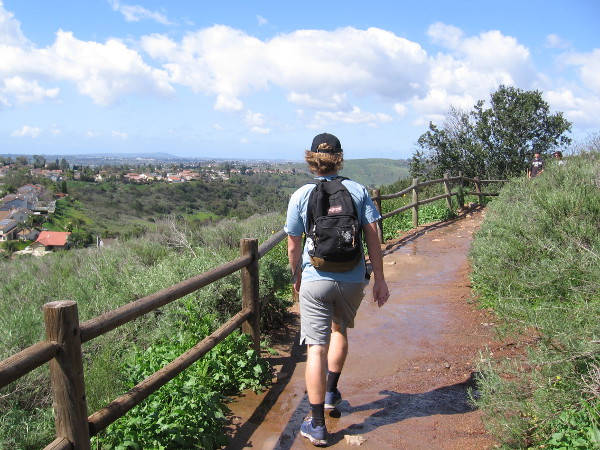
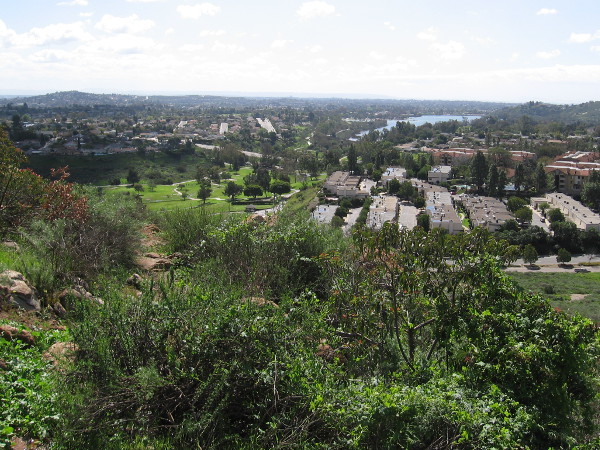
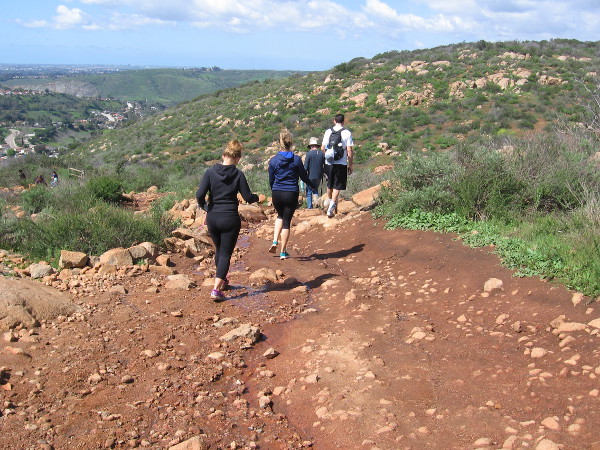
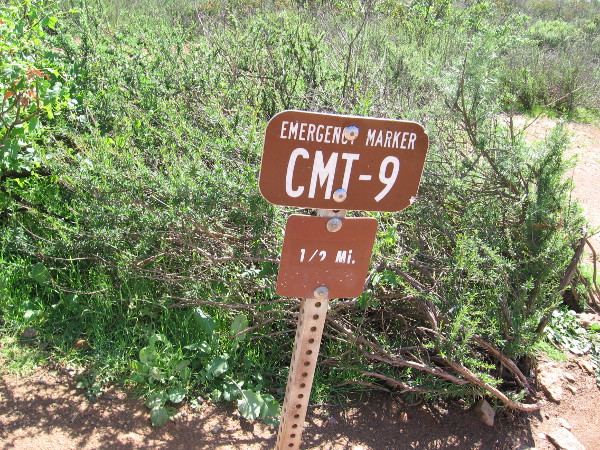
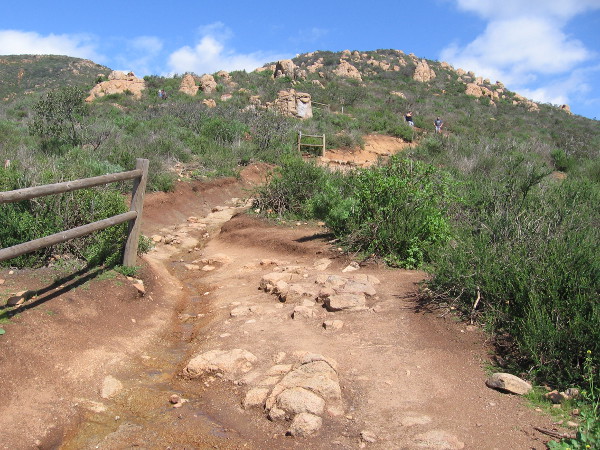
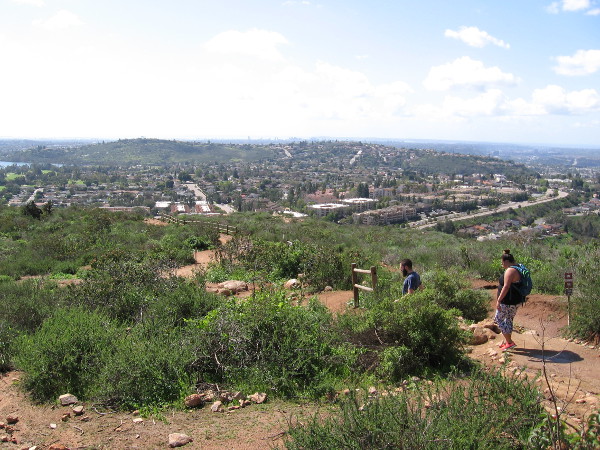
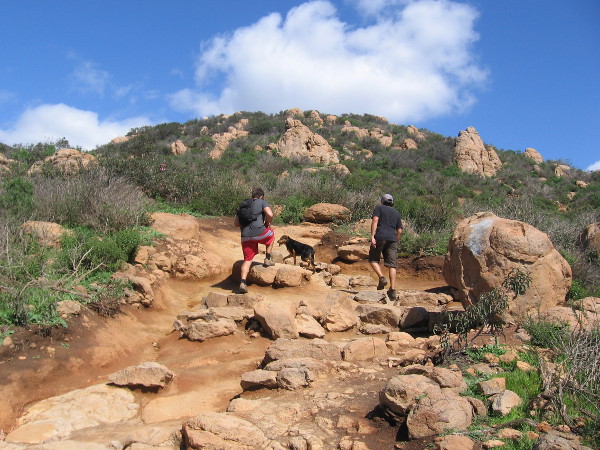
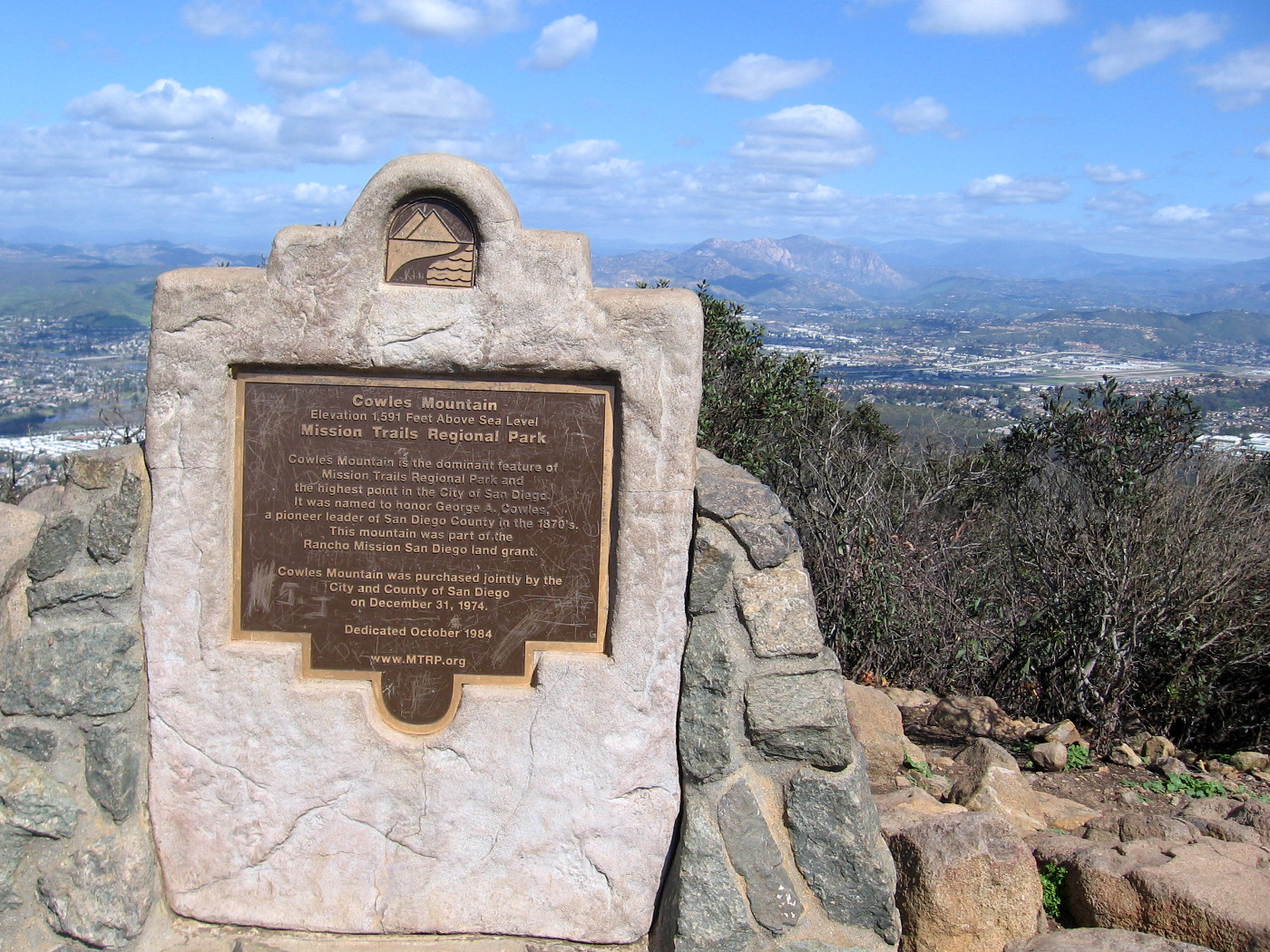
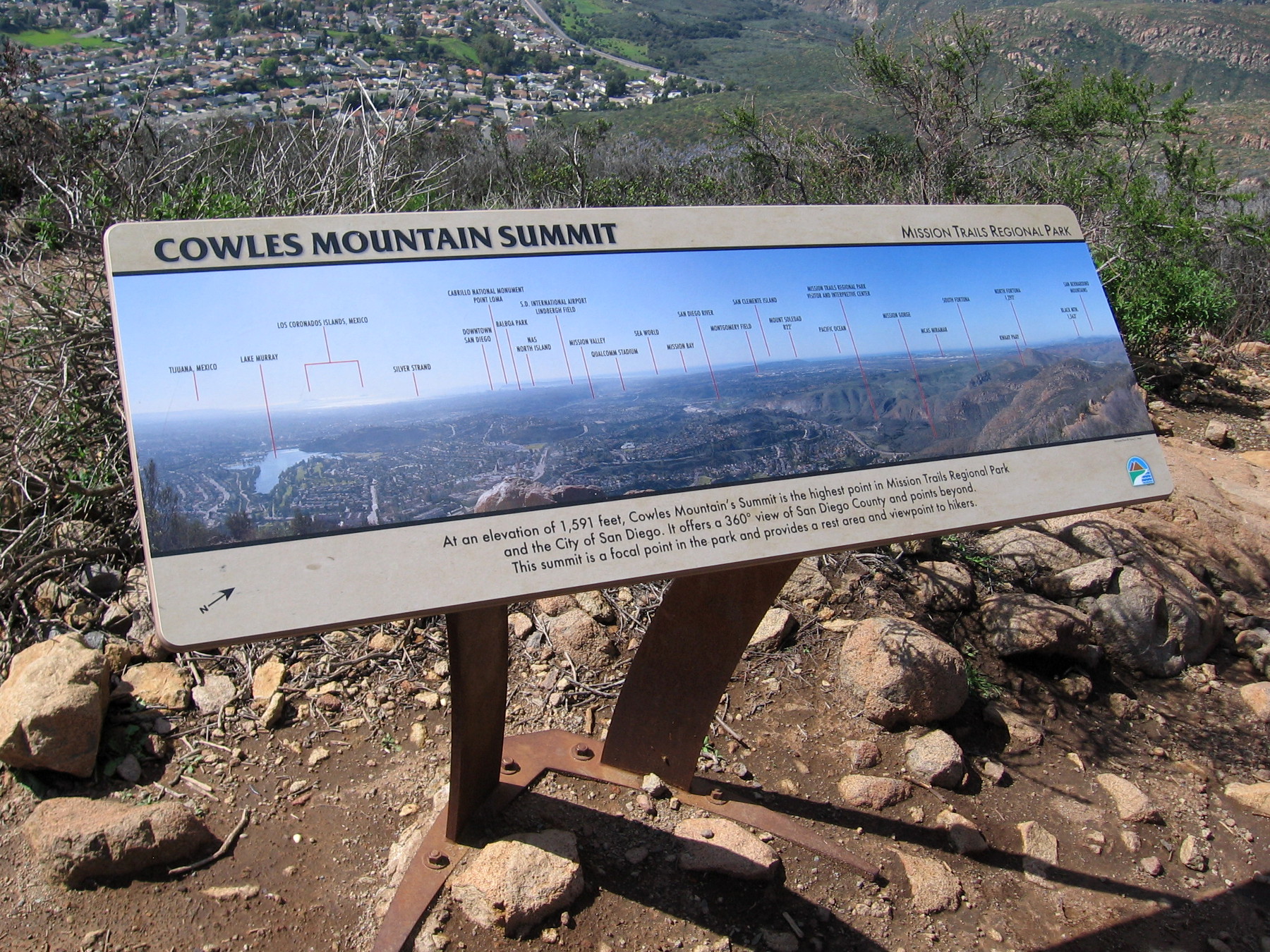
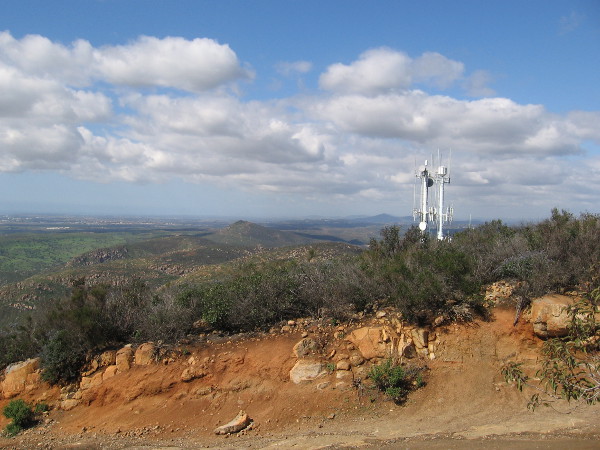
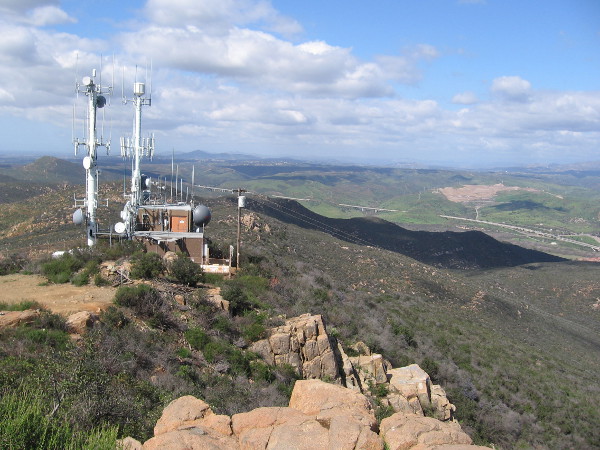
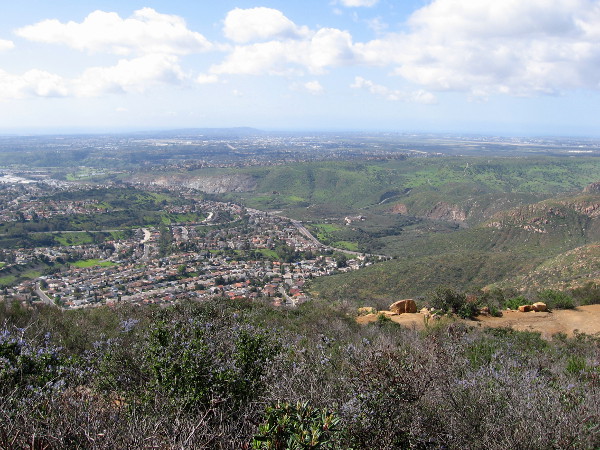
Someone sits on the stone wall at the Cowles Staging Area. This is one of the most popular hiking trails in San Diego, and can be very crowded on weekends.A bench at the staging area had this small plaque. We walked, we talked and we became friends. Thank you little Tommy Sablan.Sign at the trailhead explains Cowles Mountain was named after a prominent San Diego ranching pioneer. His two ranches in the El Cajon valley were so successful he was named Raisin King of the US.Map shows trails to the summit of Cowles Mountain in Mission Trails Regional Park, which is the largest municipal park in the state of California.Sign near the trailhead. On a busy trail, etiquette should be observed to preserve the natural beauty and enhance the experience of other hikers.Starting up the 1.5 mile trail. The footing is stony in many places. This day it was also muddy due to recent rain.Pausing for a moment to look back down at the staging area.Another hiker, starting up toward the summit, appears to be prepared. A nearly 1000 foot climb is entailed. One should wear sturdy shoes and bring water. There is no shade.Looking westward as we ascend into a beautiful San Diego sky.Looking to the south, one can see the Mission Trails Golf Course and Lake Murray.A group hikes up the trail.The top of Cowles Mountain is on the left. First we will climb up that rise on the right.Rescues are often made on this trail due to its popularity. Many urban hikers aren’t prepared for this fairly strenuous trek. I spotted a few emergency markers which are used to locate people in distress.Up, up we go! The climb is relentless, with only a few short level stretches.As we climb higher on this clear day, it’s possible to see farther into the distance. I can barely detect downtown San Diego at the horizon.Many hikers had dogs, who enjoyed the hike, too. The scrubby vegetation and exposed boulders are common in the mountains and hills around San Diego.A better look at shining Lake Murray, a popular fishing destination.Rounding a corner, we can now see to the southeast. The nearer cone-like peak is Mt. Helix in La Mesa.As we continue toward the summit, the Barker Way Trail leads off to the east.Looking again to the southwest, toward downtown San Diego, very faint in the far distance.A zoomed photo. Downtown skyscrapers rise beside San Diego Bay. The Point Loma peninsula can be seen, as well.The trail zigzags among interesting rocky outcrops near the summit.A far view from high above San Diego. Looking to the southeast, I see prominent San Miguel Mountain. My hike earlier in the day (see the previous blog post) was a bit north of that mountain in East County.Once we cross this rocky expanse, we will be at the summit of Cowles Mountain, highest point in the city of San Diego!Plaque at the summit. Cowles Mountain is the dominant feature of Mission Trails Regional Park. It was named to honor George A. Cowles, a pioneer leader of San Diego County in the 1870’s.Sign shows sights from the south to the west, including distant Tijuana, Los Coronados Islands (which I could just barely see), the Silver Strand, Point Loma, Mission Bay and Mount Soledad.A second sign shows mountains from the north to southeast, including Mt. Woodson, distant San Jacinto, Palomar Mountain, Cuyamaca Peak, the Laguna Mountains, Otay Mountain and San Miguel Mountain.To the north, antennas rise from Cowles Mountain into the sky. I could see the Pacific Ocean coastline stretching into the distance in the northwest.Looking north beyond the antenna station. Highway 52 below descends from Mission Trails Pass east into Santee.Gazing northeast toward Santee and Lakeside and nearby mountains. At the very center is El Cajon Mountain.Gazing to the west one can see Mount Soledad, and distant office buildings in University City (also called the Golden Triangle) and Sorrento Valley. The ocean is a thin blue line.Sitting high in the sky, taking in some amazing views.
…
This blog now features thousands of photos around San Diego! Are you curious? There’s lots of cool stuff to check out!
Here’s the Cool San Diego Sights main page, where you can read the most current blog posts. If you’re using a small mobile device, click those three parallel lines up at the top–that opens up my website’s sidebar, where you’ll see the most popular posts, a search box, and more!
To enjoy future posts, you can also “like” Cool San Diego Sights on Facebook or follow me on Twitter.
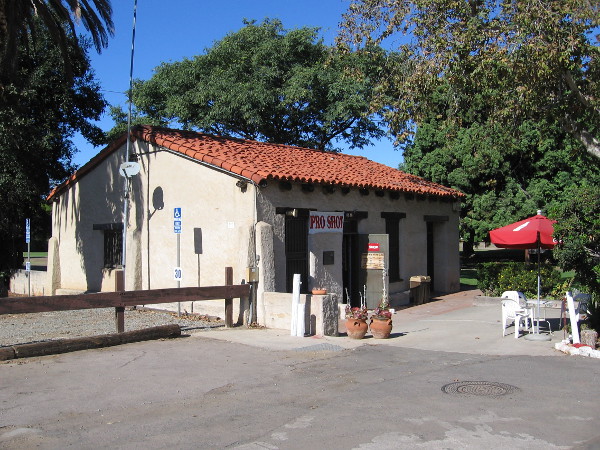
The Presidio Hills Golf Course Pro Shop can be found inside San Diego’s oldest building, La Casa de Carrillo.
Believe it or not, the oldest structure that still exists in San Diego (outside of the walls of the Mission Basilica San Diego de Alcalá) contains a golf Pro Shop!
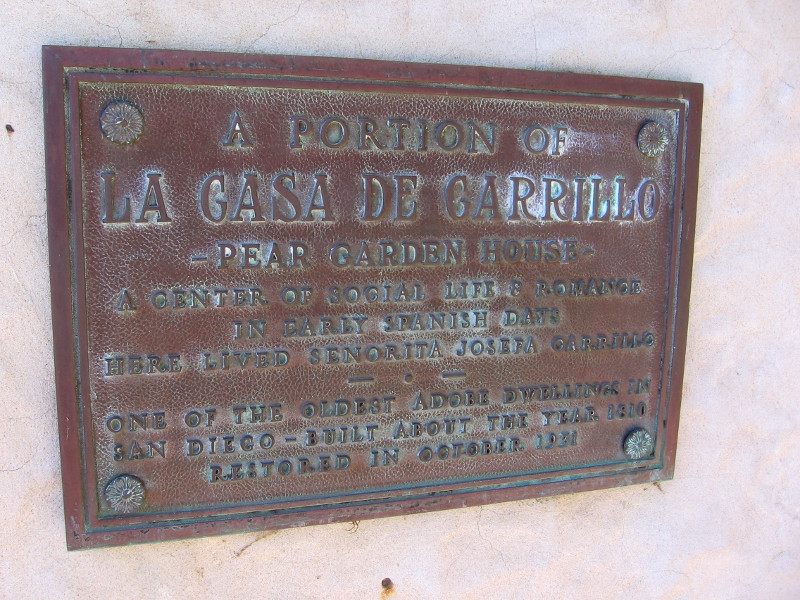
The two-century-old Casa de Carrillo, located near the base of historic Presidio Hill, was built in 1817, according to the Save Our Heritage Organisation. (Plaques at the location provide two different years.) It was built by the Spanish presidio’s commander, Francisco Maria Ruiz, for Joaquin Carrillo, a relative and fellow soldier stationed in San Diego. The adobe house stood beside the Comandante’s pear garden. Today the rather simple building, which was restored in 1931, is the home of the Presidio Hills Golf Course Pro Shop!
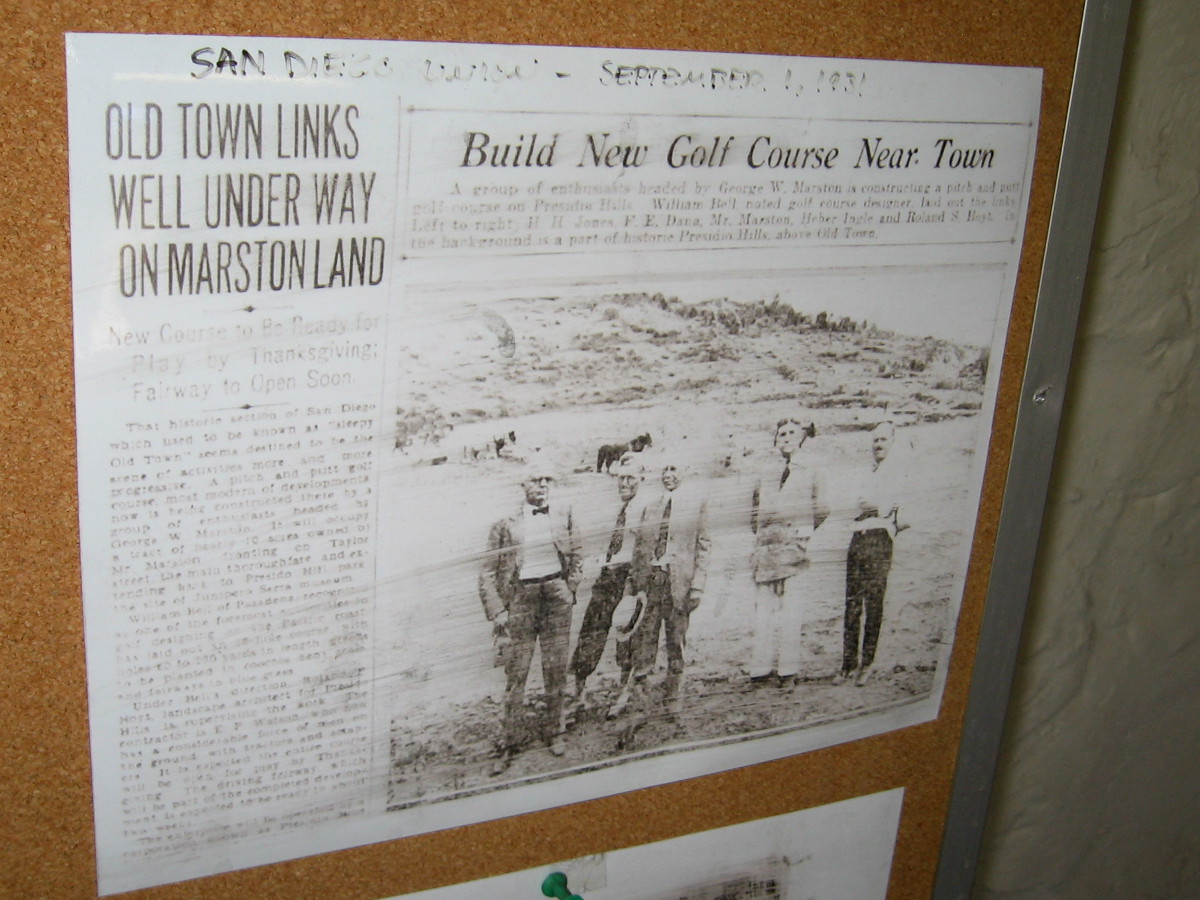
The small Presidio Hills Golf Course has its own unique history. Occupying what was once a scrubby plot of land at the foot of Presidio Hill, just east of Old Town, the pitch-and-putt golf course was developed in the early 1930s by George Marston, a visionary San Diego businessman and philanthropist who also worked to develop Balboa Park, the San Diego Public Library, and the San Diego Historical Society. Marston created the Junipero Serra Museum which rises today just above the site of the original 1769 Spanish presidio, so-called birthplace of California.
Over the years, the Presidio Hills Golf Course has hosted several world famous golfers, most notably Phil Mickelson, a resident of San Diego. When they were kids, Phil and his sister Tina would play all day at the small golf course. I was told by the super friendly young gentleman working in the pro shop that Phil Mickelson returns to visit every few years, just for old time’s sake.
A young Tiger Woods also won two Junior World trophies at Presidio Hills Golf Course!
Read the photo captions for a bit more information . . .
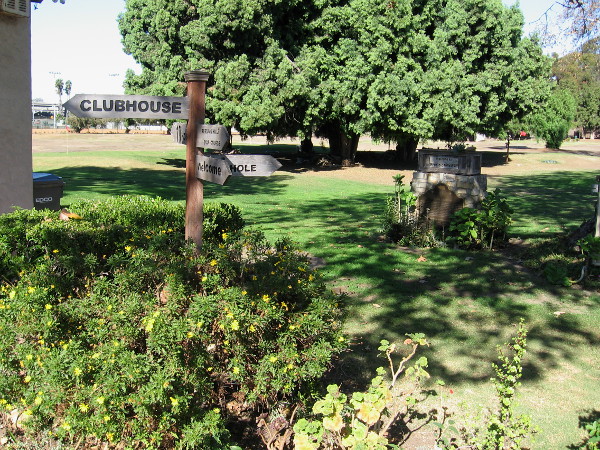
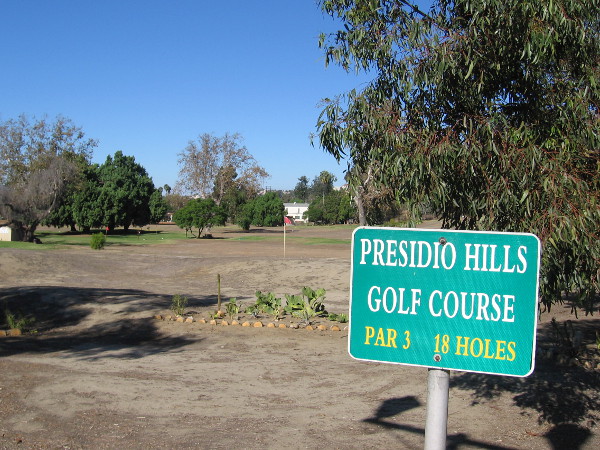
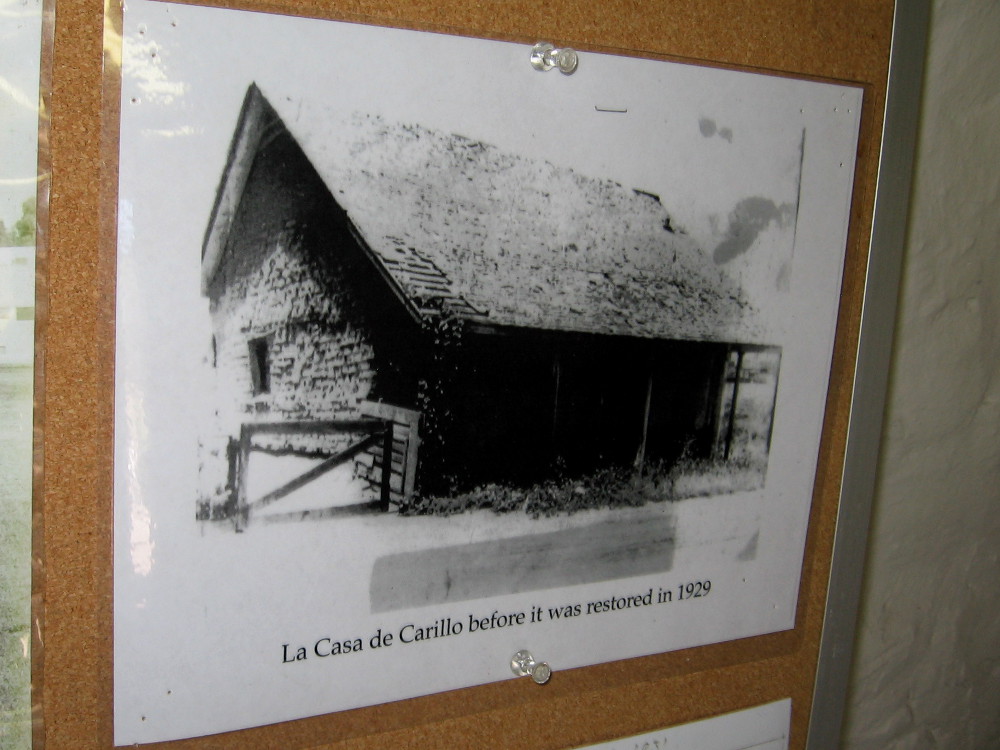
A photo of the small, historic adobe taken from the parking lot of the Presidio Hills Golf Course. Casa de Carrillo is the oldest structure that is still standing in San Diego.Bronze plaque near the front door reads: A portion of La Casa De Carrillo – Pear Garden House. A center of social life and romance in early Spanish days. Here lived Senorita Josefa Carrillo. One of the oldest adobe dwellings in San Diego. Built about the year 1810. Restored in October 1931.Photo of La Casa de Carrillo taken from a golf green just east of the structure.Sign near historical marker for Casa de Carrillo points to the golf course clubhouse and first hole.Presidio Comandante Francisco Maria Ruiz built this house next to his 1808 pear garden late in 1821 for his close relative and fellow soldier, Joaquin Carrillo, and his large family.Enter the old adobe and you will find the Pro Shop. The easy Presidio Hills Golf Course is a great place to learn golf–ideal for families and kids. And one gets a history lesson, too!Another look inside the restored adobe. I’m not sure which parts of the historically important building are original.An old newspaper article displayed in the pro shop includes a photo of 8-year-old Tiger Woods. He is showing off a Junior World trophy captured at Presidio Hills, where he won two titles.San Diego Union September 1, 1931. Old Town Links Well Under Way On Marston Land.Various photos of Presidio Hills Golf Course history inside the Pro Shop. Phil Mickelson and Craig Stadler are two notable golfers from San Diego.Another photo shows Don and Al Abrego Presidio Hills Tiny Tots Golf School. The defunct school has faded into history.The modest Presidio Hills Golf Course is Par 3, 18 Holes. It’s located at the east edge of San Diego’s Old Town.Another look across the small, easy golf course. It appears to be a bit neglected. Regrettably, I saw no players out on a Sunday afternoon.Old black-and-white photograph inside the Presidio Hills Golf Course Pro Shop shows La Casa de Carillo (note the different spelling) before it was restored in 1929.
…
I live in downtown San Diego and love to walk! I also love history! You can follow Cool San Diego Sights via Facebook or Twitter!
An area beside a popular entrance to Old Town San Diego State Historic Park, near the McCoy House Museum, will be the site of an historical reconstruction.
There are plans to bring more history to life in Old Town San Diego State Historic Park! A reconstruction of the Machado-Smith adobe and wood-framed house, including gardens and orchards, will greet future visitors to San Diego’s birthplace!
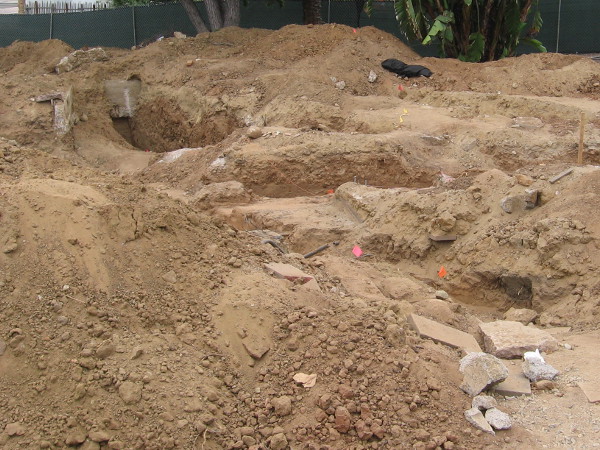
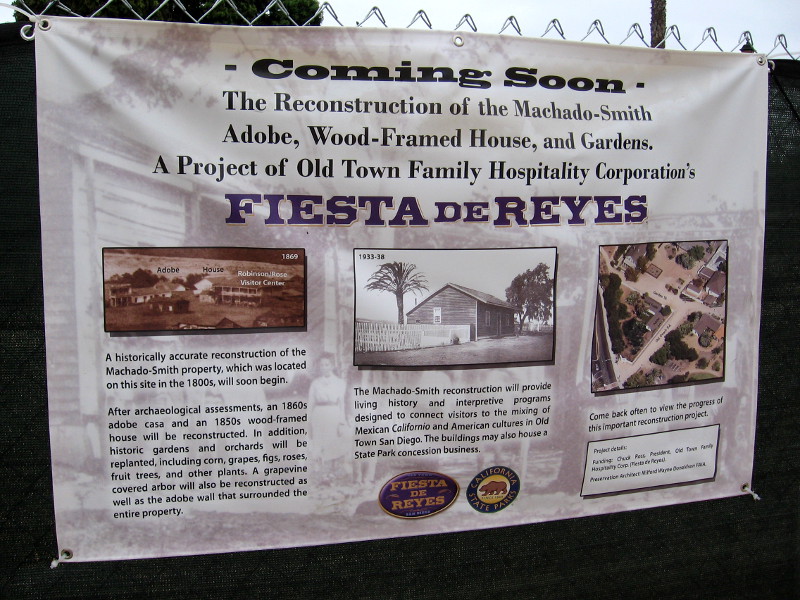
According to a sign that I read, after archaeological assessments (which appear to be underway right now), the Machado-Smith 1860s adobe casa and 1850s wood-framed house will be built near the main walkway that leads visitors from the Old Town Trolley Station into the California State Park. Also planned is a grapevine covered arbor and gardens and orchards with corn, grapes, figs, roses and fruit trees!
According to some research and a State Park employee that I spoke to, the house was built for American Albert Benjamin Smith and his Mexican wife María Guadalupe Yldefonsa Machado de Wilder who together raised nine children. The property remained with the family until 1929. Eventually the house fell into disrepair.
It is uncertain when the new construction will begin, but I’ll keep my eyes open!
Once completed, the Machado-Smith reconstruction will offer interpretive programs concerning Old Town San Diego’s unique mixture of Mexican Californio and American cultures! Very cool!
I was told by a California State Park employee that bits of pottery and other interesting objects have been found at this site.An historically accurate reconstruction of the mid 1800’s Machado-Smith property will be built in Old Town San Diego. Included will be an adobe casa, wood-framed house and gardens.
…
I live in downtown San Diego and love to walk! You can follow Cool San Diego Sights via Facebook or Twitter!
You can easily explore Cool San Diego Sights by using the search box on my blog’s sidebar. Or click a tag! There are thousands upon thousands of fascinating photos for you to enjoy!
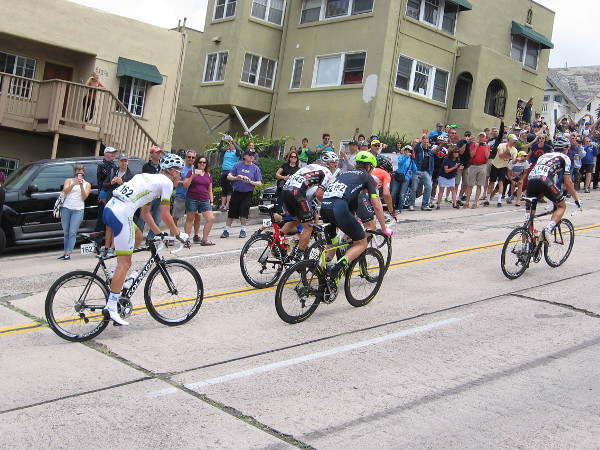
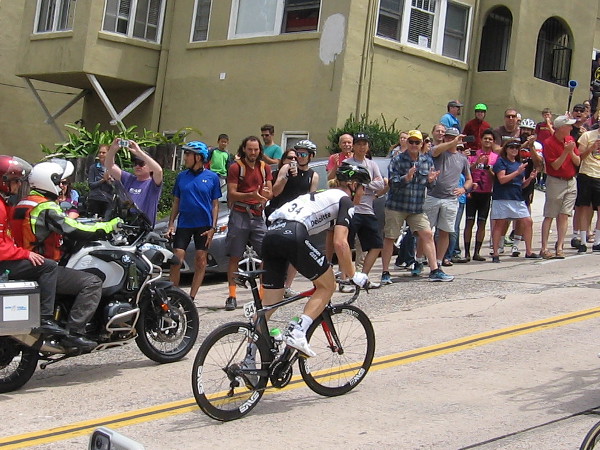
Many of the world’s top bicycling athletes fly up the Laurel Street hill in San Diego during the first stage of the Tour de California.
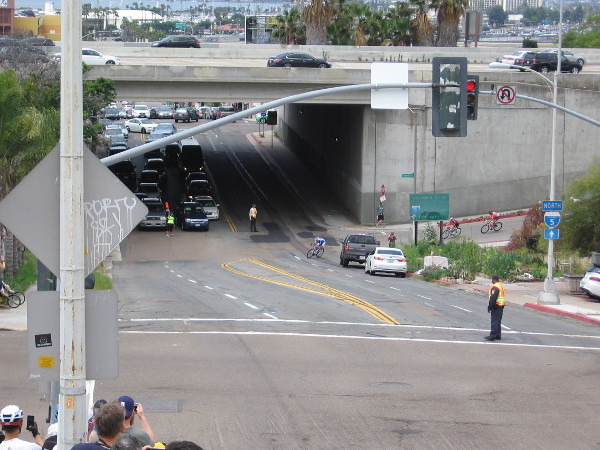
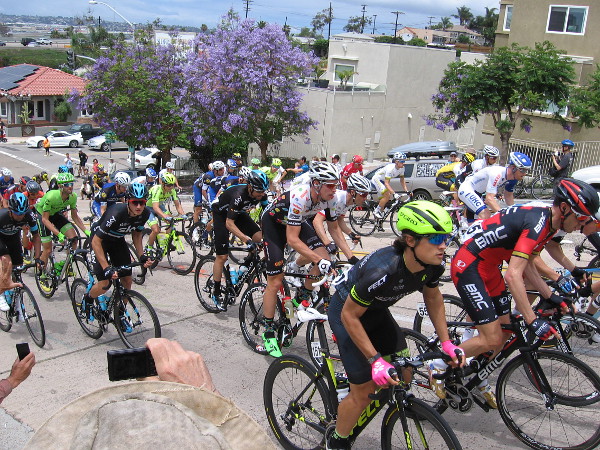
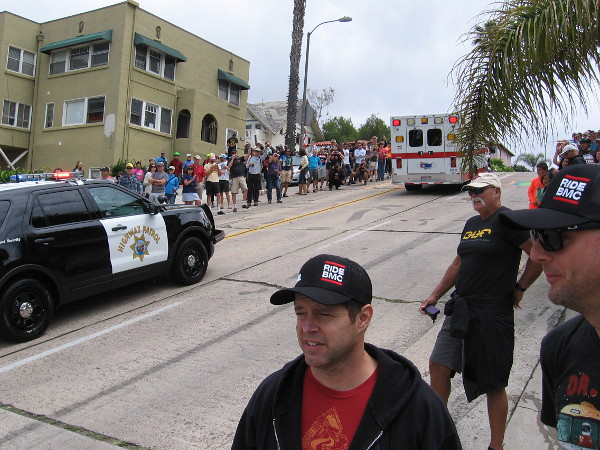
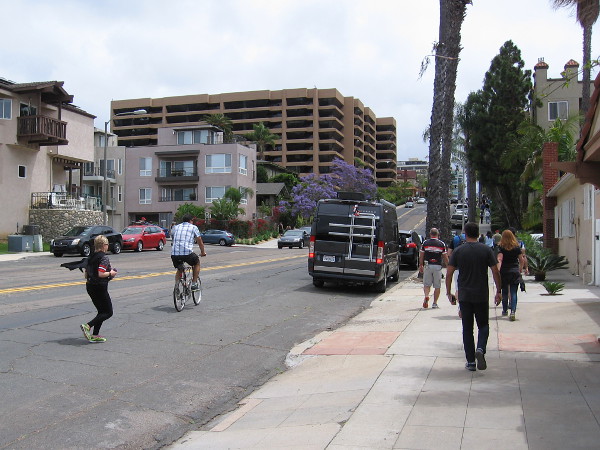
Here are lots of cool pics of Tour de California (officially called Amgen Tour of California) elite bicyclists racing up the steep hill on Laurel Street, just east of Interstate 5! Today was the first stage of the big international multi-day race, and the route looped around a good chunk of San Diego County. Easily the toughest part of the race near downtown was up Laurel Street, which presents a pretty steep grade for several blocks.
Lots of people gathered on the hill, and everyone was excited to see many of the world’s greatest bicycle athletes compete! Many of the participants have raced in the Tour de France and other top international competitions.
While I enjoy riding my street bike once in a while, I don’t know much about the professional sport. It was my first time watching this sort of event. And boy was it exciting! Lots of suspense–then flashing lights as the route is prepped and cleared–then boom! A flurry of colorful racers flying past! It was like a fantastic sporting parade! When the racers turned the corner and came into view, I felt my own adrenaline flowing!
Follow my photo captions and I’ll try to describe what I saw. Please excuse me if I don’t know all the proper terms…
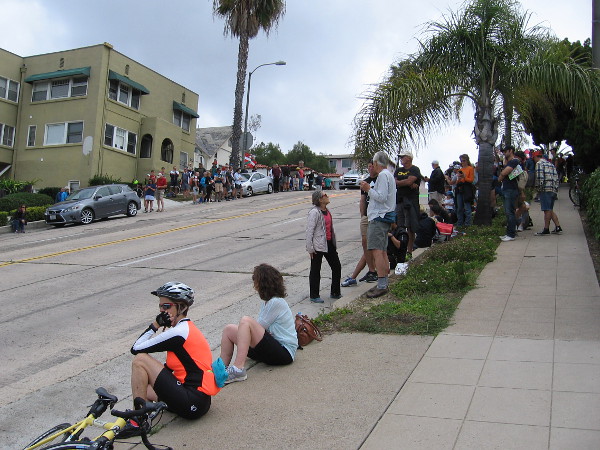
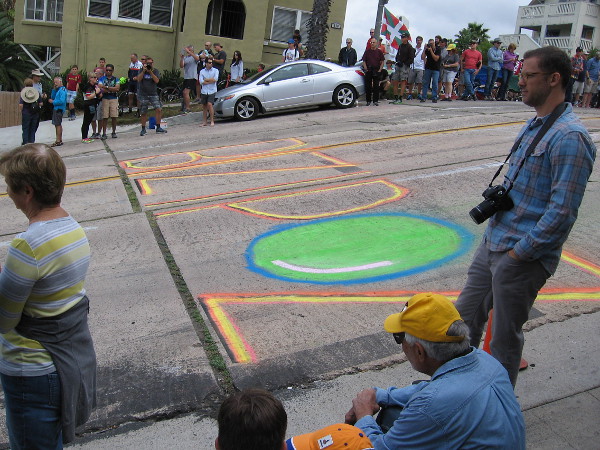
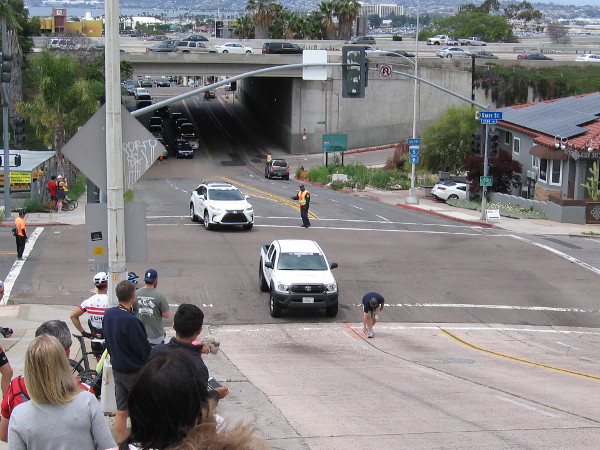
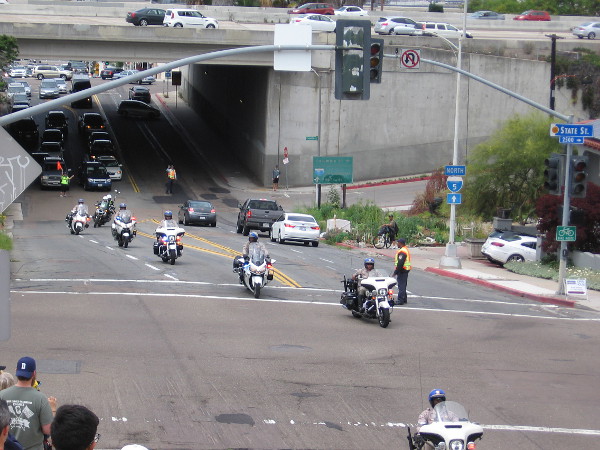
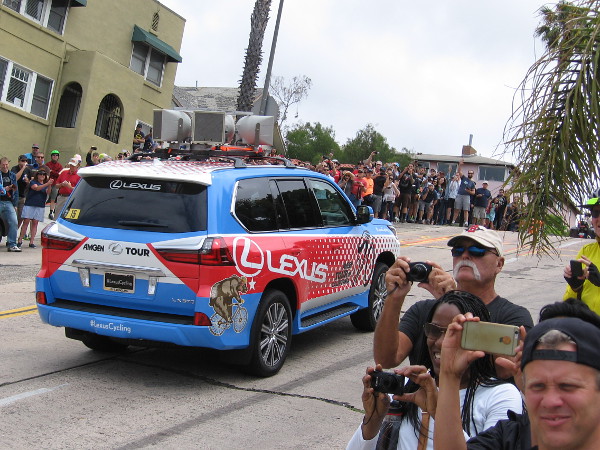
This is the first block of the Laurel Street hill–probably the toughest, steepest part.About half an hour before the race leaders were anticipated, lots of biking enthusiasts and onlookers were already lining the sidewalks.Most people formed a crowd at the top of the hill. I got photographs of the race from a point a bit lower, with a good, unobstructed view.Someone wrote a big word on the street with chalk. I think it reads Bizipoz. I’m not sure, though.Announcers on Laurel Street hill provided pre-race music, then humorous, lighthearted commentary.I saw a few banners being flown–I suppose certain international teams were being rooted on.A dog came out to view the action!Lots of spectators rode their own bikes to watch this small part of the world-famous event.Ordinary people riding up the hill before the race were cheered and spurred forward with cowbells.Some more bike lovers showing up a few minutes before the pro racers should pass through.Okay, now we’re getting close. The fast elite racers started in Mission Beach, about 15 minutes away from this spot at the very west edge of Bankers Hill.Everyone perks up! Here comes an Amgen Tour of California official spray-painting the street for the bicyclists, soon to arrive!Cameras at the ready!The race is almost here! A huge line of motorcycle cops and Highway Patrol cars, along with tour official and VIP vehicles, parades past for several minutes.Excitement mounts. They should come around Columbia Street any moment!A team support vehicle carries spare bikes. Where are they?Here they come at last! And they’re moving really fast!They’re going so fast, my camera could manage only a few pics of this first group. There seemed to be six racers in this grouping.Here comes the leader at this early part of Stage One. These amazing athletes make it look effortless. (Of course, it’s still early in the race.)And there they go! Boom! Just like that! Perhaps they slowed a bit further up the hill.The main group didn’t arrive for what seemed like another 10 minutes. People around me were amazed by that. They appeared to be pedaling quite casually!Here the huge group comes! You can just glimpse San Diego Bay and Lindbergh Field in the background. A perfect cool weather day for a bike race!Everyone watching from the sidewalks applauds, makes noise and cheers.These guys seemed to be in no hurry. Some even waved at the onlookers! I suppose they were pacing themselves.Looks of determination, and a love for their sport.Hoping for glory, bicyclists in the Tour de California power up Laurel Street hill in San Diego.A party atmosphere! Everyone is cheerfully rooting on these elite world athletes.Some cyclists at the end of the main group were intermixed with team support vehicles.And here comes a whole bunch of those team support vehicles–or whatever they’re called!Outstanding athletes conquer a tough but relatively short hill.I could hardly believe the tremendous excitement!And then it was over. They’d passed. Just some ambulances and law enforcement vehicles followed.And folks headed home. You can see more of the Laurel Street hill in this pic. The first part is definitely the steepest.World-class athletes defy gravity as they bicycle up a hill near downtown San Diego during the first stage of the Tour de California.
…
I live in downtown San Diego and love to walk! You can follow Cool San Diego Sights via Facebook or Twitter!
You can easily explore Cool San Diego Sights by using the search box on my blog’s sidebar. Or click a tag! There are thousands upon thousands of fun photos for you to enjoy!
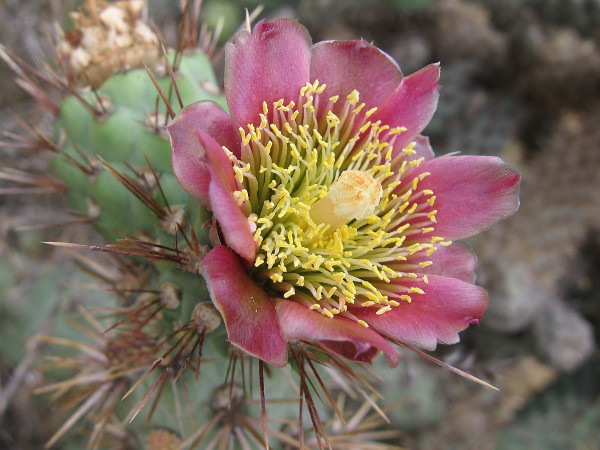
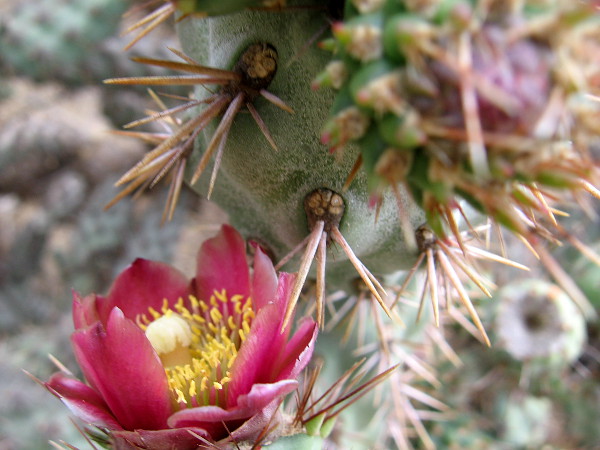
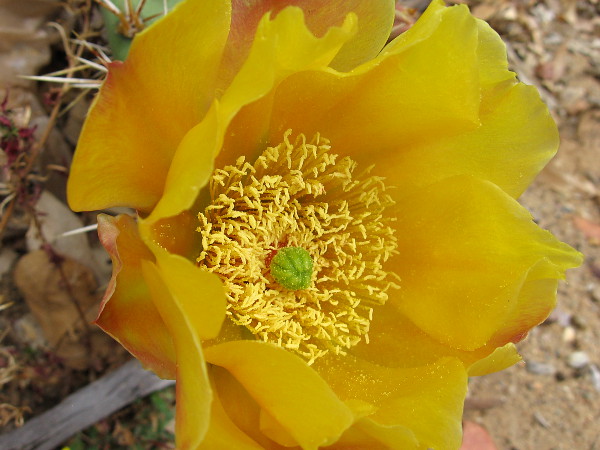
Spectacular flower of a Coastal cholla cactus in San Diego. Seen along a trail near Morley Field Drive that leads into Balboa Park’s Florida Canyon.
I took these colorful photos while walking Sunday through Balboa Park, along one of the rugged dirt trails that leads up out of Florida Canyon. A short hike can be enjoyed through native coastal chaparral and spring wildflowers, between Morley Field and Park Boulevard, just south of Morley Field Drive.
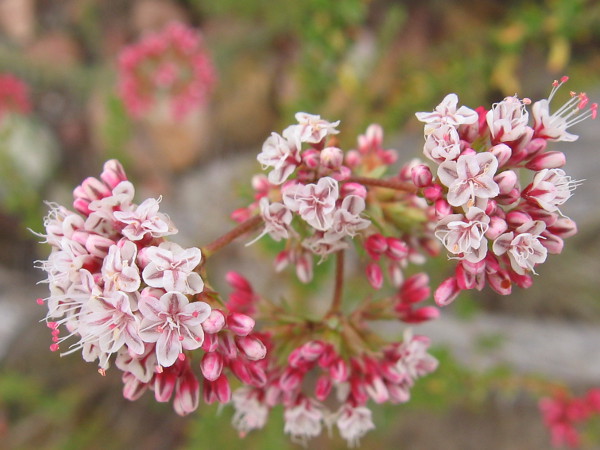
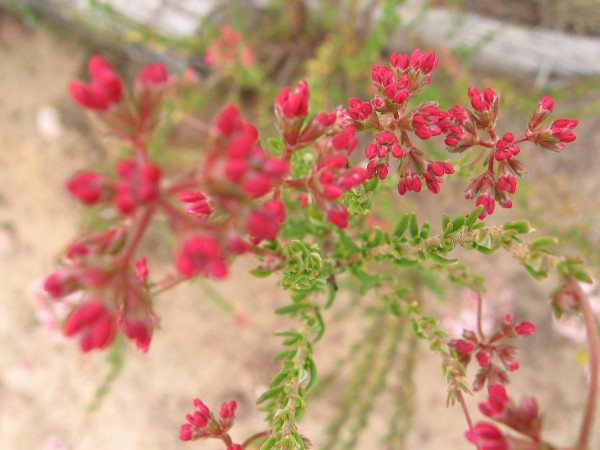
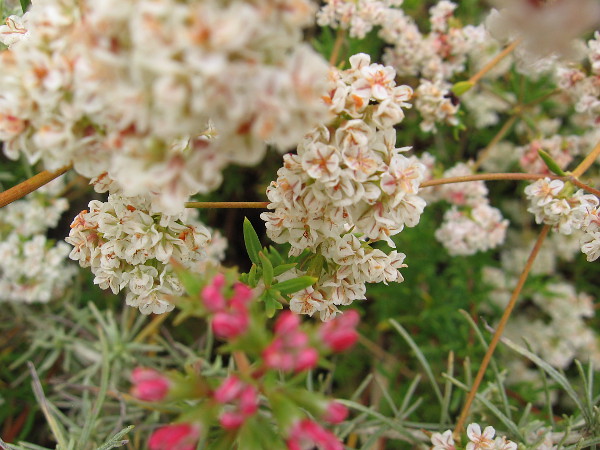
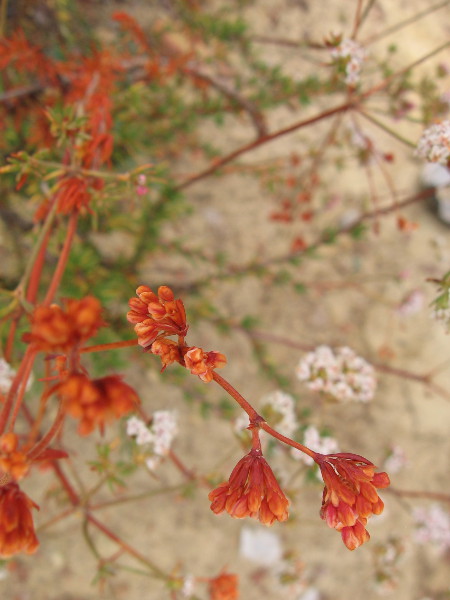
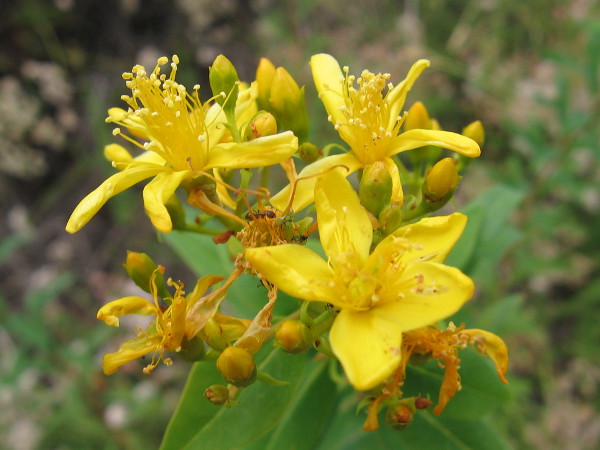
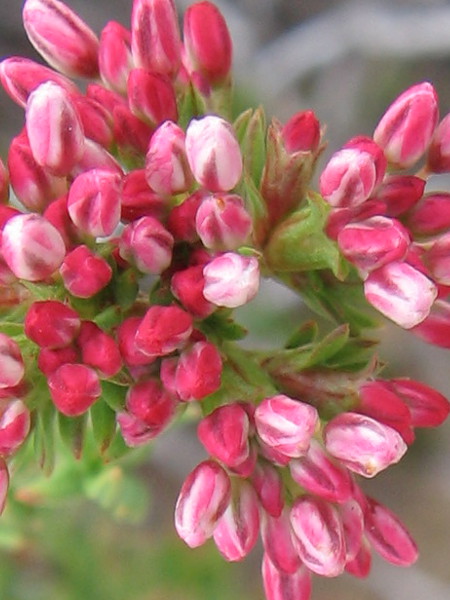
Flat-top buckwheat, or California buckwheat, flower clusters are opening in spring. These native plants grow profusely in arid San Diego.Small red flower clusters of flat-top buckwheat (Eriogonum deflexum) that have yet to open.More buckwheat in Balboa Park’s Florida Canyon. Native Americans used the plant to make tea with medicinal properties.Another flower on a very spiny Coastal cholla (Cylindropuntia prolifera) makes for an interesting photograph.A wild yellow prickly pear cactus flower near the rim of Balboa Park’s Florida Canyon, just across Park Boulevard from the San Diego Zoo.These buckwheat flower clusters have turned brown. Perhaps that’s why the plant is sometimes called skeletonweed.These flowers that I randomly photographed along the trail have me stumped. I tried to identify them, but without success. If you know what they are, please leave a comment!A profusion of red and white buckwheat beauty.
…
I live in downtown San Diego and love to walk! You can follow Cool San Diego Sights via Facebook or Twitter!
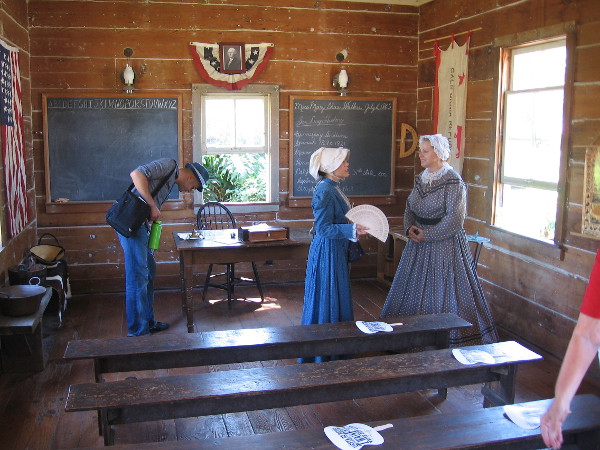
Gentleman in period attire tells visitors at Old Town San Diego State Historic Park about the history of the Mason Street School.
The Mason Street School was San Diego’s very first schoolhouse. It was built in 1865. In 2015, 150 years later, it’s one of the most interesting sights in Old Town San Diego Historic State Park.
The one room schoolhouse museum isn’t always open to the public. So whenever I walk through Old Town, I eagerly wander past to see if the front door is swung wide. If it is, I amble inside and look about, trying to absorb what life was like in the early days of San Diego.
I remember how the Mason Street School used to contain numerous desks. But they’ve been replaced by plain benches, to more accurately portray where a small number of students from Spanish, American and other diverse backgrounds, grade one to eight, sat together and learned how to read, write and do arithmetic.
Back in the early years of San Diego, school was held twelve months a year. Hours were 9 to 4, but many students would skip school to watch bull fights, fiestas and other exciting town doings. Many children were held out of school by their parents to help on a ranch or farm, or to work in a family store.
San Diego in 1865 was a small, isolated, somewhat ramshackle town. Mary Chase Walker, Mason Street School’s first teacher, wrote when she arrived in San Diego by steamship: “I arrived in the bay of San Diego on the morning of July 5, 1865. It was a most desolate looking landscape. The hills were brown and barren; not a tree or green thing was to be seen. Of all the dilapidated, miserable looking places I had ever seen, this was the worst. The buildings were nearly all of adobe, one story in height, with no chimneys. Some of the roofs were covered with tile and some with earth…”
Mary Chase Walker originally traveled from Massachusetts to California, in search of greater opportunity. While in San Francisco, she learned of a teaching opening in San Diego. After less than a year at the Mason Street School, however, she became embroiled in a local controversy. One day she made a kind gesture to a lady who was part African-American, but many early San Diegans had arrived from the Confederate South and voiced their disapproval. A number of students were removed from the small school in anger. To allow the scandal to pass over, Mary quit teaching and married the president of the school board, early San Diego settler and prominent merchant Ephraim Morse.
It’s hard in modern times to imagine the life and culture of San Diego long ago. But one can get a flavor of that fascinating history by stepping inside the old Mason Street School.
The Mason Street School was built in 1865, to provide education for the children of a sparsely populated San Diego.The first schoolhouse in San Diego County, the Mason Street School stands in historic Old Town.
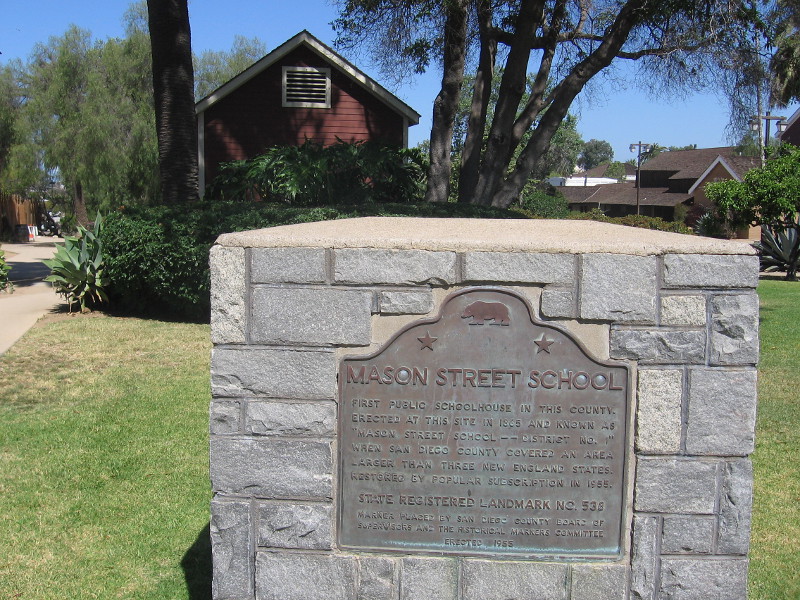
The nearby plaque reads:
MASON STREET SCHOOL
FIRST PUBLIC SCHOOLHOUSE IN THIS COUNTY.
ERECTED AT THIS SITE IN 1865 AND KNOWN AS
“MASON STREET SCHOOL – – DISTRICT NO. 1”
WHEN SAN DIEGO COUNTY COVERED AN AREA
LARGER THAN THREE NEW ENGLAND STATES.
RESTORED BY POPULAR SUBSCRIPTION IN 1955.
STATE REGISTERED LANDMARK NO. 538
MARKER PLACED BY SAN DIEGO COUNTY BOARD OF
SUPERVISORS AND THE HISTORICAL MARKERS COMMITTEE
ERECTED 1955
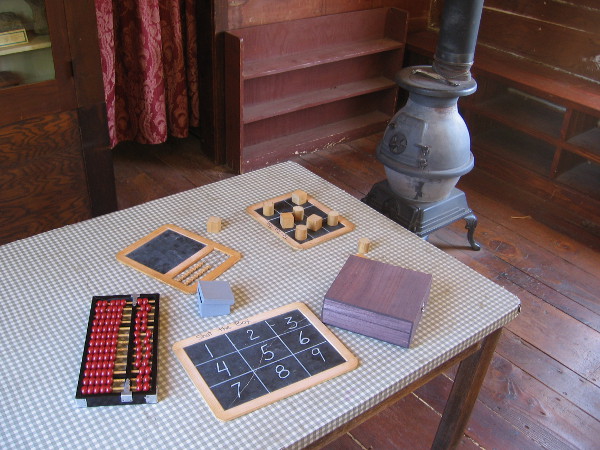
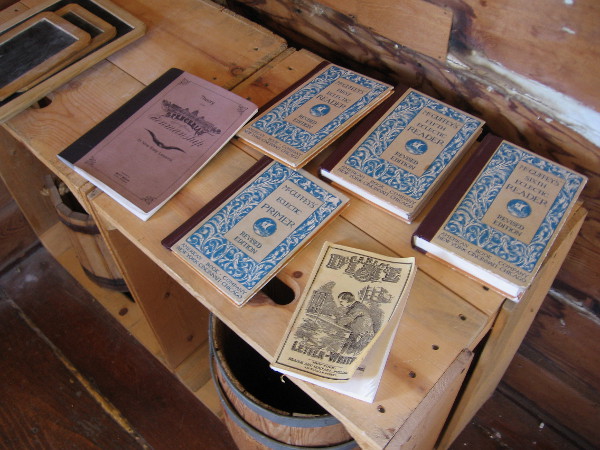
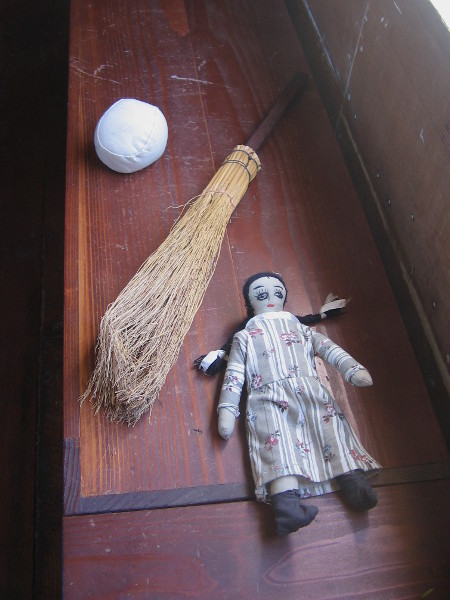
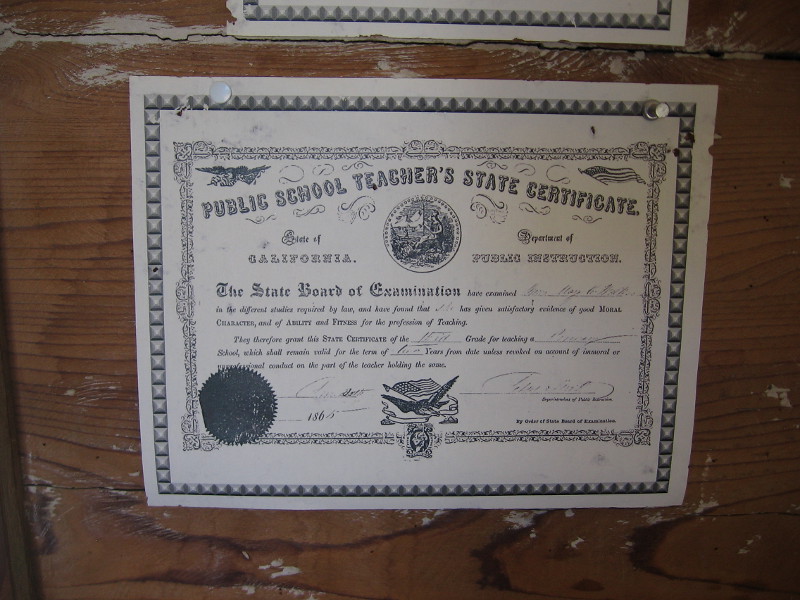
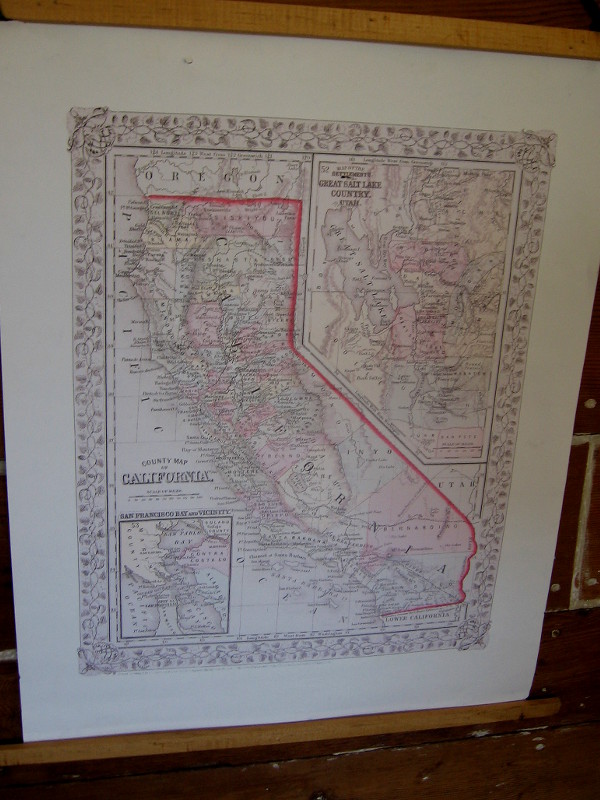
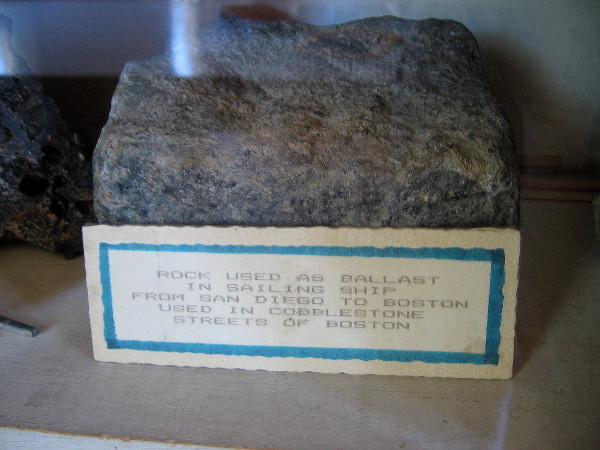
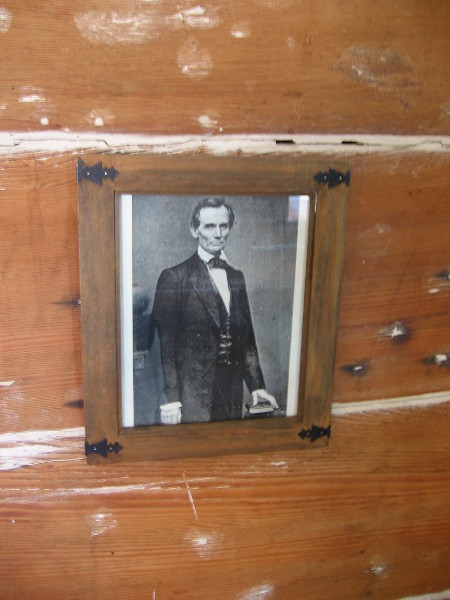
The Mason Street School museum is occasionally open to the public. If you’re lucky and it is, make sure to step inside!Years ago, the museum contained individual student desks. But these benches are a more faithful representation of actual history. Fancy desks were rare in this remote outpost of civilization!Children attending the Mason Street School used slates and chalk, as paper was also scarce and expensive. A wood stove provided heat.Some old Primers and Readers on a wooden table. A water bucket and dipper were used for drink.A ball, broom and doll.Public School Teacher’s State Certificate from the mid 19th century. San Diego’s first teacher was Mary Chase Walker.Old map of California from an era when many immigrants arrived by ship.Rock used as ballast in a ship that sailed from San Diego to Boston. Stones gathered on Ballast Point in Point Loma paved many of Boston’s cobblestone streets, 3000 miles away!Photographic portrait of President Abraham Lincoln on a primitive wall. Mason Street School was San Diego’s first schoolhouse, built in 1865 at the end of the Civil War.Water for washing and drinking was brought in from a well near the schoolhouse.The old well in the schoolhouse yard, beside a clump of prickly pear.The Mason Street School provides visitors to Old Town San Diego State Historic Park a fascinating look at our city’s very unique past.
…
Follow this blog for more San Diego history and photos of cool stuff! Join me on Facebook or Twitter.
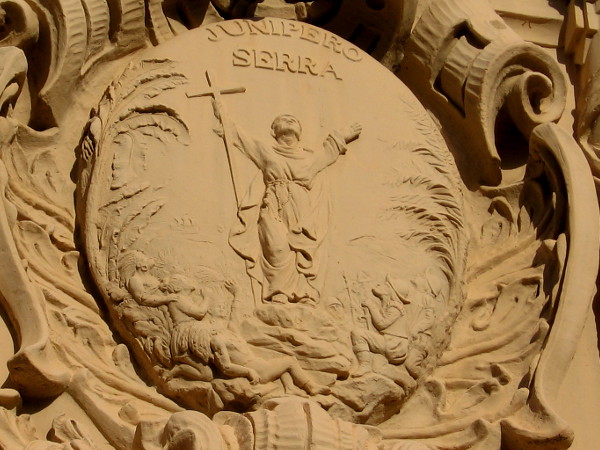
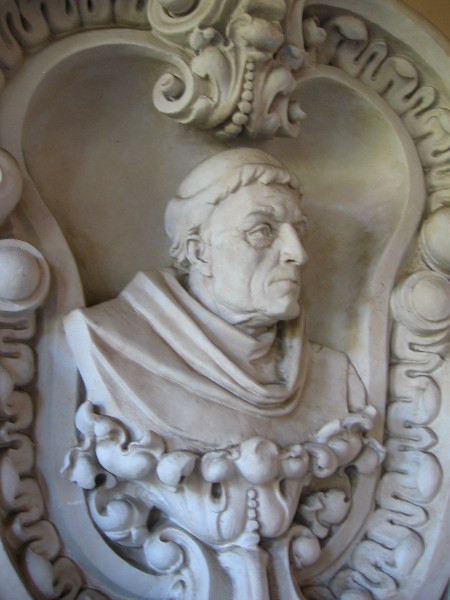
Molded plaster figure of Saint Junipero Serra at top of the California Building’s facade in Balboa Park. The Museum of Man occupies this landmark building. The ornate facade contains many sculpted historical figures and busts created by the Piccirilli brothers, famous marble carvers who immigrated from Italy in 1888.
Today, during Pope Francis’ historic first visit to the United States, Junipero Serra was canonized by the Roman Catholic Church. Father Serra was declared a saint by the Holy See at a ceremony conducted by Pope Francis at the Basilica of the National Shrine of the Immaculate Conception in Washington, D.C.
Saint Junipero Serra played a large role in San Diego’s early history. The Franciscan friar established the first nine of 21 Roman Catholic Spanish missions in what today is California. The very first of those nine, founded on July 16, 1769, was located in San Diego. The primary purpose of the missions was to convert the native peoples to Christianity; another purpose was to solidify a claim over this valuable corner of the New World for Spain.
The Mission Basilica San Diego de Alcalá is located in Mission Valley and remains to this day an active church. It’s popularity as a destination for tourists and the faithful will likely increase with the canonization of Serra.
Because of Saint Junipero Serra’s historical importance in San Diego, many images of him are found throughout our city. Some of the most prominent and well known representations can be seen in Balboa Park. The park’s Spanish Colonial Revival Style buildings created for the 1915 Panama-California Exposition include lavish ornamentation, with many illustrations of people and scenes important to San Diego history.
The following notable bits of art in Balboa Park depict Saint Junipero Serra during his time in San Diego.
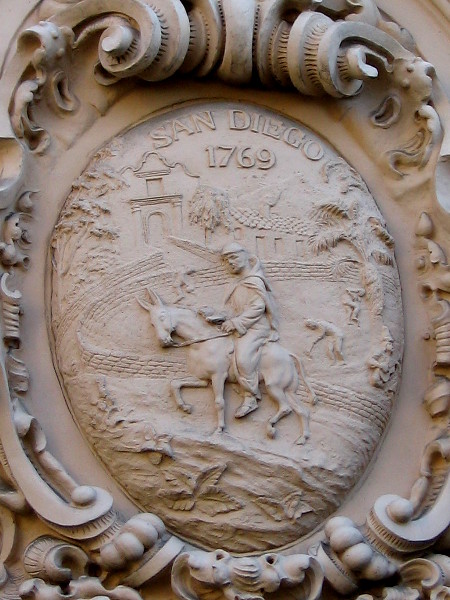
Ornamental art on Balboa Park’s Casa del Prado shows Saint Junipero Serra holding a cross among Spanish soldiers and native peoples in what today is California. In 1769, San Diego was part of Alta California in the Province of Las Californias in New Spain.More artwork seen on Balboa Park’s historic El Prado shows Franciscan friar on a horse near the Mission San Diego de Alcalá, which was built near the San Diego River, several miles inland from San Diego Bay.Junipero Serra Memorial, created in 1914. Staff plaster original ornamentation from the Food Products Building, of the Panama-California Exposition. This elegant work of art was preserved and is now located in the Casa del Prado’s Sculpture Court.
…
Follow this blog to see more photos related to San Diego’s fascinating history! Join me on Facebook or Twitter.
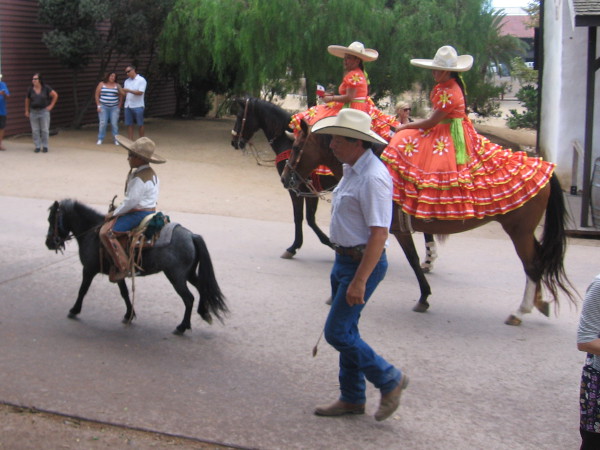
A small parade during 2015 Fiestas Patrias (September 16 is Mexico’s Independence Day) in Old Town San Diego State Historic Park.
Here are some photos of Fiestas Patrias in Old Town San Diego State Historic Park. Mexico began their war for independence from Spain on September 16, 1810, and the occasion was celebrated today with music, food, games, an equestrian demonstration and traditional Mexican dance. I caught a bit of it!
San Diego’s fascinating history includes a Mexican period, which followed the early years of settlement and rule by Spain. Mexico and San Diego share a common border and a great deal of history. A blending of culture and friendly people adds to the richness of our city.
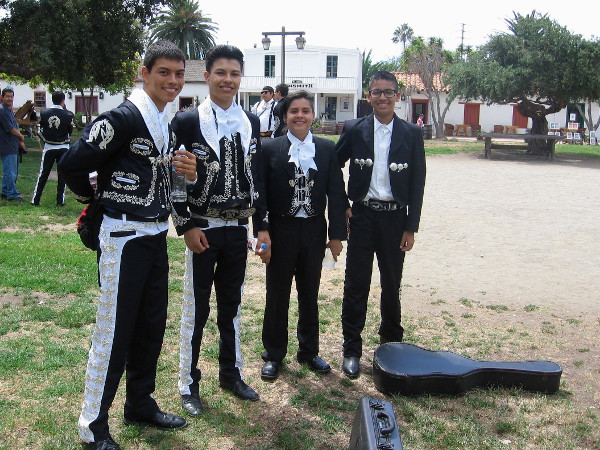
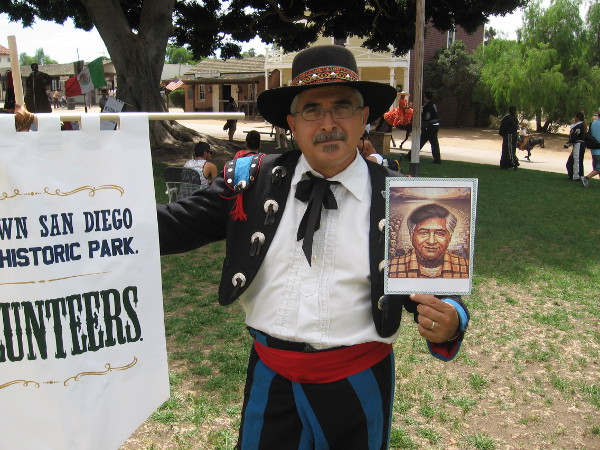
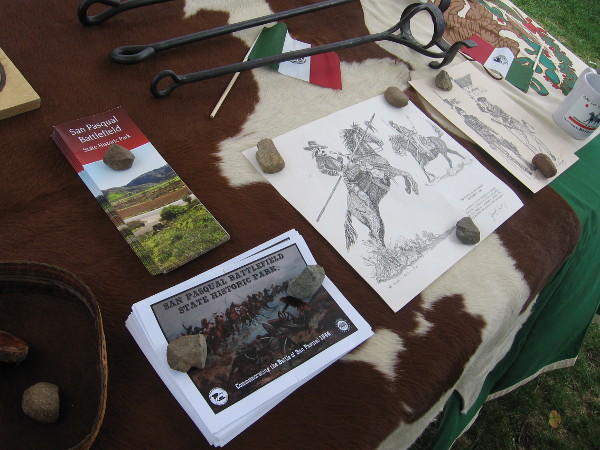
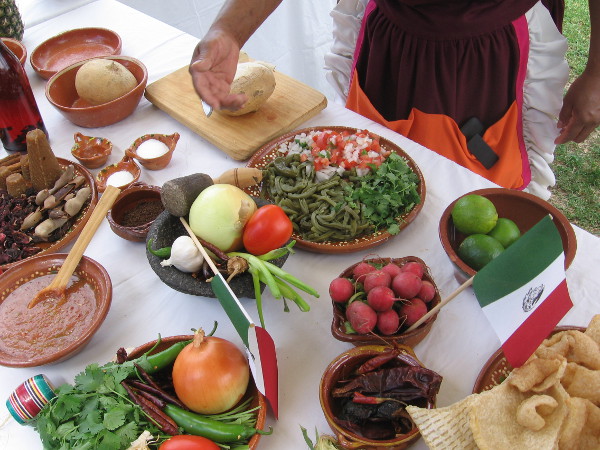
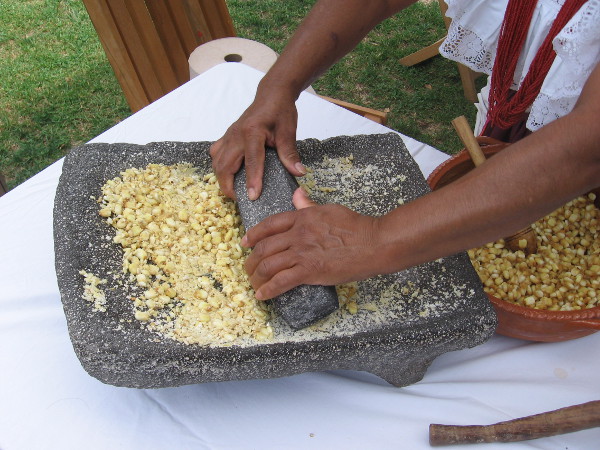
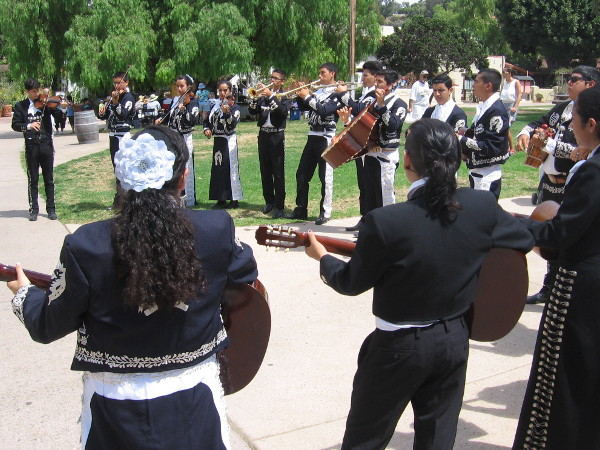
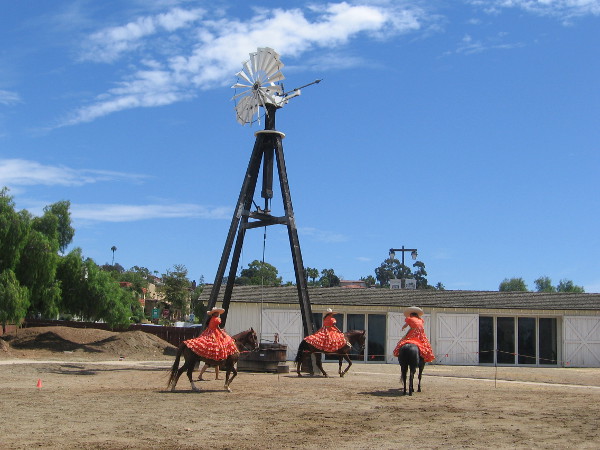
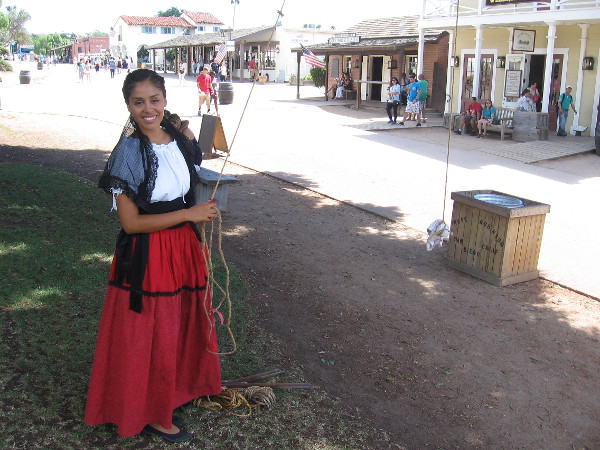
Fiestas Patrias in Old Town San Diego included many cool events flavored with Mexican culture and history.Young musicians from Chula Vista High School Mariachi band smile for the camera!Many event participants carried photos and images of important Mexicans in history. This gentleman holds a tribute to activist Cesar Chavez.Tables contained interesting info and exhibits. This one featured sketches from the Battle of San Pasqual and some cattle brands from historic Mission San Diego de Alcalá.Here are many colorful, often spicy ingredients used in Mexican cuisine. Yum!A super nice lady demonstrates grinding corn with a stone metate, a common practice long ago.Someone paints during the lively festival. Historic Old Town is a picturesque place that inspires artists, at any time!The award-winning Chula Vista High School Mariachi performers warm up before going on stage.Everyone is ready for some traditional Mexican music!These student musicians were incredibly talented. Voices and instruments conveyed stirring emotion. They all received big applause!Beautifully costumed riders of the female equestrian group Escaramuza Las Golondrinas warm up behind Seeley Stable Museum in Old Town San Diego.One rider prepares her horse for a sidesaddle riding demonstration in the afternoon.This rider was nice enough to smile! It’s a perfect, sunny day for a fiesta!A smiling California State Park employee throws a rope over a tree branch, getting ready to hang a piñata. She’s got an awesome job!Fiestas Patrias in Old Town celebrates a rich Mexican heritage and the unique, diverse history of San Diego.
…
Follow this blog for more photos of cool stuff! Join me on Facebook or Twitter.























































 Cool San Diego Sights!