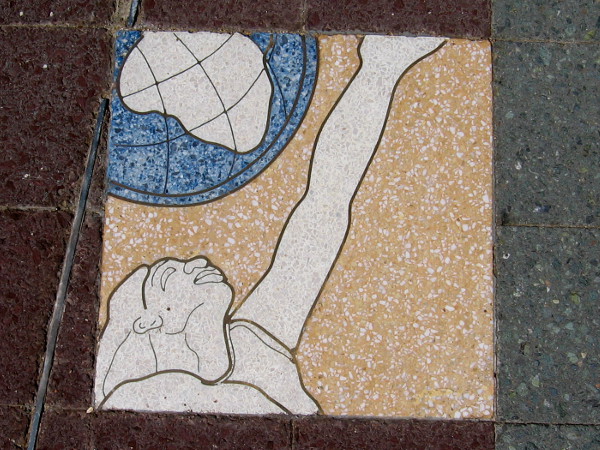
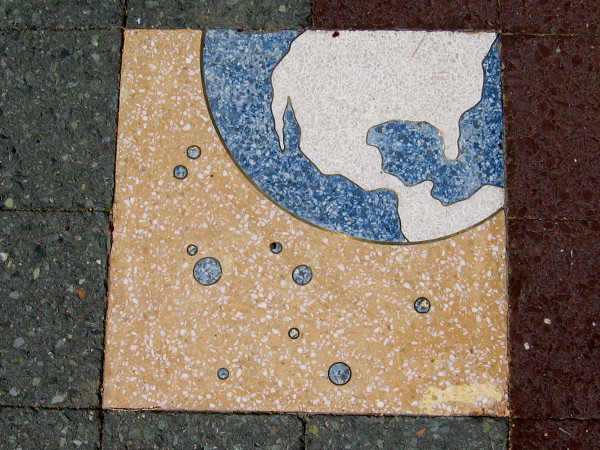
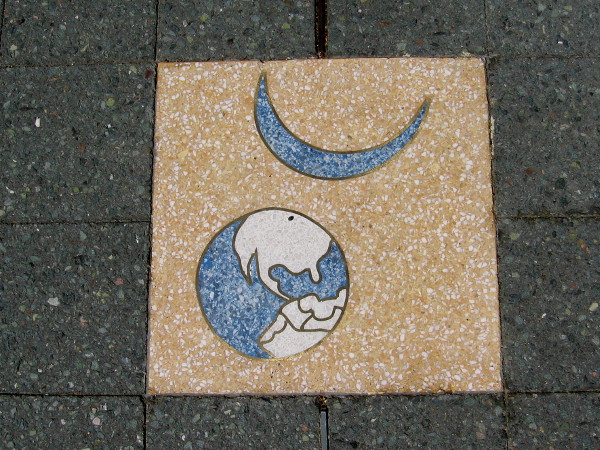
The Earth and a crescent moon. One of 26 terrazzo inserts arranged in a circle at entrance plaza of the Balboa Park Activity Center. Created in 1999 by artist Joyce Cutler-Shaw.
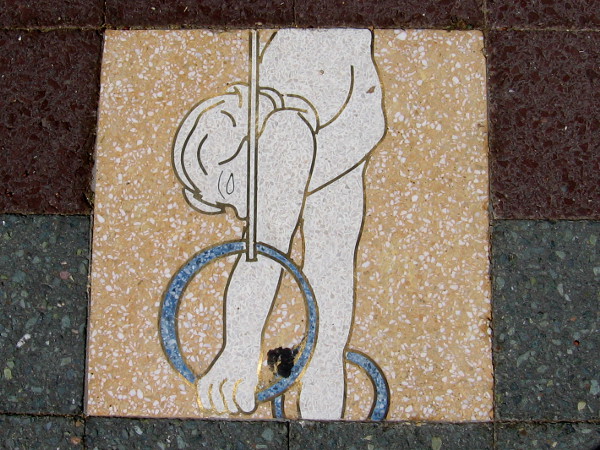
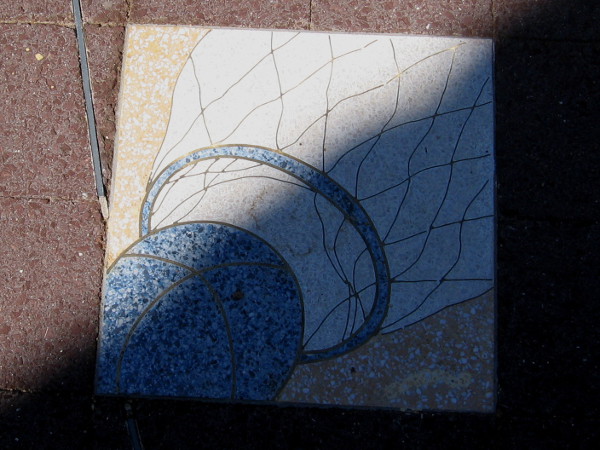
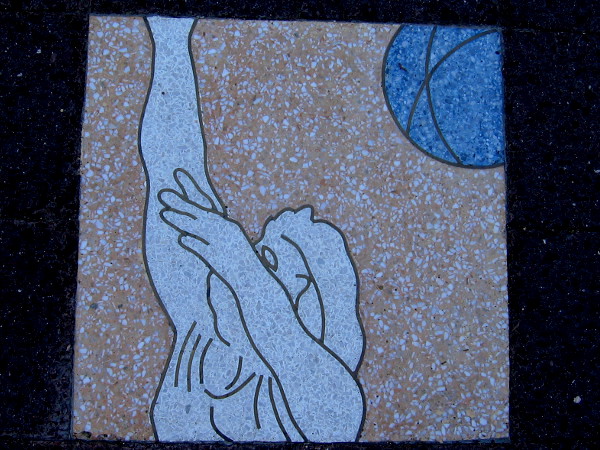
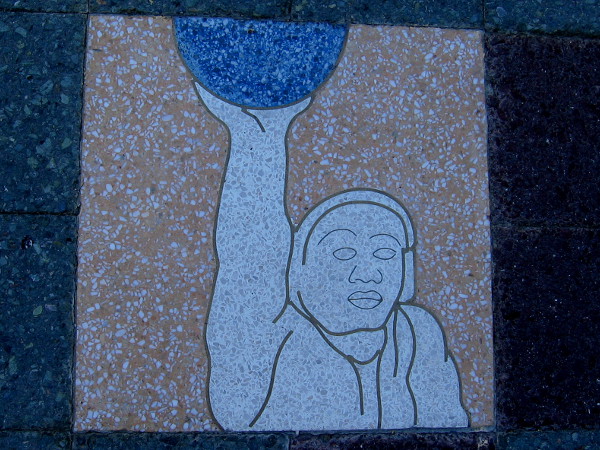
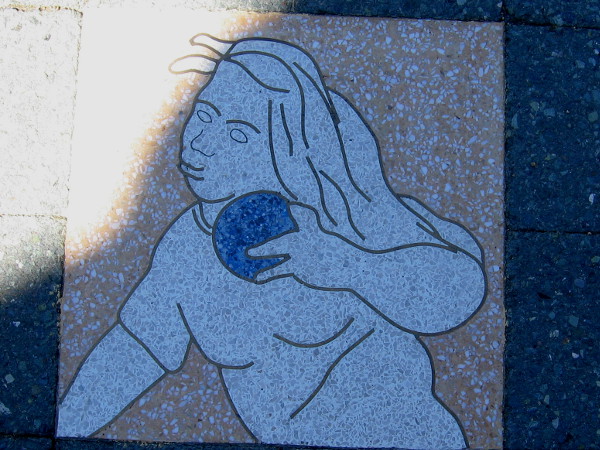
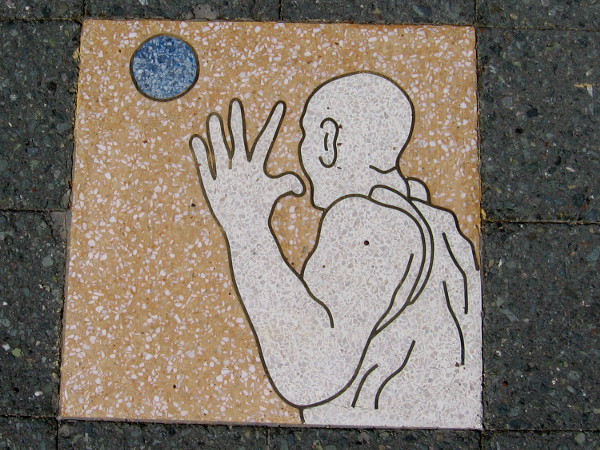
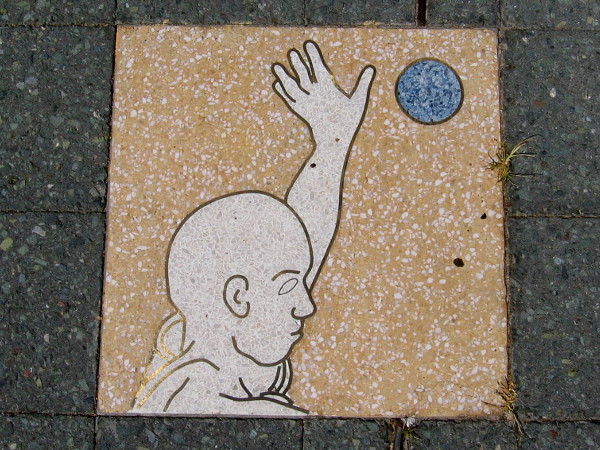
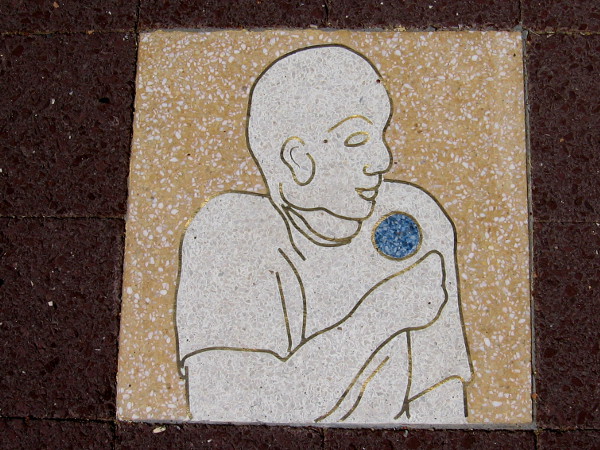
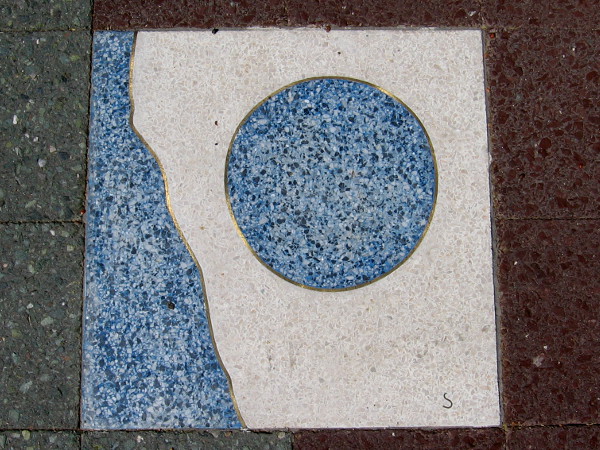
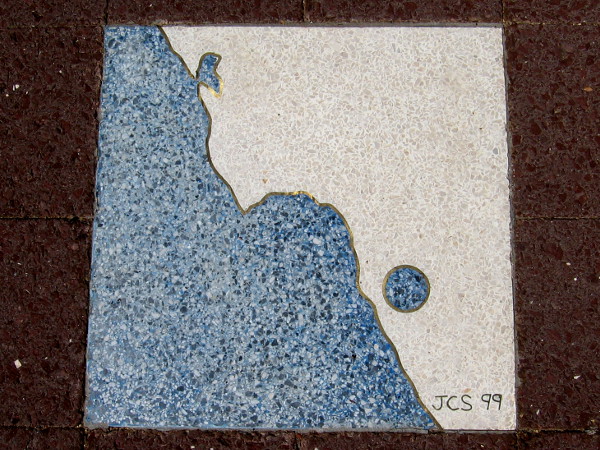
I recently enjoyed looking at some very cool public artwork. Located in front of the Balboa Park Activity Center, The Circle and the Self: A Picture Story by artist Joyce Cutler-Shaw is a series of images that tells a unique story about human activity and sport. Twenty six terrazzo inserts are arranged in a circle on the building’s south plaza, within a large tile map of the western United States, which was designed by another artist Raul Guerrero. I took a close-up photo of each terrazzo square and show them in sequence. That way you can easily follow the artist’s narrative, and the thought-provoking transformations.
The gymnasium-like Balboa Park Activity Center is where many San Diego residents go to participate in badminton, table tennis and volleyball. Similar artwork by the same artist can be found inside the building. Seventy two laser-cut metal plates depict the bodies of athletes engaged in sport, in many different, often imaginative environments.
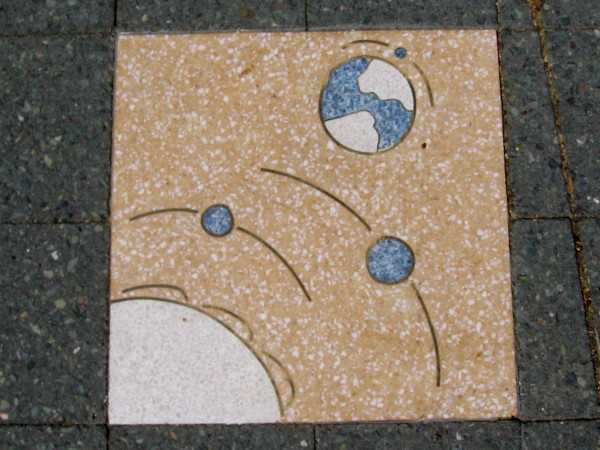
Human figure poses beneath the slender blue moon. That moon will transform as the narrative moves counter-clockwise around the circle.Reaching up toward the ring-like moon. Striving toward hopes and dreams.After grabbing hold of the ring, and another, a gymnast swings through space.This outdoor public art titled The Circle and the Self tells the story of human athletic pursuit and competitive sport. Each tile measures 16 by 16 inches square.Planet Earth seems to transform into a ball. Is it a tennis ball being served?Here’s a planet-sized ball swooshing through a cosmic basketball net!Perhaps that ball is a round blue moon orbiting the Earth.A player tosses the ball toward the net.This fun artwork causes the curious viewer to actively walk around the large Activity Center patio. Now that’s true kinetic art!A ball and net, half light, half shadow.A competitor leaps!Another figure aims to shoot the ball.Is this an Olympic athlete engaged in shot put competition?The circle is a common image in sport. A sphere moves and bounces equally. The playing field is level.Is that a flying ball and baseball player?Here comes the ever-changing blue ball!Getting ready to catch the ball–or is it the Earth moving through space?Dynamic artwork shows human physical activity while traveling along life’s circle.Is this man playing handball?A blue ball on a stick. What sport is this?Perhaps this ball is about to be served in table tennis.The magical blue ball suddenly grows!The blue circle now seems to be a lake inside the contours of an ocean coast.As scale is altered and perspective changes, ocean and coastline become the planet Earth once more. Other blue circles are heavenly bodies throughout the universe.Our big blue marble is third planet from the sun. It has its own small orbiting moon.The viewer of this art has returned to the beginning. We’ve come full circle.The Circle and the Self by Joyce Cutler Shaw, 1999. City of San Diego Civic Art Collection. Commissioned for the citizens of San Diego.
…
Follow this blog for more photos of cool stuff! Join me on Facebook or Twitter.
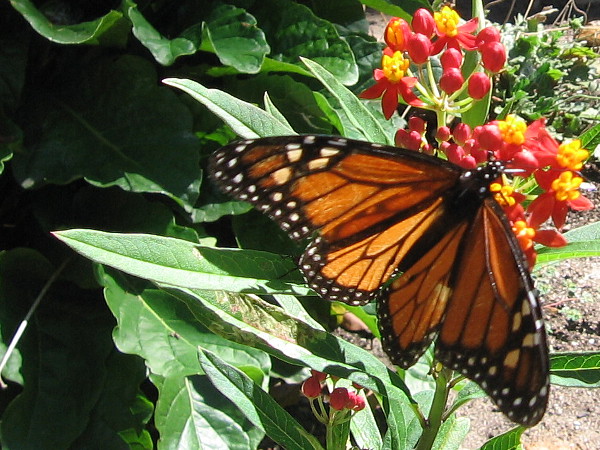
A monarch butterfly has found some milkweed. I snapped this photo just in time.
Early this afternoon I managed to capture some elusive living colors. I caught them with my camera, during a leisurely visit to Balboa Park’s beautiful Zoro Butterfly Garden.
Created in 1915 for the Panama-California Exposition, the unique amphitheatre-like stone grotto features meandering paths tucked beneath some shady trees. An easy stroll down into the hollow reveals a lush garden full of flowers specifically planted to attract butterflies. That wasn’t always the case. In 1935, during the California Pacific International Exposition in Balboa Park, this partially hidden area was called the Zoro Garden Nudist Colony!
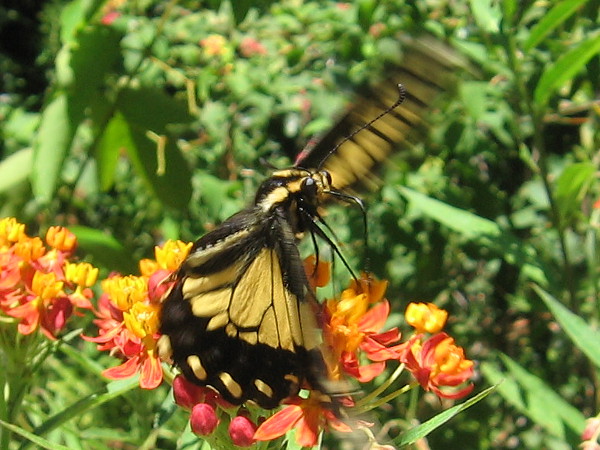
In this peaceful garden you’ll experience monarch, sulfur and swallowtail butterflies, fluttering quickly past your astonished eyes. Most of the time, my old camera finger reacted much too slowly! But I got a few pics!
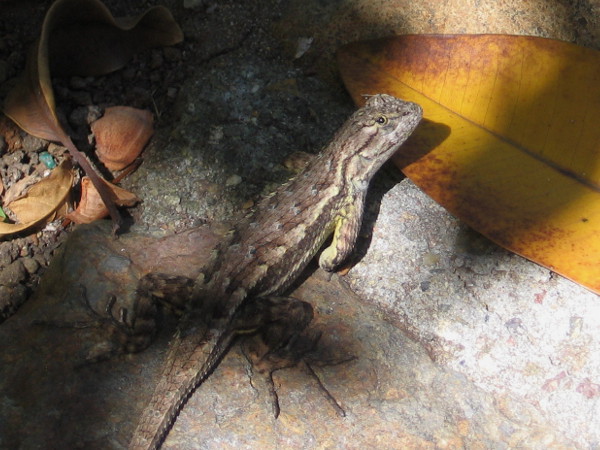
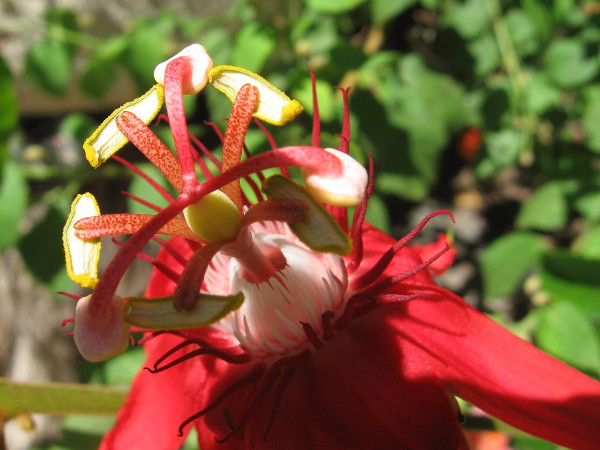
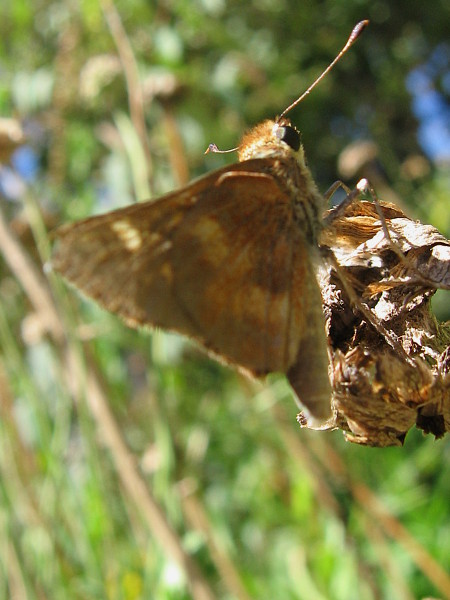
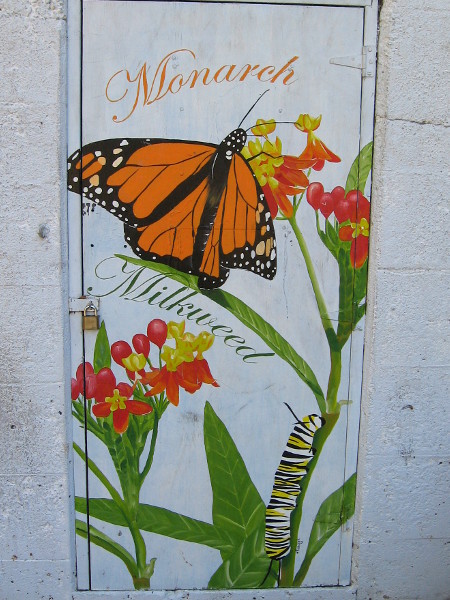
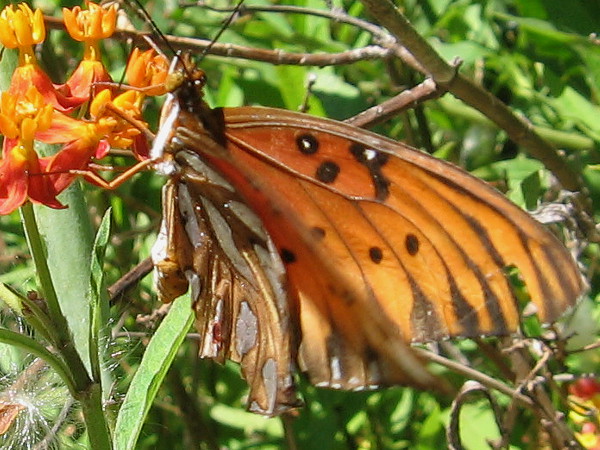
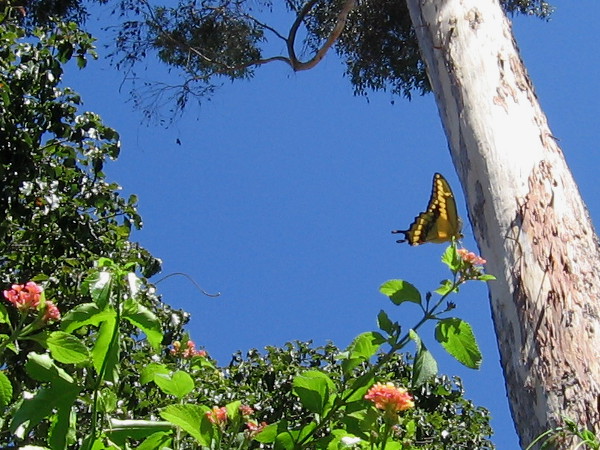
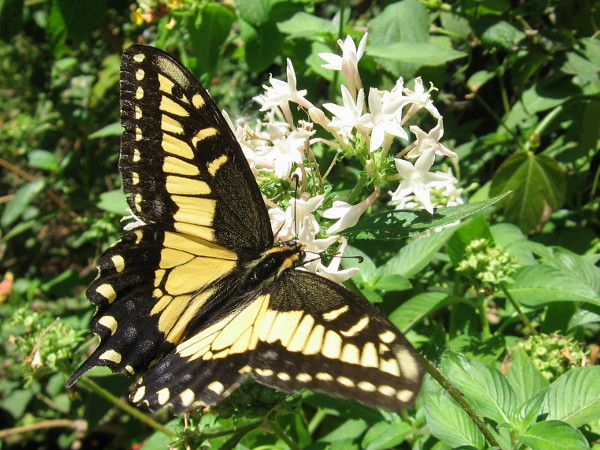
An artistic bird bath in the garden depicts leaves, flowers and butterflies, naturally!A tiny insect takes a walk on a sweet sun-yellow carpet.Zoro Butterfly Garden contains rustic, ragged beauty along its stony walkways.This sneaky lizard would’ve been happy to capture a quick butterfly, too! I don’t know if he had any luck.Cool close-up photo of red passion vine flower.I’m not sure who this guy is. Is it a Mourning Cloak? Some kind of moth? If you know, leave a comment.Sunlight reflects from a butterfly winging past some weathered public art in a section of the garden.Painted mural in Balboa Park’s Zoro Butterfly Garden shows an Orange-barred Sulphur and Cassia.Another section of this informative artwork depicts Passionvine and a Gulf Fritillary.A third section shows that Monarch butterflies are attracted to Milkweed.The underside of this Gulf fritillary almost looks like a torn, crumpled brown leaf.A swallowtail butterfly takes flight!Looking upward from the lush hollow where butterflies thrive, toward blue sky and fluttering, living color.An Anise Swallowtail spreads its wings on a glorious day in San Diego’s wonder-filled Balboa Park.
…
Follow this blog for more photos of cool stuff! Join me on Facebook or Twitter.
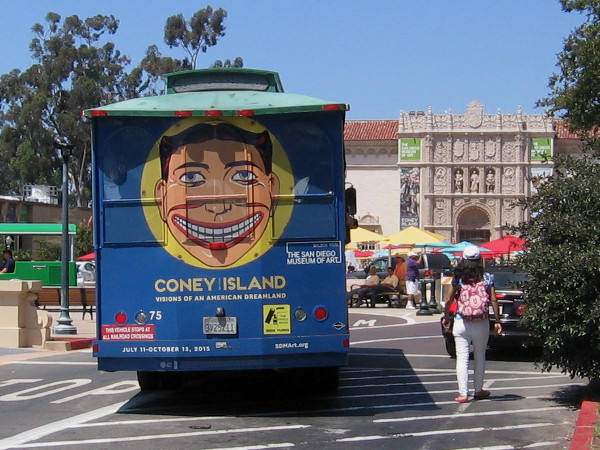
Grinning face of Tillie, symbol of Coney Island, on the back of a tour bus heading toward the San Diego Museum of Art in Balboa Park.
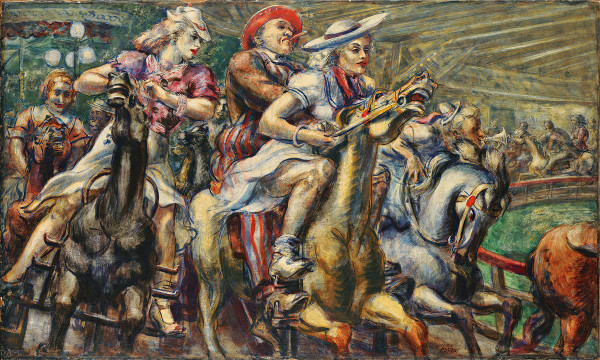
An extraordinary exhibit recently opened at the San Diego Museum of Art. It’s called Coney Island: Visions of an American Dreamland, 1861-2008. Last Saturday, I enjoyed a very special tour, courtesy of my docent friend Catherine!
The exhibit features a collection of more than a hundred objects that depict 150 years of Coney Island’s amusement parks, boardwalk, beach and people. It includes paintings, photographs, videos, carnival posters, sideshow banners, carved wooden carousel horses, and a wide range of colorful, unique artifacts.
From its early days as a peaceful beach getaway for wealthy New Yorkers, to the rise and fall of amusement parks, years of decay, political wrangling, then modern renewal, Coney Island has been interpreted by artists through the years in a variety of surprising ways. Some artists portray an innocent playland for common people. Others, something more complex, and less innocent.
Most of the exhibit’s artwork centers on Coney Island’s legendary amusement parks. Many images resemble exuberant scenes from a carnival or circus. They’re full of energy, laughter, humanity, wonder–but often base, superficial, disturbing, despairing. Many painting are dark, almost gaudy with a crowded press of people seeking pleasure. A symbol adopted by Coney Island–the unnatural, exaggerated grin of Tillie–seems to be a taunting reminder that the purchased thrills are artificial. The grin is strangely maniacal and mindless, one part Joker, one part Cheshire Cat.
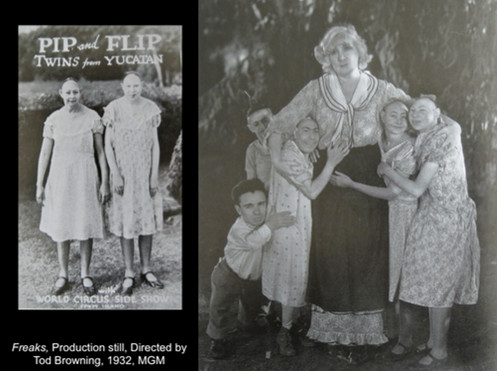
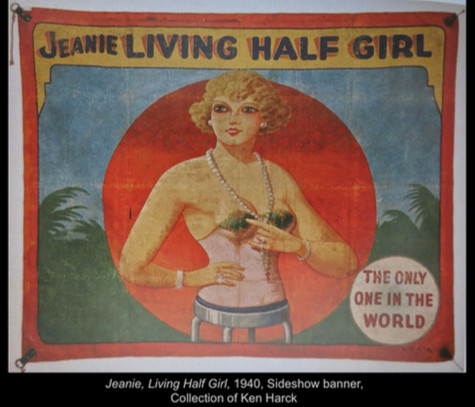
Fantastic imagery abounds in the exhibit, which is sure to delight many kids. They’ll see huge cyclops heads, videos of romping midgets, a banner promising a sideshow freak with inhuman tentacles. The adults will see images of lust, insatiability, scattered litter, dripping blood.
I suppose we humans like to be both excited and terrified.
One Impressionist painting by the important American artist William Merritt Chase shows a landscape of sunlight and natural, unspoiled beauty; the egg tempera painted canvases of Reginald Marsh are dark, crammed with unabated appetite, bold kinetic energy and human expression; photographs by Arthur Fellig (Weegee) show people crowded onto the beach like fleshy, happy sardines.
Personally, as I took my amazing tour, I saw life’s wonderful jumble and a sample of our world’s endless variety. All the emotions, the complexity–but mostly I recognized the sunlit memories of ordinary good-natured neighbors heading to the beach and boardwalk, and some exciting, brief amusements, on a sunny weekend day.
This isn’t a typical art museum exhibit. It’s more like taking an instant journey to a place you already know. A Coney Island in your mind. And your vivid experiences in the San Diego Museum of Art will make the journey seem very real.
Coney Island: Visions of an American Dreamland, 1861-2008, has come to San Diego from the Wadsworth Athenium Museum of Art in Hartford, Connecticut. This special exhibition continues through October 13, 2015.
Here are just a few things that you’ll see…
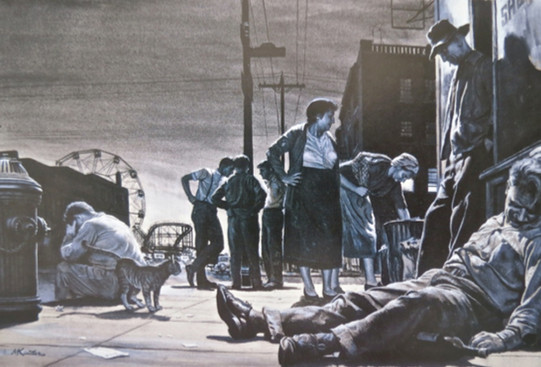
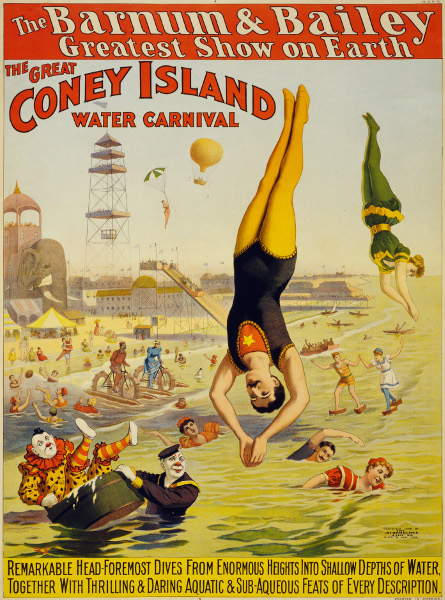
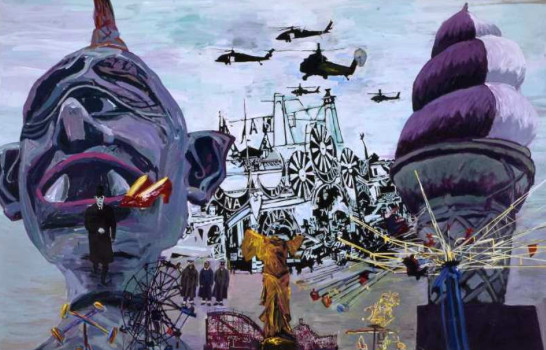
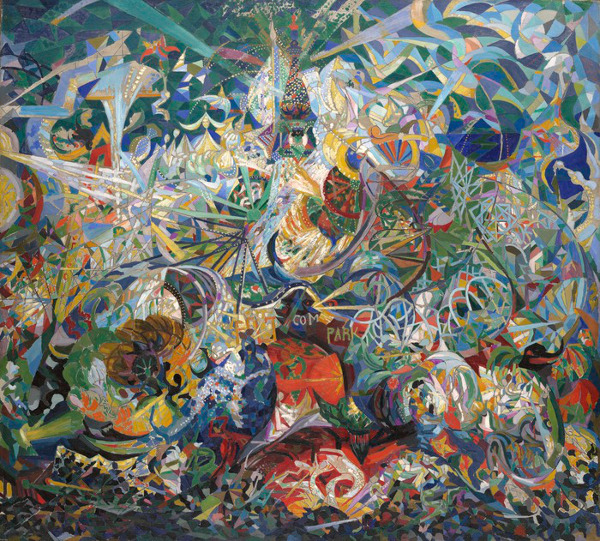
Reginald Marsh, Wooden Horses, 1936, Tempera on board. Wadsworth Atheneum Museum of Art.Pip and Flip, Twins from Yucatan with World Circus Side Show, Coney Island, 1929, Photographic reproduction. Georgia Archives, Vanishing Georgia Collection.Jeanie, Living Half Girl, 1940, Sideshow banner. Collection of Ken Harck.Mort Künstler, Coney Island, 1953, Gouache on paper. Collection of the artist.Barnum & Bailey Greatest Show on Earth, the Great Coney Island Water Carnival poster. Thrilling and daring feats of every description!Arnold Mesches, Anomie 1991: Winged Victory, 1991, Acrylic on canvas. San Diego Museum of Art.Joseph Stella, Battle of Lights, Coney Island, Mardi Gras, 1913, Oil on canvas. Yale University Art Gallery.
The San Diego Museum of Art in Balboa Park is simply jammed with fantastic, provocative Coney Island art. This is a once-in-a-lifetime opportunity. So go see it!
Coney Island, Visions of an American Dreamland, 1861–2008, at the San Diego Museum of Art.
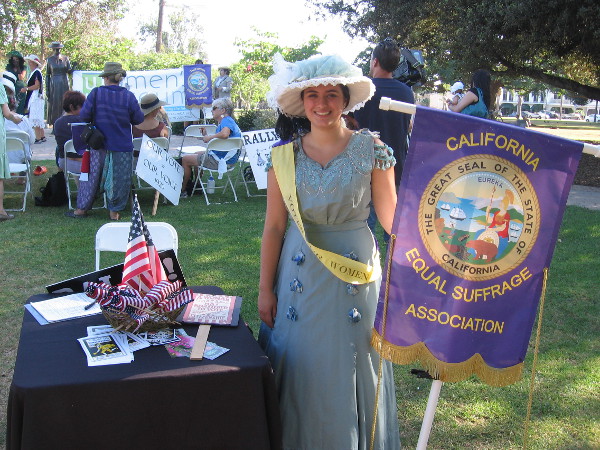
A smile, a Votes For Women sash, American flags, and a California Equal Suffrage Association banner.
Early this evening a rally and parade celebrating the ratification of the 19th Amendment were held in Balboa Park. As the sun descended toward the horizon, a small crowd gathered in Sefton Plaza to hear a variety of interesting, often stirring speeches. The speakers portrayed notable women in American history who have worked to further the cause of women’s equal civil rights. Wearing period costumes, the historical personalities included Elizabeth Cady Stanton, Susan B. Anthony, Alice Paul and Eleanor Roosevelt, plus important local San Diegans Dr. Charlotte Baker, our city’s first female practicing physician, and prominent philanthropist and journalist Ellen Browning Scripps. The event was sponsored by the Women’s Museum of California in Point Loma.
Here are a few photos!
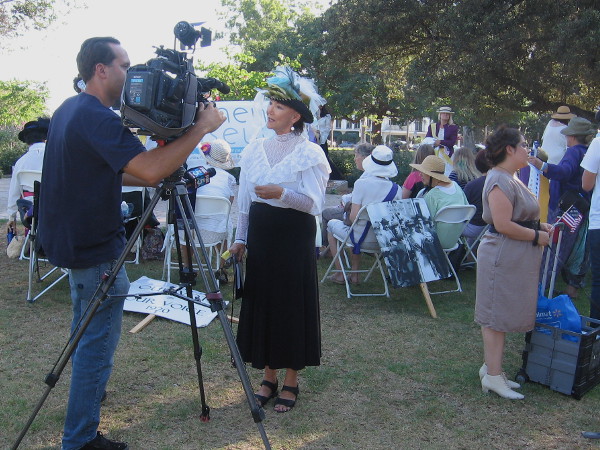
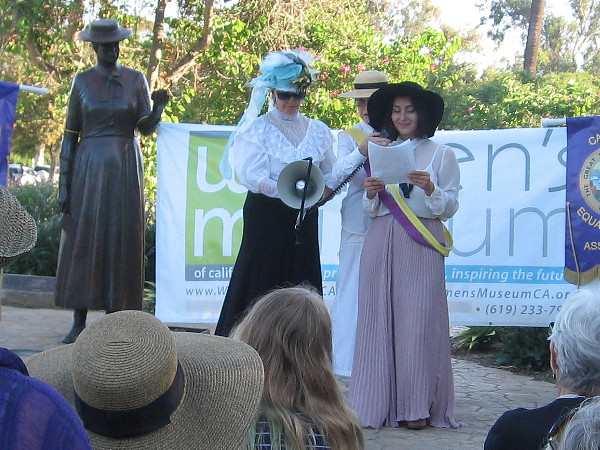
Two women head for Sefton Plaza in Balboa Park, where a suffrage rally would celebrate the anniversary of the 19th Amendment.The 19th Amendment to the United States Constitution was ratified on August 18, 1920. It guarantees all American women the right to vote.Historical sign proclaims a woman living here has registered to vote thereby assuming the responsibility of citizenship.In period attire, the person being interviewed played the role of San Diego philanthropist and trailblazer Ellen Browning Scripps during the rally.The woman with the microphone portrayed American suffragist and social activist Elizabeth Cady Stanton, who wrote many of Susan B. Anthony’s speeches.Many wore historical sashes, hats and costumes to commemorate suffragettes and leaders who have fought for equal women’s rights.One participant reenacted Eleanor Roosevelt, speaking about her life and accomplishments. The statue is of Kate Sessions, one of the founders of Balboa Park.The suffrage parade begins. Participants march toward the heart of Balboa Park, down El Prado and over the Cabrillo Bridge.
…
Follow this blog for more photos of unique and interesting events! Join me on Facebook or Twitter.
Visitors stroll through endless natural beauty at the Japanese Friendship Garden in Balboa Park.
Please enjoy the following photographs. They were taken today at the Japanese Friendship Garden in San Diego’s wonderful Balboa Park. As you can plainly see, natural beauty is abundant in this amazing garden. I hope you have a chance to visit.
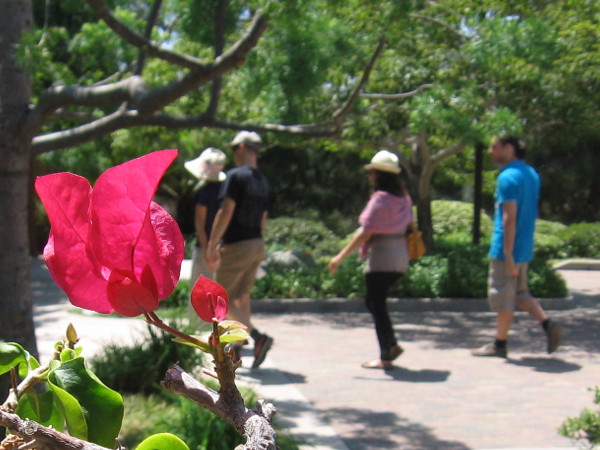
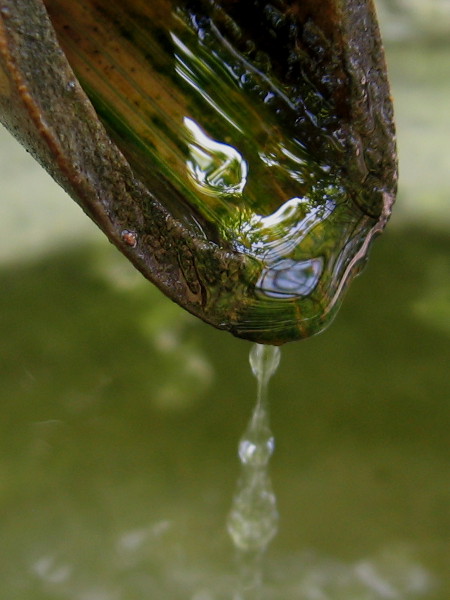
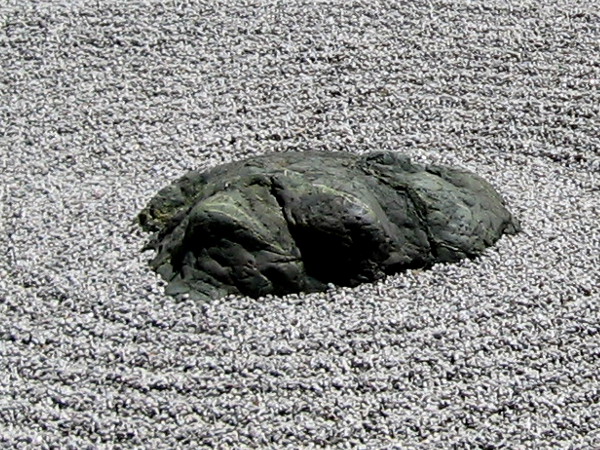
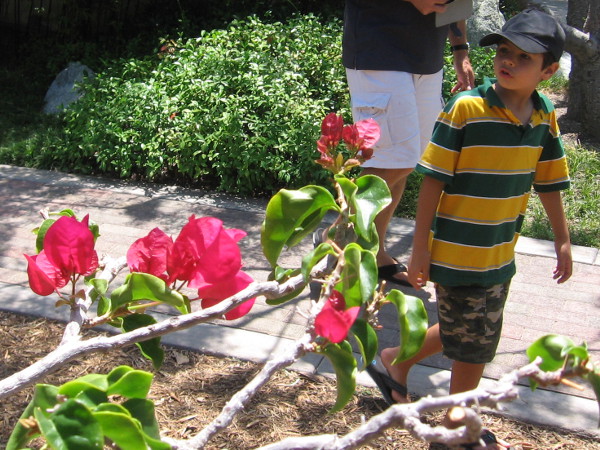
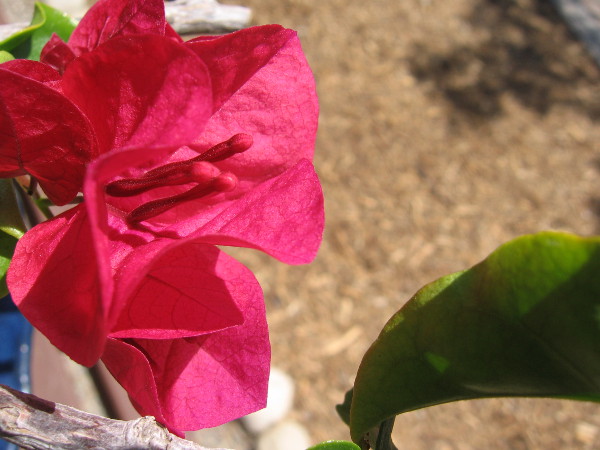
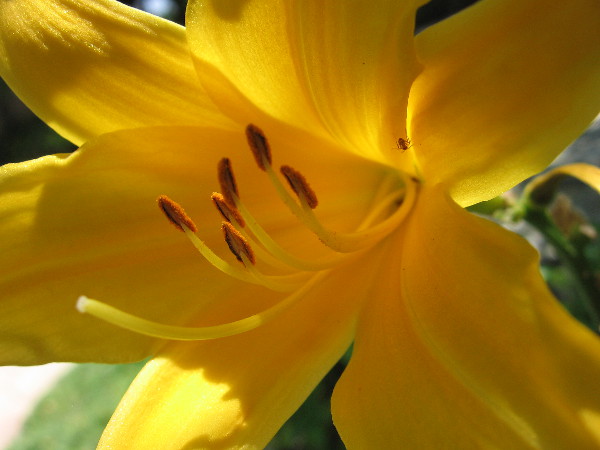
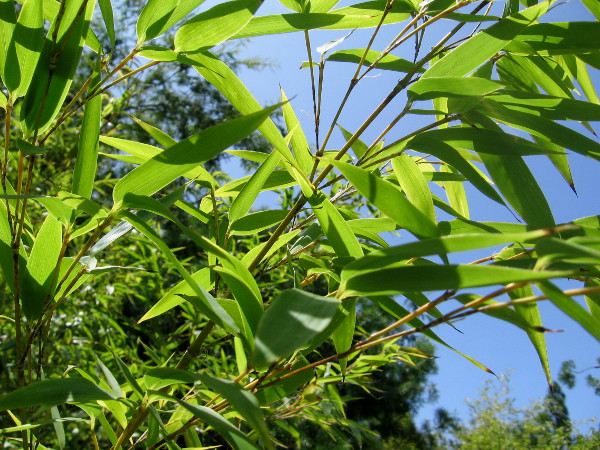
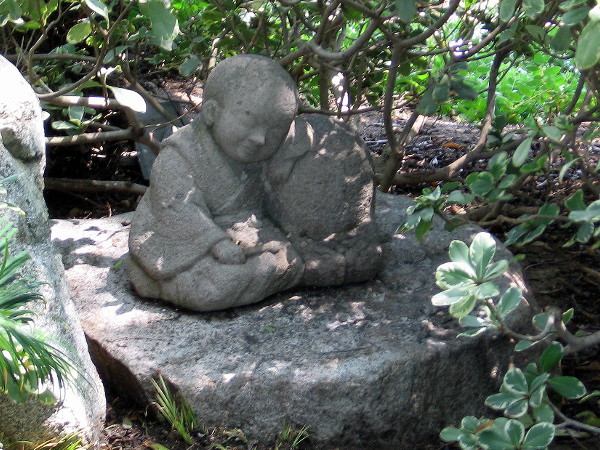
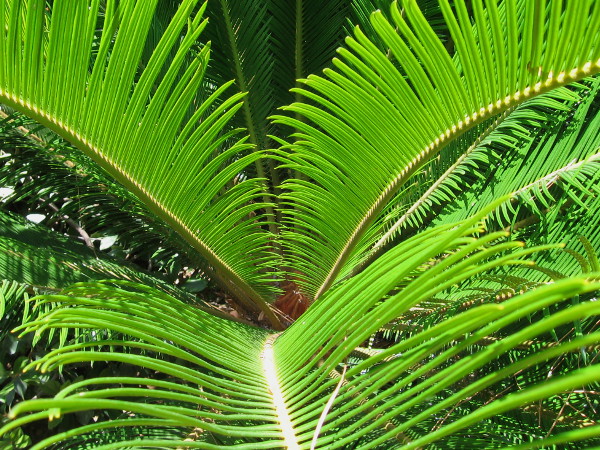
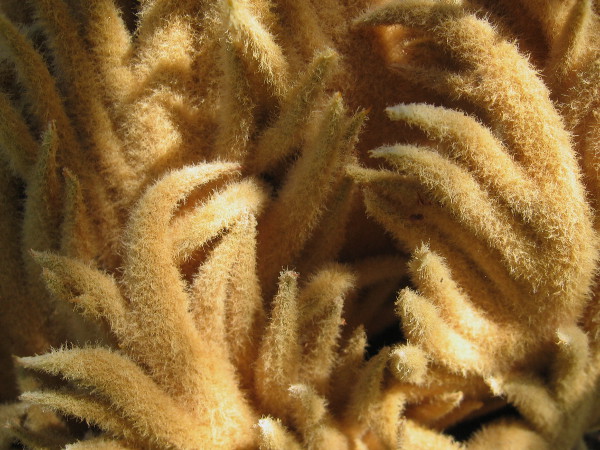
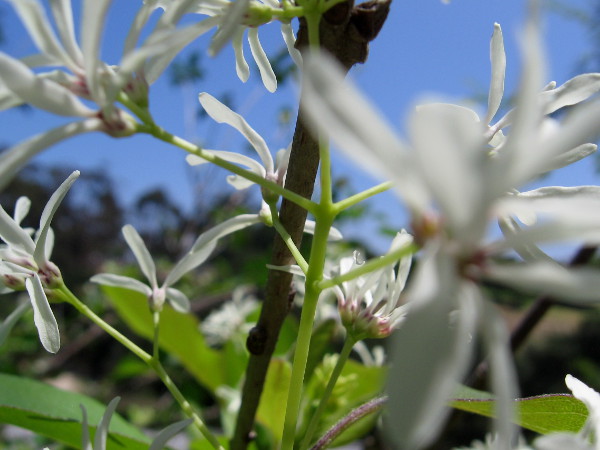
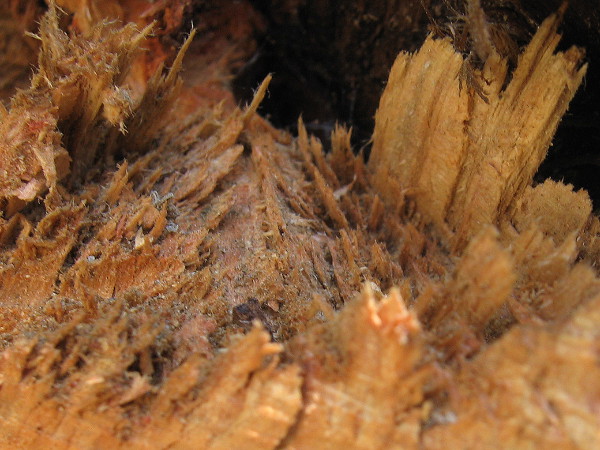
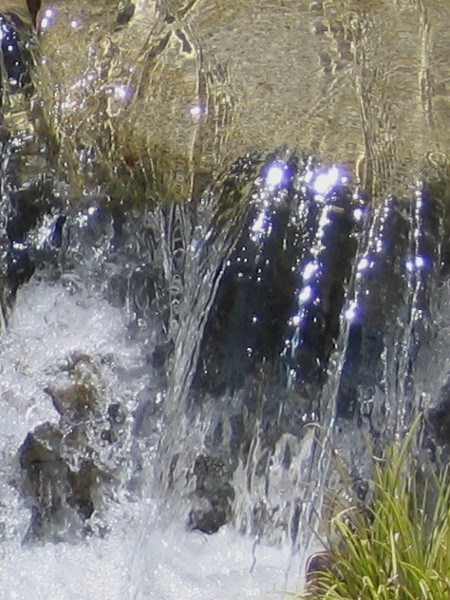
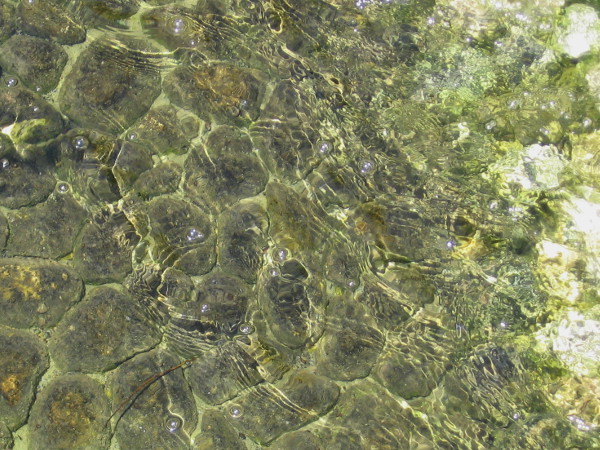
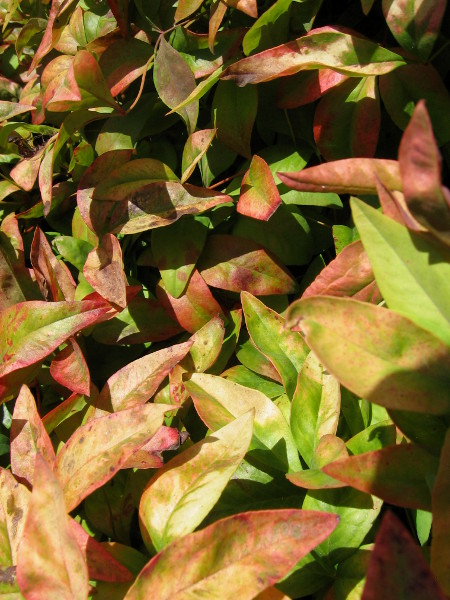
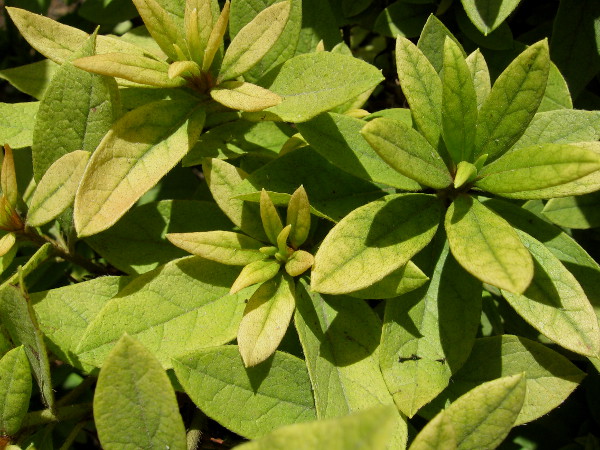
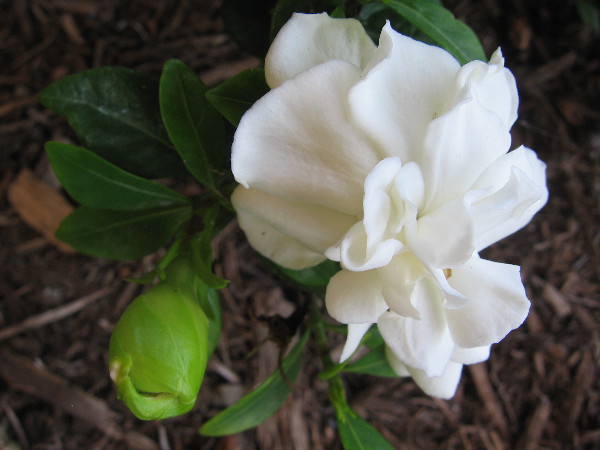
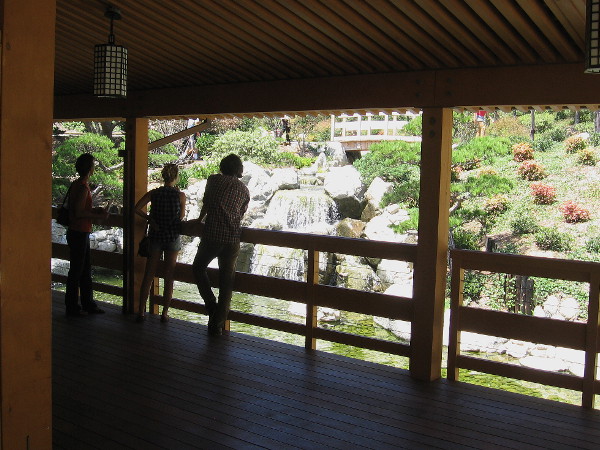
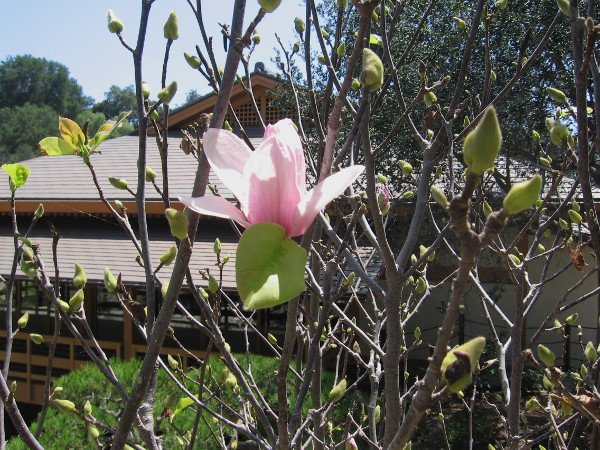
Gleaming droplets of water descend from a hollow bamboo kakei into the tranquil, cleansing tsukubai basin.Even age and imperfections in this fallen leaf are beautiful beyond description.A rocky island, seemingly, in the Karesansui Dry Stone Garden, with carefully raked gravel inviting meditation.Looking upward into the sunlit leafy canopy near the koi pond.The day’s light makes striking patterns of living green.Bright red bougainvillea bracts catch the eye of a young person walking through the Japanese Friendship Garden in San Diego.Bougainvillea red is an especially beautiful sight in the bonsai garden.A yellow day-lily which is growing near the Charles C. Dail Memorial Gate.Bamboo leaves flutter in the gentle San Diego breeze.This small sculpture is a mystery according to one of the groundskeepers. It was placed in the garden by someone unseen. The sculpture might be a young Buddha. It might have been placed here by someone who lost a child. No one seems to know its history.Bright green palm fronds produce instant human delight.Close-up photograph of the amazing, strange seed pod of a sago palm.Delicate white flowers of the star jasmine seem to have descended into this world from a heavenly place.Close-up photo of torn wood fibers where a dead tree limb finally separated from the trunk.Water cascading over stone shines in the sunlight. A small gentle river flows through the bottom of the spacious garden canyon.Looking down through magical, jewel-like water.Jumbled leaves have turned many colors.Nature’s fantastic patterns are evident everywhere you turn in the amazing Japanese Friendship Garden.After being corrected by a great reader, this appears to be a gardenia. I first thought it might be a white azalea! That shows you how much I know!Visitors at the Japanese Friendship Garden stand in the shade of the Inamori Pavilion looking down at a pleasant waterfall.A pink saucer magnolia bloom and buds. In the background you can see the new Inamori Pavilion, which opened this year.Another photographer was recording the carefully arranged natural beauty at the Japanese Friendship Garden.Even dry brown curled leaves can take one’s breath away.Leaves and shadows of leaves.If one small place can contain such abundant wonder, imagine what the vast universe holds.Natural beauty at the amazing Japanese Friendship Garden
…
Follow this blog for more photos of amazing and beautiful things! Join me on Facebook or Twitter.
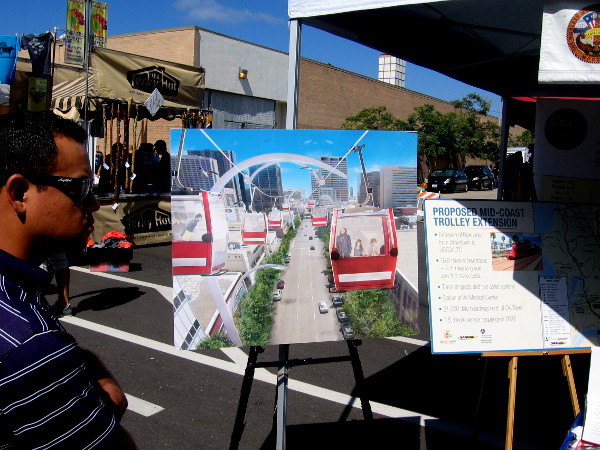
Conceptual art displayed by County of San Diego Supervisor Ron Roberts at CityFest shows proposed aerial skyway from downtown to Balboa Park.
I just got back from walking through CityFest in Hillcrest. Lots of cool pics are coming! But first, I saw some conceptual artwork being displayed by San Diego County Supervisor Ron Roberts that has renewed my enthusiasm for a proposed transportation project.
The proposal, which I read about months ago, is for an aerial tramway, or skyway, which would connect downtown San Diego to Balboa Park. It’s an idea that’s both visionary and practical!
San Diego is an extremely popular tourist destination. There are many great things to see, including beautiful, amazing, enormous Balboa Park. Balboa Park, over a mile (to its center) from downtown, is often said to be one of the two best urban parks in America, along with New York City’s Central Park. But there’s one problem. If you don’t have a rental car, you must reach it on foot, by rented bicycle, taxi, or by city or tour bus. For some tourists this might be impractical, too time consuming, or unappealing. A skyway linking downtown’s many hotels, attractions and convenient trolley network to Balboa Park, I believe, would be wildly successful.
Can you imagine all the folks who work in offices downtown, easily heading up to Balboa Park during lunchtime? Can you imagine how visually unique and appealing such a project, tastefully designed, might be? Forget a Ferris wheel or tower on the waterfront, I say. That’s been done elsewhere. Let’s create something that’s both fun and extremely useful!
Living atop Cortez Hill, directly between downtown and Balboa Park, I can’t tell you how often I’ve given directions to lost San Diego visitors. They drive north only to reach a dead end at Tweet Street Park. They have to navigate confusing one way streets to find their way across Interstate 5, then figure out how to enter Balboa Park and locate a parking place. An aerial tram would help solve that problem, as well!
According to some literature I picked up from Ron Roberts, the San Diego Bay to Balboa Park Skyway, powered by a 500 horsepower electric engine, could carry up to 2400 people per hour.
The views of downtown, San Diego Bay and Balboa Park would be breathtaking. The ride itself would almost certainly become one of San Diego’s top tourist attractions.
From what I’ve heard so far, the idea is awesome!
The cool San Diego Bay to Balboa Park Skyway would travel from the Gaslamp up Sixth Avenue, covering two miles in 12 minutes.
…
Follow this blog for cool photos, plus some random ideas and discoveries! Join me on Facebook or Twitter.
Sign outside the Spanish Village history exhibit, which is open to the public in Gallery 21.
Anyone in San Diego who loves art must visit Spanish Village Art Center in Balboa Park. Some of the region’s finest local artists occupy its 38 working studios. By strolling around the large, colorful courtyard and poking a nose here and there, the public can see (and purchase) finished artwork of every kind, watch the creative process, and talk to the friendly artists themselves.
While at Spanish Village–if you’re the curious sort–you might also check out a small but fascinating history exhibit. Just step into Gallery 21.
Earlier this summer I was graciously given a tour of the exhibit by one of the resident artists. Here are a few photos and captions describing what I saw. Of course, it’s much better to experience Spanish Village and these memories of its history firsthand. So I encourage everyone to head on over.
The exhibit reviews how, a century ago, Balboa Park (originally called City Park) was developed and transformed into a dreamlike landscape for the 1915 Panama-California Exposition. Many fantastic buildings were created, using a variety of influences from Spanish, Mexican, European Renaissance and Moorish origins. This unique mixture became what is known as Spanish Colonial Revival architecture.
Later, the successful California Pacific International Exposition of 1935 was promoted to boost San Diego during the Great Depression. It used existing buildings from the Panama-California Exposition and exhibits from the recent Chicago Century of Progress Expo. New construction designed by master architect Richard Smith Requa added a variety of buildings to Balboa Park, including those of Spanish Village. Spanish Village, as its name implied, originally recreated life in Spain, with “shops that sold art, curios, flowers, music and wine. It had a children’s theater, a Chinese Bazaar, a cocktail lounge called Cafe Granada and other restaurants. The Village was at the entrance to the Fun Zone which contained a Midway, a midget zoo, and an Indian Village.”
Today, this exhibit’s historical photographs, newspaper articles and ephemera relating to Spanish Village help visitors understand and appreciate the cultural contributions over many decades of hundreds of participating artists.
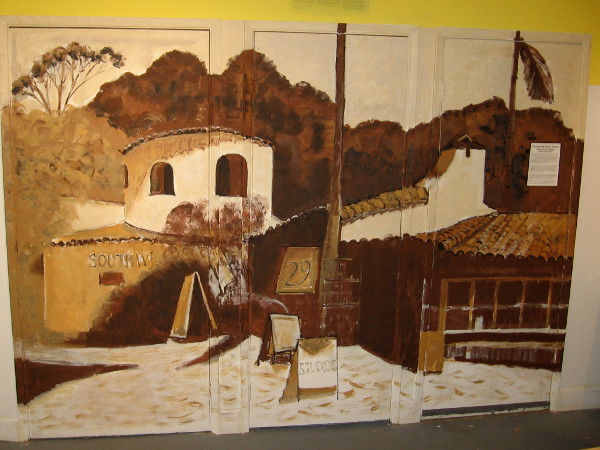
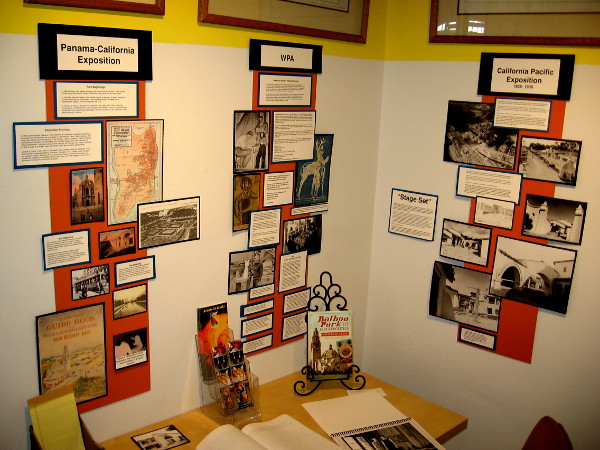
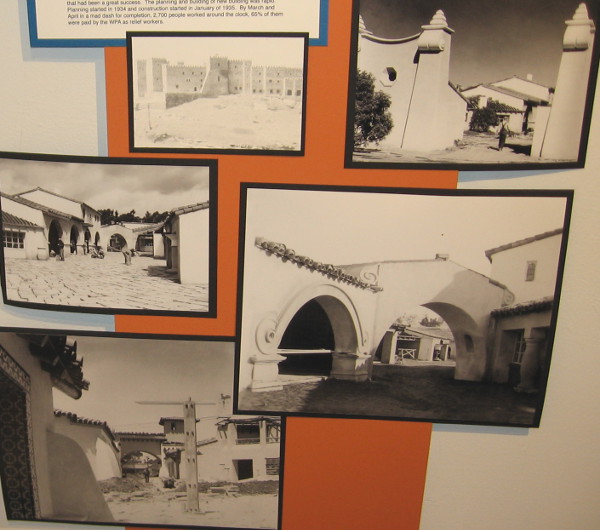
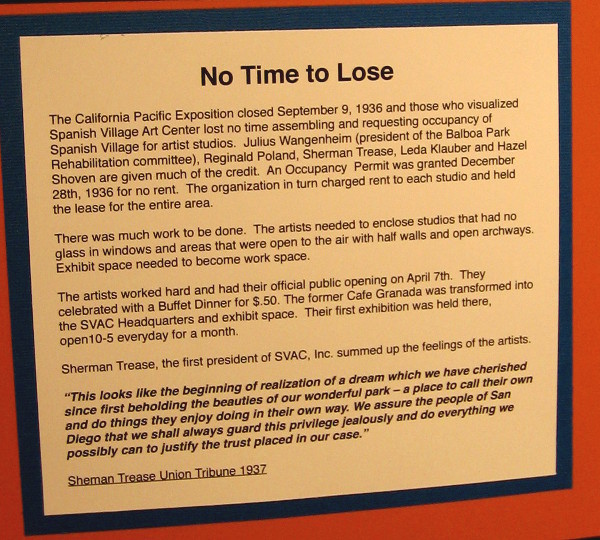
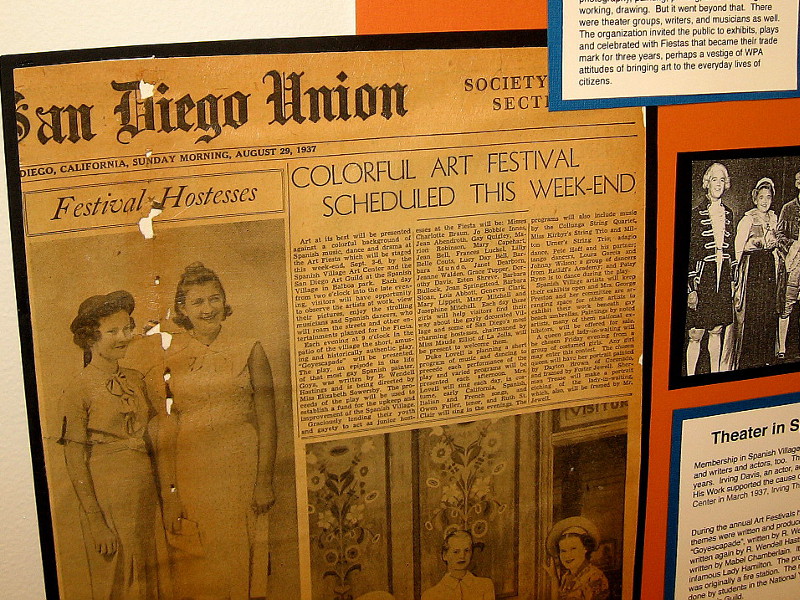
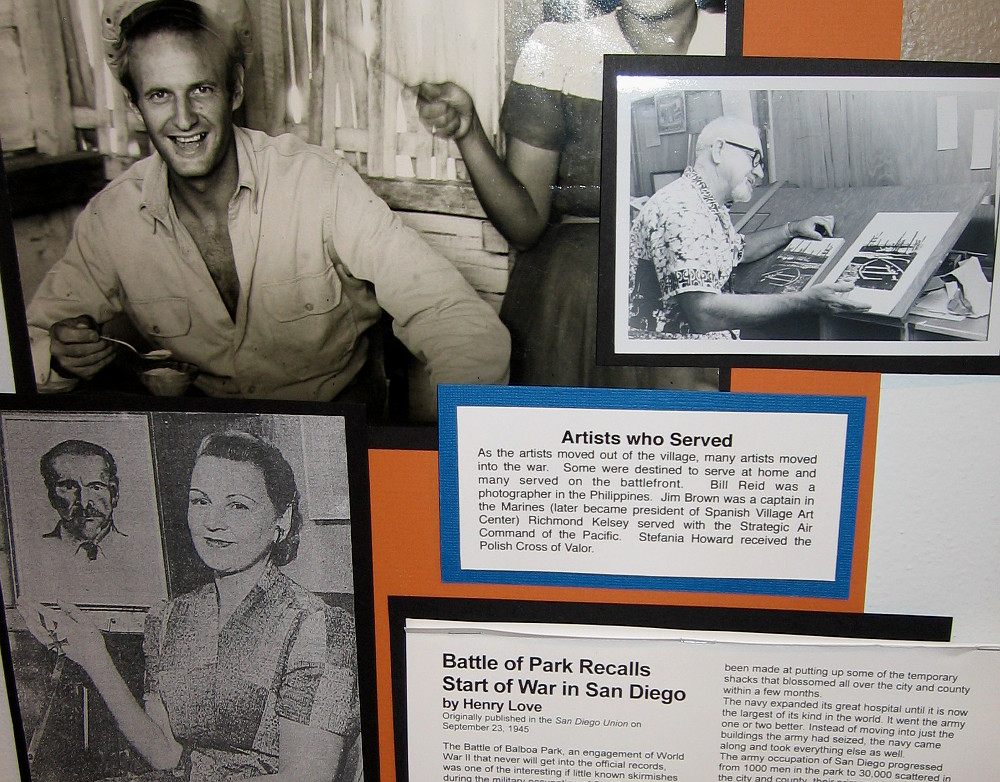
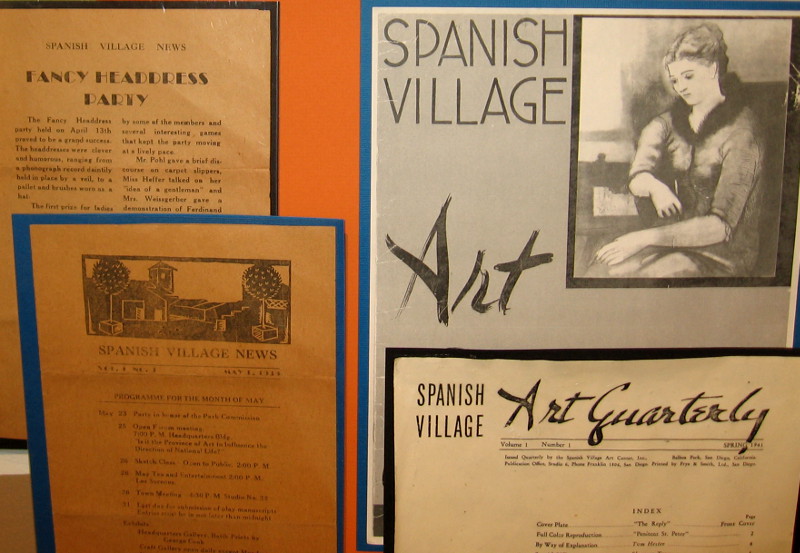
Doorway inside Gallery 21 leads to an unexpected treasure trove of Balboa Park and San Diego history.Beautifully painted mural in the small museum pleases the eyes of art-loving visitors.The walls, like a scrapbook, feature a mosaic of images and articles chronicling the history of Spanish Village.Old photographs show Spanish Village buildings, which were erected for the 1935 California Pacific Exposition in Balboa Park. They housed shops and restaurants during the expo.The California Pacific Exposition closed September 9, 1936, and the idea for Spanish Village Art Center was soon realized. Artists completed their studios and had a public opening on April 7th.Display lists Spanish Village’s artist founders. Newspaper clipping’s “Officers of Culture Project” included Sherman Trease, Mina Schultz Pulsifer, and Henry Long.Old San Diego Union newspaper announces first Art Fiesta, a festival held September 3-6, 1937. Spanish Village hosted all forms of visual art, plus theater groups, writers and musicians.Visitor to the Spanish Village history exhibit learns about the rich heritage of this very unique and wonderful place.Another display tells of the coming of World War II, and how the Army took over Spanish Village. Many departing artists would serve in the military. Some later returned to renew their art.After the Army left, a financial dispute with the City of San Diego was resolved. Artists would pay affordable rent for each studio. A jury would decide on qualified renters.Samples of past Spanish Village publications, including a quarterly. Today the artists promote their work online using websites, e-newsletters and social media.Do you have a memory or story about Spanish Village Art Center? Experiences are being collected and added to this show. Thanks for the community spirit!Spanish Village is located in amazing, historic Balboa Park. Art grows here.
…
Follow this blog for more photos of cool stuff! Join me on Facebook or Twitter.
People gather on a July evening to listen to the amazing, magical Spreckels Organ in Balboa Park.
Tonight I walked through Balboa Park. I lingered for a bit at the Spreckels Organ Pavilion to enjoy the beginning of a special concert. This year, in honor of Balboa Park’s centennial, the annual International Summer Organ Festival is featuring an incredible lineup of the world’s finest organists. Concerts are held Monday evenings through the end of August.
The concert tonight was performed by Aaron David Miller. Here are some pics of the magic…
Tonight at 7:30, composer and concert organist Aaron David Miller performed at the Centennial International Summer Organ Festival.These Spreckels Organ Society volunteers smiled for my camera at one entrance to the free public concert.San Diegans filter into the Spreckels Organ Pavilion as evening progresses and daylight fades.Treats and beverages were served near one entrance.Preparing for the concert on the shadowed stage The sun’s horizontal rays strike one end of the beautiful colonnade.The metal benches are filling up and lights turn on as night descends and the time for music nears.At night, many small lights turn the Spreckels Organ Pavilion into a truly magical place.Pan plays his pipes. Soon a world-class organist will join him.Aaron David Miller begins with Festival Overture, by Felix Mendelssohn.
Young kids learn how to become cool DJs at Make Music Day San Diego.
One more blog post this weekend about Balboa Park! Today was Make Music Day San Diego, which was held throughout our huge urban park! Music filled the air everywhere I walked!
2015 is the first year San Diego has taken part in this unique worldwide event. Countless people in more than 700 cities participated! The public was encouraged to bring instruments to Balboa Park and make music, and many instruments were given away, including 100 harmonicas. A big parade of harmonica players was one part of the event I unfortunately missed, as well as a Mass Appeal guitar jam. There was just not enough time, and too much to see in Balboa Park–and to hear!
Anyway, here are some fun pics that provide a bit of the atmosphere. This blog, alas, doesn’t feature sound.
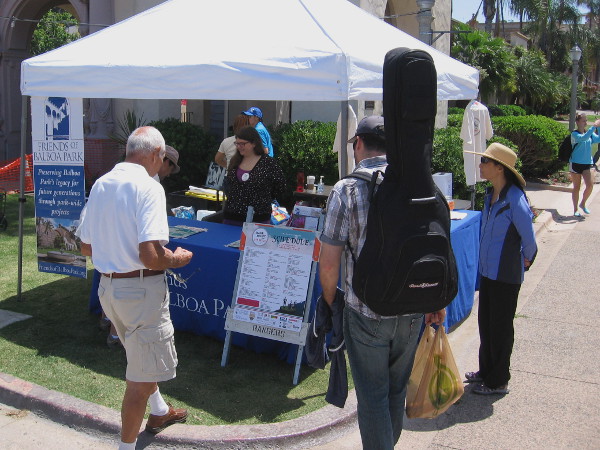
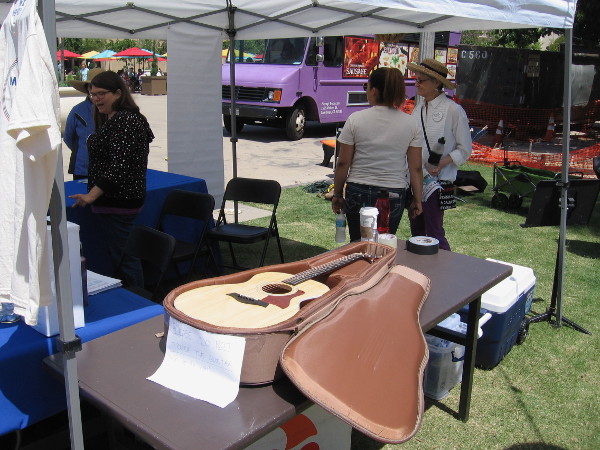
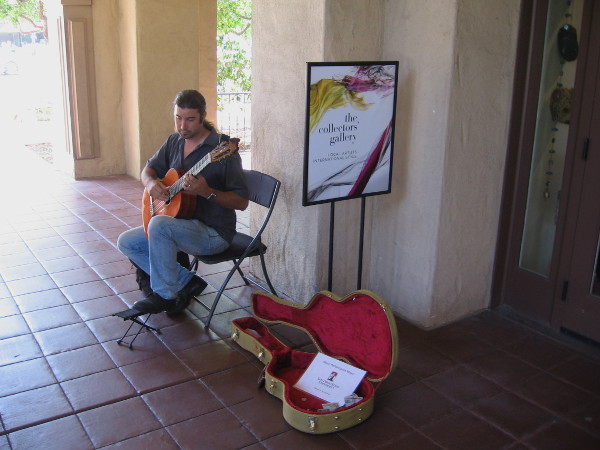
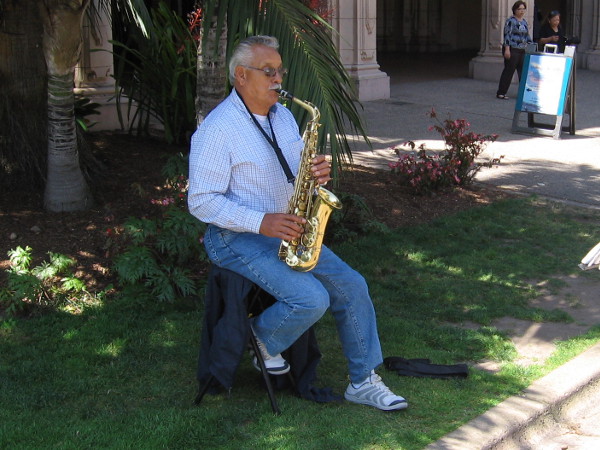
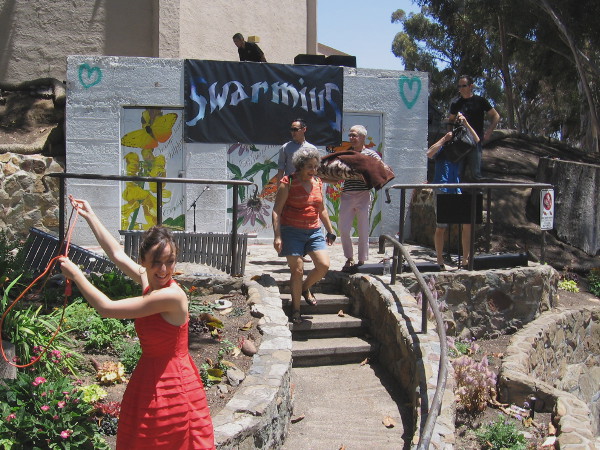
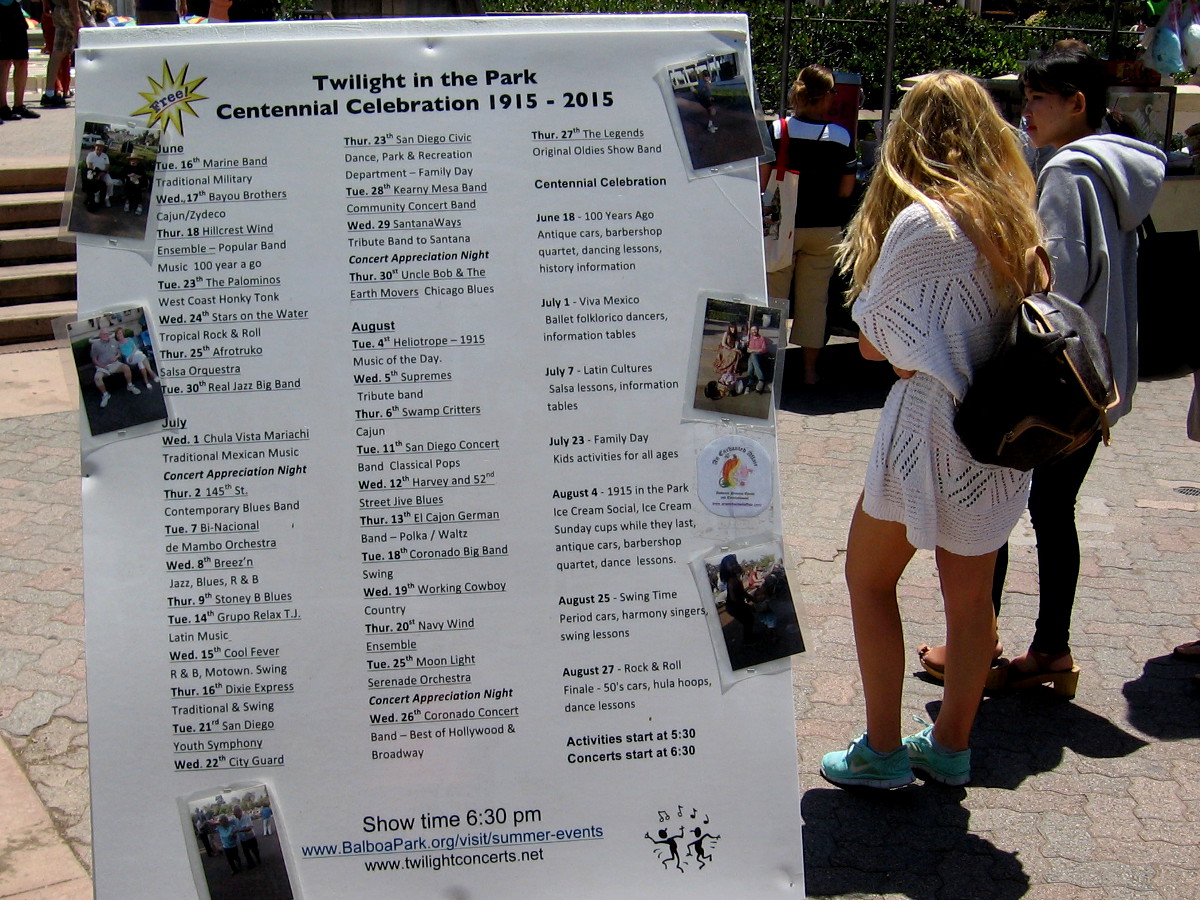
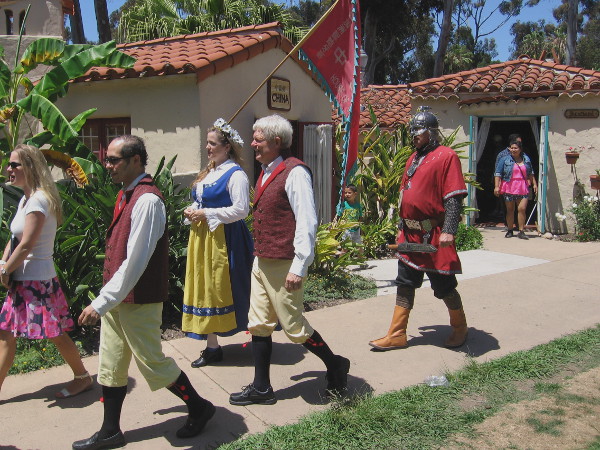
San Diego’s first ever Make Music Day was held in Balboa Park this Sunday.Friends of Balboa Park helped to organize the musical event, which encourages public participation.Some lucky person won this guitar!The public, street musicians and special Make Music Day event performers all contributed to a giant concert throughout Balboa Park.Numerous musicians were up and down El Prado, playing their hearts out.This gent was playing a cool sax in the shade.Live Music Today included Flamenco in Spanish Village, which I already blogged about!The avant-garde band Swarmius was setting up in the Zoro Garden among butterflies. Their half electronic, half instrumental music borrows from every conceivable musical style.Radio Pulso del Barrio, an internet station out of Barrio Logan, was teaching one and all how to be a DJ for the day!Music was heard no matter where you walked!Poster by Spreckels Organ Pavilion lists summer musical performances for Twilight in the Park, Centennial Celebration 1915-2015. (Click to enlarge.)By the way, Sweden had their lawn program at the International Cottages today.I missed the festive maypole dance, but got a photo of the flower-bedecked pole!Beautiful singing was heard from the stage at the International Cottages, as the House of Sweden also provided musical entertainment during Make Music Day!
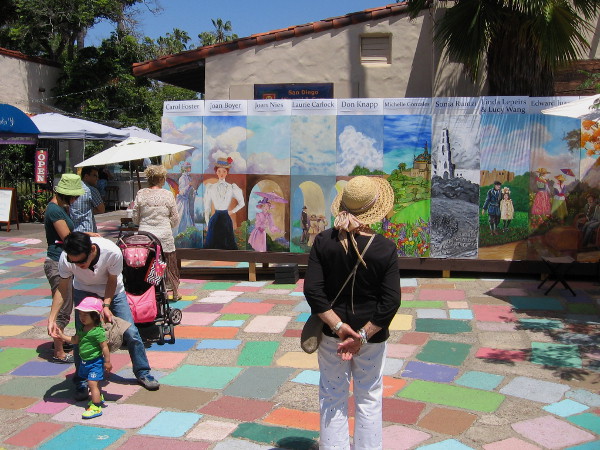
Local artists put the finishing touches on the 20 foot long 1915 Centennial Mural in Balboa Park.
My Sunday walk around Balboa Park took me through the Spanish Village Art Center. Not only were local artists painting live Flamenco dancers, but they were completing a fantastic 20 foot mural celebrating Balboa Park’s centennial. (Today I was also introduced by a couple of super friendly people, including a resident artist, to the history of Spanish Village. I will blog about that shortly, after a little additional research…and when I have the time!)
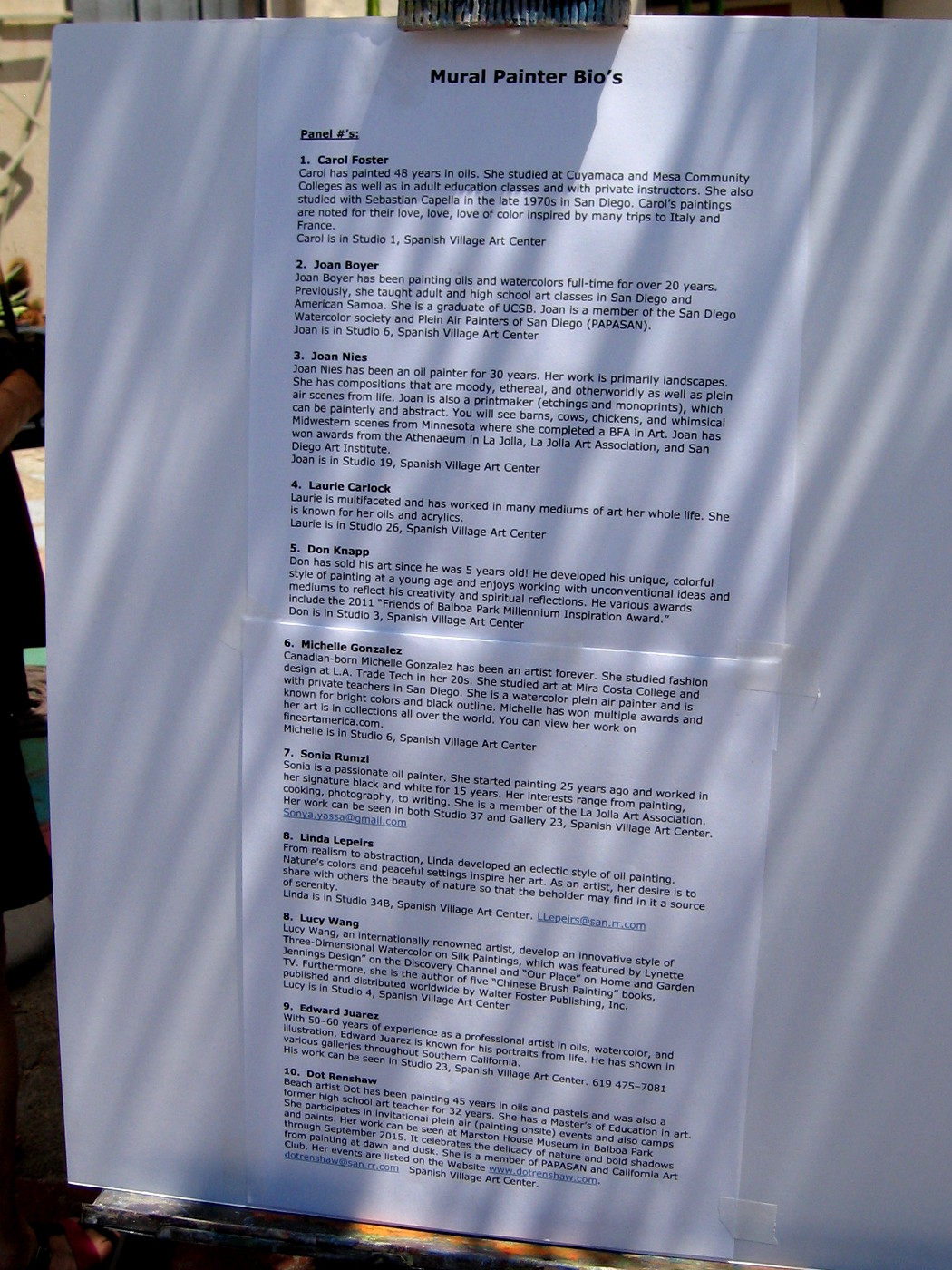
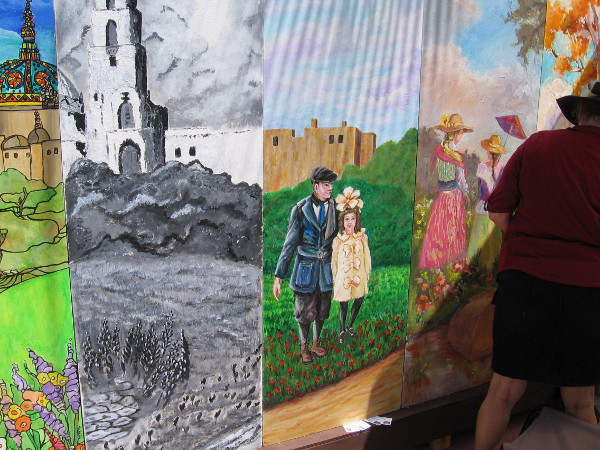
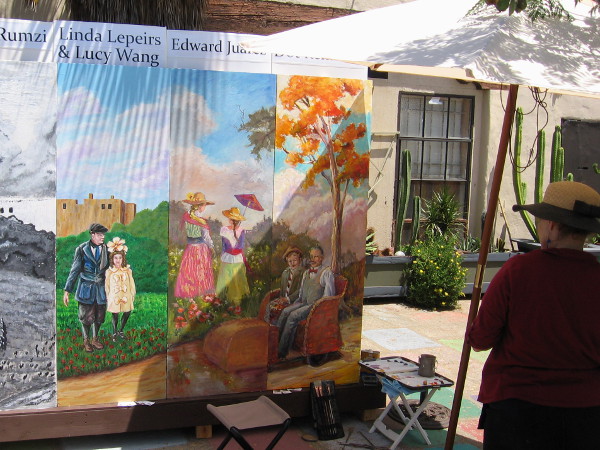
I hope you enjoy my photographs of this awesome mural. Titled “1915 Balboa Park”, it’s an imaginative composite of historical images painted by eleven talented artists. Each image occupies a 2 by 6 foot panel, and depicts locations from the 1915 Panama-California Exposition, and people in early 20th century dress.
Spanish Village is home to some of San Diego’s very finest artists. Wherever you turn, you’ll find painters, potters, sculptors, photographers, glassblowers, you name it! It’s fun to just stroll through the colorful courtyard and visit the charming studios. If you want to purchase fine artwork for yourself or as a gift, this is an excellent place to go!
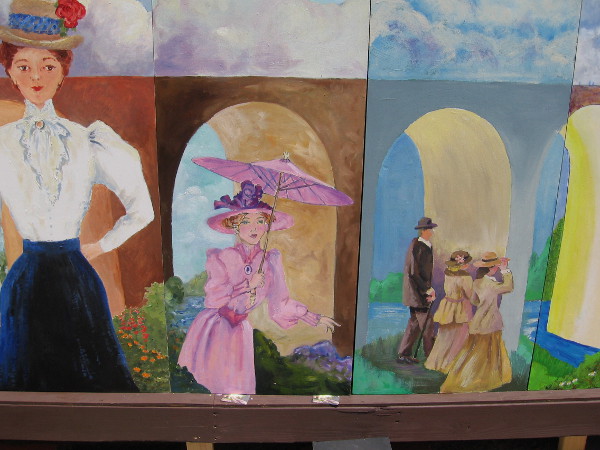
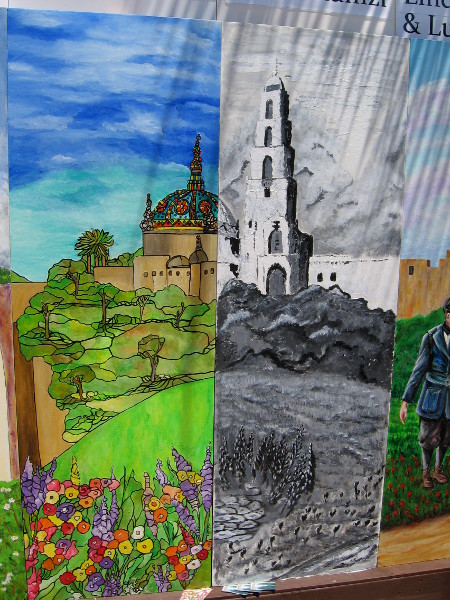
This weekend the public could watch as artists painted a historical mural in Spanish Village.Spanish Village is like San Diego sunlight passed through a prism, with rainbow splashes everywhere.Bios of artists Carol Foster, Joan Boyer, Joan Nies, Laurie Carlock, Don Knapp, Michelle Gonzalez, Sonia Rumzi, Linda Lepeirs, Lucy Wang, Edward Juarez, Dot Renshaw.Ladies in period dresses occupy the left part of the cool mural.Now we’re working our photographic way to the right, along the base of the Cabrillo Bridge. A hundred years ago there was an artificial lake beneath the bridge! (Where Highway 163 is today.)Two different styles (one with bright colors, the other with shades of gray) are fused together to depict the California Building with its iconic bell tower.There were many lush gardens around Balboa Park a hundred years ago, planted specifically for the Panama-California Exposition.An artist studies the right end of the 20 foot long mural. That golden tree looks like it could be transplanted right into Spanish Village!


































 Cool San Diego Sights!