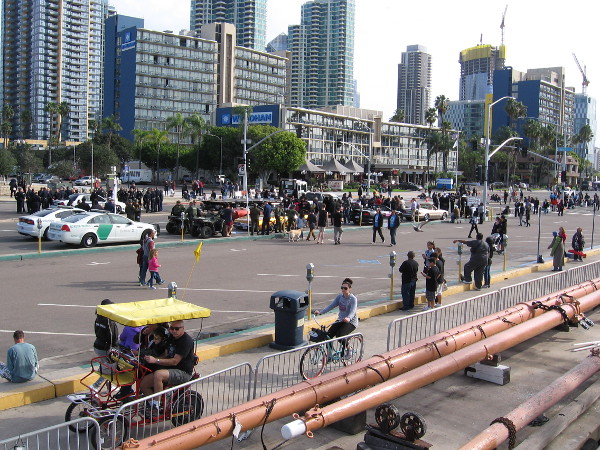
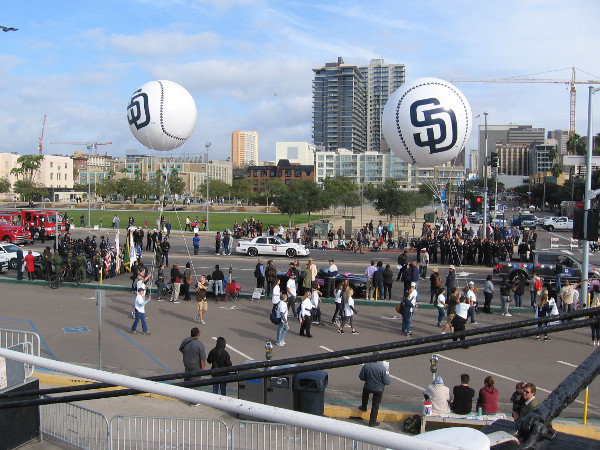
People gather together along Harbor Drive and await the start of the 2017 Martin Luther King, Jr. Day Parade in San Diego.
San Diego’s 2017 Martin Luther King, Jr. Day Parade started this afternoon at 2 o’clock. I arrived a bit early and made my way onto the tall ship Star of India. Best seat in the house!
What all did I see? Read the photo captions!
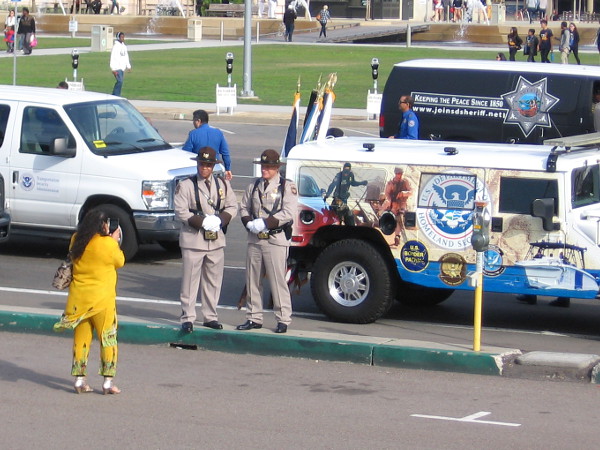
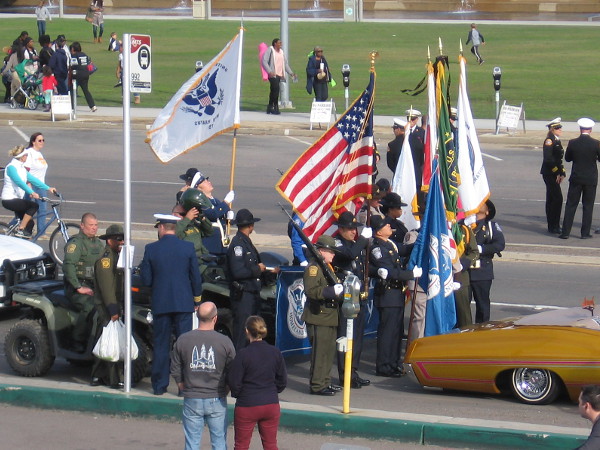
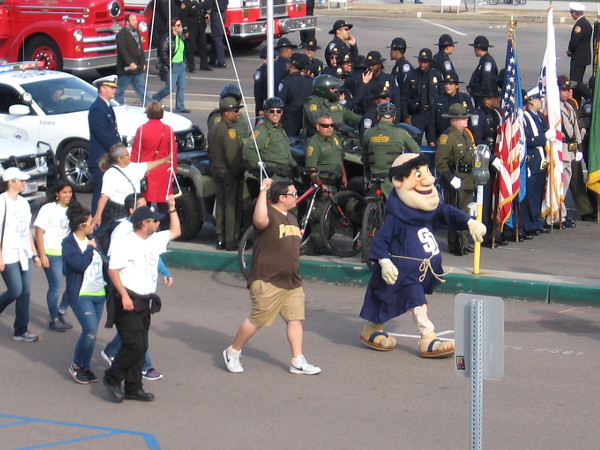
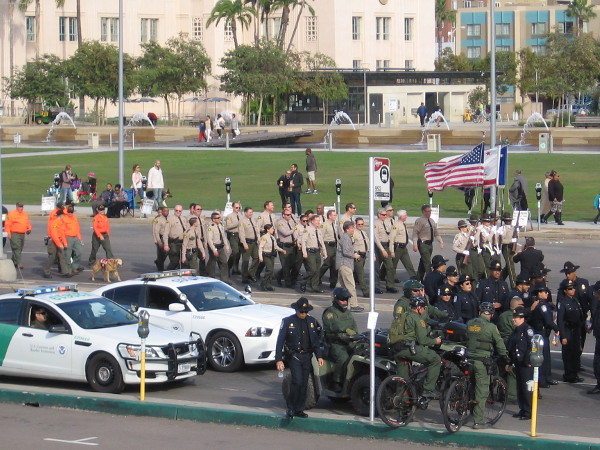
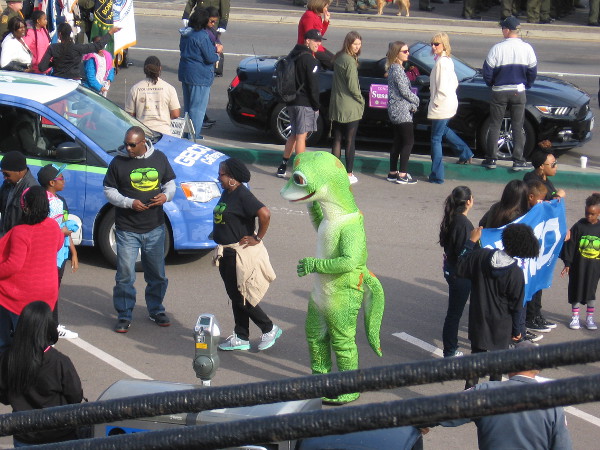
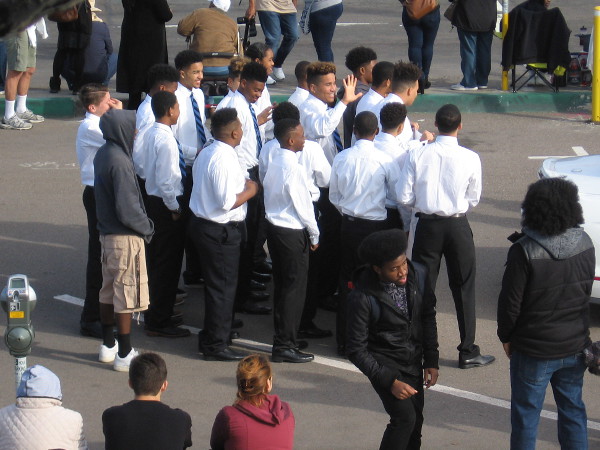
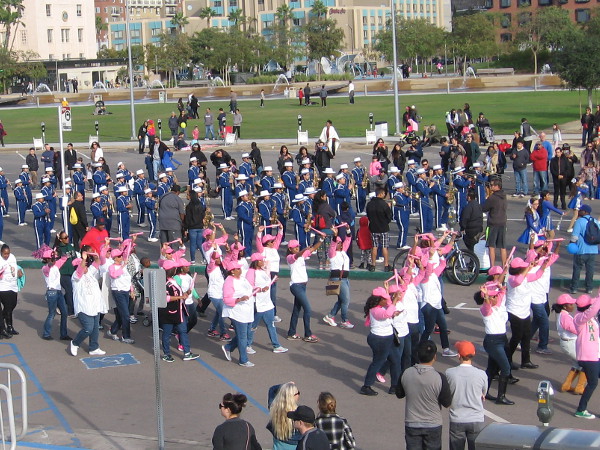
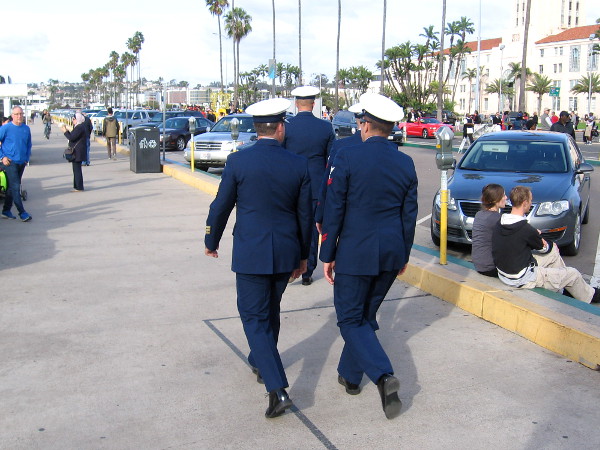
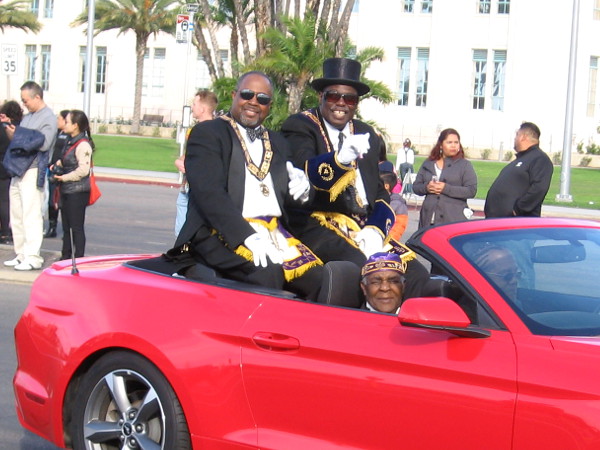
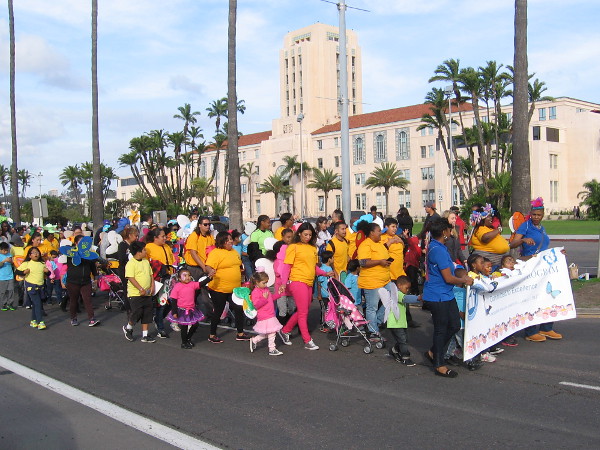
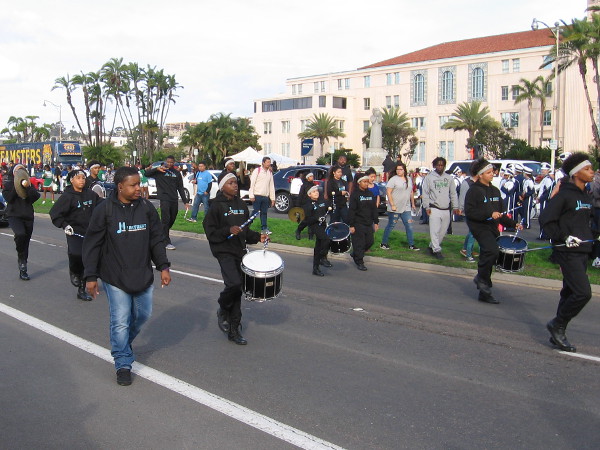
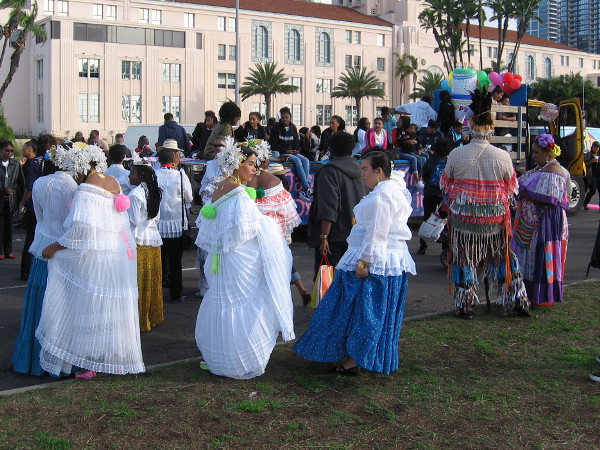
Lots of friendship and smiles up and down the street.Some Navy officers gather near the MLK Day Parade’s starting area.The San Diego Padres would be in the parade. They were waiting with some baseball balloons by the Maritime Museum.One benefit of being a member of the Maritime Museum of San Diego–I could freely watch the parade from atop one of the world’s most famous tall ships–the Star of India!Now I’m looking down from the deck above the historic ship’s forecastle. Joe who works at the museum and I had the best view of the parade all to ourselves!Look at all the folks gathering for the big MLK Day Parade. Every year, it’s one of the most popular parades in San Diego.From the Star of India we overlooked the parade’s starting point. Lots of groups were waiting by their vehicles, including these Homeland Security guys posing for a picture.I also spotted law enforcement officers from around San Diego and the Border Patrol.A pigeon joined us on the tall ship’s rigging. Funny how the politicians manage to always go first. I spotted Todd Gloria, Toni Atkins, Susan Davis and Shirley Weber.Tending to the flags.The parade has begun and here comes the Padres’ happy mascot, the Swinging Friar!The Chargers might be history, but San Diego’s beloved Padres remain a strong part of our wonderful community.I think those guys marching are the San Diego County Sheriffs.Oh, goodness! It’s the Geico gecko.Fellowship and laughter in one group before beginning down the parade route.From our cool vantage point above the starting point, sometimes the big event seemed like two parades in one!It’s a small planet. Perhaps we humans ought to be nice to one another. Martin Luther King, Jr. knew that love overcomes hate.I realized my small camera struggles at a distance, so after a bit I said bye to Joe and headed down to Harbor Drive to get closer shots.Here comes the Saint Peter Grand Lodge!Hello!Here comes a bright yellow float carrying some beauty queens!Wow–look at all the happy people. The Martin Luther King, Jr. Day Parade is a joyful celebration of human diversity and togetherness.Here come some drummers!I believe these guys are students from UCSD. The County Administration Building rises in the background.Lots of colorful costumes and finery representing different experiences and cultures. San Diego comes together as one family.Smiles, happiness and togetherness. May the parade go on and on…
…
I live in downtown San Diego and love to walk around with my camera! You can follow Cool San Diego Sights via Facebook or Twitter!
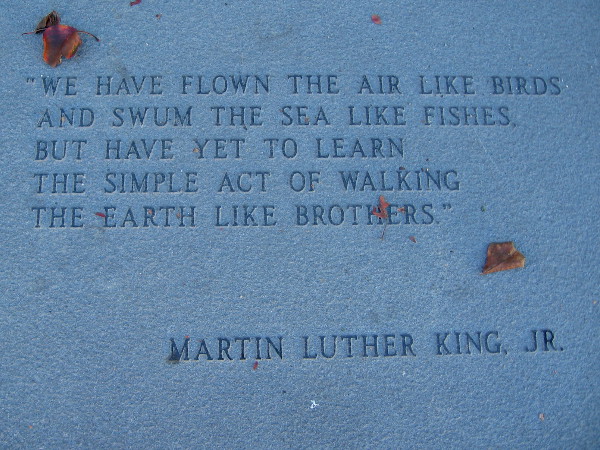
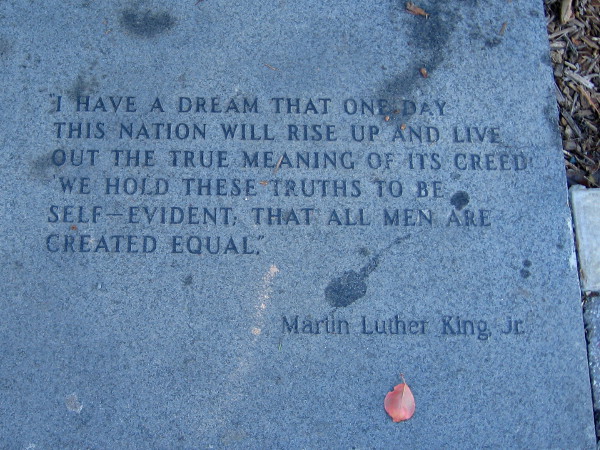
Walking past a plaque which is engraved with one of many important quotes by Martin Luther King Jr.
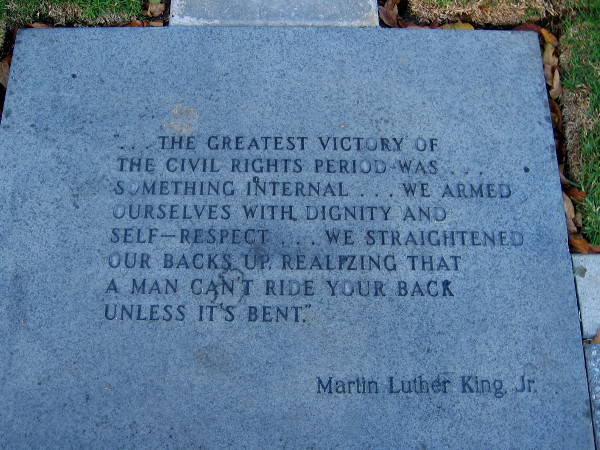
I frequently walk along the Martin Luther King Jr. Promenade in downtown San Diego. Whenever I do, I like to randomly read some of the historic MLK quotes that are engraved in plaques along the long pathway. I’ve never counted the number of quotes. There are easily dozens. Every quote on every plaque is important and powerful, and reflects the intelligence, energy, optimism and wisdom of America’s great civil rights leader.
Here are photos taken at different times of a few of Dr. King’s quotes…
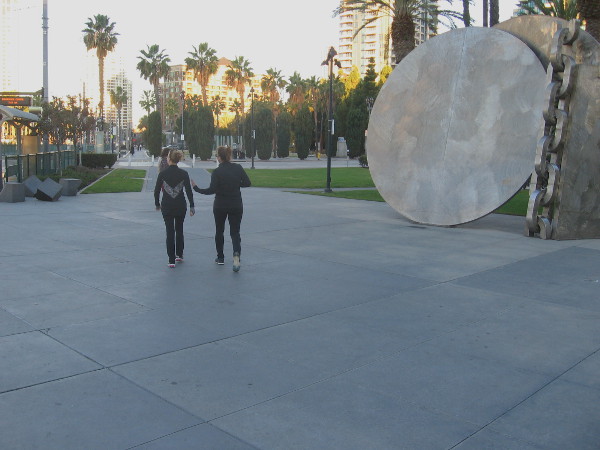
Freedom is never voluntarily given by the oppressor. It must be demanded by the oppressed.The deep rumbling of discontent that we hear today is the thunder of disinherited masses, rising from dungeons of oppression to the bright hills of freedom in one majestic chorus.Along the way of life, someone must have sense enough and morality enough to cut off the chain of hate. This can only be done by projecting the ethic of love to the center of our lives.We have flown the air like birds and swum the sea like fishes, but have yet to learn the simple act of walking the Earth like brothers.Two people walk side-by-side down the Martin Luther King Jr. Promenade in downtown San Diego.I have a dream that one day this nation will rise up and live out the true meaning of its creed: We hold these truths to be self-evident, that all men are created equal.The democratic ideal of freedom and equality will be fulfilled for all–or all human beings will share in the resulting social and spiritual doom…The greatest victory of the civil rights period was something internal…We armed ourselves with dignity and self-respect…We straightened our backs up…The ultimate measure of a man is not where he stands in moments of comfort and convenience, but where he stands at times of challenge and controversy.Any law that uplifts human personality is just, any law that degrades human personality is unjust.Love is the only force capable of transforming an enemy into a friend.Breaking the Chains sculpture, by Melvin Edwards, reminds people on MLK Promenade of the positive legacy of a great civil rights leader.
…
To enjoy future posts, you can “like” Cool San Diego Sights on Facebook or follow me on Twitter.
Abraham Lincoln, slavery, the Constitution, dissent, the Civil War, and lingering questions.
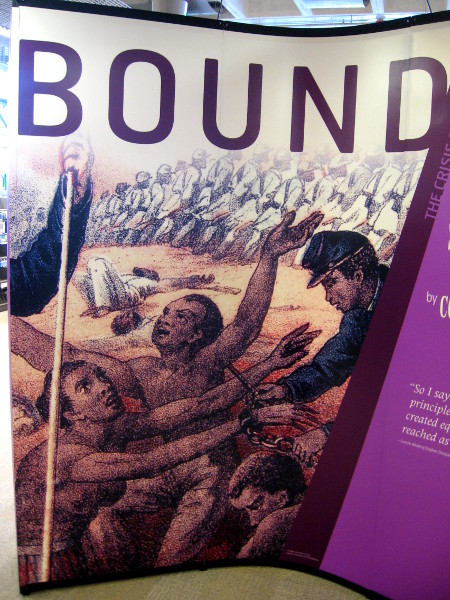
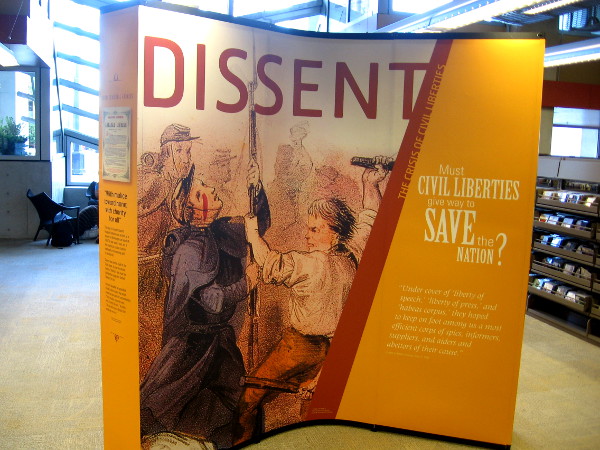
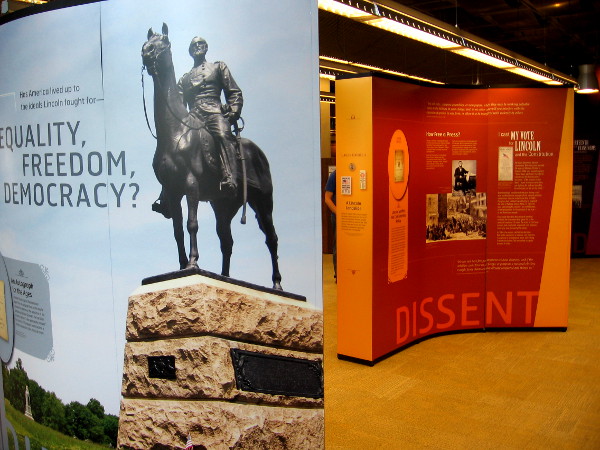
A thought-provoking historical exhibit is currently on display in downtown San Diego’s Central Library. Titled “Lincoln: The Constitution and the Civil War,” the large multi-paneled exhibit outlines and discusses a number of controversial issues that arose during the time of America’s Civil War. The exhibit, which has visited a number of different libraries, was created by the American Library Association and the National Constitution Center.
Old photos and texts help visitors to understand the election of Abraham Lincoln, the secession of the southern states, and the Civil War itself; complex topics that are explored include slavery and the plight of African Americans, the Constitution and state sovereignty, and civil liberties.
If you happen to find yourself in East Village, pop into the library. The large display is on the ground floor and very difficult to miss. The traveling exhibit will remain at this location through January 9, 2015.
Lincoln: the Constitution and the Civil War is on display in San Diego’s Central Library.Meet Mr. Lincoln. The new American president was viewed by some with uncertainty or distrust.People at San Diego’s new downtown public library check out a provocative historical exhibit.The Confederacy attacked Fort Sumter after Lincoln decided to resupply the fortification.Old envelope depicts a boxing match between Lincoln and Jefferson Davis.The Civil War, fought for complex reasons, effectively ended slavery in America.The original Constitution didn’t abolish slavery. It left the matter to the states.Exhibit examines dissent, and Lincoln’s choice to suspend the writ of habeas corpus.Traveling library exhibit asks about the state of equality, freedom and democracy today.It is for us the living…to be dedicated here to the unfinished work.
…
To enjoy future posts, you can “like” Cool San Diego Sights on Facebook. or follow me on Twitter.
Public art at Lillian Place shows many facets of African-American history in San Diego.
Should you walk through downtown San Diego’s East Village in the vicinity of 14th and J Streets, you might be attracted to several large yellow panels along the sidewalk. This proud display of public art at Lillian Place was raised to commemorate how African-Americans have played an important role in building our diverse and beautiful city.
The artwork, created by Jihmye Collins and Nina Karavasiles, is titled “A San Diego African-American Legacy” and represents African-American contributions to San Diego’s development and rich history.
Cast metal parachute recalls 1943’s Top Black Owned Business in the United States.
Here’s a large portion of the text contained on the panels:
People of African decent were present in San Diego as early as the establishment of Presidio de San Diego in 1769, and played a role in settling the area now known as Old Town.
In the later decades of the 1800s, African-Americans began emigrating to Horton New Town, San Diego’s present-day downtown, relocating primarily from the southern US.
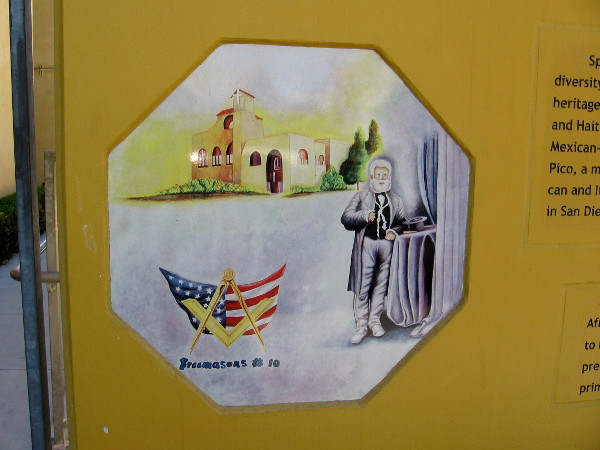
Religious institutions were, and continue to be a cornerstone of the African-American community. In 1887, the African Methodist Episcopal Church became the first organized African-American congregation in downtown San Diego, followed soon after by Calvary Baptist and Bethel AME. At the same time, African-American social and civic groups like the Violet Club, Acme Social Club and Fidelity Lodge #10 of the Prince Hall Masons became important organizations in the community.
San Diego was once the center of a thriving jazz, blues, and gospel music scene. The Creole Palace at the Douglas Hotel and the Crossroads Jazz Club were just two of the spots that hosted local and national talent playing to mixed audiences.
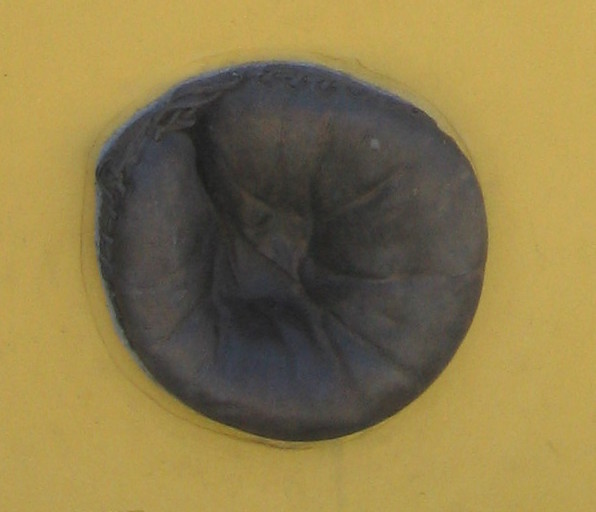
African-Americans have always played a major role in amateur and professional sports in San Diego. Local favorite Archie Moore fought at the city Coliseum as did other champions. San Diegan John Ritchey became the first black player in the Pacific Coast League when he was signed as a catcher to the then minor league padres in 1948.
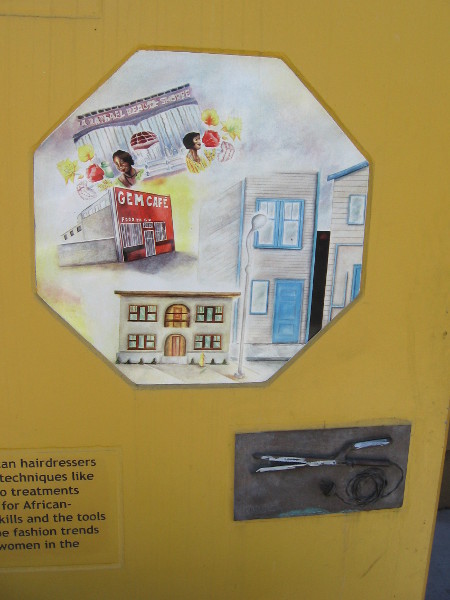
The entrepreneurial spirit of the African-American community flourished through the 20th century with doctor’s offices, hotels and clubs, barbers and beauty parlors, cafes and restaurants, ice cream parlors, laundries, jewelers and pool halls that served the African American community as well as other San Diegans.
During World War II, African-American stunt pilot and businessman Howard Skippy Smith owned the Pacific parachute Company factory on 8th Avenue. Named the Top Black Owned Business in the United States in 1943, Mr. Smith operated an integrated work place that reflected the ethnic and racial diversity of wartime San Diego.
On this block of J Street, African-American Lillian Grant owned multiple buildings, offering rooms to an ethnically mixed clientele during the time of segregation. Next door at the corner of 14th and J Streets sat the Vine/Carter Hotels. Known as the colored hotels, it was owned and operated by African-Americans Alonzo and Katie Carter from the 1930s to the 1950s.
African-Americans helped to build religious institutions and community organizations.Exact duplicate of baseball catcher’s mitt from the 1940’s made of cast metal.Artwork shows San Diego as an important center of jazz, blues, and gospel music. Count Basie and Billie Holiday both played at the Creole Palace.Hair curling iron is a symbol of many thriving African-American entrepreneurs.
…
To enjoy future posts, you can “like” Cool San Diego Sights on Facebook, or follow me on Twitter.




















 Cool San Diego Sights!