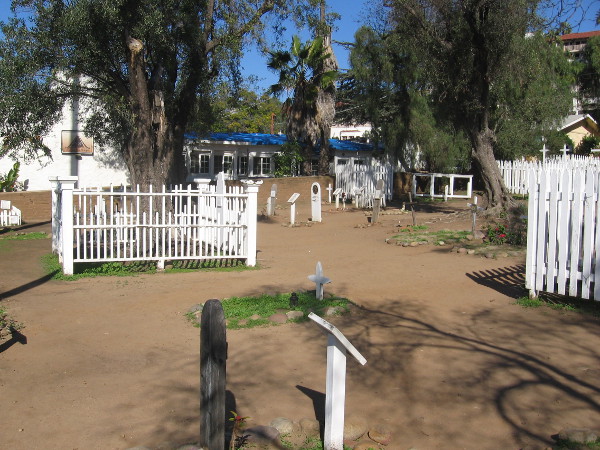
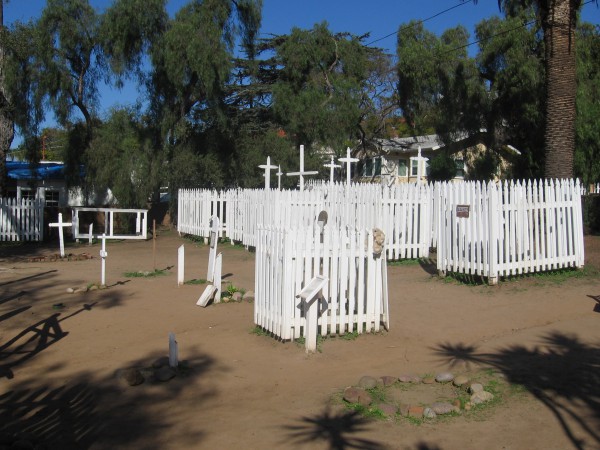
El Campo Santo, a cemetery located in Old Town, contains many of San Diego’s earliest residents. By walking respectfully among the gravestones, one can learn much about the city’s interesting history and what life was like for its diverse people. Real-life characters buried here include ranchers, gold miners, sailors, Californios, Native Americans, soldiers, politicians, merchants, actors, children and outlaws.
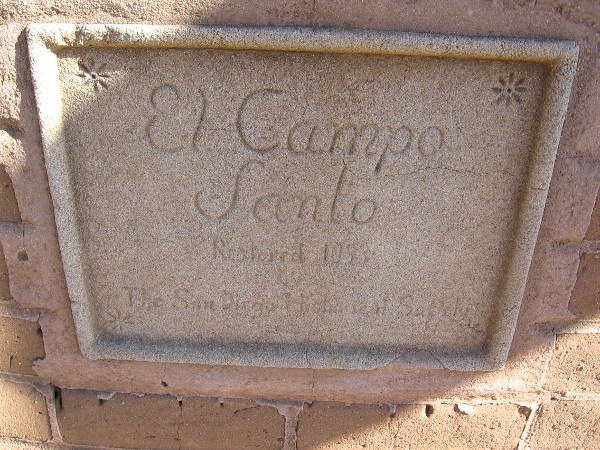
Established in 1849, the graveyard is the final resting place of nearly five hundred souls. Just a handful are shown in this blog post.
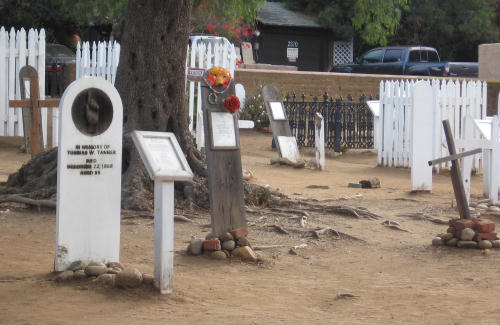
I took photographs of grave sites, headstones and many small signs in the “Holy Field” that describe what is known about the deceased. With a little editing, I’ve provided information here from many of those signs, and from a few other online sources.
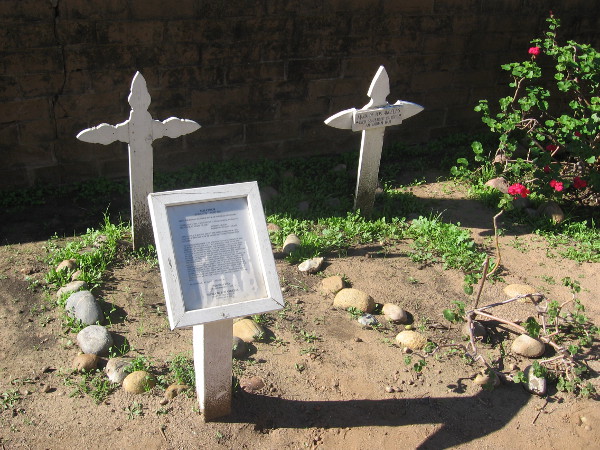
Melchior, born 1770, died 1867, age 97 years. Very little is known about the Indian Melchior. He was born a year after the arrival of Junipero Serra in San Diego. He was baptized by the missionaries and became a Roman Catholic Christian. During his long life, he saw San Diego grow from a small pueblo to a city.

Thomas W. Tanner was buried December 22, 1868, age 55 years. He ran an acting troupe that performed on the second floor of the Whaley House in December 1868. Tanner’s troupe offered moral, chaste and versatile entertainment consisting of drama, farce, comedy, singing and dancing. Unfortunately, Tanner died 17 days after his troupe opened. He was married to Policarpia de la Rosa and was a native of Baltimore, Maryland.
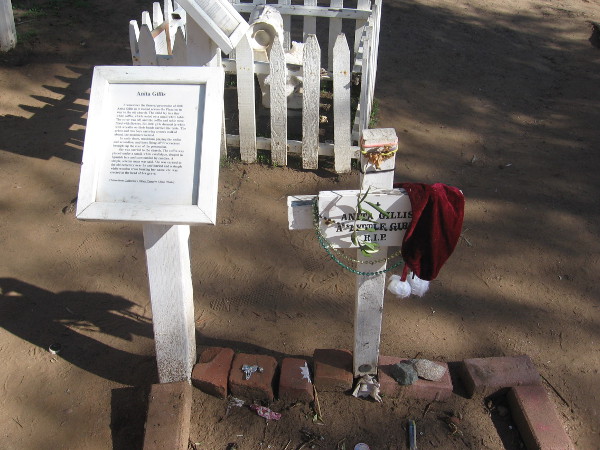
Anita Gillis was a child when she died. Her funeral is remembered as follows on a plaque by the grave. A funeral procession wound across the Plaza and ended at the old church. The child lay in a tiny white coffin, which rested on a small white table. The cover was off, and the coffin and table were filled with flowers. Six little girls dressed in white with wreaths on their heads carried the table. The priest and two boys carrying crosses walked ahead, the mourners behind. Musicians played the violin and accordion, and boys firing off firecrackers brought up the rear of the procession. She was carried to the church, and the coffin placed under a small white catafalque, draped in Spanish lace and surrounded by candles. A simple, solemn mass was said. She was then carried to the old cemetery and buried with a simple white wooden cross bearing her name erected at the head of her grave.

Juan Mendoza died February 6, 1865. He was the victim of a fatal shotgun blast to the back. The assailant was Cave Johnson Couts, a local landowner and prominent San Diegan born in Tennessee. As the story goes, Mendoza worked as majordomo, or chief steward, on one of Cave Couts’ ranches. Couts claimed that Mendoza had threatened his life and in a hasty act of revenge killed Mendoza in broad daylight. The action violated the legendary “Code of the West” which prohibited “shooting an unarmed man” and “shooting a man in the back”. Couts was tried by jury for his crime and found not guilty. This was received “with much applause” from local citizens since threatening the life of a man, as Mendoza allegedly did, gave Couts the right to stand his ground and kill him.
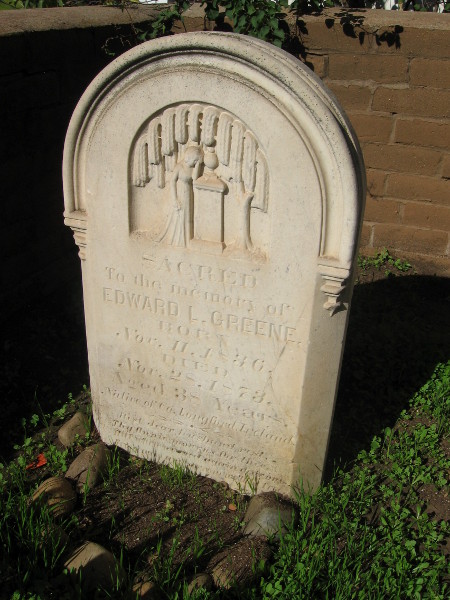
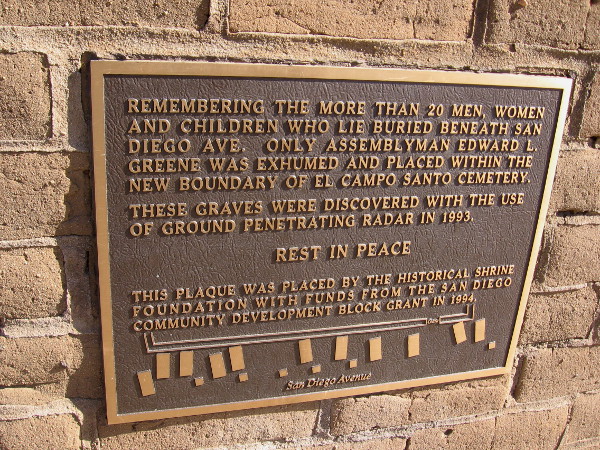
Honorable Edward Lynch Greene died November 28, 1872, age 38 years. He was a native of Ireland who came to California in 1852 and was a miner for gold. He was naturalized in 1861. He became a member of the state legislature when he was elected to the Assembly from Calaveras County in 1869. He was staying in San Diego at the Era House when he died of consumption. He’d been ill for the past eighteen months. He left behind a young wife, Ann Greene.
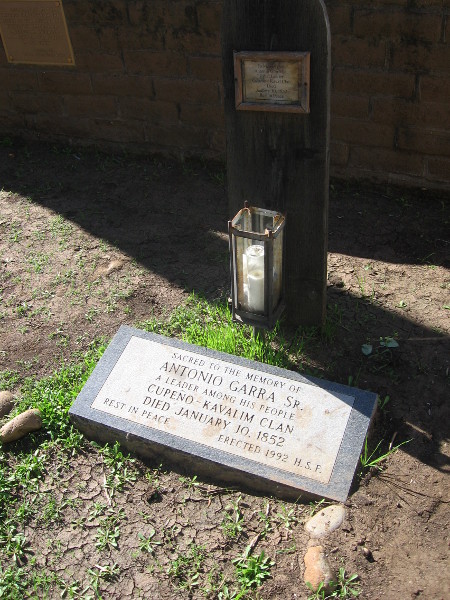
Antonio Garra Sr. died January 10, 1852. He was a leader among his people, the Cupeno-Kavalim Clan. He was educated at Mission San Luis Rey and spoke as many as five Indian dialects, as well as Latin. He was one of the foremost chiefs with great power and influence among his people. The Cupeno were considered mission Indians and were subject to pay taxes in San Diego County. Garra, upset by the taxation of his people, helped to organize a resistance movement, comprised of attacks on Santa Barbara, Los Angeles and San Diego. Against his wishes, a fatal attack was made on Warner’s Ranch. He was soon thereafter captured. On January 10, 1852 Garra was found guilty of murder and theft, but not treason, as he had never taken an oath of allegiance to the United States. Before being executed by firing squad, Garra said in his last words: “Gentlemen, I ask your pardon for all my offenses, and expect yours in return.” Antonio Garra, Sr. is believed to be buried underneath what is now San Diego Avenue.
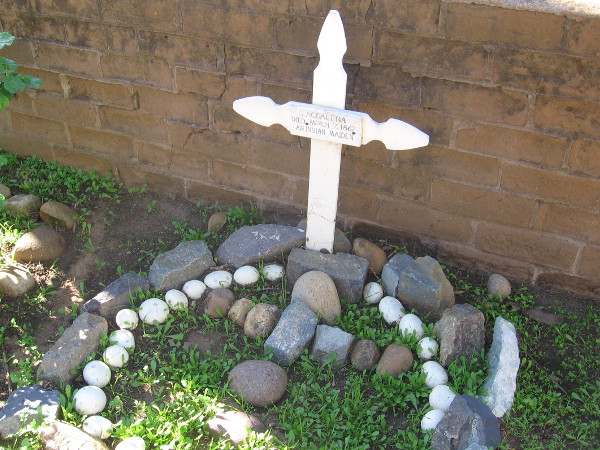
Magdalena was an Indian maiden who died on March 7, 1867 at age 21.
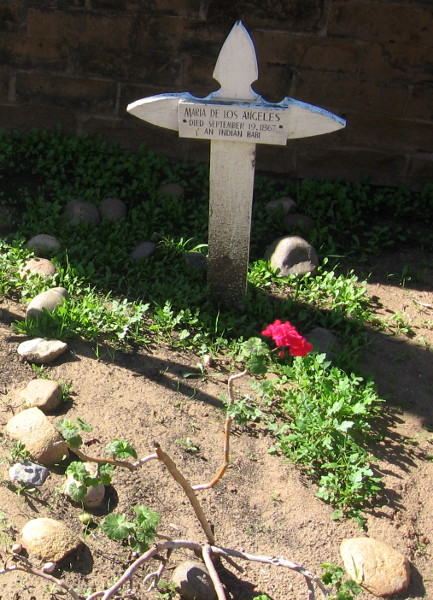
Maria de los Angeles was an Indian infant who died September 19, 1867.
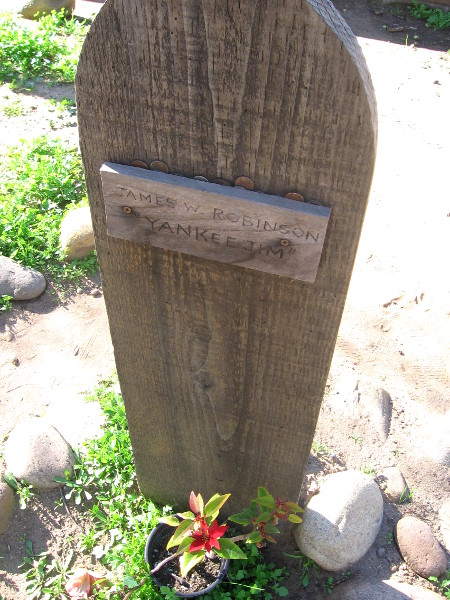
James W. Robinson was known as Yankee Jim. He suffered an extreme penalty for stealing the only rowboat in San Diego Bay. He was sentenced to be hanged. He couldn’t believe that he would be hanged until the very last moment. He appeared to think it was all a grim joke, or at worst, a serious effort to impress him with the enormity of his evil ways. He was still talking when the deputy sheriff gave the signal. Yankee Jim converted to the Roman Catholic Church prior to his death, and so was given the baptismal name of Santiago (Spanish for James). His godfather was Philip Crosthwaite, the deputy sheriff who gave the signal for his execution.

Rosa Serrano de Cassidy died February 10, 1869, age 21 years. She was the first wife of Andrew Cassidy (a native of County Cavan, Ireland) who helped establish and operate the U.S. tidal gauge in La Playa (in present day Point Loma). Rosa was the daughter of Jose Antonio Serrano who served under Pio Pico in the Mexican War and was in the battle of San Pasqual. Rosa and her husband owned a rancho in Pauma. Her headstone is one of the few remaining originals in the cemetery. After cracking during an earlier restoration, it was placed flat on the ground in order to preserve it.
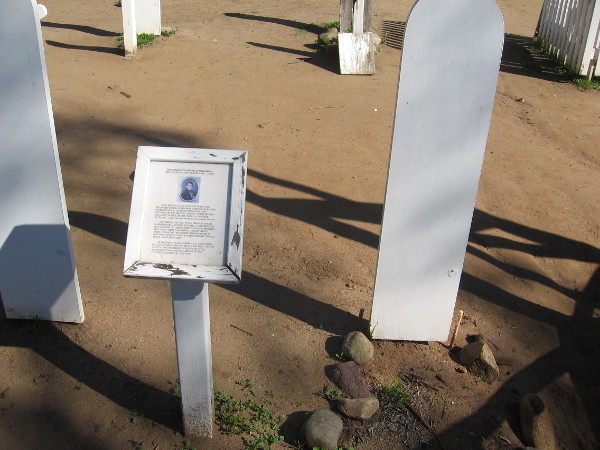
Don Miguel Telesforo de Pedrorena died March 21, 1850. Don Miguel was a native of Spain, belonging to one of the best families of Madrid. After receiving an education in his own country, he was sent to London, where he was educated in English. In 1845 he settled in San Diego. He married Maria Antonia Estudillo, daughter of Jose Antonio Estudillo, and the two had four children. They built their casa behind the Estudillo home. It was one of the first framed houses in Old Town, and still stands beside the San Diego Union print shop. Don Miguel became a leading merchant and citizen of old San Diego. He served as a delegate to the State’s Constituional Convention at Monterey in 1849 and became one of the founding fathers of California.

Juan Maria Marron, born 1808, died at the age of 45. He was a ship’s captain before coming to San Diego in the early 1820’s. He was the owner of 13,311 acres called Rancho Agua Hedionda, which extends from modern day Vista to Carlsbad. He became prominent politically when he married Dona Felipa Osuna in 1834. She was the daughter of Juan Maria Osuna, who was the first alcalde of San Diego and the owner of Rancho San Dieguito. During the Mexican-American War, Marron supported the Americans against many of his Mexican friends. He was captured by Californios who threatened to execute him, but he was released, and his rancho was stripped of horses and cattle.

Buried November 28, 1859, age 4 years, Jayme was one of probably thirteen children of George and Bernarda Lyons. Jayme’s father was a native of Donegal, Ireland, who came to San Diego in 1847. He had been a carpenter on a ship that came around Cape Horn from New Bedford, Massachusetts. He kept a store in Old Town, owned a blacksmith shop, and was sheriff for two terms. Jayme’s mother was Bernarda de Villar, the daughter of Lieutenant de Villar, who at one time was the Commandant of the San Diego Presidio.

Bill Marshall and Juan Verdugo were hanged on December 13, 1851. Bill Marshall was an American married to the daughter of a local Indian chieftain. He was a renegade sailor from Providence, Rhode Island, who’d deserted from a whaling ship at San Diego in 1844. After taking up habitation with the Indians, he took an active part in the Garra Indian uprisings in 1851. He and the Indian Juan Verdugo were caught and brought back to San Diego to be promptly tried by court martial. Both were found guilty. The Indian acknowledged his guilt, but Marshall insisted he was innocent. At two o’clock in the afternoon, a scaffold was erected near the old Catholic cemetery, the men placed in a wagon, the ropes adjusted about their necks, and the wagon moved on, leaving them to strangle to death.

Rafael Mamudes was a Native American born in Hermosillo, Mexico. He was a baker in Monterey, a miner in Calaveras County, and made a sea voyage to Guaymas. He owned a little plot of land in San Diego where the old jail stands. Legend has it he made a murderous attack upon his wife. To do penance, the priest gave Rafael the task of ringing the church bells when the occasion demanded. Rafael worked at chopping wood and digging wells. He dug the graves for the people of Old Town. He never missed a church service.

Jesus, an Indian, passed away December 15, 1879, age 25 years. He died of a blow to the head without receiving sacraments. According to the priest Juan Pujol, he was said to be drunk, so he was buried near the gate of the cemetery.
…
To enjoy future posts, you can “like” Cool San Diego Sights on Facebook or follow me on Twitter.












 Cool San Diego Sights!