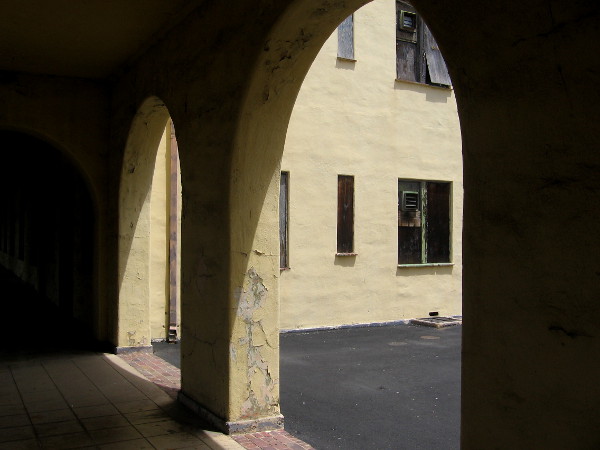
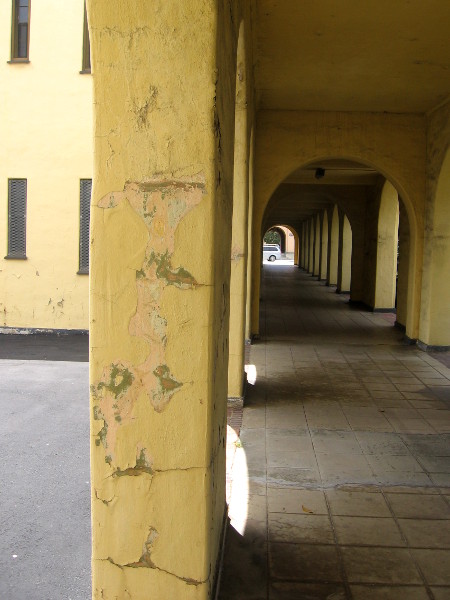
Photo of old, shuttered windows taken through dark, weathered archway.
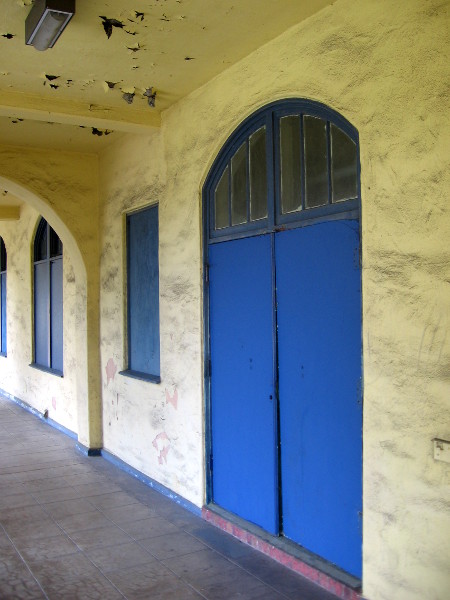
During my recent ramble around NTC Liberty Station, I did some nosing around. I took a few interesting photos of a lonely portion of the old Naval Training Center San Diego that has yet to be renovated. A row of old, weathered barracks along the North Promenade are vacant and locked shut. But if you listen closely, and use a little imagination, it might be possible to hear the echoing footsteps of naval recruits from decades ago.
The old Naval Training Center in Point Loma is a fascinating place with a significant place in United States history. The idea of training sailors in San Diego was first explored in 1915 by Assistant Secretary of the Navy, Franklin D. Roosevelt. When the complex was finally built in 1921, it was a modest affair, with several barracks, a mess hall, dispensary, and a few other buildings. It expanded over the years, and during World War II accommodated as many as 25,000 naval recruits. The center remained a vital resource of the United States Navy until 1997, when it was finally closed. Today around 50 original buildings along the beautiful promenade (which also includes the old base’s command center and parade ground) have been restored. Liberty Station has become a popular destination for shopping, recreation and a variety of cultural attractions.
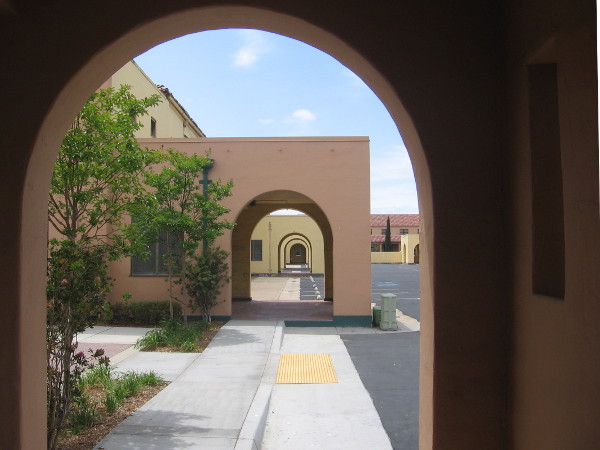
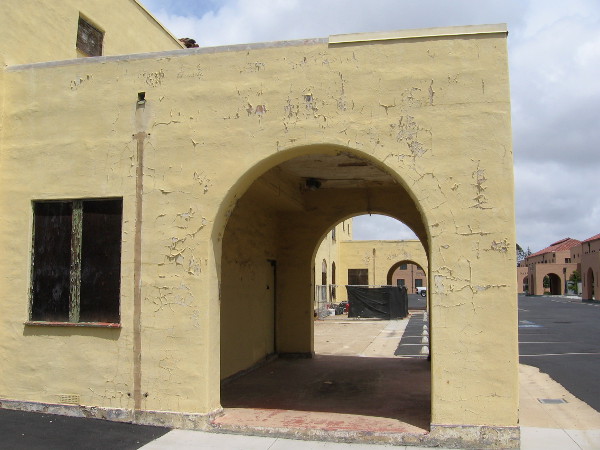
In the following photos, you might note the architecture is mostly based on the Spanish Colonial Revival style, particularly the long arcades. The design of the Naval Training Center was directly influenced by buildings constructed for the 1915 Panama-California Exposition in San Diego’s Balboa Park.
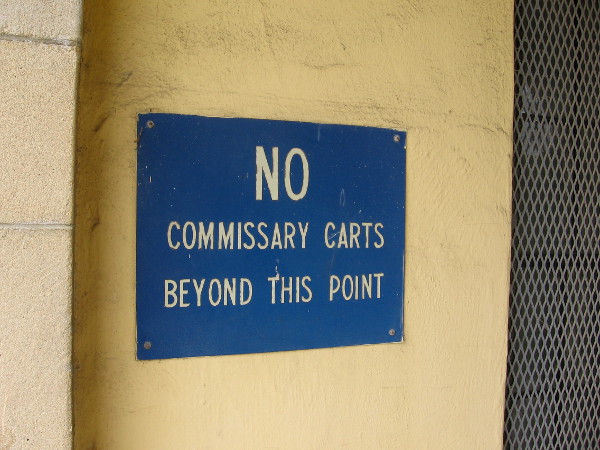
Looking along the length of long-abandoned Barracks 5 at NTC Liberty Station.Some old military base signs still can be seen at the historic Naval Training Center San Diego.Buildings 18 and 25 remain empty. Most structures in the complex are renovated and have commercial or nonprofit tenants.Simple geometry of functional architecture influenced by the Spanish Colonial Revival style.Peeling yellow paint on buildings where new United States Navy recruits used to train.There’s something strangely picturesque in this image of lonely decay.With a bit of imagination, one can picture newly recruited sailors moving and marching through the Naval Training Center years ago.This boldly painted blue door really catches the eye!Walking around NTC Liberty Station is like taking a small voyage back into history.
…
To enjoy future posts, you can “like” Cool San Diego Sights on Facebook or follow me on Twitter.
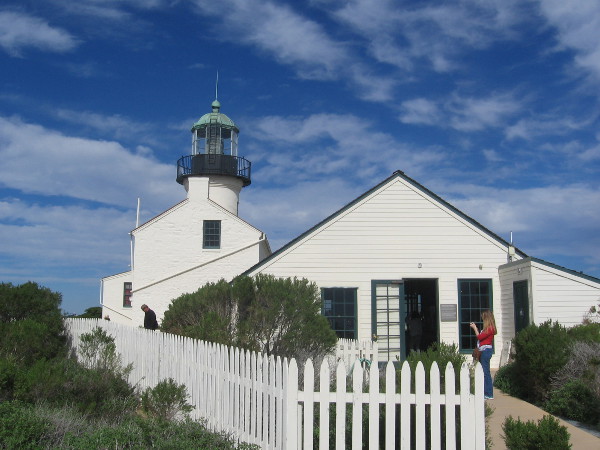
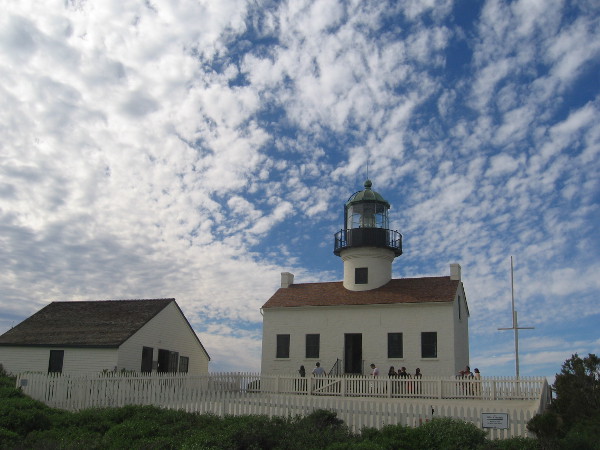
Looking up at the Old Point Loma Lighthouse in Cabrillo National Monument.
Everyone likes to explore the Old Point Loma Lighthouse. You can climb up the winding staircase and peer into several interesting rooms where the lighthouse keeper and his family lived. But the small museum in the nearby assistant keeper’s quarters contains the true marvels of science and art. Come inside and let us have a quick look!
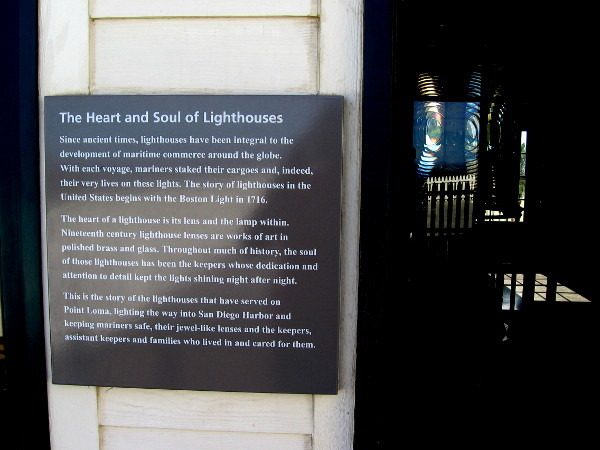
The assistant keeper’s quarters next to the lighthouse today contains a small museum.Sign outside lighthouse shows huge Fresnel lens which guided ships with focused light 400 feet above sea level.Sign at entrance to museum. The heart of a lighthouse is the lens and lamp. 19th century lenses are works of art made of polished brass and glass.
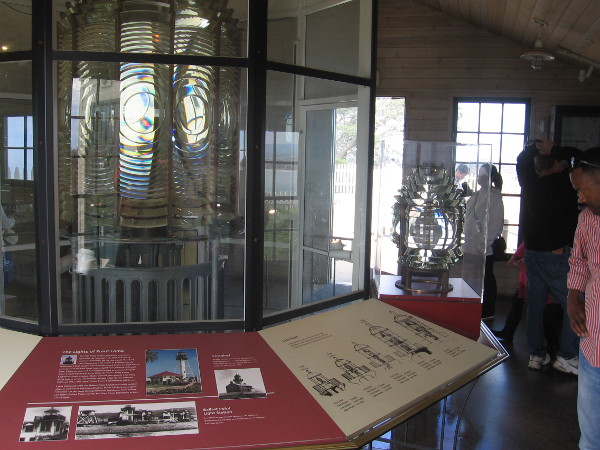
The highly polished Fresnel lenses utilized by lighthouses are beautiful objects. They refract and reflect light, creating prismatic colors when viewed from certain angles. It’s almost a miracle that a small flame in a lamp can be magnified to the extent that ships far out at sea can easily see it and be guided to safety. Light intensified by lenses in this museum could be seen 18 to 24 miles away!
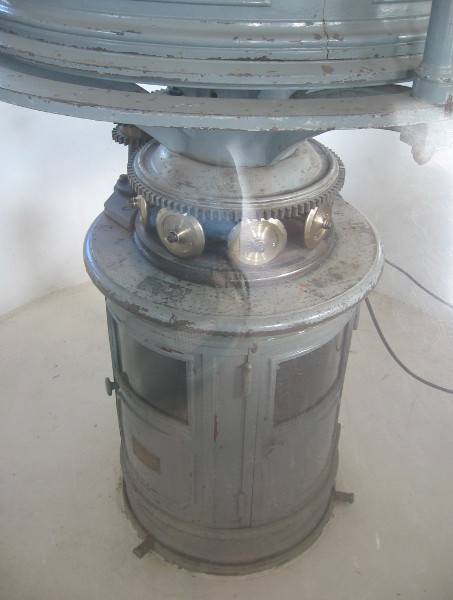
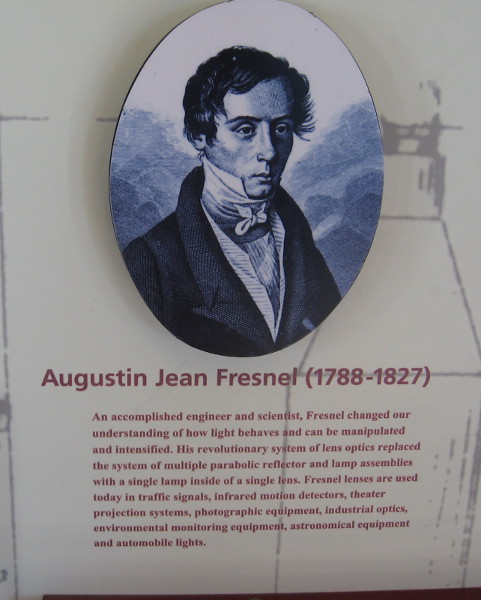
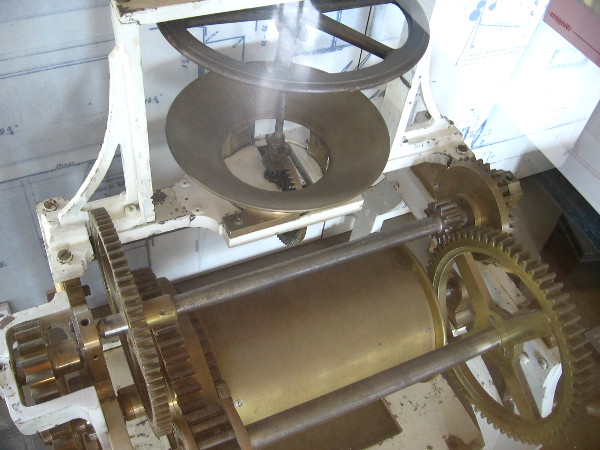
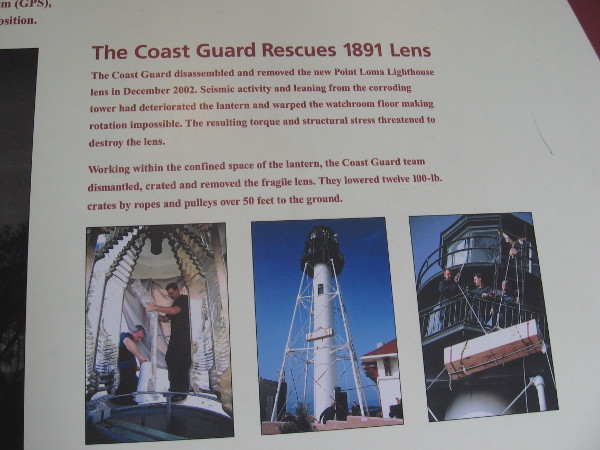
This 3rd Order Fresnel lens was used by the New Point Loma Lighthouse, built in 1891 down by the water.An optical wonder, this huge lens is an amazing, highly polished light bender.Diagram shows how a complex Fresnel lens functions.The base of the heavy Fresnel lens with chariot wheels visible.There are different orders of size, as illustrated in this display.Augustin Jean Fresnel (1788-1827) was an accomplished engineer and scientist. Fresnel lenses are used in many modern applications today.Small museum by Old Point Loma Lighthouse contains various very cool exhibits.This small 5th Order lens lighted the Ballast Point Lighthouse from 1890 to 1960.Log book of daily expenditures for oil, wicks and chimneys.This clockwork of gears slowly turned the light above.The keeper’s service box contained cleaning supplies and delicate tools for maintaining the lamp.The Coast Guard removed this large Fresnel lens from the New Point Loma Lighthouse in 2002.Looking at the iconic Old Point Loma Lighthouse and small museum beside it.
…
To enjoy future posts, you can “like” Cool San Diego Sights on Facebook or follow me on Twitter.
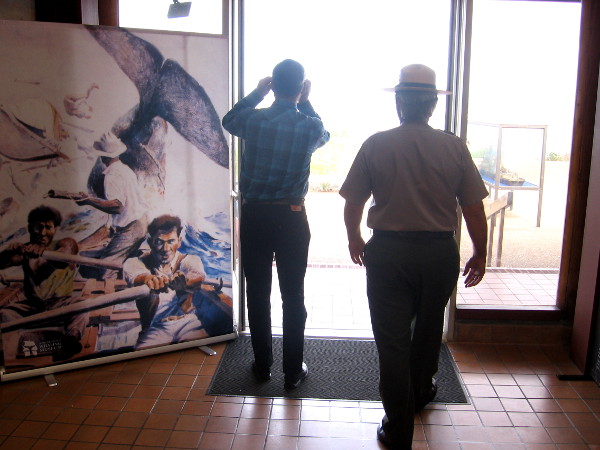
Looking out the rear of the Cabrillo National Monument Visitor Center on a beautiful day.
I saw on the morning news that an important exhibit was opening today in the Cabrillo National Monument Visitor Center. I haven’t been up that way since I blogged about the park’s centennial, so I figured I’d go check things out!
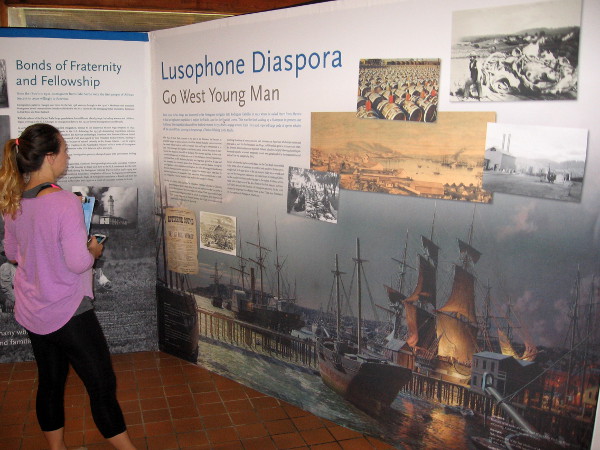
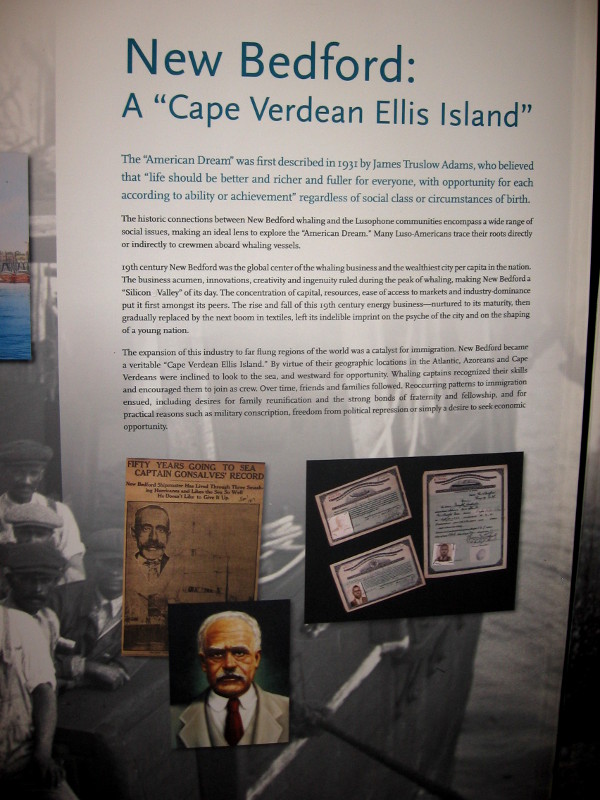
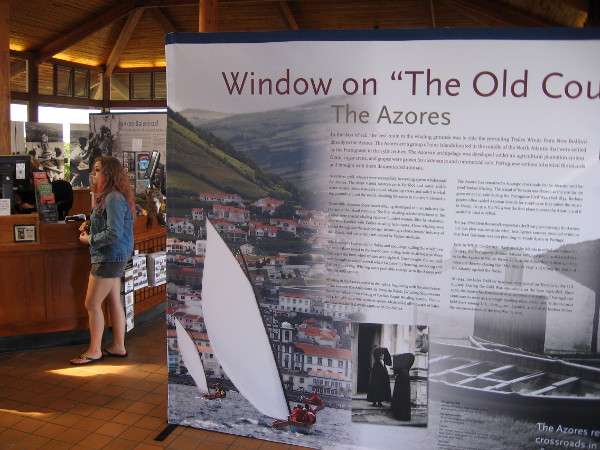
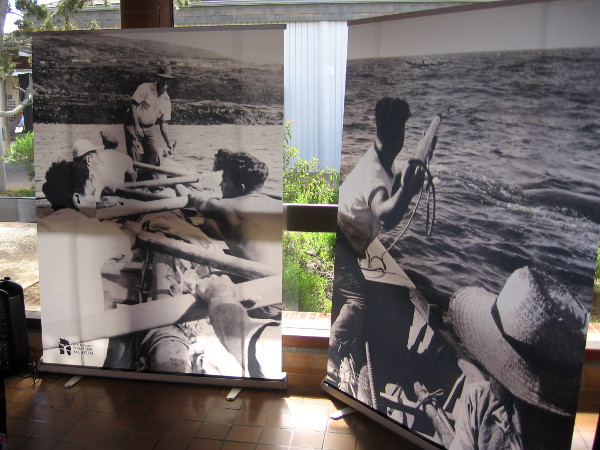
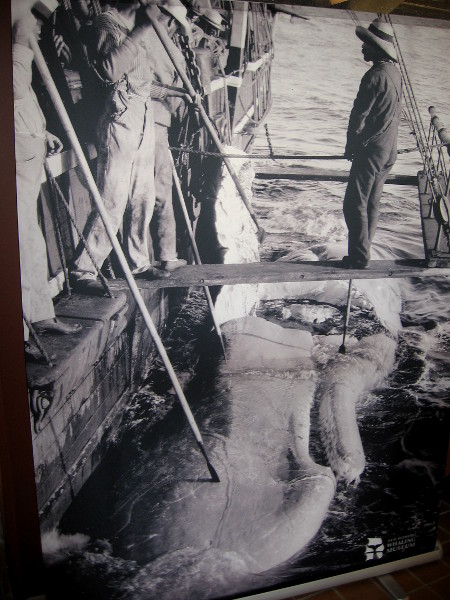
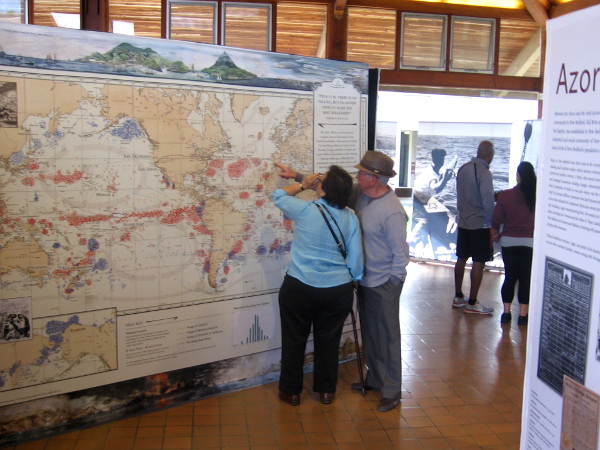
The traveling exhibition is called Yankee Baleeiros! The Shared Legacies of Luso and Yankee Whalers. That’s quite a long title, but it’s fitting for the epic displays that occupy about half of the sizable visitor center. Developed by the New Bedford Whaling Museum, the exhibit “celebrates the interwoven Luso-American stories of the Azorean, Cape Verdean, and Brazilian communities in the United States from early immigration in the 18th century through the latter half of the 20th century.” Sounds like a long and tedious thesis! But it’s actually fascinating! Basically, it shows the rich history of Portuguese speaking whalers in the Northeast, primarily New Bedford, and how they interacted with Yankee whalers.
As San Diego is one of the world’s best places to encounter a large variety of whale species, and as this is the season for migrating gray whales, the exhibit is more than appropriate. The displays also address how whaling techniques evolved over the years, the success of modern conservation efforts, and how whale-watching is now a much larger industy than whaling.
After listening to a short opening presentation by Park Superintendent Tom Workman and Christina Connett, PhD, Curator of Collections and Exhibitions at the New Bedford Whaling Museum, I headed out to Cabrillo’s excellent Pacific Ocean viewing areas to scan the horizon for spouts. I didn’t see any, but there were a bunch of boats off Point Loma whale-watching on this sunny Sunday afternoon. I got more pics from my visit coming, so stay tuned!
If you haven’t been to Cabrillo National Monument in a while (or ever), head on over! The special exhibit will be on display through April 12, 2015.
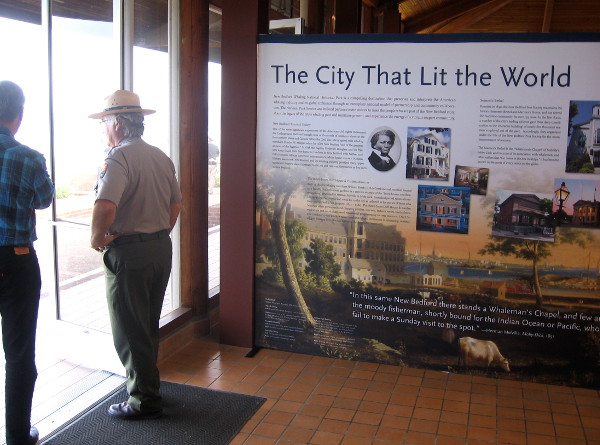
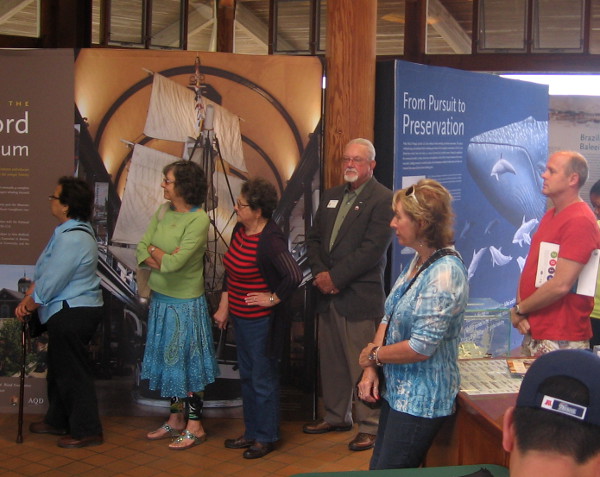
Park Superintendent Tom Workman talks while Christina Connett of the New Bedford Whaling Museum listens.People listen to presentation at opening of Yankee Baleeiros whaling exhibit.Displays recount the history of Lusophone (Portuguese-speaking) whalers in America.New Bedford was the major port for whalers in the Northeast.Inside the visitor center is a section of the 1848 Grand Panorama of a Whaling Voyage ‘Round the World by Benjamin Russell and Caleb Purrington.
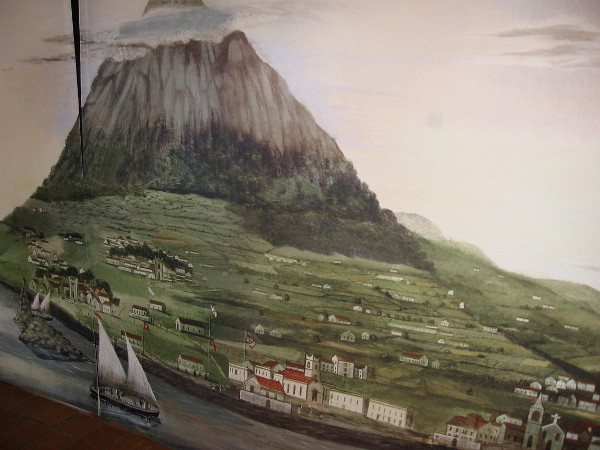
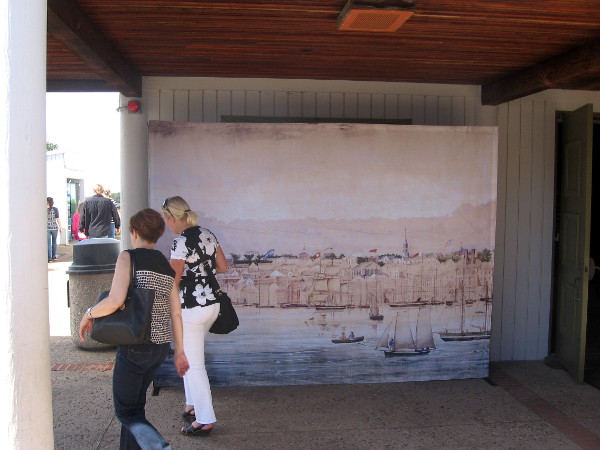
Portions of the 1848 Grand Panorama of a Whaling Voyage ‘Round the World by Benjamin Russell and Caleb Purrington were on display inside and outside the visitor center. The complete work is 1,275 feet long and eight and a half feet tall! It’s believed to be the longest painting in the world! The piece went on a national tour shortly after completion, and appeared at the 1964 New York World’s Fair! Cool!
The fantastic displays are museum quality and extremely informative.Photos of sailors rowing out to hunt whales, and a harpooner at the ready.A dead whale is hauled to the ship’s side and stripped of blubber by many hands.People point out spots on a map of historical whaling grounds.The opening presentation is over and folks head out to take in the many sights around Cabrillo.Is there a whale out there? Probably not. This back door faces San Diego Bay!
…
To enjoy future posts, you can “like” Cool San Diego Sights on Facebook or follow me on Twitter.
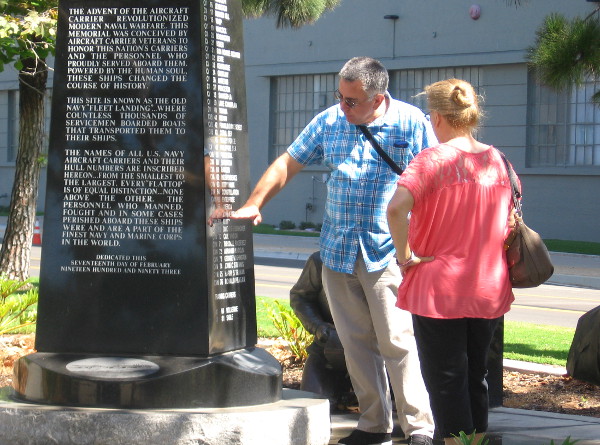
Man points out a recent fleet carrier name on the Aircraft Carrier Memorial.
Take a stroll down the Greatest Generation Walk on San Diego’s Embarcadero and you’re likely to see people standing beside the Aircraft Carrier Memorial, just gazing at the long list of historic Navy ships. Many will run their hand along the black marble obelisk as they search for the ship on which they or a loved one served.
The listed names include every fleet carrier, training carrier, light carrier, escort carrier, and amphibious assault ship from American history. Well, almost. I’ve noticed the fleet carrier section has run out of space, and the last ship named is the Ronald Reagan (CVN-76). No room remains to engrave the more recent USS George H.W. Bush (CVN-77).
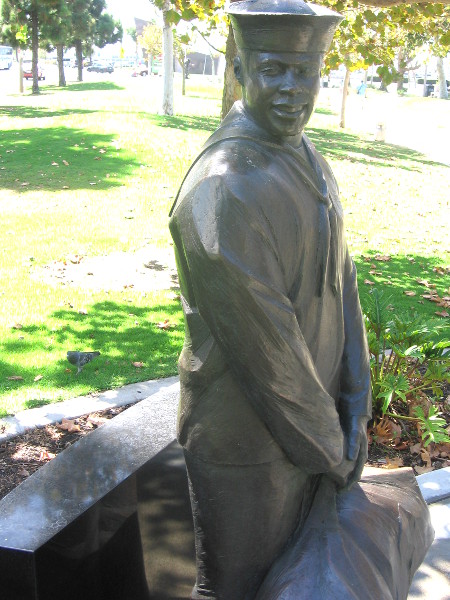
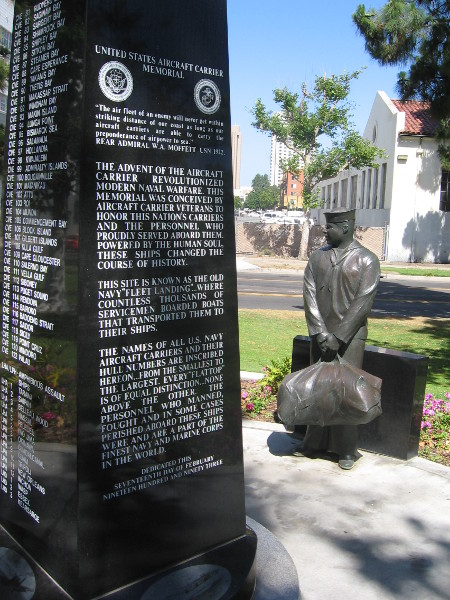
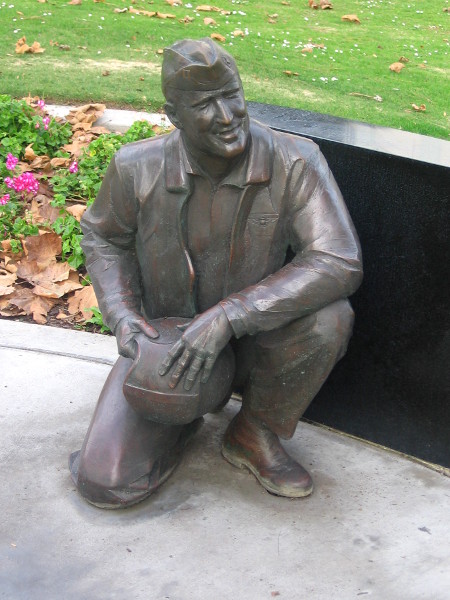
Sculpture of a sailor who served aboard a flattop.Obelisk of Aircraft Carrier Memorial remembers past ships from naval history.
The memorial, whose bronze figures were sculpted by artists T.J. Dixon and James Nelson, contains the following words:
The advent of the aircraft carrier revolutionized modern naval warfare. This memorial was conceived by aircraft carrier veterans to honor this nation’s carriers and the personnel who proudly served aboard them. Powered by the human soul, these ships changed the course of history.
This site is known as the old navy “fleet landing”…where countless thousands of servicemen boarded boats that transported them to their ships.
The names of all U.S. Navy aircraft carriers and their hull numbers are inscribed hereon…from the smallest to the largest. Every “flattop” is of equal distinction…none above the other. The personnel who manned, fought and in some cases perished aboard these ships were and are a part of the finest Navy and Marine Corps in the world.
Sculpture of a naval aviator who flew from a carrier.The Aircraft Carrier Memorial can be found on San Diego’s Greatest Generation Walk.
The Greatest Generation Walk is located on San Diego Bay, just south of the USS Midway Museum.
…
To enjoy future posts, you can “like” Cool San Diego Sights on Facebook or follow me on Twitter.
Man and boy walk along Embarcadero at San Diego’s 2014 Festival of Sail.
Here’s my third blog post concerning my visit on Sunday to the Labor Day weekend 2014 Festival of Sail on San Diego’s Embarcadero. My first post concerned the brig Pilgrim; my second contained pics of the other beautiful tall ships at the first temporary floating dock just north of the San Diego Maritime Museum. Feel free to click around Cool San Diego Sights and check them out.
I pick up now where I left off last time–heading from the first floating dock to the second.
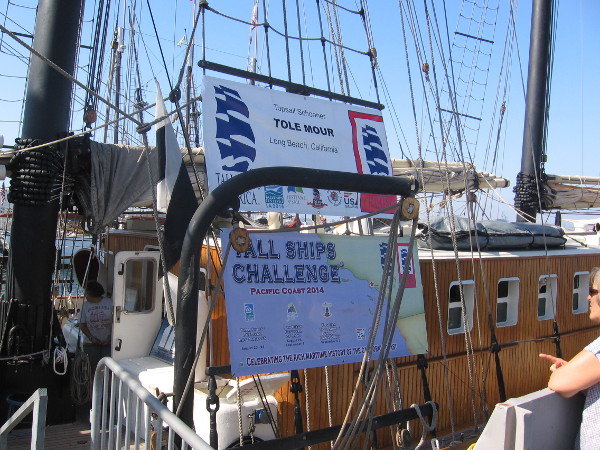
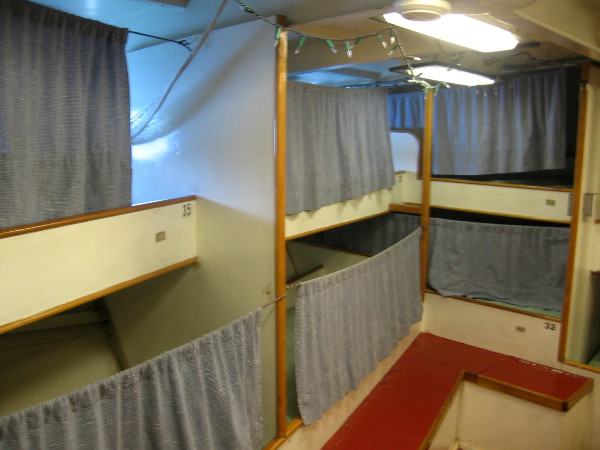
The Tole Mour takes students out to the Channel Islands as a school ship.The large topsail schooner is based out of Long Beach.Tole Mour was originally a medical vessel serving the remote Marshall Islands.A couple of young ladies on board were playing musical instruments for visitors.30 to 35 students bunk down here during their educational expeditions.
I wish I were a kid again! I remember a similar trip on a smaller vessel I took as a high school student, cruising along Alaska’s Inside Passage. I think our bunks were even narrower! But that’s a different story…
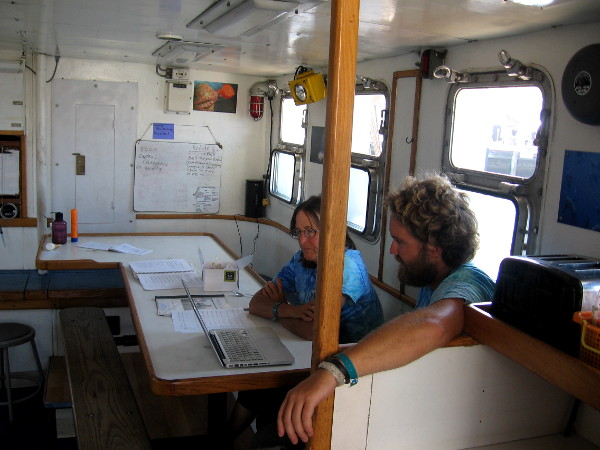
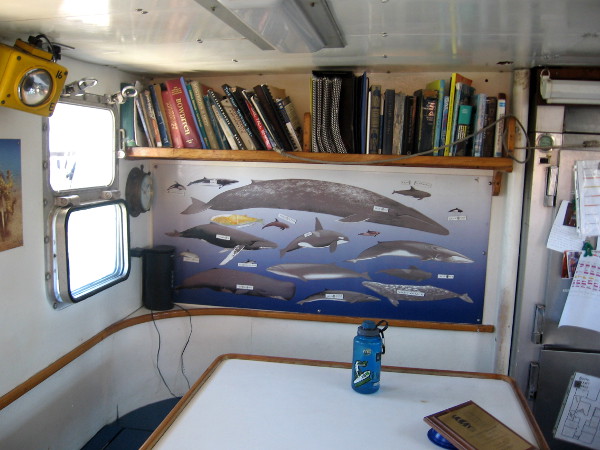
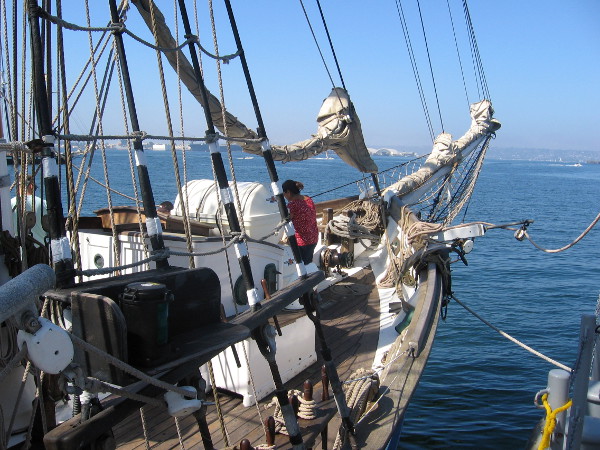
Coming up from below. Flags flap in the sunshine.Here’s the cabin where kids gather to eat and learn about the sea.A small library and a chart depicting different marine life.The very cool Tole Mour was launched in 1987.Two generations, side by side, man the helm topside.Stern of the Irving Johnson, a brigantine based in San Pedro, the port of Los Angeles.Folks at the Festival of Sail step onto the visiting tall ship.The bow faces distant Point Loma on our lovely, calm San Diego Bay.Sally has been a Los Angeles Maritime Institute crew member from the beginning–22 years!
I hope my information here is correct. I didn’t take notes. Sally just smiled as she talked about her many memories as a volunteer at the Los Angeles Maritime Institute. She started 22 years ago as a lowly volunteer sweeper. She watched the two nearly identical ships–the Irving Johnson and Exy Johnson–being built simultaneously side-by-side in a parking lot! She told me she has more than a million stories to tell! I believe her!
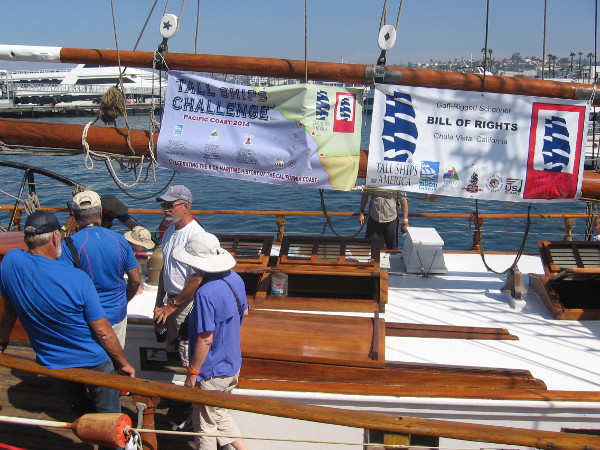
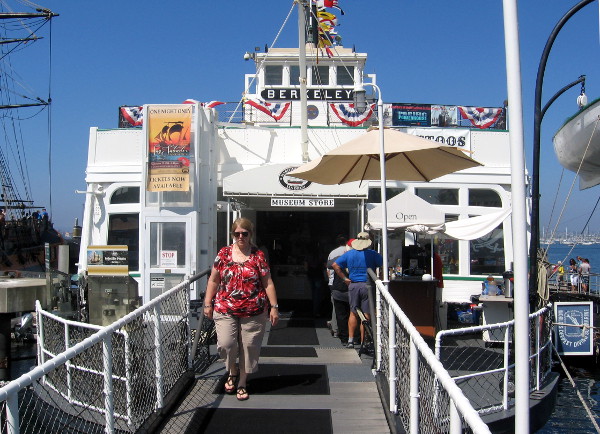
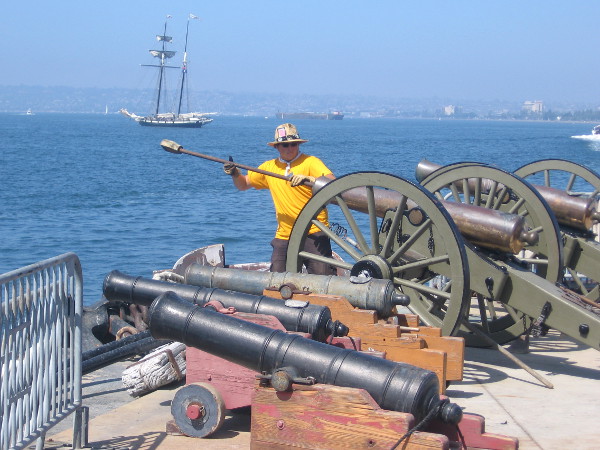
The ship’s twin–the Exy Johnson–is tied up on the opposite side of the dock.One more beautiful tall ship waits to be visited at this floating dock…It’s the Bill of Rights, a gaff-rigged schooner from Chula Vista, in our south bay!Dogs enjoyed visiting the cool ships, too!A big old ship’s wheel gives me a hankering for adventure on the high seas.Some festival visitors went on harbor cruises, or participated in cannon battles on the bay!This is the hub of the San Diego Maritime Museum–the Berkeley steam ferryboat.
I haven’t really covered the many ships of the San Diego Maritime Museum in my blog, apart from some dockside pictures of the Star of India, the build site of the galleon San Salvador, and a couple pics of the Pilot out on the bay. I suppose I’ll have to put the many cool ships in the museum’s collection on my list!
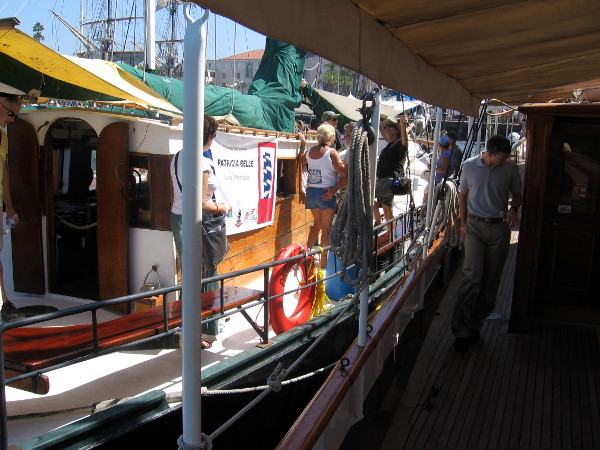
Inside the Berkeley a family watches a hobbyist create a tiny ship model.People walk out on the Dolphin, the world’s deepest diving submarine.Stepping out onto a narrow dock on the north side of the Berkeley and gazing across the water.The graceful Patricia Belle, from Mexico, is tied up next to the steam yacht Medea.Passing under a lifeboat, heading to the large dock jutting from the rear of the Berkeley.Turning around. A huge collection of ships that you could tour all day!
I’m standing near the stern of America, a modern replica of the ship that won the original America’s Cup. The boats docked side-by-side along the Berkeley are, left to right, the Jada, Patricia Belle and Medea.
Two America’s Cup boats and tall ships America and Californian are based back here!
San Diegans often see the sleek Stars and Stripes and the Abracadabra out racing on the big bay. The two participated in somewhat more recent America’s Cup competitions. I have no photos here, but I should in the future! My camera’s memory card was almost full!
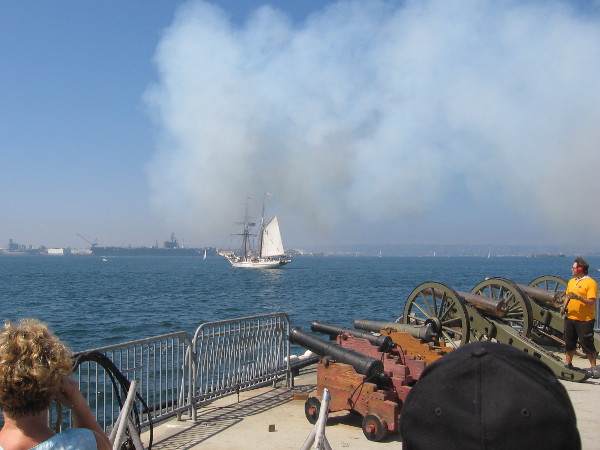
The Exy Johnson sails out to be followed by the Californian, in the foreground.Pic taken moments after the mainland battery fired a cannon!
The gun produced a huge blinding flash! I couldn’t capture it, because my fingers were firmly pressed into my ears!
While cannon is cleaned, the Exy Johnson and Californian begin a duel on the bay!
…
To enjoy future posts, you can “like” Cool San Diego Sights on Facebook, or follow me on Twitter.
People arrive at San Diego’s 2014 Festival of Sail on the Embarcadero.
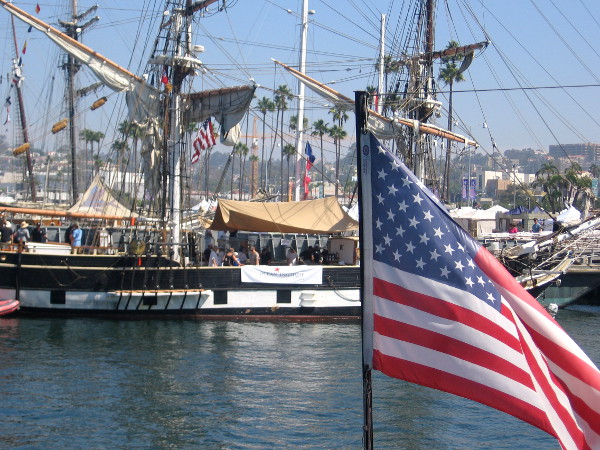
I began a description of the 2014 Festival of Sail in the previous blog post, where I showed photos of the brig Pilgrim docked on San Diego’s Embarcadero. The big Labor Day weekend event features 21 different vessels, so now I’ll provide a quick tour of the other beautiful tall ships that can be seen on sparkling San Diego Bay! I have so many pics that I’ve broken them up into two separate parts.
The sails of the historic Star of India rise beyond a kettle corn sign!The many ships of the San Diego Maritime Museum took part, including HMS Surprise.
You might remember having seen HMS Surprise in the Academy Award winning movie Master and Commander, starring Russell Crowe!
One of several pirates walking about the annual event, thrilling lots of kids.Three temporary floating docks are surrounded by visiting tall ships.
The nearest ship is the Pilgrim, a replica of the historic ship described by Richard Henry Dana in Two Years Before the Mast.
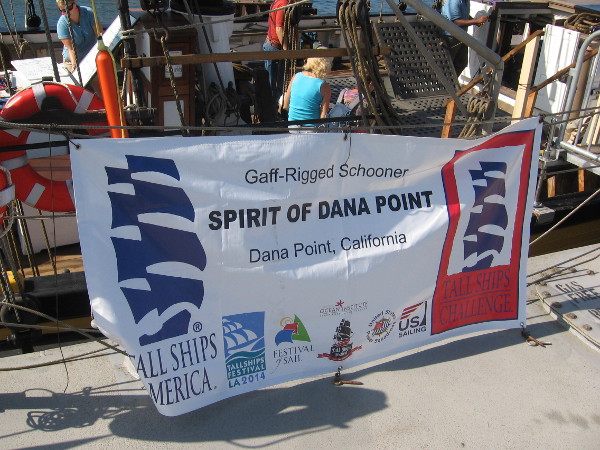
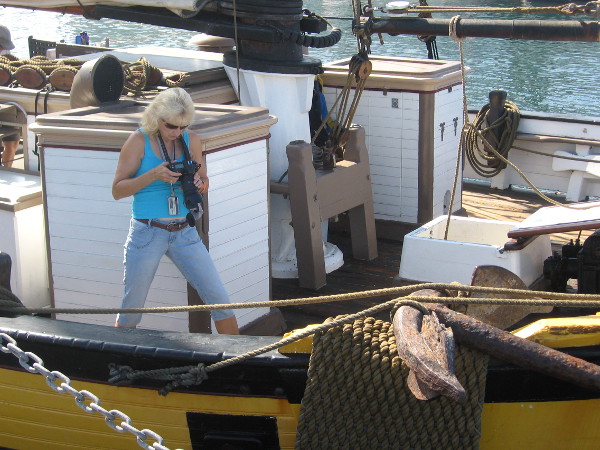
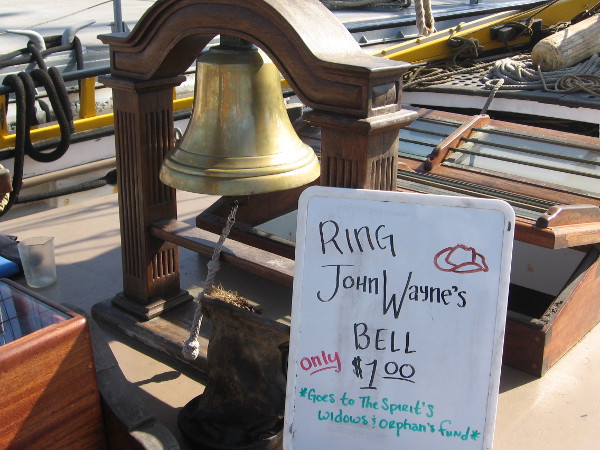
Gaff-rigged schooner Spirit of Dana Point was tied up next to the Pilgrim.Early morning festival visitors check out the Spirit of Dana Point.One of several photographers looking for cool shots on the beautiful ships.This large bell was donated by famous actor John Wayne from his own ranch!
That is one loud bell!
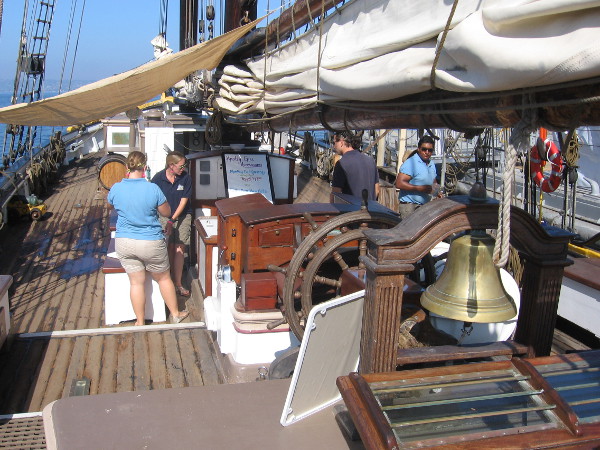
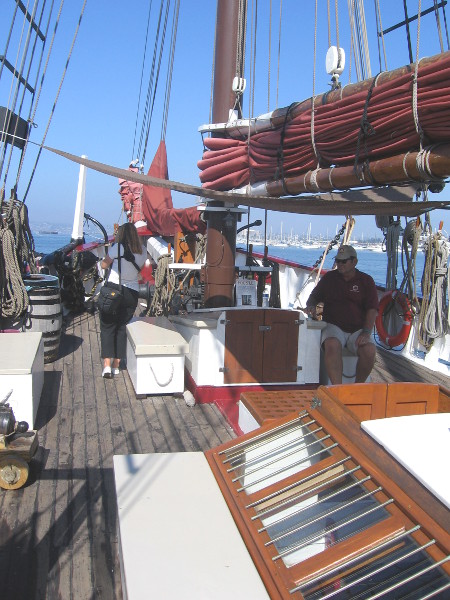
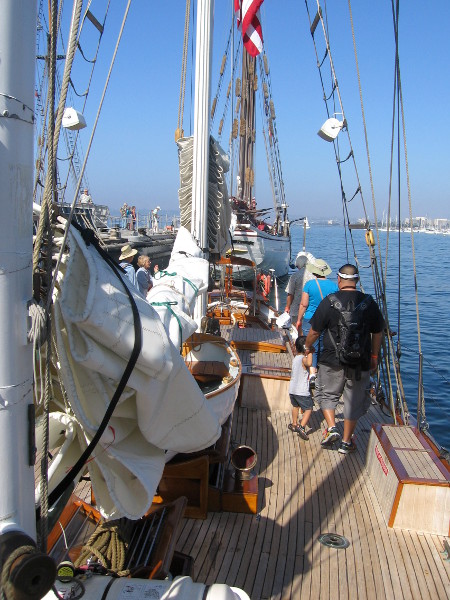
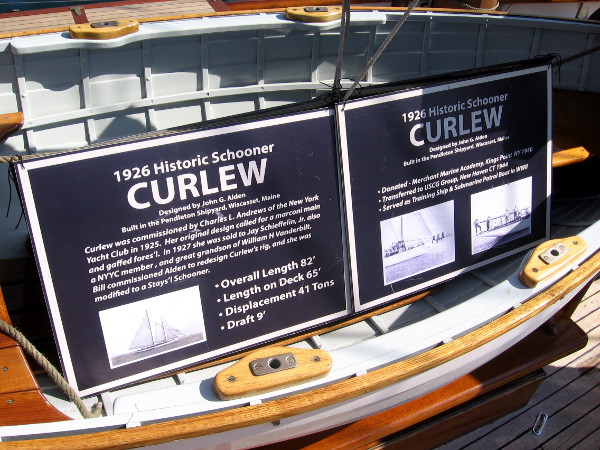
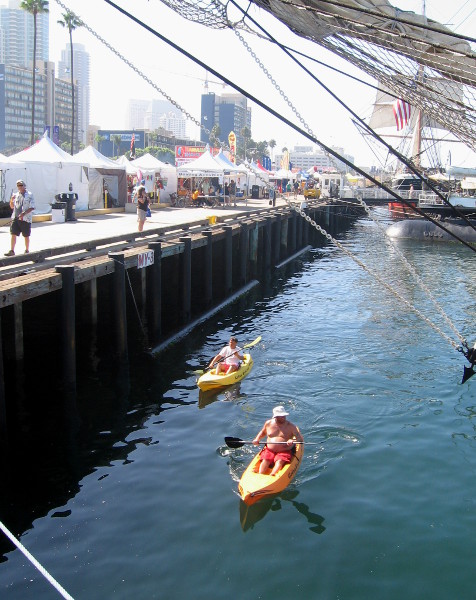
Ship’s compass is another typical nautical sight.Looking across the picturesque deck of the Spirit of Dana Point.Golden female figurehead gazes out across San Diego Bay.Three-masted schooner American Pride awaits across the dock.American Pride and paddleboarder seen from bayside walkway.View of American Pride’s elegant stern from nearby Curlew.Photographer on American Pride takes aim at a cannon!American Pride, built in 1941, calls Long Beach home.People prepare to board the small staysail schooner CurlewThis sailing ship won many East Coast races in the 1920’s and 1930’s.Visitors check out the beautiful sailing vessel.Curlew served as a training ship and submarine patrol boat in World War II.Kayakers were out cruising among the assembled tall ships.The Tole Mour awaits at the second floating dock, my next stop!
Stay tuned! There’s more to come!
…
To enjoy future posts, you can “like” Cool San Diego Sights on Facebook, or follow me on Twitter.
Mexican Navy training tall ship ARM Cuauhtémoc docked in San Diego Bay.
I had an unexpected adventure today!
I was just walking along San Diego’s Embarcadero late this afternoon, circling homeward after watching a movie and eating lunch at downtown’s Horton Plaza. And there it was. An absolutely gigantic three-masted tall ship docked near the cruise ship terminal!
It was the Mexican Navy’s training vessel Cuauhtémoc, built in Spain in 1982. And the few curious people who walked a short distance out onto the pier discovered they could freely board and tour the ship!
I believe the beautiful high-masted ship might be visiting for the upcoming Festival of Sail, which is to be put on by the San Diego Maritime Museum in two weeks. (Yes, I’ll attend!) Fortunately, today I had my trusty camera with me!
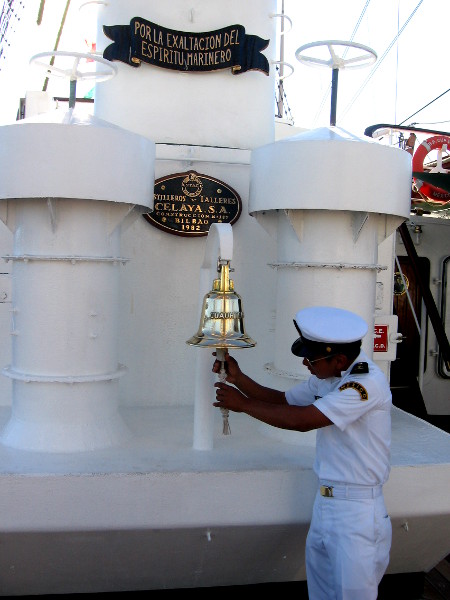
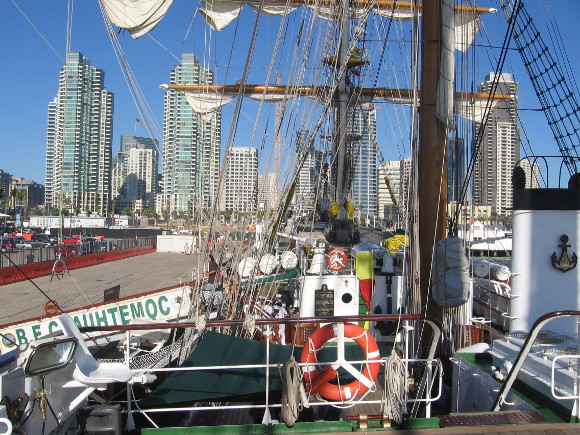
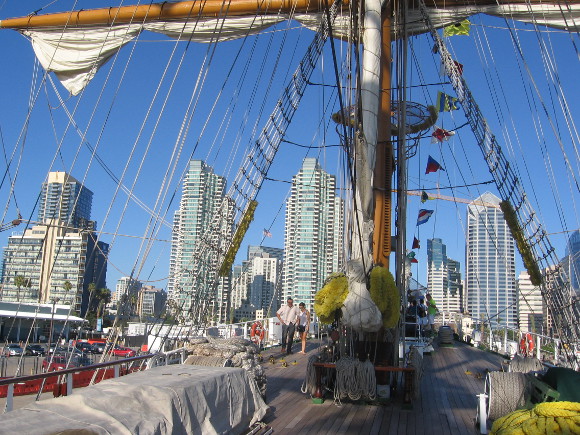
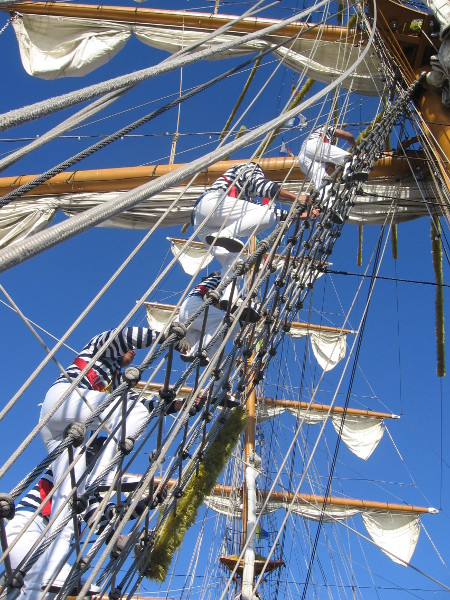
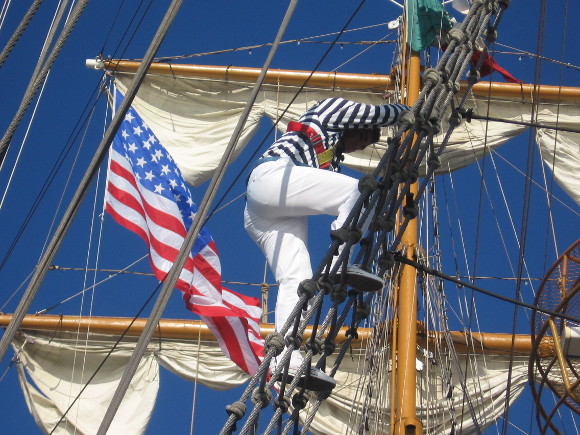
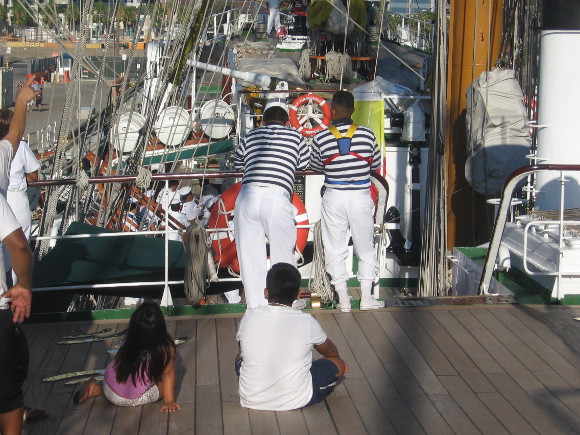
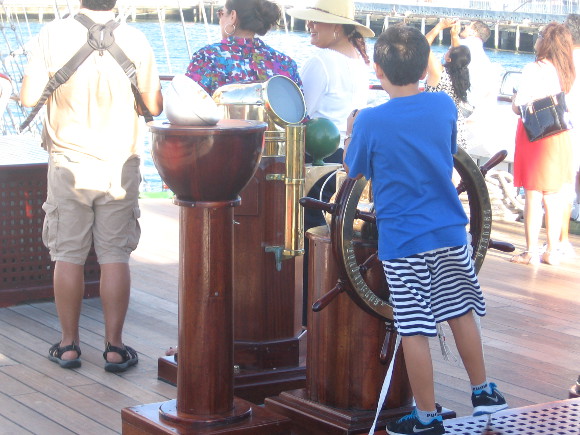
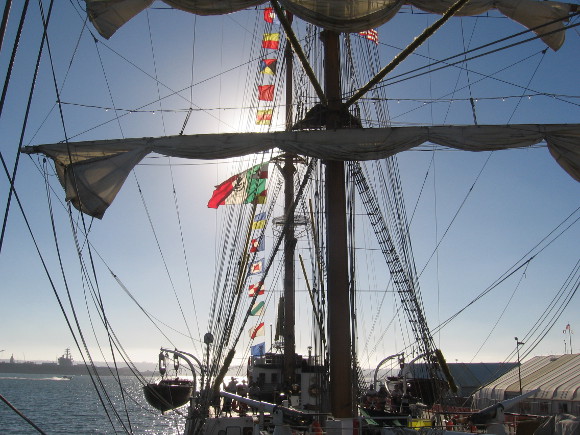
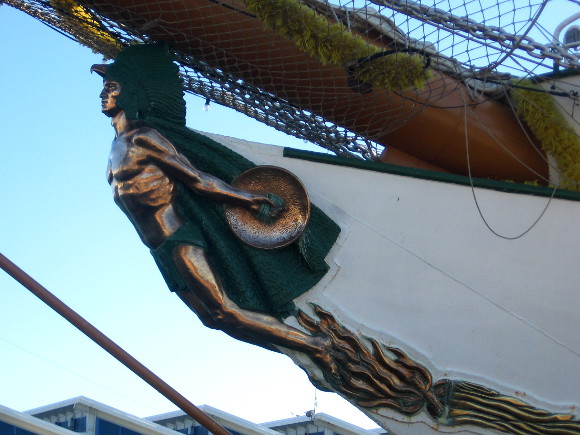
Free tour of the huge tall ship could be enjoyed beside cruise ship terminal.Visitors look at information sign near the Cuauhtémoc’s gangplank.On board, looking straight up the center mast.Mexican Navy officer checks the ship’s bell.Looking east across the beautiful ship from the upper deck.The Cuauhtémoc has participated in many events, exhibitions and regattas.San Diego’s tall ship America can be seen on the bay through the rigging.A view of downtown skyscrapers from the Mexican tall ship’s foredeck.A ship’s gun points out past the Broadway Pier.Sailors begin a drill by climbing the shrouds.A line of Mexican sailors ascends toward the sky.Higher they go up the enormous mast!They demonstrate a bit of fancy work with the sails.A sailor descends as American flag flies from the visiting vessel.Guests and sailors watch the proceedings with interest.A boy pretends to command the sailing ship at the wooden captain’s wheel.An officer’s cap rests atop ropes at one mast’s base.Ship’s plaque describes El Buque Escuela Cuauhtémoc.Looking west as sun falls toward distant Ronald Reagan aircraft carrier.The figurehead of Cuauhtémoc is a shining Aztec warrior.
…
To enjoy future posts, you can “like” Cool San Diego Sights on Facebook or follow me on Twitter.
Hundreds of colorful tiles encircle a large playground at Liberty Station. Each tile was carefully painted by a child. This one contains a special message.
And now for your entertainment: another terrifying scene!
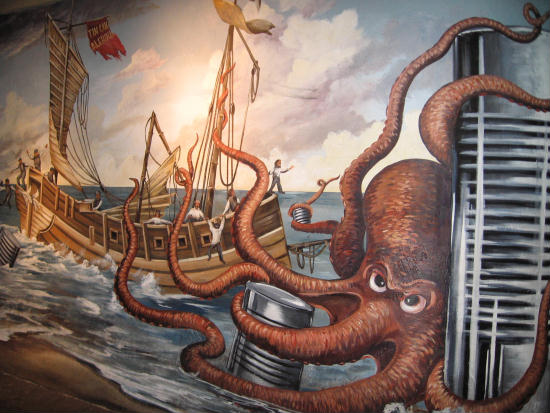
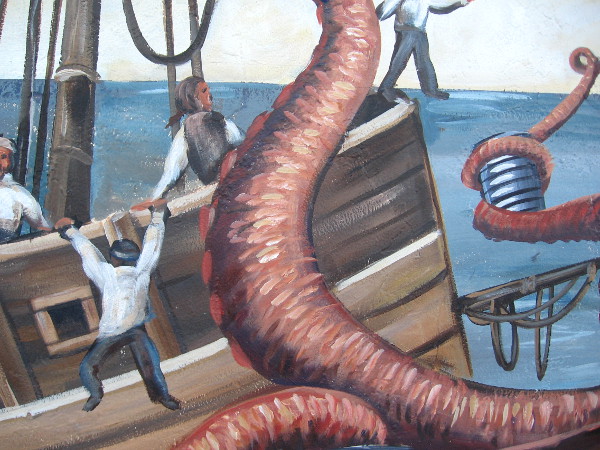
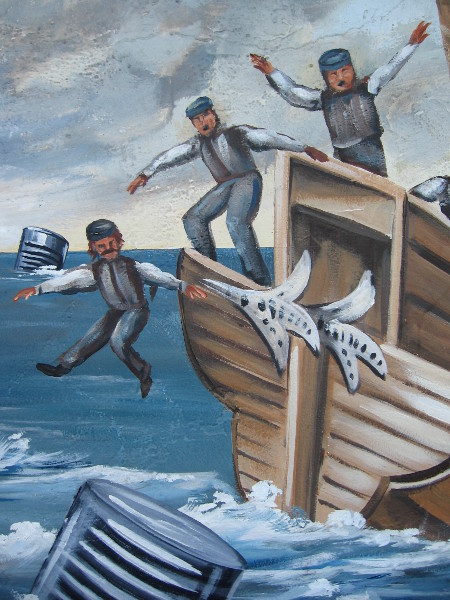
Beware of giant octopi with a taste for canned foods! This wily octopus steals tin cans from helpless, despairing sailors, who then promptly throw themselves into watery oblivion. When you’re in the middle of the ocean in an old ship full of tin cans, what is one to do?
This cool mural adds character to the front of a small dive bar on Bankers Hill. The place’s name is Tin Can Alehouse. I’m told they serve beer exclusively in cans.
This monstrous octopus really means business!A ship in peril. I guess some sea creatures like their beer in a can.Jump for your lives men! Grab hold of a tin can!
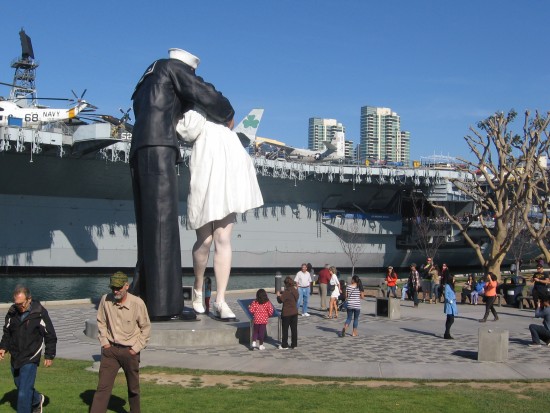
Unconditional Surrender statue on San Diego’s Embarcadero near the USS Midway Museum.
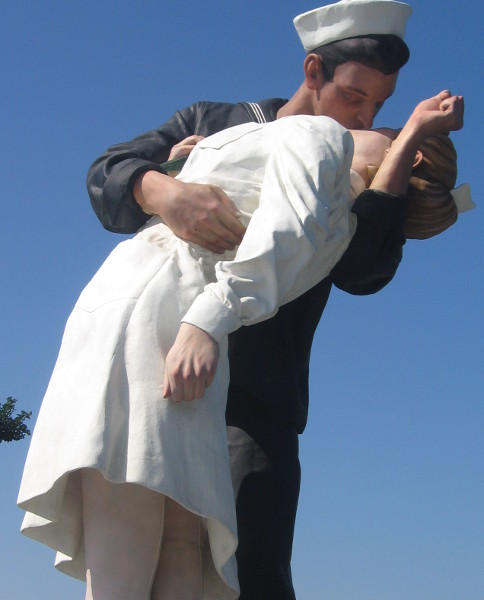
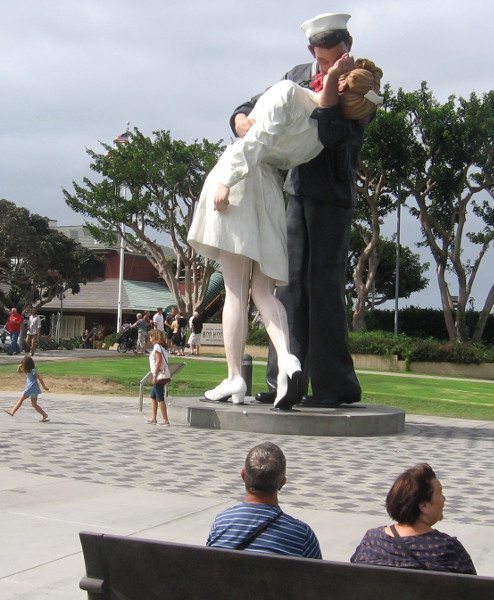
This large statue is amazingly popular with tourists visiting San Diego’s Embarcadero. Tour buses park in the nearby parking lot and throngs of people stand beneath the kissing sailor and nurse, snapping photos. Many couples joyfully imitate the dramatic pose. Critics say the statue is too kitsch, but I disagree! It perfectly represents a moment in time: the end of the Second World War.
Referred to by many as The Kiss, this huge sculpture was created by the artist Seward Johnson. Its proper name is Unconditional Surrender. It’s based on a photograph taken during V-J day in New York’s Times Square. An American sailor, overjoyed at the news of the war’s end, grabbed a random nurse nearby and gave her a spontaneous kiss. The photograph became world famous.
A temporary Unconditional Surrender statue was originally placed at this site, but it was replaced with a permanent bronze version in 2012. Unlike most other monuments and memorials located on the Greatest Generation Walk, just south of the USS Midway, this statue is so enormous it can be glimpsed from several points on San Diego Bay.
Sailor overjoyed that war is over plants a big kiss!Sailor applies The Kiss to a nurse at the end of World War II.Sitting on nearby bench on a cloudy day.People gather about Seward Johnson’s Unconditional Surrender.


















































 Cool San Diego Sights!