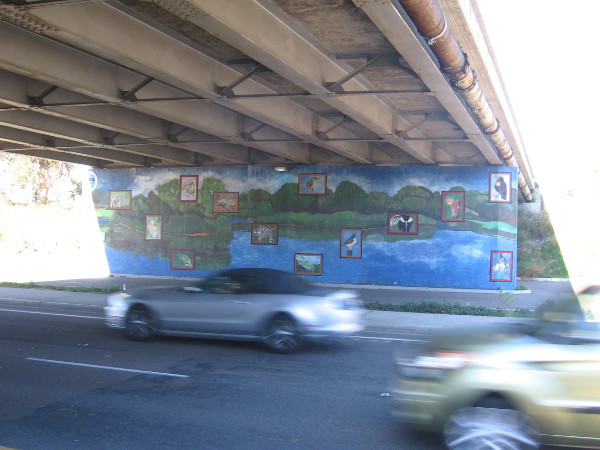
Cars zoom west down Friars Road, beneath the Morena Boulevard bridge.
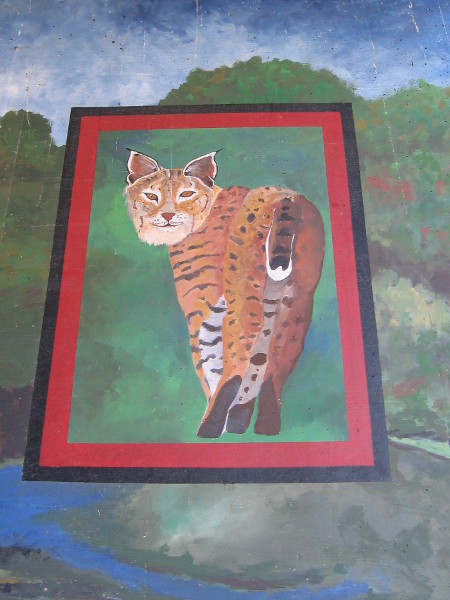
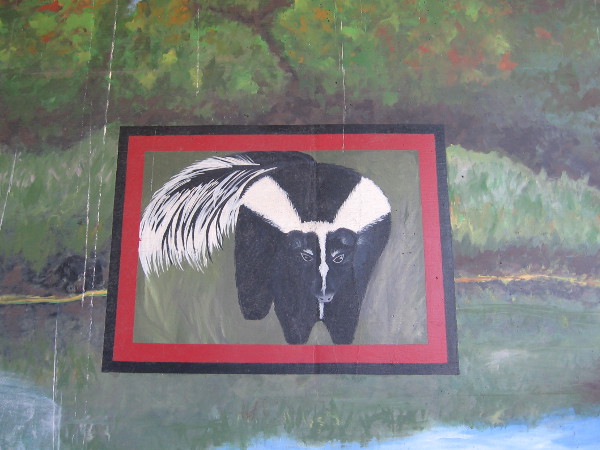
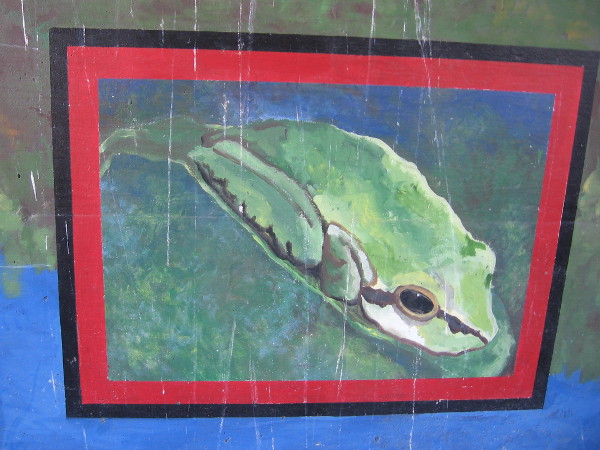
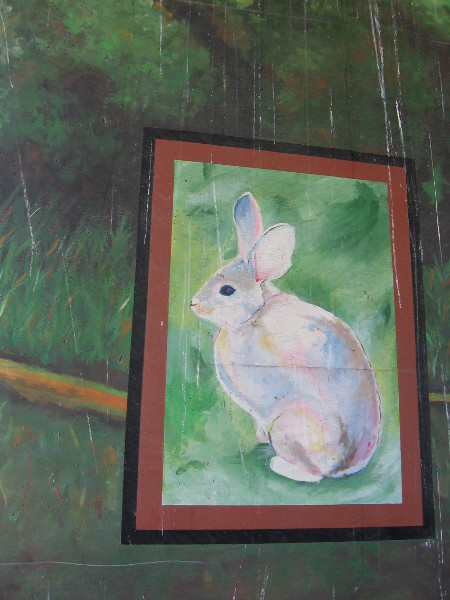
Should you ever drive west down Friars Road approaching Mission Bay, you might see a collection of native animals gathered under the Morena Boulevard bridge. They seem to like the place, because they never leave!
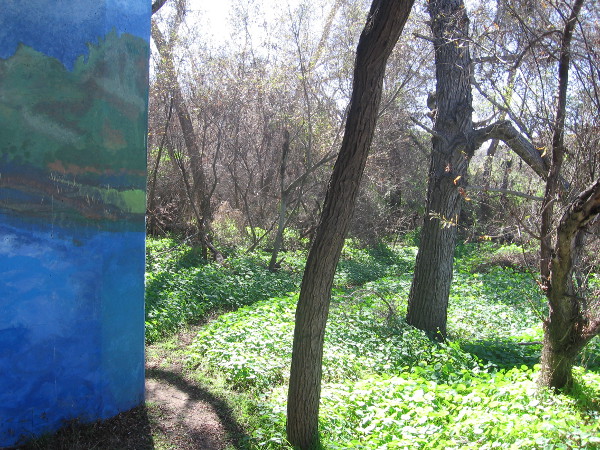
The west end of Mission Valley contains an open space preserve, where some wild animals live in the midst of a big city. The wildlife mural, designed in 2007 by lead artist Julia C. R. Gray, was a public art project of the San Diego River Park Foundation.
This mural is a project of the San Diego River Park Foundation.A bobcat lurks under the busy city bridge!So does a skunk! I didn’t smell this critter, however.Fish in dry water, painted on a public art mural near the San Diego River.Horned toad and raccoon, samples of wildlife that live in Mission Valley preserve.Frog in a painted mural, created by artist Julia C. R. Gray in 2007.A rabbit that’s still enough to be captured by my camera!It’s very rare to see a fox in the developed parts of San Diego.Second mural painted on south side of Friars Road also shows a river scene.Beyond lies open space. Lush vegetation provides shelter for wildlife near river.
…
To enjoy future posts, you can “like” Cool San Diego Sights on Facebook or follow me on Twitter.
Sculptures on display on San Diego’s Embarcadero near Tuna Harbor.
My walk early this morning took me down to Ruocco Park, just north of Seaport Village. I wanted to check out something I saw on the news that looked really interesting.
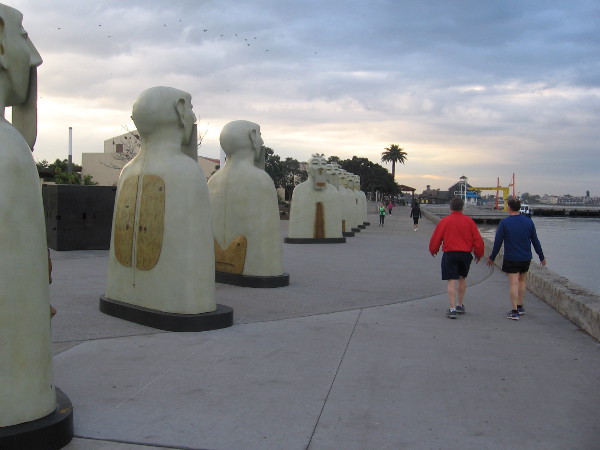
Few people were about. Sunrise was slowly brightening the sky. Ten imposing human-like sculptures rose before me. As I approached, the figures loomed larger, silent, heavy-lidded, facing the fishing boats in Tuna Harbor, and a handful of joggers passing by.
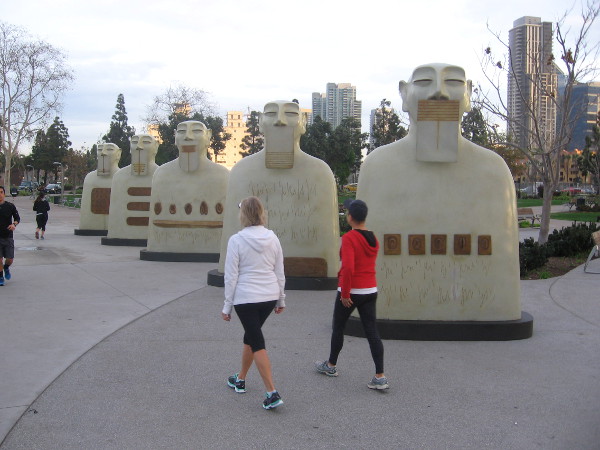
This temporary installation of public art opened yesterday to the public. Our Silences, created by Mexican sculptor Rivelino, is composed of a row of ten massive bronze figures, whose mouths are shut and silenced with a metal plate. The object of the art is to provoke thought, feeling and discussion about freedom of speech. One wonders if the small prison-like black box nearby contains a political prisoner, or someone’s trembling, innermost thoughts. This very jolting artistic statement is on display for the first time in the United States. It will remain in San Diego through March 15.
Our Silences, by Mexican artist Rivelino, concerns freedom of speech.People walk past provocative public art as day dawns near Seaport Village.This harsh black cube appears to be an oppressive prison cell.The steel box might contain someone who would like to speak.Mysterious abstract designs on backs of the human-like sculptures.Here comes the sun and another day of freedom on San Diego’s waterfront.Walking past artwork that reminds us of liberty’s precious gift.
Here’s a pic I took after a sign explaining Our Silences was installed nearby…
Sign explains Our Silences, now in San Diego. (Click to enlarge.)
Where will I walk next? Life is an adventure!
…
To enjoy future posts, you can “like” Cool San Diego Sights on Facebook, or follow me on Twitter.
View of skyscrapers from Pantoja Park in San Diego’s Marina District.
Downtown San Diego might be a bit more laid back than other big cities, but it’s still a bustling place. And so it feels good once in a while to just sit in a quiet, green place to relax.
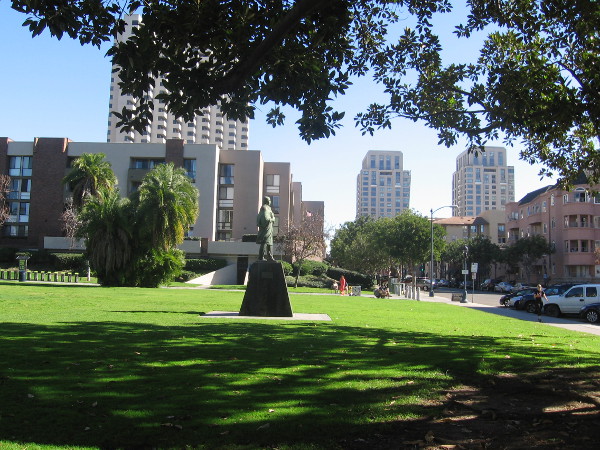
Pantoja Park is a welcome patch of tranquility in the Marina District of downtown San Diego. Registered as a San Diego Historic Landmark, it was created in 1850 and is the city’s oldest park. The park was named after Don Juan Pantoja y Arriola, a Spanish navigator who drew the first map of San Diego Bay in 1782. A couple centuries ago ships would periodically enter the bay to supply the old Spanish presidio.
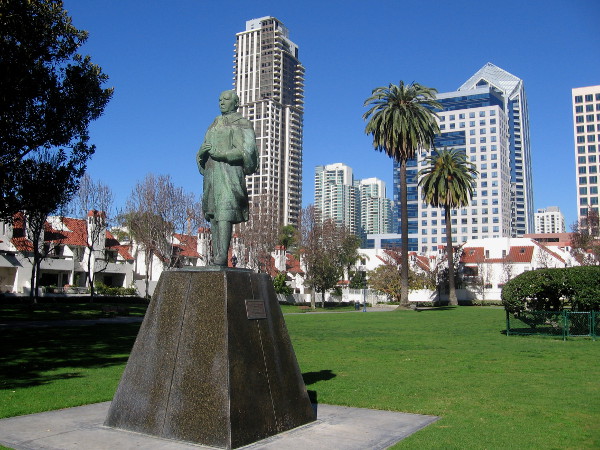
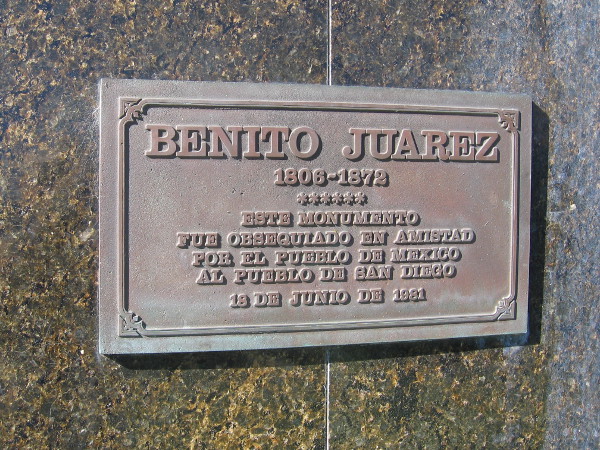
Fringed with gleaming skyscrapers, Pantoja Park today contains one notable sight: a statue of Benito Juarez, by Mexican artist Ernesto Tamariz, which was a gift to San Diego from the Mexican government in 1981.
I happened to walk through recently, so I took several pics…
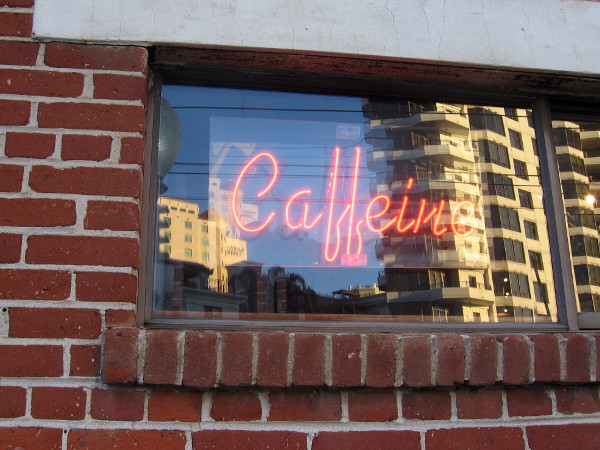
Statue of Benito Juarez, a friendly gift from the Mexican government.Plaque on bronze statue of Benito Juarez, who served as the president of Mexico for five terms.Some cool public art on a trash can in Pantoja Park.Caffeine can be found across the street near the Seaport Village trolley station.Pantoja Park is a welcome, quiet grassy area in the midst of downtown San Diego’s bustle.
UPDATE!
Here’s a better pic of the statue I took on a later date…
…
To enjoy future posts, you can “like” Cool San Diego Sights on Facebook or follow me on Twitter.
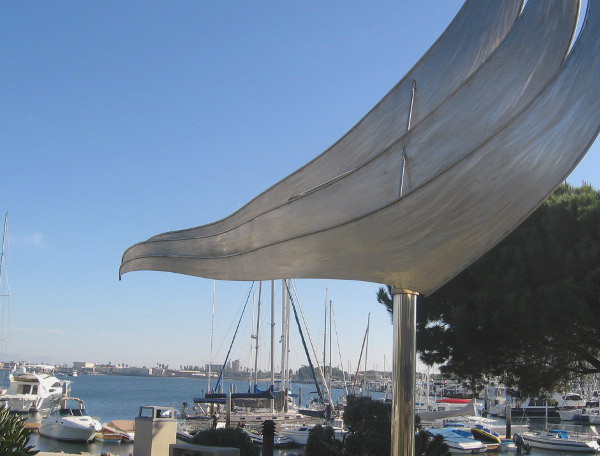
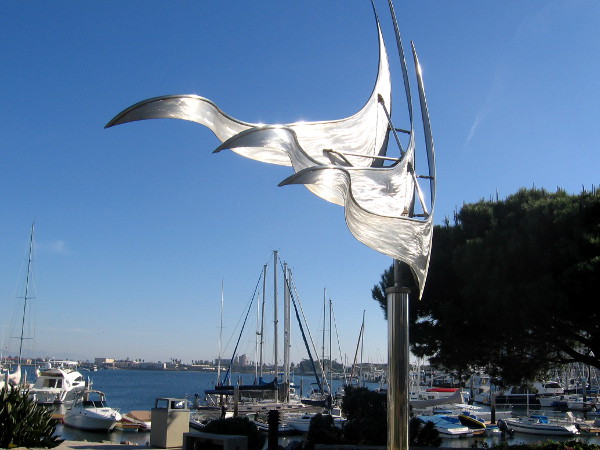
During my recent walk around Coronado, I came upon a dull, lifeless metal sculpture standing at the center of a small park. But then a rising sea breeze moved the nearby trees. The sculpture began to slowly turn. I stood in one place, snapping a few pics…
Freedom sculpture at Glorietta Bay Yacht Club Promenade appears dull and utterly lifeless.Freedom turns in the wind and surfaces begin to reflect the bright sunshine.Shining Freedom sculpture catches fire! The kinetic sculpture was created by Jon Koehler.
The public art, titled Freedom, was sculpted by artist Jon Koehler and installed in the Glorietta Bay Yacht Club Promenade in 2009.
…
To enjoy future posts, you can “like” Cool San Diego Sights on Facebook or follow me on Twitter.
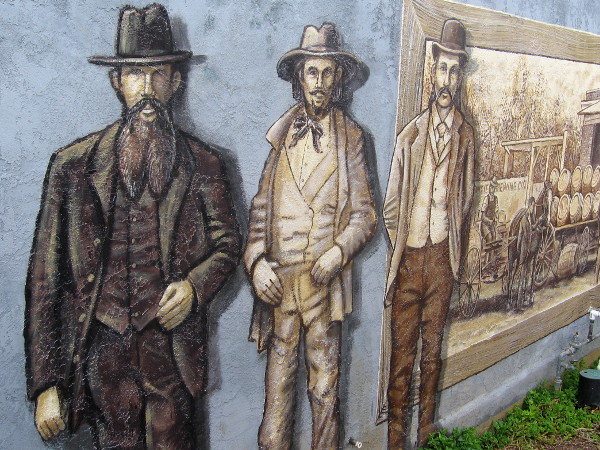
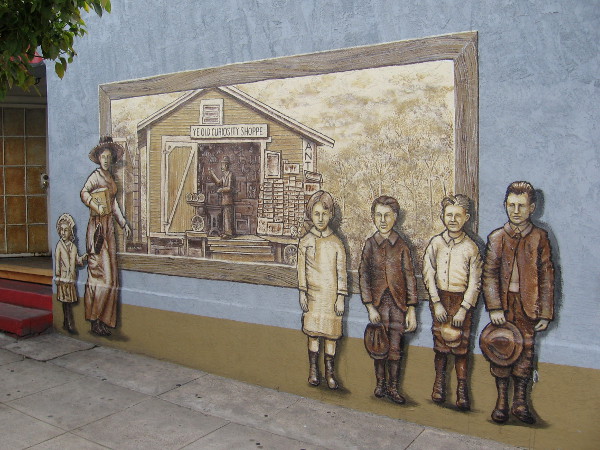
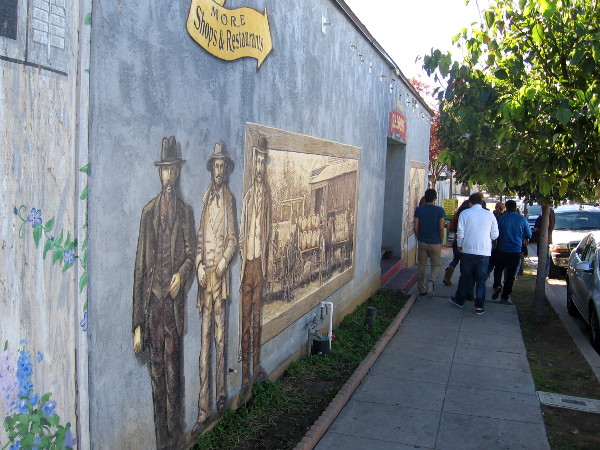
Several whiskered Western characters pose in a mural on Harney Street in Old Town.
There’s a fairly new street mural in Old Town that I really like. Every time I see it, my imagination travels back in time. Back to the first half of the 19th century.
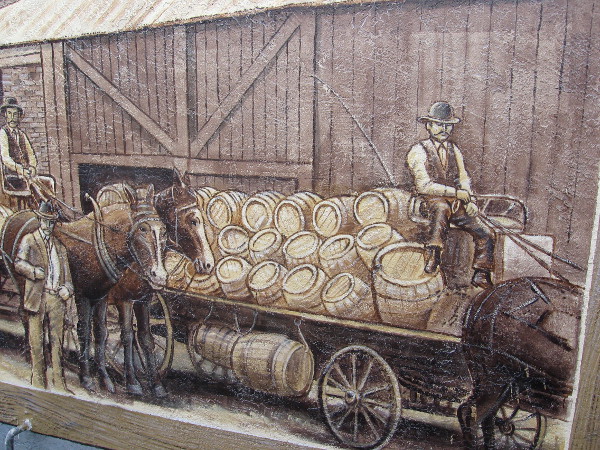
San Diego for many decades was a tiny town seemingly in the middle of nowhere. Whether it belonged to Spain, or Mexico, or the United States, Old Town San Diego was a place of dusty roads and modest, sun-baked adobe houses, horses and wagons, rugged settlers and ranchers. Characters from that era seem to live again in this mural.
Artist Frank Mando painted this artwork in 2013. I couldn’t capture the entire piece in one shot. Enlivening a building at the corner of San Diego Avenue and Harney Street, the mural is divided in two by a door of the Old Town Saloon. Standing inside that door, as you’ll see, there seems to be a well-known movie star!
Freight wagon hauls a load of barrels in fun art that recalls early San Diego history.John Wayne seems to be coming through a door of the Old Town Saloon.Elegant lady and girl from long ago stroll past Ye Old Curiosity Shoppe.Old Town mural on building wall was painted in 2013 by artist Frank Mando.Kids standing along sidewalk seem to have materialized from San Diego’s past.People walk past nostalgic street mural near side entrance to Old Town Saloon.
…
To enjoy future posts, you can “like” Cool San Diego Sights on Facebook or follow me on Twitter.
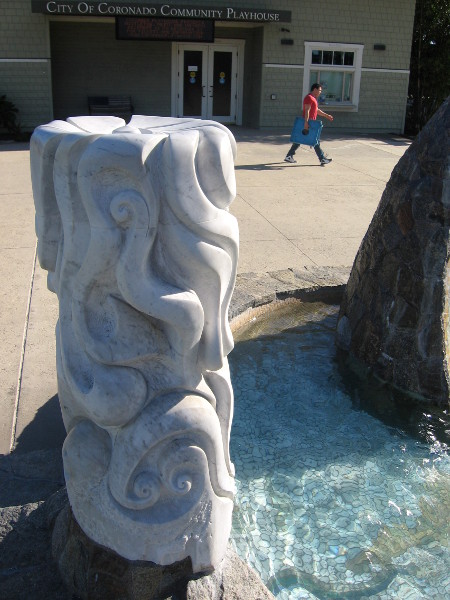
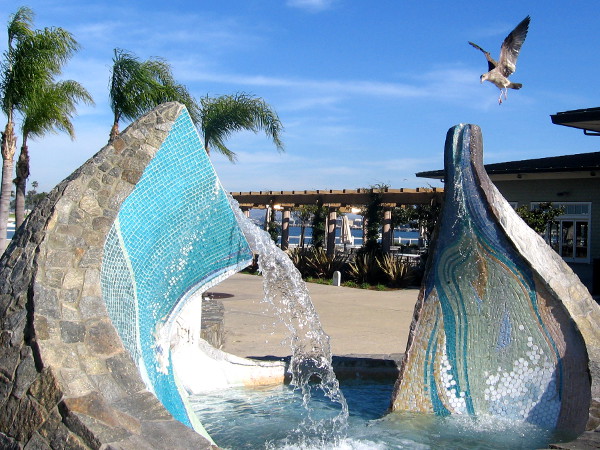
Sea Passage sculpture and fountain between Coronado City Hall and Community Center.
Whenever I walk around Coronado, or bike down the Silver Strand, I like to pass by this graceful work of art. Sea Passage, created by James T. Hubbell, adds gentle sound and sparkling color to a long park which stretches beside Glorietta Bay. The popular linear park can be found between the Hotel del Coronado’s old boathouse and Naval Amphibious Base Coronado.
The fountain contains a sinuous mosaic of many small tiles. They appear to me like silvery blue scales, glittering and swimming in the flowing water. The organic form artistically connects two somewhat ordinary-looking buildings: Coronado City Hall and the Community Center.
James T. Hubbell also designed two striking works of public art on Shelter Island, which is located just north of Coronado across San Diego Bay. I’ve already blogged about Pacific Portal. One of these days I’ll write about Pearl of the Pacific.
Sea Passage was created in 2005 by sculptor James T. Hubbell.Artwork adds gentle beauty to Coronado’s park along Glorietta Bay.Seagulls like getting a drink of water from the top of this colorful fountain!
…
To enjoy future posts, you can “like” Cool San Diego Sights on Facebook or follow me on Twitter.
Unusual street sign on Park Boulevard shows the road in someone’s hand.
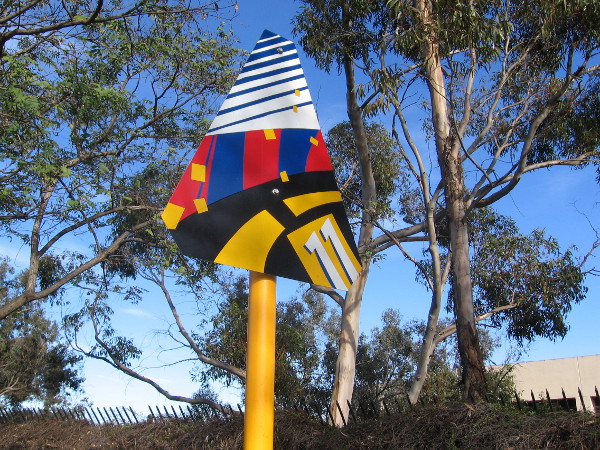
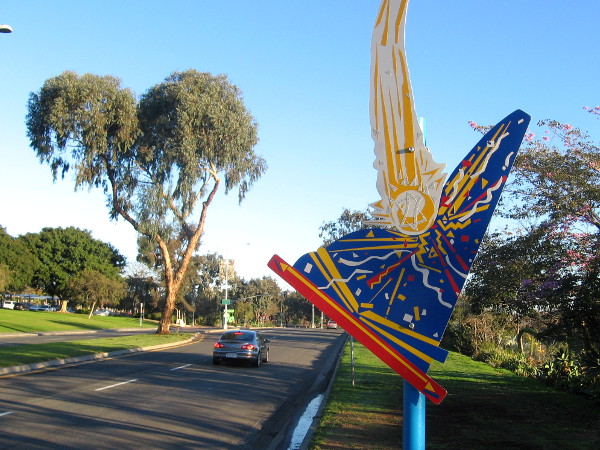
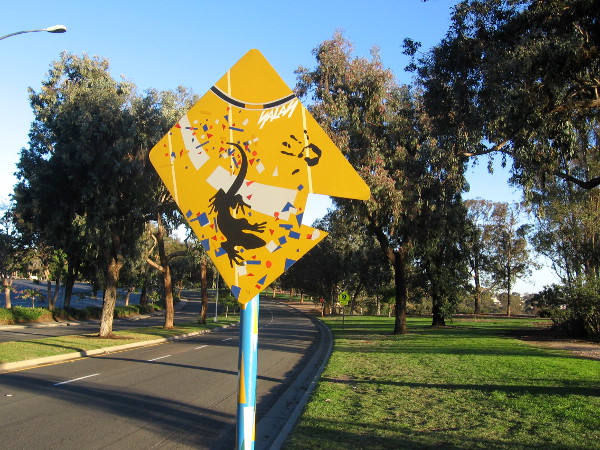
A dozen very unusual, artistic street signs line Park Boulevard in the vicinity of Balboa Park. Drive north and you’ll see them standing at intervals, all the way from Presidents Way up to Upas Street. For many years I’ve noted them.
I’m not sure how passing drivers respond to all the crazy artwork. I’m pretty sure these unique signs aren’t included in the Department of Motor Vehicles driving test! I hope not!
UPDATE!
I’ve learned this installation of art is titled Night Visions, by artist Roberto Salas. They first appeared in 1988, a year our city hosted the Super Bowl. According to what I read, in 1989 Night Visions was the very first acquisition of public art by the City of San Diego.
This funny sign shows a magician pulling a rabbit from hat.Drivers might think the speed limit here is 11 miles per hour!Odd, speckled sign stands beside Balboa Park’s rose garden.This crazy sign is a meteoric explosion of creativity.Car near San Diego Zoo entrance heeds artistic street sign, I’m sure.Does this sign indicate that a lizard is crossing?This unofficial street sign is open for interpretation.
…
To enjoy future posts, you can “like” Cool San Diego Sights on Facebook or follow me on Twitter.
The colorful new Barrio Logan gateway sign arches over Cesar Chavez Parkway.
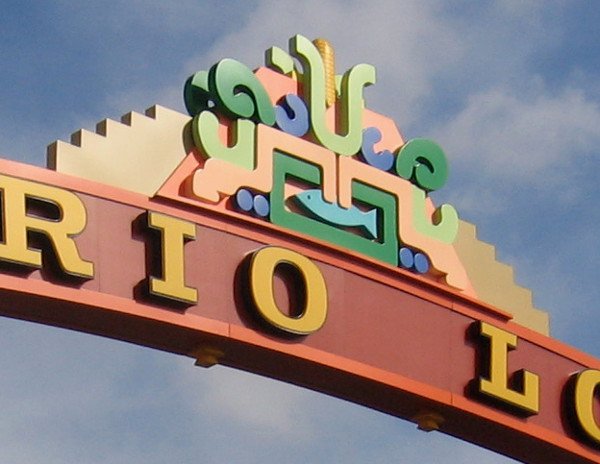
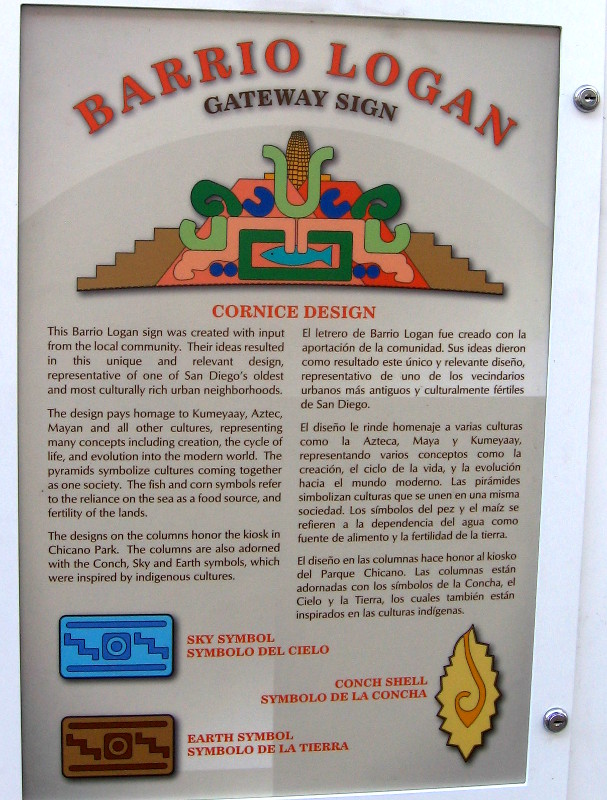
A little over a week ago, the new Barrio Logan gateway sign had a dedication ceremony. The welcoming sign, arching over Cesar Chavez Parkway between Harbor Drive and Interstate 5, is similar to others that can be spotted in various communities around San Diego. Its design, however, is notably different. The cornice contains a variety of symbolic elements inspired by this neighborhood’s complex history.
The cornice contains a variety of combined symbols that represent the community.One of two displays on either column that explains the design.
Small displays near the base of each column can be read from either sidewalk. They explain the significance of the cornice design:
“This Barrio Logan sign was created with input from the local community. Their ideas resulted in this unique and relevant design, representative of one of San Diego’s oldest and most culturally rich urban neighborhoods.
The design pays homage to Kumeyaay, Aztec, Mayan and all other cultures, representing many concepts including creation, the cycle of life, and evolution into the modern world. The pyramids symbolize cultures coming together as one society. The fish and corn symbols refer to the reliance on the sea as a food source, and fertility of the lands.
The designs on the columns honor the kiosk in Chicano Park. The columns are also adorned with the Conch, Sky and Earth symbols, which were inspired by indigenous cultures.”
View of the gateway sign as one approaches from the Barrio Logan trolley station.
…
To enjoy future posts, you can “like” Cool San Diego Sights on Facebook, or follow me on Twitter.
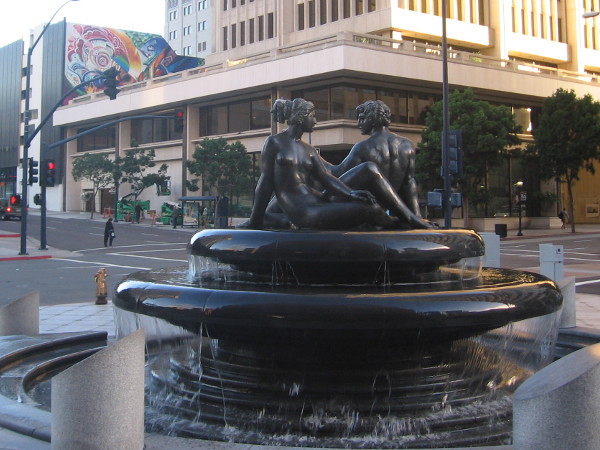
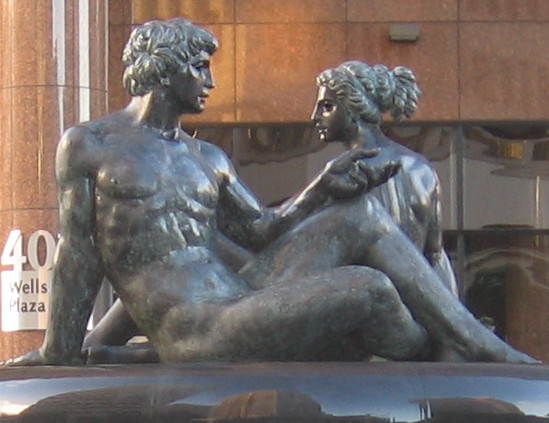
Fountain of Two Oceans sculpture in front of Wells Fargo building in downtown San Diego.
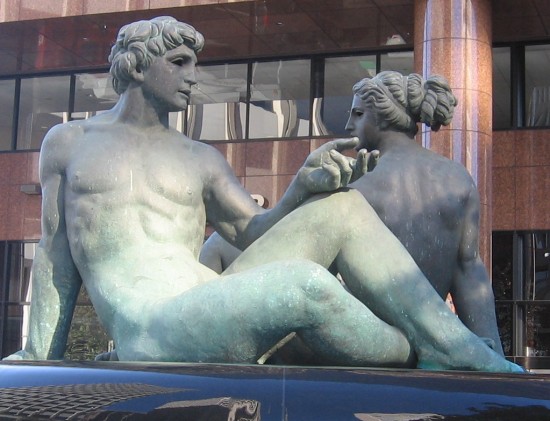
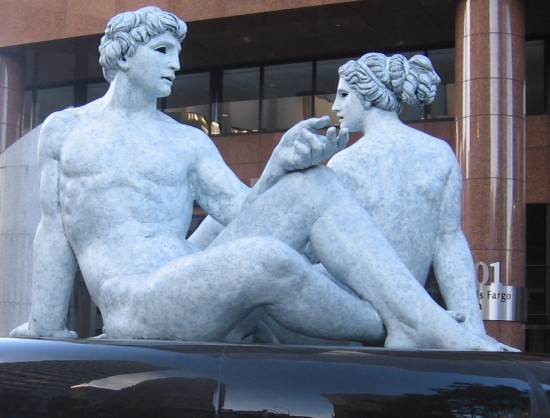
Perhaps you recall my blog post from early in the summer, where I was astonished at how the Fountain of Two Oceans sculpture in front of downtown’s Wells Fargo building had suddenly turned white! Well, yesterday I saw it has changed colors once again!
I’m guessing a number of people found the weird, mottled white color unattractive. (Personally, I thought it was ghastly.) Today, the human figures appear bronze again, but much darker than before, without the heavily tarnished surface. In my opinion, this is a big improvement. What do you think?
Before the figures were painted white:
Bronze nudes of Sergio Benvenuti’s Fountain of Two Oceans.
Painted white, possibly to resemble marble:
Fountain of Two Oceans sculpture suddenly becomes white!
Now much darker, matching the fountain’s base:
The reclining human figures today have a dark, new bronze appearance!
…
To enjoy future posts, you can “like” Cool San Diego Sights on Facebook, or follow me on Twitter.
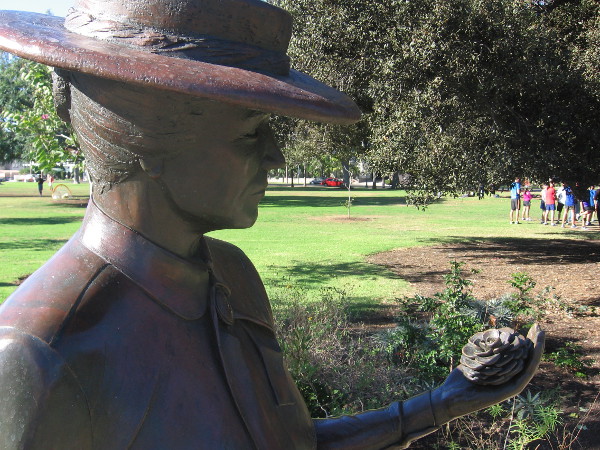
Kate Sessions, the Mother of Balboa Park, holds a pine cone by the grass.
Balboa Park is bursting with cool sights wherever you go. If you’ve ever driven or walked along El Prado a short distance west of the Cabrillo Bridge, you’ve probably seen some slightly larger than life sculptures of people standing on either side of the street. Sefton Plaza, located at the intersection of El Prado and Balboa Drive, is the location of these four bronze sculptures.
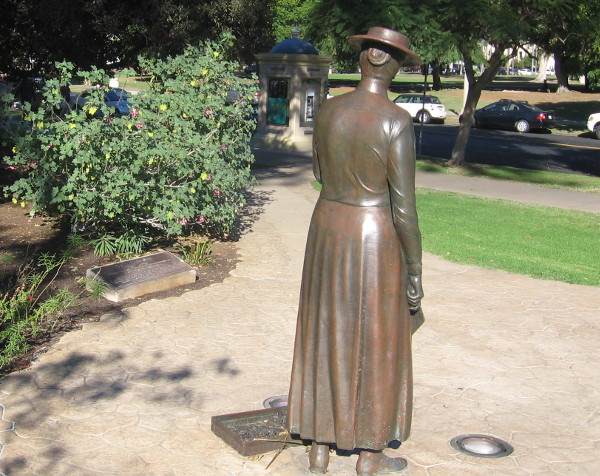
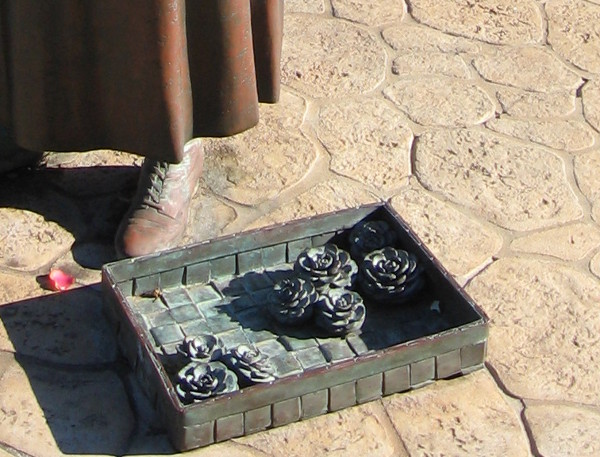
On the south side stands a representation of horticulturist Kate Sessions holding a trowel and pine cone. Often called the Mother of Balboa Park, she was instrumental in creating the park’s many lush gardens and groves of trees. The sculpture stands among a variety of beautiful plants including species she introduced in the early years of the park.
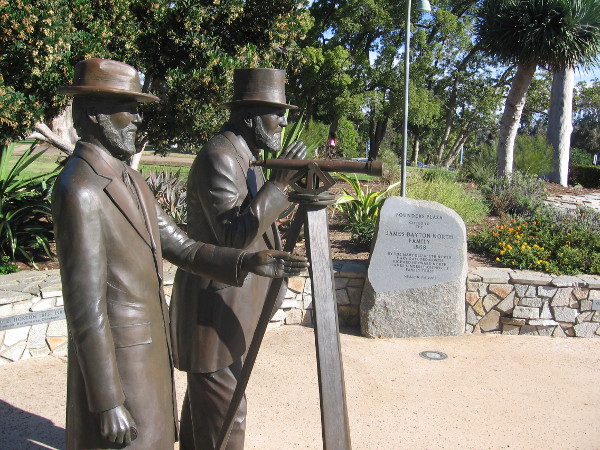
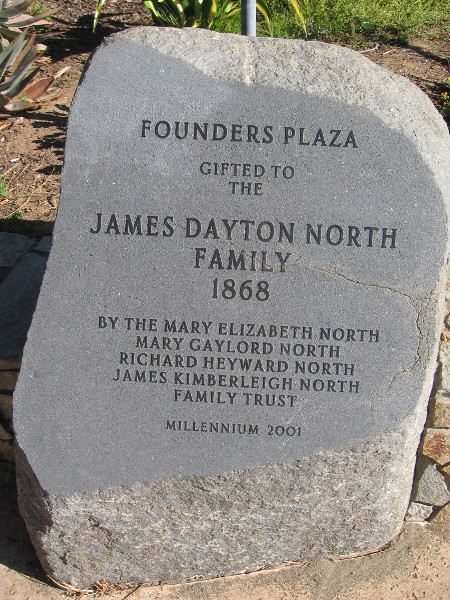
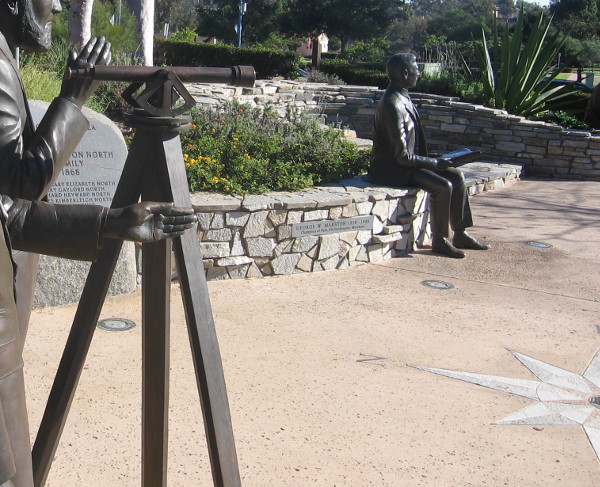
The three lifelike sculptures on the north side of Sefton Plaza, an area called Founder’s Plaza, represent Ephraim Morse, Alonzo Horton and George Marston. These three were the visionaries who orginally conceived Balboa Park, then worked tirelessly to create it.
Ephraim Morse, an early settler and promoter of San Diego, and Alonzo Horton, a land speculator responsible for downtown San Diego’s current location, proposed in 1868 that the new city park occupy 1,400 acres. The sheer size of the park was simply amazing, considering San Diego at the time had a mere 2,300 residents! George Marston, often called the Father of Balboa Park, was a prominent department store owner who personally funded the park’s design. To turn the grand vision into reality, he hired the former superintendent of New York City’s Central Park, Samuel B. Parsons Jr. The park’s construction began in 1903 at the corner of Sixth Avenue and Date Street. (Just a three minute walk from where I live! I love it!)
The four wonderfully realistic bronze sculptures were created by local artist Ruth Hayward. She intentionally made them about 10% larger than life, so they’d appear slightly imposing.
Balboa Park, which began as a grand idea in the minds of just a few people, today is the nation’s largest urban cultural park!
During her life, Kate Sessions created gardens and landscapes for all to enjoy.Kate Sessions lingers on footpath between Cabrillo Bridge and Sixth Avenue.More pine cones fill a shallow box at Kate Sessions’ booted feet.Lifelike sculptures of Ephraim Morse and Alonzo Horton in Founder’s Plaza.Two of Balboa Park’s early advocates survey their awesome creation.Founders Plaza gifted to the James Dayton North Family 1868.Near Morse and Horton, George Marston sits on a wall, enjoying the surrounding beauty.George Marston is remembered today as the Father of Balboa Park.Bronze sculpture sits comfortably next to its hat by a small pool of water.
…
To enjoy future posts, you can “like” Cool San Diego Sights on Facebook, or follow me on Twitter.






























 Cool San Diego Sights!