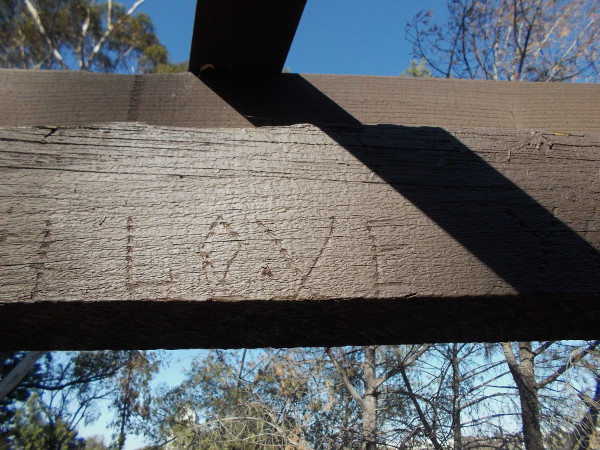
LOVE carved into the beam of a wooden shelter on Presidio Hill.
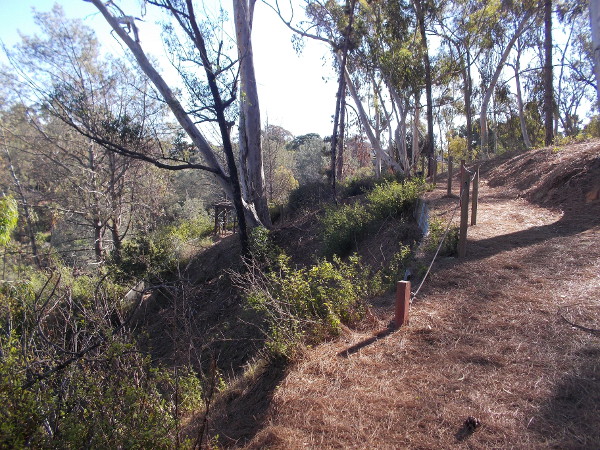
My walk today took me along a lonely dirt trail on Presidio Hill.
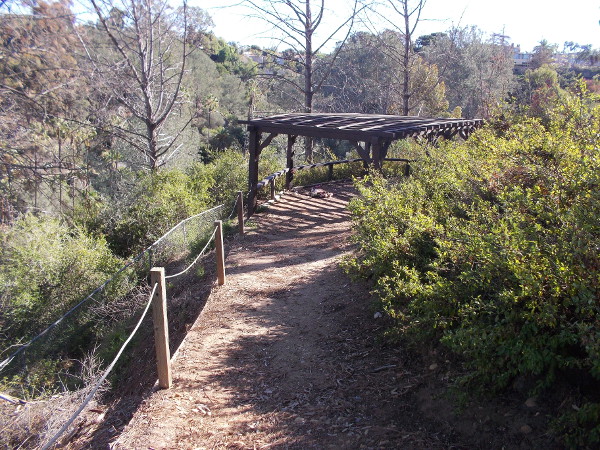
The trail, among quiet trees, climbs above the location of the old Spanish presidio, the nearly 250 year old birthplace of European civilization in California. After a short distance, the trail descends toward a primitive wooden shelter overlooking a canyon.
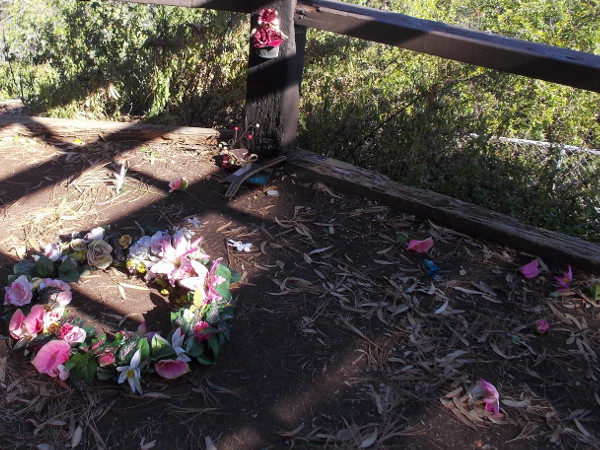
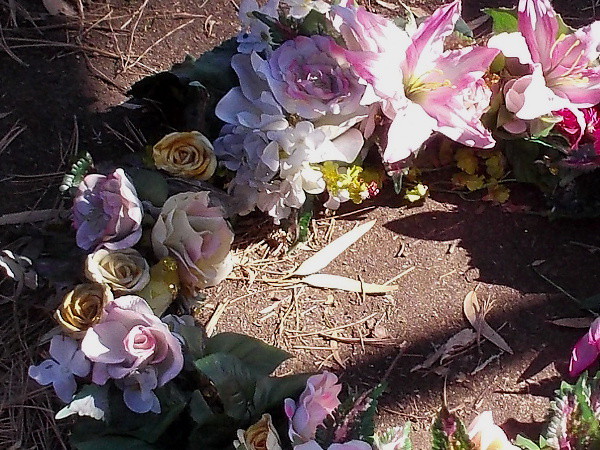
The shelter was empty. A wreath of beautiful fresh flowers lay upset on the ground. A small floral display of some kind was broken in a corner. Torn flowers lay scattered about.
It’s a very strange mystery. But so is love.
Walking along a lonely trail covered with pine needles. Few people visit this part of Presidio Hill.A simple wooden structure among the trees comes into view. It is empty.Flowers are scattered on the ground.An upset wreath of fresh flowers. A broken display, left behind. Why?A beautiful mystery. Perhaps it contains sorrow.
Approaching the La Casa de Machado y Stewart Museum in Old Town.
It seems most of the tourists who visit Old Town San Diego State Historic Park enjoy the large central grassy plaza and the many interesting buildings immediately around its perimeter. Few, however, go slightly off the beaten track to investigate the several restored old structures that are scattered a few easy steps farther away.
In addition to a very cool one room schoolhouse dating from 1865 (which I remember visiting during a field trip as a child), there is a restored adobe house called Casa de Machado y Stewart which stands as an open museum to any passersby who are curious.
The Casa de Machado y Stewart dates from 1835. It was built by José Manuel Machado, a Spanish (then later Mexican) officer who served at the nearby presidio. Jack Stewart, an American shipmate of famous author Richard Henry Dana Jr., and a pilot on San Diego Bay, married Machado’s youngest daughter Rosa in 1845 and the two moved into the house. Over their many years of residence they made many improvements, including a clay tile roof and wood-paned windows. What today seems a very simple and almost primitive existence was back in those days living in the lap of luxury.
In 1932, the house became an official California Historic Landmark.
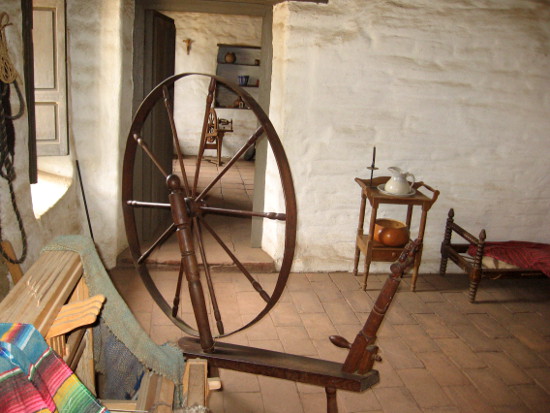
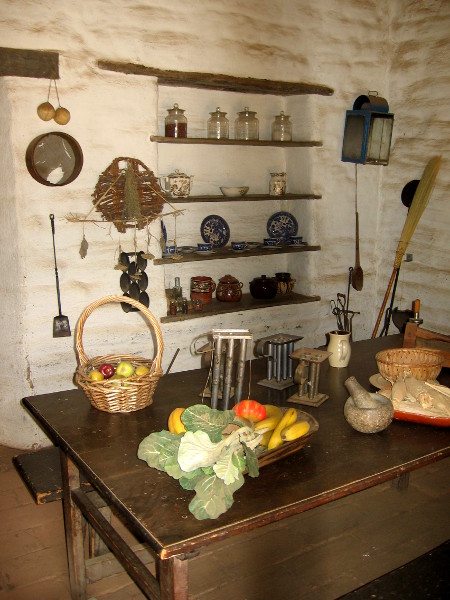
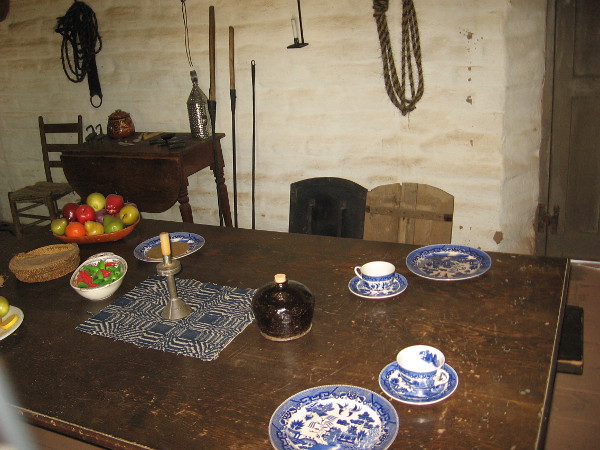
Restored 1835 adobe house in San Diego’s Old Town State Historic Park.Sign details history of La Casa de Machado y Stewart.House was built by a soldier from nearby presidio.A spinning wheel in one of the simple rooms suggests what life was like.A modest dining area as it appeared long ago.
UPDATE!
I visited La Casa de Machado y Stewart again in August, 2018, and noticed the exterior had been painted white. When I looked through the front door into the main living room, I observed that new furnishings and artifacts have been added, and others moved about.
I also peered through a window into what appears to be a bedroom.
Here are photos…
…
To enjoy future posts, you can “like” Cool San Diego Sights on Facebook, or follow me on Twitter.
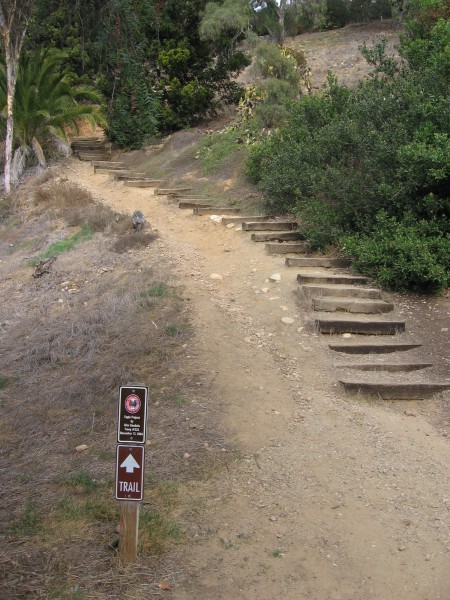
The Old Presidio Trail leads up a steep hill from San Diego’s historic Old Town.
Please join me as I walk from San Diego’s Old Town up a short but very steep trail to Presidio Park. We’ll see all sorts of interesting monuments, views, and of course, the location of the old Spanish presidio, whose ruins are no longer visible. The top of Presidio Hill is now home to the Junipero Serra Museum. Follow me!
We begin near the trailhead, beside the small Presidio Hills Golf Course, on the east edge of historic Old Town.
One of several signs along the Old Presidio Historic Trail. This one explains that soldiers and families used to walk down from the Spanish presidio to tend gardens and livestock near the Casa de Carrillo, which is now the pro shop at Presidio Hills Golf Course.The Indian sculpture by Arthur Putnam in Presidio Park.
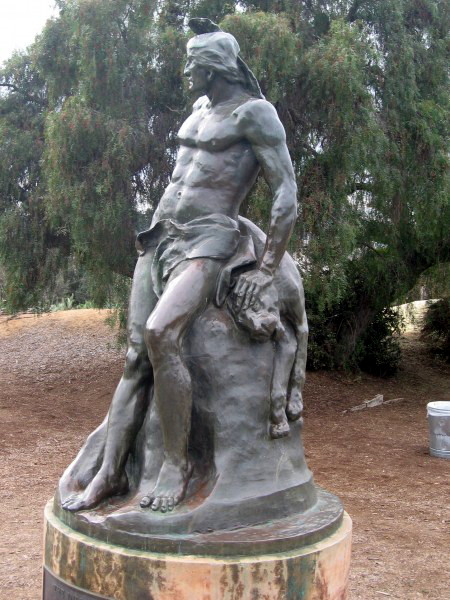
The first interesting thing we see is this sculpture, titled The Indian. It was created by famous American artist Arthur Putnam in 1905 and placed at the site of an ancient Indian village. The small village was discovered and named San Miguel by the explorer Juan Rodriguez Cabrillo in 1542.
The Padre Cross was erected near the spot where Junipero Serra established California’s first mission.
Up the hill from The Indian stands the Padre Cross. It was raised in 1913 by the Order of Panama and is made up of tiles from the Presidio ruins. The cross marks the strategic location overlooking San Diego Bay where Franciscan friar Junipero Serra chose to establish a Spanish Catholic mission in 1769. (The mission was moved several miles up the San Diego River 5 years later.)
Bronze statue titled The Padre by Arthur Putnam.
Nearby among some trees we find a memorial to the mission’s friars. It’s a bronze statue titled The Padre, completed in 1908 by renowned sculptor Arthur Putnam.
The Serra Museum rises beyond billowing Spanish flag.
Our legs are starting to feel the climb as we reach three flagpoles overlooking Mission Valley.
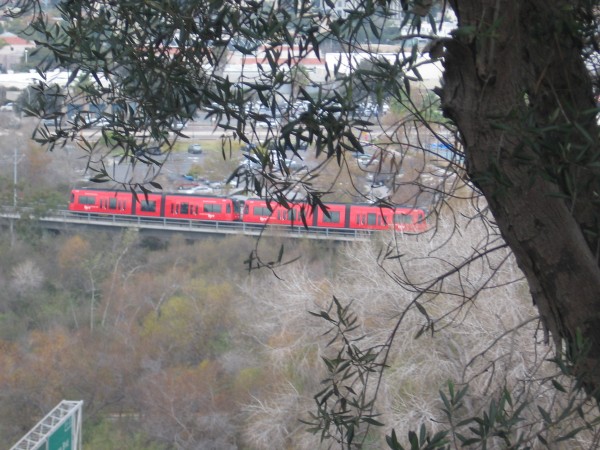
Looking down at a red trolley in Mission Valley.
Turning north for a moment, we see the trolley!
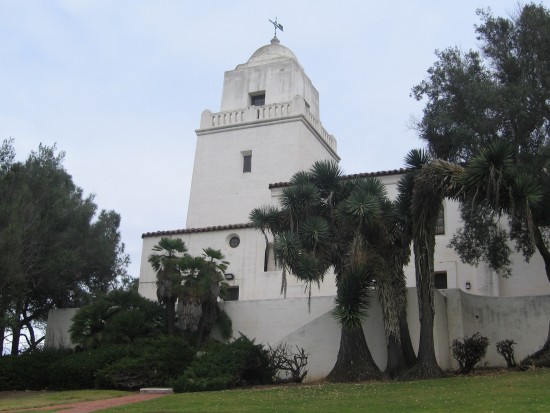
View of the Serra Museum on Presidio Hill in San Diego.
Now we’re getting close to the Serra Museum, which was built in 1928 on this historically very important hill. The museum was built, and the land containing Presidio Park was purchased and preserved for posterity, by philanthropist George Marston.
San Diego was born in 1769 at the old Presidio, a Spanish fort in a desert-like wilderness very far from European civilization. It was located just below the Serra Museum.
Serra Museum employee looks down the grassy hill.
Not many people are about at the moment. Most tourists never venture up this way.
The Serra Museum is packed with numerous historical exhibits. You can climb the tower for views of San Diego Bay, the San Diego River and Mission Valley.
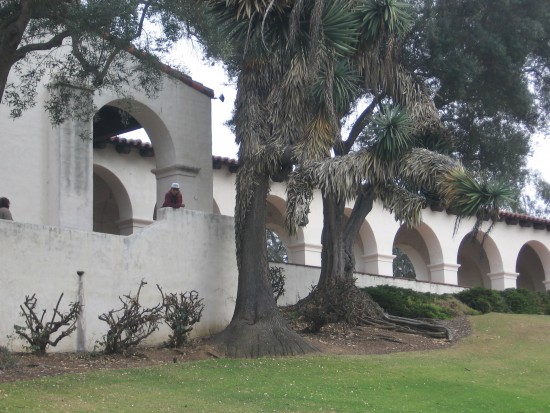
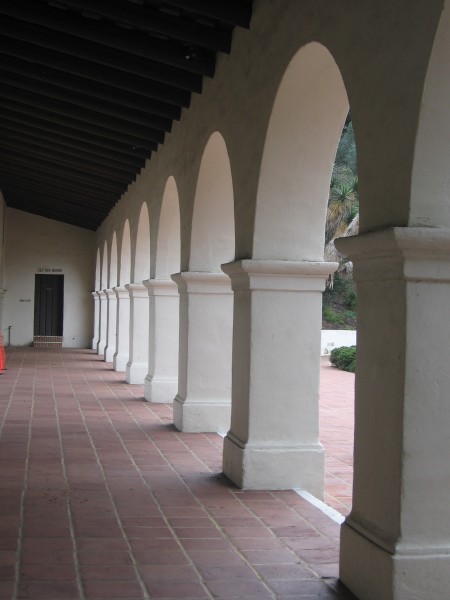
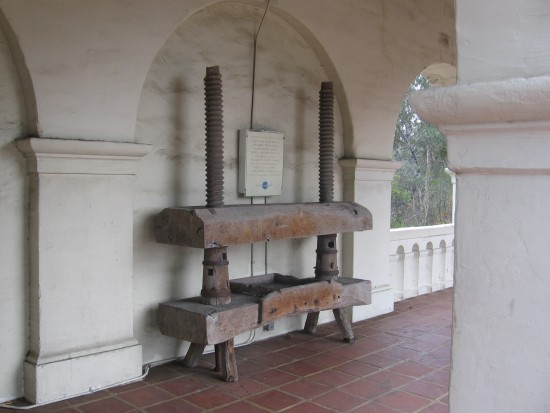
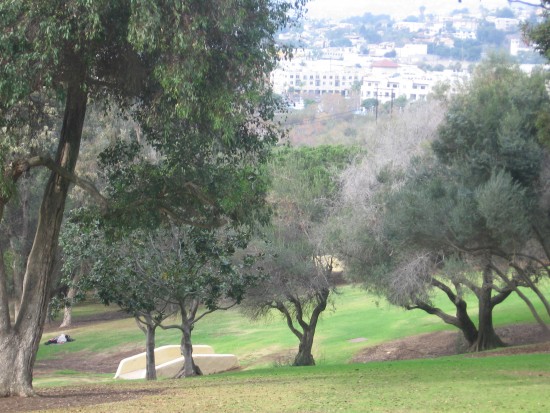
Row of Mission Revival style arches.Large wine press outside San Diego’s fascinating Junipero Serra Museum.Looking downhill from atop grassy Presidio Park.
Now we’ll wander along the hilltop to nearby Fort Stockton, the short-lived camp of the famous Mormon Battalion.
Where a cannon once overlooked Old Town at Fort Stockton.
Decades ago, when I was a young man, I remember seeing a cannon set in this concrete overlooking Old Town. I believe that same cannon is now on display in the nearby Serra Museum. Given the name El Jupiter, it was one of ten cannons that originally protected the old Spanish Fort Guijarros on San Diego Bay at Ballast Point.
(A second surviving cannon from the fort is named El Capitan. Today it can be found near the center of Old Town San Diego’s Plaza de las Armas.)
Mural at Fort Stockton of the Mormon Battalion.
In 1846, President James K. Polk asked Brigham Young of the Mormons to send a few hundred men to San Diego to help in the Mexican-American war effort. On January 29, 1847 five hundred men and about eighty women and children arrived at Fort Stockton after a very difficult 2,000-mile march from Council Bluffs, Iowa.
Mormon Battalion Monument by Edward J. Fraughton.
I hope you enjoyed our walk!
UPDATE!
In 2021 the two sculptures The Indian and The Padre were moved from Presidio Hill to the San Diego History Center in Balboa Park. To see my blog post concerning this, click here.











 Cool San Diego Sights!