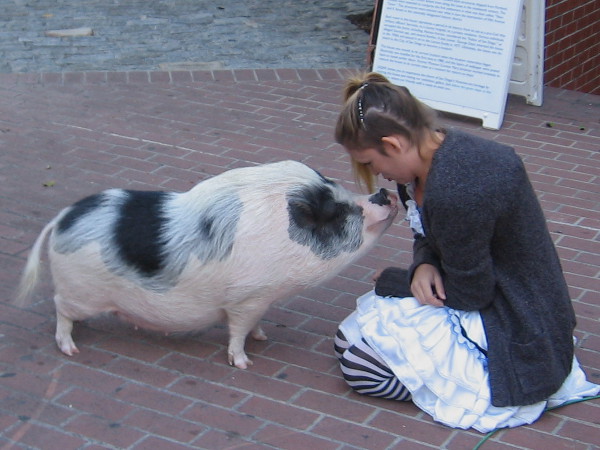
Lady promoting San Diego’s upcoming Fall Back Festival goes nose to nose with a friendly hog.
In two days a large number of characters from the Old West will be roaming the streets of modern San Diego. During the Fall Back Festival, which takes place this Sunday, November 8, between 11 and 4, several blocks of the Gaslamp Quarter will be transformed into a 1880s frontier town!
Visitors to the free event will be able to enjoy all sorts of historical exhibits, not to mention a saloon, a penny candy store, a town jail, hay and pony rides, panning for gold, butter churning, candle dipping, and a Wild West Show! Wow! I went last year and it was a lot of fun!
During my walk this morning I happened upon some folks promoting the event for the local NBC television news station. They were hanging out near the entrance to the William Heath Davis House Museum. Sneaky me… I took some pics!
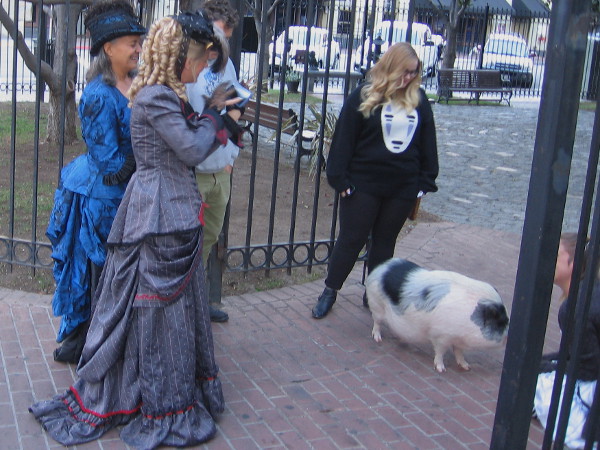
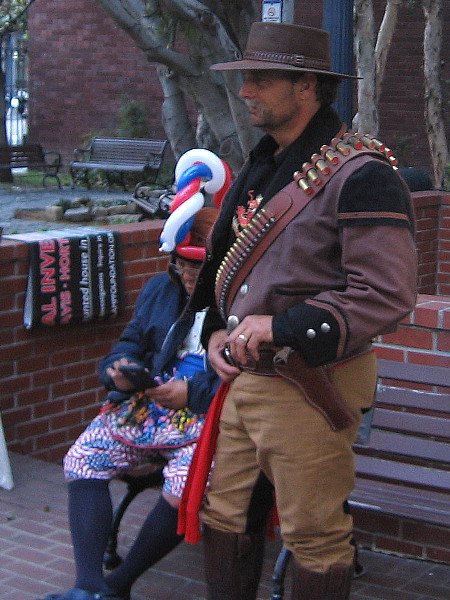
Ladies in frilly dresses linger between television shoots promoting San Diego’s Fall Back Festival. The annual event, which takes place near the William Heath Davis House Museum, will recreate a 1880s frontier town.A tough Western character hangs out with a silly balloon twister. This bench is beside the historic William Heath Davis House in downtown San Diego.Two gentleman from the Old West converse on Fourth Avenue sidewalk in San Diego’s modern Gaslamp Quarter.
…
Follow this blog for more photos of cool stuff! Join me on Facebook or Twitter.
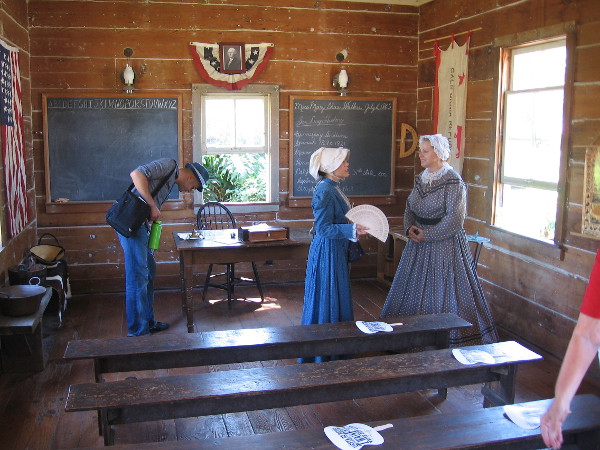
Gentleman in period attire tells visitors at Old Town San Diego State Historic Park about the history of the Mason Street School.
The Mason Street School was San Diego’s very first schoolhouse. It was built in 1865. In 2015, 150 years later, it’s one of the most interesting sights in Old Town San Diego Historic State Park.
The one room schoolhouse museum isn’t always open to the public. So whenever I walk through Old Town, I eagerly wander past to see if the front door is swung wide. If it is, I amble inside and look about, trying to absorb what life was like in the early days of San Diego.
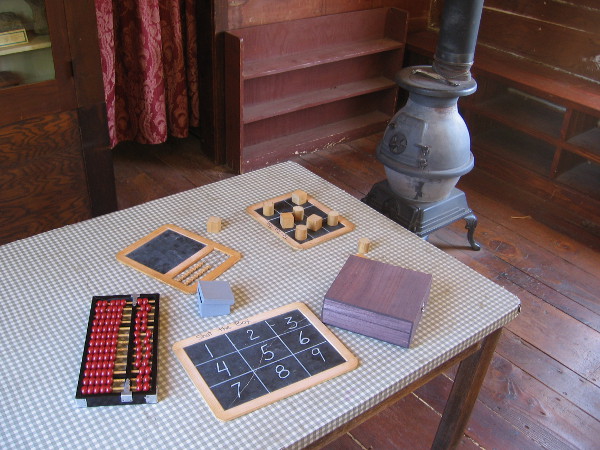
I remember how the Mason Street School used to contain numerous desks. But they’ve been replaced by plain benches, to more accurately portray where a small number of students from Spanish, American and other diverse backgrounds, grade one to eight, sat together and learned how to read, write and do arithmetic.
Back in the early years of San Diego, school was held twelve months a year. Hours were 9 to 4, but many students would skip school to watch bull fights, fiestas and other exciting town doings. Many children were held out of school by their parents to help on a ranch or farm, or to work in a family store.
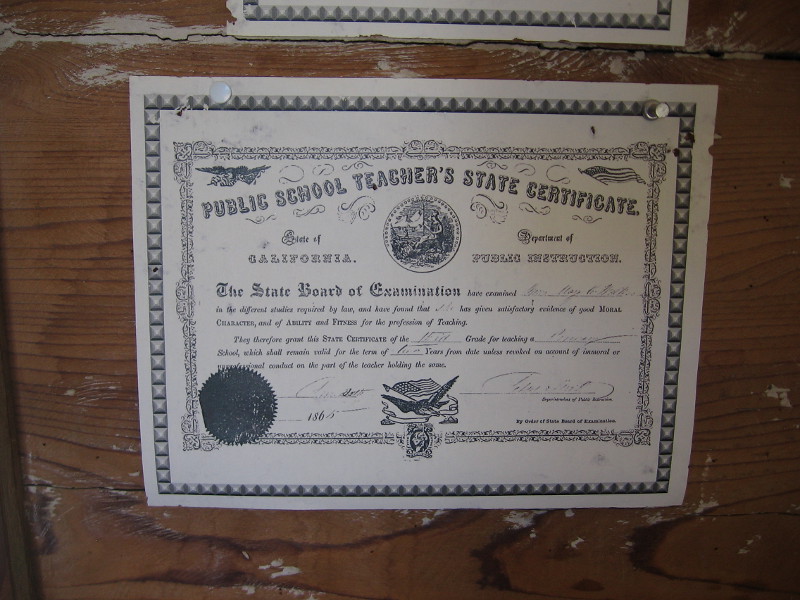
San Diego in 1865 was a small, isolated, somewhat ramshackle town. Mary Chase Walker, Mason Street School’s first teacher, wrote when she arrived in San Diego by steamship: “I arrived in the bay of San Diego on the morning of July 5, 1865. It was a most desolate looking landscape. The hills were brown and barren; not a tree or green thing was to be seen. Of all the dilapidated, miserable looking places I had ever seen, this was the worst. The buildings were nearly all of adobe, one story in height, with no chimneys. Some of the roofs were covered with tile and some with earth…”
Mary Chase Walker originally traveled from Massachusetts to California, in search of greater opportunity. While in San Francisco, she learned of a teaching opening in San Diego. After less than a year at the Mason Street School, however, she became embroiled in a local controversy. One day she made a kind gesture to a lady who was part African-American, but many early San Diegans had arrived from the Confederate South and voiced their disapproval. A number of students were removed from the small school in anger. To allow the scandal to pass over, Mary quit teaching and married the president of the school board, early San Diego settler and prominent merchant Ephraim Morse.
It’s hard in modern times to imagine the life and culture of San Diego long ago. But one can get a flavor of that fascinating history by stepping inside the old Mason Street School.
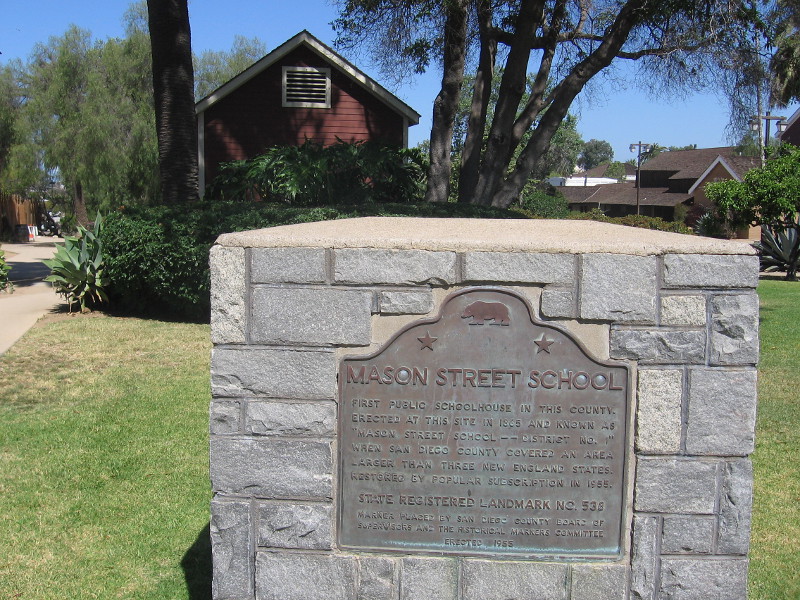
The Mason Street School was built in 1865, to provide education for the children of a sparsely populated San Diego.The first schoolhouse in San Diego County, the Mason Street School stands in historic Old Town.
The nearby plaque reads:
MASON STREET SCHOOL
FIRST PUBLIC SCHOOLHOUSE IN THIS COUNTY.
ERECTED AT THIS SITE IN 1865 AND KNOWN AS
“MASON STREET SCHOOL – – DISTRICT NO. 1”
WHEN SAN DIEGO COUNTY COVERED AN AREA
LARGER THAN THREE NEW ENGLAND STATES.
RESTORED BY POPULAR SUBSCRIPTION IN 1955.
STATE REGISTERED LANDMARK NO. 538
MARKER PLACED BY SAN DIEGO COUNTY BOARD OF
SUPERVISORS AND THE HISTORICAL MARKERS COMMITTEE
ERECTED 1955
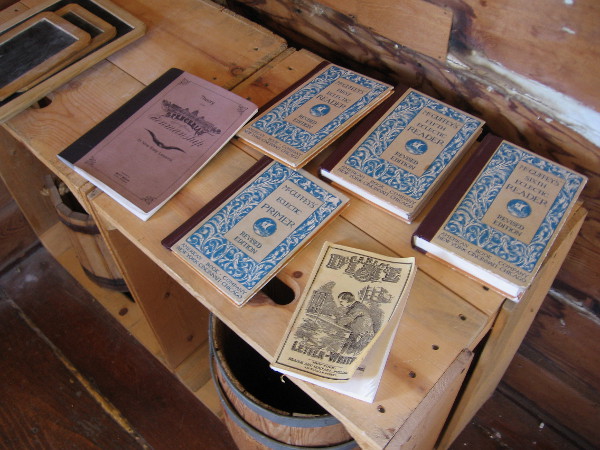
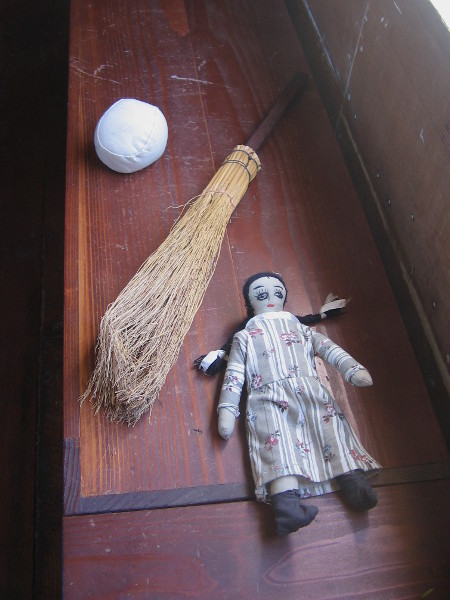
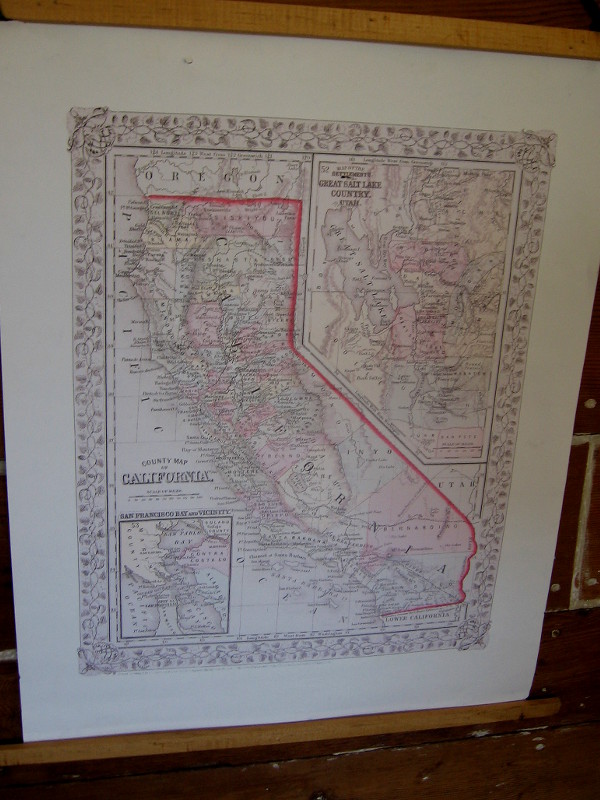
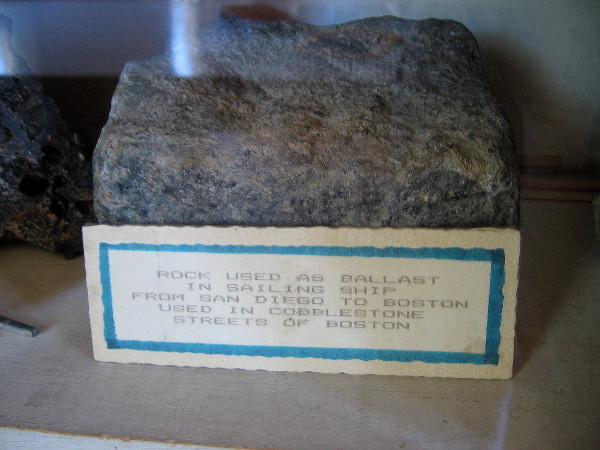
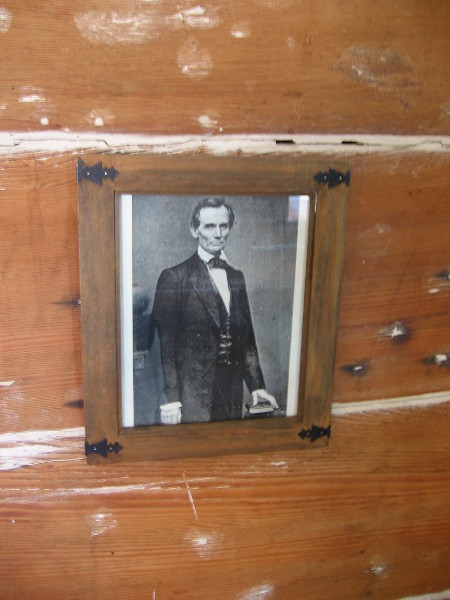
The Mason Street School museum is occasionally open to the public. If you’re lucky and it is, make sure to step inside!Years ago, the museum contained individual student desks. But these benches are a more faithful representation of actual history. Fancy desks were rare in this remote outpost of civilization!Children attending the Mason Street School used slates and chalk, as paper was also scarce and expensive. A wood stove provided heat.Some old Primers and Readers on a wooden table. A water bucket and dipper were used for drink.A ball, broom and doll.Public School Teacher’s State Certificate from the mid 19th century. San Diego’s first teacher was Mary Chase Walker.Old map of California from an era when many immigrants arrived by ship.Rock used as ballast in a ship that sailed from San Diego to Boston. Stones gathered on Ballast Point in Point Loma paved many of Boston’s cobblestone streets, 3000 miles away!Photographic portrait of President Abraham Lincoln on a primitive wall. Mason Street School was San Diego’s first schoolhouse, built in 1865 at the end of the Civil War.Water for washing and drinking was brought in from a well near the schoolhouse.The old well in the schoolhouse yard, beside a clump of prickly pear.The Mason Street School provides visitors to Old Town San Diego State Historic Park a fascinating look at our city’s very unique past.
…
Follow this blog for more San Diego history and photos of cool stuff! Join me on Facebook or Twitter.
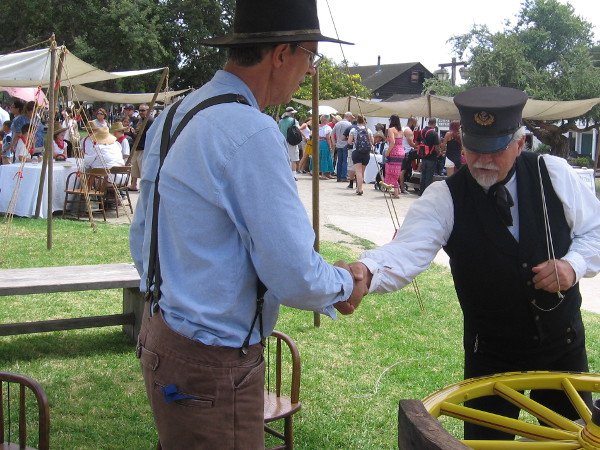
A merchant ship’s purser greets a wheelwright in Old Town San Diego State Historic Park during Stagecoach Days: Trades That Shaped the West.
This afternoon I took a short easy stroll through Old Town San Diego State Historic Park. My trusty little camera captured some interesting photos of history come to life!
During summer Saturdays, Old Town hosts a cool event called Stagecoach Days. Each weekend there’s a different theme. Today it was Trades That Shaped the West.
As you might imagine, I witnessed historical reenactments of working life in San Diego when the town was a small outpost of civilization surrounded by mostly undeveloped wilderness. In those days life was often difficult, but the people were from hardy stock. Let’s see a small sample of what 19th century San Diego might have been like…
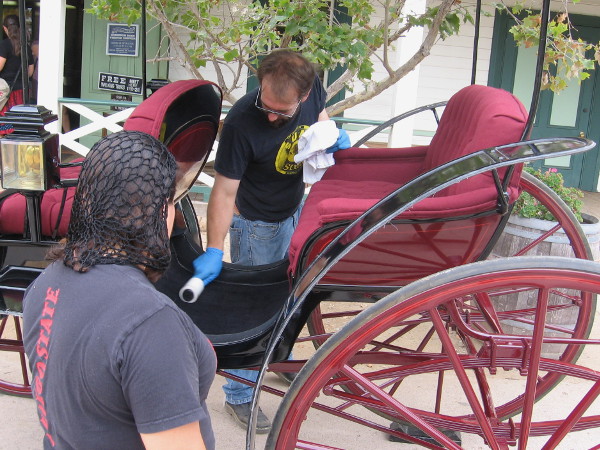
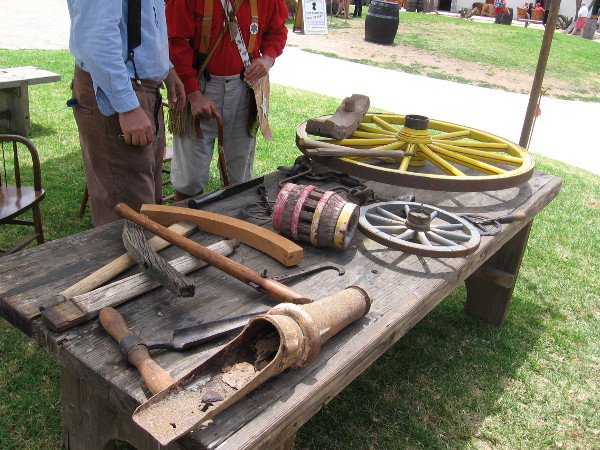
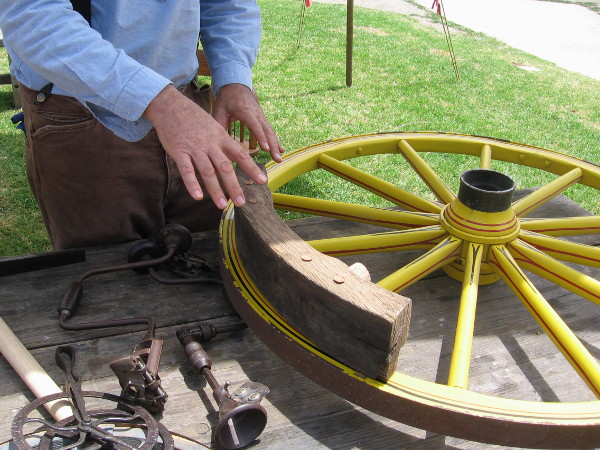
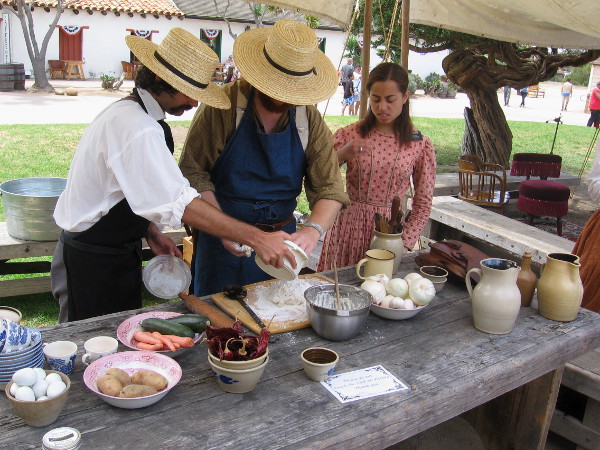
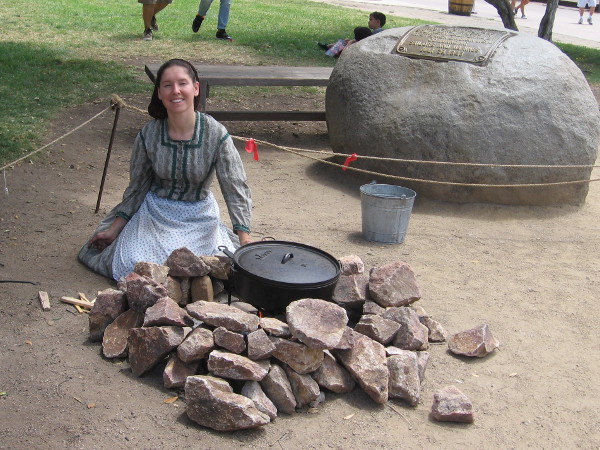
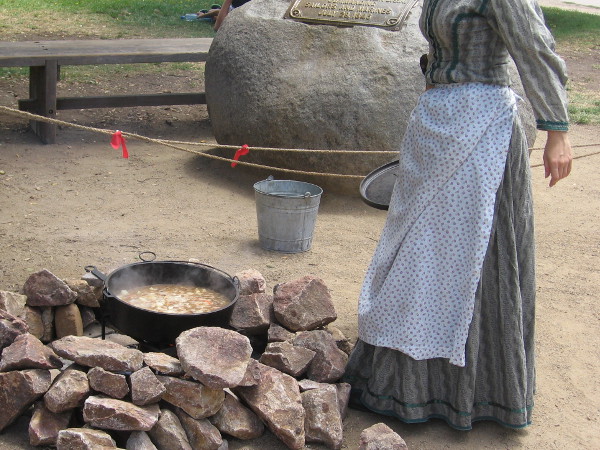
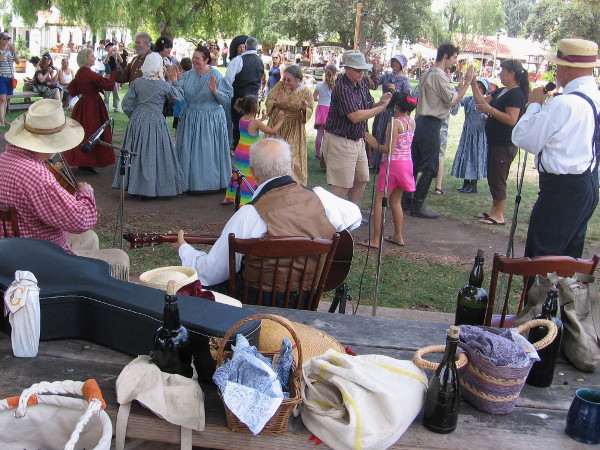
Stagecoach Days, Celebrating the West on the Move, is open free to the public. The weekly event is held on summer Saturdays in Old Town’s historic central plaza.Preparing an old Stanhope Park Phaeton, parked with other buggies and carriages in front of the Robinson-Rose House Visitor Information Center.A ladies basket trap carriage, circa 1900. This simple horse-drawn vehicle was often used for comfortable country travel, complete with wicker basket seat.The wheelwright had many tools on display and explained how wheels in the 19th century were skillfully created of wood and iron.A welded ring of bent iron would be expanded with heat, then placed around the wheel’s ash wood circumference.A cool woodworker demonstrates and provides the names of his many tools to the delight of watching kids.A sneak peek into the blacksmith shop behind Seeley Stable Museum before the event officially begins outside in the plaza.A blacksmith bangs away on some hot metal as he fashions a thin, pointed nail.This sliver of red hot iron with some hammering will be turned into a nail with a flat head, ready to be used for 19th century construction.These folks in historical costume are busily preparing some biscuits, a common food in the early days of San Diego.A smiling someone is tending the campfire. What’s cooking?Looks like a bubbling stew!Printing press demonstration underway at the San Diego Union Museum print shop in Old Town.Wells Fargo employee, from the agent’s office museum in the Colorado House, helps people into a stagecoach for a photograph.Of course, a good historical reenactment of the Old West requires lively music and enthusiastic dancing.Two ladies prepare to dance the polka.
…
Enjoy photos of cool events and random stuff! Join me on Facebook or Twitter.
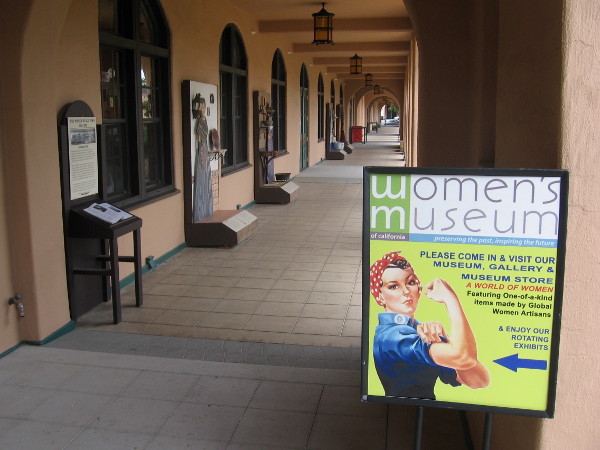
Important stories from local history are preserved at the Women’s Museum of California.
The Women’s Museum of California is one of many cultural attractions that can be enjoyed at Liberty Station in Point Loma. I took some photos of a historical exhibit just outside their front door.
This unique museum was founded by Mary Maschal, a collector of memorabilia and artifacts pertaining to women. The collection has moved to different locations and evolved over the years; today it has grown into an important museum that features art shows, live performances, lectures and other educational events. Its mission is summarized by the slogan: Preserving the past…inspiring the future.
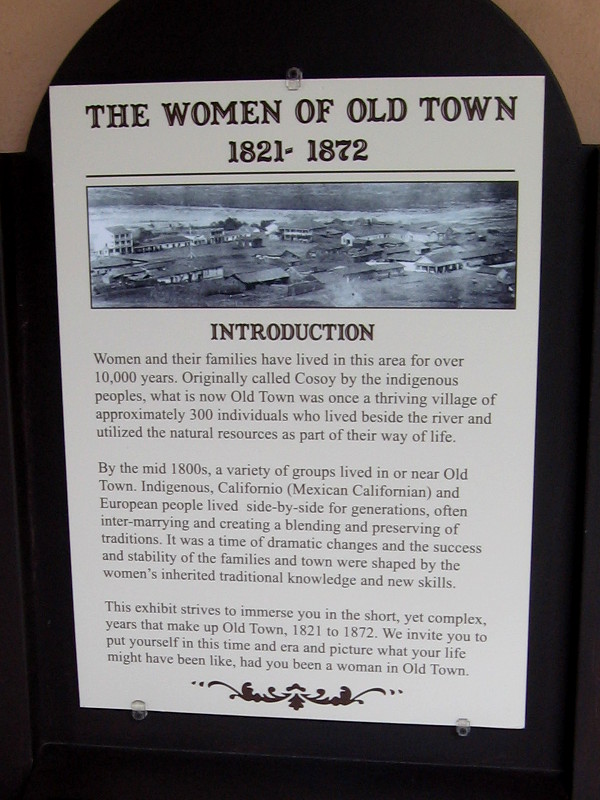
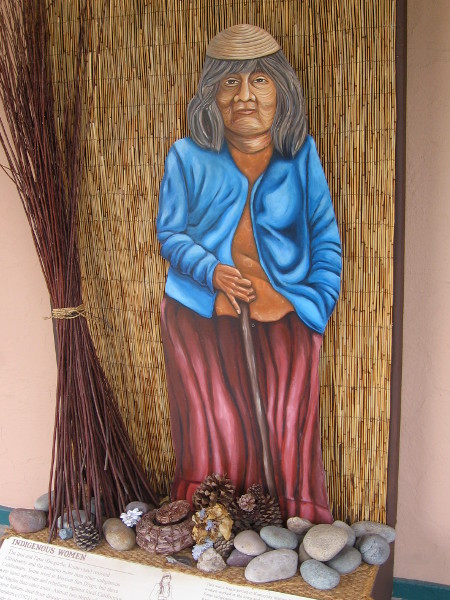
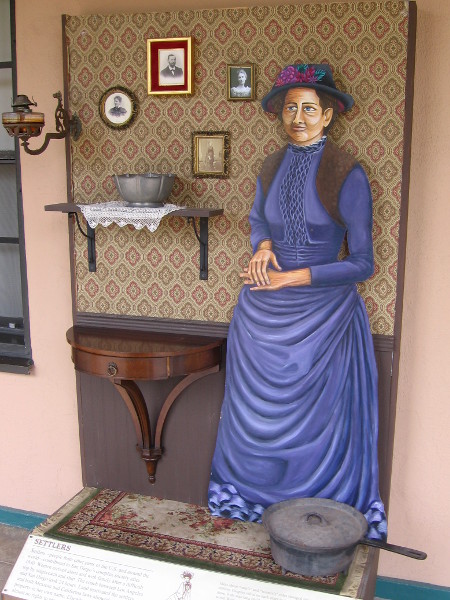
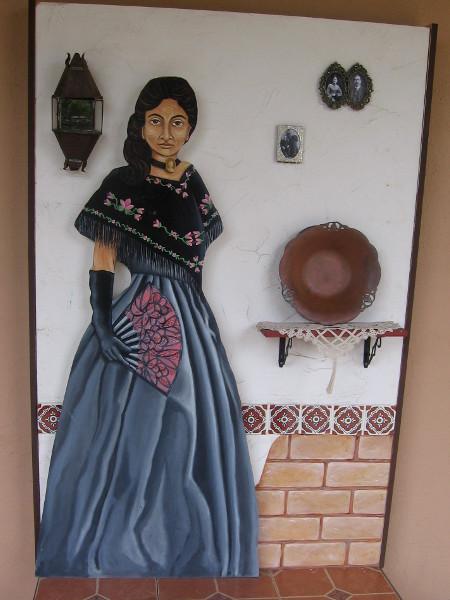
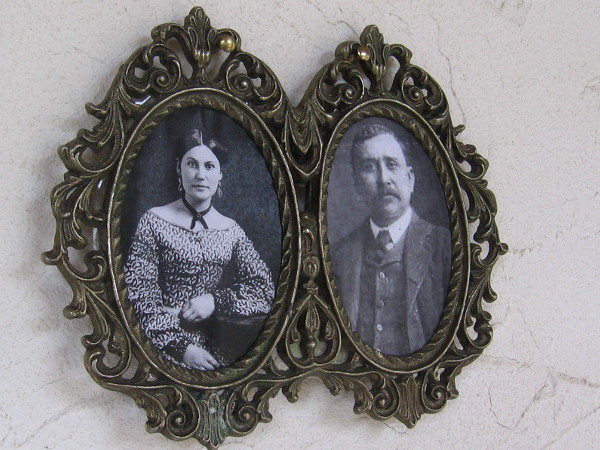
The women of Old Town, 1821-1872. Women and their families have lived in this area, called Cosoy by indigenous people, for over 10,000 years. This exhibit focuses on a short period.The historical experiences and accomplishments of local women are preserved at this unique San Diego museum.The Ipai and Tipai (Diegueño, Kumeyaay) resisted Christianity and the missions more than other indigenous Californians. Moved off their land, the women worked in the town and ranchos.The few women in Old Town had more opportunities to earn money than in the Eastern U.S. They did traditional work: laundry, baking, cooking, sewing, tending to children and livestock.Settlers contributed to San Diego’s complex society after 1830. Women arrived alone and with family after a difficult trip by stagecoach and ship.Californios were a diverse group whose culture created el pueblo San Diego. They were descendants of mixed Spanish and indigenous peoples, often given land grants by Mexico.Old photographs in an artifact help modern San Diegans remember their rugged, fascinating past.
…
To enjoy future posts, you can “like” Cool San Diego Sights on Facebook or follow me on Twitter.
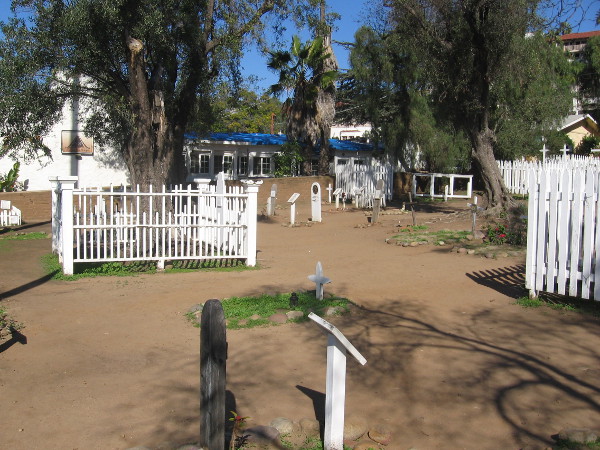
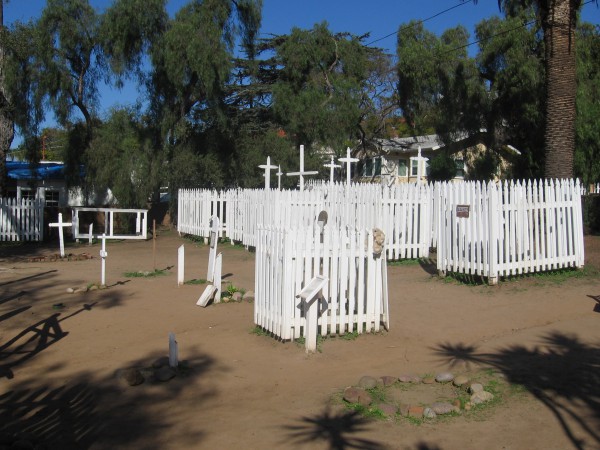
El Campo Santo cemetery in Old Town San Diego contains much history.
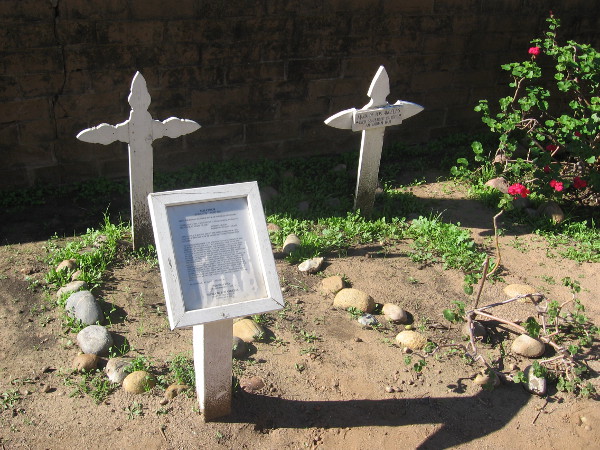
El Campo Santo, a cemetery located in Old Town, contains many of San Diego’s earliest residents. By walking respectfully among the gravestones, one can learn much about the city’s interesting history and what life was like for its diverse people. Real-life characters buried here include ranchers, gold miners, sailors, Californios, Native Americans, soldiers, politicians, merchants, actors, children and outlaws.
Established in 1849, the graveyard is the final resting place of nearly five hundred souls. Just a handful are shown in this blog post.
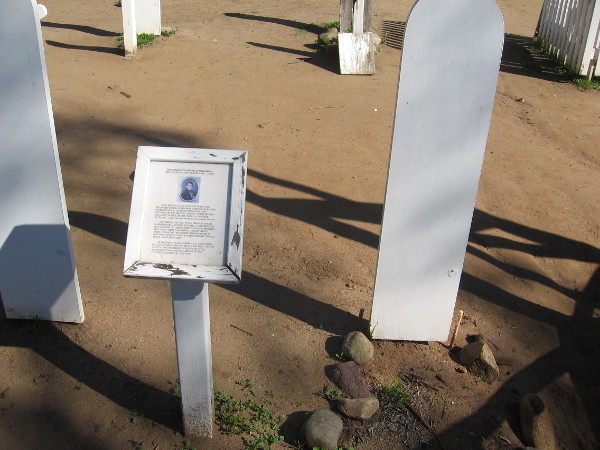
I took photographs of grave sites, headstones and many small signs in the “Holy Field” that describe what is known about the deceased. With a little editing, I’ve provided information here from many of those signs, and from a few other online sources.
Melchior was a Native American who lived to be 97 years old.
Melchior, born 1770, died 1867, age 97 years. Very little is known about the Indian Melchior. He was born a year after the arrival of Junipero Serra in San Diego. He was baptized by the missionaries and became a Roman Catholic Christian. During his long life, he saw San Diego grow from a small pueblo to a city.
Thomas W. Tanner ran an acting troupe that performed at the Whaley House.
Thomas W. Tanner was buried December 22, 1868, age 55 years. He ran an acting troupe that performed on the second floor of the Whaley House in December 1868. Tanner’s troupe offered moral, chaste and versatile entertainment consisting of drama, farce, comedy, singing and dancing. Unfortunately, Tanner died 17 days after his troupe opened. He was married to Policarpia de la Rosa and was a native of Baltimore, Maryland.
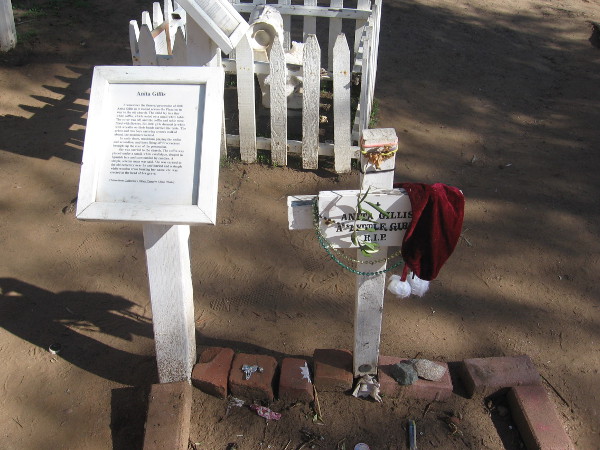
Anita Gillis was a young child.
Anita Gillis was a child when she died. Her funeral is remembered as follows on a plaque by the grave. A funeral procession wound across the Plaza and ended at the old church. The child lay in a tiny white coffin, which rested on a small white table. The cover was off, and the coffin and table were filled with flowers. Six little girls dressed in white with wreaths on their heads carried the table. The priest and two boys carrying crosses walked ahead, the mourners behind. Musicians played the violin and accordion, and boys firing off firecrackers brought up the rear of the procession. She was carried to the church, and the coffin placed under a small white catafalque, draped in Spanish lace and surrounded by candles. A simple, solemn mass was said. She was then carried to the old cemetery and buried with a simple white wooden cross bearing her name erected at the head of her grave.
Juan Mendoza worked on a ranch and was shot in the back.
Juan Mendoza died February 6, 1865. He was the victim of a fatal shotgun blast to the back. The assailant was Cave Johnson Couts, a local landowner and prominent San Diegan born in Tennessee. As the story goes, Mendoza worked as majordomo, or chief steward, on one of Cave Couts’ ranches. Couts claimed that Mendoza had threatened his life and in a hasty act of revenge killed Mendoza in broad daylight. The action violated the legendary “Code of the West” which prohibited “shooting an unarmed man” and “shooting a man in the back”. Couts was tried by jury for his crime and found not guilty. This was received “with much applause” from local citizens since threatening the life of a man, as Mendoza allegedly did, gave Couts the right to stand his ground and kill him.
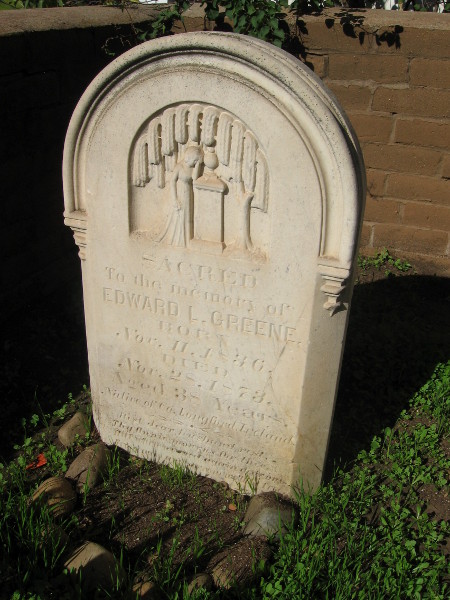
Edward Lynch Greene was a gold miner who became member of the state legislature.
Honorable Edward Lynch Greene died November 28, 1872, age 38 years. He was a native of Ireland who came to California in 1852 and was a miner for gold. He was naturalized in 1861. He became a member of the state legislature when he was elected to the Assembly from Calaveras County in 1869. He was staying in San Diego at the Era House when he died of consumption. He’d been ill for the past eighteen months. He left behind a young wife, Ann Greene.
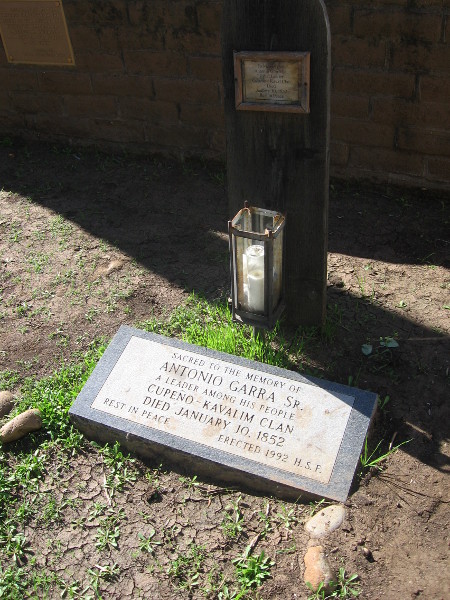
Antonio Garra Sr. was a Native American who rebelled against taxation.
Antonio Garra Sr. died January 10, 1852. He was a leader among his people, the Cupeno-Kavalim Clan. He was educated at Mission San Luis Rey and spoke as many as five Indian dialects, as well as Latin. He was one of the foremost chiefs with great power and influence among his people. The Cupeno were considered mission Indians and were subject to pay taxes in San Diego County. Garra, upset by the taxation of his people, helped to organize a resistance movement, comprised of attacks on Santa Barbara, Los Angeles and San Diego. Against his wishes, a fatal attack was made on Warner’s Ranch. He was soon thereafter captured. On January 10, 1852 Garra was found guilty of murder and theft, but not treason, as he had never taken an oath of allegiance to the United States. Before being executed by firing squad, Garra said in his last words: “Gentlemen, I ask your pardon for all my offenses, and expect yours in return.” Antonio Garra, Sr. is believed to be buried underneath what is now San Diego Avenue.
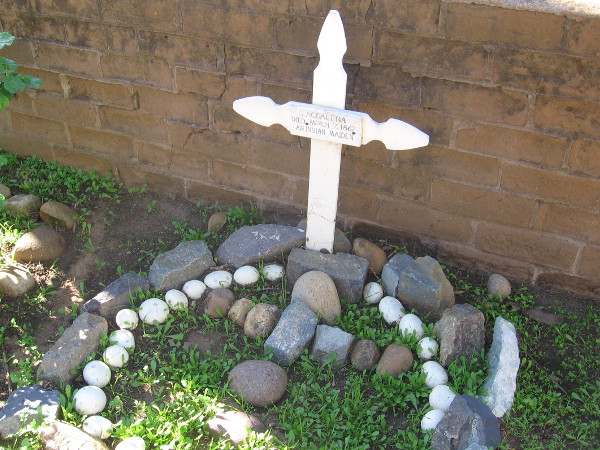
Magdalena was a Native American young lady.
Magdalena was an Indian maiden who died on March 7, 1867 at age 21.
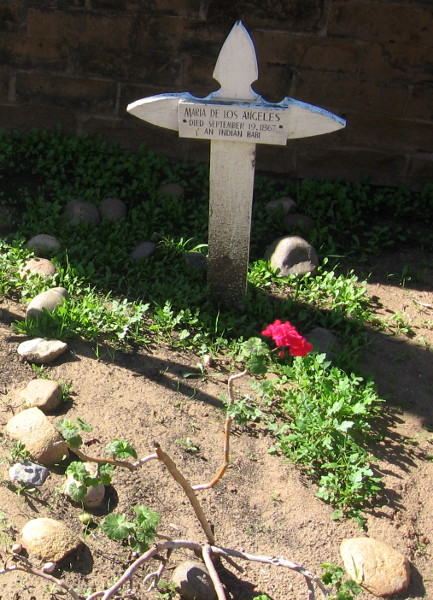
Maria de los Angeles was a Native American infant.
Maria de los Angeles was an Indian infant who died September 19, 1867.
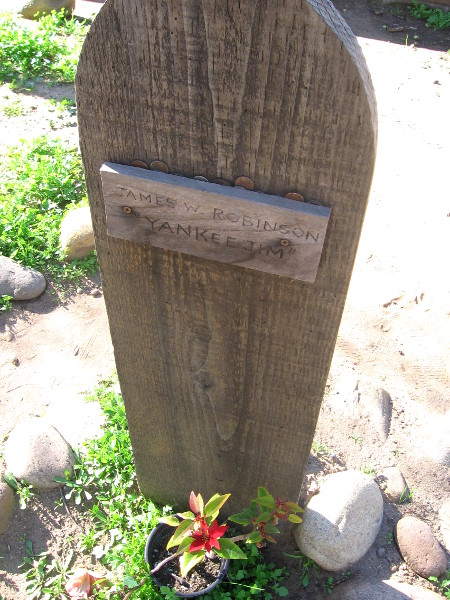
Yankee Jim was hung for stealing the only rowboat in San Diego Bay.
James W. Robinson was known as Yankee Jim. He suffered an extreme penalty for stealing the only rowboat in San Diego Bay. He was sentenced to be hanged. He couldn’t believe that he would be hanged until the very last moment. He appeared to think it was all a grim joke, or at worst, a serious effort to impress him with the enormity of his evil ways. He was still talking when the deputy sheriff gave the signal. Yankee Jim converted to the Roman Catholic Church prior to his death, and so was given the baptismal name of Santiago (Spanish for James). His godfather was Philip Crosthwaite, the deputy sheriff who gave the signal for his execution.
Rosa Serrano de Cassidy and her husband owned a rancho in Pauma.
Rosa Serrano de Cassidy died February 10, 1869, age 21 years. She was the first wife of Andrew Cassidy (a native of County Cavan, Ireland) who helped establish and operate the U.S. tidal gauge in La Playa (in present day Point Loma). Rosa was the daughter of Jose Antonio Serrano who served under Pio Pico in the Mexican War and was in the battle of San Pasqual. Rosa and her husband owned a rancho in Pauma. Her headstone is one of the few remaining originals in the cemetery. After cracking during an earlier restoration, it was placed flat on the ground in order to preserve it.
Don Miguel was a native of Spain, and one of the founding fathers of California.
Don Miguel Telesforo de Pedrorena died March 21, 1850. Don Miguel was a native of Spain, belonging to one of the best families of Madrid. After receiving an education in his own country, he was sent to London, where he was educated in English. In 1845 he settled in San Diego. He married Maria Antonia Estudillo, daughter of Jose Antonio Estudillo, and the two had four children. They built their casa behind the Estudillo home. It was one of the first framed houses in Old Town, and still stands beside the San Diego Union print shop. Don Miguel became a leading merchant and citizen of old San Diego. He served as a delegate to the State’s Constituional Convention at Monterey in 1849 and became one of the founding fathers of California.
Juan Maria Marron was a ship’s captain who became prominent politically.
Juan Maria Marron, born 1808, died at the age of 45. He was a ship’s captain before coming to San Diego in the early 1820’s. He was the owner of 13,311 acres called Rancho Agua Hedionda, which extends from modern day Vista to Carlsbad. He became prominent politically when he married Dona Felipa Osuna in 1834. She was the daughter of Juan Maria Osuna, who was the first alcalde of San Diego and the owner of Rancho San Dieguito. During the Mexican-American War, Marron supported the Americans against many of his Mexican friends. He was captured by Californios who threatened to execute him, but he was released, and his rancho was stripped of horses and cattle.
Jayme Lyons was the son of a carpenter, merchant, blacksmith and sheriff.
Buried November 28, 1859, age 4 years, Jayme was one of probably thirteen children of George and Bernarda Lyons. Jayme’s father was a native of Donegal, Ireland, who came to San Diego in 1847. He had been a carpenter on a ship that came around Cape Horn from New Bedford, Massachusetts. He kept a store in Old Town, owned a blacksmith shop, and was sheriff for two terms. Jayme’s mother was Bernarda de Villar, the daughter of Lieutenant de Villar, who at one time was the Commandant of the San Diego Presidio.
Bill Marshall and Juan Verdugo were hanged nearby.
Bill Marshall and Juan Verdugo were hanged on December 13, 1851. Bill Marshall was an American married to the daughter of a local Indian chieftain. He was a renegade sailor from Providence, Rhode Island, who’d deserted from a whaling ship at San Diego in 1844. After taking up habitation with the Indians, he took an active part in the Garra Indian uprisings in 1851. He and the Indian Juan Verdugo were caught and brought back to San Diego to be promptly tried by court martial. Both were found guilty. The Indian acknowledged his guilt, but Marshall insisted he was innocent. At two o’clock in the afternoon, a scaffold was erected near the old Catholic cemetery, the men placed in a wagon, the ropes adjusted about their necks, and the wagon moved on, leaving them to strangle to death.
Rafael Mamudes worked at chopping wood and digging wells. He dug the graves for the people of Old Town
Rafael Mamudes was a Native American born in Hermosillo, Mexico. He was a baker in Monterey, a miner in Calaveras County, and made a sea voyage to Guaymas. He owned a little plot of land in San Diego where the old jail stands. Legend has it he made a murderous attack upon his wife. To do penance, the priest gave Rafael the task of ringing the church bells when the occasion demanded. Rafael worked at chopping wood and digging wells. He dug the graves for the people of Old Town. He never missed a church service.
Jesus was a Native American who died of a blow to the head while drunk.
Jesus, an Indian, passed away December 15, 1879, age 25 years. He died of a blow to the head without receiving sacraments. According to the priest Juan Pujol, he was said to be drunk, so he was buried near the gate of the cemetery.
Hundreds of varied, rich life stories were concluded here in this early San Diego cemetery.
…
To enjoy future posts, you can “like” Cool San Diego Sights on Facebook or follow me on Twitter.
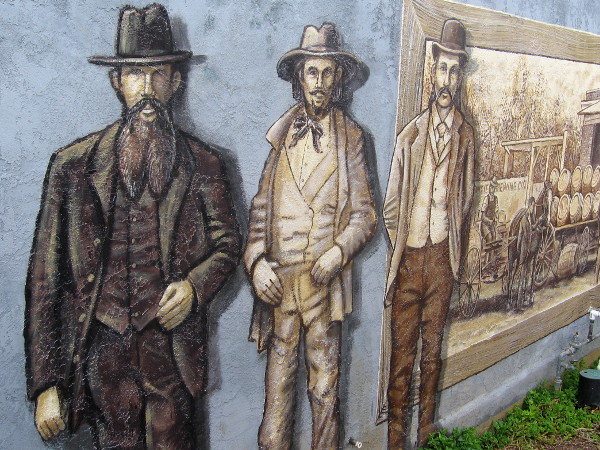
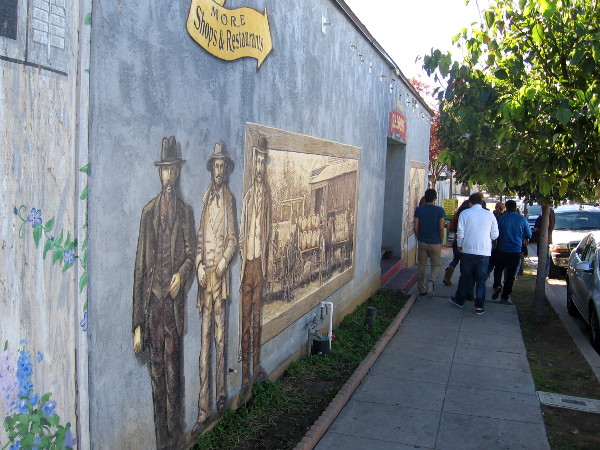
Several whiskered Western characters pose in a mural on Harney Street in Old Town.
There’s a fairly new street mural in Old Town that I really like. Every time I see it, my imagination travels back in time. Back to the first half of the 19th century.
San Diego for many decades was a tiny town seemingly in the middle of nowhere. Whether it belonged to Spain, or Mexico, or the United States, Old Town San Diego was a place of dusty roads and modest, sun-baked adobe houses, horses and wagons, rugged settlers and ranchers. Characters from that era seem to live again in this mural.
Artist Frank Mando painted this artwork in 2013. I couldn’t capture the entire piece in one shot. Enlivening a building at the corner of San Diego Avenue and Harney Street, the mural is divided in two by a door of the Old Town Saloon. Standing inside that door, as you’ll see, there seems to be a well-known movie star!
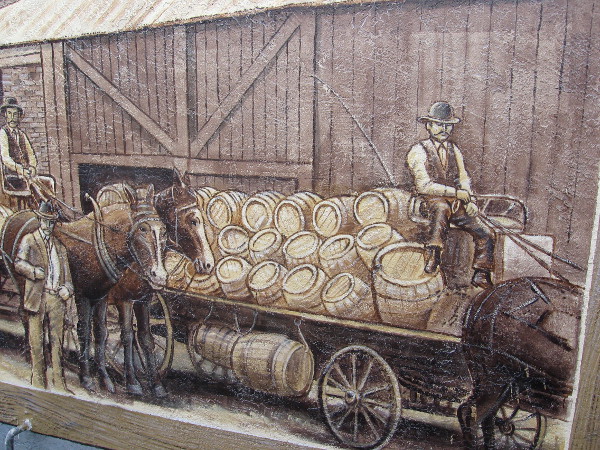
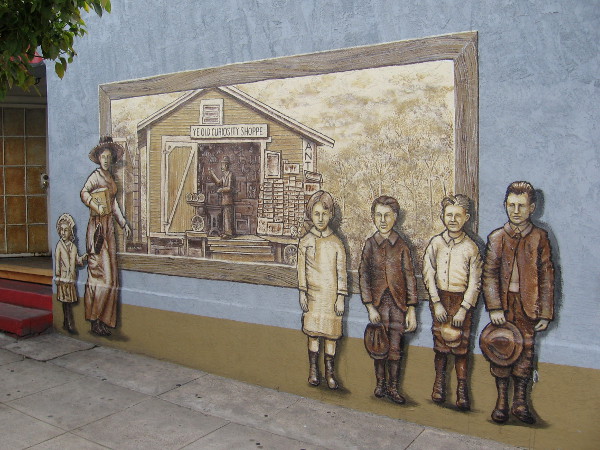
Freight wagon hauls a load of barrels in fun art that recalls early San Diego history.John Wayne seems to be coming through a door of the Old Town Saloon.Elegant lady and girl from long ago stroll past Ye Old Curiosity Shoppe.Old Town mural on building wall was painted in 2013 by artist Frank Mando.Kids standing along sidewalk seem to have materialized from San Diego’s past.People walk past nostalgic street mural near side entrance to Old Town Saloon.
…
To enjoy future posts, you can “like” Cool San Diego Sights on Facebook or follow me on Twitter.
Blacksmith at Fall Back Festival in San Diego’s Gaslamp works the bellows.
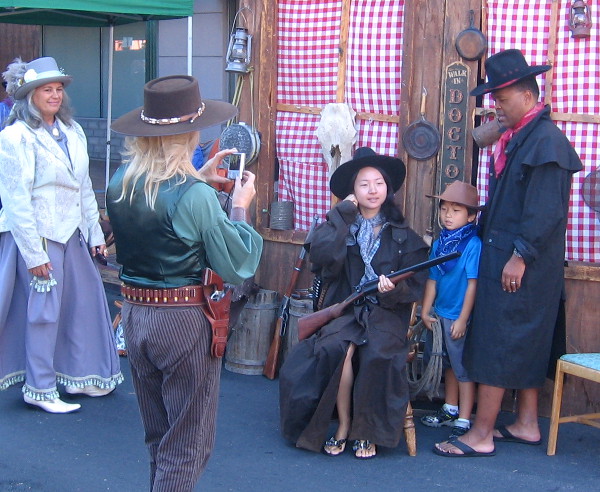
Today I checked out a great event in downtown San Diego’s Gaslamp Quarter. Called the Fall Back Festival: the Children’s Historical and Cultural Street Faire, this historical reenactment places visitors in a magical time machine, transporting them back to the 1880’s.
Three blocks of fun included a blacksmith, old western storefronts, pony rides, candle dipping and other educational activities. Many participants wore costumes and clothing from this early period in San Diego’s history. There was also an exciting High Noon shootout–which I unfortunately missed. But I did capture a few pics…
Lady in old-fashioned dress walks with her umbrella past Horton Grand Hotel.
I snapped the above photo as I headed toward the festival. The lady was just walking along through modern, shiny downtown San Diego like an image from the past.
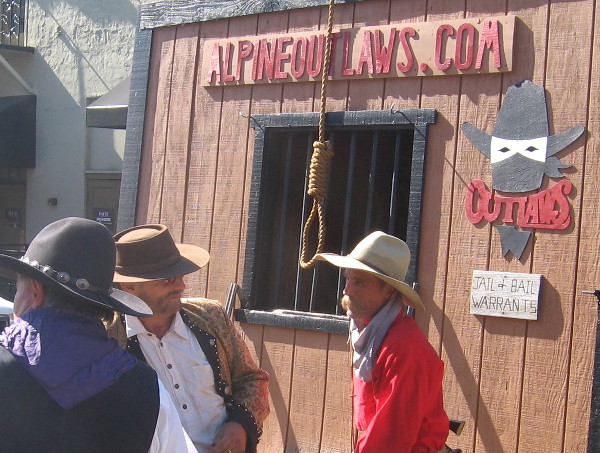
These cowboys, the Alpine Outlaws, have a jailhouse downtown and a hanging noose!
Yikes! The first thing I saw was a bunch of crafty outlaws!
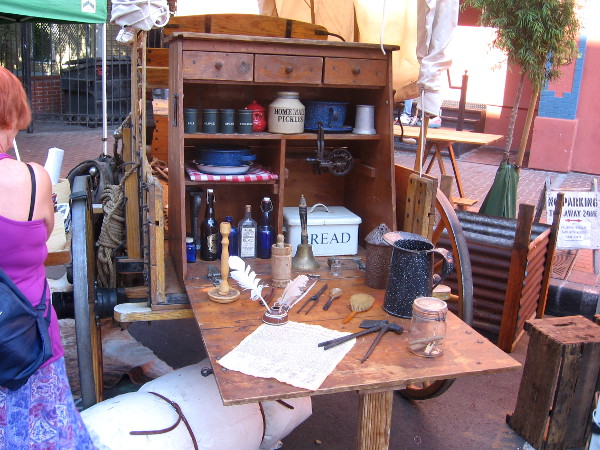
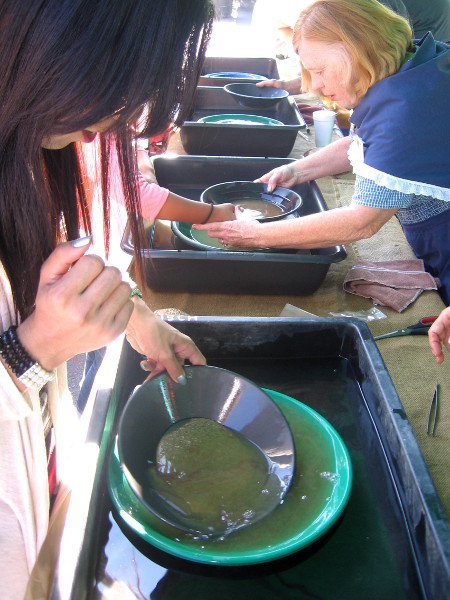
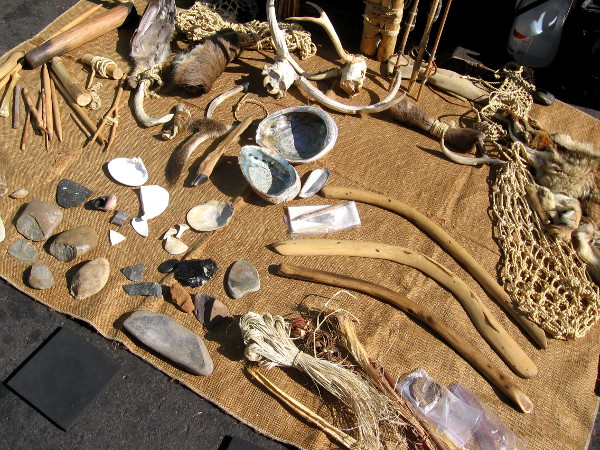
Festival celebrates the diverse and fascinating early history of San Diego.Wood cabinet at rear of wagon is packed with wares typical in 1880’s.A table full of rusty irons from the Old West!Temecula Valley Prospectors had kids panning for real gold.Realistic replicas of Native American tools and weapons were on display.
An interesting guy named Dave, of San Diego Survival History and Fitness, showed me a very cool display. He made all of the above implements and weapons by hand, using materials and techniques that were used by the Kumeyaay and earlier native peoples in the San Diego area. The Spaniards who built their first California Mission in San Diego feared the throwing sticks which you can see in the above photo. Shaped like a boomerang, they had the power to easily bring down a deer!
Historical exhibit has photos of Japanese settlers and community in San Diego.San Diego Model A Club had a row of old automobiles at the Fall Back Festival.Of course, there was live country western music for the crowd to enjoy!
…
To enjoy future posts, you can “like” Cool San Diego Sights on Facebook or follow me on Twitter.
Sculpture and cannon at entrance to the Mormon Battalion Historic Site.
Just east of Old Town San Diego State Historic Park one can find the Mormon Battalion Historic Site, an attraction created by The Church of Jesus Christ of Latter-day Saints. The location itself seems a bit arbitrary, as the Mormon Battalion manned Fort Stockton up on the hill by the old, abandoned Presidio when they arrived in San Diego in 1847.
Young lady missionaries guide visitors through a series of rooms and outdoor areas which are designed to tell a sympathetic version of the Mormon Battalion’s difficult 2000 mile march from Iowa. The ulterior motive is to promote their beliefs, and there are frequent religious references, but there is no hard sell and the tour guides are warm and friendly. One can absorb a little bit of history while experiencing a good-humored, Disney-like presentation.
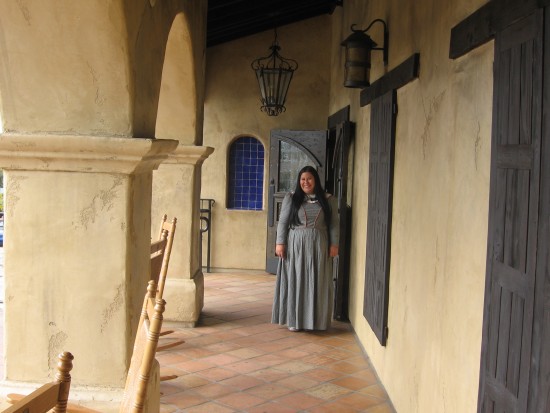
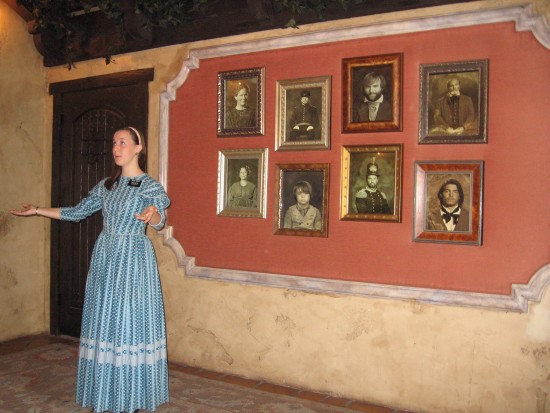
A friendly missionary lady comes outside to welcome a new visitor.Girl in a pioneer dress begins the tour with talking, moving portraits.
Much of the tour is spent watching professionally produced dramatic videos. Several real historical artifacts can be found near the tour’s end.
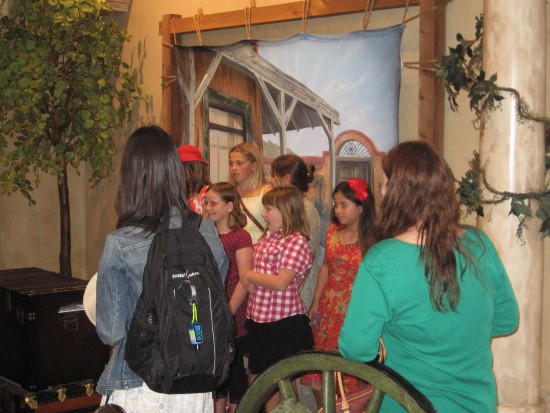
Taking pictures of visitors with a large antique camera.Girls pose for a picture in front of a western scene.
A lot of families and kids were smiling and enjoying the tour. Many appeared to be members of the LDS Church.
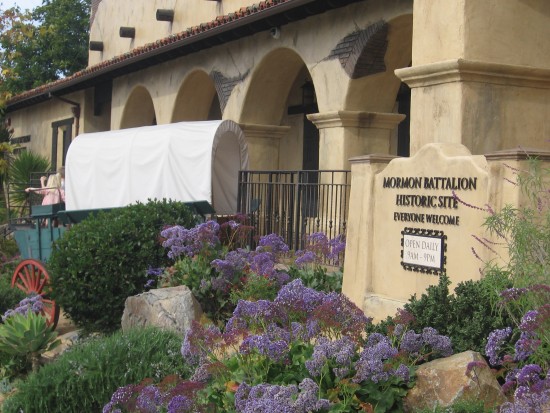
Young visitors near end of the tour pan for glittery iron pyrite.Covered wagon in front of the Mormon Battalion Historic Site.
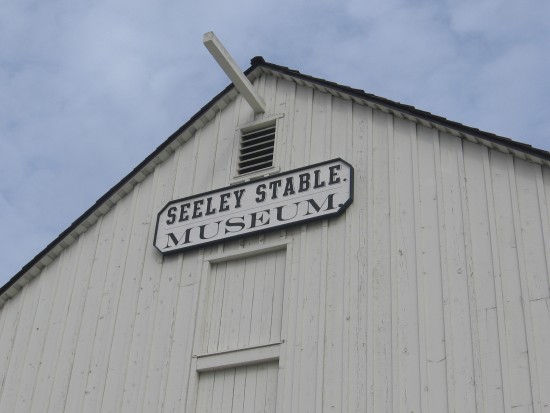
Front of the Seeley Stable Museum in Old Town San Diego.
Perhaps my favorite part of Old Town San Diego State Historic Park is the Seeley Stable Museum.
The huge old barn and surrounding area were once owned by Albert Seeley, who ran the San Diego-Los Angeles Stage Line from 1868 to 1877. His Concord stagecoaches left San Diego at 5 am, stopped overnight at San Juan Capistrano, and arrived in Los Angeles at 4 pm the next day. Eventually competition with the railroad put him out of business.
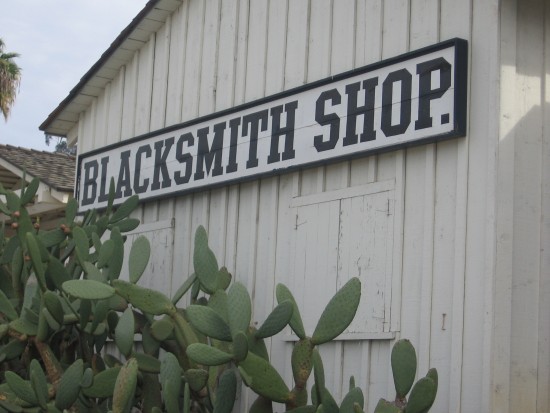
Sign on the Blacksmith Shop behind Seeley Stable.
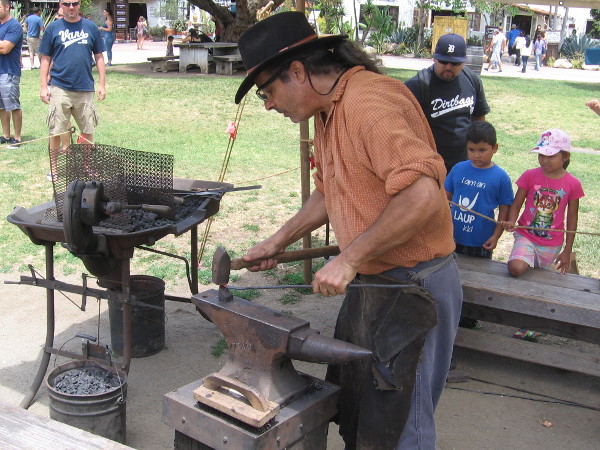
Behind the Seeley Stable is a cool blacksmith shop, where tourists can watch skilled hobbyists demonstrate the shaping of red hot iron. The hammers ring loudly and the sparks fly! Unfortunately it wasn’t open the day I took these photos.
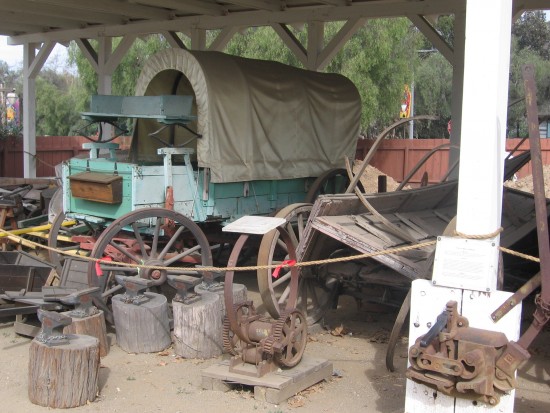
Covered wagon, anvils and relics of the Old West behind Seeley Stable.
Across from the blacksmith you’ll find this. Very cool!
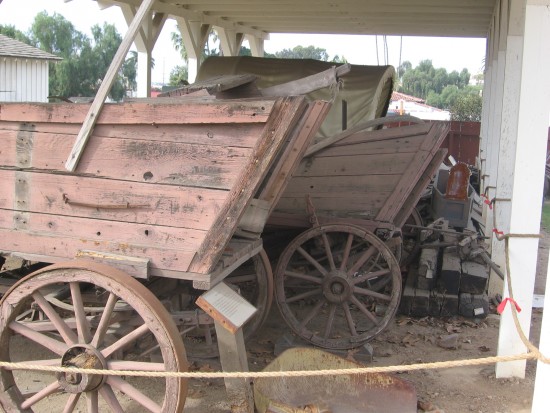
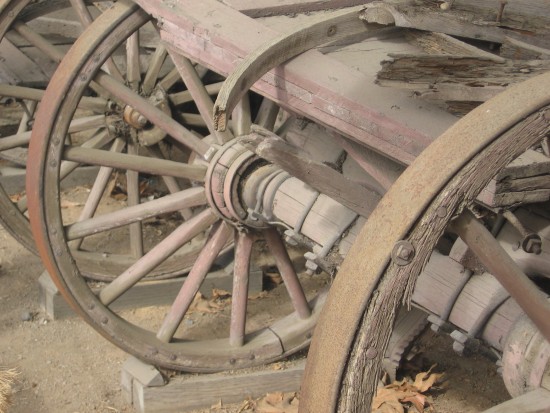
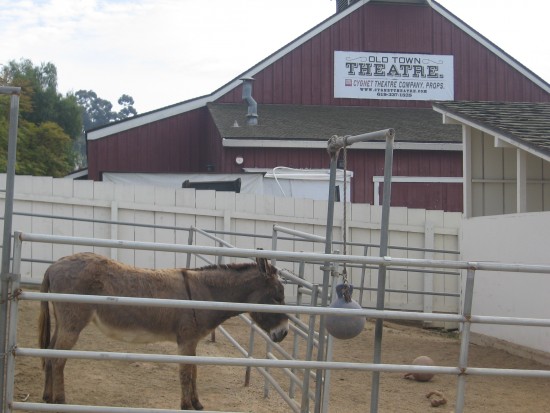
Several unrestored wagons.Peering through old wagon wheels.Donkey awaits young visitors to historic Seeley Stable.
On the south side of the stable you’ll find a couple of donkeys, which are used by park rangers to teach children about life in the Old West.
Concord stagecoach from the Los Angeles to San Diego route.
Finally, we’re inside the museum! You can see many different wagons and stagecoaches inside the dark old barn, plus other artifacts from life one and a half centuries ago.
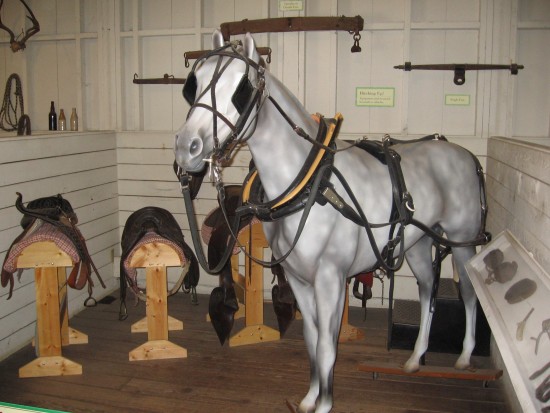
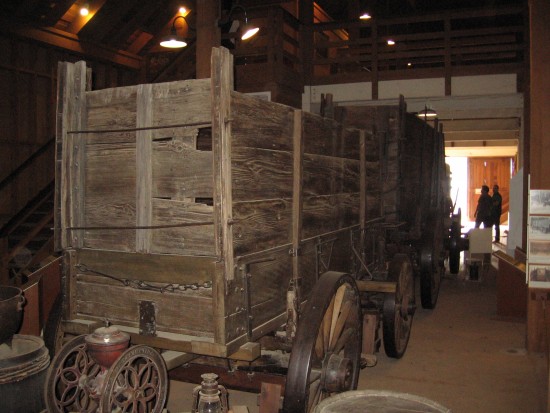
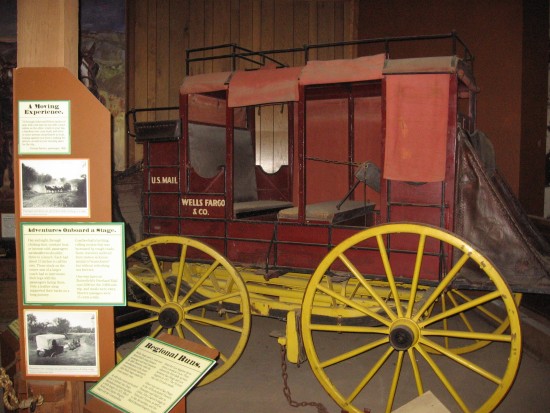
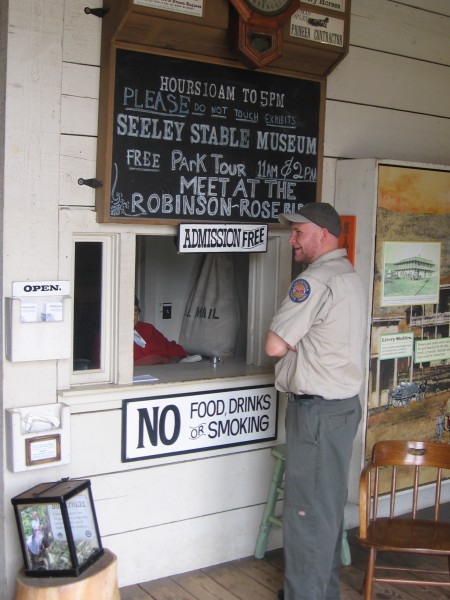
Museum display with horse and saddles recreates the old stable.Huge freight wagon on display at Seeley Stable.Old Wells Fargo wagon once used to transport the mail.Old Town San Diego State Historic Park ranger chats with friendly lady at the ticket window.
The Seeley Stable Museum is free!
UPDATE!
Here are a few more interesting and informative photos that I took inside the museum in August 2017…
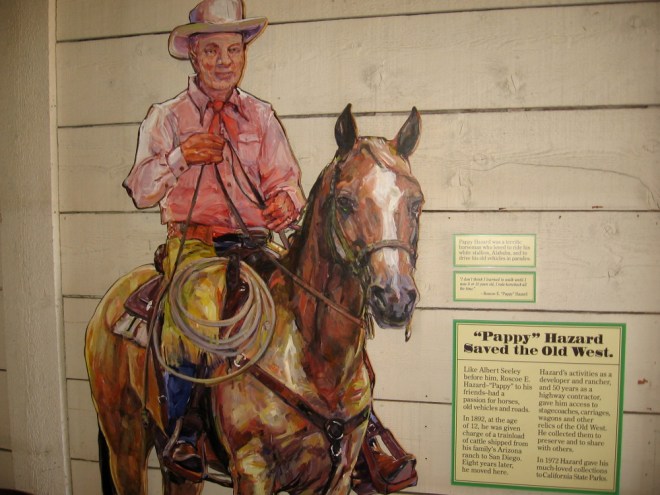
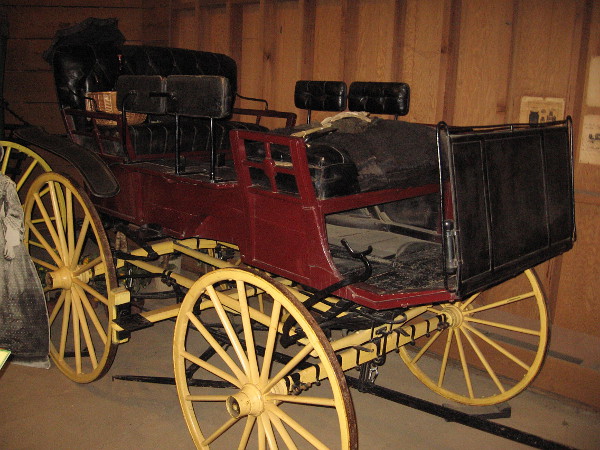
Roscoe E. “Pappy” Hazard was a developer and rancher who collected stagecoaches, carriages and wagons from the Old West. Many are displayed today in Old Town’s Seeley Stable Museum.In 1869, Albert L. Seeley transformed the nearby Bandini adobe into the two-story Cosmopolitan Hotel, which became Old Town’s stage depot and social center.Photo of Seeley Stable’s barn and yard taken from Presidio Hill in 1872. The Cosmopolitan Hotel can be seen on the right.Map shows important stagecoach routes, including the Butterfield Overland, and the Birch’s Line from San Antonio to San Diego.Signs and old photos concerning freight wagons in the Old West, which often employed large teams of mules.Spaniards introduced mules to America along with the horse. Hardy pack mules were used by trappers to haul furs, and by gold miners to move supplies and equipment.This delivery wagon was brought to San Diego by Frank Kimball in 1868. It was used to show passengers land that he had for sale in National City.This old Park Wagon was used by cattle rancher Walter Vail. He owned a land in Arizona, Santa Rosa island off the coast of California, and Warner’s Ranch northeast of San Diego.How a corner of the stable might have once appeared. Stable hands had many chores, including feeding, watering and grooming animals, and cleaning stalls.
…
This blog now features thousands of photos around San Diego! Are you curious? There’s lots of cool stuff to check out!
Here’s the Cool San Diego Sights main page, where you can read the most current blog posts. If you’re using a small mobile device, click those three parallel lines up at the top–that opens up my website’s sidebar, where you’ll see the most popular posts, a search box, and more!
To enjoy future posts, you can also “like” Cool San Diego Sights on Facebook or follow me on Twitter.
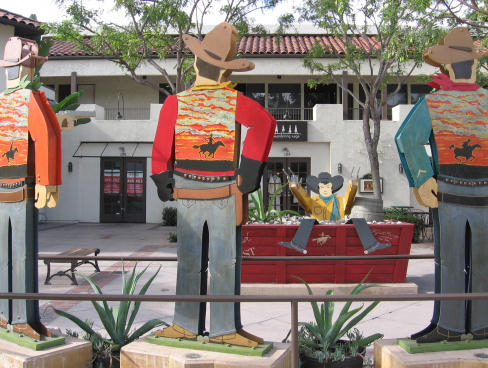
Cowboys have a gun battle in San Diego’s Old Town.
Look at these larger-than-life cowboys! They’re shooting it out in Old Town!
This whimsical art can be found on San Diego Avenue, in a courtyard among shops and restaurants catering largely to tourists. I’m not sure whether it represents the Gunfight at the O.K. Corral or just an Old West scene from a typical Western movie.
Is one of the cowboys Wyatt Earp? After his famous gunfight, Wyatt moved to San Diego to participate in a land boom, running saloons, gambling halls and a brothel!
Like the plant beside him, this guy might soon get planted.Wyatt Earp was here.Stern lawman patrols San Diego Avenue.






































 Cool San Diego Sights!