People walk past the Museum of Contemporary Art San Diego’s building at America Plaza.
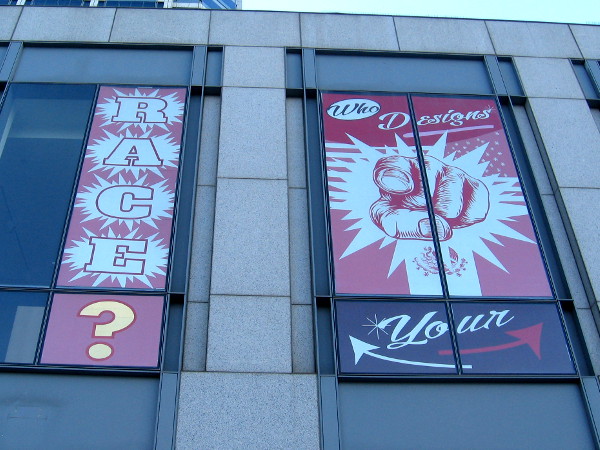
I recently noticed new thought-provoking graphics in the windows of the MCASD building at America Plaza.
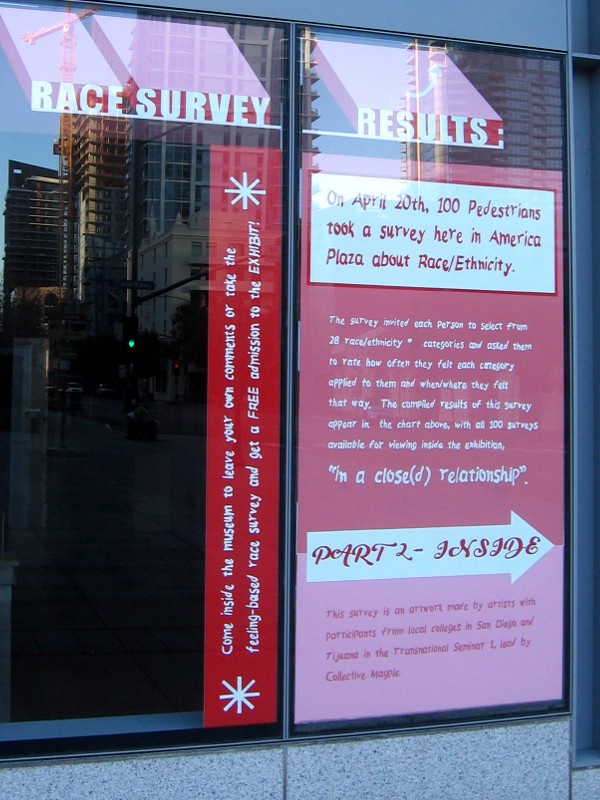
Last year, a survey was taken of 100 people passing through America Plaza. Questions were asked about racial and ethnic identity. Today an outdoor display at downtown’s Museum of Contemporary Art San Diego expands on the results and explores the complicated subject.
The window graphics are designed to catch the eye and draw visitors into the nearby gallery.
This project was produced by artists with students from local colleges in San Diego and Tijuana who participated in Transnational Seminar 1, lead by Collective Magpie.
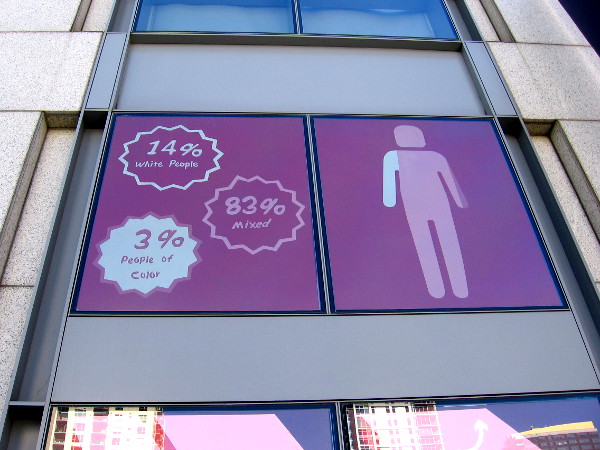
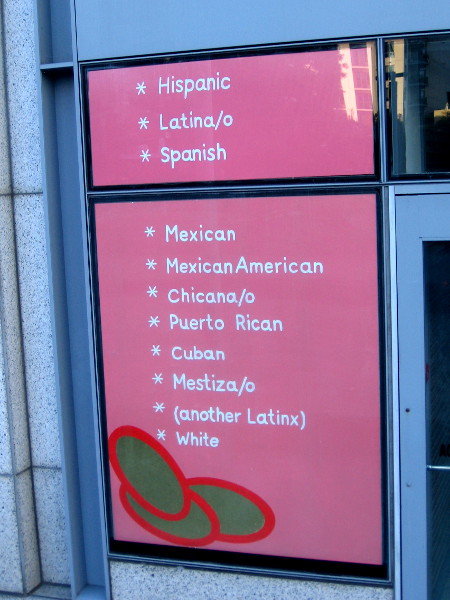
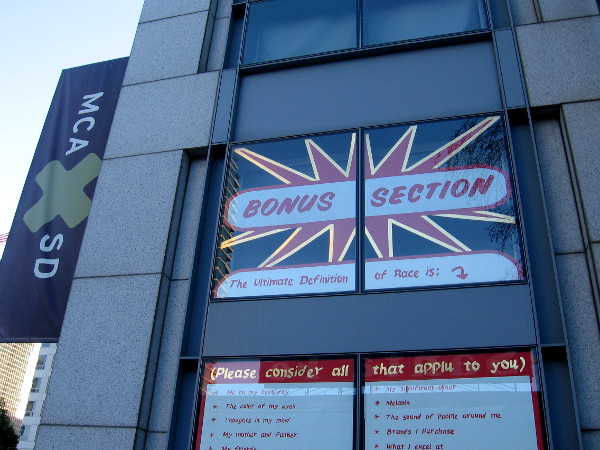
On April 20th, 100 pedestrians took a survey here in America Plaza about race and ethnicity. Self-classification data was compiled.Of the 100 surveyed, 83 answered mixed race; 14 white people; 3 people of color.Feelings about racial identity can differ from person to person.One of two panels containing some of the racial and ethnic categories that a person might choose.A splash of words, asking people walking down Kettner Boulevard what the ultimate definition of race is…People might feel differently about their racial identity depending on a range of factors and circumstances, from their appearance…to their dreams…to their immediate environment…to the way they live.Thought-provoking graphics concerning race in the windows of MCASD’s building at America Plaza.
…
I live in downtown San Diego and love to walk around with my camera! You can follow Cool San Diego Sights via Facebook or Twitter!
You can easily explore Cool San Diego Sights by using the search box on my blog’s sidebar. Or click a tag! There are thousands upon thousands of photos for you to enjoy!
Please help the Save Our Heritage Organisation gather artifacts and memories to preserve a part of San Diego history. (Click this photo to enlarge the flyer for easy reading.)
I recently tood a photo of a flyer that I spotted in the Senior Lounge in Balboa Park. Please click the above image and read it.
Save Our Heritage Organisation (SOHO) is seeking memorabilia, ephemera, merchandise and memories from Marston’s Department Store, which for nearly a century was the most elegant place to shop in San Diego. The department store was founded by George Marston, who is often referred to as San Diego’s First Citizen. As a civic leader and philanthropist, he was instrumental in creating Balboa Park, Presidio Park and the San Diego Historical Society.
Marston began as a clerk at the Horton House Hotel and eventually built the Marston Company, which ran a department store in San Diego. When earlier locations became outgrown, the large, elegant Marston’s Department Store on C Street, between 5th and 6th Street, built in the Renaissance Revival architectural style, opened in 1912 and became a popular downtown shopping destination. In 1961 it was sold by his family to The Broadway, which has since closed.
Artifacts related to Marston’s Department Store will be used by SOHO in a permanent exhibit inside their Marston House Museum in Balboa Park. Items that you contribute can be sent or delivered to the SOHO offices in Old Town. Recorded memories are also sought. The 2018 exhibit celebrates the 140th anniversary of the store’s founding!
Do you know anyone who shopped at Marston’s Department Store those many years ago? Perhaps they can help the Save Our Heritage Organisation with this very cool project!
George Marston, circa 1907-1908, San Diego businessman, civic leader and philanthropist. Public domain photo from Wikimedia Commons.Photo of San Diego Union newspaper from Monday morning, January 1, 1912. Depicted is a brand new Marston Department Store. The headline reads: Modern Mercantile Emporium One of Best Three on Coast.
…
I live in downtown San Diego and love to walk around with my camera! You can follow Cool San Diego Sights via Facebook or Twitter!
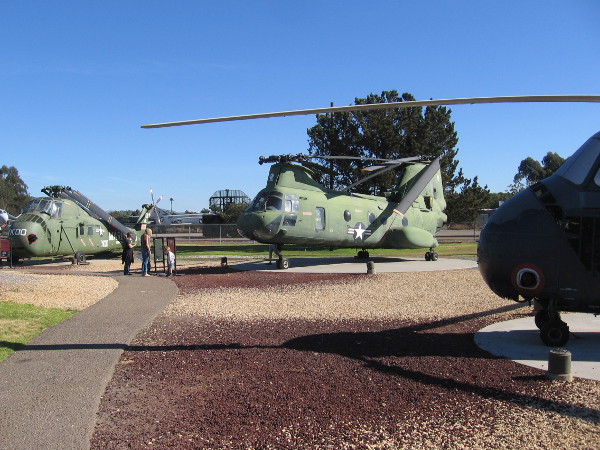
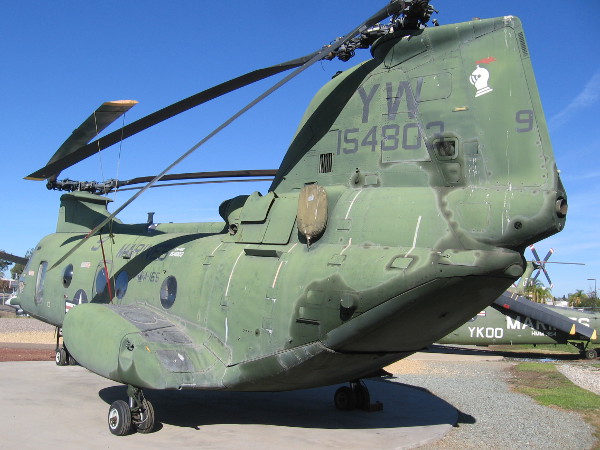
This particular Boeing Vertol CH-46D(E) Sea Knight military helicopter in San Diego is an object of great historical importance.
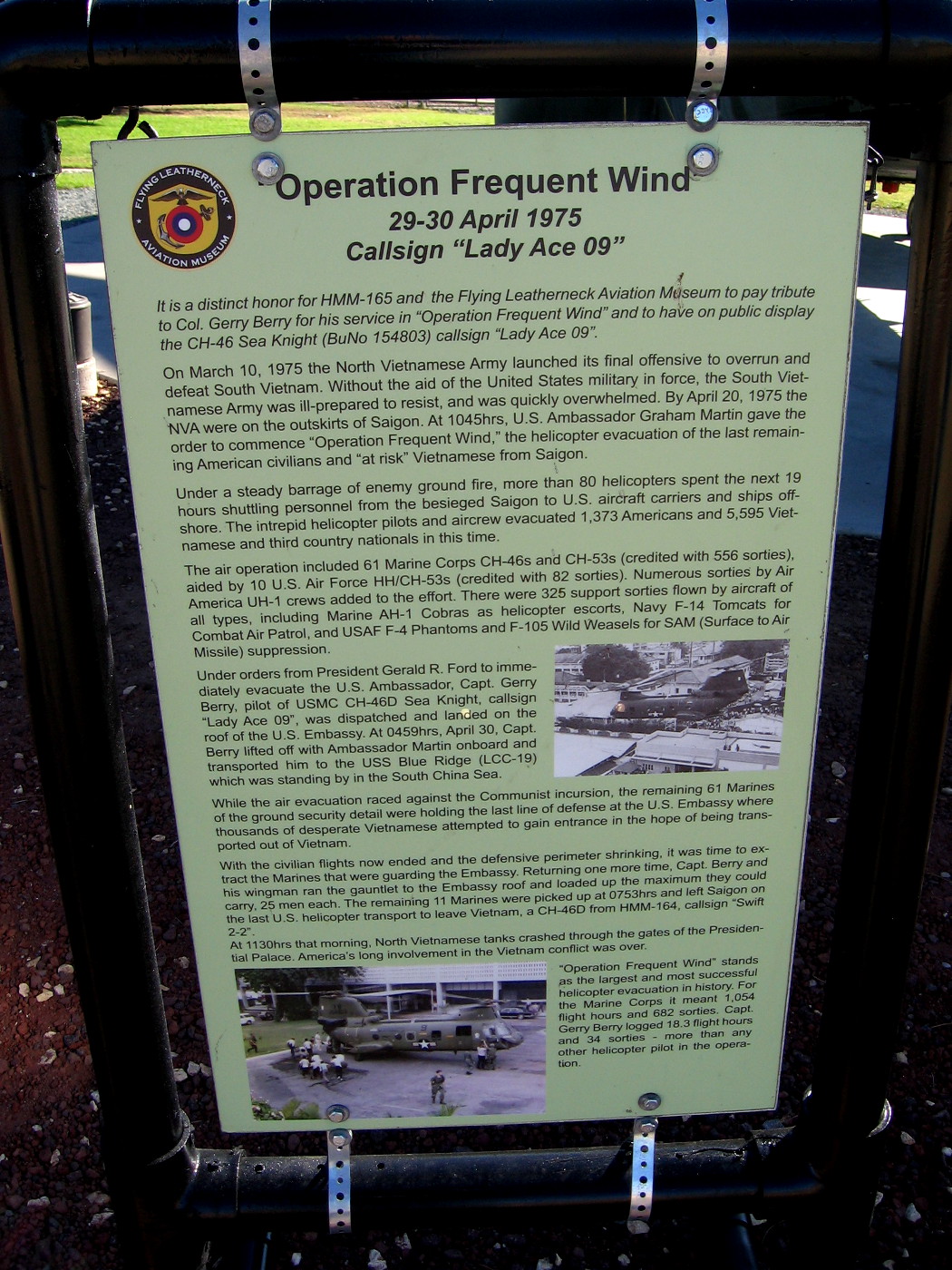
Many regard the evacuation of the United States Ambassador from Saigon as the end of the Vietnam War. On April 30, 1975, as ordered by President Gerald Ford, Ambassador Graham Martin was airlifted from the rooftop of the American Embassy. He had stepped aboard a Boeing Vertol CH-46D(E) Sea Knight military helicopter, call sign Lady Ace 09, flown by pilot Captain Gerry Berry.
While the Ambassador’s evacuation from the Embassy has provided a visual symbol of America’s departure from South Vietnam, the reality was a bit more chaotic. When Lady Ace 09 transmitted “Tiger is out,” indicating the Ambassador had been retrieved, other helicopter crews involved in the evacuation mistakenly thought the mission was completed. But Marine Security Guards on the Embassy’s rooftop would be lifted to safety hours later. Shortly thereafter, Communist forces would raise the Viet Cong flag over Saigon’s Presidential Palace.
The Flying Leatherneck Aviation Museum is located at Marine Corps Air Station Miramar in San Diego. In addition to Lady Ace 09, over two dozen aircraft that have been flown by the United States Marines are on display. Admission is free.
The museum wants to expand. You can help! Learn more here.
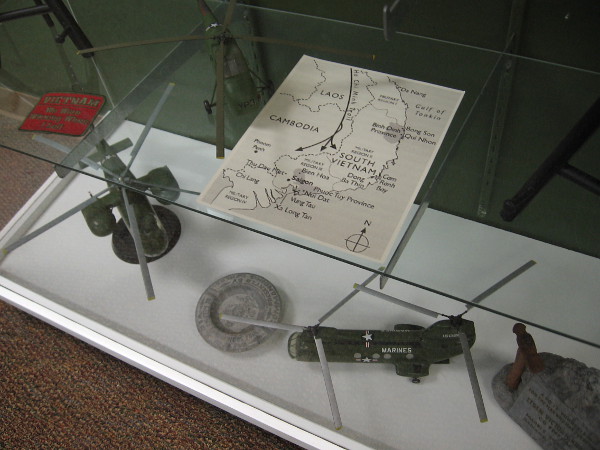
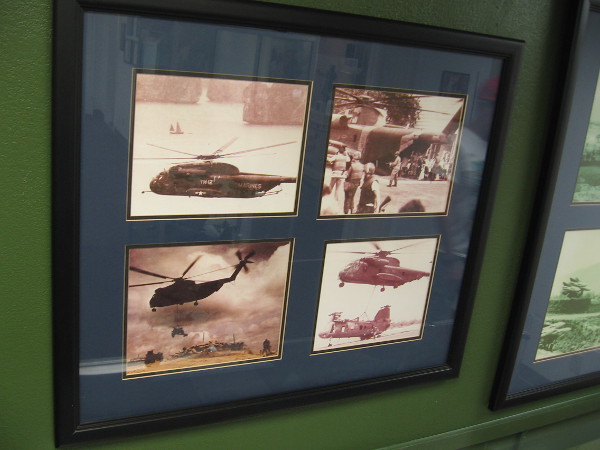
The Flying Leatherneck Aviation Museum in San Diego contains many aircraft that have been used during the history of the United States Marine Corps.At the Flying Leatherneck Aviation Museum at MCAS Miramar, the public can see the actual helicopter that evacuated the U.S. Ambassador from Saigon at the end of the Vietnam War.Operation Frequent Wind, 29-30 April 1975, call sign Lady Ace 09. This Sea Knight helicopter evacuated Ambassador Graham Martin from the U.S. Embassy in Saigon, South Vietnam. (Click photo to expand.)A look at the rear of the historic helicopter that transported U.S. Ambassador Graham Martin to the safety of USS Blue Ridge (LCC-19) standing by in the South China Sea.The fuselage of Sea Knight troop transport helicopter, call sign Lady Ace 09.At 04:58 Ambassador Martin boarded Lady Ace 09 on the rooftop of the American Embassy in Saigon. The message “Tiger is out” was transmitted, signaling the departure of the U.S. Ambassador.The nose of Lady Ace 09, which today is on display at the Flying Leatherneck Aviation Museum.Inside the the Flying Leatherneck Aviation Museum, visitors can see one section devoted to USMC aviators and aircraft that participated in the Vietnam War.One museum display case includes a map of Laos, Cambodia, and North and South Vietnam during the war.Photos of Marine helicopter operations during the Vietnam War.Boeing Vertol CH-46D(E) Sea Knight, call sign Lady Ace 09, the helicopter whose historic flight is often regarded as the conclusion of the Vietnam War.
…
I live in downtown San Diego and love to walk around with my camera! You can follow Cool San Diego Sights via Facebook or Twitter!
You can easily explore Cool San Diego Sights by using the search box on my blog’s sidebar. Or click a tag! There are thousands of interesting photos for you to check out!
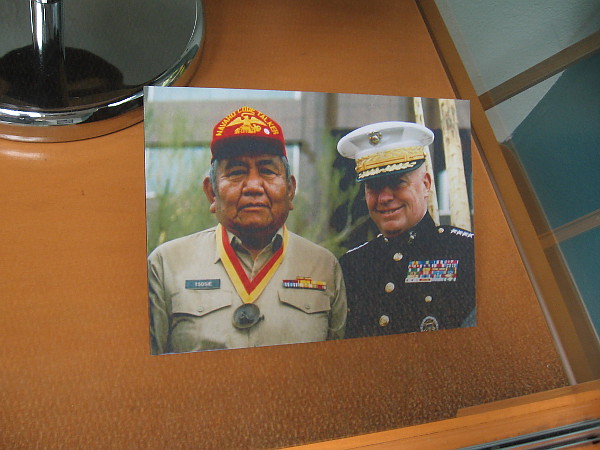
Photo of Samuel Tsosie Sr., Navajo Code Talker during World War II.
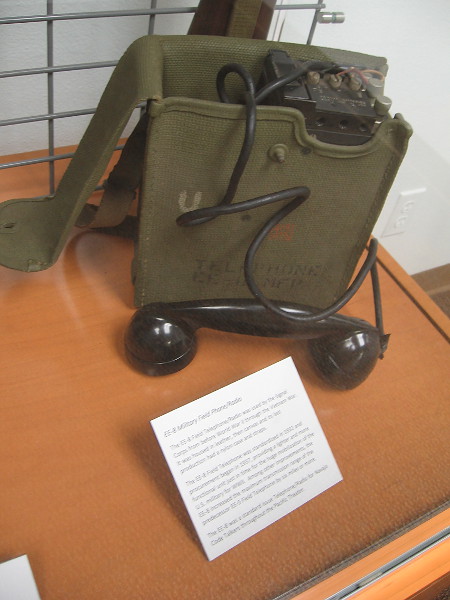
A small but fascinating exhibit remembering the Navajo Code Talkers of World War II is currently on display at the Flying Leatherneck Aviation Museum in San Diego. The exhibition, titled CELEBRATING 75 YEARS – CODE TALKERS: THE NAVAJO WEAPON, contains photos, documents, uniforms and historical artifacts that describe how the Navajo language was used to develop a code for secret tactical communication in the Pacific, in places like Iwo Jima and Okinawa. The Navajo code, which was classified until 1968, is the only spoken military code that was never deciphered.
The exhibit explains:
Many scholars credit Philip Johnston with initiating the Code Talker idea. Johnston was a Caucasian who grew up in Leupp, Arizona on the Navajo Reservation. He approached the Marine Corps in 1942 after the attack on Pearl Harbor and proposed using Native American Navajo language for combat communications.
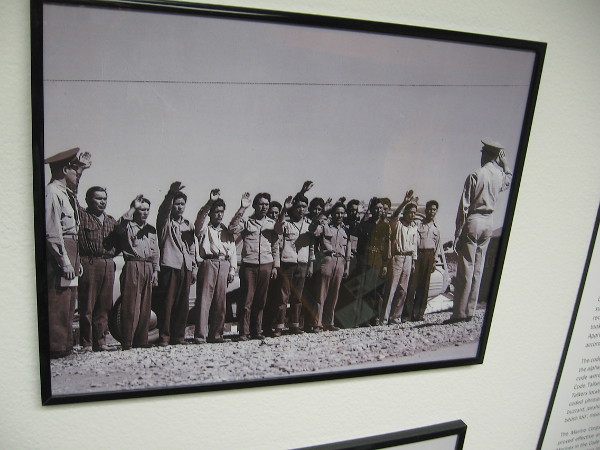
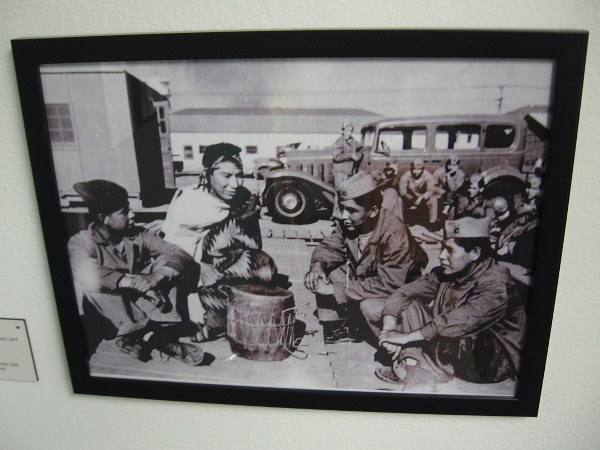
His knowledge of the Navajo culture led him to bring four Navajo volunteers to Camp Elliott in San Diego, California (an area that is now part of MCAS-Miramar) for a demonstration. Impressed with successful and efficient English and Navajo translations, the Marine Corps began recruiting Navajos. The first group of twenty-nine recruits entered boot camp, took courses in military communication procedures and developed the code. Approximately 400 Navajo recruited by the Marines learned the code.
Working around the clock during the first two days of Iwo Jima, six Navajo Code Talkers sent and received over 800 messages, all without error. According to Major Howard Connor, 5th Marine Division Signal Officer, “Were it not for the Navajos, the Marines would never have taken Iwo Jima”.
The Flying Leatherneck Aviation Museum is free and open to the public at Marine Corps Air Station Miramar. The museum grounds contains over two dozen aircraft used during the proud history of Marine Corps aviation. It has the world’s largest and most complete collection of vintage aircraft flown by United States Marine pilots.
The museum is looking to expand and I’m told they would really appreciate your help. For more info, click here.
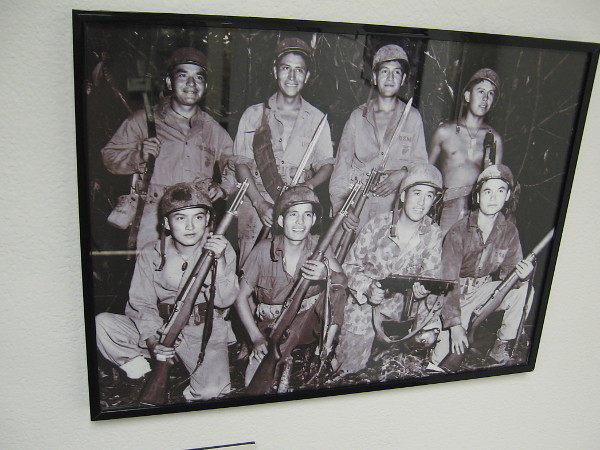
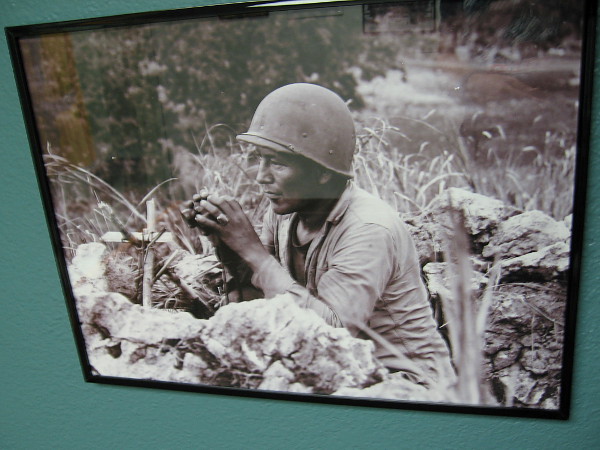
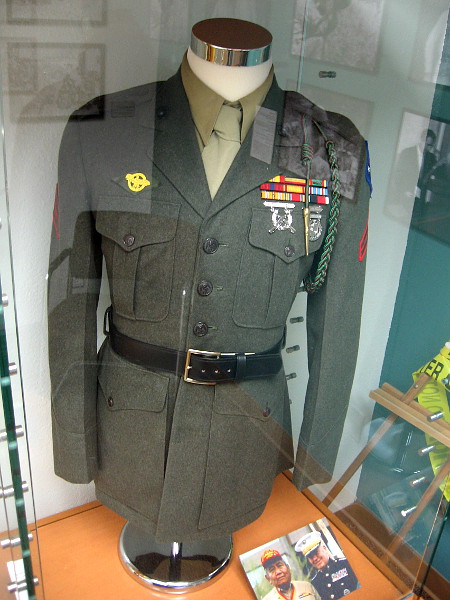
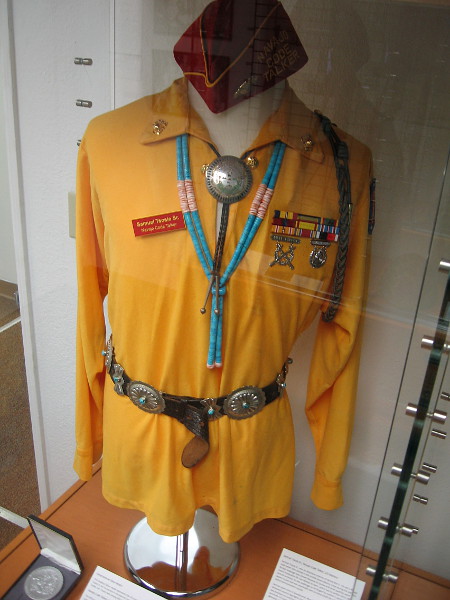
Celebrating 75 Years – Code Talkers: The Navajo Weapon. The Marine Corps deployed the Code Talkers to the Pacific, where the code proved effective and indecipherable. (Click photo to expand for easy reading.)The first 29 Code Talkers enlisting in the United States Marine Corps, 1942.First 29 Code Talkers of 382nd Platoon, 1942.Navajo Code Talkers Henry Bahe and George Kirk working their radio in the jungles of Bougainville.Eight Navajo Code Talkers on Bougainville. Most hold an M1 Garand used in combat.Display case in this special Flying Leatherneck Aviation Museum exhibit includes military field equipment used by the Navajo Code Talkers during World War II.The EE-8 Field Telephone/Radio was used by the Signal Corps from before World War II through the Vietnam War.Navajo Code Talkers share their culture at Camp Elliott, 1943.One of four creators of the code, Navajo Code Talker Chester Nez.Navajo Code Talker PFC Carl Gorman mans his observation post overlooking Garapan Saipan, 1944.This enlisted man’s uniform jacket, shirt and tie belonged to Samuel Tsosie Sr. The Guadalcanal patch was worn on discharge uniforms by all Navajo Code Talkers.Navajo Code Talker Samuel Tsosie Sr., pictured with Alfred M. Gray Jr. during an award assembly in 2009. Gray served as the 29th Commandant of the Marine Corps from 1987-1991.Official uniform of the Navajo Code Talkers includes a red cap, Navajo jewelry, gold shirt, patch on upper arm, light-colored trousers and abalone-colored shoes.
The museum exhibit explains the significance of various items worn by the Navajo Code Talkers.
The red cap indicates the United States Marine Corps. The jewelry represents the Navajo or Diné, which translates “Children of God” or “The People”. The gold shirt represents corn pollen. The light-colored trousers represent Mother Earth. The abalone-colored shoes represents the sacred mountains.
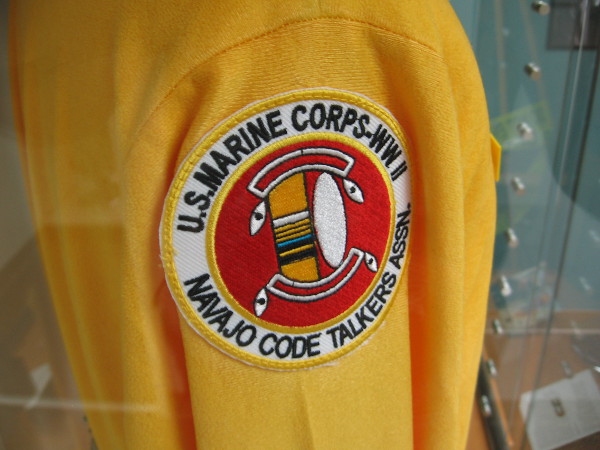
Replica of Congressional Silver Medal represents the medal received by Samuel Tsosie Sr. for his service during World War II. 300 Navajo received the Silver medal.Shoulder patch of U.S. Marine Corps–WWII Navajo Code Talkers Association.
…
I live in downtown San Diego and love to walk around with my camera! You can follow Cool San Diego Sights via Facebook or Twitter!
You can easily explore Cool San Diego Sights by using the search box on my blog’s sidebar. Or click a tag! You’ll find many interesting historical photographs!
Spaces from Yesterday is a collaborative exhibition at the SDSU Downtown Gallery featuring the art projects of three San Quentin inmates. (Click image to enlarge for easier reading.)
There’s a fascinating exhibition right now at the SDSU Downtown Gallery. It’s titled Spaces from Yesterday and features the artwork of three San Quentin inmates.
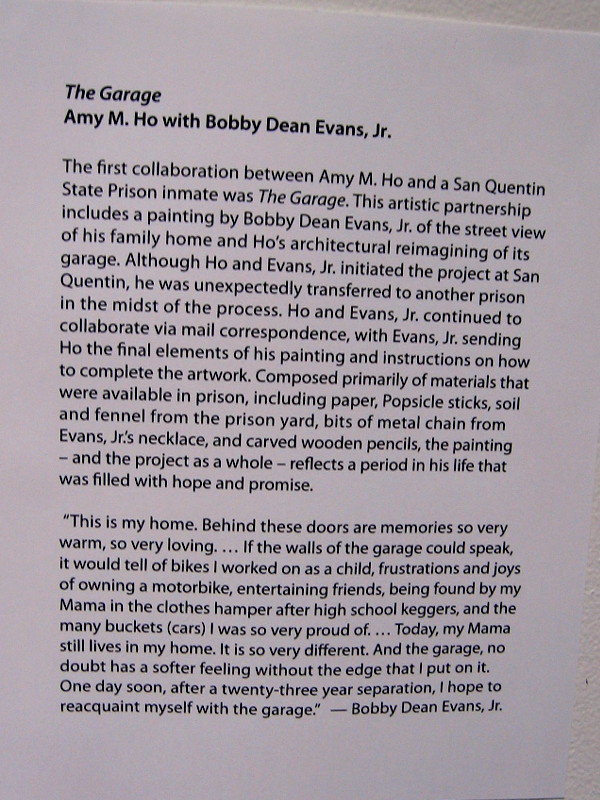
The artwork was created in collaboration with San Quentin State Prison art teacher Amy M. Ho, who also has a few related pieces in the exhibition. But the work that I found most interesting came directly from the hands of the inmates.
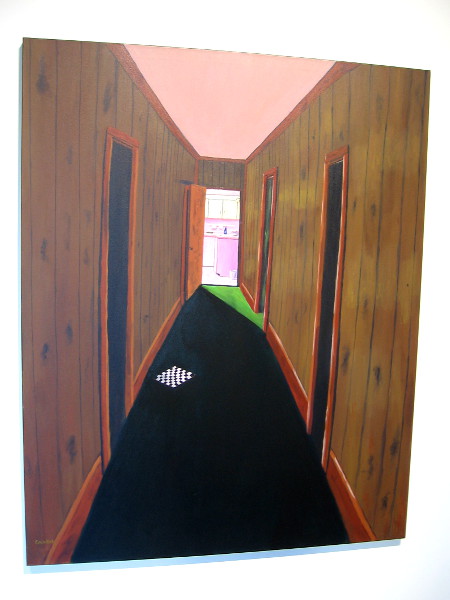
All three of the artists summon happy memories from their childhood. These images are warm, but also hard-edged and unpeopled. One work, The Hallway by Dennis Crookes, almost looks like a long, harsh, narrow prison hallway that finally leads to a home’s light-filled kitchen.
I could find no explanation why these three were incarcerated in the San Quentin correctional complex, which contains California’s only death row for male inmates. That would seem to be an essential part of the story, and might explain certain qualities of the art. But the anecdotes that are written do reveal a common yearning for a past life that is fondly remembered.
The following photos show a description of each piece, followed by the actual artwork.
Spaces from Yesterday will be on display through January 28, 2018. Those interested in art, creativity, and often hidden aspects of human life should check it out. Admission to the SDSU Downtown Gallery is free.
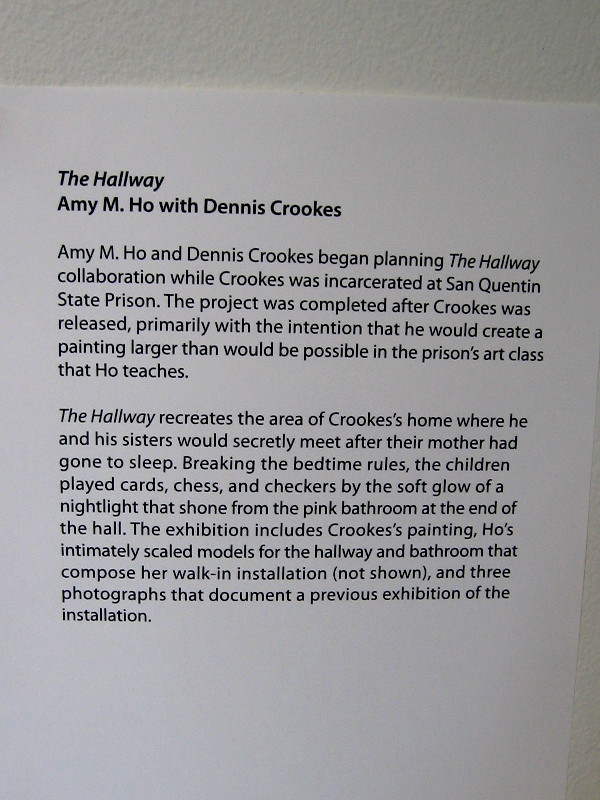
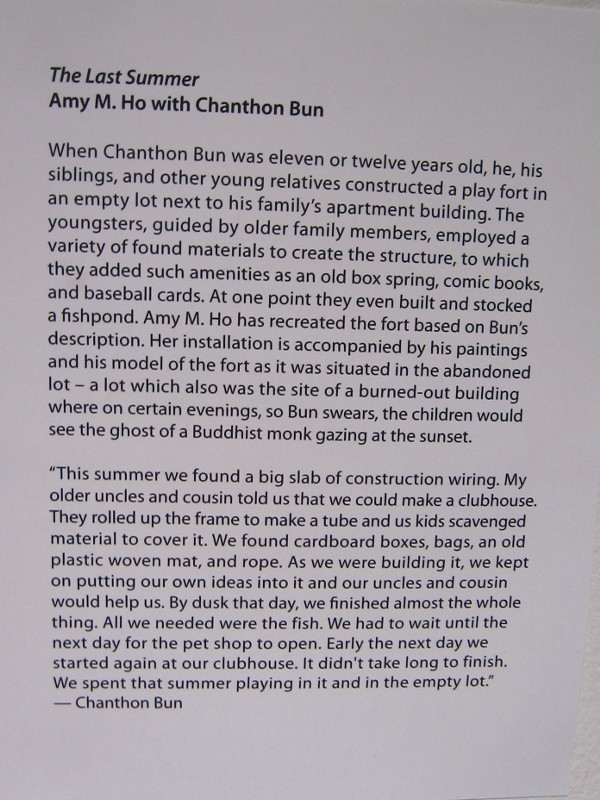
Prison art teacher Amy M. Ho and Dennis Crookes began planning The Hallway collaboration while Crookes was incarcerated at San Quentin State Prison.The Hallway, Dennis Crookes, acrylic on canvas, 2016.The Garage, a collaboration with inmate Bobby Dean Evans, Jr., contains warm memories from a playful childhood.The Garage, Bobby Dean Evans, Jr., mixed media on cardboard, 2016.Chanthon Bun painted memories from a childhood that included a play fort in an abandoned lot, comic books, baseball cards and a fish pond he created with his siblings and young relatives.The Last Summer, Chanthon Bun, acrylic on canvas, 2017.
…
I live in downtown San Diego and love to walk around with my camera! You can follow Cool San Diego Sights via Facebook or Twitter!
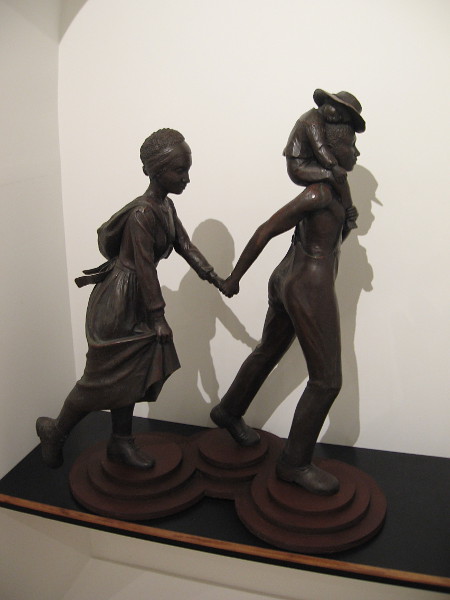
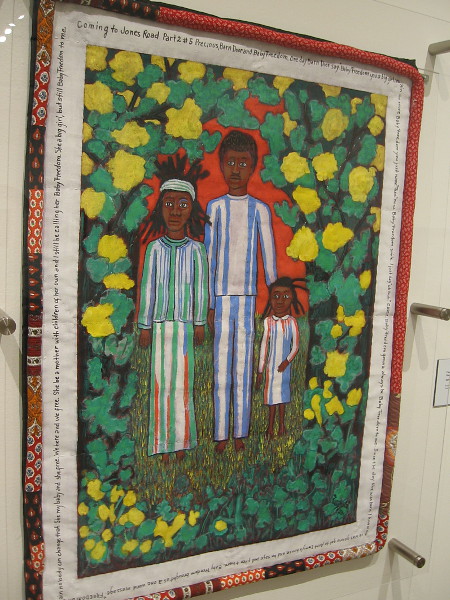
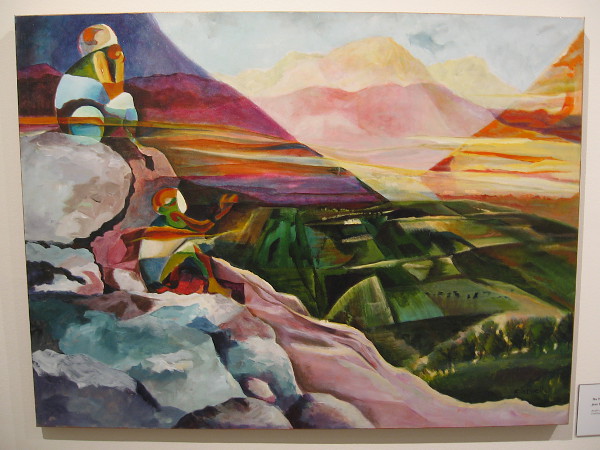
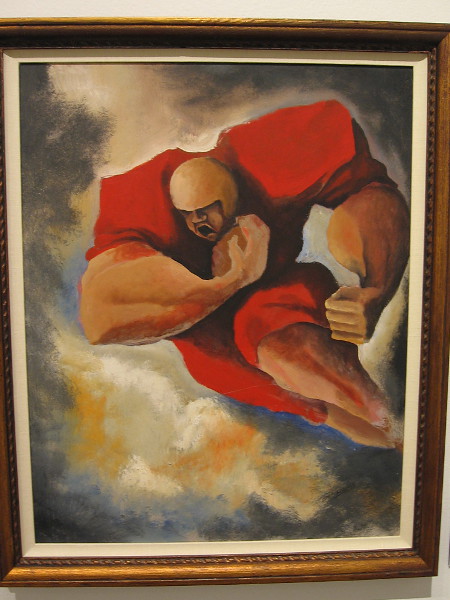
If you love fine art, there’s something you really need to see. Legacy in Black is an exhibition featuring the work of local African American artists who enjoy national and international acclaim. You can enjoy this exhibition for free by visiting the San Diego History Center in Balboa Park.
A number of outstanding pieces represent the work of eight artists who’ve made significant contributions to our city’s cultural life. Many of the artists have produced public art around San Diego and California. Faith Ringgold has had works exhibited in places like The Metropolitan Museum of Art, The National Museum of American Art, and The Solomon R. Guggenheim Museum. Ernest Eugene Barnes Jr. was the official artist of the 1984 Olympic Games in Los Angeles. Kadir Nelson was the lead conceptual artist for Steven Spielberg’s film Amistad, and his work is often featured on the cover of The New Yorker magazine. All eight artists featured in this exhibition are exceptional.
Legacy in Black is a collaboration between the San Diego History Center and the San Diego African American Museum of Fine Art. Head on over to Balboa Park before the exhibition closes on March 28, 2018!
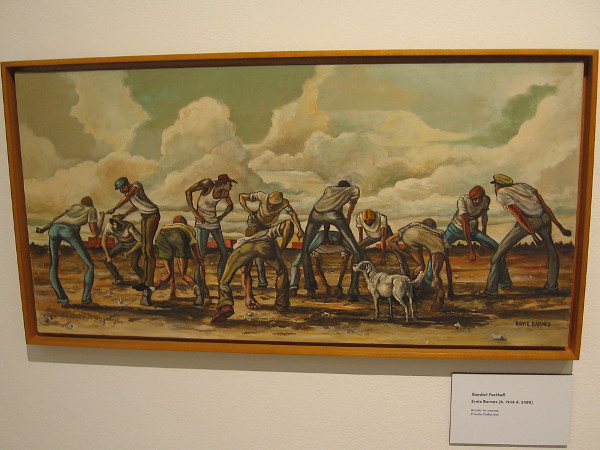
Sandlot Football. Ernie Barnes, acrylic on canvas.Legacy in Black, an exhibition of work by local African American artists, is now on display at the San Diego History Center in Balboa Park.I’ll Fly Away. Manuelita Brown, bronze with painted wood base, 2003.Coming to Jones Road Part II #5, Precious, Barn Door and Baby Freedom. Faith Ringgold, acrylic on canvas with fabric border, 2010.The Valley. Jean Cornwell Wheat, acrylic on canvas, 2014.Gridiron Hero. Ernie Barnes, acrylic on board.
…
I live in downtown San Diego and love to walk around with my camera! You can follow Cool San Diego Sights via Facebook or Twitter!
You can easily explore Cool San Diego Sights by using the search box on my blog’s sidebar. Or click a tag! There are thousands upon thousands of photos for you to enjoy!
Third Victoria, oil on canvas, 1959. Jorge Gonzalez Camarena, Mexican, 1908-1980.
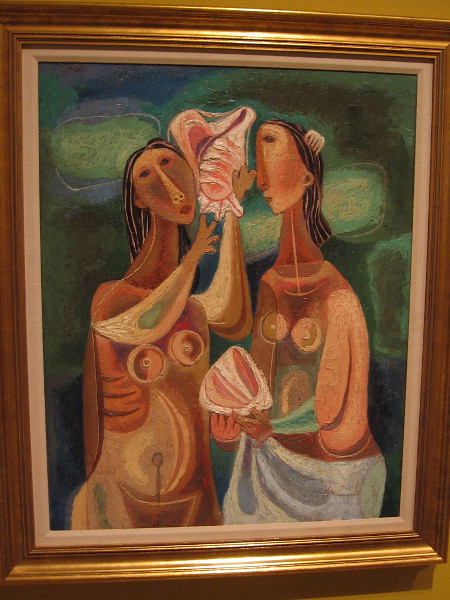
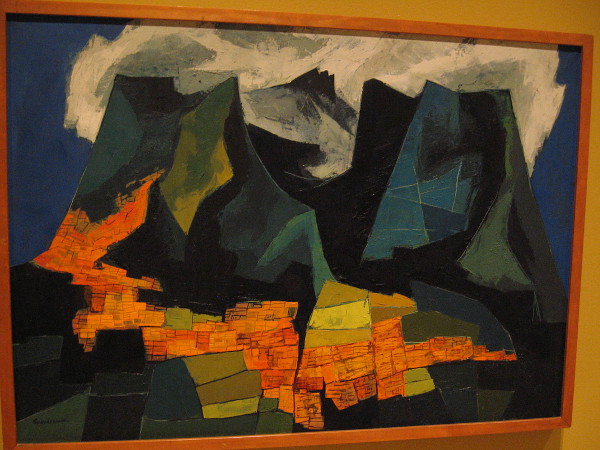
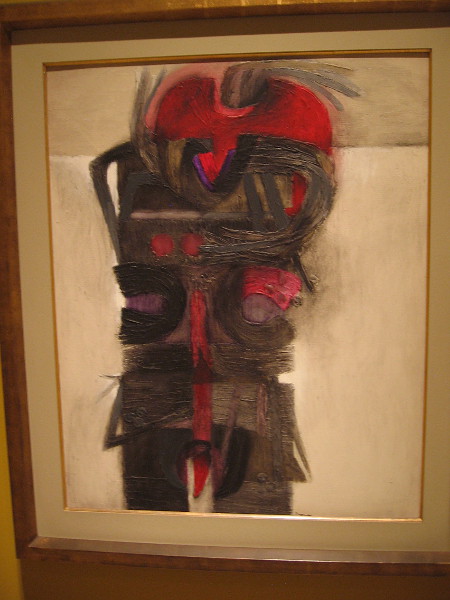
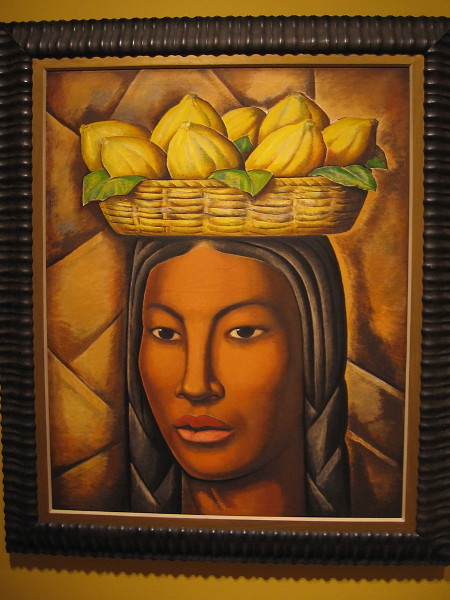
The impressive, first-ever exhibition of Modern Masters from Latin America is now on display at the San Diego Museum of Art in Balboa Park. On Christmas Eve I was given a special tour of this exhibition, and I must admit it’s fantastic! For a limited time, visitors have the rare privilege to experience one of the finest collections of modern art in the world.
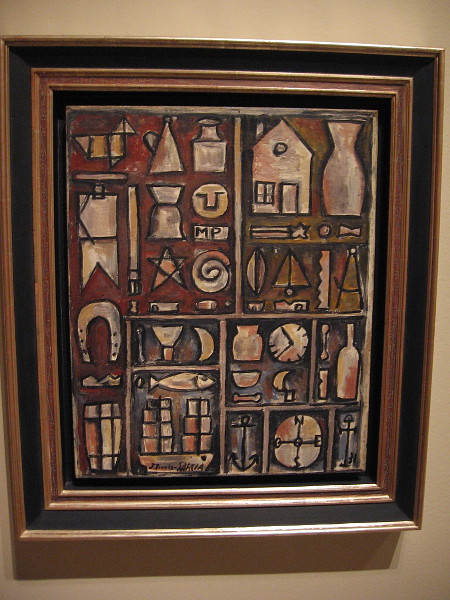
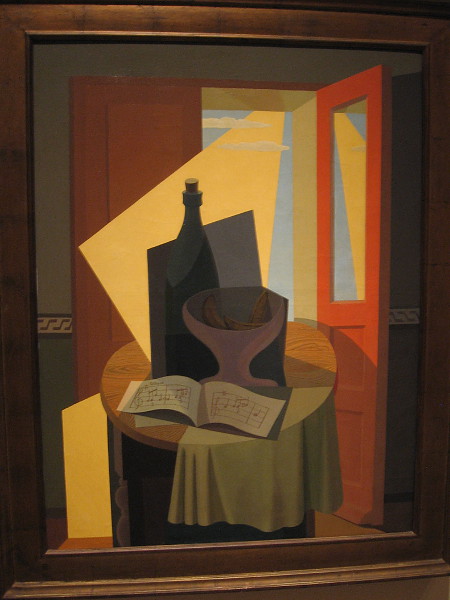
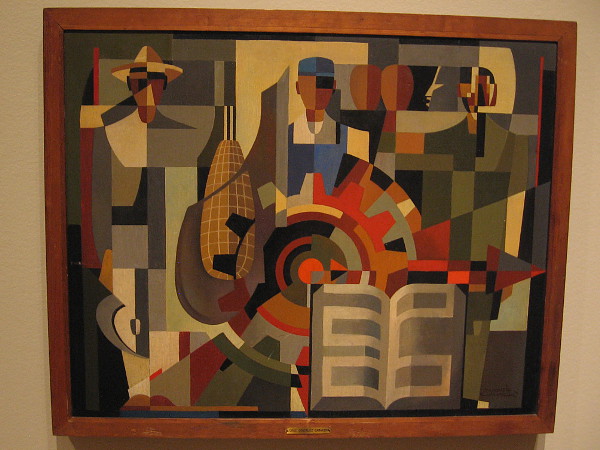
Modern Masters from Latin America: The Pérez Simón Collection contains almost a hundred memorable paintings, by the likes of Frida Kahlo, Diego Rivera, José Clemente Orozco, Joaquín Torres-García, Fernando Botero, Alfredo Castañeda and Fernando de Szyszlo. Many nations, cultures, themes, moods and styles are represented. You’ll see impressionistic landscapes, lively scenes depicted through the lens of cubism, weirdly rendered surrealism, and mind-bending, eye-teasing abstraction. Many of the works reflect different Latin American national identities. Many contrast modernity with the culture and memory of indigenous people.
I was struck by the deep emotion that radiated from most of these works. I detected human pride and passion, childlike innocence and gnawing guilt, deep love and intense anger, inexpressible suffering and irrepressible joy. These emotions were often presented in confused contrast.
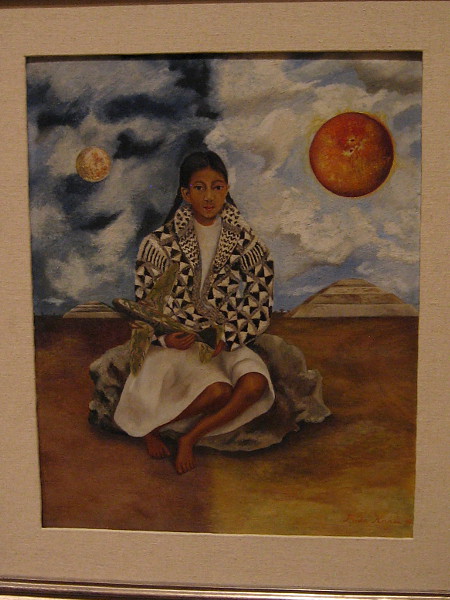
One masterful work by Frida Kahlo titled Girl from Tehuacán, Lucha María or Sun and Moon shows an innocent girl sitting between ancient symbols of night and day–the Pyramid of the Moon and the Pyramid of the Sun at Teotihuacan. She is seemingly lost in a barren desert, a model of a World War II bomber in her hands. Her quiet expression contains resignation and sadness.
My few photos here are a modest representation of the actual exhibition. To see the true colors, the touches of light and seeping darkness, the diverse textures and stunning vibrancy of these many paintings, head down to the museum while you can. You might not have a chance to see this amazing collection again.
Modern Masters from Latin America is on display at the San Diego Museum of Art through March 11. Among the fantastic works are two by Frida Kahlo, but to see those you must visit by January 14.
A visitor to the San Diego Museum of Art explores Modern Masters from Latin America, from the Perez Simon Collection.Aqueduct, oil on canvas, 1918. Diego Rivera, Mexican, 1886-1957.Ship Graveyard, oil on canvas, 1930. Benito Quinquela Martin, Argentinian, 1890-1977.Crying Woman, pyroxylin on Masonite, 1944. David Alfaro Siqueiros, Mexican, 1896-1974.Death in Life or Black Christ, acrylic on plywood, 1963. David Alfaro Siqueiros, Mexican, 1896-1974.Young Girls with Shells, Duco on canvas, 1945. Mario Carreno, Cuban, 1913-1999.City of Quito, oil on canvas, ca. 1980. Oswaldo Guayasamin, Ecuadorian, 1919-1999.The Mexican or Young Woman with Rebozo, oil on canvas, 1935. Agustin Lazo, Mexican, 1896-1971.House Eight, oil on canvas, 1978. Fernando de Szyszlo, Peruvian, 1925-2017.The Native, oil on canvas, ca. 1936. Alfredo Ramos Martinez, Mexican, 1871-1946.Girl from Tehuacán, Lucha María or Sun and Moon, oil on Masonite, 1942. Frida Kahlo, Mexican, 1907-1954.Constructive Composition in Planes and Figures, oil on canvas, 1931. Joaquin Torres-Garcia, Uruguayan, 1874-1949.Concert, oil on canvas, 1941. Emilio Pettoruti, Argentinian, 1892-1971.Peasant, Industrial, and Intellectual Work, oil on wood, 1956. Jorge Gonzalez Camarena, Mexican, 1908-1980.World’s Highest Structure, oil on canvas, 1930. Jose Clemente Orozco, Mexican, 1883-1949.Green Structures, oil on canvas, 1964. Gunther Gerzso, Mexican, 1915-2000.Study for The March of Humanity, oil on recovered plywood, ca. 1968-69. David Alfaro Siqueiros, Mexican, 1896-1974.Portrait of Maria Felix, oil on canvas, 1948. Diego Rivera, Mexican, 1886-1957.
…
I recently published an odd, moving short story about a world made of bones. You can read it here.
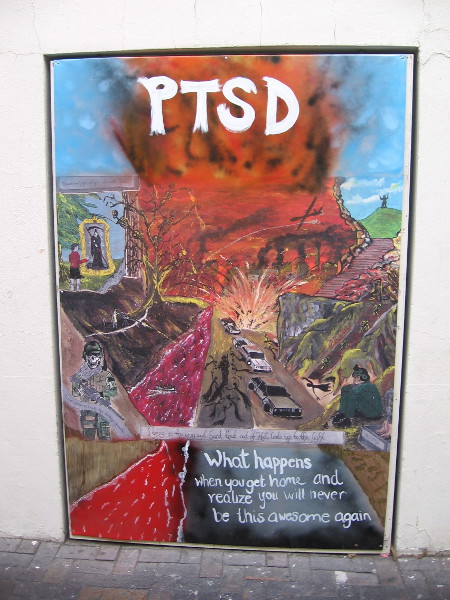
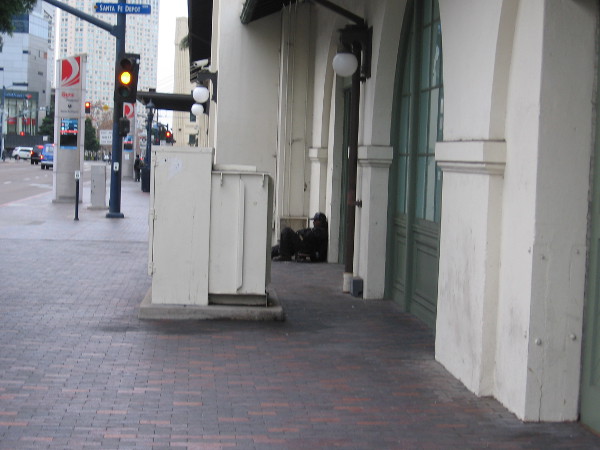
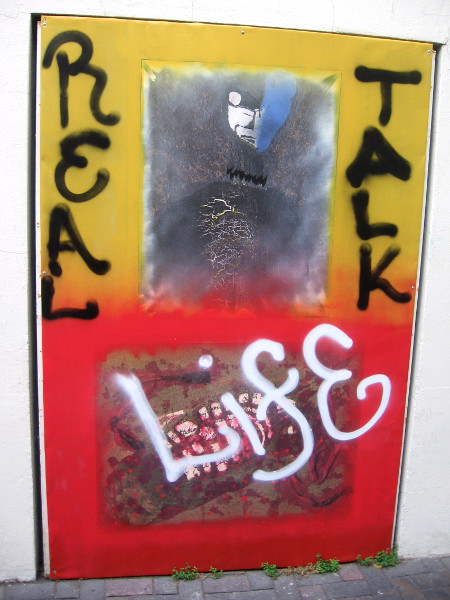
There are three new works of art on display in the breezeway between the downtown Museum of Contemporary Art San Diego and the Santa Fe Depot. These pieces concern disturbing emotions felt by combat veterans, and the ongoing battle of many with Post-Traumatic Stress Disorder (PTSD).
I believe–but I’m not certain–that the art you see in these photos was produced by military personnel who participate in the museum’s ArtOASIS program. ArtOASIS was created for PTSD patients in conjunction with Combat Arts, a local organization that provides opportunities for combat troops to express themselves.
These images are raw and painful. They are brutally honest. To paint these dark, secret things requires great personal courage.
Someone walks through the breezeway between MCASD and Santa Fe Depot in downtown San Diego.PTSD. What happens when you get home and realize you will never be this awesome again. Long is the way and hard, that out of Hell leads up to the light.A lone figure lies against the wall of Museum of Contemporary Art San Diego.REAL TALK. Life.
…
I live in downtown San Diego, and walk through the city with my camera. You can follow Cool San Diego Sights via Facebook or Twitter.
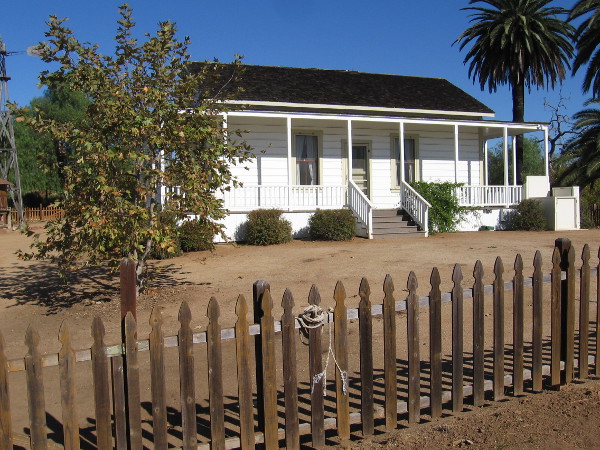
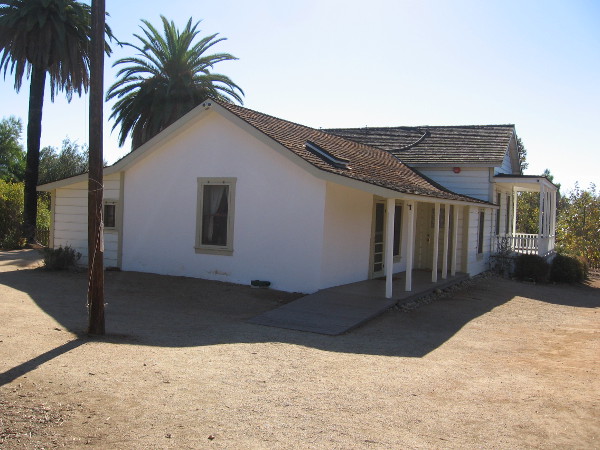
Photo of the rustic Sikes Adobe Farmhouse on a sunny November day.
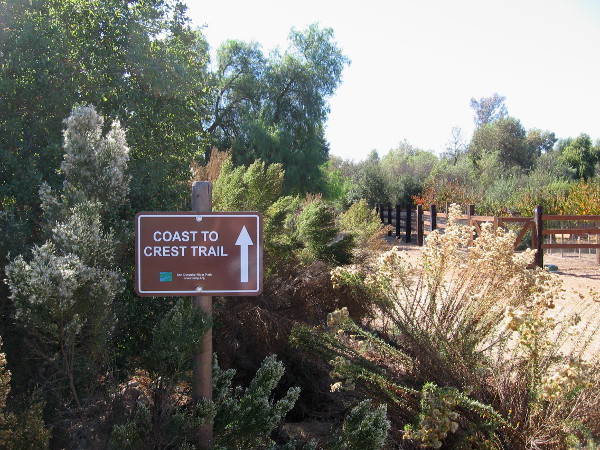
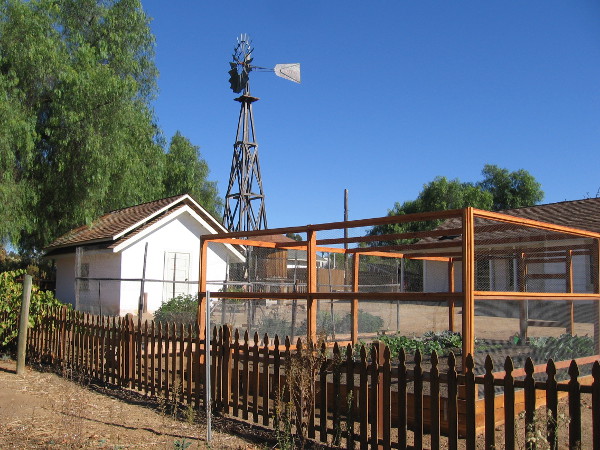
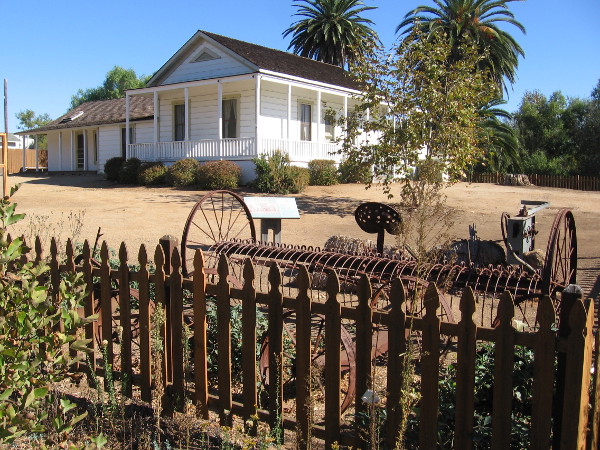
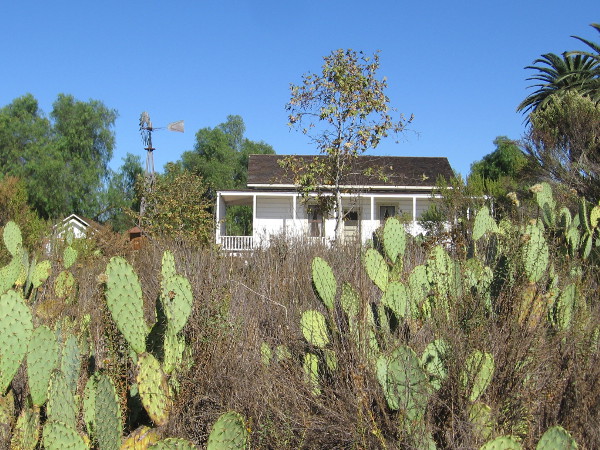
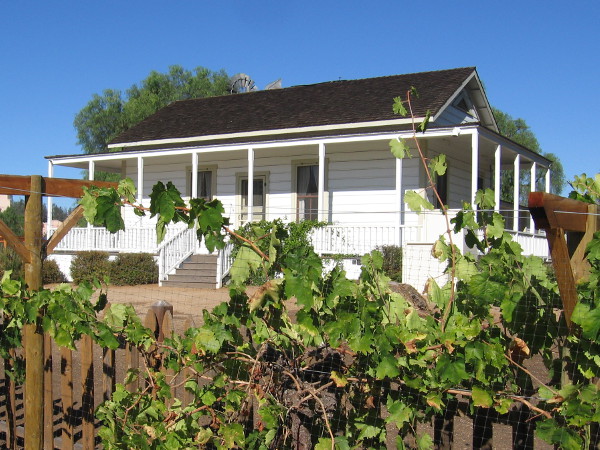
This morning I drove up to Escondido. One highlight of my day was walking around the historic Sikes Adobe Farmhouse, which is located near a popular trailhead of the San Dieguito River Park’s long, not-yet-complete Coast to Crest Trail.
The restored Sikes Adobe (originally built around 1870, and mostly destroyed in 2007 by the Witch Creek Fire) is a City of San Diego historic site. It contains a museum which is open every Sunday. Also on Sundays, the farmstead is where the North San Diego Certified Farmers Market is held.
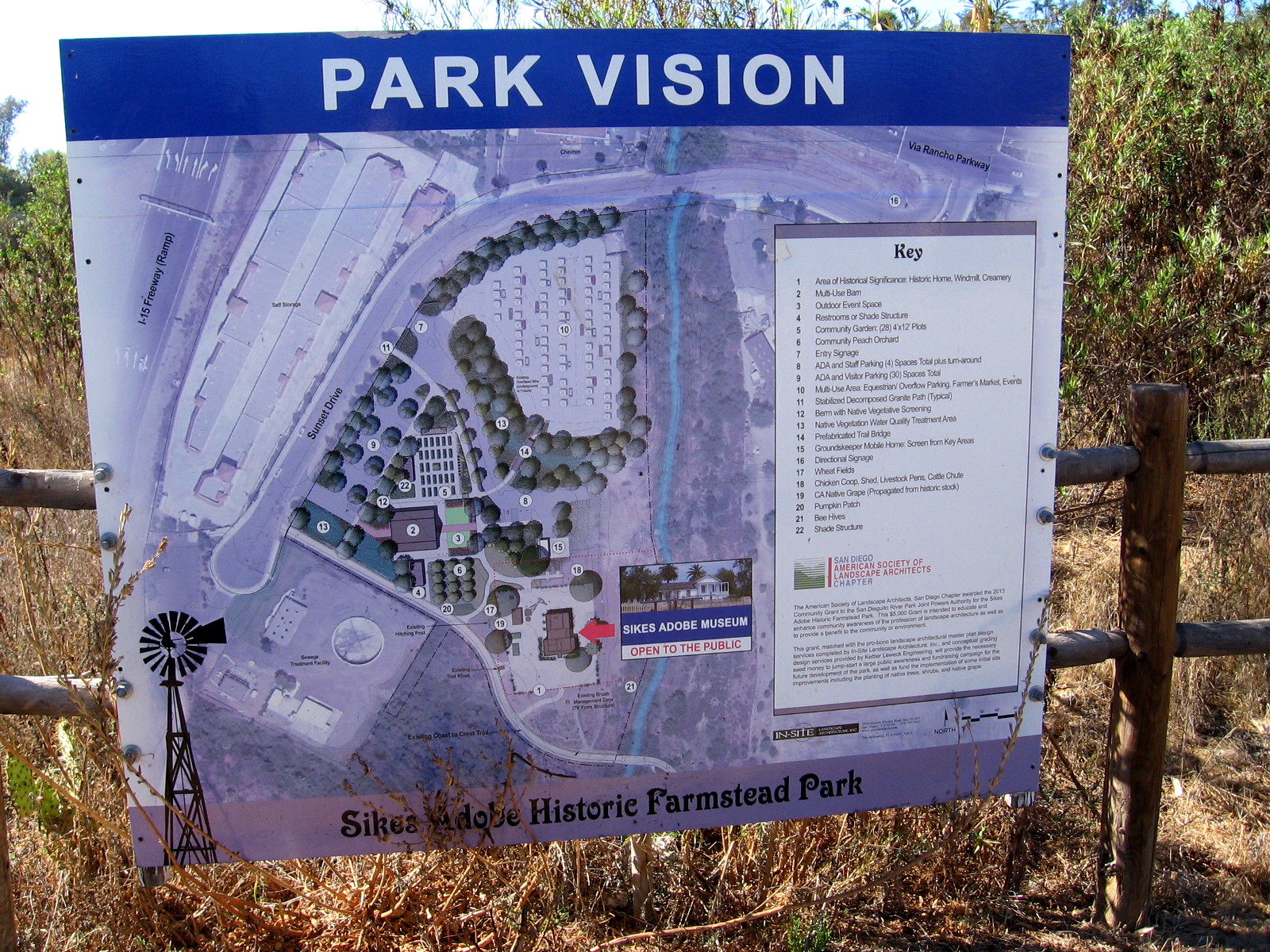
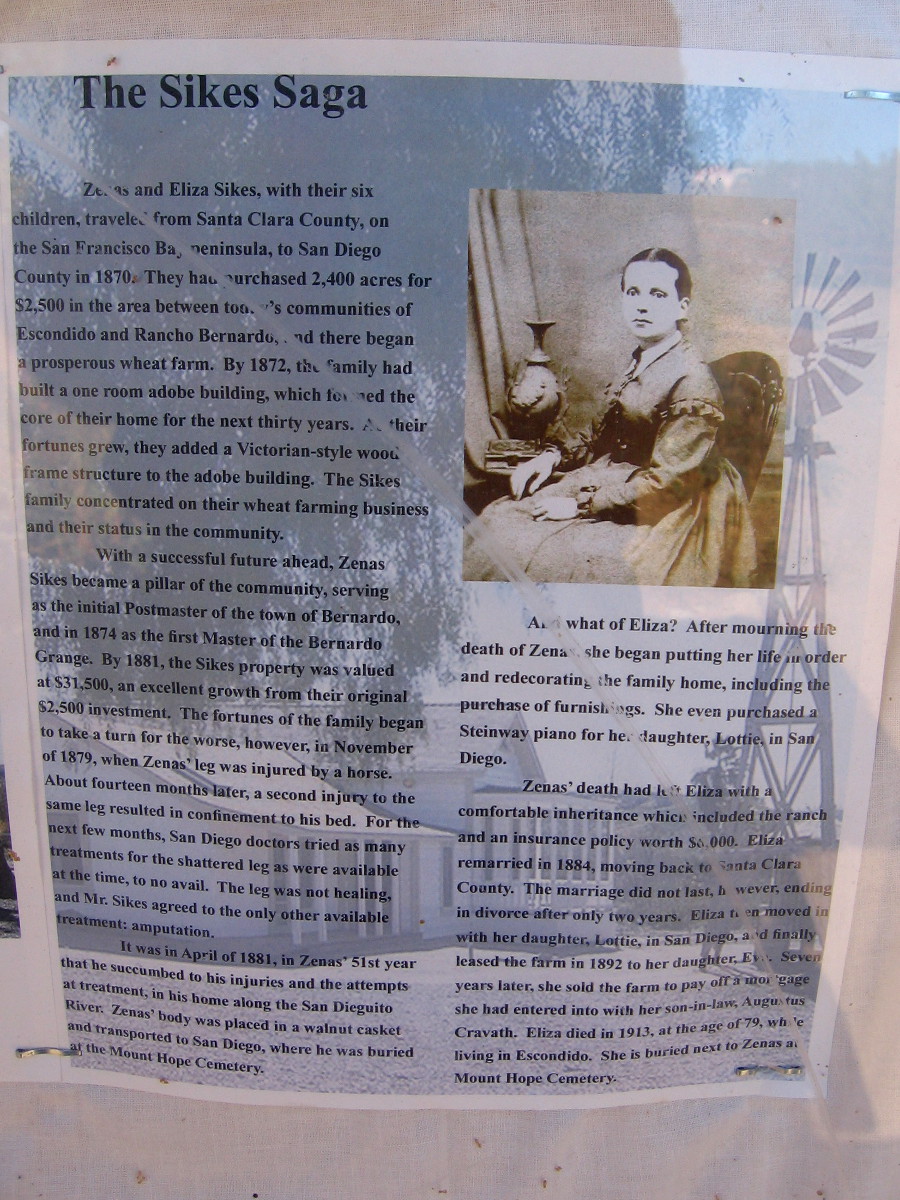
As I walked around Sikes Adobe, I happened upon some interpretive signs which explain the history of the farmstead. I took photos if you’re interested. Click those sign images and they will expand for easy reading.
People had very different lives long ago in California. Fresh air, hard work, quiet hours, simple pleasures. And wild, untrod paths. I believe I would have loved that life.
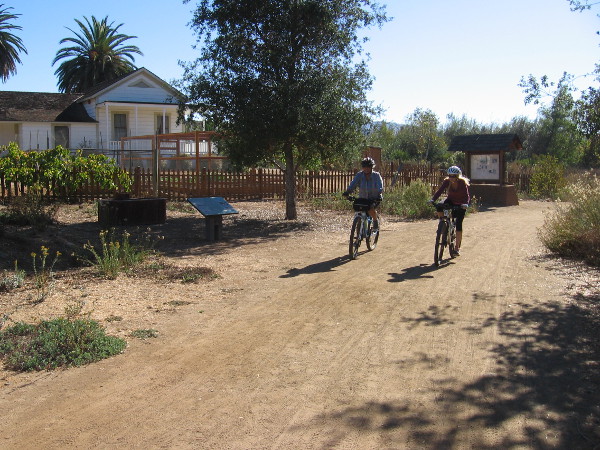
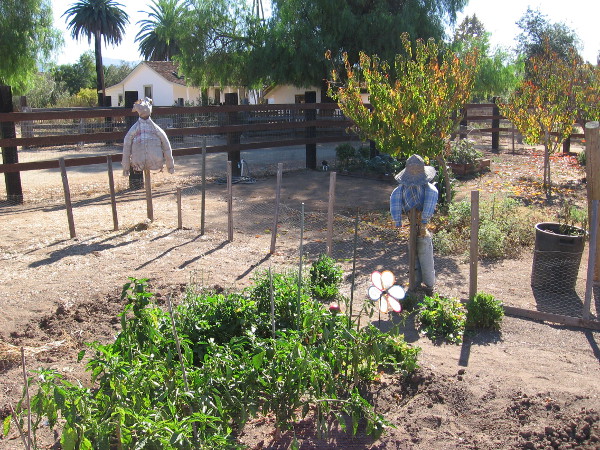
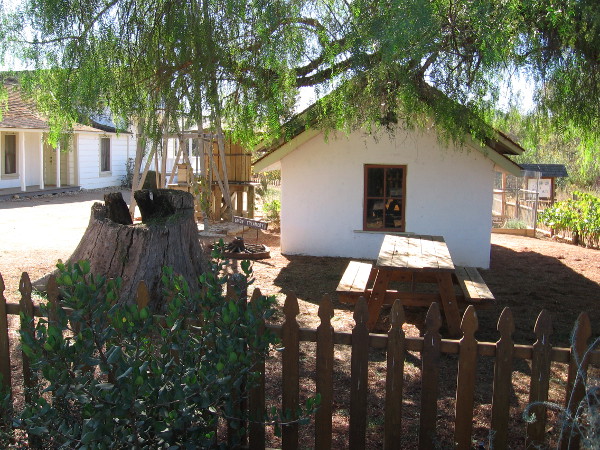
The historic Sikes Adobe Farmhouse is located near a trailhead of the Coast to Crest Trail, just east of Lake Hodges.The trail past the farmstead is popular with hikers, mountain bikers and equestrians.A sign shows proposed improvements to the Sikes Adobe Historic Farmstead Park, including event space and a reconstructed barn.Scarecrows stand guard inside a community garden near the rustic farmhouse.Approaching the Sikes Adobe. One can tour the inside on Sundays, from 10:30 am to 3:30 pm.In this photo you can see the small creamery building and the base of the restored windmill.A simple adobe house, typical of the early American era, shortly after California had achieved statehood.View of the farmstead structures from the nearby trail.Zenas and Eliza Sikes, with six children, arrived in 1870 and began their wheat farm here between the communities of Escondido and Rancho Bernardo.A small vegetable garden near the restored windmill and creamery.Old rusty farm equipment in a corner of the farmstead.Between 1860 and 1893, wheat was California’s first bonanza crop. The creamery at Sikes Farm was built in the 1880s as their farm diversified and became more generalized.A small town called Bernardo used to be located a couple miles southeast of the Sikes Adobe. The construction of the Lake Hodges Dam spelled the end for that town.Looking from the nearby trail past prickly pears at the farmhouse.Some horses have arrived at the trailhead’s dirt parking lot.Sikes Adobe depends on your support. Become a docent or volunteer!The Sikes Adobe Farmhouse rises behind a row of green grape vines.
…
This blog now features thousands of photos around San Diego! Are you curious? There’s lots of cool stuff to check out!
Here’s the Cool San Diego Sights main page, where you can read the most current blog posts. If you’re using a small mobile device, click those three parallel lines up at the top–that opens up my website’s sidebar, where you’ll see the most popular posts, a search box, and more!
To enjoy future posts, you can also “like” Cool San Diego Sights on Facebook or follow me on Twitter.
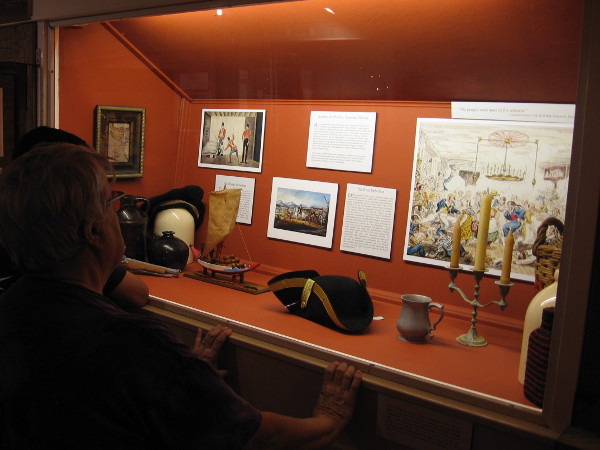
Visitors to the Maritime Museum of San Diego view a display concerning the history of rum.
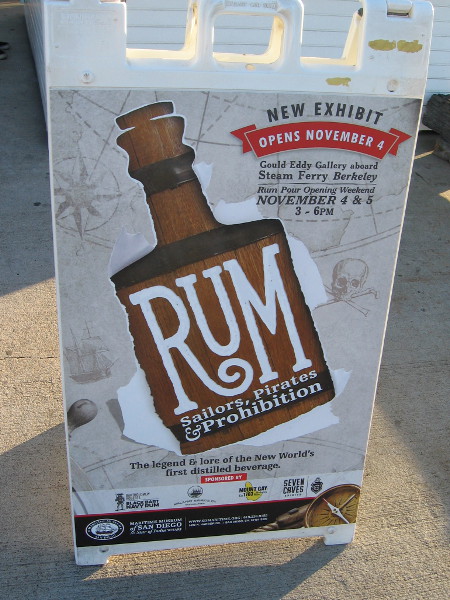
A cool new exhibit opened this weekend at the Maritime Museum of San Diego. Rum: Sailors, Pirates and Prohibition follows the colorful history of rum, from its origin to the present day, with a focus on its surprising history in San Diego.
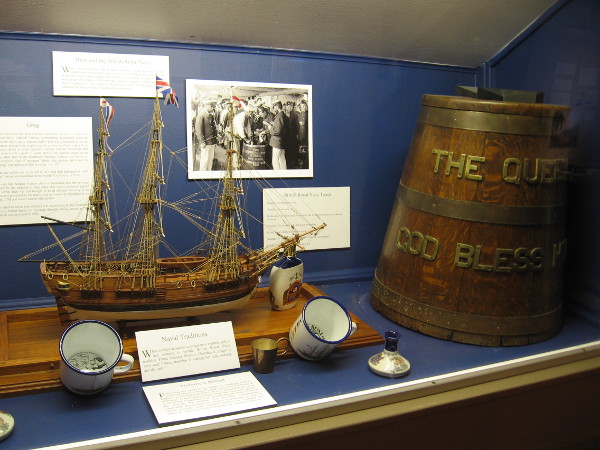
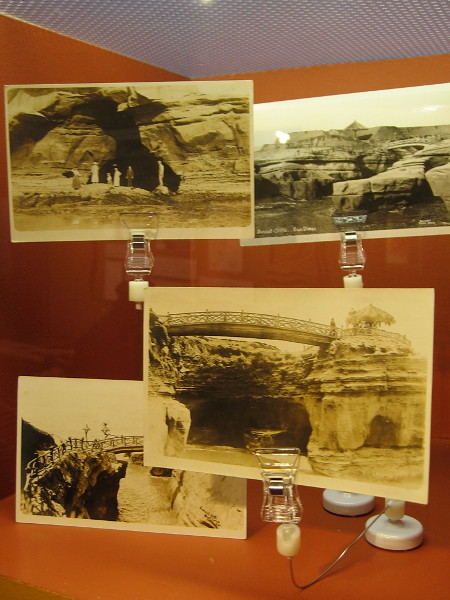
There are all sorts of interesting artifacts, old photographs and displays, as you can see from the few photos I took this afternoon. Among other things, visitors to the exhibition can learn how rum is made, about the use of rum by sailors, including those of the British Royal Navy, and how rum runners used sea caves in San Diego during Prohibition.
Anyone with a love for history should check it out!
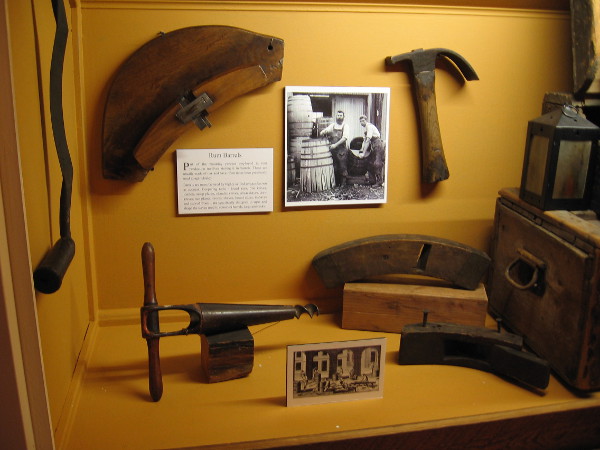
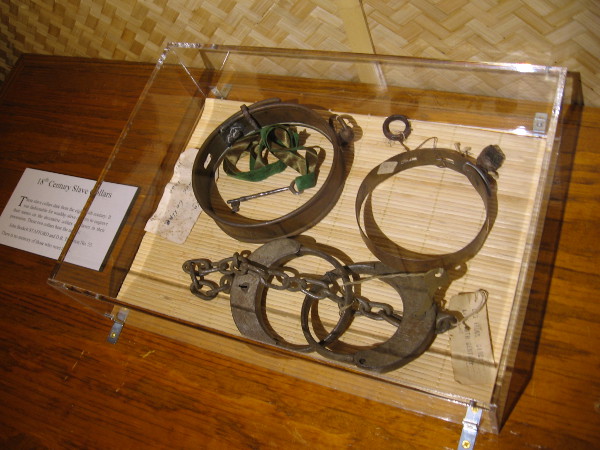
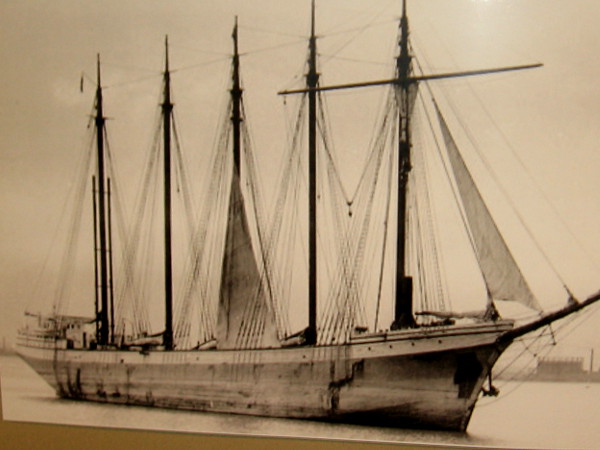
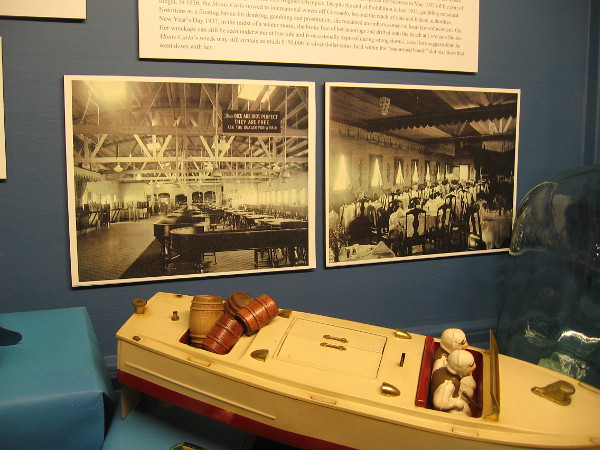
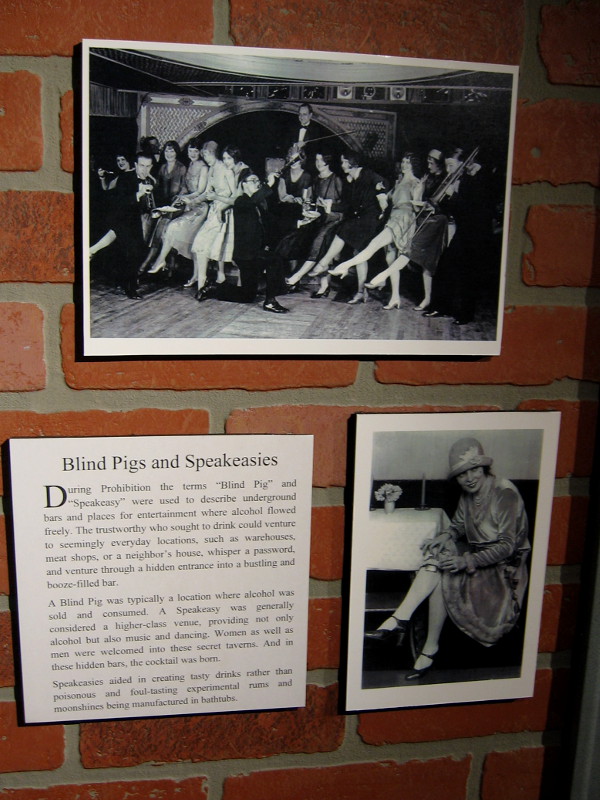
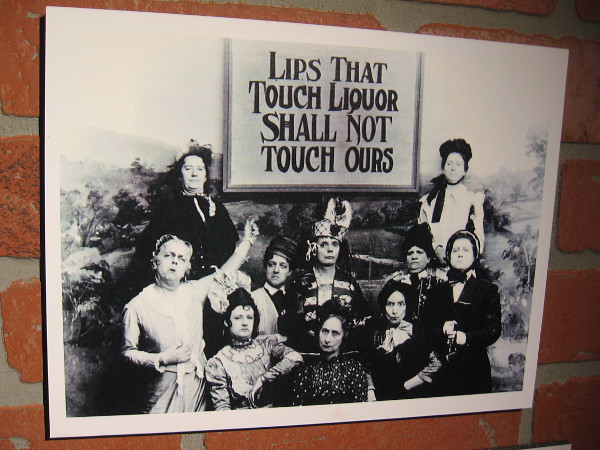
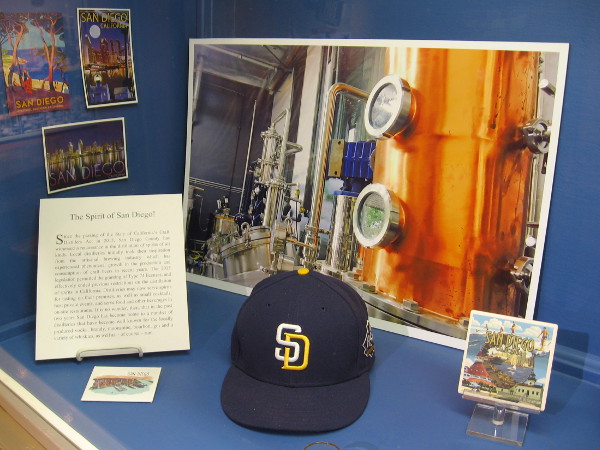
Rum: Sailors, Pirates and Prohibition is a cool new exhibit inside the Steam Ferry Berkeley, at the Maritime Museum of San Diego!A display in the Gould Eddy Gallery shows some of the coopering tools used in making oak rum barrels.Slave collars from the 18th century. Some believe African slaves in the Caribbean discovered the process of distilling the residue of sugar refining–molasses and sugarcane juice–into alcohol.A display features an explanation of grog and rum on British Royal Navy ships. Grog was rum diluted with water to prevent drunkenness. The grog ration was abolished in 1970.Old photo of the Malahat, the Queen of Rum Row. The five-masted schooner successfully delivered rum and other spirits along the West Coast during Prohibition.Local sea caves and coves in La Jolla and Sunset Cliffs were used at hideouts for rum runners arriving from Mexico during Prohibition.Photos of the Monte Carlo, San Diego’s Prohibition era floating casino. In 1937 it became beached on Coronado during a winter storm. Her wreckage can still be seen underwater at low tide.Blind Pigs and Speakeasies. A secretive Speakeasy sold alcohol during Prohibition, plus provided its guests with entertainment. Drinks were tastier than the poisonous rums and moonshines concocted in bathtubs.A photograph of anti-alcohol activists taken during Prohibition. Lips that touch liquor shall not touch ours!Display celebrates the rise of local San Diego distilleries. Our dynamic city is now considered the craft beer capital of the United States.
…
I live in downtown San Diego and love to walk around with my camera! You can follow Cool San Diego Sights via Facebook or Twitter!
You can easily explore Cool San Diego Sights by using the search box on my blog’s sidebar. Or click a tag! There are thousands upon thousands of photos for you to share and enjoy!
































 Cool San Diego Sights!