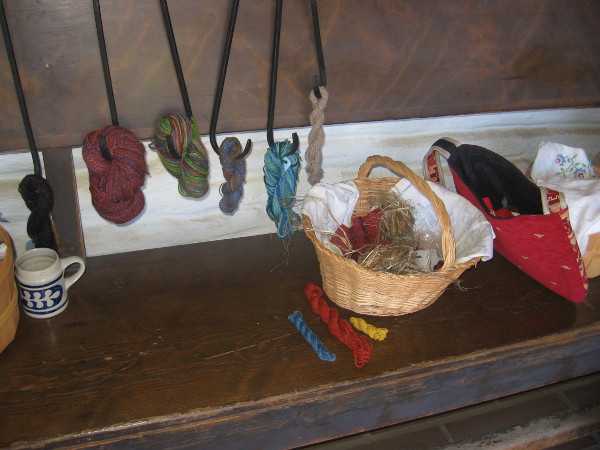
Yarns dyed many different colors out on display in San Diego’s Old Town.
One more quick post from today’s stroll through Old Town San Diego State Historic Park. After going on the free walking tour, which I do every few years to jiggle my memory, I observed that a couple of unique exhibits were out on public display. One concerned yarn, the other twine. A “string” of coincidence too good not to blog about!
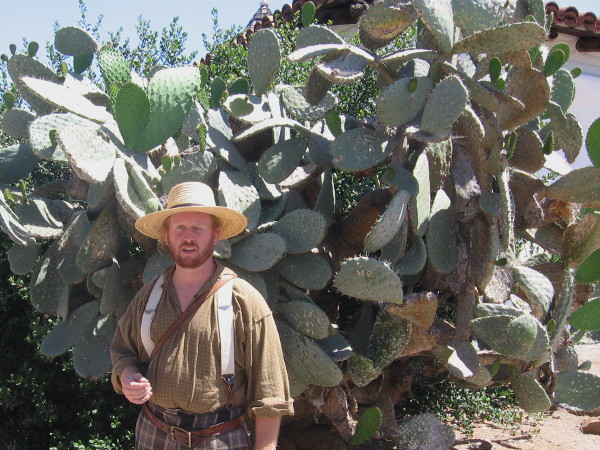
During the tour, our knowledgeable guide explained how red dye in the olden days was derived from a particular insect–the cochineal. The cochineal is a beetle that can be found on prickly pears, a cactus which grows abundantly in arid San Diego. While we watched, the guide plucked one from a prickly pear next to the Casa de Estudillo, then crushed it. His fingers turned bright purple from the beetle juice! (He explained the British Red Coats dyed their uniforms with cochineal, but Purple Coats didn’t sound quite so fierce.)
Tour guide ready to produce some reddish dye.
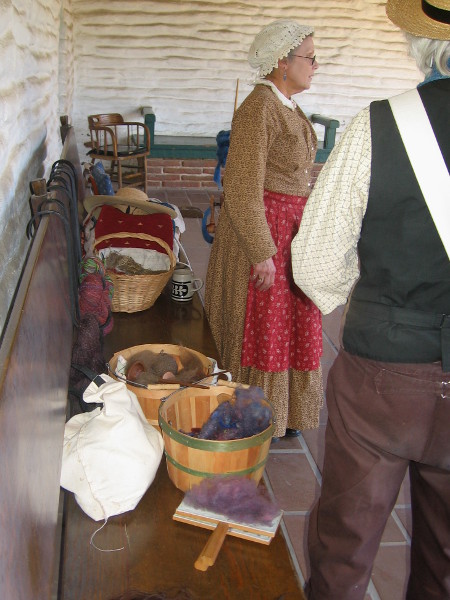
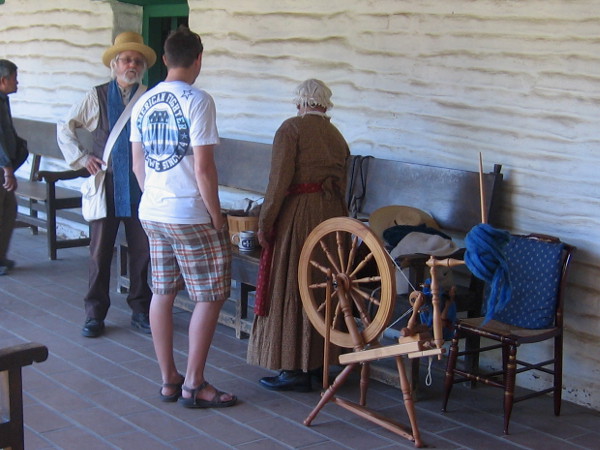
After the tour ended, two volunteers inside the Casa de Estudillo were demonstrating how yarn used to be made. To dye the fibers, both cochineal and indigo dye were commonly used. A spinning wheel served to demonstrate the hard work required to live comfortably before our more modern conveniences.
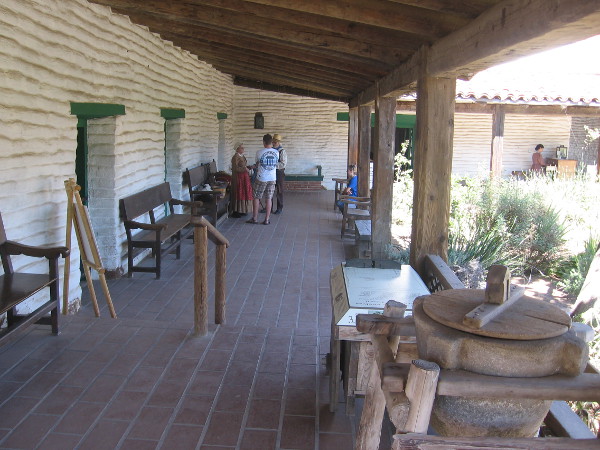
La Casa de Estudillo, an elegant adobe house built in 1827 by a wealthy Californio family that owned several large ranchos in Southern California.Volunteers in costume with baskets of color. They told me some yarns concerning San Diego’s complex, fascinating history.State Park volunteers describe life in early San Diego, when spinning wheels were common household objects.
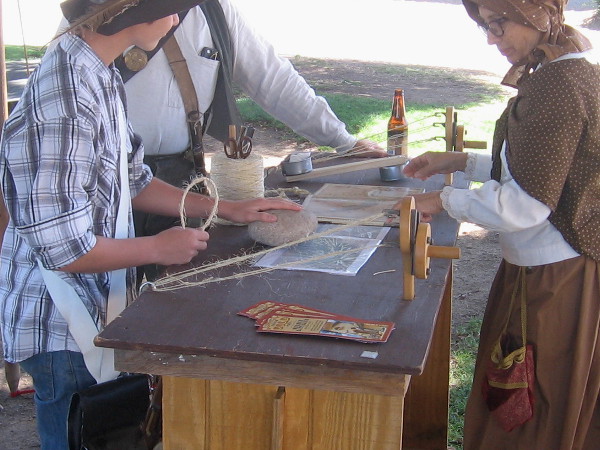
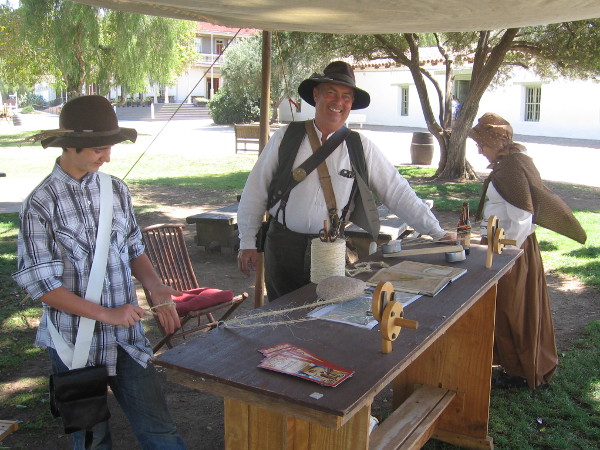
Out in one corner of Old Town’s big central plaza, some friendly Mormons were demonstrating the making of twine. Like the native prickly pear, yucca plants have always been plentiful in San Diego’s desert-like environment. The tough fibers in the leaves, once extracted, are dried and then twisted using a simple mechanism to create primitive but very practical twine or rope.
Making twine involved twisting fibers found in native yucca plants.Mormon guy smiles as he exhibits rope-making in Old Town. The Mormon Battalion was one of many diverse participants in San Diego’s early history.
Someday I’ll probably blog about the amazing, hour-long Old Town walking tour. I need some more photos and many more notes before I undertake that, however!
…
To enjoy future posts, you can “like” Cool San Diego Sights on Facebook or follow me on Twitter.
Sculpture and cannon at entrance to the Mormon Battalion Historic Site.
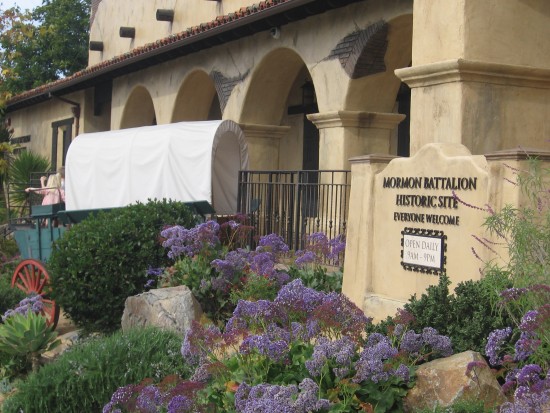
Just east of Old Town San Diego State Historic Park one can find the Mormon Battalion Historic Site, an attraction created by The Church of Jesus Christ of Latter-day Saints. The location itself seems a bit arbitrary, as the Mormon Battalion manned Fort Stockton up on the hill by the old, abandoned Presidio when they arrived in San Diego in 1847.
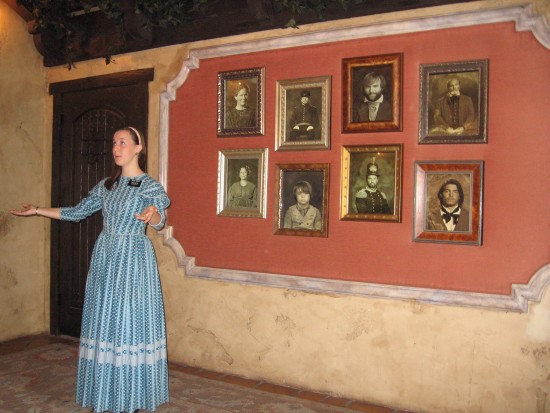
Young lady missionaries guide visitors through a series of rooms and outdoor areas which are designed to tell a sympathetic version of the Mormon Battalion’s difficult 2000 mile march from Iowa. The ulterior motive is to promote their beliefs, and there are frequent religious references, but there is no hard sell and the tour guides are warm and friendly. One can absorb a little bit of history while experiencing a good-humored, Disney-like presentation.
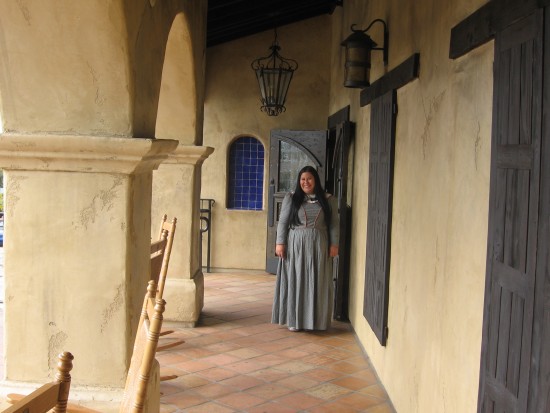
A friendly missionary lady comes outside to welcome a new visitor.Girl in a pioneer dress begins the tour with talking, moving portraits.
Much of the tour is spent watching professionally produced dramatic videos. Several real historical artifacts can be found near the tour’s end.
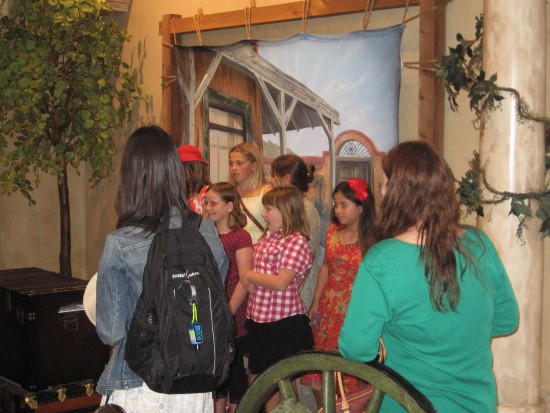
Taking pictures of visitors with a large antique camera.Girls pose for a picture in front of a western scene.
A lot of families and kids were smiling and enjoying the tour. Many appeared to be members of the LDS Church.
Young visitors near end of the tour pan for glittery iron pyrite.Covered wagon in front of the Mormon Battalion Historic Site.
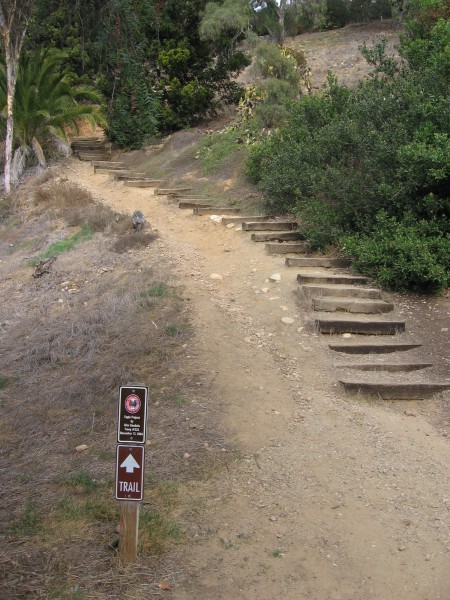
The Old Presidio Trail leads up a steep hill from San Diego’s historic Old Town.
Please join me as I walk from San Diego’s Old Town up a short but very steep trail to Presidio Park. We’ll see all sorts of interesting monuments, views, and of course, the location of the old Spanish presidio, whose ruins are no longer visible. The top of Presidio Hill is now home to the Junipero Serra Museum. Follow me!
We begin near the trailhead, beside the small Presidio Hills Golf Course, on the east edge of historic Old Town.
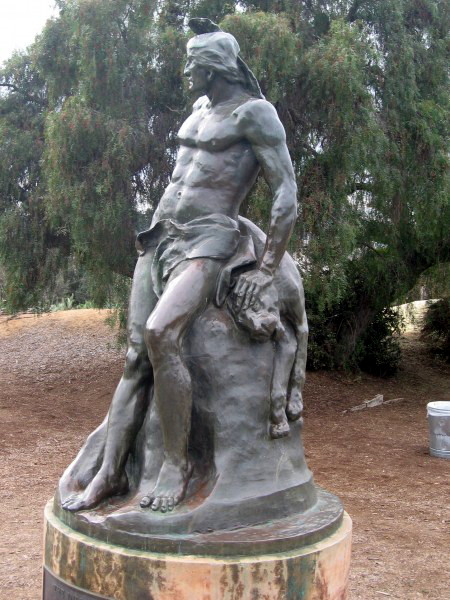
One of several signs along the Old Presidio Historic Trail. This one explains that soldiers and families used to walk down from the Spanish presidio to tend gardens and livestock near the Casa de Carrillo, which is now the pro shop at Presidio Hills Golf Course.The Indian sculpture by Arthur Putnam in Presidio Park.
The first interesting thing we see is this sculpture, titled The Indian. It was created by famous American artist Arthur Putnam in 1905 and placed at the site of an ancient Indian village. The small village was discovered and named San Miguel by the explorer Juan Rodriguez Cabrillo in 1542.
The Padre Cross was erected near the spot where Junipero Serra established California’s first mission.
Up the hill from The Indian stands the Padre Cross. It was raised in 1913 by the Order of Panama and is made up of tiles from the Presidio ruins. The cross marks the strategic location overlooking San Diego Bay where Franciscan friar Junipero Serra chose to establish a Spanish Catholic mission in 1769. (The mission was moved several miles up the San Diego River 5 years later.)
Bronze statue titled The Padre by Arthur Putnam.
Nearby among some trees we find a memorial to the mission’s friars. It’s a bronze statue titled The Padre, completed in 1908 by renowned sculptor Arthur Putnam.
The Serra Museum rises beyond billowing Spanish flag.
Our legs are starting to feel the climb as we reach three flagpoles overlooking Mission Valley.
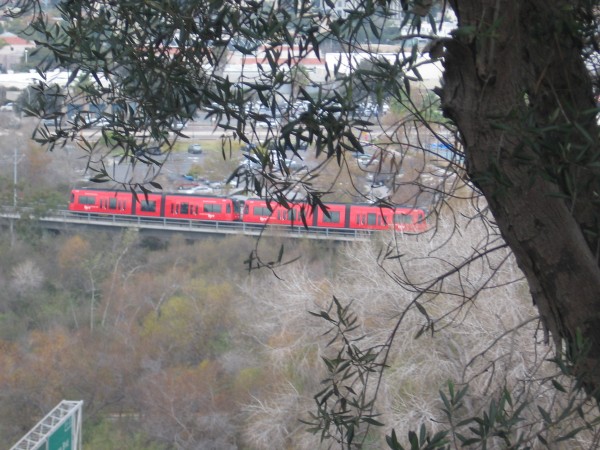
Looking down at a red trolley in Mission Valley.
Turning north for a moment, we see the trolley!
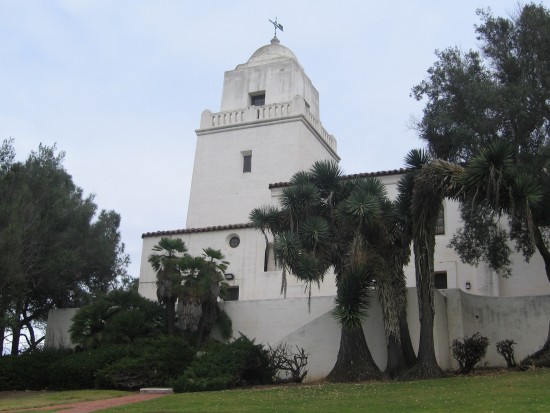
View of the Serra Museum on Presidio Hill in San Diego.
Now we’re getting close to the Serra Museum, which was built in 1928 on this historically very important hill. The museum was built, and the land containing Presidio Park was purchased and preserved for posterity, by philanthropist George Marston.
San Diego was born in 1769 at the old Presidio, a Spanish fort in a desert-like wilderness very far from European civilization. It was located just below the Serra Museum.
Serra Museum employee looks down the grassy hill.
Not many people are about at the moment. Most tourists never venture up this way.
The Serra Museum is packed with numerous historical exhibits. You can climb the tower for views of San Diego Bay, the San Diego River and Mission Valley.
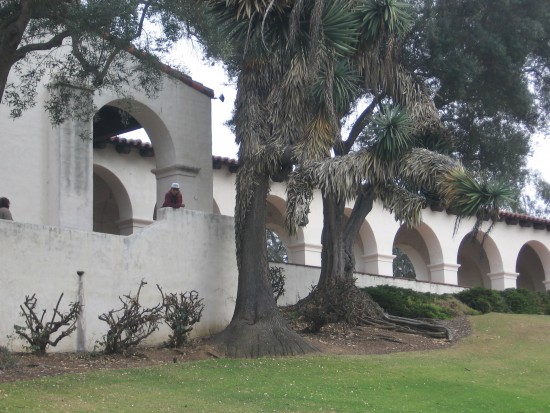
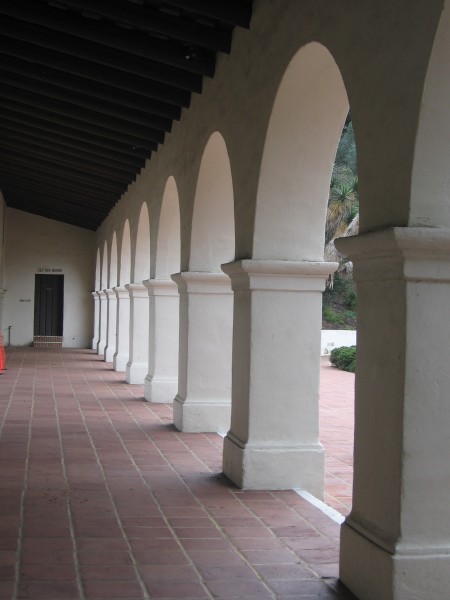
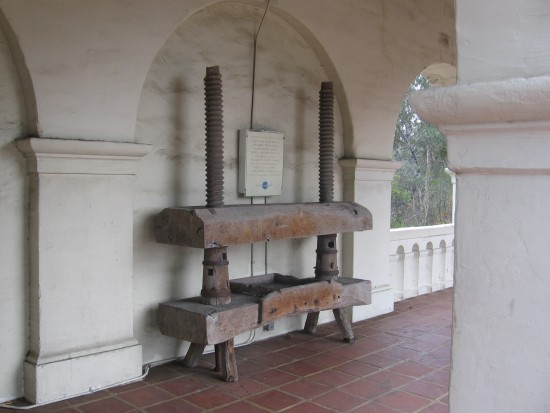
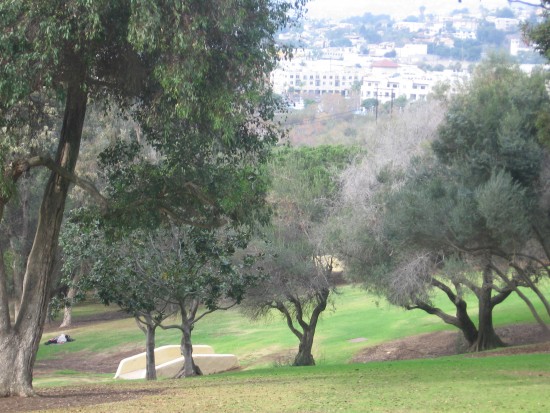
Row of Mission Revival style arches.Large wine press outside San Diego’s fascinating Junipero Serra Museum.Looking downhill from atop grassy Presidio Park.
Now we’ll wander along the hilltop to nearby Fort Stockton, the short-lived camp of the famous Mormon Battalion.
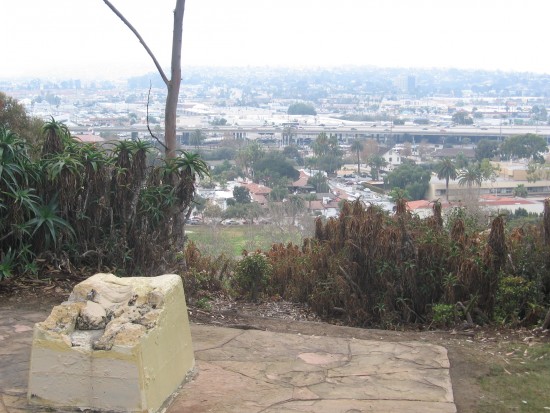
Where a cannon once overlooked Old Town at Fort Stockton.
Decades ago, when I was a young man, I remember seeing a cannon set in this concrete overlooking Old Town. I believe that same cannon is now on display in the nearby Serra Museum. Given the name El Jupiter, it was one of ten cannons that originally protected the old Spanish Fort Guijarros on San Diego Bay at Ballast Point.
(A second surviving cannon from the fort is named El Capitan. Today it can be found near the center of Old Town San Diego’s Plaza de las Armas.)
Mural at Fort Stockton of the Mormon Battalion.
In 1846, President James K. Polk asked Brigham Young of the Mormons to send a few hundred men to San Diego to help in the Mexican-American war effort. On January 29, 1847 five hundred men and about eighty women and children arrived at Fort Stockton after a very difficult 2,000-mile march from Council Bluffs, Iowa.
Mormon Battalion Monument by Edward J. Fraughton.
I hope you enjoyed our walk!
UPDATE!
In 2021 the two sculptures The Indian and The Padre were moved from Presidio Hill to the San Diego History Center in Balboa Park. To see my blog post concerning this, click here.








 Cool San Diego Sights!