Someone rides a bicycle along B Street during San Diego’s Bike to Work Day.
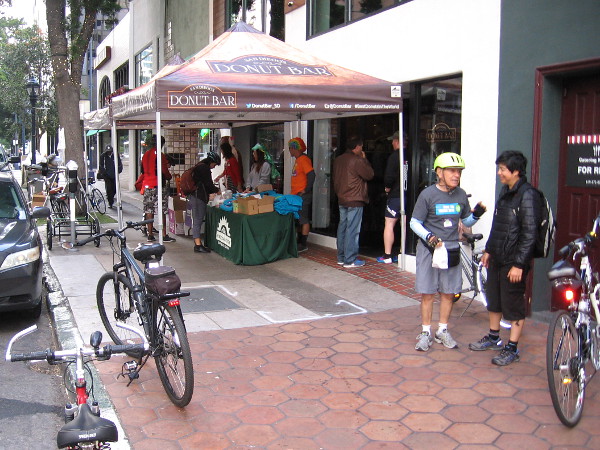
This morning, on my way to catch the trolley downtown, I saw lots of people heading to work by bicycle. Today was Bike to Work Day in San Diego!
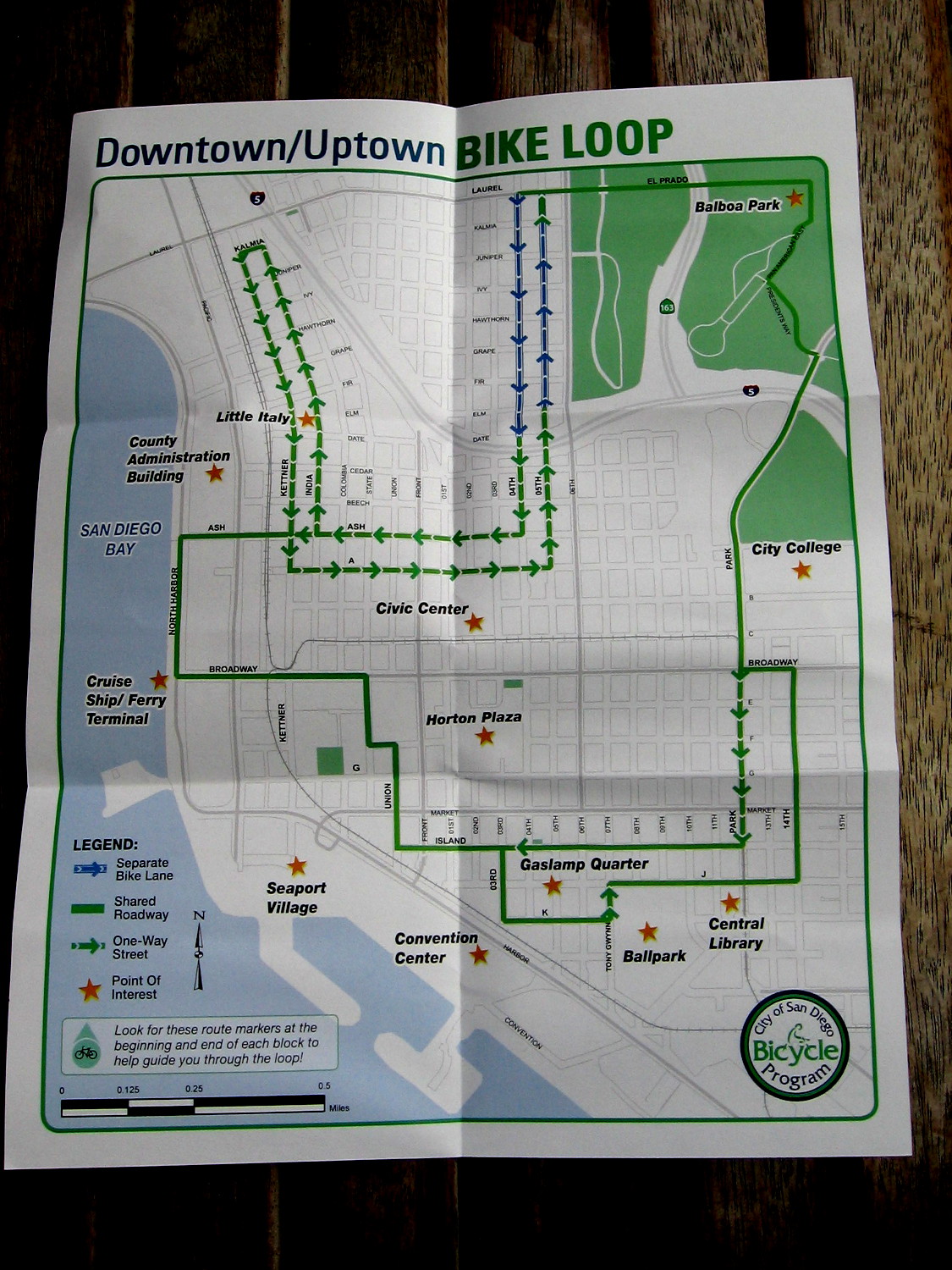
I snapped a few photos just for the fun of it. I also took a photo of a cool map showing designated places to bike in San Diego’s downtown and uptown areas. Make copies of it for your own use if you’d like!
The Donut Bar had a Bike to Work Day pit stop in downtown San Diego. Many morning riders swung on by.There were tables full of goodies for those who commuted to work by bike.Another pit stop at Civic Center Plaza. The City of San Diego has a special program that encourages bicycling.A map of the San Diego downtown and uptown bike loop. (Click image to enlarge.)Even a blogger who is more into walking received big smiles!
…
I live in downtown San Diego and love to walk around with my camera! You can follow Cool San Diego Sights via Facebook or Twitter!
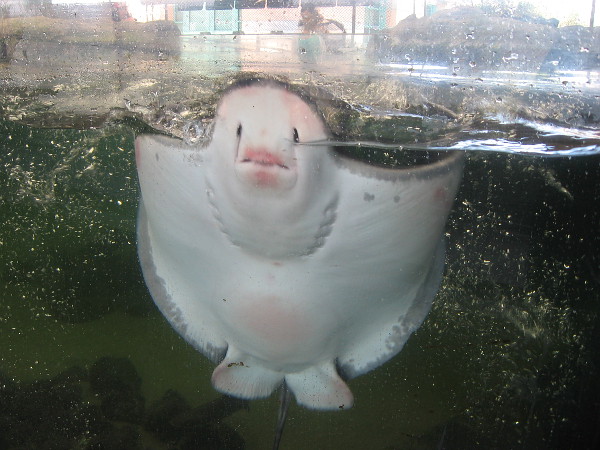
Bat ray rises against glass of an outdoor tank at the Living Coast Discovery Center in Chula Vista.
Before my hike through Sweetwater Marsh, I enjoyed a visit to the Living Coast Discovery Center, which is located inside the San Diego Bay National Wildlife Refuge. Exhibits inside the center and clusters of wildlife tanks and enclosures outside allow visitors to see and learn about the animals that make this refuge their home. The place is just right for families, with kid-size educational displays, short, easy paths, and even some picnic tables. If I were a young kid, having a birthday party here would be really cool!
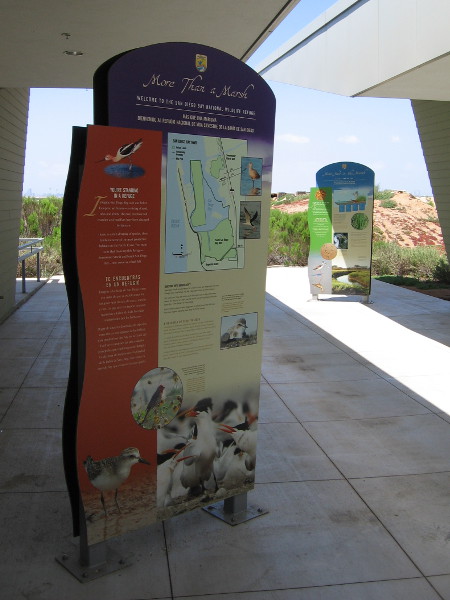
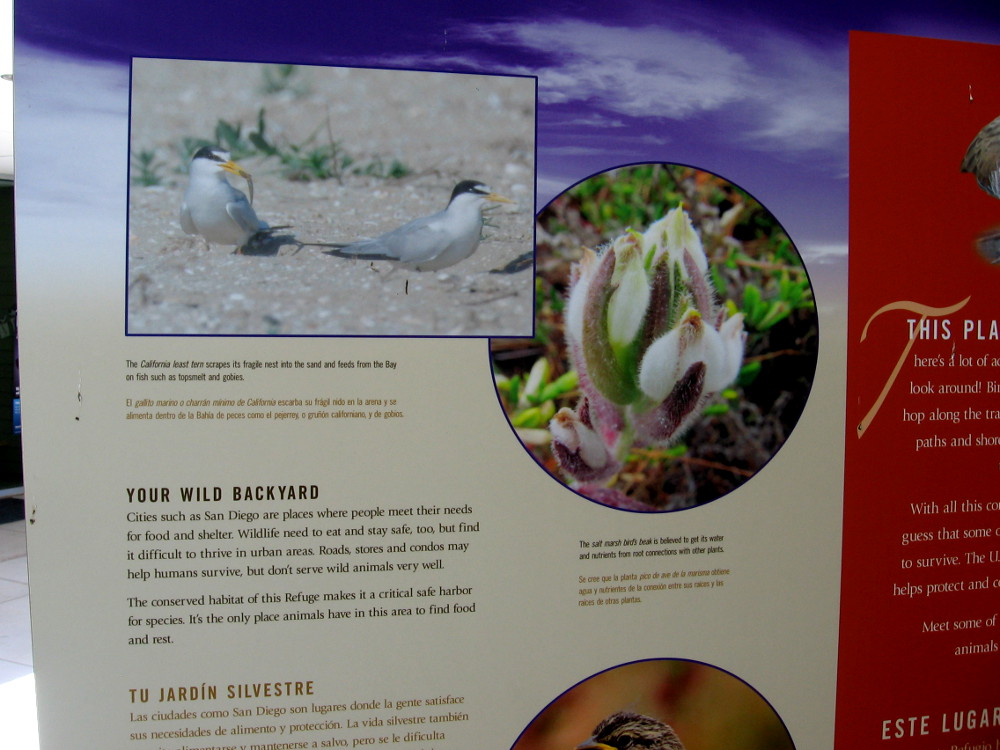
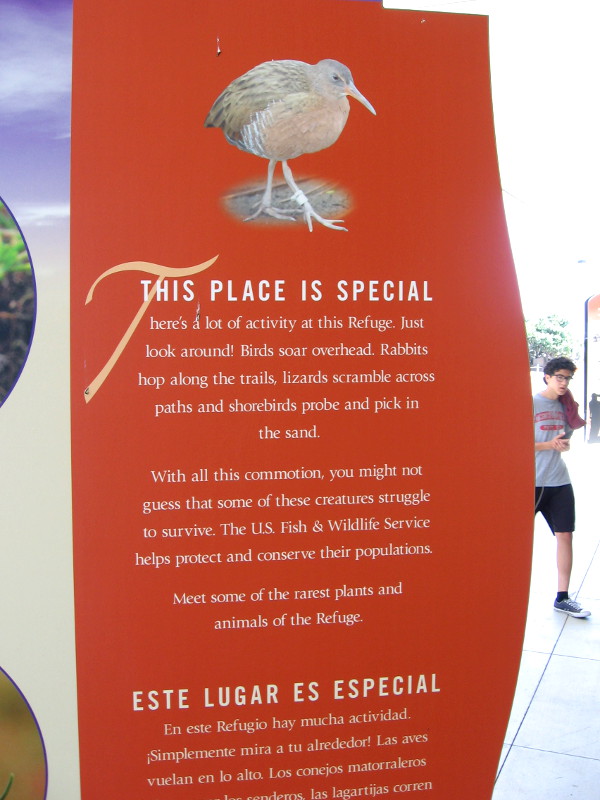
After checking out the exhibits at the Living Coast Discovery Center, I ventured over to an adjacent building that is the San Diego National Wildlife Refuge Complex headquarters. Some great displays outside provide more information about the unique and beautiful wetland that stretches in all directions. Not far from this building, one can easily find a hiking trail that leads across the marsh to San Diego Bay.
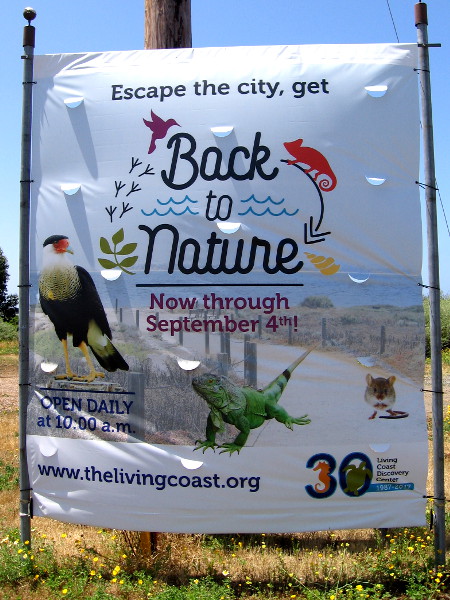
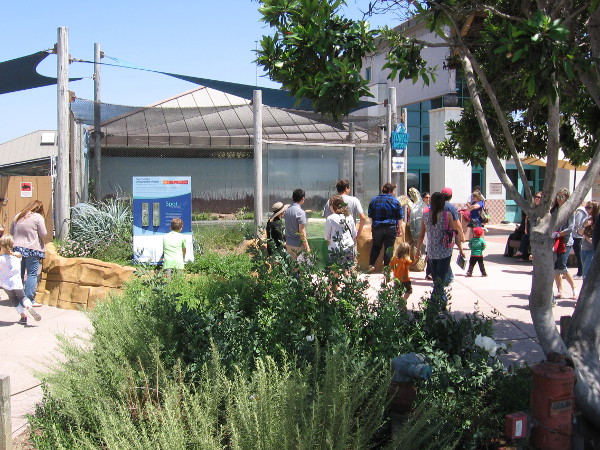
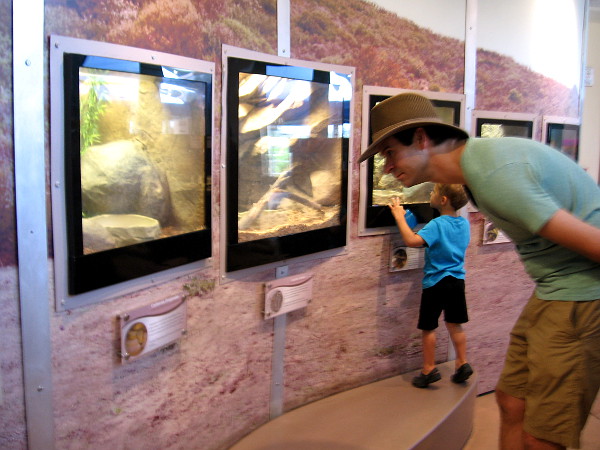
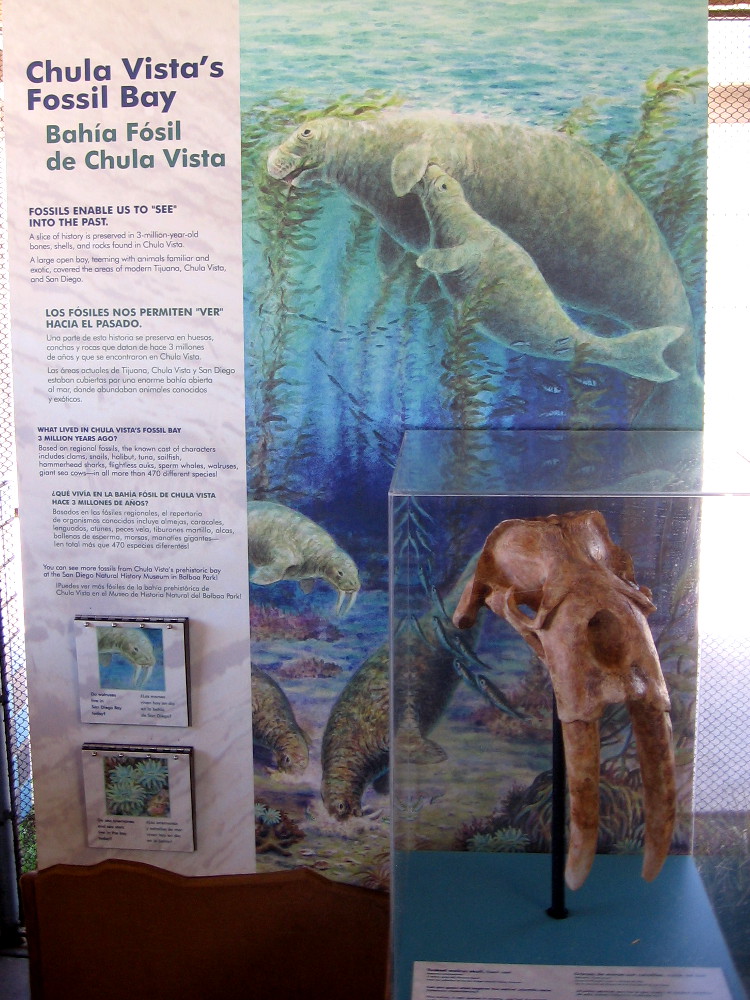
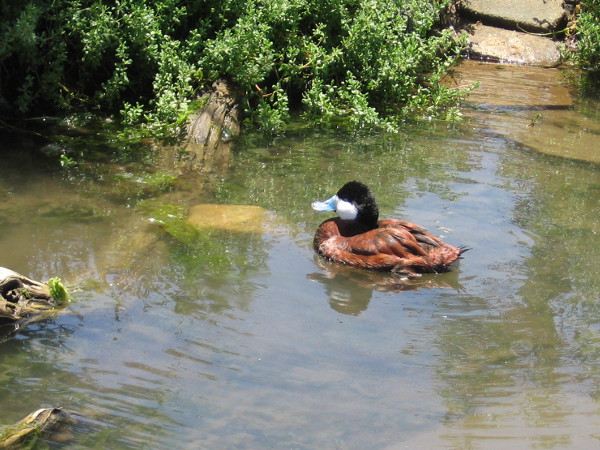
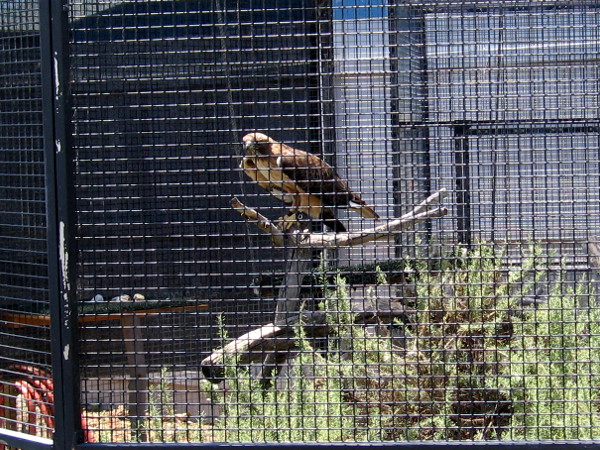
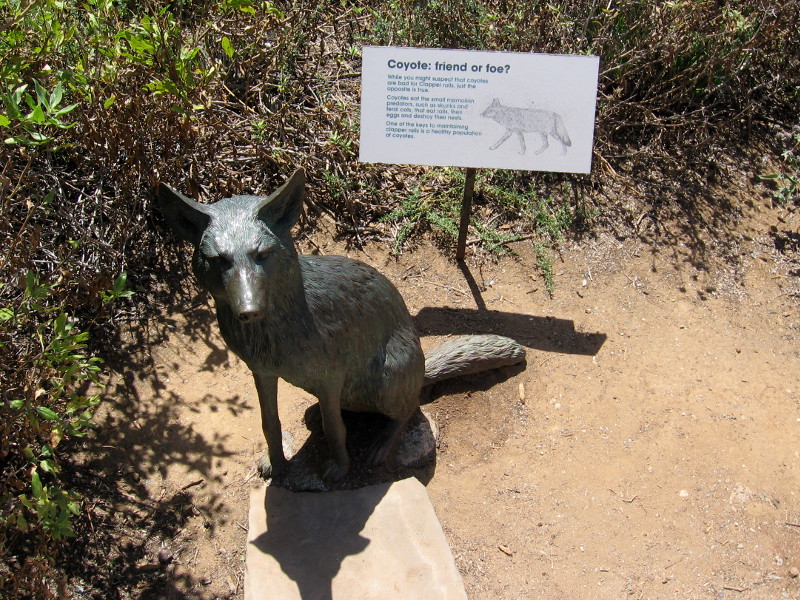
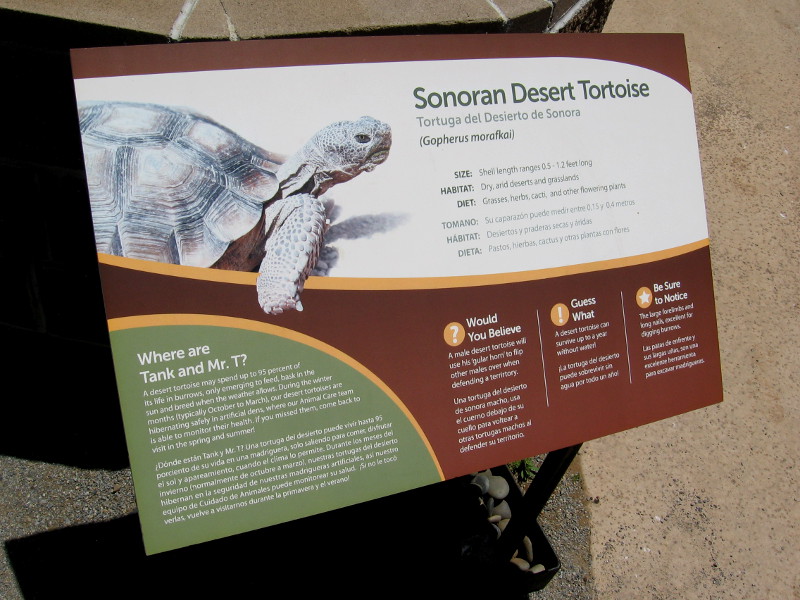
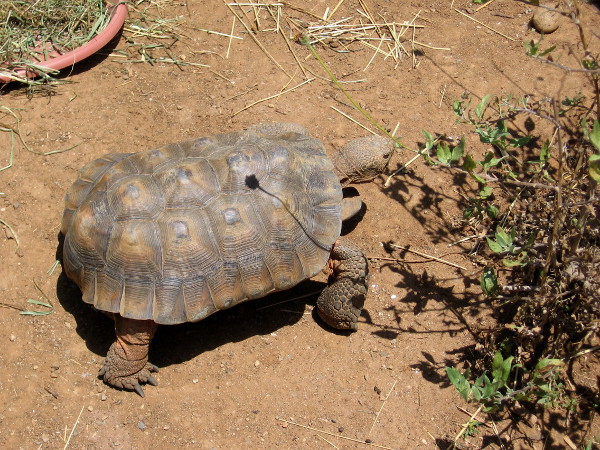
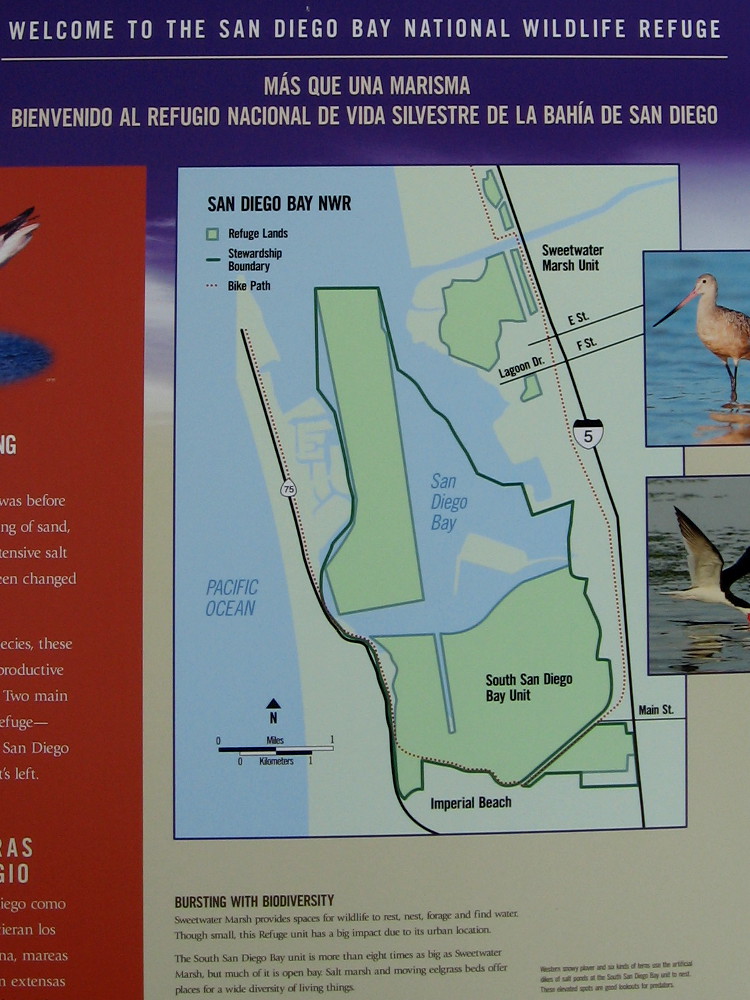
The Living Coast Discovery Center, located in the Sweetwater Marsh Unit of the San Diego National Wildlife Refuge, is where to get Back to Nature.A short bus ride takes one from the parking lot near Interstate 5 through the protected Sweetwater Marsh to the kid-friendly education center.People near the green sea turtle exhibit at the front of the Living Coast Discovery Center.Many species of reptiles, amphibians, invertebrates and fish are on display inside the small center. There’s even a mouse house popular with kids.Outside, visitors can explore exhibits featuring sharks, rays, birds and tortoises. One can also look across the surrounding Sweetwater Marsh.Actions on land affect San Diego Bay. Pollution runoff flows via creeks, rivers and storm drains into the marsh then out to the ocean.A leopard shark. They are plentiful in the waters off San Diego.This 3-million-year-old fossilized tusked walrus skull was found in the area. 470 different species have been found as fossils here, including sperm whales and now extinct flightless auks!Enclosures in the aviary area contain clapper rails, shorebirds and ducks.A blue-billed ruddy duck swims in a pool of water at the Living Coast Discovery Center.In other parts of the aviary area one can see vultures, hawks, eagles and owls.A red-tailed hawk.Beautiful artwork on one building’s side shows a beach and birds in flight. Swallows have built nests above it near the roof.Bronze sculpture of a coyote. Many other works of wildlife art can be viewed around the center.Sign near an enclosure describes the Sonoran desert tortoise.A tortoise take a slow stroll outside the Living Coast Discovery Center.This amazing art depicting marshland birds is just outside the entrance to the San Diego National Wildlife Refuge Complex headquarters.Large signs explain the role of a wildlife refuge.National Wildlife Refuges are safe havens for species. The first one, at Pelican Island in Florida, was created in 1903 by Theodore Roosevelt.Map of the extensive San Diego Bay National Wildlife Refuge.The wildlife refuge contains great biodiversity. The animals and plants are all parts of a complex and sensitive ecosystem.Different forms of life can be found in subtidal channels, mudflats, the low marsh and high marsh. The changing tide allows birds to feed and variously adapted species to thrive.Wildlife can find it hard to thrive in urban areas. The conserved habitat of this refuge is a critical safe harbor for many native species.This place is special. The U.S. Fish and Wildlife Service helps to protect its wild residents.A green sea turtle, one of those residents of San Diego Bay!
…
I live in downtown San Diego and love to walk around with my camera! You can follow Cool San Diego Sights via Facebook or Twitter!
You can easily explore Cool San Diego Sights by using the search box on my blog’s sidebar. Or click a tag! There are thousands upon thousands of fun photos for you to share and enjoy!
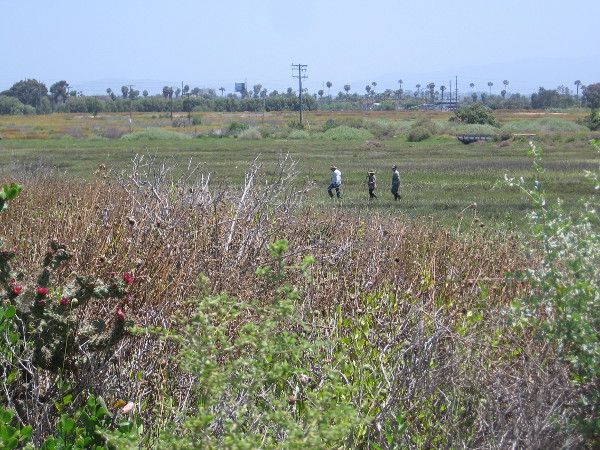
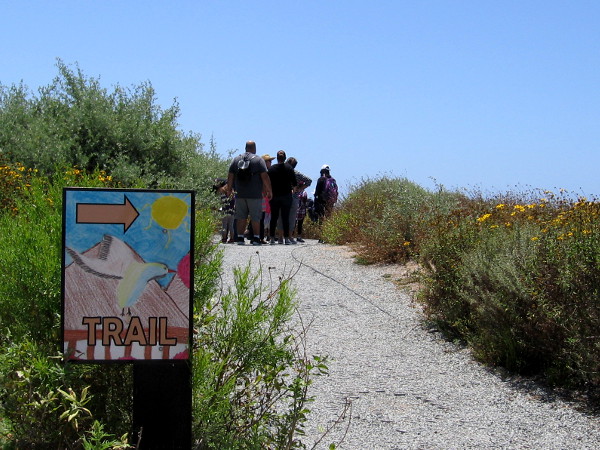
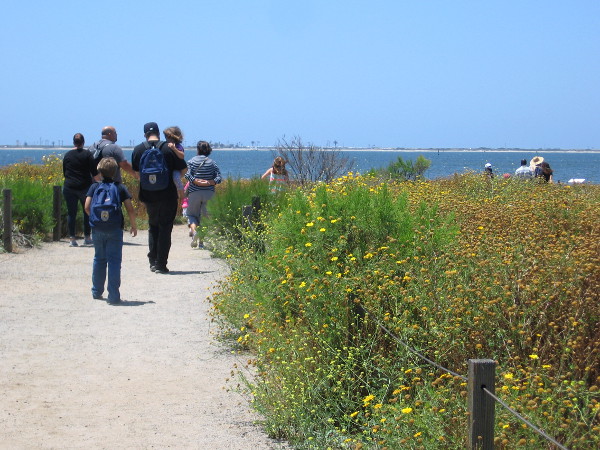
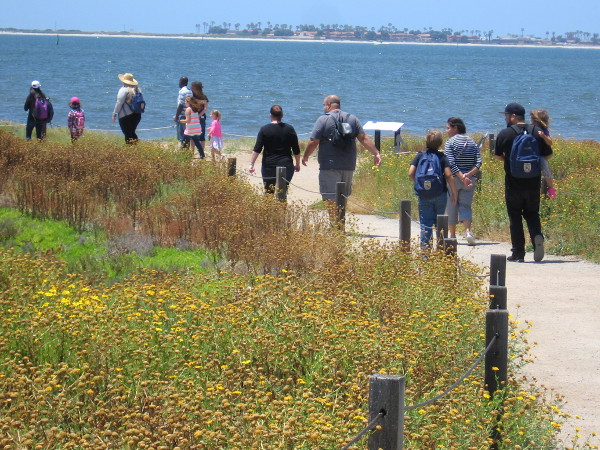
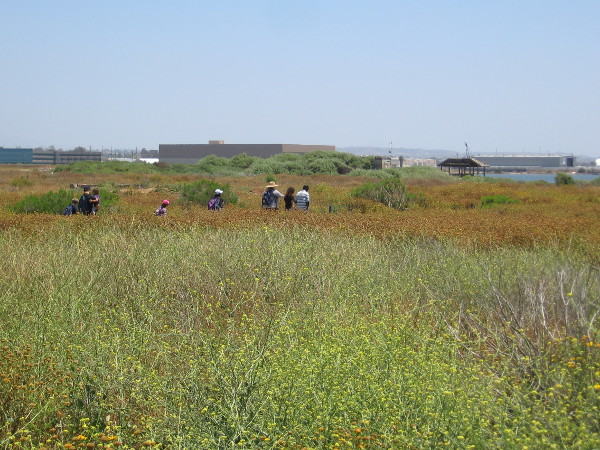
A group begins an easy nature hike down a trail at San Diego Bay National Wildlife Refuge.
On Saturday I visited Gunpowder Point, just south of where the Sweetwater River empties into San Diego Bay. The marshy area is a wildlife refuge. It’s part of the San Diego Bay National Wildlife Refuge, to be exact, and home of the popular Living Coast Discovery Center.
After visiting the Living Coast Discovery Center, I enjoyed a guided nature hike down a short trail through the Sweetwater Marsh.
I was pleasantly surprised by the bare natural beauty. I didn’t see a whole lot of wildlife during this visit, but I know our region’s marshes and estuaries are often teeming with birds. San Diego is part of the Pacific Flyway, a major route of migratory birds that stretches from Alaska to South America.
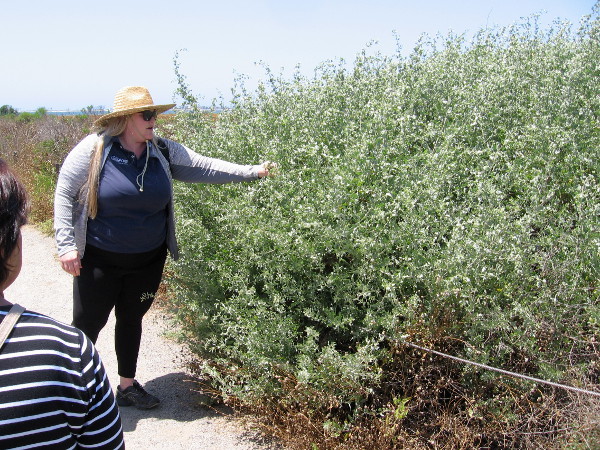
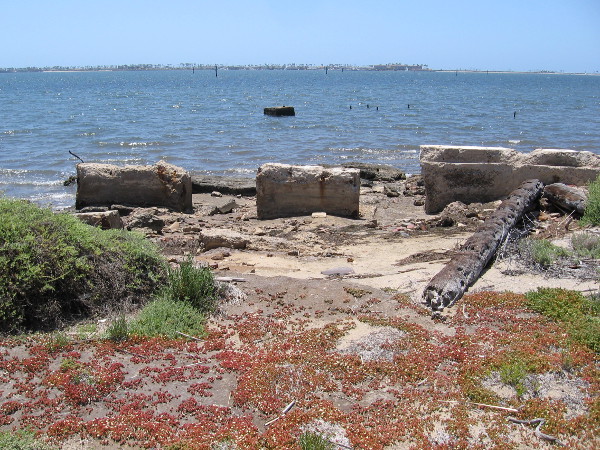
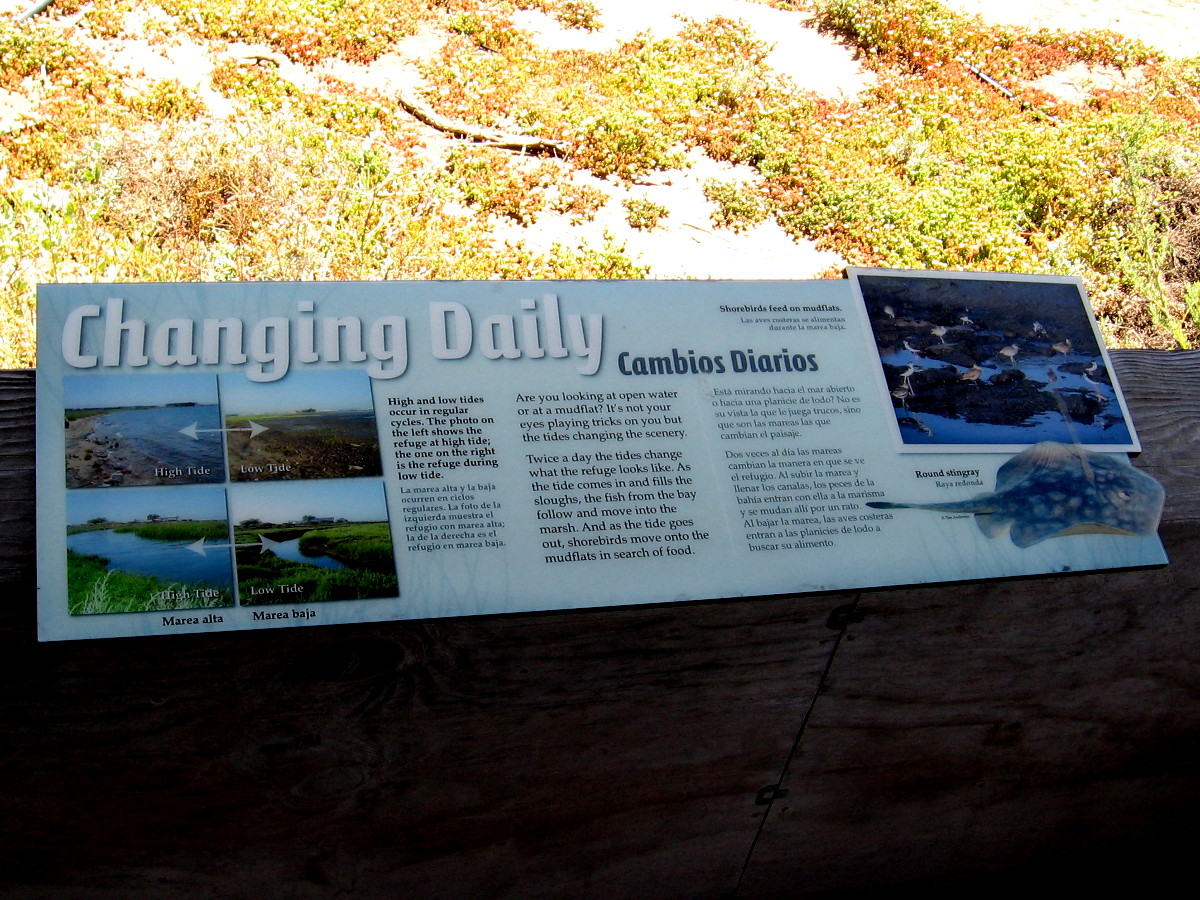
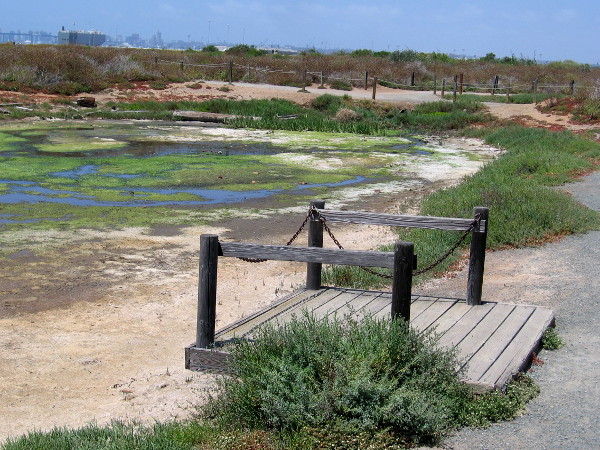
A map inside the nearby Living Coast Discovery Center shows the location of the Sweetwater River and the marsh where it enters San Diego Bay.Hiking through Chula Vista’s protected Sweetwater Marsh on a sunny day. It’s mid-May and the once green and flowering plants have begun to dry out. In this photo I see some prickly pear cactus. During the hike I also recognized black sage and coastal sagebrush.Our guide shows us saltbush. It is adapted to the type of salty soil in this coastal marsh. Its leaves taste salty!Sign by the trail. This area is called Gunpowder Point. During World War I, Hercules Powder Co. extracted potash and acetone here from kelp harvested offshore in the Pacific Ocean. These were used to make cordite, also called smokeless gunpowder, for the British.A sail on the bay beyond a drying field of San Diego Sunflowers.The short, easy hike is ideal for families.Some sunflowers are still yellow.The San Diego Sunflower, or Bahiopsis laciniata, is often found in a coastal sage scrub environment.The Silver Strand and Coronado Cays can be seen across San Diego Bay.We’ve arrived at the wildlife refuge’s narrow sandy shore. Birds could be seen here and there in the distance.As the group continues on, I linger to take in the sunshine and wide views. I notice what appears to be remnants of the potash manufacturing operation from years ago. Some benches allow rest and meditation.Stones and debris on a beach in the wildlife refuge.Some mysterious (to me) concrete ruins on Gunpowder Point.I arrived at a bird observation structure. All was very quiet. I saw a California least tern hunting small fish along the water’s edge. Few people seem to come out here.Depending on the tide, the area near the shore can be open water or a mudflat that supports shorebirds searching for food.Bird’s beaks are specially designed for feeding. Some beaks filter plants from the water, some grab flies out of the air, and some probe the mud.The tide must have been out, because this platform stood above a drying mudflat. I believe that might be bright green eelgrass in the shallow pool of water.Mesembryanthemum crystallinum, or crystalline ice plant, is salt tolerant. My hike through the marsh produced some beautiful surprises.Hiking through an expanse of green in San Diego’s South Bay.
…
I live in downtown San Diego and love to walk around with my camera! You can follow Cool San Diego Sights via Facebook or Twitter!
You can easily explore Cool San Diego Sights by using the search box on my blog’s sidebar. Or click a tag! There are thousands upon thousands of fun photos for you to share and enjoy!
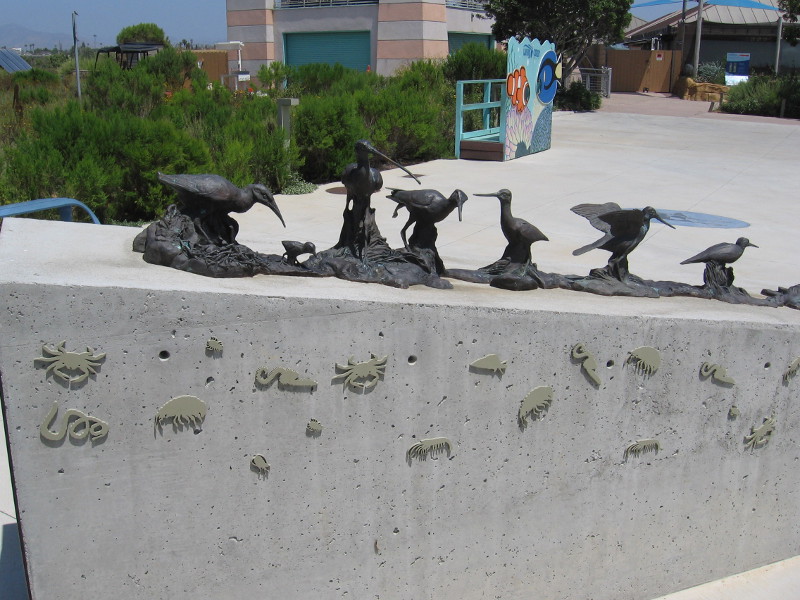
Bronze birds near entrance of the San Diego Bay National Wildlife Refuge and regional complex headquarters in Chula Vista.
Having some fun!
Today I visited the Sweetwater Marsh National Wildlife Refuge and Living Coast Discovery Center in Chula Vista. I should have a couple blog posts coming up with lots of photos.
First, here’s a fearless caterpillar that I spotted walking on a crab under some birds. The crab and bronze shorebirds are artwork in front of the wildlife refuge headquarters! The visiting caterpillar is a resident of the surrounding marsh. Perhaps it’s an art lover!
I searched the internet for a few minutes, trying to identify this particular fuzzy caterpillar. No success. Leave a comment if you know!
An inanimate crab beneath the bronze shorebirds is being visited by a living creature.A fuzzy caterpillar makes its way over the crab.Wildlife living in the Sweetwater Marsh meets art.
…
I live in downtown San Diego and love to walk around with my camera! You can follow Cool San Diego Sights via Facebook or Twitter!
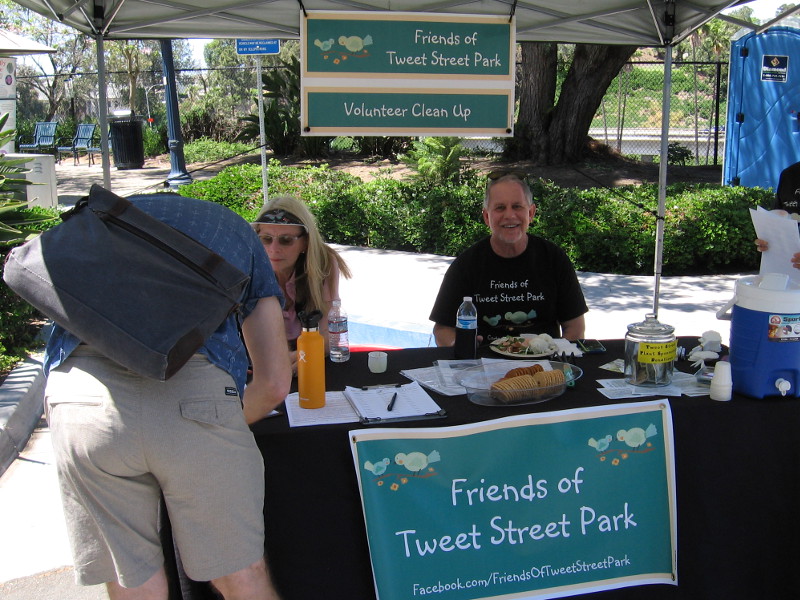
Some smiling Friends of Tweet Street Park sign up volunteers during the Jacaranda Spring Thing on Cortez Hill.
After a very long walk today, I ended up on Cortez Hill in downtown San Diego. The Jacaranda Spring Thing festival was taking place just outside my door, right next to Tweet Street Park, and I lingered to check things out.
And look what I discovered!
A community group called Friends of Tweet Street Park was organized about a year and a half ago, and they’ve been working on a volunteer basis to clean, improve and beautify our neighborhood park! If you live in or near Cortez Hill and love the Tweet Street bird-friendly park, please consider joining the group, or adding yourself to their email list, or at least following their Facebook page, which is here!
Recently I noticed some flowering succulents had been planted in a couple bare spots in the park. It turns out that was the work of these good folks!
Thank you!
…
I live in downtown San Diego and love to walk around with my camera! You can follow Cool San Diego Sights via Facebook or Twitter!
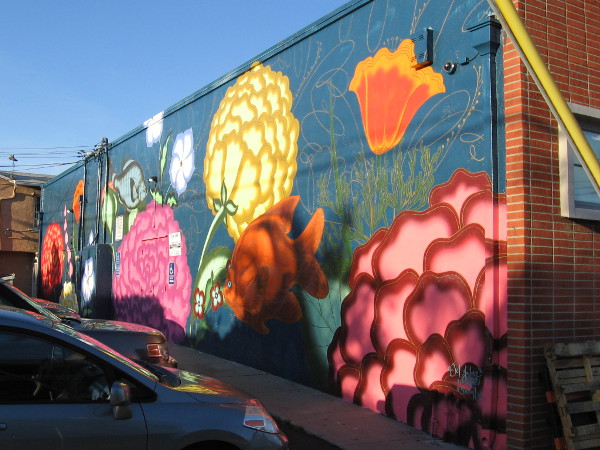
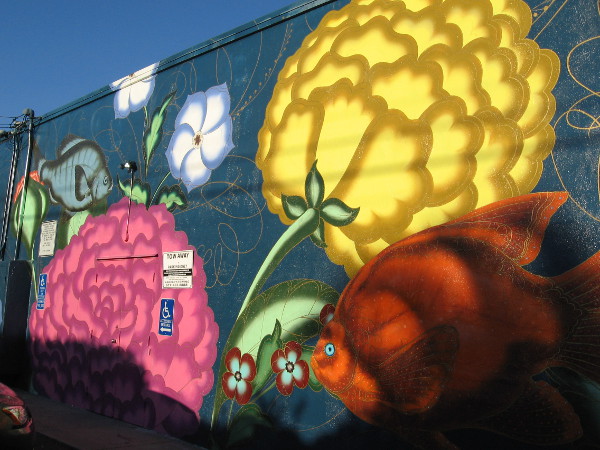
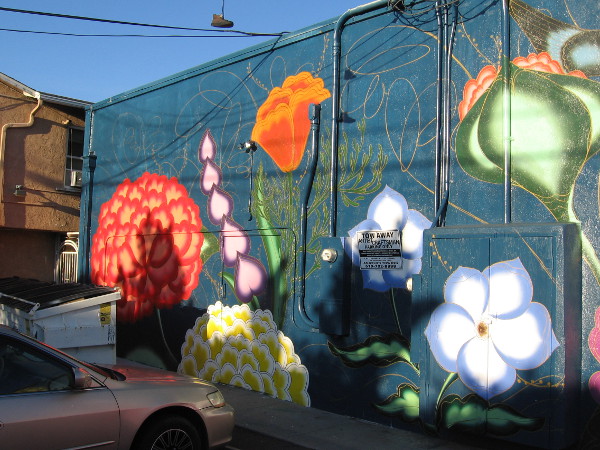
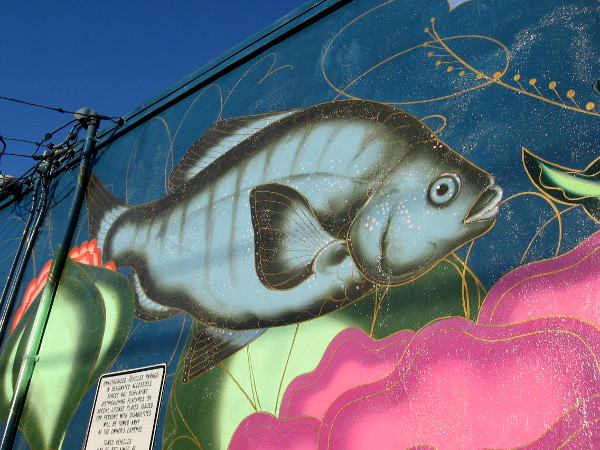
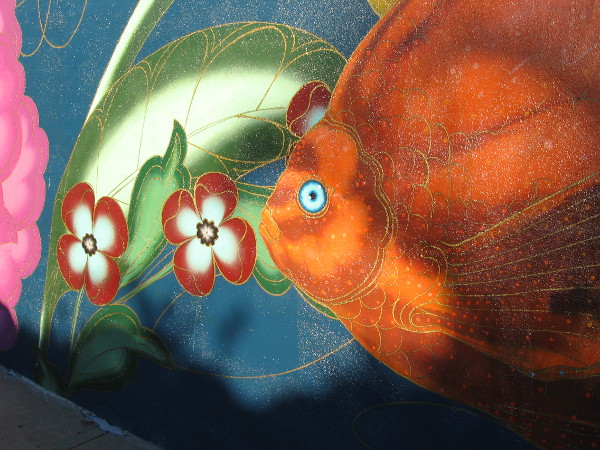
A beautiful mural in Hillcrest behind Artist and Craftsman Supply depicts flowers and sea life.
Walk around to the rear parking lot at Artist and Craftsman Supply on Fourth Avenue in Hillcrest and you’ll discover a very colorful mural. It was painted in 2016 by Jet Martinez during the Sea Walls: Murals for Oceans festival in San Diego, an environmental street art project organized by the PangeaSeed Foundation.
This beautiful spray paint mural concerns the impact of floriculture on ocean ecosystems. Many flowers are grown in San Diego’s North County. In floriculture, pesticide runoff into the ocean can be a problem. Fertilizer runoff into the ocean can also cause harmful effects, including massive algae blooms and hypoxic (low-oxygen) areas.
Environmental street art created by Jet Martinez during the 2016 Sea Walls: Murals for Oceans festival.The left part of the mural. Like an underwater garden.A fish in the ocean needs clean water to live.A bright orange fish swims past jewel-like flowers.
…
I live in downtown San Diego and love to walk around with my camera! You can follow Cool San Diego Sights via Facebook or Twitter!
You can easily explore Cool San Diego Sights by using the search box on my blog’s sidebar. Or click a tag! There are thousands upon thousands of fun photos for you to share and enjoy!
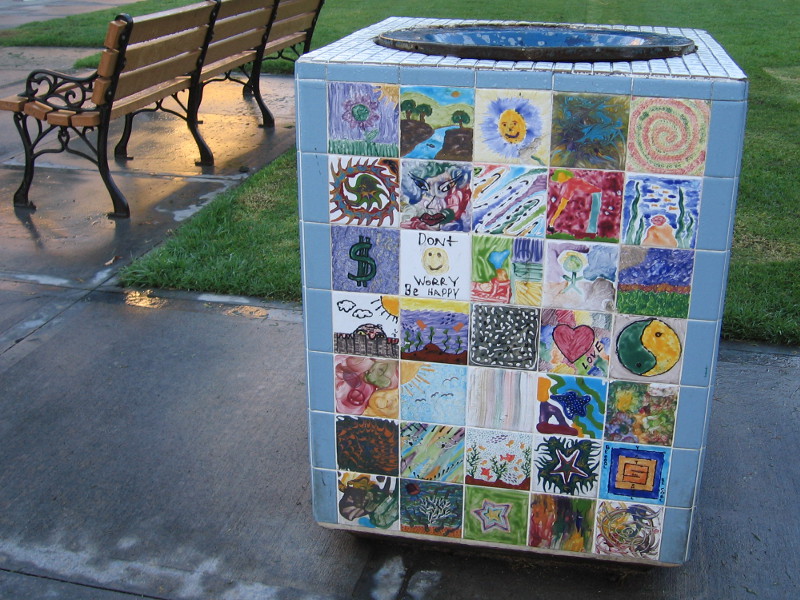
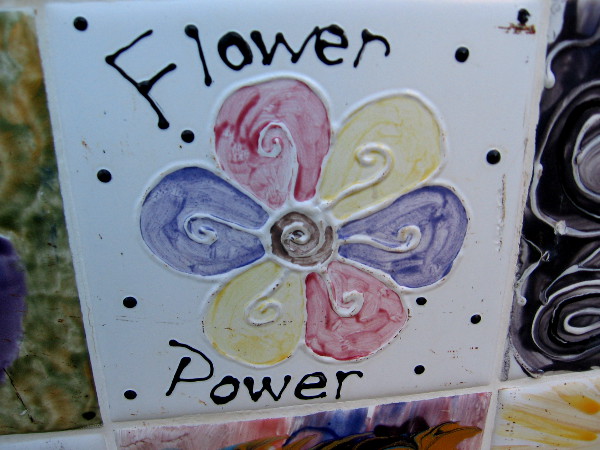
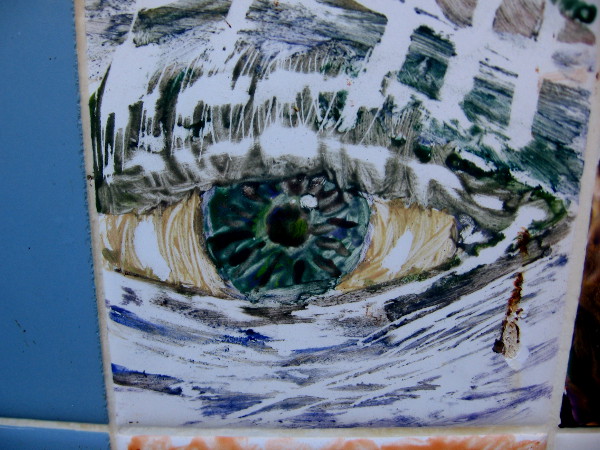
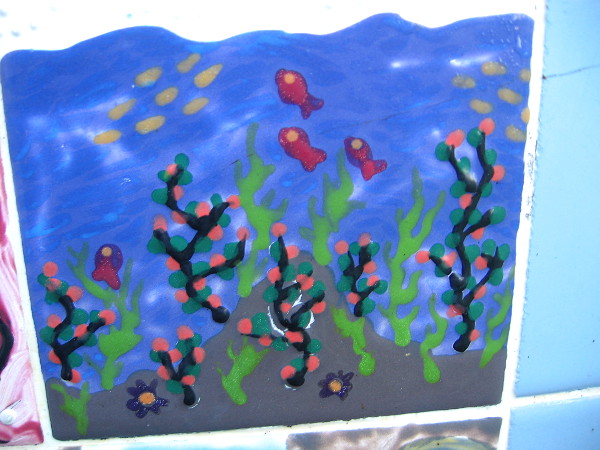
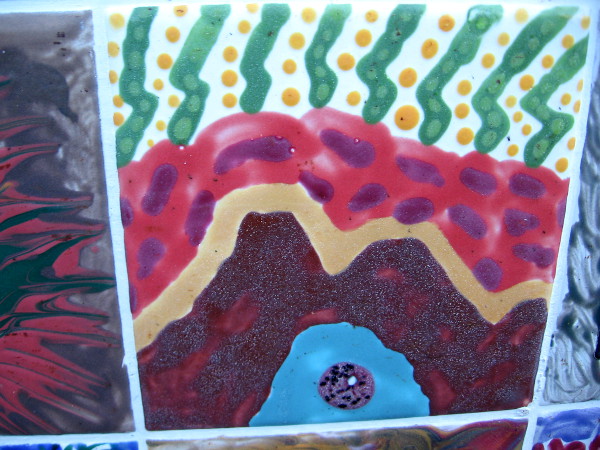
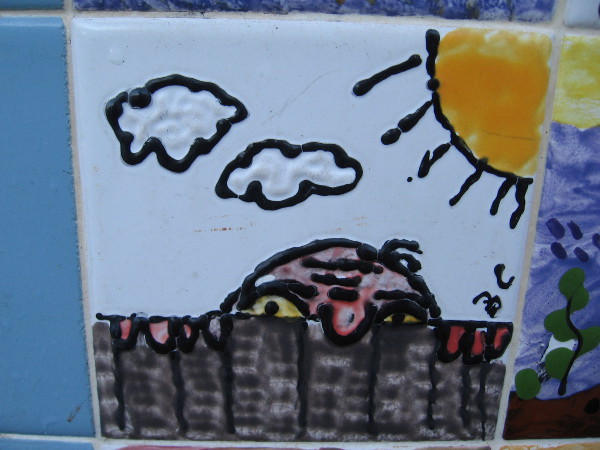
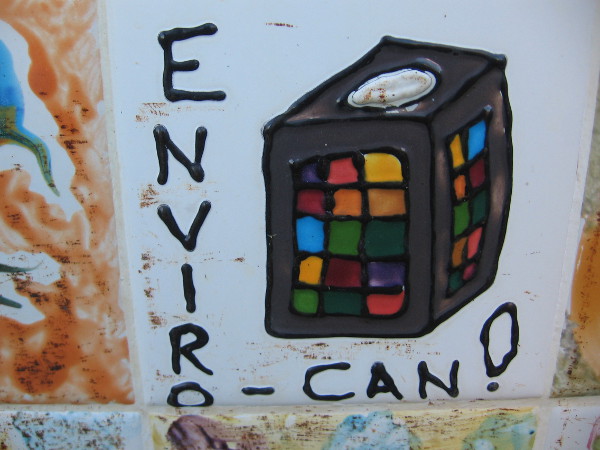
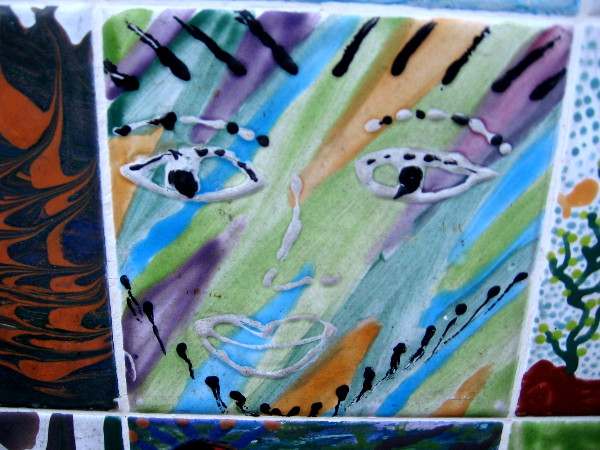
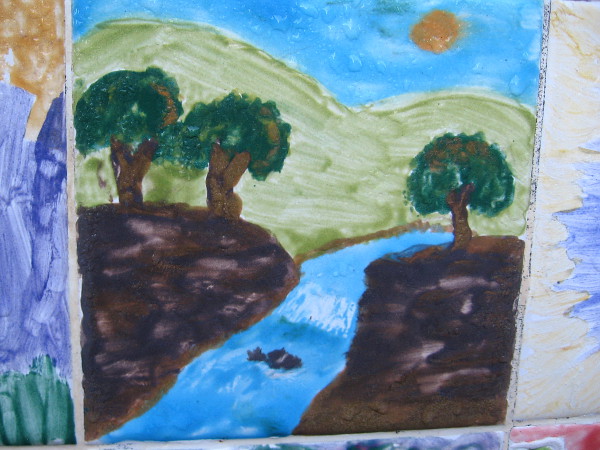
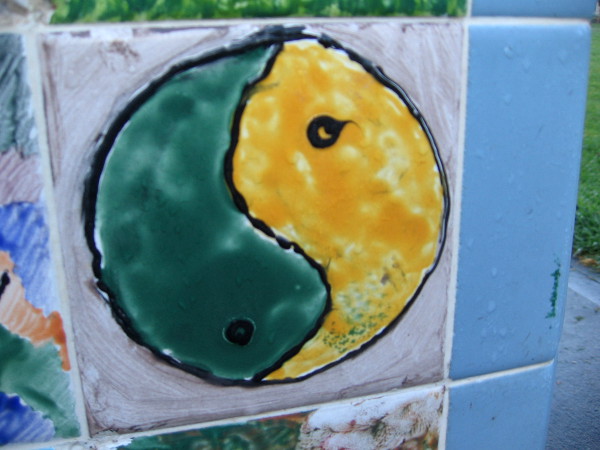
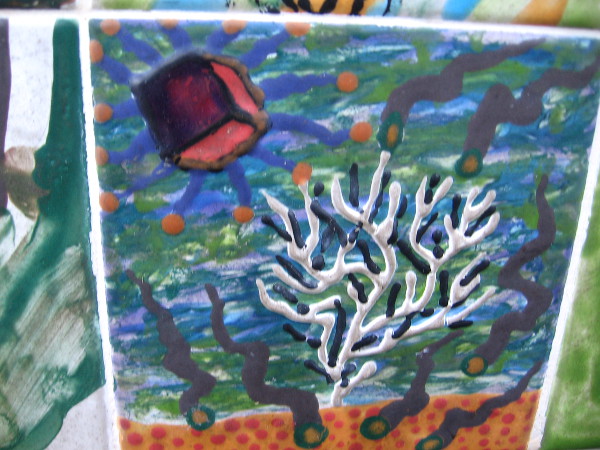
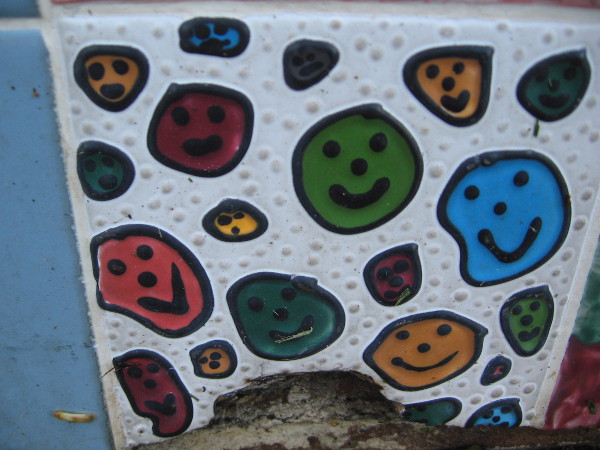
Lots of tiles painted with happy environmental themes. Together they form a mosaic that decorates this trash can in downtown San Diego’s Pantoja Park.
I love mosaics that are composed of ceramic tiles painted by ordinary people–young people in particular. It’s like a patchwork of inner visions, expressed from many hearts.
The Envirocan in downtown San Diego’s Pantoja Park is a special trashcan that is decorated with tiles that were hand-painted by young artists. Most of the colorful images express environmental themes. Clean air, clean water . . . plus lots of smiles. Smiles are good for the environment, right? Of course they are.
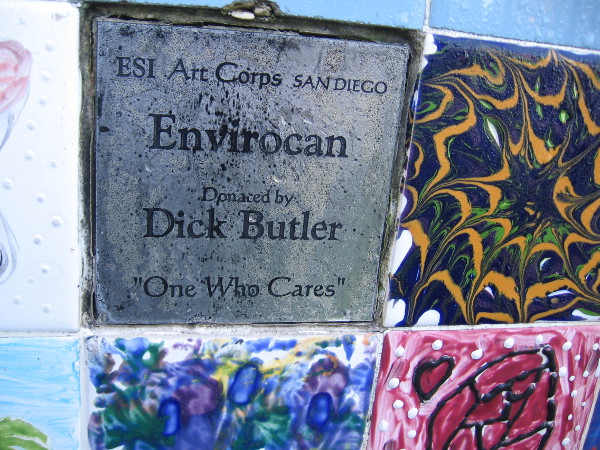
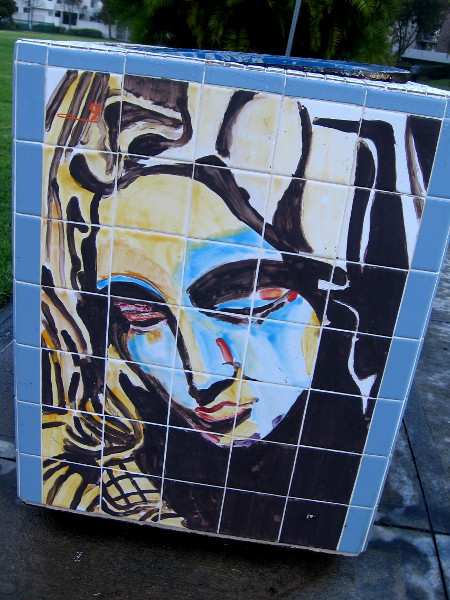
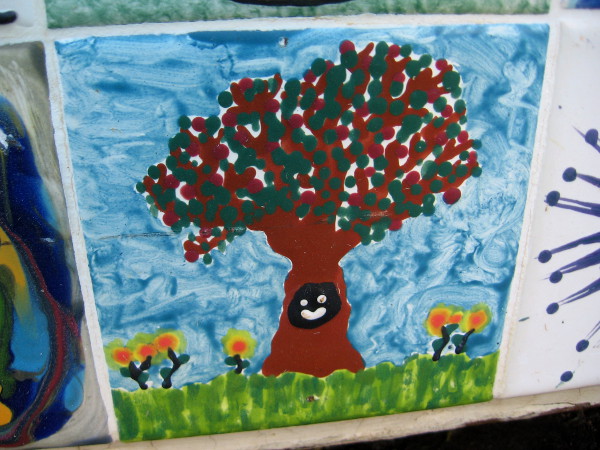
ESI Art Corps San Diego. Envirocan – Donated by Dick Butler. “One Who Cares”One side of the Envirocan features a female face. Perhaps it is Mother Earth.Colorful tiles painted by many creative hands form a mosaic on the Envirocan’s other three sides. Here’s a happy face in a tree, and some flowers.Keep our Earth clean!A house in a beautiful pristine landscape.Flower PowerA human eye. A smudge of something looks like a tear.Fish enjoy a clean blue ocean.I’m not sure what this is, but it looks pretty cool!Someone is poking their nose over a fence.One tile on the Envirocan features the Enviro-can!A happy face of many colors.Another lively underwater scene.And another beautiful face!A clean river flows down from green hills between trees.Wisdom is often found in a balance. Yin and yang. All things are connected.Looks like a weird underwater scene. Not sure about the cube with tentacles.Birds in a clear blue sky under a golden sun.Lots more smiley faces! They almost look like leaves to me.A red heart on patchwork colors. Love.
…
I live in downtown San Diego and love to walk around with my camera! You can follow Cool San Diego Sights via Facebook or Twitter!
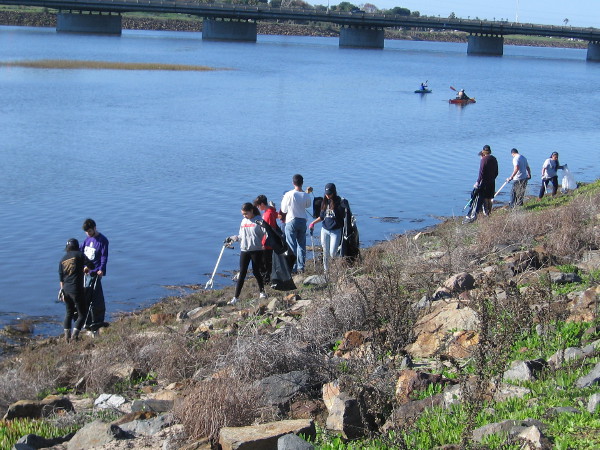
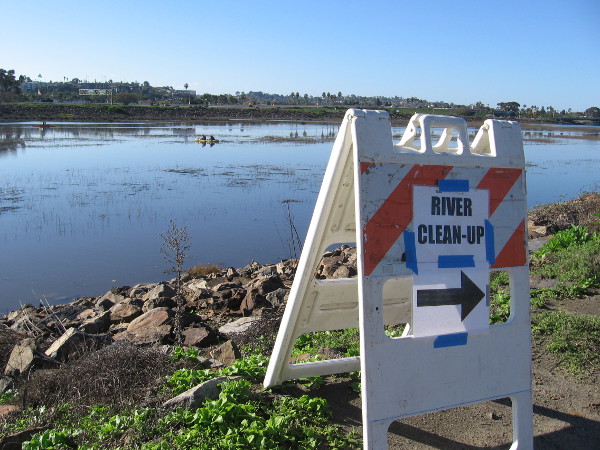
Many ordinary people came out today to help clean up the San Diego River Estuary.
Lots of good people volunteered to clean up the San Diego River Estuary today. Some took to kayaks, others walked along the shoreline, filling bags with nasty litter and debris. The river estuary, emptying into the Pacific Ocean between Mission Bay and Ocean Beach, is a very important wetland in this region, and millions of birds rely on it during their migrations. Small bits of trash ingested by birds and other wildlife can be fatal.
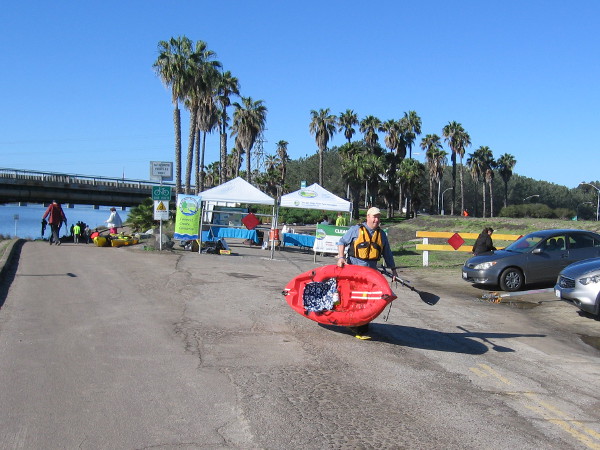
The estuary cleanup was organized by The San Diego River Park Foundation. Kayakers are permitted to enter the San Diego River Estuary only one time every year–during this special event. I walked along the river and saw what ordinary people can achieve when working unselfishly for the good of our world.
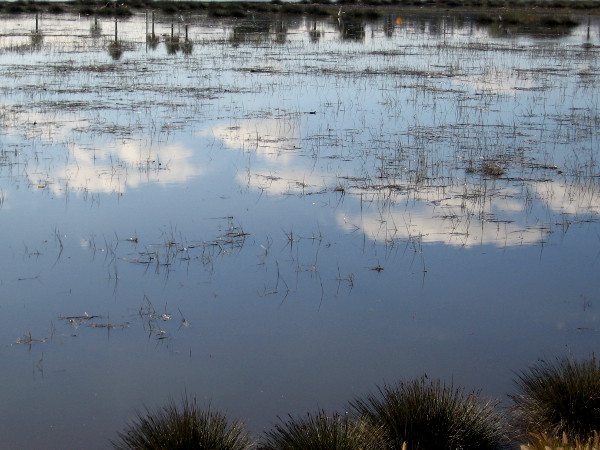
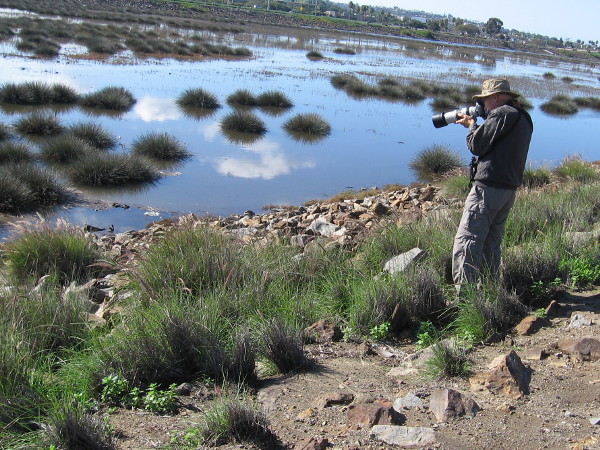
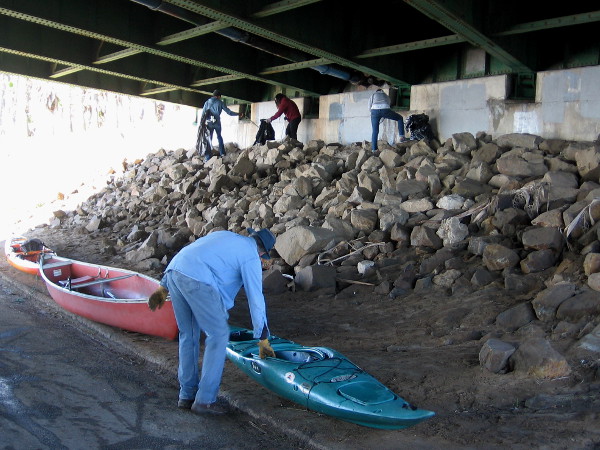
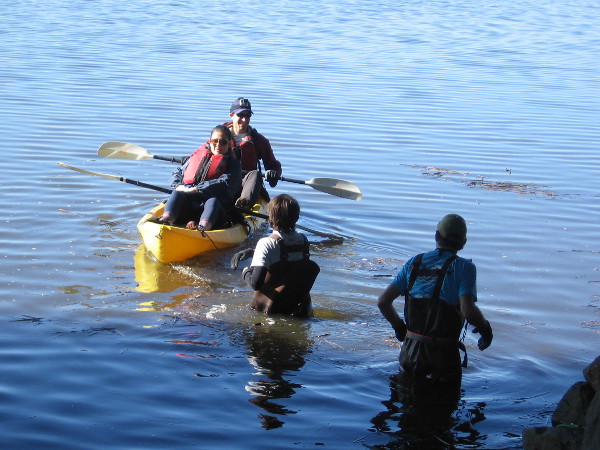
A sign directs people to the river cleanup.Beautiful white clouds are reflected in the calm water of the San Diego River as it approaches the ocean.Many birds make the river and its mud flats their home, including ducks, herons and egrets.A photographer captures images of waterfowl swimming through grass down the river.My camera isn’t quite so fancy, but I did get an okay photo of this snowy egret!As I walked west along the San Diego River, I noticed a number of kayaks out on the water.A sign by the river describes the problem of stormwater pollution. During rains, a good deal of runoff enters the estuary, carrying all sorts of pollutants and trash. (I had to really alter this photograph so we could make out what the old sign says. Click the image to enlarge it.)A cleanup volunteer with a kayak is arriving!Plastic bags in these kayaks have been filled with garbage found in the river. I learned much of it was snagged in the grass.Dozens of caring people were on the rocky river shore, looking for trash.San Diego is fortunate to have many thoughtful people, concerned about our environment.Volunteering is often a family affair, teaching the next generation about generosity and responsibility.This guy was carrying his kayak back to his car.Another guy showed me the trash he collected. He said he found a variety of garbage. Some flows downstream. Some of it is windblown. Some comes from Interstate 5 and other bridges which cross the river nearby.A tent where people can sign up to volunteer and learn more about The San Diego River Park Foundation.From the mountains to the ocean, we care for the San Diego River!Sadly, the river isn’t healthy. A grade is assigned each year based upon trash, water quality and the extent of invasive plants.Sign shows volunteering possibilities. (Click these sign images to read–they will enlarge.)Picking up garbage and readying kayaks underneath the West Mission Bay Bridge.Collected trash was placed in a nearby dumpster.Smiles in the San Diego sunlight. A perfect day to make our world cleaner, healthier and more beautiful.Kayakers launch into the San Diego River during a special event to clean the estuary.
…
I live in downtown San Diego and love to walk around with my camera! You can follow Cool San Diego Sights via Facebook or Twitter!
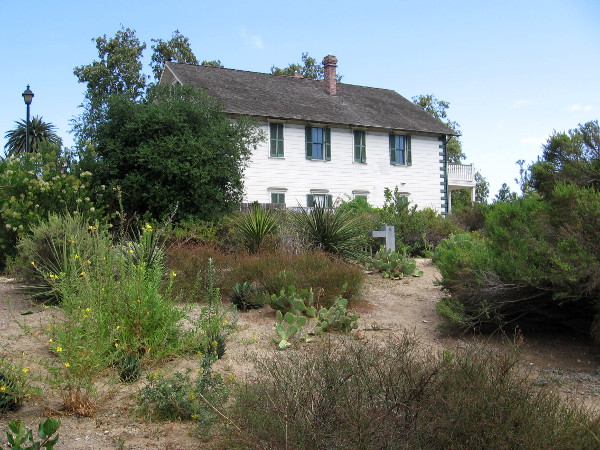
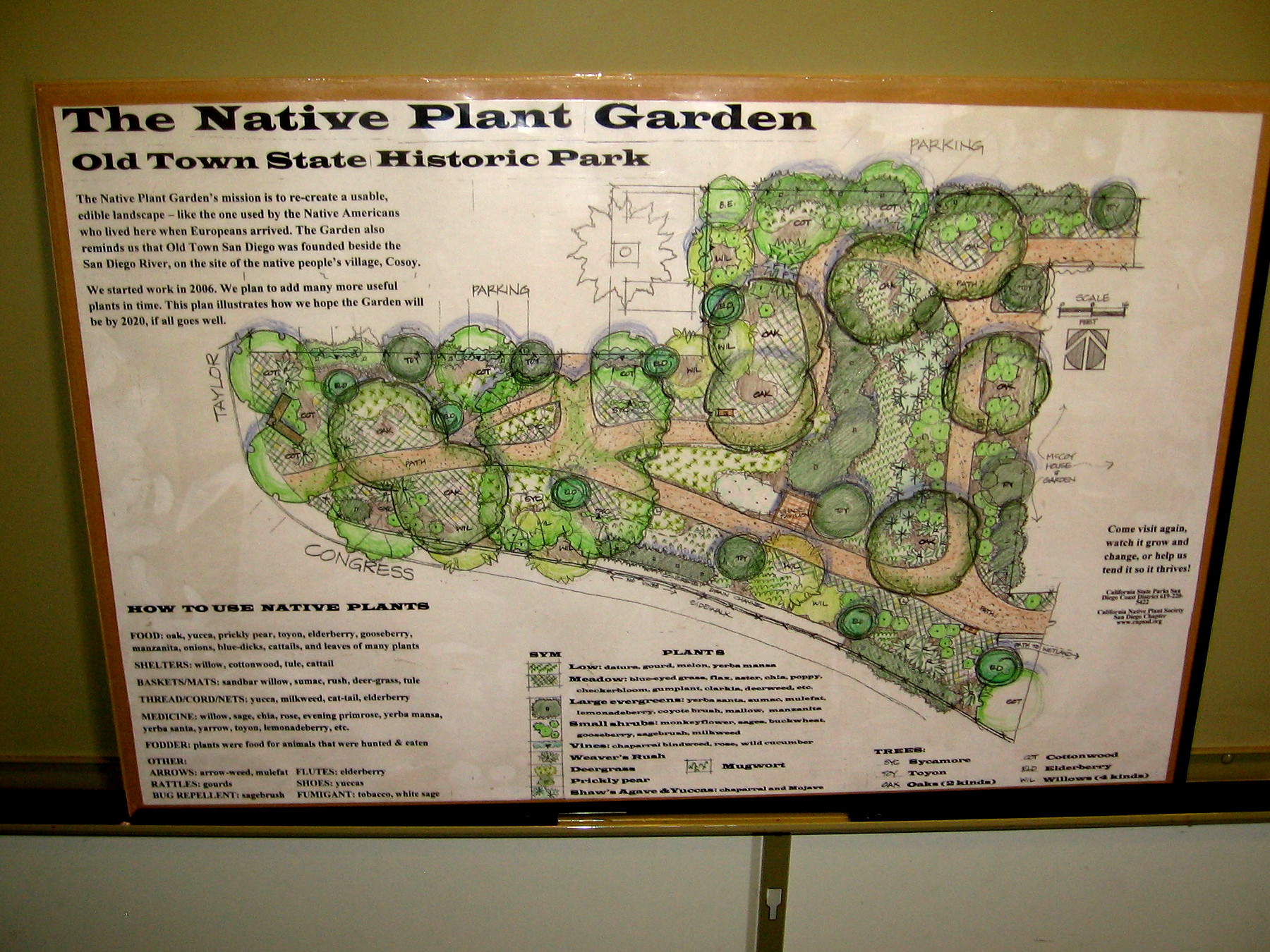
Photo of historic McCoy House in Old Town San Diego from the Native Garden. Today’s garden is located in a spot that was once very close to the San Diego River, before the river was diverted to the north, through Mission Valley.
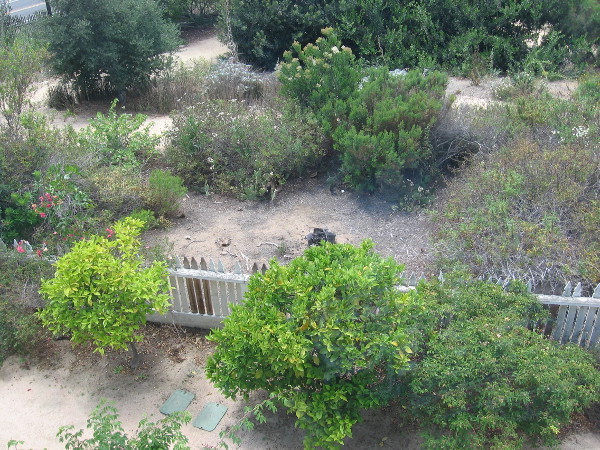
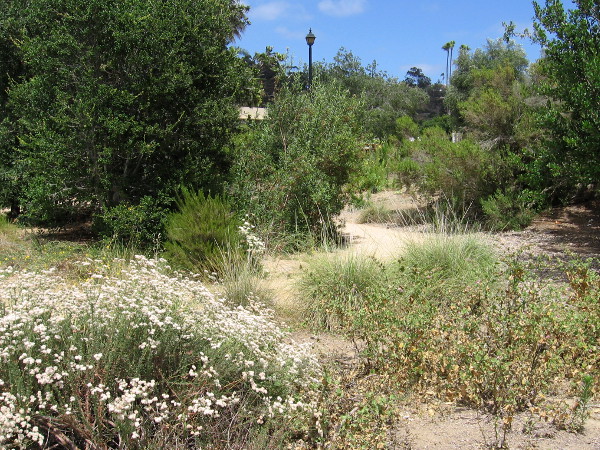
A small, ragged but beautiful native garden can be found in the northwest corner of San Diego’s Old Town, next to the McCoy House Museum. The Native Plant Garden contains vegetation that grows naturally along the rivers of our semi-arid region.
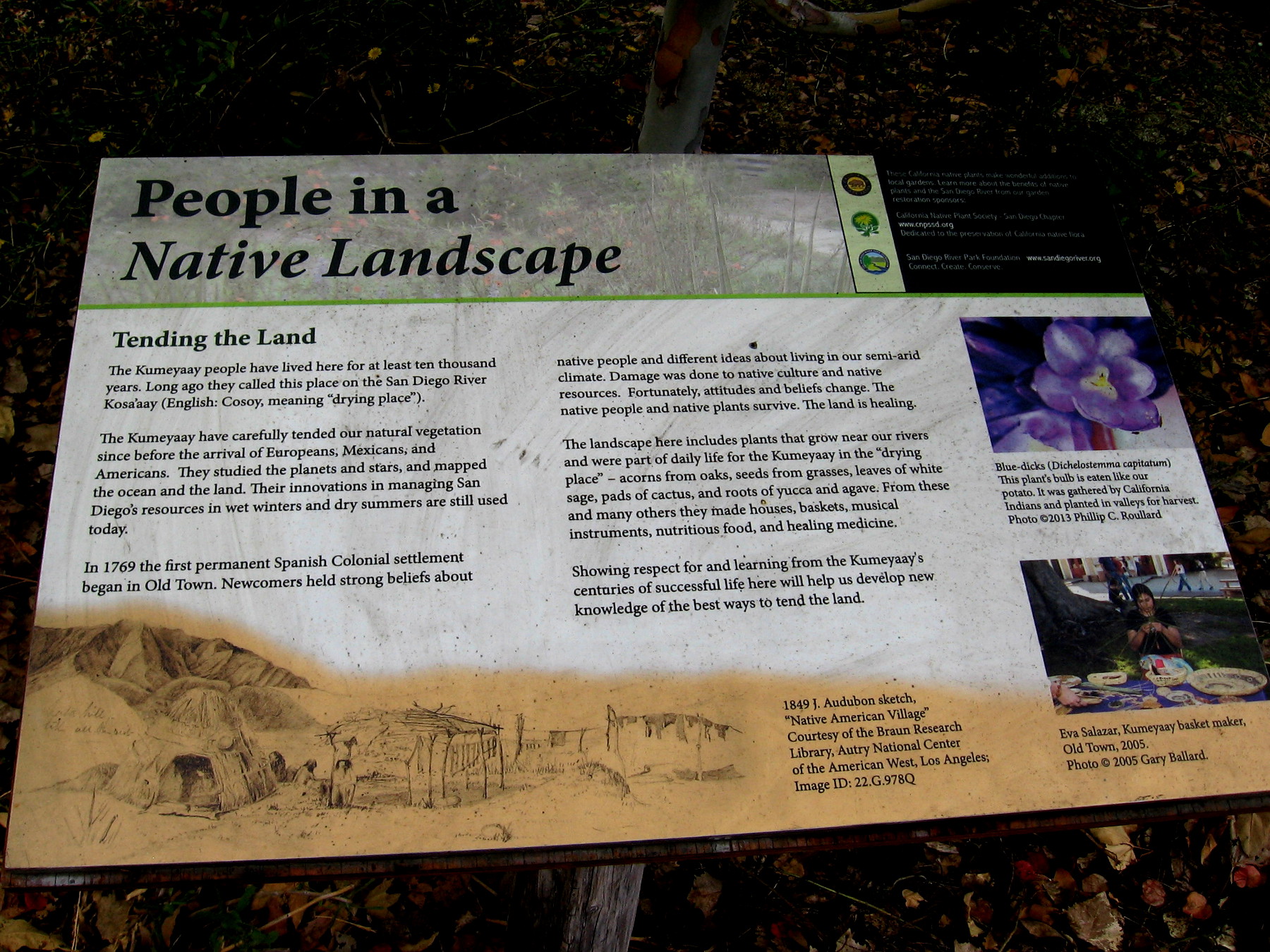
Long before Europeans arrived in Southern California, the Native American Kumeyaay lived where Old Town was eventually established; the Kumeyaay village at the base of Presidio Hill was called KOSA’AAY, or Cosoy. Many of the plants in the garden were used by the Kumeyaay people in everyday life.
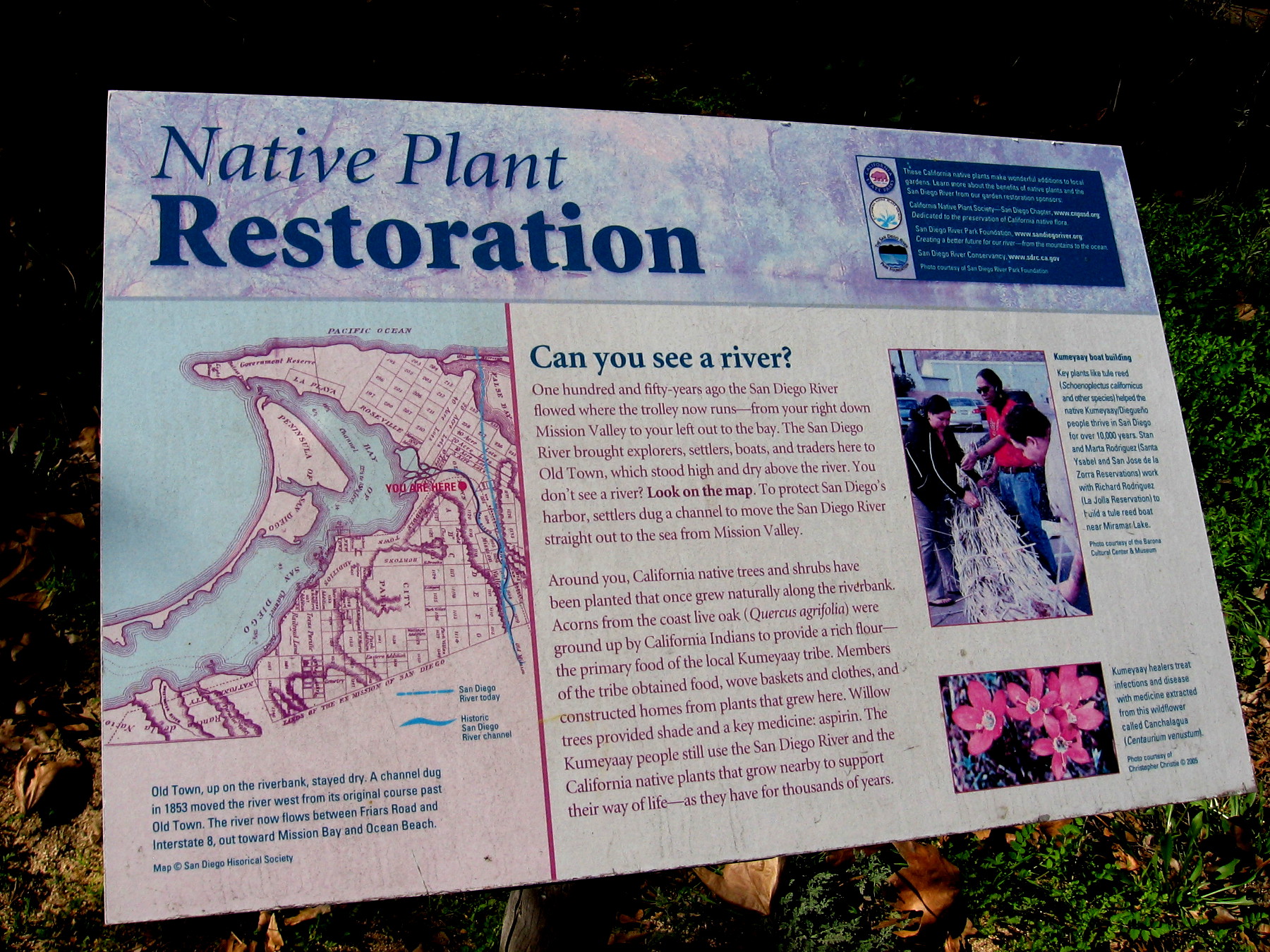
Read the photo captions to learn much more. Click the garden plans and the two signs, and those images will expand providing additional information!
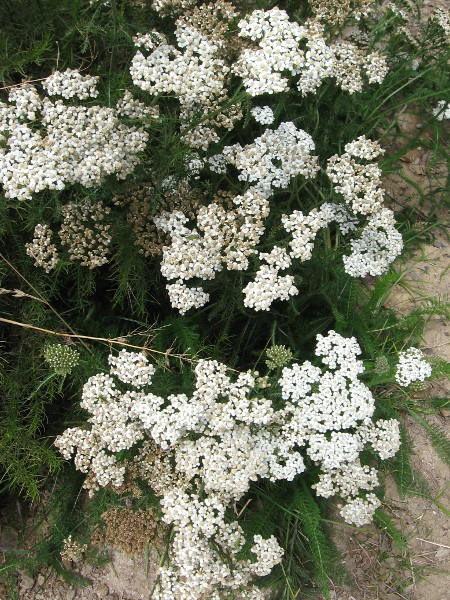
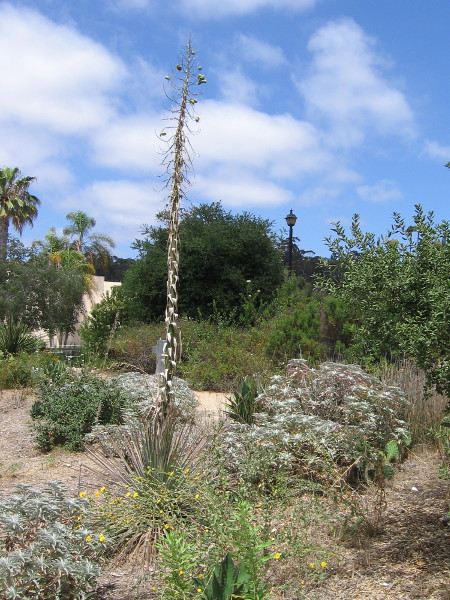
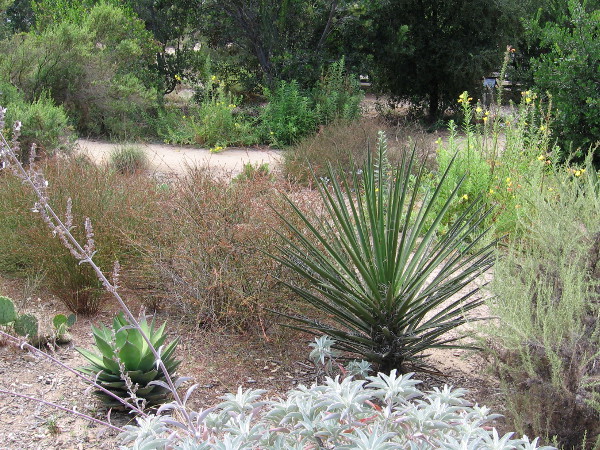
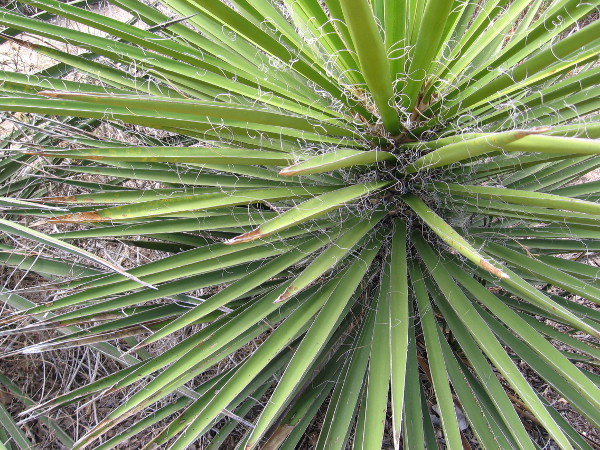
Plans of the Native Plant Garden in Old Town San Diego State Historic Park. Included are species used by the Native American Kumeyaay for food, shelter and medicine. Their village Cosoy was located here.Looking northwest from the second floor of the McCoy House Museum in Old Town San Diego. The Native Garden beyond the fence is a bit dry and scraggly–but that’s how local vegetation naturally appears.150 years ago the San Diego River flowed nearby, bringing explorers, settlers, boats and traders to Old Town. California native trees and shrubs have been planted that once grew along the riverbank.Dirt walking paths meander through the small Native Garden at the northwest corner of Old Town San Diego State Historic Park.Yarrow was used by the Kumeyaay as a treatment for various medical conditions, including burns, inflammation, and pain from toothache, headache and arthritis.Tall stalk of a yucca that already flowered still juts into the sky in Old Town San Diego.The Kumeyaay people have lived here for at least ten thousand years. Their innovations in managing San Diego’s resources in wet winters and dry summers are still used today.A variety of native plants found naturally in coastal San Diego’s semi-arid climate, including sages and prickly pear cactus.Fibers from the yucca were used by the Kumeyaay to produce cords, nets, shoes and other useful items.
…
I live in downtown San Diego and love to walk around with my camera! You can follow Cool San Diego Sights via Facebook or Twitter!
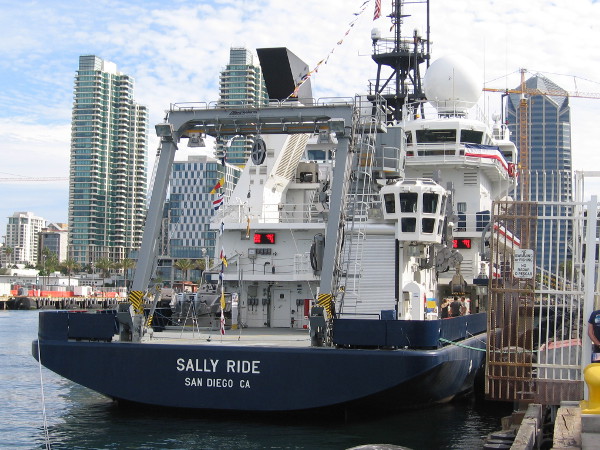
Scripps Institution of Oceanography’s new Research Vessel Sally Ride welcomes the public at San Diego’s Broadway Pier.
If you love science, technology and the study of our planet’s oceans, please enjoy the following photo tour of a very special ship. In this blog post we will visit the newest, most highly advanced oceanographic research ship in the world!
The world-famous Scripps Institution of Oceanography, a part of UC San Diego located in La Jolla, debuted their new research vessel Sally Ride this weekend at the Broadway Pier. Today the public was invited to come aboard and learn about the future work of scientists at sea.
The R/V Sally Ride is equipped with technologically advanced equipment, sensors, labs and computer systems. In the years ahead, it will be tasked with learning about and preserving the oceans, studying and protecting the environment, and inspiring the next generation. Using satellite communication and the scientists aboard, students and teachers throughout the world will actively participate in ocean exploration.
Except in documentary films, the public seldom sees the interior of an ocean-going research vessel. So today was an opportunity not to be missed!
Please read the photo captions where I’ve tried, to the best of my knowledge, to provide accurate details. But I’m no expert. If you’d like to leave a correction or useful information in a comment, please do!
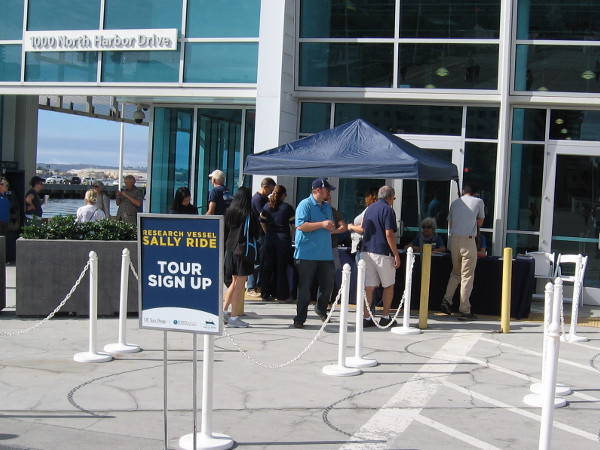
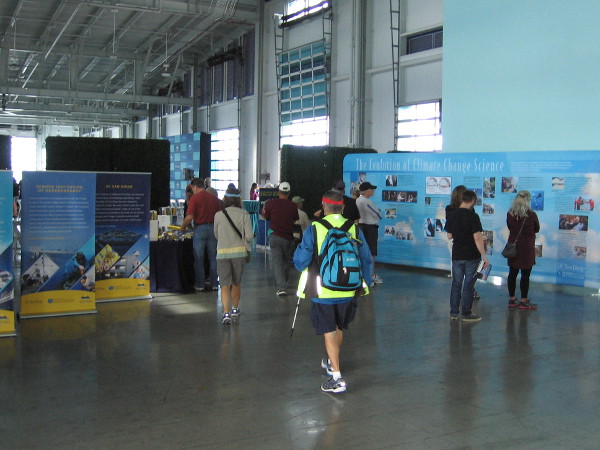
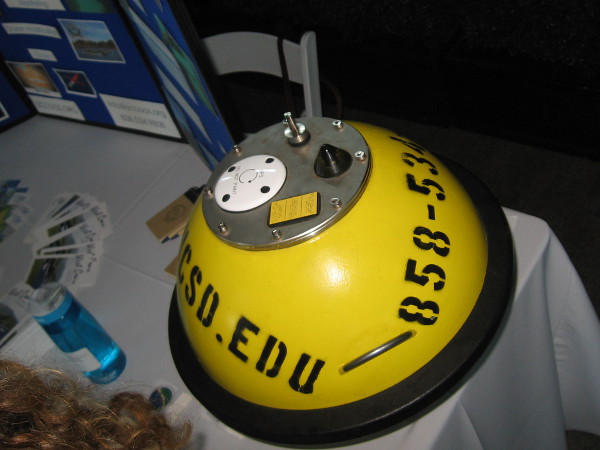
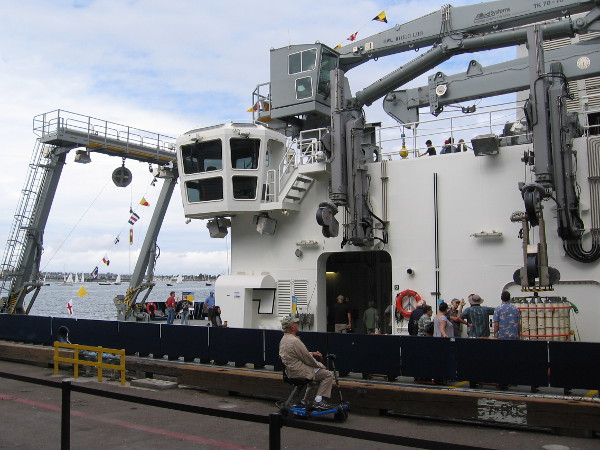
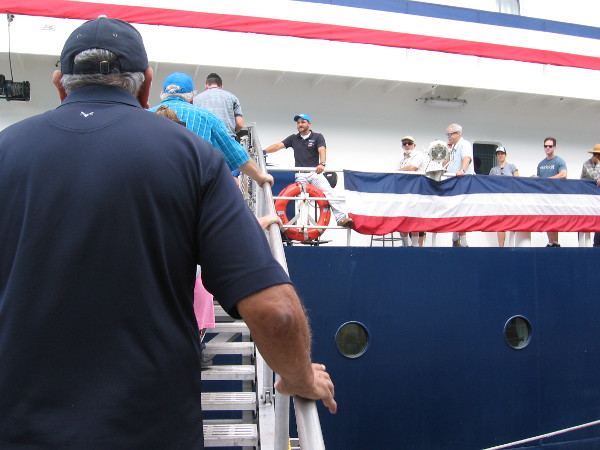
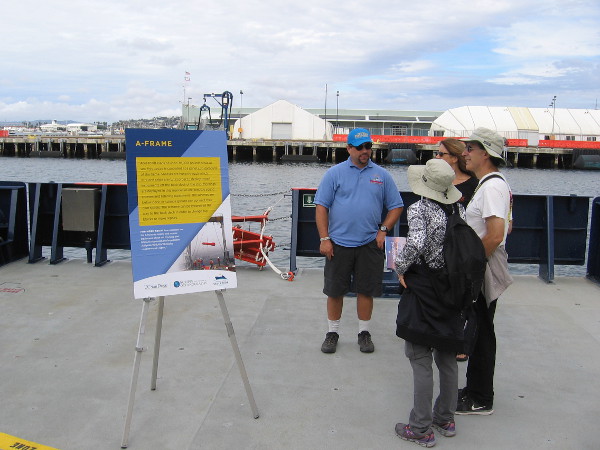
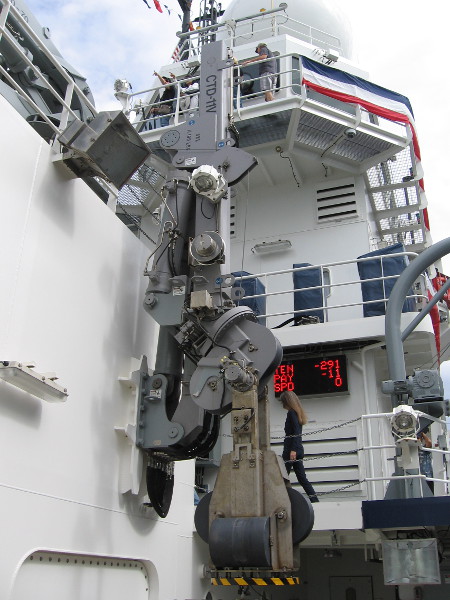
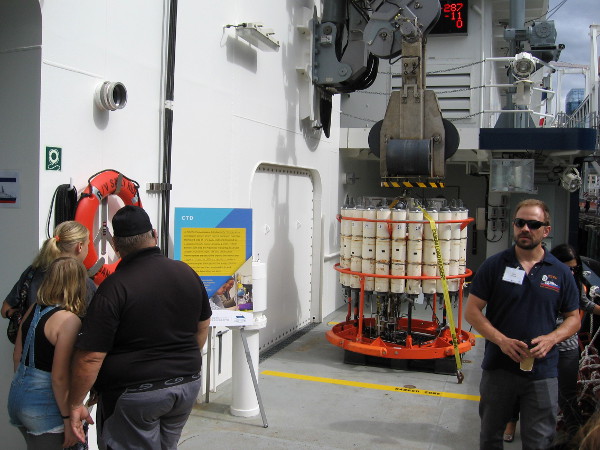
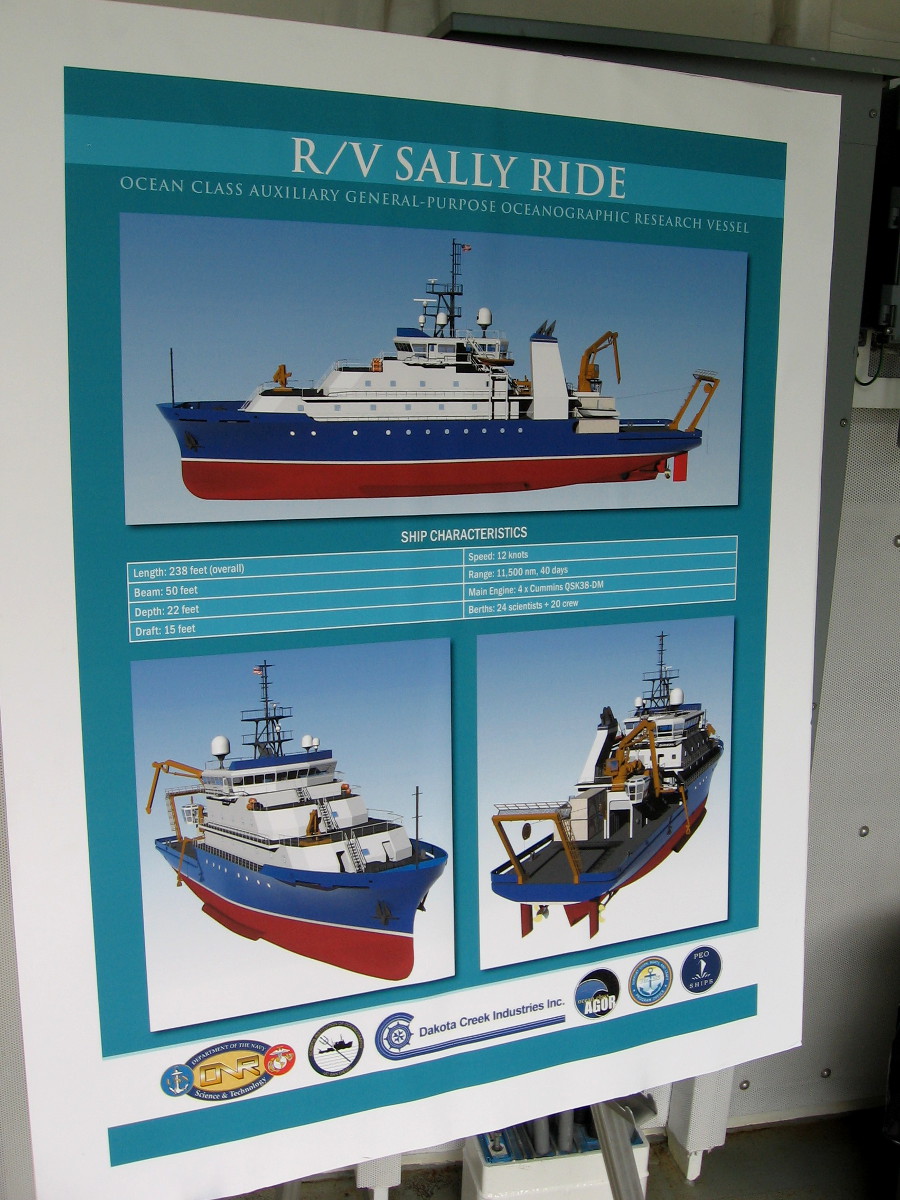
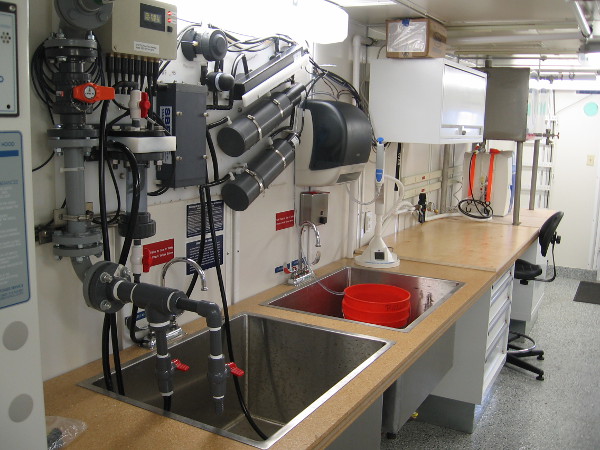
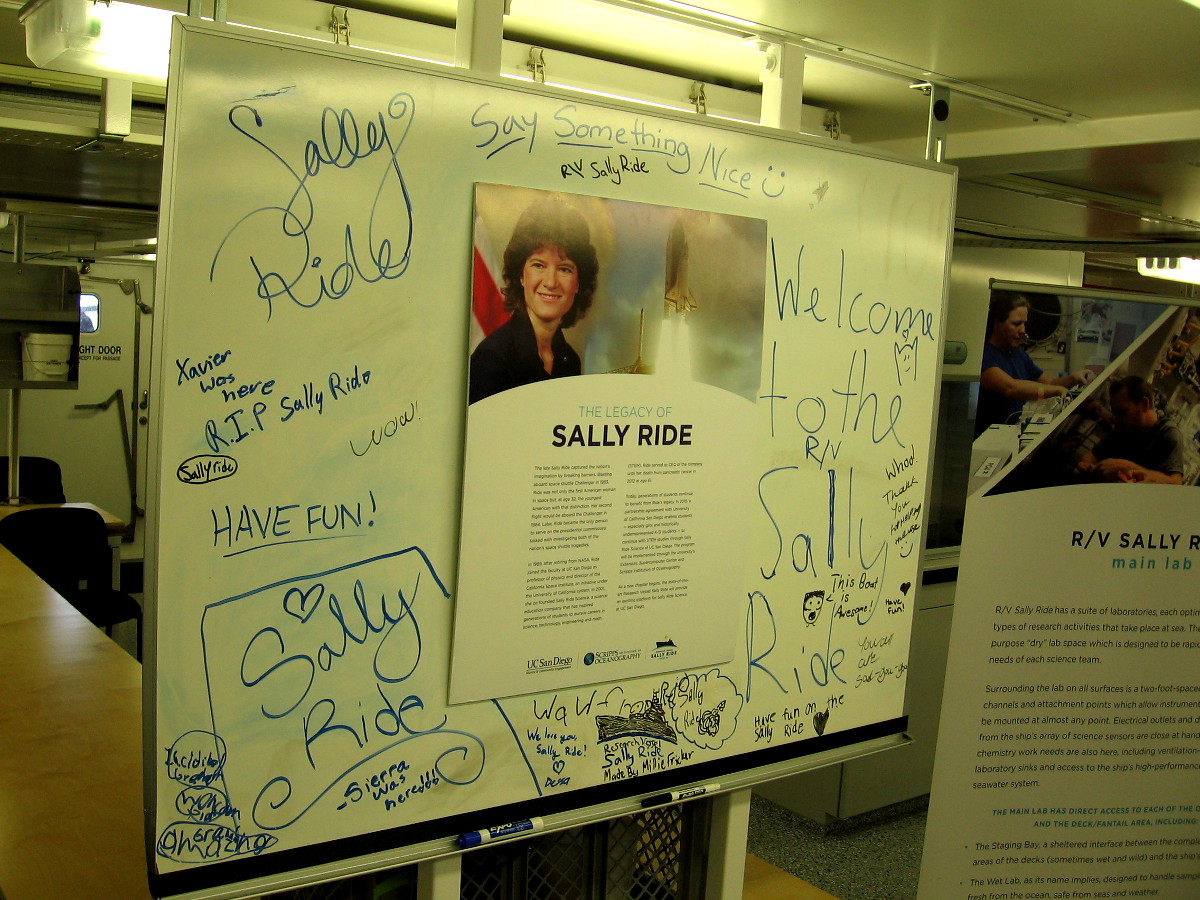
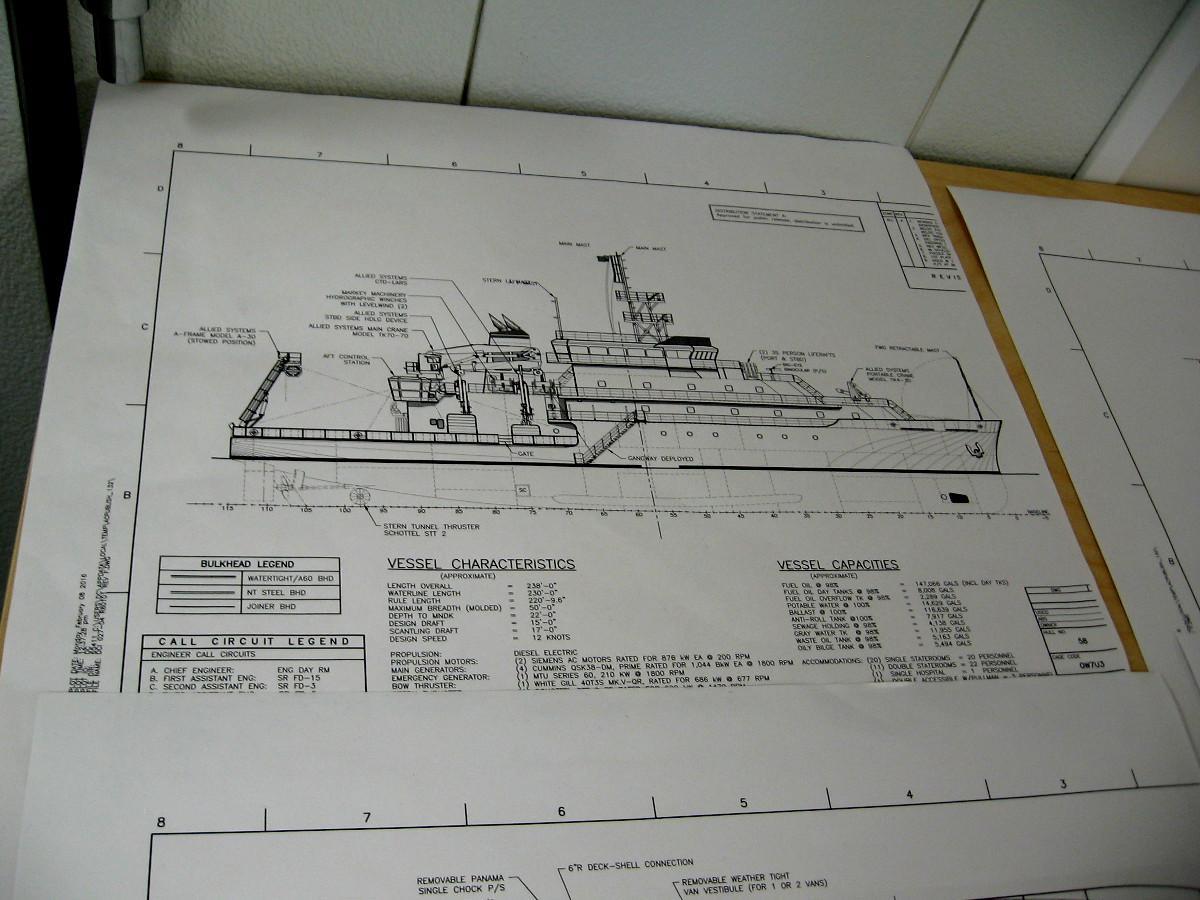
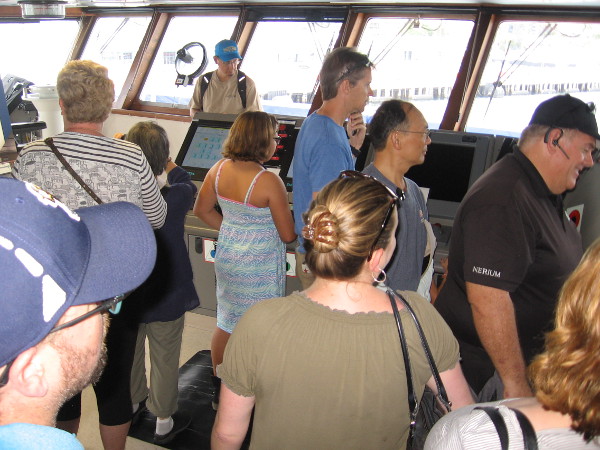
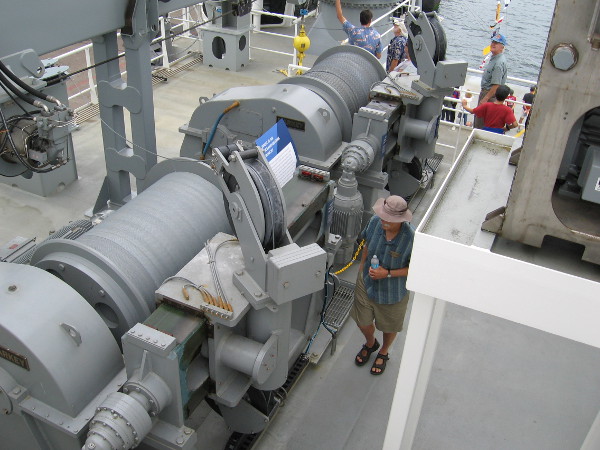
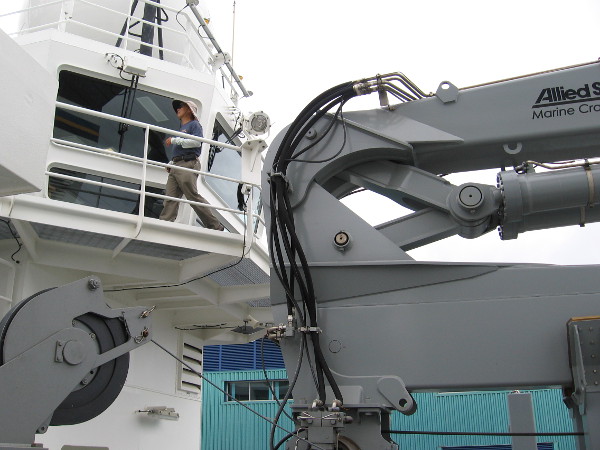
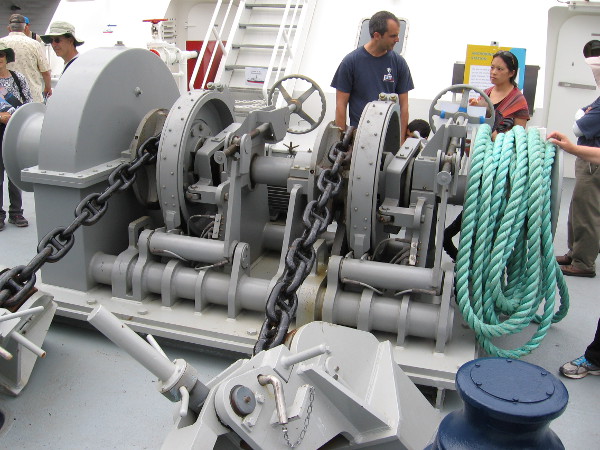
The public was invited to tour the new research ship Sally Ride. It was a rare opportunity to see how high tech exploration is carried out by UCSD Scripps scientists and oceanographers.The free public tours of R/V Sally Ride drew a good crowd on a Sunday in October, 2016. These people smartly arrived an hour early to reserve a time slot.The tour began inside the Port Pavilion on Broadway Pier. Many displays highlighted the work of UCSD’s Scripps Institution of Oceanography.UC San Diego embarks upon a new journey of exploration and boundary breaking with America’s newest research vessel R/V Sally Ride. Sally Ride was the first American woman in space.A large display goes over the history of The Evolution of Climate Change Science. UCSD scientists have made important contributions in this field.People inside the Port Pavilion learn about science and technology related to the understanding of planet Earth’s oceans.These examples of what is found when taking sediment cores on the ocean floor include tiny elegant Radiolaria.The Autonomously Deployed Deep-Ocean Seismic System’s Wave Glider is powered by solar and wave energy. It links with satellites and ocean bottom seismometers to help predict earthquakes and tsunamis.Some advanced visual equipment on display during the public debut of Research Vessel Sally Ride in San Diego. Multiple underwater photos can be taken in quick succession to form a 3-D model.Scripps Institution of Oceanography in La Jolla monitors climate variability and change, coastal hazards, marine operations, and ecosystems, fisheries and water quality.Floating device used to measure ocean wave characteristics.Peering out of the Port Pavilion at the R/V Sally Ride, docked at San Diego’s Broadway Pier.Photo aiming toward the stern of R/V Sally Ride. The big A frame, winch shack, extending crane, and two retractable arms on the starboard side of the ship are visible.Visitors eagerly head up the gangplank to explore America’s newest, most advanced research ship.Here we go!Looking down to our left.This rosette frame can be lowered into the water with a variety of mounted sensors. We’ll see it again in a bit.Heading down steep steps to the research ship’s fantail and work deck.We are halfway down. Many distant sailboats can be seen on San Diego Bay this beautiful but mostly overcast Sunday.R/V Sally Ride is equipped with shops, labs, winches, launch frames, booms and the newest scientific instruments and communication gear. The busy fantail and work deck are where science meets the sea.The gigantic A-Frame at the stern of RV Sally Ride can lift loads up to 30,000 pounds! Wire and cable deploy towed instruments. Moorings and acoustic equipment are also deployed in this manner.Visitors on the rear deck of R/V Sally Ride learn about science on the sea from a crewmember.Looking forward and up, we see several levels to the ship. If I understand correctly, the electronic display indicates a cable’s tension, payout and speed.Turning a bit to the right, we see the big crane atop a staging bay that is sheltered from the weather. Inside, equipment can be carefully prepared before deployment out in the elements.Now we are heading toward the windowed winch shack, along the starboard side of the ship toward the two retractable arms.One of two mechanical arms used to lower sensors, nets, and other oceanographic equipment into the water. They are called LARS, which stands for launch and recovery systems.A member of the public reads a sign explaining that the LARS are controlled from the winch shack. Wire or cable is used to lower equipment overboard.This rosette frame is holding a CTD, or conductivity, temperature and depth sensor. It can be lowered to a depth of nearly 4 miles! Niskin bottles attached to the frame can capture samples to be analyzed on the ship or at a later time.A poster inside the R/V Sally Ride’s staging bay details the ship’s main characteristics.Heading through a watertight door into the Wet Lab. Water samples are brought here for storage and analysis. There are drains in the floor!Another poster contains photos taken during RV Sally Ride’s construction. (Click image to enlarge.)A look inside the Wet Lab.R/V Sally Ride is the newest member of the Office of Naval Research’s fleet. These ships are owned by the U.S. Navy, but operated by university employees and professional mariners. Science teams rotate on a regular basis every two or three weeks.Heading from the Wet Lab into the Main Lab.Lab stations on the R/V Sally Ride are optimized for the different types of research activities that take place at sea.Visitors have written comments near a sign that describes the legacy of Sally Ride, our country’s first female astronaut. Sally was on the faculty of UC San Diego.A diagram of R/V Sally Ride with detailed information about the ship.Now we’ve arrived at the ship’s nerve center, the control station for CTD operations. Here scientists monitor ship location, sensor readouts, and trip bottles to collect samples.After quickly passing the no-nonsense mess deck and through two rather bare state rooms, visitors head up stairs to check out the pilot house.The high tech pilot house, or bridge, attracted a big crowd of curious visitors!One of the seats where the ship’s captain can place himself. When at sea or holding station, a deck officer is present on the bridge at all times.The huge computerized control console looks like it belongs on a spaceship!Aft of the starboard side of the bridge is the chart room, where navigational plans are made for each expedition. Old-fashioned maps are still used as an emergency backup!Heading around the pilot house, back toward the stern of R/V Sally Ride.Looking down at the telescoping knuckleboom crane and other outdoor machinery used to carry out research on the often stormy ocean.People examine an oceanographic winch. Drums can have upwards of 10,000 meters of wire or cable spooled on them.As I understand it, this sturdy telescoping knuckleboom crane can be extended in all directions for multiple purposes, including lifting the gangplank!Two impressive winches aboard R/V Sally Ride.Looking back up toward the rear of the pilot house.One last look at the aft deck and impressive A-Frame of the amazing new Research Vessel Sally Ride.I’m not the only one who is impressed.Heading forward along the ship’s port side. Downtown San Diego buildings rise across the water.We’ve arrived at the ship’s bow, just below the pilot house, where we find the anchoring station. The big windlass mechanism lowers and raises an anchor.R/V Sally Ride has three anchors, each weighing 5,000 pounds. Two are on either side of the bow and the third is a spare. Each anchor is connected to 720 feet of chain, which is stored below decks.An orange life ring reads R/V Sally Ride, San Diego.One last photo of R/V Sally ride during her debut at San Diego’s Broadway Pier. She begins her first research expedition in a matter of days!
…
I live in downtown San Diego and love to walk! You can follow Cool San Diego Sights via Facebook or Twitter!
You can easily explore Cool San Diego Sights by using the search box on my blog’s sidebar. Or click a tag! There are thousands upon thousands of fun photos for you to enjoy!



























































 Cool San Diego Sights!