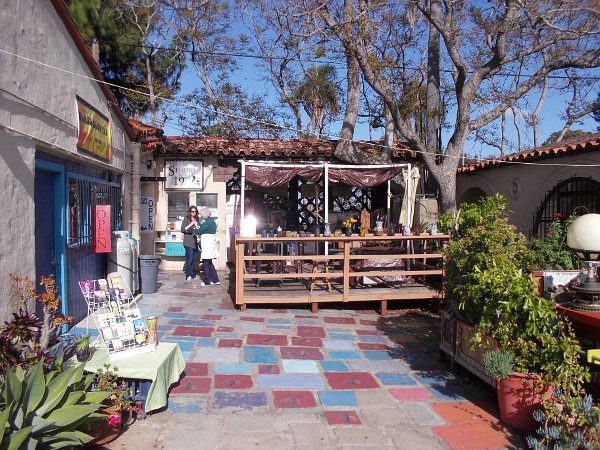
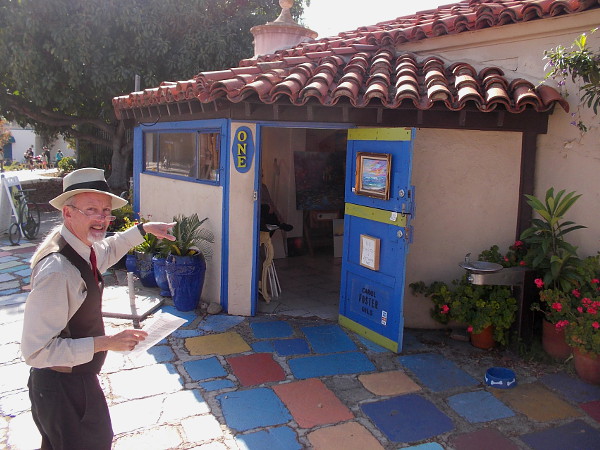
Tour guide Jeff explains that today’s Studio 36 Sculptors Guild was an outdoor theatre in the early years of Spanish Village. The front was a lobby and ticket booth. Writers, actors and set designers would act out plays on the inner patio.
Spanish Village Art Center, in beautiful Balboa Park, is where you’ll find the colorful studios of many fine San Diego artists. Last year I blogged about the history of this fascinating place. A small exhibit in Gallery 21 recounted how Spanish Village was created for the 1935 California Pacific International Exposition, and traced the village’s evolution over subsequent decades. Unfortunately, that exhibit no longer exists. But I did record much of it. To enjoy an overview of the history, you can revisit my old blog post by clicking here.
Last Saturday I was given a terrific tour of Spanish Village by a super friendly guy named Jeff. During the tour, Jeff showed me some unusual, unexpected features of Spanish Village and delved into its often surprising history.
(Fortunately, Jeff gave me some notes that I will reference in this blog. Should you enjoy a tour yourself, you can probably obtain your own copy!)
Please read the photo captions where I provide descriptions and very short explanations. As you’ll see, many interesting changes in Spanish Village have taken place over the years. And I’ve barely begun to scratch the surface!
If something I’ve written is inaccurate, or needs some elaboration, leave a comment! What memories do you have?
Click here to check out the Spanish Village Art Center blog! Support these great artists!
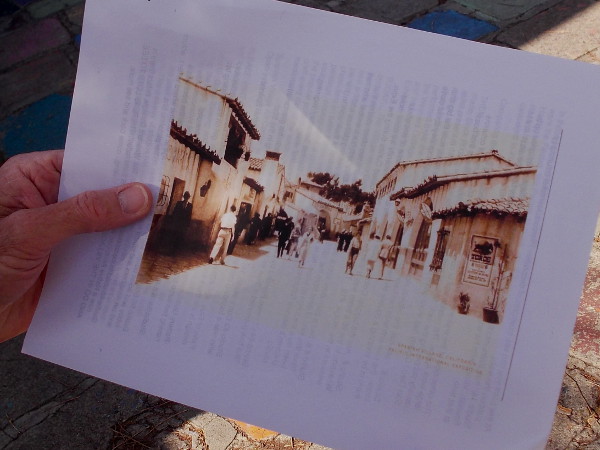
An old photograph of how Spanish Village appeared around the time of the California Pacific International Exposition of 1935.
In 1935, when Spanish Village opened, visitors strolled down simulated Old World streets, which featured restaurants and shops in picturesque, open-arched buildings. The architecture was inspired by the Andalusian region of southern Spain. In addition to wine shops, a cocktail lounge and a Chinese Bazaar, one could buy flowers and enjoy music, art . . . and even a high wire trapeze act!
You can see in the above old photograph a no-longer-existing building at the center of today’s large patio. It separated Spanish Village into two “streets” that visitors could enjoy.
Over the years, resident artists have built out the small open air shops to create practical but unique enclosed spaces. Some of the open arches have been filled in, or can now be seen inside certain studios.
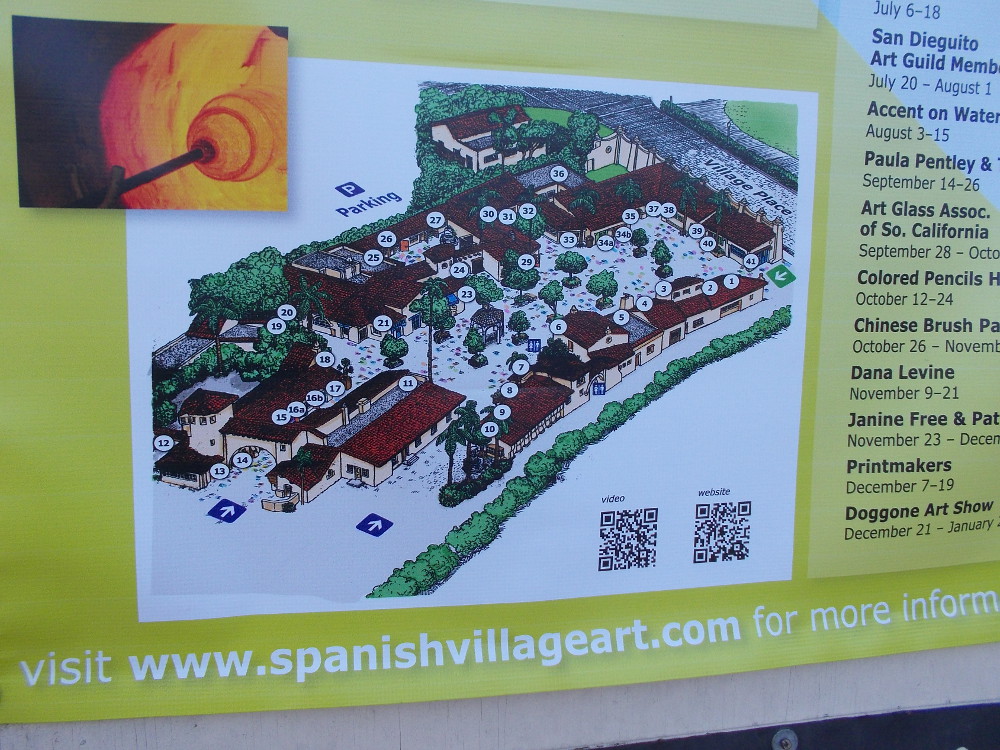
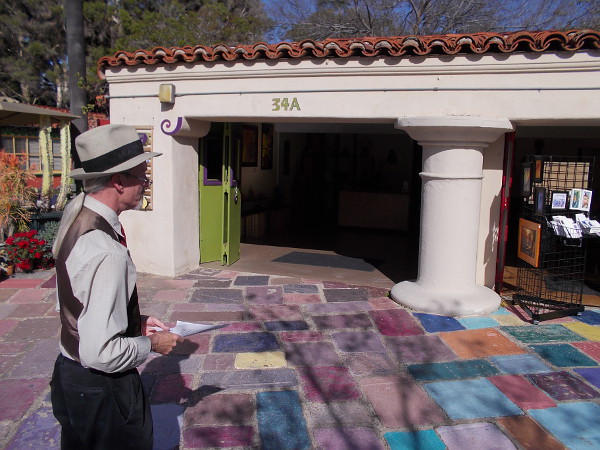
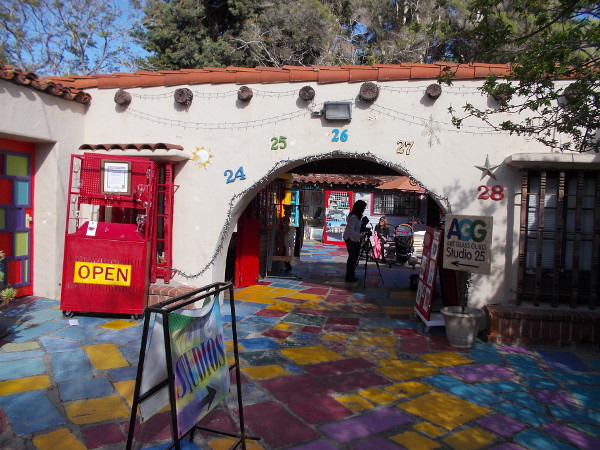
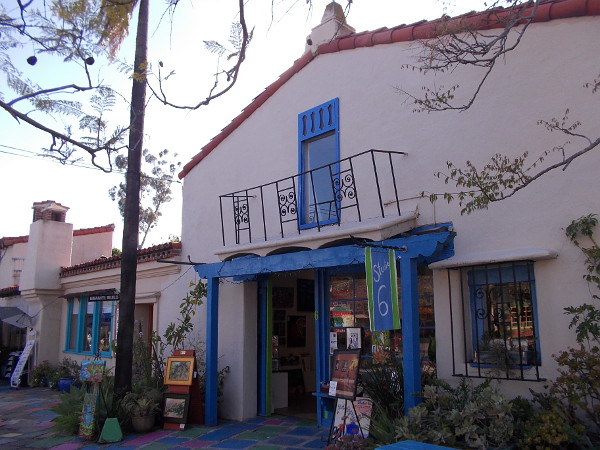
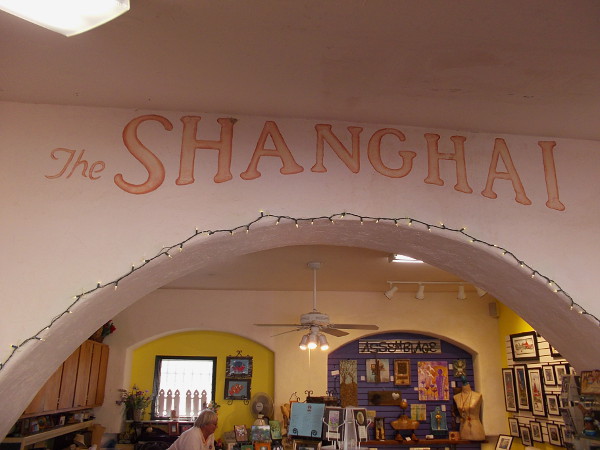
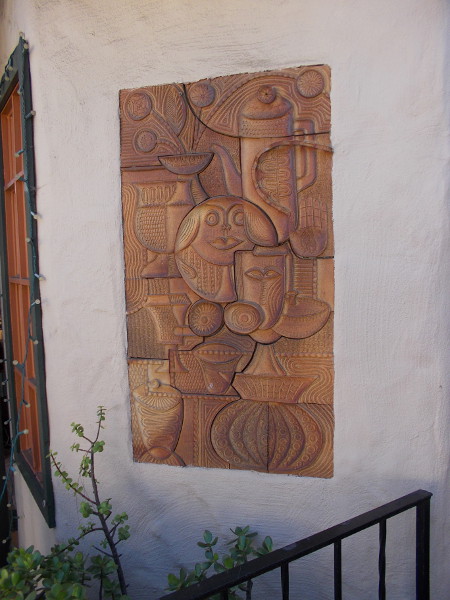
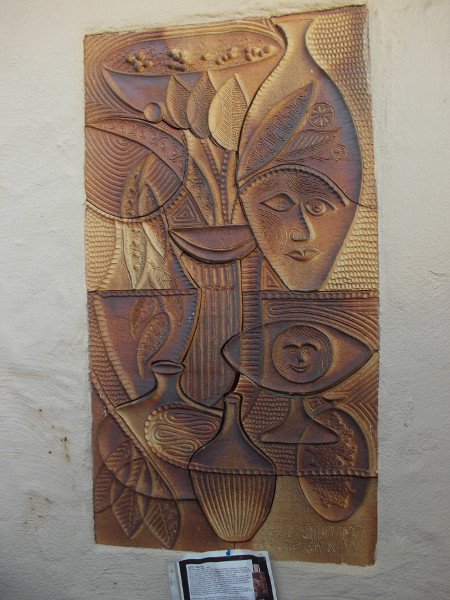
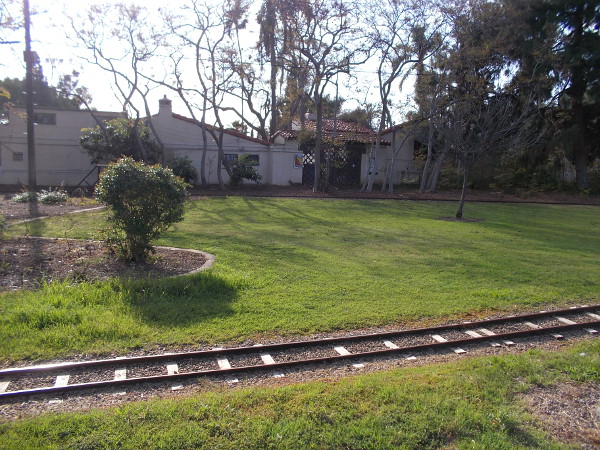
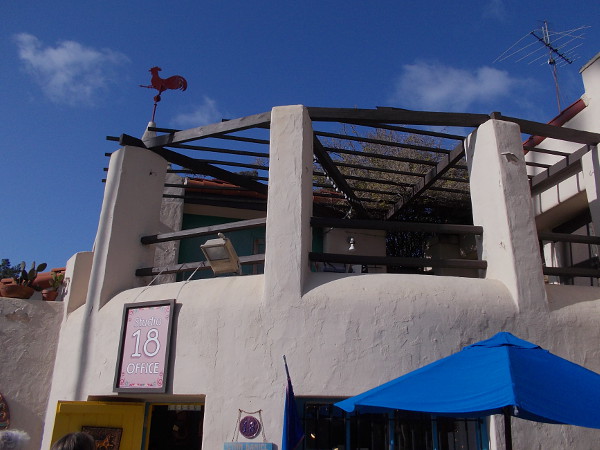
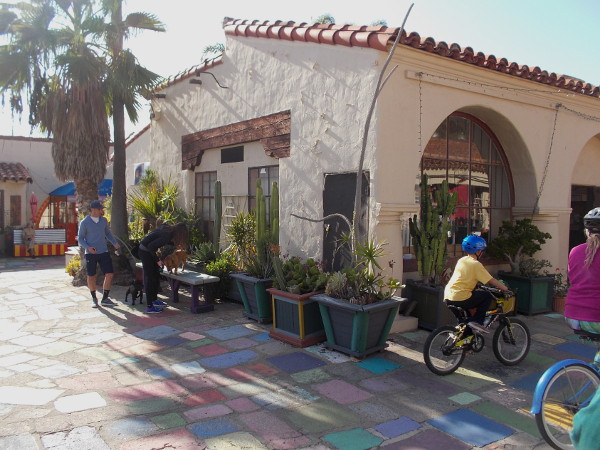
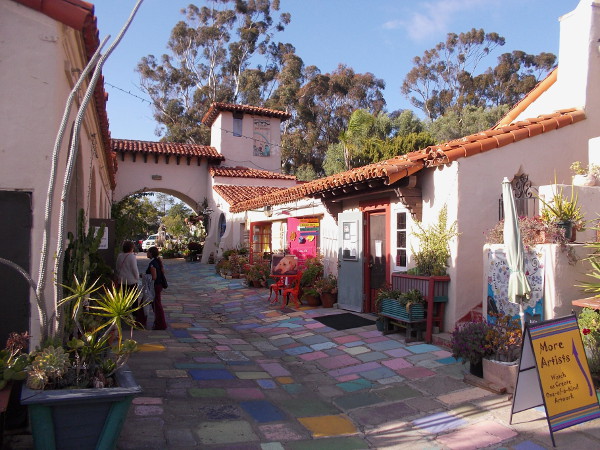
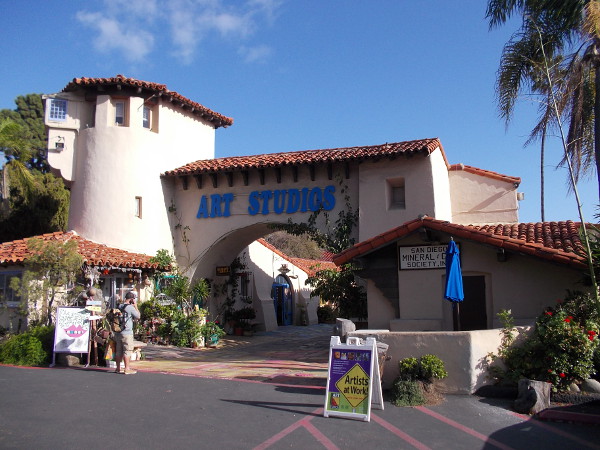
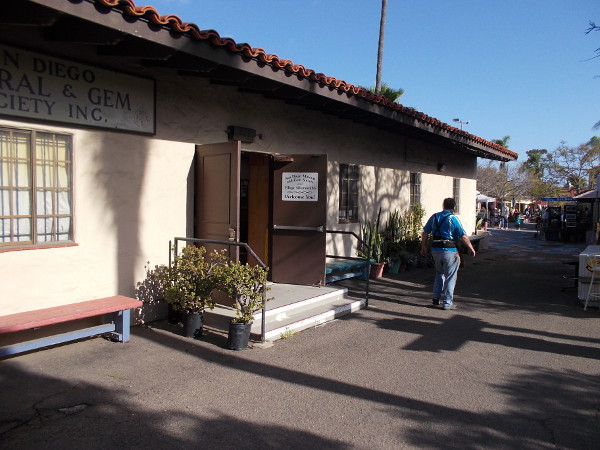
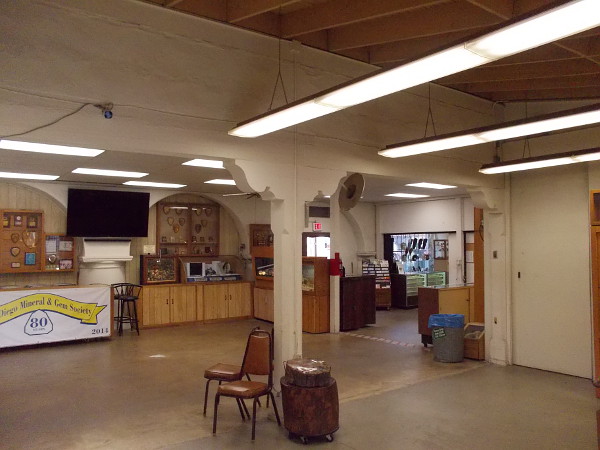
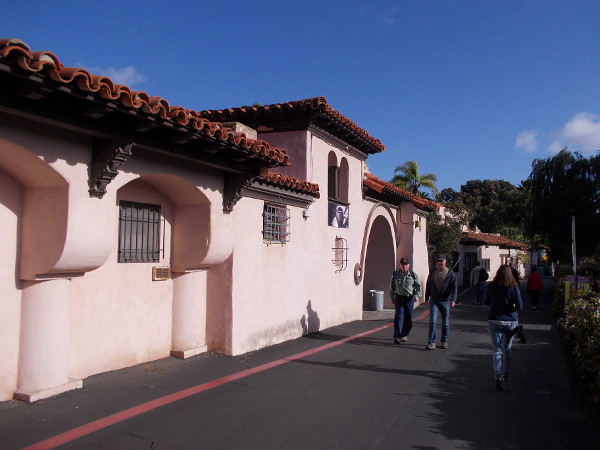
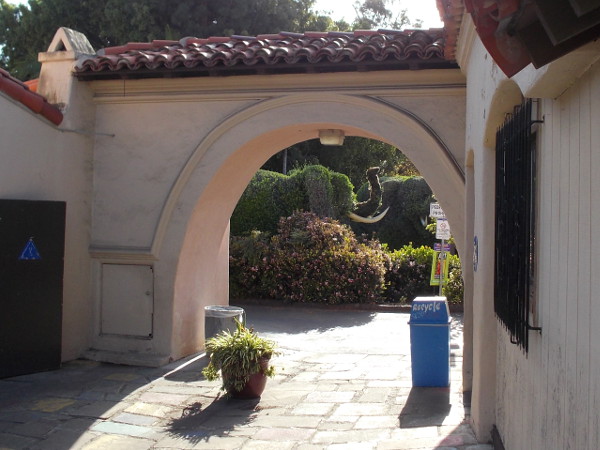
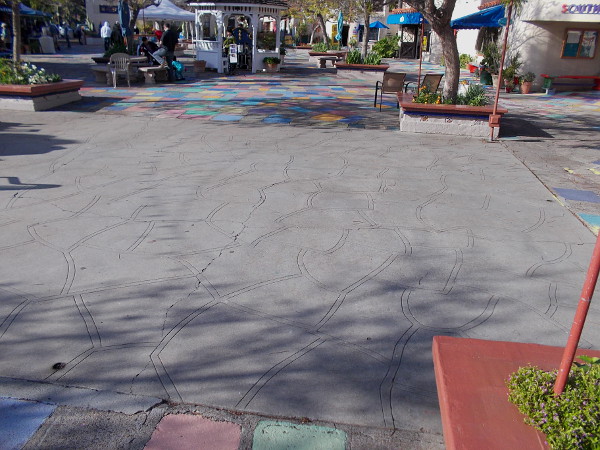
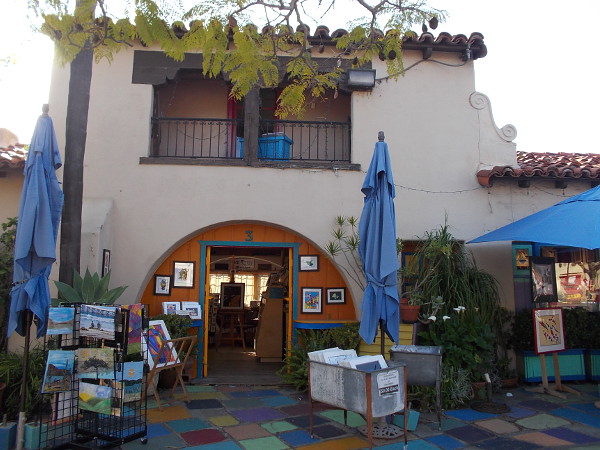
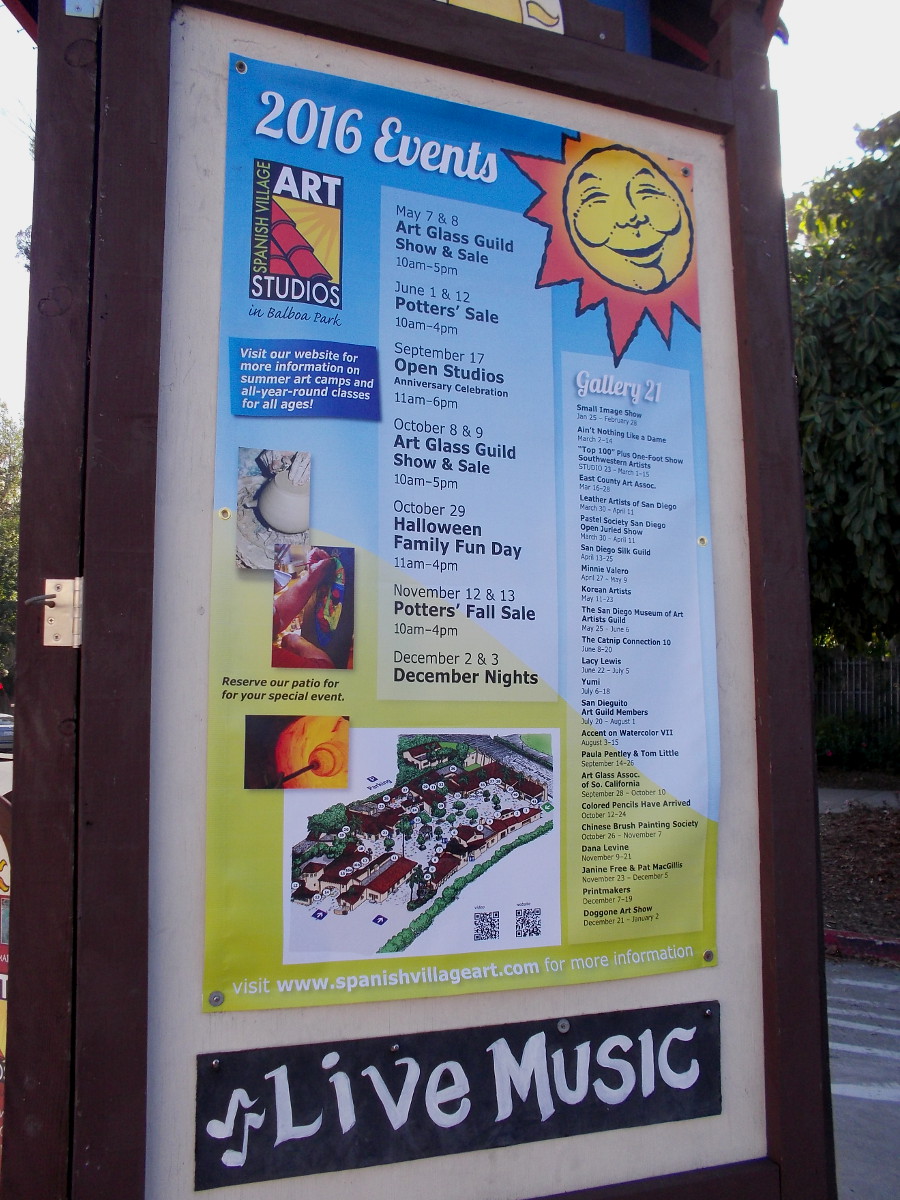
A current map of Spanish Village shows how it appears today. You can find this wonderful part of Balboa Park between the Natural History Museum and the San Diego Zoo.Jeff shows me Studios 34 A and 34 B, which were originally one space featuring a puppet show.Studios 24 through 28 surround a small inner courtyard. This area in Spanish Village originally contained a wishing well and actual horse stalls!Studio 6 has a sliding barn door! Two other studios dating from the 1935 California Pacific International Exposition have similar doors.Studio 8, like many others in Spanish Village, was built out from the original open archway to provide more space for the artists. The words The SHANGHAI are from 1935. It evidently used to be a bar.Near Studio 8’s entrance are two amazing works of art. Here’s one. It was created by John Novy, a potter who was a member of Spanish Village from 1969 to 1977.Second installation of ceramic tiles on exterior of Studio 8 in Spanish Village. This art was created by professional potter John Novy.This used to be the east entrance into Spanish Village. Today you’ll find outdoor glassblowers creating amazing glass pieces while visitors gather around to watch.The old east entrance (under the tiles) is now blocked off. Much of the grassy area occupied by today’s Balboa Park Miniature Railroad used to be a parking lot.Studio 18 is now the office of Spanish Village Art Center. In the early years a caretaker lived here. That rooster weather vane can be seen in many old photographs.The south end of the San Diego Mineral and Gem Society building used to extend a bit into today’s large patio area. You can see an old wooden beam on the present-day exterior.This quaint little street, during the 1935 California Pacific International Exposition, led into the Fun Zone! Now it leads to a small parking lot.Gazing back south from the parking lot at today’s Spanish Village artist co-op in Balboa Park.The extended west side of the San Diego Mineral and Gem Society building was built sometime after the 1935 Expo.Originally, the building terminated where you see the column.Walking along the west edge of Spanish Village. Many decorative columns and arches provide this artist’s co-op with unique character.Looking through the west archway toward a shrub elephant, which stands on a nearby, newly improved walkway that heads north to the San Diego Zoo.This large dance floor (and the area where I’m standing) at the center of the colorful Spanish Village patio was once occupied by a large building. It seems there is some debate as to what that building was, exactly.Studio 3 is occupied by artist Don Knapp. He arrived at Spanish Village as a child! His grandmother was a founding member in the 1930s.Loads of fun, creative stuff is going on in Spanish Village Art Center in 2016. Please click the image to enlarge it, and then mark your calendar!Jeff provides a really interesting tour. Look for his friendly smile if you happen to find yourself in wonderful, historic Spanish Village!
…
I live in downtown San Diego and walk like crazy! You can follow Cool San Diego Sights via Facebook or Twitter!
Do you like to read short pieces of thought-provoking fiction? You might enjoy checking out Short Stories by Richard.
Is Balboa Park one of your favorite places? Follow my special new blog, which I call Beautiful Balboa Park!
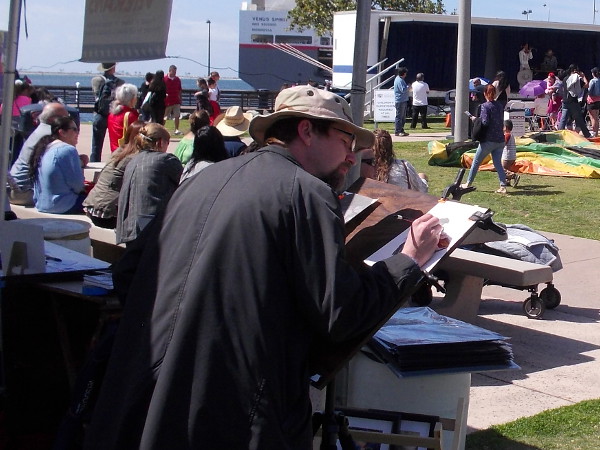
A U.S. military veteran creates art while watching folklorico dancing at a popular festival in San Diego’s South Bay.
Today I met Anthony A. LoBue for the second time. With a great big smile, he was manning his Arts For Veterans tent at the International Mariachi Festival and Competition in National City. (I chatted briefly with him once before at the Spreckels Organ Pavilion, during a special concert raising funds for Operation Rebound.)
“Tony the Vet” helps other veterans heal through creative art. He’s the founder of Support Our Veterans Association and the Arts for Veterans Project. The latter organization’s purpose is to: Engage, Educate, Employ and Empower Veterans in the Creative Arts. He provides art classes for military veterans at the Veterans Museum in Balboa Park, Veterans Village, and other places where healing, hope, wholeness and art education are welcome.
He believes the healing power of art dramatically changes lives. It’s an enormous benefit for those returning from war with psychological trauma. Art provides connection, joy, self-empowerment. Art literally saves lives.
Tony has a huge positive vision. He wants to expand his Arts for Veterans program so that it might benefit as many people as possible.
Would you please visit his website and see it you can help in some way?
Art heals. Art provides joy, connection, hope. Art helps to give life meaning and purpose.
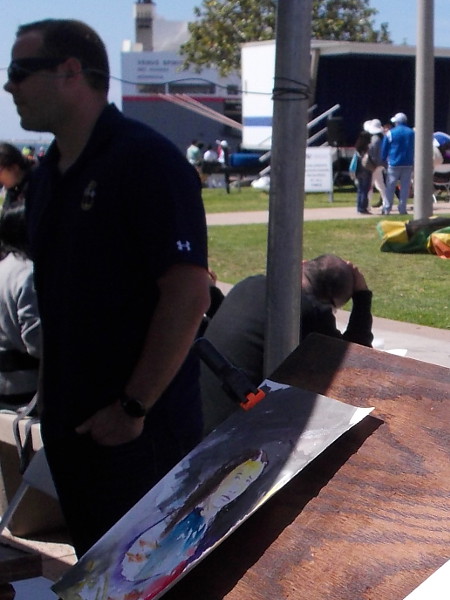
Brian Meyer was painting at the Arts For Veterans tent. I spoke to him. He’s a veteran of Desert Storm. He’s a super guy and deeply thoughtful. And his watercolors are amazing. That’s a glimpse of a work-in-progress above. He frequently paints the live musicians at Panama 66 next to the San Diego Museum of Art. Please check out his website!
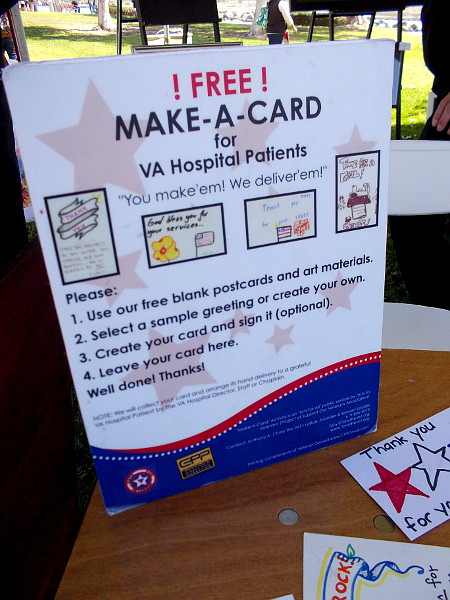
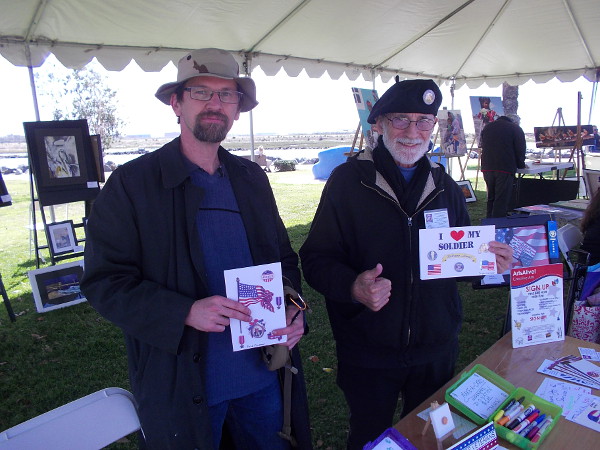
Hand-drawn art cards with hearts and flags thank service members for their sacrifice.People at the International Mariachi Festival and Competition in National City were making special greeting cards for patients at the VA Hospital.Gifted watercolor painter Brian Meyer, and Anthony A. LoBue of Arts For Veterans.
…
I live in downtown San Diego and love to walk! You can follow Cool San Diego Sights via Facebook or Twitter!
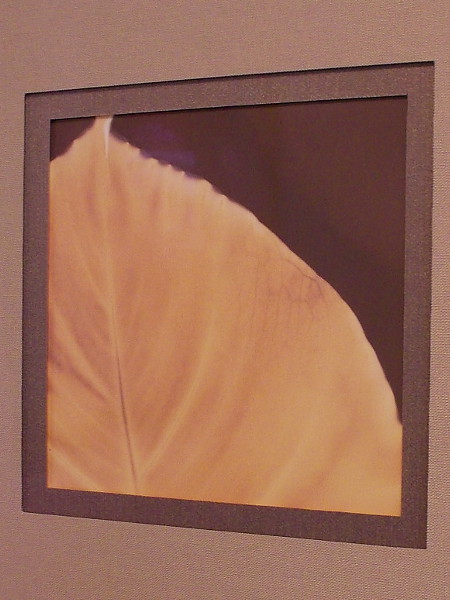
Uniquely beautiful Fern Lumen by artist Patricia Grabski.
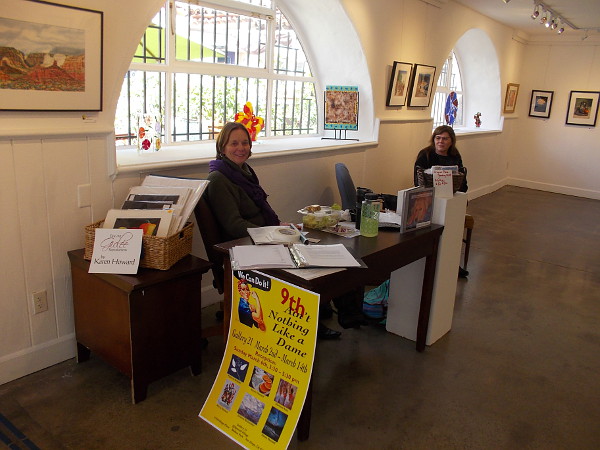
This weekend you have an opportunity to see something really unique. Patricia Grabski is displaying her amazing lumen and cyanotype photo art in Balboa Park. Her work is part of a five artist exhibition called Ain’t Nothing Like a Dame, which you can enjoy inside Gallery 21, in the always wonderful Spanish Village Art Center.
I learned that cyanotype printing was invented in England in 1842. Utilizing two chemicals, ammonium iron citrate and potassium ferricyanide, this process was used to create early blueprints. In 1843, the world’s first woman photographer, Anna Atkins, placed organic materials onto paper coated with cyanotype; when exposed to sunlight, ghostly, artistic photograms were created.
Lumens is a very similar process that uses old unexposed black and white photo paper. Exposure to sunlight creates all sorts of fantastic colors and effects.
My own poor photographs don’t do this fascinating artwork justice. You have to see the subtle detail in person. So head on over to Spanish Village tomorrow. Patricia Grabski’s work will be displayed through March 14. If you want to contact the artist, her info is visible in one photo.
Patricia Grabski is currently exhibiting her unique creations in Gallery 21, in Balboa Park’s wonderful Spanish Village Art Center. Her pieces are available for purchase.Patricia Grabski uses neither camera nor lens–she contact prints her images with alternative photographic processes–cyanotype, platinum, palladium, albumen, van dyke brown, salt and lumens. Her prints are made on photographic paper, art paper, glass, tin, cotton handkerchiefs and old linens.
Leaf Lumen. Fantastic art created by Patricia Grabski.
…
I live in downtown San Diego and love to walk! You can follow Cool San Diego Sights via Facebook or Twitter!
Do you love Balboa Park? Follow my special new blog which I call Beautiful Balboa Park!
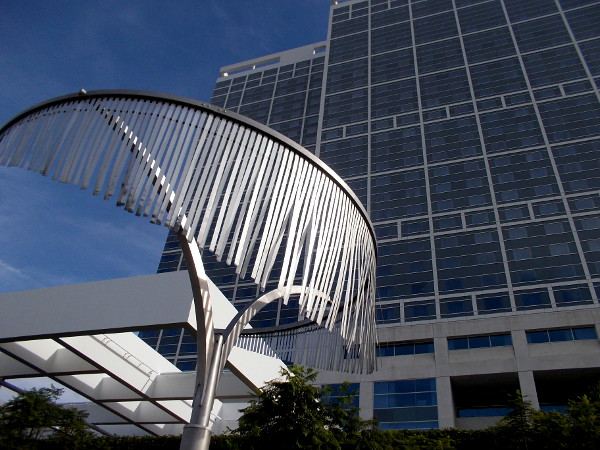
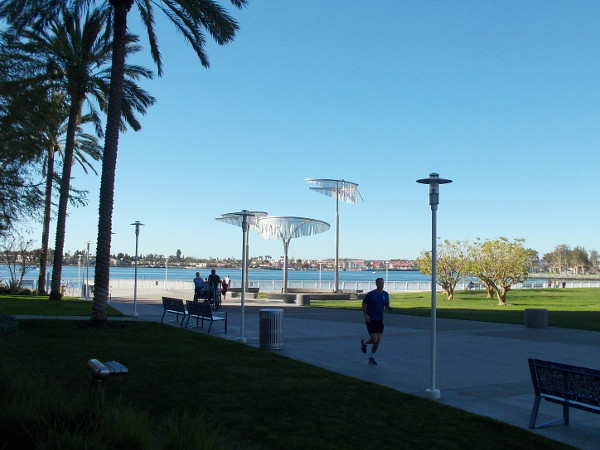
Seven curving metal palm trees rise into the beautiful San Diego sky at Bayfront Plaza.
These are photographs of “living metal” under changing skies. Since 2008, seven stainless steel abstract palm trees have stood in front of San Diego’s Bayfront Hilton, moving gently on windy days. I’ve taken many photos of these unique sculptures over the years. They were created by artist Ned Kahn.
Wind Palms, Ned Kahn, 2008. Stainless steel kinetic sculptures in front of Hilton San Diego Bayfront.People walk beneath unique tree-like art between the San Diego Convention Center and the Hilton hotel.The silvery, sun-reflecting stainless steel ribbon “leaves” of the Wind Palms move very slightly in the sea breeze.Looking upward at different geometric patterns. The curving fronds rotate when the wind’s direction changes.Seagulls circle high above the palm-like kinetic sculptures on a gray, cloudy day.Walking along near the Hilton, heading toward the edge of San Diego Bay.Shining trees in a cloudless blue sky.
…
I live in downtown San Diego and love to walk! You can enjoy more Cool San Diego Sights via Facebook or Twitter!
Do you like to read short pieces of thought-provoking fiction? Please visit Short Stories by Richard.
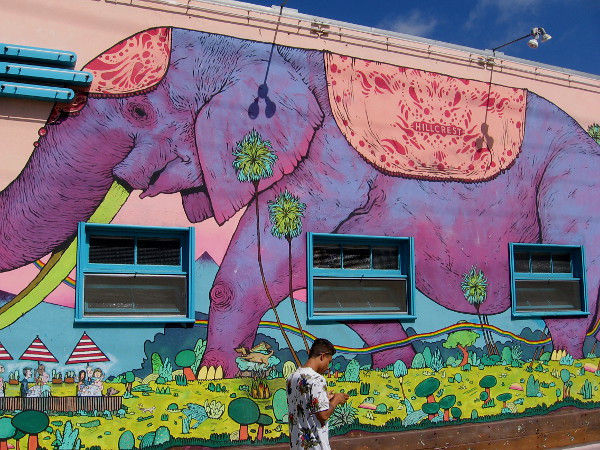
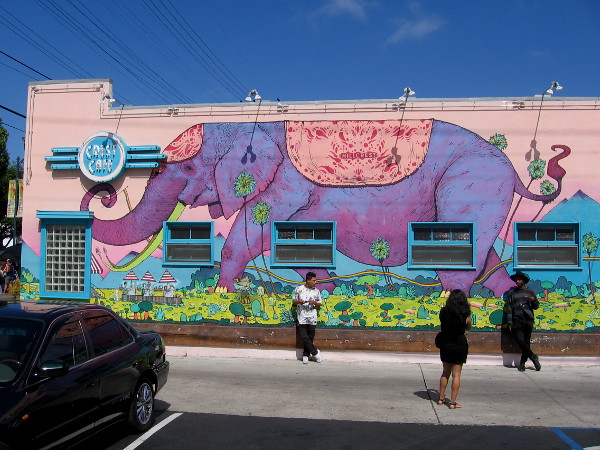
Exotic elephant on wall of the Crest Cafe in Hillcrest, created by San Diego artist Cody Griffith in 2012.
Here are two of my favorite street murals in San Diego. The colorful elephant appears on the outside west wall of the Crest Cafe in Hillcrest. It was painted by local artist Cody Griffith in 2012. The monstrous Tyrannosaurus rex dinosaur with a funny fuzzy rider can be seen in North Park, at the corner of University Avenue and Ray Street. This cool urban artwork was created by Mark Paul Deren, who also goes by the name Madsteez.
It’s a street art battle of monstrous proportions!
Funny urban art in North Park. A cool T. rex and rider rise high above a concrete mixer truck. Created by artist Mark Paul Deren, also known as Madsteez.Another fun example of creativity in the diverse and wonderful city of San Diego.
…
Join me for more Cool San Diego Sights on Facebook and Twitter!
Many outdoor sculptures are being introduced into Balboa Park. The exhibit is titled Art of the Open Air. It’s a unique project of the San Diego Museum of Art.
During the past week, a number of sculptures in the San Diego Museum of Art’s collection have been carefully moved into the Plaza de Panama, a large outdoor gathering place in Balboa Park. For the next two years, anyone in San Diego will be able to freely enjoy the sculptures, and see them in changing light, beneath different skies. Moving such large pieces has taken a lot of work, but I noticed today that the installation, titled Art of the Open Air, is approaching completion.
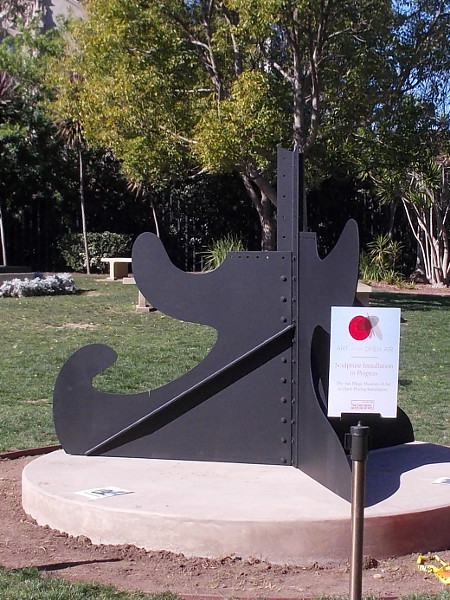
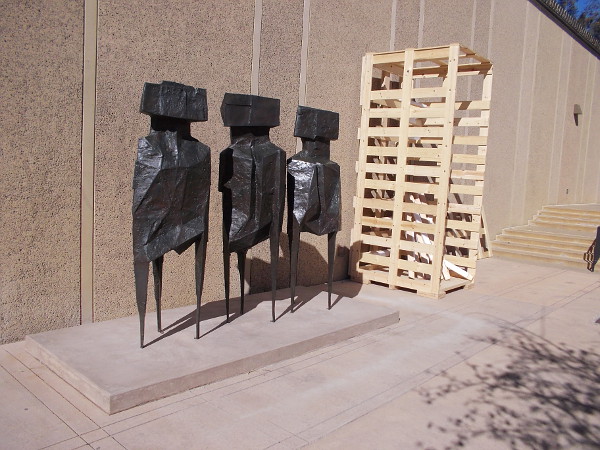
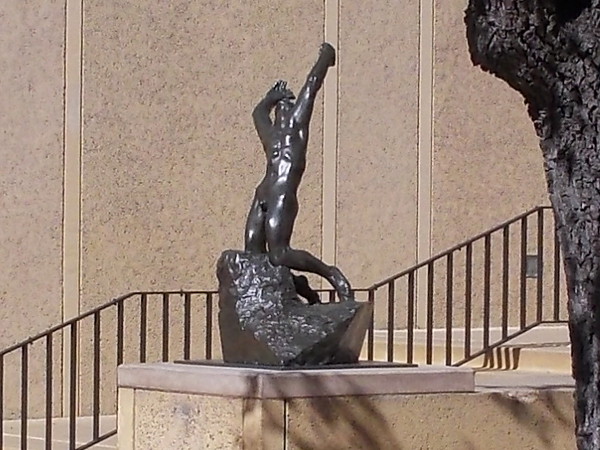
Included in the unique outdoor exhibition are works by world-famous artists Joan Miró, Auguste Rodin and Tony Rosenthal. I wasn’t able to approach the artwork too closely–right now, while the sculptures are being readied, they’re still roped off. The same goes for a new piece in the museum’s May S. Marcy Sculpture Garden, which I also photographed from a bit of a distance. I put some identifying information in the photo captions.
Art of the Open Air is set to run from February 11, 2016 through February 13, 2018. I can already see that Balboa Park is going to be more lively and interesting than ever!
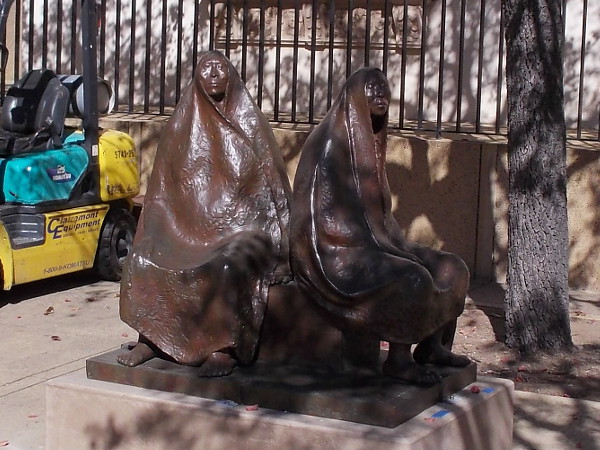
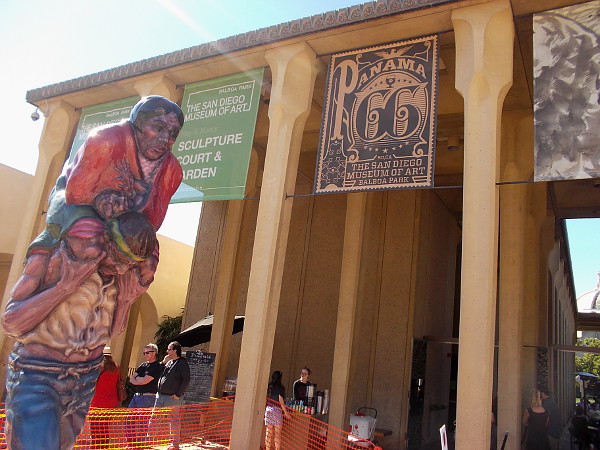
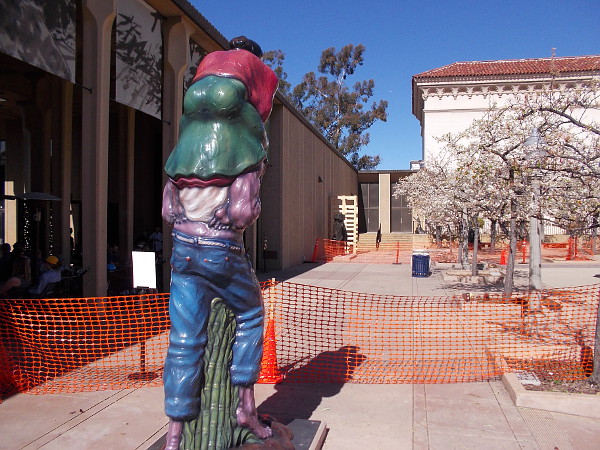
Alexander Calder. Spinal Column, 1968. Steel. A sculpture being installed in the San Diego Museum of Art’s outdoor May S. Marcy Sculpture Garden.Lynn Russell Chadwick. The Watchers, 1960. Bronze. Now stands in Balboa Park’s beautiful Plaza de Panama, part of the Art of the Open Air exhibition.Auguste Rodin. The Prodigal Son, 1905. Bronze. Installed in the northwest corner of the Plaza de Panama, where the sculpture Youth Taming the Wild (Horse Trainer) used to stand.I can’t find anything about this piece, but it seems strangely familiar. If you know what it is, leave a comment! UPDATE: I learned the bronze sculpture is called Mother and Daughter Seated, by Francisco Zuniga, 1971Two very fine sculptures that will soon will be approachable in Balboa Park’s Plaza de Panama.Joan Miró. Solar Bird, 1966. Bronze. Standing guard near the entrance to the San Diego Museum of Art.Tony Rosenthal. Odyssey III, 1967. Aluminum.Photo across front of the San Diego Museum of Art, the north end of Balboa Park’s Plaza de Panama. Outdoor art is being installed.Luis Jiménez. Border Crossing/Cruzando el Rio Bravo, 1989. Fiberglass with acrylic urethane finish. Stands outside the May S. Marcy Sculpture Court and Panama 66.Monumental totem-like sculpture depicts artist’s immigrant grandfather carrying wife and son, crossing the Rio Grande from Mexico.A large sculpture seems to stride into the life-filled Plaza de Panama in San Diego’s historic Balboa Park.
Native American Kumeyaay from the San Diego area work near the foot of an ewaa, a dome-shaped hut made of sycamore and oak tree branches.
Over two years ago, when Cool San Diego Sights was relatively new, I blogged about some amazing public art near the Santa Fe Depot in downtown San Diego. I provided just a brief glimpse, really.
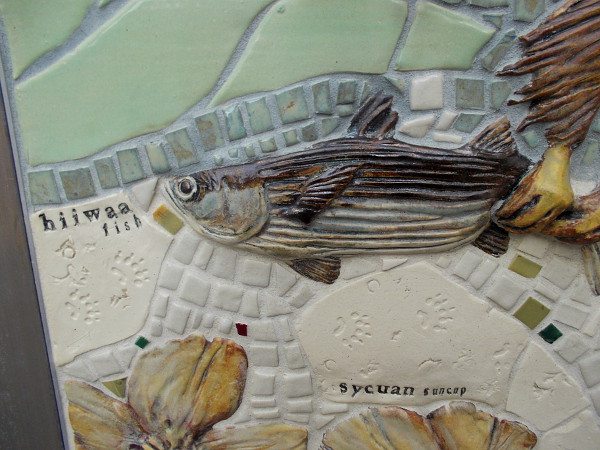
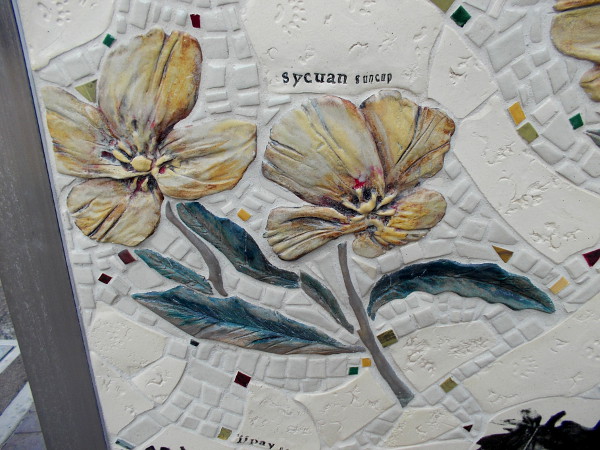
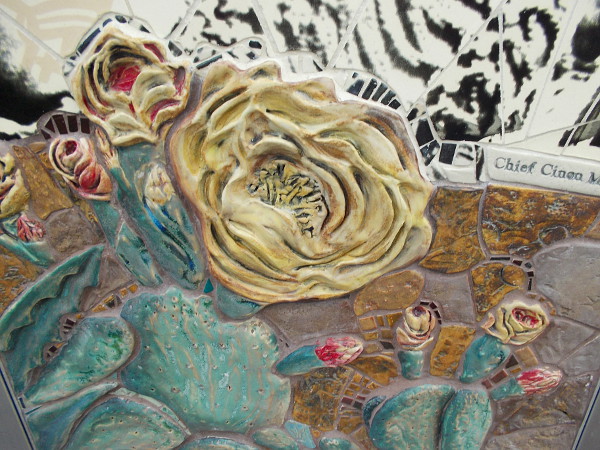
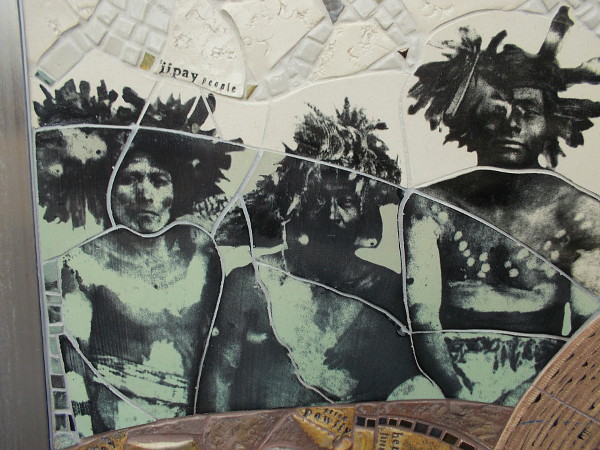
The artwork, titled The Tracks We Leave Behind, created by Betsy K. Schulz in 2008, is so utterly fantastic, so absorbing, I’ve decided to blog about it once again. Whenever I walk past (which is often), I like to pause an extra few seconds beside my favorite column, which features gorgeous mosaics that depict wild nature and the Native American Kumeyaay people, who have lived around San Diego for about 12,000 years.
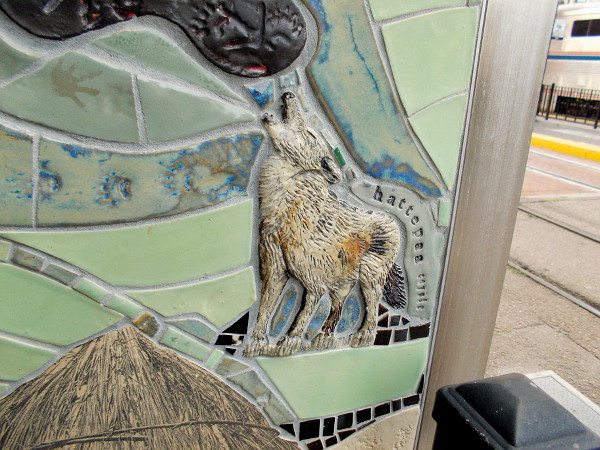
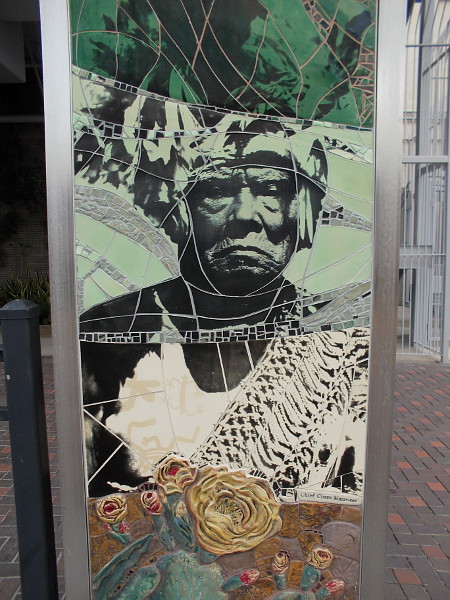
Living in this place we set fires to open the land and make the seeds grow. We fish all year, both near shore and deep. We walk to the canyons and the mountains–hunting, gathering food and trading . . .Public art titled The Tracks We Leave Behind, by Betsy K. Schulz, 2008, includes the image of a Kumeyaay hattepaa (coyote) howling.Beautiful handmade mosaic tiles form a Kumeyaay ispa (eagle) in flight.The bald eagle has captured a Kumeyaay hiiwaa (fish).Yellow Sycuan Suncups grace this gorgeous, detailed public artwork in downtown San Diego.The yellow bloom of a prickly pear. This sculpted tile mosaic is so phenomenal, you almost can’t remove your eyes from it!The native Kumeyaay people (also called Kumiai, Ipai-Iipay, Tipai-Tipay, Diegueño, Kamia) have lived in the San Diego region for around 12,000 years.Public art in San Diego depicts Cinon Duro Mataweer, spiritual leader (kuseyaay or tribal shaman) of the Ipai (formerly northern Diegueño) Native American Indian tribe.
…
Join me for many more Cool San Diego Sights on Facebook and Twitter!
It’s hard to believe, but this photo blog of San Diego now contains over 800 posts, and features a vast universe of wonderful art–not to mention other random cool stuff! Click some links that look interesting if you’d like to explore! Have fun!
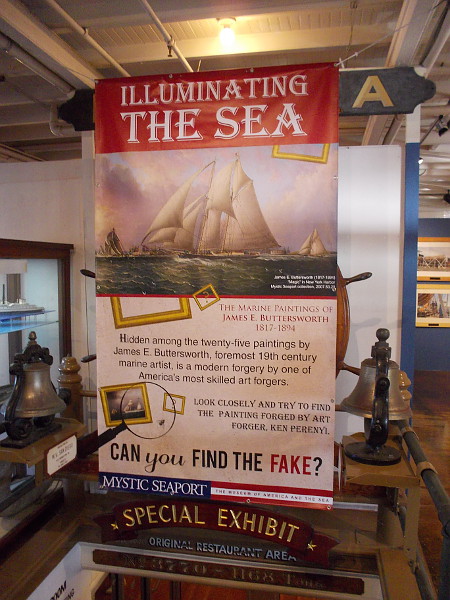
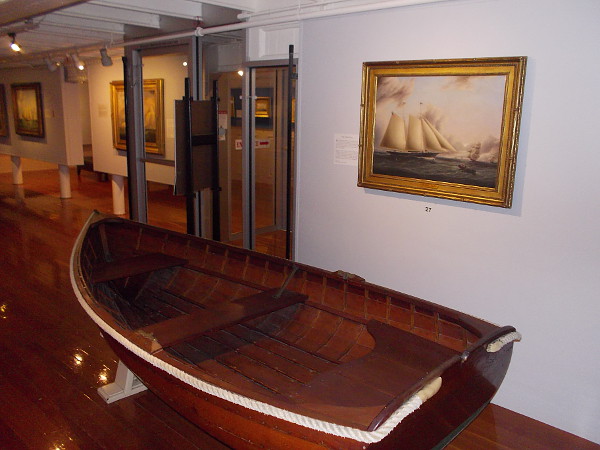
Illuminating the Sea: The Marine Paintings of James E. Buttersworth, 1817-1894. This very special exhibit can be seen at the Maritime Museum of San Diego!
Do you love breathtaking works of fine art? Are you fascinated by 19th century history? Do you like to feast your eyes on beautiful tall ships, sailing yachts and ocean scenery? There’s a special exhibit in San Diego that you positively must see!
I was surprised to discover that the Maritime Museum of San Diego, located downtown on the Embarcadero, is featuring a fantastic exhibit of marine art masterpieces by the famous painter James Edward Buttersworth. Buttersworth is considered to be one of the most important painters of the nineteenth century. His portraits of tall ships, racing yachts, steamships and other vessels from that era are beautiful works of genius, resplendent with light, energy and grace. About 600 of his classic paintings exist today, and the Maritime Museum has 24 amazing examples on display!
The exhibition is titled “Illuminating the Sea: The Marine Paintings of James E. Buttersworth, 1817-1894.” The collected paintings, on loan from Mystic Seaport until May 31, 2016, are so dynamic, detailed and glowing with beauty, they’ll make a permanent impression in your mind. His images of sky and sea are realistic and alive. Colors are rich and subtle; stormy waters seem to spray off a painted canvas; white sails shine. Several paintings depict yachts racing together, engaged in historic competitions that include the America’s Cup, an event that became important in San Diego’s more recent past.
Another interesting aspect of the exhibition is the inclusion of a modern Buttersworth forgery by Ken Perenyi. Visitors to the museum can become a detective, and do their best to uncover the cleverly made fake!
Go enjoy this exhibit of rare, fantastic paintings, then prepare to spend a good hour or two exploring the many historic ships owned by the Maritime Museum of San Diego. You’ll find yourself within a magical world. A world that gently floats upon shining water, alive with history, adventure, beauty and wonder!
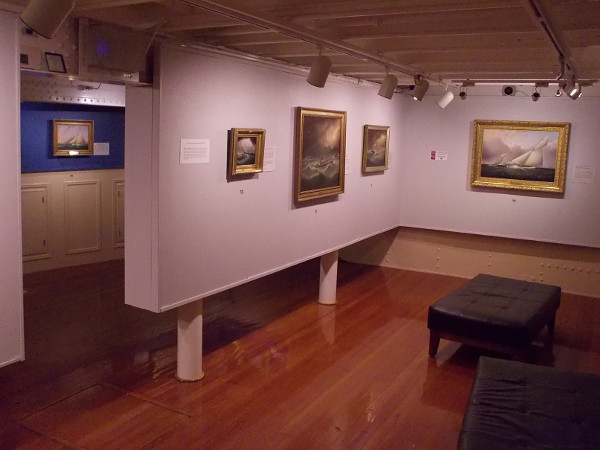
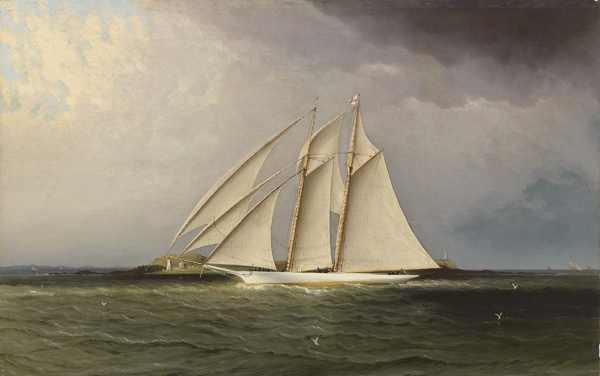
Among the classic maritime paintings of world-famous artist James E. Butterworth is a forgery. Visitors to the museum are challenged to spot it!Truly stunning works of art on display inside the steam ferryboat Berkeley, hub of the Maritime Museum of San Diego.Illuminating the Sea, James E. Butterworth, oil on canvas. Magic, schooner of New York Yacht Club, winner of the America’s Cup in 1870. Photo credit: Wikimedia Commons.In addition to this world-class art, the Maritime Museum of San Diego contains a vast collection of nautical objects. It is a must-see destination for those interested in our city’s rich history.
Here are a couple bonus photographs! I took them this morning during a short walk before heading to work!
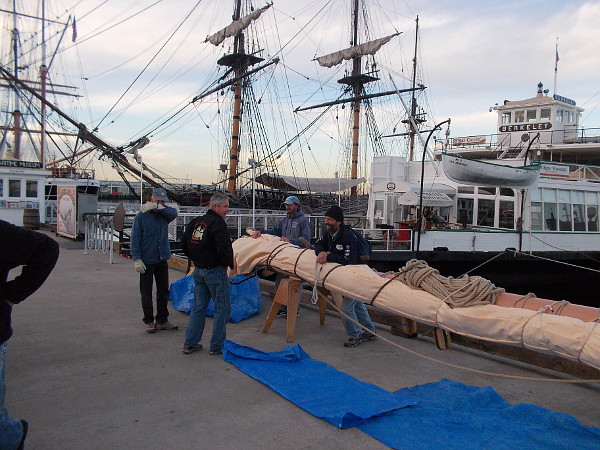
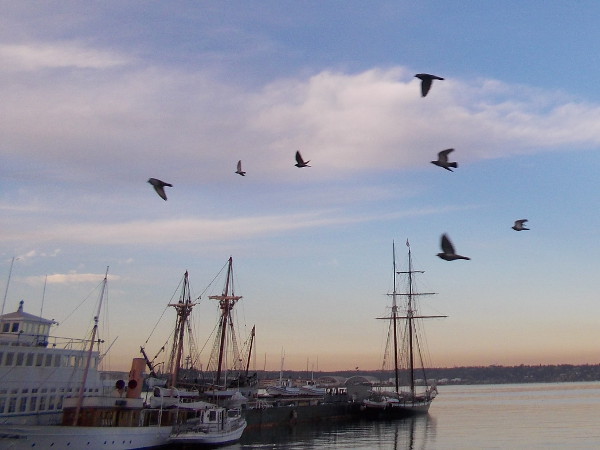
Museum volunteers gather around a ship’s yard. It would soon be lifted by crane onto the nearly-completed Spanish galleon replica San Salvador.Tall ships San Salvador and Californian docked behind the Berkeley. Just a few of the fascinating ships you can visit at the Maritime Museum of San Diego.
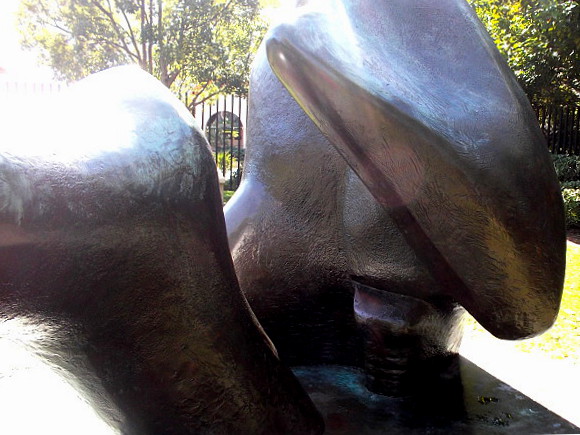
Altered photograph of a Henry Moore sculpture, located in San Diego Museum of Art’s popular sculpture garden.
Oh, no! Here come some “artsy” photos!
Today I walked through Balboa Park’s beautiful May S. Marcy Sculpture Garden. The grassy space, which is free to the public, contains several pieces of artwork belonging to the San Diego Museum of Art’s collection.
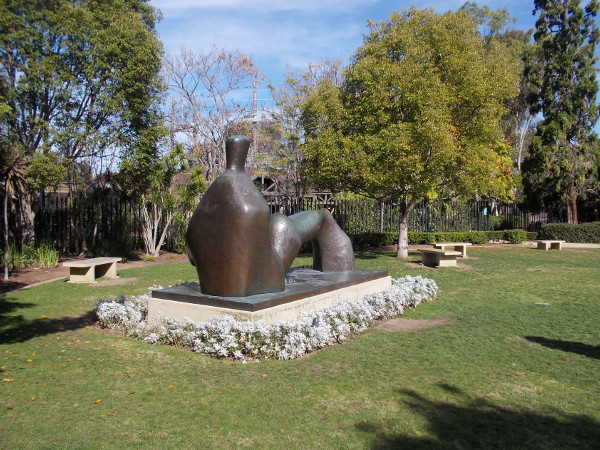
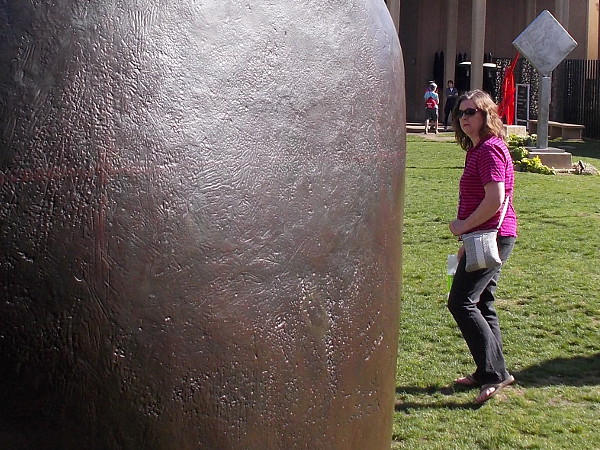
The garden’s most recognized sculpture is probably Reclining Figure: Arch Leg, which was created in 1969 by renowned British Modernist artist Henry Moore.
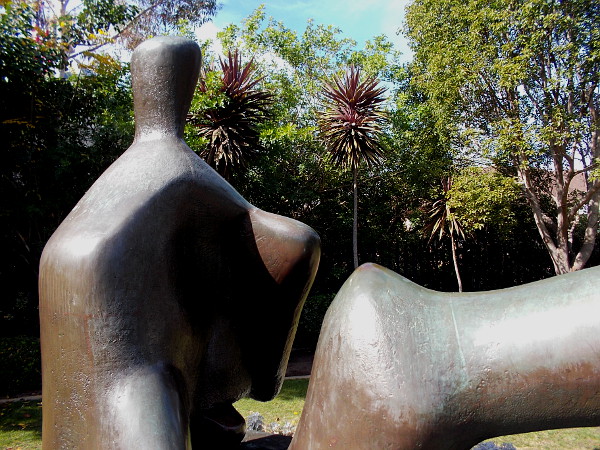
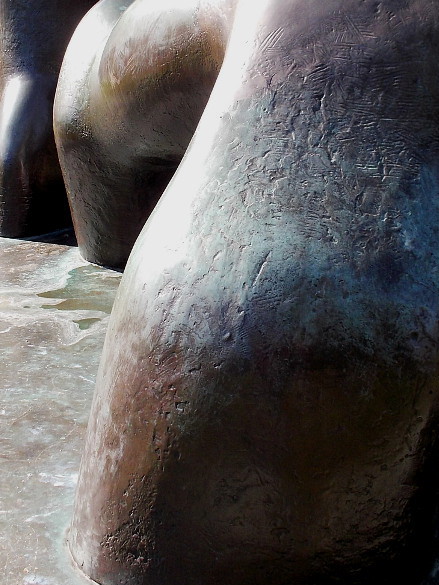
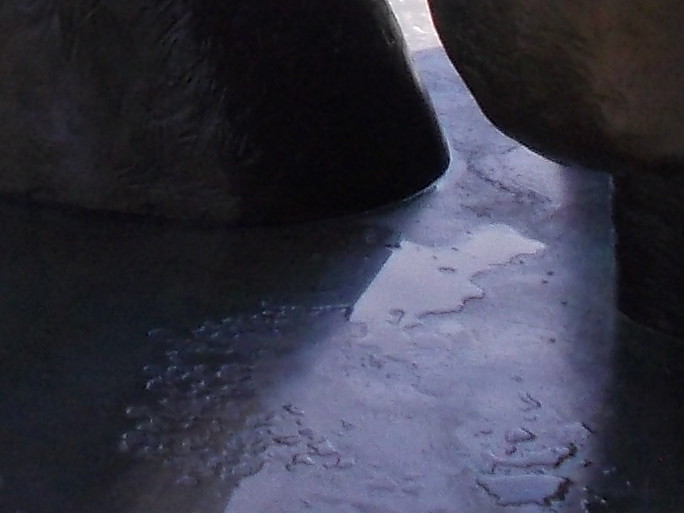
As I walked around the curvaceous sculpture, it occurred to me that different interesting photos could be taken depending on the angle and perceived distance. So I engaged in a bit of experimentation!
(Fear not! I didn’t touch the sculpture or step on the flowers! But I did lean over like crazy–and minutely cropped some images– to get the “close-up” images.)
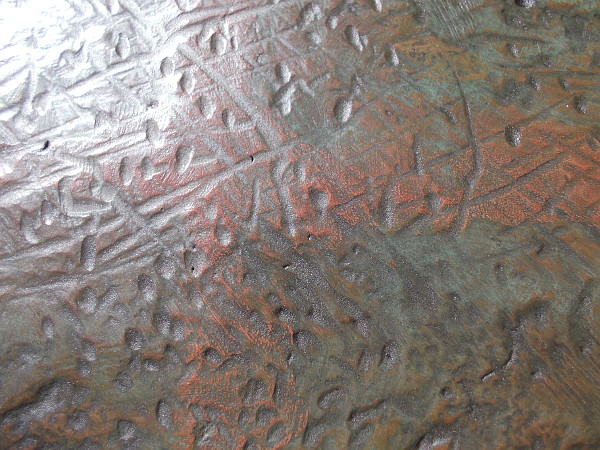
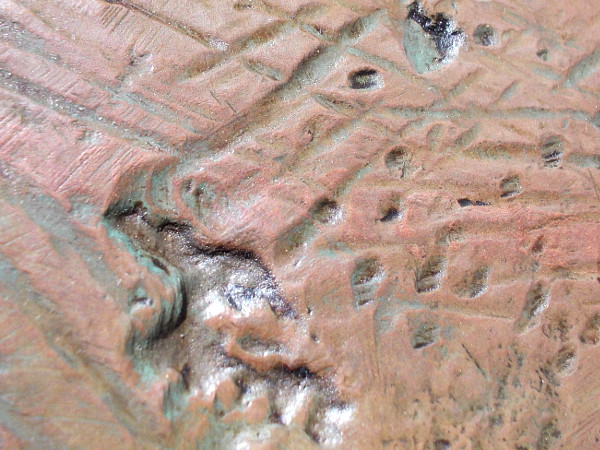
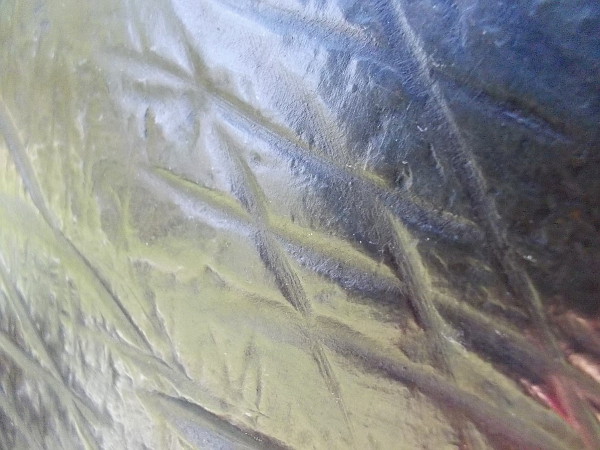
Henry Moore’s 1969 bronze sculpture Reclining Figure: Arch Leg, on the grass in the San Diego Museum of Art’s May S. Marcy Sculpture Garden.Sunlit bronze sculpture photographed from a different angle. I adjusted contrast, brightness and sharpness, and cropped according to my eye.Same sculpture, different frame, different paths of reflected light. The physical object is itself unchanged, but has become something new in the mind of the viewer.The Modernist sculpture’s fluid curves and organic quality is suggestive of human form.Raw nature interacts with human art. A camera focuses on nearby details the casual eye might miss.The form of an abstract sculpture becomes more mysterious when the defining outer edges are eliminated with photo editing.A warmly glowing bronze surface, and a pair of eyes.The sculpture’s red-tinged bronze skin reflects Southern California sunlight.A closer view reveals craters and furrows. Small glimpses of beauty within a larger whole.A strangely perfect, silvery surface.Looking up into the light. Both self-contained art and the outer world are composed of the same elements, and can evoke identical wonder.
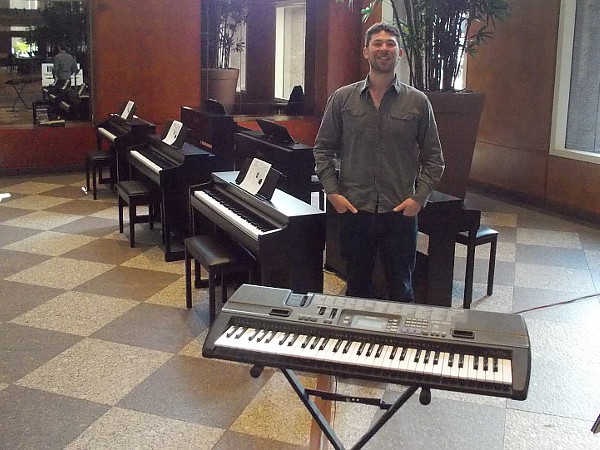
This friendly music instructor would teach lots of kids how to play the piano at Hands On Community Day at the San Diego Symphony!
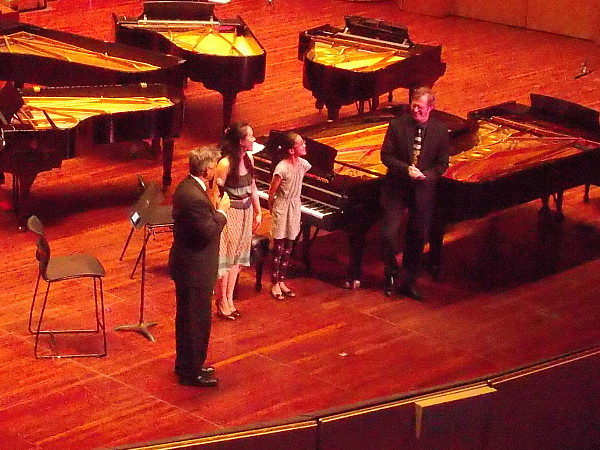
Today I enjoyed a beautiful hour at the San Diego Symphony. I arrived at noon to listen to a free public concert, which was just the first part of the five hour Hands On Community Day event. Later on, after I left for my walk, there were additional performances, and kids were taught how to play the piano by world-class musicians!
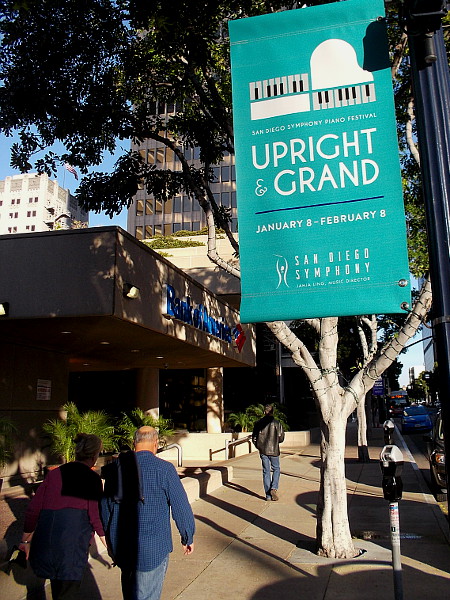
The San Diego Symphony is celebrating the piano during an ongoing Upright and Grand festival, which continues through February 8. If you haven’t been to a concert at Copley Symphony Hall, I assure you it’s a magical, wonderful experience!
Please enjoy a few photos and read the captions for explanations…
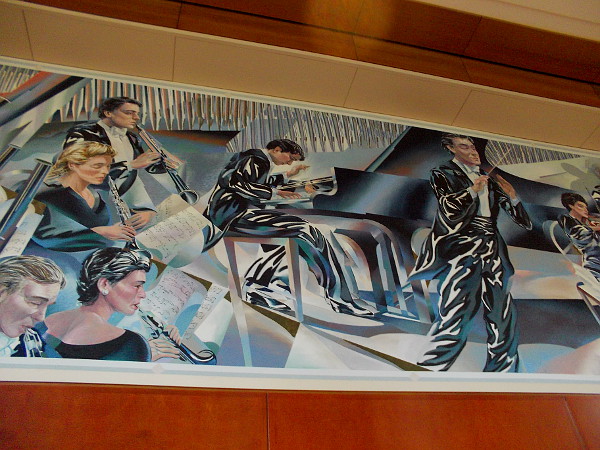
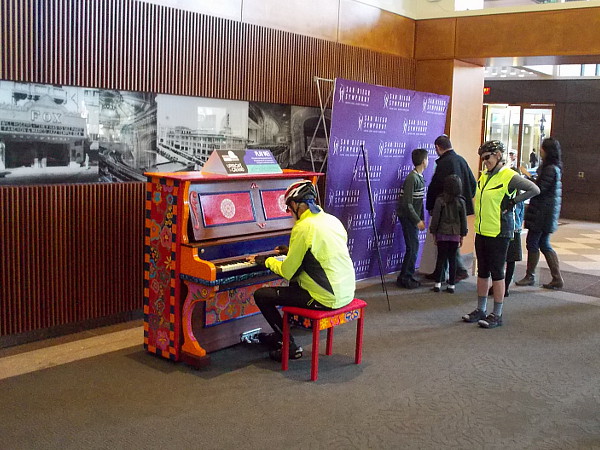
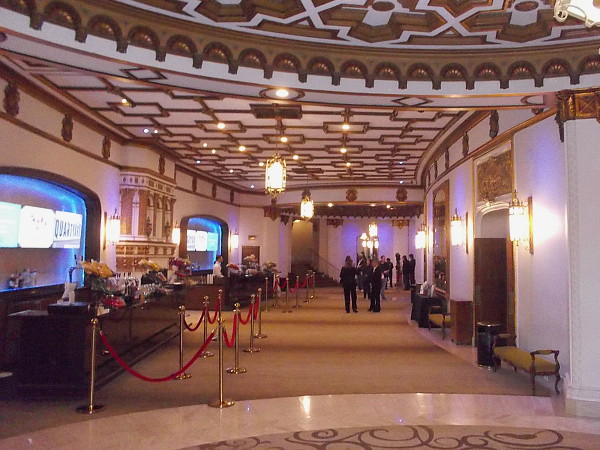
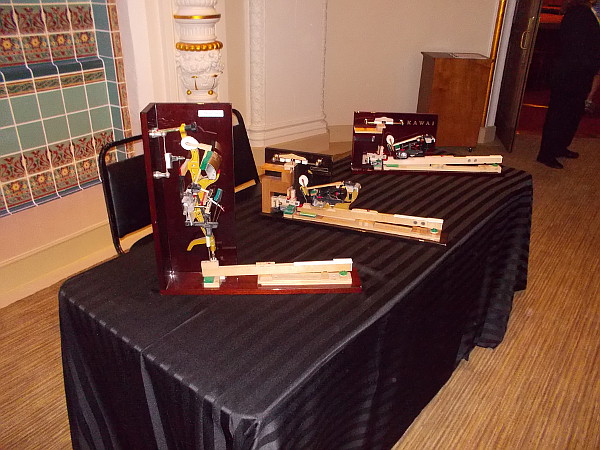
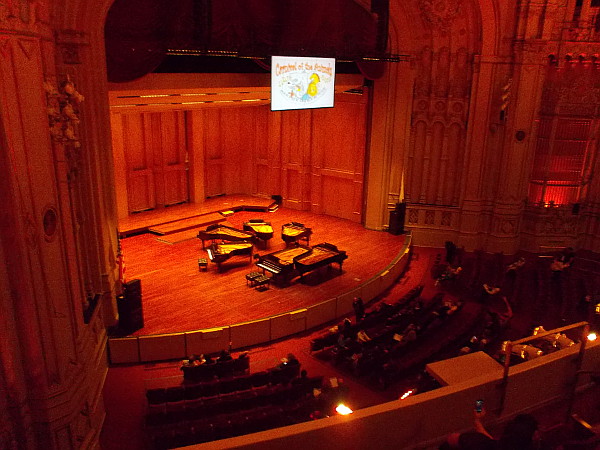
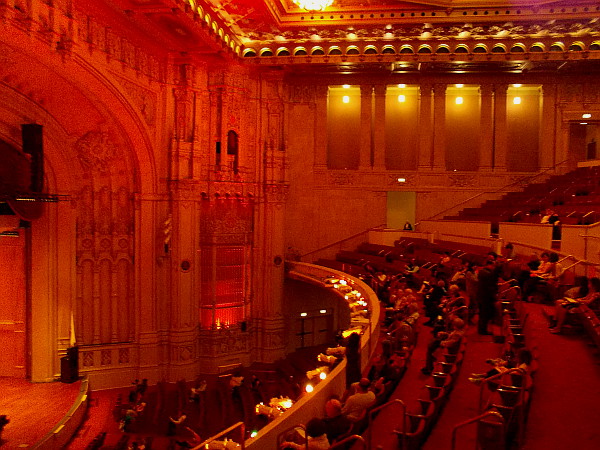
The San Diego Symphony’s Upright and Grand festival is a month-long event that celebrates the piano.Fantastic mural in lobby of Symphony Towers depicts an orchestra, including a pianist.Some bicyclists stopped by to play the public upright piano in the lobby of Symphony Towers near the box office.A vintage photo in the lobby shows the Fox Theatre, built in 1929, now Copley Symphony Hall. A modern skyscraper called Symphony Towers was built over and around the old theatre in 1989.Inside the elegant, historic Copley Symphony Hall. I arrived early to the Hands On Community Day, so there are few people in this photo.One table had samples of a piano key’s inner workings. Later on I saw lots of families and kids examining these with interest.A representative for the San Diego International Piano Competition for Outstanding Amateurs had a table outside the concert hall.Six grand pianos were set up on the stage. I enjoyed the first hour of the event, which featured The Carnival of the Animals by composer Camille Saint-Saens, with poems by Ogden Nash.Looking up inside the concert hall. A friendly usher told me there’s a winding staircase in the huge chandelier! Girls used to toss rose petals onto the audience, once upon a time long ago.People are arriving for the big San Diego Symphony free event, part of their Upright and Grand festival!After the first hour’s concert is over, the audience applauds narrator Dave Scott and amazing pianists Jessie Chang and Bryan Verhoye!
























 Cool San Diego Sights!