People on patio behind Visitor Center take in a breathtaking panorama.View from Cabrillo National Monument Visitor Center scenic overlook. Downtown San Diego is visible to the east.
Last Sunday, after I checked out the new Yankee Baleeiros whaling exhibit in the Visitor Center, I wandered about Cabrillo National Monument and took in the many beautiful views. My camera was very busy!
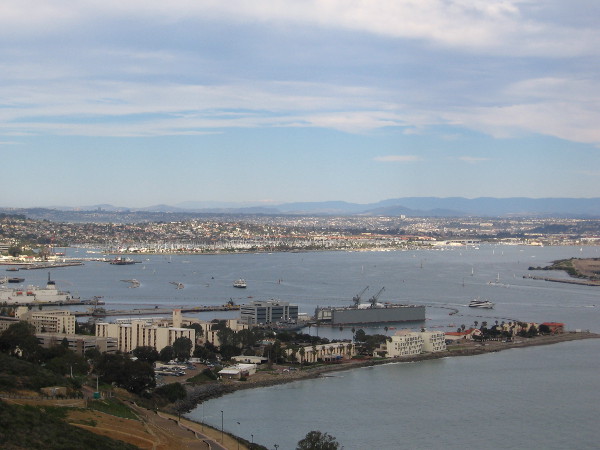
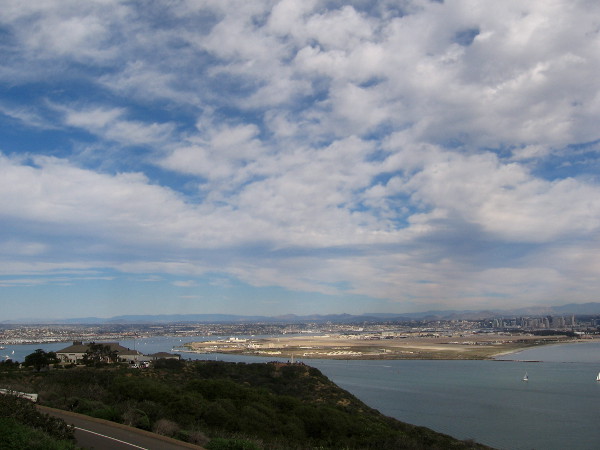
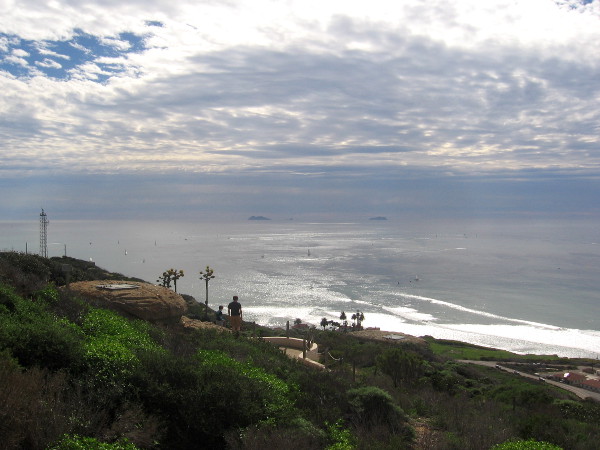
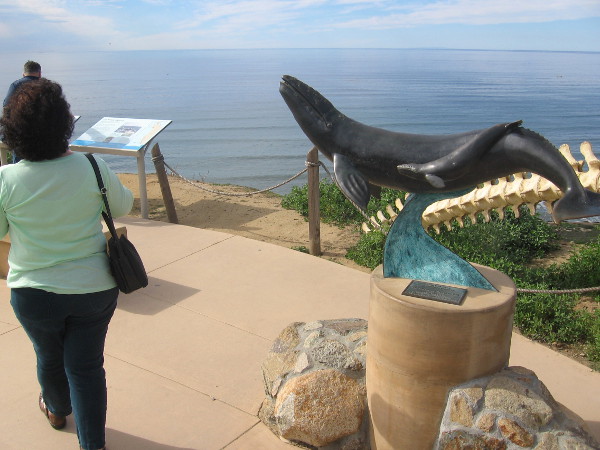
Tall ship America sails south down the channel out of the bay and into the open ocean.Looking out over San Diego Bay. Shelter Island lies in the distance beyond Naval Base Point Loma.One of many interesting signs. This one shows typical commercial and pleasure craft seen on the water below.Statue of explorer Juan Rodriguez Cabrillo at a popular lookout spot.Naval Air Station North Island seems to glow beyond the Cabrillo National Monument Visitor Center building.I took lots of photographs while climbing up through native coastal vegetation toward the beautiful Old Point Loma Lighthouse.Looking southwest over two World War II bunkers toward the distant Coronado Islands, which are a part of Tijuana, Mexico. The new lighthouse is down by the water.People gaze out at the beautiful sky and ocean from a popular whale-watching point.Gray whales migrate past Cabrillo National Monument from December through April. Spouts are often seen from here!Sculpture of a gray whale and a cetacean’s vertebrae along walkway that leads from the old lighthouse.Looking northwest toward the tidepools below and Pacific Ocean breakers.
…
To enjoy future posts, you can “like” Cool San Diego Sights on Facebook or follow me on Twitter.
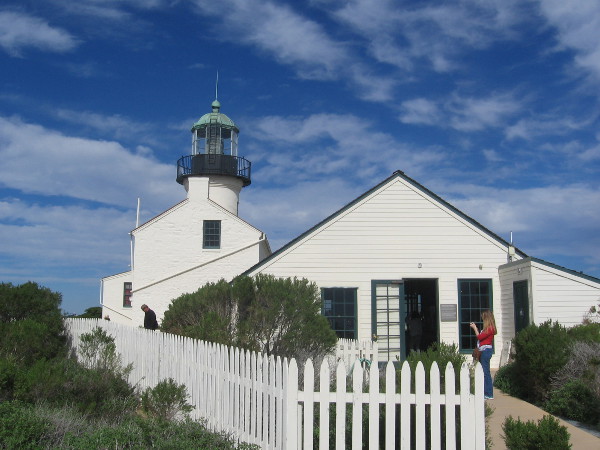
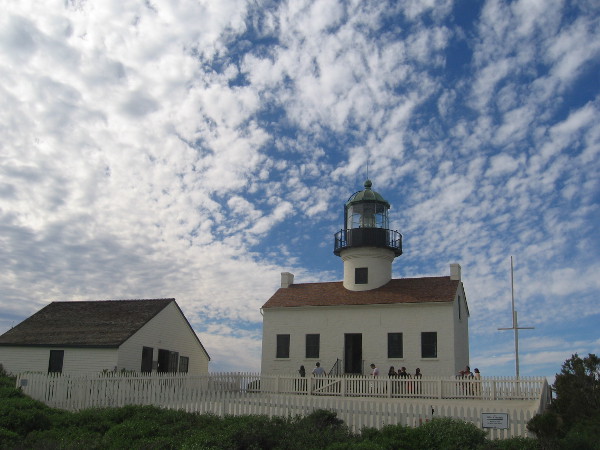
Looking up at the Old Point Loma Lighthouse in Cabrillo National Monument.
Everyone likes to explore the Old Point Loma Lighthouse. You can climb up the winding staircase and peer into several interesting rooms where the lighthouse keeper and his family lived. But the small museum in the nearby assistant keeper’s quarters contains the true marvels of science and art. Come inside and let us have a quick look!
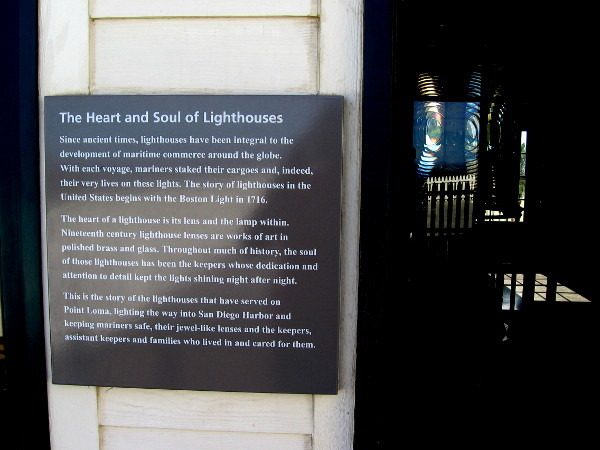
The assistant keeper’s quarters next to the lighthouse today contains a small museum.Sign outside lighthouse shows huge Fresnel lens which guided ships with focused light 400 feet above sea level.Sign at entrance to museum. The heart of a lighthouse is the lens and lamp. 19th century lenses are works of art made of polished brass and glass.
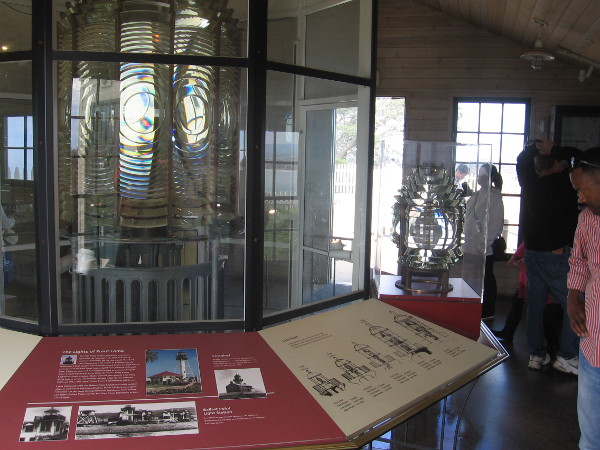
The highly polished Fresnel lenses utilized by lighthouses are beautiful objects. They refract and reflect light, creating prismatic colors when viewed from certain angles. It’s almost a miracle that a small flame in a lamp can be magnified to the extent that ships far out at sea can easily see it and be guided to safety. Light intensified by lenses in this museum could be seen 18 to 24 miles away!
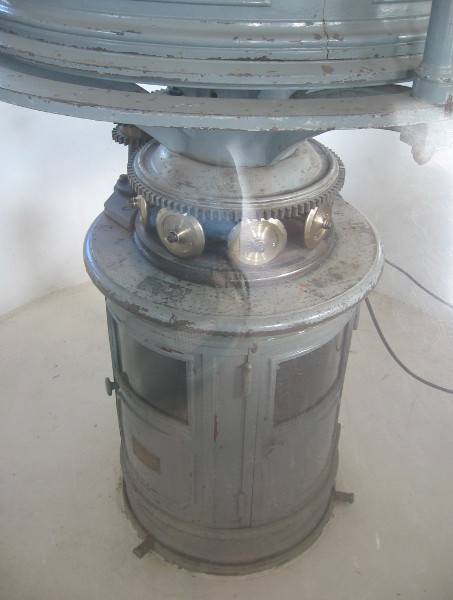
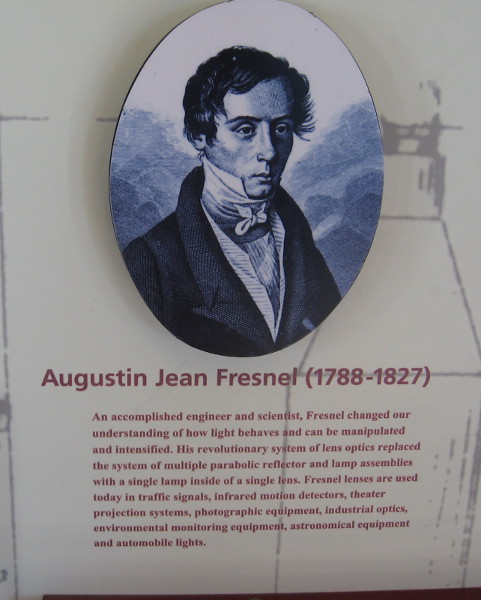
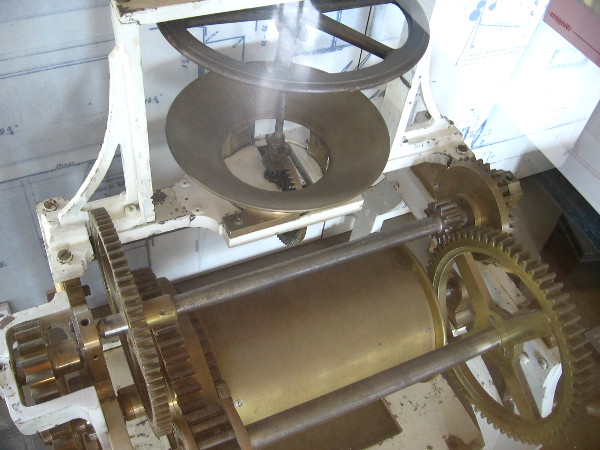
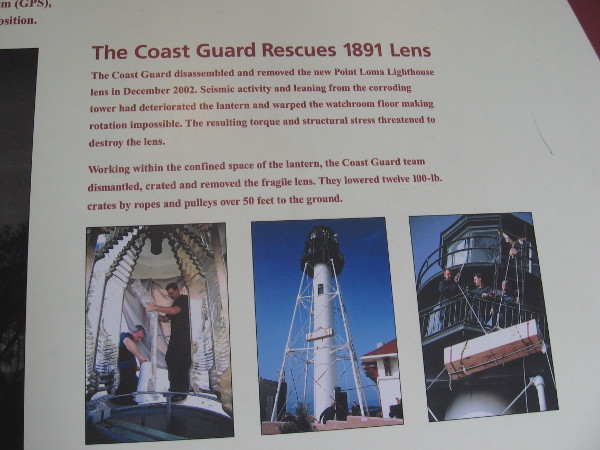
This 3rd Order Fresnel lens was used by the New Point Loma Lighthouse, built in 1891 down by the water.An optical wonder, this huge lens is an amazing, highly polished light bender.Diagram shows how a complex Fresnel lens functions.The base of the heavy Fresnel lens with chariot wheels visible.There are different orders of size, as illustrated in this display.Augustin Jean Fresnel (1788-1827) was an accomplished engineer and scientist. Fresnel lenses are used in many modern applications today.Small museum by Old Point Loma Lighthouse contains various very cool exhibits.This small 5th Order lens lighted the Ballast Point Lighthouse from 1890 to 1960.Log book of daily expenditures for oil, wicks and chimneys.This clockwork of gears slowly turned the light above.The keeper’s service box contained cleaning supplies and delicate tools for maintaining the lamp.The Coast Guard removed this large Fresnel lens from the New Point Loma Lighthouse in 2002.Looking at the iconic Old Point Loma Lighthouse and small museum beside it.
…
To enjoy future posts, you can “like” Cool San Diego Sights on Facebook or follow me on Twitter.
Looking out the rear of the Cabrillo National Monument Visitor Center on a beautiful day.
I saw on the morning news that an important exhibit was opening today in the Cabrillo National Monument Visitor Center. I haven’t been up that way since I blogged about the park’s centennial, so I figured I’d go check things out!
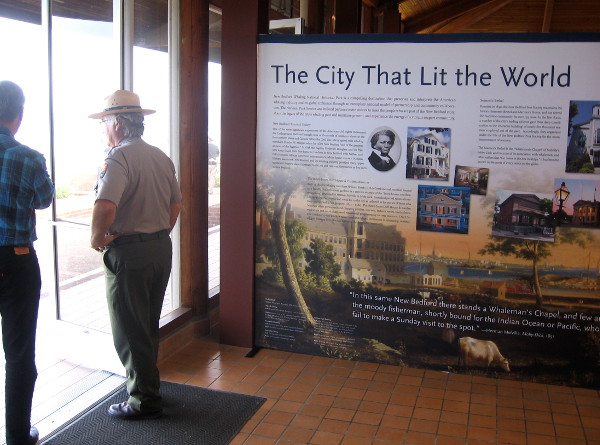
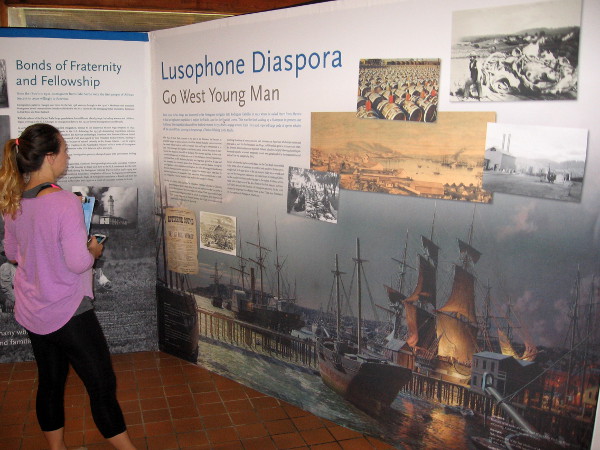
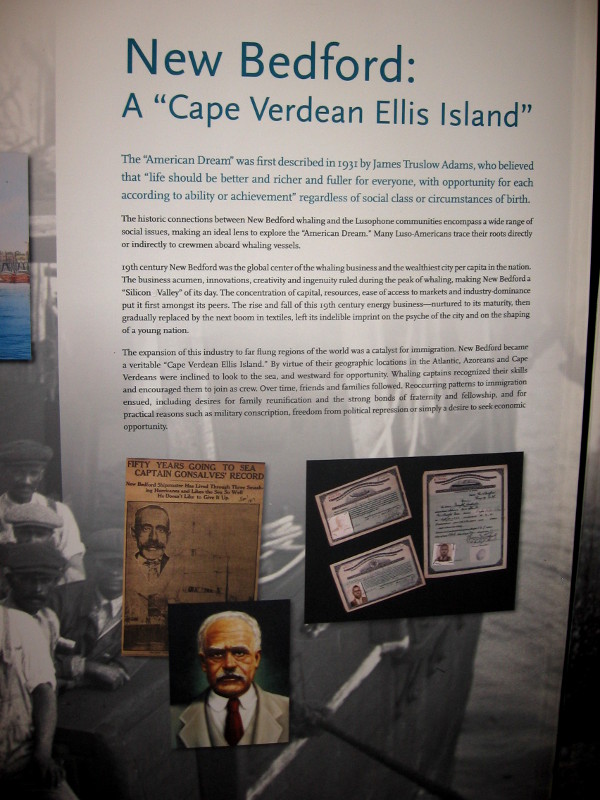
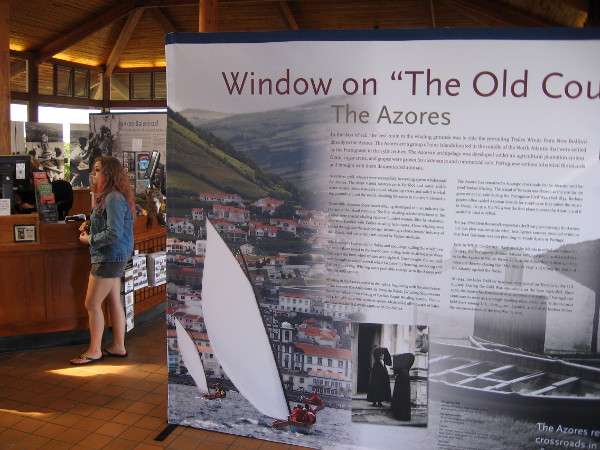
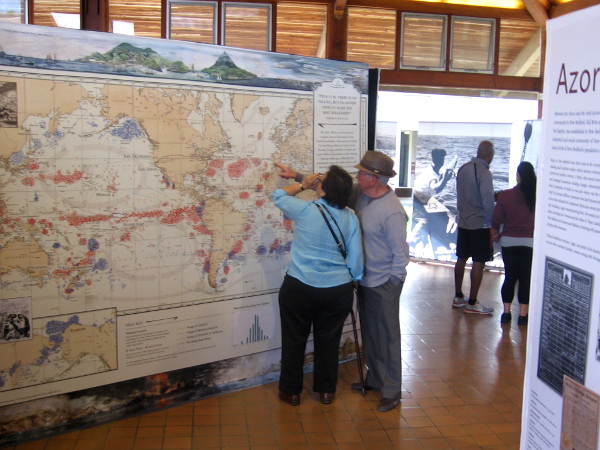
The traveling exhibition is called Yankee Baleeiros! The Shared Legacies of Luso and Yankee Whalers. That’s quite a long title, but it’s fitting for the epic displays that occupy about half of the sizable visitor center. Developed by the New Bedford Whaling Museum, the exhibit “celebrates the interwoven Luso-American stories of the Azorean, Cape Verdean, and Brazilian communities in the United States from early immigration in the 18th century through the latter half of the 20th century.” Sounds like a long and tedious thesis! But it’s actually fascinating! Basically, it shows the rich history of Portuguese speaking whalers in the Northeast, primarily New Bedford, and how they interacted with Yankee whalers.
As San Diego is one of the world’s best places to encounter a large variety of whale species, and as this is the season for migrating gray whales, the exhibit is more than appropriate. The displays also address how whaling techniques evolved over the years, the success of modern conservation efforts, and how whale-watching is now a much larger industy than whaling.
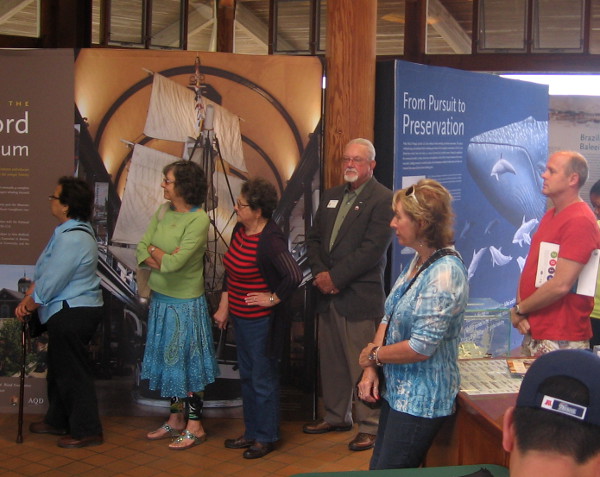
After listening to a short opening presentation by Park Superintendent Tom Workman and Christina Connett, PhD, Curator of Collections and Exhibitions at the New Bedford Whaling Museum, I headed out to Cabrillo’s excellent Pacific Ocean viewing areas to scan the horizon for spouts. I didn’t see any, but there were a bunch of boats off Point Loma whale-watching on this sunny Sunday afternoon. I got more pics from my visit coming, so stay tuned!
If you haven’t been to Cabrillo National Monument in a while (or ever), head on over! The special exhibit will be on display through April 12, 2015.
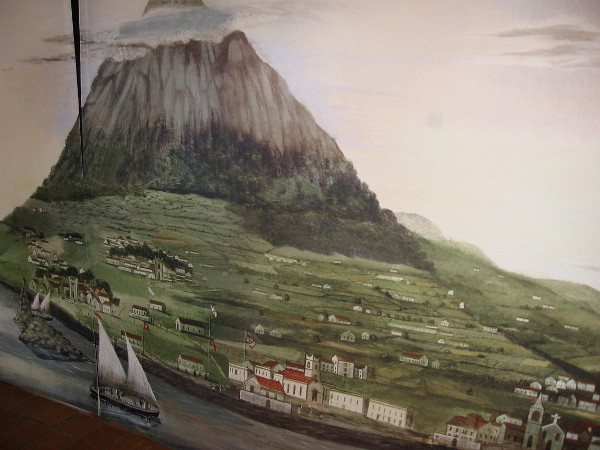
Park Superintendent Tom Workman talks while Christina Connett of the New Bedford Whaling Museum listens.People listen to presentation at opening of Yankee Baleeiros whaling exhibit.Displays recount the history of Lusophone (Portuguese-speaking) whalers in America.New Bedford was the major port for whalers in the Northeast.Inside the visitor center is a section of the 1848 Grand Panorama of a Whaling Voyage ‘Round the World by Benjamin Russell and Caleb Purrington.
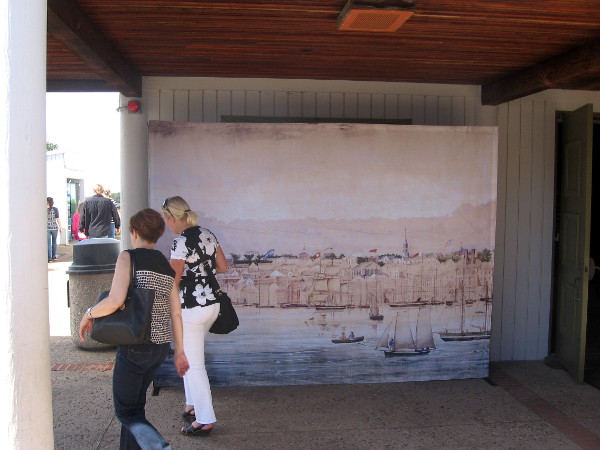
Portions of the 1848 Grand Panorama of a Whaling Voyage ‘Round the World by Benjamin Russell and Caleb Purrington were on display inside and outside the visitor center. The complete work is 1,275 feet long and eight and a half feet tall! It’s believed to be the longest painting in the world! The piece went on a national tour shortly after completion, and appeared at the 1964 New York World’s Fair! Cool!
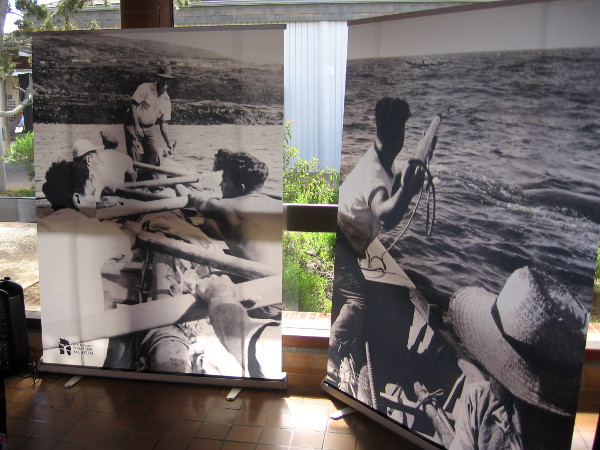
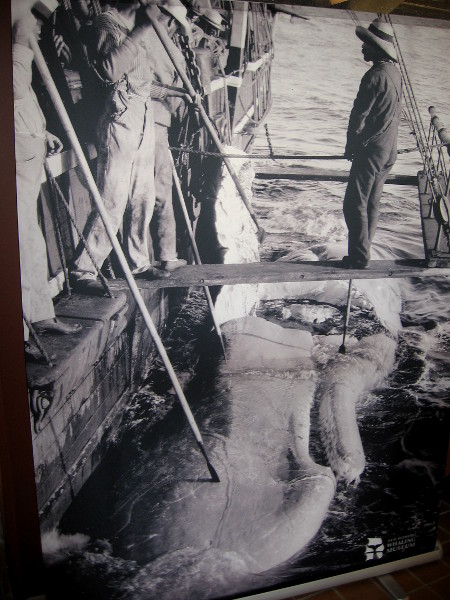
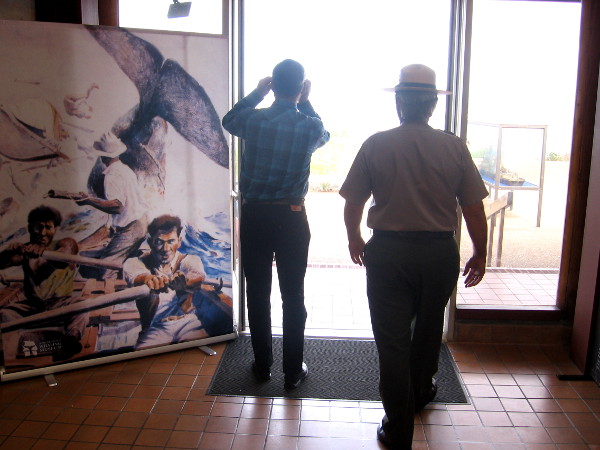
The fantastic displays are museum quality and extremely informative.Photos of sailors rowing out to hunt whales, and a harpooner at the ready.A dead whale is hauled to the ship’s side and stripped of blubber by many hands.People point out spots on a map of historical whaling grounds.The opening presentation is over and folks head out to take in the many sights around Cabrillo.Is there a whale out there? Probably not. This back door faces San Diego Bay!
…
To enjoy future posts, you can “like” Cool San Diego Sights on Facebook or follow me on Twitter.
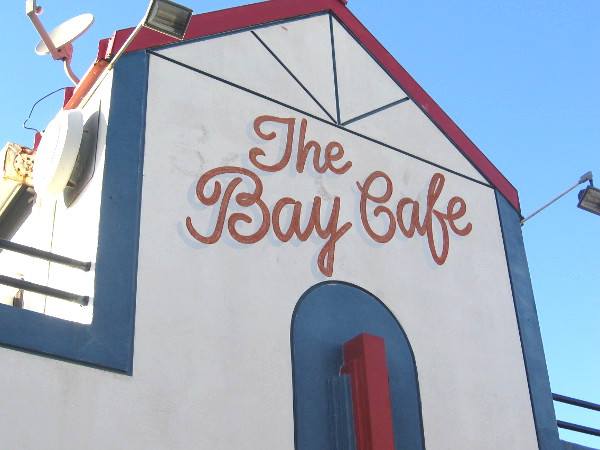
The Bay Cafe is making way for an observation platform on San Diego Bay.
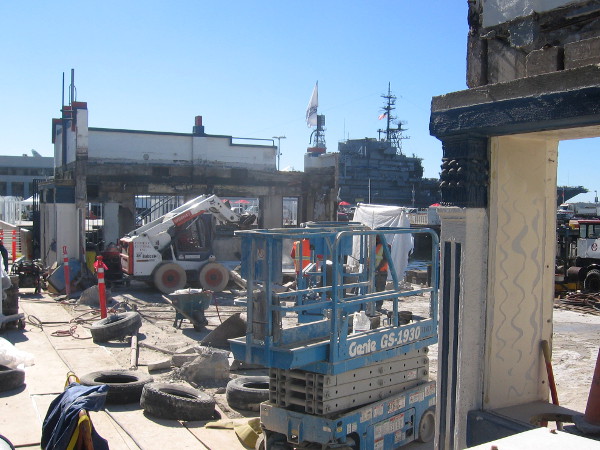
The Bay Cafe is almost gone.
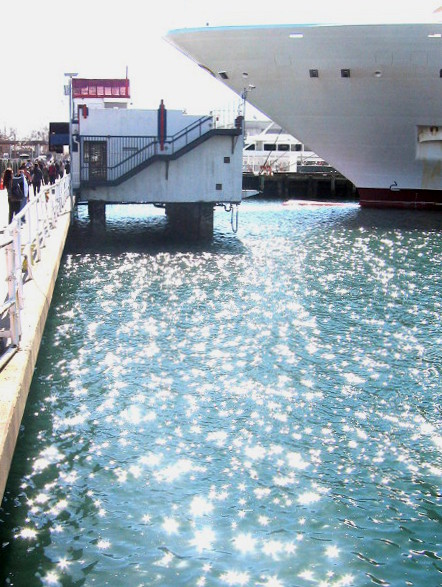
Many years ago, I loved to grab some food in the small waterfront cafe and bring it up onto the rooftop. From a table beneath an umbrella, I’d gaze out at the sparkling water. I’d observe passing sailboats, people on the Broadway Pier, and cruise ships docked at the nearby terminal. When two or more huge cruise ships were in port, I’d watch with interest as the departing Coronado ferry and harbor tour boats navigated the narrow space between them. In those days, the Bay Cafe also served as an embarkation hub for San Diego Harbor Excursion, now called Flagship. A ramp from inside the deli plunged down to a floating dock, where a gift shop was housed in a special boat. On this small dock a harbor cruise photographer asked guests to pose by a life preserver.
Up on the roof, if I wanted a change of view, I’d grab another table where I could gaze back toward downtown and watch tourists flow along Harbor Drive. There were almost always several empty tables. Few people seemed to realize the rooftop was open.
The Bay Cafe’s roof was also used for many years by broadcasters covering parades down Harbor Drive. From up there you could see everything.
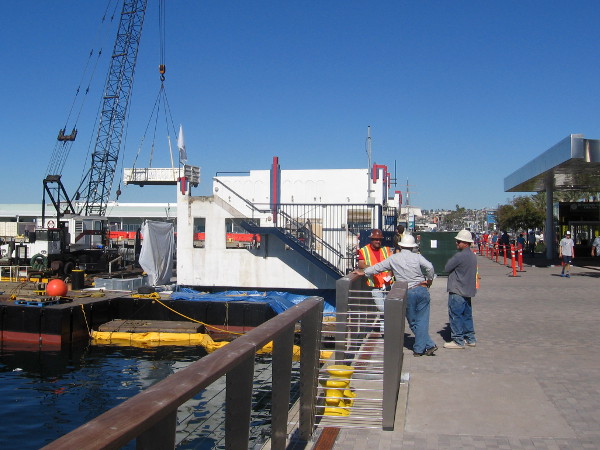
My walk this morning brought back those memories. And a bit of sadness. The Bay Cafe is being demolished as I type these very words. The structure will be removed, but the concrete pad and pilings will remain, as part of an observation platform jutting over the water. It’s just one small part of the Embarcadero’s recent renovation. I’m sure the change will be great. I believe there are supposed to be benches where folks can just sit and enjoy the views. If there are, I’ll surely enjoy them. But time and progress march on. The Bay Cafe is almost just a memory.
Demolition of the old waterfront cafe and harbor tour embarkation hub is underway.Many years ago dining could be enjoyed on the sunny roof, with views of the water, sailboats and downtown skyscrapers.Improvements on the Embarcadero consign this wonderful place to memory.
…
To enjoy future posts, you can “like” Cool San Diego Sights on Facebook or follow me on Twitter.
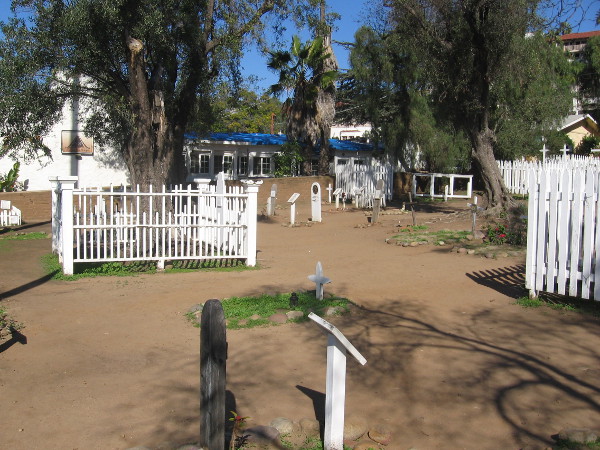
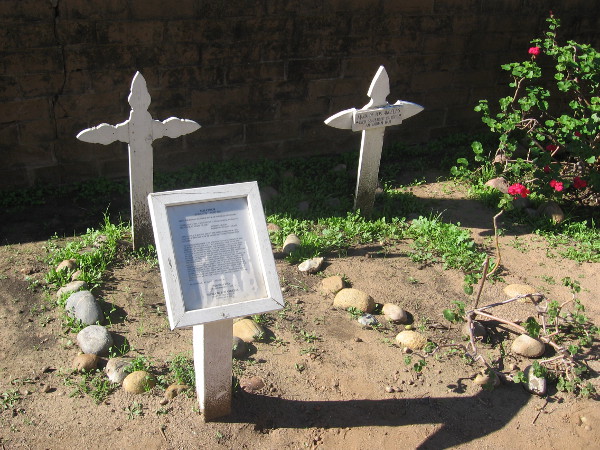
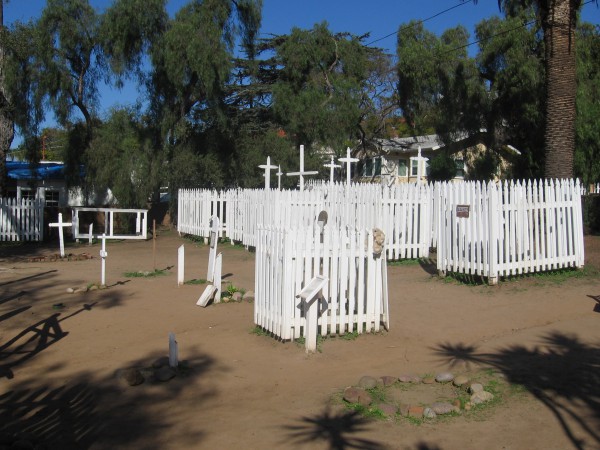
El Campo Santo cemetery in Old Town San Diego contains much history.
El Campo Santo, a cemetery located in Old Town, contains many of San Diego’s earliest residents. By walking respectfully among the gravestones, one can learn much about the city’s interesting history and what life was like for its diverse people. Real-life characters buried here include ranchers, gold miners, sailors, Californios, Native Americans, soldiers, politicians, merchants, actors, children and outlaws.
Established in 1849, the graveyard is the final resting place of nearly five hundred souls. Just a handful are shown in this blog post.
I took photographs of grave sites, headstones and many small signs in the “Holy Field” that describe what is known about the deceased. With a little editing, I’ve provided information here from many of those signs, and from a few other online sources.
Melchior was a Native American who lived to be 97 years old.
Melchior, born 1770, died 1867, age 97 years. Very little is known about the Indian Melchior. He was born a year after the arrival of Junipero Serra in San Diego. He was baptized by the missionaries and became a Roman Catholic Christian. During his long life, he saw San Diego grow from a small pueblo to a city.
Thomas W. Tanner ran an acting troupe that performed at the Whaley House.
Thomas W. Tanner was buried December 22, 1868, age 55 years. He ran an acting troupe that performed on the second floor of the Whaley House in December 1868. Tanner’s troupe offered moral, chaste and versatile entertainment consisting of drama, farce, comedy, singing and dancing. Unfortunately, Tanner died 17 days after his troupe opened. He was married to Policarpia de la Rosa and was a native of Baltimore, Maryland.
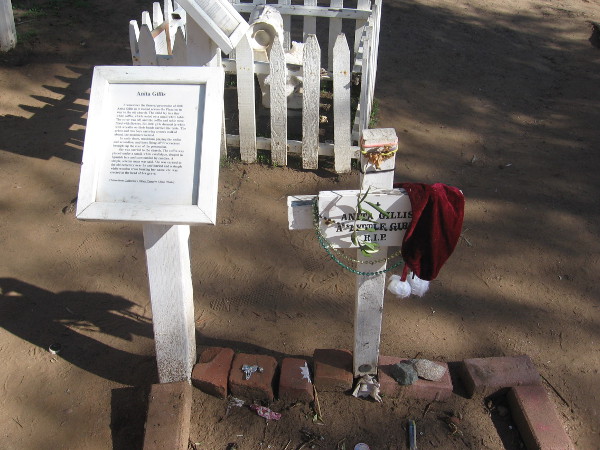
Anita Gillis was a young child.
Anita Gillis was a child when she died. Her funeral is remembered as follows on a plaque by the grave. A funeral procession wound across the Plaza and ended at the old church. The child lay in a tiny white coffin, which rested on a small white table. The cover was off, and the coffin and table were filled with flowers. Six little girls dressed in white with wreaths on their heads carried the table. The priest and two boys carrying crosses walked ahead, the mourners behind. Musicians played the violin and accordion, and boys firing off firecrackers brought up the rear of the procession. She was carried to the church, and the coffin placed under a small white catafalque, draped in Spanish lace and surrounded by candles. A simple, solemn mass was said. She was then carried to the old cemetery and buried with a simple white wooden cross bearing her name erected at the head of her grave.
Juan Mendoza worked on a ranch and was shot in the back.
Juan Mendoza died February 6, 1865. He was the victim of a fatal shotgun blast to the back. The assailant was Cave Johnson Couts, a local landowner and prominent San Diegan born in Tennessee. As the story goes, Mendoza worked as majordomo, or chief steward, on one of Cave Couts’ ranches. Couts claimed that Mendoza had threatened his life and in a hasty act of revenge killed Mendoza in broad daylight. The action violated the legendary “Code of the West” which prohibited “shooting an unarmed man” and “shooting a man in the back”. Couts was tried by jury for his crime and found not guilty. This was received “with much applause” from local citizens since threatening the life of a man, as Mendoza allegedly did, gave Couts the right to stand his ground and kill him.
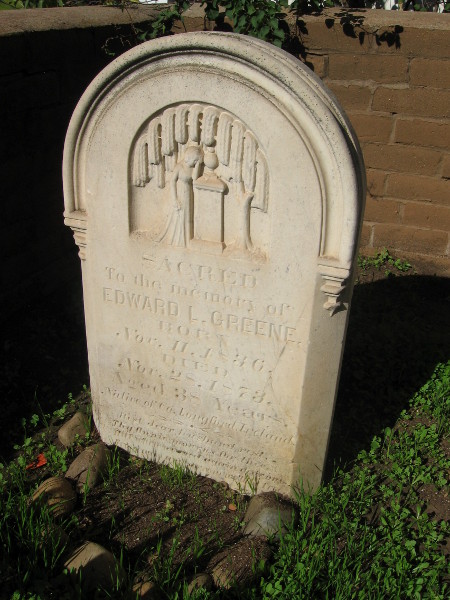
Edward Lynch Greene was a gold miner who became member of the state legislature.
Honorable Edward Lynch Greene died November 28, 1872, age 38 years. He was a native of Ireland who came to California in 1852 and was a miner for gold. He was naturalized in 1861. He became a member of the state legislature when he was elected to the Assembly from Calaveras County in 1869. He was staying in San Diego at the Era House when he died of consumption. He’d been ill for the past eighteen months. He left behind a young wife, Ann Greene.
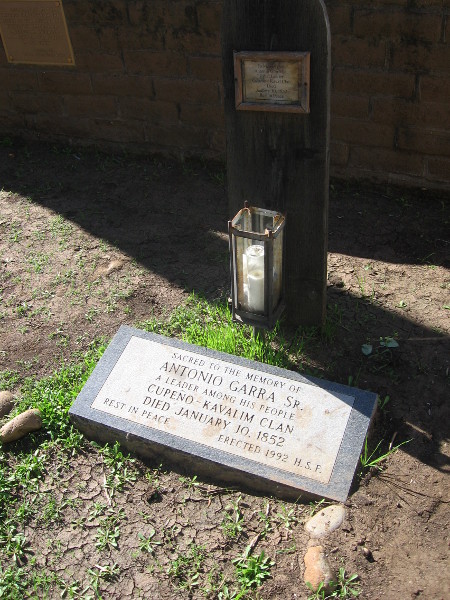
Antonio Garra Sr. was a Native American who rebelled against taxation.
Antonio Garra Sr. died January 10, 1852. He was a leader among his people, the Cupeno-Kavalim Clan. He was educated at Mission San Luis Rey and spoke as many as five Indian dialects, as well as Latin. He was one of the foremost chiefs with great power and influence among his people. The Cupeno were considered mission Indians and were subject to pay taxes in San Diego County. Garra, upset by the taxation of his people, helped to organize a resistance movement, comprised of attacks on Santa Barbara, Los Angeles and San Diego. Against his wishes, a fatal attack was made on Warner’s Ranch. He was soon thereafter captured. On January 10, 1852 Garra was found guilty of murder and theft, but not treason, as he had never taken an oath of allegiance to the United States. Before being executed by firing squad, Garra said in his last words: “Gentlemen, I ask your pardon for all my offenses, and expect yours in return.” Antonio Garra, Sr. is believed to be buried underneath what is now San Diego Avenue.
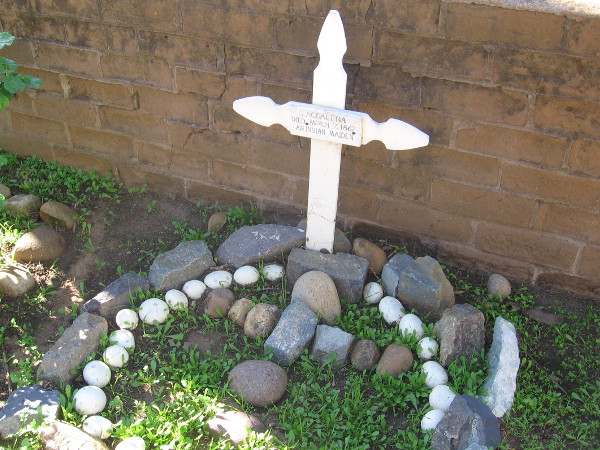
Magdalena was a Native American young lady.
Magdalena was an Indian maiden who died on March 7, 1867 at age 21.
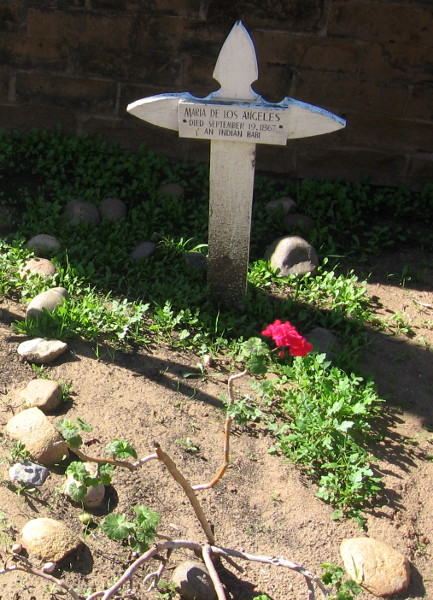
Maria de los Angeles was a Native American infant.
Maria de los Angeles was an Indian infant who died September 19, 1867.
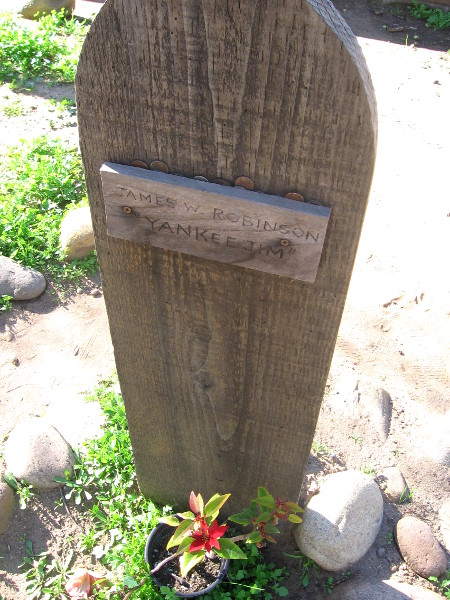
Yankee Jim was hung for stealing the only rowboat in San Diego Bay.
James W. Robinson was known as Yankee Jim. He suffered an extreme penalty for stealing the only rowboat in San Diego Bay. He was sentenced to be hanged. He couldn’t believe that he would be hanged until the very last moment. He appeared to think it was all a grim joke, or at worst, a serious effort to impress him with the enormity of his evil ways. He was still talking when the deputy sheriff gave the signal. Yankee Jim converted to the Roman Catholic Church prior to his death, and so was given the baptismal name of Santiago (Spanish for James). His godfather was Philip Crosthwaite, the deputy sheriff who gave the signal for his execution.
Rosa Serrano de Cassidy and her husband owned a rancho in Pauma.
Rosa Serrano de Cassidy died February 10, 1869, age 21 years. She was the first wife of Andrew Cassidy (a native of County Cavan, Ireland) who helped establish and operate the U.S. tidal gauge in La Playa (in present day Point Loma). Rosa was the daughter of Jose Antonio Serrano who served under Pio Pico in the Mexican War and was in the battle of San Pasqual. Rosa and her husband owned a rancho in Pauma. Her headstone is one of the few remaining originals in the cemetery. After cracking during an earlier restoration, it was placed flat on the ground in order to preserve it.
Don Miguel was a native of Spain, and one of the founding fathers of California.
Don Miguel Telesforo de Pedrorena died March 21, 1850. Don Miguel was a native of Spain, belonging to one of the best families of Madrid. After receiving an education in his own country, he was sent to London, where he was educated in English. In 1845 he settled in San Diego. He married Maria Antonia Estudillo, daughter of Jose Antonio Estudillo, and the two had four children. They built their casa behind the Estudillo home. It was one of the first framed houses in Old Town, and still stands beside the San Diego Union print shop. Don Miguel became a leading merchant and citizen of old San Diego. He served as a delegate to the State’s Constituional Convention at Monterey in 1849 and became one of the founding fathers of California.
Juan Maria Marron was a ship’s captain who became prominent politically.
Juan Maria Marron, born 1808, died at the age of 45. He was a ship’s captain before coming to San Diego in the early 1820’s. He was the owner of 13,311 acres called Rancho Agua Hedionda, which extends from modern day Vista to Carlsbad. He became prominent politically when he married Dona Felipa Osuna in 1834. She was the daughter of Juan Maria Osuna, who was the first alcalde of San Diego and the owner of Rancho San Dieguito. During the Mexican-American War, Marron supported the Americans against many of his Mexican friends. He was captured by Californios who threatened to execute him, but he was released, and his rancho was stripped of horses and cattle.
Jayme Lyons was the son of a carpenter, merchant, blacksmith and sheriff.
Buried November 28, 1859, age 4 years, Jayme was one of probably thirteen children of George and Bernarda Lyons. Jayme’s father was a native of Donegal, Ireland, who came to San Diego in 1847. He had been a carpenter on a ship that came around Cape Horn from New Bedford, Massachusetts. He kept a store in Old Town, owned a blacksmith shop, and was sheriff for two terms. Jayme’s mother was Bernarda de Villar, the daughter of Lieutenant de Villar, who at one time was the Commandant of the San Diego Presidio.
Bill Marshall and Juan Verdugo were hanged nearby.
Bill Marshall and Juan Verdugo were hanged on December 13, 1851. Bill Marshall was an American married to the daughter of a local Indian chieftain. He was a renegade sailor from Providence, Rhode Island, who’d deserted from a whaling ship at San Diego in 1844. After taking up habitation with the Indians, he took an active part in the Garra Indian uprisings in 1851. He and the Indian Juan Verdugo were caught and brought back to San Diego to be promptly tried by court martial. Both were found guilty. The Indian acknowledged his guilt, but Marshall insisted he was innocent. At two o’clock in the afternoon, a scaffold was erected near the old Catholic cemetery, the men placed in a wagon, the ropes adjusted about their necks, and the wagon moved on, leaving them to strangle to death.
Rafael Mamudes worked at chopping wood and digging wells. He dug the graves for the people of Old Town
Rafael Mamudes was a Native American born in Hermosillo, Mexico. He was a baker in Monterey, a miner in Calaveras County, and made a sea voyage to Guaymas. He owned a little plot of land in San Diego where the old jail stands. Legend has it he made a murderous attack upon his wife. To do penance, the priest gave Rafael the task of ringing the church bells when the occasion demanded. Rafael worked at chopping wood and digging wells. He dug the graves for the people of Old Town. He never missed a church service.
Jesus was a Native American who died of a blow to the head while drunk.
Jesus, an Indian, passed away December 15, 1879, age 25 years. He died of a blow to the head without receiving sacraments. According to the priest Juan Pujol, he was said to be drunk, so he was buried near the gate of the cemetery.
Hundreds of varied, rich life stories were concluded here in this early San Diego cemetery.
…
To enjoy future posts, you can “like” Cool San Diego Sights on Facebook or follow me on Twitter.
Scooter with fringed canopy zooms past as I swing my camera to capture a sudden morning photo.
Here are a few interesting photos from another meandering walk downtown. I took these yesterday morning as I headed down from Cortez Hill to catch the trolley at the Santa Fe Depot. I know, there are closer trolley stations, but I was itching to venture outside into the world and got an early start…
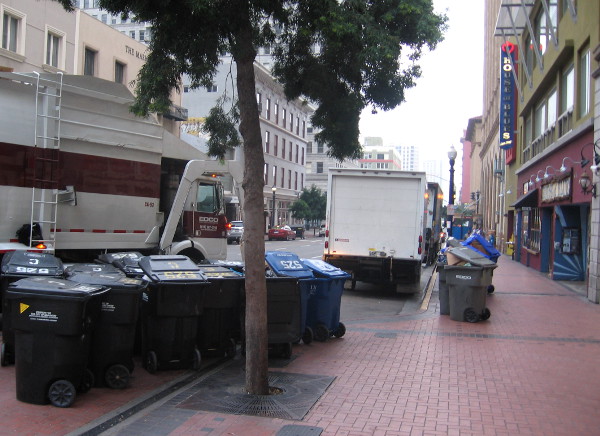
Wednesday is trash pick up day in front of the House of Blues in downtown San Diego.Cool mural on a downtown building’s upper patio which, according to a security guard, is inaccessible to the general public.
From a distance that mural looks really awesome. The security guard said perhaps he’d let me onto the patio if I were swing by in the middle of a work day. According to some research on the internet, it was painted fairly recently by Maxx Moses, the same artist who created that super fantastic Ancestors street mural in Barrio Logan.
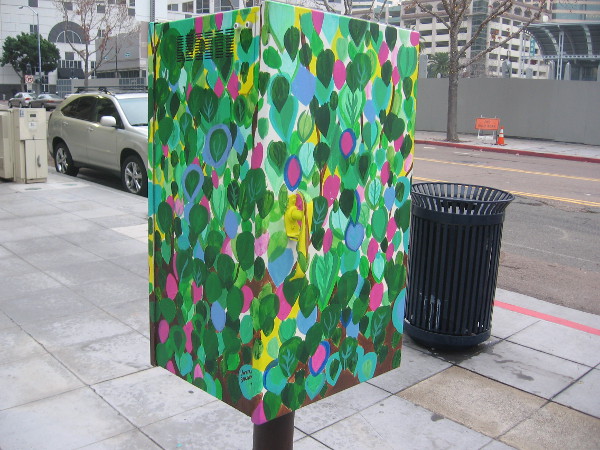
Mysterious elevated box on the sidewalk is colorfully painted with leaves.Vertically moving words on Museum of Contemporary Art San Diego don’t seem to make sense.Seward Johnson’s ‘That A Way’ sculpture at entrance of The Sofia Hotel.
Yep, that’s the same Seward Johnson who created the huge Unconditional Surrender sculpture by the USS Midway Museum. He’s best known for making life-size pieces like this one, which stands by a doorway on Broadway.
…
To enjoy future posts, you can “like” Cool San Diego Sights on Facebook or follow me on Twitter.
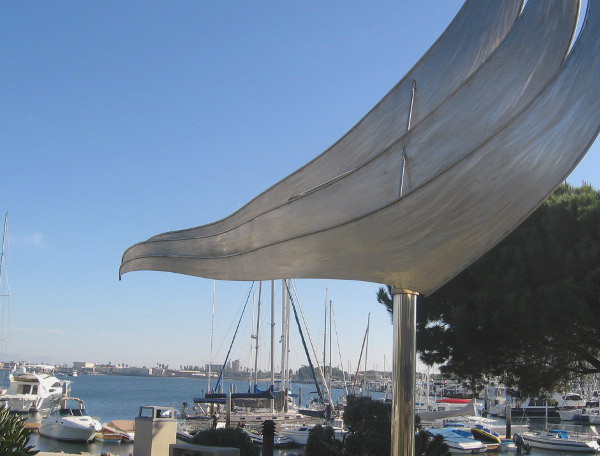
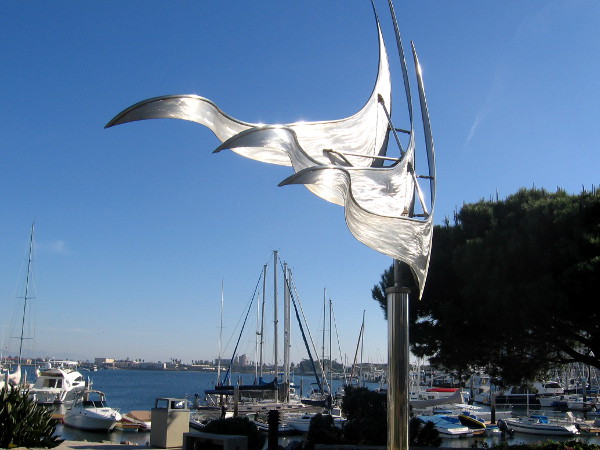
During my recent walk around Coronado, I came upon a dull, lifeless metal sculpture standing at the center of a small park. But then a rising sea breeze moved the nearby trees. The sculpture began to slowly turn. I stood in one place, snapping a few pics…
Freedom sculpture at Glorietta Bay Yacht Club Promenade appears dull and utterly lifeless.Freedom turns in the wind and surfaces begin to reflect the bright sunshine.Shining Freedom sculpture catches fire! The kinetic sculpture was created by Jon Koehler.
The public art, titled Freedom, was sculpted by artist Jon Koehler and installed in the Glorietta Bay Yacht Club Promenade in 2009.
…
To enjoy future posts, you can “like” Cool San Diego Sights on Facebook or follow me on Twitter.
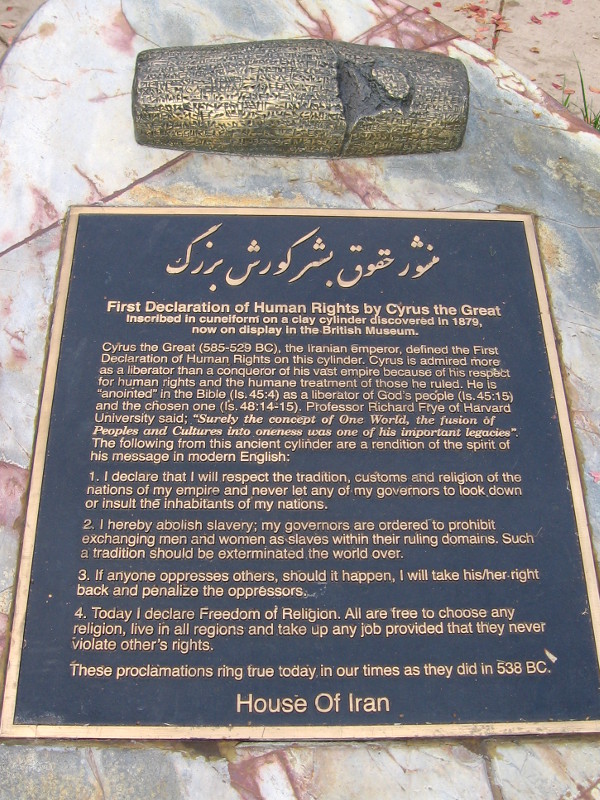
House of Iran at Balboa Park’s International Cottages and a proclamation supporting human liberty.
When I go for a pleasant stroll I’m often lazy. I’ll note interesting things from afar, but fail to walk up for a closer look.
Recently I took a good close look at a large plaque located conspicuously near the House of Iran in Balboa Park. The House of Iran is one of the couple dozen cottages built for the 1935 California Pacific International Exposition. The furnishings in the colorful little buildings exemplify life in their respective countries. Many members of each “house” trace their ancestry to the old country.
The shining plaque lies in a bed of flowers. I approached it and paused to read. It’s dedicated to the First Declaration of Human Rights by Cyrus the Great.
According to the plaque Cyrus the Great (585-529 BC) was an enlightened Iranian emperor. Unlike many rulers of old, he upheld human dignity throughout his vast empire and treated his subjects humanely. He opposed slavery and supported the freedom of religion.
This ancient declaration of human rights was inscribed in cuneiform on a clay cylinder, which is now on display in the British Museum.
Plaque with translation of the First Declaration of Human Rights by Cyrus the Great.
…
To enjoy future posts, you can “like” Cool San Diego Sights on Facebook or follow me on Twitter.
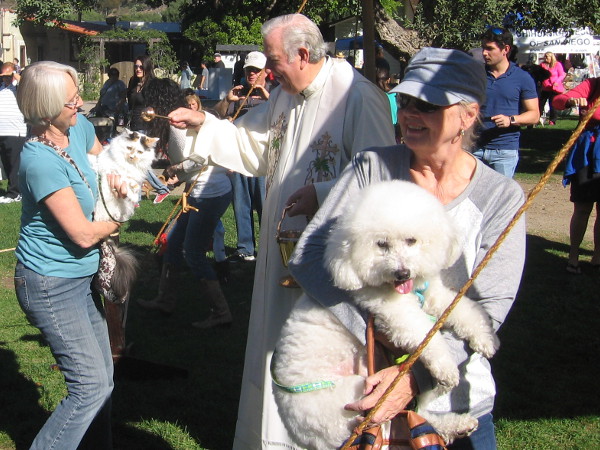
Many animals were blessed today in Old Town San Diego State Historic Park.
The animals were blessed today in Old Town San Diego State Historic Park.
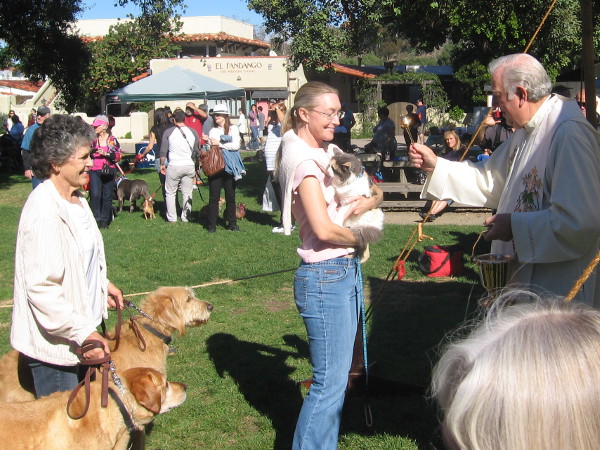
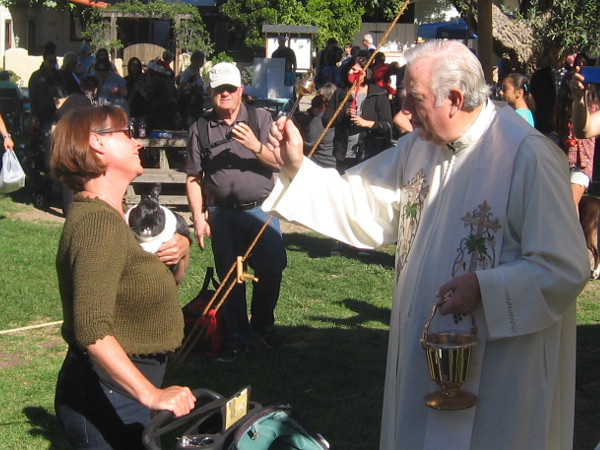
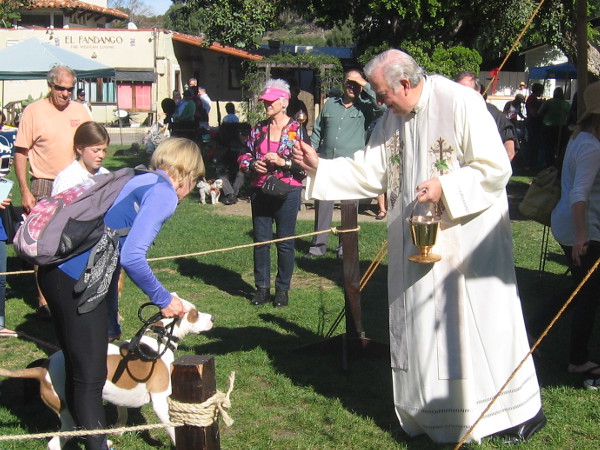
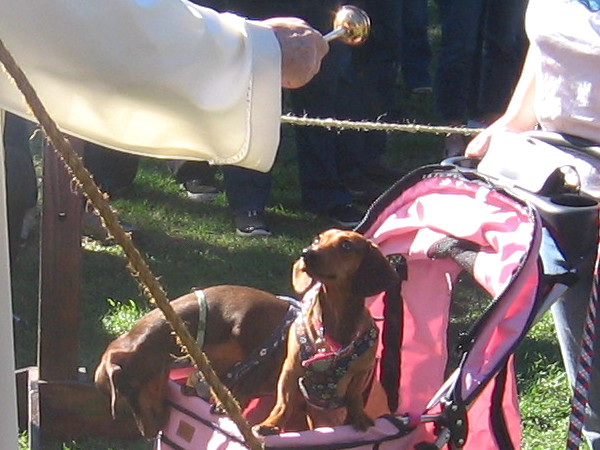
Dozens of beloved pets received a sprinkling of holy water at the annual Benediction of the Beasts, a long-time local tradition.
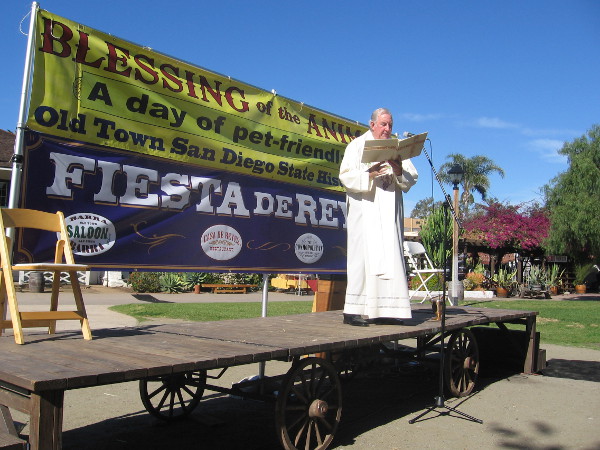
Monsignor Mark Campbell, Catholic priest of Our Mother of Confidence Parish in University City, administered the blessings. The traditional church ritual, which dates back to ancient times, invokes St. Anthony of the Desert, the Patron Saint of Animals. In the very early years of San Diego, livestock were blessed for an abundant harvest.
I watched for livestock but, alas, didn’t see any.
After today’s blessings, the fun event included a mid-afternoon costume and animal trick contest, which I missed. The male human ritual of watching football could not be violated.
Front row dogs wait patiently for the religious ceremony to begin.Monsignor Mark Campbell reads from Genesis and praises faithful pets.Holy water is cast by the Catholic priest upon animals to bestow health and blessings.Animals lined up for blessings included dogs, cats and rabbits.These two guys seemed to enjoy the proceedings.Cute, furry bunny rabbits need blessings as much as any other creature.Here comes Chopper, the motorcycle-riding dog, a big time celebrity.
Chopper, the canine motorcyclist, is quite the sensation in San Diego. I must’ve seen him on local television news a dozen times. He’s even made a cameo appearance on TMZ!
Chopper rides his motorcycle up to the priest for a sprinkling of holy water.This dog was a bit spooked and didn’t know what to make of this craziness.A cat is fascinated by the shiny aspergillum waving about.One dog seems bored while the other appears suspicious!A long line of pet owners waited in Old Town during the Benediction of the Beasts.
…
To enjoy future posts, you can “like” Cool San Diego Sights on Facebook or follow me on Twitter.


































 Cool San Diego Sights!