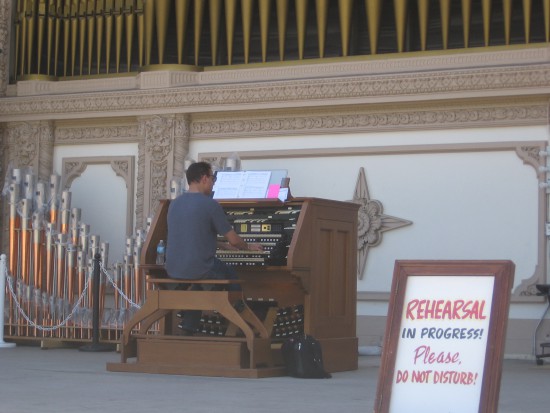
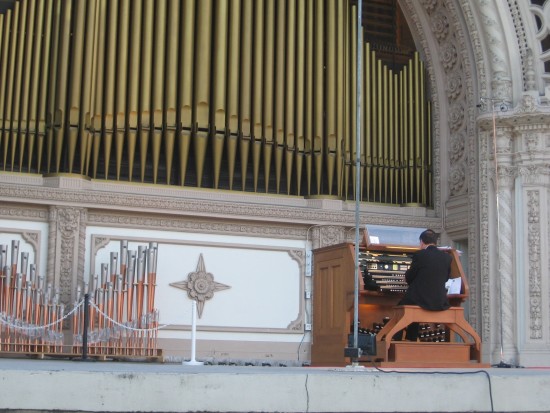
R. Jelani Eddington rehearses on the Spreckels Organ.
Take an amble through San Diego’s amazing Balboa Park and you never know what interesting or beautiful thing you might randomly stumble upon. Early this afternoon I was extremely fortunate!
It isn’t uncommon to hear the music of amateur street musicians throughout the gigantic urban park. Performers of all ages can be found in every nook and cranny playing a harp, a guitar, a violin, drums–you name it–hoping for a tip from generous visitors. Professional musicians, however, play in concerts that are scheduled, publicized, and attended by large, expectant audiences. Usually.
My first lucky discovery was stumbling upon famed theatre organist R. Jelani Eddington in a lengthy rehearsal for Monday night’s International Organ Festival at the Spreckels Organ Pavilion. Apart from a wedding party taking photographs by the pavilion’s elegant colonnade, and a few passing tourists, I seemed to have the amazing performance all to myself. Wow! The Spreckels Organ was producing pure magic, as the king of instruments was handled with world-class skill. What a privilege to listen!
R. Jelani Eddington was 2001 Theatre Organist Of The Year.The lawn of Balboa Park’s International Cottages is empty.
My second sensational discovery took place at the more modest International Cottages stage not far away. A duet was playing excellent, moving music to an all but nonexistent audience. It seems the performance was very poorly publicized, or not at all.
Reflections: Jerry and Angie, is the name of the very talented group that was being featured by the House of the United States of America. They were playing folk songs and classic American tunes with banjo and simple, heart-stirring vocals. I’m a sucker for this type of music, and I loved listening to She’ll Be Coming Round The Mountain, Country Roads, God Bless America and more. I got a kick at how they treated me and the half a dozen others on the lawn like a regular audience, asking us to sing along and providing interesting comments on many songs. I’ve never heard a banjo so well played.
Reflections is Jerry on banjo and Angie with vocals.
Balboa Park contains endless magical surprises!
…
To enjoy future posts, you can “like” Cool San Diego Sights on Facebook, or follow me on Twitter.
San Diego recently made the news as America’s most patriotic city, according to a popular social media network. It doesn’t surprise me. San Diego has more military installations and a higher concentration of veterans than any other city in the United States.
So on the Fourth of July you might expect to see a whole lot of patriotism. You’re right!
Tonight one of the biggest firework displays in the country will take place on San Diego Bay. Right now, people are filtering into the area around the bay to claim viewing spots, have barbeques and picnics, and get themselves ready for the Big Bay Boom, until the number will reach hundreds of thousands.
This afternoon I walked around the Gaslamp and the Embarcadero. Here come some pics!
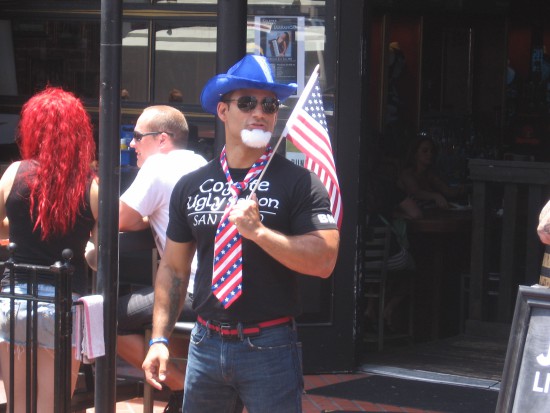
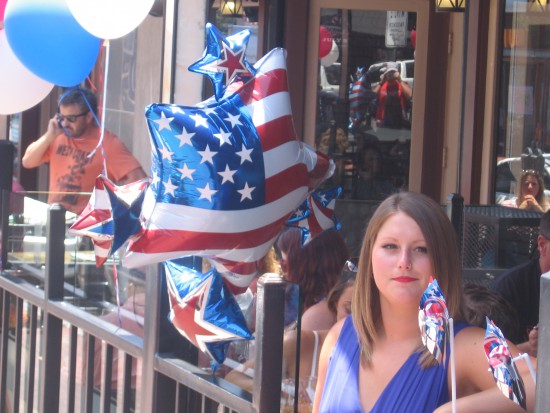
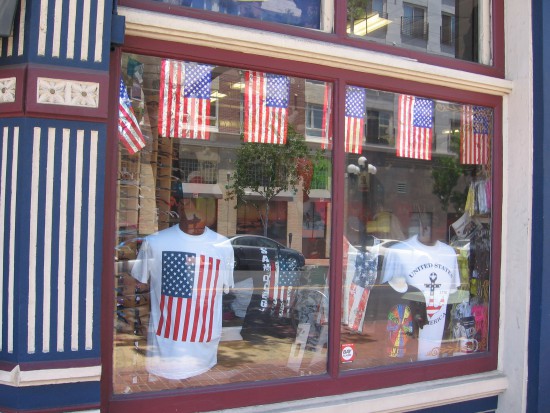
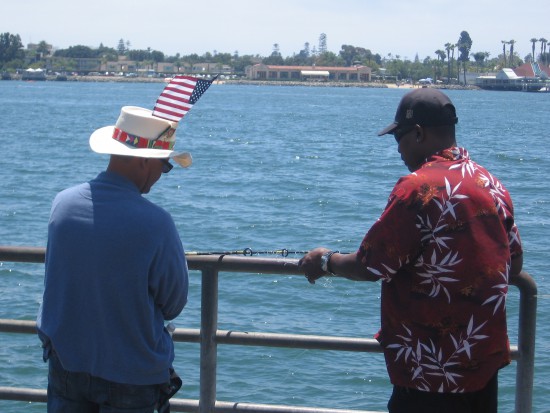
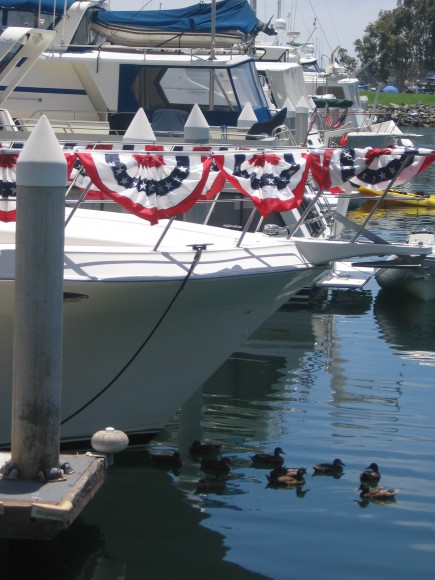
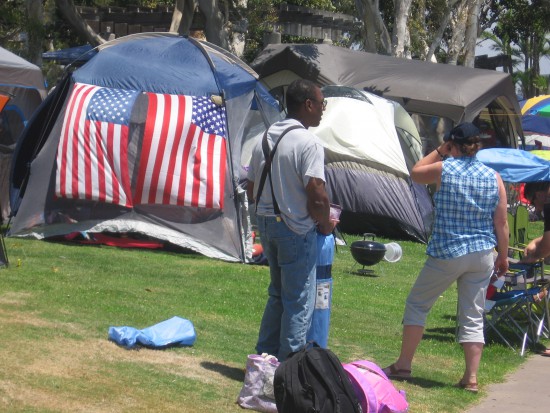
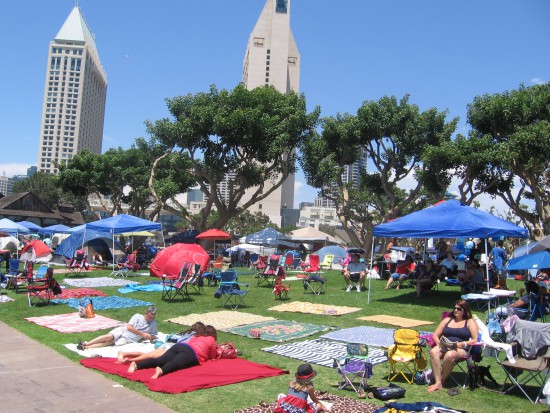
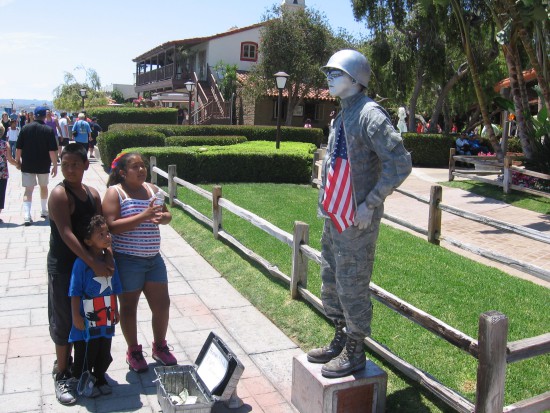
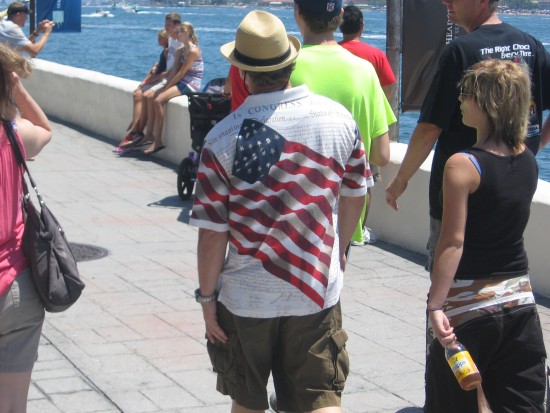
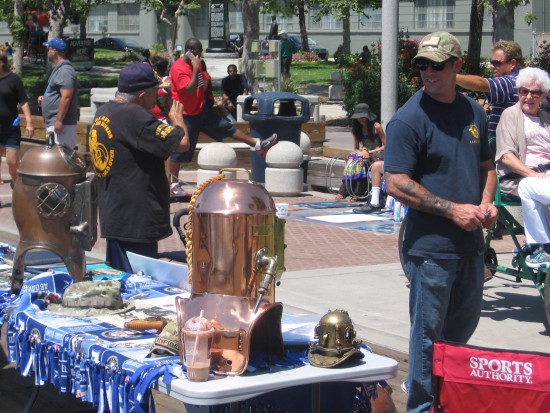
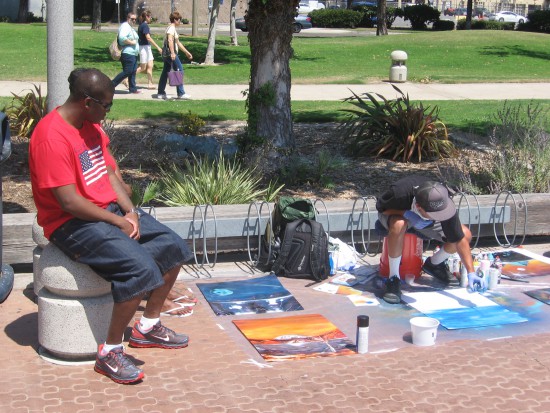
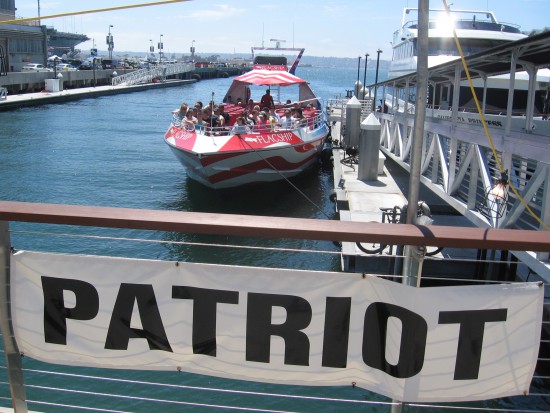
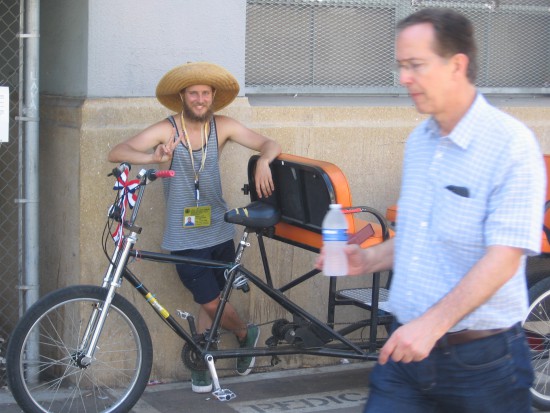
The streets of San Diego’s Gaslamp District filled with patriotic sights.Shop window in the Gaslamp filled with American flags.Friendship and brotherhood on the Embarcadero Marina Park South pier.One of many boats decked with Fourth of July bunting.The bayfront parks are crowded with tents and celebrating Americans.Thousands along San Diego Bay enjoy barbeque and play.People have claimed spots to watch tonight’s fireworks on the bay.Street performer poses with red, white and blue.Many in the crowd are wearing patriotic clothing.USS Carl Vinson, an active aircraft carrier, strung with festive colors.A display on the Embarcadero of historic diving equipment.Young man near USS Midway speaks to retired Navy diver.Just kicking back on a sunny San Diego Independence Day.The Patriot speed boat is fit for the occasion.Cool pedicab driver gives a peace sign on Fourth of July.
…
To enjoy future posts, you can “like” Cool San Diego Sights on Facebook, or follow me on Twitter.
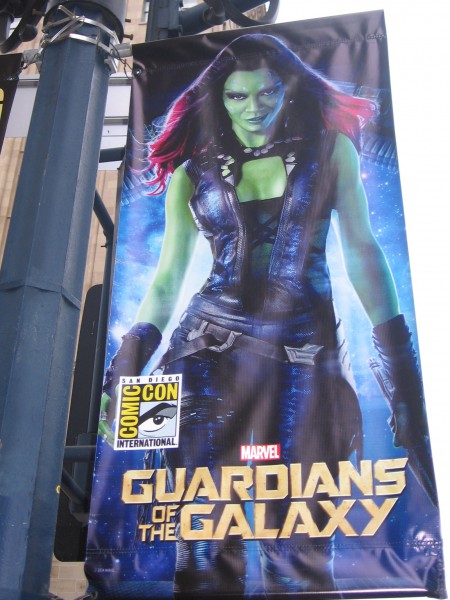
Gamora of Guardians of the Galaxy on a cool banner!
I took these quick photos this morning during a meandering walk through downtown. 2014 San Diego Comic-Con is only three weeks away!
A couple days ago I saw a San Diego trolley with an awesome Gotham television show wrap. I didn’t whip out my camera fast enough, unfortunately. Next time I have a chance, I’ll snap a pic and post it!
I started this blog last year, just a few weeks after Comic-Con had ended, so this year I plan to get a load of interesting images! Stay tuned!
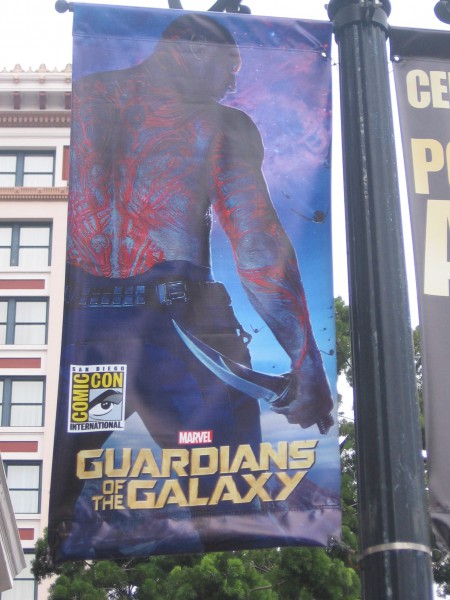
Star-Lord in action on a San Diego Gaslamp street lamp!Groot and Rocket are ready to fight cosmic evil.Drax on Comic-Con banner near San Diego Convention Center.Big Hero 6 banners line Broadway in downtown San Diego.
…
To enjoy future posts, you can “like” Cool San Diego Sights on Facebook, or follow me on Twitter.
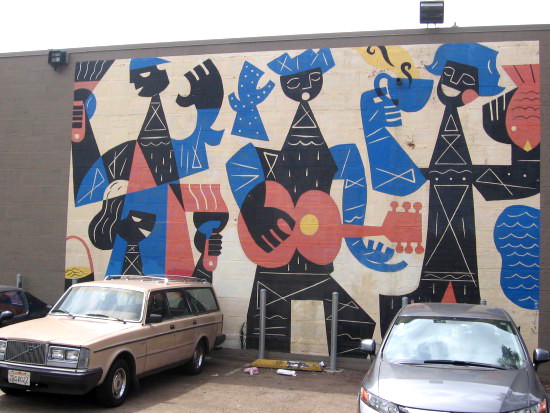
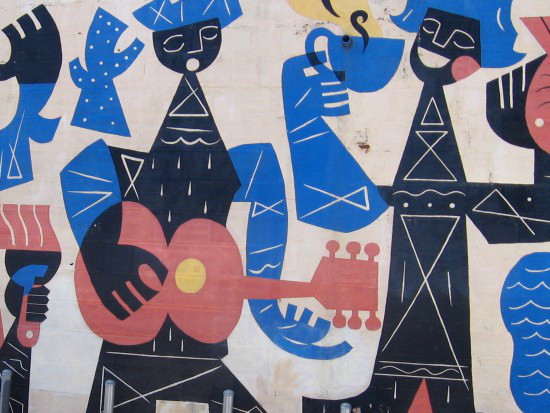
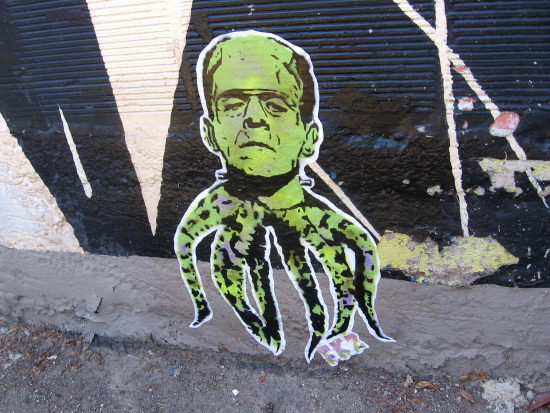
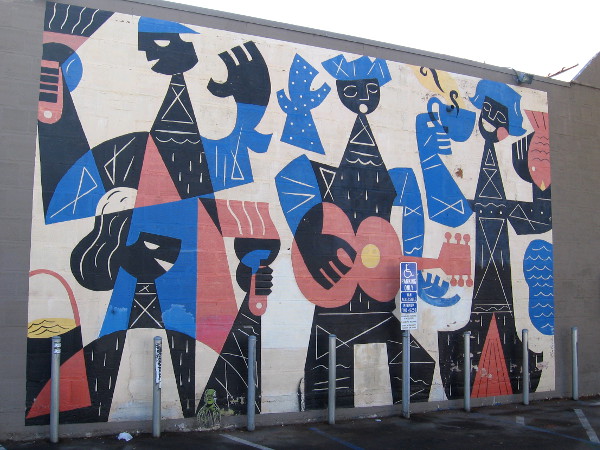
Another mural representing the artwork of Rafael Lopez can be spotted on a parking lot wall in East Village. Appropriately called Joy of Urban Living, this mural is also part of the Urban Art Trail project in San Diego. An unknown prankster seems to have added the funny image you see in the third photograph.
Mural by East Village parking lot adds life to neighborhood.Frankenstein monster head with tentacles added to mural.
Here’s a better photograph that I snapped at a later time…
An unobstructed photo of the Joy of Urban Living mural by Rafael Lopez.
…
To enjoy future posts, you can “like” Cool San Diego Sights on Facebook, or follow me on Twitter.
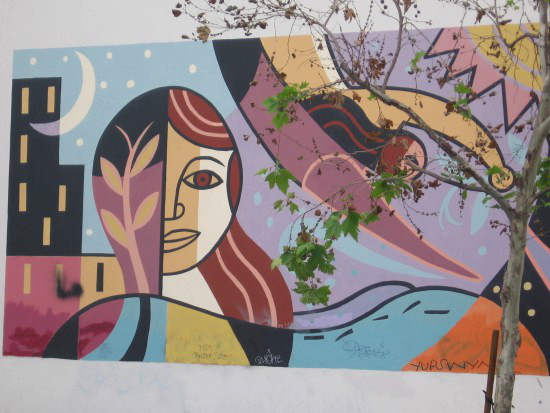
Should you ever ride the San Diego Trolley up Park Boulevard between the Market Street and City College stations, you might notice this large, colorful mural on a building wall. It’s called The Strength of the Women and is based on the work of noted local artist Rafael Lopez.
This mural is part of the Urban Art Trail, a project in San Diego whose mission is to beautify areas that have been unfortunately neglected and subject to urban decay. Along this section of Park Boulevard you’ll find many homeless people.
Beautiful mural on Park Boulevard in San Diego.A closer look at mural shows past patches of graffiti.Public art painted in 2000 by the women of CalWORKs.
…
To enjoy future posts, you can “like” Cool San Diego Sights on Facebook, or follow me on Twitter.
Many distinguished speakers at the Tony Gwynn Memorial Tribute remembered and honored one of the greatest baseball hitters of all time. The public ceremony was held at Petco Park on June 26, 2014. Here are some quotes…
Ted Leitner, Padres radio broadcaster:
So we will cry together, we will laugh together, we will have joy together today, but one thing we will never never do is to forget the greatest hitter of his generation and one of the greatest people in the history of major league sport.
I would like one more time one final standing ovation before the anthem for that magnificent Padre, number 19, Tony Gwynn.
They lied to us, you know. They lied to us in the movie A League of Their Own, when the manager and the Tom Hanks character said “There’s no crying in baseball!” Wrong, huh? Since June 16, there’s been almost nothing but crying in baseball.
People identified with him more than big muscled sculpted athletes because they thought he was the guy next door. Tony was chunky…He was 4 for 5 today, he doesn’t need to lose weight, okay?
Many of you were there in 2007 when he was inducted with the immortals, literally, in the Baseball Hall of Fame in Cooperstown, New York. It was the biggest crowd in Cooperstown history, beyond Ruth, beyond Mantle, beyond Aaron, beyond anybody when he and Cal Ripken were inducted that hot summer day.
See, nobody’s talking about at-bats and number of hits. We know those numbers. 3141 hits, and 15 All Star Games, and 8 batting titles and 5 Gold Gloves, and all that stuff, but it’s, and that is greatness unto itself, but it’s so beyond that, it’s so beyond that, but the man and the compassion…
But he stayed here. It was never about the money. It was about you folks…it was about this Padre organization that he loved..he was never about the money.
The greatest laugh of all time…it was the best…it was better than the game. I could’ve broadcast that instead of the game.
Ron Fowler, Executive Chairman of the San Diego Padres:
Tony was important to all of us. The number of wonderful stories since his passing from around the country reinforces the many reasons why he was loved by so many.
We all know of Tony’s iconic status as one of the greatest baseball players ever, but even more importantly, many of us experienced the special qualities of the warm, giving and compassionate member of our community. What stood out most for me was Tony’s ability to relate to people from all demos and economic strata. His special ability to relate to children…
Tony considered himself an Everyman and remained an Everyman throughout his entire life, so approachable and so easy for San Diegans to embrace as our city’s favorite son.
Reggie Jackson, member of baseball’s Hall of Fame:
He was a genuine man, he was a quality man, one hundred percent family man, he was a great son, a great husband, a great father, and a great brother. A great friend and a great teammate. He was the example of what we all want to live and emulate as a person. He cared about his fellow Man, and we understand and know that he cared about his community.
During the dash of his 54 years, he showed us the template of how to live with dignity.
I’ll leave you with something to think about as I refer about baseball. I saw some great hitters. I saw Mike Schmidt and Jim Rice. Kaline, Dick Allen, Molitor, Yount and Brett. Cooper and Bench. I saw Mays, Aaron, Clemente, Billy Williams, Stargell and Stretch McCovey. I saw Banks at the end. Number 19, Tony Gwynn, belongs on that page.
John Boggs, Tony Gwynn’s agent:
Tony was a very humble man, and he wasn’t big on ceremonies, especially ceremonies that were about him, but I know he’s looking down this evening on all of us here at Petco and I’m sure he’s very grateful for this outpouring of love.
He was an incredible friend. He was the definition of friend. In life there are a lot of acquaintances but very few true friends…He touched so many people, and I was just lucky to be one of them.
He was so much better than the statistics he accumulated.
There was also the memory of Tony and Ted Williams together in the first interview they did together and I’ve never seen Tony so energized and excited as two of the greatest hitters exchanged baseball knowledge…I was lucky to be just a fly on the wall.
And Tony’s humility. Waiting for the Hall of Fame call, I could not believe how nervous he was. With all of his accomplishments, I said, “Tony, this is a slam dunk.” And he just smiled and looked at me and said. “Hey, you never know.” That was Tony. He never took anything for granted.
To the fans, he loved you and appreciated you more than I convey into words. He loved the city of San Diego, he loved being an Aztec, and he most definitely loved being a Padre. He was and always will be Mr. Padre.
Kevin Faulconer, Mayor of San Diego:
Tony Gwynn represented the best of San Diego. His infectious personality did more than spark the Padres to two World Series appearances, he lit up our entire community with pride, and it’s almost impossible to sum up how much Tony Gwynn meant to our city.
Damian Jackson, former San Diego Padres player:
He was a baseball giant to me…who he was as a man so overshadows what he was as a baseball player, and that’s amazing to me.
He not only showed us how to play the game the right way, but he also showed us how to be the right person, and be a great, respected man in the community.
And boy did he love his family. He talked about them daily. When he talked about his children, he just lit up, like the sun.
He wouldn’ve been a great dad to have.
So Tony taught and inspired us on a daily basis…he was a Hall of Fame man, in my eyes.
You inspire me to be a better father, you inspire me to be a better man, and your legacy lives on in this city and in my heart. And thank you Tony. May you rest in peace.
Rob Manfred, COO of Major League Baseball:
In my 25 years in the game, I’ve known scores of players. Even among this elite group, Tony Gwynn was special. He was special because of his Hall of Fame talent, his devotion to the game, and the values he came to represent.
Tony Gwynn may have been the perfect member of the baseball family.
While he was playing, baseball could always count on Tony to do the right thing…he was a great role model to young players.
Mark Martinez, SDSU Aztecs baseball head coach:
He was my colleague, my mentor, but more importantly, my friend. My family. He was part of the Aztec family.
Coach Gwynn’s a teacher. And he was best at teaching all kinds of things. Obviously baseball, but teaching life lessons…All of his teachings were centered around his core value: Do things right.
And then he would say: “Let’s go to work.” Let’s go to work. Does that not embody what he was about? For 20 years in the big leagues and 12 years on the mesa…
Finally, Coach Gwynn is a gift. He’s a gift to all of us. His laugh, his mentorship, the way he made you feel important, even if he just met you for the first time. He gave these gifts every single day.
Trevor Hoffman, former San Diego Padres player:
Whenever… he had the opportunity to speak to you the fans, it felt like he was talking to us one on one.
What a gift he gave us all. That joy that everybody’s talked about, his smile, and his laugh, will be etched in our memories forever, another great gift…He always said, you give a little bit, you get a lot. How appropriate that was about T. Gwynn…What a great man, T. Gwynn.
It was on one of those videos we heard Tony say thank you, thank you, thank you–always being humble, always thanking us. Well it’s us that needs to be saying thank you to T. Gwynn. Thank you for your Hall of Fame career over twenty years, sharing it with us. Thank you for representing San Diego with such class. And thank you for letting us all in your house tonight. Amen.
Anisha Gwynn Jones, daughter of Tony Gwynn:
On behalf of all of the Gwynn family, I would just like to take the time to thank each and every one of you for all of the support and all the love. Thank you. You guys are why my dad loved San Diego so much.
…
To enjoy future posts, you can “like” Cool San Diego Sights on Facebook, or follow me on Twitter.
Tony Gwynn on video screen at Petco’s Park at the Park.
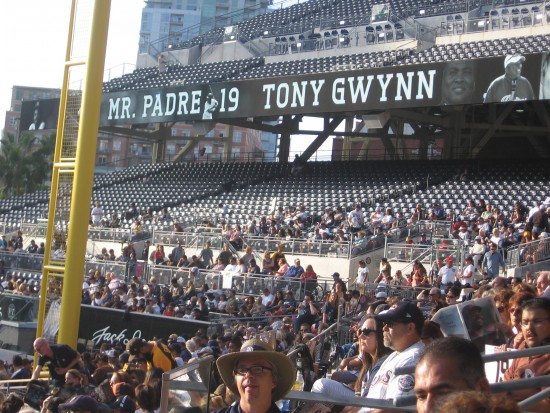
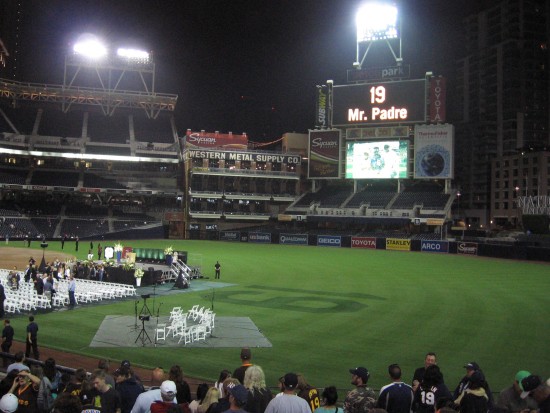
Tonight I joined thousands of other San Diegans at Petco Park to honor the late Tony Gwynn, the greatest Padres player ever…and one of the greatest baseball players in the history of the sport.
I apologize that my camera takes very poor long distance shots. There were many speakers paying tribute to Tony, and my photos of the distant stage and podium came out terribly.
A few photographs seem to have captured the spirit of the occasion. Here they are…
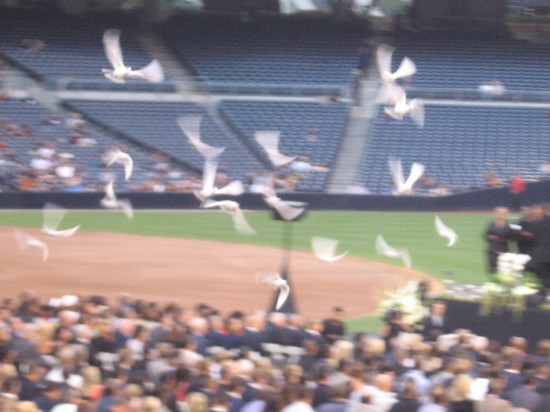
San Diegans pay their respects at the Tony Gwynn statue.Flowers, messages and memorabilia from loving fans.Child reaches up to touch number 19.Padres fans enter the stands before Tony Gwynn memorial begins.Anthony Keith Gwynn, the greatest Padre ever.Thanks for the memories, Mr. Padre.Thousands gather long before the memorial tribute starts.Thank you signs and poignant gestures from the crowd.White doves are released near the stage as program begins.
Nineteen doves were released after a choir opened the service, singing: “I’m not here, but I’m not far. My spirit lives on.”
Ted Leitner remembers Tony and introduces many guests.
Ted Leitner, long-time Padres radio announcer, said that we’d never forget the greatest hitter of his generation. He then asked the crowd to provide one last standing ovation. During the memorial tribute, Ted played a recording of Tony’s unforgettable laugh from a cell phone.
There were scores of distinguished guests, and several speakers remembered Tony Gwynn for the cheering crowd.
Reggie Jackson, Mr. October, gave a Yankee salute to Tony and his family. San Diego’s mayor spoke, and so did the Chief Operating Officer of Major League Baseball. Tony La Russa and Joe Torre stood up in the VIP section to loud applause. On the big video screen, tributes were offered by former teammates and opponents alike. In old videos, Tony Gwynn was treated with respect by contemporary baseball greats, including Mike Schmidt, Cal Ripken, Greg Maddux, Tommy Lasorda and many others.
Every guest speaker at the memorial seemed to agree that Tony was an inspiration to all those around him. To many he was a mentor, and to all he was a friend.
Tony Gwynn is remembered as a great player and great man.After the ceremony, number 19 remains on field.Petco Park slowly empties after tribute ends.
…
To enjoy future posts, you can “like” Cool San Diego Sights on Facebook, or follow me on Twitter.
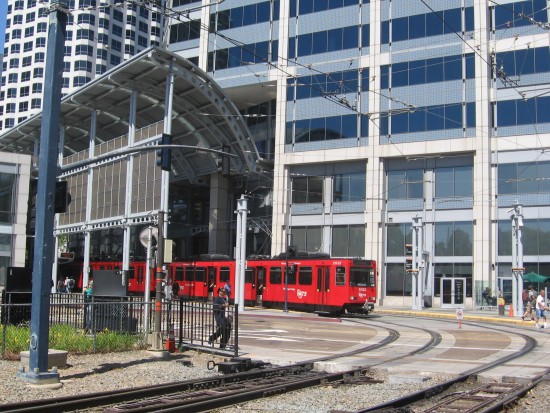
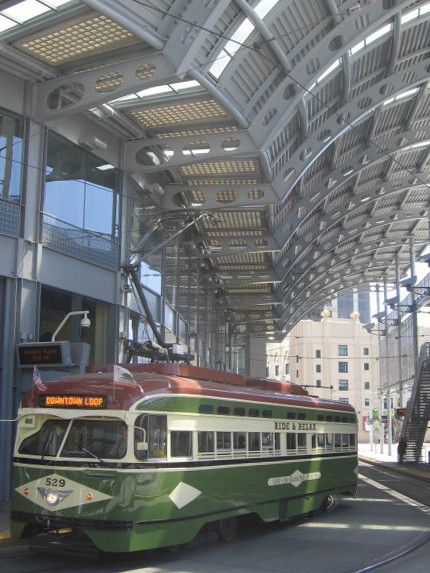
San Diego Trolley stops at cool America Plaza station.
There are a few San Diego Trolley stations that are unusual and especially interesting. One is the partially enclosed station at America Plaza. Every busy day, long red trolleys snake through the skirt of the tall, glassy building. One America Plaza is the highest skyscraper downtown, and stands just across Kettner Boulevard from the Santa Fe Depot.
Looking outward from the partially enclosed trolley station.Silver Line trolley stops at America Plaza.Taking a walk through the shady station on a sunny day.
…
To enjoy future posts, you can “like” Cool San Diego Sights on Facebook, or follow me on Twitter.
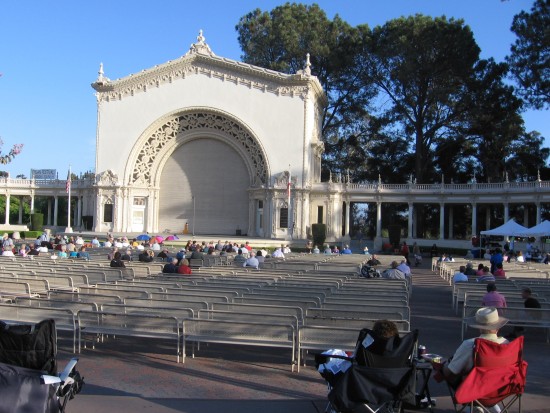
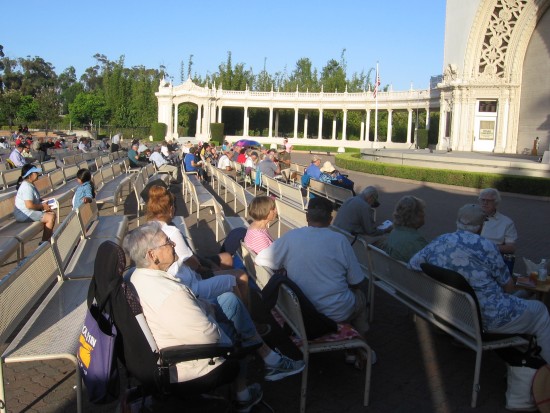
People arrive very early to get good seats for tonight’s organ concert.
Mere pictures and words are inadequate to describe the fantastic concert I enjoyed this evening in Balboa Park. Tonight was the first Monday concert at the Spreckels Organ Pavilion of the Summer International Organ Festival.
The special guest organist was Anthony Newman, widely considered one of the foremost Baroque musicians in the United States. He’s made countless recordings, won numerous awards, performed at New York City’s prestigious Lincoln Center more than 60 times, and was described by Wynton Marsalis as “The High Priest of Bach.” Tonight’s concert, I’m glad to say, was jam packed with Johann Sebastian Bach–my absolute favorite composer!
Anthony Newman seemed superhuman at times. He played difficult pieces with ease, crispness and energy. It was flawless poetry and simply amazing. The concert was over much too soon!
Here are a few pics!
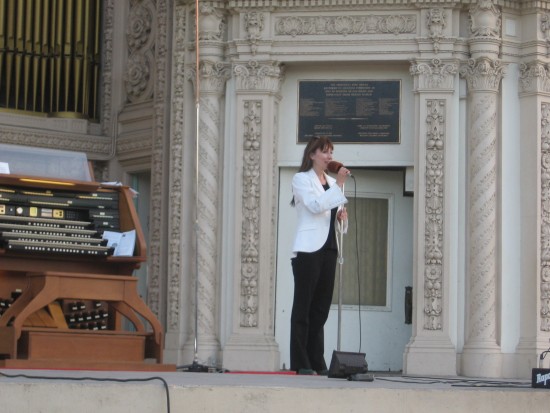
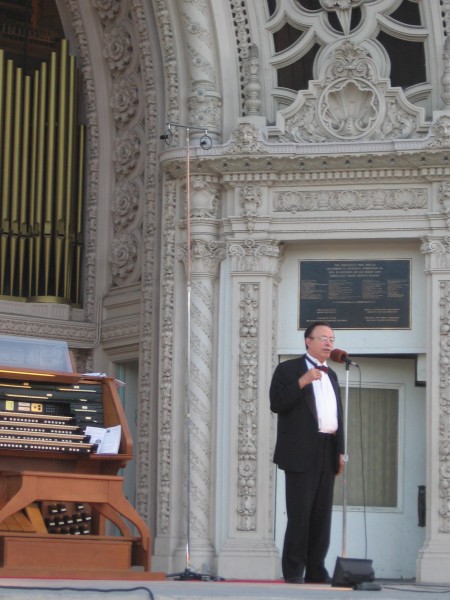
Spreckels Organ Society membership table and a smile.Anticipating first concert of the Summer International Organ Festival.Big banner on Organ Pavilion’s colonnade announces the free event.Rolling out the red carpet for great American organist Anthony Newman.Flag and a bronze plaque of the historic pavilion.Beautiful building is a treat for the eye in changing light.Elegant peek by organ assistant at the growing crowd.Dr. Carol Williams, San Diego’s Civic Organist, announces guest artist.Famed Baroque organist Anthony Newman greets audience.A masterful performance on the Spreckels Organ begins.
Those pipes you see on the left side of the stage form the new Centennial Tuba rank, soon to be added to the Spreckels Organ for its one hundredth anniversary on New Year’s Eve!
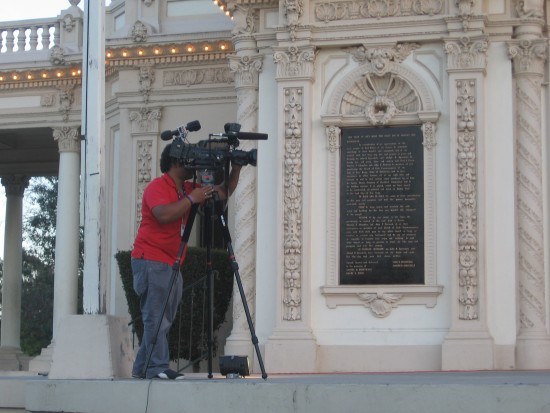
Anthony Newman acknowledges long, enthusiastic applause.KUSI television cameraman records a portion of the event.The lights come on in the twilight and the pavilion becomes magical.There are 1400 embedded lights in the main structure and colonnades.
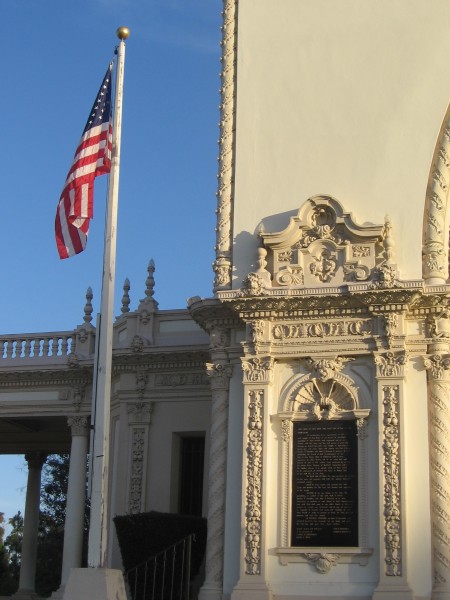
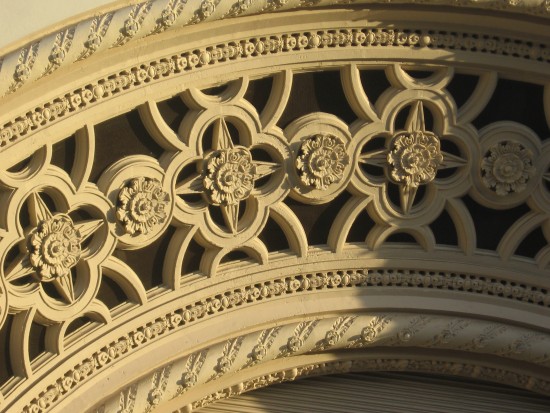
The Spreckels Organ Pavilion was built for the 1915 Panama-California Exposition. You can observe similar plaster ornamentation on the Spanish Colonial Revival style buildings that line El Prado, in the center of Balboa Park.
Night descends and people stretch their legs during intermission.
My camera is worthless at night, so I recorded only half of the evening. But the music throughout was amazing! What a brilliant start to the 2014 International Organ Festival!
…
To enjoy future posts, you can “like” Cool San Diego Sights on Facebook, or follow me on Twitter.
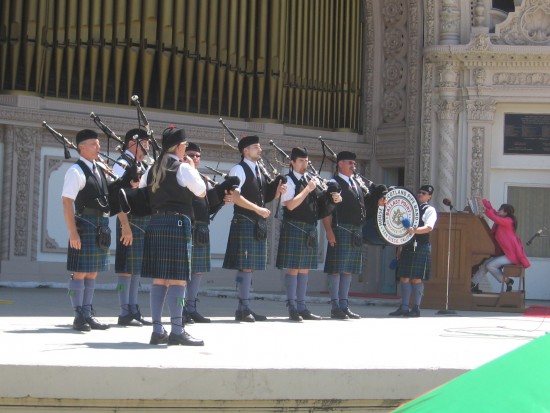
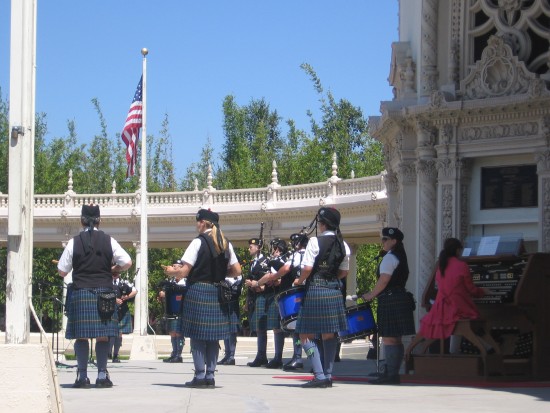
House of Scotland Pipe Band performs at Spreckels Organ Pavilion.
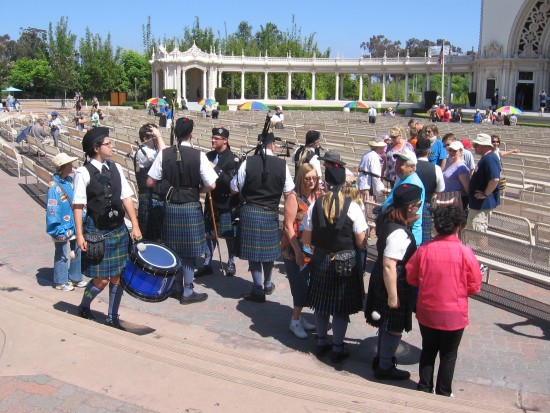
Today’s free Sunday organ concert at Balboa Park’s Spreckels Organ Pavilion featured the amazing House of Scotland Pipe Band! The House of Scotland makes its home in the International Cottages just steps away from the pavilion.
I’ve always loved bagpipe music. It’s even better, if that’s possible, when accompanied by Dr. Carol Williams, San Diego’s famous Civic Organist, on the majestic Spreckels Organ. The large-lunged instruments combine their resonance, and with the addition of a booming drum, the melodies that are produced really stir the blood. I wish the concert had gone on all afternoon!
Songs included Highland Cathedral, Flower of Scotland, Blue Bells, Amazing Grace, Scotland the Brave, and The Ballad of Glencoe.
Raising and twirling the baton in time with great bagpipe music.Dr. Carol Williams accompanies bagpipes on the Spreckels Organ.The big booming drum of the House of Scotland!Balboa Park visitors mingle with musicians after the stirring concert.
…
To enjoy future posts, you can “like” Cool San Diego Sights on Facebook, or follow me on Twitter.


























 Cool San Diego Sights!