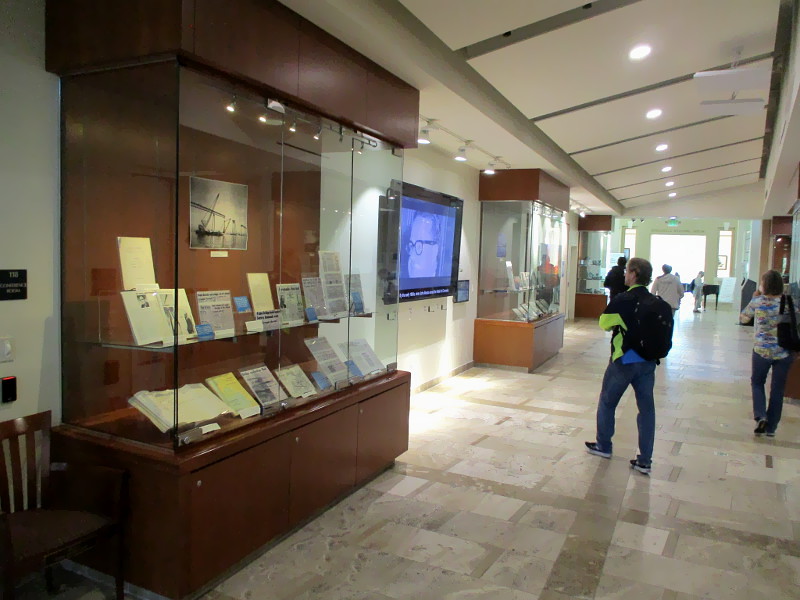
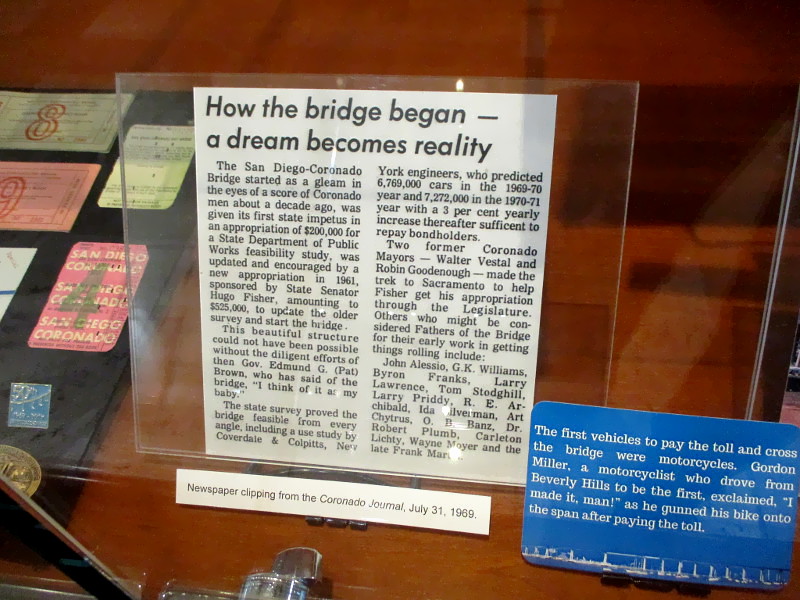
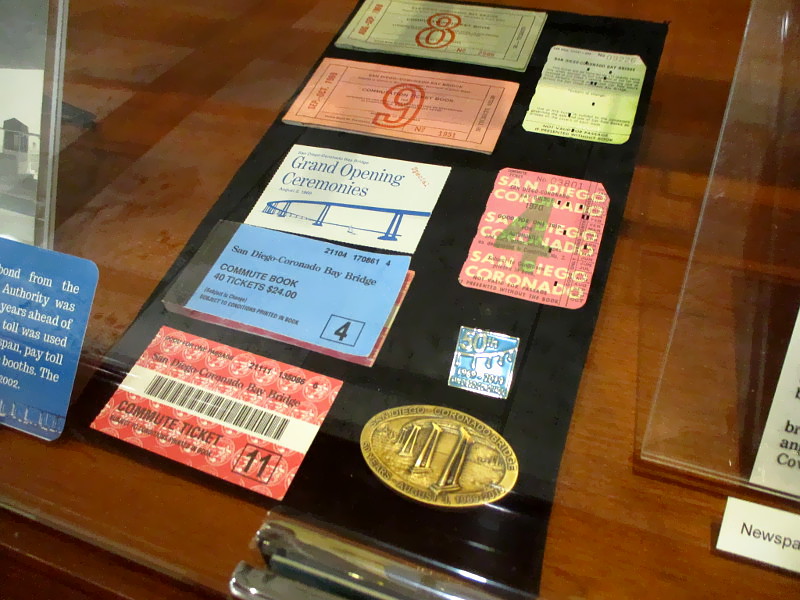
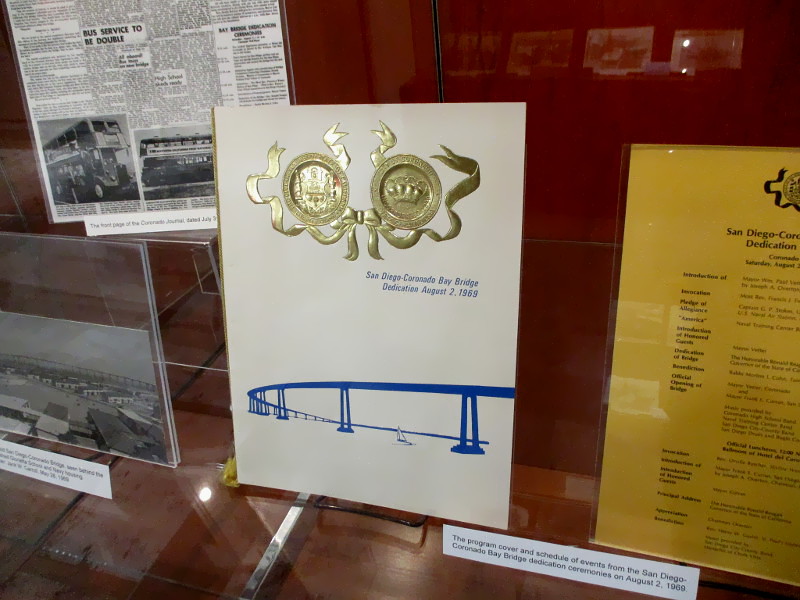
An exhibit detailing the history of the San Diego-Coronado Bridge can now be enjoyed at the Coronado Public Library.
Large display cases contain old photographs, newspaper articles, documents and preserved artifacts representing the bridge’s complex history–from initial proposals to its construction to its grand opening and beyond.
Peering into the displays, reading descriptions, I learned interesting facts about the Coronado Bridge, including:
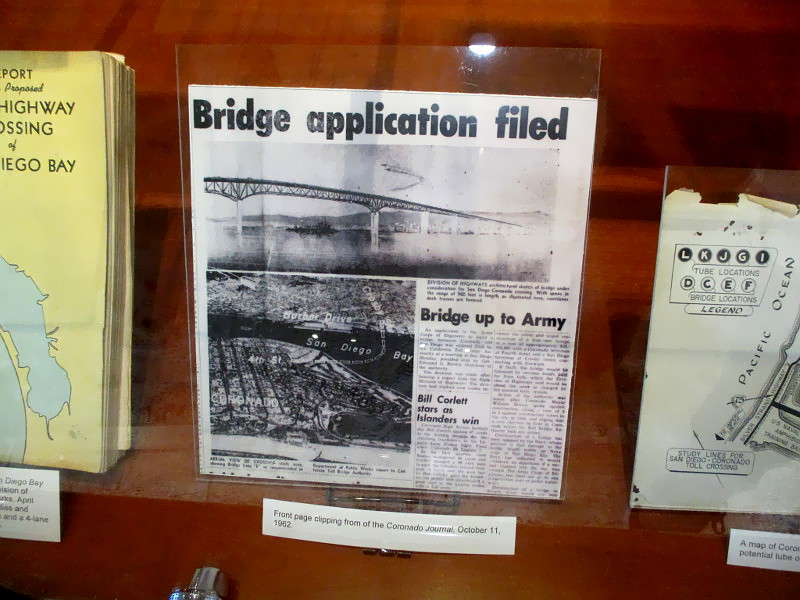
In 1926, the Spreckels Companies announced bold plans to construct a steel bridge linking Coronado to San Diego, envisioning an engineering marvel with arched spans and a lift section for maritime traffic. This news thrilled many residents eager for a fast connection to the mainland. Advocating for a tunnel instead, the Navy raised concerns about navigation and national defense. Despite initial optimism and plans for completion by 1928, the project became embroiled in decades of debate, delays, and revisions.
Mosher’s design was initially rejected by the state’s civil engineers for being too expensive. They proposed a more traditional trestle bridge, suggesting it be painted rust red or pink. Ultimately, Mosher’s design was accepted.
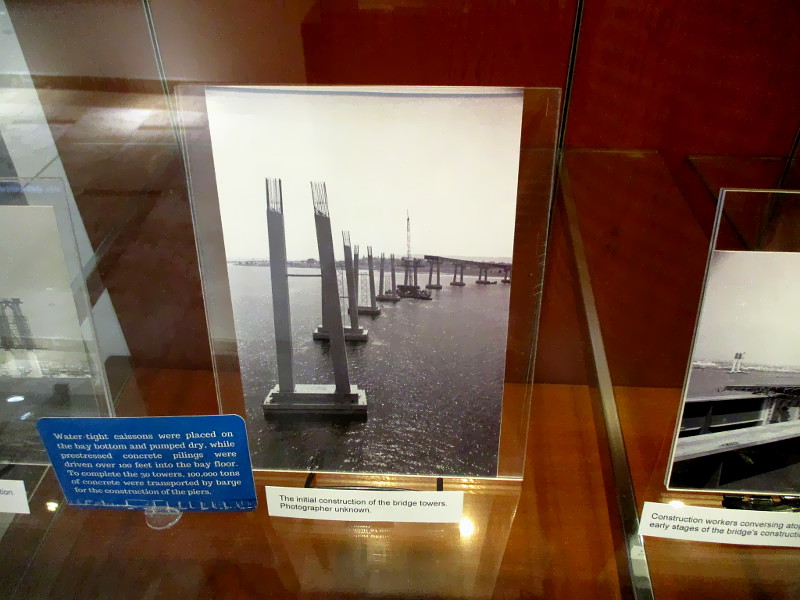
Water-tight caissons were placed on the bay bottom and pumped dry, while prestressed concrete pilings were driven over 100 feet into the bay floor. To complete the 30 towers, 100,000 tons of concrete were transported by barge for the construction of the piers.
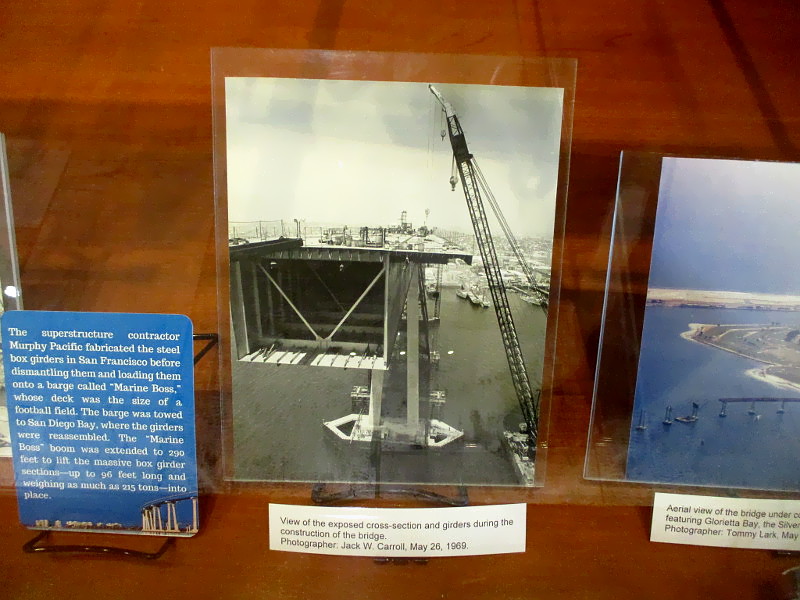
The superstructure contractor Murphy Pacific fabricated the steel box girders in San Francisco before dismantling them and loading them onto a barge called “Marine Boss,” whose deck was the size of a football field. The barge was towed to San Diego Bay, where the girders were reassembled. The “Marine Boss” boom was extended to 290 feet to lift the massive box girder sections–up to 96 feet long and weighing as much as 215 tons–into place.
The final span, one of 27 girders, was placed on May 28, 1969. Coronado Mayor Paul Vetter participating in the informal ceremony, signing his name on the metal plate at the edge of the girder.
Mosher’s original design included lights on the low side of the railing, but they were cut to reduce costs… Coronado resident Carol Cahill…flew to Sacramento, successfully petitioned officials, and secured their installation. The lights were added in April 1970.
In 1970, the bridge received the National Award of Merit for Most Beautiful Bridge from the American Institute of Steel Construction.
The bridge’s 90-degree curve allows it to reach a height of 200 feet, tall enough for an empty aircraft carrier to pass underneath, while also providing the necessary length to ramp down to the Coronado side, which is significantly lower than the San Diego side that connects to Interstate 5.
I was told by a library employee that this fascinating exhibit will be on view through early May, 2025. Go check it out!
…
I post new blogs pretty often. If you like discovering new things, bookmark coolsandiegosights.com and swing on by occasionally!
I live in downtown San Diego and love to walk around with my camera! You can follow Cool San Diego Sights via Facebook or X.
Feel free to share!

 Cool San Diego Sights!